America’s Bottom 50% Have Nowhere To Go But Down

By Charles Hugh Smith

Source: Of Two Minds

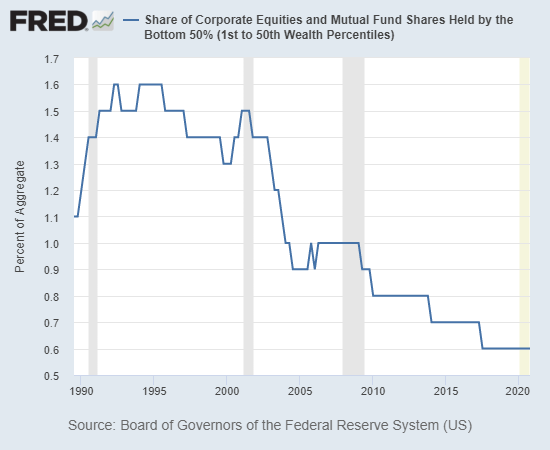
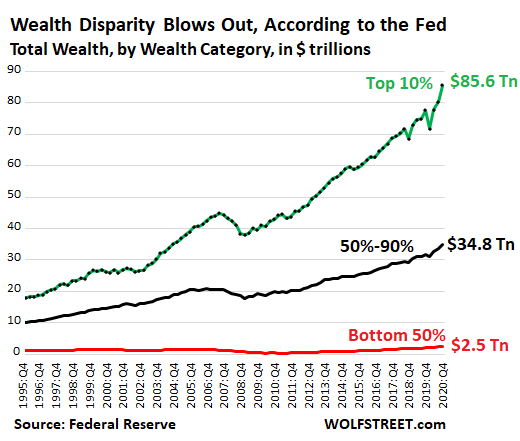
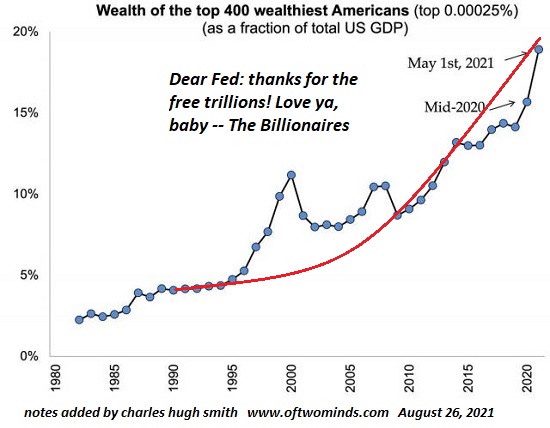
One might anticipate that the bottom 50%’s meager share of the nation’s exploding wealth would have increased as smartly as the wealth of the billionaires, but alas, no.

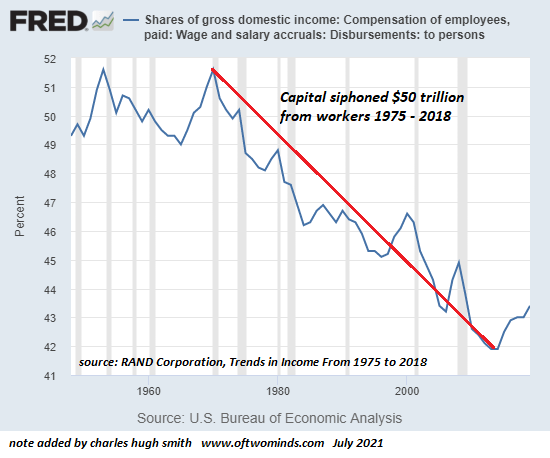
America’s economy has changed in ways few of the winners seem to notice, as they’re too busy cheerleading their own brilliance and success. In the view of the winners, who just so happen to occupy all the seats at the media-punditry-Federal Reserve, etc. table–the rising tide of stock, bond and real estate bubbles are raising all boats. What’s left unsaid is except for the 50% of boats with gaping holes below the waterline, i.e. stagnant wages and a fast-rising cost of living.

The truth the self-satisfied winners don’t include in their self-congratulatory rah-rah is there’s no place for the bottom 50% of American households to go but down. All the winnings flow to those who already owned assets back when they were affordable– the already-wealthy–whose wealth has soared as assets have shot to the moon while the the burdens of inflation and debt service hit the bottom 50% the hardest.

Meanwhile, the Federal Reserve is whining that inflation isn’t high enough yet for their refined tastes. Boo-hoo, how sad for the Fed–inflation isn’t yet high enough. Oh wait–didn’t they each mint millions by front-running their own policies? No wonder they’re not worried about inflation.

The reality few acknowledge is that globalization and financialization have stripped the American economy of low-skilled jobs that don’t demand much of the employee. The reality is that a great many people don’t have what it takes to learn high-level skills and work at a demanding pace under constant pressure–the description of the average job in America.

There were once millions of low-skill, low-pay jobs for people who for whatever mix of reasons were unable to muster the wherewithal to fulfill the fantasy of working extra hard, going to night school, soaking up high-level skills, moving quickly up the ladder to higher pay, buying the starter home and then moving up the food chain to middle class security from there.

The cost of living was low enough that those working these low-skill, low-pay jobs could still have an independent life. There were still low-cost rentals, often derided by the wealthy, in nooks and crannies of even the costliest cities. (I once lived in a room stuffed with old tax records in a poolside shack in an upscale neighborhood. The room had been cleared for a single bed and a path to the decrepit bathroom. Its most important attribute was that I could afford it on my low earnings.)

Affordable housing has vanished, eliminated by the financialization of America’s economy. Once landlords pay double the price for the property, rents have to double to pay their higher expenses. The apartment didn’t double in size or amenities–the rent doubled without any increase in utility to the renter. You get nothing more for double the price–nice.

Yes, people could make better choices, and some do. The point here is the game is rigged against those in the lower tier of the economy who can no longer afford a house or other stake in the only winning game in town–speculative asset bubbles. Go ahead and work a second job and go to night school–you’ll still be left behind the already-rich.

Globalization opened every job in America to global competition via offshoring or the influx of undocumented workers so desperate to support their families back home that no pay was too low and no working condition too wretched to refuse.

Many overindulged pundits who never worked an honest day in their lives sneer about burger flippers without realizing how hard those burger flippers have to work. I doubt the well-dressed pundits, snobbish about their university degrees and general brilliance, could manage to work a single day in a demanding fast-food job.

As the price of housing and other assets have soared, enriching the already rich, they’re out of reach for the bottom 50% who struggle to pay their bills as wages have stagnated and the costs of essentials have skyrocketed.

The rising cost of parking tickets, junk fees, user fees, utilities and food don’t impact the well-paid top 5% technocrat class, whose stake in the Everything Bubble keeps expanding by tens or hundreds of thousands of dollars. But for the bottom 50%, those incremental increases are, when added to higher rents, absolutely crushing.

As for getting high-quality healthcare that includes mental health support–those are reserved for the rich. But no worries, self-medication is always a “choice.”

Getting a boost in pay from $12 an hour to $15 an hour is welcome, but that doesn’t put the worker any closer to affording a house or equivalent stake in the Everything Bubble.

The new feudalism is masked by the glossy SillyCon Valley PR of a gig economy where (per the PR fantasy) bright, shiny and totally independent workers freely choose to serve the winners in the rigged sweepstakes for low pay and zero benefits.

In the SillyCon Valley PR, serfs freely choose to serve their noble masters for nothing but survival because they love the “freedom” and “choice” of kissing the nobility’s plump derrieres. (After all, there were “choices” even back in the good old days of feudalism–one could join the brigands in the forest, or enlist in a poorly paid mercenary army where the odds of dying were high–you know, “choices” of “gigs.”)

One might anticipate that the bottom 50%’s meager share of the nation’s exploding wealth would have increased as smartly as the wealth of the billionaires, but alas, no–the bottom 50%’s share of stocks (equities) actually plummeted in the the glorious decades of Federal Reserve free money for financiers, stock buy-backs and asset bubbles.

All this suits the billionaires and those collecting the crumbs of the Everything Bubble just fine. So what if the bottom 50% have nowhere to go but down? There’s plenty of room in the homeless encampment for another broken down station wagon or an old camper. There’s lots of “choices.”

And no consequences for the winners, of course, because The Fed has our backs.

America Is Now a Kleptocrapocracy

By Charles Hugh Smith

Source: Of Two Minds

I’ve coined a new portmanteau word to describe America’s descent: kleptocrapocracy, a union of kleptocracy (a nation ruled by kleptocrats) and crapocracy, a nation drowning in a moral sewer of rampant self-interest in which the focus is cloaking all the skims, scams, rackets and bezzles in some virtuous-sounding garb, a nation choking on low-quality junk ceaselessly hawked by robocalls, spam, phishing and Big Tech manipulation.

It’s little wonder trust has collapsed in America: the only thing we can trust is whatever’s being pitched is deceptively packaged to mask the self-interest and profiteering of the perps.

The stench from the decomposing carcasses of once-trusted institutions is everywhere. Insiders and the marketers they pay to cloak their grifting are banking bennies at the expense of hapless debt-serfs who fell for the scam. You need these three costly medications, and then when the side-effects kick in, you need six more to counteract the first three, and so on. But trust us; your “health” (heh) is our only concern. Uh, sure.

Why do state universities need to market themselves like a roto-rooter service? Maybe because they’re both working the sewers: state universities are exploiting the student loan sewers, desperate to recruit another batch of debt-serfs who fell for the 3-card monte game in which a lifetime of debt is exchanged for a credential of dubious value.

The competition for the remaining pool of debt-serfs is heating up, so like everything else in America, the game is now all about marketing, virtue-signaling, exploiting Big Tech manipulation, and so on.

Doing something useful is now for chumps. The opportunities in America are all about getting rich by doing, well, nothing: skimming 20% “guaranteed” returns in DeFi, mining cryptos, trading stablecoins, selling volatility, etc.–getting rich and then living large on the sweat of the chumps who are still working (poor deluded fools!).

The obvious goal here is for everyone to get in on trading stablecoins, buying rentals with DeFi, churning meme stocks, etc. Why should anyone lower themselves to doing something useful anymore? Why bother?

Labor has been degraded for decades in speculative-frenzy America. Why work when the Fed has our backs and all those newly issued trillions are up for grabs? Doing something useful is for chumps.

Nobody seems to ask what happens when we’re all minting fortunes off speculative churn and there’s nobody filling potholes, stocking shelves or carrying bags of QuikCrete to customers’ trucks.

And while we’re on the subject of sewage: if America’s security services and Big Tech oligarchies track everything and everyone, why are we drowning in robocalls, spam, SMS-spam (smishing), etc.? Couldn’t the NSA/CIA track the spammers and robo-callers down and rendition them (warrantlessly, of course) to a hellhole camp in an unnamed country?

Of course they could. But the ruination of everyday life is of no concern to the kleptocrats (fly with me to the stars!) or our dysfunctional government, which has become nothing more than an invitation-only auction of favors that elevates the relentless pursuit of self-interest and profiteering to new kleptocratic heights.

Please don’t make the mistake of expecting anything to work properly in America. The components are garbage, the parts are on back-order, the people who knew how to make the kludgy mess function just quit in disgust, and we’ll have to get back to you about your request, as our service staff just left to launch an OnlyFans site.

I don’t want to work, I’m minting money speculating, but gol-darn it, I want everyone else to wait on me and meet my needs for low, low quality goods and services at not-so-low prices, and if I’m not treated well enough by everyone earning chump-change, then I’ll freak out, and if that doesn’t pan out, I’ll blame it all on my meds. Accountability is like work–only for chumps.

Trust me, everything’s going great and we’re all going to get wealthier and wealthier until we won’t be able to take it any more, it will be so great. I hope everyone here is hungry because the banquet of consequences is being served.

Conscientious Resignation of Police Officer in Australia

By Robert J. Burrowes

Following the conscientious resignation of Acting Senior Sergeant Krystle Mitchell of the Victoria Police in Australia, the international network Police for Freedom https://policeforfreedom.org/ has just issued the statement below in support.

Krystle had served Victorians, with distinction, for 16 years as a police officer and has recently resigned over a matter of conscience in relation to policing of the Covid-19 restrictions.

Krystle’s interview:

‘EXCLUSIVE: Ethical Policing in Victoria, Australia’ https://www.bitchute.com/video/yvyEYcFaQICM/

And the Police for Freedom statement:

Police For Freedom International commends Acting Senior Sergeant Krystle Mitchell for standing up and giving a voice to thousands of police in Victoria, Australia right now. Thank you for your courage and integrity, sacrificing your career in the name of truth.

In the current political climate, in which rights and freedoms worldwide are restricted and under further threat, it is the conscience and courage of individuals who capably defend such rights and freedoms, such as Krystle Mitchell, that will be vital if the truth is to ultimately prevail.

These rights include those articulated in the UNESCO Declaration on Bioethics and Human Rights, including:

Article 3.1: Human dignity and human rights:

Human dignity, human rights and fundamental freedoms are to be fully respected. The interests and welfare of the individual should have priority over the sole interest of science or society.

Article 6: Consent:

Any preventive, diagnostic and therapeutic medical intervention is only to be carried out with the prior, free and informed consent of the person concerned, based on adequate information. The consent should, where appropriate, be express and may be withdrawn by the person concerned at any time and for any reason without disadvantage or prejudice.

We at Police For Freedom are happy to support each and every serving officer who decides to stand on the right side of history. It is tragic that police are having to lose their jobs for simply raising concerns about where our societies are being taken under the guise of health mandates.

Policing is all about community, and we will do our very best to help police stand together with their people.

Sincerely,
Police For Freedom: www.policeforfreedom.org

The interview with Krystle Mitchell: https://www.bitchute.com/video/yvyEYcFaQICM/

The U.S. Economy In a Nutshell: When Critical Parts Are On “Indefinite Back Order,” the Machine Grinds to a Halt

By Charles Hugh Smith

Source: Of Two Minds

Setting aside the “transitory inflation” parlor game for a moment, let’s look at what happens when critical parts are unavailable for whatever reason, for example, they’re on back order or indefinite back order, i.e. the supplier has no visibility on when the parts will be available.

If the part that blew out is 0.1% of the entire machine, and the other 99.9% still works perfectly, the entire machine is still dead in the water without that critical component. That is a pretty good definition of systemic vulnerability and fragility, a fragility that becomes much, much worse if there are two or three components which are on indefinite back order.

This is the problem with shipping much of your supply chain overseas: you create extreme systemic vulnerability and fragility even as you rake in big profits from reducing costs. Speaking of costs, let’s look at the costs of having a large, costly, complex mechanism sitting idle in a non-functioning state due to some broken element for which there is no substitute available. Whatever productive capacity the mechanism, process, etc. had is now stuck at zero.

Buying a new replacement is extremely costly, and that’s not always available for all the same reasons that parts and components aren’t available. Finding someone to fabricate a new component is not easy due to the wholesale transfer of manufacturing moxie and capability overseas.

You might be able to find someone to weld a replacement strut, but try finding someone to fab a new bicycle derailleur or better yet, a multilayer semiconductor chip. What about 3-D fabrication? Doesn’t that solve this problem? If the part can be “printed,” yes, but there are limits on what can be 3-D fabbed. You can’t 3-D fab a complex thermostat or controller, for example. You can’t 3-D fab a rubber gasket, either, or a great many other bits of petrochemical-based manufacturing.

Scarcities are not limited to parts and components; skilled people can be scarce, too. For example, there is a limited supply of ICU doctors and nurses. The training required to work in an ICU is specialized and experiential; throwing someone with minimal training in is not a substitution that’s going to work. You can’t order an ICU staff from China or print one digitally the way the Federal Reserve creates currency out of thin air. It takes many years to train the staff to function at a high level in ICU.

A great many such labor scarcities exist for skilled workers who cannot be replaced except by someone with the same training and years of experience. This is one reason ICUs can break down: there is no replacement staff available, and no way to “print more.”

It turns out there’s also a scarcity of people willing to do the dirty-work jobs America needs done for wages that haven’t kept up with inflation. As I have explained here, the $1.65 minimum wage I earned in 1970, if factored for real-world inflation, is around $18 per hour, and arguably closer to $20 per hour.

The solution is to raise the pay to levels that attract workers, but then this requires raising prices on the good and services to the point that customers can no longer afford them.

But wait, can’t we automate all work and deliver full-gee-whiz free-money, no-work communism to everyone? I invite everyone who reckons this is in the realm of the do-able to design, program and manufacture an automated robot that can trundle out to the laundry room, pop open a broken clothes dryer, diagnose the problem, manage to find a new controller board, fit it correctly and properly reconnect all the little wiring bits, close it up, test it, lift the dryer back on the washing machine and do all that for the relatively modest cost of a human repairperson. When you accomplish fabricating and programming that robot to do all the work without instruction or oversight, by all means let us all know how much it cost to design, program and manufacture, what the payback of the development and manufacturing process will cost amortized over the (short) life of the robot and how reliable it is in the real world.

The point is, fantasies are nice but reality is far more demanding.

There can also be scarcities of competence. There may be replacements who claim competence, but when reality intrudes on the shuck-and-jive, their competence was illusory, and the net result is the entire institution can be described by President G.W. Bush’s memorable phrase, this sucker’s going down.

There can also be scarcities of institutional infrastructure and capacity. Once the institution, enterprise, state agency, etc. has been stripmined of redundancy, institutional memory and competence, then the first scarcity that cannot be replaced is the first domino that topples all the other dominoes of systemic vulnerability and fragility.

The Federal Reserve can print trillions of dollars and the federal government can borrow and blow trillions of dollars, but neither can print or borrow supply chains, scarce skills, institutional depth or competence. That nice shiny new semiconductor fab you reckon will resolve the chip shortage? You can print the billions of dollars needed in an instant, but the machinery, expertise and time can’t be conjured quite so easily. That fab is years away from completion no matter how many freshly conjured dollars you throw into the air.

When Critical Parts Are On “Indefinite Back Order,” the Machine Grinds to a Halt: that’s the U.S. economy in a nutshell.

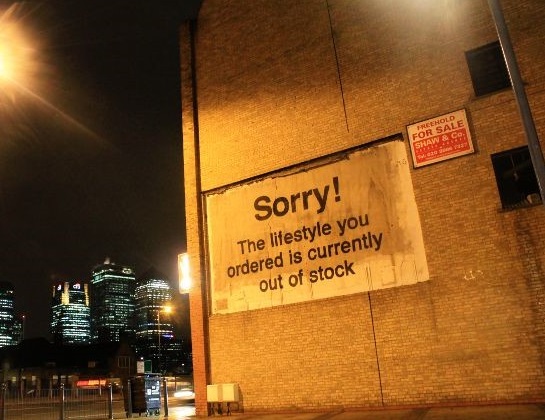
A great many essential components in America are on indefinite back order, including the lifestyle of endless globally sourced goodies at low, low prices. That lifestyle is out of stock and cannot be replaced with financialization fakery.

Hey, Federal Reserve, can you conjure up a non-corrupt financial system, a domestic supply chain, and an economy of open competition, transparency, accountability and competence? If not, you are even more worthless than we feared.

THEY ARE CREATING THE BIGGEST WITCH HUNT IN AMERICAN HISTORY

By Michael Snyder

Source: Waking Times

Prior to this pandemic, if you wanted to weed out all of the “troublemakers”, “independent thinkers” and “non-conformists” from our society, how would you have done it?

I suppose that sending everyone a questionnaire asking them what they believe would be one way to do it, but of course a lot of people would give false answers and many others would simply ignore the questionnaire.  Social media profiles contain a wealth of information, but many “non-conformists” are not even on social media and digging through all of that data would take an extraordinary amount of time, money and energy.  Up until just recently, there just hasn’t been an easy and efficient way to identify those that are not eager servants of the system.

But now the COVID vaccines have changed everything.  These injections are the perfect litmus test, because “troublemakers”, “independent thinkers” and “non-conformists” are pretty much the only ones that are refusing the shots at this point.  This makes it exceptionally easy to divide American citizens into two categories, and it also gives authorities a perfect excuse to push all of those “troublemakers”, “independent thinkers” and “non-conformists” to the fringes of society.

As I discussed yesterday, I was literally sick to my stomach as I pondered the implications of Biden’s tyrannical new decrees.  Originally, Biden and other Democratic leaders were against any sort of vaccine mandates, but now I think that they have realized that mandates are a tool that they can use to fundamentally reshape our society.

If you don’t understand where I am going with this, just keep reading, because it will become extremely clear by the end of this article.

Biden’s new decrees cover almost every major institution in our society.  Just think about it.  Any “major institution” is almost certainly going to be employing more than 100 people, and all such organizations are covered by Biden’s mandates.

In addition to businesses of various sizes, we are also talking about colleges, schools, churches, non-profits, political entities, sports teams and charitable organizations.

Millions of Americans that are employed by such institutions could be forced to leave their positions if they refuse to comply with what Biden is demanding.

And the rules that the Biden administration is coming up with will require the institutions to be the enforcers of these draconian new measures.

Your bosses will be forced to make sure that you are submitting to the new rules, because if not they could be hit with massive fines.

In my last article I used the word “sickening” to describe what Biden is trying to do to all of us, but the truth is that word is not nearly strong enough.

What we are facing is a complete and total national nightmare, and it isn’t going to end any time soon.

Biden’s new mandates are even stricter for employees of the federal government.  Previously, employees of the federal government were at least given the option to undergo regular testing if they didn’t want to be vaccinated, but now that option is being taken away.

So now millions of federal employees will have to choose between their principles and their careers.

And considering the fact that so many of these people are barely providing for their families right now, a lot of really heartbreaking choices are going to have to be made.

Earlier today, I posted a video from a woman that works for the U.S. Treasury Department.  After all these years, she publicly announced on social media that she is going to leave her job because of Biden’s new mandates.

And countless others will follow her out the door.

Biden’s new decrees will also force nearly everyone in the entire healthcare industry to either get vaccinated or give up their careers.

What a horribly cruel thing to do.

Biden is essentially putting a gun to the heads of these people.  So many of them spent an enormous amount of time, energy and money to get their educations, and now Biden is telling them that they have to sacrifice everything that they have worked for if they will not comply with his demands.

As I pointed out yesterday, healthcare workers won’t just be forced out of their current jobs.  Because virtually every health care provider in the entire country accepts Medicaid and Medicare, those that refuse to comply will essentially be banned from the entire industry.

At a time when a shortage of qualified workers is causing chaos throughout our economy, Biden’s tyrannical orders could force millions of Americans to suddenly lose their jobs.  This is an incredibly foolish thing to do, and it could have very serious ramifications in the years ahead.

Sadly, it won’t just be a few people quitting their jobs.  A poll that was just conducted discovered that 72 percent of unvaccinated Americans said that they would quit their current jobs rather than be vaccinated…

Many making this argument have cited a Washington Post-ABC News poll released over the weekend. It showed that just 18 percent unvaccinated people whose employers don’t currently have mandates said they would likely get vaccinated if their employer required it. About 7 in 10 (72 percent) said that, if they couldn’t get a medical or religious exemption, they would probably quit rather than submit to the requirement.

I don’t know what is going on behind the scenes, but it is my opinion that Kamala Harris has had a lot of influence in the recent decisions that Biden has been making.

She has always had authoritarian tendencies, and if she ever becomes president that will truly be a catastrophic scenario.

Needless to say, Biden’s new mandates are going to cause great anxiety for millions upon millions of people, and a recent CNN poll found that the mood of the country was already heading in a very negative direction

The new poll finds 69% of Americans say things in the country today are going badly, below the pandemic-era high of 77% reached in January just before President Joe Biden took office but well above the 60% who felt that way in a March CNN poll.

And 62% say that economic conditions in the US are poor, up from 45% in April and nearly as high as the pandemic-era peak of 65% reached in May 2020.

My hope is that Republican governors will fight Biden’s new decrees with everything that they have got.

Because the truth is that this is one of the most critical moments in U.S. history.

Our most basic liberties and freedoms are under full assault, and we really are descending into full-blown tyranny.

If Biden’s new mandates are not overturned by the courts, millions of Americans that love liberty and freedom could be forced from their jobs.

It would truly be a witch hunt of unprecedented size and scope, and it would represent the greatest purge of “troublemakers”, “independent thinkers” and “non-conformists” that any of us have ever witnessed.

The Great Battle for the Future

By Cory Morningstar

Source: Organic Radicals

A nightmare totalitarian industrial world, in which everything living is being poisoned to death and in which dehumanised people are subjected to full-spectrum physical and psychological control by slave-masters they never dare question.

So here is where the modern world and its self-mythologising cult of “progress” was leading us… Who’d have thought it, eh?

The warnings have been there, of course, whether from science fiction writers and filmmakers (They Live!The Terminator,  Equals...), musicians or the dozens of thinkers featured on this website.

They warned us where this would end up if we didn’t do something, but we collectively spurned their advice and here we are, on the very brink of a long-term and probably fatal dystopia.

The important question now is how we are going to get out of this global hi-tech concentration camp.

Part of the answer is that we need to keep alive, and spread as widely as possible, a vision of how the world could be, of another way of living which is utterly different from the sterile and robotic hell currently lined up for us and those who will come after.

It is very much part of the ruling elite’s propaganda to insist that their future is the only future, that no other possibility even exists.

They are always keen to dismiss the idea of a different society as totally fanciful, empty-headed or even positively dangerous, removing us from the protective bliss of the prison they have built around us.

This lie is reinforced in people’s minds by the way that the other, possible, world is increasingly distant from contemporary reality.

It is hard to imagine a transition from where we are today (let alone where we are heading) to where many of us would like to be.

It is particularly hard, even impossible, if you go along with the ruling elite’s deliberate confusion of the passing of time with the strengthening of their industrial profit-system.

If you see “the future” as necessarily an extension of the path that has brought us from the past to the present, then their version seems inevitable. It is therefore crucial to break free from this idea of some kind of predestined vector taking us towards a hyper-industrial destiny.

Industrial capitalist development was never the only possible form which human society could have taken over the last few centuries. The shape our present has taken is not due to the passing of time but to very specific processes and actions which have occurred.

If we want to reconnect with the “other world” in our hearts, and understand why it seems so unattainable, we would therefore do well to look back at how we landed up on the disastrous path of industrialised tyranny.

A key period to analyse is the Middle Ages, when capitalism first started to take over our lives.

Silvia Federici makes some very interesting observations on this period in her book Caliban and the Witch. (1)

She rejects the conventional wisdom that a “transition to capitalism” occurred as some kind of natural social evolution.

Instead, she points out that the power of the ruling elite was being threatened by the growing confidence of the 99%, who were increasingly rebelling against authority and servitude.

With the outright slavery of the Roman Empire left behind, these medieval rebels saw ahead of them a better future, one based on social justice, freedom and local autonomy.

They were on the path leading towards the light, towards genuine social progress rather than to the fake “progress” of technological sophistication and profusion.

But this didn’t go down well with the ruling class, who feared that their power and privilege would be lost for ever.

Instead of escaping from slavery into freedom, our ancestors therefore found themselves engaged in a Great Battle for the Future with the dark forces of tyranny.

This battle raged for centuries all over Europe and in the parts of the world colonised and occupied by the dominant system.

In England the most famous uprising was the peasants’ revolt of 1381, during which radical preacher John Ball told his contemporaries that the time had come when they could “cast off the yoke they have borne so long and win the freedom they have always yearned for”. (2)

But there were plenty of others, such as the Kett’s Rebellion of 1549 in which the rebels seized control of Norwich, then the second biggest city in the country.

The 17th century radicals of the English Revolution, such as Gerrard Winstanley, represent perhaps the last flowering of this wave of revolt.

The Great Battle for the Future was even fiercer on continental Europe. As Federici points out, the uprisings of the Cathars in France and the Anabaptists in Germany were not just about isolated local grievances but represented an ideological and metaphysical challenge to the world of authority, power and property. (3)

Federici argues that capitalism was in fact the reaction of the ruling elite against their potential loss of control.

She writes: “Capitalism was the counter-revolution that destroyed the possibilities that had emerged from the anti-feudal struggle – possibilities which, if realized, might have spared us the immense destruction of lives and the natural environment that has marked the advance of capitalist relations worldwide. This much must be stressed, for the belief that capitalism ‘evolved’ from feudalism and represents a higher form of social life has not yet been dispelled”. (4)

There is a strange echo here with the 20th century, when fascism emerged at a moment when the ruling elite (by this stage firmly capitalist) again faced the threat of popular insurrection.

The parallel even extends to the way in which the medieval bourgeoisie, often depicted as leading the radical onslaught against feudal power, sought common cause with their supposed enemies in the nobility in order to stamp out popular revolt.

This same bourgeoisie, which by the 20th century liked to think of itself as “liberal“, was likewise happy to see the boot of fascism keep the rabble in their place.

Capitalism – the new form taken by malevolent ruling-class domination – subjugated our ancestors by cutting them off from their sources of subsistence and autonomy.

Common land was confiscated – enclosed – making self-sufficiency impossible. Food could no longer be freely gathered or hunted, rivers could no longer be fished, wood for fuel could no longer be picked up in the privatised forests.

People were forced into the money system, forced to earn “wages” just to live, forced into factories and workhouses, reduced to craven dependency on the capitalist system.

Federici describes the period as one of “relentless class struggle” in which “the medieval village was the theater of daily warfare”. (5)

“Everywhere masses of people resisted the destruction of their former ways of existence, fighting against land privatization, the abolition of customary rights, the imposition of new taxes, wage-dependence, and the continuous presence of armies in their neighbourhoods, which was so hated that people rushed to close the gates of their towns to prevent soldiers from settling among them”. (6)

In order to impose the New Normal of capitalism on the unwilling people, the power elite used what Federici terms “social enclosure”, (7) a precursor of today’s “social distancing”.

She writes: “In pursuit of social discipline, an attack was launched against all forms of collective sociality and sexuality including sports, games, dances, ale-wakes, festivals, and other group-rituals that had been a source of bonding and solidarity among workers”. (8)

“Taverns were closed, along with public baths. Nakedness was penalized, as were many other ‘unproductive’ forms of sexuality and sociality. It was forbidden to drink, swear, curse”. (9)

In another striking parallel with the 2020s (and indeed the 1920s/1930s) the rich elite tried to create “a new type of individual” (10) – a servile, malleable and thus profitable type.

To this end it set out to separate us from our bodies and from our very sense of who we are.

“According to Max Weber, the reform of the body is at the core of the bourgeois ethic because capitalism makes acquisition ‘the ultimate purpose of life,’ instead of treating it as a means for the satisfaction of our needs; thus it requires that we forfeit all spontaneous enjoyment of life. Capitalism also attempts to overcome our ‘natural state,’ by breaking the barriers of nature and by lengthening the working day beyond the limits set by the sun, the seasonal cycles, and the body itself, as constituted in pre-industrial society”. (11)

The communal cohesion traditionally woven by, and among, women was specifically targeted by the ruling class in their efforts to disempower and enslave the common people, says Federici.

This took the form of the notorious fearmongering over “witches”, resulting in the murder of untold numbers of innocent women: “The witch-hunt destroyed a whole world of female practices, collective relations and systems of knowledge that had been the foundation of women’s power in pre-capitalist Europe, and the condition for their resistance in the struggle against feudalism”. (12)

She adds: “The witch-hunt deepened the divisions between women and men, teaching men to fear the power of women, and destroyed a universe of practices, beliefs, and social subjects whose existence was incompatible with the capitalist work discipline”. (13)

The witch hunts were thus part of the general philosophical war being waged by industrial capitalism on any way of thinking not flattened and reduced to the pitiful level of its own limited, sterile and life-hating slave-dogma.

Explains Federici: “This is how we must read the attack against witchcraft and against that magical view of the world which, despite the efforts of the Church, had continued to prevail on a popular level through the Middle Ages. At the basis of magic was an animistic conception of nature that did not admit to any separation between matter and spirit, and thus imagined the cosmos as a living organism, populated by occult forces, where every element was in ‘sympathetic’ relation with the rest”. (14)

The primary tool used by the ultra-rich minority to oppress the majority was, of course, the state.

Far from representing some kind of benign collective self-interest, as some absurdly persist in maintaining, the modern state emerged in the 14th century “as the only agency capable of confronting a working class that was regionally unified, armed and no longer confined in its demands to the political economy of the manor”. (15)

Whether claiming to be fighting “heresy”, “witchcraft” or disorder, the ruling elite deployed all the violence and propaganda of its inquisitions, wars and laws to bring the population to heel. And, as we all know to our cost, it won that Great Battle for the Future.

But because its sociopathic greed knows no end, because its “growth” is based on ever-increasing profit for the ultra-rich, it can never stop treading us further and further into the toxic industrial dust of its total control.

Today we have reached another key moment in history, when the ruling elite – under the feeble pretext of combatting a flu virus – hopes to essentially return us to the slave status we escaped a thousand years ago.

All its liberal pretence at “democracy” is going out of the window as the brutal reality of elite power becomes clear to those who have eyes to see.

There will be resistance, you can be sure of that, even if the advance disabling of certain potential sources of dissent means it may take a while for rebels to regroup and find their common voice.

Those of us who do resist will be embarking on another Great Battle for the Future.

We will be fighting for the same world of freedom and humanity and closeness to nature which inspired our ancestors hundreds of years ago.

Moreover, awareness of this historical context will be key to the way we resist.

We can never go back to the past but we can refer back to it and take our sense of direction from it.

It is clear that our defeat in the last Great Battle for the Future (and many subsequent struggles) saw us shunted down the wrong path, away from the bright future of which we dreamed and deeper and deeper into the gloom of enslavement.

We will not be able to reach our lost future by continuing along this path as it can only take us further and further from our desired destination.

The key realisation here is that industrialism, including all its technology and infrastructure, is simply an aspect of capitalism, of the slavery imposed upon us hundreds of years ago when we looked set to break free from the domination of the ruling elite.

Industrialism is not neutral. It is not something that can be turned around and used for our good. It is the prison in which we are locked.

The newnormalist technological tyranny currently being unleashed will hopefully make this inconvenient truth more evident and widely understood.

However, the underlying problem does not lie in industrialism’s excesses but in its very essence and raison d’être, as a means of control and exploitation.

We will not find the better future of which we dream in a world still polluted by factories, airports, motorways, pipelines, pylons, refineries and power stations.

The long-term happiness and self-fulfilment of humankind will not arrive via internet connections, phone networks and electricity supplies, but from their absence.

We need to destroy the whole industrial capitalist machine at the same time as we shake off this latest notching-up of repression, otherwise it will all just happen again and we will never be free.

Our victory in this 21st century Great Battle for the Future has got to be final and conclusive.

1. Silvia Federici, Caliban and the Witch (Brooklyn: Autonomedia, 2004).
2. Peter Marshall, Demanding the Impossible: A History of Anarchism (London: Fontana, 1993), p. 91.
3. See also Paul Cudenec, The Stifled Soul of Humankind (Sussex, Winter Oak Press, 2014).
4. Federici, pp. 21-22
5. Federici, p. 26.
6. Federici, p. 82.
7. Federici, p. 84.
8. Federici, p. 83.
9. Federici, p. 137.
10. Federici, p. 135.
11. Ibid
12. Federici, p. 103.
13. Federici, p. 165.
14. Federici, pp. 141-42.
15. Federici, p. 84.


The Number Of Billionaires In America Has Absolutely Exploded During The Pandemic

By Michael Snyder

Source: Investment Watch Blog

For the wealthy and the ultra-wealthy, happy days are here again.  Even though we have just been through one of the most difficult 12 months in our history, the number of billionaires has increased dramatically during this pandemic.  That seems rather odd, but there is no denying that the rich have gotten even richer during this crisis.  In fact, Forbes revealed this week that the number of billionaires has risen by about 30 percent over the past year…

The number of newly minted and reissued billionaires soared last year, Forbes reported Tuesday in its annual ranking, a staggering accumulation of personal wealth that stands in sharp contrast with the widespread economic struggles unleashed by the coronavirus pandemic.

The number of billionaires on Forbes’ 35th annual ranking swelled by 660 to 2,755 — a roughly 30 percent jump from a year ago — and 493 of them are first-timers. Seven of eight are richer than they were before the pandemic. Forbes calculates net worth by using stock prices and exchange rates from March 5.

Of course thanks to the reckless policies of our leaders, a billion dollars does not go nearly as far as it once did.

But still, a billion dollars is a whole lot of money.

Needless to say, the biggest reason why the number of billionaires has exploded is because we have been witnessing one of the greatest stock market rallies in history.

A year ago, the Dow Jones Industrial Average was sitting at about 23,000.

Today, it is above 33,000, and some analysts expect it to shoot quite a bit higher throughout the rest of 2021.

Stock prices have never been more detached from economic reality as they have been over the past 12 months, and they have only risen so high because of unprecedented intervention by the Federal Reserve and because of extremely wild spending by the federal government.

Many have warned that the party will inevitably come to a crashing end at some point, but it hasn’t happened yet.

So for now, the market optimists look like champions.

And now that Joe Biden is in the White House, the corporate media is telling us that we are on the verge of a grand new era of American prosperity.  The corporate media insists that the pandemic will soon be behind us thanks to the vaccines, and the talking heads on television envision a return to the good old days very quickly.

In fact, Barron’s is already declaring that the “U.S. economy might be stronger than it’s ever been”.

And CNN is trying to convince us that “America’s economy could be heading for a golden era of growth”.

Really?

If the U.S. economy is actually improving, then why are new claims for unemployment benefits going up?

The number of Americans filing first-time unemployment benefits unexpectedly rose last week, according to the Labor Department.

Data released Thursday showed 744,000 Americans filed first-time jobless claims in the week ended April 3. Analysts surveyed by Refinitiv were expecting 680,000 filings. The previous week’s total was revised higher by 9,000 to 728,000.

If economic conditions were getting better, that number should be going the other way.

Even I didn’t expect a number this bad.

Prior to 2020, the all-time record high for new unemployment claims in a single week was 695,000.  That record was established in October 1982, and it stood all the way until the COVID pandemic hit the U.S. early last year.

Sadly, we have been above 695,000 almost every single week since then.

The numbers compiled by the states tell us that nearly three-quarters of a million Americans filed new claims for unemployment benefits last week.  That is an absolutely catastrophic number.  Nobody should be talking about a “golden era of growth” or claiming that the “economy might be stronger than it’s ever been” until we get that number back down to pre-pandemic levels.

And right now, we are at a level that is about three times as high as pre-pandemic levels.

Look, the truth is that anyone that tells you that unemployment is low in the United States is lying to you.

According to John Williams of shadowstats.com, if honest numbers were being used the unemployment rate in the United States would be 25.7 percent right now.

That is the sort of number that we would expect to see during an economic depression, and the truth is that we are in an economic depression.

Over the past year, more than 70 million new claims for unemployment benefits have been filed, and approximately 4 million U.S. businesses have gone out of existence permanently.

But don’t worry, the stock market is hovering near all-time record highs and the corporate media is telling you that everything is going to be wonderful now that Joe Biden is in control.

Come on man!

You can’t really believe that stuff that they are shoveling.

With each passing day, more Americans are losing their jobs, more Americans are falling out of the middle class, and the cost of living just keeps going up even higher.

In fact, we just learned that global food prices have now gone up for 10 months in a row

The global food-price rally that’s stoking inflation worries and hitting consumers around the world shows little sign of slowing.

Even with grain prices taking a breather on good crop prospects, a United Nations gauge of global food costs rose for a 10th month in March to the highest since 2014. Last month’s advance was driven by a surge in vegetable oils amid stronger demand and tight inventories, according to Abdolreza Abbassian, a senior economist at the UN’s Food and Agriculture Organization.

I am going to continue to watch global food prices very carefully, because I believe that it will be a very important trend in the months and years ahead.

But for now, the good news is that at least economic conditions are relatively stable.

Yes, things are not nearly as good as they were before the pandemic, but at least they are not getting a whole lot worse.

So even though things are not great, we should enjoy this period of relative stability while we still can, because it definitely will not last.

Jeff Bezos Embodies the Cruel Autocracy of Neoliberal Capitalism

Amazon CEO and richest-man-in-the-world Jeff Bezos wants you to work as much as he does—for one millionth of the pay

By Branko Marcetic

Source: In These Times

“Is Jeff Bezos a horrible boss and is that good?” That was the question posed by Forbes magazine in 2013, a sentiment that helps explain why Amazon’s founder and CEO is detested by the Left for his oligarchic ambitions, while simultaneously admired by America’s capitalist class for his business success. Ironically, Bezos is also loathed by former President Donald Trump, while celebrated by many liberals for so-called resistance.

But with Bezos and his $115 billion fortune laying claim to the title of richest man on Earth, and with Amazon playing an increasingly influential role in public life, it is worth asking: What does Jeff Bezos stand for?

A gifted child born to a teen mom, Bezos grew up not knowing his biological father, who was once one of the top-rated unicyclists in Albuquerque, N.M. Instead, Bezos was raised by the man his mother soon married: Miguel Bezos, who had fled Cuba and the Communist revolution, which had shuttered the elite private Jesuit school he attended, as well as his family’s lumberyard.

Journalists have speculated whether Bezos’ near-pathological competitiveness is a product of his early abandonment, similar to that of fellow tech overlord Steve Jobs. No doubt equally formative was Bezos’ adoptive father, who told Brad Stone, author of The Everything Store: Jeff Bezos and the Age of Amazon, that their home life was ​“permeated” by complaints about totalitarian governments of both the Right and the Left.

Bezos envisioned the concept of an ​“everything store” while working for a Wall Street hedge fund in the 1990s. He opened Amazon in 1994 as an online bookshop, a pragmatic starting point. Bezos gave the company his own $10,000 cash injection, took out interest-free loans, and received $245,000 from his parents and family trust.

Many of Amazon’s controversial labor practices can be traced to these early years as a plucky start-up. Amazon’s small team ran on tireless ambition to live up to the company’s customer-focused promise — key to its eventual market domination. Stone reports that, to meet Bezos’ ​“get big fast” directive, employees devoted themselves completely, working long, unusual, frenzied hours. One early warehouse worker who biked to work simply forgot about his improperly parked car, eventually discovering it had been ticketed, towed and sold at auction.

Such a relentless pace is one thing for a small group of true believers but is quite another when applied to low-wage workers just making ends meet. By 2011, Amazon’s workplace culture became known through a series of headline-grabbing reports that have come to define its public image: badly paid, ceaselessly surveilled, overworked workers, struggling to maintain a breakneck pace.

Bezos created a culture in which everyone from the lowest peon to the highest-ranking executive is expected to match his own devotion, an approach that resulted in spectacular levels of staff turnover by the early 2000s. A declared enemy of ​“social cohesion,” Bezos pushed his underlings to reject compromise and instead fiercely debate and criticize colleagues when they disagreed. One former employee described it as ​“purposeful Darwinism.” Known for withering put-downs — ​“Are you lazy or just incompetent?” ​“Did I take my stupid pills today?”—Bezos also isn’t above pulling out his phone or, in some cases, simply leaving the room when an employee fails to impress.

The flipside of Bezos’ intellect is a cold, clinical approach to human relations. Bezos described himself as a ​“professional dater” during his Wall Street days, trying to improve what he called his ​“women flow” — a riff on the Wall Street term ​“deal flow.”

“He was not warm,” one person who knew Bezos during his Wall Street days told the East Bay Express in 2014. ​“It was like he could be a Martian for all I knew.”

Bezos’ pitiless leadership style bled out beyond the Amazon boardroom as he used the company’s growing market share to bully book publishers into his terms. The company launched the ​“Gazelle Project”—as in, go after publishers ​“the way a cheetah would pursue a sickly gazelle” — allowing Amazon to undercut its competition at the cost of little to no profit for smaller publishers.

As Amazon inched closer to Bezos’ original vision, it began lobbying efforts in 2000 and became more transparently political by 2011, spending millions to defeat an internet sales tax and playing hardball with state governments, threatening to shutter Amazon facilities if its wishes went unfulfilled. In 2013, Amazon began lobbying Congress to cut corporate taxes.

The same year, Bezos bought the Washington Post, invested in Business Insider and donated to the publisher of the libertarian magazine Reason. Though Bezos argues his purchase of the Post was motivated by ​“a love affair [with] the printed word” and a desire to support American democracy, others suspect Bezos’ interest in media is related to bad press following a scathing Lehman Brothers report in 2000, which sent Amazon’s stock price tumbling.

Leading up to the Post purchase, Bezos was increasingly displaying what early Amazon investor Nick Hanauer called his ​“libertarian politics.” In addition to spending $100,000 in 2010 on a campaign to defeat a proposed Washington state tax on high-income earners, Bezos put hundreds of thousands of dollars toward boosting charter schools and other neoliberal education reforms.

Bezos’ political involvement reached a new apogee in 2019 during the re-election bid of Seattle’s socialist city councilwoman, Kshama Sawant, who called Bezos ​“our enemy” and tried to pass a head tax to fund housing for those displaced by Amazon’s Seattle footprint. Amazon spent $1.5 million against Sawant and other progressive candidates, a record at the local level, with more than a dozen of the company’s executives contributing to Sawant’s opponent. (Sawant won re-election anyway.)

As for Bezos’ endgame? A Trekkie since childhood, he has long dreamed of funding space exploration, a mission pursued by other superrich moguls (such as Elon Musk) in the face of the climate emergency. Opening the doors of his secretive Blue Origin aerospace company to journalists for the first time in 2016, Bezos told the New York Times he envisioned a future of ​“millions of people living and working in space,” exploiting the natural resources of surrounding planets and rezoning Earth ​“as light industrial and residential.”

Ironically, as Bezos pours the wealth he wrung out of exhausted, low-wage Amazon workers into space exploration, Amazon is busy hastening the very planetary collapse Bezos claims he’s trying to prevent — by silencing workers who speak out against Amazon’s assistance to oil and gas companies.

Let’s imagine, however, that Bezos, who accumulates $9 million an hour, lived in a world with Bernie Sanders’ 8% wealth tax (just on fortunes over $10 billion). A single year would see $9 billion flow from Bezos’ treasure trove into government coffers, more than enough to cover the 10-year cost of Elizabeth Warren’s universal child care plan ($1.7 billion) and maintain safe drinking water under Sanders’ plan ($6 billion).

Bezos’ career is a testament to the cruel autocracy and senseless misallocation of resources that our neoliberal capitalist system enables. But his opulence also reveals that the wealth exists to build a fairer and more equitable society — if redistributed. Bezos may loathe social cohesion, but in a world organized around democracy rather than the whims of space-billionaires, it’s something we may well be able to achieve.