May Day

tumblr_mm4ek4kbR81rju234o1_500

May Day has a long history of being a culturally significant day for a number of reasons. In ancient Europe it was a time of Pagan festivities celebrating the first day of summer. It’s the day the Illuminati was founded by Adam Weishaupt in 1776 and happens to be the birthday of radical labor activist Mother Jones (in 1830) and mystical Christian theorist Pierre Teilhard de Chardin (in 1881). May Day continues to be celebrated around the world as a day of struggle for worker’s rights. More facts about the importance of May Day to Labor history and our current situation are presented in the following article:

What’s Left of May Day?

By Nathan Schneider

Source: Al Jazeera

On May 1, 1933, the Catholic journalist and activist Dorothy Day went to New York’s Union Square to distribute copies of the first issue of her newspaper The Catholic Worker. As she made her way through the crowd, she had a ready audience of thousands: men in coats, ties, and hats — as low-wage workers and radicals apparently used to dress — gathered around a maze of signs for labor unions, fraternal societies, and parties representing the various varieties of socialism then on offer. These groups disagreed in every way they could think to, but they shared the square regardless. For decades, in the U.S. and around the world, May Day was International Workers’ Day, commemorating protesters killed in Haymarket Square, Chicago, during the 1886 strike for an eight-hour workday. It also had earlier roots as a spring holiday of maypoles and flower baskets.

Dorothy Day was only one among many at Union Square trying to suggest a way out of the economic crisis of the time. This was well into the Great Depression, when the breadlines and the legions of unemployed people posed an existential threat to American capitalism; skirmishes between fed-up workers and abusive employers were common and often bloody. Day proposed a synthesis of Christian love and communist solidarity, militant pacifism in pursuit of “a society where it is easier to be good.” The Catholic Worker quickly became the script for a new religious and political movement. Within months, circulation grew from a first run of 2,500 copies to 10 times that, and it reached 150,000 before Day’s pacifist convictions caused subscriptions to drop during the lead-up to World War II. Each May Day, New York’s Catholic Workers still celebrate the birth of their movement with a communal supper and singing.

May Day to Law Day

Since the presidency of Grover Cleveland, authorities have made a point of replacing May Day with the more innocuous observance of Labor Day in September — a time for barbecues, sales and last-ditch beach trips. Dwight Eisenhower declared May 1 to be Law Day, an almost universally ignored opportunity to celebrate the rule of law. But immigrants, who still have connections to countries where May Day is celebrated, continue to use the first of May to claim their rights. In 2006, millions took part in the “day without an immigrant” strikes, and it is immigrants — impatient for meaningful reform from Washington — who will rally at Union Square today. But as May Day comes and goes each year, many in the United States don’t even notice.

Two years ago was an exception. In the fall of 2011, Occupy Wall Street captured the world’s attention with its village-like encampments in public squares and slogans against economic injustice. After a wave of police raids evicted nearly all of the encampments in late fall, Occupy activists started planning for the following May Day. They even started talking about a general strike.

The idea of a mass strike was something of a novelty: most of the core Occupy activists, like most young people nowadays, had never had the chance to join a union at work. The fierce kind of labor organizing visible at Union Square in 1933 was long ago repressed or domesticated during the Cold War’s witch hunts. The Occupiers, therefore, had to rely on their imaginations. They studied the history of May Days past and debated what a general strike in the 21st century could look like. The kind of strike they discussed in those meetings in New York was only partly a matter of pickets and labor songs; what they really wanted on the “day without the 99%” was to turn the city (and the Internet) into a canvas, a gigantic work of art painted by everybody — causing chilling economic disruption alongside proof that a better world is possible. “I’m totally in love with the general strike,” one organizer said during a planning meeting in January 2012. “To me, it’s analogous to seeing the face of God.”

Out of reach

When May Day came, pickets swarmed around midtown in the morning by the dozen. They merged with hundreds of guitarists marching south from Bryant Park, playing and singing in unison as an “Occupy Guitarmy,” past the classes of the “Free University” at Madison Square Park. They arrived at Union Square to find fellow activists dancing around a maypole, weaving together ribbons inscribed with the grievances from one of the movement’s early documents. Throughout the square, union members and immigrants’ groups rallied together, thanks to months of marathon planning meetings led by Occupiers. Around 30,000 people marched from Union Square to the financial district, chanting into the exhaust of the NYPD scooters hemming them in on either side. Four police helicopters hovered overhead.

I walked part of the way with an elderly nun, one who’d been going to protests since Dorothy Day was leading them. “When did it become like this?” she kept asking as she marveled at the level of police intimidation at a peaceful march. The day amounted to more than what May Day has typically been, but far short of what the Occupiers had dreamed of. The march did not repeat itself the year after. The world remained untransformed. There was no measurable general strike.

But perhaps there should have been.

The eight-hour day that the Chicago strikers sought in 1886 is still out of reach for many Americans. Many of us are forced to work overtime or multiple jobs just to make ends meet. The economist Thomas Piketty has revealed how profoundly wealth inequality is widening and deepening; a recent study, meanwhile, documents the vastly outsize influence of a wealthy few on U.S. politics — which we see reflected in the absence of policies to confront crises from mass incarceration to climate change.

Replacing May Day with Labor Day was part of a decades-long effort to stifle the vibrancy of populist movements. And Labor Day is not enough. As inequality widens and our democracy weakens, we are losing the spirit of May Day, and suffering the consequences. Occupy’s May Day didn’t catch on as some hoped, but what it aspired to was right: an organized population powerful enough to confront an entrenched elite, and hopeful enough to celebrate democracy in the streets.


Nathan Schneider is the author of “Thank You, Anarchy: Notes From the Occupy Apocalypse” and “God in Proof: The Story of a Search From the Ancients to the Internet.” He has written about religion and resistance for Harper’s, The Nation, The New York Times, The Chronicle of Higher Education and elsewhere, and is an editor of two online publications, Killing the Buddha and Waging Nonviolence.


Collapsing Standard of Living: Kleptocrats and Militarists Fleece Americans

117142

By Prof. James Petras

Source: GlobalResearch.ca

American living standards are plunging and it’s not simply because they are paid less, work longer (or shorter hours) under highly stressful workplace conditions and pay a higher percentage of their income for health and pension coverage.  The ‘workplace’ is only one of several locations where American working people are experiencing a sharp decline in living standards.  The new oligarchical Kleptocrats and political elites have elaborated new ways to fleece Americans.  These include: 

(1)   Increased costs and declining quality of internet, cable and other communication systems.

(2)   Intensive pervasive and perpetual surveillance by punitive espionage agencies eroding personal freedoms and violating the confidentiality of personal, political and business decisions affecting everyday life.

(3)   Large scale, repeated financial swindles by the most active and influential private and publicly trading investment companies resulting in the loss of hundreds of billions of dollars in pensions and savings for tens of millions of middle and working class investors.

(4)   Increases in taxes and charges, including sales taxes, social security deductions, medical co-payments and reductions in social services.  This is a result of the government’s commitment to finance US corporate investments and bail-outs.  Big business hoards their cash holdings abroad to avoid taxes on overseas profits.  To pay dividends they borrow.  The growth of corporate debt, concentrated in a few large corporations, holds the US taxpayer liable for any present or future collapse of the financial markets.  This corporate-induced ‘hoarding of capital’ compromises present and future living standards.  It plays a major role in the deterioration of employment, wages, social services and public infrastructure.

(5)   The astronomical growth of state spending on wars of conquest, financial giveaways propping up right-wing dictatorships and building a vast network of global military bases, proxy wars and other empire building measures reduce living standards of Americans.  By militarizing everyday life, citizens are subject to mindless repetitive propaganda designed to lower their mental capacity.  State terror-mongering propagandists in the mass media distract citizens from their declining living standards.  Political elites bully citizens to continue ‘sacrificing’ basic living standards.  Video games reproduce the worlds of war and terror, reflecting the real world policies of the ruling class.

Video games allow Americans who know they no longer have influence on political decisions and whose living standards are in decline, to vicariously exercise power and realize favorable outcomes on their mobiles.  Purchasing mobiles, video games and other gadgets enrich billionaires’— so-called “high tech” capitalists – and convert citizens into impoverished consumers.  They inhabit a bubble of illusions and passivity in the face of growing economic inequalities and political-cultural impoverishment.

The Political Bases of Declining Living Standards

The case of Comcast, the communication monopoly’s seizure of internet, is illustrative of how politics and plunder converge.  Comcast TWC, the largest communications company, presently will control 40% of the US broadband and one-third of the US cable television market.  By controlling the internet, Comcast will monopolize the principal means of communication of most Americans.  The Federal Communications Commissions (FCC), which is supposed to regulate the industry and prevent price gouging monopolies, is “dominated by senior former industry officials” (Financial Times, (FT) 4/14/, pg. 9).  Almost every elected national politician from Obama down has received substantial campaign funds from Comcast.  During Senate hearings on Comcast’s bid to monopolize the internet through the take-over of Time Warner Cable, Comcast CEO David Cohen smirked and brushed off the Senators puff-questions.  FCC complicity, Senatorial whitewashing of the private monopoly, is only part of the story.  The internet was developed largely by public funds as was Google’s search engine:  the public sector took  the risk and the private monopolists , in this case Comcast, harvest the profits.

Comcast charges Americans several times greater then what it costs to use the internet in Sweden, South Korea, Singapore and elsewhere.  Yet, US average internet speed is as little as a tenth as fast as that in Japan.  In other words the hundreds of millions of US citizens who rely on the internet spend more money for less internet quality in their work day and everyday life.  Their work life is intensified, their free time is reduced and their living standards are diminished.  With greater concentration of ownership, come greater inequalities in power and income, and a greater disparity of living standards.  All of which is obscured by the main beneficiaries – the communication barons and their political cronies.

Declining Living Standards in the Era of the Police State

‘Living’ in the deepest and most intimate sense of the term, means the ability to share ideas, feelings and experiences with individuals, families, friends and citizens  without the intrusive and pervasive presence of a punitive state apparatus.  When a state spy apparatus intercepts, collects, files, analyzes and makes a police evaluation of citizen’s communications, scientists refer to it as a police-state.  The gigantic growth of a police state and its permeation of civil society has dramatically changed for the worse the fundamental bases of inter-personal life and communications.  Police state rule, has sharply deteriorated cultural, social, political and economic living conditions.  The ‘standards’ for living have been harshly reduced.  The ‘legal’, but arbitrary, executive prerogatives of the state have been enhanced.  The parameters of the basic rights of citizens have shrunk.  As police state expenditures grow and the subjects of surveillance increase, so do budgets and taxes.

Kleptocracy:  The Highest Stage of Capitalism

Marx and Marxists for the greater part of the 19th and 20th century, focused on capital’s exploitation of labor and the resources of overseas colonies and neo-colonies.  In the 21st century a new more dynamic and totally parasitic form of economy has emerged based in the dominant financial sector.  Kleptocrats engaged in large-scale, perpetual financial swindles and the pillage of the public treasury greatly impoverish  small  investors, and the pension funds of  employees and workers.

For the better part of two decades, major financial institutions have been engaged in systematic large scale swindles, involving the sale of fraudulent financial packets (dubbed ironically “securities”), profiteering based on insider trading and other illicit activity which is prejudicial to productive activity, investors, tax payers, salary, and wage workers.

Every major investment banks in the US and Europe has been repeatedly investigated, fined and rarely prosecuted.  They pay a relatively light fine and return to criminal activity.  Looking only at the mega-swindles, involving hundreds of billions of dollars, we would include Enron, the Information Tech “bubble” of the 1990’s to 2000, the Home Mortgage fraud, the Barron, Lehman and Bear Sterns scam. In the run-up to the 2008-9 financial crash , Goldman Sachs, JP Morgan, Wells Fargo, Bank of America were part of the “pump and dump” of low grade home mortgage bonds and equities.  The swindlers are recidivists and are so because of the complicity of top Government officials at every moment.  State officials design the rules promoting Kleptocracy (deregulation), suspend safeguards, provide tax incentives, and eliminate risk via trillion dollar bailouts of the biggest investment kleptocrats when the swindlers cannibalize their assets and run out of new victims to swindle.

Under kleptocratic capitalism the apex of the system is occupied by the top fifty investment banks, hedge funds and speculators who ‘make markets’.  They determine what ‘stocks or investment objects are targeted, to be pumped or dumped, at what rate and for what period of time.  The entire activity of the kleptocratic elite has nothing to do with financing the ‘real economy’.  Kleptocrats creates paper ‘values’ – paper assets at paper prices, for real victims and huge profits.  The kleptocratic system operates like a chain.  Kleptocratic speculators extract the savings and investments of a second tier of financial houses. They draw on real resources:  savings, trust and pension funds.  The second tier speculators are the ‘bag men’ for the dominant kleptocrats and they receive a minor share of the booty in exchange for conning the savings of producers.  They write the prospectus to entice investment funds; they formulate the promise of lucrative returns. They send progress reports to clients in exchange for ‘commissions. They also ‘take the rap”, when the crises hits and bankruptcies, foreclosures and scams unfold.

The pension funds, the individual trusts and savings of workers and employees, resulting from decades of creating value in the real economy, forms the base of the pyramid.  They have no influence on the political officials who promote, protect and bailout the kleptocrats.  Under the kleptocratic elite ideology of “too big to fail”, the state eliminates all the risk for the klepto’s and imposes the losses on the second tier, who pass the losses on to the wage and salaried workers as taxpayers, via trillion dollar transfers from Treasury. Investors suffer  via the loss of equity;  workers via the loss of jobs, homes, income and social services.  Given the vast chasm between the perpetual fraudulent transactions in the mega paper economy and the daily work routines at the bottom, there is great uncertainty, volatility, and insecurity in the work-life of the wage and salaried classes.  The uncertainty and capriciousness of the ‘normal’ capitalist economic cycle, is vastly exacerbated by the turbulence caused by the mega-swindles, endless frauds and crooked trades, endemic to the kleptocratic stage of capital.

Kleptocrats and Militarists Together:  They Shall Overcome

Just as kleptocrats rule the paper economy, political confidence men and women engage in imperial wars prejudicing the real economy.  Imperial militarists extract wealth from the Treasury (the taxpayer) via perpetual political swindles.  Imperial invasions and interventions of sovereign countries are ‘sold’ to the taxpayers as “wars on terror”; non-nuclear Iran is sold as a nuclear threat; the violent overthrow of the democratically elected Ukraine government by a pro Washington junta is sold as a “democratic transition”.  Just as the kleptocracy’s “driving force” is repeated, large scale swindles, so the governing militarist elite’s “driving force” is the perpetual need to engage in warfare.

The ‘bridge’ between the kleptocrats and the militarists is the respectable financial press (Financial Times (FT), the Wall Street Journal(WSJ).  They publicize and praise high level paper transactions (buy outs and mergers) and encourage imperial warfare everywhere and all the time.  They editorialize in favor of wars which destroys lucrative trade and investment markets in the real economy because they are aligned with the kleptocrats   linked to the paper economy.  The Financial Times should change its name to the Military Times.  The editors and columnists have supported wars destroying the Libyan, Iraq, Syrian and Ukrainian economies and back sanctions prejudicing trade with Iran.  The financial press no longer promotes market relations of the real economy; it is embedded in the paper economy of the kleptos.

Kleptocratic activities have become ‘routinized’ and based on advanced technology and have created highly respected billionaires.  Even as I write today (4/14/14) the FT reports that ‘insiders at some of the hottest private and publically traded web companies sold big personal stakes before the slump in stock companies’ (my emphasis) taking advantage of a bubble of their own creation (“pump”) to reap billions at the expense of small investors.  Tell it to Jeff Bezos, CEO of Amazon, and Sheryl Sandberg, CEO of Facebook, who sold at the pre-slump peak, prior to the tech bubble bursting

Domestic Corporate Debt and Overseas Corporate Tax Havens

According to Standards and Poor (S and P), the rating agency, “the biggest US companies have added significantly to their debts during the past three years, at the same time as corporate cash piles have increased” (FT 4/14/14).  The total cash holding of the 1,100 companies rated by S and P rose by $204 billion to 1.23 trillion between 2010-13.  However, during the same time span their gross debts grew fivefold, rising from $748 billion to $4 trillion.  Their net debt (gross debt minus cash holdings) rose 24 percent to $2.78 trillion.  By holding cash overseas, US corporations avoid domestic taxes – increasing fiscal pressures, the tax burden on domestic producers and workers, heightening the regressive nature of the tax system  Secondly, by loading up on domestic debt, the corporate elite crowds out local borrowers.  Piling up debt increases corporate vulnerability to bankruptcy if and when interest rates rise.  The corporate elite evading taxes via overseas cash piles include Apple, Microsoft, Cisco Systems, Chevron, and Merck among others.  All told the top 25 multi nationals account for 43 percent of the total debt (FT 4/14/14).

Hoarding profits overseas avoids taxes.  High domestic indebtedness results from the need to pay dividends and inflate returns to big shareholders.  In other words, corporate elites escape taxes and increase economic insecurity for domestic job holders, both of which contribute to a decline in the material and psychological dimensions of ‘living standards’.

Kleptocracy and Militarism:  Declining Living Standards

The rise of a powerful kleptocratic economic elite which ‘interpenetrates’ and shares power with a militarist political elite have joined forces to pillage the productive economy and the US Treasury.  Their powerful links are the main reason for heightening class inequalities, political and social insecurities.  They have driven American society into a permanent state of crises and wars. Over the past quarter century, Americans have lived through two major economic crashes, prolonged periods of stagnation and declining income, three major wars and a multitude of overt and covert military operations – all of which have eroded living standards.

Military propaganda saturates the mass media and permeates all mass spectacles. Stock reports, dominate the economic news.  Investment speculators and swindlers are presented as cultural heroes.  The gap between elite opinion and interests and those of the majority of citizens widens.

This leads politicians to greater dependence on billionaire campaign funders.  The electoral process is unabashedly and totally controlled by the economic oligarchy. The vast majority of Americans recognizes and publically admit their total lack of political influence on all public issues of interest including those privileging the kleptocrats and the warlords.

The deeply felt and pervasive malaise resulting from social impotence in vital spheres of life is the clearest expression of the decline of political living standards.  The shrinking of public involvement, the narrow focus of isolated individuals manipulating computerized gadgets , the replacement of face to face public engagement by impersonal electronic communications, are an expression of the decline of social living standards.  The rise of ethno-religious chauvinism among klepto-elites is matched by the political warlords’ reliance on systematic deception and espionage of American citizens. Warlords and kleptocrats are enclosed in privileged living enclaves, including the private appropriation of former public spaces, but their  intrusion into private communications define the diminished world of everyday life for the most Americans.  Life expectancy may have increased but human life has decreased, drastically, over the past quarter of a century.

Conclusion

Blood and gore does not drip off the Saville suited clever inside trader.  They never see or hear their victims, nor do they have an interest in them, except to fleece them collectively and anonymously.

America is ruled by a division of labor. The financial speculators, corporate tax evaders, investment bankers – the kleptocratic ruling class– pillage the treasury and productive economy.  Their political counterparts manipulate, distract and police their exploited victims – to ensure that they submit or are intimidated if they protest.

When they political elites come up short, there are the new “opiums of the people’ videos, painkillers, terror threats, entertainment and sports spectacles.

But citizens are restless– as living standards continue to decline.  Nobody believes in bailing out speculators because they are ‘too big to fail”.  Nobody trusts the political leaders who lied their way to twelve year wars, adding others along the way.  No one follows media pundit extremists in defense of kleptocrats and warlords.  Passive resistance is widespread because it is clear to most Americans that living standards are in a free fall.  Time awaits a popular backlash. Will it happen in our lifetime?

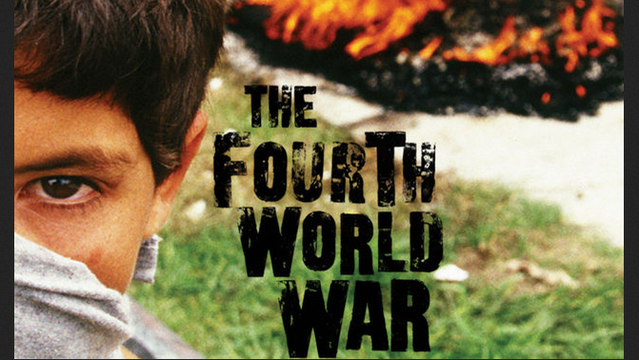
Saturday Matinee: The Fourth World War

the_fourth_world_war

From Big Noise Films:

From the front-lines of conflicts in Mexico, Argentina, South Africa, Palestine, Korea, and the North; from Seattle to Genova, and the War on Terror in New York, Afghanistan, and Iraq, The Fourth World War is the story of men and women around the world who resist being annihilated in this war.While our airwaves are crowded with talk of a new world war, narrated by generals and filmed from the noses of bombs, the human story of this global conflict remains untold. The Fourth World War brings together the images and voices of the war on the ground. It is a story of a war without end and of those who resist.The product of over two years of filming on the inside of movements on five continents, The Fourth World War is a film that would have been unimaginable at any other moment in history. Directed by the makers of This Is What Democracy Looks Like and Zapatista, produced through a global network of independent media and activist groups, it is a truly global film from our global movement.

For English speakers, portions of the film may need translation, activated by clicking on the “CC” button on bottom right corner of the video (on some mobile device browsers the function can be found on the upper right corner).

Walmart Admits: ‘Our Profits’ Depend on ‘Their Poverty’

walmart_low_morals_alt

By Lauren McCauley

Originally posted at CommonDreams.org

Although a notorious recipient of “corporate welfare,” Walmart has now admitted that their massive profits also depend on the funding of food stamps and other public assistance programs.

In their annual report, filed with the Security and Exchange Commission last week, the retail giant lists factors that could potentially harm future profitability. Listed among items such as “economic conditions” and “consumer confidence,” the company writes that changes in taxpayer-funded public assistance programs are also a major threat to their bottom line.

The company writes:

Our business operations are subject to numerous risks, factors and uncertainties, domestically and internationally, which are outside our control … These factors include … changes in the amount of payments made under the Supplement[al] Nutrition Assistance Plan and other public assistance plans, changes in the eligibility requirements of public assistance plans …

Walmart, the nation’s largest private employer, is notorious for paying poverty wages and coaching employees to take advantage of social programs. In many states, Walmart employees are the largest group of Medicaid recipients.

However, this report is the first public acknowledgement of the chain’s reliance on the funding of these programs to sustain a profit.

According to Stacy Mitchell, senior researcher with the Institute for Local Self-Reliance, the irony of their admission is that Walmart “is the company that has done, perhaps, more than any other corporation to push people into poverty.”

Citing a Penn State study, Mitchell told Common Dreams that research has proven that “when Walmart opens a store, poverty rates are negatively impacted” and that the more stores that have opened in a particular county, the worse it is. “This is a company that everywhere it goes it creates poverty.”

In addition to their own worker’s low wages, Mitchell explains that Walmart, because of their enormous size and market power, have “held down wages for the whole sector.”

As a retailer that specifically targets a low-income demographic, Mitchell adds that the “insidious genius” of their business model is that “they have so squeezed American workers […] many feel that their only choice is to shop at Walmart.”

The International Business Times reports:

Prior to the earnings report, Walmart Chief Financial Officer Charles Holley said the company didn’t anticipate how much the end to such programs as the unemployment benefits extension would affect it. Specifically, reductions to the Supplemental Nutrition Assistance Program that went into effect on Nov. 1, the first day of the company’s fourth quarter, pose a potential concern. The cuts led to a between $1 and $36 reduction in SNAP benefits per household, or up to $460 a year. Congress is debating reinstating the extension to the program and making the benefits retroactive to Nov. 1, something Walmart would clearly consider beneficial to its growth.

Previously, Walmart has joined forces with Big Food labels such as Coca Cola and Kelloggs to lobby the United States Department of Agriculture and Congress against any measures that would restrict SNAP use to healthy food choices. According to an earlier study by Michele Simon at Eat Drink Politics, in just one year, nine Walmart Supercenters in Massachusetts received more than $33 million in SNAP revenues.

11 Hanford Workers Sick From Toxic Fumes

Image from HanfordChallenge.org

Image from HanfordChallenge.org

According to a KING5 report posted yesterday, at least 11 people have been poisoned in the past week after breathing in toxic fumes while working near underground tanks holding hazardous nuclear waste at the Hanford Nuclear Site. The exact source or sources of the vapors are still unknown.

The first two workers (employees for Washington River Protection Solutions (WRPS) which manages 177 underground tanks at the site) became ill last Wednesday after inhaling fumes that “tasted like copper”. Among the symptoms they reported suffering: headache, chest pain, difficulty breathing, nose bleeds, sore throats, and coughing up blood. Four more employees were sickened yesterday morning, after which an evacuation order was given to the entire tank farm facility. Two WRPS industrial hygiene inspectors fell ill shortly after followed by three more employees who breathed in fumes later that day.

Reported statements from the employees:

“The place is falling apart and they (WRPS) aren’t doing anything to fix it,”

“I feel fine now but when you get chemical exposure, you have respiratory issues.”

“It’s BS, We’ve expressed our opinion about it. We’ve said you haven’t taken the time to put in monitors and they say ‘It’s in the works’. Yet they keep sending us out to work. They’re not putting safety first.”

“They have some serious problems out there that they need to figure out,”

While this latest incident may not have been a surprise following recent revelations about “construction flaws” in the waste tanks at the site, it could have been avoided had the government and corporations that profited from nuclear energy and the nuclear arms industry bothered to invest a little more in the containment of their toxic byproducts. It also gives further credence to the suspicion that a cluster of rare birth defects in the surrounding areas are a direct result of environmental contamination from Hanford.


Mainstream Economics Warns Out-of-Control Inequality Harms the Economy…But Corrupt Government Policy Keeps Increasing Inequality

land grap

Who’s Who of Prominent Economists Agree: Inequality Harms Economic Growth

By WashingtonsBlog

A who’s who of prominent liberal and conservative economists in government and academia have now said that runaway inequality harms economic growth, including:

  • Former U.S. Secretary of Labor and UC Berkeley professor Robert Reich
  • Global economy and development division director at Brookings and former economy minister for Turkey, Kemal Dervi
  • Societe Generale investment strategist and former economist for the Bank of England, Albert Edwards
  • Michael Niemira, chief economist at the International Council of Shopping Centers
  • Former executive director of the Joint Economic Committee of Congress, senior policy analyst in the White House Office of Policy Development, and deputy assistant secretary for economic policy at the Treasury Department, Bruce Bartlett
  • Deputy Division Chief of the Modeling Unit in the Research Department of the IMF, Michael Kumhof

Even the father of free market economics – Adam Smith – didn’t believe that inequality should be a taboo subject.

Numerous investors and entrepreneurs agree that runaway inequality hurts the economy, including:

How Bad Is It?

So how bad is it, really?

Inequality in America today is twice as bad as in ancient Rome, worse than it was in Tsarist Russia, Gilded Age America, modern Egypt, Tunisia or Yemen, many banana republics in Latin America, and worse than experienced by slaves in 1774 colonial America. (More stunning facts.)

It’s Not an Accident … It’s Policy

Extreme inequality helped cause the Great Depression, the current financial crisis … and the fall of the Roman Empire . Bad government policy – which favors the fatcats at the expense of the average American – is largely responsible for our runaway inequality.

And yet the powers-that-be in Washington and Wall Street are accelerating the redistribution of wealth from the lower, middle and more modest members of the upper classes to the super-elite.

Defenders of the status quo pretend that this inequality is something outside of our control … like a force of nature. They argue that it’s due to technological innovation or something else outside of policy-makers’ control.

In reality, inequality is rising due to bad policy.

Nobel prize winning economist Joe Stiglitz said recently:

Inequality is not inevitable. It is not … like the weather, something that just happens to us. It is not the result of the laws of nature or the laws of economics. Rather, it is something that we create, by our policies, by what we do.

We created this inequality—chose it, really—with [bad] laws …

Gaming the System to Pillage and Loot

The world’s top economic leaders have said for years that inequality is spiraling out of control and needs to be reduced. Why is inequality soaring even though world economic leaders have talked for years about the urgent need to reduce it?

Because they’re saying one thing but doing something very different. And both mainstream Democrats and mainstream Republicans are using smoke and mirrors to hide what’s really going on.

And it’s not surprising … Nobel winner Stiglitz says that inequality is caused by the use of money to shape government policies to benefit those with money. As Wikipedia notes:

A better explainer of growing inequality, according to Stiglitz, is the use of political power generated by wealth by certain groups to shape government policies financially beneficial to them. This process, known to economists as rent-seeking, brings income not from creation of wealth but from “grabbing a larger share of the wealth that would otherwise have been produced without their effort”

Rent seeking is often thought to be the province of societies with weak institutions and weak rule of law, but Stiglitz believes there is no shortage of it in developed societies such as the United States. Examples of rent seeking leading to inequality include

  • the obtaining of public resources by “rent-collectors” at below market prices (such as granting public land to railroads, or selling mineral resources for a nominal price in the US),
  • selling services and products to the public at above market prices (medicare drug benefit in the US that prohibits government from negotiating prices of drugs with the drug companies, costing the US government an estimated $50 billion or more per year),
  • securing government tolerance of monopoly power (The richest person in the world in 2011, Carlos Slim, controlled Mexico’s newly privatized telecommunication industry).

(Background here, here and here.)

Stiglitz says:

One big part of the reason we have so much inequality is that the top 1 percent want it that way. The most obvious example involves tax policy …. Monopolies and near monopolies have always been a source of economic power—from John D. Rockefeller at the beginning of the last century to Bill Gates at the end. Lax enforcement of anti-trust laws, especially during Republican administrations, has been a godsend to the top 1 percent. Much of today’s inequality is due to manipulation of the financial system, enabled by changes in the rules that have been bought and paid for by the financial industry itself—one of its best investments ever. The government lent money to financial institutions at close to 0 percent interest and provided generous bailouts on favorable terms when all else failed. Regulators turned a blind eye to a lack of transparency and to conflicts of interest.

***

Wealth begets power, which begets more wealth …. Virtually all U.S. senators, and most of the representatives in the House, are members of the top 1 percent when they arrive, are kept in office by money from the top 1 percent, and know that if they serve the top 1 percent well they will be rewarded by the top 1 percent when they leave office. By and large, the key executive-branch policymakers on trade and economic policy also come from the top 1 percent. When pharmaceutical companies receive a trillion-dollar gift—through legislation prohibiting the government, the largest buyer of drugs, from bargaining over price—it should not come as cause for wonder. It should not make jaws drop that a tax bill cannot emerge from Congress unless big tax cuts are put in place for the wealthy. Given the power of the top 1 percent, this is the way you would expect the system to work.

Former Sectretary of Labor Robert Reich recently noted:

When so much wealth accumulates at the top, with money comes the capacity to control politics… It’s not that people are rich, it’s that they abuse their wealth … The wealthy contribute to political candidates and the access that their contributions buy entrenches inequality by securing subsidies, bailouts and policies that lead to even greater inequality.

Bloomberg reports:

The financial industry spends hundreds of millions of dollars every election cycle on campaign donations and lobbying, much of which is aimed at maintaining the subsidy [to the banks by the public]. The result is a bloated financial sector and recurring credit gluts.

Indeed, the big banks literally own the Federal Reserve. And they own Washington D.C. politicians, lock stock and barrel. See this, this, this and this.

Two leading IMF officials, the former Vice President of the Dallas Federal Reserve, and the the head of the Federal Reserve Bank of Kansas City, Moody’s chief economist and many others have all said that the United States is controlled by an “oligarchy” or “oligopoly”, and the big banks and giant financial institutions are key players in that oligarchy.

The chairman of the Department of Economics at George Mason University says that it is inaccurate to call politicians prostitutes. Specifically, he says that they are more correct to call them “pimps”, since they are pimping out the American people to the financial giants.

Economics professor Randall Wray writes:

Thieves … took over the whole economy and the political system lock, stock, and barrel.

No wonder the government has saved the big banks at taxpayer expense, chosen the banks over the little guy, and

No wonder crony capitalism has gotten even worse under Obama than under Bush.

No wonder big Wall Street players are continuing to loot taxpayer money and public resources.

No wonder the big banks continue to manipulate every market and commit crime after crime and … and profit handsomely from it, while law-abiding citizens slide further and further behind.

Yet Obama is prosecuting fewer financial crimes than Bush, or his father, or Ronald Reagan.

No wonder:

All of the monetary and economic policy of the last 3 years has helped the wealthiest and penalized everyone else. See this, this and this.

***

Economist Steve Keen says:

“This is the biggest transfer of wealth in history”, as the giant banks have handed their toxic debts from fraudulent activities to the countries and their people.

Stiglitz said in 2009 that Geithner’s toxic asset plan “amounts to robbery of the American people”.

And economist Dean Baker said in 2009 that the true purpose of the bank rescue plans is “a massive redistribution of wealth to the bank shareholders and their top executives”.

Without the government’s creation of the too big to fail banks (they’ve gotten much bigger under Obama), the Fed’s intervention in interest rates and the markets (most of the quantitative easing has occurred under Obama), and government-created moral hazard emboldening casino-style speculation (there’s now more moral hazard than ever before) … things wouldn’t have gotten nearly as bad.

As we wrote in March 2009:

The bailout money is just going to line the pockets of the wealthy, instead of helping to stabilize the economy or even the companies receiving the bailouts:

  • A lot of the bailout money is going to the failing companies’ shareholders
  • Indeed, a leading progressive economist says that the true purpose of the bank rescue plans is “a massive redistribution of wealth to the bank shareholders and their top executives”
  • The Treasury Department encouraged banks to use the bailout money to buy their competitors, and pushed through an amendment to the tax laws which rewards mergers in the banking industry (this has caused a lot of companies to bite off more than they can chew, destabilizing the acquiring companies)

As we pointed out in 2008:

The game of capitalism only continues as long as everyone has some money to play with. If the government and corporations take everyone’s money, the game ends.The fed and Treasury are not giving more chips to those who need them: the American consumer. Instead, they are giving chips to the 800-pound gorillas at the poker table, such as Wall Street investment banks. Indeed, a good chunk of the money used by surviving mammoth players to buy the failing behemoths actually comes from the Fed.

Quantitative Easing

It is well-documented that quantitative easing increases inequality (and see this and this.)

Quantitative easing doesn’t help Main Street or the average American. It only helps big banks, giant corporations, and big investors.

The Federal Reserve has been doing quantitative easing for 5 years … and inequality has shot up over the last 5 years. It’s not a coincidence.

Subsidies to Giant, Wealthy Corporations

Massive subsidies to big corporations is also part of the problem. Indeed, some financial analysts say that the taxpayer subsidy to the giant banks alone is $780 billion per year.

The average American family pays $6,000/year in subsidies to giant corporations.

This is a direct transfer of wealth from the little guy to the big guy … which increases inequality.

Goosing the Stock Market

Moreover, the Fed has more or less admitted that it is putting almost all of its efforts into boosting the stock market.

Robert Reich has noted:

Some cheerleaders say rising stock prices make consumers feel wealthier and therefore readier to spend. But to the extent most Americans have any assets at all their net worth is mostly in their homes, and those homes are still worth less than they were in 2007. The “wealth effect” is relevant mainly to the richest 10 percent of Americans, most of whose net worth is in stocks and bonds.

AP writes:

The recovery has been the weakest and most lopsided of any since the 1930s.After previous recessions, people in all income groups tended to benefit. This time, ordinary Americans are struggling with job insecurity, too much debt and pay raises that haven’t kept up with prices at the grocery store and gas station. The economy’s meager gains are going mostly to the wealthiest.

Workers’ wages and benefits make up 57.5 percent of the economy, an all-time low. Until the mid-2000s, that figure had been remarkably stable — about 64 percent through boom and bust alike.

David Rosenberg points out:

The “labor share of national income has fallen to its lower level in modern history … some recovery it has been – a recovery in which labor’s share of the spoils has declined to unprecedented levels.”

The above-quoted AP article further notes:

Stock market gains go disproportionately to the wealthiest 10 percent of Americans, who own more than 80 percent of outstanding stock, according to an analysis by Edward Wolff, an economist at Bard College.

Indeed, as we reported in 2010:

As of 2007, the bottom 50% of the U.S. population owned only one-half of one percent of all stocks, bonds and mutual funds in the U.S. On the other hand, the top 1% owned owned 50.9%.***

(Of course, the divergence between the wealthiest and the rest has only increased since 2007.)

Professor G. William Domhoff demonstrated that the richest 10% own 98.5% of all financial securities, and that:

The top 10% have 80% to 90% of stocks, bonds, trust funds, and business equity, and over 75% of non-home real estate. Since financial wealth is what counts as far as the control of income-producing assets, we can say that just 10% of the people own the United States of America.

Tyler Durden notes:

In today’s edition of Bloomberg Brief, the firm’s economist Richard Yamarone looks at one of the more unpleasant consequences of Federal monetary policy: the increasing schism in wealth distribution between the wealthiest percentile and everyone else. … “To the extent that Federal Reserve policy is driving equity prices higher, it is also likely widening the gap between the haves and the have-nots….The disparity between the net worth of those on the top rung of the income ladder and those on lower rungs has been growing. According to the latest data from the Federal Reserve’s Survey of Consumer Finances, the total wealth of the top 10 percent income bracket is larger in 2009 than it was in 1995. Those further down have on average barely made any gains. It is likely that data for 2010 and 2011 will reveal an even higher percentage going to the top earners, given recent increases in stocks.” Alas, this is nothing new, and merely confirms speculation that the Fed is arguably the most efficient wealth redistibution, or rather focusing, mechanism available to the status quo. This is best summarized in the chart below comparing net worth by income distribution for various percentiles among the population, based on the Fed’s own data. In short: the richest 20% have gotten richer in the past 14 years, entirely at the expense of everyone else.

***

Lastly, nowhere is the schism more evident, at least in market terms, than in the performance of retail stocks:

Saks chairman Steve Sadove recently remarked, “I’ve been saying for several years now the single biggest determinant of our business overall, is how’s the stock market doing.” Privately-owned Neiman- Marcus reported “In New York City, business at Bergdorf Goodman continues to be extremely strong.”

In contrast, retail giant Wal-Mart talks of its “busiest hours” coming at midnight when food stamps are activated and consumers proceed through the check-outs lines with baby formula, diapers, and other groceries. Wal-Mart has posted a decline in same-store sales for eight consecutive quarters.

As CNN Money pointed out in 2011, “Wal-Mart’s core shoppers are running out of money much faster than a year ago …” This trend has only gotten worse: The wealthy are doing great … but common folks can no longer afford to shop even at Wal-Mart, Sears, JC Penney or other low-price stores.

Durden also notes:

Another indication of the increasing polarity of US society is the disparity among consumer confidence cohorts by income as shown below, and summarized as follows: “The increase in equity prices has raised consumer spirits, particularly among higher-income consumers. The Conference Board’s Consumer Confidence index for all income levels bottomed in February/March of 2009. The recovery since then has been notable across the board, but nowhere as much as for those making $50,000 or more.”

Business Week notes:

Barry Ritholtz, [CIO of Ritholtz Wealth, and popular financial blogger], says millions of potential investors may conclude, as they did after the Great Depression, that the market is a rigged game for insiders. Such seismic shifts in popular sentiment can have lasting effects. The Dow Jones industrial average didn’t regain its September 1929 peak of 355.95 until 1954. “You’re going to lose a generation of investors,” says Ritholtz. “And that’s how you end up with a 25-year bear market. That’s the risk if people start to think there is no economic justice.”

Americans know that the system is rigged against them. See this. We know that the government is giving Wall Street crooks a pass. 70% of Americans know that the government’s economic policies have thrown money at the banks and hosed the people.

In such an environment, the average American has largely gotten out of stocks and other investments.

Over-Financialization

When a country’s finance sector becomes too large finance, inequality rises. As Wikipedia notes:

[Economics professor] Jamie Galbraith argues that countries with larger financial sectors have greater inequality, and the link is not an accident.

Government policy has been encouraging the growth of the financial sector for decades:

https://desultoryheroics.com/wp-content/uploads/2014/03/71000-financialandnonfinancialsectors-compensationlesleopold.jpg

(Economist Steve Keen has also shown that “a sustainable level of bank profits appears to be about 1% of GDP”, and that higher bank profits leads to a ponzi economy and a depression).

Unemployment and Underemployment

A major source of inequality is unemployment, underemployment and low wages.

Corporate Profits v. Jobs

Government policy has created these conditions. And the pretend populist Obama – who talks non-stop about the importance of job-creation – actually doesn’t mind such conditions at all.

The“jobless recovery” that the Bush and Obama governments have engineered is a redistribution of wealth from the little guy to the big boys.

The New York Times notes:

Economists at Northeastern University have found that the current economic recovery in the United States has been unusually skewed in favor of corporate profits and against increased wages for workers.

In their newly released study, the Northeastern economists found that since the recovery began in June 2009 following a deep 18-month recession, “corporate profits captured 88 percent of the growth in real national income while aggregate wages and salaries accounted for only slightly more than 1 percent” of that growth.

The study, “The ‘Jobless and Wageless Recovery’ From the Great Recession of 2007-2009,” said it was “unprecedented” for American workers to receive such a tiny share of national income growth during a recovery.

***

The share of income growth going to employee compensation was far lower than in the four other economic recoveries that have occurred over the last three decades, the study found.

Obama apologists say Obama has created jobs. But the number of people who have given up and dropped out of the labor force has skyrocketed under Obama (and see this).

And the jobs that have been created have been low-wage jobs.

Low Wage Jobs

For example, the New York Times noted in 2011:

The median pay for top executives at 200 big companies last year was $10.8 million. That works out to a 23 percent gain from 2009.

***

Most ordinary Americans aren’t getting raises anywhere close to those of these chief executives. Many aren’t getting raises at all — or even regular paychecks. Unemployment is still stuck at more than 9 percent.

***

“What is of more concern to shareholders is that it looks like C.E.O. pay is recovering faster than company fortunes,” says Paul Hodgson, chief communications officer for GovernanceMetrics International, a ratings and research firm.

According to a report released by GovernanceMetrics in June, the good times for chief executives just keep getting better. Many executives received stock options that were granted in 2008 and 2009, when the stock market was sinking.

Now that the market has recovered from its lows of the financial crisis, many executives are sitting on windfall profits, at least on paper. In addition, cash bonuses for the highest-paid C.E.O.’s are at three times prerecession levels, the report said.

***

The average American worker was taking home $752 a week in late 2010, up a mere 0.5 percent from a year earlier. After inflation, workers were actually making less.

AP pointed out that the average worker is not doing so well:

Unemployment has never been so high — 9.1 percent — this long after any recession since World War II. At the same point after the previous three recessions, unemployment averaged just 6.8 percent.

– The average worker’s hourly wages, after accounting for inflation, were 1.6 percent lower in May than a year earlier. Rising gasoline and food prices have devoured any pay raises for most Americans.

– The jobs that are being created pay less than the ones that vanished in the recession. Higher-paying jobs in the private sector, the ones that pay roughly $19 to $31 an hour, made up 40 percent of the jobs lost from January 2008 to February 2010 but only 27 percent of the jobs created since then.

Alan Greenspan noted:

Large banks, who are doing much better and large corporations, whom you point out and everyone is pointing out, are in excellent shape. The rest of the economy, small business, small banks, and a very significant amount of the labour force, which is in tragic unemployment, long-term unemployment – that is pulling the economy apart.

Money Being Sucked Out of the U.S. Economy … But Big Bucks Are Being Made Abroad

Part of the widening gap is due to the fact that most American companies’ profits are driven by foreign sales and foreign workers. As AP noted in 2010:

Corporate profits are up. Stock prices are up. So why isn’t anyone hiring?

Actually, many American companies are — just maybe not in your town. They’re hiring overseas, where sales are surging and the pipeline of orders is fat.

***

The trend helps explain why unemployment remains high in the United States, edging up to 9.8% last month, even though companies are performing well: All but 4% of the top 500 U.S. corporations reported profits this year, and the stock market is close to its highest point since the 2008 financial meltdown.

But the jobs are going elsewhere. The Economic Policy Institute, a Washington think tank, says American companies have created 1.4 million jobs overseas this year, compared with less than 1 million in the U.S. The additional 1.4 million jobs would have lowered the U.S. unemployment rate to 8.9%, says Robert Scott, the institute’s senior international economist.

“There’s a huge difference between what is good for American companies versus what is good for the American economy,” says Scott.

***

Many of the products being made overseas aren’t coming back to the United States. Demand has grown dramatically this year in emerging markets like India, China and Brazil.

Government policy has accelerated the growing inequality. It has encouraged American companies to move their facilities, resources and paychecks abroad. And some of the biggest companies in America have a negative tax rate … that is, not only do they pay no taxes, but they actually get tax refunds.

And a large percentage of the bailouts went to foreign banks (and see this). And so did a huge portion of the money from quantitative easing. More here and here.

Capital Gains and Dividends

According to a 2013 study published by a researcher at the U.S. Congressional Research Service:

The largest contributor to increasing income inequality…was changes in income from capital gains and dividends.

Business Insider explains:

Drastic income inequality growth in the United States is largely derived from changes in the way the U.S. government taxes income from capital gains and dividends, according to a new study by Thomas Hungerford of the non-partisan Congressional Research Service.

Essentially, what Democrats have been saying about income inequality — that it’s in a large part due to favorable taxation and deduction policies for high income Americans — is largely right

***

The study … conclusively found that the wealthy benefitted from low tax rates on investment income, which in turn caused their wealth to grow faster.

Essentially, taxing capital gains as ordinary income would make the playing field more fair, and reduce over time income inequality.

Joseph Stiglitz noted in 2011:

Lowering tax rates on capital gains, which is how the rich receive a large portion of their income, has given the wealthiest Americans close to a free ride.

Indeed, the Tax Policy center reports that the top 1% took home 71% of all capital gains in 2012.

Ronald Reagan’s budget director, assistant secretary of treasury, and domestic policy director all say that the Bush tax cuts were a huge mistake. See this and this.

The Existential Threat of Algorithmic Trading

flatline

Most of us are well aware of the problem of human labor being displaced by technology. The Thought Infection blog recently posted an informative overview of how even jobs we might not immediately think of as being at risk of obsolescence are steadily being encroached upon by technology. In this follow up article, he explains how automation has an especially destabilizing effect on the financial sector and economic system.

Excerpt:

The advent of algorithmic trading extends the game that has always existed in markets, but now the speed is faster, the stakes are higher and we can’t be sure who is in control. 

The manipulation abilities of trading algorithms may already (and if not, soon will) extend beyond this kind of inter-algorithmic effects. Given that trading algorithms can act on human informational sources, such as Twitter, as news is released, it is not outlandish to imagine that these algorithms could also be producing information in an effort to manipulate the market. Given that algorithms are becoming better at turning basic information into natural language, it seems possible that an algorithm could be designed to Tweet out false information about a company to try to depress the stock price.

If we take the ketchup manufacturer again and we imagine they are in a precarious position due to a new bill to remove subsidies for tomato growing. Imagine a bunch of tweet/comment/news bots aimed at pushing the public dialogue to make it seem that the subsidies are going to be removed. If massively parallelized, this kind of attack on public sentiment could have a significant effect on the ketchup manufacturer and provide an opportunity for major profits. I think it’s likely this kind of algorithmic sentiment manipulation is already happening on some level.

Even this kind of sentiment manipulation is only a drop in the bucket compared to what may become possible in the near future. The astounding profits which can be made in this kind of algorithmic trading is driving huge investment in artificial intelligence. In the near future, algorithmic traders will be capable of much more complex manipulations to try to move market prices.

…Perhaps by identifying those congressmen who are on the fence about subsidies, a targeted campaign to manipulate the opinions of those in said congressman’s district could have a real effect on the outcome for ketchup manufacturers. This may seem a bit ridiculous, but even a tiny effect on the perceptions and opinions of one individual can make a big difference if spread across a wide enough group.

Read the full article here: http://thoughtinfection.com/2014/01/05/the-deep-end-of-decoupling-the-existential-threat-of-algorithmic-trading/

What he speculates could be our greatest threat in the future is not Terminator-like cybernetic weapons but “an army of Gordon Gekko-bots capable of manipulating every aspect of our legal and political systems in an aim to maximize market profits.”

Swiss to Vote on Basic Income for All

_71790439_71789396

Switzerland is one of the world’s wealthiest countries per capita, and also one of the most democratic. It’s the only European country with true direct democracy in which all citizens have to do is gather 100,000 signatures calling for a vote to hold a nationwide referendum with a binding result. Last November, Swiss citizens created the so-called 1:12 referendum, which would limit the wages of top executives so they couldn’t earn more in a month than lower paid employees do in a year. That proposal lost the vote, but early next year they’ll have an opportunity to decide on an equally radical referendum: a $2,800 basic income for every adult, whether employed or unemployed. There is currently no minimum wage in Switzerland, but there will also be a vote on that next year.

Anger about salaries and fairness has surged among Swiss voters because some of their biggest banks including UBS are responsible for speculative investment bubbles and continue to pay top executives huge bonuses while reporting huge losses. According to Bloomberg News, Switzerland is home to at least five of Europe’s top 20 paid executives. The inequality pay ratio in Switzerland is 1:194 (while in the U. S., average CEO to average worker compensation was 1:243 in 2010).

The idea of a Basic Income or Universal Wages are not only supported by Marxists and Communists, but have have been gaining traction among Libertarians as well. A great post at Thought Infection recently made an argument for such proposals from a civil libertarian perspective:

Freedom in the 21st century should mean freedom from having to engage in productive work simply to meet your basic needs for comfort and dignity. 

At one time, the ready availability of jobs amply filled the need for a basic access to a comfortable and dignified life, but precipitous technological and economic changes erode this dynamic further each day. The function of the economy has never been to provide gainful employment to people, but simply to provide material goods. As the economy manages to produce more with less human labor, we must create new mechanisms aimed specifically that maintaining and raising the minimum level of comfort and dignity to everyone in a society…

…Worse than just being immoral, the desperate poverty of the lower classes is both immoral and useless. It is not a lack of money that compels the great successes of the modern age, but rather the availability of opportunities. It is because healthy, well-fed people were able to get a good education that allowed us to realize the great miracles of the modern age (eg, the internet, smart phones, Google, etc…). 

We must rebalance the right of society to compel people into productive work with the obligation of society to support its citizens. It should be noted that basic income is not aimed at the unrealisitic and undesirable goal of unfettered access for all to every luxury of the world. Freedom from work does not mean the right to luxury; it simply sets a baseline below which no person should fall. Basic income seeks to strike a fair balance between allowing the benefit of work to coexist with a system aimed at delivering dignity and opportunity for all in a society.

Beyond just better enabling access to opportunities, basic income will also allow people the freedom to live as they choose; to explore unpaid work in the form of volunteering, participating in creative projects, or starting new business ventures. Some argue that there would be less incentive for people to start businesses and be productive, but it could just as easily be argued that it would remove the disincentive from the high-risk, high-reward ventures that are so valuable to modern society…

…Requiring people to live so much of their life working simply to earn a basic income is a waste of human potential and bad for progress. By eliminating the obligation to work just for simple survival, basic income would allow a new dynamic expansion of human freedom and human potential.

A society compelled to perfect cohesion and homogeneity lacks the dynamism to compete in the modern world. New ideas can only come into being at the chaotic interface between contrasting worldviews and lifestyles. In a world where progress is completely reliant on our ability to innovate and create new ideas, we should be seeking to maximize the spectrum of lifestyles which can be expressed within the society. By removing the need to work just to live, we will let people explore their true potential, and we will realize the untold benefits of a new dynamism.  

And this brings us to the real reason that I think basic income will happen soon, not only because it is morally the right thing to do (which it is), but because it makes good sense economically. Just as slavery ended when factories made the economic model of slavery obsolete, we will move towards basic income because it makes good economic sense for the modern innovation economy.

Dynamic, creative and competitive economies of today must seek to stretch the social fabric to its limits. Basic income will serve to reinforce this fabric and enable the risky ventures that will power us forward in the 21st century.

Read the full article here: http://thoughtinfection.com/2013/12/15/basic-income-means-basic-freedom/