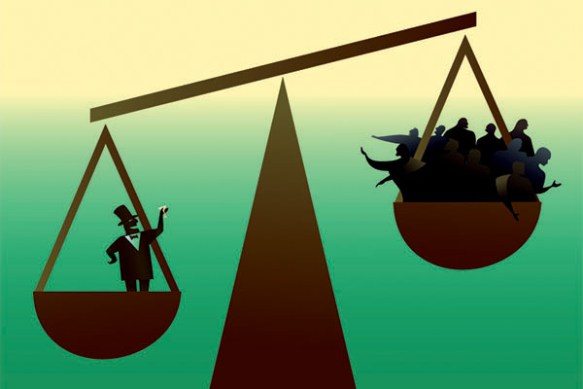
The End of Empire

The brutality abroad is matched by a growing brutality at home.

By

The American empire is coming to an end. The U.S. economy is being drained by wars in the Middle East and vast military expansion around the globe. It is burdened by growing deficits, along with the devastating effects of deindustrialization and global trade agreements. Our democracy has been captured and destroyed by corporations that steadily demand more tax cuts, more deregulation and impunity from prosecution for massive acts of financial fraud, all the while looting trillions from the U.S. treasury in the form of bailouts. The nation has lost the power and respect needed to induce allies in Europe, Latin America, Asia and Africa to do its bidding. Add to this the mounting destruction caused by climate change and you have a recipe for an emerging dystopia. Overseeing this descent at the highest levels of the federal and state governments is a motley collection of imbeciles, con artists, thieves, opportunists and warmongering generals. And to be clear, I am speaking about Democrats, too.

The empire will limp along, steadily losing influence until the dollar is dropped as the world’s reserve currency, plunging the United States into a crippling depression and instantly forcing a massive contraction of its military machine.

Short of a sudden and widespread popular revolt, which does not seem likely, the death spiral appears unstoppable, meaning the United States as we know it will no longer exist within a decade or, at most, two. The global vacuum we leave behind will be filled by China, already establishing itself as an economic and military juggernaut, or perhaps there will be a multipolar world carved up among Russia, China, India, Brazil, Turkey, South Africa and a few other states. Or maybe the void will be filled, as the historian Alfred W. McCoy writes in his book “In the Shadows of the American Century: The Rise and Decline of US Global Power,” by “a coalition of transnational corporations, multilateral military forces like NATO, and an international financial leadership self-selected at Davos and Bilderberg” that will “forge a supranational nexus to supersede any nation or empire.”

Under every measurement, from financial growth and infrastructure investment to advanced technology, including supercomputers, space weaponry and cyberwarfare, we are being rapidly overtaken by the Chinese. “In April 2015 the U.S. Department of Agriculture suggested that the American economy would grow by nearly 50 percent over the next 15 years, while China’s would triple and come close to surpassing America’s in 2030,” McCoy noted. China became the world’s second largest economy in 2010, the same year it became the world’s leading manufacturing nation, pushing aside a United States that had dominated the world’s manufacturing for a century. The Department of Defense issued a sober report titled “At Our Own Peril: DoD Risk Assessment in a Post-Primacy World.” It found that the U.S. military “no longer enjoys an unassailable position versus state competitors,” and “it no longer can … automatically generate consistent and sustained local military superiority at range.” McCoy predicts the collapse will come by 2030.

Empires in decay embrace an almost willful suicide. Blinded by their hubris and unable to face the reality of their diminishing power, they retreat into a fantasy world where hard and unpleasant facts no longer intrude. They replace diplomacy, multilateralism and politics with unilateral threats and the blunt instrument of war.

This collective self-delusion saw the United States make the greatest strategic blunder in its history, one that sounded the death knell of the empire—the invasion of Afghanistan and Iraq. The architects of the war in the George W. Bush White House, and the array of useful idiots in the press and academia who were cheerleaders for it, knew very little about the countries being invaded, were stunningly naive about the effects of industrial warfare and were blindsided by the ferocious blowback. They stated, and probably believed, that Saddam Hussein had weapons of mass destruction, although they had no valid evidence to support this claim. They insisted that democracy would be implanted in Baghdad and spread across the Middle East. They assured the public that U.S. troops would be greeted by grateful Iraqis and Afghans as liberators. They promised that oil revenues would cover the cost of reconstruction. They insisted that the bold and quick military strike—“shock and awe”—would restore American hegemony in the region and dominance in the world. It did the opposite. As Zbigniew Brzezinski noted, this “unilateral war of choice against Iraq precipitated a widespread delegitimation of U.S. foreign policy.”

Historians of empire call these military fiascos, a feature of all late empires, examples of “micro-militarism.” The Athenians engaged in micro-militarism when during the Peloponnesian War (431-404 B.C.) they invaded Sicily, suffering the loss of 200 ships and thousands of soldiers and triggering revolts throughout the empire. Britain did so in 1956 when it attacked Egypt in a dispute over the nationalization of the Suez Canal and then quickly had to withdraw in humiliation, empowering a string of Arab nationalist leaders such as Egypt’s Gamal Abdel Nasser and dooming British rule over the nation’s few remaining colonies. Neither of these empires recovered.

“While rising empires are often judicious, even rational in their application of armed force for conquest and control of overseas dominions, fading empires are inclined to ill-considered displays of power, dreaming of bold military masterstrokes that would somehow recoup lost prestige and power,” McCoy writes. “Often irrational even from an imperial point of view, these micromilitary operations can yield hemorrhaging expenditures or humiliating defeats that only accelerate the process already under way.”

Empires need more than force to dominate other nations. They need a mystique. This mystique—a mask for imperial plunder, repression and exploitation—seduces some native elites, who become willing to do the bidding of the imperial power or at least remain passive. And it provides a patina of civility and even nobility to justify to those at home the costs in blood and money needed to maintain empire. The parliamentary system of government that Britain replicated in appearance in the colonies, and the introduction of British sports such as polo, cricket and horse racing, along with elaborately uniformed viceroys and the pageantry of royalty, were buttressed by what the colonialists said was the invincibility of their navy and army. England was able to hold its empire together from 1815 to 1914 before being forced into a steady retreat. America’s high-blown rhetoric about democracy, liberty and equality, along with basketball, baseball and Hollywood, as well as our own deification of the military, entranced and cowed much of the globe in the wake of World War II. Behind the scenes, of course, the CIA used its bag of dirty tricks to orchestrate coups, fix elections and carry out assassinations, black propaganda campaigns, bribery, blackmail, intimidation and torture. But none of this works anymore.

The loss of the mystique is crippling. It makes it hard to find pliant surrogates to administer the empire, as we have seen in Iraq and Afghanistan. The photographs of physical abuse and sexual humiliation imposed on Arab prisoners at Abu Ghraib inflamed the Muslim world and fed al-Qaida and later Islamic State with new recruits. The assassination of Osama bin Laden and a host of other jihadist leaders, including the U.S. citizen Anwar al-Awlaki, openly mocked the concept of the rule of law. The hundreds of thousands of dead and millions of refugees fleeing our debacles in the Middle East, along with the near-constant threat from militarized aerial drones, exposed us as state terrorists. We have exercised in the Middle East the U.S. military’s penchant for widespread atrocities, indiscriminate violence, lies and blundering miscalculations, actions that led to our defeat in Vietnam.

The brutality abroad is matched by a growing brutality at home. Militarized police gun down mostly unarmed, poor people of color and fill a system of penitentiaries and jails that hold a staggering 25 percent of the world’s prisoners although Americans represent only 5 percent of global population. Many of our cities are in ruins. Our public transportation system is a shambles. Our educational system is in steep decline and being privatized. Opioid addiction, suicide, mass shootings, depression and morbid obesity plague a population that has fallen into profound despair. The deep disillusionment and anger that led to Donald Trump’s election—a reaction to the corporate coup d’état and the poverty afflicting at least half of the country—have destroyed the myth of a functioning democracy. Presidential tweets and rhetoric celebrate hate, racism and bigotry and taunt the weak and the vulnerable. The president in an address before the United Nations threatened to obliterate another nation in an act of genocide. We are worldwide objects of ridicule and hatred. The foreboding for the future is expressed in the rash of dystopian films, motion pictures that no longer perpetuate American virtue and exceptionalism or the myth of human progress.

“The demise of the United States as the preeminent global power could come far more quickly than anyone imagines,” McCoy writes. “Despite the aura of omnipotence empires often project, most are surprisingly fragile, lacking the inherent strength of even a modest nation-state. Indeed, a glance at their history should remind us that the greatest of them are susceptible to collapse from diverse causes, with fiscal pressures usually a prime factor. For the better part of two centuries, the security and prosperity of the homeland has been the main objective for most stable states, making foreign or imperial adventures an expendable option, usually allocated no more than 5 percent of the domestic budget. Without the financing that arises almost organically inside a sovereign nation, empires are famously predatory in their relentless hunt for plunder or profit—witness the Atlantic slave trade, Belgium’s rubber lust in the Congo, British India’s opium commerce, the Third Reich’s rape of Europe, or the Soviet exploitation of Eastern Europe.”

When revenues shrink or collapse, McCoy points out, “empires become brittle.”

“So delicate is their ecology of power that, when things start to go truly wrong, empires regularly unravel with unholy speed: just a year for Portugal, two years for the Soviet Union, eight years for France, eleven years for the Ottomans, seventeen for Great Britain, and, in all likelihood, just twenty-seven years for the United States, counting from the crucial year 2003 [when the U.S. invaded Iraq],” he writes.

Many of the estimated 69 empires that have existed throughout history lacked competent leadership in their decline, having ceded power to monstrosities such as the Roman emperors Caligula and Nero. In the United States, the reins of authority may be in the grasp of the first in a line of depraved demagogues.

“For the majority of Americans, the 2020s will likely be remembered as a demoralizing decade of rising prices, stagnant wages, and fading international competitiveness,” McCoy writes. The loss of the dollar as the global reserve currency will see the U.S. unable to pay for its huge deficits by selling Treasury bonds, which will be drastically devalued at that point. There will be a massive rise in the cost of imports. Unemployment will explode. Domestic clashes over what McCoy calls “insubstantial issues” will fuel a dangerous hypernationalism that could morph into an American fascism.

A discredited elite, suspicious and even paranoid in an age of decline, will see enemies everywhere. The array of instruments created for global dominance—wholesale surveillance, the evisceration of civil liberties, sophisticated torture techniques, militarized police, the massive prison system, the thousands of militarized drones and satellites—will be employed in the homeland. The empire will collapse and the nation will consume itself within our lifetimes if we do not wrest power from those who rule the corporate state.

Zucktown, USA

Facebook, Amazon, and Google are reviving the ill-fated “company towns” of the Gilded Age

By Julianne Tveten

Source: The Baffler

EARLIER THIS YEAR IN SILICON VALLEY, a phalanx of six-figure-earning Facebook engineers confronted Mark Zuckerberg about subsidizing their extortionate rents. Meanwhile, the contract laborers who serve them bacon kimchi dogs and duck confit found themselves cordoned off from the affordable housing market—where salaries approaching $74,000 qualify—and began converting their garages into homes. Still, if these events point to a dire situation, they’re but the latest stirrings of the hulking leviathan that is the region’s housing crisis—an issue that has peppered the headlines of news outlets great and small for nearly a decade.

Thanks in part to this accretion of bad press, Zuckerberg and his fellow cyborgian billionaires have sprung into action as property developers. In July, Facebook announced plans to create “Willow Campus,” an aggressively rectilinear, Rem Koolhaas-designed rebrand of a Menlo Park office complex it purchased in 2015. The expansion of its headquarters will boast fifteen hundred units of housing, 15 percent of which it claims will be “offered at below-market rates.” If that isn’t sufficiently microcosmic, the company promises to dedicate 125,000 square feet to commercial space, promising a grocery store, pharmacy, and the cryptically worded “additional community-facing retail.”

Equally if not more responsible for crafting California’s bloodsucking geometric crapscape is Google, whose newfangled parent company Alphabet has vowed to provide temporary housing, in the form of modular dwellings, for three hundred of its employees in its home city of Mountain View. For years, Google has been seeking to wrest control of the city from its government; last year, it gained over 370,000 square feet of office space along with the right to develop 1.4 million square feet in the North Bayshore neighborhood after vying with LinkedIn to furnish the territory with a new police station, road improvements, and college scholarships. (The modular homes will be constructed on a former NASA air base, which the company signed an agreement to lease for sixty years.)


We’re witnessing, in these schemes, a revival of the company town. An oft-recurring feature of the Western capitalist imaginary, the company town’s American variety dates back to the nineteenth century; railroad industrialist George Pullman’s eponymous city in Illinois provides one of the more illustrative examples. Pullman characterized his town, completed in 1884, as a lucrative, pro-business utopia filled with satisfied participants, employee and investor alike. Its veneer was indeed shiny: the amenities it promised—yards, indoor plumbing, gas, trash removal—were rare for industrial workers of the time, and its ultra-formal gardens and shopping center, which equipped them with a barbershop, dentist’s offices, a bank, and a slew of overpriced retail, offered a vanguard capitalist’s dabbling in luxury.

There was a catch: paternalistic and omnipresent capitalism. Immaculately manicured trees were merely curtains obscuring a panopticon, one that kept workers behaviorally economized. (White workers, that is—the town expressly excluded black people.) “[Pullman] wanted to create a company town where everybody would be . . . content with their place in the capitalist system,” Jane Eva Baxter explained to Paleofuture. Workers were forced to rent—with no option to buy—the uniform row houses that corralled them, and from which they worried over persistent inspection and imminent eviction. Their employers likewise controlled which books filled their libraries and which performances took place in their theaters, and a ban precluded them from congregating at saloons or holding town meetings unless sanctioned by the Pullman Company, lest they entertain the notion of unionizing.

The forced exchange not just of labor, but of personal autonomy, for the tenuous ability to buy bread or light one’s stove is, in a word, inhumane, and in three, cause for revolt. Pullman workers had organized several strikes throughout the 1880s, but none were so monumental as the one in 1894. In response to the prior year’s economic depression, Pullman opted to slash workers’ wages; rents, however, remained steadfastly fixed, enriching the company’s reported worth of $62 million while leaving workers with as little as two cents (after paying for housing costs). In partnership with the American Railway Union, four thousand Pullman workers, galvanized and desperate, withheld their labor, and legions of workers throughout the nation would soon join them. Yet the strike collapsed when the Cleveland administration, in a violent display of authoritarianism, deployed federal troops and imprisoned labor leaders. Not long after, by Illinois Supreme Court order, the town was forced to sell everything not used expressly for “industry.”

Still, Pullman’s fiasco didn’t discourage other magnates. In 1900, chocolatier Milton Hershey began construction on a factory complex near a collection of dairy farms in rural Pennsylvania, where he declared there’d be “no poverty, no nuisances, no evil”—a Delphic precursor to Google’s now infamous and defunct slogan, “Don’t be evil.” To attract workers, Hershey reclaimed many of Pullman’s gilded comforts: indoor plumbing, pristine lawns, central heating, garbage pickup, and eventually, the theaters and sports venues any company town worth its salt would host.

What was designed as a wholesome advertisement for the company quickly morphed into a miserly surveillance state. Hershey, who served as the town’s mayor, constable, and fire chief, patrolled neighborhoods to survey the maintenance of houses and hired private detectives to monitor employees’ after-hours alcohol consumption. While the town managed to stage a sort of idyllic capitalist performance for onlookers, by the 1930s its employees resented their binding environs and the Depression-era layoffs they endured from a company earning ten times its annual payroll in after-tax profits. A crippled attempt to unionize with the Congress of Industrial Organizations (CIO) bred a 1937 sit-down strike; days later, farmers and company cheerleaders armed with rocks and pitchforks bloodied and ejected the dissidents, destabilizing for good another corporate-civic lark. Hershey’s vast estate, however, remains unscathed to this day.


If Facebook and Google have begun to revive the company town, Amazon has already given it a futuristic luster. California’s inchoate company towns pale in comparison to their northern counterpart, which occupies 19 percent of Seattle’s office space and a farcical 8.1 million square feet. (Its CEO and founder, Jeff Bezos, has vowed to acquire four million more over the next five years, a muscular move meant to complement his midlife-crisis physique.) Touting its sponsorship of local engineering and sustainability programs, Amazon crows about such “investments” as its dog park, playing fields, art installations, and Buckyball-reminiscent domical gardens. Of course, with Bezos’s colonizing aspirations comes yet another bellicose rental market—the very conditions Facebook and Google claim to be combatting. When considered alongside its recent purchase of Whole Foods, Amazon’s dream of tethering its employees to their jobs—by way of homogenized cubes for rent and lightly discounted quinoa chips—is fast becoming a reality.

Like George Pullman and Milton Hershey, the tech industry’s elites take all prisoners in their respective campaigns to expand, absorb, and dominate. The tech company town, that most contemporary of neofeudalist wangles, is the next step in West Coast corporate behemoths’ quest to lure employees into a twenty-four-hour working existence—the totalizing successor to bottomless Indian food spreads, on-site bike-repair shops, and Frank Gehrized habitats. Its premise deviates not at all from that of its antecedents: a genial, painstakingly aestheticized service to workers, where beneficent corporate hands take the reins of the public good  for the well-being of the community. This time around, though, that community will be bridled with unionbusting and data-harvesting apparatuses sure to make even the most paranoid techno-tyrant salivate.

Certainly, the megalomaniacs who aim to populate municipal fixtures with registered-trademark logos will expect cities to genuflect at every turn. Bezos has exemplified this in Seattle, whose recent measure to “tax the rich” drove him to seek another location in which to build Amazon’s second headquarters. While residents of its hometown grapple with a commandeering leech that “suck[s] up our resources and refus[es] to participate in daily upkeep,” Amazon will soon attempt to prime another city to be sapped. Meanwhile, the smooth-faced metallic vampires of California have just begun to cosplay as frontiersmen, raring to follow Bezos’s lead. Drunk on glib TED Talk propagandizing, and accustomed to dismissing the civic inconveniences of corporate regulations and poor neighborhoods, our technosettlers feel little need to heed the lessons of the past when their chief interest is to monopolize the future. Taxing the techie billionaires is a start, but only when cities refuse to be their hosts will they cease to be their parasites.


Julianne Tveten writes about the technology industry’s relationship with socioeconomics and culture. Her work has appeared in Current Affairs, Hazlitt, In These Times, The Outline, and elsewhere.

This Chart Defines the 21st Century Economy

By Charles Hugh Smith

Source: Of Two Minds

There is nothing inevitable about such vast, fast-rising income-wealth inequality; it is the only possible output of our financial and pay-to-play political system.

One chart defines the 21st century economy and thus its socio-political system: the chart of soaring wealth/income inequality. This chart doesn’t show a modest widening in the gap between the super-wealthy (top 1/10th of 1%) and everyone else: there is a veritable Grand Canyon between the super-wealthy and everyone else, a gap that is recent in origin.

Notice that the majority of all income growth now accrues to the the very apex of the wealth-power pyramid. This is not mere chance, it is the only possible output of our financial system. This is stunning indictment of our socio-political system, for this sort of fast-increasing concentration of income, wealth and power in the hands of the very few at the top can only occur in a financial-political system which is optimized to concentrate income, wealth and power at the top of the apex.

Well-meaning conventional economists have identified a number of structural causes of rising wealth/income inequality, dynamics that I’ve often discussed here over the past decade:

1. Global wage arbitrage resulting from the commodification of labor, a.k.a. globalization

2. A winner-takes-most power law distribution of the gains reaped from new technologies and markets

3. A widening mismatch between the skills of the workforce and the needs of a rapidly changing economy

4. The concentration of capital gains in assets such as high-end real estate, stocks and bonds that are owned almost exclusively by the top 10% of households

5. The long-term stagnation productivity

6. The secular decline in the percentage of the economy that flows to wages and salaries

While each of these is real, the elephant in the room few are willing to mention much less discuss is financialization, the siphoning off of most of the economy’s gains by those few with the power to borrow and leverage vast sums of capital to buy income streams–a dynamic that greatly enriches the rentier class which has unique access to central bank and private-sector bank credit and leverage.

Apologists seek to explain away this soaring concentration of wealth as the inevitable result of some secular trend that we’re powerless to rein in, as if the process that drives this concentration of wealth and power wasn’t political and financial.

There is nothing inevitable about such vast, fast-rising income-wealth inequality; it is the only possible output of our financial and pay-to-play political system.

Policy tweaks such as tax reform are mere public relations ploys. The cancer eating away at our economy and society arises from the Federal Reserve and the structure of our financial system, and the the degradation of our representative democracy into a pay-to-play auction to the highest bidder.

“The Richest Nation On Earth” Why Are Many Americans Broke?

By Timothy Gatto

Source: OpEdNews.com

I’m going to talk about some things that many people take for granted and that most writers not will write about. I’m going to throw a lot of information and figures out in this article and I really hope that people start to think about what these facts and figures really mean.

I want to preface this that I am not a mathematician nor am I an economist. I am however, someone who can read and the figures on going to give you come directly from the government. I didn’t make these numbers up.

Many people have read some of my articles know that I detest the fact that 55% of our national budget is comprised of our so-called “defense budget”. Many Americans have written and talked about the fact that this nation is involved “in endless war”. What most people don’t realize is how much of our national treasure is devoted to our military.

Let me start by telling how much this nation spends on our so-called “defense budget”. This money that we spend isn’t to defend people of the United States, these funds go to enrich the defense contractors and the people who fund our politicians in Congress.

This is the part where I throw the amounts that fund our so-called “defense budget”:

$2,988,083.00 is the total amount for the US budget. Out of this almost $3 trillion, $582 billion dollars go to the Department of Defense. This doesn’t include all the money that goes to the defense investigative agency the DIA, or to the CIA, or to the NSA, or to the FBI or any other intelligence agencies.

The number of people in the United States in 2017 is 326,474,083. If Congress cut the defense budget for 25% by closing overseas bases and cutting the number military that serve in our endless war machine, we would save $145 billion dollars. If you divide that number by the number of people living in the United States, every man woman and child, it would come out to almost $485,260,952. If Congress only returned 5% of that money “as a dividend” to the American people that would mean a windfall of almost $25,000. A family of four would receive hundred thousand dollars.

I’m not supposing that the government would do anything of the sort, I’m just throwing some numbers around to make people think. We always hear the United States is the richest nation on earth, and this just illustrates where all our wealth is going. Many people explain that the defense industry and shore up our economy and we stop producing arms and having a large military it would hurt the United States economically. What I’m saying is that if we cut the military spending by 25% we would not only give a windfall to the American people, but we could also rebuild our infrastructure and pay down our national debt.

If people honestly looked at those numbers, it should make them angry. How many aircraft carriers do we need to defend the people of the United States? How many cruise missiles do we need to protect the people of the United States? How many spy agencies do we need to protect us from our so-called enemies? We have an ocean on each side of the United States. We have enemies across the world that we ourselves have created. One only must look at the demonization of Russia to understand how United States makes an enemy. The United States needs an enemy to justify the amount of money spent on the military. We are all being sold a giant bill of goods that is unjustifiable and really is criminal when you look at how much money we spend.

I am not isolationist nor my pacifist, I’m just someone who holds citizenship in a country that has lost its perspective.

I would also like to point out that the recent fires in California should be looked at by every citizen in the United States. There are anomalies about these fires vaporizing brick, melting glass and vaporizing steel. There also anomalies where houses were demolished by this fire, yet trees next to these houses were not touched by fire. There also videos on YouTube that showed a tree burning from the inside out. What disturbs me is that many of the videos I looked at looked much like the anomalies that happened at the World Trade Center. I’m not explaining the fires, but I would like people to look at these videos and judge for yourself. I wasn’t going to write about this, but I felt an obligation to at least mention it.

Instead of just accepting the way America puts its money into our war Department, we should demand accountability and justification for all that they do. As a retired servicemember with over 20 years in the United States Army I feel that the military is out of control. Never in my lifetime have I seen military spending on the scale with no discernible enemy creeping up on our shores. As citizens I believe that every American should hold count Congress accountable for this wasteful military spending that should really go to rebuilding United States infrastructure and creating an economy that consumes things instead of just treading water to stay alive. “As the richest nation on earth” we should be helping our citizens instead of interfering in the affairs of other nations. As an American citizen I am angry as hell and I believe that every citizen should feel the same anger that I feel.


Tim Gatto is Ret. US Army and has been writing against the Duopoly for the last decade. He has two books on Amazon, “Kimchee Days, or Stoned-Cold Warriors” and “Complicity to Contempt”.

It’s time to call the housing crisis what it really is: the largest transfer of wealth in living memory

By Laurie Macfarlane

Source: OpenDemocracy.net

One of the basic claims of capitalism is that people are rewarded in line with their effort and productivity. Another is that the economy is not a zero sum game. The beauty of a capitalist economy, we are told, is that people who work hard can get rich without making others poorer.

But how does this stack up in modern Britain, the birthplace of capitalism and many of its early theorists? Last week, the Office for National Statistics (ONS) released new data tracking how wealth has evolved over time. On paper, the UK has indeed become much wealthier in recent decades. Net wealth has more than tripled since 1995, increasing by over £7 trillion. This is equivalent to an average increase of nearly £100,000 per person. Impressive stuff. But where has all this wealth come from, and who has it benefitted?

Just over £5 trillion, or three quarters of the total increase, is accounted for by increase in the value of dwellings – another name for the UK housing stock. The Office for National Statistics explains that this is “largely due to increases in house prices rather than a change in the volume of dwellings.” This alone is not particularly surprising. We are forever told about the importance of ‘getting a foot on the property ladder’. The housing market has long been viewed as a perennial source of wealth.

But the price of a property is made up of two distinct components: the price of the building itself, and the price of the land that the structure is built upon. This year the ONS has separated out these two components for the first time, and the results are quite astounding.

In just two decades the market value of land has quadrupled, increasing recorded wealth by over £4 trillion. The driving force behind rising house prices — and the UK’s growing wealth — has been rapidly escalating land prices.

For those who own property, this has provided enormous benefits. According to the Resolution Foundation, homeowners born in the 1940s and 1950s gained an unearned windfall of £80,000 between 1993 and 2014 alone. In the early 2000s, house price growth was so great that 17% of working-age adults earned more from their house than from their job.

Last week The Times reported that during the past three months alone, baby boomers converted £850 million of housing wealth into cash using equity release products – the highest number since records began. A third used the money to buy cars, while more than a quarter used it to fund holidays. Others are choosing to buy more property: the Chartered Institute of Housing has described how the buy-to-let market is being fuelled by older households using their housing wealth to buy more property, renting it out to those who are unable to get a foot on the property ladder. And it is here that we find the dark side of the housing boom.

As house prices have continued to increase and the gap between house prices and earnings has grown larger, the cost of homeownership has become increasingly prohibitive. Whereas in the mid-1990s low and middle income households could afford a first time buyer deposit after saving for around 3 years, today it takes the same households 20 years to save for a deposit. Many have increasingly found themselves with little choice but to rent privately. For those stuck in the private rental market, the proportion of income spent on housing costs has risen from around 10% in 1980 to 36% today. Unlike homeowners, there is no asset wealth to draw on to fund new cars or holidays.

In Britain, we have yet to confront the truth about the trillions of pounds of wealth amassed through the housing market in recent decades: this wealth has come straight out of the pockets of those who don’t own property.

When the value of a house goes up, the total productive capacity of the economy is unchanged because nothing new has been produced: it merely constitutes an increase in the value of the land underneath. We have known since the days of Adam Smith and David Ricardo that land is not a source of wealth but of economic rent — a means of extracting wealth from others. Or as Joseph Stiglitz puts it “getting a larger share of the pie rather than increasing the size of the pie”. The truth is that much of the wealth accumulated in recent decades has been gained at the expense of those who will see more of their incomes eaten up by higher rents and larger mortgage payments. This wealth hasn’t been ‘created’ – it has been stolen from future generations.

House prices are now on average nearly eight times that of incomes, more than double the figure of 20 years ago. It’s unlikely that house prices will be able to outpace incomes at the same rate for the next 20 years. The past few decades have spawned a one-off transfer of wealth that is unlikely to be repeated. While the main beneficiaries of this have been the older generations, eventually this will be passed on to the next generation via inheritance or transfer. Already the ‘Bank of Mum and Dad’ has become the ninth biggest mortgage lender. The ultimate result is not just a growing intergenerational divide, but an entrenched class divide between those who own property (or have a claim to it), and those who do not.

Misleading accounting and irresponsible economics have provided cover for this heist. The government’s national accounts record house price growth as new wealth, ignoring the cost it imposes on others in society – particularly young people and those yet to be born. Economists still hail house price inflation as a sign of economic strength.

The result is a world which is rather different to that described in economics textbooks. Most of today’s ‘wealth’ isn’t the result of entrepreneurialism and hard work – it has been accumulated by being idle and unproductive. Far from the positive sum game capitalism is supposed to be, we have a system where most wealth is gained at the expense of others. As John Stuart Mill wrote back in 1848:

“If some of us grow rich in our sleep, where do we think this wealth is coming from?  It doesn’t materialise out of thin air. It doesn’t come without costing someone, another human being. It comes from the fruits of others’ labours, which they don’t receive.”

Britain’s housing crisis is complicated mess. Fixing it requires a long-term plan and a bold new approach to policy. But in the meantime let’s start calling it what it really is: the largest transfer of wealth in living memory.

The social and economic roots of the attack on democratic rights

Inequality and the American oligarchy

By Eric London

Source: WSWS.org

A report published September 27 by the US Federal Reserve, the Survey of Consumer Finances, shows that the top 10 percent of Americans now own 77 percent of all wealth. The top 1 percent increased its share of wealth from 35.5 percent in 2013 to 38.5 in 2016. The share of the bottom 90 percent declined from 25 percent to 22.9 percent over the same period.

These percentages show a transfer of trillions of dollars from the working class to the rich and affluent in just three years.

The bottom three quarters of the population, some 240 million people, now own less than 10 percent of the wealth. That is, if the United States were a 10-storey apartment building with 100 people, the richest person would be living on the top four floors, the nine next wealthiest people on the next four floors, fifteen on the second floor, and 75 people cramped at the bottom level.

Wealth share by wealth decile, Credit: People’s Policy Project

The Federal Reserve data demonstrates, in empirical terms, profound changes in social relations that affect hundreds of millions of people, touching all aspects of political, cultural and intellectual life. The US is an oligarchy in which the government, trade unions, media, universities, and major political parties are instruments used by the ruling class to manipulate the population, mask its own wealth, and crush social opposition from below.

The figures expose the material basis for the emergence of a campaign in the ruling class to block access to the World Socialist Web Site and other left-wing sites in the guise of combatting “Russian aggression.”

In an oligarchy, social inequality is incompatible with democratic rights. Incapable of and unwilling to address the social needs of the masses of people, the government turns to censorship, surveillance, blacklisting, and violence as its preferred methods for defending unprecedented levels of wealth monopolized by the ruling class.

The data shows that the main dividing line is between the top 10 percent and the bottom 90 percent that comprise the working class. The Federal Reserve figures expose as lies the claims by politicians and media pundits that the bulk of the US population belongs to the “middle class.”

Below the aristocracy and the affluent—concentrated in certain neighborhoods of major centers like New York, the San Francisco Bay Area, Los Angeles, Chicago, Houston, and other cities—the United States is a country dominated by tremendous economic hardship. The data shows that while different strata of the population face economic insecurity at different levels of urgency, decades of social counterrevolutionary policies by both parties are bringing them closer together, marking all with the same scars of class exploitation.

The poorest ten percent of the population, some 32 million people, possess negative wealth. They include the homeless and the hopelessly in debt. For this section of the population, roughly equal to the populations of Texas and New York combined, life expectancy, disease rates, and living standards resemble third world conditions.

The next poorest ten percent have no wealth, between $0 and $5,000 per family, less than the value of a 10-year-old used car. The combined wealth possessed by this layer is not significant as a proportion of overall wealth.

Roughly the lower-middle third of the population, from the 20th to 50th percentile, control just 1.6 percent of total wealth. A family of four with two parents working full-time at the minimum wage with one average-priced vehicle and no other assets would fall in the middle of this broad category of workers.

The 64 million people in the 50 to 70 percent range control just 5.1 percent of the wealth. A family with a below average-priced home worth $150,000, plus a vehicle and $0 in savings would be above the 60th percentile in wealth. A family with two working adults making between $40,000 and $50,000 each would find itself in the 70 to 80 percentile, perhaps possessing two cars, a home valued just above the national average of $175,000, a life insurance policy and $10,000 in savings.

The 80 to 90th percentile owns 11.2 percent of the wealth. Two skilled workers with incomes of $60,000 to $80,000 each, one pension, a $300,000 home, and two vehicles would find themselves in this decile. This section is slightly more comfortable, but by no means financially secure.

The chasm separating the top 10 percent from the working class has widened in recent years. From 2004 to 2016, the working class saw its wealth decline precipitously across all strata. The median family in the poorest fifth lost 29.5 percent of its wealth over this period, followed by 24.7 percent for the median family in the 20th-39th percentile, 10.8 percent in the 40th-59th percentile, 17.3 percent in the 60th-79th percentile, and 1.3 percent in the 80th-89th percentile. This wealth went to the top 10 percent, where median family wealth rose by 38.7 percent over the same period.

As a result of this massive transfer of wealth, median family wealth in the top 10 percent is nearly triple that of the 80 to 90 percent, 20 times greater than a family in the 50th percentile, and 254 times more than the median family net worth in the poorest 20 percent.

The political establishment that has overseen this transfer systematically ignores and aggravates the urgent social problems confronting the vast majority of the population.

Footage of Trump flipping paper towel rolls to victims of the storm in Puerto Rico epitomizes the callous and insulting response of the oligarchy to the problems of the working class. But sanctimonious claims by Democrats that Trump’s actions were “insensitive” ignore the fact that the entire ruling class is responsible for the social catastrophe. After all, it was Barack Obama who travelled to Flint, Michigan and told a crowd of people to “drink the water.” Nobody in the Democratic or Republican parties has made any real effort to address the opioid crisis, homelessness, declining life expectancy, storm protection and disaster infrastructure, skyrocketing student debt and the health care crisis.

The three branches of government, largely comprised of millionaires and billionaires, focus exclusively on the interests and social demands of the top 1, and, more broadly, the top 10 percent of society. A key concern of the affluent 10 percent is blocking the growth of social opposition and protecting their own wealth and privileges. In recent years, the American ruling class has become more aware of the growth of social opposition within the population to war, inequality and poverty.

Fearful that the technological advances of the Internet and social media platforms can increase access to alternative political viewpoints, the oligarchy has initiated a campaign to censor left-wing websites and crack down on social media platforms in the name of blocking “Russian interference” in the US political system. Without a shred of credible evidence to back their claims, newspaper editors, TV talking heads, Senate and House committee members, corporate executives, trade union leaders and academics are engaged in a mad rush to censor the Internet and protect the population from “fake news.”

The anti-fake news censorship and blacklisting initiative is an escalation of a years-long campaign by the ruling class to create the framework for police state methods of rule. At the same time, the growth of social inequality revealed in the Federal Reserve figures points to the inexorable intensification of social and class conflict in the United States, the objective foundation for socialist revolution.

Washington D.C. is Swarming With Unaccountable Parasites

By Michael Krieger

Source: Liberty Blitzkrieg

In theory, Americans should be proud of their national capital and all the important work that gets done there. In theory.

In reality, our nation’s capital is an utter cesspool of self-serving, unethical and unaccountable parasites. We all know it and, even worse, it’s probably a hundred times more grotesque than we can imagine. A distressingly high number of people attracted to this swamp don’t go there to do good public work or help the American people. They go in order to enrich themselves at our expense.

A particularly degenerate strain of D.C. cretin is the lobbyist. These people swarm into Washington to influence the purse-strings of the U.S. government and funnel as much American treasure as possible in the direction of their clients, including Wall Street oligarchs, defense contractors and barbaric foreign monarchies like Saudi Arabia. We’re told that Washington D.C. exists specifically to protect and benefit the American public, yet the average citizen is the one constituency which has virtually no actual representation there. Helping the vulnerable doesn’t pay very well.

Over the past couple of days, I’ve be reading political stories describing the “beltway buzz” in the aftermath of the Paul Manafort and Rick Gates indictments. I’ve found these articles quite instructive. The common theme is that hordes of the shady crooks who operate in D.C., and add absolutely zero value to society, are panicking that their gravy train of legalized corruption may be coming to an end.

To see what I mean, let’s examine two recently published articles. First from Politico:

Washington lobbyists who represent foreign powers have taken comfort for decades in the fact that the Justice Department rarely goes after them for potentially breaking the law. That all changed on Monday.

The two-tier justice system works quite nicely for D.C. crooks.

The news of Tony Podesta’s resignation from his namesake firm and indictment of Paul Manafort and Rick Gates sent K Street scrambling, as lobbyists rushed to make sure they’re in compliance with the rules. The developments also renewed calls for Congress to pass legislation beefing up the Justice Department’s enforcement of the law, which lawmakers in both parties have derided for lacking teeth.

“Firms are going to be even more careful than they have been in the past in the foreign lobbying arena,” said Trent Lott, the former Senate majority leader who’s now a lobbyist at Squire Patton Boggs, where his foreign clients have included Saudi Arabia and Turkey.

Prosecutions of violations of the Foreign Agents Registration Act — which requires lobbyists who represent foreign governments, political parties and other groups seeking to influence American foreign policy to register with the Justice Department — are rare. And it’s not clear whether the Justice Department will follow special counsel Robert Mueller’s lead and start cracking down on foreign lobbying violations.

The DOJ unit dedicated to enforcing FARA is small, and has focused in the past on prodding lobbyists to comply with the law voluntarily, rather than going after them by pressing criminal charges. Mueller’s willingness to indict Manafort and Gates instead of just hounding them to file has struck fear into lobbyists that they could be next.

If you’re a D.C. power player, you get asked politely to follow the law. Must be nice.

“It used to be [that the Justice Department would work with you to become compliant,” said another foreign lobbyist, who also spoke on condition of anonymity. “Now there’s a fear that they’ll just prosecute you.”

Oh, the horror. They might “just prosecute you” like a common peasant.

But the bar for criminal prosecution is high. Under the law, prosecutors can go after lobbyists only for willful violation of the law — a tough standard to prove.

“Policy makers are here to serve the interests of the American people, so we need to know when someone is pushing the priorities of a foreign interest,” Grassley said in a statement. “Unfortunately, we’ve seen time and again how lobbyists of foreign principals skirt existing disclosure laws to conceal their clients’ identities and agendas.”

But Lott said he wouldn’t hold his breath waiting for Congress to pass the legislation, especially with President Donald Trump still pushing to move a tax reform bill by the end of the year.

“There’s not much of anything happening right now in Congress, to be perfectly frank,” Lott said.

Of course not. Criminals run the place and they’re not going to prosecute themselves.

Now let’s turn to a few nuggets from a similarly themed BuzzFeed piece:

WASHINGTON – The threat of serving hard time for failing to disclose foreign lobbying work is rattling Washington’s multi-billion dollar influence industry following Monday’s 12-count indictment against Donald Trump’s former campaign chairman Paul Manafort and his deputy, Rick Gates.

And although the charges have largely been seen as a blow to the White House, Monday’s actions by special prosecutor Robert Mueller also sent shivers down the spines of Washington’s lobbyists, both Democrats and Repulicans.

“It’s a swampy place, and the swampy stink knows no partisan allegiance,” said one senior Democratic congressional aide.

A September 2016 report by the Justice Department’s inspector general identified a series of problems with how DOJ had handled FARA cases in the past. There was disagreement within the department about what types of cases should be prosecuted, the inspector general’s office found, and the FBI felt DOJ attorneys were slow in reviewing FARA cases and reluctant to sign off on criminal charges. The report also found that the FBI and local federal prosecutors reported feeling frustrated at being overruled by attorneys from the National Security Division about cases that they believed were worth pursuing.

Hold on a minute, what the heck is the “National Security Division” and why is it preventing rank and file FBI agents from prosecuting criminal lobbyists?

So that’s how the law works for D.C. lobbyists. Let’s now examine what happens if you’re a protester who happened to be in the wrong place at the wrong time during Donald’s Trump inauguration.

What follows are some very disturbing excerpts from a must read article published in The NationThe Prosecution of Inauguration-Day Protesters Is a Threat to Dissent:

Late next month, the first mass trial will be held for some of the roughly 200 people facing years—or even decades—in prison after being arrested during an anti-capitalist, anti-fascist protest that took place on the day of Donald Trump’s inauguration. The “J20” cases, as they are known, offer a glimpse at the treatment of dissent in this country, and the story they tell is one of overreach and criminalization. Defense lawyers have described the government’s approach as “unprecedented,” its indictments as “littered with fatal irremediable defects.” Sam Menefee-Libey of the DC Legal Posse, a group of activists who provide support to the defendants, was more blunt, criticizing the cases as “blatant political prosecutions” designed to “chill resistance.”

The story of the J20 protesters should frighten anyone concerned about the future of both free assembly and dissent in the United States. The charges—which include felony rioting, inciting or urging others to riot, conspiracy to riot, and property destruction—all stem from the same mass arrest, during which police indiscriminately swept up protesters, journalists, and legal observers. What makes the charges all the more troubling is that prosecutors then failed to allege that the bulk of defendants did anything specifically unlawful; rather, merely being at the protest was a crime.

A case in point: The prosecution charged all of the defendants (at one point numbering 214) with breaking the same windows. Prosecutors, of course, know that 200 people cannot break the same windows. But the logic of the case dictates that the defendants’ mere presence at a protest during which property damage occurred makes them guilty…

Few people dispute that property destruction took place during the march. Some individuals smashed windows, including those of a Bank of America branch and a limousine; prosecutors allege that there was more than $100,000 in property damage and that six police officers received minor injuries. Where things get thorny is that many of the people who have been charged did not commit property damage or violence but have been deemed guilty by their mere presence at the protest.

The problems began during the arrests themselves—arrests deemed so troubling that the ACLU has brought a lawsuit against the Metropolitan Police Department (MPD) accusing its members of using excessive force, making unconstitutional arrests, and more.

Among the controversial practices police engaged in that day, lawyers and observers say, was a tactic called “kettling.” Kettling is a form of indiscriminate mass arrest, wherein police block off a given area and arrest everyone within it. To be lawful, an arrest requires probable cause based on individual suspicion. Yet, inevitably, this heavy-handed tactic often sweeps up other protesters and bystanders whose only offense was their physical proximity to the alleged crime. Indeed, a report on the inauguration by the DC Office of Police Complaints noted that “it seems that proximity to the area where property damage occurred was a primary factor” in the arrests.

The mass arrests gave birth to the next government overreach, mass “felony riot” charges against those arrested. Felony rioting carries a penalty of up to 10 years in prison and a $25,000 fine, and applies when the alleged riot results in more than $5,000 in property damage. This is opposed to misdemeanor rioting, which can get you only 180 days in jail.

Attorneys who have long represented protesters in DC report never having encountered mass felony charges stemming from a protest before. Not the least of the reasons is that it’s difficult to produce enough evidence to sustain felony charges against dozens—or in this case, some 200—people. Yet, rather than backing down, prosecutors expanded the case by filing additional charges, and, in April, a grand jury returned a superseding indictment that added inciting or urging to riot and conspiracy to riot to the list of crimes. These new charges brought the number of felony counts up from one to eight and the amount of time defendants could face from 10 years to more than 70 years in prison.

The government’s overarching theory, then, seems to be one of guilt by association. Or that, as Assistant US Attorney Jennifer Kerkhoff asserted during a hearing about dismissing the charges, it is “the group that is the danger, the group that is criminal.” Thus one need not have committed an act of vandalism as an individual; just being present at the protest makes one guilty. (The DoJ declined to comment for this story, as the cases are currently pending.)

Among those swept up in this overbroad approach was a group of at least seven journalists who were covering the J20 protests. While prosecutors ultimately dismissed the felony rioting charges against the bulk of the journalists nearly as quickly as they were filed, two journalists remain in the crosshairs: Aaron Cantú, then a freelancer who has published with The Nation and The Intercept, and Alexei Wood, who livestreamed the event. In April a grand jury brought a superseding indictment of eight felony charges against both reporters along with the other defendants. They face as many as 70 years in prison, possibly more.

The indictment against Cantú deploys the same guilt-by-association approach that mars the entire case. Per prosecutors, Cantú moved in proximity to the march—something that would be necessary in order for him to do his job as a journalist. But prosecutors have additional evidence against Cantú: He wore the color black.

Financialization, precarity and reactionary authoritarianism

By increasing global competition, the precariousness wrought by financialization has laid the foundations for reactionary authoritarianism around the world.

By Max Haiven

Source: ROAR

Financialization: Fictitious Capital in Popular Culture and Everyday Life, released last month in paperback from Palgrave Macmillan. The book argues that financialization is not just the increasing power and authority of speculative capital over the global economy, but also the way the it seems into and is reflected in politics, social institutions and the realm of cultural meaning.

This section comes at the end of a chapter on the ways financialization both drives onward and depends on the increasing precariousness of workers, putting us into global competition with one another and also infecting our sense of value and success. Haiven argues that this situation produces a tendency towards reactionary authoritarianism based on a “forgetting” and a loathing of our shared human condition of precariousness. He concludes by asking us to consider other models for thinking about debt and precarity that stress radical interdependence.

It is followed by a brief authors’ note reflecting on the piece four years since it was first penned in 2013.


Precarious fear and loathing

Today precariousness is the norm, not the exception. Our current precarious moment, one dominated by market and financial forces and manifesting itself as a violent form of hyper-neoliberal austerity (which is producing ever more and deeper economic precariousness), is only one particularly pernicious manifestation of an underlying ontological condition. It is worse than many such manifestations precisely because it is so successful in privatizing precariousness through the logic of individualism and competition.

We come to blame ourselves, rather than the system, for our precariousness, in part because, unlike some rigid caste-based system or a slave society, we are (most of us) legally and technically free to escape precariousness (though, ironically, to escape by embracing precarity, by using every skill, talent and asset we might possess to leverage ourselves into fabled prosperity). It is a system that works by promising that we can, each of us, alone, escape our existential condition of precariousness by getting rich, by obeying the system’s axiomatic dictates and playing our role.

The constant barrage of images and tales of the lifestyles of the rich and famous, of celebrities and of others who have “made it” do not exist (as they did in a previous era) to show us the right social order and the natural superiority of certain sorts of people. Rather, these ubiquitous dream-images promise each of us a life without precariousness or, more accurately (if we think about the cinematic depictions of the Wall Street predator) a life where precariousness is mastered and leveraged.

This helps explain the virulent disdain that grows and grows towards the poor, the refugee, the  (almost always racialized) populations deemed to be “at risk.” To the extent that we succeed in leveraging ourselves out of the total liquidation of our lives by building up a life of financial prosperity and (the illusion of) security, we are compelled to close ourselves off to what Judith Butler, drawing on the work of Emmanuel Levinas, calls the “face” of the other: the empathetic image of existential suffering. In fact, to the extent participation in financialization has come afford us the privilege of forgetting our inherent shared condition of precariousness, we come to loathe the face of precarity, loathe the way it calls us back into a fellow precarious human body.

The colors of risk

As a result, we should not expect that the almost universal adoption of the free market will lead to any sort of peace or cosmopolitanism in the world, as neoliberal thinkers like Fredrich Hayek or Francis Fukayama believed. Nor should we assume that the financialized age of austerity will prompt such a wave of popular discontent that radical social transformation is inevitable. To the extent that we are made more and more precarious, we brew an existential anger, a self-loathing that can easily be displaced onto convenient others.

Ironically, it is not easily displaced onto the architects and beneficiaries of financialized capitalism, but instead gravitates towards the more precarious, the more abject: they who call us back into the shared precarious what Marx called our “species being,” our shared precarious condition as imaginative cooperative animals dependent on one another for joy and survival. While this may or may not manifest itself in the form of new nationalisms, it will manifest itself in the form of hatred towards the homeless, towards refugees, towards welfare recipients and towards others.

It is vital to note that, in North America and Europe, and in different ways elsewhere, this precarious vitriol cannot be separated from the history of race and racism. Older modes of racial enslavement, apartheid and segregation served the same function, similarly allowing those read as “white” to posit a superior form of humanity which both occluded a shared precariousness and elevated the material wealth and security of whites at the expense of immiserated, exploited and impoverished non-whites (in different ways, in different times and places).

Indeed, earlier moments of capitalism explicitly mobilized whiteness and its real and perceived benefits vis-a-vis precariousness to divide workers along color lines, a condition that fed, and was fed by, the existential precariousness of non-whites who, as second-class citizens, slaves, migrant laborers or perpetual “outsiders,” were not afforded the same personal safety or security (neither de jure nor de facto).

The current reigning assumption is that we have entered a “post-racial” moment, that racism is merely a marginal anachronism, and that racialized people face no systemic barriers to achieving a non-precarious life like “everyone else” — in other words, they are as free to enter the market as anyone else, and the market does not “see” race. The opposite is, in fact, the case: racism and racial inequality towards non-white people persist and, in some ways, are even worse thanks to the mechanisms of financialized market which also works to make those inequalities functionally invisible.

Banking on resentment

On another level, we might speculate that precariousness, in both image and concept, is already racialized, that our understandings of what it means to be precarious, and the negative associations with which this term resonates, are already coded as non-white and call up a legacy and a present of racialized images of abjection, destitution, subservience and shiftlessness. Indeed, we might ask to what extent political systems in the West base their legitimacy on the invisiblized darkness of precariousness. The politically expedient citation of the disappearance of “hard-working Americans” and “the middle class” (both of which are imagined as white) into a dark miasma of economic depression is indelibly associated with popular depictions of ghettos and menial racialized workers.

Suffice it for now to say that we can certainly see these trends as played out in largely white backlash movements which have arisen to confront non-white peoples’ or groups’ claims to social and economic justice. From anti-Muslim organizing in Western Europe (framed in terms of defending a white national heritage and white workers), to anti-Black “whitelash” in the United States (from the Detroit Riots to Rodney King to Trevon Martin), to the anti-Indigenous vitriol in my home country of Canada, these seemingly spontaneous “social movements” speak not only to the politics of ignorance and fear, but also to the socio-economic conditions of precariousness, as well as the perceived failure of the state to live up to its promises to prevent precariousness for white people, all coupled with a history that locates precariousness along the axes of race and racialization.

This deeper existential and ontological crisis and anger is joined by another: the crisis of the middle class. Those professional or semi-professional workers who have been taught to expect middle-class incomes and job security are quickly finding themselves disposable in a vast pool of precarious workers, leading highly indebted, precarious lives with little hope for reprieve. In the coming years, increasingly fascistic political powers will gain ground by offering hollow promises to rebuild the middle class and to end precarity, through neocolonial geopolitical adventure or by creating or maintaining localized under-classes of hyper-precarious migrant or abject workers.

The cult of risk management

What would a politics look like that promised not to end but to embrace precariousness, not as an inescapable economic “reality” (which is what our current system of financialized austerity pledges) but as a socio-ontological sine qua non?

The answer is yet to be determined. But, ironically, an answer may be emerging out of the financialized paradigm that has driven precariousness to a new level of universality and acuity. The speculative ethos that animates financialization is one intimately and irreducibly acquainted with the ontological realities of precariousness. “Risk” and “risk management” are, underneath all their trappings of quantitative and scientistic rigour, mythological constructs for engaging with, navigating through and manipulating the cultural fabric of precariousness. Investments are, at a certain abstract level, attempts to leverage precarious life into more advantageous out- comes.

Finance, as a broad sphere of activities, is a mechanism by which individuals and society at-large seek to gain agency over the precariousness and contingency of the future. It is a particularly perverse mechanism, and one whose logic and mechanisms are either occluded from sight, or so complex, rapid or vast to be fully grasped, even by their primary engineers and agents in hedge funds and investment banks. Yet finance reproduces itself by cultivating and mobilizing the energies, creativity and hope of almost everyone in their attempts to thwart or diminish precarity, and aggregates all these individual and institutional actions into a system which, tragically, only drives greater and greater precariousness.

Generative debts?

The silver lining is perhaps this: what financialization reveals is the inherent futurity of precariousness. The word itself derives from the Latin prex or prayer, with strong connotations of begging or soliciting: yearning for future outcomes, throwing oneself on the mercy of fate or divine provenance. What our financialized moment might reveal is that our shared precariousness, which is the condition both of disastrous authoritarianism (including the disorganized and diffuse totalitarianism of finance capital itself) and of solidarity, does not only emerge from our shared material and ontological conditions; it is also a horizon of shared futurity. That is, precariousness carries encrypted within it a shared relationship with the future.

In this sense, nascent anti-debt organizing in the United States and elsewhere bears a great deal of potential. As Richard Dienst, David Graeber and Andrew Ross all affirm, the politics of debt, if they are to be a radical challenge to the financialized empire, cannot simply be a demand for some libertarian fantasy of complete individual freedom. Rather, they must embrace a broader, more capacious concept of the ontological wealth of social bonds that make life possible, that render all of us precariously reliant on one another. In this sense, they, each in their own way, encourage us to envision an expanded notion of (non-monetary) debt beyond as a grounds for crafting and building common futures through the entanglement of our social relationships.

Likewise, Angela Mitropoulos insists on the importance of moving beyond the limited concepts of financial debt and “debt servitude,” which depend upon and exalt the ideal of the individuated (white, masculine) self, the esteemed, contract-making personage at the heart of Western liberal political and economic philosophy and law. She notes that behind today’s politics of debt there reside the unacknowledged debts germane to the worlds of social reproduction and affective labor on which we all rely, which today are increasingly commodified in the so-called service sector. Indeed, the growth of precarious, feminized service-based labor over the past few decades cannot be separated from the rise of debt as a means to discipline workers and extract surplus value. Beyond the hollow promise of an ideal state of freedom from all obligations, radical potentialities might emerge from the affirmation and recognition of shared interdependency, of the shared need for what today is misrecognized as “service.” As she puts it:

The question it seems to me is not whether our debts can be erased, but what the lines of indebtedness are, how debt is defined, whether it takes the form of a financial obligation or some other consideration of relational inter-dependence, of the forms of life that the routine accounting of debts lets flourish or those that it obscures behind propositions of a seemingly more natural order of individuation, dependence, and obligation.

Beyond the colonial bond?

Glen Coulthard articulates a radical Indigenous reenvisioning of obligation that goes well beyond the Western philosophical canon:

Consider the following example from my people, the Dene Nations of what is now the Northwest Territories, Canada. In the Yellowknives Dene (or Weledeh) dialect of Dogrib, land (or dè) is translated in relational terms as that which encompasses not only the land (understood here as material), but also people and ani- mals, rocks and trees, lakes and rivers, and so on. Seen in this light, we are as much a part of the land as any other element. Furthermore, within this system of relations human beings are not the only constituent believed to embody spirit or agency. Ethically, this meant that humans held certain obligations to the land, animals, plants, and lakes in much the same way that we hold obligations to other people. And if these obligations were met, then the land, animals, plants and lakes would reciprocate and meet their obligations to humans, thus ensuring the survival and well-being of all over time.

Coulthard’s articulation of a broader field of grounded land-based obligation, reciprocity and care demonstrates the radical potentialities that might emerge from a reconsideration of the bonds of debt and the conditions of shared precarity, were we open to re-envision their meanings beyond the hollow promises of security proffered by capital and the state.


Since the publication of Cultures of Financialization I have felt unhappily vindicated in my suspicion that financialization would give right to revanchist authoritarianism. But were I to approach the topic of this excerpt again, I would take more care to locate the origins of the loathing of precariousness within the specific histories of anti-Black racism. I would approach this by making more explicit the origins of finance capital in the trans-Atlantic slave trade and slave economies in the Americas. I would follow this tendency through to the present-day ways that anti-Black racism and white-supremacy, as the template and operating condition of all forms of modern racism, is manifested again and again in the machinations of the financial empire, from the continued neocolonial pillage of Africa to the racialized dimension of the sub-prime loan crisis which led to the single largest theft of Black family wealth since Reconstruction.

Were I to approach this topic again I would also stress more centrally the ways in which settler colonialism destroys and denigrates a cooperative relationship with land, most horrifically by seeking the systematic elimination of autonomous Indigenous presence and power on land. I would seek to understand (as I have elsewhere) how settler colonialism has always been a financialized project, and how financialization has, historically and in the present, been enabled by settler colonialism.

I think that only with these in mind can we seek to understand how financialization has given rise not only to new forms of authoritarianism that promise (white people) respite from the precarity financialization has created, but which are fundamentally based on the acceleration and intensification of white supremacy and settler colonialism.

Finally, were I to approach this chapter again I would caution myself against a conclusion that could appear to call for a kind of new universalist embrace of shared precarity. I would have concerned myself with the way such a universalism, while noble in a certain abstract sense, can work to erase precisely the continued centrality of (anti-Black) racism and settler colonialism. Instead, I would have stressed that overcoming financialized precarity and these systems of oppression and exploitation will be based not only on high-minded virtues but meaningful relationships of militant solidarity and the collective invention of new forms of power, new institutions of care and new frames and practices of revolutionary thought and action.