Why the media don’t want to know the truth about the Nord Stream blasts

First, journalists lapped up Russian culpability. Now they peddle a preposterous James Bond-style story. Anything to ignore the US role
By Jonathan Cook

Source: Jonathan Cook Blog

No one but the terminally naïve should be surprised that security services lie – and that they are all but certain to cover their tracks when they carry out operations that either violate domestic or international law or that would be near-universally rejected by their own populations.

Which is reason enough why anyone following the fallout from explosions last September that ripped holes in three of the four Nord Stream pipelines in the Baltic Sea supplying Russian gas to Europe should be wary of accepting anything Western agencies have to say on the matter.

In fact, the only thing that Western publics should trust is the consensus among “investigators” that the three simultaneous blasts deep underwater on the pipelines – a fourth charge apparently failed to detonate – were sabotage, not some freak coincidental accident.

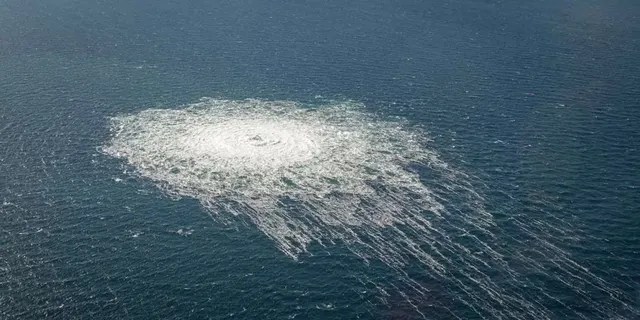
Someone blew up the Nord Stream pipelines, creating an untold environmental catastrophe as the pipes leaked huge quantities of methane, a supremely active global-warming gas. It was an act of unrivaled industrial and environmental terrorism.

If Washington had been able to pin the explosions on Russia, as it initially hoped, it would have done so with full vigor. There is nothing Western states would like more than to intensify world fury against Moscow, especially in the context of NATO’s express efforts to “weaken” Russia through a proxy war waged in Ukraine.

But, after the claim made the rounds of front pages for a week or two, the story of Russia destroying its own pipelines was quietly shelved. That was partly because it seemed too difficult to maintain a narrative in which Moscow chose to destroy a critical part of its own energy infrastructure.

Not only did the explosions cause Russia great financial harm – the country’s gas and oil revenues regularly financed nearly half of its annual budget – but the blasts removed Moscow’s chief influence over Germany, which had been until then heavily dependent on Russian gas. The initial media story required the Western public to believe that President Vladimir Putin willingly shot himself in the foot, losing his only leverage over European resolve to impose economic sanctions on his country.

But even more than the complete lack of a Russian motive, Western states knew they would be unable to build a plausible forensic case against Moscow for the Nord Stream blasts.

Instead, with no chance to milk the explosions for propaganda value, official Western interest in explaining what had happened to the Nord Stream pipelines wilted, despite the enormity of the event. That was reflected for months in an almost complete absence of media coverage.

When the matter was raised, it was to argue that separate investigations by Sweden, Germany and Denmark were all drawing a blank. Sweden even refused to share any of its findings with Germany and Denmark, arguing that to do so would harm its “national security.”

No one, again including the Western media, raised an eyebrow or showed a flicker of interest in what might be really going on behind the scenes. Western states and their compliant corporate media seemed quite ready to settle for the conclusion that this was a mystery cocooned in an enigma.

Isolated and friendless

It might have stayed that way forever, except that in February, a journalist – one of the most acclaimed investigative reporters of the past half-century – produced an accountthat finally demystified the explosions. Drawing on at least one anonymous, highly placed informant, Seymour Hersh pointed the finger for the explosions directly at the US administration and President Joe Biden himself.

Hersh’s detailed retelling of the planning and execution of the Nord Stream blasts had the advantage – at least for those interested in getting to the truth of what took place – that his account fitted the known circumstantial evidence.

Key Washington figures, from President Biden to Secretary of State Anthony Blinken and his senior neoconservative official Victoria Nuland – a stalwart of the murky US, anti-Russia meddling in Ukraine over the past decade – had either called for the destruction of the Nord Stream pipelines or celebrated the blasts shortly after they took place.

If anyone had a motive for blowing up the Russian pipelines – and a self-declared one at that – it was the Biden administration. They opposed the Nord Stream 1 and 2 projects from the outset – and for exactly the same reason that Moscow so richly prized them.

In particular, the second pair of pipelines, Nord Stream 2, which was completed in September 2021, would double the amount of cheap Russian gas available to Germany and Western Europe. The only obstacle in its path was the hesitancy of German regulators. They delayed approval in November 2021.

Nord Stream meant major European countries, most especially Germany, would be completely dependent for the bulk of their energy supplies on Russia. That deeply conflicted with US interests. For two decades, Washington had been expanding NATO as an anti-Moscow military alliance embracing ever more of Europe, to the point of butting up aggressively against Russia’s borders.

The Ukrainian government’s covert efforts to become a NATO member – thereby destroying a long-standing mutual and fragile nuclear deterrence between Washington and Moscow – were among the stated reasons why Russia invaded its neighbor in February last year.

Washington wanted Moscow isolated and friendless in Europe. The goal was to turn Russia into Enemy No. 2 – after China – not leave Europeans looking to Moscow for energy salvation.

The Nord Stream explosions achieved precisely that outcome. They severed the main reason European states had for cozying up to Moscow. Instead, the US started shipping its expensive liquified natural gas across the Atlantic to Europe, both forcing Europeans to become more energy dependent on Washington and, at the same time, fleecing them for the privilege.

But even if Hersh’s story fitted the circumstantial evidence, could his account stand up to further scrutiny?

Peculiarly incurious

This is where the real story begins. Because one might have assumed that Western states would be queuing up to investigate the facts Hersh laid bare, if only to see if they stacked up or to find a more plausible alternative account of what happened.

Dennis Kucinich, a former chair of a US Congressional investigative subcommittee on government oversight, has noted that it is simply astonishing no one in Congress has been pushing to use its powers to subpoena senior American officials, such as the secretary of the Navy, to test Hersh’s version of events. As Kucinich observes, such subpoenas could be issued under Congress’s Article One, Section 8, Clause 18, providing “constitutional powers to gather information, including to inquire on the administrative conduct of office.”

Similarly, and even more extraordinarily, when a vote was called by Russia at the United Nations Security Council late last month to set up an independent international commission to investigate the blasts, the proposal was roundly rejected.

If adopted, the UN Secretary-General himself would have appointed expert investigators and aided their work with a large secretariat.

Three Security Council members, Russia, China and Brazil, voted in favor of the commission. The other 12 – the US and its allies or small states it could easily pressure – abstained, the safest way to quietly foil the creation of such an investigative commission.

Excuses for rejecting an independent commission failed to pass the sniff test. The claim was that it would interfere with the existing investigations of Denmark, Sweden and Germany. And yet all three have demonstrated that they are in no hurry to reach a conclusion, arguing that they may need years to carry out their work. As previously noted, they have indicated great reluctance to cooperate. And last week, Sweden once again stated that it may never get to the bottom of the events in the Baltic Sea.

As one European diplomat reportedly observed of meetings between NATO policymakers, the motto is: “Don’t talk about Nord Stream.” The diplomat added: “It’s like a corpse at a family gathering. It’s better not to know.”

It may not be so surprising that Western states are devoted to ignorance about who carried out a major act of international terrorism in blowing up the Nord Stream pipelines, considering that the most likely culprit is the world’s only superpower and the one state that can make their lives a misery.

But what should be more peculiar is that Western media have shown precisely no interestin getting to the truth of the matter either. They have remained completely incurious to an event of enormous international significance and consequence.

It is not only that Hersh’s account has been ignored by the Western press as if it did not even exist. It is that none of the media appear to have made any effort to follow up with their own investigations to test his account for plausibility.

‘Act of war’

Hersh’s investigation is filled with details that could be checked ­– and verified or rebutted – if anyone wished to do so.

He set out a lengthy planning stage that began in the second half of 2021. He names the unit responsible for the attack on the pipeline: the US Navy’s Diving and Salvage Center, based in Panama City, Florida. And he explains why it was chosen for the task over the US Special Operations Command: because any covert operation by the former would not need to be reported to Congress.

In December 2021, according to his highly placed informant, National Security Adviser Jake Sullivan convened a task force of senior administration and Pentagon officials at the request of Biden himself. They agreed that the explosions must not be traceable back to Washington; otherwise, as the source noted: “It’s an act of war.”

The CIA brought in the Norwegians, stalwarts of NATO and strongly hostile to Russia, to carry out the logistics of where and how to attack the pipelines. Oslo had its own additional commercial interests in play, as the blasts would make Germany more dependent on Norwegian gas, as well as American supplies, to make up the shortfall from Nord Stream.

By March last year, shortly after Russia’s invasion of Ukraine, the precise site for the attack had been selected: in the Baltic’s shallow waters off Denmark’s Bornholm Island, where the sea floor was only 260ft below the surface, the four pipelines were close together and there were no strong tidal currents.

A small number of Swedish and Danish officials were given a general briefing about unusual diving activities to avoid the danger that their navies might raise the alarm.

The Norwegians also helped develop a way to disguise the US explosive charges so that, after they were laid, they would not be detected by Russian surveillance in the area.

Next, the US found the ideal cover. For more than two decades, Washington has sponsored an annual NATO naval exercise in the Baltic every June. The US arranged that the 2022 event, Baltops 22, would take place close to Bornholm Island, allowing the divers to plant the charges unnoticed.

The explosives would be detonated through the use of a sonar buoy dropped by plane at the time of President Biden’s choosing. Complex arrangements had to be taken to make sure the explosives would not be accidentally triggered by passing ships, underwater drilling, seismic events or sea creatures.

Three months later, on September 26, the sonar buoy was dropped by a Norwegian plane, and a few hours later three of the four pipelines were put out of commission.

Disinformation campaign

The Western media’s response to Hersh’s account has perhaps been the most revealing aspect of the entire saga.

It is not just that the establishment media have been so uniformly and remarkably reticent to dig deeper into making sense of this momentous crime – beyond making predictable, unevidenced accusations against Russia. It is that they have so obviously sought to dismiss Hersh’s account before making even cursory efforts to confirm or deny its specifics.

The knee-jerk pretext has been that Hersh has only one anonymous source for his claims. Hersh himself has noted that, as with other of his famous investigations, he cannot always refer to additional sources he uses to confirm details because those sources impose a condition of invisibility for agreeing to speak to him.

That should hardly be surprising when informants are drawn from a small, select group of Washington insiders and are at great risk of being identified – at great personal cost to themselves, given the US administration’s proven track record of persecuting whistleblowers.

But the fact that this was indeed just a pretext from the establishment media becomes much clearer when we consider that those same journalists dismissive of Hersh’s account happily gave prominence to an alternative, highly implausible, semi-official version of events.

In what looked suspiciously like a coordinated publication in early March, The New York Times and Germany’s Die Zeit newspapers printed separate accounts promising to solve “one of the central mysteries of the war in Ukraine.” The Times headline asked a question it implied it was about to answer: “Who Blew Up the Nord Stream Pipelines?”

Instead, both papers offered an account of the Nord Stream attack that lacked detail, and any detail that was supplied was completely implausible. This new version of events was vaguely attributed to anonymous American and German intelligence sources – the very actors, in Hersh’s account, responsible both for carrying out and covering up the Nord Stream blasts.

In fact, the story had all the hallmarks of a disinformation campaign to distract from Hersh’s investigation. It threw the establishment media a bone: the chief purpose was to lift any pressure from journalists to pursue Hersh’s leads. Now they could scurry around, looking like they were doing their job as a “free press” by chasing a complete red herring supplied by U.S. intelligence agencies.

Which is why the story was widely reported, notably far more widely than Hersh’s much more credible account.

So what did the New York Times’ account claim? That a mysterious group of six people had hired a 50ft yacht and sailed off to Bornholm Island, where they had carried out a James Bond-style mission to blow up the pipelines. Those involved, it was suggested, were a group of “pro-Ukrainian saboteurs”– with no apparent ties to President Volodymyr Zelenskiy – who were keen to seek revenge on Russia for its invasion. They used fake passports.

The Times further muddied the waters, reporting sources that claimed some 45 “ghost ships” had passed close to the site of the explosion when their transponders were not working.

The crucial point was that the story shifted attention away from the sole plausible possibility, the one underscored by Hersh’s source: that only a state actor could have carried out the attack on the Nord Stream pipelines. The highly sophisticated, extremely difficult operation needed to be concealed from other states, including Russia that were closely surveilling the area.

Now the establishment media was heading off on a completely different tangent. They were looking not at states – and most especially not the one with the biggest motive, the greatest capability and the proven opportunity.

Instead, they had an excuse to play at being reporters, visiting Danish yachting communities to ask if anyone remembered the implicated yacht, the Andromeda, or suspicious characters aboard it, and trying to track down the Polish company that hired the sailing boat. The media had the story they preferred: one that Hollywood would have created, of a crack team of Jason Bournes giving Moscow a good slapping and then disappearing into the night.

Welcome mystery

A month on, the media discussion is still exclusively about the mysterious yacht crew, though – after reaching a series of dead-ends in a story that was only ever meant to have dead-ends – establishment journalists are asking a few tentative questions. Though, let us note, most determinedly not questions about any possible US involvement in the Nord Stream sabotage.

Britain’s Guardian newspaper ran a story last week in which a German “security expert” wondered whether a group of six sailors was really capable of carrying out a highly complex operation to blow up the Nord Stream pipelines. That is something that might have occurred to a less credulous newspaper a month earlier when the Guardian simply regurgitated the Times’ disinformation story.

But despite the security expert’s skepticism, the Guardian is still not eager to get to the bottom of the story. It conveniently concludes that the “investigation” conducted by the Swedish public prosecutor, Mats Ljungqvist, will be unlikely ever to “yield a conclusive answer”.

Or as Ljungqvist observes: “Our hope is to be able to confirm who has committed this crime, but it should be noted that it likely will be difficult given the circumstances.”

Hersh’s account continues to be ignored by the Guardian – beyond a dismissive reference to several “theories” and “speculation” other than the laughable yacht story. The Guardian does not name Hersh in its report or the fact that his highly placed source fingered the US for the Nord Stream sabotage. Instead, it notes simply that one theory – Hersh’s – has been “zeroing on a Nato Baltops 22 wargame two months before” the attack. 

It’s all still a mystery for the Guardian – and a very welcome one by the tenor of its reports.

The Washington Post has been performing a similar service for the Biden administration on the other side of the Atlantic. A month on, it is using the yacht story to widen the enigma rather than narrow it down.

The paper reports that unnamed “law enforcement officials” now believe the Andromeda yacht was not the only vessel involved, adding: “The boat may have been a decoy, put to sea to distract from the true perpetrators, who remain at large, according to officials with knowledge of an investigation led by Germany’s attorney general.”

The Washington Post’s uncritical reporting surely proves a boon to Western “investigators”. It continues to build an ever more elaborate mystery, or “international whodunnit,” as the paper gleefully describes it. Its report argues that unnamed officials “wonder if the explosive traces – collected months after the rented boat was returned to its owners – were meant to falsely lead investigators to the Andromeda as the vessel used in the attack.”

The paper then quotes someone with “knowledge of the investigation”: “The question is whether the story with the sailboat is something to distract or only part of the picture.”

How does the paper respond? By ignoring that very warning and dutifully distracting itself across much of its own report by puzzling whether Poland might have been involved too in the blasts. Remember, a mysterious Polish company hired that red-herring yacht.

Poland, notes the paper, had a motive because it had long warned that the Nord Stream pipelines would make Europe more energy dependent on Russia. Exactly the same motive, we might note – though, of course, the Washington Post refuses to do so – that the Biden administration demonstrably had.

The paper does inadvertently offer one clue as to where the mystery yacht story most likely originated. The Washington Post quotes a German security official saying that Berlin “first became interested in the [Andromeda] vessel after the country’s domestic intelligence agency received a ‘very concrete tip’ from a Western intelligence service that the boat may have been involved in the sabotage”.

The German official “declined to name the country that shared the information” – information that helpfully draws attention away from any US involvement in the pipeline blasts and redirects it to a group of untraceable, rogue Ukraine sympathizers.

The Washington Post concludes that Western leaders “would rather not have to deal with the possibility that Ukraine or allies were involved”. And, it seems the Western media – our supposed watchdogs on power – feel exactly the same way.

‘Parody’ intelligence

In a follow-up story last week, Hersh revealed that Holger Stark, the journalist behind Die Zeit’s piece on the mystery yacht and someone Hersh knew when they worked together in Washington, had imparted to him an interesting additional piece of information divulged by his country’s intelligence services.

Hersh reports: “Officials in Germany, Sweden, and Denmark had decided shortly after the pipeline bombings to send teams to the site to recover the one mine that has not gone off. [Holger] said they were too late; an American ship had sped to the site within a day or two and recovered the mine and other materials.”

Holger, Hersh says, was entirely uninterested in Washington’s haste and determination to have exclusive access to this critical piece of evidence: “He answered, with a wave of his hand, ‘You know what Americans are like. Always wanting to be first.’” Hersh points out: “There was another very obvious explanation.”

Hersh also spoke with an intelligence expert about the plausibility of the mystery yacht story being advanced by the New York Times and Die Zeit. He described it as a “parody” of intelligence that only fooled the media because it was exactly the kind of story they wanted to hear. He noted some of the most glaring flaws in the account:

‘Any serious student of the event would know that you cannot anchor a sailboat in waters that are 260 feet deep’ – the depth at which the four pipelines were destroyed – ‘but the story was not aimed at him but at the press who would not know a parody when presented with one.’

Further:

‘You cannot just walk off the street with a fake passport and lease a boat. You either need to accept a captain who was supplied by the leasing agent or owner of the yacht, or have a captain who comes with a certificate of competency as mandated by maritime law. Anyone who’s ever chartered a yacht would know that.’ Similar proof of expertise and competence for deep sea diving involving the use of a specialized mix of gases would be required by the divers and the doctor.

And:

‘How does a 49-foot sailboat find the pipelines in the Baltic Sea? The pipelines are not that big and they are not on the charts that come with the lease. Maybe the thought was to put the two divers into the water’– not very easy to do so from a small yacht – ‘and let the divers look for it. How long can a diver stay down in their suits? Maybe fifteen minutes. Which means it would take the diver four years to search one square mile.’

The truth is that the Western press has zero interest in determining who blew up the Nord Stream pipelines because, just like Western diplomats and politicians, media corporations don’t want to know the truth if it cannot be weaponized against an official enemy state.

The Western media are not there to help the public monitor the centers of power, keep our governments honest and transparent, or bring to book those who commit state crimes. They are there to keep us ignorant and willing accomplices when such crimes are seen as advancing on the global stage the interests of Western elites – including the very transnational corporations that run our media.

Which is precisely why the Nord Stream blasts took place. The Biden administration knew not only that its allies would be too fearful to expose its unprecedented act of industrial and environmental terrorism but that the media would dutifully line up behind their national governments in turning a blind eye.

The very ease with which Washington has been able to carry out an atrocity – one that has caused a surge in the cost of living for Europeans, leaving them cold and out of pocket during the winter, and added considerably to existing pressures that have been gradually de-industrializing Europe’s economies – will embolden the US to act in equally rogue ways in the future.

In the context of a Ukraine war in which there is the constant threat of a resort to nuclear weapons, where that could ultimately lead should be only too obvious.


The Impending Economic Collapse – A Cause of Current Conflict

By Phil Butler

Source: New Eastern Outlook

Brazil’s Luiz Inacio Lula da Silva has called on BRICS nations to create an alternative to replace the dollar in foreign trade. Other experts suggest President Joe Biden’s policies will destroy America’s middle class for good. The news comes when China and Russia strengthen ties with Brazil and Latin America. Brazil’s leader questioned the institution of the U.S. dollar as the world’s trade currency in the first place and asked why each country could not trade in its currency.

This brings to the forefront the historical moment when the gold standard was abolished in favor of the current system. When President Richard Nixon moved to abolish the gold standard as a commitment mechanism, his administration ushered in decades of relative volatility and made hard currency.

The exchange of gold was severely curtailed through the Bretton Woods international monetary agreement of 1944. When the International Monetary Fund was established, the U.S. Dollar became the most potent currency in the world. Initially, the role of the IMF was only to assist with international transactions, but as we see today, that institution has far overstepped its original purpose. Today, the IMF is a leverage arm for the United States and a few European nations to fund countries/regimes that align with its policy. The U.S., for instance, has an almost 20% share of contributions to the fund.

The primary purpose of remaining off the gold standard is that the government can print money endlessly, with two primary goals. First, a massive defense budget and needless proxy wars would not be possible if the United States were on the gold standard. Secondly, the people who control the central banks cannot extract interest on national debts that are currently out of control. So, the fiat currency supposedly backed by the “full faith and credit” of the government, the dollar, is worth what lying politicians and finance ministers say it is.

One look at the worldwide bond market reveals a disturbing imbalance. The U.S., which now has over $51 trillion in outstanding debt, has borrowed more to finance wars and programs than China, Japan, Germany, Italy, France, the U.K., and Canada combined. The American taxpayer is responsible for almost 40% of all the foreign debt in the world. And the outlook for the short and long-term future could be better.

President Joe Biden wants to borrow even more when his administration conducts a proxy war against Russia in Ukraine. With billions flowing into Europe’s most corrupt country, Americans are on the precipice of an economic catastrophe not seen since the Great Depression.

According to the Bipartisan Policy Center in Washington and the Congressional Budget Office, the government will no longer be able to pay everyone — including bondholders, Social Security recipients, and federal employees — sometime this summer or early this fall. A New York Times report from late March outlines the situation. But the problem is far worse than many experts suggest. No matter which way lawmakers move, the U.S. has almost insurmountable fiscal issues. The ramifications will be dire whether or not they raise the debt limit. And if the BRICS countries go off the dollar as a trade currency… Well.

Many experts predict that American greenbacks won’t be worth the printed paper if the world stops using the U.S. dollar as its world currency reserve. Moreover, if the dollar loses its value significantly, every American who owes a credit card loan or a home mortgage will find it ten times harder to pay off those debts.

To make matters worse, millions of jobs will be sacrificed for the Federal Reserve to get any financial stability. Analysis from RSM International shows that the central banks must “induce” a recession to get America’s economic situation in check. And the dollar being made useless by the larger world community was not a factor in their analysis.

The bottom line is if we were still on the gold standard, this would be fine. The gold standard reduced the risks of such economic crises and recessions. Income levels were higher when we were on the bullion-backed system. More importantly, the gold standard created hard limits on printing money and limiting military spending. For more intuition on this, this Barron’s report reveals how our current failing system came into being. The information also serves as a crystal ball for what will happen.

As confidence in the dollar wanes and U.S. policy overseas gets more aggressive toward BRICS nations and others, the tipping point of the American hegemony draws closer.

Did Bellingcat get Ukrainian forces killed?

By Kit Klarenberg

Source: The Grayzone

Christo Grozev of Bellingcat gained a front row seat to a bungled Ukrainian intelligence operation that left a friendly airfield destroyed and soldiers dead. His narrative about his role in the plot is filled with holes.

Criminal charges of treason and abuse of power have been leveled against an unspecified number of Ukrainian servicemen by the Security Service of Ukraine (SBU). In a bizarre plot to seize Russian aircraft and transfer the planes to Ukraine, the accused soldiers disclosed sensitive information that allowed Moscow to strike an important Ukrainian airfield with a Kalibr missile. A commander was killed, 17 airmen were wounded, two fighter jets destroyed, and “significant damage” was inflicted to the airstrip and several nearby buildings.

Will Ukrainian authorities now level criminal charges against members of Bellingcat, the Western government-funded open source investigations collective, for its role in the connivance? Christo Grozev, the organization’s “lead Russia investigator,” was inexplicably granted a front row seat to the chicanery by the individuals who attempted to carry it out. 

Once the plot unravelled spectacularly, Grozev attempted to spin it as an embarrassment for Russia, while denying the SBU or Ukraine’s Defense Intelligence Directorate (GUR) played any role in its execution. Instead, he claimed, it was the work of “maverick ex-operatives.” The criminal cases pursued by the SBU validate this narrative:

“These actions of individual servicemen [emphasis added], which led to serious consequences, death and injury of Ukraine’s defenders and harmed the country’s defence capabilities, require an appropriate legal assessment.”

As we will see, Grozev was far from a passive spectator in the scheme. Indeed, his framing of the event gives every appearance of a damage control exercise, shielding Bellingcat and the GUR and SBU from blame. Coincidentally, his Bellingcat website profile notes his interest in “the weaponization of information.”

Read Alex Rubinstein’s report on Christo Grozev’s defense of a terror attack on a St. Petersburg, Russia cafe, and his call for more of such actions.

Bulgarian journalist and Bellingcat’s “lead Russia investigator” Christo Grozev

Bellingcat’s proxy war blunders pile up

Since the war in Ukraine began, Christo Grozev and Bellingcat have played a lead role in disseminating and “verifying” dubious, if not outright fraudulent, material and claims related to the conflict. 

Just over a week after Russia’s February 24, 2022 invasion, Grozev confidently declared that Moscow’s war-fighting resources would be spent by March 6th, at which time Russian forces would “collapse.” Over a year later, the gears of the Russian war machine are still churning away.

By the end of March 2022, Bellingcat had fed the Wall Street Journal an entirely bogus tale, asserting that oligarch Roman Abramovich and two Ukrainian negotiators who had been trying to broker peace between their two countries were poisoned.

The finding was the result of an investigation reportedly organized by Grozev, who claimed to have seen the images of the effects of the attack. He further alleged that “too much time had passed for the suspected poison to be detected by the time a German forensic team was able to perform an examination,” accounting for why his assertions could not be verified by authorities.

“It was not intended to kill, it was just a warning,” Grozev falsely declared.

Though Ukrainian and US officials quickly dismissed the story as fantasy, Grozev was not deterred. In late April 2022, while appearing on a charity telethon for Kiev, he claimed to have “personally checked,” and found that Russia had already lost “90%” of the “highest quality, important and essential part of its army, without which it is impossible to conquer key infrastructure facilities.” 

For the families of those killed at Kanatove airfield, and the countless conscripts who have lost their lives under Russian artillery fire in Bakhmut, such comments must seem like a sick joke.

Bellingcat’s Grozev spins a cinematic yarn

On July 25th 2022, Moscow’s state-owned news agency TASS reported that Russia’s FSB security agency had thwarted a Ukrainian operation to steal Russian aircraft, “supervised by NATO.” 

Intelligence officers acting on behalf of Kiev’s political leadership reportedly approached Russian military pilots in secret, offering them millions of dollars and citizenship of an EU country of their choosing in return for deliveries of aircraft such as Su-24s and Su-34s. 

Several pilots appeared to take the bait. And it turned out that Bellingcat’s Christo Grozev had been helping to cultivate the turncoats through a series of exchanges on encrypted messaging apps. 

However, the FSB had apparently infiltrated the plot from the outset, and were using discussions over defection to glean sensitive information from the Ukrainians. This yield then helped the Russian air force to “inflict fire damage on a number of Ukrainian military facilities.”

The Russian strike on Ukraine’s Kanatove airfield, and the SBU’s criminal investigation of the incident, tends to confirm that version of events. However, in the wake of the TASS report, Grozev offered a radically different tale: a “crazier-than-fiction story of triple-agents, fake passports and faux girlfriends.” 

The Bellingcat staffer claimed that after Kiev passed a law in April offering financial incentives to Russians to surrender and hand over weapons and vehicles, “a team of Ukrainian operatives decided to approach Russian pilots with an offer based on this law.” Bellingcat miraculously “found out about the initiative” and secured a “front seat” to make a documentary about a “brazen operation.”

Grozev and company then watched as Russian pilots were successfully lured into providing “proof-of-access” videos from inside their planes, some of which were “quite detailed and enlightening,” as they prepared to defect. It was only then that the FSB became involved, as the Ukrainians learned later on. At this point, the plot morphed into a “double ‘operational game’ in which both sides were trying to extract maximum information from the other, while feeding them maximum disinfo.”

The Ukrainians peddled the FSB “fake maps of their anti-aircraft deployments, as well as disinfo on the operational airstrips.” They even convinced the security service to send one of the pilot’s wives, “along with a whole FSB tailing team,” to Minsk, Belarus for an in-person meeting. When nobody showed up, the Russians realized they had been “burned,” the Ukrainians realized they were not “getting a real pilot,” and the “mutual-deceit game came to an end.”

“While Russia is presenting today this as a coup for its counter intelligence, in fact the operation was a serious blunder for the FSB, disclosing unintentionally identities of dozens of counter intel officers, their methods of operation, and their undercover assets,” Grozev boldly declared.

After pushback, Grozev changes his story

The narrative Grozev spun out was marred by several obvious problems. How did Bellingcat learn of a secret Ukrainian operation? Why were outsiders – particularly ostensibly independent journalists – encouraged by the plotters to film a documentary on the operation as it was being conducted? Why did Grozev wait for the FSB to get the first word, if the plot was such a stunning success for the Ukrainians? 

Perhaps most pertinently of all, if Bellingcat played no active part in the connivance and were simply observers, how did the Russians learn of their presence, to be able to falsely accuse Grozev of involvement?

Even if Grozev’s version of events were true, it provides numerous indications that Bellingcat assisted the so-called “Ukrainian operatives.”

For example, one of the pilots sent the Ukrainians a photo of his “lover,” whom he wished to take with him when he defected. Grozev boasted that it took him “about five minutes” to discover that the woman was in reality “an FSB girlfriend-for-hire.” Did he keep this information siloed from the “operatives”? Would Grozev really not share this revelation with the supposed subjects of his “documentary”?

While many took Grozev’s unbelievable fable at face value, several of Bellingcat’s normally deferential mainstream boosters began asking if the organization’s involvement with “Ukrainian operatives” placed it in direct quarters with the SBU and GUR. At this point, Grozev felt compelled to issue a clarification. He claimed neither agency was involved, and if either had been, “there’d be no way we would – or want to – get access to it.”

Instead, Grozev contended the Ukrainians in contact with Bellingcat had been “maverick ex-operatives” who he met during a previous investigation, and that they were acting independently of the government and security services. As such, he claimed the FSB’s counterintelligence wing was “fighting tooth and nail against a bunch of, essentially, volunteers.”

Grozev’s clunky narrative raised far more suspicion than it allayed. It is inconceivable that such a sensitive attempt to secure defections during wartime would be conducted without state authorization or knowledge. This is particularly the case if defections are sought under the terms of a dedicated government program providing financial incentives for switching sides and handing over military hardware.

Offers of money and EU citizenship for the pilots and their “lovers” would have necessarily needed to be approved by Kiev. Even if the Ukrainian “ex-operatives” ultimately intended to betray the defectors and not provide what they promised, the Ukrainian military would have by definition needed to agree to the pilots’ arrival, and their planned flightpaths, in advance. Otherwise, their jets would be shot down before they landed.

In any event, not providing the pilots with what was offered would inevitably deter any further defections from the Russian side, therefore sabotaging the government’s high-profile incentive scheme outright.

Bonfire of security officials suggests state involvement

In a curious twist, just hours after Grozev deployed a blizzard of excuses, Ukrainian President Volodymyr Zelensky fired the First Deputy Secretary of the National Security and Defense Council, Ruslan Demchenko, and Special Operations Forces (SSO) commander Hryhoriy Halahan. Both positions are directly related to clandestine operations, such as attempts to facilitate Russian military defections.

The firings followed the surprise canning of Zelensky’s childhood friend and close confidante, Ivan Bakanov, as SBU chief on July 17th 2022. Bakanov was officially dismissed under Article 47 of the Disciplinary Statute of the Armed Forces of Ukraine: “non-performance (improper performance) of official duties, which caused human casualties or other serious consequences or created a threat of such consequences.” The grounds for his termination echo the charges faced by the unnamed Ukrainian servicemen.

It is not hard to imagine the righteous fury that would have erupted in Mariinskyi Palace if Zelensky were told the FSB had stitched up a plot to recruit Russian pilots and their cutting-edge fighter jets. Public confirmation on July 25 that the conspiracy had been a setup all along would have provided ample grounds for the firing of Demchenko and Halahan.

This March, Yahoo News published a lengthy investigation supporting Grozev’s claims that the Ukrainians involved were mere “volunteers,” and that Russian pilots had indeed been planning to defect, only for the FSB to catch them and step in. However, the report also revealed that substantial amounts of money had been sent to the pilots to convince them to defect. The sums were so high, it is almost inconceivable Kiev did not pay them, reinforcing the interpretation that the mission was state-approved.

While basing its story exclusively on testimony and material supplied by an unnamed “volunteer,” Yahoo News nonetheless acknowledged at least one of the pilots may have been working for the FSB all along. Moreover, it claimed some of the pilots could still be active in the Ukraine war, which obviously would not be the case if they had ever seriously intended to defect.

Did careless disclosures from the “volunteer” to Yahoo News play any role in triggering the SBU’s sudden move to prosecute the individuals involved? It would by definition silence them, killing off any and all suggestions the cataclysm was Kiev’s own doing. Alternatively, with Western military aid running out and the Pentagon and mainstream media alike acknowledging Russia’s air force will soon fly effectively unopposed in Ukrainian airspace, it may be necessary to find people to blame.

Grozev has remained eerily silent about the SBU’s criminal investigation. It would be reasonable to expect a “documentarian” with such a candid, insider view of what went down to be a suspect, or at least a witness, in such a probe. Should he and his fellow laptop jockeys not be charged with assisting reckless actions of “individual servicemen” that cost lives, it would strongly suggest Bellingcat enjoys some degree of protection from Ukrainian security and intelligence services.

While Bellingcat and Christo Grozev seek to downplay their role in a high-level Ukrainian intelligence operation, their website continues to refer to their organization as “an independent investigative collective.”

USAID Board Member Says ‘New World Order’ will Continue Despite a Rising Multipolar World

By Timothy Alexander Guzman

Source: Silent Crow News

That same old American institution called the United States Agency for International Development (USAID) who supports regime change and wars across the world has a board member who wrote an opinion piece for The Hill, a liberal online news organization on the relevance of the rules-based order and how much the world needs it.  Harley Lippman, a board member for USAID wrote about how the rules-based order (New World Order) will continue despite the challenges of a multipolar world and the peace dividends it has brought to the table thus far.  Lippman’s claims about where the rules-based order stands in this new world of geopolitics is propaganda at its best, so you might already know where this article is going since the liberal media is absolutely pro-establishment and pro-war.  

Lippman wrote an opinion piece called ‘The rules-based order will endure, despite ‘shifting sands’ based on Russia and China’s achievements that includes establishing a diplomatic solution between Iran and Saudi Arabia and bringing back Syria into the fold with the rest of the Middle East which is a big deal, but to Lippman, it “rings hollow”, its insincere:

Russia and China recently have attempted to act as chief mediators on the international stage. Russia reportedly facilitated meetings between Saudi Arabia and Syria to restore ties and reopen their respective consular services, and China played peacemaker between Saudi Arabia and Iran. More recently, Saudi Arabia’s Cabinet approved a decision to join the Shanghai Cooperation Organization (SCO) as a dialogue partner. The SCO was created to counter U.S. economic hegemony and includes longtime adversaries and partners of our country. These recent developments have been described by some as evidence of the decline of the U.S.-led rules-based order.

Despite the clamoring of pundits to bemoan America’s decline, Moscow and Beijing’s attempts at diplomatic relevance ring hollow as the U.S. shores up the post-World War II international order by reinvigorating existing strategic alliances that underpin various security architectures

Lippman says that the US-led rules-based order is in decline but at the same time, it is working on replenishing its old alliances as a counterweight to Russia and China even though they were able to forge a peaceful solution among nations who were at odds against each other at one time or another.  However, Russia and China are trying to establish real peaceful solutions among nations and that should be welcomed by the international community.  Lippman says that “the U.S. values its alliance with Japan and South Korea in the Asia-Pacific to serve as a counterweight to an increasingly belligerent China.”  A belligerent China?  How many military bases does the US have around the world?  In fact, how many of these bases surround China?  China’s peace initiatives should be welcomed at all costs.  Bringing peace is a good thing while the US and its Western allies (and Israel) has brought endless wars and chaos on almost every continent on the planet, in fact the US war machine has killed more than 20 million people since World War II.  In other words, when Lippman says that the US “values” its alliance with Japan and South Korea, he is talking about the continuation of selling them military hardware and keeping the same US bases in place to counter China’s growing influence in the region so that the US war machine can keep antagonizing China in the South Pacific sea at all costs even if it means starting a war.   

Lippman also takes aim at Russia, “Correspondingly, America’s role in NATO is pivotal to the West’s efforts to face off an aggressive Russia that threatens the security of Europe and the Balkans.”  Seriously?  Wasn’t Ukraine’s continuous bombardment of the Eastern Donbass region for more than 8 years killing at least 8,000 Ukrainian people who spoke Russian an aggressive action that was and still is supported by the US-NATO alliance? 

The US has used its alliances to counter Russia and China as part of the old rules-based order strategy of divide and conquer in Asia and Eastern Europe.  In other words, he wants Washington to keep the same policies of funding and arming one-side against another to advance the US war machine and continue the rules-based order to establish their Great Reset agenda.  

Concerning the Middle East, Russia and China also have a wide range of interests with Iran, therefore that arrangement angers the US political establishment and their bosses who are based in Israel, and that’s the other problem for Lippman:

In contrast to America’s values-based approach to allies and partners, engagement with Russia and China offers only a transactional and interest-based relationship that rests on economic ties both countries share equally with such aggressors as Iran and Iran’s proxies 

Russia and China’s strategic partnership with Iran, Syria and now Saudi Arabia bypasses US interests in the region so for most of the people in the Middle East, it’s a new development that is welcomed in a region that has only experienced regime change and endless wars that the US and its closest ally, Israel sponsored and at times participated in since the end of World War II:   

Riyadh’s decision to restore diplomatic relations with Tehran via China is an attempt to reduce regional tensions with an aggressive neighbor committed to militant Islam and regional hegemony. In the near term, Tehran will likely seek to avoid actions that threaten this new relationship. However, absent an Iranian decision to radically redefine its foreign policy and abolish the Revolutionary Guards, this rapprochement is likely to collapse in the wake of fresh Iranian violence

First, let me start by saying that Iran is not looking to expand into a hegemonic footprint in the Middle East, it is Israel who is looking to expand its territorial ambitions by hoping to destroy all its Arab neighbors’ piece by piece and carry-out Oded Yinon’s plan or what is known as the “Greater Israel” project.  Rabbi Fischmann, a member of the Jewish Agency for Palestine testified to the U.N. Special Committee of Enquiry on July 9th, 1947, said that “the Promised Land extends from the River of Egypt up to the Euphrates, it includes parts of Syria and Lebanon.” But Iran is the aggressor?  The rules-based order will continue if the U.S. Central Command (CENTCOM) focuses on its security commitments according to Lippman:

America’s security commitment to the region must be paramount. U.S. Central Command (CENTCOM) remains the foundation of the region’s security architecture that protects trade and energy arteries critical to global economic stability. The Biden administration should ensure that CENTCOM remains well-resourced and focused on building regional partnerships. Furthermore, economic ties must be strengthened. American firms view the region with enthusiasm. The Biden administration must be more vocal in its support for trade and expedite approvals for technology sharing on 5G and 6G communications, green energy, and space. Furthermore, increased cabinet-level visits to the region would demonstrate the U.S.’s commitment to the region. While this will not offset the inevitable commercial relationships between the Gulf States and China, it will assert America’s ability to compete in this strategic region

Using the Sunni-Shiite argument is propaganda to further instigate that there is a sectarian divide in the Arab world for thousands of years’, and the threat of a nuclear-armed Iran and because of that, the US security structure under CENTCOM will remain in place since the US and Saudi Arabia has a long-standing relationship.  China’s peace deal between Iran and Saudi Arabia is what he calls “cosmetic”, and that China has no place for its peace initiative in the Middle East:

Despite the region’s “shifting sands” of ever-changing relationships, the Sunni-Shiite tensions are over a thousand years old and Iran’s advancement toward nuclear status has every U.S. partner in the Middle East on alert. The traditional security architecture underpinned by U.S.-Saudi strategic ties will remain intact. As a result, future Chinese transactional neutrality is likely to be cosmetic, devoid of any significant strategic substance. 

The U.S. and its allies can best sustain the rules-based order established after WWII through robust engagement with allies and partners in which we show that we understand and support their core economic and security interests in the same way that we expect they will do the same for American interests

Tell that to the families of the 20 million people that US and its NATO allies killed since the end of World War II.  The old rules-based order has collapsed in the face of a new multipolar world, as for Harley Lippman’s vision for the US and its globalist cabal to continue its hegemonic agenda in this new world of ours, is just wishful thinking.       

China, Russia and India Versus USA, EU and Japan: Axis Powers of a New Global Cold War?

By Gilbert Mercier

Source: New Junkie Post

The birth of a bipolar world order?

Since 2014, which marked the first Russian intervention in Ukraine, a new global geopolitical dynamic has amplified under conflicting impulses. The areas of direct, or more often proxy conflicts, have been in many senses contained with some sort of cynical pressure-cooker mechanism. If empires always seek hegemony, sane geopolitics imply balance to avoid slipping into World War scenarios. We have presently reached a Cold War-like balance between two blocks: the West and their satellites on one side, against BRICS nations and their affiliates on the other side. In the best case scenario, this new cold war could give birth to a lasting bipolar world order: curiously enough, following pretty closely Orwell’s cartography of Oceania & Eurasia.

The West is defined by the US empire and its vassals

The two axes of powers must be explained more precisely. On one side “the West” includes US, UK, EU, Canada, Japan, South Korea and Australia. The command headquarters of this imperial structure are of course located in the United States of America. The empire’s military muscle is NATO. As for the junior members such as the UK, European Union and Japan, they are, despite some claims of the contrary the vassals of big Uncle Sam.

One factor could be viewed as a miscalculation by Vladimir Putin. In many ways his decision last year to start a military operation in Ukraine had a paradoxical effect. The intervention was an attempt by Russia to prevent Ukraine from joining NATO & the EU, but this has failed as Western military gears as well as direct assistance have poured in. Just like in Afghanistan in the 1980’s Russia was effectively sucked into a West proxy war. Meanwhile, NATO has found a new raison d’etre with Finland now officially a member and Sweden soon also to become one. The general paranoia used in Western media to depict Putin as the ultimate bogeyman has worked wonders on Europe’s public opinion.

BRICS & affiliates

On the other side it is more complex as China’s dominance is more subdued than that of the US. Besides the BRICS nations of Brazil, Russia, India, China & South-Africa, other nations are gravitating into the same geopolitical orbit: notably Iran, Venezuela and African countries such as Mali and Burkina Faso. While China is clearly the biggest power within BRICS, the other two major players, which are Russia and India, also are heavyweights on an overall geopolitical and economic scale.

Russia holds vast reserves of energy products, such as gas and oil, and since the European sanctions has quickly worked on redirecting its energy production both towards China and India. India, which has become the most populous country on Earth, has just like China a considerable manufacturing power as well as a huge internal market for products and services. In other words, neither China nor India have to rely mainly on exports to sustain their respective economic growth.

Non-alignment is dead

The concept of non-alignment in a multipolar world, dear to the likes of Tito and de Gaulle, has unfortunately become a geopolitical faux pas at best, or a risky behavior for a small state wanting to stay independent at worst. Because of a lack of political will and leadership, the European Union has basically capitulated from asserting itself as a third block to become a provincial entity of the US empire. The notion of true non-alignment might have run its course in this new bipolar order.

As matter of fact, one of the Ukraine war’s major side effects has been to speed up the process of obedient realignment of the EU to the US. European leaders with their respective media propaganda divisions (either state or corporate controlled) have managed to convince the bulk of their public opinion that the ogre Vladimir Putin and Russia had to be defeated in Ukraine as if the hordes from a memory of the Red Army were about to invade Europe. The Ukraine war has been sold in Europe as a war of necessity to counter an existential threat that was never really there. Public opinion largely bought it, and the financial rewards are pouring into the coffers of the military-industrial complex, as well as US and Qatari energy businesses of natural gas liquefaction, to replace the well-organized Russian gas supply Europe used to get before the sanctions against Russia.

Ukraine war cannot be won on the battle fields

Despite what most people are lead to believe in the West, a military victory by Ukrainian forces, even with full logistic support from NATO in equipment and training is quasi impossible. After all, a lesson should be learned from Afghanistan where the Taliban managed to defeat the mighty alliance. If the EU and the United States cared for the welfare of Ukrainians, they would come to the realization that only a diplomatic solution can resolve the crisis. A sine qua non condition of diplomacy is that it requires concessions on all sides.

For example, let’s take the case of Crimea. It has a complex history. During the 15th century Crimea was under control of the Ottoman Empire. In 1783, the Russian Empire of Tsarina Catherine the Great annexed Crimea after a conflict with Turkey. Lastly, under the authority of Nikita Khrushchev, the USSR gave Crimea to Ukraine in 1954. Therefore, Crimea was Russian for 171 years while it was Ukrainian for only 60 years. The weight of history, in this case, should tilt the balance in favor of Russia.

Military-industrial complex Uber Alles

Wars have always been capitalism‘s best friend. Ultimately they are seldom about the lofty notions of patriotism but systematically about profits. Ukraine’s Western proxy adventure is no exception. As matter of fact, it has been a gargantuan bonanza for the global military-industrial complex and its stockholder war profiteers. Case in point: since Russia started its military operation in Ukraine in February 2022, the United States has spent $30 billion in military equipment which was shipped to Ukraine. This is according to the US Department of Defense.

For its part the European Union is planning a 74 billion Euros increase in military spending within three years. This trend of huge increase in military spending affects all the EU 27 members, as they are allocating bigger shares of their respective GDPs to this weapons race. In December 2022, the European Defense Agency proudly announced that EU defense spending had surpassed 200 billion Euros for the first time in the union’s history. What an accomplishment!

Needless to say, military-industrial consortium and their unscrupulous stockholders have collected huge dividends from the death and destruction business. Stocks in the so-called aerospace & defense area of the market have been incredibly profitable for investors and are therefore in high demand. On average, most defense-company stocks have seen their values increase by 25 to 30 percent since February 2022.

Naturally, in terms of military spending, the United States represents the lions’ share with a whopping 38 percent of the global military spending. It is an astronomical $800 billion a year or 3.1 percent of the US GDP. Unfortunately other major powers are catching up. In second place comes China with $293 billion or 1.7 percent of its GDP; then India with $76.6 billion; the UK with 68.4 billion; Russia with $65.9 billion or 3.1 percent of GDP; France and Germany with $56 billion each; and Japan with $54 billion. In France, despite a very concerning debt, the Macron administration has announced that 413 billion Euros will be spent on the military between 2024 and 2030.

Taiwan: the Ukraine of the far-east?

With Russia sucked into what can be called a military quagmire in Ukraine, one has to wonder if the Oceania empire, with its Washington nevralgic center, would not indeed want to take advantage or even provoke a Chinese move to take over Taiwan, in accordance to the One-China precept. This could create a Ukrainian-like situation for China in Taiwan. Instead of having the obedient EU to absorb part of the cost in the West, in the Pacific it could be US vassals such as Japan, South-Korea and Australia that could get involved into a proxy war with China, and therefore increase their military spending in US equipment. Trillion of dollars would be wasted in resources to allow the chess masters of geopolitics to keep playing their mindless criminal games. Everywhere, the brutal Russian roulette folly of capitalism, either state or corporate, would thrive while all populations suffer.

America’s empire is bankrupt

The dollar is finally being dethroned

Credit: JOEL PETT

By John Michael Greer

Source: UnHerd

Let’s start with the basics. Roughly 5% of the human race currently live in the United States of America. That very small fraction of humanity, until quite recently, enjoyed about a third of the world’s energy resources and manufactured products and about a quarter of its raw materials. This didn’t happen because nobody else wanted these things, or because the US manufactured and sold something so enticing that the rest of the world eagerly handed over its wealth in exchange. It happened because, as the dominant nation, the US imposed unbalanced patterns of exchange on the rest of the world, and these funnelled a disproportionate share of the planet’s wealth to itself.

There’s nothing new about this sort of arrangement. In its day, the British Empire controlled an even larger share of the planet’s wealth, and the Spanish Empire played a comparable role further back. Before then, there were other empires, though limits to transport technologies meant that their reach wasn’t as large. Nor, by the way, was any of this an invention of people with light-coloured skin. Mighty empires flourished in Asia and Africa when the peoples of Europe lived in thatched-roofed mud huts. Empires rise whenever a nation becomes powerful enough to dominate other nations and drain them of wealth. They’ve thrived as far back as records go and they’ll doubtless thrive for as long as human civilisations exist.

America’s empire came into being in the wake of the collapse of the British Empire, during the fratricidal European wars of the early 20th century. Throughout those bitter years, the role of global hegemon was up for grabs, and by 1930 or so it was pretty clear that Germany, the Soviet Union or the US would end up taking the prize. In the usual way, two contenders joined forces to squeeze out the third, and then the victors went at each other, carving out competing spheres of influence until one collapsed. When the Soviet Union imploded in 1991, the US emerged as the last empire standing.

Francis Fukuyama insisted in a 1989 essay that having won the top slot, the US was destined to stay there forever. He was, of course, wrong, but then he was a Hegelian and couldn’t help it. (If a follower of Hegel tells you the sky is blue, go look.) The ascendancy of one empire guarantees that other aspirants for the same status will begin sharpening their knives. They’ll get to use them, too, because empires invariably wreck themselves: over time, the economic and social consequences of empire destroy the conditions that make empire possible. That can happen quickly or slowly, depending on the mechanism that each empire uses to extract wealth from its subject nations.

The mechanism the US used for this latter purpose was ingenious but even more short-term than most. In simple terms, the US imposed a series of arrangements on most other nations that guaranteed the lion’s share of international trade would use US dollars as the medium of exchange, and saw to it that an ever-expanding share of world economic activity required international trade. (That’s what all that gabble about “globalisation” meant in practice.) This allowed the US government to manufacture dollars out of thin air by way of gargantuan budget deficits, so that US interests could use those dollars to buy up vast amounts of the world’s wealth. Since the excess dollars got scooped up by overseas central banks and business firms, which needed them for their own foreign trade, inflation stayed under control while the wealthy classes in the US profited mightily.

The problem with this scheme is the same difficulty faced by all Ponzi schemes, which is that, sooner or later, you run out of suckers to draw in. This happened not long after the turn of the millennium, and along with other factors — notably the peaking of global conventional petroleum production — it led to the financial crisis of 2008-2010. Since 2010 the US has been lurching from one crisis to another. This is not accidental. The wealth pump that kept the US at the top of the global pyramid has been sputtering as a growing number of nations have found ways to keep a larger share of their own wealth by expanding their domestic markets and raising the kind of trade barriers the US used before 1945 to build its own economy. The one question left is how soon the pump will start to fail altogether.

When Russia launched its invasion of Ukraine in February 2022, the US and its allies responded not with military force but with punitive economic sanctions, which were expected to cripple the Russian economy and force Russia to its knees. Apparently, nobody in Washington considered the possibility that other nations with an interest in undercutting the US empire might have something to say about that. Of course, that’s what happened. China, which has the largest economy on Earth in purchasing-power terms, extended a middle finger in the direction of Washington and upped its imports of Russian oil, gas, grain and other products. So did India, currently the third-largest economy on Earth in the same terms; as did more than 100 other countries.

Then there’s Iran, which most Americans are impressively stupid about. Iran is the 17th largest nation in the world, more than twice the size of Texas and even more richly stocked with oil and natural gas. It’s also a booming industrial power. It has a thriving automobile industry, for example, and builds and launches its own orbital satellites. It’s been dealing with severe US sanctions since not long after the Shah fell in 1978, so it’s a safe bet that the Iranian government and industrial sector know every imaginable trick for getting around those sanctions.

Right after the start of the Ukraine war, Russia and Iran suddenly started inking trade deals to Iran’s great benefit. Clearly, one part of the quid pro quo was that the Iranians passed on their hard-earned knowledge about how to dodge sanctions to an attentive audience of Russian officials. With a little help from China, India and most of the rest of humanity, the total failure of the sanctions followed in short order. Today, the sanctions are hurting the US and Europe, not Russia, but the US leadership has wedged itself into a position from which it can’t back down. This may go a long way towards explaining why the Russian campaign in Ukraine has been so leisurely. The Russians have no reason to hurry. They know that time is not on the side of the US.

For many decades now, the threat of being cut out of international trade by US sanctions was the big stick Washington used to threaten unruly nations that weren’t small enough for a US invasion or fragile enough for a CIA-backed regime-change operation. Over the last year, that big stick turned out to be made of balsa wood and snapped off in Joe Biden’s hand. As a result, all over the world, nations that thought they had no choice but to use dollars in their foreign trade are switching over to their own currencies, or to the currencies of rising powers. The US dollar’s day as the global medium of exchange is thus ending.

It’s been interesting to watch economic pundits reacting to this. As you might expect, quite a few of them simply deny that it’s happening — after all, economic statistics from previous years don’t show it yet, Some others have pointed out that no other currency is ready to take on the dollar’s role; this is true, but irrelevant. When the British pound lost a similar role in the early years of the Great Depression, no other currency was ready to take on its role either. It wasn’t until 1970 or so that the US dollar finished settling into place as the currency of global trade. In the interval, international trade lurched along awkwardly using whatever currencies or commodity swaps the trading partners could settle on: that is to say, the same situation that’s taking shape around us in the free-for-all of global trade that will define the post-dollar era.

One of the interesting consequences of the shift now under way is a reversion to the mean of global wealth distribution. Until the era of European global empire, the economic heart of the world was in east and south Asia. India and China were the richest countries on the planet, and a glittering necklace of other wealthy states from Iran to Japan filled in the picture. To this day, most of the human population is found in the same part of the world. The great age of European conquest temporarily diverted much of that wealth to Europe, impoverishing Asia in the process. That condition began to break down with the collapse of European colonial empires in the decade following the Second World War, but some of the same arrangements were propped up by the US thereafter. Now those are coming apart, and Asia is rising. By next year, four of the five largest economies on the planet in terms of purchasing power parity will be Asian. The fifth is the US, and it may not be in that list for much longer.

In short, America is bankrupt. Our governments from the federal level down, our big corporations and a very large number of our well-off citizens have run up gargantuan debts, which can only be serviced given direct or indirect access to the flows of unearned wealth the US extracted from the rest of the planet. Those debts cannot be paid off, and many of them can’t even be serviced for much longer. The only options are defaulting on them or inflating them out of existence, and in either case, arrangements based on familiar levels of expenditure will no longer be possible. Since the arrangements in question include most of what counts as an ordinary lifestyle in today’s US, the impact of their dissolution will be severe.

In effect, the 5% of us in this country are going to have to go back to living the way we did before 1945. If we still had the factories, the trained workforce, the abundant natural resources and the thrifty habits we had back then, that would have been a wrenching transition but not a debacle. The difficulty, of course, is that we don’t have those things anymore. The factories were shut down in the offshoring craze of the Seventies and Eighties, when the imperial economy slammed into overdrive, and the trained workforce was handed over to malign neglect.

We’ve still got some of the natural resources, but nothing like what we once had. The thrifty habits? Those went whistling down the wind a long time ago. In the late stages of an empire, exploiting flows of unearned wealth from abroad is far more profitable than trying to produce wealth at home, and most people direct their efforts accordingly. That’s how you end up with the typical late-imperial economy, with a governing class that flaunts fantastic levels of paper wealth, a parasite class of hangers-on that thrive by catering to the very rich or staffing the baroque bureaucratic systems that permeate public and private life, and the vast majority of the population impoverished, sullen, and unwilling to lift a finger to save their soi-disant betters from the consequences of their own actions.

The good news is that there’s a solution to all this. The bad news is that it’s going to take a couple of decades of serious turmoil to get there. The solution is that the US economy will retool itself to produce earned wealth in the form of real goods and non-financial services. That’ll happen inevitably as the flows of unearned wealth falter, foreign goods become unaffordable to most Americans, and it becomes profitable to produce things here in the US again. The difficulty, of course, is that most of a century of economic and political choices meant to support our former imperial project are going to have to be undone.

The most obvious example? The metastatic bloat of government, corporate and non-profit managerial jobs in American life. That’s a sensible move in an age of empire, as it funnels money into the consumer economy, which provides what jobs exist for the impoverished classes. Public and private offices alike teem with legions of office workers whose labour contributes nothing to national prosperity but whose pay cheques prop up the consumer sector. That bubble is already losing air. It’s indicative that Elon Musk, after his takeover of Twitter, fired some 80% of that company’s staff; other huge internet combines are pruning their workforce in the same way, though not yet to the same degree.

The recent hullaballoo about artificial intelligence is helping to amplify the same trend. Behind the chatbots are programs called large language models (LLMs), which are very good at imitating the more predictable uses of human language. A very large number of office jobs these days spend most of their time producing texts that fall into that category: contracts, legal briefs, press releases, media stories and so on. Those jobs are going away. Computer coding is even more amenable to LLM production, so you can kiss a great many software jobs goodbye as well. Any other form of economic activity that involves assembling predictable sequences of symbols is facing the same crunch. A recent paper by Goldman Sachs estimates that something like 300 million jobs across the industrial world will be wholly or partly replaced by LLMs in the years immediately ahead.

Another technology with similar results is CGI image creation. Levi’s announced not long ago that all its future catalogues and advertising will use CGI images instead of highly-paid models and photographers. Expect the same thing to spread generally. Oh, and Hollywood’s next. We’re not too far from the point at which a program can harvest all the footage of Marilyn Monroe from her films, and use that to generate new Marilyn Monroe movies for a tiny fraction of what it costs to hire living actors, camera crews and the rest. The result will be a drastic decrease in high-paying jobs across a broad swathe of the economy.

The outcome of all this? Well, one lot of pundits will insist at the top of their lungs that nothing will change in any way that matters, and another lot will start shrieking that the apocalypse is upon us. Those are the only two options our collective imagination can process these days. Of course, neither of those things will actually happen.

What will happen instead is that the middle and upper-middle classes in the US, and in many other countries, will face the same kind of slow demolition that swept over the working classes of those same countries in the late 20th century. Layoffs, corporate bankruptcies, declining salaries and benefits, and the latest high-tech version of NO HELP WANTED signs will follow one another at irregular intervals. All the businesses that make money catering to these same classes will lose their incomes as well, a piece at a time. Communities will hollow out the way the factory towns of America’s Rust Belt and the English Midlands did half a century ago, but this time it will be the turn of upscale suburbs and fashionable urban neighbourhoods to collapse as the income streams that supported them disappear.

This is not going to be a fast process. The US dollar is losing its place as the universal medium of foreign trade, but it will still be used by some countries for years to come. The unravelling of the arrangements that direct unearned wealth to the US will go a little faster, but that will still take time. The collapse of the cubicle class and the gutting of the suburbs will unfold over decades. That’s the way changes of this kind play out.

As for what people can do in response this late in the game, I refer to a post I made on The Archdruid Report in 2012 titled “Collapse Now and Avoid the Rush”. In that post I pointed out that the unravelling of the American economy, and the broader project of industrial civilisation, was picking up speed around us, and those who wanted to get ready for it needed to start preparing soon by cutting their expenses, getting out of debt, and picking up the skills needed to produce goods and services for people rather than the corporate machine. I’m glad to say that some people did these things, but a great many others rolled their eyes, or made earnest resolutions to do something as soon as things were more convenient, which they never were.

Over the years that followed I repeated that warning and then moved on to other themes, since there really wasn’t much point to harping on about the approaching mess when the time to act had slipped away. Those who made preparations in time will weather the approaching mess as well as anyone can. Those who didn’t? The rush is here. I’m sorry to say that whatever you try, it’s likely that there’ll be plenty of other frantic people trying to do the same thing. You might still get lucky, but it’s going to be a hard row to hoe.

Mind you, I expect some people to take a different tack. In the months before a prediction of mine comes true, I reliably field a flurry of comments insisting that I’m too rigid and dogmatic in my views about the future, that I need to be more open-minded about alternative possibilities, that wonderful futures are still in reach, and so on. I got that in 2008 just before the real estate bubble started to go bust, as I’d predicted, and I also got it in 2010 just before the price of oil peaked and started to slide, as I’d also predicted, taking the peak oil movement with it. I’ve started to field the same sort of criticism once again.

We are dancing on the brink of a long slippery slope into an unwelcome new reality. I’d encourage readers in America and its close allies to brace themselves for a couple of decades of wrenching economic, social, and political turmoil. Those elsewhere will have an easier time of it, but it’s still going to be a wild ride before the rubble stops bouncing, and new social, economic, and political arrangements get patched together out of the wreckage.

US to double its ‘defense’ budget

Signe’s second toon du jour SIGN17e Military

By Drago Bosnic

Source: InfoBRICS.org

Back in late March, top American General Mark Milley, Chairman of the Joint Chiefs of Staff, said that the United States of America would be doubling its military budget in case the Kiev regime was defeated by Russia. At the time, Milley claimed that “not supporting Ukraine now would lead to a massive increase in future defense budgets”. He also added that “it would lead to a global conflict that has been avoided since World War II ended”.

“If that rules-based order, which is in its 80th year, if that goes out the window, then be very careful,” Milley said while testifying before the US Congress on March 23, further adding: “We’ll be doubling our defense budgets at that point because that will introduce not an era of great power competition. That’ll begin an era of great power conflict. And that’ll be extraordinarily dangerous for the whole world.”

Firstly, it should be noted that Milley’s remark about the so-called “rules-based (world) order” supposedly lasting 80 years is completely misplaced. The geopolitical situation in the last three decades has merely been a shadow of the post-WWII global order. With the US conducting virtually incessant aggression against the entire world, any notion that there are actual rules that equally apply to everyone is beyond laughable. However, his claim that Washington DC would need to double its “defense” spending is much more serious and consequential. Ironically, he’s threatening to do that while “warning” about a looming global conflict, one which is solely caused by the US itself, as it’s the only country on the planet with an openly stated strategy of “full spectrum dominance”.

Milley testified before the House Appropriations Committee-Defense on the next year’s DoD (Department of Defense) budget, alongside Defense Secretary Lloyd Austin. The figure for the Pentagon officially stands at $842 billion, $69 billion more than the $773 billion the military requested for 2023. However, the total spending on national “defense”, including work on nuclear weapons (officially under the jurisdiction of the Department of Energy), pushes that up to $886 billion. This is without including the so-called “aid” for the Kiev regime, which stood at approximately $113 billion at the beginning of 2023. However, the updated figure is now getting closer to $150 billion and there’s no indication that it will stop growing any time soon.

General Milley has repeatedly described the conflict in Ukraine as “an important national interest” and “fundamental to the United States, to Europe and to global security”. It could be argued that it’s neither of those things, as the world, the EU and the US itself all have more pressing concerns. Unfortunately, this notion is extremely unlikely to lead to any peaceful settlement, especially as the US Military Industrial Complex (MIC) keeps getting its windfall. While some members of Congress have consistently been skeptical about the “aid” for the Kiev regime, the majority still have a strong preference for the official narrative. The skeptics usually cite “the US and Kiev regime’s failure to more clearly define their strategic goals” as the primary reason for the lack of “more adamant support”.

This clearly indicates that the only “strategic goal” is to keep the war going for as long as possible, which also explains the repeated calls for the perpetual increase of the Pentagon’s budget. However, Milley’s call for doubling it is a major escalation and it’s unclear how exactly Washington DC is planning to achieve such a monumental task. Global military spending for 2022 was around $2.1 trillion, meaning that the US is already at over 40% of the world’s total with its current budget. Doubling it, even over the next several years (also taking into account other superpowers would certainly respond to it) could push that figure close to 60%. In terms of the US federal budget, it would also require further cuts to investment in healthcare, infrastructure, education, etc.

As the military currently spends approximately 15% of the entire US federal budget, obviously, doubling it would mean the percentage would go up to (or even over) 30%. Such figures are quite close to what the former Soviet Union was spending in terms of its overall budget, which was one of the major factors that contributed to its unfortunate dismantlement. On the other hand, it also forces others to drastically increase their own military spending. If China were to follow suit, its military budget would then be close to $500 billion, with Russia’s military budget approaching $200 billion. This would cause a military spending “death spiral” that would be extremely difficult (if possible at all) to control, leading the world into an unprecedented arms race.

However, this “new” Cold War could potentially be far more dangerous than the “old” one, as there would be approximately half a dozen superpowers and great powers competing for influence and a bigger geopolitical footprint. On the other hand, if the rest of the world refuses to respond in kind, such a massive increase in US military spending would only push the multipolar world into greater integration, as it would be the only way to counter US aggression without doubling their own military budgets. Either way, the US is left with a choice – further escalate, not only with Russia, but the rest of the world as well, or find an off-ramp. Otherwise, its inflation will surge so much that the “doubling” of the Pentagon’s budget will happen on its own.

The End of American “Exceptionalism”?

Failing banks, inflation, soaring interest rates and the flight from the petrodollar could become a disaster for ordinary Americans

Dollar” by Images_of_Money is licensed under CC BY 2.0.

By Philip Giraldi

Source: FreePress.org

Watching a once great nation commit suicide is not pretty. President Joe Biden does not seem to understand that his role as elected leader of the United States is to take actions that directly or indirectly benefit the folks who voted for him as well as the other Americans who did not do so. That is how a constitutional democracy is supposed to work. Instead, Biden and the gang of introverts and neocon war criminals that the has surrounded himself with have done everything that can to inflict fatal damage on the economy through rash initiatives both overseas and at home. A spending spree to buy support from the bizarre constituencies that make up the Democrat Party base while also fighting an undeclared war in Europe have meant that nearly two trillion dollars has been added to the national debt under Biden’s rule, a debt that was already unsustainable at nearly $30 trillion, larger than the United States’ gross national product. Plans to cancel student loan debts will add hundreds of billions of dollars more to the red ink.

And those actions undertaken overseas, to include continuing to expand the war in Ukraine against Russia, will do immeasurable more damage. Consider how the Democratic Party has long had it in for Russian Federal President Vladimir Putin, dating back to when Putin took power in 2000 and started kicking out the western scallywags who were looting his country. Subsequently, false intelligence and other innuendoes were contrived by Hillary Clinton and her team in 2016 to implicate Donald Trump as a Russian stooge who was secretly working for Putin. When that didn’t work and Trump was elected, the Russians were accused by the media and Democrats of willy-nilly interfering in US elections more generally speaking, a much-exaggerated claim in contrast to the overwhelming silence surrounding the real electoral and policy interference, which has been coming from Israel and its fifth column inside the United States, who, not coincidentally, are the chief proponents of the war against Russia.

Placing a target on Vladimir Putin’s back appears to have an unfortunate consequence which Biden has yet to wake up to, namely the fact that the United States now has what might be described as a Ponzi scheme faux economy which is very vulnerable, particularly as much of the world has become disenchanted with the US style of global leadership. Note for example the recent state visit by French President Emmanuel Macron to Beijing, where he embraced a “global strategic partnership with China” to bring about a “multipolar” world, freed of “blocs” that is not sheltering behind “Cold War mentality.” Macron also criticized the “extraterritoriality of the US dollar.”

And threats made by the Bidens against both China and Russia have accomplished little beyond drawing the two major political and military powers closer together. Beijing and Moscow entered into a trade agreement in their own currencies in 2014 and have openly taken steps to challenge US dominance of international currency exchanges, creating instead a global multipolar trading environment. Europe aside, many nations are now eager to cut the tie that binds, which is the decades long American dominance of international financial mechanisms and also the general use of dollars to pay for oil and other energy supplies. The widespread use of petrodollars enables the buffoonish Janet Yellen at the US Treasury and the Federal Reserve banks to print unlimited unbacked fiat currency, knowing that there will always be a market for it.

Which brings us back to the Ukraine war, pursued “until we win” by Biden and his somnolent Secretary of State Antony Blinken. One of the first moves when Russia intervened in Ukraine was to block and eventually confiscate Russia’s 300 billion dollars-worth of foreign reserves in banks in the US and Europe. That sent a shock wave across currency markets all around the world. Biden and Yellen had weaponized the US’s own national currency, which hitherto had been an untouchable step in international relations for nations that were not actually at war. Countries like China and India with large economies then realized that the US Treasury Department and the dominance of the dollar as an exchange currency had now become a weapon of war and a serious threat to the economies of all other nations.

As a consequence, the US Dollar is right now being rejected by many nations as the world’s reserve currency. Some nations all over the world have agreed to use the Chinese Yuan and Indian Rupee for any-and-all international currency transactions. Saudi Arabia continues to use the petrodollar but does not demand it. Recently, Saudi Crown Prince Mohammed bin Salman and Chinese President Xi Jinping agreed to permit the Saudis to sell oil to China in Yuan. Saudi Arabia, the world’s largest oil exporter, is now allowing multiple currencies to be used to purchase its oil, a major attack on the primacy of the US dollar and it also has accepted Chinese mediation to mend fences with the US and Israel’s arch enemy Iran. And the Saudis have even more recently refused a Biden Administration request that it start pumping more oil to reduce energy costs, signaling that the shift is both political and economic in nature. Japan, a major economy, has also started purchasing oil and gas directly from Russia against the US imposed energy embargo while Brazil, another major economy, has agreed to use the Yuan in its increasing trade with China. As fewer nations utilize the US dollar, America’s ability to export and ignore its burgeoning domestic debt and inflation to other countries is being diminished.

This might have a decisive impact on the US currency as the drive to break with the petrodollar continues to grow and could produce something like a “perfect storm” impacting on the US economy. It threatens to drastically lower the standards of living of nearly all Americans within the next several years as the dollar loses value and purchasing power. As the US economy is heavily interconnected with many European economies, Europe is also likely to be a victim of the coming disaster.

The good news, of course, is that the United States will no longer be able to afford its endless wars and international interventions. Lacking its economic power, it will no longer be able to declare itself “exceptional” and the enforcer of a “rules based international order.” It would mean an ending of the funding of developments like the Ukraine proxy war and the troops will have to come home from places like Syria and Somalia. And it might even mark the ending of sending billions of dollars annually to a wealthy Israel.

Ending dollar supremacy would inevitably have an immediate impact on what passes for US foreign policy, making it more difficult for Washington to initiate and sustain Treasury Department sanctions on countries like Iran and North Korea. It could also create economic turmoil for many countries until the situation resolves itself by producing greater volatility in currency markets worldwide. The Federal Reserve Bank will no doubt respond to the unfolding crisis by acting as it always does by raising interest rates to astronomical levels, thereby hurting most the Americans who can least afford the shock therapy.

And it did not have to turn out this way. It could have been avoided. If the US, which had no horse in the race, had left Ukraine alone Vladimir Putin would not have become a symbol of defiance against the “Rules Based International Order” and he would not have worked with China to establish multipolarity in the way the financial world operates. Instead, we have a situation where Europe is being de-industrialized due to soaring energy prices and Washington’s destruction of the Nord Stream pipelines while the US is potentially confronting economic disaster as the dollar’s relevance to international trade sinks. The ultimate irony is that Russia, and also the US/Israeli arch enemy Iran, are by comparison doing quite well economically as they sell their oil and gas to anyone in any currency. One has to conclude that when US Treasury Secretary Janet Yellen recently made her secret trip to Kiev to promise the despicable Volodymyr Zelensky billions of taxpayer dollars the United States might just have been better served if she had stayed in Washington and made some minimal effort to address the mounting economic problems confronting us here at home.