The Economic Crash So Far: A Look At The Real Numbers

By Brandon Smith

Source: Alt-Market.com

There are many problems when attempting to track a faltering economy. For one, the people in government generally do not want the public to know when the system is in decline because this looks bad for them. They prefer to rig statistical indicators as much as possible and hope that no one notices. When the crash occurs, they then claim that “no one saw it coming” and the disaster “came out of nowhere”, so how could they be to blame?

I have even heard it argued that political leaders, including the president, have a “duty” to lie about the state of the economy because once they admit to the decline they will cause a panic and perpetuate the crisis. This is stupidity. If an economic system is in disrepair and is built on a faulty foundation, then the problems should be identified and fixed immediately. The weak businesses should be culled, not bailed out. The wasteful government spending should be cut, not increased. The downturn should not be hidden and prolonged for years or decades. In most cases, this only makes the inevitable crash far worse and more damaging.

Another factor, which some people might call “conspiracy theory” – but it has been proven time and time again in history – is that the money elites have a tendency to engineer economic disasters while deliberately hiding the real statistics from the public. Why? Well, if the real data was widely disseminated, then a crash would not be much of a surprise and the populace could be prepared for it. I suspect the elites hide the data because they WANT the crash to be a surprise. The bigger the shock, the bigger the psychological effect on the masses. This fear and confusion allows them to make changes in the power structure of a nation or of the entire world that they would not be able to accomplish otherwise.

The most rigged statistics tend to be the least important overall in analysis, but this does not stop the mainstream media and investors from hyper focusing on them. How many times have you told friends and family about the collapse in manufacturing or the explosion in consumer and corporate debt, only to hear them say, “But the stock market is at all-time highs!” Yes, even though stock markets are a meaningless trailing indicator, even though GDP stats are a complete fallacy, and even though jobless numbers do not include tens of millions of people out of work, these are the stats that the average person takes mental note of when consuming their standard 15 minutes of news per day.

While the issue of rigged statistics makes analysis of a crash difficult, a willfully ignorant citizenry makes reporting on the real data almost impossible. It’s sad to say, but a large number of people do not want to hear about negative information. They want to believe that all is well, and will delude themselves with fantasies of blind optimism and endless summers. Like the tale of “The Ant And The Grasshopper”, they are grasshoppers and they see anyone who focuses on the negative as “chicken littles” and “doom mongers”. In their minds they have all the time in the world, until they freeze and starve when winter comes.

When I encounter people who actually believe the manipulated numbers or buy into the stock market farce or simply don’t want to accept that a crash could happen in their lifetime, I always ask them to consider these questions: If the global economy is not on the verge of collapse, then why did central banks keep propping it up for the past ten years? And if central banks have been propping up the system, how much longer do you think they can do this? How much longer do you think they want to do it? What if one day they decide to let the entire house of cards tumble? What if such an event actually benefits them?

We’ve seen that a broken economy can be technically held together for a decade, but under the surface, the structure continues to rot. The bottom line is that even if the elites wanted to keep the system going for another ten years, and even if politicians continued to help them by pumping out false statistics, there is no way to hide the effects of crumbling fundamentals. We saw this during the crash of 2008, and now we’re seeing it again.

After nearly ten years of stimulus inflated the largest financial bubble in history (the Everything Bubble), the Federal Reserve and other central banks halted stimulus measures and tightened global liquidity. By the end of 2018, a new crash began, the implosion of the Everything Bubble had been triggered. All of this is still just an extension of the crash of 2008, which never really subsided; it was only slowed down through tens of trillions of dollars in central bank intervention. Now, the central banks have started an avalanche that cannot be stopped. But the fact of the matter is, they don’t really want to stop it.

Here are the indicators so far that prove a crash is happening in the U.S. while a majority of the public is oblivious:

GDP numbers are completely manipulated. Government spending of taxpayer dollars on a number of inflated programs, including continued spending on Obamacare, is added to GDP calculations. Without this fancy accounting, U.S. GDP growth would actually be negative, according to ShadowStats. But even with the juiced data, official GDP growth is still in decline, falling to 1.9% and well below the 3% growth we were supposed to see this year.

Official unemployment stats remain at all-time lows, which is commonly cited by the mainstream media, Donald Trump (he used to argue the opposite three years ago), and even the Federal Reserve in reference to the health and stability of the economy. What they do not mention much is the 95 million people not in the labor force and not counted because they have been unemployed for so long. When the media does mention this fact, they claim the number is “misleading”, that most of these people are students or retired, that the retirement age is decreasing and Baby Boomers are leaving the workforce sooner, and that the people who don’t have jobs are simply “not interested” in working. None of this is true.

The retirement age is increasing in the U.S., not decreasing, according the SS Administration. Current average retirement age is now 67, up from 65, almost the same as it was during the Great Depression.

Baby Boomers are not retiring at rates similar to ten years ago, and are in fact attempting to stay in the workforce due to the poor economy. Many of them are trying to come OUT of retirement just to make ends meet.

The labor participation rate remains near record lows.

Interestingly, the Bureau of Labor Statistics (BLS) house survey that is used to determine if people “want a job” assumes that if you are near retirement age and do not have a job, you are simply not interested in a job, and they count you as “non-participating”. However, if you DO have a job and you are near retirement age, they count you as participating. It’s a rather convenient assumption on the government’s part to claim that just because an unemployed person is near retirement age, that means they “don’t want a job”.

While there is surely a small percentage of the 95 million people not counted in the labor force that do not want a job, if unemployment stats counted U-6 measurements as they used to, the unemployment rate would be closer to 20%.

Another problem is the quality of jobs being created. U.S. manufacturing jobs, as well as higher wage jobs, are in steep decline. They have been replaced with low paying jobs in the service sector.

Real wages in the U.S. have not kept up with inflation. The average worker is now losing money overall as prices rise beyond the pace of their incomes.

As more and more Millennials say they cannot afford to buy a home, rental prices have skyrocketed in the past several years. The home ownership rate plunged starting in 2006 and has not recovered since.

U.S. manufacturing has fallen to levels not seen since the crash of 2008. U.S. factory orders have slumped in 2019.

U.S. Services PMI continues to falter since spring of this year. Job growth is now slowing and over 8,500 retail stores have been closed down already in 2019. Web-based retail is not picking up the slack, as online sellers like Amazon are suffering from falling profits.

Corporate profits overall have tumbled this year and projected future profits have been drastically adjusted to the downside.

Corporate debt, consumer debt and national debt are all at historic highs. Corporate cash flow is so tight that Federal Reserve repo purchases continue to run into high demand. This debt signal is one we saw in 2007, just before the credit crisis.

U.S. trucking and railroad freight continue to log steep declines in traffic and goods. This tells us what we already know: Even though consumer spending has increased recently, this does not mean people are buying more stuff or have more disposable income. What is really happening is inflation, or stagflation. Cost of living is going up. Debt payments are going up. Consumers are spending more on the same amount of stuff, or less stuff, and have less expendable income. U.S. consumers are being bled dry.

All of these factors and more show an economy in recession or depression (depending on what historic standards you use). In the darker corners of the investment world, the great hope is that the central banks will return to pumping trillions into the banking sector ($16 trillion during the TARP bailout dwarfs the $250 billion the Fed has recently pumped out in their repo markets). They hope that this will free up even more credit. Meaning, they believe only more debt will save the system from suffering.

I say, time is up on the debt party. More stimulus will not stall the crash that is already happening, and the Fed does not appear poised to print anywhere near what it did during the credit crisis, at least not in time to change the trend. The can has been kicked for the last time. The grasshopper mentality will not save people from the clear reality. Only preparation and planning will.
Capitalism, Empire, and the Infernal Gloom Machine

By Jason Holland

Source: Dissident Voice

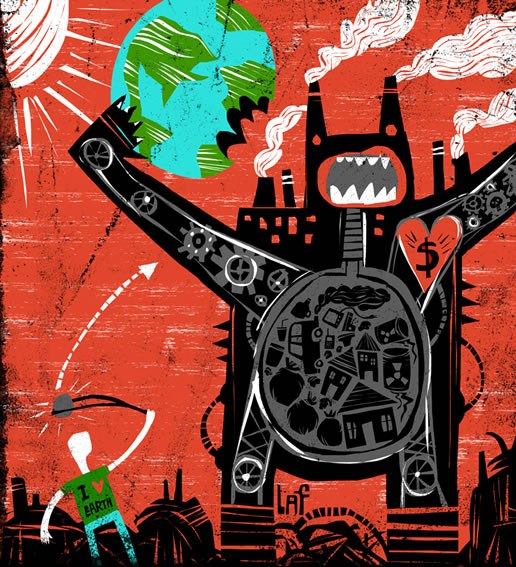
Depression is built into this machine and the evidence is plastered on the morose faces of people caught in the clutches of its business as usual activities. Depression is found in the insurmountable debts we owe for spending a lifetime of preparation and labor to serve the machine. In addition to debt, the machine awards us for our servitude with trinkets, gadgets, doodads and gizmos that provide a moment of hollow amusement and then sit on shelves in garages and decay. They represent the planned obsolescence of the human heart. The sacrifice paid for our fetish with materialism is the actual quality of our lives.

The gloom machine tells us the quality of our lives is defined by the machine in the driveway, and the machine that flushes away our excrement, and the machine that chills the tortured slaughtered animal flesh for later consumption, and the machine that flashes pornographic images and supplies numbers detailing how much we are liked by our so called friends. But to us humans it seems that quality of life is more appropriately measured in the amount of disposable time we have to pursue that which we want, and the quality of the community around us, and living without being chronically stressed with threats of being displaced from the land upon which we live for not working hard enough for the machine.

Depression is waking up at 6 in the morning in darkness to sit in traffic for an hour to arrive at a job that we don’t want to be at, only to serve the machinations of people with nothing but greed in their overstuffed bellies. And we go to these jobs so that we can pay rents that are unaffordable, and to service debt we’ll never escape, and we go home in darkness to our lonely lives in places where community is absent with a view of an equally lonely tree or a man-made retention pond which is an upgrade over the view of staring directly at your neighbor’s domicile. Depression is the realization there is no vacation on the horizon, no respite, just more of the same. Depression is knowing that such a life is better than many others have it.

Depression is recognizing the cynics were right about this society, that Cohen spoke truth when he sullenly moaned:

Everybody knows that the dice are loaded
Everybody rolls with their fingers crossed
Everybody knows the war is over
Everybody knows the good guys lost
Everybody knows the fight was fixed
The poor stay poor, the rich get rich
That’s how it goes
Everybody knows

Depression is watching art die. The surrealist, the bohemian, the rock ’n roll, and the anti-authoritarian soul has lain down and pledged fealty to the dollar. For money, they’re now all willing to become ready made predictable cubes to be packaged and sold in plastic wrap placed in cleverly designed boxes which deliver to the depressed public what they want, more of something that’s pretty on the outside and vacant within. We are left with monthly subscriptions of more tales of self aggrandizement for the throngs of temporarily embarrassed millionaires.

Depression is watching the worst of us rise to legitimacy and awarded iniquitous riches for it. The popular is depressive, musical hack Cardi B sings about her money money money and she is loved. Jordan Peterson sells cheap self help stolen from better written material decades ago amalgamated with misogyny and dictates of hierarchal subjugation and becomes wildly popular. Trump purveys hatred of people of color and a love of authoritarianism and the depressive people, oh do they eat it up. This is sickness, depressive sickness.

Depression is acceptance of the violent now. The grossly unhappy men with their armaments spread their gloom and horror across the planet and claim righteousness for doing so. Depression is watching society applaud murderous hearts for their crimes who don badges and camouflage and have holidays to celebrate their violent history, while villains are made of those who simply don’t want to stand up for songs of oppression. Thank you for your service to the machine.

Depression is watching notions of resistance and revolution take form in slightly altered subservience. The great reformation desired now is for a “green new deal” that doesn’t come close to mitigating the impending culling of humanity from soon to be ecological catastrophes. Their plans offer only more endless work at the behest of the gloom machine while promising healthcare that will never happen, less debt it will also never deliver, and affordable housing that still won’t solve homelessness. They don’t want to break the machine, just tweak it, and they lack the ability to do that even. Never have I borne witness to such eager slaves and such depressive aspirations. The people seem to adore their cubicle lives, their environmental destruction, their corporations, their debts, their corrupt leaders, their prisons, their banks, and their taxes.

They want to continue to be put to work under the thumb of the status quo western civilization authoritarian mind and this is all the depressed mentally dominated masses can think of as a possible improvement. Instead of wanting to taste real liberty and be actual equals, their dreams are limited to being better treated servants. The gloom machine chugs along fueled with dimwitted ideas sold by boxed-in thinkers without any possibility of escaping the darkness, rather simply offering a more cushy seat for viewing the end of everything.

The machine bellows out demanding more, more, you owe me more, and somehow those wearing red, white, and blue agree and celebrate the demands of the machine. These debts we owe are servitude. The numbers held in digital machines are immoral which demand one must wake up to a dreary existence to do more of what is killing our souls along with the flora and fauna around us.

Depression is the downtrodden plebs who celebrate their corrupt democracy, which is in reality a thinly veiled oligarchy that should be obvious to all. They prop up a system of voting that allows the election of the presidency, a position that shouldn’t exist in the first place in an egalitarian society, to be awarded to candidates who don’t capture the most votes. What little democracy there is in a representative system is lost in totality when the winner of elections need not win the majority of votes. The gloom machine is straight up tyranny.

A non-depressed society would reject being served faux democracy. They’d reject a system absent of reason or compassion and disdain would be for ideas of continuing to support such a destructive way of being. But instead, within the gloom machine shame is reserved for those who don’t want to take part in the busted system, and it venerates those who cast votes for imperialist conquerers and planet destroyers, and those voters are lauded as doing their civic duty for taking part in open public corruption.

Depression is the insincere know it all crowd who are incapable of honest debate and have rarely endeavored to open a book of substance or engage in critical thought, but they know trivialities which they mistake as facts and wisdom. They know arrogance well and emanate it with aplomb. They know how to believe all they see in the corporatized media, but thinking without boundaries or limitations is beyond their capacity. This is not even depression, this is tragedy.

Depression is watching the trees be plowed down for more tract housing, a portion of which will sit empty for years because no one can afford to move there, and even if they could it’s a heinous boring life that awaits which is only significantly better compared to being homeless. Depression is knowing this is the reason why we are rapidly destroying our habitable environment and commencing a 6th mass extinction event which is now accelerating.

Depression is to know there is nothing we can do to stop the country we live in from mercilessly killing innocent people all over the world for no reason other than more economic expansion and our sadistic ideas of exceptionalism that entail spreading pain and hardship so a few elites can have more of what they already have more than enough of.

Depression is the powerlessness to change anything of significance. There is no other way they say other than the desolate gloom machine, they say this is how it must be. And so we remain here waiting for the horror that is soon to approach us all as the gloom descends in ever quickening waves.

A zombified indoctrinated populace can see no other way than capitalism and beating each other over the heads to satiate egos in needless competition that is unnecessary for survival and deleterious to the common good. Capitalism is the primary tool of empire, and a word that should be synonymous with depression. It’s the accumulation of resources in an effort to gain more power in man-made markets to leverage that power over other people and get them to do what the person with the most power desires. Capitalism’s depressing ideology is defined by the lecherous desire for more for the sake of it so the winner can pound their simian chest in victorious celebration of the devastation they’ve created.

Capitalism is inherently unsustainable due the way it allows power to coalesce via the leveraging abilities given to money to buy land, the means of production, elections, and advertising. It allows the whims of the few to overrun the needs of the many where those with the worst intentions aspire to gain more than others because they will attempt to fill the void in their hearts with self importance expressed via power over others. This is why it cannot be used.

If there is no central currency or advantage to collecting huge amounts of resources then the motivation to hoard would evaporate, as those resources would simply rot or become a burden to maintain. There’s no fun in that kind of hoarding. The “fun” comes to the simpleton power seeker when they acquire power to make others do what they want and thus gain the ephemeral validation they so desperately seek.

If one runs the math on players competing for money at different rates of gain over a certain amount of time, there will be a doubling effect which becomes exponential. And this effect will accelerate as it plunders along due to gains in leverage which allows for ever greater amounts of money to be made at faster rates. Eventually it always ends the way a game of monopoly ends, someone has all the power and everyone else is subservient to that entity/person.

These dour thoughts manifest from the recognition of the stranglehold empire has over our lives. The depression is the result of the myriad of expectations I can’t let go of that wants to see a kinder more egalitarian and sustainable world emerge while knowing how unlikely it is. Our collective depression is rooted in the foundations of social hierarchy and its economic tools of control, and understanding what a perfect trap it is, and so it goes, and everyone doesn’t know, but they feel it, though.

The Erosion of the Middle Class — Why Americans Are Working Harder and Earning Less

By John Liberty

Source: The Mind Unleashed

“I don’t have to tell you things are bad. Everybody knows things are bad. It’s a depression. Everybody’s out of work or scared of losing their job. The dollar buys a nickel’s worth, banks are going bust, shopkeepers keep a gun under the counter. Punks are running wild in the street and there’s nobody anywhere who seems to know what to do, and there’s no end to it.” — Howard Beale

Howard Beale, the main character in the 1976 film Network, became a part of cinematic history when he uttered the line “I’m mad as hell and I’m not gonna take it anymore.” That one line expressed a growing rage among America’s shrinking middle class at a time when Americans were reeling from years of war, political scandals and economic downturn.

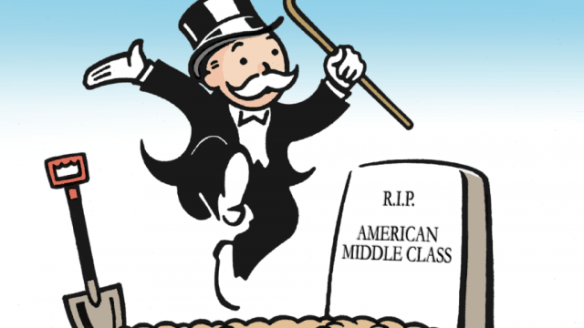
In the four decades that have followed, little has improved for the average American. We’re still ‘mad as hell’ and the middle class is being eroded right in front of our eyes. When adjusted for inflation, many Americans are working longer hours and earning less than they did in 1976. So, how have we gone from vibrant middle class to the working poor in a matter of decades?

Median Incomes Are Stagnant

Despite increases in the national income over the past fifty years, middle class families have experienced little income growth over the past few decades. According to U.S. Census datamiddle class incomes have grown by only 28 percent from 1979 – 2014. Meanwhile, a report from the Congressional Budget Office (CBO) shows that the top 20 percent of earners has seen their incomes rise by 95 percent over that same period of time.

Contributing to the stagnation of wages is a notable decrease in the workforce participation rate. According to the Brookings institute, “One reason for these declines in employment and labor force participation is that work is less rewarding. Wages for those at the bottom and middle of the skill and wage distribution have declined or stagnated.” Historical data from the Bureau of Labor Statistics backs up these findings, showing a steady decrease in workforce participation over the last two decades.

The Erosion of the Minimum Wage & America’s Purchasing Power

Anyone who has read a comment thread on the internet about minimum wage laws knows the debate is currently one of the most highly contentious political topics in America. In the halls of Congress, the debate has turned into a nearly decade long impasse. As a result, workers at the low end of the wage scale have watched the purchasing power of their wages decrease from $7.25 in 2009, to $6.19 in 2018 due to inflation. In 2018, you need to perform 47 hours of minimum wage work to achieve the same amount of purchasing power as 40 hours of work in 2009.

The inflation-adjusted minimum wage value has been in steady decline since 1968, when the $1.60 minimum wage was equal to $11.39 (in 2018 dollars). Since then, lawmakers have reduced minimum wage increases relative to the rate of inflation. As Christopher Ingraham reports:

“Recent research shows that the reason politicians — Democrats and Republicans alike — are dragging their feet on popular policies such as the minimum wage is that they pay a lot more attention to the needs and desires of deep-pocketed business groups than they do to regular voters. Those groups tend to oppose minimum wage increases for the simple reason that they eat into their profit margins.”

To be clear, the erosion of the purchasing power of everyday Americans is hardly a new phenomenon. According to data from the U.S. Bureau of Labor Statistics, the purchasing power of the U.S. Dollar has plummeted by over 95 percent since 1913, the year the Federal Reserve was created. The Bureau’s Consumer Price Index indicates that prices in 2018 are 2,436.33% higher than prices in 1913 and that the dollar has experienced an average inflation rate of 3.13% per year during this period.

The Rich Get Richer

While the outlook may be grim for low-wage workers, this is fantastic news for large corporations. Data from the U.S. Bureau of Economics shows that corporate profits are approaching all-time highs. But it’s not just workers who are feeling the effect of growing income inequality. The contrast is also being felt on Main Street. An analysis of the S & P 500 and the Russell 1,000 & 2,000 indexes by Bloomberg revealed a growing gap between America’s largest employers and smaller businesses.

A report from the Institute for Policy Studies entitled Billionaire Bonanza: The Forbes 400 and the Rest of Us echoed these findings when it revealed that America’s 20 wealthiest people — a group that could fit comfortably in one single Gulfstream G650 luxury jet –­ now own more wealth than the bottom half of the American population combined.

Although the Trump administration continues to tout stock market and labor force increases as signs of economic prosperity, numbers show that the wealthiest 10 percent of Americans own 84 percent of all stock. A study conducted by the Economic Policy Institute found that wage growth remains too weak to consider the economy at full employment and that stagnant wage growth has contributed to the growing level of income inequality in America. The study noted that while wages have recovered from the 2008 recession, the gap between those at the top and those at the middle and bottom has continued to increase since 2000. As the study’s author, Elise Gould writes:

“We’re looking at nominal wage growth that is still slower than you would expect in a full employment economy, slower than you would expect if you thought there were any sort of inflation pressures from wage growth.”

The Decimation of the American Dream

Comedian George Carlin once said, “The reason they call it the American Dream is because you have to be asleep to believe it.” For millions of middle class Americans Carlin’s statement has proven eerily accurate. Stagnant wages and decreased purchasing power has put the prospects for middle class children in a tailspin as upward mobility trends have reportedly fallen by over 40 percent since 1950.

A poll conducted by the Pew Research Institute corroborates this claim. According to Pew, only 37 percent of Americans believe that today’s children will grow up to be better off financially than their parents. That means more Americans think that today’s children will be financially worse off than their parents than those who believe they will be better off.

The sentiments expressed by millions of middle class Americans appear to be wholly justified due to the fact that middle class families are becoming more fragile and dependent on two incomes. A report from the Council of Economic Advisors found the majority of the income gains made by the middle class from 1979 to 2013 were a result of increased participation in the workplace by women. The report also noted the fragility of two income families amidst a decline in marriage and a drastic rise in single parent homes in recent years.

As a result of the slow growth in wages, over half of Americans now receive more in Government transfer payments (Medicare, Medicaid, food stamps, Social Security) than they pay in federal taxes. An analysis of all 50 states also found that in 42 states the cost of living is higher than the median income.

The rising cost of healthcare is also putting the pinch on the wallets of many Americans. As Jeffrey Pfeffer noted in his book Dying for a Paycheck, healthcare spending—per capita—has increased 29 fold over the past 40 years, outpacing the growth of the American economy.

While many Americans continue to look to the government to fix problems like wage stagnation, income inequality and rising healthcare costs, the sad truth is that we live in a time when 1 in 3 households has trouble paying energy bills and 40 percent of Americans face poverty in retirement at the exact same time the Federal Government has admitted that they lost $21 trillion. Not only did they lose $21 trillion (yes that’s TRILLION with a T), but the Department of Defense indicated in a press conference that they “never expected to pass” the audit to locate the missing taxpayer money.

John Emerich Edward Dalberg Acton famously proclaimed in 1887:

“Power tends to corrupt, and absolute power corrupts absolutely. Great men are almost always bad men.”

Perhaps it’s time for the millions of Americans who are quietly ‘mad as hell’ to start expressing their rage at the corrupt institutions of power that are decimating their livelihoods rather than expecting those very same institutions to fix the problems they created.


The Evidence Pours In: Poverty Is Getting Much Worse In America

By Paul Buchheit

Source: Occupy.com

A White House report recently proclaimed that the “War on Poverty is largely over and a success.” United Nations Ambassador Nikki Haley said it was “ridiculous for the United Nations to examine poverty in America.”

Well-positioned Americans must talk like this, of course, because admitting the debilitating state of poverty in America might provoke feelings of guilt for 35 years of oppressive economic policies. Wealthier people need to take an honest look at the facts. They need to face reality as it sadly exists in America today.

1 in 7 Americans is Part of the World’s Poorest 10%

According to the Credit Suisse 2018 Global Wealth Databook, 34 million American adults are among the world’s poorest 10%. How is that possible? In a word, debt. In more excruciating words: stifling, misery-inducing, deadly amounts of debt for the poorest Americans. And it goes beyond dollars to the “deaths of despair” caused by the stresses of inferior health care coverage, stagnating incomes, and out-of-control inequality.

Numerous sources report on the rising debt for the poor half of America, especially for the lowest income group, and largely because of health care and education costs. Since 2008 consumer debt has risen almost 50 percent. The percentage of families with more debt than savings is higher now than at any time since 1962.

It could be argued that Scandinavian countries face the same degrees of debt as Americans. But far less of the debt is for health and education costs. And the Scandinavian safety net is renowned for its generous provisions for all citizens.

Half of us Are in or Near Poverty

$1 in expenses twenty years ago is now $1.25. $1 in earnings twenty years ago is now still $1.

More and more Americans are facing financial difficulty. Estimates of adults living from paycheck to paycheck range from half to 60 percent to 78 percent. Any sign of a recession would be devastating for most of us.

It’s estimated that a typical U.S. household needs about $60,000 annually to meet all expenses. That’s only manageable if two adults are working full-time for $15 per hour. Beyond that, little cushion exists. No American adult in the bottom 40% has more than $31,124 in total wealth, including house and car and savings (Table 3-4).

Booming Economy, Low Unemployment, and Other Deceptions

While 1 in 7 Americans is part of the world’s poorest 10%, nearly 3 in 7 Americans are part of the world’s richest 10%. The economy is booming for THEM. Yet the Wall Street Journal has the arrogance to claim that “Americans traditionally left behind…are reaping the benefits..”

How about the “jobs for everyone” fantasy? The official unemployment rate, according to the Bureau of Labor Statistics (BLS) itself, is based on employees “who did any work for pay or profit during the survey reference week.” The BLS workforce includes contingent and alternative employment arrangements that make up about 10% of the workforce. It includes part-time workers (even one hour a week!), who make up about 16% of the workforce. And, inexplicably, it fails to count as unemployed those who have given up looking for work – 4% more Americans than in the year 2000.

Many of today’s ‘gig’ jobs don’t pay a living wage, and most have no retirement or health benefits, no job security, no government regulations backing them, and usually a longer work day, with many people putting in 10- to 12-hour days for $13 per hour or less. According to a New York Times report, “41.7 million laborers – nearly a third of the American work force – earn less than $12 an hour, and almost none of their employers offer health insurance.”

Safety Net Failures

While it’s true that the U.S. spends a greater percentage of its GDP on social safety net programs than developing countries, Americans generally have to face much higher costs for housing, heating, transportation, child care, and other basic expenses.

Beyond this, there are significant shortcomings in American social protections, as pointed out by the UN. These include the “shockingly high number of children living in poverty” and the “reliance on criminalization to conceal the underlying poverty problem.” Furthermore, with the call for work requirements comes the realization that the job market for the poorest Americans is “extraordinarily limited.”

Poverty: Not Just a Number

Poverty is living without health care, and choosing the life-threatening alternative of opioid painkillers. Poverty is the stress of overwhelming debt; the steady decline of jobs that pay enough to support a family; the inability to afford a move to a desired neighborhood; the deadening impact of inequality on physical and mental well-being.

The United Nations describes America as a nation near the bottom of the developed world in safety net support and economic mobility, with its citizens living “shorter and sicker lives compared to those living in all other rich democracies,” with the highest infant mortality rate in the developed world, the world’s highest incarceration rate, and the highest obesity levels.

Low-income Americans are often surrounded by food deserts, with insufficient access to clean water and sanitation, and with the pollution levels of third-world countries. The poorest among us are even susceptible – unbelievably – to rare tropical diseases and once-eradicated scourges like hookworm.

The extreme levels of American poverty and inequality are ripping apart once-interdependent communities with mental health and homelessness problems, and with a surge in drug and alcohol and suicide“deaths of despair.”

Part of the definition of poverty is “the state of being inferior in quality.” As one of the most unequal nations in the entire world, America is also, in many ways, one of the most poverty-stricken.

Why Are so Few Americans Able to Get Ahead?

By Charles Hugh Smith

Source: Of Two Minds

Our entire economy is characterized by cartel rentier skims, central-bank goosed asset bubbles and stagnating earned income for the bottom 90%.

Despite the rah-rah about the “ownership society” and the best economy ever, the sobering reality is very few Americans are able to get ahead, i.e. build real financial security via meaningful, secure assets which can be passed on to their children.

As I’ve often discussed here, only the top 10% of American households are getting ahead in both income and wealth, and most of the gains of these 12 million households are concentrated in the top 1% (1.2 million households). (see wealth chart below).

Why are so few Americans able to get ahead? there are three core reasons:

1. Earnings (wages and salaries) have not kept up with the rising cost of living.

2. The gains have flowed to capital, which is mostly owned by the top 10%, rather than to labor ((wages and salaries).

3. Our financialized economy incentivizes cartels and other rentier skims, i.e. structures that raise costs but don’t provide any additional value for the additional costs.

It’s instructive to compare today’s household with households a few generations ago. As recently as the early 1970s, 45 years ago, it was still possible for a single fulltime-earner to support the household and buy a home, which in 1973 cost around $30,000 (median house price, as per the St. Louis FRED database).

As recently as 20 years ago, in 1998, the median house price in the U.S. was about $150,000— still within reach of many two-earner households, even those with average jobs.

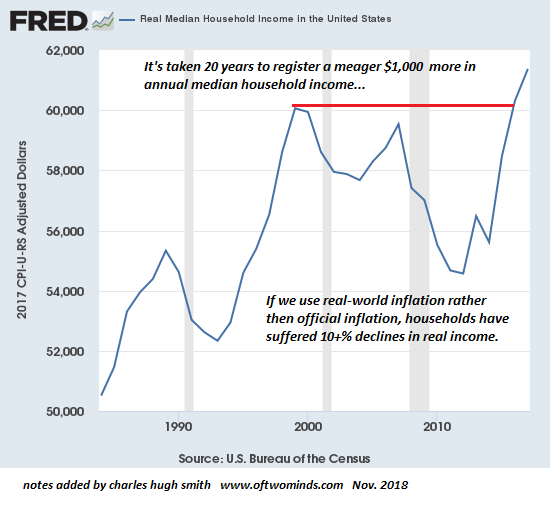
As the chart below shows, real median household income has only recently exceeded the 1998 level— and only by a meager $1,000 annually. If we use real-world inflation rather than the under-estimated official inflation, real income has plummeted by 10% or more in the past 20 years.

This reality is reflected in a new study of wages in Silicon Valley, which we might assume would keep up due to the higher value of the region’s output. The study found the wages of the bottom 90% declined when adjusted for inflation by as much as 14% over the past 20 years:

“The just-released report showed that wages for 90 percent of Silicon Valley workers (all levels of workers except for the top 10 percent)are lower now than they were 20 years ago, after adjusting for inflation. That’s in stark contrast to the 74 percent increase in overall per capita economic output in the Valley from 2001 to 2017.”

source: Why Silicon Valley Income Inequality Is Just a Preview of What’s to Come for the Rest of the U.S.

Meanwhile, the median house price has more than doubled to $325,000 while median household income has stagnated. Please note this price is not adjusted for inflation, like the median income chart. But if we take nominal household income in 1998 (around $40,000 annually) and compare it to nominal household income now in 2018 (around $60,000), that’s a 50% increase–far below the more than doubling of house prices.

To raise stagnant incomes, the Federal Reserve and other central banks have attempted to generate a wealth effect by boosting the valuations of risk-on assets such as stocks, bonds and commercial real estate. But the Fed et al. overlooked the fact that the vast majority of these assets are owned by the top 10%–and as noted above, the ownership of the top 10% is concentrated in the top 1% and .1%.

As a result, the vast majority of the wealth effect capital gains have flowed to the top 1%:

Lastly, the cartel structure of the U.S. economy has raised costs while providing no additional value. One example is higher education, a cartel that issues diplomas with diminishing economic value that now cost a fortune, a reality reflected in this chart of student loan debt, which simply didn’t exist a generation ago:

Our entire economy is characterized by cartel rentier skims, central-bank goosed asset bubbles and stagnating earned income for the bottom 90%. Given these realities, the bottom 90% are left with few pathways to get ahead in terms of financial security and building secure family wealth.


The Wealth Hiding in Your Neighborhood

From country farmland to big city skyscrapers, absentee billionaires may be hiding wealth in your town — and driving up your cost of living.

By Chuck Collins

Source: OtherWords

The rich are hiding trillions in wealth.

You’ve probably heard about their offshore bank accounts, shell corporations, and fancy trusts. But this wealth isn’t all sitting in the Cayman Islands or Panama. Much of it’s hiding in plain view: maybe even in your town.

America’s big cities are increasingly dotted with luxury skyscrapers and mansions. These multi-million dollar condos are wealth storage lockers, with the ownership often obscured by shell companies.

In Boston, where I live, there’s a luxury building boom. According to a study I just co-authored, out of 1,805 luxury units — with an average price of over $3 million — more than two-thirds are owned by people who don’t live here.

One-third are owned by shell companies and trusts that mask their ownership. And of these units, 40 percent are limited liability companies (LLCs) organized in Delaware.

Why Delaware?

Criminals around the world set up their shell companies in Delaware, the premiere secrecy jurisdiction in the United States — where you don’t have to disclose who the real owners are. As a result, human traffickers, drug smugglers, and tax evaders all enjoy the anonymous cover of a Delaware company.

Many of these companies use illicit funds to purchase real estate in North American cities to launder their ill-gotten money.

In New York City, dozens of luxury towers have been connected to global money laundering. In Vancouver, Chinese investors disrupted the city’s housing market so badly that the province of British Columbia established a foreign investor tax and a tax on vacant properties.

With European countries now insisting on more transparency, illicit cash is now cascading into the United States. In fact, the U.S. is now the world’s second-biggest tax haven and secrecy jurisdiction, after Switzerland.

The U.S. Treasury Department’s Financial Crimes Enforcement Network (FinCEN) has increased its scrutiny over real estate markets in Miami, New York, and parts of California, Texas, and Hawaii.

But that just makes the rest of the country more attractive for secret cash — even far from big cities. In a small Vermont town, I met a Russian investor who lives in Dubai. He was buying up thousands of acres of Green Mountain farmland.

Our communities are being fundamentally transformed by land grabs and luxury building booms. These drive up the cost of land in central neighborhoods, with ripple impacts throughout a community. And this worsens the already grotesque inequalities of income, wealth, and opportunity.

Our communities should defend themselves.

Property ownership should have to pass the “fishing license” or “library card” test. In most communities, to get a library card or a fishing license, you need to prove who you are and where you actually live.

In Boston, they’re pretty strict — you need to show a utility bill with your name on it. Cities should require the same for real estate purchases.

At a national level, bi-partisan legislation from Senators Marco Rubio and Sheldon Whitehouse would require real estate owners to be disclosed when buyers use shell corporations and pay millions in cash. That would be a welcome development.

Better still, cities should tax luxury real estate transactions on properties selling for over $2 million to fund local services. Such a tax in San Francisco generated $44 million last year that’s been used to fund free community college and help the city’s neglected trees.

Communities could discourage high-end vacant properties by taxing buildings that sit empty for more than six months a year. Cities like Vancouver have created incentives to house people, not wealth.

We need to defend our communities for the people who live in them, not just store their wealth there.

Reimagining the Middle Class

In her new book, Alissa Quart chronicles what happens when capitalism and families collide

By Ann Neumann

Source: The Baffler

AS THE ECONOMIC STATUS OF MANY in the United States has declined over the past several decades, journalists have often focused on the challenges faced by the working poor. In her new book, Squeezed: Why Our Families Can’t Afford America, Alissa Quart writes about how economic inequality has also drastically changed the middle class, destabilizing what was once considered a secure class and sending families into the tailspin of debt, overwork, underemployment, and precarious financial states. Squeezed demonstrates that inequality is not just a problem of those left behind in the lowest financial brackets, but a feature of our current economic system characterized by working professionals who are unable to pay for child care, declining job salaries, shifting work hours, and unaffordable housing. Families too often wrestle with “penalizing” factors, like women’s depressed salaries and unaffordable health care, making success unattainable for a formerly comfortable, educated, and skilled demographic of society.

The book challenges us to reimagine our prior understanding of what it means to be middle class, even as legislators champion “traditional values” that contradict the needs and responsibilities of families—and erode a safety net that once supported U.S. workers. Some of the factors that have upended the middle class are obvious—declining salaries, for instance—but others remain masked by corporate and social portrayal of them as a benefit to today’s workers. The gig economy, which, we’re told, gives workers young and old more flexibility and independence, turns out to be a contributor to what Quart calls the forever clock, a twenty-four-hour schedule that has usurped family and free time by keeping workers on constant call. Squeezed recounts the lives of the teachers who work second jobs, the professional mothers who struggle to pay for day care, the paralegals and adjuncts who have to moonlight to pay the rent, the well educated who never found a job in their intended profession that provides a livable salary. And the book causes us to ask why so many suffer in isolation, too ashamed to acknowledge their economic plight and too belabored to politically address it.

Quart is executive editor of the Economic Hardship Reporting Project, a nonprofit organization founded by Barbara Ehrenreich (a contributing editor for The Baffler) that supports journalism examining economic inequality, its causes and solutions (EHRP has funded my own work and that of others published at The Baffler). Quart is the author of four previous books: BrandedRepublic of OutsidersHothouse Kids, and the poetry book Monetized. She also co-writes, with Maia Szalavitz, a column for The Guardian titled “Outclassed.”

This month, Quart stopped by The Baffler office to talk to me about Squeezed. We’ve known each other for several years and I read the book in manuscript, so our conversation was casual, touching on individuals in the book, our own squeezed lives, how we can counter economic decline, and a necessary new definition of self-help.

Ann NeumannSqueezed straddles the Trump election and very often people on the left—and the right, to be honest—are using this as a clear demarcation. I think one of the things the book does really well is point out that the mechanisms in place that harm working class families have been long in coming.

Alissa Quart: The reason Sanders and Trump could tap into anger are the numbers of those economically squeezed; it’s what I was seeing anecdotally. And you can feel that. You can feel when you go sit in people’s living rooms, when you talk to them on the phone. I went to a conference called iRelaunch that was all about helping people to start their careers over and the room just rippled with shame and fear. And acidic humor.

AN: How did the election change this book project?

AQ: I think it gave it new urgency for me. Just as it gave urgency to the Economic Hardship Reporting Project, the organization I run. I think everyone in journalism felt like we have to tell these stories. The Trump effect has made me feel like I have to keep a laser focus on the things people are ignoring and try to find a way for readers to pay attention to them. We’re all focusing on Ivanka and whether she’s the c-word or not, which is fine, there are all kinds of things happening around us and in our own lives politically that have nothing directly to do with what Trump is tweeting, but the effects of his administration and long-term trends are real and we just need to keep looking.

We just published an article at EHRP about a journalist who lives in a $17 a night Airbnb, places below what you usually scroll to. But this person was a working journalist who was getting six-figure advances fifteen or twenty years ago. There are all these human examples that constantly show this decline. Fine, maybe the job numbers are up, but how many jobs are people working and are they jobs in the professions? Are they jobs that pay enough for people to live in cities? Or they’re working three different jobs which leads us to things like, as in this book, twenty-four-hour day care.

AN: Day care centers that are open twenty-four hours to accommodate parents with nontraditional work hours or multiple jobs.

AQ: And they are growing in number. I wrote a piece on this; I called it the dystopian social net. I feel like that’s part of my life’s work. I love dystopian fiction and science fiction, probably because it seems a few clicks away from the life we’re leading. It’s a markedly different life and childhood than the one you and I had. It may be horrible, or maybe not, but we’re seeing a palpable transformation in what childhood can be in the course of twenty years.

AN: And that’s really just the decline of income?

AQ: It’s people working different hours, it’s corporations using algorithms to find out what times of day are most profitable—when they’ll have the most foot traffic in retail, for instance—and demanding that employees work those times. It’s increasing nightwork. Nontraditional could mean 11 to 3 or it could mean working in the evening, or working in different jobs, hither and thither. That alone points to a huge transformation in things like time. A lot of the issues I address in the book are really about time, how we spend it. In the twenty-four-hour day care section I use the term the forever clock. But that’s true of the upper middle class too, they feel squeezed because they’re also on a forever clock. They’re working in IT, for instance, and they’re working unusual hours and they have the expectation that they should be better paid for it. 

AN: Your work has been focused on economic inequality for a long time.

AQ: Every single one of my books is in some way about economic inequality. I used to teach at Columbia J-school and I always told my students that every writer has a central question they spend their career trying to answer and your job is to find out what your question is. It’s like a parlor game. So I think mine is: what happens when the family—or childhood—hits capitalism? What are the deformations and the formations? I read so many nineteenth-century novels as a kid that I’m fascinated by that intersection. Naturalism is ascetically but also politically and intellectually appealing to me. I think I just like the texture of family, love, money, and how they all meet.

AN: That comes out in the writing of the book because, I’ll tell you, there are economics books that I have no interest in reading because they’re a slog, a data dump. You also coin terms that give us a way to think about worker’s plights. You just mentioned the forever clock but there’s also the middle precariat.

AQ: I was trying to explain the shift in the middle class as an imaginative category. The middle class used to equal solid, fixed, stable. Temporally it was about gratification later, but your life wasn’t miserable while you were waiting for it. It wasn’t like OK, total slog, but you’re going to get that pension. We have to now think of it as a shaken category, an unstable category, and that’s a big shift. When we visualize the middle class, we’re visualizing the white picket fence, like the blue sky on the cover of the book. But it’s really this truck being squeezed between two houses.
It’s an unsettled identity, and you can fall out of it, you can barely get into it, you certainly can’t rise above it very easily. Guy Standing coined the term precariat in 2011 to describe the proletariat, which is a Marxist way of understanding the working class, crossed with precariousness. And people get that. Every time they ride an Uber or they have a gig economy Task Rabbit person come to their house they’re like, OK, that’s the precariat. But I was seeing the same thing among paralegals or those who have law degrees but were still doing temporary work.

AN: Getting a law degree can be like selling your soul to the banks.

AQ: All these people are in debt. Some of it is because they went to for-profit colleges and those colleges were really expensive and they didn’t have a good rate of placement. Which can be traced to for-profit colleges and grad schools that have very little oversight—and are sometimes indeed federally funded. It can also be traced to fewer law jobs overall and too many people imagining that law is a secure profession. This is about reimagining. Once you can reimagine a profession, even if you choose to do it—you choose to be a journalist, you choose be a lawyer—we should understand that we’re choosing something unstable. Awareness is a huge part of survival and I guess part of what I want with this book is to increase awareness. This is your self-help: Don’t blame yourself. We have to come alive to this recognition. You can still do what you love, so long as you know what it can mean.

This is a personal journey for me too. When I was younger, as a freelancer, I had some recognition that journalism was starting to fragment. It was around 2006 or 2007—but it was before that too, the’90s. The word rates used to be consistent and for freelance writers those rates became lower or stayed the same while inflation rose. I remember talking to someone and they said, “just think about us as post modern.” Now you do lots of things, it’s a hustle here and a hustle there. That person was a boomer who had a steady job, who would get social security. I remember feeling an incredible resentment.

AN: So precarious employment has been described to us as a beautiful thing. We’re not chained to a factory job, we get to think and move around, but it doesn’t pan out.

AQ: I personally came from a middle class background. As I describe in the book, my parents were college professors, originally community college professors, and they could afford to send me to a private school. They didn’t have any inheritance or anything. That’s the sort of the world I thought I’d be living in. All of us, our generation, Generation X, had an idea of the world we thought we’d be living in. The generation after us has come to understand some of these things.

AN: That they’re fucked? So do you think this is a moment in capitalism, as we watch continued market decline over the next years, when we either do something about it or devolve into a disordered society?

AQ: Yes, I think so. But this book isn’t depressing because it points to some solutions—not in a pat way, but things that will work. It’s a way to think about what kind of family safety net, federal and local, we need to make sure people aren’t falling through. For instance, a few of the people I write about in the book are on food stamps and other kinds of support, but many of them are a little above that in terms of earning power and they can’t get help. There’s a labor organizer I spoke with who tries to lower her salary to be able to get some sort of subsidized day care, some sort of health insurance program. It’s that edge: people who are middle class in terms of education, but working class in terms of earning. They’re on the edge of being working poor and not being able to access any of those services. That’s most of the people in this book. Once we understand that they’re precarious we need to find a safety net for them.

AN: What this book does is lay out the many ways that people are hurting at the moment and it kind of gives a blueprint as to how precariousness could be addressed. Subsidized day care, for instance. I had no idea about how expensive child care is.

AQ: Child care can be 30 percent of many salaries. Or more. I think for us it was 30 percent of our take-home pay.

AN: How do people do it? In the book you show us. We spend a lot of time with individuals, we get a look at their lives and there’s a revelation for a reader to think, Oh, it’s not just me. There are things that I go without, there are resources that I don’t have access to, there are crises that I lose sleep over or pray will never come my way. There’s something about this book that brings this issue to light and I wonder if that was what you thought you’d get out of the stories? Is that why you used a storytelling approach?

AQ: That’s the chick lit, soap operatic part of me. And there is something of that in these stories. You think, What’s going to happen next? Sometimes I was surprised because they did have the messy amplitude of ordinary life. The people I write about aren’t just symbolic though. Some of them I followed for years.

AN: I think of the co-parenting section where you spend time with families who are trying to come up with creative solutions. In some cases, over time, things were better; in some cases they were worse. But readers still get the sense that nothing is fixed, no one really knows what’s working.

AQ: Or like the nanny who was separated from her son when I first met her and it was one kind of story. It became a story about them reunited, but then it became a story about school choice, and then it became a story about a mixed outcome at the end. She was actually happy, but I think the reader would want her to have a more middle class life given how hard she’s worked and all the effort she’s made to make the right choices.

AN: The anxiety of her life stayed with me. There are so many things that thwart her from getting ahead. She just needs the smallest break, trying to bring her son here, trying to find an affordable place to live. She’s doing everything right and she doesn’t deserve to go through this. That’s what comes out in the story. So when you were doing this reporting, did you get a sense of relief that we’re all going through this at the same time?

AQ: I definitely did. I felt relief. I say that this book is self-help because it makes you realize that it’s not your fault. And that’s how I see self-help. I see it as awareness, really granularly understanding all the ways that systems have made it impossible for you personally to overcome financial challenges—so that you’re no longer blaming yourself.

AN: Thank God someone’s redefining self-help.

AQ: [Laughs] But that’s it. How do you not feel stigmatized, how do you not feel isolated? So many of my friends feel ashamed that they can’t figure out the school system, can’t figure out how to own their home.

AN: The various penalties—for being a woman, for having children, for having debt—stack up. Shaming has abetted this erosion of rights and financial stability.

AQ: Time, day care scheduling, and other demands mean people can’t organize. They’re ashamed of where they are and so that becomes another debilitating factor. The adjunct in one chapter feels ashamed even though she knows politically she shouldn’t. There are people like the teachers who drive for Uber, who feel ashamed even though they know they shouldn’t. And it goes on and on. I don’t want to put it back on individuals, but the personal thing that people can do is start talking openly about their monetary situation. People are startled when you do that. It can erode social norms in a weird way, but I also think it’s important that people stop fronting with one another.

I write in one chapter about the 1 percent media, about the social media where people pretend to live in more expensive places than they do. I call them wealthies, not selfies. So it’s not your imagination when you’re in any of these circumstances and you see people in a sun dappled villa. People are representing themselves in this inflated way and then you feel terrible and isolated. There are so many ways in which the stigma, the isolation, around your class position gets underlined.

AN: Has it always been shameful to be poor?

AQ: Probably.

AN: It’s not a fair question!

AQ: But let’s be clear. A lot of these people are not poor. Most of the people in this book are earning between $45,000 and $125,000. Working class is $35,000. They’re not at the poverty level.

AN: So the shame then comes from not being able to make ends meet.

AQ: The shame comes from having debt for the education that you got in order to be middle class. The shame comes from not doing as well as your peers. The shame comes from not living up to your potential. The shame comes from not owning your home, defaulting on your mortgage. Not giving your kids as good a life as you had. I’m not writing about the working poor. I’m writing about the middle poor.

AN: We still operate under the myth that as a society we can continue to lift people into middle class and lift middle class into other class brackets. We no longer have any of that upward mobility. We cannot anticipate that our children will be better off.

AQ: No, we cannot anticipate that.

AN: But that’s still the American dream, isn’t it? And that American dream has been tied to, say, home ownership or a vehicle or not having debt.

AQ: In New York it’s like what school your kid goes to. What college your kid goes to.

AN: You use the word reimagining; it’s a word that I don’t hear often enough in politics, particularly not applied to class.

AQ: I mean reimagining what it means to be successful, reimagining what it means to be middle class. In a dream scape kind of way, like, This is what we would like to see in this country. But also reimagining middle class in its truth, what it actually means now? Let’s tear the veil and not just say, Oh, it means stability or security. It doesn’t.

Conjuring Up the Next Depression

By Chris Hedges

Source: TruthDig

During the financial crisis of 2008, the world’s central banks, including the Federal Reserve, injected trillions of dollars of fabricated money into the global financial system. This fabricated money has created a worldwide debt of $325 trillion, more than three times global GDP. The fabricated money was hoarded by banks and corporations, loaned by banks at predatory interest rates, used to service interest on unpayable debt or spent buying back stock, providing millions in compensation for elites. The fabricated money was not invested in the real economy. Products were not manufactured and sold. Workers were not reinstated into the middle class with sustainable incomes, benefits and pensions. Infrastructure projects were not undertaken. The fabricated money reinflated massive financial bubbles built on debt and papered over a fatally diseased financial system destined for collapse.

What will trigger the next crash? The $13.2 trillion in unsustainable U.S. household debt? The $1.5 trillion in unsustainable student debt? The billions Wall Street has invested in a fracking industry that has spent $280 billion more than it generated from its operations? Who knows. What is certain is that a global financial crash, one that will dwarf the meltdown of 2008, is inevitable. And this time, with interest rates near zero, the elites have no escape plan. The financial structure will disintegrate. The global economy will go into a death spiral. The rage of a betrayed and impoverished population will, I fear, further empower right-wing demagogues who promise vengeance on the global elites, moral renewal, a nativist revival heralding a return to a mythical golden age when immigrants, women and people of color knew their place, and a Christianized fascism.

The 2008 financial crisis, as the economist Nomi Prins points out, “converted central banks into a new class of power brokers.” They looted national treasuries and amassed trillions in wealth to become politically and economically omnipotent. In her book “Collusion: How Central Bankers Rigged the World,” she writes that central bankers and the world’s largest financial institutions fraudulently manipulate global markets and use fabricated, or as she writes, “fake money,” to inflate asset bubbles for short-term profit as they drive us toward “a dangerous financial precipice.”

“Before the crisis, they were just asleep at the wheel, in particular, the Federal Reserve of the United States, which is supposed to be the main regulator of the major banks in the United States,” Prins said when we met in New York. “It did a horrible job of doing that, which is why we had the financial crisis. It became a deregulator instead of a regulator. In the wake of the financial crisis, the solution to fixing the crisis and saving the economy from a great depression or recession, whatever the terminology that was used at any given time, was to fabricate trillions and trillions of dollars out of an electronic ether.”

The Federal Reserve handed over an estimated $29 trillion of this fabricated money to American banks, according to researchers at the University of MissouriTwenty-nine trillion dollars! We could have provided free college tuition to every student or universal health care, repaired our crumbling infrastructure, transitioned to clean energy, forgiven student debt, raised wages, bailed out underwater homeowners, formed public banks to invest at low interest rates in our communities, provided a guaranteed minimum income for everyone and organized a massive jobs program for the unemployed and underemployed. Sixteen million children would not go to bed hungry. The mentally ill and the homeless—an estimated 553,742 Americans are homeless every night—would not be left on the streets or locked away in our prisons. The economy would revive. Instead, $29 trillion in fabricated money was handed to financial gangsters who are about to make most of it evaporate and plunge us into a depression that will rival that of the global crash of 1929.

Kevin Zeese and Margaret Flowers write on the website Popular Resistance, “One-sixth of this could provide a $12,000 annual basic income, which would cost $3.8 trillion annually, doubling Social Security payments to $22,000 annually, which would cost $662 billion, a $10,000 bonus for all U.S. public school teachers, which would cost $11 billion, free college for all high school graduates, which would cost $318 billion, and universal preschool, which would cost $38 billion. National improved Medicare for all would actually save the nation trillions of dollars over a decade.”

An emergency clause in the Federal Reserve Act of 1913 allows the Fed to provide liquidity to a distressed banking system. But the Federal Reserve did not stop with the creation of a few hundred billion dollars. It flooded the financial markets with absurd levels of fabricated money. This had the effect of making the economy appear as if it had revived. And for the oligarchs, who had access to this fabricated money while we did not, it did.

The Fed cut interest rates to near zero. Some central banks in Europe instituted negative interest rates, meaning they would pay borrowers to take loans. The Fed, in a clever bit of accounting, even permitted distressed banks to use these no-interest loans to buy U.S. Treasury bonds. The banks gave the bonds back to the Fed and received a quarter of a percent of interest from the Fed. In short, the banks were loaned money at virtually no interest by the Fed and then were paid interest by the Fed on the money they borrowed. The Fed also bought up worthless mortgage assets and other toxic assets from the banks. Since Fed authorities could fabricate as much money as they wanted, it did not matter how they spent it.

“It’s like going to someone’s old garage sale and saying, ‘I want that bicycle with no wheels. I’ll pay you 100 grand for it. Why? Because it’s not my money,’ ” Prins said.

“These people have rigged the system,” she said of the bankers. “There is money fabricated at the top. It is used to pump up financial assets, including stock. It has to come from somewhere. Because money is cheap there’s more borrowing at the corporate level. There’s more money borrowed at the government level.”

“Where do you go to repay it?” she asked. “You go into the nation. You go into the economy. You extract money from the foundational economy, from social programs. You impose austerity.”

Given the staggering amount of fabricated money that has to be repaid, the banks need to build greater and greater pools of debt. This is why when you are late in paying your credit card the interest rate jumps to 28 percent. This is why if you declare bankruptcy you are still responsible for paying off your student loan, even as 1 million people a year default on student loans, with 40 percent of all borrowers expected to default on student loans by 2023. This is why wages are stagnant or have declined while costs, from health care and pharmaceutical products to bank fees and basic utilities, are skyrocketing. The enforced debt peonage grows to feed the beast until, as with the subprime mortgage crisis, the predatory system fails because of massive defaults. There will come a day, for example, as with all financial bubbles, when the wildly optimistic projected profits of industries such as fracking will no longer be an effective excuse to keep pumping money into failing businesses burdened by debt they cannot repay.

“The 60 biggest exploration and production firms are not generating enough cash from their operations to cover their operating and capital expenses,” Bethany McLean writes of the fracking industry in an articletitled “The Next Financial Crisis Lurks Underground” that appeared in The New York Times. “In aggregate, from mid-2012 to mid-2017, they had negative free cash flow of $9 billion per quarter.”

The global financial system is a ticking time bomb. The question is not if it will explode but when it will explode. And once it does, the inability of the global speculators to use fabricated money with zero interest to paper over the debacle will trigger massive unemployment, high prices for imports and basic services, and a devaluation in which the dollar will become nearly worthless as it is abandoned as the world’s reserve currency. This manufactured financial tsunami will transform the United States, already a failed democracy, into an authoritarian police state. Life will become very cheap, especially for the vulnerable—undocumented workers, Muslims, poor people of color, girls and women, anti-capitalist and anti-imperialist critics branded as agents of  foreign powers—who will be demonized and persecuted for the collapse. The elites, in a desperate bid to cling to their unchecked power and obscene wealth, will disembowel what is left of the United States.