Podcast Roundup: Halloween Edition

Photo: The Onion

Photo: The Onion

Though I don’t regularly feature podcasts delving into horror/sci-fi aspects of pop culture or the world of metaphysics and the paranormal, today seems an appropriate time to share a few in observance of Halloween, All Hallow’s Eve, Samhain, Day of the Dead, etc.

10/27 Maja D’Aoust and Erik Davis discuss magical and synchronistic aspects of politics and modern culture at Expanding Mind: Show link: http://prn.fm/category/archives/expanding-mind/

10/28 A great discussion on John Carpenter’s 1982 remake of “The Thing” and what makes it a classic horror film at the Debatable Podcast: Show link: http://debatablepodcast.tumblr.com/post/65307821240/episode-56-the-thing-with-sip-eric-sipple-joins

10/29 Guillermo Jimenez and Dr. Paul Cantor have a conversation about the political meaning of apocalyptic “end of the world” narratives in shows like The Walking Dead, X- Files, Fringe, and Falling Skies from a libertarian perspective: Show Link: http://tracesofreality.com/2013/10/29/tor-radio-the-truth-behind-the-walking-dead-liberty-vs-authority-in-pop-culture-with-dr-paul-cantor/

10/30 Tim Binnall and David Acord commemorate the 75th anniversary of Orson Welles’ infamous “War of the Worlds” radio broadcast with an analysis of the program, how it came to be, its importance in the context of emerging technology and the field of media literacy, and how it’s connected to conspiracy and UFOlogy: Show link: http://www.binnallofamerica.com/boaa103013.html

Judging from the last few minutes of this trailer for his film “F For Fake”, Welles himself was involved in perpetuating the mystery and speculation surrounding his War of the Worlds broadcast:

10/30 The always educational “Stuff They Don’t Want You to Know” video podcast covers the origins of Halloween traditions:

Show link: http://www.howstuffworks.com/podcasts/stuff-they-dont-want-you-to-know.rss

Out of the Wild

london20after20people-jj-001

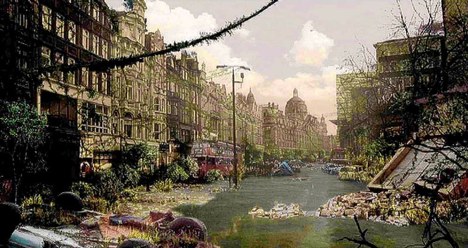
At Orion Magazine, authors William Cronon and Michael Pollan share a stimulating conversation about how language shapes our world. They cover questions such as “what is wild?”, “what is cultivated?”, and “what can these ideas teach us about our relationship to landscape?”. What I found most compelling was the last part of the conversation where they talk about the power and importance of storytelling:

Bill:  Right. Ecology, storytelling, history—they all render connections visible. We make that which is invisible visible through story, and thereby reveal people’s relationships to other living things.

Michael:  Stories establish canons of beauty, too. There is a role for art in changing cultural norms about what’s worth valuing. One hundred fifty years ago, certain people looked at a farm and saw what you might see if you look today at a nuclear power plant or some other degraded landscape. Part of the reason we tell stories is to create fresh value for certain landscapes, certain relationships.

Bill:  And stories make possible acts of moral recognition that we might not otherwise experience. They help us see our own complicity in things we don’t ordinarily see as connected to ourselves.

Michael:  Yes, exactly. That recognition can help remove the condescension in so much environmental writing by showing us that, look, these things we abhor are done in our name, and we are complicit in them, and we need to take account of them. It was Wendell Berry’s idea that the environmental crisis is a crisis of character. The big problem is the result of all the little problems in our everyday lives. That can be a guilt trip, but it doesn’t have to be. You can tell that story in ways that empower people.

Storytelling can also help us find hopeful solutions. For example, when I was writing Omnivore’s Dilemma and I went to Joel Salatin’s farm in Virginia, I learned how his grazing worked—intensive rotational grazing—and he explained to me what happens under the surface, how every time the ruminants come through and shear that pasture and reduce that leaf mass, a roughly equivalent amount of root mass is broken down and turned into soil. I learned that he takes vast amounts of food off this pastureland, without subtracting anything. To the contrary, the sun is feeding the grass, and the grass is feeding the ruminants; the ruminants are feeding us, and they’re also feeding the soil.

I suddenly saw a whole other way of conceiving our relationship to nature, that there are systems that exist, and could exist, that are non zero sum. There is a free lunch in nature: it’s solar energy, which means it isn’t necessarily true that for us to feed ourselves we have to diminish the world.

When you tell an audience that story, it fills them with hope and a sense of possibility, and that’s a function of storytelling. But, of course, it isn’t always so neat. There are questions of scale, and if you eat meat, there are problems with cattle. But I’m always looking for stories that refresh this narrative about nature that we’re so stuck in.

Bill:  Messy stories invite us into politics. They also invite us to laugh at ourselves. And those things together—the ability to laugh, to experience hope, to be inspired toward action at the personal and political levels—these strike me as the work of engaged storytelling in a world we’re trying to change for the better.

Michael:  I do have a lot of faith in the power of stories to do things. My greatest thrill as a writer is when I see people changed by the work, when people tell me that they’ve changed their behavior in some way because of something they’ve read.

One of the things I’ve fought very hard to do with my editors is to talk about alternatives when I talk about problems. For example, if I’m writing an incredibly dark story about industrial meat production and following a cow through the feedlot and slaughterhouse, I really want three paragraphs on the alternative to this system, which is to say, grass-finished beef. Those three paragraphs have more impact than anything else in the piece. And I still hear from ranchers that it was on the day that an article on that topic came out that we began to see the stirrings of a new market for grass-finished beef. “We no longer send them to the auction barn right away,” they tell me. “We’re finishing on grass now.”

Bill:  That’s a good story about storytelling.

Michael:  You have to pass through the dark wilderness of the feedlot before you can get there, but I think that there’s an appetite for hope that journalists don’t often satisfy.

I’ve met people, in their twenties especially, who really hate the model of the investigative article that tells them how messed up things are and doesn’t point to some alternative. True, the alternative you’re proposing can seem tacked on, and it can be incommensurate with the scale of the evils—but I think people want hope, a course of action they can take. This is something many journalists are missing right now. I think if our writing doesn’t include that dimension in some way, we lose people.

Bill:  It strikes me that you’re pointing to a great tradition in the environmental movement, which is the power of good storytelling, going back to Rachel Carson.

Michael:  She was incredibly effective rhetorically. Silent Spring is a very sophisticated piece of work.

Bill:  It’s stunningly done.

Michael:  It’s stunningly done. And it speaks to the power of fictional ideas like wilderness. Carson understood that, even if you’re writing about science, narrative is important. The trick I learned from her is never to talk about “neurotoxins”; instead, you tell the story of the molecule in the cell. Because there’s a narrative everywhere, even at the level of molecules.

Bill:  Maybe that’s a good note for us to end on, don’t you think? The poet Muriel Rukeyser once said that “the world is made of stories, not of atoms.” When we lose track of the narratives that human beings need to suffuse their lives and the world with meaning, we forget what makes the world worth saving. Telling stories is how we remember.


Read the complete transcript here: http://www.orionmagazine.org/index.php/articles/article/7811

Are We Living In a Police State?

police-share-1

Based on the criteria listed by Sibel Edmonds here, we definitely are. Even folks at the “Top Criminal Justice Degrees” website (Your Online Guide to the Best Criminal Justice Degrees) seem to think so.

The Militarization of the Police
Image source: www.topcriminaljusticedegrees.org

The Militarization of the Police

Are we living in a police state?

– There has been a 4000% increase in “no knock,” militarily-armed swat team raids over the past thirty years.
– Mid 80’s: 2,000-3,000 raids per year[1]
– Present day: 80,000 raid estimate[1]
– ——————
– Pros:
– –Element of Surprise
– –Suspect can’t destroy evidence
– Cons:
– –Invasion of privacy
– –Seconds for suspect to decide if these or cops or break in.
– –Faulty intelligence

– ————
Case Study

– Basics:[4]
– Ogden, Utah. 1/4/12 8:40 pm.
– Local swat team battered down Matthew David Stewart’s door with no warning. Thinking his home was being invaded, Stewart readied his pistol.
– Stewart: 31 rounds fired
– Swat: 250 rounds fired
– Tip: Stewart’s girlfriend saying he might be growing weed.
– Previous record: Clean, veteran.
– Result: 6 wounded swat. 1 killed. Stewart shot twice.
– Findings: 16 small pot plants. No intent to sell.
– Outcome: Upon losing hearing about search warrent legality. Stewart hangs himself in jail cell.

– ————-

And that’s just one of potentially hundreds of similar tragedies.

– Spotlight: NY
– 1994: 1,447 swat style drug raids
– 2002: 5,117
– “I have my own army in the NYPD–the seventh largest army in the world.” Michael Bloomberg

– ————
– Swat Armament:[3]
– Submachine Guns
– Automatic Weapons
– Breaching Shotguns
– Sniper Rifles
– Stun Grenades
– Heavy Body Armor
– Motion Detectors
– Advanced Night Vision Wear
– Armored Personal Carriers
– “From the Gulf war to the drug war–Battle proven” Heckler and Koch’s slogan for the M5[6]

– ————-

These “criminals” are heavily armed too, right?

– WRONG:
– [Weapon used in violent crime: %]
– Gun: 12.7%
– Knife: 10.1%
– Other: 12.1%
– Unknown weapon: 1.8%
– None: 55.8%
– Don’t Know: 5.8%

– —-
– So how can we allow this? The fact is, we don’t.
– 1970: The “no-knock” law is passed with the beginning of the war on drugs.
– 1974: The law was repealed.
– Today: “No knock” happens ALL THE TIME.
– ——
– Leading to more and more unecessary, intrusive, illegal, and deadly SWAT raids.
– Raids leading to civilian injuries, death, or intrusion of the privacy of innocents.
– While injuries from “no knock” raids have been around since the inception of the swat team. Paramilitary like brutality has become a feature of the increasing armed SWAT of the last 10 years.

– Using the military in civic life is like using a hammer when you need a butter knife. There’s bound to be collateral damage. It could happen to you, your neighbors, your friends, or your family. Speak out against the militarization of the police.
Citations- http://usatoday30.usatoday.com/news/nation/2011-02-14-noknock14_ST_N.htm
https://www.aclu.org/blog/criminal-law-reform-free-speech-technology-and-liberty/too-many-cops-are-told-theyre-soldiers
http://en.wikipedia.org/wiki/SWAT
http://online.wsj.com/article/SB10001424127887323848804578608040780519904.html?mod=WSJ_hpp_LEFTTopStories
http://www.cato.org/raidmap


Update 10/25:

Lee Camp recently posted his thoughts on the topic of police militarization:

Why ‘I Have Nothing to Hide’ Is the Wrong Way to Think About Surveillance

verizon-we-can-hear-you-now

A common defense of mass surveillance used by apologists is “if you have nothing to hide, why worry?” Nevermind that there’s many things that are perfectly legal that we might not “hide” but choose not to reveal indiscriminately (ie. credit card numbers, medical records, nakedness, etc.), we may in fact have something to hide but not even know it. As noted by Moxie Marlinspike of Wired.com:

If the federal government can’t even count how many laws there are, what chance does an individual have of being certain that they are not acting in violation of one of them?

For instance, did you know that it is a federal crime to be in possession of a lobster under a certain size? It doesn’t matter if you bought it at a grocery store, if someone else gave it to you, if it’s dead or alive, if you found it after it died of natural causes, or even if you killed it while acting in self defense. You can go to jail because of a lobster.

If the federal government had access to every email you’ve ever written and every phone call you’ve ever made, it’s almost certain that they could find something you’ve done which violates a provision in the 27,000 pages of federal statues or 10,000 administrative regulations. You probably do have something to hide, you just don’t know it yet.

He also makes a compelling argument for why we should have something to hide:

Over the past year, there have been a number of headline-grabbing legal changes in the U.S., such as the legalization of marijuana in Colorado and Washington, as well as the legalization of same-sex marriage in a growing number of U.S. states.

As a majority of people in these states apparently favor these changes, advocates for the U.S. democratic process cite these legal victories as examples of how the system can provide real freedoms to those who engage with it through lawful means. And it’s true, the bills did pass.

What’s often overlooked, however, is that these legal victories would probably not have been possible without the ability to break the law.

The state of Minnesota, for instance, legalized same-sex marriage this year, but sodomy laws had effectively made homosexuality itself completely illegal in that state until 2001. Likewise, before the recent changes making marijuana legal for personal use in Washington and Colorado, it was obviously not legal for personal use.

Imagine if there were an alternate dystopian reality where law enforcement was 100% effective, such that any potential law offenders knew they would be immediately identified, apprehended, and jailed. If perfect law enforcement had been a reality in Minnesota, Colorado, and Washington since their founding in the 1850s, it seems quite unlikely that these recent changes would have ever come to pass. How could people have decided that marijuana should be legal, if nobody had ever used it? How could states decide that same sex marriage should be permitted, if nobody had ever seen or participated in a same sex relationship?

…We can only desire based on what we know. It is our present experience of what we are and are not able to do that largely determines our sense for what is possible. This is why same sex relationships, in violation of sodomy laws, were a necessary precondition for the legalization of same sex marriage. This is also why those maintaining positions of power will always encourage the freedom to talk about ideas, but never to act.

Read the full article here: http://www.wired.com/opinion/2013/06/why-i-have-nothing-to-hide-is-the-wrong-way-to-think-about-surveillance/

The East German STASI regime also put their citizens under mass surveillance allegedly for their own good. The information collected was used as leverage by authorities to force informants to betray friends, neighbors and family members.  Trust throughout the society crumbled and eventually the government itself crumbled.

Obama Picks Terrorist War Criminal To Head Department Of Homeland Security

October 19, 2013

Source: Lee Rogers, Blacklisted News

Barack Obama has nominated Jeh Johnson to head the Department of Homeland Security.  Johnson is actually a perfect choice for the Washington DC war criminals considering his prior track record.  Since 2009 he has worked in the Department of Defense as their general counsel.  In this role he has provided the legal justification for the Obama regime’s foreign military interventions including drone strikes that have killed numerous civilians.  Johnson has also claimed that the Obama regime has the legal authority to kill American citizens if they take up arms with Al-Qaeda.  Through these and other ridiculous legal assertions, Johnson has proven that he himself is a terrorist war criminal.  Considering that the American economy is edging closer and closer to a total collapse they will need someone in charge of Homeland Security who is not afraid to give orders to kill Americans.  Johnson as a terrorist war criminal will fit very nicely into this role.

According to a recent Washington Post article, Johnson was responsible for the prior legal review and approval of all military operations executed by the Obama regime.  This makes Johnson an incredibly evil man.  The Obama regime has been responsible for a number of war crimes including the authorization of drone strikes that have killed many civilians.  Even women and children have been killed by some of these strikes.  It is also worth noting that the Obama regime launched an unprovoked attack against the sovereign nation of Libya which by the standards set after World War II is a war crime.  Of course they almost did the same thing in Syria until it became clear that such an operation had no real support domestically or amongst the international community.  It is hard to believe that anyone could possibly find an appropriate legal justification for such horrible atrocities but apparently if you are a criminal like Johnson this comes easy.

It is no secret that Al-Qaeda is just a brand name used to describe proxy forces of Islamic fanatics run and managed by the United States.  These forces are either used to destabilize foreign governments as we have seen with Libya and Syria or they are used as an excuse for foreign military intervention.  In a sense there is no group officially named Al-Qaeda and any group labeled as such is manufactured for the purpose of expanding American influence.  As stated previously, Johnson believes that the federal government has the authority to kill American citizens if they align themselves with Al-Qaeda.  In other words, if the Obama regime says you are with Al-Qaeda, Johnson believes they have the right to kill you.  Even though the Obama regime runs Al-Qaeda, the legal framework supported by Johnson gives them the ability to link their domestic enemies with Al-Qaeda to justify killing them.  The entire thing is such a sick joke that it defies any sort of rational comprehension.

Previously there has been numerous propaganda stories planted in the corporate press talking about the so-called emergence of a domestic white Al-Qaeda threat.  As the American public becomes increasingly upset with the Obama regime’s criminal policies, we will likely see this type of disinformation revisited.  Obama’s political opponents will be labeled as terrorists.  In fact we have already started to see some of this.  During the recent debt ceiling and government shutdown fiasco some of Obama’s cronies labeled certain Republicans and Tea Party members as such.

The further things get out of control domestically, the more important Johnson’s role could become.  He could eventually be in charge of putting down any sort of domestic rebellion that will inevitably occur as we see America fall further and further into an economic abyss.  His track record at the Pentagon suggests that he will have no problem authorizing deadly force to kill Americans who pose any sort of threat to the Obama regime.  After all, they will just label these people as domestic terrorists.  Under former Department of Homeland Security head Janet Napolitano, the agency purchased all sorts of goodies to wage war against the American people including armored vehicles and billions of bullets.  There is a very good possibility that once Johnson’s nomination is confirmed that he could be the one to ordering the deployment of these assets against regular Americans.

Johnson has even made the ridiculous claim that Martin Luther King would have supported military intervention in Afghanistan and Iraq.  King was staunchly anti-war and strongly opposed the Vietnam War throughout the 1960s.  This type of blatant historical revisionism says all we need to know about this man’s credibility.  He will lie, fabricate or do whatever it takes to legally justify the Obama regime’s criminal policies.

So there you have it.  The Obama regime’s future head of the Department of Homeland Security is nothing more than a terrorist war criminal.  There’s no question that this man is evil and because of that it is pretty much assured that he will have no problem getting approved through the Congressional nomination process.

Saturday Matinee: The Holy Mountain

images

There was once a time when seeking out cult movies was a challenge, involving a combination of dedicated effort and luck to hear about them and to actually be able to see them. Even learning what exactly is a cult film was not so common. Today, with internet communities that thrive on niche interests and novelty, most of us have an idea of what they are. For those who don’t there’s always wikipedia, but it used to be knowledge gained mostly through word of mouth or books discovered in stores or libraries like Midnight Movies by Stuart Samuels and Cult Movies by Danny Peary. To watch such films one had to be lucky enough to live near video stores or independent theaters managed by the right kinds of people (weirdos) or be able to visit such places on trips. Obscure or pirated videotapes could sometimes be ordered by mail through catalogs and magazines or found at comic conventions. Sometimes college campuses would also have small screenings organized by student film societies. Once in a blue moon, some of these films would even air on late night network or cable television.

To do my small part to carry on the cult movie tradition I will feature old and new examples of such films every Saturday that can be viewed in their entirety on YouTube. The first is “The Holy Mountain”, which is appropriate because the director, Alejandro Jodorowsky also created “El Topo”, one of the early acknowledged cult classics.

Rushkoff on the Economy

pyramid_of_power

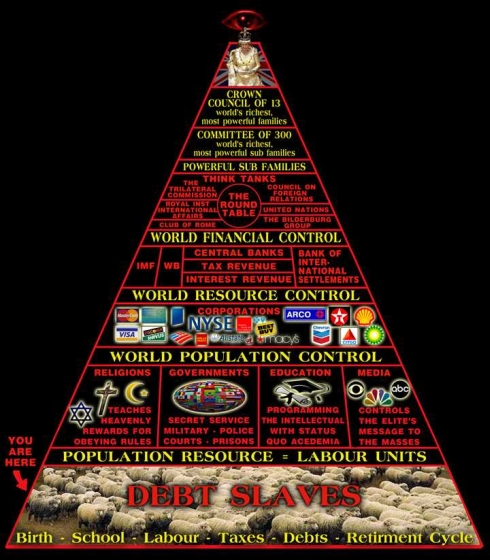
I’ve been reading Douglas Rushkoff’s “Present Shock: When Everything Happens Now” and have by coincidence just reached a chapter of the book covering the topic of currencies and the economy as Washington D.C. attempts to avoid another default. I found similar writings from Rushkoff on the same topic in two articles published by Arthur Magazine. As can be seen from these excerpts, they’re helpful for understanding our current situation:

Local currencies favored local transactions, and worked against the interests of large corporations working from far away. In order to secure their own position as well as that of their chartered monopolies, monarchs began to make local currencies illegal, and force locals to instead use “coin of the realm.” These centralized currencies worked the opposite way. They were not earned into existence, they were lent into existence by a central bank. This meant any money issued to a person or business had to be paid back to the central bank, with interest.

What does that do to an economy? It bankrupts it. Think of it this way: A business borrows 1000 dollars from the bank to get started. In ten years, say, it is supposed to pay back 2000 to the bank. Where does the other 1000 come from? Some other business that has borrowed 1000 from the bank. For one business to pay back what it owes, another must go bankrupt. That, or borrow yet another 1000, and so on.

An economy based on an interest-bearing centralized currency must grow to survive, and this means extracting more, producing more and consuming more. Interest-bearing currency favors the redistribution of wealth from the periphery (the people) to the center (the corporations and their owners). Just sitting on money—capital—is the most assured way of increasing wealth. By the very mechanics of the system, the rich get richer on an absolute and relative basis.

The biggest wealth generator of all was banking itself. By lending money at interest to people and businesses who had no other way to conduct transactions or make investments, banks put themselves at the center of the extraction equation. The longer the economy survived, the more money would have to be borrowed, and the more interest earned by the bank.

[…]Commerce is good. Commerce is not the problem. Monopolies are.

Except in a few rare cases, corporate charters and centralized currency were never intended to promote commerce. They were intended to prevent locals and non-chartered entities from creating and exchanging value. They are not extensions of the free market, but efforts at extracting value from the free market. Corporate monopoly charters were extended to a king’s favorite companies in return for shares. Then, no one else was allowed to do business in that industry. Centralized currency forced businesses to run their revenue through the king’s coffers. Likewise, in its current form, centralized currency is more akin to a ponzi scheme of interest rates, each borrower paying up to the banker above him.

Both of these innovations—corporate charters and centralized currency—tend towards resource exploitation rather than innovation. They are extractive in nature, not productive. And, more importantly, these particular innovations cause wealth to end up being generated through speculation rather than creation. They cause scarcity, not abundance. Over time, it becomes easier to make money by having money than by doing anything. And this was the pure, stated intent of centralized currency and banking in the early Renaissance: to keep the wealthy wealthy, in the face of a rising merchant class.

This isn’t some extremist perspective. It’s just historical fact, though largely forgotten and seemingly refuted by our collective false memory of the Renaissance’s greatness. If you’re interested in finding out more about this, or seeing the evidence on which my research is based, take a look at the best historians writing about the era: Fernand Braudel (The Wheels of Commerce: Civilization and Capitalism: 15th-18th Century, Volume 2, Univ. of California Press, 1992), Carlo M. Cipolla (Before the Industrial Revolution: European Society and Economy, 1000-1700, WW Norton, 1994) or Bernard A. Lietaer, whose book On Human Wealth used to be available for free download off his site, but doesn’t seem to be anymore. In these books, you can find out about the sustainable local economic systems of the Late Middle Ages, learn that the Black Plague actually began after mandated centralized currency had impoverished Europe, and find support of my contention that cathedrals were built with local money before the Renaissance, not Vatican money during the Renaissance.

I highly recommend checking out both articles here (as well as his most recent book “Present Shock”):

http://arthurmag.com/2009/03/16/let-it-die-rushkoff-on-the-economy/

http://arthurmag.com/2009/03/23/hack-money-hack-banking-rushkoff-on-the-economy/

More voices of sanity (Nicole Voss and Laurence Boomert) calling for an overhaul of the monetary system can be heard on the C-Realm podcast :