Monsanto Sues Maui for Direct Democracy, Launches New PR Campaign

maui monsanto protest

By Rebekah Wilce

Source: PR Watch

Residents of Maui County, Hawai’i voted on November 4 to ban the growing of genetically modified (GMO) crops on the islands of Maui, Lanai, and Molokai until scientific studies are conducted on their safety and benefits. Monsanto and Dow Chemical’s unit Mycogen Seeds have sued the county in federal court to stop the law passed by the people.

In Vermont, the Grocery Manufacturers Association (GMA, of which Monsanto and Dow were recently listed as members) has sued the state over its law requiring GMO labels. And Monsanto has a history of suing to prevent consumer labeling regarding its products. The company sued a number of dairies in the 1990s and 2000s for labeling milk free from recombinant bovine growth hormone (rBGH), which Monsanto developed and marketed as Posilac® (sold to Eli Lilly in 2008), the only commercially approved form. Vermont itself is no stranger to such suits. The International Dairy Foods Association sued Vermont for passing a law requiring labeling of milk containing rBGH (Monsanto wrote an amicus brief in support of the plaintiff, and GMA was a plaintiff-appellant) — and it won in federal court.

On the same day that Monsanto said it would challenge the decision of Maui’s citizens to regulate their own land and environment in court, the company also launched a new national advertising campaign as part of an effort to improve the image of the widely reviled company.

The glossy ads portray families of many cultures sitting down to eat gorgeous foods, invoking images more often seen in the pages of Saveur than in the hallways of one of the world’s largest chemical companies.

In addition to print ads in several national magazines and TV ads airing on national cable networks and several local stations in coastal cities, the campaign includes a slick new website launched in September, Discover.Monsanto.com.

The website invites questions from the public. The vast majority are skeptical, if not hostile. Others sound like they were written by Monsanto staff. Predictably, some of the hardest questions, like the one posed by Tim H., “In 2013, how much money has Monsanto spent on lobbyists in DC? What laws were these lobbyists attempting to create/amend and why?” are given short shrift.

Monsanto’s pretty TV ads target moms and millenials, according to the company’s corporate brand lead, Jessica Simmons. Monsanto has even hired a new “director of millenial engagement,” Vance Crowe, 32. He represented the company at a recent South by Southwest Eco conference in Austin, where revelations that Monsanto had paid for a panel of farmers to attend and present generated some excitement, as Tom Philpott reports in Mother Jones.

Crowe told NPR‘s “The Salt” blog, “[T]he challenge with something like SXSW Eco is that it doesn’t do anybody any good if people are so passionate that they’re yelling. The challenge is how can we enter the conversation so that people don’t feel like they have to yell to be heard?” Apparently, Crowe hopes to “enter the conversation” one party at a time. He enthusiastically describes how he and a gay colleague attended sessions on “sustainable fashion” and got invited to parties where they won fans and accolades.

Coincidentally, the front page of Discover.Monsanto.com contains, under “Here’s where we work,” a picture of corn crops being tended in Maui, with the text, “Hawaii’s unique climate allows for three to four growing seasons a year, reducing the time it takes us to develop new products. Our island roots go back more than 45 years.”

The marketing text may indicate the issue at the heart of Monsanto’s lawsuit against Maui. Those multiple growing seasons mean that “about 90 percent of all corn grown in the U.S. is genetically engineered and has been developed partially at Hawaii farms,” according to the Associated Press. Monsanto and the rest of the seed crop industry reap $146.3 million a year in sales from their activities in the state, according to a 2009 USDA report. Now Monsanto would have to substantially downsize its activity in Maui County in order to follow the new law, according to its lawsuit.

Monsanto’s new PR campaign seeks to make its brand approachable to the American consumer. Yet, with 92 percent of Americans demanding that GMO foods be labelled, according to a new Consumer Reports poll, Monsanto and its new millenial hires have their work cut out for them.

Consumer Reports recently put out a study on where GMOs are hiding in your food, including in packages labeled “natural.” You can access the report here.

Rebekah Wilce is a reporter and researcher who directs CMD’s Food Rights Network project.

The Real Thanksgiving (repost)

Illegals-e1417043153234

Hope you all have a good Thanksgiving. While it’s always nice to celebrate special occasions with loved ones (if one is fortunate enough to be in a situation to be able to) and one should be thankful for what one has, we should also feel discontent for what so many do not have or for what they’ve had taken away from them.

An excerpt from The Hidden History of Massachusetts by Dr. Tingba Apidta:

Much of America’s understanding of the early relationship between the Indian and the European is conveyed through the story of Thanksgiving. Proclaimed a holiday in 1863 by Abraham Lincoln, this fairy tale of a feast was allowed to exist in the American imagination pretty much untouched until 1970, the 350th anniversary of the landing of the Pilgrims. That is when Frank B. James, president of the Federated Eastern Indian League, prepared a speech for a Plymouth banquet that exposed the Pilgrims for having committed, among other crimes, the robbery of the graves of the Wampanoags. He wrote:

“We welcomed you, the white man, with open arms, little knowing that it was the beginning of the end; that before 50 years were to pass, the Wampanoag would no longer be a free people.”

But white Massachusetts officials told him he could not deliver such a speech and offered to write him another. Instead, James declined to speak, and on Thanksgiving Day hundreds of Indians from around the country came to protest. It was the first National Day of Mourning, a day to mark the losses Native Americans suffered as the early settlers prospered. This true story of “Thanksgiving” is what whites did not want Mr. James to tell.

What Really Happened in Plymouth in 1621?

According to a single-paragraph account in the writings of one Pilgrim, a harvest feast did take place in Plymouth in 1621, probably in mid-October, but the Indians who attended were not even invited. Though it later became known as “Thanksgiving,” the Pilgrims never called it that. And amidst the imagery of a picnic of interracial harmony is some of the most terrifying bloodshed in New World history.

The Pilgrim crop had failed miserably that year, but the agricultural expertise of the Indians had produced twenty acres of corn, without which the Pilgrims would have surely perished. The Indians often brought food to the Pilgrims, who came from England ridiculously unprepared to survive and hence relied almost exclusively on handouts from the overly generous Indians-thus making the Pilgrims the western hemisphere’s first class of welfare recipients. The Pilgrims invited the Indian sachem Massasoit to their feast, and it was Massasoit, engaging in the tribal tradition of equal sharing, who then invited ninety or more of his Indian brothers and sisters-to the annoyance of the 50 or so ungrateful Europeans. No turkey, cranberry sauce or pumpkin pie was served; they likely ate duck or geese and the venison from the 5 deer brought by Massasoit. In fact, most, if notall, of the food was most likely brought and prepared by the Indians, whose 10,000-year familiarity with the cuisine of the region had kept the whites alive up to that point.

The Pilgrims wore no black hats or buckled shoes-these were the silly inventions of artists hundreds of years since that time. These lower-class Englishmen wore brightly colored clothing, with one of their church leaders recording among his possessions “1 paire of greene drawers.” Contrary to the fabricated lore of storytellers generations since, no Pilgrims prayed at the meal, and the supposed good cheer and fellowship must have dissipated quickly once the Pilgrims brandished their weaponry in a primitive display of intimidation. What’s more, the Pilgrims consumed a good deal of home brew. In fact, each Pilgrim drank at least a half gallon of beer a day, which they preferred even to water. This daily inebriation led their governor, William Bradford, to comment on his people’s “notorious sin,” which included their “drunkenness and uncleanliness” and rampant “sodomy”…

The Pilgrims of Plymouth, The Original Scalpers

Contrary to popular mythology the Pilgrims were no friends to the local Indians. They were engaged in a ruthless war of extermination against their hosts, even as they falsely posed as friends. Just days before the alleged Thanksgiving love-fest, a company of Pilgrims led by Myles Standish actively sought to chop off the head of a local chief. They deliberately caused a rivalry between two friendly Indians, pitting one against the other in an attempt to obtain “better intelligence and make them both more diligent.” An 11-foot-high wall was erected around the entire settlement for the purpose of keeping the Indians out.

Any Indian who came within the vicinity of the Pilgrim settlement was subject to robbery, enslavement, or even murder. The Pilgrims further advertised their evil intentions and white racial hostility, when they mounted five cannons on a hill around their settlement, constructed a platform for artillery, and then organized their soldiers into four companies-all in preparation for the military destruction of their friends the Indians.

Pilgrim Myles Standish eventually got his bloody prize. He went to the Indians, pretended to be a trader, then beheaded an Indian man named Wituwamat. He brought the head to Plymouth, where it was displayed on a wooden spike for many years, according to Gary B. Nash, “as a symbol of white power.” Standish had the Indian man’s young brother hanged from the rafters for good measure. From that time on, the whites were known to the Indians of Massachusetts by the name “Wotowquenange,” which in their tongue meant cutthroats and stabbers.

Who Were the “Savages”?

The myth of the fierce, ruthless Indian savage lusting after the blood of innocent Europeans must be vigorously dispelled at this point. In actuality, the historical record shows that the very opposite was true.

Once the European settlements stabilized, the whites turned on their hosts in a brutal way. The once amicable relationship was breeched again and again by the whites, who lusted over the riches of Indian land. A combination of the Pilgrims’ demonization of the Indians, the concocted mythology of Eurocentric historians, and standard Hollywood propaganda has served to paint the gentle Indian as a tomahawk-swinging savage endlessly on the warpath, lusting for the blood of the God-fearing whites.

But the Pilgrims’ own testimony obliterates that fallacy. The Indians engaged each other in military contests from time to time, but the causes of “war,” the methods, and the resulting damage differed profoundly from the European variety:

o Indian “wars” were largely symbolic and were about honor, not about territory or extermination.

o “Wars” were fought as domestic correction for a specific act and were ended when correction was achieved. Such action might better be described as internal policing. The conquest or destruction of whole territories was a European concept.

o Indian “wars” were often engaged in by family groups, not by whole tribal groups, and would involve only the family members.

o A lengthy negotiation was engaged in between the aggrieved parties before escalation to physical confrontation would be sanctioned. Surprise attacks were unknown to the Indians.

o It was regarded as evidence of bravery for a man to go into “battle” carrying no weapon that would do any harm at a distance-not even bows and arrows. The bravest act in war in some Indian cultures was to touch their adversary and escape before he could do physical harm.

o The targeting of non-combatants like women, children, and the elderly was never contemplated. Indians expressed shock and repugnance when the Europeans told, and then showed, them that they considered women and children fair game in their style of warfare.

o A major Indian “war” might end with less than a dozen casualties on both sides. Often, when the arrows had been expended the “war” would be halted. The European practice of wiping out whole nations in bloody massacres was incomprehensible to the Indian.

According to one scholar, “The most notable feature of Indian warfare was its relative innocuity.” European observers of Indian wars often expressed surprise at how little harm they actually inflicted. “Their wars are far less bloody and devouring than the cruel wars of Europe,” commented settler Roger Williams in 1643. Even Puritan warmonger and professional soldier Capt. John Mason scoffed at Indian warfare: “[Their] feeble manner…did hardly deserve the name of fighting.” Fellow warmonger John Underhill spoke of the Narragansetts, after having spent a day “burning and spoiling” their country: “no Indians would come near us, but run from us, as the deer from the dogs.” He concluded that the Indians might fight seven years and not kill seven men. Their fighting style, he wrote, “is more for pastime, than to conquer and subdue enemies.”

All this describes a people for whom war is a deeply regrettable last resort. An agrarian people, the American Indians had devised a civilization that provided dozens of options all designed to avoid conflict–the very opposite of Europeans, for whom all-out war, a ferocious bloodlust, and systematic genocide are their apparent life force. Thomas Jefferson–who himself advocated the physical extermination of the American Indian–said of Europe, “They [Europeans] are nations of eternal war. All their energies are expended in the destruction of labor, property and lives of their people.”

Puritan Holocaust

By the mid 1630s, a new group of 700 even holier Europeans calling themselves Puritans had arrived on 11 ships and settled in Boston-which only served to accelerate the brutality against the Indians.

In one incident around 1637, a force of whites trapped some seven hundred Pequot Indians, mostly women, children, and the elderly, near the mouth of the Mystic River. Englishman John Mason attacked the Indian camp with “fire, sword, blunderbuss, and tomahawk.” Only a handful escaped and few prisoners were taken-to the apparent delight of the Europeans:

To see them frying in the fire, and the streams of their blood quenching the same, and the stench was horrible; but the victory seemed a sweet sacrifice, and they gave praise thereof to God.

This event marked the first actual Thanksgiving. In just 10 years 12,000 whites had invaded New England, and as their numbers grew they pressed for all-out extermination of the Indian. Euro-diseases had reduced the population of the Massachusett nation from over 24,000 to less than 750; meanwhile, the number of European settlers in Massachusetts rose to more than 20,000 by 1646.

By 1675, the Massachusetts Englishmen were in a full-scale war with the great Indian chief of the Wampanoags, Metacomet. Renamed “King Philip” by the white man, Metacomet watched the steady erosion of the lifestyle and culture of his people as European-imposed laws and values engulfed them.

In 1671, the white man had ordered Metacomet to come to Plymouth to enforce upon him a new treaty, which included the humiliating rule that he could no longer sell his own land without prior approval from whites. They also demanded that he turn in his community’s firearms. Marked for extermination by the merciless power of a distant king and his ruthless subjects, Metacomet retaliated in 1675 with raids on several isolated frontier towns. Eventually, the Indians attacked 52 of the 90 New England towns, destroying 13 of them. The Englishmen ultimately regrouped, and after much bloodletting defeated the great Indian nation, just half a century after their arrival on Massachusetts soil. Historian Douglas Edward Leach describes the bitter end:

The ruthless executions, the cruel sentences…were all aimed at the same goal-unchallengeable white supremacy in southern New England. That the program succeeded is convincingly demonstrated by the almost complete docility of the local native ever since.

When Captain Benjamin Church tracked down and murdered Metacomet in 1676, his body was quartered and parts were “left for the wolves.” The great Indian chief’s hands were cut off and sent to Boston and his head went to Plymouth, where it was set upon a pole on the real first “day of public Thanksgiving for the beginning of revenge upon the enemy.” Metacomet’s nine-year-old son was destined for execution because, the whites reasoned, the offspring of the devil must pay for the sins of their father. The child was instead shipped to the Caribbean to spend his life in slavery.

As the Holocaust continued, several official Thanksgiving Days were proclaimed. Governor Joseph Dudley declared in 1704 a “General Thanksgiving”-not in celebration of the brotherhood of man-but for [God’s] infinite Goodness to extend His Favors…In defeating and disappointing… the Expeditions of the Enemy [Indians] against us, And the good Success given us against them, by delivering so many of them into our hands…

Just two years later one could reap a ££50 reward in Massachusetts for the scalp of an Indian-demonstrating that the practice of scalping was a European tradition. According to one scholar, “Hunting redskins became…a popular sport in New England, especially since prisoners were worth good money…”

Darren Wilson Wasn’t the First: A Short History of Killer Cops Let Off the Hook

michael-brown-darren-wilson

The U.S. has a long history of allowing police to walk free after vicious racist violence.

By Flint Taylor

Source: In These Times

The Ferguson grand jury’s decision not to indict Ferguson police officer Darren Wilson for the killing of African-American teenager Michael Brown is heartless but unsurprising. But it is important to place the case in context with the history of police violence investigations and prosecutions in high profile cases—and the systemic and racist police brutality that continues to plague the nation. In doing so, there are lessons for the movement for justice in the Michael Brown case, as well as for those who are engaged in the broader struggle against law enforcement violence.

What follows, then, is a brief history of similar high profile cases where public outrage compelled the justice system to confront acts of racially motivated police violence—with, to say the least, less than satisfactory results.

Chicago

Over the past 45 years, Chicago has been a prime example of official indifference and cover-up when it comes to prosecuting the police for wanton brutality and torture.

On December 4, 1969, Black Panther leaders Fred Hampton and Mark Clark were slain in a police raid that implicated the Cook County State’s Attorney and the FBI’s Cointelpro program. A public outcry led to a Federal Civil Rights investigation. Despite finding that the raiding police fired more than 90 shots to one by the Panthers, the Grand Jury in 1970 did not indict, but rather issued a report that equally blamed the police perpetrators and the Panther victims.

Outrage at this decision led to the appointment of a Special Prosecutor who, in the face of extreme official resistance, obtained an indictment against the police and the State’s Attorneys who planned and executed the raid—not for murder and attempted murder, but rather for obstruction of justice.

The case came to trial in front of a politically connected judge who dismissed the case without even requiring that the charged officials put on a defense. Again, the outrage, particularly in the African-American community was so extreme that the chief prosecutor, Edward V. Hanrahan, was voted out of office a week after the verdict was rendered in 1972.

The Jon Burge police torture scandal provides another stark example. Evidence that had been unearthed over the years demonstrated that a crew of predominately white Chicago police detectives, led by Jon Burge, tortured at least 120 African-American men from 1972 to 1991.

Cook County State’s Attorney Richard M. Daley was tendered powerful evidence of this torture as early as 1982, but did not investigate or prosecute Burge and his men. Daley’s office continued to use confessions tortured from the victims to send scores of them to prison—10 of whom went to death row, though they were later saved by a death penalty moratorium in 2000 and by a grant of clemency in 2003 by then-Governor George Ryan—during the next seven years.

In 1989, the local U.S. Attorneys’ office declined to prosecute, as did the Department of Justice in 1996 and Cook County State’s Attorney Richard Devine for the five years directly thereafter. In 2001, due to continuing public pressure, a politically connected Special Prosecutor was appointed to investigate the torture. But after a four year, $7 million investigation, he too refused to indict, instead issuing what is widely considered to be a whitewash report that absolved Daley, Devine, and numerous high Chicago police officials.
Finally, in 2008 the U.S. Attorney indicted Burge for perjury and obstruction of justice, and he was convicted in 2010, and sentenced to 4 ½ years in prison. However, the U.S. Attorney has subsequently declined to prosecute Burge’s confederates for similar offenses.

New Orleans

Chicago is by no means an isolated example of how difficult it is to obtain justice for wanton police violence through the judicial system. In New Orleans, a crew of white detectives responded to the killing of a white police officer in 1980 by terrorizing the black community of Algiers, killing four innocent people and torturing numerous others by “booking and bagging” them: beating suspects with telephone books and suffocating them with bags over their heads.

Seven officers were indicted by the Department of Justice for civil rights violations arising from the torture of one of the victims and three were convicted.  No officers were charged for the four killings or for the other acts of torture.

In 2005, in the wake of Hurricane Katrina, an NOPD officer fatally shot an unarmed black man named Henry Glover, then several of his fellow officers burned his body to cover-up their crime. NOPD officers also shot and killed two unarmed black men on the Danziger Bridge.

After state authorities botched their investigation, the Civil Rights Division of the Justice Department indicted the officers involved in the two cases and obtained convictions of some of the main police actors. However, the Court of Appeals for the Fifth Circuit overturned the verdict in the Glover case, and the trial judge, citing government misconduct, took the extraordinary step of granting the convicted officers a new trial in the Danziger case. 

New York

In 1997, an NYPD officer sexually assaulted a Haitian-American man named Abner Louima in a precinct station bathroom by shoving a broken broomstick up his rectum. Louima’s attacker was subsequently charged with federal civil rights violations, while three of his police accomplices were charged with covering up the crimes.

After Louima’s attacker pleaded guilty, his accomplices were convicted, but the Second Circuit Court of Appeals overturned their convictions on the grounds that the lawyers who represented the officers had a conflict of interest. After they were convicted a second time, the Appeals Court again overturned their convictions—this time on the basis that there was insufficient evidence of intent.

In 1999, four officers from the NYPD’s Street Crimes Unit fired 41 shots at Amadou Diallo, a Guinean immigrant who was reaching for his wallet, hitting him 19 times. The officers were indicted for second degree murder and the case was moved to upstate New York, where a jury acquitted the officers. 

In July of this year, NYPD officers arrested an African-American man named Eric Garner, allegedly for selling untaxed cigarettes. They put a prohibited chokehold on him, forced him to the ground face first with his hands behind his back, and shoved his face into the pavement, where he died a few minutes later of a heart attack. The deadly assault, which was captured on videotape, is now under investigation by a Special Grand Jury empaneled by the District Attorney’s Office.

Los Angeles

Among the most notorious cases was the brutal 1991 beating of Rodney King by five LAPD officers. A videotape captured most of the brutality and also showed several other officers standing by and doing nothing to stop the pummeling of a defenseless black man.

Four officers were charged at the state level with assault with a deadly weapon and use of excessive force. The trial was moved to a predominantly white suburban county, and three of the officers were acquitted of all charges, while the fourth was acquitted of assault with a deadly weapon and other lesser charges. But the jury failed to reach a verdict on his use of excessive force.

After an angry uprising in the Africa- American community of Los Angeles that left 53 dead and around 2,000 injured, the U.S. Justice Department indicted the four officers, and a federal jury convicted two of them, while acquitting the other two.

This past August, LAPD officers fatally shot an unarmed mentally ill African-American man named Ezell Ford, who witnesses said was shot in the back while lying on the ground. Despite massive protests, there has been no grand jury investigation to date, the autopsy report is yet to be released, and the LAPD has not completed its investigation.

Oakland

In Oakland, California in the late 1990s, a unit of police officers dubbed the “Rough Riders” systematically beat, framed and planted narcotics on African Americans whom they claimed were dealing drugs. Four of the “Riders” were indicted by the District Attorney’s Office, and the trial was moved to a suburban county. The ringleader fled the country, and was tried in absentia.

After a year-long trial before a bitterly divided jury on which there were no blacks, the officers were acquitted of eight charges, and the jury was hung on the remaining 27 counts. At the urging of then-Mayor Jerry Brown, the officers were not re-tried.

Also in Oakland, in the early morning hours of New Years Day, 2009, a BART officer shot and killed a young black man named Oscar Grant, who was lying face down, unarmed,  in a busy transit station. The shooting was videotaped, and led to militant protests in Oakland.

Another jury with no black members rejected the charge of murder and instead found the officer guilty of involuntary manslaughter. As a result, Oscar Grant’s killer spent less than a year behind bars. The Department of Justice subsequently opened a civil rights investigation, but no charges were brought.

Milwaukee

From 2007-2012 in Milwaukee, a unit of white police officers, spurred on by the Department’s CompStat program of aggressive policing, stopped and illegally body cavity searched more than 70 African-American men whom they claimed to be investigating for drug dealing. In conducting these searches, most commonly performed on the street, the searching officer reached inside the men’s underwear, and probed their anuses and genitals.

After this highly illegal practice came to light, the unit’s ringleader, Michael Vagnini, was indicted by the Milwaukee County District Attorney on numerous counts of sexual assault, illegal searches, and official misconduct, while three of the other unit officers were also charged for participating in two of the searches. The unit’s sergeant and several other members of the unit, all of whom were present for many of the searches, were not charged.

The charged officers were permitted to plead guilty to the lesser included offenses of official misconduct and illegal strip searches, with Vagnini receiving a 36-month sentence while the other three received sentences that totaled, collectively, less than a month in jail. By pleading guilty, they also received promises that they would not be charged with federal civil rights violations.

Pattern and Practice Investigations

These high profile cases represent only the tip of the iceberg when it comes to cases where racist police violence has not been subjected to equal justice under the law.

Recently, the Justice Department declined to prosecute Little Rock, Arkansas, officers who shot and killed Eugene Ellison, an elderly African American man who was walking out of his home with a cane in his hand, while there have been documented reports of unarmed black men recently being shot down by the police in Chicago; Houston; San Antonio; Beaver Creek, Ohio; and Sarasota, Florida.

In 1994, the United States Congress, recognizing that police misconduct and violence was systemic in many parts of the country, passed 42 U.S. Code Section 14141, which empowered the Justice Department to file suit against police departments alleging patterns and practices of unconstitutional conduct, and to obtain wide ranging court orders, consent decrees, and independent monitors in order to implement reforms to those practices.

Although understaffed, the Pattern and Practice Unit of the Justice Department has attacked systemic and discriminatory deficiencies in police hiring, supervision, and monitoring in numerous police departments over the past 20 years.  A particularly egregious act or series of acts of police violence often prompts the Unit to initiate an investigation, and its lawyers have obtained consent decrees or court orders in Cincinnati, Pittsburgh, Steubenville, Ohio, New Orleans, Puerto Rico, Oakland, and Miami.

Last month, lawyers handling the Little Rock cases requested that the DOJ do a pattern and investigation of the LRPD, and the Unit is reportedly now investigating the practices of the Ferguson Police Department. While these investigations are not a panacea, they offer a mechanism for exposing and reforming blatantly unconstitutional police practices, and have also demonstrated how pervasive the problem systemic police violence continues to be.

In light of this history, the pre-ordained failure of a biased local prosecutor to obtain an indictment against Darren Wilson should not surprise us. But the movement for justice for Michael Brown has brought widespread attention to the nationwide problem of systemic and racist police violence and highlighted the movement that has come together to battle against it.

Just two weeks ago, the Brown case, along with the Burge torture cases, was presented to the United Nations Committee Against Torture in Geneva. The movement should now turn its attention to the Department of Justice, demanding a federal civil rights indictment against Wilson a full scale pattern and practice investigation of the Ferguson Police Department, and, more broadly, an end to systemic and racist police violence.

As the history of the battle against racist police violence so pointedly teaches, the public outcry and agitation must continue not only in Ferguson but across the nation. Because as Frederick Douglas rightly stated many years ago, power concedes nothing without a demand.
Flint Taylor is one of the lawyers for the families of slain Black Panther leaders Fred Hampton and Mark Clark and together with his law partner Jeffrey Haas was trial counsel in the marathon 1976 civil trial. For more information on the Hampton/Clark case, the history of Black Panther Party, and the FBI’s Program to destroy it, visit peopleslawoffice.com.

 

Don’t forget Malala Yousafzai’s appeal to Obama: end the drone war

M_Id_429009_Malala_Yousafzai

By Zack Beauchamp

Source: Vox.com

On Friday morning, 17 year-old Pakistani activist Malala Yousafzai won the Nobel Peace Prize. Yousafzai’s prize is well-deserved: she’s been a prominent campaigner for girls’ education for years, and survived a Taliban assassination attempt for her efforts.

But women’s education isn’t Malala’s only cause. She’s also waged a prominent campaign on a topic Americans aren’t talking much about nowadays: the drone war in Pakistan.

In characteristically bold fashion, Yousafzai brought these concerns up in a meeting with President Obama back in October 2013 — one that had originally been held to celebrate her commitment to education.

“I thanked President Obama for the United States’ work in supporting education in Pakistan and Afghanistan and for Syrian refugees,” Yousafzai said in a statement after the meeting — before turning to drones. “I also expressed my concerns that drone attacks are fueling terrorism. Innocent victims are killed in these acts, and they lead to resentment among the Pakistani people. If we refocus efforts on education it will make a big impact.”

The White House statement on its meeting with Yousafzai left that bit out.

The US drone campaign in Pakistan peaked back in 2010, but that hardly justifies forgetting about it in 2014. We should remember it because we still have no idea if the targeted killings are actually reducing militant violence in Pakistan. We should remember it because it may not actually weaken al-Qaeda in the long run. And, most of all, we should remember it because it’s killed hundreds, if not thousands, of Pakistani civilians:

Screen_Shot_2014-10-10_at_11.02.13_AM.0

Drone war casualties, civilian and militant. (New America Foundation)

In other words: Yousafzai was pointing to exactly the right issues. We don’t know if drone strikes are weakening al-Qaeda, but we definitely know that they’re killing people — including innocents.

Nowadays, the American public is more focused on the US military campaign against ISIS than they are on the campaign in Pakistan. Part of that is that the ISIS war is newer and more intense. Another part is that, for the first half of 2014, the US wasn’t hitting any targets in Pakistan. In fact, Peter Bergen, an expert on the drone war at the New America Foundation, said that “the program [in Pakistan] appears to have ended.”

Yet on June 11, the US began bombing Pakistan again. According to New America data, there have been five strikes in October 2014 alone.

So as Yousafzai gets her deserved accolades for her peace work, it’s worth remembering her concerns about one of America’s quieter wars. That’s especially true as the US government is ramping up another air campaign against an jihadi group that’s expected to last for years.


Don’t Forget Why Marijuana Legalization Is Winning

index

By Maia Szalavitz

Source: Substance.com

When I first started writing about drugs in the mid-’80s—before I got into recovery in 1988—it was almost impossible to imagine an America where four states and DC have legalized recreational marijuana use, 58% of Florida midterm voters just cast their ballots in favor of legalizing medical use (the measure needed 60% to pass), and California passed a ballot initiative to lower drug and other nonviolent crime sentences. (Nineteen other states have legalized medical marijuana.)

The magnitude of the change is hard to understand without knowing a bit of recent history—and if we are going to continue to move toward rational drug policy, knowing where we’ve been and how it has changed is critical. I offer this perspective through the lens of my own experience covering the drug war for nearly 30 years.

My first national column was called, embarrassingly enough, “Piss Patrol.” I was assigned by High Times to write about corporate urine testing policies, starting around 1987, presumably as a service to stoned readers who were considering their employment options.

Over the next few years, the media would spill so much ink and airtime demonizing crack cocaine that by 1989, 64% of people polled by CBS News said that drugs were the country’s biggest problem—and Republicans and Democrats began tripping over one another to race to pass the harshest possible drug sentencing laws.

High Times itself was targeted by the DEA with frequent demands for its list of subscribers and raids on all of its biggest advertisers of growing supplies, nearly forcing the magazine to close.

Testifying before Congress, LAPD chief Daryl Gates said that casual drug users “ought to be taken out and shot,” and the DARE drug prevention program he founded saw nothing ominous in encouraging kids to turn their parents in to the police if they used drugs. Supreme Court Justice Thurgood Marshall warned in a prescient 1989 dissent in a urine testing case that “there is no drug exception to the Constitution,” although Congress and the rest of the legal establishment apparently begged to differ.

Even today, police can confiscate cash and property they suspect to be involved in drug crimes, without convicting the owners and with virtual impunity. The surveillance revelations about the NSA’s spying on American citizens include cases where that agency has shared information with the DEA that was gathered from phones and computers without a warrant. In fact, the DEA has an official policy of basically lying to defense attorneys—and sometimes even prosecutors and judges—about the source of this data.

Yet even before the rage to pass tough drug laws took off in the 1980s, law enforcement efforts like mandatory minimum sentences were known to be ineffective. The federal government had quietly overturned one set of mandatory drug sentences in the late ‘60s—since they had clearly failed to prevent the late ‘60s.

And New York City would never have been one of the capitals of crack if the 15-to-life “Rockefeller law” mandatory sentences for selling even powder cocaine, which had been in place here since the mid-‘70s, actually suppressed drug use.

As is clear from this brief summary, for most of my adult life, the idea of a rational drug policy seemed literally to be a pipe dream (a term, by the way, from opium dens). So how did we go, in just a few years, from seeing drug users as demon enemies in a war who must be locked up to having the drug czar drop the military language and even speak at last month’s National Harm Reduction Conference in Baltimore?

Many factors are clearly playing a role. Two of the most obvious are the sheer economic burden of having become the world’s most prolific jailer and the drop in violent crime that hasn’t been paralleled by a fall in addiction rates or a reduction in the availability of drugs like marijuana, heroin and cocaine. Some of the crime decrease may, of course, be linked to the 500% rise in the number of prisoners since 1980—but research shows that violent crime fell more in states that have lowered incarceration rates.

Other influences have also been important. One has been the increasing recognition—driven especially by Michelle Alexander’s 2011 bestseller The New Jim Crow—of the racist nature of the drug war. When you know this history of the drug laws it is very hard to justify supporting them.

Another factor is the rise of the Internet. Early adopters of the net tended to be hippies and libertarians: Steve Jobs famously said that his use of LSD was one of the most important experience of his life, for example, and pro-legalization views dominated online before the mainstream media began to realize the web was the future of its business.

This gave legalizers a loud voice—one that had been previously drowned out by a media that had so bought into the drug war that networks and newsmagazines thought nothing of taking government payments to place stories with the “correct” anti-drug slant in lieu of running paid anti-drug ads.

The Internet has also allowed critics—including me—to directly attack inaccurate coverage as it appeared, exposing readers to truthful information about drugs and drug users that was previously hard to find. It is much harder to start a panic when debunkers immediately offer alternative perspectives.

Three other important forces should also be mentioned. First, the Drug Policy Alliance—helped by large donations from billionaire George Soros—spurred activism and funded ballot initiative measures that brought marijuana policy reform out of the fringes and into the mainstream.

Second, the harm reduction movement spurred by the AIDS epidemic quietly racked up successes. As it became clear that needle exchange hadn’t resulted in a massive increase in IV drug use—but had helped halt the spread of HIV—resistance to measures like naloxone to reverse overdose was pre-empted.

In contrast to the fight over needle exchange, when conservative politicians, drug treatment providers and religious leaders actively opposed expansion and claimed, without data, that it would encourage drug use, it’s actually hard now to find anyone who will argue that drug users and their families should not have access to the OD antidote for fear that preventing the deaths of users “sends the wrong message.”

Third, recovery activists have played a role. While there are still reactionary forces like Patrick Kennedy, many people who have come out about their own recovery have made clear that the criminal justice approach has failed. By putting a real face on drug users—not a stereotyped image of a criminal—recovering people have begun to help fight against, rather than support, their own oppression.

Of course, historically, fights for drug law reform have often resulted in backlash—marijuana was almost legalized, for example, under President Jimmy Carter, but instead we got Ronald Reagan’s war on drugs. But the strength and variety of the forces working against that possibility—particularly the rapid access to accurate information—give me hope that we may finally be starting to get drug policy right.

Maia Szalavitz is one of the nation’s leading neuroscience and addiction journalists, and a columnist at Substance.com. She has contributed to Timethe New York TimesScientific American Mindthe Washington Post and many other publications. She has also published five books, including Help at Any Cost: How the Troubled-Teen Industry Cons Parents and Hurts Kids (Riverhead, 2006), and is currently finishing her sixth, Unbroken Brain, which examines why seeing addiction as a developmental or learning disorder can help us better understand, prevent and treat it. Her last column for Substance.com was about why it is time to reclaim the concept of “recovery” from the abstinence-only establishment.

Saturday Matinee: JFK Documentary Archive

AMERICAN ROYALTY JFK DALLAS 03

Show notes by ConspiracyScope

The Men Who Killed Kennedy is a 9-part video documentary series about the John F. Kennedy assassination by Nigel Turner that began with two 50 minutes segments originally aired on 25 October 1988 in the United Kingdom, titled simply Part One and Part Two. The programmes were produced by Central Television for the ITV network, and were immediately followed by a studio discussion on the issues titled The Story Continues, chaired by broadcaster Peter Sissons. The United States corporation, Arts & Entertainment Company, purchased the rights to the original two segments. In 1989, the series was nominated for a Flaherty Documentary Award. The series was re-edited with additional material into three 50 minute programmes in 1991, which were again shown by ITV. A sixth episode appeared in 1995. The series typically aired in November every year, but also from time to time during the year as repeats. But in November, 2003, when three additional segments (“The Final Chapter”) were added by the History Channel, the consequences were so immense that the entire series is no longer aired, though the History Channel still sells DVD copies of the first six documentaries.

Fair Use:
“Copyright Disclaimer Under Section 107 of the Copyright Act 1976, allowance is made for “fair use” for purposes such as criticism, comment, news reporting, teaching, scholarship, and research. Fair use is a use permitted by copyright statute that might otherwise be infringing. Non-profit, educational or personal use tips the balance in favor of fair use.”

This is the mindblowing 6-part,10 hour, video documentary series Evidence of Revision whose purpose is to present the publicly unavailable and even suppressed historical audio, video and film recordings largely unseen by the American and world public relating to the assassination of the Kennedy brothers, the little known classified “Black Ops” actually used to intentionally create the massive war in Viet Nam, the CIA “mind control” programs and their involvement in the RFK assassination and the Jonestown massacre and other important truths of our post-modern time.

Playlist:
http://www.youtube.com/playlist?p=PL6…

http://conspiracyscope.blogspot.com/


US War on Iran Takes Bizarre Turn

mek

By Tony Cartalucci

Source: Land Destroyer Report

It is not merely hyperbole when it is said the US created terrorist organizations like Al Qaeda or the so-called “Islamic State.” It is documented fact. The current conflict in the Middle East may appear to be a chaotic conflagration beyond the control of the United States and its many eager allies, but in reality it is the intentional, engineered creation of regional fronts in a war against Iran and its powerful arc of influence.

It is not Western policy that indirectly spurs the creation and perpetuation of terrorist organizations, but in fact, direct, intentional, unmistakable support.

This support would manifest itself in perhaps the most overt and bizarre declaration of allegiance to terrorism to date, US Army General Hugh Shelton on stage before terrorists of the Mujahedeen-e-Khalq (MEK) and their Wahabist counterparts fighting in Syria, hysterically pledging American material, political, and strategic backing. MEK was listed for years by the US State Department as a foreign terrorist organization, but has received funding, arms, and safe haven by the United States for almost as long.

General Hugh’s speech titled, “Making Iranian mullahs fear, the MEK, come true,” was most likely never meant to be seen or fully understood by Americans. In titled alone, it is clear that US foreign policy intends to use the tool of terrorism to exact concessions from Tehran. If the true nature of America’s support for terrorist organizations like MEK were more widely known, the current narrative driving US intervention in Iraq and Syria would crumble.

MEK Has Killed US Servicemen, Contractors, and Iranian Civilians For Decades

MEK has carried out decades of brutal terrorist attacks, assassinations, and espionage against the Iranian government and its people, as well as targeting Americans including the attempted kidnapping of US Ambassador Douglas MacArthur II, the attempted assassination of USAF Brigadier General Harold Price, the successful assassination of Lieutenant Colonel Louis Lee Hawkins, the double assassinations of Colonel Paul Shaffer and Lieutenant Colonel Jack Turner, and the successful ambush and killing of American Rockwell International employees William Cottrell, Donald Smith, and Robert Krongard.

Admissions to the deaths of the Rockwell International employees can be found within a report written by former US State Department and Department of Defense official Lincoln Bloomfield Jr. on behalf of the lobbying firm Akin Gump in an attempt to dismiss concerns over MEK’s violent past and how it connects to its current campaign of armed terror – a testament to the depths of depravity from which Washington and London lobbyists operate.

To this day MEK terrorists have been carrying out attacks inside of Iran killing political opponents, attacking civilian targets, as well as carrying out the US-Israeli program of targeting and assassinating Iranian scientists. MEK terrorists are also suspected of handling patsies in recent false flag operations carried out in India, Georgia, and Thailand, which have been ham-handedly blamed on the Iranian government by the United States and Israel.

MEK is described by Council on Foreign Relations Senior Fellow Ray Takeyh as a “cult-like organization” with “totalitarian tendencies.” While Takeyh fails to expand on what he meant by “cult-like” and “totalitarian,” an interview with US State Department-run Radio Free Europe-Radio Liberty reported that a MEK Camp Ashraf escapee claimed the terrorist organization bans marriage, using radios, the Internet, and holds many members against their will with the threat of death if ever they are caught attempting to escape.

US Has Been Eagerly Supporting MEK Terrorists For Years

Besides providing MEK terrorists with now two former US military bases in Iraq as safe havens, the US has conspired to arm, fund, and back MEK for years in a proxy war against Iran.

Covert support for the US-listed terrorist group Mujahedeen e-Khalq (MEK) has been ongoing since at least 2008 under the Bush administration, when Seymour Hersh’s 2008 New Yorker article “Preparing the Battlefield,” reported that not only had MEK been considered for their role as a possible proxy, but that the US had already begun arming and financing them to wage war inside Iran:

The M.E.K. has been on the State Department’s terrorist list for more than a decade, yet in recent years the group has received arms and intelligence, directly or indirectly, from the United States. Some of the newly authorized covert funds, the Pentagon consultant told me, may well end up in M.E.K. coffers. “The new task force will work with the M.E.K. The Administration is desperate for results.” He added, “The M.E.K. has no C.P.A. auditing the books, and its leaders are thought to have been lining their pockets for years. If people only knew what the M.E.K. is getting, and how much is going to its bank accounts—and yet it is almost useless for the purposes the Administration intends.

Seymore Hersh in an NPR interview, also claims that select MEK members have already received trainingin the US.

More recently, the British Daily Mail published a stunning admission by “US officials” that Israel is currently funding, training, arming, and working directly with MEK. The Daily Mail article states:

U.S. officials confirmed today that Israel has been funding and training Iranian dissidents to assassinate nuclear scientists involved in Iran’s nuclear program. Washington insiders confirmed there is a close relationship between Mossad and MEK.

In 2009, an extensive conspiracy was formulated within US policy think-tank Brookings Institution’s 2009 “Which Path to Persia?” report, proposing to fully arm, train, and back MEK as it waged a campaign of armed terror against the Iranian people. In their report, they openly conspire to use what is an admitted terrorist organization as a “US proxy” (emphasis added):

“Perhaps the most prominent (and certainly the most controversial) opposition group that has attracted attention as a potential U.S. proxy is the NCRI (National Council of Resistance of Iran), the political movement established by the MEK (Mujahedin-e Khalq). Critics believe the group to be undemocratic and unpopular, and indeed anti-American.

In contrast, the group’s champions contend that the movement’s long-standing opposition to the Iranian regime and record of successful attacks on and intelligence-gathering operations against the regime make it worthy of U.S. support. They also argue that the group is no longer anti-American and question the merit of earlier accusations. Raymond Tanter, one of the group’s supporters in the United States, contends that the MEK and the NCRI are allies for regime change in Tehran and also act as a useful proxy for gathering intelligence. The MEK’s greatest intelligence coup was the provision of intelligence in 2002 that led to the discovery of a secret site in Iran for enriching uranium.

Despite its defenders’ claims, the MEK remains on the U.S. government list of foreign terrorist organizations. In the 1970s, the group killed three U.S. officers and three civilian contractors in Iran. During the 1979-1980 hostage crisis, the group praised the decision to take America hostages and Elaine Sciolino reported that while group leaders publicly condemned the 9/11 attacks, within the group celebrations were widespread.

Undeniably, the group has conducted terrorist attacks—often excused by the MEK’s advocates because they are directed against the Iranian government. For example, in 1981, the group bombed the headquarters of the Islamic Republic Party, which was then the clerical leadership’s main political organization, killing an estimated 70 senior officials. More recently, the group has claimed credit for over a dozen mortar attacks, assassinations, and other assaults on Iranian civilian and military targets between 1998 and 2001. At the very least, to work more closely with the group (at least in an overt manner), Washington would need to remove it from the list of foreign terrorist organizations.”

Besides US Army General Hugh Shelton, other prominent US politicians to literally stand before crowds of baying MEK terrorists and their supporters include former New York City Mayor Rudy Giuliani, Howard Dean, Tom Ridge, John Lewis, Ed Rendell, former ambassador John Bolton, former FBI Director Louis Freeh, retired General Wesley Clark, Lee Hamilton, former US Marine Corps Commandant General James Jones, and Alan Dershowitz. US Congresswoman Nancy Pelosi would also stand in front of MEK terrorists to deliver to them an Iranian New Year “greeting.”

Blind Lust for Global Hegemony is Leading America Over a Cliff 

What it says about American foreign policy, to trick US servicemen and women into dying in far off lands to “fight terrorism” when US politicians in the highest positions of power openly pledge support to terrorism – using it as a battering ram against its enemies abroad, and failing to topple them by proxy, using their own terrorist hordes as a pretext for direct military intervention to do so – is that such policy is underpinned by nothing more than blind lust for power, wealth, and influence in senseless pursuit of global hegemony. There is no guiding principles of peace, stability, democracy, freedom, or any confining principles of humanity that prohibit US foreign policy from exercising the most abhorrent practices in order to achieve its goals.

For America and the Western aligned nations and interests caught in its orbit, there is no future. Chasing hegemony for the sake of hegemony alone leaves no room for actual progress. When anything and everything obstructing the path to hegemony is seen as an “enemy” to be destroyed by any means necessary, that includes setting aside resources and attention to solving some of the most pressing issues of our time – health care, infrastructure, education, better jobs, peace, and prosperity. All of these are seen as obstacles toward hegemony, and the very same interests standing before MEK terrorists pledging America’s resources to their campaign of terrorism against Iran, are the same interests calling for and implementing austerity upon the American people to continuously fuel its foreign adventures.

Failure to identify these interests blindly chasing hegemony at the cost of global peace and prosperity leads not only America over a cliff into a ravine of madness, but the entire world as well. That a US general can stand before terrorists even as the US bombs two nations in the name of fighting terrorism, is but a glimpse into this madness.

Tony Cartalucci, Bangkok-based geopolitical researcher and writer, especially for the online magazine New Eastern Outlook”.

Cynicism, Recession, and the Resurgence of Cyberpunk

books

By Marshall Sandoval

Source: PopMatters

Human nature might be augmented and highly channeled by technology, but human nature stays the same. And that tech might actually amplify all the worst things about us too.

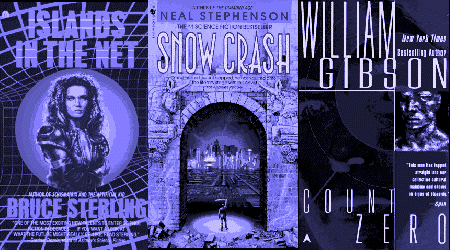
Cyberpunk has seen a recent resurgence in video games. Seemingly every game developer working today has a William Gibson book tucked under their arm or follows @swiftonsecurity (a satirical Twitter account that imagines a Taylor Swift consumed with cyber security). Cyberpunk video games are pervasive, including cyberpunk game jam projects on itch.io, Twine games, indie titles, and major AAA releases. All of these projects embrace cyberpunk themes and aesthetics. Observers credit the current trend to a number of cyclical and cultural factors. After talking to the indie developers behind a number of exciting cyberpunk titles at the center of this resurgence, I believe that the creators of these games are overwhelmingly inspired by the headlines in today’s newspapers.

It seems like no coincidence that these games have all appeared in a short time period following the economic recession. On the most basic level of analysis, it seems that these games may be providing a sense of escape from recent economic events. Last Life developer Sam Farmer notes, “I’m gonna go back to my film school class on Sci-Fi and Fantasy and say that it’s escapism. Horror, in general, and escapism, in particular, is often more popular in times of economic downturn, when you want to be somewhere else.”

Garrett Cooper’s Black Ice is an action game which casts the player as a hacker taking down corporate servers. Promoting the game, he’s found that cyberpunk narratives may be popular for reflecting reality as much as for providing an escape. He says, “I’ve talked to people about my game. I say, ‘All the corporations are evil.’ So they’re like, ‘Oh. So you’re talking about real life?’ I’m like, ‘No. Not exactly.’ That’s what people feel. The fantasy of being the one guy that can take something technological and turn it against the corporation.”

Games writer Austin Walker is an academic and cyberpunk superfan who sees the same throughline in these games and the literary roots of the genre. Walker says, “A key to traditional cyberpunk again and again is that there is economic inequality. We are positioning ourselves somewhere on that scale of how we feel about this stuff. Cyberpunk stories do that too. Usually they position the hero at the bottom of that; they’re usually in or near poverty.” In a time of extreme real-world inequality, cyberpunk stories locate players in a fantasy of rising up to subvert the system and taking down greedy corporations.

David Pittman’s indie project Neon Struct deals with a fictional near-future surveillance state. The game was heavily influenced by the recent leaks about actual domestic surveillance in the present day in the United States. Pittman says, “Edward Snowden’s release of NSA documents in 2013 was an essential part of the inception of Neon Struct (formerly Die Augen der Welt, or ‘The Eyes of the World’). I have strong feelings about the abuse of surveillance by the U.S. government, and I’ve known for close to a year that I wanted to make a game about it.” He’s quick to add, “Despite my own interest and leaning in the real world debate over mass surveillance, I am developing a way to introduce the story, which does not require the player character to actually leak any classified information. I don’t want to assume that the player shares my biases.” Nonetheless, it’s clear that the forthcoming project was informed by recent events.

Other examples of indie games providing commentary on and gaining inspiration from world events abound. Brigador is an isometric cyberpunk shooter with an extremely stylish trailer, and developer Jack Monahan lists a surprising influence. Monahan says, “While I’m not sure if the author would agree with the genre classification {of cyberpunk}, my brother and I both read and enjoyed (and were worried by) a book called Cities Under Siege: The New Military Urbanism by Stephen Graham. Like William Gibson said, the future caught up to all of his writing, more or less. We basically are living in a dystopic future”. Notably, Monahan made these statements before the recent military-style urban clashes in Ferguson, Missouri. The aforementioned Last Life is shaped by real world advances in medicine and philosophical debates about transhumanism. Matt Conn is seeking to expand LGBT representation in the games space with the cyberpunk RPG R.O.M. He says, “Because I did GaymerX and prior to that I did a startup that was very successful and then crashed. Seeing how all that happened, I feel like I have an interesting perspective of the tech scene and the LGBT rights scene.” These varied examples show the differing events influencing today’s cyberpunk boom.

As strongly as these games are influenced by the socio-political climate, it is reductionist to say this is the only thing bringing cyberpunk back into prominence. Again, Austin Walker says, “It’s tempting to just say, ‘Oh that’s happening again. We’re getting concerned again about things like privatization and inequality.’ I think that’s part of it. I don’t know if I’d be comfortable saying, ‘This is the one reason why’”. Many developers also noted the power of nostalgia as a reason for the influx of cyberpunk games. Alex Preston a developer behind Hyper Light Drifter says, “I think my generation is coming into its own, creatively, and we have a fondness for these themes and ideas. A lot of us grew up with books, films, and games that touched on these themes, and it bleeds through in our creative work. I think nostalgia is a powerful force.”

Likewise, Brendan Chung, creator of ‘90s-influenced hacker game Quadrilateral Cowboy has noticed the cyclical nature of cyberpunk themes. He says, “My guess is that the people who grew up fiddling with old PC tech are now at an age where they now have the skillset and financial means to make their own games. Now that we can make games, we’re making things that harken back to one of the things that got us interested in games in the first place.” Nostalgia for ‘80s and ‘90s cyberpunk is another likely force bringing these kinds of games back to the games market.

Additionally, I kept hearing indie developers suggest their own outlook about the state of the world today is extremely bleak. Conn says, “On a more philosophical note, this is a way of writing about the future we kind of want to see. Even if it’s dystopian or dark. I think that for a lot of us, it’s very scary going into the future.” A similarly grim outlook is shared by Monahan. He says, “I think the dystopic elements of cyberpunk point to a certain cynicism that things aren’t going to get any better. Human nature might be augmented and highly channeled by technology, but human nature stays the same. And that tech might actually amplify all the worst things about us too.” Monahan also sees this cynicism in the nostalgia that drives the cyberpunk resurgence. He adds, “So much great work from the ‘80s was in a similar vein. I think of Snake Plissken’s deadpan response to news that the president’s plane has gone down: ‘President of what?’. There’s a disillusionment from the classic era of cyberpunk that makes a revival now seem fairly natural, I think.” Natural or not, the revival is in full force, and it’s becoming a strong and subversive undercurrent in the indie games space.