Though I was in neuro ICU for less than a month it felt much longer partly because of the number of post-injury “firsts” such as new protocols learned and significant milestones reached. “Firsts” are in quotes because I’m not completely certain whether I experienced certain things previously such as while at trauma ICU.
As far as I’m aware, “firsts” included the use of a sling and lift, being seated on a wheelchair, and visits from physical and occupational therapists. The physical therapist demonstrated a sequence of foot and leg stretches designed to preserve the range of motion of limbs. The occupational therapist did the same for hands and arms. At first I didn’t understand the value of the exercises since it seemingly had no impact on how I felt except for mild pain and discomfort and was a poor substitute for work outs I once did on my own. Only later would I understand the benefits such as preserving good circulation and joint flexibility, reducing spasms and muscle tightness, and increasing the chances of future emergent movement.
One example of a milestone would be being allowed to drink water and chew on ice. Since first waking up on a ventilator, my mouth felt continually dehydrated. When I expressed a need for water, nurses explained there was still a risk of liquids accidentally getting to my lungs and I would keep sufficiently hydrated with the saline IV drip. After about a week at neuro ICU and having taken various diagnostic tests, it was determined I could safely drink water. At first it was a great relief but was reminded of the downside which was a pain in my throat every time I swallowed caused by the medicine feed tube.
Another milestone was being able to speak again. With the breathing tube in my throat and the ventilator on I was unable to speak and at the time it was still unclear whether my lungs were strong enough to go without it. With the encouragement of a pulmonologist I started trying short amounts of time with the trach tube balloon cuff deflated. This was a key step in weaning off the ventilator and being able to speak again. At first it was painful but eventually I built up enough stamina to have short conversations before being put back on breathing assist.
Along with the milestones there were setbacks such as infections and suspected blood clots. These required pharmaceutical treatments, constant blood draws and a longer stay at the ICU. As important as it was to be under constant monitoring and in close proximity to nurses and medical specialists, neuro ICU was a sometimes chaotic environment with a constant flow of neighboring patients separated only by curtains. Some seemed calm and reasonable but others were disturbingly erratic and loud making it difficult to sleep. For this reason I made it a goal to transfer to the rehab unit as soon as possible. Unfortunately that wouldn’t be possible until I was in a more stable condition.
When I first arrived at neuro ICU my body felt mostly numb from strong meds and also inflammation from the injury. In the relatively short time I was there I began to sense the changes as the inflammation gradually decreased and sensations of pain emerged.
I experienced the frequency of muscle spasms incrementally increase as arm and shoulder muscles tightened. Little did I know this would continue as a chronic baseline pain to this day. Sometimes it can be temporarily alleviated with medication or other modalities, but the pain is always there.
Also during my stay at neuro ICU, a mild soreness in my throat gradually intensified to the point of finding it difficult to swallow. At the time I didn’t need to swallow often since I took in water and nutrients through tubes and phlegm could be removed with the suction tube. Fortunately that particular pain was permanently relieved about a month later when the feed tube was removed from my nose and throat.
Being unable to move makes one acutely aware of how discomfort and pain exist on a continuum. Without a way to easily relieve oneself of mildly sore muscles, I would sometimes wait it out until it escalated to legitimate pain. In such cases my only option at the time would be to trigger a nurse call light to request a dose of oxycodone.
Sometimes I’d still feel pain after the effects of the oxy wore off. Since I wasn’t allowed to take more than one dose of it within six hours I had no choice but to live with the pain, which was an experience I’ve never had to endure prior to my injury. Like most people, I’d always find some way to block, alleviate, or easily distract attention away from the pain with activities. In some cases the sustained pain became a new baseline and seemed to lose intensity over time on its own.
Being less able to completely avoid pain forced me to examine it and think of ways to ameliorate it as much as possible in my mind. I had previously noticed how emotional pain sometimes diminished with the onset of more immediate physical pain, or how a lower intensity pain would fade in the background as more acute and alarming pain emerged, highlighting the connection between pain and attention.
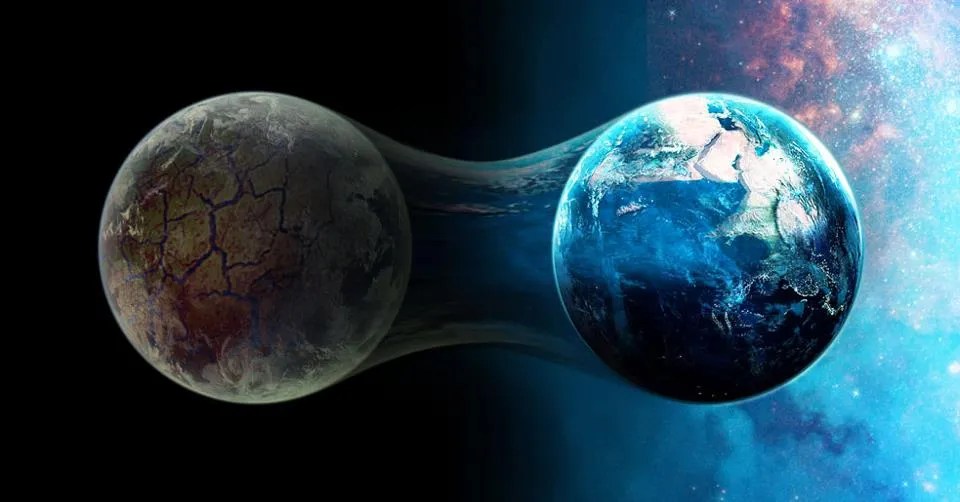
Another pain management strategy was one I practiced while conditioning myself to be able to sit on a wheelchair for extended periods. In conjunction with binaural beats, I visualized my soul or astral body disassociating from my physical body and floating away, usually orbiting above earth. This imagery happens to be similar to thumbnail and video art often accompanying binaural beats on YouTube. The sound and visuals seem to go together naturally and I found it to be effective for the type of pain I went through.
As if to foreshadow what was in store for my future, just a few days after being admitted to neuro ICU I was visited by Aaron, a research coordinator for a University of Washington study on hypnosis as a pain management therapy for spinal cord injury patients. He was scouting for volunteers for his study which would require a series of one hour sessions throughout my stay at Harborview (and a few months after) compensated for by a small gift card stipend and access to the hypnosis recordings.
Though still in relatively less pain at the time, I volunteered to see if hypnosis could diminish the pain I was starting to feel and to hopefully provide useful data for therapists and patients. Volunteers were split into study and control groups. Those in the study would receive the hypnotherapy while the control group was interviewed about experiences and attitudes regarding pain.
Unfortunately I ended up in the control group, but was allowed access to hypnotherapy recordings after the conclusion of the study and the interviews provided much food for thought about the nature of pain. It also helped mentally prepare me for the increasing pain to come. As it turned out, the hypnosis sessions I listened to didn’t seem to alleviate my pain, though the effectiveness may have been hindered by my mental state and/or setting.
I may give hypnotherapy another try in the future, but in the meantime I’ve found therapeutic massage, acupuncture, electrical stimulation therapy, and CBD, CBN, and CBG cannabinoids to be more effective alternative treatments.
Once again focusing attention on my immediate situation, I self-assessed how I felt. The adjective I kept coming back to was “traumatized”. At first it didn’t seem quite right because I associated trauma with survivors of violent assault. Upon further thought, I understood how it results from any violent event and could be physical as well as psychological.
Though I have no accessible memory of the crash that caused my injury, it’s possible a buried subconscious memory exists. At times I couldn’t stop recreating scenarios of what probably happened mixed with fantasies of what could have happened (either dying or escaping unscathed). In any case, the injury resulting from the crash including aspects of hospitalization, was itself a source of trauma.
Unless one has experienced it, it’s difficult to imagine the horror of waking up in a newly immobilized body especially if one was relatively healthy immediately prior to the injury. It instantly shatters any illusions one might have had of a just universe or merciful higher power. But the evidence was always there, from psychopathic war criminals and health insurance CEOs living in luxury to innocent children killed and maimed in indiscriminate bombings and countless sick and injured living curtailed lives of misery due to denied claims and inaccessible treatments.
Initially it’s like a waking nightmare that never ends. One wouldn’t wish such an affliction on one’s worst enemy, much less easily accept that it’s actually happening to oneself. Even typing this now, nearly a year after the crash, waking life still sometimes feels like a bad dream.
As the reality of the situation sets in it begins to feel more like a fracture or demarcation point between two very different lives and lifestyles. Though fundamentally one remains the same person, the extremity of the physical change makes changes in personality, priorities, interests, beliefs, self/public image, and relationships, inevitable and how could it not?
Although in my case I experienced no physical deformation and associated acute pain, it was nevertheless traumatic to so suddenly lose such a large part of oneself. Especially early on, it was odd to feel so disconnected from one’s body despite appearing healthy on the outside (aside from breathing tube, nose tube, catheter, IV line, etc).
In a sense, my injury was analogous to accelerated aging. Rather than a gradual loss of certain functions and abilities over time, it’s a rapid loss of many functions and abilities instantly. At the same time, quadriplegia evokes the experience of infancy such as the many times when one is more of a spectator rather than participant and having to rely on others to attend to basic needs. Quadriplegia is not as restricting as Locked-in Syndrome, in which the only body part capable of movement are the eyes, but it is still a significant reduction of freedom and a loss of one’s primary means of interacting with the world.
From one’s new perspective, life pre-injury was one of relative comfort, ease and happiness (even if it didn’t always seem like it at the time). Life post-injury may have moments of comfort, ease and happiness, but much shorter, fewer and farther between, making them all the more precious. On particularly challenging days, sleep also offers a welcome respite as it did that night.
Though I can’t speak for everyone who has suffered spinal cord injury, my experience had destabilized every aspect of my life to the point where I questioned who I was. Delving into memories was one way to ground myself, but at the time more recent memories were all too painful reminders of what I had lost.
Another strategy which I gravitated towards intuitively was to create a narrative. I began thinking about how to put such an overwhelming experience into words as if it was a book or screenplay. My goal wasn’t to actually create media but to entertain myself during long sleepless nights, though some of these musings were memorized and included in these posts.
Creating a narrative also helped integrate pre and post-crash lives (which at times still seems as disconnected and dissociated as my mind from my body). Part of it involved making sense of the senseless, a struggle which also draws people towards religion and philosophy in times of crisis. I’ve had an interest in both for a long time, sparked in part by cannabis and entheogen experimentation throughout my early to mid 20s. However, the perspective provided by spinal cord injury opened up a deeper emotional and experiential appreciation.
Oddly, qualities which one might think would prepare me for my fate also presented unique challenges. For example, pre-injury I often felt I was “living in my head”, preoccupied by fictional, theoretical, and speculative topics. Much of my waking hours are now focused on pragmatic matters like correspondences and research related to health, bills, insurance, social security, etc. which is still in the mind but in a way not previously accustomed to. This is partly why my writing been more sporadic lately.
Similarly, pre-injury I was often immersed in multimedia of a wide variety of genres. While I fortunately still have access to electronic media, my interest in physical media has significantly decreased. I thought about my library of rare and obscure books collected over many years I was once so proud of. Not being able to read them without help nor able to enjoy the tactile pleasure of holding them, I lost interest in owning the books. I could only hope to get help selling them on Ebay or giving them to people who might value them as I once did.
I was and still am somewhat of a loner, though I can and do reach out to people when I want to via internet. Having “alone time” has always been important and I still get enough of it, but what’s different now is that activities that were previously private (ie. showers, bathroom, toothbrushing, etc.) are now shared with a caregiver out of necessity.
Prior to my injury I was fortunate to have never needed to be hospitalized for anything major other than a minor stroke in 2019 (which I completely recovered from within a month). I had long been semi-health-conscious, eating healthy most of the time and structuring my life to stay somewhat fit without having to go to the gym. My goal used to be longevity with a focus on quality of life. Now my goal is pain management, preventing my health from deteriorating, and regaining as much health as I once had as possible.
Even while relatively healthy, for some reason for much of my life I just didn’t feel comfortable in my skin. It seems humorous thinking back on it now because I’d do anything to feel as comfortable in my skin as anytime before the crash. Especially right after it happened, my body never felt so alien, hostile, and confining.
The food transition, the energy transition, net-zero ideology, programmable central bank digital currencies, the censorship of free speech and clampdowns on protest. What’s it all about? To understand these processes, we need to first locate what is essentially a social and economic reset within the context of a collapsing financial system.
Writer Ted Reece notes that the general rate of profit has trended downwards from an estimated 43% in the 1870s to 17% in the 2000s. By late 2019, many companies could not generate enough profit. Falling turnover, squeezed margins, limited cashflows and highly leveraged balance sheets were prevalent.
Professor Fabio Vighi of Cardiff University has described how closing down the global economy in early 2020 under the guise of fighting a supposedly new and novel pathogen allowed the US Federal Reserve to flood collapsing financial markets (COVID relief) with freshly printed money without causing hyperinflation. Lockdowns curtailed economic activity, thereby removing demand for the newly printed money (credit) in the physical economy and preventing ‘contagion’.
According to investigative journalist Michael Byrant, €1.5 trillion was needed to deal with the crisis in Europe alone. The financial collapse staring European central bankers in the face came to a head in 2019. The appearance of a ‘novel virus’ provided a convenient cover story.
The European Central Bank agreed to a €1.31 trillion bailout of banks followed by the EU agreeing to a €750 billion recovery fund for European states and corporations. This package of long-term, ultra-cheap credit to hundreds of banks was sold to the public as a necessary programme to cushion the impact of the pandemic on businesses and workers.
In response to a collapsing neoliberalism, we are now seeing the rollout of an authoritarian great reset — an agenda that intends to reshape the economy and change how we live.
SHIFT TO AUTHORITARIANISM
The new economy is to be dominated by a handful of tech giants, global conglomerates and e-commerce platforms, and new markets will also be created through the financialisation of nature, which is to be colonised, commodified and traded under the notion of protecting the environment.
In recent years, we have witnessed an overaccumulation of capital, and the creation of such markets will provide fresh investment opportunities (including dodgy carbon offsetting Ponzi schemes) for the super-rich to park their wealth and prosper.
This great reset envisages a transformation of Western societies, resulting in permanent restrictions on fundamental liberties and mass surveillance. Being rolled out under the benign term of a ‘Fourth Industrial Revolution’, the World Economic Forum (WEF) says the public will eventually ‘rent’ everything they require (remember the WEF video ‘you will own nothing and be happy’?): stripping the right of ownership under the guise of a ‘green economy’ and underpinned by the rhetoric of ‘sustainable consumption’ and ‘climate emergency’.
Climate alarmism and the mantra of sustainability are about promoting money-making schemes. But they also serve another purpose: social control.
Neoliberalism has run its course, resulting in the impoverishment of large sections of the population. But to dampen dissent and lower expectations, the levels of personal freedom we have been used to will not be tolerated. This means that the wider population will be subjected to the discipline of an emerging surveillance state.
To push back against any dissent, ordinary people are being told that they must sacrifice personal liberty in order to protect public health, societal security (those terrible Russians, Islamic extremists or that Sunak-designated bogeyman George Galloway) or the climate. Unlike in the old normal of neoliberalism, an ideological shift is occurring whereby personal freedoms are increasingly depicted as being dangerous because they run counter to the collective good.
The real reason for this ideological shift is to ensure that the masses get used to lower living standards and accept them. Consider, for instance, the Bank of England’s chief economist Huw Pill saying that people should ‘accept’ being poorer. And then there is Rob Kapito of the world’s biggest asset management firm BlackRock, who says that a “very entitled” generation must deal with scarcity for the first time in their lives.
At the same time, to muddy the waters, the message is that lower living standards are the result of the conflict in Ukraine and supply shocks that both the war and ‘the virus’ have caused.
The net-zero carbon emissions agenda will help legitimise lower living standards (reducing your carbon footprint) while reinforcing the notion that our rights must be sacrificed for the greater good. You will own nothing, not because the rich and their neoliberal agenda made you poor but because you will be instructed to stop being irresponsible and must act to protect the planet.
NET-ZERO AGENDA
But what of this shift towards net-zero greenhouse gas emissions and the plan to slash our carbon footprints? Is it even feasible or necessary?
Gordon Hughes, a former World Bank economist and current professor of economics at the University of Edinburgh, says in a new report that current UK and European net-zero policies will likely lead to further economic ruin.
Apparently, the only viable way to raise the cash for sufficient new capital expenditure (on wind and solar infrastructure) would be a two decades-long reduction in private consumption of up to 10 per cent. Such a shock has never occurred in the last century outside war; even then, never for more than a decade.
But this agenda will also cause serious environmental degradation. So says Andrew Nikiforuk in the article The Rising Chorus of Renewable Energy Skeptics, which outlines how the green techno-dream is vastly destructive.
He lists the devastating environmental impacts of an even more mineral-intensive system based on renewables and warns:
“The whole process of replacing a declining system with a more complex mining-based enterprise is now supposed to take place with a fragile banking system, dysfunctional democracies, broken supply chains, critical mineral shortages and hostile geopolitics.”
All of this assumes that global warming is real and anthropogenic. Not everyone agrees. In the article Global warming and the confrontation between the West and the rest of the world, journalist Thierry Meyssan argues that net zero is based on political ideology rather than science. But to state such things has become heresy in the Western countries and shouted down with accusations of ‘climate science denial’.
Regardless of such concerns, the march towards net zero continues, and key to this is the United Nations Agenda 2030 for Sustainable Development Goals.
Today, almost every business or corporate report, website or brochure includes a multitude of references to ‘carbon footprints’, ‘sustainability’, ‘net zero’ or ‘climate neutrality’ and how a company or organisation intends to achieve its sustainability targets. Green profiling, green bonds and green investments go hand in hand with displaying ‘green’ credentials and ambitions wherever and whenever possible.
It seems anyone and everyone in business is planting their corporate flag on the summit of sustainability. Take Sainsbury’s, for instance. It is one of the ‘big six’ food retail supermarkets in the UK and has a vision for the future of food that it published in 2019.
Here’s a quote from it:
“Personalised Optimisation is a trend that could see people chipped and connected like never before. A significant step on from wearable tech used today, the advent of personal microchips and neural laces has the potential to see all of our genetic, health and situational data recorded, stored and analysed by algorithms which could work out exactly what we need to support us at a particular time in our life. Retailers, such as Sainsbury’s could play a critical role to support this, arranging delivery of the needed food within thirty minutes — perhaps by drone.”
Tracked, traced and chipped — for your own benefit. Corporations accessing all of our personal data, right down to our DNA. The report is littered with references to sustainability and the climate or environment, and it is difficult not to get the impression that it is written so as to leave the reader awestruck by the technological possibilities.
However, the promotion of a brave new world of technological innovation that has nothing to say about power — who determines policies that have led to massive inequalities, poverty, malnutrition, food insecurity and hunger and who is responsible for the degradation of the environment in the first place — is nothing new.
The essence of power is conveniently glossed over, not least because those behind the prevailing food regime are also shaping the techno-utopian fairytale where everyone lives happily ever after eating bugs and synthetic food while living in a digital panopticon.
FAKE GREEN
The type of ‘green’ agenda being pushed is a multi-trillion market opportunity for lining the pockets of rich investors and subsidy-sucking green infrastructure firms and also part of a strategy required to secure compliance required for the ‘new normal’.
It is, furthermore, a type of green that plans to cover much of the countryside with wind farms and solar panels with most farmers no longer farming. A recipe for food insecurity.
Those investing in the ‘green’ agenda care first and foremost about profit. The supremely influential BlackRock invests in the current food system that is responsible for polluted waterways, degraded soils, the displacement of smallholder farmers, a spiralling public health crisis, malnutrition and much more.
It also invests in healthcare — an industry that thrives on the illnesses and conditions created by eating the substandard food that the current system produces. Did Larry Fink, the top man at BlackRock, suddenly develop a conscience and become an environmentalist who cares about the planet and ordinary people? Of course not.
Any serious deliberations on the future of food would surely consider issues like food sovereignty, the role of agroecology and the strengthening of family farms — the backbone of current global food production.
The aforementioned article by Andrew Nikiforuk concludes that, if we are really serious about our impacts on the environment, we must scale back our needs and simplify society.
In terms of food, the solution rests on a low-input approach that strengthens rural communities and local markets and prioritises smallholder farms and small independent enterprises and retailers, localised democratic food systems and a concept of food sovereignty based on self-sufficiency, agroecological principles and regenerative agriculture.
It would involve facilitating the right to culturally appropriate food that is nutritionally dense due to diverse cropping patterns and free from toxic chemicals while ensuring local ownership and stewardship of common resources like land, water, soil and seeds.
That’s where genuine environmentalism and the future of food begins.
Last time I wrote about the increasing mental health crisis happening around the world. I didn’t write it to bring about negativity but more so to bring awareness to the reality of our current moment. Awareness is the first step toward any change.
Tied in with both of those subjects is the decade-over-decade increase in the difficulty of surviving financially in our modern world.
More and more younger people have been struggling to buy a home and make ends meet due to the high cost of living and stagnating wages. For many, affording necessities in life has become difficult despite working 40-60 hours per week.
This reality recently drove a viral TikTok video that highlights the frustration younger generations feel and the misconceptions associated with their position.
Before you watch it, conversations I have with people about this issue don’t just exist in the Gen Z and Millenial age group. I’ve spoken to people in their 50s and 60s who have also become completely disenfranchised about the state of work.
Also, Quiet Quitting is a trend on the rise. Simply put, people are going to work and doing the bare minimum to stay employed at greater and greater rates. Gallup estimates that in the US 50% of employees have Quiet Quit and that it’s an increasing crisis. In Japan, 94% of employees report being disengaged at work.
Perhaps unsurprisingly, Gallup blames the trend on poor management. This is where humans really have to start waking up and thinking bigger in my opinion, more on this shortly.
Alright, let’s get to the video.
She makes many good points, and if we take her words to heart, clearly she isn’t lazy and trying to ‘not work.’ She is passionate about her work but sees the gap between salary and the reality of living a comfortable life. She also sees the value in work… just not like how it is today.
Not surprisingly, many have agreed with her while many have attacked her. Let’s explore why she might feel this way about life and work. (Note: There is an element that sometimes people can judge, hate, and avoid work so much that it’s a self sabotage situation, I talk about that here.)
She and the generation she represents, even people like her from other generations, are just lazy or may even grow out of this idea.
She’s lying about enjoying her job and if she were to quit and do something she likes she’d find just enough satisfaction to not care about the fact that she can’t afford to do anything beyond eat, have shelter, and enjoy a few things.
Maybe she’s just permanently unhappy and therefore no matter what she does, she will find a way to frame it as negative and bad.
From a position of common sense and orienting to our current environment, this girl realizes the losing game she is part of and is making the observation that this isn’t a reasonable game to play.
As an extension to number 4, the fact that multiple generations of people not only realize how rigged the game is, don’t want to play the game AND are saying something about it provides an evolutionary pressure for society to address it.
The key is, can we listen vs. sitting in judgment?
Oddly, reaction videos are all the craze on YouTube these days. When people make videos like hers or when something happens, creators turn on their cameras and watch the video while simultaneously reacting to it.
Usually, creators reacting to videos like this from Gen Z’ers are well off themselves or conservatives. Their career often stems around having a ‘hot take,’ creating polarity, and leaning into drama so their content can get a lot of views and thus pay their bills.
Sadly, this dynamic in content creation is often missed by the user, not realizing that the host of the video says what they say primarily because they know it will make them money even if it’s not entirely what they think.
Further, we never get to the bottom of what people bring forth because we are skipping the step of coming to the table in good faith and empathizing with each other’s position. Instead, we get a culture stuck in a debating/debunking/warring mindset. Good luck getting good faith conversation to go viral when most out there are focused on hi-jacking your attention.
Sensing Beyond The Surface
Sensing Beyond The Surface
‘Working’ is Important – Being part of something, contributing to something, living in a community and having a role, all add meaning and purpose to life.
Being a creative, productive person is a necessity for human well-being, even if only for a few hours a day. No one is saying let’s sit around and do nothing all day. But should we have to work 40 or 50 hours a week to simply survive? No, that is the result of poor system design. We have advanced our technology incredibly to provide the necessities of life yet we work more than we ever have. Doesn’t something seem wrong there? Our cultural idea of needing to work 40 hours a week for most of our lives ‘just to be a contributor’ is rather warped. Many cultures have thrived working a few hours a day, yet look at us – working constantly yet experiencing mental illness, poor health, and meaninglessness at massive rates. It would benefit us to have a deeper look at WHY our society is currently producing results no one wants all while destroying our environment and people. Too many discussions about this topic think small and are limited to lazy questions from system protectors or political ideologies. This won’t get us to the root of the issue and why people feel the way they do.
Cost of Living is Too High, But Why? – I’m 36, when my parents were my age one worked a mid-level job in corporate and the other a grocery store. They made enough to buy a fairly big house near Toronto, pay off the mortgage by 40 and raise two kids. These days, they’d need to make $100,000+ each just to buy the same house, and forget about paying off the mortgage by 40. Even when interest rates were 22% back then, things were a lot easier.
Often, when I talk about mortgage rates with older generations, and how it is becoming hard to afford homes, they say “Back in my day rates were 18% – 22%.” The sense that people aren’t listening to what is being said is palatable. We’re not thinking clearly. In 1945 a US citizen dedicated on average 25% of his salary to pay rent/mortgage. In 2019 it was 47%. It’s higher now. And of course in that time interest rates have come down dramatically. Plain and simple, the cost of living has risen incredibly and wages didn’t climb at anywhere near the same rate.
This is a losing game, and only set to get worse given the path we’re on. That said, this is what anyone should expect in a system driven by fractional reserve banking. When we understand the design of our system, we understand this isn’t about one political view or another, it’s about bad system design. We have to think deeper.
Evolutionary Pressure – As our society declines more and more, younger people who look ahead to their future see something undesirable. The life their parents lived is no longer possible and they see the game is rigged. They aren’t lazy, they are demoralized. A left hemisphere reductionist and othering view, who sees humans as cogs in a system might say “Nah, people are lazy. Grow up. Things are fine.” Yet when we take a step back and include a sense of something sacred, our entire perspective changes. Why are we seeing life and merely working to uphold a rigged economy? Is this really all we are capable of? Why are we always trying to protect societal design producing results we don’t like? Do we realize we made all this up and it can be different? Sure, there are aspects of younger generations that I think are immature too, we’ve all been through it, but at the same time, younger people are not buying the rigged game and thus are not dying to play it. They are right. They are smart to speak up. And to tie things back to meaninglessness and mental health issues, I think we’re seeing now how this all ties into our current moment. People don’t thrive playing a losing game where basic needs are gated behind 100 foot walls.
Movements toward system redesign have been around for many many decades. It’s not a new idea to discuss how rigged, limiting, and problematic our existing societal design is, but more people are waking up to it now. When I spoke about this stuff in 2009 and 2010, most people laughed at me thinking I was nuts. Now, they mostly agree with me. We’re on fertile ground for something new. For a while, we’ll likely live feeling and sensing the possibility of a new society while living in the old. Feeling that we’re not sure we quite belong to a visible society entirely. This is the Metacrisis. This is the shift in consciousness as I’ve always called it. It’s an evolutionary pressure that begs us to look deeper than political ideology and hot takes on why someone we don’t agree with is wrong. It begs us to re-taste the sacred. To examine what it means to be human and why we’re here. I believe the speed at which it unfolds is intimately connected to the quality of our attention, consciousness and state of being. The more capacity we have to steward a better world, the more it will unfold. Change starts within.
Everything is presented as rock-solid until it falls apart.
Of the many signs of systemic decay in the late Roman Empire, one of particular relevance to our era is the Phantom Legion, military units that on paper were at full strength–and paid accordingly–but which were in reality no longer there: the paymaster collected the silver wages and recorded the unit’s roll of officers and soldiers, but it was all make-believe.
When the Empire’s wealth seems limitless, graft, embezzlement and fraud all seem harmless to those skimming the wealth. Look, the Empire is forever, what harm is there in my little self-interested skim?
This rot starts at the top, of course, and then seeps into every nook and cranny of the system. When those at the top are getting fabulously wealthy on modest salaries while claiming to serve the public, the signal is clear: go ahead and maximize your own private gain at the expense of the public and the state. Civic virtue–the backbone of the Empire–decayed into self-interest, incompetence and indulgence.
The “Phantom Legion” Problem has another wrinkle: the legion is reported at full strength, but the actual number of soldiers is far lower than the reported number, and the competence of the officers is so low that the legion is incapable of performing its duties. In other words, the numbers don’t reflect the actual utility-value of the legion as a combat unit: the soldiers may be ill-trained, ill-equipped and poorly fed, and the officers inexperienced, corrupt or just waiting for their term of duty to end.
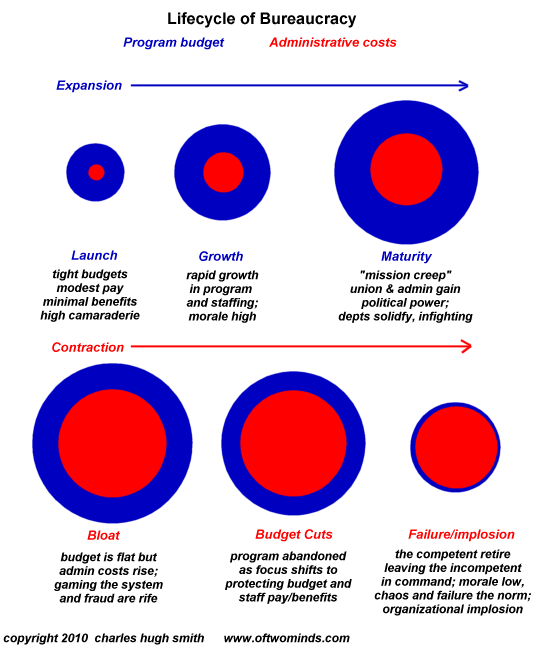
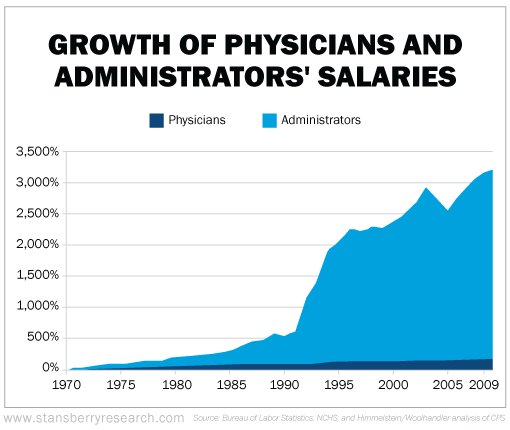
In the present day, this is how The Phantom Legion Problem manifests: the agency / institution is reported at full strength and fully capable of performing all its duties, but beneath the surface it’s lacking experienced staff and competent leadership, and much of the staffing is in unproductive, dead-wood administrative positions.
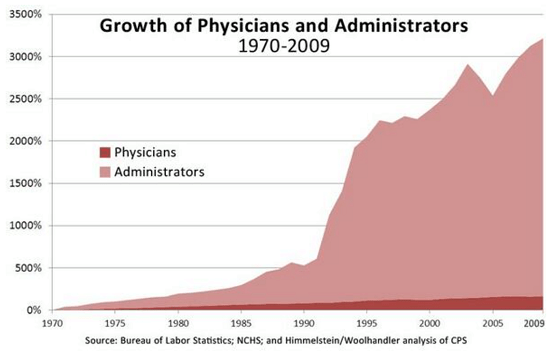
Taking healthcare as an example, we find experienced frontline caregivers are retiring and not being replaced with equivalent numbers of staff with the equivalent experience. We find caregivers are burning out due to crushing workloads, or quitting the profession in order to have a family and get their life back.
Meanwhile, the number of administrators increases, soaking up the system’s funding with endlessly expanding compliance data entry, reports, etc., all of which adds additional burdens on those actually providing care.
There’s always enough money to increase administrators’ salaries, but not enough to maintain essential systems or hire more caregivers.
The Phantom Legion Problem plays out in many ways in modern bureaucracies. The number of sworn officers in a police department may appear adequate but if many are assigned to desks, the PD is not actually at full strength.
If administrators are advanced due to their PR and financial skills rather than on their competence in actually leading the organization, the Phantom Legion problem is already terminal. the rot starts at the top, and those actually carrying the weight fulfilling the organization’s mission burn out, get disgusted and give up.
The problem with The Phantom Legion Problem is there is every incentive to hide the decay of systemic competence and capability behind glowing annual reports and ginned-up numbers. Only those within the organization know the truth and they are under pressure to keep quiet, lest they find themselves on the slow train to Siberia.
Here is how systems decay and collapse: everything is reported at full strength, but the numbers don’t reflect reality. Everything is presented as rock-solid until it falls apart. Everyone outside the system is in disbelief while insiders wondered how it held together as long as it did.
Over the last few decades, many have written about our time as a space where humanity is between worlds. On one hand, we have our current way of life which is incredibly demanding on our minds and bodies, is rather toxic, and filled with conflict and destruction. On the other hand is a vision for a world that’s slower, more connected, more natural, and more loving.
As we navigate what appears to be the dying stages of the old paradigm, the intensity of what it is seems to increase. The qualities of the old system become louder, acting as an evolutionary pressure to push things along.
Many become inspired to explore ways to bring the ‘new world’ to the here and now via their actions.
How do I live without money? How do I exit the toxicity of our current system? How do I not participate anymore?
If we aren’t careful, these questions can create a framing of our current world that can make it very hard to live within.
If we deeply judge the need to work, to make money, to pay taxes etc, all of it can become a heavy thing to carry. We end up waking up every day dreading going to work, and having endless conversations, thoughts and emotions about how the bad guys are ruining life for us and we’re the victims in it all.
While there may be truth to some of the observations about our society, the framing of it in our minds is disempowering many of us, and it’s making our current moment dreadful. Further, it holds us back from living and being able to solve the problem.
So how do we work with this? How do we live in the space between worlds?
What Feels Natural To Us?
Indeed, our current societal design is not supportive of human beings thriving. In that sense, it has been poorly designed. We have such an easy time as a species doing this because our higher-order thinking allows us to override what is good for our biology. Simply put: it’s easy to ignore our needs using our thinking, especially when we become so identified with life cognitively.
I have 7 alpacas. The moment they need to poop, they just do it, no thinking, no “I’ll just finish this paragraph,” they just do it. They listen to their biology. Humans on the other hand don’t always listen. In some cases we don’t because we have social structures, social norms, and brains to hold this all together. But we also don’t because we’ve learned to ignore our body, feelings, and emotions in many ways.
While our higher-order thinking is beautiful in one sense, how do we know when it begins to work against us?
I often use an example with friends and clients of a bear. The bear (a mammal like us) was likely raised by an attached parent. It learned how to ‘bear’ and how to be in its environment from that parent in its natural environment. If that bear’s ecosystem was cut down or destroyed by humans, it wouldn’t stay for too long. It would know that concrete, a lack of forest, and a lack of fresh water aren’t good for it, and it would leave to find a suitable home. The bear is simply following its connection to its biology.
We as humans know we are doing this to animals and call it ‘displacing nature/animals.’ Interestingly, we tend to see ourselves ‘outside’ of nature, conveniently ignoring how we’re ‘displacing’ ourselves.
As mentioned, humans are resilient in that we can survive in different environments. We find ways to adjust, cope, and problem solve within environments that are not natural to us. Here I’m not just talking about physical environments but also emotional ones. We find ways to survive in abusive situations for example. We know we should leave, but sometimes we feel we can’t or don’t have the capacity to.
Further, there are difficult elements to our environments like not having access to clean food, clean water, and shelter without having to work very hard to get them.
Because of our amazing thinking brains, humans can do and create incredible things, but we can also become so cognitively and mentally identified that we override our basic biology so much so that we build systems that aren’t attuned to our own well-being.
Thus, humans are currently surviving, but we are in no way thriving. And we did this to ourselves via a disconnection from ourselves.
To be clear, it’s not that we shouldn’t have roads, technology, and societal systems, it’s that they should be designed with human and natural thrivability in mind. Instead, our world is designed with economic thrivability and elite power structures in mind. All at the expense of human wellness.
The tricky part is, that the more people see and experience this truth, the more we can become angered and upset by it. This is fair. A boundary feels crossed because we living now aren’t necessarily the ones who built it or are choosing it. “Why am I subjected to a system I don’t like nor support, yet feel like I can’t escape it?”
As I stated in my essay If No One Wants This, Why Are We Doing It?our way of life doesn’t feel natural to us deep down and it’s overwhelming the challenge is we can’t change it overnight. So what do we do to live within it without driving ourselves mad?
Exploring The Art of Existing Between Worlds
Over the last 15 years exploring alternative thinking and spiritual spaces, I have discovered that it’s common for people to want to fully “exit” the system. They don’t want to integrate, use money, or do anything within the system as they feel it’s “toxic.”
As mentioned, these feelings are somewhat valid, but how we choose to navigate them is everything. Here are a few key observations.
1. Having unprocessed anger, resentment, victimhood and judgment for the system is a recipe for disaster.
If we go to work each day, pay taxes, or drive on highways with the mindset and emotional drive that we are victims and stuck, we will certainly make our lives feel more challenging. Our mental, emotional, physical, and spiritual framing at that point is that of contraction and stuckness. And it’s often built on a nervous system foundation of survival.
Everything will feel much more difficult in this state. Now, this doesn’t mean we can’t observe the state of the world, understand it, and explore how to change it, all of that can be done without getting stuck in mental and emotional traps. But we have to be careful about the general state of mind and being we are taking into our daily lives. Without being aware of this, we give all of our power away to the system and allow it to dictate how we feel.
I’ve watched people panic and freak out about not eating organic apples, yet their mindset and relationship with themselves and the world is creating more toxicity in themselves than a non-organic apple.
When this mindset goes unchecked, our locus of control for our own well-being is outside of us, not inside. (Key note, I’m not suggesting that the system doesn’t have toxic effects on us, I’m saying that there is a space where we can exist within the system with greater wellness.)
Can we begin to see work, life, and what we currently have going as an opportunity? Can we change the lens through which we see it so it doesn’t add to greater dis-ease? Can we support ourselves, our nervous system, and our emotional well-being through practice that helps us build capacity and resilience?
2. Trying to exit completely is incredibly hard, and most end up just as unhappy.
I have found a lot of people trying everything in their power to avoid working and making money. Here I’m not referring to people who are not well or injured and can’t work, I’m talking about folks who can yet have such a degree of judgment toward the system that they avoid being within it.
Often this path leaves people stuck, uninspired, unable to experience much of the world, and unable to even afford fun projects at home. Life begins to become small, and these people rarely seem truly happy.
That said, intentional communities are an interesting path for some. Although they work and exist within the system in more ways than people think. Sure, a few places are fully off grid, but for the most part money, utilities, land purchases, property tax etc, are all part of the mix.
If you don’t have a lot of money, this path is very tough. People can of course move to countries where things are very cheap and start over, but even that is tough for most people as it’s still expensive and work still needs to be found to live well into the future.
1. Exploring capacity and resilience building to exist in our current world and help solve problems within it seems a fruitful path. This includes doing small things within the system to make life more natural.
To me, this is a path that is accessible to most people and provides a meaningful balance of making a difference and enjoying life. I may also be biased toward this as this is the path I’ve chosen and have taught throughout my work since 2009.
For example, I chose to start a company and embrace the world as it was in 2009. I built my business on a foundation of creating an amazing work environment for employees to work, rest, grow, and contribute to a ‘collective evolution.’ Over time, I was able to give back by hiring 14 people to come into this environment of serving something greater than our personal ambitions, yet those were taken care of too.
We did some amazing projects around the world with excess funds, and we helped establish an internet culture of wellness, consciousness and conscious media. If I had kept the system at a distance, those benefits would not have been shared.
Humans have lived for such a long time in unnatural ways, disconnected from ourselves, and not processing our emotions and traumas, our nervous systems hold that history. It is further being re-inforced by the reality that yes, there is toxicity still in our world. It is badly designed.
But still, regulation and capacity at a deep cellular level need to be restored for most of us. We need to clear out the messy stuff. Otherwise, we will take our pains into any revolutionary systems that pops up outside the system anyway. We see this a lot with intentional communities that collapse.
This means focusing on deeply restoring physiological safety, wellbeing, emotional fluidity and regulation is foundational to living well, and it can be done even in the existing system. Even though our system is tough, this path gives us much more energy, resilience and capacity to exist within the system and make as big a difference as possible while enjoying life.
This path is work. It acknowledged that it isn’t easy to feel great in our world due to the poor design, but that it’s still within our capacity if we focus on it.
This doesn’t mean we ignore the need to change or adjust our system. But this path gives us the greatest ability to do so as we will have built the capacity and deep empowerment to actually do it, vs. being feeling stuck, tired and victimized resisting the system so heavily.
Existing in a space between worlds means building individual and collective wellbeing, and creating change along the way. The more resilient we are, the more we can make money and use it as a tool to find ways to make our lives better, less reliant on the system, and healthier.
In that space of wellness, we can have meaningful conversations and learn to hold visions of a future world that isn’t built on hating and resenting the old. If I’m honest, almost all of the successful changes and projects I’ve seen out there have come from this space of being.
In summary, taking stock of whether our observations of the world have become deep disempowering judgements is a worthwhile reflection. Being ‘awake to corruption’ doesn’t have to come with lifelong resentment toward the system, where we comment online about ‘the bad guys’ ruining things for everyone. Or that somehow Biden, Trump, Trudeau etc. are the root of the problems. I hate to say it but, this gets us nowhere.
Questioning whether we are truly living our lives in a way that promotes emotional, physical, and spiritual well-being and expansiveness is important. Without this, our foundation is weak.
The path forward I’m suggesting is one of building enough strength, well-being, and energy to live with wellness in our current system, so we have energy left over to see clearly and act upon changing what is not natural to us. Good sensemaking of our current events goes alongside this, but as you’ll note from my previous work, good sensemaking is built on a healthy nervous system.

 After the Crash