“Charity” Accused of Sex Abuse Coordinating ID2020’s Pilot Program For Refugee Newborns

A refugee family hold numbered placards as they pose for a photo during a census conducted by the Thai authorities at Mae La refugee camp in 2014. Photo: Reuters

A biometric identification program backed by the ID2020 alliance will see its new “digital id” program rolled out for refugee newborns in close coordination with a charity tied to Wall Street and prominent Western politicians whose workers have been accused of sexually exploiting refugee children.

By Whitney Webb

Source: Unlimited Hangout

iRespond, an international non-profit organization that is “dedicated to using biometrics to improve lives through digital identity,” has begun piloting a new biometric program for newborns among the predominately Karen refugee population along the Myanmar-Thailand border, a program it soon hopes to “quickly deploy” at a greater scale and make available to the general global population. The pilot program is being conducted as part of the controversial ID2020 alliance, backed by Microsoft, the GAVI vaccine alliance and the Rockefeller Foundation, and with the International Rescue Committee (IRC), a non-profit organization deeply tied to the Western political elite and Wall Street with a controversial track record of silencing numerous sex abuse and fraud allegations.

The new program, an extension of iRespond’s “voluntary” biometric identification program in the Mae La refugee camp, “will create a record of a birth, attested by a trusted clinic, with a goal of changing the life trajectory for the participants.” Through the program, “a guardianship relationship between the newborn and the mother is established and linked to digital and high security physical identity documents.”

However, iRespond’s CEO, Scott Reid, told Biometric Update that these credentials do “not carry the same weight as a true birth certificate,” but asserts that the organization’s biometric “birth attestation” program “could leapfrog the traditional barriers to establishing identity.” Despite the fact that iRespond’s quasi-birth certificates would seemingly serve little purpose in areas where actual birth certificates are readily available, the organization notes that “once the pilot is completed, iRespond is ready to quickly deploy the solution at scale” for mass use around the globe. “Product development” on adapting their platform for newborns began earlier this year and Reid notes that having an iRespond-provided biometric “birth attestation” will enable “access to vital services such as healthcare, social protection, education and banking.”

The pilot program is being conducted at the Mae Tao clinic, which is largely funded by the CIA cut-out USAID as well as the governments of Germany and Taiwan, the Open Society Foundations and the International Rescue Committee (IRC). The IRC is very active in the day-to-day functions of the clinic (financed by a USAID-funded project) and it is also intimately involved in iRespond’s digital identity program, including its new pilot program for newborns and its earlier efforts to supply Mae La’s residents with biometric identity.

Food or Sovereignty

iRespond’s work in Mae La in conjunction with IRC was first announced by the ID2020 alliance in September 2018. The ID2020-funded pilot program, the announcement states, was to be “led by Alliance partner iRespond and will be conducted in close partnership with the International Rescue Committee (IRC).” It aims to provide biometric identities to the approximately 35,000 individuals inhabiting the area, with the newer program aiming to ensure that babies born in the community are also made participants by default upon birth. It notes specifically that “the pilot will offer blockchain-based digital identification, linked to individual users through iris recognition, for refugees accessing the IRC’s services in the Mae La Camp in Thailand.” Having a “digital identity” would allow refugees “to access improved, consistent healthcare within the camp” with plans for the same system to eventually “electronically document both educational attainment and professional skills to aid with employment opportunities.”

A year later, the program, featured in a lengthy profile in Newsweek, was revealed to be “just the first step in an effort that aims to equip the camp’s entire refugee population with secure and portable “digital wallets” that will hold not just their medical records but also educational and vocational credentials, camp work histories and myriad other records,” ostensibly including financial activity. This is particularly likely given that iRespond is partnered with Mastercardanother ID2020 partner that is closely allied with the company, Trust Stamp, a biometric identity platform that also doubles as a vaccine record and payment system. In addition, IRC’s strategic plans for Mae La through 2020 include “expand[ing] micro-enterprise development and village savings and loans associations,” such as those offered by ID2020 partner Kiva, among others, who link biometric identity to the receipt of loans.

iRespond’s system, not unlike Trust Stamp’s, is also slated to serve as a vaccine record. Larry Dohr, iRespond’s head of Southeast Asia operations, told Reuters in April that “a biometric ID system can keep a record of such people [who have previously tested positive for Covid-19] and those getting the vaccine.” Dohr added that “we can biometrically identify the individual and tie them to the test results, as well as to a high security document. The person then has ‘non-refutable’ proof that they have immunity due to antibodies in their system.” Dohr then refers to such “proof” as a “very valuable credential.”

Notably, in press releases and news reports, iRespond executives emphasize how their biometric identity system, based on iris scans and powered by Microsoft, will “protect privacy” and allow “control and ownership of identity data belong to the holder.” However, the Mae La project does not offer this degree of control and ownership, with Newsweek noting that“Eventually, [iRespond and their collaborators] aim to offer the refugees a level of fine-grained control over what pieces of personal information are shared with others.” In other words, such control over their personal information has not yet been made available to them, despite the public portrayal that this functionality is a base component of iRespond’s system.

What is particularly noteworthy about iRespond’s and IRC’s digital identity efforts is that, while it is a “voluntary” program, destitute refugees wishing to access healthcare and other services IRC provides in the area, including access to clean water, must have their irises scanned in order to reap those benefits. It is highly unlikely that such individuals are not only uninformed about any potential risks of providing their biometrics for use in a pilot program, but are not in a stable enough state to make an informed decision on the matter, as their precarious position would see them choose urgent healthcare needs, etc. over privacy. It increasingly seems that Mae La was chosen as the pilot project because its residents were highly unlikely to decline participation, especially when healthcare access and other basic needs provided by IRC are dangled as carrots on a stick and only accessible upon participation in iRespond’s biometric identity program.

This program is remarkably similar to the World Food Programme’s recently implemented “Building Blocks” initiative, which  is funded by the US, German, Dutch and Luxembourgian governments. Building Blocks uses a blockchain-based biometric identity system “to expand refugees’ choices in how they access and spend their cash assistance” in Syrian refugee camps within Jordan. Now, “over 100,000 people living in the camps can purchase groceries by scanning an iris at checkout” as part of the checkout. Those who do not participate are unable to access their WFP “cash benefits” since they are available exclusively through this biometric system, leaving refugees the choice between surrendering their biometric data and food.

Equally noteworthy is the fact that those financially supporting the Mae La project and similar projects, particularly the ID2020 alliance, are “hopeful” that iRespond’s efforts in Mae La will some day be rolled out on a global scale. Indeed,Newsweek noted that “many of the funders [of the Mae La project]—part of what’s known as the ID2020 alliance, which includes Accenture, Microsoft and the Rockefeller Foundation—hope the Mae La project could eventually serve as a blueprint for the world’s millions of stateless people, as well as citizens of developed nations and everyone else.”

Biometric Enclosure

According to iRespond’s rather spartan website, their biometric identity platform “primarily relies on iris biometrics, the best modality after DNA for accuracy and reliability.” It further describes its platform as follows:

“When a new participant is enrolled, an encrypted biometric template is created from their iris scan and a randomly assigned 12-digit number is drawn from a pool of 90 billion numbers. On subsequent visits, the identity of the participant is verified when their template is matched and the system returns the original 12-digit unique identifier.”

iRespond’s platform also “easily integrates into healthcare, humanitarian aid, research, and human-rights applications,” and it has been used to grant refugees and other vulnerable populations access to food, healthcare, and other forms of aid provided by foreign NGOs operating in these areas. It has also been used to keep track of participants in clinical drug trials. iRespond’s platform in the latter case was used by the U.S. Center for Disease Control and Prevention (CDC) in conjunction with Johns Hopkins School of Public Health (both are iRespond partners), to track participants in clinical HIV treatment trials in Senegal as well as an additional Johns Hopkins study in South Africa. It has also been used to track recipients of the controversial HPV vaccine in Sierra Leone, where it was used “to track patients who have not completed their vaccination series.”

It is also being used among “vulnerable groups” in Myanmar by the NGO Population Services International (PSI) to “track demographics and the timing of positive HIV tests.” By analyzing these details, “we uncover which groups are most vulnerable to becoming infected,” according to PSI’s country representative for Myanmar.

The non-profit’s platform is powered by its main tech partner and another ID2020 member, Microsoft. iRespond’s platform “couldn’t exist without the cloud,” according to its CEO Scott Reid, and Microsoft supplies iRespond with a $60,000 grant to its Azure cloud system, allowing the organization to use it free of charge. In addition, Microsoft donated 39 tablets to iRespond that are used by the organization in the various places it operates “to enable flexibility in the field.” “The number of people we have helped has rapidly gone from the tens of thousands to the hundreds of thousands, and we look forward to soon working on behalf of many millions of people. These Microsoft tools are helping to make it possible,” iRespond’s Larry Dohr stated in a Microsoft profile.

Eric Rasmussen, iRespond’s president and chairman of the board, is a particularly interesting character who has been quite frank about the rationale behind the creation of iRespond. “When you understand who someone is, you understand what they’re entitled to, whether that’s national citizenship, international refugee support, or simply food distributions,” Rasmussen told Microsoft last year.

In addition to his key role at iRespond, Rasmussen is a professor at the Google-backed “Singularity University” as well as chairman of the board at InSTEDD, a “global NGO specializing humanitarian informatics, particularly around health in resource-poor economies” that is partnered with the Bill and Melinda Gates Foundation, the Rockefeller Foundation, the CDC, Google and UNICEF. In addition, Rasmussen is also the CEO of a “profit-for-purpose” company called Infinitum Humanitarian Systems (IHS). IHS works closely with USAID and the State Department as well as U.S. military intelligence agencies and intelligence/defense contractor Booz Allen Hamilton. Prior to his roles at iRespond, IHS and InSTEDD, Rasmussen was the Principal Investigator in humanitarian informatics for the Pentagon’s Defense Advanced Research Projects Agency (DARPA) and made multiple war time deployments to Bosnia, Iraq and Afghanistan.

“Charity” of the Predator Class

More troubling than the background and associations of iRespond are those of their partner in the recently announced newborn biometric identification initiative, the International Rescue Committee (IRC). The IRC describes themselves as responding “to the world’s worst humanitarian crises and help[ing] people whose lives and livelihoods are shattered by conflict and disaster to survive, recover and gain control of their future.”

Despite the IRC framing itself as a “humanitarian” venture, its board is stuffed with a sordid mix of Wall Street criminals and war criminals. For example, its board is co-chaired by Timothy Geithner, former Treasury Secretary during the 2008 financial crisis bail-outs and current President of Wall Street titan Warburg-Pincus, and Susan Susman, an Executive Vice President at Pfizer. Its board of advisers includes war criminals Henry Kissinger and Madeleine Albright as well as Condoleezza Rice and Colin Powell. Also present are current and former leaders and top executives at McKinsey, Morgan Stanley, Goldman Sachs, Kroll Associates (“the CIA of Wall Street”), PepsiCo, Bank of America, Lehman Brothers, Citigroup and the World Bank. Another advisor is former chairman and CEO of AIG Maurice “Hank” Greenberg, a name that will likely be familiar to those who have researched the September 11th attacks and Wall Street financial crimes in general.

Since 2013, the IRC has been led by David Miliband, the Tony Blair “protégé” who Bill Clinton once called “one of the ablest, most creative public servants of our time” and who worked closely with then-U.S. Secretary of State Hillary Clinton while serving as the U.K.’s Foreign Secretary. So close was Miliband to the Clintons, that he was being considered for a “top U.S. government job” if Hillary Clinton had won the 2016 election.

In the years since joining the IRC, Miliband’s salary as the group’s president has ballooned to nearly a million dollars annually (up from approximately $240,000 when he arrived at the organization in 2013). In addition, the group has been mired in scandal since Miliband became its president. For instance, it was revealed in 2018 that IRC was one of several U.K.-based charities where “workers [were] alleged to be in sexually exploitative relationships with refugee children” including through “sex-for-food scandals” where “sexual abuse was so endemic that the only way for many refugee families to survive was to allow a teenage girl to be exploited.” Reports further alleged that IRC and other charities named in the report, including Save the Children, had known of the egregious abuse for years prior to the allegations being made public and chose not to act.

That year, it was also found that the IRC had “silenced 37 sex abuse, fraud and bribery allegations,” resulting in the U.K. government, which had previously funneled millions to the organization, cutting off its funding entirely. Despite the troubling revelations, no IRC workers accused of wrong-doing were ever prosecuted.

Given the fact that the IRC’s board and presidency is stuffed with professional exploiters, from Wall Street to the public sector, it is hardly surprising that this “charity” would be caught doing the same under the guise of providing “aid” to the world’s most vulnerable populations, who they apparently view as easy prey.

Foxes in the Hen House

In the several media profiles of the iRespond-IRC biometric identity effort, the initiative is described as helping to prevent the exploitation of the world’s most vulnerable, particularly forced labor and sex trafficking. However, if that really were the case, why is this program being executed by iRespond, whose president and chairman has close ties to the U.S. military and intelligence communities, and the IRC, backed by a legion of war criminals and financial predators?

The U.S. military, a close partner of iRespond’s Eric Rasmussen, is notorious for its role in the trafficking of persons for forced labor, while many of its key contractors – like DynCorp — have been the subject of numerous scandalsregarding the sexual abuse or sex trafficking of war-torn or otherwise vulnerable populations. On the other hand, the IRC’s mix of backers like Madeleine Albright, infamous for her comment on the murder by sanctions of half a million Iraqi children being “worth it,” and Henry Kissinger, notorious for his words about using food as a weapon to force populations into subservience and to reduce third-world populations, is equally anathema to the publicly professed purpose of the iRespond-IRC biometric identification program.

Not unlike the “sex-for-food” scandal in which IRC was once embroiled, this new initiative is placing refugees in the position of taking part in a massive technocratic experiment if they wish to eat or access other basic services. Though certainly not as egregious as a sex crime, it is nonetheless another means of exploiting the world’s most vulnerable populations under the guise of “helping” them, when those really being aided are the technocratic elite who aim to take this biometric identification program global in short order.

Killing Democracy in America

By William J. Astore

Source: Strategic Culture Foundation

The phrase “thinking about the unthinkable” has always been associated with the unthinkable cataclysm of a nuclear war, and rightly so. Lately, though, I’ve been pondering another kind of unthinkable scenario, nearly as nightmarish (at least for a democracy) as a thermonuclear Armageddon, but one that’s been rolling out in far slower motion: that America’s war on terror never ends because it’s far more convenient for America’s leaders to keep it going — until, that is, it tears apart anything we ever imagined as democracy.

I fear that it either can’t or won’t end because, as Martin Luther King, Jr., pointed out in 1967 during the Vietnam War, the United States remains the world’s greatest purveyor of violence — and nothing in this century, the one he didn’t live to see, has faintly proved him wrong. Considered another way, Washington should be classified as the planet’s most committed arsonist, regularly setting or fanning the flames of fires globally from Libya to Iraq, Somalia to Afghanistan, Syria to — dare I say it — in some quite imaginable future Iran, even as our leaders invariably boast of having the world’s greatest firefighters (also known as the U.S. military).

Scenarios of perpetual war haunt my thoughts. For a healthy democracy, there should be few things more unthinkable than never-ending conflict, that steady drip-drip of death and destruction that drives militarism, reinforces authoritarianism, and facilitates disaster capitalism. In 1795, James Madison warned Americans that war of that sort would presage the slow death of freedom and representative government. His prediction seems all too relevant in a world in which, year after year, this country continues to engage in needless wars that have nothing to do with national defense.

You Wage War Long, You Wage It Wrong

To cite one example of needless war from the last century, consider America’s horrendous years of fighting in Vietnam and a critical lesson drawn firsthand from that conflict by reporter Jonathan Schell. “In Vietnam,” he noted, “I learned about the capacity of the human mind to build a model of experience that screens out even very dramatic and obvious realities.” As a young journalist covering the war, Schell saw that the U.S. was losing, even as its military was destroying startlingly large areas of South Vietnam in the name of saving it from communism. Yet America’s leaders, the “best and brightest” of the era, almost to a man refused to see that all of what passed for realism in their world, when it came to that war, was nothing short of a first-class lie.

Why? Because believing is seeing and they desperately wanted to believe that they were the good guys, as well as the most powerful guys on the planet. America was winning, it practically went without saying, because it had to be. They were infected by their own version of an all-American victory culture, blinded by a sense of this country’s obvious destiny: to be the most exceptional and exceptionally triumphant nation on this planet.

As it happened, it was far more difficult for grunts on the ground to deny the reality of what was happening — that they were fighting and dying in a senseless war. As a result, especially after the shock of the enemy’s Tet Offensive early in 1968, escalating protests within the military (and among veterans at home) together with massive antiwar demonstrations finally helped put the brakes on that war. Not before, however, more than 58,000 American troops died, along with millions of Vietnamese, Cambodians, and Laotians.

In the end, the war in Indochina was arguably too costly, messy, and futile to continue. But never underestimate the military-industrial complex, especially when it comes to editing or denying reality, while being eternally over-funded for that very reality. It’s a trait the complex has shared with politicians of both parties. Don’t forget, for instance, the way President Ronald Reagan reedited that disastrous conflict into a “noble cause” in the 1980s. And give him credit! That was no small thing to sell to an American public that had already lived through such a war. By the way, tell me something about that Reaganesque moment doesn’t sound vaguely familiar almost four decades later when our very own “wartime president” long ago declared victory in the “war” on Covid-19, even as the death toll from that virus approaches 150,000 in the homeland.

In the meantime, the military-industrial complex has mastered the long con of the no-win forever war in a genuinely impressive fashion. Consider the war in Afghanistan. In 2021 it will enter its third decade without an end in sight. Even when President Trump makes noises about withdrawing troops from that country, Congress approves an amendment to another massive, record-setting military budget with broad bipartisan support that effectively obstructs any efforts to do so (while the Pentagon continues to bargain Trump down on the subject).

The Vietnam War, which was destroying the U.S. military, finally ended in an ignominious withdrawal. Almost two decades later, after the 2001 invasion, the war in Afghanistan can now be — the dream of the Vietnam era — fought in a “limited” fashion, at least from the point of view of Congress, the Pentagon, and most Americans (who ignore it), even if not the Afghans. The number of American troops being killed is, at this point, acceptably low, almost imperceptible in fact (even if not to Americans who have lost loved ones over there).

More and more, the U.S. military is relying on air power, unmanned drones, mercenaries, local militias, paramilitaries, and private contractors. Minimizing American casualties is an effective way of minimizing negative media coverage here; so, too, are efforts by the Trump administration to classify nearly everything related to that war while denying or downplaying “collateral damage” — that is, dead civilians — from it.

Their efforts boil down to a harsh truth: America just plain lies about its forever wars, so that it can keep on killing in lands far from home.

When we as Americans refuse to take in the destruction we cause, we come to passively accept the belief system of the ruling class that what’s still bizarrely called “defense” is a “must have” and that we collectively must spend significantly more than a trillion dollars a year on the Pentagon, the Department of Homeland Security, and a sprawling network of intelligence agencies, all justified as necessary defenders of America’s freedom. Rarely does the public put much thought into the dangers inherent in a sprawling “defense” network that increasingly invades and dominates our lives.

Meanwhile, it’s clear that low-cost wars, at least in terms of U.S. troops killed and wounded in action, can essentially be prolonged indefinitely, even when they never result in anything faintly like victory or fulfill any faintly useful American goal. The Afghan War remains the case in point. “Progress” is a concept that only ever fits the enemy — the Taliban continues to gain ground — yet, in these years, figures like retired general and former CIA director David Petraeus have continued to call for a “generational” commitment of troops and resources there, akin to U.S. support for South Korea.

Who says the Pentagon leadership learned nothing from Vietnam? They learned how to wage open-ended wars basically forever, which has proved useful indeed when it comes to justifying and sustaining epic military budgets and the political authority that goes with them. But here’s the thing: in a democracy, if you wage war long, you wage it wrong. Athens and the historian Thucydides learned this the hard way in the struggle against Sparta more than two millennia ago. Why do we insist on forgetting such an obvious lesson?

“We Have Met the Enemy and He Is Us”

World War II was arguably the last war Americans truly had to fight. My Uncle Freddie was in the Army and stationed at Pearl Harbor when it was attacked on December 7, 1941. The country then came together and won a global conflict (with lots of help) in 44 months, emerging as the planetary superpower to boot. Now, that superpower is very much on the wane, as Donald Trump recognized in running successfully as a declinist candidate for president in 2016. (Make America Great Again!) And yet, though he ran against this country’s forever wars and is now president, we’re approaching the third decade of a war on terror that has yielded little, spread radical Islamic terror outfits across an expanse of the planet, and still seemingly has no end.

“Great nations do not fight endless wars,” Trump himself claimed only last year. Yet that’s exactly what this country has been doing, regardless of which party ruled the roost in Washington. And here’s where, to give him credit, Trump actually had a certain insight. America is no longer great precisely because of the endless wars we wage and all the largely hidden but associated costs that go with them, including the recently much publicized militarization of the police here at home. Yet, in promising to make America great again, President Trump has failed to end those wars, even as he’s fed the military-industrial complex with even greater piles of cash.

There’s a twisted logic to all this. As the leading purveyor of violence and terror, with its leaders committed to fighting Islamic terrorism across the planet until the phenomenon is vanquished, the U.S. inevitably becomes its own opponent, conducting a perpetual war on itself. Of course, in the process, Afghans, Iraqis, Libyans, Syrians, Somalis, and Yemenis, among other peoples on this embattled planet of ours, pay big time, but Americans pay, too. (Have you even noticed that high-speed railroad that’s unbuilt, that dam in increasing disrepair, those bridges that need fixing, while money continues to pour into the national security state?) As the cartoon possum Pogo once so classically said, “We have met the enemy and he is us.”

Early in the Iraq War, General Petraeus asked a question that was relevant indeed: “Tell me how this [war] ends.” The answer, obvious to so many who had protested in the global streets over the invasion to come in 2003, was “not well.” Today, another answer should be obvious: never, if the Pentagon and America’s political and national security elite have anything to do with it. In thermodynamics class, I learned that a perpetual motion machine is impossible to create due to entropy. The Pentagon never took that in and has instead been hard at work proving that a perpetual military machine is possible… until, that is, the empire it feeds off of collapses and takes us with it.

America’s Military Complex as a Cytokine Storm

In the era of Covid-19, as cases and deaths from the pandemic continue to soar in America, it’s astonishing that military spending is also soaring to record levels despite a medical emergency and a major recession.

The reality is that, in the summer of 2020, America faces two deadly viruses. The first is Covid-19. With hard work and some luck, scientists may be able to mass-produce an effective vaccine for it, perhaps by as early as next spring. In the meantime, scientists do have a sense of how to control it, contain it, even neutralize it, as countries from South Korea and New Zealand to Denmark have shown, even if some Americans, encouraged by our president, insist on throwing all caution to the winds in the name of living free. The second virus, however, could prove even more difficult to control, contain, and neutralize: forever war, a pandemic that U.S. military forces, with their global strike missions, continue to spread across the globe.

Sadly, it’s a reasonable bet that in the long run, even with Donald Trump as president, America has a better chance of defeating Covid-19 than the virus of forever war. At least, the first is generally seen as a serious threat (even if not by a president blind to anything but his chances for reelection); the second is, however, still largely seen as evidence of our strength and exceptionalism. Indeed, Americans tend to imagine “our” military not as a dangerous virus but as a set of benevolent antibodies, defending us from global evildoers.

When it comes to America’s many wars, perhaps there’s something to be learned from the way certain people’s immune systems respond to Covid-19. In some cases, the virus sparks an exaggerated immune response that drives the body into a severe inflammatory state known as a cytokine storm. That “storm” can lead to multiple organ failure followed by death, yet it occurs in the cause of defending the body from a viral attack.

In a similar fashion, America’s exaggerated response to 19 hijackers on 9/11 and then to perceived threats around the globe, especially the nebulous threat of terror, has led to an analogous (if little noticed) cytokine storm in the American system. Military (and militarized police) antibodies have been sapping our resources, inflaming our body politic, and slowly strangling the vital organs of democracy. Left unchecked, this “storm” of inflammatory militarism will be the death of democracy in America.

To put this country right, what’s needed is not only an effective vaccine for Covid-19 but a way to control the “antibodies” produced by America’s forever wars abroad and, as the years have gone by, at home — and the ways they’ve attacked and inflamed the collective U.S. political, social, and economic body. Only when we find ways to vaccinate ourselves against the destructive violence of those wars, whether on foreign streets or our own, can we begin to heal as a democratic society.

To survive, the human body needs a healthy immune system, so when it goes haywire, becomes wildly inflamed, and ends up attacking and degrading our vital organs, we’re in trouble deep. It’s a reasonable guess that, in analogous terms, American democracy is already on a ventilator and beginning to feel the effects of multiple organ failure.

Unlike a human patient, doctors can’t put our democracy into a medically induced coma. But collectively we should be working to suppress our overactive immune system before it kills us. In other words, it’s truly time to defund that military machine of ours, as well as the militarized version of the police, and rethink how actual threats can be neutralized without turning every response into an endless war.

So many years later, it’s time to think the unthinkable. For the U.S. government that means — gasp! — peace. Such a peace would start with imperial retrenchment (bring our troops home!), much reduced military (and police) budgets, and complete withdrawal from Afghanistan and any other place associated with that “generational” war on terror. The alternative is a cytokine storm that will, in the end, tear us apart from within.


Undeclared Israeli War on Syria

By Stephen Lendman

Source: StephenLendman.org

In cahoots with the US and their ISIS, al-Nusra, and other terrorist proxies, Israel has been waging undeclared war on Syria for years.

Ruling regimes of both countries partner in each other’s high crimes of war and against humanity.

Obama’s war on Syria — now Trump’s, to be Biden’s war next year if he triumphs over DJT in November — is in its 9th year with no prospect for resolution because bipartisan US hardliners reject turning a page for peace and stability in all their active war theaters.

Pentagon and IDF warplanes terror-bomb Syria at their discretion, civilians harmed most.

The latest Netanyahu regime aggression occurred Monday night.

Israeli warplanes and attack helicopters struck Syrian targets in Quneitra province, a premeditated strike like all others.

According to the IDF, observation posts, intelligence collection systems, anti-aircraft artillery, and military command and control systems were targeted.

The Syrian Arab News Agency (SANA) reported that overnight Israeli aggression caused “material damages” with no further elaboration.

Citing state media, Southfront said “Syrian forces intercepted several missiles, while the impact of the rest of them caused” no casualties.

An IDF spokesman claimed Israel foiled an attempt by unnamed parties to plant bombs earlier on Monday along the border of Occupied Golan and Syria, adding:

The unidentified individuals were lethally shot. It’s unclear who was shot, how many individuals, or for what reason other than what Israel claimed that may not reflect reality.

Time and again, its explanations of hostile incidents later were exposed as disinformation to justify what’s unjustifiable.

Aggression is a US and Israeli specialty, not how Syria or Hezbollah operate. Claims otherwise by ruling US or Israeli regimes are falsified.

No nations, groups or individuals threaten their territory. Their imperial aims threaten humanity.

Separately, IDF warplanes preemptively terror-bombed Gaza, what’s gone on repeatedly since the Strip was unlawfully blockaded in 2007, an IDF statement, saying:

Its warplanes struck Hamas targets.

“During the attack, a concrete production site used to excavate underground infrastructure was attacked, and in addition, underground (Hamas) infrastructure.”

“The attack was carried out in response to (a) rocket fire(d) from the Gaza Strip into Israeli territory” by an unknown party — causing no damage or casualties, the incident unrelated to Hamas.

Yet the Netanyahu regime falsely blames its ruling authorities for whatever happens in the Strip or in its coastal waters, knowing they’re not responsible.

Time and again, Israel blames others for its own high crimes. The US operates by the same unlawful standard.

Separately, Israeli provocations heightened tensions along its border with Lebanon.

In late July, the IDF falsely claimed that “Hezbollah attempted to carry out an infiltration operation and that the Israeli army frustrated the attack and killed a number of its fighters.”

Hezbollah refuted the phony claim, explaining that Israeli forces preemptively carried out the border incident — stressing that gunfire occurred only from the Israeli side, adding:

Its aggression “will not remain unanswered.”

Israel lied about the late July incident. Its explanation of what occurred overnight along the border of Occupied Golan and Syria was also likely falsified.

The US and Israel are belligerent states, longstanding aggressors — threatening their own people and other nations in pursuit of their hegemonic aims.

Hiroshima Denial is Terror

By Finian Cunningham

Source: Information Clearing House

Those who deny history, or who are oblivious, are apt to repeat it. That is the frightening, perhaps most disturbing aspect of the 75th anniversary this week of the American atomic bombing of Hiroshima and Nagasaki.

The indiscriminate mass murder of 200,000 people on August 6 and 9, 1945, is beyond words in its horror and moral depravity. But what is equally condemning is the ostensible lack of remorse and the obfuscation to conceal the scale of such evil.

For if there were any remorse or realization about the crime there would surely be a commitment to never repeat it. The most solemn manifestation of commitment would be the pursuance of nuclear disarmament.

Seventy-five years on, yes, American news media run so-called commemorative articles on the historic events. However, there is a sense of glibness about the calamity, a sort of dull duty to mark the occasion as if it is a yearly chore of “regret”. There is also a sneaking awe at the destructive power unleashed on those Japanese cities, as well as the usual inclusion of official justification about how US leaders at the time were allegedly motivated by ending the Pacific War quickly. There are even in some media coverage brief mentions of acknowledgement that the dropping of the A-bombs was “unnecessary”.

But it’s all delivered in an insidious way to obscure the shocking, barbaric truth that the United States dropped weapons of mass destruction on civilians. How about going further and acknowledging it was a deliberate act of mass terror for political purpose to establish American hegemony in the postwar order?

No proper humane or moral lessons, it seems, have been drawn about the genocide that took place at Hiroshima and Nagasaki. Neither by the people in US government and media establishments nor, lamentably, by the wider American population. If lessons were truly learned then there would be a sense of revulsion and outrage demanding immediate nuclear disarmament and the end to all war machinery.

Just last month, the US Congress passed an annual military budget of $740 billion, including for the development of weapons of mass destruction. This is while 30 million American workers and their families are suffering from unemployment and deprivation due to the coronavirus pandemic and the government shutting off pittance welfare payments.

The anniversary of Hiroshima and Nagasaki comes as the Trump administration issues ever-more provocative slander against China over the pandemic and other matters that are really not Washington’s business nor remit, especially the subjects of alleged human rights violations or government espionage against citizens.

Washington continues to provoke both Russia and China with ever-expanding plans to deploy intermediate-range missiles near their territories. This only one year after Washington scrapped the Intermediate-range Nuclear Forces (INF) treaty with Moscow.

It is the US side which is threatening to collapse the New START accord, the last-remaining nuclear arms-control treaty with Moscow.

It is the US side which is pushing recklessly ahead with weaponizing outer space while falsely, cynically, accusing Russia and China of doing so, even though the latter have both repeatedly called for a United Nations-backed moratorium on militarizing this domain.

It is the US side which reserves the unilateral “right to first nuclear strike” while Russia and China have declared to only use such weapons as defensive response to attack.

The militarization by Washington and its bellicose policies towards Moscow and Beijing are proof that the criminality of Hiroshima and Nagasaki has never been accounted for.

The criminality of that genocide remains unacknowledged and ignored by the US ruling system because, evidently, it wants to use that horror as a psychological weapon against others. The psychological weapon being: “We did it before, and we can do it again”. The ultimate “terror card” was played and continues to be played, albeit tacitly.

Contemporary developments and indicators of geopolitical tensions with China and Russia show that Washington is not willing or indeed capable of engaging for mutual peace. It is hellbent on stoking cold war confrontation, even if that confrontation results in hot war. A war with Russia or China would inevitably escalate into a catastrophic nuclear end.

On August 6 and 9, 1945, 75 years ago, the world witnessed two cities despatched to the hell of nuclear annihilation. It is utterly shameful that the nation that perpetrated such an absolute crime remains unapologetic and in denial. But more than that, it is utterly nefarious because the unapologetic logic means it could happen again.

Military Escalation in the Middle East: Is Israel Planning a Multi-Front War against Its Arab Neighbors?

Top US and Israeli Military Officials Meet Unannounced in Southern Israel

By Timothy Alexander Guzman

Source: Silent Crow News

If you watch the US mainstream media’s 24 hour news coverage on recent events around the world no matter what time of the day it is, Covid-19 and China dominate the headlines while ignoring recent escalations in the Middle East involving Israel and its Arab neighbors as they come closer to another war in an already devastated region.  The Times of Israel reported that the Israeli government “sent a message to Hezbollah warning the Lebanese terror group against any retaliatory action in response to the killing of one of the organization’s fighters in an airstrike in Syria on Monday night, which was attributed to Israel.”  According to various reports, Israel has killed one of Hezbollah’s fighters Ali Kamel Mohsen Jawad in another cross-border attack in Syria last week and now fears that Hezbollah will retaliate, but Israel’s military and intelligence community has issued a statement aimed at Hezbollah, Lebanon and Syria warning them not to retaliate considering that Israel would most likely launch a multi-front attack on all entities involved.  The report said that “the airstrike attributed to Israel on Monday night hit weapons depots and military positions belonging to Syrian regime forces and Iran-backed militia fighters, according to the Syrian Observatory for Human Rights.”  For the record, The Syrian Observatory for Human Rights (SOHR) is a UK government funded pro-opposition group to the Assad Government.  In a statement by the Israeli army, “The IDF holds the Syrian regime responsible for the fire against Israel earlier today” and that “the IDF will continue operating with determination and will respond to any violation of Israeli sovereignty.”  What was revealing was an unannounced meeting between the US Chairman of the Joint Chiefs of Staff General Mark Milley and Israel’s top military leaders including Defense Minister Benny Gantz:

US Chairman of the Joint Chiefs of Staff Gen. Mark Milley, made an unannounced visit to Israel, meeting with Defense Minister Benny Gantz, IDF chief Lt. Gen. Aviv Kohavi and Mossad director Yossi Cohen, along with other top brass. 

Israeli television commentators speculated on the possible significance of the visit, particularly regarding the threat posed by Iran and its Lebanese ally Hezbollah. “In light of a situational assessment in the IDF and in accordance with the Northern Command’s defense plan, the IDF’s deployment will change in both the military and civilian arena. with the goal of strengthening defenses along the northern border,” the IDF said in the statement. In a tacit threat, the IDF preemptively warned Beirut that it sees the state of Lebanon as “responsible for all actions emanating from Lebanon”

Something big is about to take place as the IDF “cleared some troops out of positions directly along the border, moving them deeper into Israel, so that they would not represent a clear target for Hezbollah, while still allowing them to defend the frontier” according to the report.  However, Milley’s visit at the Nevatim Air Base in southern Israel is significant according to another report by the Times of Israel ‘US military chief visits Israel to talk regional threats, amid tensions in north’ stating that “the visit came at a time of heightened tensions with Iran and its allies across the Middle East.” General Milley was briefed by Israel’s Intelligence agencies including Mossad and Israel’s military intelligence unit, Aman on the threat they face from Iran and its allies.  After the briefing, Gantz declared that “the need to continue the pressure on Iran and its proxies that threaten regional and global stability” signaling to it’s neighboring enemies “not” to test Israel.

Lebanon has two major problems to deal with besides another catastrophic war, for starters it has a severe economic crisis with a collapsing currency.  The other problem is their newly discovered offshore oil and gas reserves which the US and Israel would love to get their hands on.  Lebanon’s offshore oil reserves is estimated to be at 865 million barrels and has gas reserves that range from 25 trillion cubic feet (an estimate published in 2018 by the Chatham House which is part of the Royal Institute of International Affairs, a think tank based in London) to 96 trillion cubic feet in 2013, an estimate claimed by the Lebanese Energy Minister at the time, Gebran Bassil.  Either way, Lebanon hosts Hezbollah on its territory and has discovered an abundance of natural resources in its offshore territories, its a prime target for Israel and the US.

War Will Begin in the Middle East, Not Asia?

The recent incident involving Iran’s Mahan air passenger plane traveling from Tehran to Beirut over Syria and a US F-14 fighter jet who apparently came dangerously close to the plane according to Iranian media is a sign of aggression that sends a message to Iran and its allies including Hezbollah that the US and Israel is prepared for war.  Israel does not want Washington to focus on China since the upcoming US elections are months away and Israel is not sure what is going to happen come this November with Trump and his pro-Israel administration.  Israel cannot afford to have Washington start a new war with China so for the time being tensions between the US and China will lead to a new Cold War 2.0.  The Middle East is an important region that remains a strategic part of the world’s economy with its valuable natural resources, a fact too important to ignore for western Big Oil interests and Israel.  The meeting between US and Israeli military officials is significant and should be taken seriously, but the world is consumed with news on Covid-19 and China. Another Middle East war can happen either before or after the November elections and that depends on how desperate Israel becomes.  Israel can pull Washington’s strings and ignite a war between the US and Iran before the situation intensifies in the South China Sea.

War is inevitable and it will begin in the Middle East and end on the US mainland with an already declining economy and a society that is falling apart.  Non-stop protests continue to destroy many US cities with the possibility of more riots to to come if the never-Trump crowd or the Democrats lose the elections in November.  However, while the world is occupied by a virus and the tensions in the South China Sea continue between the US and China and an upcoming Presidential election, a new conflict between Israel and its Arab neighbors is a real possibility, making it one of the most dangerous periods in human history.

ATOMIC BOMBINGS AT 75: Scholars Speak Out Against ‘Unnecessary’ Attacks


The bombing of Nagasaki as seen from the town of Koyagi, about 13 km south, taken 15 minutes after the bomb exploded. In the foreground, life seemingly went on unaffected. (Wikipedia)

Japan was ready to surrender, making the atomic bombings of Hiroshima on Aug. 6, 1945, and Nagasaki two days later, totally unnecessary and morally indefensible, say a panel of scholars in two video discussions.

By Consortium News

The debate over the atomic bombings—a controversy that forced the Smithsonian Institution to abandon its Enola Gay exhibit 25 years ago—continues unabated in America today as we approach the 75th anniversary of the incineration of Hiroshima and Nagasaki.

Four historians, each of whom has written extensively on the topic, discussed the documentary evidence and explored the current state of knowledge about the bombings in two sessions with TV, print, radio, and internet journalists from around the world.

Among other points, they argue that the bombings were unnecessary as Japan was ready to surrender as long as they could keep the emperor (which the U.S. eventually allowed them to do); that U.S. generals, including Dwight Eisenhower and Douglas MacArthur, were opposed to the bombings; and that a real aim of the attacks was to send a message to the Soviet Union and not to avert a U.S. invasion, which was still months away.

The historians taking part are:

Gar Alperovitz, formerly a Fellow of Kings College Cambridge, the Institute of Politics at Harvard, and Lionel Bauman Professor of Political Economy at the University of Maryland, is the author of Atomic Diplomacy: Hiroshima and Potsdam and The Decision to Use the Atomic Bomb. He is currently a Principal of The Democracy Collaborative, an independent research institution in Washington, D.C.

Martin Sherwin, University Professor of History, George Mason University, is author of A World DestroyedHiroshima and Its Legacies winner of the Society of Historians of American Foreign Relation’s Bernath Book Prize, co-author with Kai Bird of American Prometheus: The Triumph and Tragedy of J. Robert Oppenheimer winner of the 2006 Pulitzer Prize for biography, and Gambling with Armageddon: Nuclear Roulette from Hiroshima to the Cuban Missile Crisis, forthcoming in September 2020.

Kai Bird, Executive Director, CUNY Graduate Center’s Leon Levy Center for Biography, co-author (with Martin Sherwin) of Pulitzer Prize-winning American Prometheus: The Triumph and Tragedy of J. Robert Oppenheimer, co-editor (with Lawrence Lifschultz) Hiroshima’s Shadow, and author The Chairman: John J. McCloy and the Making of the American Establishment.

Peter Kuznick, Professor of History, Director, Nuclear Studies Institute, American University, co-author (with Akira Kimura), Rethinking the Atomic Bombings of Hiroshima and Nagasaki: Japanese and American Perspectives, co-author (with Oliver Stone) of The New York Times best-selling The Untold History of the United States (books and documentary film series), and author “The Decision to Risk the Future: Harry Truman, the Atomic Bomb and the Apocalyptic Narrative.”

Former news executive at NPR, NBC, and CBS and professor emeritus at the University of Missouri Barbara Cochran moderated both sessions. The questioning in the first press briefing began with Owen Ullmann, former world news editor at USA Today, and current executive editor of International Economy Magazine, followed by former Washington Post columnist and current John S. and James L. Knight Chair in Public Affairs Journalism at the University of Maryland Dana Priest, Walter Pincus, former reporter/columnist at The Washington Post and contributing senior national security columnist at the Cipher Brief, Pablo Pardo of El Mundo, and Yuliya Olhovskaya of Channel One Russia. The second briefing was kicked off by New York Times Tokyo station chief Motoko Rich, Masato Tainaka of Asahi Shimbun, and Miya Tanaka of Kyodo News.

The two press briefings, one for the Western press, and the other for journalists in Asia, can be seen here:

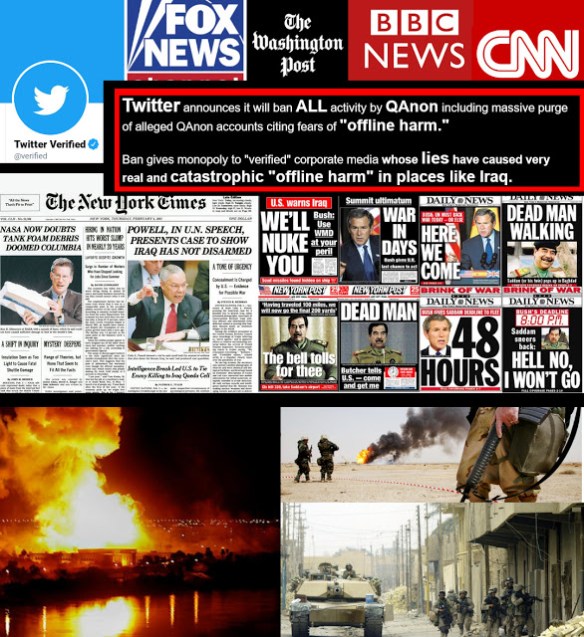
Twitter QAnon Purge Gives Bigger Monopoly to Corporate Media

By Tony Cartalucci

Source: Land Destroyer

News outlets like CNN reported on Twitter’s move to purge the QAnon movement from its platform.

Articles like, “Twitter cracks down on QAnon accounts,” would claim Twitter fears QAnon’s rhetoric online could eventually lead to “offline harm.”

There is no doubt that QAnon has been behind absurd conspiracy theories and verified lies circulating online – suspiciously absurd. Banning it from Twitter because of alleged fears its activity will lead to “offline harm” is even more absurd .
Despite making absurd claims that demonstrably never materialize or providing evidence that is later revealed to be clearly fabricated, nothing QAnon has done differs from what the corporate media does on a daily basis. In many ways they are one in the same – dividing and distracting the public while US special interests advance their agenda unnoticed and unopposed.
QAnon allegedly made false claims that Hillary Clinton’s arrest was imminent – she was never arrested. Conversely, the corporate media regularly claims that various world leaders in nations targeted by Western regime change have “fled,” are “dead,” or otherwise “ousted from power” – with lies spread by the Western media over the alleged “fates” of still incumbent leaders like Syrian President Bashar Al-Assad, Venezuela’s President Nicolás Maduro, and North Korean leader Kim Jong-un coming to immediate mind.
The Western corporate media also helps sell various wars of aggression.

This includes the US invasion of Afghanistan in 2001, the US invasion of Iraq in 2003, US interventions in Libya and Syria from 2011 onward and US-backed regime change in Ukraine in 2013-2014.

Collectively these conflicts have killed over a million people and driven millions more from their homes. This “offline harm” – the direct result of lies told by the Western corporate media – has not only gone completely unaddressed by Twitter – it is enabled by Twitter.
Twitter – along with other US tech giants like Facebook and Google – aided the US government in sowing chaos across North Africa and the Middle East in 2011, precipitating wars that are still raging today, claiming lives, and effecting “offline harm” impacting millions of people.
The banning of the more absurd QAnon movement will pave the way for other purges – eventually eliminating any alternative to the corporate media and its demonstrably dangerous and dishonest narratives. QAnon’s absurdity will make it easy for Twitter to justify its ban, but the momentum toward greater censorship across Western social media will eventually impact accounts and movements previously difficult to justify banning.
US-based “social media” platforms – Twitter, Facebook, YouTube, etc. – are no longer truly social media. They are clearly transforming into centralized programed media where corporate monopolies create content that is consumed, removing the public, independent organizations, and competitors’ role in creating content, contributing to discussions, offering alternative views, and interacting with one another.
It is important that this fact be fully recognized and exposed as well as the creation of alternative platforms – especially overseas where US-based “social media” has been fully weaponized and used to undermine sociopolitical and economic stability.

The Maxwell Family Business: Espionage

Ghislaine Maxwell is hardly the only Maxwell sibling to continue their father’s controversial work for intelligence, with other siblings carrying the torch specifically for Robert Maxwell’s sizable role in the PROMIS software scandal and subsequent yet related hi-tech espionage operations.

By Whitney Webb

Source: Unlimited Hangout

Many were surprised to learn earlier this month that the key co-conspirator in Jeffrey Epstein’s intelligence-linked sexual blackmail operation, Ghislaine Maxwell, had been in hiding in New England since Epstein’s arrest and subsequent “suicide” last summer. Her recent arrest, of course, has returned attention to the Epstein scandal and to Ghislaine’s ties to the entire operation, in which she played a central and crucial role, arguably more so than Epstein himself.

Ghislaine was first reported to be living in New England at the mansion of her alleged boyfriend Scott Borgeson on August 14th of last year. Though Maxwell is believed to have stayed there until purchasing the nearby New Hampshire home where she was arrested, attention from her presence on the East Coast was immediately and sensationally re-directed to the West Coast when, a day later on August 15ththe New York Post published a picture allegedly depicting Maxwell reading a book on “CIA operatives” at an In-N-Out Burger in Los Angeles, California. The photo was later revealed to have been photoshopped and a fake, but ultimately served its purpose in distracting from her actual location in New England.

While the media frenziedly covered the fake In-N-Out Burger photo, the appearance of an unexpected visitor nearby Borgeson’s mansion succeeded in largely slipping under the radar. On August 18th, Ghislaine’s sister Christine was spotted “packing up a number of bags” into a SUV just a few miles from Borgeson’s “secluded beachfront” home. Christine, who currently lives and works in Dallas, Texas, declined to comment on why she was visiting the exact area where Ghislaine was allegedly hiding at the time.

Out of the seven Maxwell siblings, Ghislaine Maxwell has undoubtedly received the bulk of media scrutiny both in recent years and arguably ever since the suspected homicide of the family patriarch, Robert Maxwell, in 1991. In the years since his death, Robert Maxwell’s close ties to Israeli intelligence and links to other intelligence agencies have been documented by respected journalists and investigators including Seymour Hersh and Gordon Thomas, among others.

While Ghislaine’s own ties to intelligence have since come to light in relation to her critical role in facilitating the Jeffrey Epstein sexual blackmail operation. Little, if any attention, has been paid to her siblings, particularly Christine and her twin sister Isabel, despite them having held senior roles at the Israeli intelligence front company that facilitated their father’s greatest act of espionage on Israel’s behalf, the sale of the bugged PROMIS software to the U.S. national laboratories at the heart of the country’s nuclear weapons system.

Not only that, but Christine and Isabel later became directly involved with technology-based business ventures that directly involved Ghislaine during the very period she worked with Epstein on behalf of Israeli and U.S. intelligence to ensnare powerful U.S. political and public figures in a sexual blackmail scheme involving minors. At the time, Ghislaine described her profession to a number of newspapers as “an internet operator.” Then, after this venture’s multi-million dollar sale to a competitor, Christine and Isabel became involved with successors to the PROMIS software scandal that were closely tied to U.S. intelligence and Israeli intelligence, respectively.

Ghislaine herself also became involved in these affairs, as did Jeffrey Epstein following his first arrest, as they began courting the biggest names in the U.S. tech scene, from Silicon Valley’s most powerful venture capital firms to its most well-known titans. This also dovetailed with Epstein’s investments in Israeli intelligence-linked tech firms and his claims of having troves of blackmail on prominent tech company CEOs during this same period.

With Ghislaine’s name and her ties to intelligence now inking their way back into the media sphere, detailing the decades-long course of these technology-focused espionage operations and their persistent ties to the Maxwell sisters demands the attention it deserves, as the need to air out the real Maxwell family business – espionage – is now greater than ever before.

Trap doors and Treason

One of the most brazen and successful operations conducted by Israeli intelligence on a global scale is undeniably its sale of a bugged software program to governments, corporations and major financial and scientific institutions around the world. That software program, known as the Prosecutor’s Information Management System or by its acronym PROMIS, was orginally created and marketed by Inslaw Inc., a company created by former NSA official Bill Hamilton and his wife Nancy.

In 1982, Inslaw leased its revolutionary PROMIS software to the U.S. Justice Department, then headed by arch neocon Edwin Meese III, Ronald Reagan’s most trusted advisor and who would later go on to advise Donald Trump following the 2016 election. The success of the software, which allowed integration of separate databases and information analysis on a previously unimaginable scale, eventually caught the attention of Rafi Eitan, the notorious and legendary Israeli spymaster and handler of the “most damaging spy” in American history, Jonathan Pollard. Eitan, at the time, was serving as the then-head of the now defunct Israel intelligence service known as Lekem, which focused specifically on espionage related to scientific and technical information and discoveries.

Eitan had first learned of PROMIS from Earl Brian. Brian was a long-time associate of Ronald Reagan who had previously worked for the CIA in covert operations and had been in charge of Reagan’s healthcare program when Reagan was governor of California. Brian often bragged of the nickname he had acquired in overseeing that health care initiative – “the man who walked over the dead.” In 1982, however, Brian was attempting to build a business empire, in which then-AG Ed Meese’s wife was a major investor, and he had first met Eitan while attempting to sell a healthcare system in Iran.

Brian divulged the efficacy of PROMIS, but – instead of praising its revolutionary approach to data analysis – expressed his frustration that the software enabled U.S. federal investigators to successfully track and target money laundering and other financial crimes. He also expressed frustration that he had been left out of the profits on PROMIS, the development of which he had followed closely for several years.

As their conversation wore on, Eitan and Brian hatched a plan to install a “trapdoor”, today more often referred to as a back door, into the software. They would then market PROMIS throughout the world, providing Israeli intelligence and allied elements of U.S. intelligence with a direct window into the operations of its enemies and allies while also netting Eitan and Brian massive profits for the sale of the software. Brian, of course, would also be able to use PROMIS to circumvent authorities investigating financial crimes.

According to the testimony of ex-Mossad official Ari Ben-Menashe, after a copy of PROMIS was obtained by Israeli military intelligence (via direct collusion with the U.S. Department of Justice), Ben-Menashe contacted an Israeli American programmer living in California on Eitan’s orders. That programmer then planted a “trapdoor” or back door into the software that would allow Lekem covert access to any database connected to a device on which the software was installed.

Once the back door was present, Brian attempted to use his company Hadron Inc to market the bugged PROMIS software around the world, though he first had tried to buy out Inslaw to do so. Unsuccessful, Brian turned to his close friend, then-Attorney General Ed Meese, and the Justice Department then abruptly refused to make the payments to Inslaw that had been stipulated by the contract, essentially using the software for free, which Inslaw claimed to be theft.

Meese’s actions would force Inslaw into bankruptcy and Inslaw subsequently sued the Justice Department, with a US court later finding that the Meese-led department “took, converted, stole” the software through “trickery, fraud and deceit.” With Inslaw out of the way, Brian sold the bugged software to Jordan’s and Iraq’s intelligence services, a major boon for Israel, and to a handful of companies. Despite this, Eitan was unsatisfied with Brian and Hadron and he quickly turned to the person he thought could most effectively market and sell PROMIS to governments of interest all over the world, Robert Maxwell.

First recruited as an asset of Israeli intelligence in the early 1960s, Maxwell’s standing with Israeli intelligence would strengthen considerably beginning in the early 1980s, when he purchased a web of Israeli companies, many of which were official “service providers” for the Mossad. One of these companies, a computer firm called Degem, had been used for years to provide cover to Mossad assassins that conducted kidnappings and murders in Latin America and Africa.

Through Degem and other Maxwell-owned companies based in Israel and elsewhere, Maxwell marketed PROMIS so successfully that Israeli intelligence soon had access to the innermost workings of innumerable governments, corporations, banks and intelligence services around the world. Many of Maxwell’s biggest successes came in selling PROMIS to dictators in Eastern Europe, Africa and Latin America. Following the sale and after Maxwell collected a handsome paycheck, PROMIS’ unparalleled ability to track and surveil anything – from cash flows to human movement – were used by these governments to commit financial crimes with greater finesse and used to hunt down and disappear dissidents. Israeli intelligence, of course, watched it all play out in real time.

In Latin America, for instance, Maxwell sold PROMIS to military dictatorships in Chile and Argentina, which were used to facilitate the mass murder that characterized Operation Condor as the friends and families of dissidents and so-called subversives were easily identified using PROMIS. PROMIS was so effective for this purpose that, just days after Maxwell sold the software to Guatemala, its US-backed dictatorship rounded up 20,000 “subversives” who were never heard from again. Of course, thanks to the back door in PROMIS, Israeli intelligence knew the identities of Guatemala’s disappeared before the victim’s own families. Israel was also intimately involved in the arming and training of many of the same Latin American dictatorships that had been sold the bugged PROMIS software.

Though Israeli intelligence found obvious use for the steady stream of sensitive and classified information, their biggest prize was yet to come – top secret government laboratories in the United States. Eitan tasked Maxwell with selling PROMIS to US labs in the Los Alamos complex, including Sandia National Laboratory, which was and is at the core of the US nuclear weapons system. Notably, the eventual sale of PROMIS to these laboratories by Maxwell occurred during the same period in 1984 when Eitan tasked one of Israel’s top experts in nuclear targeting with supervising Jonathan Pollard’s espionage of U.S. nuclear secrets on Israel’s behalf.

In order to plot how he would accomplish such a feat, Maxwell would meet with none other than Henry Kissinger, who told him that – in order to sell PROMIS to these sensitive laboratories – he needed to enlist the services of then-Senator for Texas John Tower, who was the head of the Senates’ Armed Services Committee at the time. Maxwell quickly struck a deal with Tower and then, using Mossad money, paid Tower $200,000 for his services, which included opening doors – not just to the Los Alamos complex, but also to the Reagan White House. Tower would arrange a trip for Maxwell to travel to Sandia National Laboratory, where he would market PROMIS. Unlike most other PROMIS sales, this one would not be handled by Degem, but a US-based company called Information on Demand.

It is worth noting that, despite Tower’s obvious and treasonous actions with respect to U.S. national security, another long-time “source” of Robert Maxwell, George H.W. Bush, would attempt to nominate Tower to serve as U.S. Secretary of Defense. When the Senate refused to confirm Tower, only then did Bush nominate Dick Cheney, who would then head the Pentagon and oversee the U.S.’ role in the First Gulf War. Not long after his failure to secure the nomination as Pentagon chief, Tower died in a suspicious plane crash soon after the equally suspicious death of Robert Maxwell.

Front Companies and FBI Cover-ups

Robert Maxwell purchased Information on Demand from its founder, Sue Rugge – a former librarian, through the Pergamon Group in 1982 – the very year plans were made by Rafi Eitan and Earl Brian to subvert PROMIS. Its offices were just a few doors down from the home of Isabel Maxwell and her first husband Dale Djerassi, son of the scientist credited with creating the birth control pill.

According to FBI files obtained by Inslaw Inc. via a FOIA request in the 1990s, San Francisco’s FBI opened an investigation into Information on Demand a year later in October 1983 and subsequently interviewed Rugge about the business and its activities. She told the FBI that the company’s sources “include over 250 computer data bases” and that company uses these to “locate single facts as well as provide answers to complex questions dealing with such areas as comprehensive marketing research, custom data summaries, sophisticated literature searching, current awareness service and global information capability.

One of these databases included Lockheed’s Dialog database and “the Defense Technical Center which is connected to the Department of Defense (DOD) which contains classified information. ” She asserted, however, that the company “has no password for access and further no need for access.” Elsewhere in the document, it notes that Information on Demand claimed not have any access to classified information “to the best of their knowledge” and “includes information concerning government and various available means of tapping government information databases.”

The FBI asked Rugge about one client of the company in particular, whose name and identifying information is redacted in its entirety, but notes that this mysterious client had worked with Information on Demand since at least 1973. Subsequent efforts by Inslaw Inc. and others to learn the identity of the redacted client have been unsuccessful since 1994.

Notably, just one month before the FBI opened an investigation into Information on Demand and interviewed Sue Rugge, another related Maxwell-owned firm, Pergamon International Information Corporation, had sent a letter to then-CIA Director Bill Casey, offering to provide the agency with access to patent databases. The only redacted portion of the letter is the identity of PIIC’s Executive Vice President, who had written the letter to Casey.

After Rugge had been interviewed, FBI interest in Information on Demand peaked soon after in June 1984, when a formal investigation was opened. This took place after two employees of Sandia National Laboratory who worked in technology transfer approached the Bureau over Information on Demand’s efforts to sell PROMIS to the laboratory. Those employees were compelled to contact the FBI after obtaining information from employees of the National Security Agency (NSA) regarding “the purchase of Information on Demand Inc. by one Robert Maxwell, the owner of Pergamon International.” The specific information on this purchase from the NSA is included in the report but redacted in its entirety. Two months later, one of the Sandia employees followed up with the Bureau, suggesting that the NSA and FBI jointly investigate Information on Demand, but was essentially stonewalled and told to take it up with FBI headquarters.

The FBI case file is coded as a foreign counter-intelligence investigation specifically, suggesting that the case was opened because the FBI was made aware of the alleged involvement of a foreign intelligence service in some aspect of Information on Demand’s activities that related specifically to the “dissemination, marketing or sale of computer software systems, including but not limited to the PROMIS computer software product.” It also noted that Maxwell himself had previously been the subject of a “security investigation” conducted by the FBI from 1953 until 1961, the year Maxwell was formally recruited as an Israeli intelligence asset.

In early August 1984, FBI headquarters and other higher-ups in the Ed Meese-led Department of Justice, which itself was complicit in the whole sordid PROMIS affair, ordered the New Mexico office to halt its investigation into Information on Demand, Maxwell and PROMIS. The cover-up, oddly enough, continues today, with the FBI still refusing to release documents pertaining to Robert Maxwell and his role in the PROMIS scandal.

Several months following the shuttering of the FBI investigation into Information on Demand, Robert Maxwell again returned to Sandia National Laboratories in February 1985, signing the contract for the sale of PROMIS and listing himself as President and CEO of Information on Demand. A few months later, he passed that role on to his daughter Christine, who served as the company’s president and CEO up until her father’s death in 1991, according to her résumé. Upon the collapse of his business empire shortly after his demise, which also resulted in the closure of Information on Demand, Christine created a company called Research on Demand that offered similar services and specialized “in Internet- and Big Data analytics-related market studies for companies in the Telecoms.”

In addition, Isabel Maxwell, who lived in close proximity to the company’s offices in Berkely, CA, told Haaretz that she had also worked for Information on Demand, which she refers to as “her sister’s company,” following her 1989 divorce from Dale Djerassi.

Recreating their Father’s Legacy

After the death of Robert Maxwell, in what most of his family and many of his biographers regard as a murder conducted by Israeli intelligence, his children began to pick up the pieces and sought to rebuild their father’s empire. Of his seven children, five took on different aspects of their father’s vast portfolio.

Kevin and Ian Maxwell took over much of his businesses (and the associated fall-out) and his murky network of interlocking companies, trusts and foundations spread throughout the world. Ghislaine, having already positioned herself in New York at her father’s behest to anchor his efforts to expand his empire and operations into Manhattan, began a sexual blackmail operation on behalf of Israeli intelligence alongside Jeffrey Epstein. Christine and Isabel, however, would take off where Maxwell’s intelligence-linked work with PROMIS and in technology had left off by cashing in on a new revolutionary technology, the Internet.

“We literally were trying to think about how to restart this whole business” that had collapsed after their father’s death, Christine Maxwell would later say of her decision to found, along with her husband Roger Malina, Isabel and Isabel’s then-husband David Hayden, their internet services company – the McKinley Group – in January 1992. Isabel would remember the decision similarly, telling Wired in 1999, that she and her sister had “wanted to circle the wagons and rebuild,” seeing McKinley as “a chance to recreate a bit of their father’s legacy.” In 2000, Isabel would tell The Guardian that her father would “love it [the internet] if he was still here.” “He was very prescient….He’d be in his element, he’d be having a blast, I’m sure he’d be thrilled to know what I’m doing now,” she told the UK-based publication while “throwing back her head and laughing loudly.” Notably, at that time, Isabel was leading Israeli software company with ties to Israeli military intelligence and powerful Israeli political players, including some who had previously worked directly under her father.

It’s not hard to see why Christine and Isabel saw the internet as their chance to expand upon and rebuild upon Robert Maxwell’s “legacy.” As previously mentioned, Christine, right up until her father’s death, had been president and CEO of the Robert Maxwell-owned Israeli intelligence front company, Information on Demand, where Isabel had also worked. Upon his death, Christine had founded a related company called Research on Demand, which specialized in “internet and big data analytics” for telecommunications firms, and would later overlap with the McKinley Group’s work. McKinley began as a directory with a rating system for websites, later transitioning into the Magellan search engine, all of which Isabel Maxwell told Cnet in 1997 were all Christine’s idea.

McKinley created what became known as the Magellan online directory, remembered as “the first site to publish lengthy reviews and ratings of websites.” Magellan’s “value-added content” approach attracted several large corporations, resulting in “major alliances” with AT&T, Time Warner, IBM, Netcom and the Microsoft Network [MSN] that were negotiated by Isabel Maxwell. Microsoft’s major alliance with McKinley came in late 1995, when Microsoft announced that Magellan would power the search option for the company’s MSN service. Time Warner first chose Magellan for its early web portal called Pathfinder and Magellan was on the homepage of the internet browser Netscape for much of the 1990s.

However, McKinley’s fortunes were troubled as its efforts to be the first search engine to go public fell through, igniting a stand-off between Christine Maxwell and Isabel’s husband that also resulted in the company’s essentially falling behind other market leaders both missing the window for a second IPO attempt and lagging behind in adding ad revenue to their business model. Excite, which was later acquired by AskJeeves, ultimately bought the McKinley Group and Magellan for 1.2 million shares of Excite stock in 1996, which was then valued at $18 million. It was allegedly Isabel Maxwell who made the deal possible, with Excite’s CEO at the time, George Bell, claiming she alone salvaged their purchase of McKinley.

Despite the company’s lackluster end, the Maxwell sisters and other stakeholders in the company, Ghislaine Maxwell among them, not only obtained a multi-million dollar payout from the deal, but also forged close connections with Silicon Valley high-rollers. Upon McKinley/Magellan’s sale, the overt ties of Christine and Isabel Maxwell to intelligence in both the U.S. and Israel would grow considerably.

A Family Affair

While the company is often framed as being a venture between Christine and Isabel Maxwell, McKinley Group and Magellan were much more than just the twin sisters’ business. For instance, a November 2003 article in The Evening Standard notes that Christine and Isabel launched the company with considerable help from their brother, Kevin Maxwell who the article described as being “consumed by an overwhelming desire to be his ‘dad reincorporated’” according to confidants. Another Evening Standard article from March 2001 cited report that “Kevin played a major role” in the company’s affairs.

In addition, at the time, The Sunday Times noted in November 2000 that Ghislaine Maxwell “had a substantial interest in Magellan” and netted a considerable sum following its sale to Excite in 1996. It also noted that Ghislaine, throughout the 1990s, had “been discreetly building up a business empire as opaque as her father’s” and that “she is secretive to the point of paranoia and her business affairs are deeply mysterious.” However, she would nonetheless describe “herself as an ‘internet operator’” even though “her office in Manhattan refuses to confirm even the name or the nature of her business.” A separate article in The Scotsman from 2001 also notes that Ghislaine “is extremely secretive about her affairs and describes herself as an internet operator.”

Exactly how involved Ghislaine Maxwell was involved in the McKinley Group and Magellan is unclear, though her decision to describe herself as an “internet operator” and her documented “substantial interest” in the company suggest that it was more than superficial. What is notable, however, is that Ghislaine’s time as an “internet operator” and her business interests in Magellan overlap directly with her time working alongside Jeffrey Epstein in an Israeli intelligence-linked sexual blackmail operation.

During this period of time, Ghislaine Maxwell and Jeffrey Epstein frequently had considerable overlap in their finances, with press reports from the time often asking whether Ghislaine’s expenses were paid by Epstein or through her access to the “lost Maxwell millions” that had been hidden in a web of murky, untraceable financial entities and allegedly “disappeared” following his 1991 death.

The latter is certainly a possibility as it was Ghislaine who was the first to walk into her late father’s office on the Lady Ghislaine following his death, where she “shredded all incriminating documents onboard,” according to journalist John Jackson who witnessed the scene. This would likely mean that she was quickly able to distinguish which documents were “incriminating” and was intimately aware of his more unsavory business activities. In addition, prior to his death, Robert Maxwell had provided Ghislaine with a “tailor-made” New York corporation called Maxwell Corporate Gifts, of which little is known. The corporation was reportedly intended to aid her in establishing a foothold in New York’s power base for Robert Maxwell’s planned expansion into New York society, a plan first set into motion following his purchase of the New York Daily News.

Notably, an article from The Evening Standard in 2001 makes an odd comment about a major source of income from Epstein during the 1990s, stating that “has made many millions out of his business links with the likes of Bill Gates, Donald Trump and Ohio billionaire Leslie Wexner, whose trust he runs.”  In addition, Epstein victim Maria Farmer noted in an interview that she overheard Ghislaine and Epstein discuss Bill Gates as though they knew him well in 1995. However, these mentions of Bill Gates here defies the official narrative about the Epstein-Gates relationship, which claims they first met in 2011.Given the “major alliance” between McKinley/Magellan and Microsoft that was forged in 1995-1996, it is certainly possible that Epstein’s pre-2001 “business links” with Bill Gates were, in fact, related to Ghislaine’s involvement and stake in Magellan. This is also supported by the fact that, as will be shown in Part 2 of this report, Magellan co-founder Isabel Maxwell had a personal relationship with Bill Gates and that he put her subsequent company, Israel-based CommTouch, “on the map” after a major investment that had been brokered between Gates and Isabel personally. Part 2 will also show how both Isabel and Christine’s overt involvement, with Israeli and U.S. intelligence, respectively, deepened after Magellan was sold to Excite in 1996.