Schrödinger’s War – And Orwell’s

By Raúl Ilargi Meijer

Source: The Automatic Earth

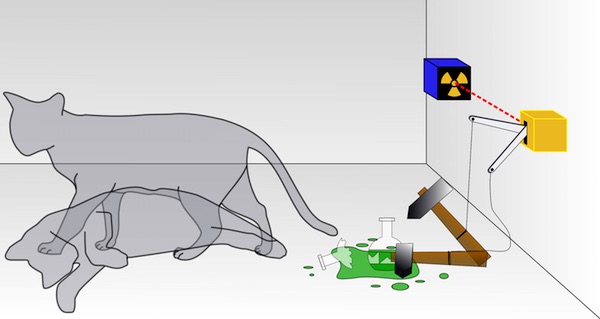
Physicist Erwin Schrödinger in 1935 tried to explain the (consequences of the) uncertainty principle, defined by Werner Heisenberg as a core theme of Albert Einstein’s view of quantum mechanics, to … Albert Einstein. The latter must have been thrilled. Even though he did not like the uncertainty principle (God does not play dice). The thought experiment became known as “Schrödinger’s cat”. Since you cannot know both a particle’s position and its speed -and that’s just one example-, you have to assume all possible outcomes are valid (superposition). Only when you “look” does one particular outcome become the “reality”. It’s all part of the subatomic “world”

Wikipedia: “In Schrödinger’s original formulation, a cat, a flask of poison, and a radioactive source are placed in a sealed box. If an internal monitor (e.g. a Geiger counter) detects radioactivity (i.e. a single atom decaying), the flask is shattered, releasing the poison, which kills the cat. The Copenhagen interpretation implies that, after a while, the cat is simultaneously alive and dead. Yet, when one looks in the box, one sees the cat either alive or dead, not both alive and dead. This poses the question of when exactly quantum superposition ends and reality resolves into one possibility or the other.”

As I’m trying to explain this, I very much have to wonder if I get it right. And I always thought that follows the uncertainty principle too: I can understand it and not understand it both at the same time. A physicist might fare a bit better, but it won’t come easy.

This is what I was thinking of with regards to the war in Ukraine. Before the fighting started, all possible outcomes seemed equally possible. If you did not look too closely at numbers of soldiers and weaponry, that is. But once it did start (when Schrödinger’s box was opened), it became clear very rapidly that Ukraine had no chance of winning. So why are we still acting as if the box remains closed? Because that way we get to spend billions more on armory, and we get western people to support Zelensky and his neo-nazis as those same people suffer from high prices for everything. Any outcome is still possible!

Take the Kakhovka dam narrative, or Nord Stream or any of the numerous other examples. When both sides accuse each other of perpetrating a certain event, Schrödinger’s box remains closed. Which is exactly what our politicians and arms makers desire. They don’t want us to know that they’ve been beaten by Russia, because you would no longer support their policies and their arms purchases. They want “superposition”. They can’t very well declare victory -though they try-, but they don’t need to either. They need uncertainty. Politicians, arms makers and media. They all profit from keeping you in the dark.

The best comment on Kakhovka I’ve seen perhaps comes from @CheburekiMan on Twitter: “Restoring water flow to the North Crimean Canal was top priority for Russia, the very first act of the SMO. Before Kiev shut off the flow in 2014, the canal was supplying 85% of Crimea’s water. So much depended on it, from crops to industry to drinking water, that’s how important it is. Now the pro-Ukraine bleating sheep want people to believe that Russia would wreck the dam, empty the reservoir and cause serious harm to its own people by running the canal dry. It’s so bonkers that one has to seriously consider such ideas are the result of brain damage, or perhaps fetal alcohol syndrome.”

Where Orwell comes in is in the terminology. Where “War equals Peace”. The EU pays its member states for the second hand weapons they “donate” to Kiev, through something called the European Peace Fund (aka Facility). Mass weapons deliveries that get huge numbers of people killed, are labeled “Peace”. Zelensky touts a plan labeled a Peace Plan, which demands Russia give back all territories, pay war reparations, deliver Putin et al to some international criminal court etc. The chance of that happening is of course zero, but as long as Schrödinger’s box remains closed, anything is possible. Still, it is a War Plan, not a Peace Plan.

Similarly, Zelensky and his international backers are organizing a Peace Summit, where everybody is invited except Russia. That makes it a War Summit. The suggestion made to westerners is that this is a globally supported initiative, but it is only a small part of the world population (10%?) that supports it. NATO+Japan+Australia. Did I leave anyone out? New Zealand? Ha ha ha, I read that Jacinda Ardern was made a dame. If you know a better illustration of how deep we’ve sunk, I’m game.

All the rest of the world is much more interested in the economic developments that involve BRICS+. 31 and counting nations have expressed interest in joining. And they’re not going to risk their potential role in that over a local fight far away that they know is long decided. US/NATO, in provoking this war, have lost not only the fight, but much more importantly, their economic power. Recently, the G7 were talking about what they were going to do in Central Asia. Which is basically all the “-Stans” left over after the Soviet Union dissolved. But the G7 is not going to do anything, it has no power there anymore. All these countries want to join the BRICS+. Why would you join a waning power if you have a shot at joining a power in its ascendancy, that all your neighbors are also joining?

The same attitude is prevalent in Africa, South America, East Asia, etc. Full of countries that remember how they were treated through the years by first Europe and then the US. The world has changed beyond recognition since the start of Russia’s SMO, and the “globalist west” is the only “region” that doesn’t recognize this. The USD won’t be replaced tomorrow as the reserve currency, but it doesn’t have to be. The process goes step by step, and is unstoppable. Hemingway’s famous words about how you go bankrupt (first gradually, then suddenly) have us on the wrong foot here. We only look at the “suddenly” part when it comes to the reserve currency, and ignore all the “gradually” steps. And then one day we will wake up and everything’s changed.

The rest of the world sees Schrödinger’s box as open. Only the west thinks that it’s still closed, and all possible outcomes are still viable.

Clinging Bitterly to Guns and Religion

The End Stage of American Empire

By William J. Astore

Source: TomDispatch.com

All around us things are falling apart. Collectively, Americans are experiencing national and imperial decline. Can America save itself? Is this country, as presently constituted, even worth saving?

For me, that last question is radical indeed. From my early years, I believed deeply in the idea of America. I knew this country wasn’t perfect, of course, not even close. Long before the 1619 Project, I was aware of the “original sin” of slavery and how central it was to our history. I also knew about the genocide of Native Americans. (As a teenager, my favorite movie — and so it remains — was Little Big Man, which pulled no punches when it came to the white man and his insatiably murderous greed.)

Nevertheless, America still promised much, or so I believed in the 1970s and 1980s. Life here was simply better, hands down, than in places like the Soviet Union and Mao Zedong’s China. That’s why we had to “contain” communism — to keep them over there, so they could never invade our country and extinguish our lamp of liberty. And that’s why I joined America’s Cold War military, serving in the Air Force from the presidency of Ronald Reagan to that of George W. Bush and Dick Cheney. And believe me, it proved quite a ride. It taught this retired lieutenant colonel that the sky’s anything but the limit.

In the end, 20 years in the Air Force led me to turn away from empire, militarism, and nationalism. I found myself seeking instead some antidote to the mainstream media’s celebrations of American exceptionalism and the exaggerated version of victory culture that went with it (long after victory itself was in short supply). I started writing against the empire and its disastrous wars and found likeminded people at TomDispatch — former imperial operatives turned incisive critics like Chalmers Johnson and Andrew Bacevich, along with sharp-eyed journalist Nick Turse and, of course, the irreplaceable Tom Engelhardt, the founder of those “tomgrams” meant to alert America and the world to the dangerous folly of repeated U.S. global military interventions.

But this isn’t a plug for TomDispatch. It’s a plug for freeing your mind as much as possible from the thoroughly militarized matrix that pervades America. That matrix drives imperialism, waste, war, and global instability to the point where, in the context of the conflict in Ukraine, the risk of nuclear Armageddon could imaginably approach that of the 1962 Cuban Missile Crisis. As wars — proxy or otherwise — continue, America’s global network of 750-odd military bases never seems to decline. Despite upcoming cuts to domestic spending, just about no one in Washington imagines Pentagon budgets doing anything but growing, even soaring toward the trillion-dollar level, with militarized programs accounting for 62% of federal discretionary spending in 2023.

Indeed, an engorged Pentagon — its budget for 2024 is expected to rise to $886 billion in the bipartisan debt-ceiling deal reached by President Joe Biden and House Speaker Kevin McCarthy — guarantees one thing: a speedier fall for the American empire. Chalmers Johnson predicted it; Andrew Bacevich analyzed it. The biggest reason is simple enough: incessant, repetitive, disastrous wars and costly preparations for more of the same have been sapping America’s physical and mental reserves, as past wars did the reserves of previous empires throughout history. (Think of the short-lived Napoleonic empire, for example.)

Known as “the arsenal of democracy” during World War II, America has now simply become an arsenal, with a military-industrial-congressional complex intent on forging and feeding wars rather than seeking to starve and stop them. The result: a precipitous decline in the country’s standing globally, while at home Americans pay a steep price of accelerating violence (2023 will easily set a record for mass shootings) and “carnage” (Donald Trump’s word) in a once proud but now much-bloodied “homeland.”

Lessons from History on Imperial Decline

I’m a historian, so please allow me to share a few basic lessons I’ve learned. When I taught World War I to cadets at the Air Force Academy, I would explain how the horrific costs of that war contributed to the collapse of four empires: Czarist Russia, the German Second Reich, the Ottoman empire, and the Austro-Hungarian empire of the Habsburgs. Yet even the “winners,” like the French and British empires, were also weakened by the enormity of what was, above all, a brutal European civil war, even if it spilled over into Africa, Asia, and indeed the Americas.

And yet after that war ended in 1918, peace proved elusive indeed, despite the Treaty of Versailles, among other abortive agreements. There was too much unfinished business, too much belief in the power of militarism, especially in an emergent Third Reich in Germany and in Japan, which had embraced ruthless European military methods to create its own Asiatic sphere of dominance. Scores needed to be settled, so the Germans and Japanese believed, and military offensives were the way to do it.

As a result, civil war in Europe continued with World War II, even as Japan showed that Asiatic powers could similarly embrace and deploy the unwisdom of unchecked militarism and war. The result: 75 million dead and more empires shattered, including Mussolini’s “New Rome,” a “thousand-year” German Reich that barely lasted 12 of them before being utterly destroyed, and an Imperial Japan that was starved, burnt out, and finally nuked. China, devastated by war with Japan, also found itself ripped apart by internal struggles between nationalists and communists.

As with its prequel, even most of the “winners” of World War II emerged in a weakened state. In defeating Nazi Germany, the Soviet Union had lost 25 to 30 million people. Its response was to erect, in Winston Churchill’s phrase, an “Iron Curtain” behind which it could exploit the peoples of Eastern Europe in a militarized empire that ultimately collapsed due to its wars and its own internal divisions. Yet the USSR lasted longer than the post-war French and British empires. France, humiliated by its rapid capitulation to the Germans in 1940, fought to reclaim wealth and glory in “French” Indochina, only to be severely humbled at Dien Bien Phu. Great Britain, exhausted from its victory, quickly lost India, that “jewel” in its imperial crown, and then Egypt in the Suez debacle.

There was, in fact, only one country, one empire, that truly “won” World War II: the United States, which had been the least touched (Pearl Harbor aside) by war and all its horrors. That seemingly never-ending European civil war from 1914 to 1945, along with Japan’s immolation and China’s implosion, left the U.S. virtually unchallenged globally. America emerged from those wars as a superpower precisely because its government had astutely backed the winning side twice, tipping the scales in the process, while paying a relatively low price in blood and treasure compared to allies like the Soviet Union, France, and Britain.

History’s lesson for America’s leaders should have been all too clear: when you wage war long, especially when you devote significant parts of your resources — financial, material, and especially personal — to it, you wage it wrong. Not for nothing is war depicted in the Bible as one of the four horsemen of the apocalypse. France had lost its empire in World War II; it just took later military catastrophes in Algeria and Indochina to make it obvious. That was similarly true of Britain’s humiliations in India, Egypt, and elsewhere, while the Soviet Union, which had lost much of its imperial vigor in that war, would take decades of slow rot and overstretch in places like Afghanistan to implode.

Meanwhile, the United States hummed along, denying it was an empire at all, even as it adopted so many of the trappings of one. In fact, in the wake of the implosion of the Soviet Union in 1991, Washington’s leaders would declare America the exceptional “superpower,” a new and far more enlightened Rome and “the indispensable nation” on planet Earth. In the wake of the 9/11 attacks, its leaders would confidently launch what they termed a Global War on Terror and begin waging wars in Afghanistan, Iraq, and elsewhere, as in the previous century they had in Vietnam. (No learning curve there, it seems.) In the process, its leaders imagined a country that would remain untouched by war’s ravages, which was we now know — or do we? — the height of imperial hubris and folly.

For whether you call it fascism, as with Nazi Germany, communism, as with Stalin’s Soviet Union, or democracy, as with the United States, empires built on dominance achieved through a powerful, expansionist military necessarily become ever more authoritarian, corrupt, and dysfunctional. Ultimately, they are fated to fail. No surprise there, since whatever else such empires may serve, they don’t serve their own people. Their operatives protect themselves at any cost, while attacking efforts at retrenchment or demilitarization as dangerously misguided, if not seditiously disloyal.

That’s why those like Chelsea ManningEdward Snowden, and Daniel Hale, who shined a light on the empire’s militarized crimes and corruption, found themselves imprisoned, forced into exile, or otherwise silenced. Even foreign journalists like Julian Assange can be caught up in the empire’s dragnet and imprisoned if they dare expose its war crimes. The empire knows how to strike back and will readily betray its own justice system (most notably in the case of Assange), including the hallowed principles of free speech and the press, to do so.

Perhaps he will eventually be freed, likely as not when the empire judges he’s approaching death’s door. His jailing and torture have already served their purpose. Journalists know that to expose America’s bloodied tools of empire brings only harsh punishment, not plush rewards. Best to look away or mince one’s words rather than risk prison — or worse.

Yet you can’t fully hide the reality that this country’s failed wars have added trillions of dollars to its national debt, even as military spending continues to explode in the most wasteful ways imaginable, while the social infrastructure crumbles.

Clinging Bitterly to Guns and Religion

Today, America clings ever more bitterly to guns and religion. If that phrase sounds familiar, it might be because Barack Obama used it in the 2008 presidential campaign to describe the reactionary conservatism of mostly rural voters in Pennsylvania. Disillusioned by politics, betrayed by their putative betters, those voters, claimed the then-presidential candidate, clung to their guns and religion for solace. I lived in rural Pennsylvania at the time and recall a response from a fellow resident who basically agreed with Obama, for what else was there left to cling to in an empire that had abandoned its own rural working-class citizens?

Something similar is true of America writ large today. As an imperial power, we cling bitterly to guns and religion. By “guns,” I mean all the weaponry America’s merchants of death sell to the Pentagon and across the world. Indeed, weaponry is perhaps this country’s most influential global export, devastatingly so. From 2018 to 2022, the U.S. alone accounted for 40% of global arms exports, a figure that’s only risen dramatically with military aid to Ukraine. And by “religion,” I mean a persistent belief in American exceptionalism (despite all evidence to the contrary), which increasingly draws sustenance from a militant Christianity that denies the very spirit of Christ and His teachings.

Yet history appears to confirm that empires, in their dying stages, do exactly that: they exalt violence, continue to pursue war, and insist on their own greatness until their fall can neither be denied nor reversed. It’s a tragic reality that the journalist Chris Hedges has written about with considerable urgency.

The problem suggests its own solution (not that any powerful figure in Washington is likely to pursue it). America must stop clinging bitterly to its guns — and here I don’t even mean the nearly 400 million weapons in private hands in this country, including all those AR-15 semi-automatic rifles. By “guns,” I mean all the militarized trappings of empire, including America’s vast structure of overseas military bases and its staggering commitments to weaponry of all sorts, including world-ending nuclear ones. As for clinging bitterly to religion — and by “religion” I mean the belief in America’s own righteousness, regardless of the millions of people it’s killed globally from the Vietnam era to the present moment — that, too, would have to stop.

History’s lessons can be brutal. Empires rarely die well. After it became an empire, Rome never returned to being a republic and eventually fell to barbarian invasions. The collapse of Germany’s Second Reich bred a third one of greater virulence, even if it was of shorter duration. Only its utter defeat in 1945 finally convinced Germans that God didn’t march with their soldiers into battle.

What will it take to convince Americans to turn their backs on empire and war before it’s too late? When will we conclude that Christ wasn’t joking when He blessed the peacemakers rather than the warmongers?

As an iron curtain descends on a failing American imperial state, one thing we won’t be able to say is that we weren’t warned.

First There Were Neo-Nazis, Then There Were No Nazis, Then There Were

By Patrick Lawrence

Source: Scheerpost

I tell you, serving as a New York Times correspondent these days cannot be easy. You have to convey utter nonsense to your readers while maintaining a straight face and a serious demeanor. You have to suggest the Russians may have exploded a drone over the Kremlin, that they may have blown up their own gas pipeline, that their president is an out-of-touch psychotic, that their soldiers in Ukraine are drunkards using faulty equipment, that they attack with “human hordes” (Orientalism, anyone?) and on and on—all the while affecting the gravitas once associated with the traditional “Timesman.” You try it sometime.

I am reminded of that pithy passage in Daniel Boorstin’s regrettably overlooked book, The Image. “The reporter’s task,” Boorstin wrote in 1962, “is to find a way of weaving these threads of unreality into a fabric that the reader will not recognize as entirely unreal.”

Boorstin reflected on America’s resort to imagery, illusion, and distortion as Washington geared up its gruesome follies in Vietnam. The reporter’s task is a whole lot harder now, given how much farther we have wandered into illusion and distortion since Boorstin’s day.  

And now we have the case of Thomas Gibbons–Neff, a square-jawed former Marine covering the Ukraine war for The Times—strictly to the extent the Kyiv regime permits him to do so, as he explains with admirable honesty. This guy is serious times 10, he and his newspaper want us to know.  

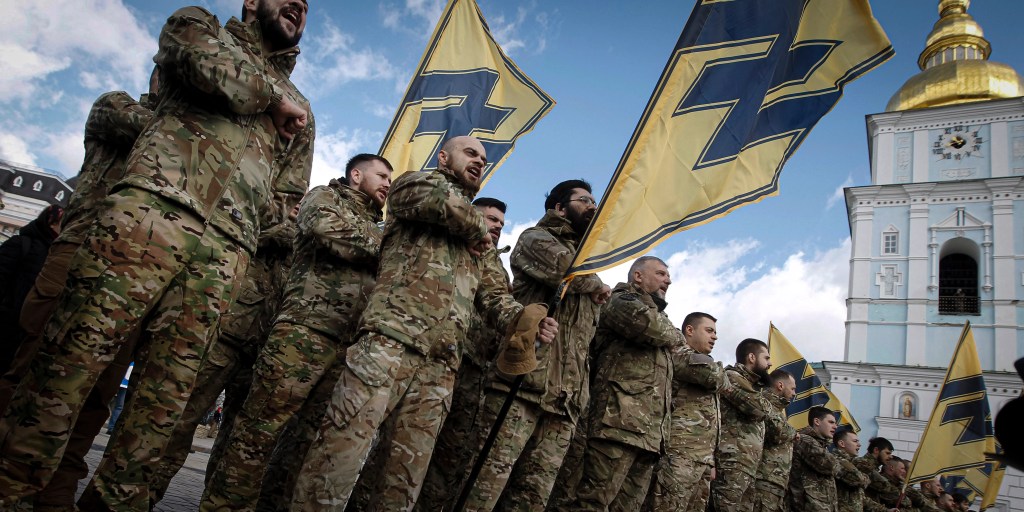
Tom’s job this week is to persuade us that all those Ukrainian soldiers wearing Nazi insignia, idolizing Jew-murdering, Russophobic collaborators with the Third Reich, gathering ritually in Nazi-inspired cabals, marching through Kyiv in Klan-like torch parades are not what you think. Nah, our Tom tells us. They look like neo–Nazis, they act like neo–Nazis, they dress like neo–Nazis, they profess Fascist and neo–Nazi ideologies, they wage this war with the Wehrmacht’s visceral hatred of Russians—O.K., but whyever would you think they are neo–Nazis? 

They are just regular guys. They wear the Wolfsangel, the Schwarze sonne, the black sun, the Totenkopf, or Death’s Head—all Nazi symbols—because they are proud of themselves, and these are the kinds of things proud people wear. I was just wearing mine the other day. 

The slipping and sliding starts early in “Nazi Symbols on Ukraine’s Front Lines Highlight Thorny Issues of History,” the piece Gibbons–Neff published in Monday’s editions. He begins with three photographs of neo–Nazi Ukrainian soldiers, SS insignia plainly visible, that the Kyiv regime has posted on social media, “then quietly deleted,” since the Russian intervention began last year. “The photographs, and their deletions,” Gibbons–Neff writes, “highlight the Ukrainian military’s complicated relationship with Nazi imagery, a relationship forged under both Soviet and German occupation during World War II.”

Complicated relationship with Nazi imagery? Stop right there, Mr. Semper fi.  Ukraine’s neo–Nazi problem is not about a few indiscreetly displayed images. Sorry. The Ukrainian army’s “complicated relationship” is with a century of ultra-right ideology drawn from Mussolini’s Fascism and then the German Reich. As is well-known and documented, the neo–Nazis who infest the Armed Forces of Ukraine, the AFU—among many other national institutions—have made idols of such figures as Stepan Bandera, the freakishly murderous nationalist who allied with the Nazi regime during the war.

This history is a matter of record, as briefly outlined here, but Gibbons–Neff alludes to none of it. It’s merely a matter of poor image-making, you see. In support of this offensive whitewash, Gibbons–Neff has the nerve to quote a source from none other than Bellingcat, which was long, long back exposed as a CIA and MI6 cutout and which is now supported by the Atlantic Council, the NATO–funded, spook-infested think tank based in Washington. 

“What worries me, in the Ukrainian context, is that people in Ukraine who are in leadership positions, either they don’t or they’re not willing to acknowledge and understand how these symbols are viewed outside of Ukraine,” a Bellingcat “researcher” named Michael Colborne tells Gibbons–Neff. “I think Ukrainians need to increasingly realize that these images undermine support for the country.”

Think about that. The presence of Nazi elements in the AFU is not a worry. The worry is merely whether clear signs of Nazi sympathies might cause some members of the Western alliance to decide they no longer want to support Nazi elements in the AFU. I am reminded of that Public Broadcasting news segment last year, wherein a provincial governor is featured with a portrait of Bandera behind him. PBS simply blurred the photograph and ran the interview with another of the courageous, admirable Ukrainians to which we are regularly treated.

I hardly need remind paying-attention readers that the neo–Nazis-who-are-not-neo–Nazis were for years well-reported as simply neo–Nazis in the years after the U.S.–cultivated coup in 2014. The Times, The Washington Post, PBS, CNN—the whole sorry lot—ran pieces on neo–Nazi elements in the AFU and elsewhere. In March 2018, Reuters published a commentary by Jeff Cohen under the headline “Ukraine’s Neo–Nazi Problem.” Three months later The Atlantic Council, for heaven’s sake, published a paper, also written by Cohen, titled, “Ukraine’s Got a Real Problem with Far–Right Violence (And no, RT Didn’t Write This Headline).” I recall, because it was so surprising coming from the council, that the original head on that paper was “Ukraine’s Got a Neo–Nazi Problem,” but that version now seems lost to the blur of stealth editing. 

Then came the Russian intervention, and Poof! There are no more neo–Nazis in Ukraine. There are only these errant images that are of no special account. And to assert there are neo–Nazis in Ukraine—to have some semblance of memory and a capacity to judge what is before one’s eyes—“plays into Russian propaganda,” Gibbons–Neff warns us. It is to “give fuel to his”—Vladimir Putin’s—“false claims that Ukraine must be de–Nazified.” For good measure Gibbons–Neff gets out the old Volodymyr-Zelensky-is-Jewish chestnut, as if this is proof of… of something or other.

My mind goes to that lovely Donovan lyric from the Scottish singer’s Zen enlightenment phase. Remember “There Is a Mountain?” The famous lines went, “First there is a mountain/ Then there is no mountain/ Then there is.” There were neo–Nazis in Ukraine, then there were no neo–Nazis, and now there are neo–Nazis but they aren’t neo–Nazis after all. 

There are a few things to think about as we consider Thomas Gibbons–Neff’s story, other than the fact that it is horse-droppings as a piece of journalism. For one thing, nowhere in it does he quote or reference any member of the AFU—no one wearing a uniform, no one sporting one of these troubling insignia. Various image-managing officials speak to him about the neo–Nazis who-are-not-neo–Nazis, but we never hear from any neo–Nazi-who-is-not-a-neo–Nazi to explain things as a primary source, so to say. I wager Gibbons–Neff never got within 20 miles of one: He wouldn’t dare, for then he would have to quote one of these insignia-sporting people saying that of course he was a neo–Nazi. Can’t you read, son? 

For another, Gibbons–Neff resolutely avoids dilating his lens such that the larger phenomenon comes into view. It all comes down to those three unfortunate insignia in those three deleted photographs. The parades, the corridors of neo–Nazi flags, the ever-present swastikas, the reenactments of all-night SS rituals, the glorification of Nazis and Nazi collaborators, the Russophobic blood lust: Sure, it can all be explained, except that our Timesman does not go anywhere near any of this.

Gibbons–Neff’s story follows by 10 days an even more contorted piece of pretzel-like rubbish published in The Kyiv Independent, a not-independent daily that has been supported by various Western governments. This is by one Illia Ponomarenko, a reporter much-lionized in the West, and appeared under the headline, “Why some Ukrainian soldiers use Nazi-related insignia.”

This is the kind of piece that is so bad it tips into fun. “No, Ukraine does not have ‘a Nazi problem,’” Ponomarenko states flatly, and this is the last flat sentence we get in this piece. “Just like in many places around the world, people with far-right and neo–Nazi views, driven by their ideology, are prone to joining the military and participating in conflicts,” he writes. And then this doozy, where begins a riot of irrationality:

It is, of course, true that, for instance, the Azov Battalion was originally founded by neo–Nazi and far-right groups (as well as many soccer ultra-fans), which brought along with it the typical aesthetics—not only neo–Nazi insignia but also things like Pagan rituals or names like “The Black Corps,” the official newspaper of Nazi Germany’s major paramilitary organization Schutzstaffel (SS).

But worry not, readers. It is merely an aesthetic, part of a harmless, misunderstood “subculture”: 

In the oversimplified memory of some around the world, particularly within various militaristic subcultures, symbols representing the Wehrmacht, Nazi Germany’s Armed Forces, and the SS are seen to reflect a super-effective war machine, not the perpetrators of one of the greatest crimes against humanity in human history.

But of course. SS insignia, Wehrmacht iconography: Seen it everywhere people admire super-effective war machines. Remember this logic next time some liberal flamer proposes to persecute a MAGA supporter who partakes of this “subculture.”

Has Tom Gibbons–Neff given us a rewrite job? Having been around the block for a good long time, I have seen this kind of thing often enough—correspondents scoring off the local dailies to look deep and penetrating back on the foreign desk. It is also possible, assuming for a moment Gibbons–Neff’s editors still read other newspapers, that they asked him for just such a piece after seeing Ponomarenko’s. Either way, we get this in Ponomarenko’s recognizably illogical style:

Questions over how to interpret such symbols are as divisive as they are persistent, and not just in Ukraine. In the American South, some have insisted that today, the Confederate flag symbolizes pride, not its history of racism and secession. The swastika was an important Hindu symbol before it was co-opted by the Nazis. 

If you are going to reach, Tom, may as well reach for the stars.

We have a New York Times correspondent quoting Ukraine’s Defense Ministry and Bellingcat, an intel cutout that is part of a NATO think tank, and then rather too closely, I would say, aping a Western-supported newspaper in Kyiv. Yes, Virginia, I believe we all got ourselves one of them there echo chambers, just the way the Deep State likes ’em.

Last March, Gibbons–Neff was interviewed by The New York Times. Yes, they do this sort of thing down there on Eighth Avenue, where they simply cannot get enough of themselves. It is enlightening. The unfortunate Times reporter assigned as the straight man asked, as our intrepid correspondent self-aggrandized, “What have been the biggest challenges in covering the war?” Gibbons–Neff’s reply is pricelessly revealing. 

“Wrestling with access and being allowed to go certain places to see things that you need the press officer for, or permission from the military unit,” the fearless ex–Marine explains. “Ukrainians know how to manage the press fairly well. So navigating those parameters and not rubbing anyone the wrong way has always been tough.”

Forget about bombs, missiles, gore, the fog of war, courageous sergeants, trench stench, grenades, or any of the other horrors of battle. Gibbons–Neff’s big problems as he pretends to cover the Ukraine war are maintaining access, getting the Kyiv gatekeepers’ permission to go someplace, and avoiding annoying the regime’s authorities. 

Does this tell you everything you want to know about our Timesman or what? 

It is always interesting to ask why a piece such as this appears when it does. Dead silence for months on the neo–Nazi question, and then suddenly a long explainer that does its best to avoid explaining anything. Always interesting to ask, never easy to answer. 

It could be that a lot of stuff on these awful people is sifting out from under the carpet. Or maybe something big is on the way and this piece is preemptive. Or maybe either Gibbons–Neff or his editors saw the Ponomarenko piece as an opportunity to dispose of one of the Kyiv regime’s most embarrassing features. 

Or maybe the larger context counts here. As mentioned in this space last week, The Times’s Steve Erlanger recently suggested from Brussels that NATO might do a postwar Germany job with Ukraine: Welcome the west of the country to the alliance and let the eastern provinces go for an indefinite period, unification the long-term objective. Late last week Foreign Affairs ran a fantastical piece by Andriy Zagorodnyuk, formerly a Ukrainian defense minister and now, yes indeedy, a distinguished fellow at the Atlantic Council. It appeared under the headline, “To Protect Europe, Let Ukraine Join NATO—Right Now.” 

Zagorodnyuk’s argument is as loopy as his subhead, “No Country Is Better at Stopping Russia.” But these kinds of assertions, dreamily hyperbolic as they may be, have a purpose. They serve to enlarge the field of acceptable discourse. They inch us closer to normalizing the thought that Ukraine must be accepted in the North Atlantic alliance for our sake, the sake of the West, no matter how provocative such a move will prove.

This suggest that Gibbons–Neff’s piece, along with the one he followed in the Kyiv paper, are by way of a cleanup job. The Western press, working closely with intelligence agencies, did its best to prettify the savage jihadists attempting to bring down the Assad government in Damascus, you will recall. Remember the “moderate rebels?” Maybe Gibbons–Neff is on an equally dishonorable errand. 

Semper fi, huh? Always faithful to what?

‘Give War a Chance’ – A ‘War That Even Pacifists Can Get Behind’

By Alastair Crooke

Source: Strategic Culture Foundation

The West is now waking up to the reality of the emerging, polycentric and fluid global order, Alastair Crooke writes.

More than a year into Russia’s Special Operation, the initial burst of European excitement at western push-back on Russia has dissipated. The mood instead has turned to “existential dread, a nagging suspicion that [western] civilisation may destroy itself”, Professor Helen Thompson writes.

For an instant, a euphoria had coalesced around the putative projection of the EU as a world power; as a key actor, about to compete on a world scale. Initially, events seemed to play to Europe’s conviction of its market powers: Europe was going to bring down a major power – Russia – by financial coup d’état alone. The EU felt ‘six feet tall’.

It seemed at the time a galvanising moment: “The war re-forged a long-dormant Manichaean framing of existential conflict between Russia and the West, assuming ontological, apocalyptic dimensions. In the spiritual fires of the war, the myth of the ‘West’ was rebaptised”, Arta Moeini suggests.

After the initial disappointment at the lack of a ‘quick kill’, the hope persisted – that if only the sanctions were given more time, and made more all-embracing, then Russia surely would ultimately collapse. That hope has turned to dust. And the reality of what Europe has done to itself has begun to dawn – hence Professor Thomson’s dire warning:

“Those who assume that the political world can be reconstructed by the efforts of human Will, have never before had to bet so heavily on technology over [fossil] energy – as the driver of our material advancement”.

For the Euro-Atlanticists however, what Ukraine seemed to offer – finally – was validation for their yearning to centralise power in the EU, sufficiently, to merit a place at the ‘top table’ with the U.S., as partners in playing the Great Game.

Ukraine, for better or worse, underlined Europe’s profound military dependence on Washington – and on NATO.

More particularly, the Ukraine conflict seemed to open the prospect for consolidating the strange metamorphosis of NATO from military alliance to an enlightened, Progressive, peace alliance! As Timothy Garton Ash effused in the Guardian in 2002, “NATO has become a European peace movement” where one could watch “John Lennon meet George Bush”.

The Ukraine war is portrayed, in this vein, as the “war­ that even former pacifists can get behind. All its proponents seemed to be singing is “Give War a Chance””.

Lily Lynch, a Belgrade-based writer, argues that,

“…especially in the past 12 months, telegenic female leaders such as the Finnish Prime Minister, Sanna Marin, German Foreign Minister, Annalena Baerbock, and Estonian Prime Minister, Kaja Kallas, have increasingly served as the spokespersons of enlightened militarism in Europe … ”

“No political party in Europe better exemplifies the shift from militant pacifism to ardent pro-war Atlanticism than the German Greens. Most of the original Greens had been radicals during the student protests of 1968 … But as the founding members entered middle age, fissures began to appear in the party – that would one day tear it apart”.

“Kosovo then changed everything: The 78-day NATO bombing of what remained of Yugoslavia in 1999, ostensibly to halt war crimes committed by Serbian security forces in Kosovo, would forever transform the German Greens. NATO for the Greens became an active military compact concerned with spreading and defending values such as human rights, democracy, peace, and freedom – well beyond the borders of its member states”.

A few years later, in 2002, an EU functionary (Robert Cooper) could envisage Europe as a new ‘liberal imperialism’. The ‘new’ was that Europe eschewed hard military power, in favour of weaponising both a controlled ‘narrative’ and controlled participation in its market. He advocated for ‘a new age of empire’, in which Western powers no longer would have to follow international law in their dealings with ‘old fashioned’ states; they could use military force independently of the United Nations; and could impose protectorates to replace regimes which ‘misgovern’.

The German Greens’ Foreign Minister, Annalena Baerbock, has continued with this metamorphosis, scolding countries with traditions of military neutrality, and imploring them to join NATO. She has invoked Archbishop Desmond Tutu’s line: “If you are neutral in situations of injustice, you have chosen the side of the oppressor”. And the European Left has been utterly captivated. Major parties have abandoned military neutrality and opposition to war – and now champion NATO. It is a stunning reversal.

All this may have been music to the ears of the Euro-élites anxious for the EU to rise to Great Power status, but this soft-power European Leviathan was wholly underpinned by the unstated (but essential) assumption that NATO ‘had Europe’s back’. This naturally implied that the EU had to tie itself ever closer to NATO – and therefore to the U.S. which controls NATO.

But the flip-side to this Atlanticist aspiration – as President Emmanuel Macron noted – is its inexorable logic that Europeans simply end by becoming American vassals. Macron was trying rather, to rally Europe towards the coming ‘age of empires’,hoping to position Europe as a ‘third pole’ in a concert of empires.

The Atlanticists were duly enraged by Macron’s remarks (which nonetheless drew support of other EU states). It could even seem (to furious Atlanticists) that Macron actually was channelling General de Gaulle who had called NATO a “false pretence” designed to “disguise America’s chokehold over Europe”.

There are however, two related schisms that flowed out from this ‘re-imagined’ NATO: Firstly, it exposed the reality of internal European rivalries and divergent interests, precisely because the NATO lead in the Ukraine conflict sets the interests of the Central East European hawks wanting ‘more America, and more war on Russia’ up and against that of the original EU western axis which wants wanting strategic autonomy (i.e. less ‘America’, and a quick end to the conflict).

Secondly, it would be predominantly the western economies that would have to bankroll the costs and divert their manufacturing capacity towards military logistic chains. The economic price, non-military de-industrialisation and high inflation, potentially, could be enough to break Europe – economically.

The prospect of a pan-European cohesive identity might be both ontologically appealing – and be seen to be an ‘appropriate accessory’ to an aspiring ‘world actor’ – yet such identity becomes caricature when mosaic Europe is transformed into an abstract de-territorialised identity that reduces people to their most abstract.

Paradoxically, the Ukraine war – far from consolidating the EU ‘identity’, as first imagined – has fractured it under the stresses of the concerted effort to weaken and collapse Russia.

Secondly, as Arta Moeini, the director of the Institute for Peace and Diplomacy, has observed:

“The American push for NATO expansion since 1991 has enlarged the alliance by adding a host of faultline states from Central and Eastern Europe. The strategy, which began with the Clinton administration but was fully championed by the George W. Bush administration, was to create a decidedly pro-American pillar on the continent, centred on Warsaw – which would force an eastward shift in the alliance’s centre of gravity away from the traditional Franco-German axis”.

“By using NATO enlargement to weaken the old power centres in Europe that might have occasionally stood up to [Washington] such as in the run-up to the invasion of Iraq, Washington ensured a more compliant Europe in the short-term. The upshot, however, was the formation of a 31-member behemoth with deep asymmetries of power and low compatibility of interests” – that is much weaker and more vulnerable – than it believes itself to be”.

Here is the key: “the EU is much weaker than it believes it to be”. The outset of the conflict was defined by a cast of mind entranced by the notion of Europe as a ‘mover and shaker’ in world affairs, and mesmerised by Europe’s post-war prosperity.

EU leaders convinced themselves that this prosperity had bequeathed it the clout and the economic depth to contemplate war – and to weather its reversals – with panglossian sanguinity. It has produced rather, the converse: It has put its project in jeopardy.

In John Raply and Peter Heather’s The Imperial Life Cycle, the authors explain the cycle:

“Empires grow rich and powerful and attain supremacy through the economic exploitation of their colonial periphery. But in the process, they inadvertently spur the economic development of that same periphery, until it can roll back and ultimately displace its overlord”.

Europe’s prosperity in this post-war era, thus was not so much one of its own making, but drew benefit from the tail-end of accumulations hewn from an earlier cycle – now reversed.

“The fastest-growing economies in the world are now all in the old periphery; the worst-performing economies are disproportionately in the West. These are the economic trends that have created our present landscape of superpower conflict — most saliently between America and China”.

America may think of itself as exempt from the European colonial mould, yet fundamentally, its model is

“an updated cultural-political glue that we might call “neoliberalism, NATO and denim”, which follows in the timeless imperial mould: The great wave of decolonisation that followed WW2 was meant to end that. But the Bretton Woods system, which created a trading regime that favoured industrial over primary producers and enshrined the dollar as the global reserve currency – ensured that the net flow of financial resources continued to move from developing countries to developed ones. Even when the economies of the newly-independent states grew, those of the G7 economies and their partners grew more”.

A once-mighty empire is now challenged and feels embattled. Taken aback by the refusal of so many developing countries to join with isolating Russia, the West is now waking up to the reality of the emerging, polycentric and fluid global order. These trends are set to continue. The danger is that economically weakened and in crisis, western countries attempt to re-appropriate western triumphalism, yet lack the economic strength and depth, so to do:

“In the Roman Empire, peripheral states developed the political and military capacity to end Roman domination by force… The Roman Empire might have survived – had it not weakened itself with wars of choice – on its ascendant Persian rival”.

The final ‘transgressive’ thought goes to Tom Luongo: “Allowing the West to keep thinking they can win – is the ultimate form of grinding out a superior opponent”.

Interesting!

The Twilight of Freedom

By Craig Murray

Source: CraigMurray.org.uk

Three British journalists I know personally – Johanna Ross, Vanessa Beeley and Kit Klarenberg – have each in the last two years been detained at immigration for hours on re-entering their own country, and questioned by police under anti-terrorist legislation.

This is plainly an abuse of the power to detain at port of entry, because in each case they could have been questioned at any time in the UK were there legitimate cause, and the questioning was not focused on their travels.

They were in fact detained and interrogated simply for holding and publishing dissident opinion on foreign policy, and in particular for supporting a more collaborative approach to Russia – with which, lest we forget, the UK is not at war.

These detentions have taken place over the period of a couple of years. All were targeted for journalism and this is plainly a continuing policy of harassment of dissident British journalists.

I have three times in that same period been questioned by police in my own home in Edinburgh for journalism, over three separate matters. I spent four months in jail for publicising essential information to show that a high level conspiracy was behind the false accusations against Scottish Independence leader Alex Salmond.

Julian Assange remains in maximum security jail for publicising the truth about war crimes. Meanwhile a new National Security Bill goes through the Westminster parliament, which will make it illegal for a journalist possess or publish classified information.

This has never been illegal. The responsibility has always lain with the whistleblower or leaker, not the journalist or publisher. It seeks to enshrine in UK law precisely what the US Government is seeking to achieve against Assange using the US 1917 Espionage Act. This is a huge threat to journalism.

It is also worth pointing out that, if Evan Gershkovich was indeed doing nothing more than he has claimed to have been doing in Russia, that action would land him a long jail sentence in either the USA or the UK under the provisions which both governments are attempting to enforce.

On top of that, you have the Online Safety Bill, which under the excuse of protecting against paedophilia, will require social media gatekeepers to remove any kind of content the government deems as illegal.

When you put all this together with the new Public Order Act, which effectively gives the police authority to ban any protest they wish to ban, there is a fundamental change happening.

This is not just a theoretical restriction on liberty. Active enforcement against non-approved speech is already underway, as shown by those detentions and, most strongly of all, by Julian’s continued and appalling incarceration.

To complete the horror, there is no longer a genuine opposition within the political class. Keir Starmer’s Labour Party opposes none of this wave of attacks on civil liberties. The SNP has been sending out identical stock replies from its MPs on Julian Assange, 100% backing the UK government line on his extradition and imprisonment.

I feel this very personally. I know all of these people affected – Julian, Alex, Kit, Vanessa, Johanna, and view them as colleagues whose rights I defend, even though I do not always agree with all of their disparate views.

Two other people I know personally and admire are under attack. The campaign of lies and innuendo against Roger Waters this last few weeks has been astonishing in both its viciousness and its mendacity, recalling the dreadful attacks on Jeremy Corbyn.

More mundane but also part of the same phenomenon, my friend Randy Credico has had his Twitter account cancelled.

To be a dissident in the UK, or indeed the “West”, today is to see, every single day, your friends persecuted and to see the walls close in upon yourself.

A unified political class, controlled by billionaires, is hurtling us towards fascism. That now seems to me undeniable.

US Gov’t Remaining Silent on American Detained in Ukraine for His Political Views

Detained by Security Service of Ukraine (SBU) due to his political views on the conflict…

By Dave DeCamp

Source: The Free Thought Project

The State Department has refused to say if it’s engaging with the Ukrainian government over American citizen Gonzalo Lira, who was detained by the Security Service of Ukraine (SBU) due to his political views on the conflict with Russia.

Lira has a popular YouTube channel and a large following on Twitter and Telegram. He is also a writer who has contributed to several media outlets, including Business Insider. Lira was born in California and is a dual citizen of the US and Chile and had been living in Kharkiv, Ukraine, throughout the war.

Lira is a critic of the Ukrainian government and was arrested by the SBU on charges of justifying the Russian invasion. “After the start of the full-scale invasion, the blogger was one of the first to support the Russian invaders and glorify their war crimes,” the SBU said in a press release referring to Lira.

The SBU also accused Lira of “discrediting the top military and political leadership and the Defense Forces of our state.” He was charged under sections 2 and 3 of Article 436-2 of Ukraine’s criminal code, which outlaws the “distribution of materials” that justify Russia’s actions going back to 2014.

Epoch Times reporter Liam Cosgrove asked State Department spokesman Matthew Miller if the administration was aware of Lira’s detainment and how the US feels about Ukraine arresting an American for speech.

“So I will say in general that we’re aware of the report. We obviously support the exercise of freedom of speech anywhere in the world, and I’ll leave it at that,” Miller said.

When asked if the administration was working to secure Lira’s release, Miller said, “I’m going to leave my comments where I just left them.”

Cosgrove also asked Reps. Ted Lieu (D-CA) and Marjorie Taylor Greene (R-GA) about Lira’s detainment. Lieu said that he wasn’t aware of the case but said US citizens should “have the ability to express their thoughts and views” and that he would look into the arrest.

Responding to the news, Greene told Cosgrove: “America is providing weapons, equipment for the defense of their country, but the Ukrainian government is not going to defend any American’s freedom of speech, and that’s a real problem.”

Lira’s arrest received virtually no attention in Western media. One of the few outlets to cover it was the Daily Beast, which smeared the American instead of questioning the charges. According to the BeastLira is facing five to eight years in prison.

Those ‘Dam’ Russians… Now They’re Flooding Themselves for Propaganda!

By Finian Cunningham

Source: Strategic Culture Foundation

It’s not the Russians who are perverse and barbaric. It’s the Western regimes and their Nazi terrorist front in Ukraine.

Western media would have its consumers believe that Russians are the most devious, perverse, and self-destructive people on Earth. Following a flood of jaw-dropping, biblical proportions in the Russian-controlled Kherson region this week, the Western media amplified the Kiev regime’s talking points, which is to say, the Kiev regime’s Western sponsors’ talking points.

The Russians are destroying themselves for propaganda gain, according to those talking points.

The giant Kakhovka Hydroelectric Power Plant was spectacularly blown up by an explosion or explosions and its vast reservoir began flooding hundreds of cities and villages in the surrounding Kherson countryside. The nearby city of Nova Kakhovka with a population of 45,000 is being evacuated. Aerial images of the deluge show an unprecedented disaster with huge environmental, economic and social repercussions.

The damage from the dam’s collapse is catastrophic. The impact of displacement and destroyed livelihoods, businesses and industries will affect millions of Russian citizens. Kherson is one of the four former Ukrainian territories that voted to join the Russian Federation in referenda last year following Moscow’s military intervention in Ukraine to neutralize what was then ongoing aggression from the Kiev regime towards ethnic Russians.

Of the countless consequences from the dam’s destruction, there are two main specific impacts of priority concern. The Kakhovka power plant serves to supply water for the upstream Zaporozhye Nuclear Power Plant – Europe’s largest civilian nuclear power station. Disruption of the water supply could adversely impact the cooling systems at the nuclear plant, causing its reactors to blow up thereby creating a radiation disaster. The Zaporozhye nuclear station is in Russian-controlled territory and has been under Russian military protection since the beginning of Russia’s military intervention on February 24, 2022.

A second consequence from the dam’s collapse is the threat to cut off supply of drinking water to Russia’s Crimea Peninsula where some 3 million people live.

It is obvious who gains and who loses from the blowing up of the Kakhovka hydro facility. The NATO-backed Kiev regime has inflicted massive damage to Russian infrastructure in the Kherson region and beyond.

Yet, in spite of the patently obvious conclusion, Western media and governments are trying to tell the world that the dam was sabotaged by Russian “terrorists”. British foreign minister James (Not-So) Cleverly and the European Union’s Charles Michel were among the Western politicians who were immediately trying to cast the Kremlin as the villain.

It takes an inestimable capacity for double-think and debilitating Russophobia for such logic to be articulated with a straight face.

This a repeat of the same stultifying nonsense that followed the destruction of the Nord Stream gas pipelines last September. When the Russian-owned pipelines under the Baltic Sea were blown up, the Western governments and their dutiful media immediately blamed Russia for sabotaging its own infrastructure. It transpired later that the gas pipes were mined by the U.S. military, an act of terrorism that was ordered by President Joe Biden, according to respected veteran investigative journalist Seymour Hersh. Months later, the Western media ignored or censored out this most plausible cause as a means to delete European-Russian energy trade for America’s strategic interests.

The same double-think by Western governments and media has been deployed over the constant artillery attacks on the Zaporozhye nuclear plant. For months, the plant has been bombarded by the Kiev regime with U.S.-supplied HIMARS rockets. The unspeakable nefarious objective is to cause a nuclear catastrophe in Europe. The Russians are guarding the nuclear facility and have presented documentary evidence to the United Nations Security Council and the International Atomic Energy Agency of who is doing the shelling. Yet, the UN and IAEA as well as the Western media feign a cynical agnosticism about who the nuclear terrorists are, trying to leave question marks that Russia may be somehow inflicting self-sabotage.

The same shelling tactics have been used to hit the Kakhovka dam over many months by Kiev regime forces. It was Russia that has repeatedly warned of the imminent danger of flooding if the hydro plant was crippled. That warning has come to reality, though the Western media are defying cause, motive and past record to invert the accusations.

The Kiev regime has claimed that Russia bombed the Kakhovka dam in order to hamper its planned counteroffensive. This week saw intensified efforts along the 1000-kilometer front line between Ukrainian forces and Russian-held territory. Moscow said it repelled the attacks with heavy losses incurred by the Ukrainian side. Those battles occurred much further to the north from the Kherson region on the Black Sea where the dam was blown.

Adding two and two and getting five is the usual Western media formula because, more than ever, this media system is shown to be a propaganda service, both private and state-owned.

The shamelessness of such media’s double-think is breathtaking to any rational observer. What’s more, the Western public can more and more see through the lies and preposterous pretensions of “independent journalism”. The Western media is a war ministry aiming to demonize Russia as barbarians whose level of sub-humanity, it is implied, is deserving of war and destruction.

In case you didn’t notice, such a mindset is consistent with Nazi ideology.

It’s not the Russians who are perverse and barbaric. It’s the Western regimes and their Nazi terrorist front in Ukraine.

EU’s Voluntary Disinformation Code Is Compulsory: Obey or Die

By Declan Hayes

Source: Strategic Culture Foundation

Though Musk is still playing at being NATO’s token non-conformist, the EU is essentially telling him and all of us that any dissent from its Russophobic, Slavophobic and Sinophobic narratives will be severely punished.

The European Union’s enforcers have told Twitter owner Elon Musk that the EU’s voluntary information code is not voluntary and that the EU will fine the pants off Twitter if Musk does not play by NATO’s self-serving rules. Though Musk is still playing at being NATO’s token non-conformist, the EU is essentially telling him and all of us that any dissent from its Russophobic, Slavophobic and Sinophobic narratives will be severely punished.

From the point of view of von der Leyen and NATO’s other EU puppets, that makes absolutely perfect sense. As legacy media’s active shelf life is fast expiring, that just leaves the EU with alternative media to kill off with massive fines in Twitter’s case or, more generally, by crowding out and muzzling any and all truth tellers.

Look at the treatment being meted out to Pink Floyd’s Roger Waters, a life-long anti-fascist, whose father was killed in action fighting the Nazis but which the usual suspects, led as always by the BBC and the Guardian, are trying to ban for supposedly being a Jew-hating Nazi simply because of his support for Palestinian rights, for Julian Assange and for being stupid enough to still be doing live concerts with those unreconstructed views, as he touches 80 years of age.

The EU’s code Waters and Musk are falling foul of “aims to prevent profiteering from disinformation and fake news, as well as increasing transparency and curbing the spread of bots and fake accounts”.

By disinformation, in addition to Waters, von der Leyen’s thugs mean the work of folk like our own excellent Stephen Karganovic, who is not only a quality thinker and writer, but is on every EU and NATO hit list imaginable because he speaks his truths to their power. And others like Fyodor Lukyanov and Timur Fomenko, who file excellent analytical copy for Russia Today which, with this site, is subject to a string of sanctions and name-calling that are as libellous and ignorant as those these EU and NATO morons throw at Waters or any other of their betters.

The objective in labelling SCF, Russia Today, Waters and even Masha and Mishka as dis-information is to control the common space and not to give the ideas of heretics like Jeremy Corbyn, Robert F Kennedy Junior or their type space to survive.

With fake news, the EU is primarily concerned with folk who expose their crimes, family folk like Roger Waters and Julian Assange, who has now done the equivalent of a life tariff for exposing the tiniest fracton of the war crimes the Yanks committed in Iraq, crimes which, remember, included the gang rape of little girls by these harbingers of US-style democracy.

And then there is Gonzalo Lira, who is in the worst of all places, in Ukraine, whose soldiers rape corpses, and whose politicians ban all opposition parties, all opposition media and all religions that do not worship their utterly corrupt system but yet, as the corpse rapists do God knows what to Gonzalo Lira in God knows where, Ukraine has seen its ranking in NATO’s Press Freedom and Transparency Indexes soar like an American bald eagle that is oblivious to the stench below. The Nazi rump Reich is, the EU’s disinformation experts proclaim, the land of the free and the land of the brave, even as it is hell on earth for Lira and millions of Zelensky’s other victims.

The torture of Assange and Lira has silenced countless others and thereby made way for NATO’s own quack journalists to fill the void with their own fake news, which was presented to us up till recently by sexual predators like Philip Schofield, ITV’s equivalent of the BBC’s Jimmy Savile.

Not to put too fine a point on it, but corrupt countries and institutions that elevate Jimmy Saville, Philip Schofield, Ghislaine Maxwell, Lord BoothbyTom Driberg MP, Jeffrey Epstein, Sir Ted HeathCyril SmithKarim Ahmad KhanImran Ahmad Khan and Prince Andrew to positions of power and authority are not in a position to lecture to anyone on transparency or to spin their fake news line on their own terrorist attack on Nordstream.

As regards bots and fake accounts, that smear should have died a death with the end of Russiagate, one of a number of massive CIA/EU efforts to disseminate fake news and opaqueness through their own bots and fake accounts.

But why, the Clinton, Biden, Obama and other organised crime families would ask, re-invent the wheel, when the old smears NATO’s media spin work as well as ever?

What we have with all these rafts of EU laws, fines, sanctions, bluster and bluff is a sort of NATO Cosplay, where von der Leyen and her fellow Cosplay conspirators get to moralise, whilst the Biden, Kerry and Pelosi families get to sprinkle Ukraine with enough bio labs to take out half of Europe’s population, and the New York Post, the only media outlet that reported on the crimes Hunter Biden’s laptop revealed, gets banned and harassed by the FBI goon squads.

Von der Leyen’s Digital Services Act will further criminalise offensive humour such as comparing French dictator Macron to Hitler (though Waters will remain fair game). Some 19 companies, including Alphabet’s Google Maps, Google Play, Google Search, Google Shopping, YouTube, Meta’s Facebook and Instagram, Amazon’s Marketplace, Apple’s App Store, Twitter, Microsoft’s two units LinkedIn and Bing, booking.com, Pinterest, Snap Inc’s Snapchat, TikTok, Wikipedia, Zalando, and Alibaba’s AliExpress will all have to obey von der Leyen’s diktats “to make the internet safer” by erasing so-called disinformation in whatever way von der Leyen and her fellow plagiarists decide to define it from one moment to the next.

Not that war is their only earner needing the censor’s protection. Over 3,400 peer-reviewed papers questioning NATO’s Covid narrative have also been sidelined and ignored. Fake news, Russian propaganda, dis-information or some such stuff. I am one of many who did not take the vaccine von der Leyen’s husband made a fortune pimping. And I am glad I didn’t fall for their dancing nurses and their relentless marketing, irrespective of whether they were peddling fake news with their fake vaccines or not. I have no idea whether those vaccines are effective or not. I am not qualified to opine.

But what I do know is this. There are large groups of American and European politicians, like American fugitive Lindsey Graham who have been promoted because, thick as bricks though they are, they are sufficiently spineless to pimp the wars, vaccines and other societal wrecking balls those who fund and control them are selling.

Speaking of war, NATO and KFOR mercenaries have just slaughtered a bunch of Serbs in Zvecan (northern Kosovo). Though I look forward with interest to getting a proper analysis of this latest NATO war crime from Fyodor Lukyanov, Timur Fomenko and our own excellent Stephen Karganovic, I do know that not only will their take be totally at odds with that of the EU’s semi-literate fact-checkers but that Russia Today and Karganovic will be much nearer to the truth than any of von der Leyen’s minions could ever be because those EU yellow packs are groomed to paint over and hide the crimes against Serbs and Palestinians this article and a thousand others on this site draw attention to.