The Transformer: Sabotage for Peace

514_230x230_NoPeel

By William T. Hathaway

Source: Dissident Voice

A former student of mine works as a janitor. After graduating from college he worked as a market researcher and an advertising salesperson, but both jobs soured him on the corporate world. He hated being a junior suit, and the thought of becoming a senior suit was even worse.

He finds being a janitor a much better job. He’s left alone, it’s low pressure, and what he does improves the world rather than worsens it. The pay’s lousy but that’s standard these days. He loves music, so he loads up his MP3 and grooves to the sounds. Although the work is routine, it’s brightened by occasional bits of human interest: used condoms in executive wastebaskets, marijuana butts in the emergency stairwell, a twenty-dollar bill under a desk. His shift is from 6 p.m. to 2 a.m., and afterwards he hits the late-night clubs, where he can enjoy the scene with the advantage of being sober. He works for a janitorial service company, and one of their clients is a defense contractor — not secret weapons, just ordinary supplies.

The man is a pacifist. Originally he felt that rallies, petitions, marches, and picketing would help turn public opinion against the war, and when the majority of Americans opposed it, our political representatives would vote to stop it. That’s what democracy means. The first part turned out to be true. Polls showed a clear majority of Americans wanted the war ended and our troops brought home. In 2006 they elected Democratic majorities in the House and Senate who said they would do this. But rather than bringing the soldiers home, “our” representatives voted more money for the war so more soldiers could be sent to Iraq, a surge of troops for another attempt to crush the resistance there. Several months later they voted additional billions for a US troop surge to Afghanistan.

In 2008 the people elected Barack Obama on a pledge to bring peace. But the war still continues with thousands dying, despite the will of the voters to end it.

He began to realize the politicians aren’t representing us but what he calls the corpses, short for corporations. The majority of those want the war to continue. It’s the corporate majority that rules, not the citizens. That’s the democracy we have. When business leaders turn against the war, then it will end.

What would make them turn against it? When they stop making a profit from it, he concluded.

Finally feeling glad to be part of the corporate world, he decided to stage a surge for peace. He bought a 10-amp step-up transformer at an electronics flea market, the kind used to increase voltage from 110 to 220. Next time he was scheduled to work at the defense contractor and the weatherman predicted a thunder storm, he brought the transformer along in his dinner box. At the first flash of lightning, he took it to the data processing center. First he unplugged all the computers and auxiliaries from the surge protectors and zapped them with 220. Then he plugged them back in and zapped the surge protectors. A clear case of surge-protector failure: the damned things must’ve let the surge through before they shut down.

The stench of sizzled electronics gave him a headache, but other than that he felt fine. He figured the lost work and ruined equipment put a hefty dent in profits. The company will try to pass those costs on to the government, but with budget deficits and taxes already cripplingly high, congress will finally have to admit they don’t have enough money to conquer Iraq and Afghanistan.

The lost work also cuts into the military supply line. If supplies are reduced, war operations have to be reduced. Soldiers can’t fight without logistics. Both economically and tactically, destroying war supplies helps to end war.

He’s aware that direct action like this is unpopular. Many people are afraid of government repression that will make their already difficult situation even more unpleasant. But he’s convinced that their difficult situation — working long hours for low pay, living in a deteriorating society, raising children amid fear and hostility — is caused by the same forces that drove us to war. Capitalism manifests now as invasion in Iraq and Afghanistan, as privatization and impoverishment in Latin America, and as the destruction of the middle class in the industrial nations. It’s the same system operating in different environments.

Rather than sheepishly obeying in hopes of avoiding more punishment, he feels we must actively rebel and seize the power that has been usurped from us. This struggle won’t be comfortable, but it will be meaningful. By taking charge of our history, we’ll earn the gratitude of future generations. Otherwise our and their lives will be continually constricted by the rule of capital. He’s convinced the time is ripe for change, and it needs to be fundamental, not superficial.

He grew up in a small town where his family owned the local hardware store. When he was in high school, Wal-Mart moved to town. Their family store couldn’t compete with Wal-Mart and went broke. His father became a clerk in the Wal-Mart hardware department at a wage less that what he had paid his lowest employee. Soon he was joined there by the former owners of the local clothing, appliance, sporting goods, and toy stores, all of which had gone broke. Despite their expertise, none was hired as a department manager, all clerks, because they might harbor resentment. The managers were long-term Wal-Mart employees brought in from outside.

But it wasn’t just Wal-Mart that used economics of scale to destroy home-grown businesses. Many farmers in the area had to sell out to corporate agriculture. Local restaurants were replaced by cheaper chains. The real estate office was driven out by a discount franchise. And all the workers were making much less than before. The whole town, except for a few big new houses, became bleak.

His parents had enough money saved so he could go to college with the help of student loans and part-time jobs. But his younger brother and sister couldn’t. The brother went into the navy, where he wouldn’t have to actually fight, and the sister worked at Wal-Mart.

What’s happening to small businesses in the USA is happening to small countries overseas. Their economies are getting taken over, sucked into the maw of transnational corporations. The World Bank and International Monetary Fund are economic weapons in this conquest. Countries that resist face other weapons, from CIA subversion to outright invasion. Feudalism has been revived and globalized. The nobility are the corporate rulers, the yeomen are their declining ranks of employees, and the serfs are the rest of us worldwide — the huge majority.

He’s certain that we’re not going to change this system without a fight, and we’d better start now while we still have some freedoms. Hoping to make basic changes through liberal reform is a delusion. We cling to that hope because we’ve been raised with the comforting myth that we live in a democracy. But behind the “we, the people” rhetoric lies entrenched power determined to maintain itself. The rulers are willing to change only in ways that make more profit, such as expanding the labor pool to include women and blacks, thus enabling them to reduce wages.

The “have a nice life” days are over in the USA. Conditions are getting inexorably worse. Americans are beginning to get the same treatment as people in the client states. As protest to this grows, the power elite will try to crush it. They’ll scapegoat the radicals, blaming them for the problems, trying to make them the target of rising populist anger. But dissidents aren’t causing these conditions, they’re resisting them. The conditions are caused by the predatory nature of capitalism.

In opposing this process, he’s a pacifist but not a passivist. He fights, but only in ways that don’t injure living creatures. Currently his transformer is stowed away, awaiting the next weather report when he can transform more war computers into peaceful scrap.


William T. Hathaway is an adjunct professor of American studies at the University of Oldenburg in Germany. “The Transformer” is a chapter from Radical Peace: People Refusing War, which presents the experiences of peace activists who have moved beyond protest into direct action: helping soldiers to desert, destroying computer systems, trashing recruiting offices, burning military equipment, and sabotaging defense contractors. Chapters are posted at Trineday. William T. Hathaway’s new book, Lila, the Revolutionary, is a fable for adults about an eight-year-old girl who sparks a world revolution for social justice. Chapters are posted here and a selection of his writing is available at his website. Read other articles by William.

Ukraine a Vector for GMO Poison’s Spread Through EU

MOnsanto-Blackwater

By Ulson Gunnar

Source: Land Destroyer Report

When the Washington Post chooses to pen an insulting, condescending editorial targeting entire nations speaking up against Western impropriety, one can just as well assume the precise opposite of whatever narrative the Post is trying to push forward is true.

Regarding American biotech companies and their attempts to infest the planet with genetically modified organisms (GMOs), and in particular their attempts to corrupt the whole of Europe with their unwanted poison through a backdoor (Ukraine), has prompted Russia to speak up for their Eastern European neighbor. Up until the armed coup in 2013-2014, also known as the “Euromaidan,” Ukraine had adamantly rejected GMOs.

With an obedient client regime now installed in Kiev, a series of political, economic and military decisions have been made that have more or less extinguished Ukraine as a sovereign nation state. Along with its extinguished sovereignty comes a complete lack of desire for self-preservation, and so, sowing one’s fields with genetically tainted, unsafe, literal poison goes from being adamantly avoided, to being openly embraced.

This brings us back to the Washington Post and a recent editorial it has published. Titled, “Russia says Western investment in Ukraine’s farms is a plot to take over the world,” it first attempts to make Russia’s accusations that Monsanto is now moving in on Ukraine with plans to institute GMOs nationwide sound unfounded. That is until the Post itself admits that is precisely what Monsanto is doing. The pieces claims:

Ukraine has long tried to sell itself to Europe as the once-and-future breadbasket of the continent, promising that Western investment is the key to making its under-exploited black earth bloom. 

But official Russia would like you to know that all this agricultural development talk is really just a secret plot to help companies like Monsanto take over the world.

Then the Post openly admits:

Genetically-modified cultivation was long banned in Ukraine – as was the sale of farmland.

Then admits:

But the association agreement signed between the European Union and Ukraine last year may have created new space for the potential introduction of genetically-modified crops in Ukraine. 

Finally, the Post mentions Monsanto:

Monsanto – perhaps the most recognizable corporate name in genetically modified products – did express interest in investing in Ukraine last year. (It’s worth noting that the company operates in Russia as well, though not with GMOs, just as it has operated in Ukraine.)

Since Monsanto already operates in Ukraine, what else would it be investing in additionally that it hasn’t had the opportunity to before besides GMOs? Ukraine would serve as the perfect victim to host Monsanto and other biotech corporations’ GMO-infected products in the heart of Europe.

With the EU itself relaxing some of its regulations regarding GMOs, likely without the consent of a population increasingly conscious of the risks and actively seeking organic alternatives, biotech conglomerates hope to make GMO products spread from what will be the completely unregulated fields of Ukraine, into Europe and to become as ubiquitous and unavoidable as they are in America.

Elsewhere around the world, big-agriculture has attempted to use other backdoors to bring their products into regions they are wholly rejected, including Asia where “Golden Rice” has been proposed as the answer to fighting “vitamin A deficiency,” even  when simply planting some carrots would accomplish this goal more easily, cheaper and without the threat of tainting Asia’s rice crops with a strain consumers would reject out of hand.

In other instances, conquering Western interests, like in Afghanistan, have used “aid” as a backdoor to bring big-agriculture and GMOs into the region.

So by the Post’s own admission and by simply looking at what Monsanto and its counterparts have done all over the world already, they themselves couldn’t agree more with the Russian Federation regarding Monsanto’s obvious intentions in Ukraine and for the rest of Europe.

The Post, like many papers across America and Europe, has long-served the interests of the monied elite, with biotech and big-agriculture counted prominently among them. The Post and others will spin and obfuscate Monsanto’s intentions until it is too late to overturn the genetic corruption their crops will inflict on the once well-protected, sovereign fields of Ukraine.

Like many other things in Ukraine, the so-called “Euromaiden” that was allegedly spurred for freedom and self-determination has clearly stripped Ukraine of both its freedom and its ability to determine what is best for itself. From a military set upon its own people, to an economy looted by foreign interests, to a government directed literally by foreigners who chair it, to now fields to be sown with genetically altered poison, the ruination of Ukraine is nearly complete and a lasting testament to what the West truly means when it says “democratization.”

No One Will Buy GMO-Tainted Crops 

Included in Russia’s comments regarding the impending despoilment of Ukraine’s agricultural industry by Monsanto and others, the Post would report:

Russian Security Council Secretary Nikolai Patrushev told a meeting of his counterparts in the Shanghai Cooperation Organization on Tuesday that the West plans to grown “genetically modified crops” in Ukraine. And it’s a fool’s errand too, he suggested, because, “to put it mildly, Europe will not approve of such products.”

The Post, in its role as associate lobbyist for big-agriculture, attempts to downplay this fact. However, reported elsewhere, even within the Western media itself, are reports that the agricultural powerhouse that is the United States is now importing organic corn because consumers refuse to eat tainted GMO products grown within the States.

Bloomberg in its report “U.S. Forced to Import Corn as Shoppers Demand Organic Food” would claim:

A growing demand for organics, and the near-total reliance by U.S. farmers on genetically modified corn and soybeans, is driving a surge in imports from other nations where crops largely are free of bioengineering. 

Imports such as corn from Romania and soybeans from India are booming, according to an analysis of U.S. trade data released Wednesday by the Organic Trade Association and Pennsylvania State University.

The humiliation of a nation historically self-reliant agriculturally having to import something as basic as corn because everything grown domestically is poisoned is a lesson any Ukrainian seeking to preserve what is left of not only their dignity, but their sense of self-preservation should take note of. Even as the “miracle” of GMO evaporates amid an increasingly astute market in the United States, US corporations are buying off Ukraine’s infinitely servile regime to place Ukraine’s neck into the same noose.

However, in a way the Post is right. Russia is crazy to think Monsanto is taking over the world. The corporation, despite untold of billions pumped into lobbying, propaganda, bribes and other forms of mass persuasion, is failing miserably to convince people to ingest their poison, even in the nation their headquarters is located in. However, Russia shedding light on what Monsanto is trying to do in Ukraine, against the obvious best interests of Ukraine itself, is yet another illustration of how the “Euromaiden” putsch had nothing to do with freedom, and everything to do with Washington and Wall Street hijacking yet another nation and its resources out from under its own people under the guise of “democracy.”


Why I Wept at the Russian Parade

00023783_medium

By William F. Engdah

Source: New Eastern Outlook

Something extraordinary just took place in Russia and it may have moved our disturbed world one major step nearer to peace and away from a looming new world war. Of all unlikely things, what took place was a nationwide remembrance by Russians of the estimated 27 to perhaps 30 million Soviet citizens who never returned alive from World War II. Yet in what can only be described in a spiritual manner, the events of May 9, Victory Day over Nazism, that took place across all Russia, transcended the specific day of memory on the 70th anniversary of the end of World War II in 1945. It was possible to see a spirit emerge from the moving events unlike anything this author has ever witnessed in his life.

The event was extraordinary in every respect. There was a sense in all participants that they were shaping history in some ineffable way. It was no usual May 9 annual show of Russia’s military force. Yes, it featured a parade of Russia’s most advanced military hardware, including the awesome new T-14 Armata tanks, S-400 anti-missile systems and advanced Sukhoi Su-35 fighter jets. It was indeed impressive to watch.

The military part of the events also featured for the first time ever elite soldiers from China’s Peoples’ Liberation Army marching in formation along with Russian soldiers. That in itself should shivers down the spines of the neoconservative warhawks in the EU and Washington, had they any spines to shiver. The alliance between the two great Eurasian powers—Russia and China—is evolving with stunning speed into a new that will change the economic dynamic of our world from one of debt, depression, and wars to one of rising general prosperity and development if we are good enough to help make it happen.

During his visit, China’s President Xi, in addition to his quite visible honoring of the Russian Victory event and its significance for China, met separately with Vladimir Putin and agreed that China’s emerging New Silk Road high-speed railway infrastructure great project will be integrated in planning and other respects with Russia’s Eurasian Economic Union which now consists of Russia, Belarus, Kazakhstan and Armenia with several prospective candidates waiting to join. While it may seem an obvious step, it was not at all certain until now.

The two great Eurasian countries have now cemented the huge oil and gas deals between them, the trade deals and the military cooperation agreements with a commitment to fully integrate their economic infrastructure. Following his meeting with Xi, Putin told the press, “The integration of the Eurasian Economic Union and Silk Road projects means reaching a new level of partnership and actually implies a common economic space on the continent.”

It’s Zbigniew Brzezinski’s worst geopolitical nightmare come to fruition. And that, thanks to the stupid, short-sighted geopolitical strategy of Brzezinski and the Washington war faction that made it clear to Beijing and to Moscow their only hope for sovereign development and to be free of the dictates of a Washington-Wall Street Sole Superpower was to build an entire monetary and economic space independent of the dollar world.

The Parade of the Good

Yet the most extraordinary part of the day-long events was not the show of military hardware at a time when NATO is not only rattling sabres at Russia, but even intervening militarily in Ukraine to provoke Russia into some form of war.

What was extraordinary about the May 9 Victory Day Parade was the citizens’ remembrance march, a symbolic parade known as the March of the Immortal Regiment, a procession through the streets of Moscow into the famous and quite beautiful Red Square. The square, contrary to belief of many in the West was not named so by the “Red” Bolsheviks. It took its name from Czar Alexei Mikhailovich in the mid-17th Century from a Russian word which now means red. Similar Immortal Regiment parades involving an estimated twelve million Russians took place all over Russia at the same time, from Vladivostock to St. Petersburg to Stevastopol in what is now Russian Crimea.

In an atmosphere of reverence and quiet, some three hundred thousand Russians, most carrying photos or portraits of family members who never returned from the war, walked on the beautiful, sunny spring day through downtown Moscow into Red Square where the President’s residence, the famous Kremlin, is also located.

To see the faces of thousands and thousands of ordinary Russians walking, optimism about their future beaming from their faces, young and the very old, including surviving veterans of the Great Patriotic War as it is known to Russians, moved this writer to quietly weep. What was conveyed in the smiles and eyes of the thousands of marchers was not a looking back in the sense of sorrow at the horrors of that war. Rather what came across so clearly was that the parade was a gesture of loving respect and gratitude to those who gave their lives that today’s Russia might be born, a new, future-looking Russia that is at the heart of building the only viable alternative to a one-world dictatorship under a Pentagon Full Spectrum Dominance and a dollar system choking on debt and fraud. The entire Russian nation exuded a feeling of being good and of being victorious. Few peoples have that in today’s world.

When the television cameras zoomed in on President Vladimir Putin who was also marching, he was walking freely and open amid the thousands of citizens, holding a picture of his deceased father who had served in the war and was severely wounded in 1942. Putin was surrounded not by bulletproof limousines that any US President since the assassination of Kennedy in 1963 would have, were he even to dare to get close to a crowd. There were three or four presidential security people near Putin, but there were thousands of ordinary Russians within arm’s length of one of the most influential world leaders of the present time. There was no climate of fear visible anywhere.

My tears

My tears at seeing the silent marchers and at seeing Putin amid them was an unconscious reaction to what, on reflection, I realized was my very personal sense of recognition how remote from anything comparable in my own country, the United States of America, such a memorial march in peace and serenity would be today. There were no “victory” marches after US troops destroyed Iraq; no victory marches after Afghanistan; no victory marches after Libya. Americans today have nothing other than wars of death and destruction to commemorate and veterans coming home with traumas and radiation poisonings that are ignored by their own government.

That transformation in America has come about in those same 7o years since the end of the war, a war when we–Americans and Russians, then the Soviet Union of course—had fought side-by-side to defeat Hitler and the Third Reich. Today the Government of the United States is siding with and backing neo-nazis in Ukraine to provoke Russia.

I reflected how much my countrymen have changed over those few decades. From the world’s most prosperous nation, the center of invention, innovation, technology, prosperity, in the space of seven decades we have managed to let our country be ruined by a gaggle of stupid and very rich oligarchs with names like Rockefeller, Gates, Buffett and their acolytes in the Bush dynasty. Those narcissistic oligarchs cared not a whit for the greatness of the American people, but saw us as a mere platform to realize their sick dream of world dominion.

We let that happen.

I’ll let you in on a secret that I recently discovered. The American oligarchs ain’t all-powerful; they ain’t some new Illuminati or gods as some try to convince us. They ain’t omniscient. They get away with murder because we allow them. We are hypnotized by their aura of power.

Yet were we to stand tall and clear in the open and say, “These silly would-be Emperors have no clothes!,” their power would evaporate like cotton candy in hot water.

That’s what they’re terrified of. That’s why they are deploying the US Armed Forces into Texas to stage war games aimed at US citizens; that’s why they have torn up the Constitution and Bill of Rights after 911. That’s why the Created a Department of Homeland Security. It’s why they try to terrify our citizens to vaccinate with untested Ebola or other vaccines. It’s why they are desperate to control free expression of political ideas in the Internet.

Now, when I reflect on the true state of America today compared with Russia, it brings tears. Today the economy of the USA is in ruins. It has been “globalized” by its Fortune 500 global companies and the banks of Wall Street. Its industrial jobs have been outsourced to China, Mexico, even Russia over the past 25 or so years. Investment in the education of our youth has become a politically-correct sick joke. College students must go deep into debt to private banks, some $1 trillion worth today, to get a piece of paper called a degree in order to look for non-existent jobs.

Our Washington government has become serial liars who have lied to us about the true state of the economy ever since Lyndon Johnson during the Vietnam War ordered the Commerce and Labor departments to find ways to fake the numbers to hide the developing internal economic rot. The consequence, followed by every president since, is that we live in a fairy tale world where the mainstream media tells us we are in the “sixth year of economic recovery” and have a mere 5.4% unemployment. The reality is that more than 23% of Americans today are unemployed but through clever tricks have been defined out of the statistics. Some 93 million Americans are unable to get full time work. It isn’t the fault of Obama or Bush before him or Clinton, Bush, Reagan or Jimmy Carter. It’s our own fault because we were passive; we gave them the power because we did not believe in ourselves enough. We let billionaires decide for us who will be our President and Congress because we no longer believed that we were good.

By the same token, Russians today, amid brutal Western economic and financial warfare sanctions; amid a NATO war in Ukraine that has led more than one million Russian-speaking Ukrainians to flee to Russia for safety, despite the demonization in the western media of their country, exude a new optimism about their future. What makes Vladimir Putin so extraordinarily popular, with over 83% approval, is that he acts out that growing sense of representing that Russian soul, the people who are good, being just, being right, the sense that the vast majority of Russians today have.

That was overwhelmingly visible in the faces of the May 9 marchers. You could feel that Putin on the speaker’s podium felt it when he looked into the vast crowd. It was clear when Defense Minister Shoigu, a Russian-Mongolian Tuvan-born Buddhist, respectfully and humbly made the Orthodox sign of the cross with bowed head as he passed through the Kremlin’s Saviour Tower to take his place aside Putin. As Victor Baranets, a noted Russian journalist put it: ”At that moment I felt that with his simple gesture Shoigu brought all of Russia to his feet. There was so much kindness, so much hope, so much of our Russian sense of the sacred in this gesture.“  The legendary Russian Soul was manifest on May 9 and its alive and very well, thank you.

And that’s why I shed the tears on May 9, watching hundreds of thousands of peaceful Russians walk through their capital city, the city that saw the defeat of Napoleon’s army and of Hitler’s. I was moved deeply watching them slowly and deliberately walking into the Red Square next to their President’s residence at a time when Washington’s White House is surrounded by concrete barriers, barbed wire and armed guards.

You could see it in the eyes of the Russians on the street: they knew that they were good. They were good not because their fathers or grandfathers had died defeating Nazism. They were god because they could be proud Russians, proud of their country after all the ravages of recent decades, most recently the US-backed looting during the 1990’s Harvard Shock Therapy in the Yeltsin era.

I shed tears being deeply moved by what I saw in those ordinary Russians and tears for what I felt had been destroyed in my country. We Americans have lost our sense that we are good or even perhaps again could be. We have accepted that we are bad, that we kill all around the world, that we hate ourselves and our neighbors, that we fear, that we live in a climate of race war, that we are despised for all this around the world.

We feel ourselves to be anything but good because we are in a kind of hypnosis induced by those narcissistic oligarchs to be so. Hypnosis, however, can be broken under the right circumstances. We only have to will it so.

Postscript:

The last time I wept at a public event was in November 1989 when the Berlin Wall came down and Germans—east and west—danced together on the symbol of the Cold War division between East and West, Beethoven’s Ode to Joy rang out. The German Chancellor made a speech to the Bundestag proposing the vision of a high-speed rail linking Berlin to Moscow. Then, Germany was not strong enough, not free enough from guilt feelings from the war, to reject the pressure that came from Washington. The architect of that vision, Alfred Herrhausen, was assassinated by the ‘Red Army Fraction’ of Langley, Virginia. Russia was deliberately thrown into chaos by IMF shock therapy and the criminal Yeltsin family. Today the world has a new, far more beautiful possibility to realize Herrhausen’s dream—this time with Russia, China and all Eurasia. This is what was so beautiful about the May 9 parade.

F. William Engdahl is strategic risk consultant and lecturer, he holds a degree in politics from Princeton University and is a best-selling author on oil and geopolitics, exclusively for the online magazine “New Eastern Outlook”.


So how should we “really” refer to these United States of America?

Print

By Dave Lefcourt

Source: OpEdNews.com

So how should we really refer to these United States of America? A banana republic? How about an oligarchic plutocracy? They both fit quite admirably with what we’ve become. Actually I prefer the more vernacular US of BS. Sure it’s crude, base, coarse and of course “politically incorrect” but take a close look at America.

In almost every area one can think of it’s pretty much the same. Truth and honesty is what we’re indoctrinated with, yet in reality we’re a country imbued with dishonesty and lying. Hell, even with little kids nowadays it’s the parents always yammering “good job” here and “good job” there. My god, leave the little tyke alone. He, she will get it together without the constant praising fearing without it he’ll somehow become a failure.

Think about it; from the way we conduct war to being held personally accountable, the “American Dream” to our “color blindness” on race, from “official” Washington to the “independent” MSM, and how it’s all dispensed to the people, it’s all the same BS.

We go to war to bring “freedom and democracy” to the people we invade and occupy. That’s how “dubya” Bush put it to the American people. We commit torture but call it “enhanced interrogation techniques”. We kill innocents in those wars but refer to it as “collateral damage”; come on.

This didn’t all begin with our latest wars against “terrorists”. In Viet Nam, it was the Viet Cong and the North Vietnamese Communists and every VC we killed were the “enemy” including women and children. “Winning” that war was calculated based on the number of “enemy” reported killed. Read Nick Turse’s, “Kill Anything That Moves” where “My Lai” wasn’t an aberration-as the Army said it was-but an everyday occurrence. Terrorists are just the latest manifestation of a contrived, mortal “enemy” we’re told we must fight.

Now everyone we kill are all called “terrorists”, insurgents, al Qaeda, Taliban, ISIS. But of course our killing with drones and missile strikes isn’t “terrorism” it’s what; winning the “hearts and minds”?

Go back further to our wars and “diplomacy” with our own indigenous people. It was all part of what we were taught in our schools called, “Manifest Destiny”. Well that was manifested with every treaty “official” Washington brokered with the true natives of this country being broken. The indigenous know it and now live with the circumstances that was forcibly thrust upon them. Plundering, confiscating the land and what’s now called genocide was really what it was about. You know, “from sea to shining sea”.

As far as who is held to account for their actions today, it’s mostly the poor, black or brown, those profiled, harassed, rousted and often killed but rarely are the police held accountable for their actions.

In the Ferguson police killing of Michael Brown, the grand jury exonerated officer Darren Wilson even though one of those testifying had earlier admitted to prosecutor Bob McCulloch to not being at the scene-which he later publicly stated she “clearly wasn’t present at the scene”- yet he let the panel hear her false testimony and they subsequently voted to acquit Wilson. As for McCulloch I believe he remains as the prosecutor in Ferguson.

We’re supposed to be “color blind” when it comes to race and ethnicity and enforcing the law, yet it’s not just Ferguson where the injustice is occurring it’s a country wide phenomenon. Our largest minorities are those disproportionately incarcerated. Justice? What justice? And for whom?

The “American Dream…a hoax. “Work hard, get an education, get a good job, get married and own a big house”. Maybe that’s true for a handful but the reality for most college students is debt for life. There’s over a $trillion in college student debt with outrageous interest rates tacked on. Too many are working as bartenders and wait staff. They can’t find jobs in their area of study as outsourcing of jobs has become endemic.

As “Americans” we embrace “capitalism” and despise “socialism”. Yet when the financial “masters of the universe” and the big banks brought the financial system to its knees with its fraudulent excesses in 2008, they were “bailed” out by the FED and the US Treasury-and unlike college students now get $billions in FED loans at near zero interest rates. It was government “socialism” that came to the rescue keeping the vultures afloat but sold as a “bailout” to the public. As far as “accountability” for the fraud they committed, other than a few millions in fines-and always with the stipulation they admit no wrongdoing as part of the settlement- that were miniscule and insignificant compared to the billions they made with their financial scheming, it was simply a financial bump in the road. And most significantly none went to jail. How’s that for equal justice under the law!

Our “defense” industry, Lockheed Martin, Boeing, Raytheon, General Dynamics, Northrop Grumman -the big five of the lot- are considered as “independent” corporations but they’re all pretty much owned by the Defense Department-formerly known as the “War Department” until changed after WWII-as the bulk of their earnings is from government spending called innocently as “fiscal” policy. Well that fiscal policy goes to the tune of a $trillion each year when all expenditures are considered i.e. armaments, over a 1000 military bases, wars and occupations, homeland security, NGO’s directly funded by the government, the NSA, CIA, independent contractors, NASA, the VA et al. All against “enemies” not really a threat but conjured up as so to the public to make them fearful so “official” Washington can justify the bloated, unnecessary expenditures.

Every other 1st world post industrialized country has public health insurance for all, in essence a single payer, Medicare type system run by the government. Accept for those 65 and older on Medicare in this country we now have “Obama” care, the Affordable Care Act system still leaves millions without health insurance. But it sure increased the “benefits” to the private health care behemoths, essentially a monopoly with no competition- whereby they divide the country into distinct areas so they don’t compete with each other, akin to the mafia, that is inefficient, has excessive overhead costs but sold as the best health system in the world while in actuality its 37th in the world in delivering health care. So to an imagined “good ole boy” who remarks, “We ain’t got no stinkin socialized medicine in this country. What are ya some kinda commie or somethin?” Ah, but I digress.

And lastly- there’s no way to elaborate on all the BS befouling America in such a short piece; just substitute your own; the crock is endless – there’s the corporate MSM. What may have been a time of an independent free press, naturally skeptical of government with investigative journalism unearthing official wrongdoing has descended into what can best be described as the “ministry of propaganda”, a compliant, complicit, enabling organ of the state.

It “informs” us alright but mostly with lies, distortions and misinformation rather than keeping the public informed with the truth as it really is, not some fictionalized version to keep it in good stead with “official” Washington.

But that corporate MSM fits in quite nicely with this pieces hypothesis, the US of BS.

And an increasingly dangerous one at that not only to others in the world but also for Americans.

But don’t tell that to most Americans, we’re still “the land of the free and the home of the brave” .

Yeah, BS to the very end.

About the Author:

Retired. The author of “DECEIT AND EXCESS IN AMERICA, HOW THE MONEYED INTERESTS HAVE STOLEN AMERICA AND HOW WE CAN GET IT BACK”, Authorhouse, 2009

Garland Shooter Elton Simpson ‘Handled’ By Paid FBI Informant

indexSource: 21st Century Wire

In our story released late last night, we posed this question to our readers:

“Were these supposed ‘dead gunmen’ part of the drill, or were they patsies handled by a counter-terrorism federal ‘informant’?

We didn’t know it at the time, but it turns out that we were right.

Last night in the Dallas suburb of Garland, Texas, at Pam Geller’s “Muhammad Art Exhibit and Cartoon Contest”, two alleged “gunmen” were shot and killed by a Special Ops paramilitary ‘SWAT’ unit hired by the city of Garland to provide security for the controversial event.

It’s now been revealed that “gunman”, Elton Simpson, was already under surveillance by the FBI and was even the subject of a terror investigation. More importantly, we can also confirm Simpson was being handled by an FBI informant. Court papers filed in Arizona name the FBI undercover informant as Mr. Daba Deng, a Kenyan and who, from 2007, was paid $132,000 by the FBI to “become friends with Mr. Simpson”, and who appears to have groomed Simpson through a local mosque, and helped to develop Simpson’s ideas about “jihad”. Deng also helped to catch ‘Islamic convert’ Simpson on tape saying he wanted to travel to Somalia to join the terror orgaization al Shabaab. That recording was made on May 29, 2009, which shows Simpson telling his handler Deng, “It’s time to go to Somalia, brother… we gonna make it to the battlefield… it’s time to roll.” This recording was the basis for Simpson’s later FBI arrest, after which time he was ‘let off’ with 3 years probation.

The official misdirect device for this story can be found in a recent article from the Israeli-owned soft propaganda outlet, Vocativ, whose headline reads, “How Texas Terror Shooter Elton Simpson Avoided Prison In 2011″, which appears to be designed to pollute any inquiry by attempting to rationalize that Elton Simpson had avoided jail because a Judge was too lenient on this potential terrorist, furthering the popular talking point that somehow “the Feds dropped the ball.”

It is unknown exactly how far Deng had led Simpson in relation to yesterday’s attack, or if Simpson was assigned a new handler, but the revelation clearly demonstrates that not only have the FBI been aware of Simpson’s activities and movements for many years, but that the FBI has also had a hand in ‘managing’ Simpson. This fact should cast serious doubts on the official narrative being constructed about the Garland event being carried out by a bonafide and organic “home-gown jihadist” in America.

Authorities in Texas have identified the second “gunman” as Nadir Hamid Soofi (photo, above). It’s claimed that Soofi was Elton Simpson’s roommate and that they both shared an apartment in Phoenix, Arizona, and also attended the same mosque – the Islamic Center of North Phoenix. It is fairly certain that FBI informant Deng also knew and was interacting with Soofi as well.
We’re also meant to believe that just minutes before Simpson and Soofi launched their failed “terror attack”, they both posted Twitter messages and that ISIS Tweeters then joined-in to cheer them on, albeit, virtually.

SEE ALSO: Hebdo Redux in Garland, TX? ‘Mohammed Cartoon’ Shooting Reeks of a Staged False Flag

Not coincidentally, this is nearly the identical M.O. to the two dead ‘gunmen’ in the Charlie Hebdo shooting incident that took place in Paris earlier this year. 21WIRE reported back in January:

“At least one of the suspects was already “under surveillance” by French anti-terror authorities, and that his file was “shared with US security officials” as well. If this is indeed the case, then it’s highly improbable that the suspect would have staged his attack so easily. Once again, official admissions practically cancel out the official narrative.”

In addition to similarities to the Hebdo attack, it’s worth pointing out that in every high-profile US ‘terror bust’, the assailants had some connection beforehand to federal authorities. Only days after the media was beginning to close-out their round-the-clock Hebdo coverage, FBI agents concluded the frame-up of 20 year old Christopher Lee Cornell from Cincinnati, Ohio, claiming the youth was planning a “pipe bomb attack” against the nation’s Capitol in Washington DC, and that he was “linked to ISIS”, and that this was somehow an “ISIS-inspired attack”, only no attack actually took place.

The Guardian reported on the scale and scope of this trend in 2014:

“In some cases the FBI may have created terrorists out of law-abiding individuals by suggesting the idea of taking terrorist action or encouraging the target to act.”

The list of FBI-related ‘terrorist’ incidents inside the US is a long one. The formula for creating a ‘terror icon’ required a confidential informant to guide and manage the future “suspect” right up to the point of arrest, or in some cases, like the World Trade Center Bombing in 1993, the FBI have even allowed the terrorist incident to take place.

Other high-profile terror icons with informant and patsy stories include the other ‘Paris Shooter’, Amedi Coulibaby (see his compelling patsy-informant case here), ‘Ottawa Shooter’ Zehaf-Bibeau (see his patsy story here), ‘Boston Bomber’ Tamerlan Tsarnaev (see his FBI recruitment story here), ‘The Underwear Bomber’ Umar Farouk Abdulmutallab (see his patsy story here), Buford Rogers (read his patsy-informant story here), Jerad Miller (read his patsy-informant story here), Naji Mansour (read his informant story here), Quazi Mohammad Nafis (read his informant story here), Mohamed Osman Mohamud (read his informant story here), ‘OKC Bomber’ Timothy McVeigh (read his informant story here).

In addition to these examples, we could also include last month’s ‘Queens of Brooklyn’ terror plot, Washington Metro bomb plot, the New York City subway bomb plot, as well as the Sears Tower bomb plot in Chicago, and last but certainly not least – the attacks of 9/11… where the alleged hijackers lived with an FBI informant.

Just a few reasons to question the official narrative in Garland, Texas.

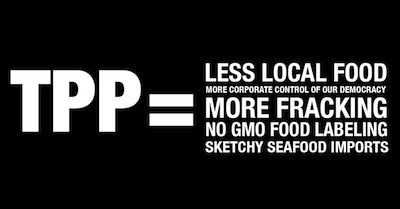
The Trans-Pacific Partnership and the Death of the Republic

TPPequals

By Ellen Brown

Source: Washington’s Blog

The United States shall guarantee to every State in this Union a Republican Form of Government.    — Article IV, Section 4, US Constitution

A republican form of government is one in which power resides in elected officials representing the citizens, and government leaders exercise power according to the rule of law. In The Federalist Papers, James Madison defined a republic as “a government which derives all its powers directly or indirectly from the great body of the people . . . .”

On April 22, 2015, the Senate Finance Committee approved a bill to fast-track the Trans-Pacific Partnership (TPP), a massive trade agreement that would override our republican form of government and hand judicial and legislative authority to a foreign three-person panel of corporate lawyers.

The secretive TPP is an agreement with Mexico, Canada, Japan, Singapore and seven other countries that affects 40% of global markets. Fast-track authority could now go to the full Senate for a vote as early as next week. Fast-track means Congress will be prohibited from amending the trade deal, which will be put to a simple up or down majority vote. Negotiating the TPP in secret and fast-tracking it through Congress is considered necessary to secure its passage, since if the public had time to review its onerous provisions, opposition would mount and defeat it.

Abdicating the Judicial Function to Corporate Lawyers

James Madison wrote in The Federalist Papers:

The accumulation of all powers, legislative, executive, and judiciary, in the same hands, . . . may justly be pronounced the very definition of tyranny. . . . “Were the power of judging joined with the legislative, the life and liberty of the subject would be exposed to arbitrary control, for the judge would then be the legislator. . . .”

And that, from what we now know of the TPP’s secret provisions, will be its dire effect.

The most controversial provision of the TPP is the Investor-State Dispute Settlement (ISDS) section, which strengthens existing ISDS  procedures. ISDS first appeared in a bilateral trade agreement in 1959. According to The Economist, ISDS gives foreign firms a special right to apply to a secretive tribunal of highly paid corporate lawyers for compensation whenever the government passes a law to do things that hurt corporate profits — such things as discouraging smoking, protecting the environment or preventing a nuclear catastrophe.

Arbitrators are paid $600-700 an hour, giving them little incentive to dismiss cases; and the secretive nature of the arbitration process and the lack of any requirement to consider precedent gives wide scope for creative judgments.

To date, the highest ISDS award has been for $2.3 billion to Occidental Oil Company against the government of Ecuador over its termination of an oil-concession contract, this although the termination was apparently legal. Still in arbitration is a demand by Vattenfall, a Swedish utility that operates two nuclear plants in Germany, for compensation of €3.7 billion ($4.7 billion) under the ISDS clause of a treaty on energy investments, after the German government decided to shut down its nuclear power industry following the Fukushima disaster in Japan in 2011.

Under the TPP, however, even larger judgments can be anticipated, since the sort of “investment” it protects includes not just “the commitment of capital or other resources” but “the expectation of gain or profit.” That means the rights of corporations in other countries extend not just to their factories and other “capital” but to the profits they expect to receive there.

In an article posted by Yves Smith, Joe Firestone poses some interesting hypotheticals:

Under the TPP, could the US government be sued and be held liable if it decided to stop issuing Treasury debt and financed deficit spending in some other way (perhaps by quantitative easing or by issuing trillion dollar coins)? Why not, since some private companies would lose profits as a result?

Under the TPP or the TTIP (the Transatlantic Trade and Investment Partnership under negotiation with the European Union), would the Federal Reserve be sued if it failed to bail out banks that were too big to fail?

Firestone notes that under the Netherlands-Czech trade agreement, the Czech Republic was sued in an investor-state dispute for failing to bail out an insolvent bank in which the complainant had an interest. The investor company was awarded $236 million in the dispute settlement. What might the damages be, asks Firestone, if the Fed decided to let the Bank of America fail, and a Saudi-based investment company decided to sue?

Abdicating the Legislative Function to Multinational Corporations

Just the threat of this sort of massive damage award could be enough to block prospective legislation. But the TPP goes further and takes on the legislative function directly, by forbidding specific forms of regulation.

Public Citizen observes that the TPP would provide big banks with a backdoor means of watering down efforts to re-regulate Wall Street, after deregulation triggered the worst financial crisis since the Great Depression:

The TPP would forbid countries from banning particularly risky financial products, such as the toxic derivatives that led to the $183 billion government bailout of AIG. It would prohibit policies to prevent banks from becoming “too big to fail,” and threaten the use of “firewalls” to prevent banks that keep our savings accounts from taking hedge-fund-style bets.

The TPP would also restrict capital controls, an essential policy tool to counter destabilizing flows of speculative money. . . . And the deal would prohibit taxes on Wall Street speculation, such as the proposed Robin Hood Tax that would generate billions of dollars’ worth of revenue for social, health, or environmental causes.

Clauses on dispute settlement in earlier free trade agreements have been invoked to challenge efforts to regulate big business. The fossil fuel industry is seeking to overturn Quebec’s ban on the ecologically destructive practice of fracking. Veolia, the French behemoth known for building a tram network to serve Israeli settlements in occupied East Jerusalem, is contesting increases in Egypt’s minimum wage. The tobacco maker Philip Morris is suing against anti-smoking initiatives in Uruguay and Australia.

The TPP would empower not just foreign manufacturers but foreign financial firms to attack financial policies in foreign tribunals, demanding taxpayer compensation for regulations that they claim frustrate their expectations and inhibit their profits.

Preempting Government Sovereignty

What is the justification for this encroachment on the sovereign rights of government? Allegedly, ISDS is necessary in order to increase foreign investment. But as noted in The Economist, investors can protect themselves by purchasing political-risk insurance. Moreover, Brazil continues to receive sizable foreign investment despite its long-standing refusal to sign any treaty with an ISDS mechanism. Other countries are beginning to follow Brazil’s lead.

In an April 22nd report from the Center for Economic and Policy Research, gains from multilateral trade liberalization were shown to be very small, equal to only about 0.014% of consumption, or about $.43 per person per month. And that assumes that any benefits are distributed uniformly across the economic spectrum. In fact, transnational corporations get the bulk of the benefits, at the expense of most of the world’s population.

Something else besides attracting investment money and encouraging foreign trade seems to be going on. The TPP would destroy our republican form of government under the rule of law, by elevating the rights of investors – also called the rights of “capital” – above the rights of the citizens.

That means that TPP is blatantly unconstitutional. But as Joe Firestone observes, neo-liberalism and corporate contributions seem to have blinded the deal’s proponents so much that they cannot see they are selling out the sovereignty of the United States to foreign and multinational corporations.

For more information and to get involved, visit:

Flush the TPP

The Citizens Trade Campaign

Public Citizen’s Global Trade Watch

Eyes on Trade

__________________

Ellen Brown is an attorney, founder of the Public Banking Institute, and author of twelve books including the best-selling Web of Debt. Her latest book, The Public Bank Solution, explores successful public banking models historically and globally. Her 300+ blog articles are at EllenBrown.com.

Baltimore and the Human Right to Resistance: Rejecting the Framework of the Oppressor

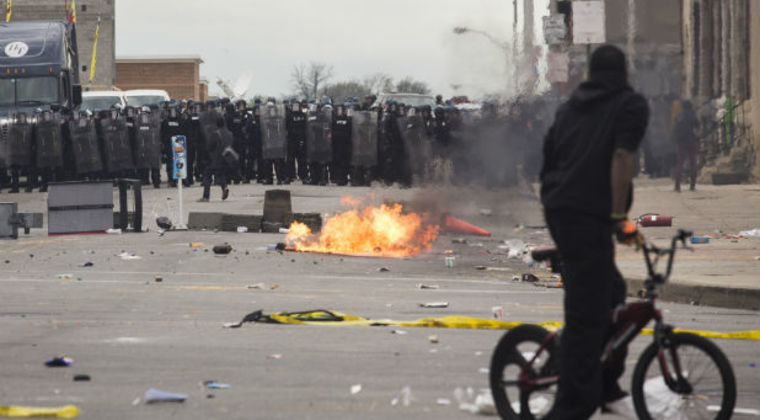
Baltimore-Riots.jpg_23790e32da49a4d09d45db82b7634b69To hear President Obama and Baltimore mayor Rawlings tell it, politeness, nonviolence and respect for law and property are the fundamental obligations of those confronting the brazen and lawless violence of police in Baltimore and beyond. This is a truly upside-down reality.

By Ajamu Baraka

Source: Black Agenda Report

Anti-Black racism, always just beneath the surface of polite racial discourse in the U.S., has exploded in reaction to the resistance of black youth to another brutal murder by the agents of this racist, settler-colonialist state. With the resistance, the focus shifted from the brutal murder of Freddie Gray and the systematic state violence that historically has been deployed to control and contain the black population in the colonized urban zones of North America, to the forms of resistance by African Americans to the trauma of ongoing state violence.

The narrative being advanced by corporate media spokespeople gives the impression that the resistance has no rational basis. The impression being established is that this is just another manifestation of the irrationality of non-European people – in particular, Black people – and how they are prone to violence. This is the classic colonial projection employed by all white supremacist settler states, from the U.S., to South Africa and Israel.

The accompanying narrative is that any kind of resistance that does not fit the narrow definition of “non-violent” resistance is illegitimate violence and, therefore, counter-productive because – “violence doesn’t accomplish anything.”  Not only does this position falsely equate resistance to oppression as being morally equivalent to the violence of the oppressor, it also attempts to erase the role of violence as being fundamental to the U.S. colonial project.

The history of colonial conquest saw the U.S. settler state shoot and murdered its’ way across the land mass of what became the U.S. in the process of stealing indigenous land to expand the racist White republic from “sea to shining sea.”  And the marginalization of the role of violence certainly does not reflect the values of the Obama administration that dutifully implements the bi-partisan dictates of the U.S. strategy of full spectrum dominance that privileges military power and oppressive violence to protect and advance U.S. global supremacy. The destruction of Libya; the reinvasion of Iraq; the civil war in Syria; Obama’s continued war in Afghanistan; the pathological assault by Israel on Palestinians in Gaza and the U.S. supported attack on Yemen by the Saudi dictatorship, are just a few of the horrific consequences of this criminal doctrine.

Race and oppressive violence has always been at the center of the racist colonial project that is the U.S. It is only when the oppressed resist — when we decide, like Malcolm X said, that we must fight for our human rights — that we are counseled  to be like Dr. King, including by war mongers like Barack Obama. However, resistance to oppression is a right that the oppressed claim for themselves. It does not matter if it is sanctioned by the oppressor state, because that state has no legitimacy.

No rational person exalts violence and the loss of life. But violence is structured into the everyday institutional practices of all oppressive societies. It is the deliberate de-humanization of the person in order to turn them into a ‘thing’ — a process Dr. King called “thing-afication.” It is a necessary process for the oppressor in order to more effectively control and exploit. Resistance, informed by the conscious understanding of the equal humanity of all people, reverses this process of de-humanization. Struggle and resistance are the highest expressions of the collective demand for people-centered human rights – human rights defined and in the service of the people and not governments and middle-class lawyers.

That resistance may look chaotic at this point – spontaneous resistance almost always looks like that. But since the internal logic of neoliberal capital is incapable of resolving the contradiction that it created, expect more repression and more resistance that will eventually take a higher form of organization and permanence. In the meantime, we are watching to see who aligns with us or the racist state.

The contradictions of the colonial/capitalist system in its current expression of neoliberalism have obstructed the creation of decent, humane societies in which all people are valued and have democratic and human rights. What we are witnessing in the U.S. is a confirmation that neoliberal capitalism has created what Chris Hedges called “sacrificial zones” in which large numbers of black and Latino people have been confined and written off as disposable by the system. It is in those zones that we find the escalation of repressive violence by the militarized police forces. And it is in those zones where the people are deciding to fight back and take control of their communities and lives.

These are defining times for all those who give verbal support to anti-racist struggles and transformative politics. For many of our young white comrades, people of color and even some black ones who were too young to have lived through the last period of intensified struggle in the 1960s and ‘70s and have not understood the centrality of African American resistance to the historical social struggles in the U.S., it may be a little disconcerting to see the emergence of resistance that is not dependent on and validated by white folks or anyone else.

The repression will continue, and so will the resistance. The fact that the resistance emerged in a so-called black city provides some complications, but those are rich and welcoming because they provide an opportunity to highlight one of the defining elements that will serve as a line of demarcation in the African American community – the issue of class.  We are going to see a vicious ideological assault by the black middle class, probably led by their champion – Barack Obama – over the next few days. Yet the events over the last year are making it more difficult for these middle-class forces to distort and confuse the issue of their class collaboration with the white supremacist capitalist/colonialist patriarchy. The battle lines are being drawn; the only question that people must ask themselves is which side they’ll be on.

Ajamu Baraka is a human rights activist, organizer, geo-political analyst and editor and contributing columnist for the Black Agenda Report. Baraka serves as the Public Intervenor for Human Rights as a member of the Green Shadow Cabinet and coordinates the International Affairs Committee of the Black Left Unity Network. He is also an Associate Fellow at the Institute for Policy Studies (IPS) in Washington, D.C.

Game Over

Political_Studies_3798278

The Jargon of Game Theory

By

Source: Soul of the East

While suffering under the information barrage wrought by mass media, a question arises in one’s mind: exactly how many words are there in the media vocabulary? For, when it comes to treatment of serious subjects like the economy and politics, the words in use are reduced to surprisingly few, so that even purported media analysis or commentary comes to resemble a mantra or nursery rhyme. Furthermore, it is notable that this “linguistic drain” occurs precisely at the moment when “serious” matters come into focus, and in spite of all the loftiness of the talking heads – our designated hierophants and media oracles – we are bombarded with rather frivolous terminology. One can only be perplexed at why, for instance, economic and political agents are called players? Why does the philosophy professor speak about the strategy of Nietzsche’s arguments? What exactly does it mean to have a cultural strategy? On what grounds does the literally critic assume that James Joyce employed a narrative strategy?

Why are all those serious things spoken about as if they were some kind of game?

On the face of it, the answer is surprisingly easy to deduce. Game or game-play jargon originates in global epistemic dominance of thought models derived from mathematical game theory. Its various abstract and complex forms (so called ‘models’ or ‘modules’), as well as their global application to all aspects of life, build the spiritual framework of our time to a significant extent, although they are rarely discussed outside of academia. However, game theory is not merely a mathematician’s plaything. If we bear in mind that the world stage – with all those global players – is also the home to all sorts of people who are well aware that they are being played, but have no idea of true nature of those playing them, then it is clear that the fundamentals of game theory should be subjected to critical scrutiny. The task is all the more urgent – and all the easier – if we bear in mind that the peculiarity of game theory, in contrast to other mathematical models, lies in the fact that it is founded on all-encompassing and simultaneously incredibly simple – one could say simple as in ‘dim witted’ – explanation of man and the world in general.

Game theory is a metaphysical doctrine, i.e. its ambition is to encompass everything, both the nature of man and the nature of universe. And there is a one special rule to every game of metaphysics, namely this: when the abstract and esoteric professional language of science is put aside, the game is potentially understandable to all parties – both those who are playing and those who are being played. It is an unspoken rule, an ancient assumption of all world-view con-games: in order for half-truth to hold sway over everybody, it must be spoken in common language. So let us examine, aided by some elementary concepts, what game theory is exactly and what it means for someone who is not a player, only played.

At its core, though, game theory is an explanatory model of decision making. It defines its subject as rational activity whose purpose is an increase in well-being of the deliberating individual or collective. Any behavior seemingly pursuing different purpose is only a roundabout way to achieve this goal more rationally, or it is simply “irrational.” Tertium non datur. Obviously, we are dealing with, broadly speaking, a “liberal” definition of man, although it is in fact the legacy of Ancient Greek Sophists. Bearing in mind that an individual is always in the midst of other individuals and that in order to achieve its goals it must collaborate or come into conflict with them, society must be rationally modelled in order to minimize conflict. That old bogeyman of political philosophy, Thomas Hobbes, conceived such a thing as possible only through the absolute sovereignty of the State, for was convinced that all those self-centered atoms were more prone to play at some iteration of Total War than that of Sims.

Proponents of game theory try to evade this fairly consistent inference of universal war or use it to prove something else: atomized individuals do not strive toward all-out conflict but towards equilibrium. The term denotes a state of conflict turned latent, in the sense of permanent threat or warning, but having ceased to be destructive; it is, in a word, a rational conflict, a war that grew cold. Namely, rational behavior is primarily strategic, i.e. it endeavors to accomplish its objective despite possible resistance by anticipating the strategies of that resistance. The healthy society is the one in which unavoidable conflicts are being channeled into relative harmony, regulated by the rules of the game, because the players realized that relative equality is more expedient than playing an ‘all or nothing’ game. Hence, game theory has a notably militaristic nature, affirmed by its history: it flourished inside military think tanks during the first years of the Cold war, only to be later unleashed on civil societies throughout the West.

The Prisoner’s Dilemma

At this level, some peculiarities are also notable. The term ‘game’ is made distinct but is not clearly defined, i.e. it is obviously artificially narrowed. For instance: since when does the game have to be competitive? Moreover, it is usually understood as a leisure activity, an escape from labor and conflict. Game by its nature doesn’t require winners and losers. It can be – and it usually is – a completely self-sufficient activity. In that sense, dances, visual and linguistic creative activities, fine or liberal arts, are all forms of playing a game. Those are all activities that, deprived of any calculated purpose outside themselves, remain autonomous and, therefore, free. However, game theory, without further clarification, presumes that games are always forms of competition implying conflict, binary division on winners and losers, elements of chance and power relations, domination and submission. So game theory is concerned with power plays. This is best illustrated in that most famous of game theory modules, the “Prisoner’s Dilemma.”

The Prisoner’s Dilemma is an imagined situation that game theoreticians apply to reality, and it has many variations with according levels of complexity. It can be described, using the so-called static model, in the following way:

Two criminals are brought to a police station for questioning. They committed the crime, but if the police fail to get the confession from one or either of them, they’ll walk. They are put in separate rooms and isolated from one another. A confession is demanded from each one. A situation develops in which the rules of the game provide them with a limited number of possible strategies: each one could or could not confess. If both confess, their pay-off is equally small, but if only one confesses, his pay-off is small, but bigger than the pay-off of his accomplice. If neither confesses, the pay-off is equally big for both of them, yet so is the risk of losing everything. Two key factors are in play: the prisoners are completely isolated from one another – they only know the game’s rules and the pay-offs by which they model their respective strategies, and each one only wants to maximize his own pay-off. The game-theory endeavor to use this module to explain real-life situations and foresee the decisions to be made by opponents (for instance, by Soviets in the Cold-War era) or to offer the best course of deliberation to its users. In the dynamic model of The Prisoner’s Dilemma, the main difference is in access to information, because players are allowed to confer before they are isolated.

A striking feature of such models must be noted. More often than not, the agents of decision-making in game theory modules are described as criminals. Sometimes they are jewel thieves, sometimes it’s a fugitive escaping the posse, and one encyclopedia’s game theory module is illustrated by the act of tossing the incapacitated opponent into precipice. It is interesting that the author uses the pronoun he for the victim while the criminal in the dilemma is denoted as she, in strict obeisance to the rules of political correctness. Bearing in mind that victimhood, imaginary or not, proves to gain a rather abundant pay-off, it seems that even the game theoretician is faced with a Prisoner’s Dilemma.

The Game Myth

This feature leads us to key weak point of game theory, i.e. its flimsy definition of rationality. Namely, the “big players”, of whose moving and shaking the media hierophants inform us unceasingly, are implicitly denounced as criminal organizations, and not by the frustrated and confused public – the notion appears incorporated into the very definition of their enterprises. Every player seeks exclusively his own maximal gain, and that which is considered to be “one’s own,” therefore rationally desirable, seemingly private, comes dangerously close to being privative. Bearing in mind that such exclusive economic players are prone to merge with their playmates in politics – which is, after all, the elementary definition of fascism – one must reach the conclusion that in the foundations of seemingly supra-private bodies, be it corporations or governments, not only private but also privative interests are embedded, and that the very process of democracy can be seen as a means of accomplishing this.

In that sense, it is no wonder that what is now called liberalism is a form of strange metaphysics. Namely, it appeals to ‘human nature’ and ‘natural rights’, but has in fact always been infected with an urge for escapism, clearly visible in so-called “state of nature” and “social contract” theories, mythical stories about a historical event that never happened in a historical age that never was, which man escaped by a decision he never made. Game theory metaphysics transforms this myth and enriches it, but it certainly doesn’t dispel it. The myth is sold, against all reason and the wealth of human imagination, as the veritable image of truth, i.e. a valid world-view, the prism through which the entire contemporary landscape is transmitted before our eyes. However, this picture, no matter how coherent and self-sufficient, is in fact rather fragile.

The persuasive power of the myth is proportional to the verity of its images of truth, while the persuasive power of the lie stems from its appellation to weaknesses of thought – to an inertia delighted with the ease of passing flippant judgment. The mythology of the rational playground falls precisely into this second category, because it assumes the pretense of a necessary and all-applicable system, thereby subverting the transcendental, robbing it of its very possibility while replacing it with a simulacrum. However, in moments of crisis – etymologically equal to moments of judgment – its frailty is all the more obvious, and its ability to maintain the illusion ever more inadequate to the task. The notion of man as a ‘selfish information processor’ is in fact a careless distortion of the classical understanding of elementary human solidarity, founded on love of one’s own transferred to another, best explained in Aristotle’s Book VIII of Nicomachean Ethics, where it is defined as ‘friendship’ (filia) in the broadest sense. The progressive concentration of power in the hands of players, at the expense of those who are played is more likely to push the losing side into the irrational decision of giving up on selfishness, of declaring: “I will not play anymore.”

Ghosts in the Machine 

We face the following eventuality: the choice of irrational decision sheds more light on a crucial system error in the definition of man and game that this pseudo-metaphysics imposes on us. The term ‘irrational’ is never really defined in the framework of game theory. And rationality fared only slightly better, though at least it can serve as a foothold for via negativa deduction of what is not irrationality. For the game theoretician, irrational behavior is not behavior at all; it is a pseudo-behavior deprived of deliberation. Bearing in mind that game theory yields a considerable pay-off in microbiology, where genes are conceived as rational players in the game of survival of the fittest, we can’t even say that irrational players are making monkeys of themselves. So how, using this sophisticated net, does one catch this elusive mutant who won’t play games, strategize, steal, or bow to political religion?

Let’s define him. This “ghost in the machine” could be someone whose moral sentiment forces him to irrationally decline profitable professions or profitable occasions, such as employing his talents in mass propaganda or advertising. Furthermore, in order to achieve his objective, perhaps writing a novel penetrating the depths of human condition, for example, he irrationally decides to always be close to death, because only then he can really reach the heart of his subject, while at the same time he knows that the pay-off will probably come after he is long gone. Is there any conceivable rational agent who can assume that he rationally planned all this? Or are all those “whistleblowers” really rational players; people who rationally decided to confront corruption, and now enjoy the pay-off by being unemployed or jailed, crucified between responsibility towards their conscience and their families?

After all, were the lines you now read calibrated for a payoff? “Irrationality” is what you were seeking the entire time.

Game theory views the irrational as its own confinement; the razor wire lining the playground fence or an unforeseen eventuality breaking the rules of game-play, its strict order. Bearing in mind that we are talking about world order – and world-encircling razor wire – the deprecation of the irrational is absolute inasmuch as the myth of the rational is absolute. Endemic, logically indescribable specimens are reduced to occasional noise in communication channels between players. Yet those endemic specimens are in fact the majority of our respectably populated planet, and so the noise grows to permeate our societies. It even begins to obstruct the tranquility of academic think tanks, and we know that devising complex and abstract logical, not to mention mathematical, models demands focus, a certain withdrawal from the world in the isolation of one’s paneled office – that parody of the monk’s cloister. Could it be that the hum of the irrational is evolving into an unpredictable, unbearable roar of chaos whose source is too powerful for even the valiant forces of campus security to subdue?

Is it only rational to predict that a creature of grand scale is much too big for nets weaved from a flimsy conceptual framework, unfit for catching even butterflies? What happens when the net breaks? Because the enemy is irrational, and therefore unthinkable. It is the great Unknown, something equal to an extraterrestrial invasion. Can the controllers’ sorcery of half-truth, half-philosophy, half-culture, and half-living keep our eyes wide shut for much longer? Among the faceless and unprepossessing shall awaken the beast of the irrational, its inner abyss suspending man between the angelic and the infernal. Game over.

See all of Branko Malic’s writings on philosophy, culture, and deep politics at Kali Tribune.