A Critical Update on the Failing Global Economy

stock-footage-hd-spinning-currency-globe-no-background-alpha-matte-at-seconds

By Phillip J. Watt

Source: The Mind Unleashed

The matrix-media will have us believe that the global economy is only experiencing a temporary glitch and that everything will be fine, however that is simply an outright lie. After several decades of saturating the world with unbacked currency and mountains of debt, the can we’ve been kicking has finally run out of road.

As you would know, stocks are plummeting across the globe and since their peak in around mid 2015, individual regions have lost 10-40% in stock value. In total, on the 20th of January the MSCI global stock market index reflected that the world’s markets had officially entered a bear market, which is 20% or more. This is just the beginning, too.

The exceptionally poor start to stocks in 2016 has somewhat been driven by ‘fears’ about China’s economic troubles, but really it is because many of the fundamentals of the global economy are extremely weak. For example, oil, which sustains the financial health of many countries and industries, has crashed over 70% in the last 2 years, whilst the Baltic Dry Index, which measures the amount of raw materials being shipped around the planet, is at a record low of 298 (to put this into context, just before the great recession of 2008 is was over 11,000).

More examples are that in early 2016, North Atlantic cargo shipping almost came to a halt and the U.S. orders in the trucking industry “for Class 8 trucks – the big rigs that haul freight on North American highways – plunged 48% from a year ago”. Furthermore, the retail sector is falling apart, with tens of thousands of job cuts and shop doors closing at an alarming rate.

For a deeper analysis of the data which scream that we’re steam-rolling towards a long over-due debt reset, which might even end in a sustained global depression such as that of the 1930′s, read “22 Signs That The Global Economic Turmoil We Have Seen So Far In 2016 Is Just The Beginning”.

OFFICIAL REPORTING IS FALSE

Given the ‘faith’ that stakeholders need to have in this economic system to keep it from imploding, the governmental data and the mainstream media cannot be truthful in what they report to the world, otherwise news of doom would be a self-fulfilling prophecy. It’s ridiculous to design an economic model in this way, yet regardless of the epic failure of Keynesian economics and the Wall Street casino, any investor who doesn’t recognize this by now is unfortunately in line for some serious financial loss.

To solidify the point, all official numbers in the U.S. and elsewhere are manipulated; shadow stats have made that abundantly clear. For example, real unemployment in the U.S. is above 20% and many of those who are actually working are in low-paying, part-time jobs.

Further to the true state of the labor market in America, many university graduates are working in hospitality or an unrelated field. Something like half of all under 25 yr olds still live with their parents or grandparents. Labor participation rates are at the lowest level in 38 years. Over 45 million people are on food subsidies and poverty and homelessness is increasing not just in America, but all around the globe.

Brazil, Canada, Russia and other countries are already in recession, amplified by the collapse of oil and commodity prices. Unofficial figures suggest the US is too. Canada in particular has seen massive inflation in food and other necessities, so it is likely that we can expect that to emerge in other countries as well.

This shit is really getting serious.

WHO IS AT FAULT?

Unfortunately, the masses don’t yet understand that most central banks around the world are private companies owned by private families i.e. the oligarchs. Essentially, this and the other banking organisations that they own is a century-old scam that robs the people of their riches.

Simply, the U.S. Government has effectively been taken over by an oligarchy, as evidenced by this Princeton University study in 2014. It’s no surprise then that this small group of so-called elites benefited from the largest transfer of wealth in human history, which happened in the 2008 GFC.

The 1%, particularly the 0.1%, economically prospered from the illegal, unethical and unprecedented bank bailouts, whilst the 99% suffered with losses in superannuation, savings, homes and employment. Many also lost their lives due to overdose, suicide and other self-abuse, which was due to their loss of livelihood and economic independence brought about by the global monetary scam.

WHAT HAPPENS NEXT?

The recovery from the GFC of 2008 never occurred, particularly for the main street economy (the real economy, not the Wall street economy). It’s happening all over again because unlike Iceland, there were no incarcerations for the fraudulent bankers and no serious revolution to the banking and finance sector.

This time though, it appears the shadow order (who have monopolized the banking and corporate sectors and effectively control western foreign and domestic policy) are not quite ready for another recessionary/depressionary round because they don’t yet have all their mechanisms in place to offer ‘the solution’ (i.e. global currency, trade agreements and governance).

They’ve got processes such as High Frequency Trading that prop up stocks by buying them back with the money they manifest from nothing (Plunge Protection Teams). They’ve been in overdrive trying to keep it afloat, but to no avail, because the real economy is drying up. As mentioned, global trade is tanking and many businesses are either going into liquidation or laying off thousands of workers each, so it’s easy to imagine that we’re going to hear about a major corporation going bust any day now.

This might just be the black swan event that ‘officially’ triggers the next crisis.

History indicates what will likely happen next: war. When a superpower and their economic hegemony is in collapse (such as the end of petrodollar and the U.S. Dollar as the world’s reserve currency), going to war can distract the populace from the true reasons of an economic crash and the associated suffering that emerges as a result. Essentially, the blame can be shifted to foreign entities.

This is why a high probability exists for a massive false flag to occur over the coming weeks/months to convince the masses to go to war with Russia, China and/or Iran. Saudi Arabia and Iran’s tensions are high right now so they might use that platform; it may in fact be orchestrated for this aim.

In the very short term, however, expect more dramatic policy measures, such as more mass money creation (QE) and even negative interest rates by the Federal Reserve (just like they’ve recently done at Japan’s central bank). They might even attempt widespread bank bail-ins, as already implemented in Italy, Portugal and Cyprus.

As explained in this Reuters article:

“so-called bail-ins typically mean wiping out creditors’ investments, slashing their value or converting them into shares in the bank. Uninsured depositors could get caught along with professional investors”.

In other words, they’re once again planning to steal the hard-earned cash of the little guy, but instead of doing it via tax-funded bail-outs as they did in 2008, they’re going to do it directly by commandeering the financial assets that people house in banks.

Yet, no matter what they do in the short term, they cannot stop the massive bubbles in debt, derivatives (over 1.5 quadrillion dollars), real estate, stocks, and bonds from inevitably popping. It might happen tomorrow or it might hold off for another year, yet regardless of the exact timing, any one of these or other triggers could easily send the global economy into a severe and sustained global depression.

Preparing accordingly, therefore, is nothing short of wise.

WHAT TO DO NEXT?

The potential for it to get seriously ugly over the coming months and years is very real, so both individually and collectively, we should be taking this very seriously.

Whatever does happen though, I do feel it will be in our collective favor. Their matrix of control is crashing; so many more people are now aware of the agenda to create a global governance, as well as the propaganda narratives they convey through the mainstream media that they either own or control.

In other words, we need to accept that all ‘official truths’ are a farce and they’ve been unarguably exposed and documented for the world to see as clear as day. Excitingly, the mainstream ‘truths’ are even beginning to be viewed by the masses as the bullshit of a pathological liar.

To prepare financially, many alternative economists recommend to exit all high risk investments such as stocks. For example, do you know where your superannuation is invested? There will no doubt be massive swings in stocks in the coming weeks, but the risk is high that they will continue to decrease at the least, and dramatically crash at the worst.

Also, to prepare physically, have you secured food and water insurance? Just like we get insurance for our health, car, home contents etc., in these times we should do the same with our basic necessities. I’m sure those in Canada are wishing they stocked up on essential goods because now they’re spending all their hard earned cash on just surviving.

For a deeper discussion on how to prepare, read “70 Tips That Will Help You Survive What Is About To Happen To America”.

FINAL THOUGHTS

These are exciting times because the western world is waking up to the lies and deceptions they’ve been force-fed (much of it is of course common knowledge in places like Russia and parts of Europe etc.). The mainstream narrative in every way you could possibly imagine is a complete fabrication to elicit your consent, especially for war. Yet, even though all of this is driving the awakening needed for humanity’s evolution, there are real risks for all of us.

Organizing our lives in as many self-sufficient ways as possible is simply being street smart. Arming ourselves with the right information is not just for the benefit of ourselves, but our family, friends and community as a whole. And of course, don’t feed the fear machine; we’re electro-magnetic beings in an electro-magnetic universe and how we think and feel does ripple out into the waters.

Make sure it’s worthy energy.

And remember, the banking sector is the head of the snake. This is the fundamental control mechanism of the powers-that-will-no-longer-be that we need to disassemble, because everything else of importance will naturally follow suit. For further information on how to create a better world for our personal future, as well as the future of humanity, see the articles linked below.

ABOUT THE AUTHOR

Phillip J. Watt lives in Australia. His written work deals with topics from ideology to society, as well as self-development. Follow him on Facebook or visit his website.

FURTHER READING

http://themindunleashed.org/2015/08/we-are-the-people-weve-been-waiting-for.html

http://themindunleashed.org/2015/08/this-is-how-to-create-true-freedom-for-humanity.html

http://themindunleashed.org/2015/10/whilst-the-old-system-crashes-a-new-one-is-being-built.html

http://themindunleashed.org/2016/01/how-to-say-no-to-war-with-ken-okeefe-2.html

http://themindunleashed.org/2016/01/12-methods-to-unplug-from-the-matrix.html

http://themindunleashed.org/2015/12/the-risks-for-2016-economic-collapse-more-false-flags-and-wwiii.html

http://themindunleashed.org/2015/12/information-that-society-needs-to-wake-the-fuk-up.html

http://themindunleashed.org/2015/09/the-dirty-secret-about-money-that-is-finally-being-exposed-to-the-masses.html

http://themindunleashed.org/2015/11/why-do-we-allow-private-families-to-control-the-worlds-money.html

Financial turmoil and increasing risks of a severe worldwide economic recession in 2016-17

images

By Rodrigue Tremblay

Source: Dissident Voice

“May you live in interesting times.”—Popular curse, purported to be a translation of a traditional Chinese curse

“The sources of deflation are not a mystery. Deflation is in almost all cases a side effect of a collapse of aggregate demand—a drop in spending so severe that producers must cut prices on an ongoing basis in order to find buyers. Likewise, the economic effects of a deflationary episode, for the most part, are similar to those of any other sharp decline in aggregate spending—namely, recession, rising unemployment, and financial stress.”—Ben S. Bernanke (1953- ), on November 21, 2002

“I’m about to repeat what I said at this time last year and the year before . . . Sooner or later a crash is coming and it may be terrific. The vicious circle will get in full swing and the result will be a serious business depression. There may be a stampede for selling which will exceed anything that the Stock Exchange has ever witnessed. Wise are those investors who now get out of debt.”—Roger Babson (1875-1967), on September 5, 1929

The onset of 2016 has been most chaotic for global financial markets with, so far, a severe stock market correction. As a matter of fact, the first month of 2016 has witnessed the most severe drop in financial stocks ever, with the MSCI All-Country World Stock Index, which measures major developed and emerging stock markets, dropping more than 20 percent, as compared to early 2015. For sure, there will be oversold rallies in the coming weeks and months, but one can expect more trouble ahead.

Many commentators are saying that the epicentre of this unfolding financial and economic crisis is in China, with the Shanghai Composite Index beginning to plummet at the beginning of the year. In my view, reality is more complex and even though China’s financial and economic problems are contributing to the collapse in commodity prices, the epicenter of the crisis is still in Washington D.C.

That is because the current unfolding crisis is essentially a continuation of the 2007-08 financial crisis which has been temporarily suspended and pushed into the future by the U.S. central bank, the Fed, with its aggressive and unorthodox monetary policy of multiple rounds of quantitative easing (QE), i.e., buying huge quantities of financial assets from commercial mega-banks and other institutions, including mortgage-backed securities, with newly created money. As a consequence, the Fed’s balance sheet went from a little more than one trillion dollars in 2008 to some four and a half trillion dollars when the quantitative easing program was ended in October 2014. Other central banks have followed the Fed example, especially the central bank of Japan and the European central bank, which also adopted quantitative easing policies in monetizing large amounts of financial assets.

Why did the Bernanke Fed adopt such an aggressive monetary policy in 2008? Essentially for three reasons: First, the lame-duck Bush administration in 2008 was clueless about what to do with the financial crisis that had started with the de facto failure of Bear Stearns in the spring of 2008 and of Merrill Lynch in early September 2008, culminating on September 15, 2008, with the failure of the large global investment bank of Lehman Brothers. So the U.S. central bank felt that it had to step in. In fact, it financed the merger of the two first failed mega-banks with the JPMorgan Chase bank and the Bank of America respectively. (For different reasons, it did not intervene in the same way when the Lehman Brothers bank failed.)

Secondly, bankers who have a huge influence in the way the Fed is managed did not want the U.S. government to nationalize the American mega-banks in financial difficulties, as it had done in 1989 when the George H.W. Bush administration established the government-owned Resolution Trust Corporation (RTC) to take over some 747 insolvent savings and loans thrift banks.

Thirdly, the Bernanke Fed was very worried that the 2007-08 banking crisis would lead to a Japanese-style deflation that would wreak havoc with an overleveraged economy. The hope was to avoid a devastating debt-deflation economic depression like the one suffered in the 1930s.

By injecting so much liquidity in the system, the Bernanke Fed created a gigantic financial bubble in stocks and bonds, even though the real economy has grown at a somewhat languishing 2 percent growth rate. Stock prices went into the stratosphere while interest rates fell as bond prices rose. Last December 16, the Fed announced officially that it will no longer blow into the financial balloons and that it was raising short-term interest rates for the first time since the financial crisis, setting the target range for the federal funds rate to between 1/4 to 1/2 percent. This was a signal that the financial party was over. And what’s more, this means that the stock market and the bond market will once again go in different directions, as a reflection of the state of the real economy, no matter what the Fed does.

Since 2008, the U.S. Fed has painted itself into a financial corner from which I personally felt it would be difficult to extricate itself. Indeed, it would be extremely difficult to correct the financial bubbles it has created—as an unintended consequence of salvaging the mega-banks in creating trillions of free money—without damaging the real economy of production and employment. If global stock markets collapse and if price deflation accelerates, making it more difficult to service the debt of consumers, corporations, and government alike, a repeat on a larger scale of what has happened in Japan over the last twenty-five years can be feared. This, at the very least, could lead to a global economic recession in 2016-17. If we go back in history, it could also be a repeat of the 1937-38 crash and recession, eight years after the crash and financial crisis of 1929-32.

One thing can be made clear: The creation of the Fed in 1913, as a semi-public American central bank, has not prevented the occurrence of financial crises. It has, however, been a boon to large banks because it has served as an instrument to socialize their losses.

Stay tuned.


Dr. Rodrigue Tremblay is an international economist and author, whose last two books are The Code for Global Ethics, Prometheus Books, 2010; and The New American Empire, Infinity Publishing, 2003. He can be reached at: rodrigue.tremblay@yahoo.com.


Forget Techno-Optimism: We Can’t Innovate Our Way Out of Inequality

thediplomat_2015-07-10_09-53-42-386x255

By Chris Lehmann

Source: In These Times

Toward the end of his 250-page hymn to digital-age innovation, The Industries of the Future, Alec Ross pauses to offer a rare cautionary note. Silicon Valley may have incubated all the wonders and conveniences one can imagine—and oh, so many more! But for the international business elites looking to remake their emerging market economies in the Valley’s gleaming, khaki-clad image, there’s some bad news: It can no longer be done. A “decades-long head start” has granted too great a competitive advantage to the charmed peninsula along the Northern California coast.

Not to worry, though! On-the-make tech globalists can still make a go of it, provided they’re prepared to embrace “specific cultural and labor market characteristics that can contradict both a society’s norms and the more controlling impulses of government leaders.”

Stripped of the vague and glowing techno-babble, this is a prescription for good old-fashioned neoliberal market discipline. Everywhere Ross looks across the radically transformed world of digital commerce, the benign logic of market triumphalism wins the day. When Terry Gou—the Taiwanese CEO of Foxconn, the vast Chinese electronics sweatshop that doubles as an incubator for worker suicides—plans to eliminate the headache of supervising an unstable human workforce by replacing it with “the first fully automated plant” in manufacturing history, why, he’s simply “responding to pure market forces”: i.e., an increase in Chinese wages that cuts into Foxconn’s ridiculously broad profit margins. And you and I might see the so-called sharing economy as a means to casualize service workers into nonunion, benefit-free gigs that transfer economic value on a massive scale to a rentier class of Silicon Valley app marketers. But bouncy New Economy cheerleaders like Ross see “a way of making a market out of anything, and a microentrepreneur out of anyone.”

When confronted with the spiraling of income inequality in the digital age, Ross, like countless other prophets of better living through software, sagely counsels that “rapid progress often comes with greater instability.” Sure, the “wealthy generally benefit over the short term,” but remember, kids: “Innovations have the potential to become cheaper over time and spread throughout the greater population.”

Ross first stormed into political prominence as an architect of Barack Obama’s “technology and innovation plan” during his 2008 presidential campaign, and he has spent four years captaining his own charmed, closed circle of tech triumphalism as the White House’s “senior advisor for innovation” under Secretary of State Hillary Clinton. This renders The Industries of the Future something more than another breathless, Tom Friedman-style tour of the wonderments being hatched in startups, trade confabs and gadget factories. Ross’ book is also a tech-policy playbook for the likely Democratic presidential nominee, who has spared no effort in soliciting the policy input—and landing the campaign donations—of the Silicon Valley mogul set. As such, it should give any Hillary-curious supporter of economic justice considerable pause.

To be sure, Ross raises some vague concerns about how, for example, the runaway growth of the sharing economy drains workers of job security, healthcare benefits, pensions and the like. He avers that “as the sharing economy grows … the safety net needs to grow with it,” but, much like his politically savvy boss, he offers nothing in the way of policy specifics besides the inarguable yet unactionable truism that if the sharing economy “generates enormous amounts of wealth for the platform owners, then the platform owners can and should help pay for added costs to society.”

The larger point for Ross, in any event, is that the innovative megafirms of tomorrow will come to spontaneously serve the public good. Not to mention that many IPO investors “are pension funds,” Ross coos, which “manage the retirement funds for people in the working class like teachers, police officers, and other civil servants.” Never mind, of course, that the neoliberal logic of the Uber model means that we’re creating a workforce that’s unlikely ever to come within shouting distance of a pension benefit again.

This kind of terminal Silicon Valley myopia also accounts for the vast economic and political blindspots that continually undermine Ross’ relentlessly chipper TED patter. To take just one instructive instance, in a book that devotes considerable real estate to the innovations of “fintech” (the streamlining of global digital currency exchanges and investment transactions) nowhere does the author acknowledge the pivotal role that tech-savvy Wall Street analysts—the “quants” as they’re known in Street argot—played in stoking the early-aughts housing bubble that led to the near-meltdown of the global economy.

That’s because it’s an axiomatic faith for this brand of techno-prophecy that innovation can never actually make anything worse—in just the same fashion that the quants were insisting, right up until the end, that there could never be a downturn in the national housing market. If this is the kind of wisdom Hillary Clinton relied on to promote her global innovation agenda at the State Department, one shudders to think of how it might run riot through the White House come next January.

Related Video:

Hang onto your wallets: Negative interest, the war on cash, and the $10 trillion bail-in

global-economic-crisis

By Ellen Brown

Source: Intrepid Report

Remember those old ads showing a senior couple lounging on a warm beach, captioned “Let your money work for you”? Or the scene in Mary Poppins where young Michael is being advised to put his tuppence in the bank, so that it can compound into “all manner of private enterprise,” including “bonds, chattels, dividends, shares, shipyards, amalgamations . . .”?

That may still work if you’re a Wall Street banker, but if you’re an ordinary saver with your money in the bank, you may soon be paying the bank to hold your funds rather than the reverse.

Four European central banks—the European Central Bank, the Swiss National Bank, Sweden’s Riksbank, and Denmark’s Nationalbank—have now imposed negative interest rates on the reserves they hold for commercial banks; and discussion has turned to whether it’s time to pass those costs on to consumers. The Bank of Japan and the Federal Reserve are still at ZIRP (Zero Interest Rate Policy), but several Fed officials have also begun calling for NIRP (negative rates) [update: Bank of Japan implemented a negative interest rate 1/29/16].

The stated justification for this move is to stimulate “demand” by forcing consumers to withdraw their money and go shopping with it. When an economy is struggling, it is standard practice for a central bank to cut interest rates, making saving less attractive. This is supposed to boost spending and kick-start an economic recovery.

That is the theory, but central banks have already pushed the prime rate to zero, and still their economies are languishing. To the uninitiated observer, that means the theory is wrong and needs to be scrapped. But not to our intrepid central bankers, who are now experimenting with pushing rates below zero.

Locking the door to bank runs: The cashless society

The problem with imposing negative interest on savers, as explained in the UK Telegraph, is that “there’s a limit, what economists called the ‘zero lower bound.’ Cut rates too deeply, and savers would end up facing negative returns. In that case, this could encourage people to take their savings out of the bank and hoard them in cash. This could slow, rather than boost, the economy.”

Again, to the ordinary observer, this would seem to signal that negative interest rates won’t work and the approach needs to be abandoned. But not to our undaunted central bankers, who have chosen instead to plug this hole in their leaky theory by moving to eliminate cash as an option. If your only choice is to keep your money in a digital account in a bank and spend it with a bank card or credit card or checks, negative interest can be imposed with impunity. This is already happening in Sweden, and other countries are close behind. As reported on Wolfstreet.com:

The War on Cash is advancing on all fronts. One region that has hogged the headlines with its war against physical currency is Scandinavia. Sweden became the first country to enlist its own citizens as largely willing guinea pigs in a dystopian economic experiment: negative interest rates in a cashless society. As Credit Suisse reports, no matter where you go or what you want to purchase, you will find a small ubiquitous sign saying “Vi hanterar ej kontanter” (“We don’t accept cash”) . . .

The lesson of Gesell’s decaying currency

Whether negative interests will actually stimulate an economic recovery, however, remains in doubt. Proponents of the theory cite Silvio Gesell and the Wörgl experiment of the 1930s. As explained by Charles Eisenstein in Sacred Economics:

The pioneering theoretician of negative-interest money was the German-Argentinean businessman Silvio Gesell, who called it “free-money” (Freigeld). . . . The system he proposed in his 1906 masterwork, The Natural Economic Order, was to use paper currency to which a stamp costing a small fraction of the note’s value had to be affixed periodically. This effectively attached a maintenance cost to monetary wealth.

. . . [In 1932], the depressed town of Wörgl, Austria, issued its own stamp scrip inspired by Gesell. . . . The Wörgl currency was by all accounts a huge success. Roads were paved, bridges built, and back taxes were paid. The unemployment rate plummeted and the economy thrived, attracting the attention of nearby towns. Mayors and officials from all over the world began to visit Wörgl until, as in Germany, the central government abolished the Wörgl currency and the town slipped back into depression.

. . . [T]he Wörgl currency bore a demurrage rate [a maintenance charge for carrying money] of 1 percent per month. Contemporary accounts attributed to this the very rapid velocity of the currencies’ circulation. Instead of generating interest and growing, accumulation of wealth became a burden, much like possessions are a burden to the nomadic hunter-gatherer. As theorized by Gesell, money afflicted with loss-inducing properties ceased to be preferred over any other commodity as a store of value.

There is a critical difference, however, between the Wörgl currency and the modern-day central bankers’ negative interest scheme. The Wörgl government first issued its new “free money,” getting it into the local economy and increasing purchasing power, before taxing a portion of it back. And the proceeds of the stamp tax went to the city, to be used for the benefit of the taxpayers. As Eisenstein observes:

It is impossible to prove . . . that the rejuvenating effects of these currencies came from demurrage and not from the increase in the money supply. . . .

Today’s central bankers are proposing to tax existing money, diminishing spending power without first building it up. And the interest will go to private bankers, not to the local government.

Consumers today already have very little discretionary money. Imposing negative interest without first adding new money into the economy means they will have even less money to spend. This would be more likely to prompt them to save their scarce funds than to go on a shopping spree.

People are not keeping their money in the bank today for the interest (which is already nearly non-existent). It is for the convenience of writing checks, issuing bank cards, and storing their money in a “safe” place. They would no doubt be willing to pay a modest negative interest for that convenience; but if the fee got too high, they might pull their money out and save it elsewhere. The fee itself, however, would not drive them to buy things they did not otherwise need.

Is there a bigger threat than a sluggish economy?

The scheme to impose negative interest and eliminate cash seems so unlikely to stimulate the economy that one wonders if that is the real motive. Stopping tax evaders and terrorists (real or presumed) are other proposed justifications for going cashless. Economist Martin Armstrong goes further and suggests that the goal is to gain totalitarian control over our money. In a cashless society, our savings can be taxed away by the banks; the threat of bank runs by worried savers can be eliminated; and the too-big-to-fail banks can be assured that ample deposits will be there when they need to confiscate them through bail-ins to stay afloat.

And that may be the real threat on the horizon: a major derivatives default that hits the largest banks, those that do the vast majority of derivatives trading. On November 10, 2015, the Wall Street Journal reported the results of a study requested by Senator Elizabeth Warren and Rep. Elijah Cummings, involving the cost to taxpayers of the rollback of the Dodd-Frank Act in the “cromnibus” spending bill last December. As Jessica Desvarieux put it on the Real News Network, “the rule reversal allows banks to keep $10 trillion in swaps trades on their books, which taxpayers could be on the hook for if the banks need another bailout.”

The promise of Dodd-Frank, however, was that there would be “no more taxpayer bailouts.” Instead, insolvent systemically-risky banks were supposed to “bail in” (confiscate) the money of their creditors, including their depositors (the largest class of creditor of any bank). That could explain the push to go cashless. By quietly eliminating the possibility of cash withdrawals, the central bank can make sure the deposits are there to be grabbed when disaster strikes.

If central bankers are seriously trying to stimulate the economy with negative interest rates, they need to repeat the Wörgl experiment in full. They need to first get some new money into the economy, money that goes directly to the consumers and local businessmen who will spend it. This could be achieved in a number of ways: with a national dividend; or by using quantitative easing for infrastructure or low-interest loans to states; or by funding free tuition for higher education. Consumers will hit the malls when they have some new discretionary income to spend.

Ellen Brown is an attorney, founder of the Public Banking Institute, and author of twelve books including the best-selling Web of Debt. Her latest book, The Public Bank Solution, explores successful public banking models historically and globally. Her 300+ blog articles are at EllenBrown.com. Listen to “It’s Our Money with Ellen Brown” on PRN.FM.

Is This China & USA’s “Thelma & Louise” Moment?

thelma-and-louise

By James Howard Kunstler

Source: Zero Hedge

Why would anybody suppose that the Peoples Bank of China might want to tell the truth about anything that was within their power to lie about? Especially the soundness of any loan portfolio vested unto the grasp of its tentacles? Of course, most of what China has done in speeding toward the wall of financial crack-up, it learned from watching US bankers slime their way into Too Big To Fail nirvana — most particularly the array of swindles, dodges, and frauds constructed in the half-light of shadow banking to hedge the sudden, catastrophic appearance of reality-based price discovery.

When so many loans end up networked as collateral in some kind of bet against previous bets against other previous bets, you can be sure that cascading contagion will follow. And so that is exactly what’s happening as China’s rocket ride into Modernity falls back to earth. Like most historical fiascos, it seemed like a good idea at the time: take a nation of about a billion people living in the equivalent of the Twelfth Century, introduce the magic of money printing, spend a gazillion of it on CAT and Kubota earth-moving machines, build the biggest cement industry the world has ever seen, purchase whole factory set-ups, and flood the rest of the world with stuff. Then the trouble starts when you try to defeat the business cycles associated with over-production and saturated markets.

Poor China and poor us. Escape velocity has failed. Which raises the question: escape from what, exactly? Answer: the implacable limits of life on earth. The metaphor for all this, of course, is the old journey-into-space idea, which still persists in the salesmanship of Elon Musk, the ragged remnants of NASA, and even the nightmares of Stephen Hawking. Get off this messed-up home planet and light out of the territories, say Mars. Of course, this is a vain and stupid idea, since we already have a planet engineered to perfection for all the life systems associated with the human project. We just can’t respect its limits.

So now, that dynamic duo, Nature and Reality, the actual owners of the planet, have showed up to read the riot act to the renters throwing a wild party. The fourth and perhaps ultimate financial crisis of the last twenty years begins to express itself in terms that only the raptors and vultures can see from on high. George Soros, Kyle Bass, and the other flocking shadow banking scavengers prepare to short the living shit out of the old Middle Kingdom. The immortal words of G.W. Bush ring in their ears: This sucker is going down,” and they are sure to win big by betting on the obvious. Trouble is, this sucker could go down so much further than they imagined, that whatever fortunes they gain from its descent will be foiled by the destruction of the very economic system needed for them to enjoy their gains.

For instance, when banking systems go down, governments usually follow, and when governments go down, societies often unravel. It doesn’t take a great effort of imagination to see China’s one party politburo leadership machine lose the respect of its governed masses, and then its control of events, followed by a Great Struggle among the regions and factions to restore some kind of order. And when the smoke clears there will a whole lot of nearly worthless concrete and steel, and a vast loss of notional wealth, and China will be lucky to land back in some approximation of the Twelfth Century.

It must be interesting for China to watch the horrifying disintegration of America’s political party structure currently on view, with the mad bull called Trump rampaging across the land and the designated inevitable Mz It’s-My-Turn hijacking her collective for the greater glory of Goldman Sachs. The last time China got the vapors politically — the so-called Cultural Revolution of the 1960s — the country went batshit crazy. Surely some of the ruling party remembers that with requisite terror.

Or maybe this is China and the USA’s Thelma and Louise moment. Pedal to the metal, they drive into the abyss of history holding hands. Remember, audiences loved that!

The West Is Reduced To Looting Itself

wPGF1

By Paul Craig Roberts

Source: PaulCraigRoberts.org

I, Michael Hudson, John Perkins, and a few others have reported the multi-pronged looting of peoples by Western economic institutions, principally the big New York Banks with the aid of the International Monetary Fund (IMF).

Third World countries were and are looted by being inticed into development plans for electrification or some such purpose. The gullible and trusting governments are told that they can make their countries rich by taking out foreign loans to implement a Western-presented development plan, with the result being sufficient tax revenues from economic development to service the foreign loan.

Seldom, if ever, does this happen. What happens is that the plan results in the country becoming indebted to the limit and beyond of its foreign currency earnings. When the country is unable to service the development loan, the creditors send the IMF to tell the indebted government that the IMF will protect the government’s credit rating by lending it the money to pay its bank creditors. However, the conditions are that the government take necessary austerity measures so that the government can repay the IMF. These measures are to curtail public services and the government sector, reduce public pensions, and sell national resources to foreigners. The money saved by reduced social benefits and raised by selling off the country’s assets to foreigners serves to repay the IMF.

This is the way the West has historically looted Third World countries. If a country’s president is reluctant to enter into such a deal, he is simply paid bribes, as the Greek governments were, to go along with the looting of the country the president pretends to represent.

When this method of looting became exhausted, the West bought up agricultural lands and pushed a policy on Third World countries of abandoning food self-sufficiency and producing one or two crops for export earnings. This policy makes Third World populations dependent on food imports from the West. Typically the export earnings are drained off by corrupt governments or by foreign purchasers who pay little while the foreigners selling food charge much. Thus, self-sufficiency is transformed into indebtedness.

With the entire Third World now exploited to the limits possible, the West has turned to looting its own. Ireland has been looted, and the looting of Greece and Portugal is so severe that it has forced large numbers of young women into prostitution. But this doesn’t bother the Western conscience.

Previously, when a sovereign country found itself with more debt than could be serviced, creditors had to write down the debt to an amount that the country could service. In the 21st century, as I relate in my book, The Failure of Laissez Faire Capitalism, this traditional rule was abandoned.

The new rule is that the people of a country, even a country whose top offiials accepted bribes in order to indebt the country to foreigners, must have their pensions, employment, and social services slashed and valuable national resources such as municipal water systems, ports, the national lottery, and protected national lands, such as the protected Greek islands, sold to foreigners, who have the freedom to raise water prices, deny the Greek government the revenues from the national lottery, and sell the protected national heritage of Greece to real estate developers.

What has happened to Greece and Portugal is underway in Spain and Italy. The peoples are powerless because their governments do not represent them. Not only are their governments receiving bribes, the members of the governments are brainwashed that their countries must be in the European Union. Otherwise, they are bypassed by history. The oppressed and suffering peoples themselves are brainwashed in the same way. For example, in Greece the government elected to prevent the looting of Greece was powerless, because the Greek people are brainwashed that no matter the cost to them, they must be in the EU.

The combination of propaganda, financial power, stupidity and bribes means that there is no hope for European peoples.

The same is true in the United States, Canada, Australia, and the UK. In the US tens of millions of US citizens have quietly accepted the absence of any interest income on their savings for seven years. Instead of raising questions and protesting, Americans have accepted without thought the propaganda that their existence depends upon the success of a handful of artificially created mega-banks that are “too big to fail.” Millions of Americans are convinced that it is better for them to draw down their savings than for a corrupt bank to fail.

To keep Western peoples confused about the real threat that they face, the people are told that there are terrorists behind every tree, every passport, under every bed, and that all will be killed unless the government’s overarching power is unquestioned. So far this has worked perfectly, with one false flag after another reinforcing the faked terror attacks that serve to prevent any awareness that this a hoax for accumulating all income and wealth in a few hands.

Not content with their supremacy over “democratic peoples,” the One Percent has come forward with the Trans-Atlanta and Trans-Pacific partnerships. Allegedly these are “free trade deals” that will benefit everyone. In truth, these are carefully hidden, secret, deals that give private businesses control over the laws of sovereign governments.

For example, it has come to light that under the Trans-Atlantic partnership the National Health Service in the UK could be ruled in the private tribunals set up under the partnership as an impediment to private medical insurance and sued for damages by private firms and even forced into abolishment.

The corrupt UK government under Washington’s vassal David Cameron has blocked access to legal documents that show the impact of the Trans-Atlantic partnership on Britain’s National Health Service. http://www.globalresearch.ca/cameron-desperate-to-stop-scandal-as-secret-plans-to-sell-the-national-health-service-are-discovered/5504306

For any citizen of any Western country who is so stupid or brainwashed as not to have caught on, the entire thrust of “their” government’s policy is to turn every aspect of their lives over to grasping private interests.

In the UK the postal service was sold at a nominal price to politically connected private interests. In the US the Republicans, and perhaps the Democrats, intend to privatize Medicare and Social Security, just as they have privatized many aspects of the military and the prison system. Public functions are targets for private profit-making.

One of the reasons for the escalation in the cost of the US military budget is its privatization. The privatization of the US prison system has resulted in huge numbers of innocent people being sent to prison, where they are forced to work for Apple Computer, IT services, clothing companies that manufacture for the US military, and a large number of other private businesses. The prison laborers are paid as low as 69 cents per hour, below the Chinese wage.

This is America today. Corrupt police. Corrupt prosecutors. Corrupt judges. But maximum profits for US Capitalism from prison labor. Free market economists glorified private prisons, alleging that they would be more efficient. And indeed they are efficient in providing the profits of slave labor for capitalists.

Here is a news report on UK Prime Minister Cameron denying information about the effect of the Trans-Atlantic partnership on Britains’ National Health.
http://www.theguardian.com/business/2016/jan/26/anger-government-blocks-ttip-legal-documents-nhs-health-service

The UK Guardian, which often has to prostitute itself in order to maintain a bit of independence, describes the anger that the British people feel toward the government’s secrecy about an issue so fundamental to the well being of the British people. Yet, the British continue to vote for political parties that have betrayed the British people.

All over Europe, the corrupt Washington-contolled governments have distracted people from their sellout by “their” governments by focusing their attention on immigrants, whose presence is a consequence of the European governments representing Washington’s interests and not the interest of their own peoples.

Somthing dire has happened to the intelligence and awareness of Western peoples who seem no longer capable of comprehending the machinations of “their” governments.

Accountable government in the West is history. Nothing but failure and collapse awaits Western civilization.

Global House Price Crash Led by Major Cities And Rapid Exit Of Investors

property-market-crash-investwithalex

By Graham Vanbergen

Source: TruePublica

The global house price crash is being led by the most important cities in the world and where they are not falling yet, they soon will be.

The fault lies directly in the lap of central banks as quantitative easing caused an enormous injection of cash into economies, forcing interest rates to fall the their lowest levels in history. This knee-jerk over-reaction effectively halted price corrections that should have fully unfolded but didn’t and put rocket boosters under house price inflation the world over.

With banks and their financial services operations now seen by the public as nothing more than criminal gangs operating with impunity, both legally saved money and laundered cash needed a safe haven. Normal people know nothing about derivatives, day-trading and the like. Property is something most people know something about. Criminals just want to harbour ill gotten gains.

With institutional investors, individuals looking to boost pension incomes, criminals with global reach and an aspirational general public all combined, mountains of cash found their way into property. The international property bubble inflated as the market uncoupled from both the economy and reality.

In Britain, a blinkered Chancellor, unable to see the obvious, supported naive first time buyers in various ways all at the expense of the taxpayer in the hope of winning votes in his 2020 bid. By then the housing market in Britain will have crashed and all his first time buyer voters will be in negative equity for another decade.

It now takes an average skilled worker 14 years to buy a 600q ft one bed apartment in London, the equivalent of renting it for 30 years. What could go wrong?

Sales in London have now dropped by a quarter, prices are already deflating with some commentators blaming new stamp duty/taxation rules imposed for April this year. This is just another reason for the impending decline soon to engulf London and then ripple out to the rest of the country. The average price of a property in Britain is 300 per cent higher today than 20 years ago and that includes the biggest financial crash since the Great Depression.

Hong Kong is experiencing property price falls with most commentators expecting declines of 20 per cent, some at 30 per cent and a few at 40 per cent. The government backed builders to construct rented property to ease the ridiculous prices required to buy an apartment. It took ten years and now rental prices have fallen back just as property investment has taken a nosedive.

In Sydney there’s been a total collapse of business investment and corresponding increase in property investment as Australians got on the ‘get-rich-quick’ bandwagon. Prices are now falling at around 1.5 per cent a month. Not much you might think but by mid 2016, prices could easily be off 12 per cent with no indication of the bottom.

So over-stretched are they in Vancouver it is estimated that a normal price correction of 20 per cent would completely wipe out ten per cent of homeowners. Not surprising as house prices there are by some estimates now 30 per cent overvalued.

America’s most important housing market, San Fransico is about the feel the big house price chill after its epic over-heating. It managed an eye-watering 103 per cent increase in some plush areas in just four years. Affordability has tanked and only the top 10 per cent of earners in the city can now afford to own a home there. If prices fall back to 2008 levels, the 60 to 70 per cent average increase in prices since then could dive with catastrophic consequences.

In The Netherlands just 7 per cent of properties sell for more than the asking price – about the norm for the country. In Amsterdam that figure is about 60 per cent. Housing stock has vaporised and prices today have shot past the 2008 peak. These are the ominous signs of a price correction. Amsterdam may continue to rise for a short while but soon the party will be over.

In Geneva, Switzerland 90 per cent of all household debt is mortgaged. Since 2008, property prices have increased what some might say is a modest 24.3 per cent. Price falls are expected for several reasons; the imposition of a countercyclical capital buffer (CCB) to prevent the real estate market from further overheating, other stricter (mortgage) lending controls and a squeeze on immigration which was causing house price inflation. Switzerland’s mortgage market is 140 per cent of GDP. Expectations are that prices will deflate more slowly, but deflate they will.

The French property market had the dubious distinction of being the most overvalued in Europe in 2011. Even the OECD gave a stern warning that Paris was about to implode – it probably knew best as that is where it’s office are located. Property prices in Paris rose 278 per cent in eleven years to 2011 with two well known French economists predicting steady house price falls for the next ten years totalling 35 per cent to 2025 and a best case scenario of falls until 2020.

What all this says now is obvious. The financial crash in 2008 was caused by reckless banks deliberately overextending mortgage lending that led to the public speculating in the property market. Central banks then pumped trillions of dollars, euros and pounds into the market in order to save the banks. It saved them in part by deliberately inflating property prices.

Investors are now getting out of the game. They know the QE scam is over. As ZeroHedge reportsHow Billionaires Are Investing In 2016: “The Only Winning Move Is Not To Play The Game“. Here they report that the rich and powerful have ended their investment strategies; the only way now is to hold cash, duck and see what happens as the global markets in all asset classes unravel. It confirms what is being said here; that all this ‘funny money’ has created growing distortions in nearly all asset prices—from stocks to bonds to real estate.

The UBS global real estate bubble index for 2016 makes for sobering reading, predicting falls in 10 major cities this year. Fortune reports that the “world is headed for disaster, and will take the prices of equities down with it. How much? Edwards predicts the U.S. stock market could plunge as much as 75%. That would be worse than during the financial crisis, in which stocks from their peak to trough dropped a brutal 62%.”

Even the Oracle of Omaha, Warren Buffet has got this all wrong as his stock is heading south and about to enter ‘bear’ territory.

Bloomberg agrees: “Fed Up Investors Yank Cash From Almost Everything Just Like 2008“.

And what they mean by everything is not just stocks and bonds. The FTGlobal property bubble fears mount as prices and yields spike”. Here the FT reports that returns for rental income (globally) has collapsed when a crash in massively overleveraged property triggered the 2008 international banking crash. Time to get out.

Everyone got into property because prices were expected to beat bond prices, and they did.

When the worlds biggest, wealthiest and most powerful start losing their shirts they rapidly divest to save the proverbial bacon. Result? Asset prices fall and house prices with it. The global house price crash is on and coming to a town near you.

When Collapse Is Cheaper and More Effective Than Reform

a-falling-house-of-cards

By Charles Hugh Smith

Source: Of Two Minds

Collapse begins when real reform becomes impossible.

We all know why reforms fail: everyone whose share of the power and money is being crimped by reforms fights back with everything they’ve got.

Reforms that can’t be stopped by the outright purchase of politicos are watered down in committee, and loopholes wide enough for jumbo-jets of cash to fly through are inserted.

The reform quickly becomes “reform”–a simulacrum that maintains the facade of fixing what’s broken while maintaining the Status Quo. Another layer of costly bureaucracy is added, along with hundreds or thousands of pages of additional regulations, all of which add cost and friction without actually solving what was broken.

The added friction increases the system’s operating costs at multiple levels. Practitioners must stop doing actual work to fill out forms that are filed and forgotten; lobbyists milk the system to eradicate any tiny reductions in the flow of swag; attorneys probe the new regulations for weaknesses with lawsuits, and the enforcing agencies add staff to issue fines.

None of this actually fixes what was broken; all these fake-reforms add costs and reduce whatever efficiencies kept the system afloat. Recent examples include the banking regulations passed in the wake of the 2008 meltdown and the ObamaCare Affordable Care Act (ACA).

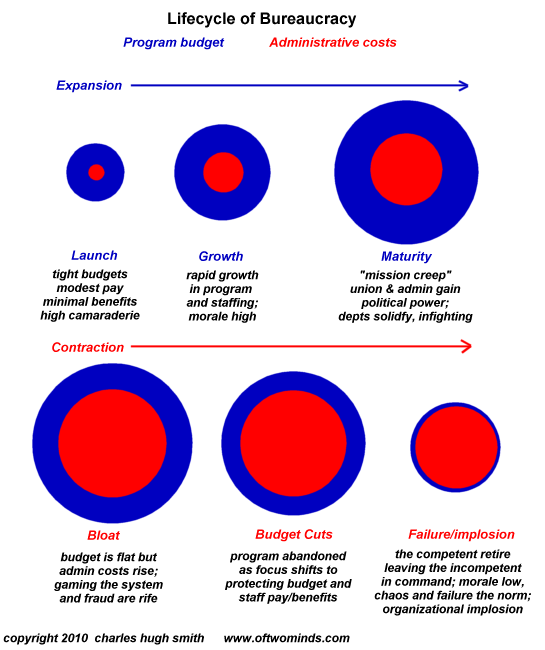
Back in 2010 I prepared this chart of The Lifecycle of Bureaucracy: as bureaucracies expand, they inevitably become less accountable, less efficient, more bloated with legacy staffing and requirements that no longer make sense, etc.

As costs soar, the bureaucracy’s budget is attacked, and the agency circles the wagons and focuses on lobbying politicos and the public to leave the budget untouched.

Since accountability has been dissipated, management becomes increasingly incompetent and larded with people who can’t be fired so they were kicked upstairs. Staff morale plummets as the competent quit/transfer out in disgust, leaving the least productive and those clinging on in order to retire with generous government benefits.

In this state of terminal decline, the agency’s original function is no longer performed adequately and the system implodes from the dead weight of its high costs, lack of accountability, gross incompetence, inability to adapt and staggering inefficiency.

lifecycle-bureaucracy

I’ve covered this dynamic a number of times:

Our Legacy Systems: Dysfunctional, Unreformable (July 1, 2013)

The Way Forward (April 25, 2013)

When Escape from a Previously Successful Model Is Impossible (November 29, 2012)

Complexity: Bureaucratic (Death Spiral) and Self-Organizing (Sustainable) (February 17, 2011)

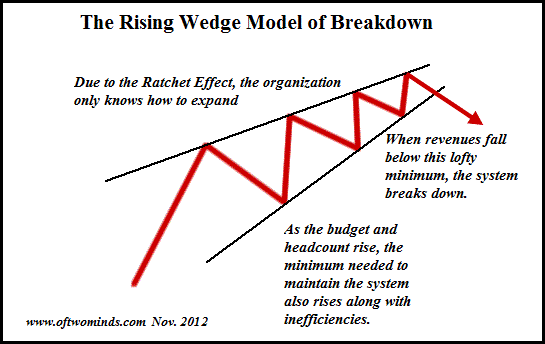
This generates a ratchet effect, where costs increase even as the bureaucracy’s output declines. The ratchet effect can also be visualized as a rising wedge, in which costs and inefficiencies continue rising until any slight decrease in funding collapses the organization.

Dislocations Ahead: The Ratchet Effect, Stick-Slip and QE3 (February 14, 2011)

The Ratchet Effect: Fiefdom Bloat and Resistance to Declining Incomes (August 23, 2010)

rising-wedge

The net result of the Ratchet Effect and the impossibility of reform is this: it’s cheaper and more effective to let the system collapse than squander time and treasure attempting reforms that are bound to fail as vested interests will fight to the death to retain every shred of power and swag.

Since the constituent parts refuse to accept any real reforms, the entire system implodes. We can look at healthcare, higher education and the National Security State as trillion-dollar examples of systems that become increasingly costly even as their performance declines or falls off the cliff.

This is the lesson of history, as described in the seminal book The Upside of Down: Catastrophe, Creativity, and the Renewal of Civilization.

Collapse does not need to be complete or sudden. Collapse tends to be a process, not an event.

Collapse begins when you can’t find any doctors willing to accept Medicaid payments, when the potholes don’t get filled even when voters approve millions of dollars in new taxes, and when kids aren’t learning anything remotely useful or practical despite the school board raising tens of millions of dollars in additional property taxes.

Collapse begins when real reform becomes impossible.