
“Bidenomics” Is A Fraud Based On Deliberately Misrepresented Stats

By Brandon Smith

Source: Alt-Market.us

Economic issues are some of the most politically abused issues often because the data politicians exploit is easy to present out of context. The vast majority of the public doesn’t spend their time immersed in the intricacies of monetary policy, unemployment stats and the processes of inflation vs deflation. They hear a soundbite on the news or social media once in a while, assume it must be true and then go on with their day.

This is how economic crisis events always seem to take the population by surprise – The establishment tells people all is well and no one questions the narrative in the face of numerous warning signs. Sometimes, the populace continues to believe that everything is fine despite the financial framework burning down around them, all because the “experts” continue to convince them that recovery is “right around the corner.”

There are numerous incentives for government officials and mainstream economists to mislead the citizenry with tales of imminent prosperity in the midst of instability. Primarily, the goal is to keep the middle-class population as docile as possible so that they don’t revolt until it’s too late (the middle class being predominantly conservative, and the greatest threat to any corrupt regime). Understand that economics is the root of power, and economic perception is the key to influencing the masses.

Hidden Indicators And Rampant Money Printing

The reality is that the US was hurtling towards stagflationary disaster ever since the crash of 2008, when Barack Obama and Joe Biden (with the help of the Federal Reserve) oversaw the near doubling of the national debt from $10 trillion to almost $20 trillion – The most egregious abuse of monetary policy that the US had ever seen.

And, keep in mind this was only the officially reported cash. Because of pressure brought by people like Ron Paul in 2011, the government was forced to pursue a limited audit of the Federal Reserve bailouts at that time. This revealed at least $16 trillion created from nothing by the Fed to prop up the failing system.

In 2006, right before the derivatives collapse, the Federal Reserve conveniently and abruptly ended their M3 money supply report. They now only report the M2 money supply, which does not include the vast assets held in corporate coffers, large time deposits in banks, institutional money market funds, short-term repurchase agreements (repo), and larger liquid assets. It was as if they knew an inflationary event was about to take place and they needed to obscure the evidence.

In other words, in economics there is the “official government data” and then there is the REAL data, which is sometimes so hidden it is impossible to quantify.

Even if we only go by the M2 report, the money supply skyrocketed starting in 2020, and rose exponentially through 2021 and 2022 – It jumped by 40% in only two years. This is why the cost of most necessities has risen 25% or more.

I’m sure most readers have noticed that inflation is not going away despite Joe Biden’s claims that he has “cut inflation in half” under his “Bidenomics” plan. This is because inflation is cumulative. The CPI might fluctuate, but the effects of inflation remain as prices tend to increase and stay high perpetually.

There Is No Such Thing As “Bidenomics”

The supposed financial progress that Biden is trying to take credit for has nothing to do with Biden’s policies. Not a thing. Unless, of course, you count market manipulation as a positive.

For example, the reduction in CPI is directly related to the continuous interest rate hikes of the Federal Reserve, which Biden has zero control over. The Fed is autonomous and makes its decisions independent of the White House or government. This is a fact openly admitted by former chairman Alan Greenspan. When the fed raises rates, debt becomes more expensive, lending slows down and thus the economy slows down.

One of the only ways that Biden can influence CPI is through artificial deflation of energy prices. The Biden Administration has been dumping US strategic oil reserves on the market for the past year as a means to suppress oil prices, thereby directly and indirectly keeping the CPI numbers down. This is not progress, it’s economic fraud.

The misuse of stats extends to other sectors, such as Biden’s attempt to take credit for the recent reduction in the US deficit. Again, this has nothing to do with Biden; the Fed’s interest rate hikes make it more expensive for the government to take on debt, therefore, debt spending drops.

It’s also not a situation that signals a recovery in the economy – The Fed continues to hike rates supposedly to stall inflation, but higher rates in a debt heavy environment lead to inevitable deflationary upheaval. As I predicted a year ago, the Fed is continuing to increase interest rates until this happens.

Employment Miracle Or Employment Scam?

This issue has been brought up by many analysts but I’ll touch on it again here because Biden is relentless in his falsehoods when it comes to employment data. FACT: 72% of all “new jobs” Biden takes credit for were originally lost during the pandemic lockdowns. The very lockdowns which Democrats avidly enforced and tried to keep in place perpetually. You can’t take credit for “creating” jobs that you are responsible for destroying.

In terms of higher labor demand, the pressure is in low wage service sector jobs and these are the majority of jobs added since Biden took office. And, this rush into retail/service was purchased with $8 trillion+ in covid stimulus cash along with a moratorium on rent and student loan payments. That much extra money in circulation buys at least a few years of consumer spending, propping up jobs numbers.

Throughout history, such gains from inflationary actions and government interventions are always short term, and they always end with a dramatic plunge in employment once the effects subside.

Biden’s Fake Manufacturing Boom

Biden has recently touted a jump in US manufacturing as the latest achievement of Bidenomics, but like every other claim he makes, you have to look at the context. These are not free market manufacturing facilities built according to market demand. Rather, Biden is pumping billions of taxpayer dollars into green tech, once again artificially engineering a “manufacturing boom” through government subsidies for products that have limited demand.

Biden wants to rig the demand, too, by enforcing climate laws which make gas, oil and coal sources too expensive and solar panels and wind turbines cheaper by comparison. For example, Biden is increasing costs for oil and gas exploration on federal lands, while greatly lowering the prices for building solar farms on federal lands. In other words, the government uses your money to create factories for green tech and then creates laws which force people to use that green tech.

In the meantime, Joe’s manufacturing “boom” paid for with tax dollars also comes at the cost of America’s oil, gas and coal industries, not to mention less energy freedom for the general public. It’s socialism, not a revolution in domestic manufacturing.

For Biden, The Key Is To Create As Many Government Cash Injections As Possible Until 2025

You want to know why Democrats are so angry that the Supreme Court blocked Biden’s plan to make taxpayers cover student loan debts? It’s not because they care about naive college kids who paid too much money for garbage degrees – It’s because student debt relief would immediately add trillions more in spending in the short term to the US economy.

An interesting side effect of the college loan moratorium is the surprising credit boost – As soon as college loan payments were put on hold, millions of former students had their credit ratings increase by default. Meaning, they could now hike their credit limits and spend MORE money they don’t have. It’s an incredibly sneaky way to artificially prop up the system WITHOUT using direct stimulus measures that rely on the central bank. This false boost will disappear by October of this year.

Biden’s constant attempts to introduce infrastructure programs are another way the government can create the illusion of recovery by using debt spending as a means to mitigate the signals of greater fiscal decline. Without Fed stimulus it’s the only option Biden has, and as rates rise it becomes costly.

The bottom line is this – The US economy is on a short timetable as long as the Fed continues to raise interest rates into weakness as a means to suppress inflation. As we witnessed in the spring, higher rates are already breaking the back of mid-tier banks across the western world and the Fed’s backstop funds are only enough to stall the debt crisis for a time. I continue to predict that once the Fed Funds Rate is raised to 6% or more, we will once again see a banking calamity similar to the 2008 crash, but this time if the Fed steps in with a bailout hyperinflation will be the immediate result.

Bidenomics is a sham in every respect. Anything that could be considered an economic improvement is due to the Federal Reserve playing the odds with interest rates. A massive 40% increase in the money supply sure helps in obscuring fiscal weakness as well. Luckily, nearly 60% of Americans in recent polls say they aren’t buying the Bidenomics fairytale – They see the dangers around them every day.

The covid event was a catalyst that revealed all the weaknesses of the US system that many of us in alternative economics have been warning about for years. And now it seems as if the establishment is trying to drag things along for just a little while longer. The reason why is up for speculation, but the fact remains that a broken structure cannot be propped up with stop gaps. I’m doubtful that Biden will be able to ride the wave created by covid stimulus until the end of 2024. Something has to give.

The decline of America is becoming an accepted fact

By Veniamin Popov

Source: New Eastern Outlook

On July 5 of this year, the New York Times published an article titled “America Lives on Borrowed Money.”

It states that borrowing is expensive. A rising portion of federal earnings, money that could be utilized to help the American people, is returned to investors who buy government bonds in the form of interest payments. Instead of collecting taxes from the rich, the government pays the rich to borrow their money.

According to the Congressional Budget Office, the government will spend more on interest than on national defense by 2029, and interest payments will account for 3.6 percent of national GDP by 2033.

The authors of the article believe that the situation is becoming more and more alarming and painful, and therefore radical decisions should be made.

However, with the growing division of US political forces, these alternatives are no longer visible, especially since “Joe Biden’s global vision is too timid and pessimistic,” according to the British-based Economist.

The fact that President Biden has been indicted with impeachment by the Republican-led House of Representatives cannot be overlooked: On June 22, the House voted 219 to 208 to send two articles of impeachment to the Homeland Security and Judiciary committees, one for abuse of power and the other for dereliction of duty.

What is interesting is the evaluation of the current scenario made not only by Americans but also by political analysts from emerging countries. For example, the Saudi-based Arab News reported on June 25 this year that the United States’ political system is in disarray and the country is extremely fragmented.

The author puts the current problem in the United States on a par with the fall of the Roman Empire: “You cannot be a world leader if your society is crumbling and your leadership is divided, indecisive, and weak.” Especially when the media, once lauded as a strong weapon of truth, has devolved into a tool of political bias motivated by profit rather than principle, and free speech is dead in America.

According to the author, American influence in South America and Africa is likewise dwindling: America has never been weaker than it is today in its relatively short history.

On June 19, this year, Marwan Bishara, a senior political analyst for Al Jazeera TV, noted that signs that the American-dominated world order was crumbling had become increasingly visible over the previous decade and that America’s political and economic decline had affected its global influence and credibility.

Attempts to resurrect US leadership through the so-called “rules-based international system,” according to the author, have failed. This system was perceived as a rigged arrangement that benefited the West over the rest of the world and violated international law.

Back in the spring, well-known American journalist Ross Douthat determined that the elites of the Middle East, Africa, and Central Asia favor Russia and China, and that public opinion in emerging countries is more sympathetic to Russia and China than to America.

Richard Haas, a respected American political analyst who led a prominent think tank, the Council on Foreign Relations, for more than 20 years, went even further in his analysis: “The collapse of the American political system means that for the first time, the internal threat has surpassed the external threat. Instead of being a reliable anchor in an unstable world, the United States has become the deepest source of instability and an unreliable model of democracy.”

In September 2022, current US President Joe Biden spoke of American democracy being on the verge of collapse, clinging by a thread.

In response to this, Gulf News, one of the UAE’s leading publications, said that America today is a house divided. More and more Americans acknowledge that the country’s current status is abnormal.

The summer of 2020’s street violence and instability revealed the actual mental state of the world’s most powerful nation. The United States has long had one of the highest rates of violent crime in the world, and deteriorating public order has expedited the spread of firearms. The United States ranks first in the number of privately owned guns. Researchers at the Small Arms Survey estimated that Americans own 393 million of the 857 million available civilian guns, about 46% of the world’s civilian gun stockpile. According to the same publication, there are 120 guns per 100 Americans. According to the Pew Research Center, 48% of Americans believe that gun violence is a major issue in the country.

According to polls, only 17% of Americans believe the US criminal justice system treats everyone fairly, according to the USA Today website.

Currently, the issue of migration in America has seriously escalated.

Of course, there will be ups and downs in American domestic politics, but one of the most notable trends in recent years has been the growing polarization of the elite, which could lead to a major split of the country.

A new presidential election will be held in 2024, and many objective observers believe that both parties, Republicans and Democrats, will protest the results. Since 2000, contesting presidential elections has been a tradition.

When Hillary Clinton lost to Trump in 2016, the Democratic Party functionaries became full-time election deniers, emphasizing that the Democratic Party leadership and journalists, its supporters, had done nothing wrong: Vladimir Putin and the Russians were to blame, having hacked the election.

In 2020, Trump claimed that his loss to Biden had been the result of election fraud: the election had been stolen. Within weeks, the Republican Party’s mantra became “stop the stealing.”

A recent study found that more than half of Americans now expect another civil war “within the next couple of years,” with numerous forecasts for the end of America.

One of them says that if Trump, or any other Republican, occupies the White House, Californians are taking serious steps toward withdrawing from the United States.

Another scenario that is being seriously studied assumes that red, or Republican states will launch an independence movement if the Democratic Party wins, including Biden’s second term.

Many analysts are debating the prospect of a significant civil conflict in the United States. Meanwhile, some political analysts have noticed a discernible strengthening of the so-called neoconservative positions among the American ruling elite, who are adamant that Washington should be in charge of the entire world and harshly punish those who disagree with them. Their stance on the Ukraine issue has the potential to push the world to the verge of a nuclear war. This group’s careless acts have already generated a sizable number of issues and fresh crises.

In order to find a way out of the current impasse in international affairs, more and more developing countries are turning to Russia and China. They place their expectations in this respect, above all, on the approaching BRICS conference, where the enlargement of this association may be announced.

ARE CENTRAL BANK DIGITAL CURRENCIES (CBDC) DESTINED TO FAIL?

By Timothy Alexander Guzman

Source: Silent Crow News

Since Bitcoin (BTC) was introduced to the world as an alternative to the current central bank system with a dying US dollar that is backed by nothing as its reserve currency, but now there is a plan by several governments to move ahead with implementing their own central bank digital currencies (CBDCs), which is a digital form of currency that is still backed by, you guessed it, nothing.  The Nigerian government had made the decision to be the financial guinea pig for the globalist CBDC scheme, and so far, it has failed and that’s the good news.  The bad news is that certain governments are still moving forward with the idea of using government-issued digital currencies.  In the case of Nigeria, its citizens rejected their government’s plan to issue CBDCs by restricting cash in efforts to create a cashless society and so far, it seems that it has failed in epic fashion according to an opinion piece by author Nicholas Anthony that was published by coindesk.com ‘Nigerians’ Rejection of Their CBDC Is a Cautionary Tale for Other Countries’ is a warning to governments who are willing to take the same step: 

In Nigeria, citizens have taken to the streets to protest the nation’s cash shortage, further objecting to their government’s implementation of a central bank digital currency (CBDC). The shortage came about due to cash restrictions aimed at pushing the country into a 100% cashless economy. Yet, instead of adopting the CBDC, Nigerian protesters are demanding paper money be restored.

The country’s experience strongly suggests the average citizen understands that CBDCs present a substantial risk to financial freedom while providing no unique benefit

Not only did the Nigerian people reject CBDCs, but they also demanded a return to paper currencies because they quickly found out that financial freedoms would be severely limited. 

The concerns ranged from risking financial privacy to the possibility of financial oppression by government institutions.  Anthony mentioned how “the Nigerian government has unleashed a flurry of tricks to spur adoption, but none has proven effective.”  He even gave credit to the Nigerian government in terms of using modest approaches to influence its citizens to use CBDCs and it still failed:

To its credit, the Nigerian government initially tried to encourage use through modest measures. In August 2022, it removed access restrictions so that bank accounts were no longer required to use the CBDC. Then, in October, it offered discounts if people used the CBDC to pay for cabs.  Yet, neither effort proved to be fruitful. Put simply, Nigerians prefer cash

However, the Nigerian government continued its assault on cash:

Unfortunately, the Nigerian government doubled down and moved to more drastic measures by restricting cash itself. In December the Central Bank of Nigeria began restricting cash withdrawals to 100,000 naira (US$225) per week for individuals and 500,000 naira ($1,123) for businesses.

To make matters worse, the Nigerian government also chose to redesign the currency during this time in a “move aimed at restoring the control of the Central Bank of Nigeria (CBN) over currency in circulation” and to “further deepen the push to [a] cashless economy,” according to a CBN press release

The Nigerians had a hard time adapting to the government’s restrictions on their hard earned cash, so they posted their concerns on Twitter, Tik Tok and other social media platforms to let the world know what went wrong.  Soon after, major protests erupted on the streets because of the cash shortages imposed by the Central Bank of Nigeria: 

The government decided to redesign the currency to restore control over the Central Bank of Nigeria as its governor, Godwin Emefiele claimed that “the destination, as far as I am concerned, is to achieve a 100% cashless economy in Nigeria.”  To add insult to injury, “the company that designed the Nigerian CBDC called the cash restrictions a creative use of marketing and said other countries could be expected to take similar steps.”  A top manager from a financial institutional ratings firm called Agusto and Co., Ayokunle Olumbunmi said that the central bank “doesn’t want us to be spending cash. They want us to be doing transactions electronically, but you can’t legislate a change in behavior.”  Anthony concluded that the idea of CBDCs will not go very far, “CBDCs may be popular among central bankers, but money is ultimately a tool for the people. So long as the risks outweigh the benefits, it’s unlikely any CBDC will gain traction in Africa or elsewhere.”

Nicholas Anthony was correct to point out that CBDCs will not become mainstream as several countries have already demonstrated their unwillingness to move forward with the new form of digitized currencies. 

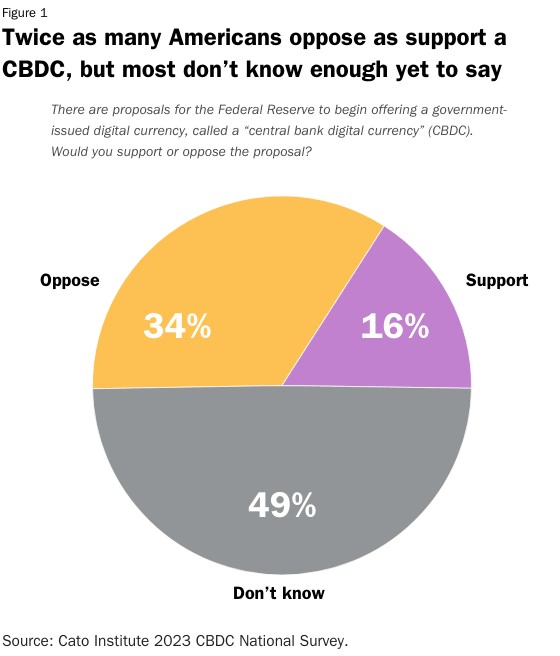
The average human being on earth understands that CBDCs is a bad idea, even in the United States where two-thirds of the population believes almost anything that their government tells them to believe are skeptical of CBDCs according to the Cato Institute, a think tank who also published an article by Nicholas Anthony on the findings of a survey that was conducted by the US federal Reserve Bank on how people view CBDCs.  Here is what they found, “Specifically, more than 66 percent of the 2,052 commenters were concerned or outright opposed to the idea of a CBDC in the United States (Figure 1).”

Bitcoin.com published an article on the GOP’s 2024 presidential candidate, Florida’s governor, Ron DeSantis who is opposed to CBDCs, ‘Ron DeSantis Vows to Prohibit CBDC, ‘Woke Politics,’ and ‘Financial Surveillance’ in Florida,’ he said “I think what the danger of the digital currency is that, one, they want to make that the sole currency, they want to get rid of crypto,” DeSantis continued, “They don’t like crypto because they can’t control crypto. So, they want to put everything in a central bank digital currency.”  There were other politicians who also have similar views on CBDCs:

DeSantis shares the view of several Republican officials who have criticized the idea of a central bank digital currency (CBDC). Minnesota congressman Tom Emmer introduced the Central Bank Digital Currency (CBDC) Anti-Surveillance State Act, while Texas senator Ted Cruz has created legislation against the government developing a CBDC. Georgia representative Marjorie Taylor Greene has also spoken out against CBDCs, and 2024 Democratic presidential candidate Robert Kennedy Jr. has warned that a central bank digital currency could lead to financial slavery

Cash is King! How the CBDC Failed in Japan and Ecuador

Cointelegraph.com, an independent digital news platform that focuses on crypto assets, blockchain technology and emerging fintech trends published an article last year written by Helen Partz based on which countries have rejected CBDCs for one reason or another titled ‘Some central banks have dropped out of the digital currency race’ mentions Japan, who is a major player in the global economy, ultimately rejected developing a CBDC scheme.  The Bank of Japan (BOJ) started testing their digital currency proof-of-concept in 2021 and had planned to finish the first phase by 2022 but in January “former BOJ official Hiromi Yamaoka advised against using the digital yen as part of the country’s monetary policy, citing risks to financial stability.” 

The BOJ issued a report in July 2022 and stated that it had no plan to establish a CBDC system since there is a “strong preference for cash and high ratio of bank account holding in Japan” and that the regulator suggested for a CBDC to be used as a “public good” and it “must complement and coexist” with “private payment services in order for Japan to achieve secure and efficient payment and settlement systems.”  However, it also said that “the fact that CBDC is being seriously considered as a realistic future option in many countries must be taken seriously,” in other words, the CBDC scheme in Japan will not move forward although several countries are still in the early stages of developing a plan for the use of CBDCs, but for Japan, cash is still and will be king well into the foreseeable future.

Ecuador is another example as its central bank, Banco Central del Ecuador (BCE) who launched its own electronic currency known as dinero electrónico (DE) in 2014 to increase some sort of financial inclusion for the public as well as to control the flow of fiat currencies.  According to Partz “As of February 2015, Ecuador managed to adopt DE as a functional means of payment, allowing qualified users to transfer money via a mobile app. The application specifically allowed citizens to open an account using a national identity number and then deposit or withdraw money via designated transaction centers.”  But industry observers were not so sure that the DE can take the form of a CBDC since Ecuador’s currency is the US dollar, and since Ecuador does not currently have its own sovereign currency, many were not so sure that they can call the DE, a form of CBDC.  “The Ecuadorian government cited the support of its dollar-based monetary system as one of the goals behind its DE platform after it started to accept U.S. dollars as legal tender in September 2000.”  It seems that Ecuador remains skeptical on any possibility that issuing CBDCs will be a success:

According to online reports, Ecuador’s DE operated from 2014 to 2018, amassing a total of 500,000 users at its peak out of a population of roughly 17 million people. The project ​​was eventually deactivated in March 2018, with the BCE reportedly citing legislation abolishing the central bank’s electronic money system. Passed in December 2021, the law stated that e-payment systems should be outsourced to private banks.

Years after dropping its central bank digital money initiative, Ecuador has apparently remained skeptical about the whole CBDC phenomenon. In August 2022, Andrés Arauz, the former general director at Ecuador’s central bank, warned eurozone policymakers that a digital euro could potentially disrupt not only privacy but also democracy

Bottom line, the CBDC will not be a standard for financial transactions for the few countries who already tried launching their versions of digital currencies. 

However, in the US, the Federal Reserve’s ‘FedNow’ was supposed to be launched sometime in July 2023.  Here is the Federal Reserve’s Press Release:

The Federal Reserve announced that the FedNow Service will start operating in July and provided details on preparations for launch.  The first week of April, the Federal Reserve will begin the formal certification of participants for launch of the service. Early adopters will complete a customer testing and certification program, informed by feedback from the FedNow Pilot Program, to prepare for sending live transactions through the system.

Certification encompasses a comprehensive testing curriculum with defined expectations for operational readiness and network experience. In June, the Federal Reserve and certified participants will conduct production validation activities to confirm readiness for the July launch.

“We couldn’t be more excited about the forthcoming FedNow launch, which will enable every participating financial institution, the smallest to the largest and from all corners of the country, to offer a modern instant payment solution,” said Ken Montgomery, first vice president of the Federal Reserve Bank of Boston and FedNow program executive. “With the launch drawing near, we urge financial institutions and their industry partners to move full steam ahead with preparations to join the FedNow Service”

For the US population, FedNow is a test that will eventually fail.  People will be skeptical about a central bank digital currency once it proves that it is used to surveil people’s spending habits and control what they spend their money on, and God forbid they are anti-war, anti-vaccine activists, homeschoolers, pro-gun supporters or conspiracy theorists, the bankers can cut them off from using CBDCs and then what happens?  Will there be riots in the streets? 

Since Bitcoin was introduced as an alternative to central bank control, the creation of the CBDC is their answer in hopes of retaining their power, but that idea is not likely to happen, it will in some way, backfire. 

When it comes to Bitcoin, it’s a different story.  In an interesting article written by Jay Speakman of beincrypto.com ‘When You Buy Bitcoin You Gain Freedom’ says that “in a world where economic and political uncertainties abound, owning Bitcoin (BTC) could provide the path toward financial freedom and autonomy. It’s no longer just about investing in a digital asset. It’s about making a revolutionary move to gain control over your finances and future.”  Speakman makes several main points on why people should own Bitcoins and one of those points is that owning sovereign cryptos such as Bitcoins, Ethereum’s and others is a step towards financial freedom:

It provides the opportunity to participate in the global economy without the limitations of traditional banking systems. Bitcoin is not subject to government regulations. At least not yet, and it is free from the inflationary policies which can erode fiat currency values. This means Bitcoin provides an alternative and potentially more secure, store of value

Another reason for owning Bitcoins is for future investment purposes:

Investing in Bitcoin is no longer simply making money. It is about investing in your future and securing your financial freedom. Bitcoin’s decentralized financial system operates independently of central authorities or governments. This means it is resistant to censorship and regulation. Bitcoin holders can make transactions without the need for banks, which are subject to government intervention

“Investment Diversification” is another reason to own Bitcoins since putting all your eggs in one basket, especially in a globalist banking system, is a bit risky:

Investing in Bitcoin can provide portfolio diversification as it is not correlated to traditional assets such as stocks and bonds. This means it may provide a hedge against inflation and market volatility, mitigating the risks associated with traditional investment portfolios

However, owning Bitcoins does have risks like everything else since the “market is notoriously volatile. Prices often fluctuate wildly based on a range of factors, from government regulations to media coverage.”  Speakman also mentions that “BTC transactions can result in a permanent loss of funds. There is also the risk of hacking and theft, as these transactions are irreversible and untraceable.” 

In conclusion, the article lays out what owning Bitcoins could mean for individuals and investors alike especially for those who do not trust the traditional banking system:

The decision to buy BTC is more than just a financial investment. It’s a move towards financial freedom, control, and security. Bitcoin’s feature of allowing individuals to act as their own banks. Providing a secure alternative to traditional banking systems which have exhibited instability and vulnerability to failures.  Furthermore, the appeal goes beyond just financial security and autonomy. The digital currency resonates with libertarians who value individual freedom and limited government intervention. Despite a torrent of dissenting voices Bitcoin continues to gain mainstream adoption. As the technology continues to mature, it may address some of the concerns raised by the dissenting voices.

Investing in digital assets may involve risks such as volatility and the potential for hacking and theft. Yet, the benefits of financial freedom outweigh the downsides. As the world becomes increasingly uncertain, owning Bitcoin could be the first step toward financial security and autonomy

When you look at the difference between CBDCs along with the system imposed by international banking cartels who still maintain some form of financial dominance versus the Bitcoin revolution, there is a difference.  CBDCs means no financial freedoms and owning Bitcoins means the exact opposite.  Even though Bitcoins are still in the early stages, there is hope in the new crypto technology.  But like everything else, you should be cautious, do not invest 100% of your net worth in just one asset, in other words, invest maybe 5% in bitcoins, and the rest? 15% in emergency preparedness (food, water filters, guns, flashlights, etc.)  20% in real estate or invest in a second passport, 20% in hard assets like gold, silver and copper, 20% in high-end watches, antiques, aged wines and liquor, collectibles etc. and the last 20% in foreign stocks especially those that are in politically stabilized environments or in gold and silver mining companies, but that’s just my opinion. 

Government-backed CBDCs will be a failure because the people already do not trust international banking cartels to totally control their finances. So, for these banks to have total control over your financial wellbeing under their CBDC scheme would be an extremely difficult task for them to manage. 

The banking cartel or the financial bureaucrats are about to discover that they will be in over their heads with an angry population.  Just imagine if the banking cartels, certain governments and their corporate conglomerates are in  control over the people’s finances, they will get to determine who eats and who will starve.  This is the ultimate power grab the globalist bankers have been dreaming about for a very long time, but will the people stop this from happening?  I’m an optimist, so I believe that they will demand their financial freedoms and that is something of value that they can hold and control in their own hands.  The case for CBDCs will be a hard sell, so central banks who are proposing this idea should think twice about what they are trying to impose on the public, if not, they will face some form of resistance just like they did in Nigeria.    

Why You Should Stop Trusting ‘The Experts’

We’re constantly told to “trust the experts”, but that is phenomenally bad advice.

By Jeremy R. Hammond

Source: JeremyRHammond.com

“Trust the experts,” we are constantly being told, whatever the topic of discussion. The problem with this advice is that the so-called “experts” are frequently wrong, sometimes as a result of plain incompetence and other times because it is their function to propagandize rather than to educate.

For instance, I got my start doing citizen journalism speaking out against the US government’s planned war on Iraq. In 2002 and early 2003, the government claimed that Iraq had stockpiles of chemical and biological weapons, active weapons manufacturing programs, and an active nuclear program aimed at producing a nuclear bomb. Mainstream media outlets like the New York Times uncritically parroted the government’s claims. All the “expert” analysts and commentators towed the official line.

When I would point out to people that there was no credible evidence to support the government’s claims that Iraq had weapons of mass destruction (WMD) and that the documentary record rather indicated that Iraq had been disarmed of the weapons it produced during the 1980s with the support of the US government, I was frequently confronted with the idea that we should trust the expert intelligence analysts because surely government policymakers must have classified information supporting their case that they just couldn’t share with the public.

Later, when the Central Intelligence Agency (CIA) issued its official report acknowledging that Iraq had indeed been disarmed by UN inspectors by 1991 and never restarted its weapons programs, a whole new propaganda narrative was developed to whitewash how the US government lied to the American people and the world. We were then fed the myth that there had been an “intelligence failure”, the truth being that the government had successfully waged a disinformation campaign against the public for the purpose of manufacturing consent for an illegal war of aggression that left Iraq devastated, with negative ripple effects throughout the Middle East, including the war’s precipitation of the rise of the Islamic State of Iraq and Syria (ISIS).

Another example is the housing bubble that precipitated the 2008 financial crisis. The mainstream “experts” insisted that there was no bubble, that the economy was rolling along nicely. Right up to the bubble’s peak, Federal Reserve Chairman Ben Bernanke refused to see it. In the New York Times, throughout the 2000s, Keynesian economist Paul Krugman lauded the Fed’s inflationary monetary policy that was the principal cause of the housing bubble only to ludicrously blame the bubble on the forces of the free market after it burst.

Meanwhile, free market economists schooled in the ideas of Austrian economics, so called because its founders and early luminaries hailed from Austria, were accurately warning how the Fed’s policy of maintaining artificially low interest rates—meaning rates below where they would otherwise be if determined by the market rather than by a roomful of policymakers—was fueling a housing bubble that would cause economic devastation when it inevitably burst. Congressman Ron Paul famously warned about this as early as 2001, yet we were consistently told by the mainstream “experts” that we shouldn’t listen to him or other advocates of liberty in the marketplace.

The preposterousness of the mainstream narrative was so overwhelming, it prompted me to write a book titled Ron Paul vs. Paul Krugman: Austrian vs. Keynesian Economics in the Financial Crisis, which ended up getting a rave review by none other than Barron’s. Gene Epstein, the former Economics and Books editor for Barron’s said of it:

Any work of economics that can make you laugh is at least worth a look. If in less than 100 pages it also informs you about a subject of great importance, it might just qualify as a must-read. Jeremy Hammond, a political journalist self-taught in economics and a writer of rare skill, has produced such a book…. This short work conveys more insight into the causes and cures of business cycles than most textbooks, and more about the recent business cycle than most volumes of much greater length.

Once again, we could see that there is a whole class of “experts” whose primary function was not to truly educate us about how the economy functions but to manufacture consent for the existence of central banking—the Fed being a government-legislated private monopoly over the currency supply.

That episode also once again illustrates how any non-expert willing to commit the time to self-education can easily see through the lies and deceptions propagated by the “experts”.

Arguably, there is no more perfect example of how the “experts” get things completely wrong than the governmental responses to the COVID‑19 pandemic. While I and others fervently opposed the lockdown measures from the start on the grounds that they would do more harm than good, the thought-controlling media insisted that we must trust the government’s “experts” like Dr. Anthony Fauci. We should “follow the science” we were told, while Fauci claimed to be science incarnate, deeming himself beyond reproach by proclaiming that to criticize him was to attack science itself.

Predictably, the proclaimed benefits of lockdowns never manifested in the data while the harms have been devastating, with negative consequences being disproportionately borne by children, who are at the lowest risk from SARS‑CoV‑2 infection.

I was also warning people since March 2020 that the endgame of the lockdown measures was coerced mass vaccination, which was dubbed a “conspiracy theory” by the mainstream media but nevertheless came to pass.

While all the “experts” in the so-called “public health” establishment were proclaiming that widespread acceptance of the mRNA COVID‑19 vaccines would end the pandemic by conferring herd immunity, dissident voices like my own were being censored for telling the truth that there was no scientific evidence that the vaccines would induce durable sterilizing immunity that would prevent infection and transmission of the virus.

I was also warning since very early into the mass vaccination campaign that the policy goal of getting everyone vaccinated could prolong the pandemic and worsen outcomes in the long-term because of the immunologic phenomenon of “original antigenic sin” and the opportunity cost of superior natural immunity. These warnings, too, proved prescient as we now know from the available scientific evidence that the mRNA COVID‑19 vaccines do result in an “immune imprinting” so that vaccinated individuals are stuck generating a suboptimal immune response to circulating SARS‑CoV‑2 variants.

After it became obvious from the data that the vaccines failed to prevent infection and transmission of the virus, the media went so far in their efforts to defend the criminal regime of lockdowns and coerced mass vaccination by gaslighting us and absurdly denying that the COVID‑19 vaccines were sold to the public on the basis of lies.

We’re also supposed to trust doctors, but my own household’s experience with the medical establishment led us to the opposite conclusion. The doctors were not just unhelpful; they were less than useless. Especially in my wife’s case, listening to them caused more harm than good. In fact, it wasn’t until we learned to stop listening to the doctors and started trusting our own judgment that my wife and I both found a path to healing from the respective health problems we used to have (leaky gut in my case and mercury toxicity from dental amalgams in my wife’s).

Throughout the time that I was seeking help from the so-called “health care” system, I was repeatedly confronted by doctors whose ignorance was matched only by their arrogance and condescension. I ultimately bypassed the doctors by researching our symptoms directly in the medical literature; we diagnosed ourselves and successfully treated the root cause of our respective symptoms (taking steps to heal my gut and getting the mercury fillings safely removed followed by a two-year mercury detox regimen, respectively).

The supposed “experts” with an “MD” after their name were far more interested in lazily pushing pharmaceutical products on us to treat symptoms than in doing their job to try to figure out what the root cause was, much less in figuring out treatments aimed at addressing the underlying cause.

So, the next time you hear someone telling you to place your trust in the “experts”, emphasize the foolishness of placing blind faith in supposed authorities in lieu of doing one’s own research and thinking for oneself, and remind the person how the “experts” are frequently nothing more than professional propagandists serving a given political or financial agenda.

The Two Causes of the Coming Great Depression

By Charles Hugh Smith

Source: Of Two Minds

There are two approaches to analyzing a situation:

1. Choose the desired outcome–generally the one that doesn’t require any major changes, sacrifices or downward mobility
2. Identify the initial conditions and systemic dynamics and then follow these to a conclusion back-tested by comparisons with historical outcomes.

Our default setting as humans is 1: select the outcome we want and then find whatever bits and pieces supports that conclusion. Cherry-pick data, draw false analogies–the field is wide open.

This is why we get so upset when our “analysis” is challenged: we’re forced to ask what happens to us if our desired outcome doesn’t transpire, and since the answer might be something less than optimal, we violently reject any data or analogies that conflict with our carefully curated “analysis.”

A great deal of what passes for analysis today is cherry-picked bits and pieces that support a happy story of endlessly expanding prosperity–AI, fusion, etc.–with no mention of limits, constraints, costs or worst-case outcomes rather than best-case outcomes.

Let’s start with an historical analogy most reject: the Great Depression of 1929 to 1942. The conventional account claims that the Depression was the result of a “Federal Reserve policy error”: the Fed tightened credit when it should have loosened it.

This is nonsense. What actually happened was credit expanded rapidly in the Roaring 1920s, which is why they were Roaring. Farmers could borrow money to buy prairie land to put under the plow, speculators could borrow $9 on margin to play the stock market with $1 in cash, and so on.

In other words, what happened was a gigantic credit bubble inflated that pushed stocks and other assets to unsustainable heights of over-valuation, valuations based on the Roaring 20s expansion of credit and consumption continuing forever.

But all bubbles pop, and so the weather changed for the worse and newly plowed prairie turned into a Dust Bowl, wiping out heavily leveraged farmers. Since there was no federal bank deposit guarantee (no FDIC), the bankruptcies of overleveraged borrowers wiped out thousands of small banks, wiping out the savings of prudent depositors.

So even prudent savers got wiped out in the crash of the credit bubble.

Stock speculators gambling on margin (i.e. borrowed money) were quickly wiped out, and the selling became self-reinforcing, accelerating the cascading crash.

The real policy error was protecting the wealthy who owned the debt from a debt-clearing write-down. The wealthy own debt, the non-wealthy owe debt. When the debt is defaulted on, the lender / owner of the debt has to absorb the loss. The debtor is freed of the burden. In a debt-clearing event driven by defaults, insolvencies and bankruptcies, the wealthy are the losers and the debtors are freed of the burden of debt.

Various programs were implemented to stave off the consequences of default, as if pushing losses into the future would somehow enable the credit bubble to reinflate. That’s not how it works: the financial system is like a forest, and if the dead wood of bad debt piles up and isn’t allowed to burn, then the forest cannot foster new growth.

Economies that refuse to accept the wealth destruction that results from credit bubbles popping stagnate. This is the story of Japan from 1990 to the present: the status quo in Japan refused to accept the losses, hiding bad debt (i.e. non-performing loans) behind artifices such as new loans that covered the interest due, listing the non-performing loans in “zombie” categories, i.e. as assets that were still on the books at full value even though they were essentially worthless, and so on.

The net result was 33 years of stagnation and social decay as young people gave up on owning homes and having families.

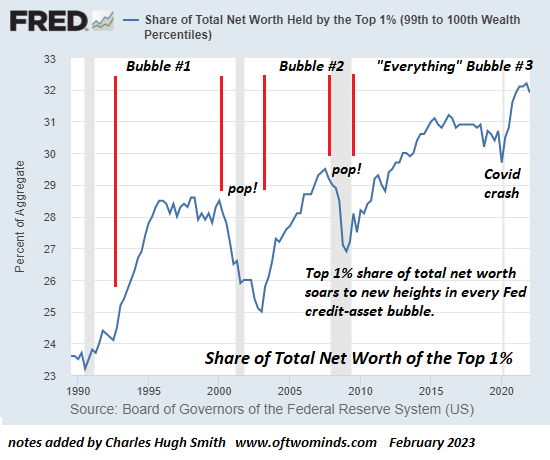
Now the US has inflated another “debt super-cycle” credit bubble that has pushed assets into over-valuation. Once again the goal is to avoid handing the wealthy owners of all this debt the enormous losses that must be accepted to clear the dead wood of bad debt, money lent to borrowers and projects that were not creditworthy except in a bubble.

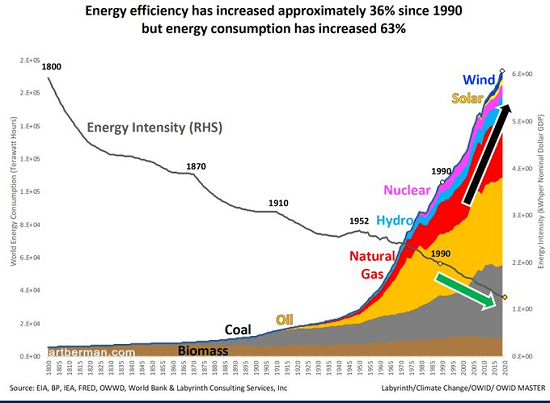
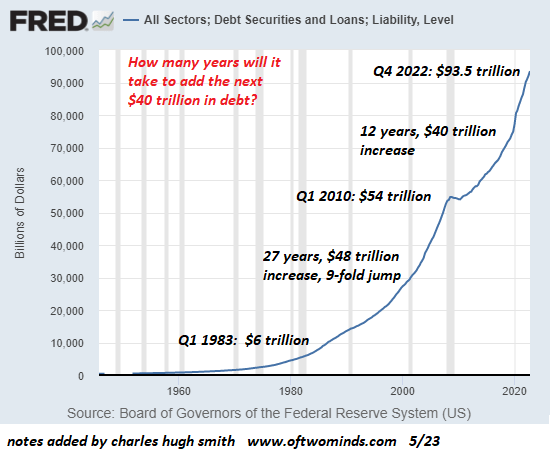
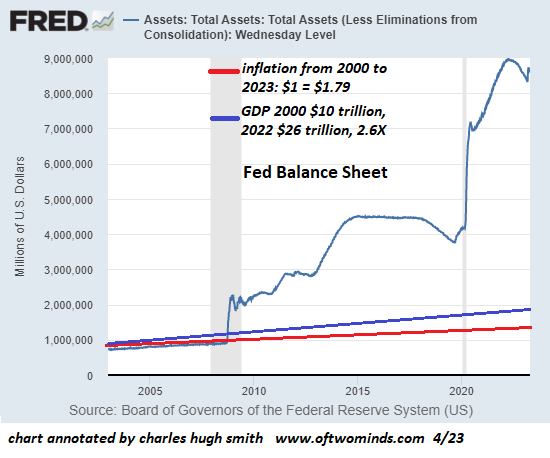
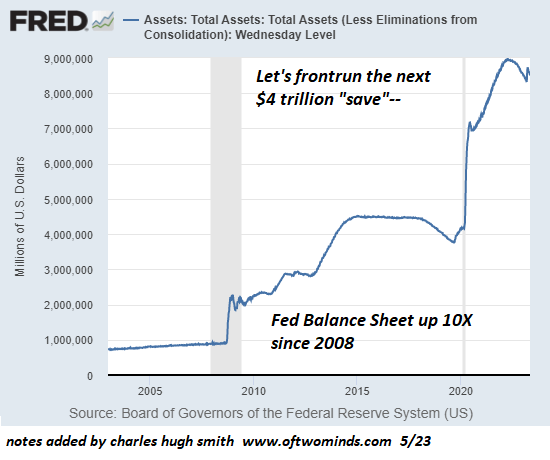
The lesson the status quo took from the Great Depression is to cover up private-sector over-valuations and bad debts with vast expansions of credit via the Federal Reserve and the federal government. Please look at these four charts below:
1. total credit (TCMDO)
2. the Federal Reserve balance sheet (2 charts)
3. federal debt

All are in visibly unsustainable parabolic ascents.

Predictably, the status quo will refuse to accept the necessity of clearing the dead wood and accepting the trillions of dollars in losses that will accrue to those who own the unpayable debts.

Consider CRE, commercial real estate. Office towers are now worth one-third of their pre-pandemic valuations, the valuations on which their mortgages were based. There is no way these properties can be magically restored to their previous over-valuation. Massive losses must be accepted by the owners of the debt. If those losses make them insolvent, so be it. That is unacceptable in a system geared to protect the wealthy at all costs.

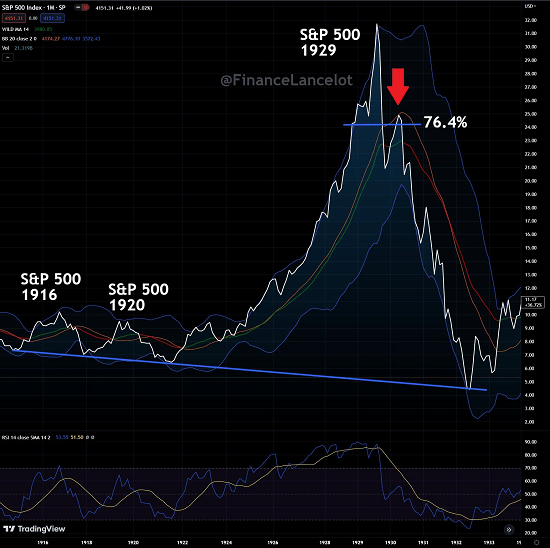
But bubbles pop anyway, regardless of policy tweaks. Consider these stock market charts of the Roaring 20s and the Great Depression and the present (below). The similarity is remarkable–possibly even eerie.

The big difference between the Great Depression of the 1930s and the Depression we’re entering is the world still had enormous reserves of resources to tap and a (by today’s standards) modest population in the resource-consuming developed nations.

Recall that a developed-world consumer uses up to 100 times more energy and resources than a poor person in a rural undeveloped nation. Recycling a few bottles doesn’t change this.

This means the planet’s “savings account” of abundant, cheap-to-access resources has been depleted. Yes, there is still oil and copper, etc., but it’s of far lower quality and much harder to get now. The rich ores have been mined and the shallow super-giant oil fields have all been tapped long ago. Now the Saudis must pump stupendous quantities of seawater into their oil wells to maintain production. All these technologies consume vast quantities of energy.

The inevitable result is the energy efficiency–how much energy is required to access, process and transport the energy–has plummeted even as consumption has soared.

The outcome many hope for is some new miraculously cheap and abundant sources of energy such as fusion. But fusion is far more complicated and tricky than pumping oil, and oil is a high-energy-density fuel that can be stored rather easily. All the electricity generated by various technologies can’t be stored easily or cheaply, and so the happy story is that a new miraculous battery technology is just around the corner.

But batteries are also complicated and resource-dense, so they’ll always be as expensive as the materials needed to fabricate them. There will never be “low-cost” batteries if the materials needed to make them are scarce and expensive to dig out of the ground, process and transport.

So the policy choices are simple: either protect the wealthy from write-downs of bad debt and the collapse of asset bubbles and usher in decades of stagnation, or force the wealthy to take the losses and clear away the dead wood.

But either choice will be constrained by the reality that humanity has already drained the easy-to-get “savings account” of global resources.

I get emails from readers who say things like “mining techniques are far more efficient now.” That’s fine, but most of these new mines are often thousands of kilometers away from railways or seaports, and thousands of kilometers away from the processing plants that turn the ore into useful metals.

Recall the enormity of the cost and effort required to build a single two-lane highway thousands of kilometers to a new mine, and the oceans of diesel fuel needed to power the mining equipment and trucks hauling the ore to railways or seaports. Recall the immense amounts of energy required to smelt / process these ores, and the near-zero percentage of lithium-ion batteries that are currently being recycled.

Batteries are difficult to recycle because they’re not manufactured to be recycled, and they’re not manufactured to be recycled because that would raise costs considerably, reducing profits.

So on the present course, the idea is to manufacture billions of batteries, throw them all in the landfill in 10 years, and then mine enough minerals to build another couple billion batteries and then repeat the cycle of throwing them away in 10 years forever.

That isn’t realistic, so the status quo will have to adjust to this unwelcome reality.

This is why I keep writing books about relocalizing, degrowth, using less rather than more to yield a higher level of well-being. The resource “savings account” won’t support fantasies of endlessly expanding consumption of hard-to-get resources.

But the status quo has much to unlearn, and it seems the only pathway to a new understanding is a Great Depression that won’t end with a new expansion of credit because the resources required for that new expansion simply won’t be available or affordable.

Reducing our exposure to avoidable risks is a key strategy of Self-Reliance.

The Ultimate All-American Slush Fund

How A New Budget Loophole Could Send Pentagon Spending Soaring Even Higher

By Julia Gledhill and William D. Hartung

Source: TomDispatch

On June 3rd, President Joe Biden signed a bill into law that lifted the government’s debt ceiling and capped some categories of government spending. The big winner was — surprise, surprise! — the Pentagon.

Congress spared military-related programs any cuts while freezing all other categories of discretionary spending at the fiscal year 2023 level (except support for veterans). Indeed, lawmakers set the budget for the Pentagon and for other national security programs like nuclear-related work developing nuclear warheads at the Department of Energy at the level requested in the administration’s Fiscal Year 2024 budget proposal — a 3.3% increase in military spending to a whopping total of $886 billion. Consider that preferential treatment of the first order and, mind you, for the only government agency that’s failed to pass a single financial audit! 

Even so, that $886 billion hike in Pentagon and related spending is likely to prove just a floor, not a ceiling, on what will be allocated for “national defense” next year. An analysis of the deal by the Wall Street Journal found that spending on the Pentagon and veterans’ care — neither of which is frozen in the agreement — is likely to pass $1 trillion next year.

Compare that to the $637 billion left for the rest of the government’s discretionary budget. In other words, public health, environmental protection, housing, transportation, and almost everything else the government undertakes will have to make do with not even 45% of the federal government’s discretionary budget, less than what would be needed to keep up with inflation. (Forget addressing unmet needs in this country.)

And count on one thing: national security spending is likely to increase even more, thanks to a huge (if little-noticed) loophole in that budget deal, one that hawks in Congress are already salivating over how best to exploit. Yes, that loophole is easy to miss, given the bureaucratese used to explain it, but its potential impact on soaring military budgets couldn’t be clearer. In its analysis of the budget deal, the Congressional Budget Office noted that “funding designated as an emergency requirement or for overseas contingency operations would not be constrained” by anything the senators and House congressional representatives had agreed to.

As we should have learned from the 20 years of all-American wars in Afghanistan and Iraq, the term “overseas contingency” can be stretched to cover almost anything the Pentagon wants to spend your tax dollars on. In fact, there was even an “Overseas Contingency Operations” (OCO) account supposedly reserved for funding this country’s seemingly never-ending post-9/11 wars. And it certainly was used to fund them, but hundreds of billions of dollars of Pentagon projects that had nothing to do with the conflicts in Iraq or Afghanistan were funded that way as well. The critics of Pentagon overspending quickly dubbed it that department’s “slush fund.”

So, prepare yourself for “Slush Fund II” (coming soon to a theater near you). This time the vehicle for padding the Pentagon budget is likely to be the next military aid package for Ukraine, which will likely be put forward as an emergency bill later this year.  Expect that package to include not only aid to help Ukraine fend off Russia’s ongoing brutal invasion but tens of billions of dollars more to — yes, of course! — pump up the Pentagon’s already bloated budget.

Senator Lindsey Graham (R-SC) made just such a point in talking with reporters shortly after the debt-ceiling deal was passed by Congress. “There will be a day before too long,” he told them, “where we’ll have to deal with the Ukrainian situation. And that will create an opportunity for me and others to fill in the deficiencies that exist from this budget deal.”

Senate Majority Leader Chuck Schumer (D-NY) made a similar point in a statement on the Senate floor during the debate over that deal. “The debt ceiling deal,” he said, “does nothing to limit the Senate’s ability to appropriate emergency/supplemental funds to ensure our military capabilities are sufficient to deter China, Russia, and our other adversaries and respond to ongoing and growing national security threats.”

One potential (and surprising) snag in the future plans of those Pentagon budget boosters in both parties may be the position of House Speaker Kevin McCarthy (R-CA). He has, in fact, described efforts to increase Pentagon spending beyond the level set in the recent budget deal as “part of the problem.” For the moment at least, he openly opposes producing an emergency package to increase the Pentagon budget, saying:

“The last five audits the Department of Defense [have] failed. So there’s a lot of places for reform [where] we can have a lot of savings. We’ve plussed it up. This is the most money we’ve ever spent on defense — this is the most money anyone in the world has ever spent on defense. So I don’t think the first answer is to do a supplemental.”

The Massive Overfunding of the Pentagon

The Department of Defense is, of course, already massively overfunded. That $886 billion figure is among the highest ever — hundreds of billions of dollars more than at the peak of the Korean or Vietnam wars or during the most intensely combative years of the Cold War. It’s higher than the combined military budgets of the next 10 countries combined, most of whom are, in any case, U.S. allies. And it’s estimated to be three times what the Chinese military, the Pentagon’s “pacing threat,” receives annually. Consider it an irony that actually “keeping pace” with China would involve a massive cut in military spending, not an increase in the Pentagon’s bloated budget.

It also should go without saying that preparations to effectively defend the United States and its allies could be achieved for so much less than is currently lavished on the Pentagon.  A new approach could easily save significantly more than $100 billion in fiscal year 2024as proposed by Representatives Barbara Lee (D-CA) and Mark Pocan (D-WI) in the People Over Pentagon Act, the preeminent budget-cut proposal in Congress. An illustrative report released by the Congressional Budget Office (CBO) in late 2021 sketched out three scenarios, all involving a less interventionist, more restrained approach to defense that would include greater reliance on allies. Each option would reduce America’s 1.3-million-strong active military force (by up to one-fifth in one scenario). Total savings from the CBO’s proposed changes would, over a decade, be $1 trillion.

And a more comprehensive approach that shifted away from the current “cover the globe” strategy of being able to fight (though, as the history of this century shows, not always win) wars virtually anywhere on Earth on short notice — without allies, if necessary — could save hundreds of billions more over the next decade. Cutting bureaucracy and making other changes in defense policy could also yield yet more savings. To cite just two examples, reducing the Pentagon’s cohort of more than half-a-million private contract employees and scaling back its nuclear weapons “modernization” program would save significantly more than $300 billion extra over a decade.

But none of this is even remotely likely without concerted public pressure to, as a start, keep members of Congress from adding tens of billions of dollars in spending on parochial military projects that channel funding into their states or districts. And it would also mean pushing back against the propaganda of Pentagon contractors who claim they need ever more money to provide adequate tools to defend the country.

Contractors Crying Wolf

While demanding ever more of our tax dollars, the giant military-industrial corporations are spending all too much of their time simply stuffing the pockets of their shareholders rather than investing in the tools needed to actually defend this country. A recent Department of Defense report found that, from 2010-2019, such companies increased by 73% over the previous decade what they paid their shareholders. Meanwhile, their investment in research, development, and capital assets declined significantly. Still, such corporations claim that, without further Pentagon funding, they can’t afford to invest enough in their businesses to meet future national security challenges, which include ramping up weapons production to provide arms for Ukraine.

In reality, however, the financial data suggests that they simply chose to reward their shareholders over everything and everyone else, even as they experienced steadily improving profit margins and cash generation. In fact, the report pointed out that those companies “generate substantial amounts of cash beyond their needs for operations or capital investment.” So instead of investing further in their businesses, they choose to eat their “seed corn” by prioritizing short-term gains over long-term investments and by “investing” additional profits in their shareholders. And when you eat your seed corn, you have nothing left to plant next year.

Never fear, though, since Congress seems eternally prepared to bail them out. Their businesses, in fact, continue to thrive because Congress authorizes funding for the Pentagon to repeatedly grant them massive contracts, no matter their performance or lack of internal investment. No other industry could get away with such maximalist thinking.

Military contractors outperform similarly sized companies in non-defense industries in eight out of nine key financial metrics — including higher total returns to shareholders (a category where they leave much of the rest of the S&P 500 in the dust). They financially outshine their commercial counterparts for two obvious reasons: first, the government subsidizes so many of their costs; second, the weapons industry is so concentrated that its major firms have little or no competition.

Adding insult to injury, contractors are overcharging the government for the basic weaponry they produce while they rake in cash to enrich their shareholders. In the past 15 years, the Pentagon’s internal watchdog has exposed price gouging by contractors ranging from Boeing and Lockheed Martin to lesser-known companies like TransDigm Group. In 2011, Boeing made about $13 million in excess profits by overcharging the Army for 18 spare parts used in Apache and Chinook helicopters. To put that in perspective, the Army paid $1,678.61 each for a tiny helicopter part that the Pentagon already had in stock at its own warehouse for only $7.71.

The Pentagon found Lockheed Martin and Boeing price gouging together in 2015. They overcharged the military by “hundreds of millions of dollars” for missiles. TransDigm similarly made $16 million by overcharging for spare parts between 2015 and 2017 and even more in the following two years, generating nearly $21 million in excess profits. If you can believe it, there is no legal requirement for such companies to refund the government if they’re exposed for price gouging.

Of course, there’s nothing new about such corporate price gouging, nor is it unique to the arms industry. But it’s especially egregious there, given how heavily the major military contractors depend on the government’s business. Lockheed Martin, the biggest of them, got a staggering 73% of its $66 billion in net sales from the government in 2022. Boeing, which does far more commercial business, still generated 40% of its revenue from the government that year. (Down from 51% in 2020.)

Despite their reliance on government contracts, companies like Boeing seem to be doubling down on practices that often lead to price gouging. According to Bloomberg News, between 2020 and 2021, Boeing refused to provide the Pentagon with certified cost and pricing data for nearly 11,000 spare parts on a single Air Force contract. Senator Elizabeth Warren (D-MA) and Representative John Garamendi (D-CA) have demanded that the Pentagon investigate since, without such information, the department will continue to be hard-pressed to ensure that it’s paying anything like a fair price, whatever its purchases.

Curbing the Special Interest Politics of “Defense”

Reining in rip-offs and corruption on the part of weapons contractors large and small could save the American taxpayer untold billions of dollars. And curbing special-interest politics on the part of the denizens of the military-industrial-congressional complex (MICC) could help open the way towards the development of a truly defensive global military strategy rather than the current interventionist approach that has embroiled the United States in the devastating and counterproductive wars of this century.

One modest step towards reining in the power of the arms lobby would be to revamp the campaign finance system by providing federal matching funds, thereby diluting the influential nature of the tens of millions in campaign contributions the arms industry makes every election cycle. In addition, prohibiting retiring top military officers from going to work for arms-making companies — or, at least, extending the cooling off period to at least four years before they can do so, as proposed by Senator Warren — would also help reduce the undue influence exerted by the MICC.

Last but not least, steps could be taken to prevent the military services from giving Congress their annual wish lists — officially known as “unfunded priorities lists” — of items they want added to the Pentagon budget. After all, those are but another tool allowing members of Congress to add billions more than what the Pentagon has even asked for to that department’s budget.

Whether such reforms alone, if adopted, would be enough to truly roll back excess Pentagon spending remains to be seen. Without them, however, count on one thing: the department’s budget will almost certainly continue to soar, undoubtedly reaching $1 trillion or more annually within just the next few years.  Americans can’t afford to let that happen.

What Happens When the Competent Opt Out?

By Charles Hugh Smith

Source: Of Two Minds

By this terminal stage, the competent have been driven out, quit or burned out.

What happens with the competent retire, burn out or opt out? It’s a question few bother to ask because the base assumption is that there is an essentially limitless pool of competent people who can be tapped or trained to replace those who retire, burn out or opt out, i.e. quit in favor of a lifestyle that doesn’t require much in the way of income or stress.

These assumptions are no longer valid. A great many essential services that are tightly bound to other essential services are cracking as the competent decide (or realize) they’re done with the rat-race.

The drivers of the Competent Opting Out are obvious yet difficult to quantify. Those retiring, burning out and opting out will deny they’re leaving for these reasons because it’s not politic to be so honest and direct. They will offer time-honored dodges such as “pursue other opportunities” or “family obligations.”

1. The steady increase in workloads, paperwork, compliance and make-work (i.e. work that has nothing to do with the institution’s actual purpose and mission) that lead to burnout. There is only so much we can accomplish, and if we’re burdened with ever-increasing demands for paperwork, compliance, useless meetings, training sessions, etc., then we no longer have the time or energy to perform our productive work.

I wrote a short book on my experience of Burnout. I believe it is increasingly common in jobs that demand responsibility and accountability yet don’t provide the tools and time to fulfill these demands. Once you’ve burned out, you cannot continue. That option no longer exists.

For others, the meager rewards simply aren’t worth the sacrifices required. The theme song playing in the background is the Johnny Paycheck classic Take this job and shove it.

Healthcare workloads, paperwork and compliance are one example of many. Failure to complete all the make-work can have dire consequences, so it becomes necessary to do less “real work” in order to complete all the work that has little or nothing to do with actual patient care. Alternatively, the workload expands to the point that it breaks the competent and they leave.

2. Loss of autonomy, control, belonging, rewards, accomplishment and fairness. Professor Christina Malasch pioneered research on the causes of burnout, which can be summarized as any work environment that reduces autonomy, control, belonging, rewards, accomplishment and fairness. Despite a near-infinite avalanche of corporate happy-talk (“we’re all family,”–oh, barf) this describes a great many work environments in the US: in a word, depersonalized. Everyone is a replaceable cog in a great impersonal machine optimized to maximize profits for shareholders.

3. The politicization of the work environment. Let’s begin by distinguishing between policies enforcing equal opportunity, pay, standards and accountability, policies required to fulfill the legal promises embedded in the nation’s social contract, and politicization, which demands allegiance and declarations of loyalty to political ideologies that have nothing to do with the work being done or the standards of accountability necessary to the operation of the complex institution or enterprise.

The problem with politicization is that it is 1) intrinsically inauthentic and 2) it substitutes the ideologically pure for the competent. Rigid, top-down hierarchies (including not just Communist regimes but corporations and institutions) demand expressions of fealty (the equivalent of loyalty oaths) and compliance to ideological demands (check the right boxes of party indoctrination, “self-criticism,” “struggle sessions,” etc.).

The correct verbiage and ideological enthusiasm become the basis of advancement rather than accountability to standards of competence. The competent are thus replaced with the politically savvy. Since competence is no longer being selected for, it’s replaced by what is being selected for, political compliance.

It doesn’t matter what flavor of ideological purity holds sway–conservative, progressive, communist or religious–all fatally erode competence by selecting for ideological compliance. Everyone knows the enthusiasm is inauthentic and only for show, but artifice and inauthenticity are perfectly adequate for the politicization taskmasters.

4. The competent must cover for the incompetent. As the competent tire of the artifice and make-work and quit, the remaining competent must work harder to keep everything glued together. Their commitment to high standards and accountability are their undoing, as the slack-masters and incompetent either don’t care (“I’m just here to qualify for my pension”) or they’ve mastered the processes of masking their incompetence, often by blaming the competent or the innocent for their own failings.

This additional workload crushes the remaining competent who then burn out and quit, go on disability or opt out, changing their lifestyle to get by on far less income, work, responsibility and far less exposure to the toxic work environments created by depersonalization, politicization and the elevation of the incompetent.

5. As the competent leadership leaves, the incompetent takes the reins, blind to their own incompetence. It all looked so easy when the competent were at the helm, but reality is a cruel taskmaster, and all the excuses that worked as an underling wear thin once the incompetent are in leadership roles.

By this terminal stage, the competent have been driven out, quit or burned out. There’s only slack-masters and incompetent left, and the toxic work environment has been institutionalized, so no competent individual will even bother applying, much less take a job doomed to burnout and failure.

This is why systems are breaking down before our eyes and why the breakdowns will spread with alarming rapidity due the tightly bound structure of complex systems.

US Empire of Debt Headed for Collapse

By Pepe Escobar

Source: The Unz Review

Prof. Michael Hudson’s new book, The Collapse of Antiquity: Greece and Rome as Civilization’s Oligarchic Turning Point is a seminal event in this Year of Living Dangerously when, to paraphrase Gramsci, the old geopolitical and geoeconomic order is dying and the new one is being born at breakneck speed.

Prof. Hudson’s main thesis is absolutely devastating: he sets out to prove that economic/financial practices in Ancient Greece and Rome – the pillars of Western Civilization – set the stage for what is happening today right in front of our eyes: an empire reduced to a rentier economy, collapsing from within.

And that brings us to the common denominator in every single Western financial system: it’s all about debt, inevitably growing by compound interest.

Ay, there’s the rub: before Greece and Rome, we had nearly 3,000 years of civilizations across West Asia doing exactly the opposite.

These kingdoms all knew about the importance of canceling debts. Otherwise their subjects would fall into bondage; lose their land to a bunch of foreclosing creditors; and these would usually try to overthrow the ruling power.

Aristotle succinctly framed it: “Under democracy, creditors begin to make loans and the debtors can’t pay and the creditors get more and more money, and they end up turning a democracy into an oligarchy, and then the oligarchy makes itself hereditary, and you have an aristocracy.”

Prof. Hudson sharply explains what happens when creditors take over and “reduce all the rest of the economy to bondage”: it’s what’s called today “austerity” or “debt deflation”.

So “what’s happening in the banking crisis today is that debts grow faster than the economy can pay. And so when the interest rates finally began to be raised by the Federal Reserve, this caused a crisis for the banks.”

Prof. Hudson also proposes an expanded formulation: “The emergence of financial and landholding oligarchies made debt peonage and bondage permanent, supported by a pro-creditor legal and social philosophy that distinguishes Western civilization from what went before. Today it would be called neoliberalism.”

Then he sets out to explain, in excruciating detail, how this state of affairs was solidified in Antiquity in the course of over 5 centuries. One can hear the contemporary echoes of “violent suppression of popular revolts” and “targeted assassination of leaders” seeking to cancel debts and “redistribute land to smallholders who have lost it to large landowners”.

The verdict is merciless: “What impoverished the population of the Roman Empire” bequeathed a “creditor-based body of legal principles to the modern world”.

Predatory oligarchies and “Oriental Despotism”

Prof Hudson develops a devastating critique of the “social darwinist philosophy of economic determinism”: a “self-congratulatory perspective” has led to “today’s institutions of individualism and security of credit and property contracts (favoring creditor claims over debtors, and landlord rights over those of tenants) being traced back to classical antiquity as “positive evolutionary developments, moving civilization away from ‘Oriental Despotism’”.

All that is a myth. Reality was a completely different story, with Rome’s extremely predatory oligarchies waging “five centuries of war to deprive populations of liberty, blocking popular opposition to harsh pro-creditor laws and the monopolization of the land into latifundia estates”.

So Rome in fact behaved very much like a “failed state”, with “generals, governors, tax collectors, moneylenders and carpet beggars” squeezing out silver and gold “in the form of military loot, tribute and usury from Asia Minor, Greece and Egypt.” And yet this Roman wasteland approach has been lavishly depicted in the modern West as bringing a French-style mission civilisatrice to the barbarians – while carrying the proverbial white man’s burden.

Prof. Hudson shows how Greek and Roman economies actually “ended in austerity and collapsed after having privatized credit and land in the hands of rentier oligarchies”. Does that ring a – contemporary – bell?

Arguably the central nexus of his argument is here:

“Rome’s law of contracts established the fundamental principle of Western legal philosophy giving creditor claims priority over the property of debtors – euphemized today as ‘security of property rights’. Public expenditure on social welfare was minimized – what today’s political ideology calls leaving matters to ‘the market’. It was a market that kept citizens of Rome and its Empire dependent for basic needs on wealthy patrons and moneylenders – and for bread and circuses, on the public dole and on games paid for by political candidates, who often themselves borrowed from wealthy oligarchs to finance their campaigns.”

Any similarity with the current system led by the Hegemon is not mere coincidence. Hudson: “These pro-rentier ideas, policies and principles are those that today’s Westernized world is following. That is what makes Roman history so relevant to today’s economies suffering similar economic and political strains.”

Prof. Hudson reminds us that Rome’s own historians – Livy, Sallust, Appian, Plutarch, Dionysius of Halicarnassus, among others – “emphasized the subjugation of citizens to debt bondage”. Even the Delphic Oracle in Greece, as well as poets and philosophers, warned against creditor greed. Socrates and the Stoics warned that “wealth addiction and its money-love was the major threat to social harmony and hence to society.”

And that brings us to how this criticism was completely expunged from Western historiography. “Very few classicists”, Hudson notes, follow Rome’s own historians describing how these debt struggles and land grabs were “mainly responsible for the Republic’s Decline and Fall.”

Hudson also reminds us that the barbarians were always at the gate of the Empire: Rome, in fact, was “weakened from within”, by “century after century of oligarchic excess.”

So this is the lesson we should all draw from Greece and Rome: creditor oligarchies “seek to monopolize income and land in predatory ways and bring prosperity and growth to a halt.” Plutarch was already into it: “The greed of creditors brings neither enjoyment nor profit to them, and ruins those whom they wrong. They do not till the fields which they take from their debtors, nor do they live in their houses after evicting them.”

Beware of pleonexia

It would be impossible to fully examine so many precious as jade offerings constantly enriching the main narrative. Here are just a few nuggets (And there will be more: Prof. Hudson told me, “I’m working on the sequel now, picking up with the Crusades.”)

Prof. Hudson reminds us how money matters, debt and interest came to the Aegean and Mediterranean from West Asia, by traders from Syria and the Levant, around 8th century B.C. But “with no tradition of debt cancellation and land redistribution to restrain personal wealth seeking, Greek and Italian chieftains, warlords and what some classicists have called mafiosi [ by the way, Northern European scholars, not Italians) imposed absentee land ownership over dependent labor.”

This economic polarization kept constantly worsening. Solon did cancel debts in Athens in the late 6th century – but there was no land redistribution. Athens’ monetary reserves came mainly from silver mines – which built the navy that defeated the Persians at Salamis. Pericles may have boosted democracy, but the eventful defeat facing Sparta in the Peloponnesian War (431-404 B.C.) opened the gates to a heavy debt-addicted oligarchy.

All of us who studied Plato and Aristotle in college may remember how they framed the whole problem in the context of pleonexia (“wealth addiction”) – which inevitably leads to predatory and “socially injurious” practices. In Plato’s Republic, Socrates proposes that only non-wealthy managers should be appointed to govern society – so they would not be hostages of hubris and greed.

The problem with Rome is that no written narratives survived. The standard stories were written only after the Republic had collapsed. The Second Punic War against Carthage (218-201 B.C.) is particularly intriguing, considering its contemporary Pentagon overtones: Prof. Hudson reminds us how military contractors engaged in large-scale fraud and fiercely blocked the Senate from prosecuting them.

Prof. Hudson shows how that “also became an occasion for endowing the wealthiest families with public land when the Rome state treated their ostensibly patriotic donations of jewelry and money to aid the war effort as retroactive public debts subject to repayment”.

After Rome defeated Carthage, the glitzy set wanted their money back. But the only asset left to the state was land in Campania, south of Rome. The wealthy families lobbied the Senate and gobbled up the whole lot.

With Caesar, that was the last chance for the working classes to get a fair deal. In the first half of the 1st century B.C. he did sponsor a bankruptcy law, writing down debts. But there was no widespread debt cancellation. Caesar being so moderate did not prevent the Senate oligarchs from whacking him, “fearing that he might use his popularity to ‘seek kingship’” and go for way more popular reforms.

After Octavian’s triumph and his designation by the Senate as Princeps and Augustus in 27 B.C., the Senate became just a ceremonial elite. Prof Hudson summarizes it in one sentence: “The Western Empire fell apart when there was no more land for the taking and no more monetary bullion to loot.” Once again, one should feel free to draw parallels with the current plight of the Hegemon.

Time to “uplift all labor”

In one of our immensely engaging email exchanges, Prof. Hudson remarked how he “immediately had a thought” on a parallel to 1848. I wrote in the Russian business paper Vedomosti: “After all, that turned out to be a limited bourgeois revolution. It was against the rentier landlord class and bankers – but was as yet a far cry from being pro-labor. The great revolutionary act of industrial capitalism was indeed to free economies from the feudal legacy of absentee landlordship and predatory banking — but it too fell back as the rentier classes made a comeback under finance capitalism.”

And that brings us to what he considers “the great test for today’s split”: “Whether it is merely for countries to free themselves from US/NATO control of their natural resources and infrastructure — which can be done by taxing natural-resource rent (thereby taxing away the capital flight by foreign investors who have privatized their natural resources). The great test will be whether countries in the new Global Majority will seek to uplift all labor, as China’s socialism is aiming to do.”

It’s no wonder “socialism with Chinese characteristics” spooks the Hegemon creditor oligarchy to the point they are even risking a Hot War. What’s certain is that the road to Sovereignty, across the Global South, will have to be revolutionary: “Independence from U.S. control is the Westphalian reforms of 1648 — the doctrine of non-interference in the affairs of other states. A rent tax is a key element of independence — the 1848 tax reforms. How soon will the modern 1917 take place?”

Let Plato and Aristotle weigh in: as soon as humanly possible.