Billionaires, Bunkers and Brain Damage

“The rich are not like us”

By Mickey Z.

Source: Dissident Voice

Douglas Rushkoff has an article (based on his latest book) called “The super-rich ‘preppers’ planning to save themselves from the apocalypse,” in The Observer.

This excerpt gives you an idea of how the barbaric brain of a billionaire operates:

Finally, the CEO of a brokerage house explained that he had nearly completed building his own underground bunker system, and asked: “How do I maintain authority over my security force after the event?” The event. That was their euphemism for the environmental collapse, social unrest, nuclear explosion, solar storm, unstoppable virus, or malicious computer hack that takes everything down.

This single question occupied us for the rest of the hour. They knew armed guards would be required to protect their compounds from raiders as well as angry mobs. One had already secured a dozen Navy Seals to make their way to his compound if he gave them the right cue. But how would he pay the guards once even his crypto was worthless? What would stop the guards from eventually choosing their own leader?

The billionaires considered using special combination locks on the food supply that only they knew. Or making guards wear disciplinary collars of some kind in return for their survival. Or maybe building robots to serve as guards and workers – if that technology could be developed “in time.” It’s as if they want to build a car that goes fast enough to escape from its own exhaust

I tried to reason with them. I made pro-social arguments for partnership and solidarity as the best approaches to our collective, long-term challenges. The way to get your guards to exhibit loyalty in the future was to treat them like friends right now, I explained. Don’t just invest in ammo and electric fences, invest in people and relationships. They rolled their eyes at what must have sounded to them like hippy philosophy.

After reading that, you may be wondering if the rich are brain-damaged. To which I reply: Why weren’t you thinking that all along and yes, they are brain-damaged. Some studies to consider:

There’s plenty more where that came from but, of course, all such “research” must be viewed with healthy skepticism. Personally, since I’m justifiably wary of “studies,” I’ll just look around to see — with my own three eyes — how the wealthiest humans on the planet have behaved since, well… forever.

Or consider the words of the immortal Dorothy Parker: “If you want to know what God thinks of money, just look at the people he gave it to.”

Translation: The billionaires are not going to save you — or ever help you. They’re running scared to get their brain-damaged butts into bunkers.

So, connect with your peers. Connect across “party” lines and ideological hive minds. Toss away your purity litmus tests and find common ground.

What will save us is what always saves us: community, resilience, compassion, open-mindedness, innovation, and imagination.

The Fourth Turn, Turn, Turn

By Charles Hugh Smith

Source: Of Two Minds

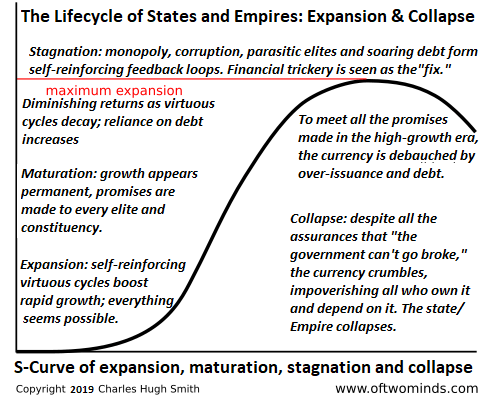
The cycles of The Fourth Turning, Fischer and Turchin are all in alignment at this point in history..

The 1997 book The Fourth Turning: An American Prophecy proposed a cyclical pattern of four 20-year generations which culminate in a national crisis every 80 years. The book identifies these dates as Fourth Turnings: 1781 (Revolutionary War), 1861 (Civil War) and 1941 (global war). add 80 years and voila, 2021.

I use the term Fourth Turning generically to describe an existential crisis that decisively changes the course of national identity and history.

In other words, we don’t have to accept the book’s theory of generational dynamics to accept an 80-year cycle. There are other causal dynamics in play that also tend to cycle: the credit (Kondratieff) cycle, for example.

While each of the previous existential crises were resolved positively, positive outcomes are not guaranteed: dissolution and collapse are also potential outcomes.

David Hackett Fischer’s book The Great Wave: Price Revolutions and the Rhythm of History proposes another cycle: humans expand their numbers and consumption until they’ve exploited and depleted all available resources.

As resources become scarce, societies and economies unravel as humans do not respond well to rising prices generated by scarcities.

The unraveling continues until consumption is realigned with the resources available. In the past this meant either a mass die-off that drastically reduced human numbers and consumption (for example, The Black Plague), a decline in fertility that slowly reduced population to fit resources, mass migration to locales with more resources or the discovery and exploitation of a new scalable energy source that enabled a new cycle of rising consumption.

The 14th century Black Death reduce Europe’s population by roughly 40%, enabling depleted forests to regrow and depleted agricultural land to restore fertility.

Once the human population regained its numbers and consumption in the 17th century, wood was once again under pressure as the key source of energy, shipbuilding, housing, etc.

The development of steam power and the technologies of mining enabled the exploitation of coal, which soon replaced wood as the primary energy source.

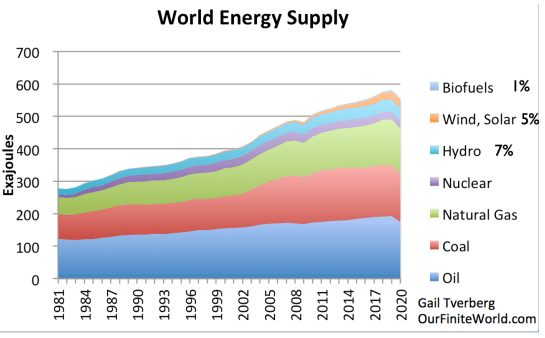
Oil and natural gas added to the energy humans could tap, followed (at a much more modest level) by nuclear power. Despite gargantuan investments, the recent push to develop solar and wind energy has yielded very modest results, as globally these sources provide about 5% of total energy consumption. (See chart below)

It’s self-evident that despite breezy claims of endless expansion of consumption, the global human population has now exceeded the resources available for practical extraction. Energy, fresh water, wild fisheries and fertile soils have all been exploited and the easy/cheap-to-extract resources have been depleted.

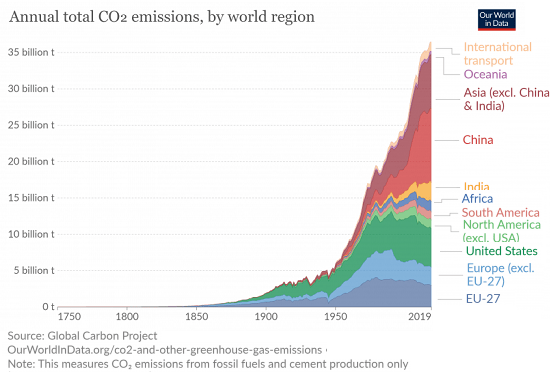
(The chart below of global CO2 emissions is a proxy for energy / resource consumption.)

So once again it’s crunch-time: either we proactively reduce consumption to align with available resources, or Nature will do it for us via scarcities.

Peter Turchin proposed another socio-economic cycle of 50 years in his book Ages of Discord: in the integrative stage, people find reasons to cooperate. In the disintegrative stage at the end of the cycle, people no longer find much common ground or reasons to cooperate. Political, social and financial extremes proliferate, culminating in a rolling crisis.

In Turchin’s analysis, the previous 50-year age of discord began around 1970, and the current era of discord began in 2020. Those who lived through the domestic terrorism, urban decay, stagflation and political/social/legal crises of the 1970s recall how inter-related crises dominated the decade.

In my analysis, the last period of discord in the 1970s was “saved” by the supergiant oil fields discovered in the 60s coming online in the late 1970s and early 1980s. That oil enabled a 40-year boom which is now ending, with no new scalable source of energy available to replace oil, much less enable an expansion of consumption.

In other words, the cycles of The Fourth Turning, Fischer and Turchin are all in alignment at this point in history. We have proliferating political, social and financial extremes and a forced transition to lower consumption to align with declining energy.

Turn, turn, turn. Right when we need to cooperate on transforming a high-consumption, bubble-dependent “waste is growth” Landfill Economy to declining consumption / Degrowth, we’re beset by discord and demographic pressures, as the promises made to the elderly back when it was expected that there would always be 5 workers per retiree cannot possibly be kept now that the worker-retiree ratio is 2-to-1 and there are no limits on healthcare spending for the elderly.

Humans are happy to expand their numbers and consumption and much less happy to consume less. They tend to start revolutions and wars in vain attempts to secure enough resources to maintain their profligate consumption and expansion.

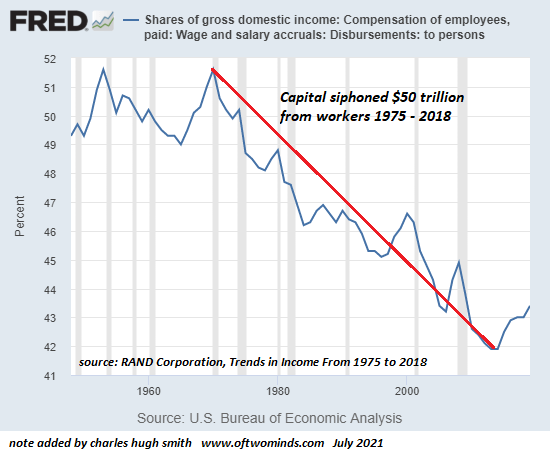
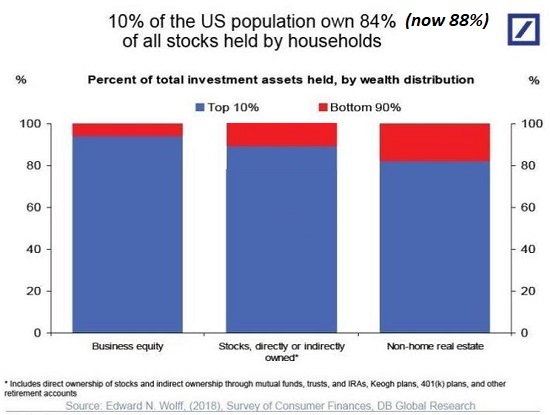
Today’s extremes of wealth and income inequality are optimized to spark political discord and revolts. The wealthiest 20% will be able to pay higher prices, but the bottom 40% will not. The middle 40% will find their disposable income, i.e. their income left over after paying for essentials, will drop to near-zero.

When 80% of the populace are crunched financially, revolutions and the overthrow of governments follow.

As I’ve outlined in previous posts, global inequalities are widening as the Core exploits its built-in advantages at the expense of the vulnerable Periphery.

Core nations will be much better able to maintain their consumption at the expense of the Periphery nations, which will experience sharp declines in purchasing power and consumption.

Previous Fourth Turnings have been resolved one way or another within 5 to 7 years. If this Turning began in 2020, we can expect resolution by 2025 – 2027.

As I explained in my book Global Crisis, National Renewal, those nations that embrace Degrowth will manage the transition, while those that cling to the endless-expansion, bubble-dependent Waste Is Growth model will fail.

This is why I keep talking about making Plans A, B and C to preserve optionality and reduce financial commitments and consumption now rather than passively await crises over which we will have little direct control.

As I’ve endeavored to explain, those anticipating decades of time to adjust are overlooking the systemic fragilities of the current global financial/supply systems. Tightly bound systems of interconnected dependency chains have been optimized to work perfectly in an era of expansion. They’re not optimized to gradually adjust to contraction; they’re optimized to break and trigger domino-like breakdowns in interconnected chains.

We don’t control these macro-trends, we only control our response.

Europe, more than Putin, must shoulder the blame for the energy crisis

The same arrogant, self-righteous posturing from the West that fuelled the Ukraine war is now plunging Europe into recession

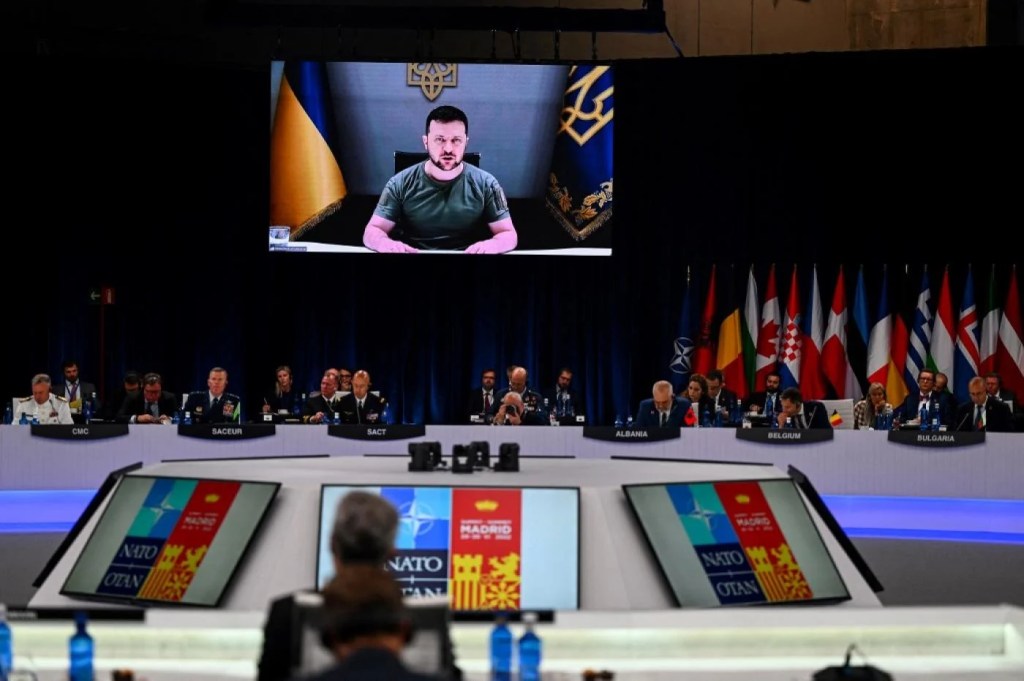
Ukraine’s President Volodymyr Zelensky appears on a giant screen as he addresses a Nato summit in Madrid, 29 June 2022 (AFP)

By Jonathan Cook

Source: Middle East Eye

Outraged western leaders are threatening a price cap on imports of Russian natural gas after Moscow cut supplies to Europe this month, deepening an already dire energy and cost-of-living crisis. In response, Russian President Vladimir Putin has warned that Europe will “freeze” this winter unless there is a change of tack.

In this back-and-forth, the West keeps stepping up the rhetoric. Putin is accused of using a mix of blackmail and economic terror against Europe. His actions supposedly prove once more that he is a monster who cannot be negotiated with, and a threat to world peace.

Denying fuel to Europe as winter approaches, in a bid to weaken the resolve of European states to support Kyiv and alienate European publics from their leaders, is Putin’s opening gambit in a plot to expand his territorial ambitions from Ukraine to the rest of Europe.

Or so runs the all-too-familiar narrative shared by western politicians and media.

In fact, Europe’s arrogant, self-righteous posturing over Russian gas supplies, divorced from any discernible geopolitical reality, reflects precisely the same foolhardy mindset that helped provoke Moscow’s invasion of Ukraine in the first place.

It is also the reason why there has been no exit ramp – a path to negotiations – even as Russia has taken vast swaths of Ukraine’s eastern and southern flanks – territory that cannot be reclaimed without a further massive loss of life on both sides, as the limited Ukrainian assault around Kharkiv has highlighted.

The western media has to carry a major share of the blame for these serial failures of diplomacy. Journalists have amplified only too loudly and uncritically what US and European leaders want their publics to believe is going on. But maybe it is time that Europeans heard a little of how things might look to Russian eyes.

Economic war

The media could start by dropping their indignation at “insolent” Moscow for refusing to supply Europe with gas. After all, Moscow has been only too clear about the reason for the shutdown of gas supplies: it is in retaliation for the West imposing economic sanctions – a form of collective punishment on the wider Russian population that risks violating the laws of war. 

The West is well practised in waging economic war on weak states, usually in a futile attempt to topple leaders they don’t like or as a softening-up exercise before it sends in troops or proxies.

Iran has faced decades of sanctions that have inflicted a devastating toll on its economy and population but done nothing to bring down the government.

Meanwhile, Washington is waging what amounts to its own form of economic terrorism on the Afghan people to punish the ruling Taliban for driving out US occupation forces last year in a humiliating fashion. The United Nations reported last month that sanctions had contributed to the risk of more than a million Afghan children dying from starvation.

There is nothing virtuous about the current economic sanctions on Russia either, any more than there is about the blackballing of Russian sportspeople and cultural icons. The sanctions are not intended to push Putin to the negotiating table. As US President Biden made clear in March, the West is planning for a long war and he wants to see Putin removed from power

Rather, the goal has been to weaken his authority and – in some fantasy scenario – encourage his subordinates to turn on him. The West’s game plan – if it can be dignified with that term – is to force Putin to over-extend Russian forces in Ukraine by flooding the battlefield with armaments, and then watch his government collapse under the weight of popular discontent at home.

But in practice, the reverse has been happening, just as it did through the 1990s when the West imposed sanctions on Iraq’s Saddam Hussein. Putin’s position has been bolstered, as it will continue to be whether Russia is triumphing or losing on the battlefield. 

The West’s economic sanctions against Russia have been doubly foolish. They have reinforced Putin’s message that the West seeks to destroy Russia, just as it previously did IraqAfghanistanLibyaSyria and Yemen. A strongman is all that stands between an independent Russia and servitude, Putin can plausibly argue.

And at the same time, the sanctions have demonstrated to Russians how truly artful their leader is. Economic pressure from the West has largely backfired: sanctions have barely made an impression on the value of the rouble, while Europe looks to be heading into recession as Putin turns off the gas spigot.

It will doubtless not only be Russians quietly rejoicing at seeing the West get a dose of the medicine it so regularly force-feeds others.

Western conceit

But there is a more troubling dimension to the West’s conceit. It was the same high-handed belief that the West would face no consequences for waging economic warfare on Russia, just as earlier assumed it would be pain-free for Nato to station missiles on Moscow’s doorstep. (Presumably, the effect on Ukrainians was not factored into the calculations.)

The decision to recruit ever-more east European states into the Nato fold over the past two decades not only broke promises made to Soviet and Russian leaders, but flew in the face of advice from the West’s most expert policy-makers.

Guided by the US, Nato countries closed the military noose around Russia year by year, all the while claiming that the noose was entirely defensive.

Nato flirted openly with Ukraine, suggesting that it too might be admitted to their anti-Russia alliance.

The US had a hand in the 2014 protests that overthrew Ukraine’s government, one elected to keep channels open with Moscow. 

With a new government installed, the Ukrainian army incorporated ultra-nationalist, anti-Russia militias that engaged in a devastating civil war with Russian communities in the country’s east.

And all the while, Nato secretly cooperated with and trained that same Ukrainian army.

At no point in the eight long years of Ukraine’s civil war did Europe or the US care to imagine how all these events unfolding in Russia’s backyard might look to ordinary Russians. Might they not fear the West just as much as western publics have been encouraged by their media to fear Moscow? Putin did not need to invent their concern. The West achieved that all by itself.

The encirclement of Russia by Nato was not a one-off error. Western meddling in the coup and support for a nationalist Ukrainian army increasingly hostile to Russia were not one-offs either. Nato’s decision to flood Ukraine with weapons rather than concentrate on diplomacy is no aberration. Nor is the decision to impose economic sanctions on ordinary Russians.

These are all of a piece, a pattern of pathological behaviour by the West towards Russia – and any other resource-rich state that does not utterly submit to western control. If the West were an individual, the patient would be diagnosed as suffering from a severe personality disorder, one with a strong impulse for self-destruction.

Bogeyman needed

Worse still, this impulse does not appear to be open to correction – not as things stand. The truth is that Nato and its US ringmaster have no interest in changing.

Their purpose is to have a credible bogeyman, one that justifies continuing the massive wealth redistribution from ordinary citizens to an elite of the already ultra-rich. A supposed threat to Europe’s safety justifies pouring money into the maw of an expanding war machine masquerading as the “defence industries” – the military, the arms manufacturers, and the ever-growing complex of the surveillance, intelligence and security industries. Both Nato and a US network of more than 800 military bases around the globe just keep growing.

A bogeyman also ensures western publics are unified in their fear and hatred of an external enemy, making them readier to defer to their leaders to protect them – and with it, the institutions of power those leaders uphold and the status quo they represent.

Anyone suggesting meaningful reform of that system can be rounded on as a threat to national security, a traitor or a fool, as Britain’s former Labour leader Jeremy Corbyn found out.

And a bogeyman distracts western publics from thinking about deeper threats, ones that our own leaders – rather than foreigners – are responsible for, such as the climate crisis they not only ignored but still fuel through the very military posturing and global confrontations they use to distract us. It is a perfect circle of self-harm.

Since the fall of the Berlin Wall, and the demise of the Soviet Union, the West has been casting around for a useful bogeyman to replace the Soviet Union, one that supposedly presents an existential threat to western civilisation.

Iraq’s weapons of mass distraction were only 45 minutes away – until we learned they did not, in fact, exist.

Afghanistan’s Taliban was harbouring al-Qaeda – until we learned that the Taliban had offered to hand Osama bin Laden over even before the 9/11 attacks.

There was the terrifying threat from the head-choppers of the Islamic State (IS) group – until we learned that they were the West’s arm’s-length allies in Syria and being supplied with weapons from Libya after it was liberated by the West from its dictator, Muammar Gadaffi.

And there is always Iran and its supposed nuclear weapons to worry about, even though Tehran signed an agreement in 2015 putting in place strict international oversight to prevent it from developing a bomb – until the US casually discarded the deal under pressure from Israel and chose not to replace it with anything else.

Braced for recession

Each of these threats was so grave it required an enormous expenditure of energy and treasure, until it had served its purpose of terrifying western publics into acquiescence. Invariably, the West’s meddling spawned a backlash that created another temporary enemy.

Now, like a predictable Hollywood sequel, the Cold War is back with a vengeance. Russia’s President Putin has a starring role. And the military-industrial complex is licking its lips with delight.

Ordinary people and small businesses are being told by European leaders to brace for a recession as energy companies once again clock up “eye-watering” profits.

Just as with the financial crash nearly 15 years ago, when the public was required to tighten its belt through austerity policies, a crisis is providing ideal conditions for wealth to be redistributed upwards.

Like other officials, Nato’s Secretary-General Jens Stoltenberg has sounded the alarm about “civil unrest” this winter as prices across Europe soar, even while demanding public money be used to send yet more weapons to Ukraine.

The question is whether western publics will keep buying the narrative of an existential threat that can only be dealt with if they, rather than their leaders, dig deep into their pockets. 

Escalation: Recent Events Suggest Mounting Economic Danger

By Brandon Smith

Source: Alt-Market.us

A common refrain from people who are critical of alternative economists is that we have been predicting crisis for so long that “eventually we will be right.” These are generally people who don’t understand the nature of economic decline – It’s like an avalanche that builds over time, then breaks and quickly escalates as it flows down the mountain. What they don’t grasp is that they are in the middle of an economic collapse RIGHT NOW, and they just can’t see it because they have been acclimated to the presence of the snow and cold.

Economic decline is a process that takes many years, and while you might get an event like the market crash of 1929 or the crash of 2008, these moments of panic are nothing more than the wreckage left behind by the great wave of tumbling ice that everyone should have seen coming far in advance, but they refused.

In 2022 the job of warning people is far easier than it used to be because we are well past the midpoint of the process of decline. But, believe it or not, I still get people today who claim that we analysts are “doom mongers.” The power of willful ignorance is truly amazing. It’s enough to make a person blind to stagflationary crisis, supply chain disruptions, quickly inflating prices, stock market carnage, bond market instability, record consumer debt, and international conflict.

At this point, I think if a person can’t see the dangers ahead they are probably a waste of time and space and are destined to be buried in the ice; there’s nothing that can be done for them. Yes, there are some people out there that don’t get exposed to the information and we have to take them into account, but my priority will be people that are awake and aware and try to give them a sense of what point in the collapse process we find ourselves.

In the past month there has been a considerable uptick in economic and geopolitical activity that suggests we are entering a new phase, and not surprisingly it’s all accumulating right before we hit October. Here are the events that I find most concerning:

The European Energy Crisis

This is an event that I have been predicting since the Russian invasion of Ukraine and now it is upon us. I wrote about it extensively in my recent article ‘Europe Is Facing Energy Disaster And It’s Going To Bleed Over Into The US’ so I won’t rehash all that information here. What I do want to point out is the complete lack of planning on the part of European officials to deal with the threat. It is as if they WANT a full spectrum disaster.

Russia has now completely cut off natural gas supplies to Europe, which represent around 40% of all EU energy resources. Europe’s benchmark natural gas prices spiked by 28% a week ago, on top of already existing inflation. Oil supplies are also in steep decline for Europe and the EU government has pledged to cut what’s left of Russian oil imports by sea at the end of the year. Sadly, they have offered very little in the way of solutions to the supply-side problem.

There has been talk of increasing imports of alternative resources from other nations, but the EU is already buying up around 75% of all liquid natural gas from the US. OPEC oil producers have indicated they will not be attempting to increase production anytime soon (probably because they can’t due to inflation in operation costs). There is NO backup energy resource for Europe; it doesn’t exist right now. They will try to buy up whatever coal, oil and gas they can find on the market while driving up prices even more for other countries. They will still come up short, which means people are going to freeze this winter.

Best case scenario is that there are mostly mild temps and people barely scrape buy with minimum heating. But EU industry is going to suffer and many manufacturers are going to cut production (which mean more stress on the global supply chain).

Core Inflation Is Still Rising

As I warned last week in my article ‘It’s A Fact That Needs Repeating: The Federal Reserve Is A Suicide Bomber,’ inflation is continuing to rise despite the Fed’s continued interest rate hikes, giving the central bank even more ammunition to justify higher rates into extreme economic weakness.

The latest CPI print showed an increase to 8.3% and was a shock to markets which universally expected a drop. This is the nature of stagflation – Even with falling demand prices continue to climb or remain high for extended periods. The stagflation event of the 1970s lasted for a decade until the Fed jacked rates to 21% and then employment crumbled in the early 1980s.

This doesn’t mean that rates will go to 21% this time; they don’t need to. All it would take is a Federal Funds Rate of around 4% – 5% to crash our current QE addicted system. A 75 bps rate hike is now widely expected at the next Fed meeting this month, with some predicting a 100 bps hike. This would put us close to crash territory for markets and for employment, though I think we still have well into 2023 before unemployment really starts to spike.

Putin’s Meeting With Xi

As I write this, Vladimir Putin is set to meet with China’s Xi Jinping and the nature of the conference is not clear. There are the obvious points of agreement such as China’s continued purchases of Russian oil and other commodities, as well as the ongoing plan to build a pipeline to China by 2025. There is also strategic cooperation which is evident in the recent naval exercises between the two nations around Japan and Taiwan.

The timing of the meeting is concerning to me, because the prime season for a potential Chinese invasion of Taiwan is fast approaching (October is the best month for naval movements to avoid typhoons). China would not necessarily need to commit to a ground invasion, either. They could simply cut off all import/export trade from any source other than China and starve Taiwan until they accept unification.

There is also the issue of Ukraine and arms sales. With the amount of propaganda coming from Ukrainian Intelligence and NATO, it’s hard to say what is actually happening, but I suspect Russia is changing strategies and repositioning to deploy missile and artillery bombardment of infrastructure, including power grids and water. This is a tactic that Russia has avoided for months (until this week), which is surprising because one of the first measures usually taken by the US during an invasion is to eliminate most key infrastructure (as we did in Iraq). You would think Russia would have done the same, but perhaps they were saving that scenario for winter when it is harder for Ukraine to cope.

This would make Ukraine essentially unlivable in the coming winter for most of the population. Putin may be seeking to ensure China remains a steady economic partner should geopolitical pressures increase. They may even be making a deal of mutual support: China takes Taiwan while Russia makes Ukraine a resource wasteland and they each support the other economically when NATO counties try to impose sanctions on China. We probably won’t know until October, but the timing of the meeting should raise eyebrows.

If the manure is about to hit the fan in Taiwan along with Ukraine, then diplomatic and economic ties will be severed and western access to China’s manufacturing will be cut. This is a problem for China’s economy, certainly, which may be why they have continued their mass covid lockdowns well after every other government has abandoned them. Could this be practice for civil controls in an impending war environment?

China’s global dominance in imports/exports gives them considerable economic leverage in trade, however. Many nations would not support sanctions against them. Also, their vast holdings of US dollars and Treasuries could be used as a weapon to damage or destroy the dollar’s world reserve status. If China invades Taiwan this year, then all bets are off – The economic decline will move swiftly from that point on.

There are many other trends which factor into the crash environment but the above factors are the most recent and hold the biggest potential for causing a domino effect globally. The question that always arises is “what can we do about it?” Not much in terms of prevention. What we can do, though, is prepare locally to weather the storm. This means stocking necessities before they rise even further in price or become non-existent. Become a producer and learn a valuable skill for survival in a depleted economy Organize with people locally who are on the same page to create security and alternative trade opportunities.

Hopefully, the aware citizenry will rise to the challenge and organization will be extensive, because the worst case scenario would be great masses of completely isolated people all vying against each other rather than working towards mutual security. Even in a slow collapse scenario this is a problem in terms of rising crime; so plan on working with others if you want to avoid inevitable third world conditions.

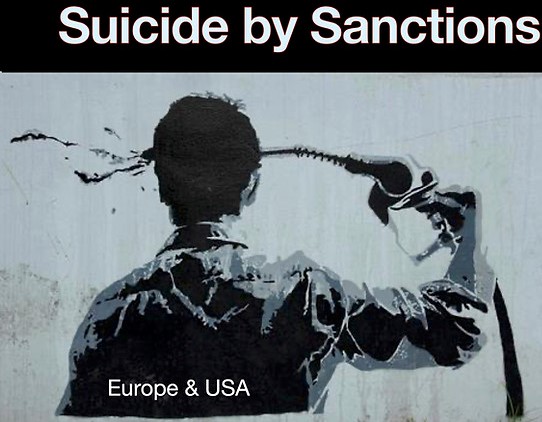
Europe Commits Suicide-By-Sanctions

Relentless Ukraine reporting helps conceal other conflicts

By Ron Paul

Source: Eurasia Review

A Swiss billboard is making the rounds on social media depicting a young woman on the telephone. The caption reads, “Does the neighbor heat the apartment to over 19 degrees (66F)? Please inform us.” While the Swiss government has dismissed the poster as a fake, the penalties Swiss citizens face for daring to warm their homes are very real. According to the Swiss newspaper Blick, those who violate the 66 degree heating limit could face as many as three years in prison!

Prison time for heating your home? In the “free” world? How is it possible in 2022, when Switzerland and the rest of the political west have achieved the greatest economic success in history, that the European continent faces a winter like something out of the dark ages?

Sanctions.

While long promoted – often by those opposed to war – as a less destructive alternative to war, sanctions are in reality acts of war. And as we know with interventionism and war, the result is often unintended consequences and even blowback.

European sanctions against Russia over its invasion of Ukraine earlier this year will likely go down in history as a prime example of how sanctions can result in unintended consequences. While seeking to punish Russia by cutting off gas and oil imports, European Union politicians forgot that Europe is completely dependent on Russian energy supplies and that the only people to suffer if those imports are shut down are the Europeans themselves.

The Russians simply pivoted to the south and east and found plenty of new buyers in China, India, and elsewhere. In fact, Russia’s state-run Gazprom energy company has reported that its profits have increased by 100 percent in the first half of this year.

Russia is getting rich while Europeans are facing a freezing winter and economic collapse. All because of the false belief that sanctions are a cost-free way to force other countries to do what you want them to do.

What happens when the people see dumb government policies making energy bills skyrocket as the economy grounds to a halt? They become desperate and take to the streets in protest.

This weekend thousands of Austrians took to the streets in a “Freedom Rally” to demand an end to sanctions and the opening of Nord Stream II, the gas pipeline on the verge of opening earlier this year. Last week an estimated 100,000 Czechs took to the streets of Prague to protest NATO and EU policy. In France, the “Yellow Vests” are back in the streets protesting the destruction of their economy in the name of “defeating” Russia in Ukraine. In Germany, Serbia, and elsewhere, protests are gearing up.

Even the Washington Post was forced to admit that sanctions on Russia are not having the intended effect. In an article yesterday, the paper worries that sanctions are inflicting “collateral damage in Russia and beyond, potentially even hurting the very countries that impose them. Some even worried that the sanctions intended to deter and weaken Putin could end up emboldening and strengthening him.”

This is all predictable. Sanctions kill. Sometimes they kill innocents in the country targeted for destruction and sometimes they kill innocents in the country imposing them. The solution, as always, is non-intervention. No sanctions, no “color revolutions,” no meddling. It’s really that simple.

An Engineered Food and Poverty Crisis to Secure Continued US Dominance 

By Colin Todhunter

Source: Dissident Voice

In March 2022, UN Secretary-General Antonio Guterres warned of a “hurricane of hunger and a meltdown of the global food system” in the wake of the crisis in Ukraine.

Guterres said food, fuel and fertiliser prices were skyrocketing with supply chains being disrupted and added this is hitting the poorest the hardest and planting the seeds for political instability and unrest around the globe.

According to the International Panel of Experts on Sustainable Food Systems, there is currently sufficient food and no risk of global food supply shortages.

We see an abundance of food but skyrocketing prices. The issue is not food shortage but speculation on food commodities and the manipulation of an inherently flawed global food system that serves the interests of corporate agribusiness traders and suppliers of inputs at the expense of people’s needs and genuine food security.

The war in Ukraine is a geopolitical trade and energy conflict. It is largely about the US engaging in a proxy war against Russia and Europe by attempting to separate Europe from Russia and imposing sanctions on Russia to harm Europe and make it further dependent on the US.

Economist Professor Michael Hudson recently stated that ultimately the war is against Europe and Germany. The purpose of the sanctions is to prevent Europe and other allies from increasing their trade and investment with Russia and China.

Neoliberal policies since the 1980s have hollowed out the US economy. With its productive base severely weakened, the only way for the US to maintain hegemony is to undermine China and Russia and weaken Europe.

Hudson says that, beginning a year ago, Biden and the US neocons attempted to block Nord Stream 2 and all (energy) trade with Russia so that the US could monopolise it itself.

Despite the ‘green agenda’ currently being pushed, the US still relies on fossil fuel-based energy to project its power abroad. Even as Russia and China move away from the dollar, the control and pricing of oil and gas (and resulting debt) in dollars remains key to US attempts to retain hegemony.

The US knew beforehand how sanctions on Russia would play out. They would serve to divide the world into two blocks and fuel a new cold war with the US and Europe on one side with China and Russia being the two main countries on the other.

US policy makers knew Europe would be devastated by higher energy and food prices and food importing countries in the Global South would suffer due to rising costs.

It is not the first time the US has engineered a major crisis to maintain global hegemony and a spike in key commodity prices that effectively trap countries into dependency and debt.

In 2009, Andrew Gavin Marshall described how in 1973 – not long after coming off the gold standard – Henry Kissinger was integral to manipulating events in the Middle East (the Arab-Israeli war and the ‘energy crisis’). This served to continue global hegemony for the US, which had virtually bankrupted itself due to its war in Vietnam and had been threatened by the economic rise of Germany and Japan.

Kissinger helped secure huge OPEC oil price rises and thus sufficient profits for Anglo-American oil companies that had over-leveraged themselves in North Sea oil. He also cemented the petrodollar system with the Saudis and subsequently placed African nations, which had embarked on a path of (oil-based) industrialisation, on a treadmill of dependency and debt due to the spike in oil prices.

It is widely believed that the high-priced oil policy was aimed at hurting Europe, Japan and the developing world.

Today, the US is again waging a war on vast swathes of humanity, whose impoverishment is intended to ensure they remain dependent on the US and the financial institutions it uses to create dependency and indebtedness – the World Bank and IMF.

Hundreds of millions will experience (are experiencing) poverty and hunger due to US policy. These people (the ones that the US and Pfizer et al supposedly cared so much about and wanted to get a jab into each of their arms) are regarded with contempt and collateral damage in the great geopolitical game.

Contrary to what many believe, the US has not miscalculated the outcome of the sanctions placed on Russia. Michael Hudson notes energy prices are increasing, benefiting US oil companies and US balance of payments as an energy exporter. Moreover, by sanctioning Russia, the aim is to curtail Russian exports (of wheat and gas used for fertiliser production) and for agricultural commodity prices to therefore increase. This too will also benefit the US as an agricultural exporter.

This is how the US seeks to maintain dominance over other countries.

Current policies are designed to create a food and debt crisis for poorer nations especially. The US can use this debt crisis to force countries to continue privatising and selling off their public assets in order to service the debts to pay for the higher oil and food imports.

This imperialist strategy comes on the back of ‘COVID relief’ loans which have served a similar purpose. In 2021, an Oxfam review of IMF COVID-19 loans showed that 33 African countries were encouraged to pursue austerity policies. The world’s poorest countries are due to pay $43 billion in debt repayments in 2022, which could otherwise cover the costs of their food imports.

Oxfam and Development Finance International have also revealed that 43 out of 55 African Union member states face public expenditure cuts totalling $183 billion over the next five years.

The closure of the world economy in March 2020 (‘lockdown’) served to trigger an unprecedented process of global indebtedness. Conditionalities mean national governments will have to capitulate to the demands of Western financial institutions. These debts are largely dollar-denominated, helping to strengthen the US dollar and US leverage over countries.

The US is creating a new world order and needs to ensure much of the Global South remains in its orbit of influence rather than ending up in the Russian and especially Chinese camp and its belt road initiative for economic prosperity.

Post-COVID, this is what the war in Ukraine, sanctions on Russia and the engineered food and energy crisis are really about.

Back in 2014, Michael Hudson stated that the US has been able to dominate most of the Global South through agriculture and control of the food supply. The World Bank’s geopolitical lending strategy has transformed countries into food deficit areas by convincing them to grow cash crops – plantation export crops – not to feed themselves with their own food crops.

The oil sector and agribusiness have been joined at the hip as part of US geopolitical strategy.

The dominant notion of ‘food security’ promoted by global agribusiness players like Cargill, Archer Daniel Midland, Bunge and Louis Dreyfus and supported by the World Bank is based on the ability of people and nations to purchase food. It has nothing to do with self-sufficiency and everything to do with global markets and supply chains controlled by giant agribusiness players.

Along with oil, the control of global agriculture has been a linchpin of US geopolitical strategy for many decades. The Green Revolution was exported courtesy of oil-rich interests and poorer nations adopted agri-capital’s chemical- and oil-dependent model of agriculture that required loans for inputs and related infrastructure development.

It entailed trapping nations into a globalised food system that relies on export commodity mono-cropping to earn foreign exchange linked to sovereign dollar-denominated debt repayment and World Bank/IMF ‘structural adjustment’ directives. What we have seen has been the transformation of many countries from food self-sufficiency into food deficit areas.

And what we have also seen is countries being placed on commodity crop production treadmills. The need for foreign currency (US dollars) to buy oil and food entrenches the need to increase cash crop production for exports.

The World Trade Organization’s Agreement on Agriculture (AoA) set out the trade regime necessary for this type of corporate dependency that masquerades as ‘global food security’.

This is explained in a July 2022 report by Navdanya International – Sowing Hunger, Reaping Profits – A Food Crisis by Design – which notes international trade laws and trade liberalisation has benefited large agribusiness and continue to piggyback off the implementation of the Green Revolution.

The report states that US lobby and trade negotiations were headed by former Cargill Investors Service CEO and Goldman Sachs executive – Dan Amstutz – who in 1988 was appointed chief negotiator for the Uruguay round of GATT by Ronald Reagan. This helped to enshrine the interests of US agribusiness into the new rules that would govern the global trade of commodities and subsequent waves of industrial agriculture expansion.

The AoA removed protection of farmers from global market prices and fluctuations. At the same time, exceptions were made for the US and the EU to continue subsidising their agriculture to the advantage of large agribusiness.

Navdanya notes:

With the removal of state tariff protections and subsidies, small farmers were left destitute. The result has been a disparity in what farmers earn for what they produce, versus what consumers pay, with farmers earning less and consumers paying more as agribusiness middlemen take the biggest cut.

‘Food security’ has led to the dismantling of food sovereignty and food self-sufficiency for the sake of global market integration and corporate power.

We need look no further than India to see this in action. The now repealed recent farm legislation in India was aimed at giving the country the ‘shock therapy’ of neoliberalism that other countries have experienced.

The ‘liberalising’ legislation was in part aimed at benefiting US agribusiness interests and trapping India into food insecurity by compelling the country to eradicate its food buffer stocks – so vital to the nation’s food security – and then bid for food on a volatile global market from agribusiness traders with its foreign reserves.

The Indian government was only prevented from following this route by the massive, year-long farmer protest that occurred.

The current crisis is also being fuelled by speculation. Navdanya cites an investigation by Lighthouse Reports and The Wire to show how speculation by investment firms, banks and hedge funds on agricultural commodities are profiting off rising food prices. Commodity future prices are no longer linked to actual supply and demand in the market but are based purely on speculation.

Archer Daniels Midland, Bunge, Cargill and Louis Dreyfus and investment funds like Black Rock and Vanguard continue to make huge financial killings, resulting in the price of bread almost doubling in some poorer countries.

The cynical ‘solution’ promoted by global agribusiness to the current food crisis is to urge farmers to produce more and seek better yields as if the crisis is that of underproduction. It means more chemical inputs, more genetic engineering techniques and suchlike, placing more farmers in debt and trapped in dependency.

It is the same old industry lie that the world will starve without its products and requires more of them. The reality is that the world is facing hunger and rising food prices because of the system big agribusiness has instituted.

And it is the same old story – pushing out new technologies in search of a problem and then using crises as justification for their rollout while ignoring the underlying reasons for such crises.

Navdanya sets out possible solutions to the current situation based on principles of agroecology, short supply lines, food sovereignty and economic democracy – policies that have been described at length in many articles and official reports over the years.

As for fighting back against the onslaught on ordinary people’s living standards, support is gathering among the labour movement in places like the UK. Rail union leader Mick Lynch is calling for a working class movement based on solidarity and class consciousness to fight back against a billionaire class that is acutely aware of its own class interests.

For too long, ‘class’ has been absent from mainstream political discourse. It is only through organised, united protest that ordinary people will have any chance of meaningful impact against the new world order of tyrannical authoritarianism and the devastating attacks on ordinary people’s rights, livelihoods and standards of living that we are witnessing.

What Will You Say When Millions Of People Starve To Death?

By Michael Snyder

Source: End of the American Dream

For a long time, those of us that were claiming that a global famine was coming were widely mocked.  The skeptics could see the exact same trends that everyone else could see, but they just assumed that we would find a way to muddle through somehow.  So they didn’t want to listen to common sense, and they weren’t interested in warnings from “gloom and doomers” such as myself.  But I don’t consider myself to be a “doom and gloomer” because I am actually a very optimistic person.  I am so excited to be living during this time in human history, but I also know that very difficult times are ahead of us.  One of the major trends that I keep writing about over and over is famine, because the truth is that there simply is not going to be enough food for everyone on the planet in 2023 and beyond.  Of course the mainstream media is also starting to issue similar warnings.  For example, the following comes from a Yahoo News article entitled “Millions in East Africa face starvation due to drought”

The World Health Organization warned on Wednesday that millions of people in East Africa face the threat of starvation. Speaking at a media briefing in Geneva, WHO Director-General Tedros Adhanom Ghebreyesus said that drought, climate change, rising prices and an ongoing civil war in northern Ethiopia are all contributing to worsening food insecurity.

Over 50 million people in East Africa will face acute food insecurity this year, a study from late July by the World Food Programme and Food and Agriculture Organization found. Roughly 7 million children are suffering from malnourishment and, according to the United Nations High Commissioner for Refugees, hundreds of thousands are leaving their homes in search of food or livelihoods. Affected countries include Djibouti, Ethiopia, Kenya, Somalia, South Sudan, Sudan and Uganda.

In Somalia, authorities are projecting that vegetable and grain production will “drop by about 80% this year” due to the endless drought that they are currently experiencing.

Millions of precious people in Africa are facing imminent starvation.  But most of us in the western world don’t care, because our grocery stores are still full of food.

If you are one of those people that are choosing to ignore what is happening on the other side of the planet, you can afford to be cocky for now.

But conditions are starting to change here too.

Earlier today, I came across an excellent article about how the multi-year megadrought in the western half of the country is absolutely devastating the ranching industry…

The megadrought in the Western U.S., the region’s worst in 1,200 years, is threatening America’s cattle heartland: withering pastures, wrecking feed harvests and endangering a quintessential way of life.

The drought is forcing ranchers here in Texas and across the Southern plains to make an agonizing decision: Sell early now for less money than they planned on — or hold on, pray for rain and risk losing everything.

Sadly, more ranchers are deciding to sell off cattle with each passing day.

If you can believe it, the rate at which cattle are being sold is now 120 percent above last year’s level…

Over the last two weeks of July, the national cattle sale rate also jumped to 120 percent above 2021 levels — an average that reporting by The Hill and KAMR suggested conceals even higher frenzies of sales in some markets.

What this means is that lots of beef is coming on to the market.

Beef prices had been soaring, but in the short-term all of the cattle that are being slaughtered will help to moderate prices.

However, the outlook for 2023 is grim.  The national cattle herd just keeps getting smaller and smaller, and some beef producers in Oklahoma are now predicting that ground beef “could eventually top $50 per pound”

Thanks to the unending economic symptoms of the pandemic and 2022’s inflation double-punch, average beef prices are currently about twice what they were in 2019. Add in the deepening widespread drought, a shortage of hay and feed, skyrocketing prices, transport costs, and various other metrics, some Southwest Oklahoma beef producers suggest cheap ground beef could eventually top $50 per pound.

If the price of ground beef does reach 50 dollars a pound, what do you think our country will look like?

Needless to say, at that point there will be absolutely no debate about whether we are in a global food crisis or not.

And we are also being told that we could soon be facing shortages of potatoes and tomatoes.  The following comes from Zero Hedge

Days ago, we said the next food insecurity problem that may impact Americans’ eating habits could be an emerging potato shortage. Now there appears to be another issue: Tomatoes are getting squeezed, and risks of a ketchup shortage rise as a severe drought batter California’s farmland.

California accounts for a quarter of the world’s tomato output. The worst drought in 1,200 years has forced farmers to abandon fields as crops turn to dust amid a water crisis.

I recently wrote an entire article about the coming tomato shortage that you can find right here.  Unless some rain comes along, the tomato crop in California this year is going to be absolutely disastrous.

So are you ready to eat less pizza because there isn’t enough pizza sauce to go around?

And are you ready to pay twice as much for spaghetti sauce at the grocery store?

On top of everything else, we are also potentially facing an extremely painful shortage of cotton

Intense drought has forced cotton farmers to abandon millions of acres that have produced so little cotton that they are no longer worth harvesting, the Wall Street Journal reported Tuesday.

Farmers will harvest an estimated 7.13 million acres, abandoning approximately 5.35 million acres due to an ongoing drought hammering southern U.S. states, representing an estimated abandonment rate of 42.87%, according to the National Cotton Council of America, who based their analysis on U.S. Department of Agriculture (USDA) data. This represents the smallest harvest by area since 1868, The Wall Street Journal reported.

What I have touched on in this article is just the tip of the iceberg.

Agricultural production is going to be way down all over the planet this year.

But we will surely find a way to “muddle through” somehow, right?

If you have been a skeptic of reports of shortages and famine, it is time to wake up.

We really are staring an unprecedented global crisis right in the face, and the months ahead are going to be filled with pain.

More Billions to Ukraine as America Falls Apart

By Ron Paul

Source: Ron Paul Institute

There is a video clip making the rounds showing President Biden speaking at a recent NATO summit about the seven billion dollars the US government had – at that time – provided to Ukraine. Attached to that is another clip showing the horrific state of several US major cities, including in Pennsylvania, California, and Ohio. The video of American cities is shocking: endless landscapes of filth, trash, homelessness, open fires on the street, drug-addicted zombies. It doesn’t look like the America most of us remember.

Watching Biden bragging about sending billions of dollars to corrupt leaders overseas with American cities looking like bombed-out Iraq or Libya is US foreign policy in a nutshell. The Washington elites tell the rest of America that they must “promote democracy” in some far-off land. Anyone who objects is considered in league with the appointed enemy of the day. Once it was Saddam, then Assad and Gaddafi. Now it’s Putin. The game is the same, only the names are changed.

What is seldom asked, is what is in this deal for those Americans who suffer to pay for our interventionist foreign policy. Do they really think a working American in Ohio or Pennsylvania is better off or safer because we are supposedly protecting Ukraine’s borders? I think most Americans would wonder why they aren’t bothering to protect our own borders.

A reported 200,000 illegals crossed the border into the US in July alone. You can believe they are learning quickly about the free money provided by the US government to illegals. They’ll probably get a voting card as well.

Last Friday the Pentagon announced that yet another $775 million would be sent to Ukraine. As Antiwar.com reported, it was the eighteenth weapons package to Ukraine in six months. Has there ever been a more idiotic US intervention in history?

Supporters of this proxy war may celebrate more aid to Ukraine, but the reality is that it is in no way aid to Ukraine. That’s not how the system works. It is money created out of thin air by the Fed and appropriated by Congress to be spent propping up the politically-connected military-industrial complex. It is a big check written by middle America to rich people who run Raytheon and Lockheed Martin. Americans watch their budget being stretched to the limit while the Beltway fat-cats loosen their belts to continue enjoying the gravy train.

Bloomberg reported earlier this summer that inflation is costing the average American household more than $5,200 this year. Inflation is a tax on middle class and poor Americans. The wealthy – like those who run Raytheon and Lockheed Martin – always get the new money first, before prices go up. The rest of us watch as the dollar buys less and less.

As Washington salivates over fighting Russia in Ukraine, the rest of America feels like we’re becoming Zimbabwe. How long until it takes a trillion dollars for a loaf of bread? Will there be a run on wheelbarrows?

There is a way out. It’s called “non-interventionism.” The war in Ukraine was caused by the US regime change in 2014 and the neocon insistence that Ukraine join NATO. The State Department and CIA thought it was a great victory to overthrow the elected government, but meanwhile the rest of us get the bill. No NATO and not one more penny for Ukraine!