“I Am Cuba” (1964) is a Soviet-Cuban co-production directed by Mikhail Kalatozov which ties together several stories depicting different aspects of the Cuban experience during the pre-Castro era. Upon release (and long after), the film was largely ignored, being too Communist for western audiences and not revolutionary enough for audiences in the Soviet Union. Fortunately, in the 1990s the film was re-discovered and championed by prominent directors such as Martin Scorsese and Francis Ford Coppola who with Milestone Films re-released the film at New York’s Film Forum in 1995. I Am Cuba is notable for inspiring and emotionally powerful scenes as well as technical achievements such as complex tracking shots and striking cinematography utilizing wide angle lenses and infrared film stock.
“Light Years” (1988) is the US version of the film “Gandahar” directed by René Laloux who previously directed the mind-bending animated sci-fi classic “Fantastic Planet”. While the animation in Light Years is of lesser quality than Fantastic Planet, it’s just as imaginative and ambitious in its depiction of an alien world. Its plot centers on the bioengineering based civilization of Gandahar who, with the help of a mutant race they created struggle for survival against an army of automatons. While the French version has a superior soundtrack by Gabriel Yared, the US version does feature fine voice actors including Glenn Close, Bridget Fonda, David Johansen and Christopher Plummer as well as an intelligent screenplay adaptation by Isaac Asimov.
“Kamikaze Girls” (2004) is a film adaptation of the novel and manga “Shimotsuma Story” directed by Tetsuya Nakashima. It’s about the unlikely friendship between girls of vastly different subcultures; one a “Lolita” obsessed by Rococco-era French fashions and the other a member of a “Yanki” biker gang modeled after 1950’s American rock and rollers. Besides the underlying theme of friendship transcending cultural differences, it’s also a coming-of-age story with a positive message about the importance of pursuing one’s dreams, rejecting conformity, and thinking/acting independently. Similar to Nakashima’s other films such as “Memories of Matsuko” and “Paco and the Magical Book” (as well as Jeunet’s “Amélie”) the viewing experience of Kamikaze Girls is enhanced by surrealistic touches such as over-saturated colors and inventive camera/editing work.
Update: no longer on YouTube but still available with subtitles here.
Director Todd Haynes is well-known for his arty, fictionalized depictions of music iconography. Velvet Goldmine was a glam rock epic, with characters modeled after Bowie and Iggy, while I’m Not There features seven different actors portraying “fictional” facets of Bob Dylan’s personality or mystique. Both films blur reality with stylized interpretations, but neither takes even a fraction of the liberties Haynes exercised with his 1987 grad school student film, Superstar: The Karen Carpenter Story.
The film opens up on Karen’s death, then flashes back to narrate her rise to fame. It’s a spasmodic format—switching between interviews with peripheral music industry people, random footage and fascinatingly elaborate mise-en-scène reenactments staged with Barbie dolls and melodramatic voice-overs. In reference to Karen’s anorexia, Haynes actually whittled down her Barbie effigy with a knife for later scenes, mimicking the progressive emaciation of her body. It’s a dark portrayal of a slow death, Karen and Barbie, both icons of American perfection, wasting away before our eyes.
Superstar: The Karen Carpenter Story is technically illegal to exhibit, although since the advent of YouTube, it’s a bit of a moot point (the upload embedded below was posted in 2012). Karen’s brother Richard sued Haynes for copyright infringement. MOMA has a copy but even they aren’t allowed to screen it. Even if Haynes hadn’t used Carpenters songs, there’s a good chance Richard Carpenter would’ve found basis for a lawsuit. Haynes portrays Karen as the victim of her narcissistic and tyrannical family, even suggesting Richard was closeted.
It’s difficult not to be sympathetic to Richard Carpenter who probably viewed the film as mere ghoulish, exploitative sensationalism. It’s a strangely invasive and voyeuristic piece of art, and the argument could be made that it’s totally unethical in its ambiguous, semi-biographical fiction. It’s also totally hypnotic, with a compelling narrative and a pioneering experimentalism that makes it one of the great cult classics.
“Heaven and Earth” (1993) was released at the height of director Oliver Stone’s popularity (made between JFK and Natural Born Killers) and is considered the final film of his “Vietnam Trilogy” following Platoon and Born on the Fourth of July. While Heaven and Earth is just as powerful and provocative (if not more so) than Stone’s other films, it has never received the popular and critical recognition it deserves. Unlike the other films of the Vietnam Trilogy (and most films about war) Heaven and Earth tells the story of an innocent civilian of a war-torn nation as well as the psychological impact of war on soldiers and their post-war life. The film features a remarkable debut performance by Hiep Thi Le and a career-best performance by Tommy Lee Jones.
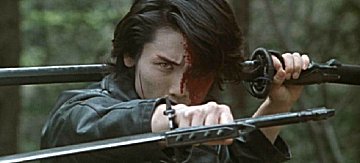
“Versus” (2000) is an action/horror/comedy directed by Ryuhei Kitamura about an escaped prisoner’s fight for survival against Yakuza gangsters and zombies in a forest containing an inter-dimensional portal. As the film’s title suggests, the main focus is on action scene setpieces which mash-up a wide range of genre tropes in an over-the-top style.
Obviously the film isn’t for everyone but if one happens to have intersecting interests in Yakuza, Samurai and zombie films, it doesn’t get much better than “Versus”. Even for those less fanatical about such genres it’s better than one might expect thanks to the enthusiasm and low-budget inventiveness of the filmmakers, athleticism of lead actor Tak Sakaguchi and the team of stuntmen, and a self-aware absurdist sense of humor.
“The Return of the Living Dead” (1985) was written and directed by Dan O’Bannon (writer of “Dark Star” and “Alien”), and remains among the all-time horror/comedy classics. Unlike typical zombie film scenarios, this one is set off by bumbling employees who release military-grade toxic waste inexplicably stored in the basement of a medical storage facility. The girlfriend of one of the employees and her punk rocker friends end up at the scene and find themselves under siege from reanimated bodies in the storage facility and the neighboring cemetery. While zombie apocalypse films are a dime a dozen today, Return of the Living Dead still has an edge thanks to it’s nihilistic slapstick humor and biting social satire. Four sequels followed Return of the Living Dead, none of them nearly as good.