
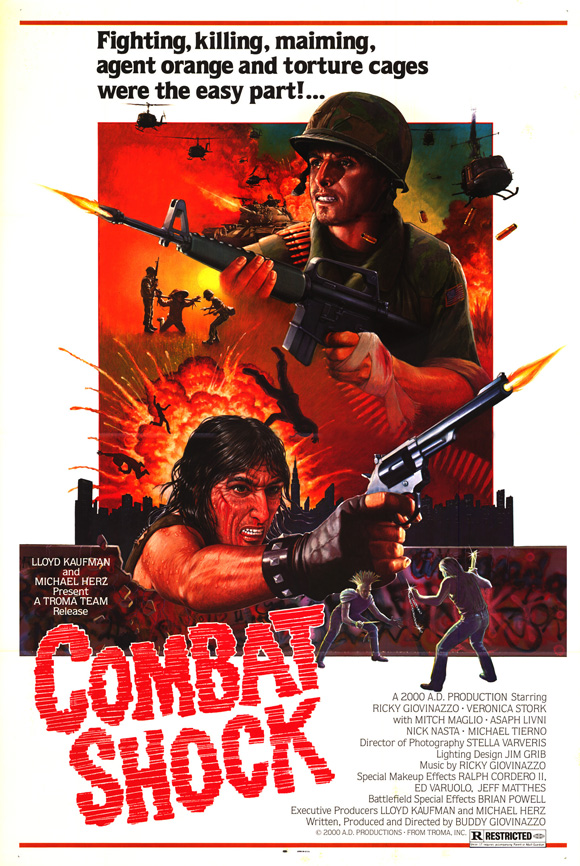
Saturday Matinee: Combat Shock

combatshock

By Oliver Hall

Source: Dangerous Minds

Frankie’s having a terrible day. His wife and infant son are starving. He’s run out of money and food. Now he’s going to be evicted. He’s got a gun. Let’s hear it for Frankie…

If this sounds familiar, it’s because the story of the 1984 Troma movie Combat Shock bears a striking resemblance to that of Suicide’s harrowing song “Frankie Teardrop.” The movie concerns the struggle of a young man named Frankie to feed his wife and child in blighted Staten Island, and if you’ve heard the song, I don’t have to tell you that it ends pretty badly for Frankie, his family, you, me, and the entire human race.

Frankie isn’t a factory worker in this version of the story, but an unemployed Vietnam vet whose days and nights are continually interrupted by flashbacks of ‘Nam and the torture he suffered at the hands of the VC. These, in turn, lead to flashbacks within flashbacks where, for purposes of exposition, Frankie relives arguments with his father, now estranged because a) Frankie has refused to carry on the family legacy of race hate and b) Dad disapproves of Mrs. Frankie. Suffering through the exposition of any movie is itself a form of torture.

However, these gestures toward the conventions of plot are mercifully few and brief, and Combat Shock soon makes with the laffs and gasps you crave from late-night horror fare. Much of the pleasure of watching Combat Shock comes from the genre detail writer, director, producer and editor Buddy Giovinazzo adds to extend Suicide’s story to feature length. For instance, because of Frankie’s exposure to Agent Orange, and because this is a Troma movie, the child looks like a cross between the Eraserhead baby and Edvard Munch’s screamer.

Until the awful climax, the movie takes its time presenting a loser’s-eye view of urban anomie. If you’ve ever lived in a place that had a TV set, you already know all these characters: Frankie’s slow descent into madness involves demoralizing encounters with small-time hoods (Frankie’s creditors), child prostitutes, junkie thieves and social workers (one of whom is missing a Ronco Veg-O-Matic). There are also one or two thrilling surprises, even for the very jaded.

And in case you somehow feel cheated of your full share of human misery after watching Combat Shock, here’s a kind of sequel to “Frankie Teardrop,” Alan Vega’s 12-minute bum-out “Viet Vet.”
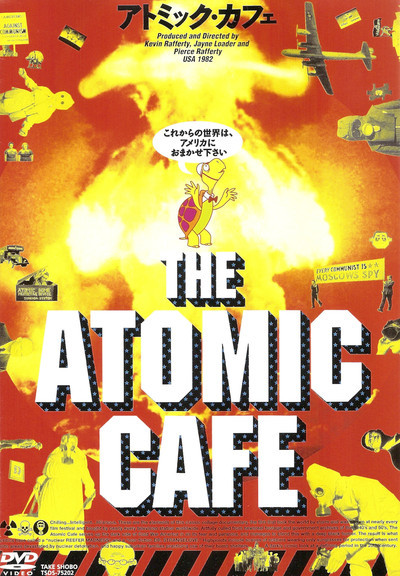
Saturday Matinee: War Documentary Double Feature

large_fKiccFBjZwOKkmsDCQVVcuKgYbxhearts-and-minds

“Hearts and Minds” (1974) and “The Atomic Cafe” (1982) are two of the most chilling and persuasive anti-war documentaries ever made (at least for viewers who are not psychopaths). Though the editorial choices of both films clearly reflect an anti-war perspective, their messages are made more powerful by their lack of narration and abundance of archive footage, newsreels, and public statements from military and political officials. Both documentaries were years in the making with much time (nearly the entire time in the case of The Atomic Cafe) spent on research and editing, and the work clearly pays off by expanding the scope of the films to the political, cultural, and psychological factors behind wars. The filmmakers involved in Hearts and Minds and The Atomic Cafe, unlike most corporate news coverage of wars, both display great empathy in their inclusion of footage of “enemy” casualties of the war and “collateral damage” (ie. innocent victims caught in the crossfire). In the context of the current war-mongering from the Obama administration and corporate/government news media, Hearts and Minds and The Atomic Cafe are more relevant than ever and should be required viewing for everyone who values life.


Saturday Matinee: The Saragossa Manuscript

936full-the-saragossa-manuscript-poster

“The Saragossa Manuscript” (1965) is a Polish film directed by Wojciech Has and based on the novel “The Manuscript Found in Saragossa” (1815) by Jan Potocki. It is a long and complex film but endlessly fascinating for its humor and uniquely dreamlike narrative connecting numerous interrelated stories within stories. The film starts off in Spain during the Napoleonic Wars when soldiers from opposing armies find a manuscript in a deserted house which happens to tell the story of the Spanish officer’s grandfather. The film was a success in Poland in the 60s, is said to be a favorite of surrealist director Luis Bunuel, and was restored in the 90s with financial backing from Francis Ford Coppola, Martin Scorsese and Jerry Garcia. The original US release of The Saragossa Manuscript had nearly an hour cut from the film but the version posted below is the full three hour director’s cut.

To activate English subtitles, click on the “cc” button on the bottom right corner of the video window, click on the field that reads “French”, click “Translate Captions”, scroll down and click “English” and “OK”.

Two for Tuesday

Filastine

Colony Collapse production notes:

Please play on some speakers with bass, and share this afterwards.
From the album £00T. Get it here http://postworldindustries.bandcamp.c…
Directed by Astu Prasidya & Grey Filastine / Produced by Grey Filastine & Nova
– – – – – – – – – – – – – – – – – – – – – – – – – – – – – – – – – – – – – – – – – – – – –
Colony Collapse is filmed at sites of ecological friction, the fault lines of conflict between humanity and (the rest of) nature. It is a video made to confront and indict the ongoing catastrophes that are the very fabric of our globalized economic order. For examples we used….

Lapindo (Sidoarjo) Mud Disaster is an eruption of scalding mud and flammable vapors triggered by a gas drilling gone awry. It has buried more than a dozen villages and blocked a major highway, and is expected to keep expanding for the next 25 years. Lapindo is located close to the home town of the the director (Tooliq) and singer (Nova).

Below a freshly shattered dam on the shoulder of Merapi mountain. This required a meeting with an important Islamic mountain shaman, who wanted to know we weren’t up to anything frivolous or disrespectful. After the vetting he sent his crew to guide and protect us, some men went upriver a few kilometers to warn us by mobile phone if a new flood was coming down.

Bantar Gebang is a landscape of trash. Garbage stretches farther than the eye can see. Mountains, rivers, and even villages where the trash-pickers live. Not something easy to summarize in words.

A supermarket nested in a mega-mall within a skyscraper. Air conditioning, shopping carts, muzak, just like any posh supermarket. But right outside is a the permanent traffic jam of Jakarta, a sprawling mega-city of at least 10 million.
– – – – – – – – – – – – – – – – – – – – – – – – – – – – – – – – – – – – – – – – –

Saturday Matinee: Kontroll

kontro08“Kontroll” (2003) centers on Hungarian Metro ticket collector Bulcsú and his random encounters with neurotic colleagues, belligerent passengers, shadowy criminals, rival coworkers and a mysterious love interest. The film was an impressive debut for first-time writer/director Nimród Antal featuring great acting and cinematography, an interesting mix of genre elements and a darkly humorous screenplay.

Saturday Matinee: Goodbye 20th Century

MV5BOTQ2MTU1NzU5Nl5BMl5BanBnXkFtZTYwMTc4NDg4._V1_SX640_SY720_

“Goodbye 20th Century” (1998) is a twisted but ambitious Macedonian film (directed by Darko Mitrevski and Aleksandar Popovski) connecting three allegorical tales from different eras. In the first segment, a man cursed with immortality in a post-apocalyptic world encounters a trickster who may hold the key to ending his existence. A shorter segment follows depicting the tragic first wedding captured on film in 190o. The film concludes in 1999 when a man in a Santa suit’s interruption of a military wake has violent consequences for all involved.

For English subtitles, click on the “cc” button near the bottom right corner of the video window.

Podcast Roundup

9/7: On Expanding Minds, hosts Maja D’Aoust and Erik Davis have a conversation with Andy Sharp of English Heretic about death, Horror films, Hiroshima, psychogeography, and his latest release, The Underworld Service.

 
http://s50.podbean.com/pb/fd840a4721e38d3f25dd4ec01834d2c6/541340f7/data2/blogs18/276613/uploads/ExpandingMind_090714.mp3

9/8: R.U. Sirius joins hosts Chris Dancy and Klint Finley to discuss technology transhumanism, and the current social/political climate among other topics.

https://soundcloud.com/itsmweekly/pending-mindful-cyborgs-episode-37
 
9/9: Peter Null interviews Professor Andrew Kolin, a professor of political science at Hilbert College in Hamburg and Kevin Carson, researcher at the Center for a Stateless Society, on militarization of police, centralization of power, war and the military-industrial complex.


http://s53.podbean.com/pb/e788a26888199ef114360f06cc89f48c/541347f9/data1/blogs18/371244/uploads/ProgressiveCommentaryHour_090914.mp3

9/10: On the C-Realm, KMO and June Pulliam discuss and dissect the archetypes and cultural meaning of zombie apocalypse narratives.


http://c-realmpodcast.podOmatic.com/enclosure/2014-09-10T12_48_22-07_00.mp3

9/11: Christopher Knowles joins Aeon Byte Gnostic Radio to examine how Gnosticism connects to alternative cultures, politics and humanity’s existential crisis.


http://content.screencast.com/users/AeonByte/folders/AEON%20BYTE/media/7984ec1d-8363-4162-a034-0dabc54aef33/1.%20Gnosticism%20and%20Politics%20with%20Chris%20Knowles.mp3

9/12: On New World Next Week, James Corbett and James Evan Pilato report on 9/11 terror hysteria, Obama’s private CFR event with Sandy Berger (9/11 document thief) and the cryptocurrency/anti-surveillance potential of a new off-the-grid communications technology.

 
http://www.corbettreport.com/mp3/2014-09-11%20James%20Evan%20Pilato.mp3

Saturday Matinee: The Color of Life

vermillion_011

“The Color of Life” (2002) is a feature-length compilation of some of the oddest of the many odd moments from cult Japanese late night comedy/variety program “Vermilion Pleasure Night”. Recurring skits featured on the show include NSFW English language and cooking educational programs, an alien trapped on a starship resembling a Japanese studio apartment and antics of families of zombies, mannequins and human Barbie dolls. Interspersed through the film and television episodes are surrealistic musical and/or animated segments.

For English subtitles, click on the “cc” button near the bottom right corner of the video window.