“Bangkok Loco” (2004) is a surreal Thai musical comedy (and feature film debut) from director Pornchai Hongrattanaporn. Actor/musician Krissada Terrence stars as Bay, a 70’s era drum prodigy with special skills taught to him by a monk. After getting framed for a murder, he becomes a fugitive but is aided by friend and fellow drummer Ton (Nountaka Warawanitchanoun). Together, they struggle to evade police, clear his name and win a climactic drum duel against “Devil’s Drums Master” Mr. David (Rang Sabian).
Watch the full film with English subtitles here. (May not stream on some portable devices.)
What is it that makes us human? And how best to ensure that we all get our fair say?
For director, photographer, and environmental activist Yann Arthus-Bertrand, the answers lay in framing all of his interview subjects using the same single image layout. The formal simplicity and unwavering gaze of his new documentary, Human, encourage viewers to perceive his 2,020 subjects as equals in the storytelling realm.
There’s a deep diversity of experiences on display here, arranged for maximum resonance.
The quietly content first wife of a polygamist marriage is followed by a polyamorous fellow, whose unconventional lifestyle is a source of both torment and joy.
There’s a death row inmate. A lady so confident she appears with her hair in curlers.
Where on earth did he find them?
His subjects hail from 60 countries. Arthus-Bertrand obviously went out of his way to be inclusive, resulting in a wide spectrum of gender and sexual orientations, and subjects with disabilities, one a Hiroshima survivor.
Tears, laughter, conflicting emotions… students of theater and psychiatry would do well to bookmark this page. There’s a lot one can glean from observing these subjects’ unguarded faces.
The project was inspired by an impromptu chat with a Malian farmer. The director was impressed by the frankness with which this stranger spoke of his life and dreams:
I dreamed of a film in which the power of words would resonate with the beauty of the world. Putting the ills of humanity at the heart of my work—poverty, war, immigration, homophobia—I made certain choices. Committed, political choices. But the men talked to me about everything: their difficulty in growing as well as their love and happiness. This richness of the human word lies at the heart of Human.
In Volume I, above, the interviewees consider love, women, work, and poverty. Volume II deals with war, forgiveness, homosexuality, family, and the afterlife. Happiness, education, disability, immigration, corruption, and the meaning of life are the concerns of the third volume .
The interview segments are broken up by aerial sequences, reminiscent of the images in Arthus-Bertrand’s book, The Earth from Above. It’s a good reminder of how small we all are in the grand scheme of things.
Appropriately, given the subject matter, and the director’s longtime interest in environmental issues, the filming and promotion were accomplished in the most sustainable way, with the support of the GoodPlanet Foundation and the United Carbon Action program. It would be lovely for all humanity if this is a feature of filmmaking going forward.
“Terror in Resonance” is an 11 episode anime series directed by Shinichirō Watanabe (director of a number of cult anime titles such as Cowboy Bebop, Space Dandy and Samurai Champloo). This latest series (known in Japan as Terror in Tokyo) centers on two teenage terrorist masterminds code-named Nine and Twelve who collectively go by the name Sphynx. They set off a number of targeted bombs around the city while releasing videos designed to communicate cryptic messages to authorities. What starts off as a conventional “cat & mouse” detective story gradually becomes an even more intriguing parapolitical parable. Terror in Resonance stands out for its mixture of elements from Akira,Dark Angel and V for Vendetta and references to familiar topics in the conspiracy milieu such as thermite bombs, remotely piloted planes, EMPs and human experimentation.
The earliest version of Reefer Madness was released in 1936. It was financed by a church group who intended it to be a morality tale warning parents of supposed dangers of cannabis use and helped prime the public for prohibitionist Harry Anslinger’s Marihuana Tax Act introduced a year later. In spring of 72, the founder of NORML, Keith Stroup, rediscovered the film and organized college campus screenings throughout California to raise funds for the California Marijuana Initiative which would potentially legalize cannabis in the 1972 fall elections. Though the initiative failed to pass, Reefer Madness was soon after elevated to the status of cult classic and became notorious for midnight movie screenings with spirited audience participation including mass pot smoking during key scenes.
Reefer Madness was “re-imagined” as a musical comedy by Kevin Murphy and premiered in Los Angeles in 1998 and in 2005 Showtime created the cable movie version directed by Andy Fickman and starring Kristen Bell, Christian Campbell, and John Kassir reprising their stage roles.
The Very First Film of J.G. Ballard’s Crash, Starring Ballard Himself (1971)
The Collins English Dictionary defines “Ballardian” as “resembling or suggestive of the conditions described in J. G. Ballard’s novels and stories, especially dystopian modernity, bleak man-made landscapes and the psychological effects of technological, social or environmental developments.” You’ll find no more distilled dose of the Ballardian than in Ballard’s book The Atrocity Exhibition, a 1969 experimental novel, or collection of fragments, or what’s been called a collection of “condensed novels.” Subject to an obscenity trial in the United States and the subsequent pulping of nearly a whole print run, the book has earned a permanent place in the canon of controversial literature. Its twelfth chapter, “Crash!”, even provided the seed for a Ballard novel to come: 1973’s Crash, a story of symphorophilia which David Cronenberg adapted into a film 23 years later. The movie, in its turn, stoked a furor in the United Kingdom, culminating in a Daily Mail campaign to ban it. But as far as filming material born of Ballard’s fascination with the intersection of auto wrecks and sexuality, Cronenberg didn’t get there first.
Susan Emerling and Zoe Beloff drew from Crash the novel to make the still-unreleased Nightmare Angel in 1986, but fifteen years before that, Harley Cokeliss turned “Crash!” the chapter into Crash! the short film (also known as The Atrocity Exhibition). Casting Ballard himself in the starring role and Gabrielle Drake (sister of singer-songwriter Nick Drake) opposite, Cokeliss crafts a vision almost oppressively of the seventies: the protagonist’s wide, striped shirt collar dominates his even wider jacket collar below the grim visage he wears while ensconsed in the suit of armor that is his hulking American vehicle. “I think the key image of the twentieth century is the man in the motor car,” Ballard says in voiceover. “Have we reached a point now in the seventies where we only make sense in terms of these huge technological systems? I think so myself, and that it is the vital job of the writer to try to analyze and understand the huge significance of this metallized dream.” If this Ballardian vision resonates with you, see also Simon Sellars’ thorough essay on the film at fan site Ballardian.
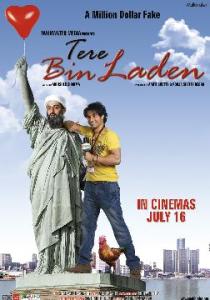
“Tere Bin Laden” (2010) is a Bollywood comedy written and directed by Abhishek Sharma. Pakistani pop star Ali Zafar stars as Ali Hassan, a TV reporter for a low budget news station in Karachi. Determined to find success in America despite previously being deported after being mistaken for a terrorist, he hatches a plan to raise funds for a fake ID with a sensational video using Noora (Pradhuman Singh), a dimwitted chicken farmer who happens to be a convincing Bin Laden lookalike. The plan rapidly spins out of control when it gets the attention of US government officials and the Pakistani intelligence agency. Though some gags dependent on regional references and wordplay may be lost on western audiences, much of it is broad enough to transcend cultures (especially bits mocking the paranoid and xenophobic post 9/11 milieu). Not surprisingly, the film was banned upon release in the US and several countries in the Middle East including Pakistan. The sequel Tere Bin Laden: Dead or Alive was released last February.
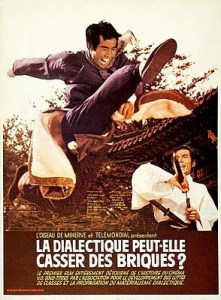
La Dialectique Peut-Elle Casser Des Briques?, in English, “Can Dialectics Break Bricks?”, is a 1973 Situationist film produced by the French director René Viénet which explores the development of class conflict through revolutionary agitation against a backdrop of graphic kung-fu fighting.
The film uses 1972 martial arts film Crush by Tu Guangqi, which tells the story of anti-colonialist revolt in Korea during the period of Japanese occupation, for its visuals which has been dubbed over by the filmmakers in an attempt at détournement. The concept and motivation of this film was to adapt a “spectacular” film into a radical critique of cultural hegemony and thus into tools of subversive revolutionary ideals.
The Narrative is based upon a conflict between the proletarian and bureaucrats within state capitalism. The proletarians enlist their dialectics and radical subjectivity to fight their oppressors whilst the bureaucrats defend themselves using a combination of co-optation and violence. The film is noted for its humorous approach to this serious subject matter.
The film also contains many praising references to revolutionaries who thought and fought for the realisation of a post-capitalist world, including Marx, Bakunin, and Wilhelm Reich, as well as scathing criticism towards the French Communist Party, trade unionism and Maoism. Also Subplots dealing with issues of gender equality, alienation, Paris Commune, May 1968, and the Situationist themselves are riddled throughout the film.




 After the Crash