Saturday Matinee: Blade Runner Black Out 2022

In 2022, an EMP detonation has caused a global blackout that has massive, destructive implications all over the world. Directed by Cowboy Bebop and Samurai Champloo’s Shinichiro Watanabe, Blade Runner Black Out 2022 is a new animated short which serves as a prologue for the feature film Blade Runner 2049.

Ken Burns’ Vietnam War: An Object Lesson in the Failures of the Objective Lens

By Reed Richardson

Source: FAIR

If journalism resigns itself to being a “first draft of history,” Ken Burns’ popular PBS documentaries, written by Lynn Novick, have increasingly aspired to—and achieved—a coveted status as popular historical canon. This has, in part, been accomplished by Burns’ choice of cozily American subject matter—jazz, baseball, the Brooklyn Bridge—as well as the calming effect that time and distance provide when it comes to more difficult, inflammatory topics like the Civil War. His success is a rare, fraught feat.

But how would Burns’ earnest, middlebrow glosses on American history, forever panning slowly across sepia-tinted photos, treat a more contemporaneous, contentious event like the Vietnam War? The answer can be found in a 10-part, 18-hour opus that for the first time ventures outside Burns’ previous editorial and narrative comfort zones. The Cold War lead-up, decade-plus of intense air and ground combat, and subsequent years of national shame/guilt over the war affected the second half of our 20th century like nothing else.

Teasing out a coherent, honest through-line of such a momentous, highly charged topic is ambitious, to say the least, and Burns rises to the challenge in many ways. Most notable among them: a dedicated effort to include the voices and experiences of the Vietnamese who suffered and/or fought Americans, to create a much more complete, insightful portrait of the war. But in the striving to present all sides and simply lay out the facts for the viewer, Burns nonetheless pulls his punches when it comes to assigning blame and culpability for the disastrous war. As a result, he has produced a sometimes daring, sometimes schmaltzy, richly detailed yet ultimately flawed film about the tragedy and horrors that the United States brought upon itself and inflicted upon Southeast Asia.

As a Washington Post article (9/18/17) on all the behind-the-scenes detective work that went into the film makes clear, Burns and Novick did an incredible amount of research and original reporting. However, the narrative shortcomings of the documentary mirror many of the same journalistic sins one finds in the corporate media’s coverage of the far-off wars of today. Much like the mainstream press, Burns suffers from inherent biases about objectivity that affect his storytelling.

In an insightful New Yorker profile (9/4/17) of Burns by Ian Parker, one can see the tendrils of the filmmaker’s can’t-we-find-a-consensus editorial viewpoint that longs for inviolable truths sure to exist somewhere in between the ideological extremes:

Burns frequently—almost hourly—says, “Sometimes a thing and the opposite of a thing are true at the same time,” paraphrasing a remark made by Wynton Marsalis, in Jazz. Burns uses the line less to acknowledge historical uncertainty than to advertise inclusiveness: a desire to guide all but the most sectarian or jaded viewers through an obstacle course of their own biases. He is not disengaged from his material, but his sense of a subject, and his sense of an audience’s reaction to that subject, seem to be fused. He once said, “I want to bring everybody in.”

Later in that story, Burns betrays more of this tendency for false equivalence when he makes a prediction about the bifurcated political reaction his documentary would receive. Sounding very much like a put-upon, but archly centrist editorial page editor, he makes clear that he sees angering both the right and the left simultaneously as an occupational hazard, if not a proxy for having arrived closest to the truth:

After The Vietnam War, I’ll have to lie low. A lot of people will think I’m a Commie pinko, and a lot of people will think I’m a right-wing nutcase, and that’s sort of the way it goes.

While this suggests little capacity on the part of Burns to engage in past criticisms of his work—chief among them, his tendency to overindulge in hokey American splendor-ism—that’s not to say there aren’t stark departures from his oeuvre in The Vietnam War. In just the first few minutes of the first episode, “Deja Vu,” over a squawling original Trent Reznor score, Burns literally pushes the audience backwards by spooling iconic footage of the war—and protests of it—in reverse. It’s a disorienting, but shrewd gambit; a recognition of all the baggage the Vietnam War still carries in the American psyche.

Right after this jarring sequence, though, the old Burns reappears. We see languid, gauzy shots of the Vietnam Memorial in Washington, DC, overlaid with Bob Dylan’s “Hard Rain’s Gonna Fall” and former US senator and Vietnam veteran Max Cleland talking philosophically about the tragedy of suffering and surviving war. As presented, Cleland’s connection to the war is inexplicably vague—he’s only identified on-screen by his name and “Army”—and, though he is a triple amputee because of wounds suffered from a grenade blast in Vietnam, he is filmed only in close up, as if Burns still wants to ease his audience into the full violence wrought by the war. (Burns repeats this ambiguous decontextualization of his interview subjects throughout the documentary.) Then, the film’s narration, once again voiced by longtime actor Peter Coyote, offers up what journalism would call the “nut graf,” the defining leitmotif of the 17 hours and 55 minutes yet to come.

America’s involvement in Vietnam began in secrecy. It ended 30 years later in failure, witnessed by the entire world. It was begun in good faith by decent people out of fateful misunderstandings, American overconfidence and Cold War miscalculation. And it was prolonged because it seemed easier to muddle through than admit that it had been caused by tragic decisions made by five American presidents belonging to both political parties.

There is a lot to unpack in this short passage, but it is accurate in its summation of Burns’ narrative focus throughout his film: that is, long on personal perspectives and documentary evidence of the chronological evolution, but short on broader conclusions about American foreign policy, or any real condemnation of the indescribable cruelty and dishonesty among policymakers who orchestrated it. In one telling anecdote, Burns confided to the New Yorker that his team debated saying “ended in defeat” in this section, but nevertheless chose “failure” instead.

Likewise, the film’s “begun in good faith by decent people” line doesn’t merely land like a false note, it deafens like a discordant symphony. As Veterans for Peace pointed out, Burns’ own documentary refutes this claim. Nearly every episode in the film offers up myriad examples of our elected officials, the military, or CIA willfully lying to the public (or each other) about the US’s involvement in Vietnam, often for personal or political gain.

Nor can you overlook the passive construction of the language, which helps to strip agency from the war’s cheerleaders. Burns’ equivocations here represent stunning intellectual cop-outs, pure and simple, and throw doubt on all that follows.

Relevant to such a compromised take is how Burns and Novick get funding for their projects. Less than a quarter of their money is provided by government sources; the rest comes from charities and the private sector. So perhaps it’s foolish to believe any Ken Burns documentary—partly paid for by the likes of David Koch and Bank of America, among other sponsors—would offer up a polemicized indictment of US politicians and war policy.

By all accounts, Burns and Novick maintain full editorial independence, but their funding pipeline for future projects also greatly depends upon the continued generosity of those same nonprofit and corporate benefactors, who don’t ordinarily court highly controversial filmmakers. As a result of this ongoing relationship, there’s an unseen, but unmistakable gravitational pull that serves to keeps the pair from wandering too far afield from conventional wisdom. Just like Bank of America, in other words, Ken Burns has a brand to protect.

To stay safely within the bounds of convention, Burns and Novick spend a great deal of their time “in-country,” so to speak, on a simple, universal theme: War is hell. And their ability to convey the visceral fear and pathos of battle at the human level is remarkable and poignant: “In war, nobody wins or loses. There is only destruction. Only those who have never fought like to argue about who won or lost,” says Bao Ninh, a North Vietnamese soldier Burns interviews. (Bao is no random grunt—he is also the author of The Sorrow of War, a novel of a soldier’s anguish—but, again, Burns identifies him only as “North Vietnamese Army.”)

When paired with the blunt, chilling lessons that combat taught US Marine Karl Marlantes, the combination has a powerful effect. “One of the things I learned in the war is that we’re not the top species on the planet because we’re nice,” recounts Marlantes about a firefight from 1969. “People talk a lot about how well the military turns kids into killing machines and stuff, and I’ll always argue that it’s just finishing school.”

Feeding this seething killing machine on the American side was a wide-open, virulent streak of racism, which Burns, to his credit, delves into (finally) in the fifth episode. (A Washington Post podcast interview with Burns—9/22/17—delves further into this aspect of the war.) Still, the film can never quite make the leap between the countless tragedies on the tactical level and strategic policies that enabled them and then quickly metastasized.

The most famous battlefield atrocity, the 1968 My Lai massacre, which was mostly covered up and pinned on one Lt. William Calley, again shows Burns putting his directorial thumb on the scale. Rather than call the massacre “murder,” as it was originally described by Novick, Burns switched the script to read that “the killing of civilians has happened in every war.” While true, this statement is so banal that it is meaningless, and serves to inoculate My Lai and all the other atrocities committed in the war of their conscience-shocking power. In effect, the film’s stance is normalizing war crimes. And Burns all but confesses to this in a bizarre admission to the New Yorker: “‘Killing’ was the better word, [Burns] said, ‘even though My Lai ismurder.’”

These distinctions without differences betray a corrupted objectivity, one that can’t really reckon with the fact that the wanton destruction and unceasing, lawless violence seen at My Lai was more the rule than the exception. Perpetrating atrocities was, in fact, standard operating procedure for entire units on the US and Vietnamese sides throughout the war, not merely the work of a few deranged individuals. One academic who studies democide (murder by government) conservatively estimates North Vietnam killed 216,000 non-combatants between 1954 and 1975. (The Vietnamese government had been silent about the film until this week, when it issued a boilerplate response. But Vietnamese citizens have been able to watch a version of the documentary with Vietnamese subtitles on PBS online.)

To cite but one specific example of this lawless killing by the US military, the “Tiger Force” recon platoon of the 1/327th Infantry Regiment, 101st Airborne Division, committed a “wave of terror” in Vietnam’s Central Highlands in 1967. This bloodthirsty campaign was detailed in a 2003 series by the Toledo Blade (10/19/03). But for a more exhaustively comprehensive look at the tsunami of illegal killing by the US across the entire theater, you’re better off reading Nick Turse’s damning account: Kill Anything That Moves: The Real American War in Vietnam. As an American Conservative (7/30/13) book review of Turse’s book makes clear:

The relentless violence against civilians was more than the activity of a few sociopaths: It was policy. This was a war fought along Fordist principles—Robert McNamara had gone to the Department of Defense straight from the helm of the auto giant—and the slaughter was industrial in scale. Victory over the Viet Cong was to be achieved by quantifiable “kill ratios,” to reach that elusive tipping point where the insurgency could no longer replenish its troops. This approach hard-wired incentives to secure a high “body count” down the chain of command, with the result that US soldiers often shot civilians dead to pad their tallies and thereby move up the ranks.

Turse sent copies of his book to Burns’ team, and it is listed as a source in the show’s online bibliography. But while episodes two and three of Burns’ series do take time to cite McNamara’s chilling preference for quantifying enemy deaths as success (i.e., the infamous “body counts”), the film still fails to connect all the dots as to how this high-level political and military mindset—also propelled by racism—set the conditions for consistent, everyday atrocities, versus mere military operations, by combat units. (Thomas Bass’s highly critical essay covering the entire 18-hour documentary—Mekong Review, 8–10/17—discusses this.)

Ironically, Burns and Novick’s compromised framing also echoes much of the jingoistic reporting of the war as it was happening, which the film does an admirable job of debunking. Most TV media coverage of the early years of ever-expanding war, Burns notes, was almost willfully obtuse, invoking World War II newsreels that portrayed the war in terms that were “enthusiastic, unquestioning, good guys fighting and defeating bad guys.” At one point, Burns features a Marine, Roger Harris, telling his mother in 1967 that “she shouldn’t believe what she sees in the newspaper, what she sees on television, because we’re losing the war.”

There were a few, notable exceptions, however. While Vietnam was still fighting French colonial rule, on-the-ground reporters like Seymour Topping, the local Associated Press correspondent in Saigon, were warning that Western imperialist intentions in the country were doomed to fail. In 1951, Topping said as much to a young congressmember from Massachusetts, John F. Kennedy, who was visiting the nation for the first time.

Once the US began sending advisers, and then combat troops, in the early 1960s, Burns points to a handful of reporters—Neil Sheehan (who was an adviser to the documentary), the New York Times’ David Halberstam and Malcolm Browne of the AP—who dared to buck the party line. After spending time in the field, the film notes, they “were beginning to see that from the Vietnamese countryside, things looked very different than they did from the press offices in Washington or Saigon.”

But even intrepid reporters committed to telling the truth about the war were susceptible to creeping American bias. Sheehan, who had fought in Korea, acknowledges that he found riding along in US helicopters on an South Vietnamese Army air assault raid “absolutely thrilling.” Similarly, Joe Galloway, a UPI reporter who filed countless battlefield reports during the war, says in the film:

You can’t just be a neutral witness to something like war.… It’s not something you can stand back and be neutral and objective, and all of those things that we try to be as reporters, journalists and photographers. It doesn’t work that way.

Not coincidentally, when Galloway recounts a landmark 1965 battle in the Ia Drang Valley, where the Air Cavalry unit he was with faced a massive, frontal attack by the Viet Cong, he notably lapses into the first-person plural: “We had two things going for us. We had a great commander and great soldiers and we had air and artillery support out the yin-yang.” That Galloway later co-authored a New York Times bestselling book about the battle with its US commander, Lt. Gen. Hal Moore, and was later awarded a Bronze Star by the US Army for helping rescue a wounded soldier during that battle, goes unmentioned by Burns.

It’s this blindspot—the failure to see that one is adopting the point of view of one’s subjects—that ultimately dooms the film’s potential. Which is a tragedy, since the US is currently failing to learn the the same painful, sunk-costs lessons of Vietnam with its bipartisan, Groundhog Day war policy in Afghanistan. As Drake University political science professor, David Skidmore, noted in his review of the film (Military Times, 9/17/17):

Now Trump has also reneged from previous pledges to disengage from Afghanistan…the histories of US military involvements in Vietnam and Afghanistan should serve as warnings to future presidents who might be tempted to again jump onto the treadmill of perpetual war.

Burns has said he wants his film to act at as “some sort of vaccination” to war, to “get you immune to the disunion that it has sponsored.” But by denying the role and agency of the people who lied us into the Vietnam War, and then kept lying to keep us from leaving, his film misdiagnoses the real problem.

Looking for an invading sickness or outside cause for the mayhem and destruction our country unleashed upon Vietnam, and itself, is a dodge. In the end, the answer to the fundamental question about the Vietnam War, “Why?,” cannot be found in any clinical or objective analysis—no matter how many hours of documentary footage you have—that stubbornly avoids placing blame where it is so richly due.

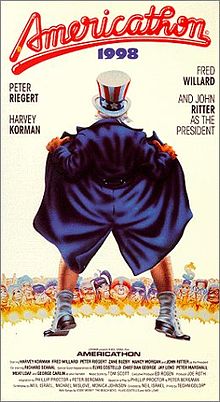
Saturday Matinee: Americathon

“Americathon” (1978) is, like Idiocracy, a dystopian comedy with prophetic predictions such as the fall of the USSR, privatization of public assets, smoking being banned, masses of homeless people living in cars, and the dominance of reality TV, but set in the then future year of 1998. It was directed by Neal Israel, based on a play by Firesign Theatre alumni Phil Proctor and Peter Bergman with narration by George Carlin. In Americathon’s vision of the future, the U.S. has passed peak oil and the government is on the brink of bankruptcy. In order to avoid having the country foreclosed and repossessed by the original owners, president Chet Roosevelt (John Ritter) organizes a national telethon with hilarious results. Features surprising appearances by Elvis Costello, Meat Loaf, Cybill Shepherd and Howard Hesseman.

Watch the full film here.

Saturday Matinee: A Short Vision

The Night Ed Sullivan Scared a Nation with the Apocalyptic Animated Short, A Short Vision (1956)

Source: Open Culture

On May 27, 1956, millions of Americans tuned in to The Ed Sullivan Show, expecting the usual variety of comedians, talents and musical guests. What they weren’t prepared for was a short animated film that Sullivan introduced thusly:

Just last week you read about the H-bomb being dropped. Now two great English writers, two very imaginative writers — I’m gonna tell you if you have youngsters in the living room tell them not to be alarmed at this ‘cause it’s a fantasy, the whole thing is animated — but two English writers, Joan and Peter Foldes, wrote a thing which they called “A Short Vision” in which they wondered what might happen to the animal population of the world if an H-bomb were dropped. It’s produced by George K. Arthur and I’d like you to see it. It is grim, but I think we can all stand it to realize that in war there is no winner.

And with that, he screened the horrific bit of animation you can watch above. At the height of the atomic age, this film was a short sharp shock. Its vision of a nuclear holocaust is told in the style of a fable or storybook, with both animals and humans witnessing their last moments on earth, and ending with the extinguishing of a tiny flame. The mostly static art work is all the more effective when faces melt into skulls.

Many children didn’t leave the room of course, and the website Conelrad has a wonderful in-depth history of that night and collected memories from people who were traumatized by the short as a child. One child’s hair–or rather a small section of his hair–turned white from fright.

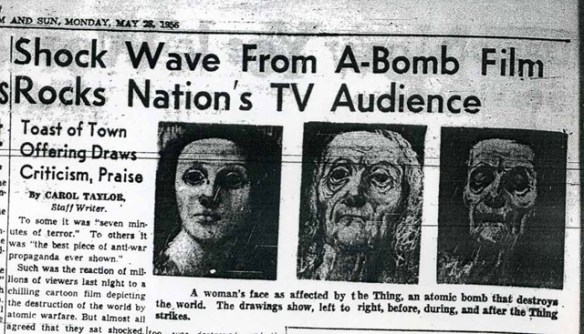
It was as formative a moment as The Day After would be to children of the ‘80s. The papers the next day reported on the short in salacious detail (“Shock Wave From A-Bomb Film Rocks Nation’s TV Audience”) and Sullivan not only defended his decision, but showed the film again on June 10.

The film was created by married couple Peter and Joan Foldes, and shot for little money in their kitchen on a makeshift animation table. Peter was a Hungarian immigrant who had studied at the Slade School of Art and the Courtlaud Institute and apprenticed with John Halas where he learned animation.

(Halas is best known for the animated feature version of Orwell’s Animal Farm.)

A Short Vision would go on in September of that year to win best experimental film at the 17th Venice Film Festival. (Peter Foldes would later make another disturbing and award-winning short called Hunger.)

Once so shocking, A Short Vision fell out of circulation. But a generation grew up remembering that they had seen something horrific on television that night (in black and white, not the color version above.) For a time, it was hard to find a mention of the film on IMDB and a damaged educational print was one of the few copies circulating around. Fortunately the British Film Institute has made a pristine copy available of this important Cold War document.

Saturday Matinee: Le Orme (aka Footprints on the Moon)

From Archive.org:

“Le Orme” (a/k/a “Footprints on the Moon” and “Primal
Impulse”) has been described variously as an Italian giallo, a sci-fi film, a
mystery, or a psychological thriller. Ultimately, it defies pigeonholing.

It stars Florinda Bolkan as Alice Cespi, a professional
translator, who is tormented by a recurring nightmare; in it, a lunar-landing
team deliberately abandons a colleague on the moon’s surface as part of a scientific
experiment.

Alice arrives for work one day and is summarily canned. The
reason? She’d walked out of an international astronomy conference and disappeared
for three days, incommunicado.

Those three days are a complete blank for her. Alice finds a
few vague clues — a torn postcard from Garma, a resort she’s never visited; an
earring, a unfamiliar bloody yellow dress that fits her perfectly — and sets out
to learn what has happened.

When she arrives in Garma, all of the strangers are
delighted to see her “again” — but claim that she’s another person entirely. And that’s
just the beginning…

Although the storytelling in “Le Orme” is fairly linear, it’s also disorienting — so you’ll
have to pay attention to it. There are blind alleys, red herrings and
(possibly) misleading implications throughout.

Cast includes Bolkan, Peter McEnery, Nicoletta Elmi, and a cameo by Klaus Kinski.

Titles and credits are in Italian, but all dialogue is in English.

Saturday Matinee: The President’s Analyst

“The President’s Analyst” (1967) is a political satire written and directed by Ted Flicker. James Coburn stars as Dr. Sidney Schaefer, a psychiatrist recruited by the U.S. government to serve as the president’s private psychoanalyst. Overwhelmed by stress and paranoia, he goes on the lam and is promptly hunted down by foreign and domestic intelligence agents as a pawn in a technocratic plot to control the world. The film’s comedic sensibility is at times dated but features themes which are even more relevant today such as the conflict between power and ethics, transhumanist aspirations of Big Data corporations, the ever-encroaching surveillance state and resultant loss of privacy.

Watch the full film here.

You Want a Picture of the Future? Imagine a Boot Stamping on Your Face

By John W. Whitehead

Source: The Rutherford Institute

“The Internet is watching us now. If they want to. They can see what sites you visit. In the future, television will be watching us, and customizing itself to what it knows about us. The thrilling thing is, that will make us feel we’re part of the medium. The scary thing is, we’ll lose our right to privacy. An ad will appear in the air around us, talking directly to us.”—Director Steven Spielberg, Minority Report

We have arrived, way ahead of schedule, into the dystopian future dreamed up by such science fiction writers as George Orwell, Aldous Huxley, Margaret Atwood and Philip K. Dick.

Much like Orwell’s Big Brother in 1984, the government and its corporate spies now watch our every move.

Much like Huxley’s A Brave New World, we are churning out a society of watchers who “have their liberties taken away from them, but … rather enjoy it, because they [are] distracted from any desire to rebel by propaganda or brainwashing.”

Much like Atwood’s The Handmaid’s Tale, the populace is now taught to “know their place and their duties, to understand that they have no real rights but will be protected up to a point if they conform, and to think so poorly of themselves that they will accept their assigned fate and not rebel or run away.”

And in keeping with Philip K. Dick’s darkly prophetic vision of a dystopian police state—which became the basis for Steven Spielberg’s futuristic thriller Minority Report which was released 15 years ago—we are now trapped into a world in which the government is all-seeing, all-knowing and all-powerful, and if you dare to step out of line, dark-clad police SWAT teams and pre-crime units will crack a few skulls to bring the populace under control.

Minority Report is set in the year 2054, but it could just as well have taken place in 2017.

Seemingly taking its cue from science fiction, technology has moved so fast in the short time since Minority Report premiered in 2002 that what once seemed futuristic no longer occupies the realm of science fiction.

Incredibly, as the various nascent technologies employed and shared by the government and corporations alike—facial recognition, iris scanners, massive databases, behavior prediction software, and so on—are incorporated into a complex, interwoven cyber network aimed at tracking our movements, predicting our thoughts and controlling our behavior, Spielberg’s unnerving vision of the future is fast becoming our reality.

Both worlds—our present-day reality and Spielberg’s celluloid vision of the future—are characterized by widespread surveillance, behavior prediction technologies, data mining, fusion centers, driverless cars, voice-controlled homes, facial recognition systems, cybugs and drones, and predictive policing (pre-crime) aimed at capturing would-be criminals before they can do any damage.

Surveillance cameras are everywhere. Government agents listen in on our telephone calls and read our emails. Political correctness—a philosophy that discourages diversity—has become a guiding principle of modern society.

The courts have shredded the Fourth Amendment’s protections against unreasonable searches and seizures. In fact, SWAT teams battering down doors without search warrants and FBI agents acting as a secret police that investigate dissenting citizens are common occurrences in contemporary America.

We are increasingly ruled by multi-corporations wedded to the police state. Much of the population is either hooked on illegal drugs or ones prescribed by doctors. And bodily privacy and integrity has been utterly eviscerated by a prevailing view that Americans have no rights over what happens to their bodies during an encounter with government officials, who are allowed to search, seize, strip, scan, spy on, probe, pat down, taser, and arrest any individual at any time and for the slightest provocation.

All of this has come about with little more than a whimper from a clueless American populace largely comprised of nonreaders and television and internet zombies. But we have been warned about such an ominous future in novels and movies for years.

The following 15 films may be the best representation of what we now face as a society.

Fahrenheit 451 (1966). Adapted from Ray Bradbury’s novel and directed by Francois Truffaut, this film depicts a futuristic society in which books are banned, and firemen ironically are called on to burn contraband books—451 Fahrenheit being the temperature at which books burn. Montag is a fireman who develops a conscience and begins to question his book burning. This film is an adept metaphor for our obsessively politically correct society where virtually everyone now pre-censors speech. Here, a brainwashed people addicted to television and drugs do little to resist governmental oppressors.

2001: A Space Odyssey (1968). The plot of Stanley Kubrick’s masterpiece, as based on an Arthur C. Clarke short story, revolves around a space voyage to Jupiter. The astronauts soon learn, however, that the fully automated ship is orchestrated by a computer system—known as HAL 9000—which has become an autonomous thinking being that will even murder to retain control. The idea is that at some point in human evolution, technology in the form of artificial intelligence will become autonomous and that human beings will become mere appendages of technology. In fact, at present, we are seeing this development with massive databases generated and controlled by the government that are administered by such secretive agencies as the National Security Agency and sweep all websites and other information devices collecting information on average citizens. We are being watched from cradle to grave.

Planet of the Apes (1968). Based on Pierre Boulle’s novel, astronauts crash on a planet where apes are the masters and humans are treated as brutes and slaves. While fleeing from gorillas on horseback, astronaut Taylor is shot in the throat, captured and housed in a cage. From there, Taylor begins a journey wherein the truth revealed is that the planet was once controlled by technologically advanced humans who destroyed civilization. Taylor’s trek to the ominous Forbidden Zone reveals the startling fact that he was on planet earth all along. Descending into a fit of rage at what he sees in the final scene, Taylor screams: “We finally really did it. You maniacs! You blew it up! Damn you.” The lesson is obvious here, but will we listen? The script, although rewritten, was initially drafted by Rod Serling and retains Serling’s Twilight Zone-ish ending.

THX 1138 (1970). George Lucas’ directorial debut, this is a somber view of a dehumanized society totally controlled by a police state. The people are force-fed drugs to keep them passive, and they no longer have names but only letter/number combinations such as THX 1138. Any citizen who steps out of line is quickly brought into compliance by robotic police equipped with “pain prods”—electro-shock batons. Sound like tasers?

A Clockwork Orange (1971). Director Stanley Kubrick presents a future ruled by sadistic punk gangs and a chaotic government that cracks down on its citizens sporadically. Alex is a violent punk who finds himself in the grinding, crushing wheels of injustice. This film may accurately portray the future of western society that grinds to a halt as oil supplies diminish, environmental crises increase, chaos rules, and the only thing left is brute force.

Soylent Green (1973). Set in a futuristic overpopulated New York City, the people depend on synthetic foods manufactured by the Soylent Corporation. A policeman investigating a murder discovers the grisly truth about what soylent green is really made of. The theme is chaos where the world is ruled by ruthless corporations whose only goal is greed and profit. Sound familiar?

Blade Runner (1982). In a 21st century Los Angeles, a world-weary cop tracks down a handful of renegade “replicants” (synthetically produced human slaves). Life is now dominated by mega-corporations, and people sleepwalk along rain-drenched streets. This is a world where human life is cheap, and where anyone can be exterminated at will by the police (or blade runners). Based upon a Philip K. Dick novel, this exquisite Ridley Scott film questions what it means to be human in an inhuman world.

Nineteen Eighty-Four (1984). The best adaptation of Orwell’s dark tale, this film visualizes the total loss of freedom in a world dominated by technology and its misuse, and the crushing inhumanity of an omniscient state. The government controls the masses by controlling their thoughts, altering history and changing the meaning of words. Winston Smith is a doubter who turns to self-expression through his diary and then begins questioning the ways and methods of Big Brother before being re-educated in a most brutal fashion.

Brazil (1985). Sharing a similar vision of the near future as 1984 and Franz Kafka’s novel The Trial, this is arguably director Terry Gilliam’s best work, one replete with a merging of the fantastic and stark reality. Here, a mother-dominated, hapless clerk takes refuge in flights of fantasy to escape the ordinary drabness of life. Caught within the chaotic tentacles of a police state, the longing for more innocent, free times lies behind the vicious surface of this film.

They Live (1988). John Carpenter’s bizarre sci-fi social satire action film assumes the future has already arrived. John Nada is a homeless person who stumbles across a resistance movement and finds a pair of sunglasses that enables him to see the real world around him. What he discovers is a world controlled by ominous beings who bombard the citizens with subliminal messages such as “obey” and “conform.” Carpenter manages to make an effective political point about the underclass—that is, everyone except those in power. The point: we, the prisoners of our devices, are too busy sucking up the entertainment trivia beamed into our brains and attacking each other up to start an effective resistance movement.

The Matrix (1999). The story centers on a computer programmer Thomas A. Anderson, secretly a hacker known by the alias “Neo,” who begins a relentless quest to learn the meaning of “The Matrix”—cryptic references that appear on his computer. Neo’s search leads him to Morpheus who reveals the truth that the present reality is not what it seems and that Anderson is actually living in the future—2199. Humanity is at war against technology which has taken the form of intelligent beings, and Neo is actually living in The Matrix, an illusionary world that appears to be set in the present in order to keep the humans docile and under control. Neo soon joins Morpheus and his cohorts in a rebellion against the machines that use SWAT team tactics to keep things under control.

Minority Report (2002). Based on a short story by Philip K. Dick and directed by Steven Spielberg, the setting is 2054 where PreCrime, a specialized police unit, apprehends criminals before they can commit the crime. Captain Anderton is the chief of the Washington, DC, PreCrime force which uses future visions generated by “pre-cogs” (mutated humans with precognitive abilities) to stop murders. Soon Anderton becomes the focus of an investigation when the precogs predict he will commit a murder. But the system can be manipulated. This film raises the issue of the danger of technology operating autonomously—which will happen eventually if it has not already occurred. To a hammer, all the world looks like a nail. In the same way, to a police state computer, we all look like suspects. In fact, before long, we all may be mere extensions or appendages of the police state—all suspects in a world commandeered by machines.

V for Vendetta (2006). This film depicts a society ruled by a corrupt and totalitarian government where everything is run by an abusive secret police. A vigilante named V dons a mask and leads a rebellion against the state. The subtext here is that authoritarian regimes through repression create their own enemies—that is, terrorists—forcing government agents and terrorists into a recurring cycle of violence. And who is caught in the middle? The citizens, of course. This film has a cult following among various underground political groups such as Anonymous, whose members wear the same Guy Fawkes mask as that worn by V.

Children of Men (2006). This film portrays a futuristic world without hope since humankind has lost its ability to procreate. Civilization has descended into chaos and is held together by a military state and a government that attempts to keep its totalitarian stronghold on the population. Most governments have collapsed, leaving Great Britain as one of the few remaining intact societies. As a result, millions of refugees seek asylum only to be rounded up and detained by the police. Suicide is a viable option as a suicide kit called Quietus is promoted on billboards and on television and newspapers. But hope for a new day comes when a woman becomes inexplicably pregnant.

Land of the Blind (2006). This dark political satire is based on several historical incidents in which tyrannical rulers were overthrown by new leaders who proved just as evil as their predecessors. Maximilian II is a demented fascist ruler of a troubled land named Everycountry who has two main interests: tormenting his underlings and running his country’s movie industry. Citizens who are perceived as questioning the state are sent to “re-education camps” where the state’s concept of reality is drummed into their heads. Joe, a prison guard, is emotionally moved by the prisoner and renowned author Thorne and eventually joins a coup to remove the sadistic Maximilian, replacing him with Thorne. But soon Joe finds himself the target of the new government.

All of these films—and the writers who inspired them—understood what many Americans, caught up in their partisan, flag-waving, zombified states, are still struggling to come to terms with: that there is no such thing as a government organized for the good of the people. Even the best intentions among those in government inevitably give way to the desire to maintain power and control at all costs.

Eventually, as I point out in my book Battlefield America: The War on the American People, even the sleepwalking masses (who remain convinced that all of the bad things happening in the police state—the police shootings, the police beatings, the raids, the roadside strip searches—are happening to other people) will have to wake up.

Sooner or later, the things happening to other people will start happening to us and our loved ones.

When that painful reality sinks in, it will hit with the force of a SWAT team crashing through your door, a taser being aimed at your stomach, and a gun pointed at your head. And there will be no channel to change, no reality to alter, and no manufactured farce to hide behind.

As George Orwell warned, “If you want a picture of the future, imagine a boot stamping on a human face forever.”

Saturday Matinee: The Constant Gardner

“The Constant Gardner” (2005) is a conspiracy thriller directed by Fernando Meirelles (City of God) with a screenplay based on a John le Carré novel of the same name. Loosely based on a actual incident in Nigeria, the plot follows Justin Quayle (Ralph Fiennes), a British diplomat based in Kenya who while investigating the death of his activist wife Tessa (Rachel Weisz), uncovers criminal activities of a Big Pharma corporation with connections to the highest levels of power.