Saturday Matinee: Annihilation

Movie review: Annihilation

By Frank Kaminski

Source: Resilience.org

Annihilation

Directed by Alex Garland; screenplay by Alex Garland; based on the novel Annihilation by Jeff VanderMeer; cinematographed by Rob Hardy; edited by Barney Pilling; music by Geoff Barrow and Ben Salisbury; production design by Mark Digby; produced by Eli Bush, Andrew Macdonald, Allon Reich and Scott Rudin. Released in Feb. 2018 by Paramount Pictures. Running time: 115 minutes. Rated NNN

Starring: Natalie Portman as Lena, Oscar Isaac as Kane, Jennifer Jason Leigh as Dr. Ventress, Gina Rodriguez as Anya Thorensen, Tuva Novotny as Cass Sheppard, Tessa Thompson as Josie Radek, David Gyasi as Daniel and Benedict Wong as Lomax

There are many layers to this smart, tense, slow-building science fiction drama. It’s at once a nuanced exploration of trauma and identity, a surreal excursion into high-concept cosmic horror and an endlessly rich subject for intellectual debate. It’s a movie that invites many interpretations, having been read as a metaphor for everything from depression to cancer to radioactive contamination following a nuclear accident. Perhaps its most poignant subtext is that of nature fighting back against the encroachments of human civilization.

Loosely based on an eponymous 2014 novel by Jeff VanderMeer, Annihilation centers around a journey to the heart of an anomalous region known as Area X on America’s southern coast. Three years earlier, a meteorite crashed into a lighthouse in a national park, bringing with it an extraterrestrial entity that has since been transforming everything around it. During its spread inland, the alien has forged new ecosystems filled with mutations like something out of a psychedelic vision. At the edge of the contaminated zone lies a hypnotic, pulsating electromagnetic field called The Shimmer, from which almost no one who enters ever emerges—the one man to have done so bearing little trace of his former personality or memories afterward.

A clandestine government organization called Southern Reach has been created to study Area X with the aim of halting and reversing its progress. But Area X is impervious to satellite surveillance, and no one has picked up radio transmissions from any of the numerous teams that have ventured inside. So far, Southern Reach has managed to keep Area X under wraps, using the pretext of a chemical spill to evacuate the sparsely populated swampland that has thus far been consumed. But it’s only a matter of months before Area X will begin to expand into population centers, raising the prospect of mass evacuations that will be much harder to explain.

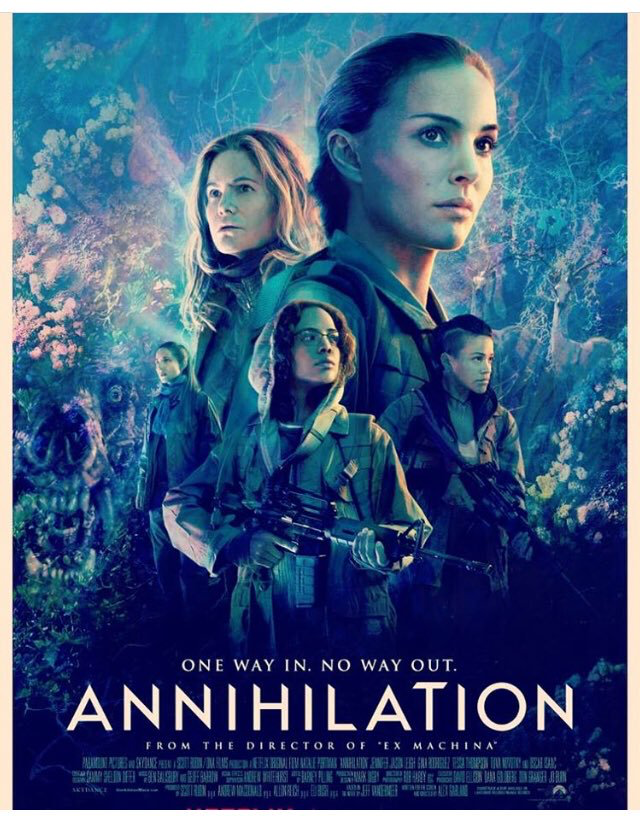
In the movie’s opening scene, the sole survivor of the latest expedition into Area X, a cellular biologist named Lena (Natalie Portman), is being questioned in a small, bare room by Southern Reach agents in hazmat suits. It’s been four months since she and the rest of her team embarked on their mission to reach and study the lighthouse that appears to be The Shimmer’s epicenter. The other members of her group were psychologist Dr. Ventress (Jennifer Jason Leigh), paramedic Anya Thorensen (Gina Rodriguez), geomorphologist Cass Sheppard (Tuva Novotny) and physicist Josie Radek (Tessa Thompson). They left with food rations, camping gear, weapons and their various scientific instruments. Lena’s questioners want to know what became of the others, how Lena lasted for months on only two weeks’ worth of food and what transpired between her and the lighthouse entity. The movie then flashes backward to recount the saga.

Portman gives a strong, sympathetic performance. Her character’s personal journey—which involves coming to terms with the fate of her husband Kane (Oscar Isaac), a special forces officer who was part of an earlier mission—forms the emotional core of the story. Leigh, who plays the group’s stoic leader, seems strangely subdued at first, until we come to understand her character’s motivations for heading into Area X. All of the actresses excel as action heroines during the movie’s periodic swings into action-thriller mode.

Unfortunately, some of the characters are given more to do than others. Lena and Josie are the only ones who really put their respective areas of expertise to use, each making important discoveries that advance our understanding of the entity’s threat. The others might as well just be soldiers.

Though subtle at first, the aberrations to the landscape and its flora and fauna grow increasingly dreamlike the closer the group comes to the lighthouse. The early mutations are, to use Lena’s words, “Corruptions of form. Duplicates of form.” But eventually the women encounter humanoid shrubs, stems harboring multiple plant species, an alligator with shark-like concentric rows of teeth, deer with flowering branches for antlers and trees made of glass. Josie hypothesizes that the alien being is a prism that refracts not only light rays and energy waves, but molecular structures as well, including DNA. This explains how shark’s teeth ended up in the mouth of an alligator, how sand formed into glass trees and how plants have melded with one another and with humans and deer.

Freakish things soon begin happening to the bodies and minds of our protagonists. Examining a drop of her own blood under a microscope, Lena finds it suffused with rapidly dividing alien cells. Anya is unnerved to see her fingerprint patterns moving. Paranoia begins to overrun the group. Some of the women fall victim to the creatures of Area X, while others turn into them, like Gregor Samsa becoming a cockroach in Franz Kafka’s “The Metamorphosis.” Characterized by intense emotions and moments that seem to occur out of sequence and without logical explanation, these events play out much like a dream sequence. This feeling is heightened by Geoff Barrow and Ben Salisbury’s musical score, whose sounds become increasingly unnatural and mesmerizing.

The movie’s frights are a mixed bag. At their best, they’re superb at evoking a sense of incomprehensible horror such as one finds in the works of H. P. Lovecraft. Indeed, Annihilation has been likened to Lovecraft’s 1927 short story “The Colour Out of Space”—as well as its numerous film adaptations—in which a life form brought to Earth on a meteorite wreaks madness and all manner of physical deformities upon the wildlife and human residents of a tract of Massachusetts woodland. (Unlike Annihilation’s alien, however, the being in that tale decimates its surroundings rather than creating something new from them.) The film also contains some very effective Cronenberg-esque body horror. However, not all the scares arise naturally from the plot and the characters; there are some monster attacks and shoot ’em up scenes that belong in a less lofty movie, and which are nowhere to be found in the book.

Beyond its similarity to the Lovecraft story (and despite VanderMeer stoutly denying he was influenced by either of the following two works), Annihilation also has obvious echoes of Arkady and Boris Strugatsky’s 1972 novel Roadside Picnic and its 1979 movie adaptation, Stalker. These also involve journeys through a restricted zone rife with strange mutations and inexplicable phenomena brought on by contamination left by an extraterrestrial presence.

Annihilation’s screenwriter and director is Alex Garland, whose previous film was another landmark of intelligent sci-fi filmmaking—and his directorial debut, no less—2014’s Ex Machina. With Annihilation, he takes great liberties with his source material, changing much of the plot, premise and thematic emphasis. The film has more human connection, more emotional interplay among the characters, than the novel does. (The book’s characters don’t relate; they’ve completely shed their names and pasts.) The book begins in medias res and bypasses much of its backstory, whereas the film starts more conventionally, with a full act of setup that relies on clichés such as a getting-to-know-you session between Lena and her future fellow expeditioners and tearful flashbacks to Lena’s personal drama that led her to agree to the mission. Neither version of the story is superior, really; they’re more like “refractions” of a single underlying inspiration.

The novel repeatedly stresses the pristineness of Area X. It’s a region that has managed, even if by otherworldly means, to beat back humankind. In the real world, of course, industrial humanity faces pushback from nature in the form of droughts, floods, diminishing returns in soil fertility, emerging infectious diseases and uncountable other threats to human habitat. Clearly, annihilation runs both ways.

Watch Annihilation on Hoopla here: https://www.hoopladigital.com/title/15222198
Saturday Matinee: Conquest of the Planet of the Apes

Conquest of the Planet of the Apes: The

Most Violent and Bleak of the Franchise

The fourth Apes movie, Conquest of the Planet of the Apes, showcased Caesar’s controversial and timely fight for freedom.

By Don Kaye

Source: Den of Geek

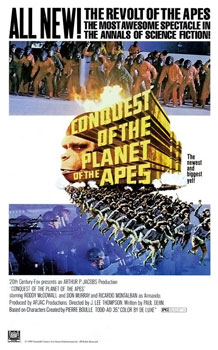
On June 30, 1972, 20th Century Fox released the fourth film in the original Planet of the Apes cycle, titled Conquest of the Planet of the Apes. It followed up the previous year’s Escape from the Planet of the Apes, the first of the Apes films to deliberately end with the promise of a sequel. In that film, two intelligent chimps from the future, Cornelius (Roddy McDowall) and Zira (Kim Hunter), traveled back to our time only to be brutally slain by the U.S. government over fears that they would plant the seeds for the apes’ eventual domination of humankind. Their baby, however, secretly survived, hidden away by the circus owner Armando (Ricardo Montalban) and already beginning to form words.

As Conquest of the Planet of the Apes opens, Armando and the child ape, now grown and named Caesar (played by McDowall), arrive at an unnamed North American city. The year is 1991 and the U.S. government has turned totalitarian. A virus from space has destroyed all the world’s cats and dogs, leading humans to turn toward apes as first pets and then slaves. When Caesar expresses outrage at the cruel treatment of an ape by police, he’s forced to flee and hide — since he was officially declared dead 20 years earlier and his very existence is a threat to humanity.

Caesar makes his way to the ape training facilities and assimilates himself there, eventually going up for auction — where he is sold to the city’s ape-hating governor Breck (Don Murray) and placed under the command of Breck’s assistant MacDonald (Hari Rhodes), who is sympathetic to the plight of the apes. But when Armando is killed while in the government’s custody, an enraged Caesar begins to plot a revolution — slowly but surely organizing his fellow apes for a violent uprising that will be the first step toward the downfall of the human race.

By the time that Conquest of the Planet of the Apes was in production, Apes producer Arthur P. Jacobs and his studio partner Fox were in truly uncharted territory. Even though Planet of the Apes (1968) was a critical success and a box office smash, sequels at the time were considered quick, disposable vehicles to milk a few more bucks out of the audience. Instead, what Jacobs did — aided by the inspired efforts of screenwriter Paul Dehn — was create an ongoing sci-fi story and intricate future history over the course of his Apes movies, the likes of which had never been attempted before in the genre.

Jacobs, however, was still up against the studio mindset that sequels had to cost less, so by the time he made Conquest the budget for the film was a third of the price of the original Planet of the Apes. He had a meager $1.7 million to visualize the ape revolution that had been discussed in the previous films, economizing by using the brand new Century City high-rise complex in Los Angeles as the exterior of the city of the future — but also skimping on the makeup budget, resulting in some clearly fake-looking ape masks.

Dehn’s third screenplay for the series, following Beneath the Planet of the Apes (1970) and Escape from the Planet of the Apes, was the most explicitly political of the series. The previous Apes films had commented obliquely on race and other social issues, but against the backdrop of ongoing racial tensions in America, Dehn crafted a story that drew directly upon the 1965 Watts riots in Los Angeles for the imagery of his ape revolution. His screenplay was also the most violent of the franchise, initially ending in a bleak standoff that found Caesar ordering the cold-blooded execution of the sadistic Governor Breck and forecasting the complete subjugation of the human race.

To direct, Jacobs hired J. Lee Thompson (Cape FearThe Guns of Navarone), who had been approached for Planet of the Apes but had to turn it down due to a previous commitment. Thompson was skilled at handling both large-scale action and low budgets, making him uniquely suited to the twin challenges of Conquest. He embraced the themes of Dehn’s screenplay with relish, giving a documentary quality to the third act’s scenes of revolution that was both realistic and unnerving in its ferocity.

As with all the Apes sequels, Conquest of the Planet of the Apes works on a very simplistic and often slapdash logic, a flaw evident in many key scenes of the film (how does Caesar, for example, know to fake being electrocuted? How does female ape Lisa magically acquire the power of speech?).

At the same time, however, Dehn’s screenplay is bolstered in a huge way by McDowall’s performance, perhaps the finest of his four in the series. His makeup similar to but also different from the appliances he wore as Cornelius, the actor makes Caesar’s transformation from frightened youth to fiery revolutionary leader believable and powerful. His climactic speech, in which he prophesizes that humanity will ultimately turn on itself and allow the apes to ascend in its place, is one of Dehn’s best pieces of writing and a haunting high point for the franchise.

That ending, as first conceived, proved controversial. The pitch-black original climax did not play well with test audiences already disturbed by the movie’s intense violence (which Thompson also trimmed to avoid a series-first R rating). With no time left for reshoots, the use of existing takes and dubbed dialogue by McDowall created a more optimistic ending, in which Caesar halts the murder of Breck and decides that it’s time for the apes to lay down their arms and find a way to live in peace with their former captors. While the idea that Caesar takes his first step toward being a true leader and not just a vengeful warrior is a sound one, the re-edited scene is clumsily handled: the timbre of McDowall’s voice is noticeably different on the new lines, and the scene uses just close-ups of his eyes or wide shots of him from a distance so that we can’t see that his mouth is not actually saying the added dialogue.

Conquest of the Planet of the Apes is a powerful film in either version (the original is available on the Blu-ray edition alongside the theatrical cut) and, despite its shortcomings, remains a riveting and frequently chilling entry. In depicting the events that launch the eventual ascendancy of the apes, it also brings the clever circular structure of the entire series dramatically into focus. The series’ 2011 reboot, Rise of the Planet of the Apes, is a loose remake of Conquest (albeit with many different plot elements) and it’s easy to see why: the ape uprising is narratively and emotionally a strong starting point from which to retell this still unique and even eccentric saga. 

Saturday Matinee: Call of Heroes

CALL OF HEROES: Old School Story, New School Style

By Alexander Miller

Source: Film Inquiry

Hong Kong has been making genre films for decades, and many of them adhere to the formulaic structure that has maintained their reputation as foremost purveyors of action movies. Benny Chan is one of the few noted Hong Kong directors to have transitioned from the early nineties action movies through the handover into current action films, from period wuxia films like Shaolin 2010, to contemporary actioners like the Gen X Cops, and Jackie Chan vehicles Who am I? and New Police Story. Although Benny Chan’s filmography might suggest that of a hired gun working amid the many cogs in the modicum of action films in Hong Kong, there’s a slightly transgressive and gritty tone throughout his career.

Taking place in 1914, Call of Heroes opens when our napping protagonist, an amiable rapscallion Ma Feng (Eddie Peng), pummels some thugs who try to rob a noodle bar in the country; did the bandits offend his sense of honor and propriety? Not really, it seems Ma Feng is more annoyed that they interrupted what should have been a peaceful lunch.

After the introductory clobbering, he meets a teacher, Ms. Pak (Jiang Shuying), who has narrowly escaped (with a group of children in tow) a military siege on her school led by the sinister Cao Shaolun, who murders with impunity being the son of a general.

Meanwhile, in the village of Pucheng, led by the honorable Sheriff Yang (Lau Ching-Wan), there is an area that has become a haven for refugees as a result of the murderous military campaigns going on through the lands. While Ms. Pak and her accompanying travelers are met with resistance, they are welcomed by the locals; however, the mysterious wanderer arrives around the same time as the nefarious Cao Shaolun, and our seemingly ambivalent loner is intertwined in the ensuing intrigue.

In concert with the cultural influence, what with John Ford inspiring Kurosawa, whose samurai epics were later remade into westerns in Hollywood and Italy, Call of Heroes has the dirty look of a Cinecittà production, with the twangy electric guitar echoing Ennio Morricone as a tasteful homage.

Old School, New School

Does this incidental hybrid of east-west convey an entertaining action yarn? Considering some edges that need sanding off, Call of Heroes is a fun trip to the dusty plains of both samurai and western movies, with the now prototypical stray dog hero. Here Eddie Peng’s Ma Feng is equal parts Toshiro Mifune’s Sanjuro character with Clint Eastwood’s laconic ‘Man With No Name’ and a hint of Elliott Gould’s iteration of Phillip Marlowe – Benny Chan’s film isn’t shy about its modernist mashup, and we’re all the better for it too, because the action is fun and the drama feels genuine.

This crossover of revisionist platitudes retains its accumulative power while sturdily fitting the wuxia formula; there’s good versus bad, and the moral boundaries are clearly drawn. Its black and white ethics are a perfect fit for this handsome little epic of quality, and in the past few years Hong Kong has gotten closer to reclaiming their throne as the foremost purveyors of fun action films. Not in the bullet ballets of John Woo and Ringo Lam, but in the period dramas that have populated the Chinese film market in their post-handover era. Benny Chan’s latest is just as much a return to form as it is a continuation of (relatively) recent hits like 7 AssassinsBrotherhood of Bladesand Bodyguards & Assassins.

“A Hero is Only as Good as His Villain”

Call of Heroes has an air of familiarity in its execution, but plays towards a more mature demeanor. Koo’s performance of Cao Shaolun is more than a mustache-twirling baddie; he’s homicidal, sadistic and it shows as he mercilessly guns down man, woman, and child. The film doesn’t shy from the nasty bits of his bastardly demeanor.

Veteran actor Koo might seem hammy, but he succeeds in filling out the archetypal story, and in concert with the rest of the leading cast who are delivering top-notch work. Johnnie To mainstay Lau Ching-Wan, (who starred in LifelineMad Detective, and Running out of Time) is powerful as the Pucheng village chief, but it’s baby-faced Eddie Peng who steals the show as the unkempt defender of the innocent; rightfully so, he’s funny, charming, and convincingly tough.

Influence of International Action

Deviating from the “cleaner” titles before it, Call of Heroes is as much a full-blooded action film as it is a martial arts movie; the blood flow makes the tenor of Chan’s feature feel more developed. Instead of anonymous henchman (who cease to be when they’re kicked out of frame), swords, bullets, spikes, fists and spears injure people, and violence has consequence.

The fight choreography, courtesy of martial arts guru Sammo Hung, employs a handful of fighting styles, from blunt punches and kicks, gravity-defying swordplay, as well as classic hand-to-hand combat. Call of Heroes might not have any headline martial artists such as Jackie Chan or Donnie Yen, but there’s no shortage of carefully choreographed action. Eddie Peng, under the tutelage of Sammo Hung, carries the film with stalwart Lau Ching-Wan doing some heavy lifting as well. Men, women, and children get in on the collective ass kicking, during some of the film’s exciting group brawls.

For the gravitas offered throughout, Hung and director Chan aren’t trying to mask the fantastical wire work, and in the spirit of high-flying fun it works to the film’s advantage; it’s the myth of heroism that we romanticize, and that comes off the screen every time someone trapezes themselves during the many scenes of combat.

Conclusion

What we are presented with is a thoroughly modern and satisfyingly self-aware action film; both classic, old fashioned, and authentically exciting. Fight sequences are plentiful and inventive; some standout moments include a waterside skirmish with walls of wooden spikes, a moonlit brawl with weaponized baskets and cookware; capped with a knockout finale involving Peng and accomplished martial artist Wu Jing duking it out with a mountain of clay pots.

I’d like to think of this inventive set piece as a nod to the 1976 John Woo/Jackie Chan vehicle Strike of Death (aka Hand of Death, choreography thanks to Sammo Hung), but this might be wishful thinking on my part.

Evolution in action films might take the form of stoic warriors abiding by Buddhist mantras in Jean-Pierre Melville’s heist films, or the operatic violence hyperbolized in the westerns of Sergio Leone. At the risk of evoking a cliché, action speaks every language and the more international cross pollinating that occurs the better off we all are; Hollywood’s been drawing from the eastern well for decades, and seeing the inverse in Call of Heroes is a pleasure.

Watch Call of Heroes on Hoopla here: https://www.hoopladigital.com/title/11726006

The 100 Year-Old Man Who Climbed Out the Window and Disappeared

By Josh Kupecki

Source: Austin Chronicle

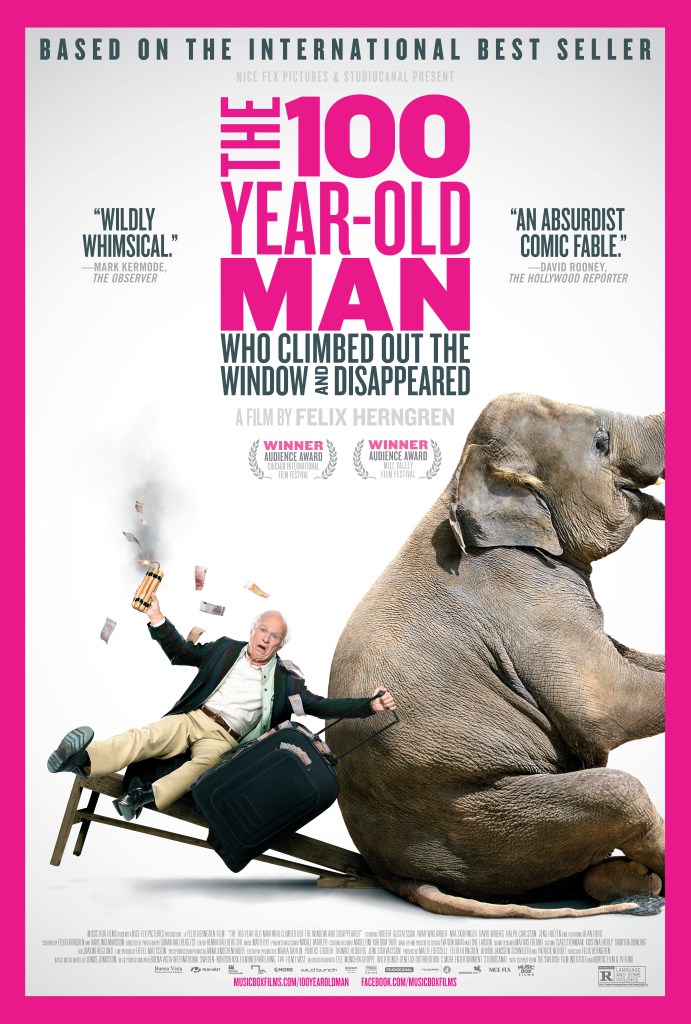
A whimsical comedy based on the bestselling Swedish novel (and book-club fodder) by Jonas Jonasson, The 100-Year-Old Man Who Climbed out the Window and Disappeared begins with exactly that, as Allan Karlsson (Gustafsson) escapes his retirement home on the day of his inauguration into the centenarian club with a “fuck this” attitude and little more than the slippers that bear his first name in Magic Marker. He shuffles off to the bus station where he buys a ticket to the next bus leaving town and inadvertently steals a suitcase with 50 million krona from some local thugs. He hooks up with a retired train attendant, Julius (Wiklander), and together they hit the road, picking up stray characters to add to their entourage while (often unknowingly) skirting the tattooed gangsters after that jackpot. One character owns an elephant. Another can’t decide on a career path, so has almost completed a half-dozen degrees. It is all very fanciful and droll, a mildly subversive and ramshackle Scandinavian version of the Grumpy Old Men on-the-road formula.

But that’s only half the story. Through flashbacks that seem to come whenever the present-day action hits a lull, we see Allan’s life unfold, and what a life that was. From his humble beginnings as the son of a revolutionary, young Allan develops a passion for blowing things up that parlays him into becoming a demolitions expert. There follows a stumbling and drunken shuffle through the history of the major conflicts of the 20th century (the film will be endlessly compared to Forrest Gump), as Allan travels to Franco’s Spain for the Spanish Civil War, helps Robert Oppenheimer develop the atomic bomb, pisses off Josef Stalin to the point where he gets sent to a gulag, becomes a double agent for the CIA during the Cold War, confers with Ronald Reagan, etc. Throughout it all, Allan is oblivious to the impact he has on world events, holding true to the theory espoused by his mother that “life is what it is and does what it does.”

These two narrative threads are constantly jockeying for dominance in a story that has a refreshing nonchalance, but is hindered by the lack of any tension whatsoever. Obviously better served as a novel, The 100-Year-Old Man… still entertains for the majority of its running time, but it feels like two separate movies, a dual shaggy dog story stitched together like Frankenstein’s monster, never breaking free of its quirky literary origins.

Watch The 100-Year-Old Man… on Kanopy here: https://www.kanopy.com/en/product/1053322

Saturday Matinee: The New Pearl Harbor

Source: Top Documentary Films

On the very day of “September 11” several commentators drew a parallel with the historical events of Pearl Harbor. But there was also someone on the same day who offered a prediction. In fact the more information that’s been emerging about “September 11” the more we’ve come to realize that many different aspects of the two events bear a chilling resemblance to each other. While both events were needed by the U.S. to go to war, in both cases the ultimate goal was not the one initially stated.

Roosevelt knew a surprise Japanese attack would enrage the public and jumpstart the American war machine. In this way F.D.R. would get backdoor entry into what he really wanted – war with Hitler. According to their own documents, before 9/11, authorities knew that surprise attack like new Pearl Harbor would enrage the public and start a war against Afghanistan. In this way they would get the backdoor entry into what they really wanted – the war with Saddam Hussein.

Before and during the World War II, the propaganda machine made a relentless effort to create a direct connection between Hitler and Japan. One poll, taken immediately after Pearl Harbor, showed that more than 60% of Americans believed that Germany was behind the attack. The Bush-Cheney propaganda machine made an even harder effort to create direct association between Iraq and Osama bin Laden. By the end of 2003 nearly 70% of Americans believed that Saddam was implicated in the “September 11” attacks.

Top levels of the Roosevelt’s administration knew in advance that Pearl Harbor was going to be attacked. Secretary of state, Cordell Hull, even knew the exact day of the attack a week before it took place. Before “September 11” many in the intelligence community knew the attacks were on their way.

Vital information on the Japanese attack was kept from those who could’ve used it to defend the Hawaiian port and to minimize the number of American casualties. Two men could use that information immediately: Admiral Husband Kimmel and Lieutenant General Walter Short, the commanders at Pearl Harbor. But they never get it. Before “September 11” important information was kept from counterterrorism czar, Richard Clarke, who could have organized the defense and even have prevented the attacks altogether.

Saturday Matinee: Death to Smoochy

In defence of Death to Smoochy – the most absurd kids’ TV satire ever made

By Sophie Yapp

Source: Little White Lies

Once a film has been critically tarnished, it’s hard to come back from that. As soon as the negative reviews start to drop, public perceptions are formed and the box office is often affected accordingly. Yet it’s fairly common for a film to be met with critical apathy upon its initial release, only to assume the mantle of overlooked gem later on. Fourteen years after its disappointing theatrical run in 2002, Danny DeVito’s absurd black comedy, Death to Smoochy, exists as one such film.

The twisted satire both illuminates and mocks the brutality and corruption behind the ruthless industry of children’s television, and makes no bones about it. Rainbow Randolph (Robin Williams) is fired from his job as a children’s TV host and replaced by Smoochy (Edward Norton), an overly optimistic performer in a fluffy, fuchsia rhinoceros costume who skyrockets to fame, despite not being able to fathom the idea that his colleagues, unlike him, are solely in it for the money. Inevitably, the cutthroat nature of the industry means that Smoochy becomes a target of not only Randolph’s vengeance, but also the people pulling the strings.

Death to Smoochy flopped at the box office, grossing a little shy of $8.5m domestically. Critics were quick to slam the film as ‘odd’, ‘inexplicable’ and ‘unpleasant’. Such descriptions were not wrong. Indeed, Death to Smoochy is all of these things, but as a cynical comedy, this is all part of its charm. While the film pivots around children’s characters, it is not a children’s movie in the slightest. The seedy, deeply disturbing underlying nature of the film is disguised by the colourful, child-like context of the industry which it mocks. Essentially, it’s about sociopaths pursuing and trying to kill their rivals, demonstrating how money is the root of all evil.

Above all, though, it’s about greed. DeVito has been known to both direct and act in films that poke fun at society’s weaknesses in equal measures of maliciousness and light-heartedness. Here he ridicules the children’s entertainment industry while bringing to light the commercial, dog-eat-dog aspect of children’s television by exemplifying the profitable agenda of selling plastic and sugary commercial products off the back of the television shows. “We’re not looking at kids, we’re looking at wallets with pigtails,” are DeVito’s own words, echoed by Smoochy as he struggles to comprehend the sheer magnitude of manipulative scheming that goes on beneath the surface of an industry that, as he sees it, exists to provide entertainment for children.

The film’s morbid sense of humour is perhaps most prominent in Robin Williams’ highly amusing performance as a corrupt kiddy-host bordering on clinically insane. His twisted take on Rainbow Randolph is evidence of his acting diversity, also evoking some of his early stand-up work. What explicitly seeps through in Williams’ performance is his former relation to the backstabbing side of the business based on his own experiences in television, with the popular sitcom Mork & Mindy being cancelled after its fourth season.

Whether it’s framing Smoochy into performing live at a neo-Nazi rally, or replacing a batch of cookies with penis-shaped biscuits on Smoochy’s live show before proceeding to run on stage shouting obscenities such as “It’s a one-eyed wonder weasel!” in front of the preteen studio audience, Williams only adds to his hilarious legacy. It’s his outrageous performance that makes this tremendously funny, admittedly absurd satire well worth revisiting.

Saturday Matinee: Beasts Clawing at Straws

Director: Kim Young-Hoon
Cast: Jeon Do-Yeon, Jung Woo-Sung, Bae Sung-Woo, Youn Yuh-Jung, Jeong Man-Sik, Shin Hyun-Bin, Jung Ga-Ram, Jin Kyung, Park Ji-Hwan, Kim Joon-Han 
Running Time: 108 min.

By Paul Bramhall

Source: City of Fire

Adapted from a Japanese novel by Keisuke Sone, Beasts Clawing at Straws marks the directorial debut of Kim Yong-hoon, who also penned the script after being impressed by the novels intertwining story. Onscreen it’s easy to see why it made for a compelling big screen outing, as an impressively cast ensemble come together for an almost Shakespearean comedy of errors that focuses on 10 characters, all of whom are looking to get their hands on a Luis Vuitton bag stuffed with cash.

Taking place in the North Western harbour city of Pyeongtaek, giving the surrounds of Beasts Clawing at Straws a welcomely different aesthetic from the usual Seoul set thrillers, we initially meet a down on his luck bathhouse worker played by Bae Sung-woo (MetamorphosisThe Great Battle). Life’s been giving Sung-woo a tough time after going bankrupt, which isn’t made any easier by living with his mother, played by Youn Yuh-jung (Minari, Keys to the Heart). Suffering from the onset of dementia, she feels sure his wife (Jin Kyung – The WitnessVeteran) is trying to kill her, and matters are confounded further by their daughter having to take a break from studying to work so she can afford the tuition fees. Sung-woo and his family are fundamentally good people, the only ones in the entire cast, however when he finds the bag in question stuffed in one of the bathhouse lockers, the contents understandably prove hard to resist.

Meanwhile a frazzled immigration officer played by Jung Woo-sung (Steel RainAsura: City of Madness) is also in debt and being pressured to repay a vicious loan shark, played by Jung Man-sik (The SwordsmanRampant). His limbs are on the line, and to make matters worse his girlfriend has disappeared, although in reality she’s running a hostess bar across town. Played by Jeon Do-yeon (The ShamelessMemories of the Sword), she’s always on the make and seems to be two steps ahead in whatever shifty deals are afoot. Working in the hostess bar is a newcomer played by Shin Hyun-bin (Seven Years of NightConfidential Assignment), a character forced into the world of hostessing after she fell victim to a financial scam, but equally to get away from her abusive husband. When a Chinese customer (Jung Ga-ram – The Odd Family: Zombie On SaleBeliever) falls for her, he offers to assist with getting rid of her violent spouse.

All of these disparate scenarios gradually end up connecting with each other in different ways across the 108 minute runtime, and for a first time director Yong-hoon does an amicable job of balancing them all in a way that lets us get to know each character just enough to be invested in them. While the synopsis may indicate that Sung-woo is as close as we get to a main character as the everyman who ends up out of his depth, onscreen we get to spend just as much time with Woo-sung as the immigration officer and Do-yeon as the hostess bar madame. It’s the first time for the pair to share the screen together, and as 2 of the most recognisable faces in Korean cinema for more than 20 years, it’s a fitting vehicle to show off their talents. Woo-sung here is in the same hyper tense state that we saw him in Asura: City of Madness (although he doesn’t end up half as bloodied), and it’s undeniably fun to see him return to this kind of role.

As with almost any production she appears in though, it’s Do-yeon that steals the show whenever she’s onscreen. One of the world’s best actresses, after recent appearances in disaster flicks like Ashfall and Emergency Declaration which offered solid but unremarkable roles, it’s a real pleasure to see her here in a role fitting to her talents. Perhaps even more ruthless than the loan sharks who turn out to be as much on her tail as they do Woo-sung’s, it’s Do-yeon’s character who lingers most in the memory as the end credits roll.

It’s also another of Do-yeon’s movies that I was reminded of the most when watching Beasts Clawing at Straws, with the whole concept of various unsavoury characters in pursuit of a stash of dubiously acquired cash recalling Ryoo Seung-wan’s 2002 crime caper No Blood No Tears. Yong-hoon employs a similar caper style feel to his debut, and despite the fact that characters repeatedly get killed off left right and centre (in various gruesome ways), the violence never feels like its breaking from the black comedy tone which is established from the outset. At its core it’s a tale of dog-eat-dog, with each dog never knowing if there’s a bigger dog just around the corner, and it’s a scenario which allows for a brisk pace and some unexpected surprises.

The tension is ratcheted up further by the arrival of a cop from Seoul looking into a dismembered body that’s washed ashore. Played by the always welcome Yoon Je-moon clocking in a special appearance, ironically the last time he clocked in a special appearance was also playing a cop alongside Jung Woo-sung in 2017’s Asura: City of Madness. Je-moon’s character, who seems just as keen on hanging out in the local hostess bars and downing a few beers, has a habit of turning up at the most inconvenient of times, pushing half the cast who are already on edge just that little bit closer to it. Indeed it’s the concoction of the characters that populate the narrative that makes Beasts Clawing at Straws so much fun, with everyone suffering from some kind of bad luck, debt, or simply a case of being in the wrong place at the wrong time (or right, depending on which way you look at it).

The biggest surprise that Yong-hoon has up his sleeve is that it’s only revealed mid-way through that we’re in fact watching a non-linear tale play out, and have been watching a number of timelines that are playing out concurrently rather than chronologically. It’s executed in an unassuming way, and shows off first time director Yong-hoon’s strong grasp of storytelling, almost certainly making him a talent to watch out for in the future. Matched with the scripts unbiased approach to who gets killed off next, while there’s been countless movies that prove going after a bag stuffed with cash of unknown origin always turns out to be a bad idea, Beats Clawing at Straws does enough with the concept to keep it feeling fresh.

With that being said there are moments when Yong-hoon’s inexperience shows through. In particular the plot thread involving Shin Hyun-bin’s rookie escort pairing with Jung Ga-ram as the customer that falls for her, and the subsequent sub-plot that sees Ga-ram offering to kill off her husband, feels undercooked. The scenario plays out, however in the end it doesn’t feel particularly important to the overall plot, coming across more like an inconsequential aside that should have either been dropped or spent more time connecting to the bigger picture. Similarly for Youn Yuh-jung as the meddling and paranoid mother, who’s character ultimately just feels kind of there, but fails to serve any real purpose.

These are minor flaws though in what’s an undeniably fun movie, and it’s easy to imagine the tagline for its western release going something alone the lines of “No Country for Old Men meets Pulp Fiction!” There’s arguably traces of both the Coen Brothers and Quentin Tarantino’s filmmaking DNA throughout both the tone and structure of Beasts Clawing at Straws, but Yong-hoon’s success is that it never feels like it’s being derivative of either. The distinctive locales of hostess bars, late night saunas, and scrappy apartments forever bathed in the neon of the surrounding nightlife mean there’s no question we’re in Korean territory. With a healthy mix of black comedy, typically brutal violence, and colourful characters, the lesson on offer is one we should already know, but as a reminder to leave bags stuffed full of cash exactly where they are, Beasts Clawing at Straws is an entertaining one.

Watch Beasts Clawing at Straws on Hoopla here: https://www.hoopladigital.com/title/15296509

We’ve Been Lied To Our Whole Lives About Everything That Matters

By Caitlin Johnstone

Source: CaitlinJohnstone.com

Stories about protagonists who’ve been misguided their whole lives about something very important have been emerging in our culture for generations, and they continue to delight audiences in the box office to this day.

The pauper was really a prince. Luke was Darth Vader’s son. Keanu Reeves had been living in a computer simulation. Bruce Willis was really a ghost. Jim Carrey’s whole world was the set of a TV show, and everyone in his life had been lying to him since his infancy.

This theme repeats so often because it strongly resonates with people. And it strongly resonates with people because it’s exactly what is happening.

From our earliest moments we are trained to fit in with a society that was designed from the ground up by the powerful in the service of the powerful. As soon as we are old enough to get curious about the world and how it works our heads are filled with lies about such matters, by our education systems, by the media we consume, by our parents who were indoctrinated in the same way, and by the very culture we find ourselves immersed in from day one.

These stories about a character who’s been deceived about life resonate so strongly with us because on some level we all suspect it might be true of our own lives as well. They whisper to something hidden and sacred within us that has always sensed that there’s something not quite right with the way we are perceiving things.

We’ve spent our whole lives marinating in lies which serve the powerful. We’re deceived into believing that we live in a democracy whose government acts in accordance with the will of the voting public. We’re deceived into believing our political systems are driven by two warring ideological factions whose divisions are naturally occurring phenomena in our society instead of the product of deliberate social engineering. We’re deceived into believing our government is basically good, and that it stands in opposition to foreign governments who are pure evil. We’re deceived into believing the way things are is the only way they could possibly be.

We’re deceived into believing false things about the ways we gather information and form our understanding of the world. We’re deceived into believing the news media tell us the truth about what’s going on. We’re deceived into believing that everything we hear from our side of the political partisan divide is true and trustworthy. We’re deceived into believing the partisan filters which have been placed over our perception of national and world events by indoctrination are entirely reliable instruments for interpreting information and drawing conclusions.

We’re deceived into believing false things about ourselves. We’re deceived into believing that we are successful if we can become dominant capitalists and wealthy ladder climbers, and that we are failures if we don’t turn the gears of industry and climb over others to get ahead. We’re deceived into believing that we are good if we uphold the made-up, power-serving rules of law, of culture and of religion, and that we are bad if we transgress them. We are deceived into believing that we need to keep accomplishing, achieving and obtaining, that we need to keep earning money and approval, so that we might one day feel adequate at some imaginary point in a future which never arrives.

If we really commit to uprooting the untruth that’s been planted in us, we can even discover that we’ve been deceiving ourselves about the way we experience reality. That the perception of oneself as a finite character who is separate from the world is based on false assumptions about the way experience is happening, unhelpful mental habits born of incorrect premises, and overlooked aspects of our own consciousness. That we’ve been making ourselves miserable with false beliefs about who and what we are.

This civilization is the set of the Truman Show, and we are all Truman.

But because we are all Truman, we can only walk off the set if we walk off together. There is no option to leave as an individual, because even if you know it’s all lies, you’re still stuck in a world full of humans whose behavior is driven by lies.

Awakening to reality as an individual can for this reason sometimes be more uncomfortable than remaining asleep in the dream, because you’re like Truman after he realizes it’s all a sham, but before he escapes. At times you’re just stuck there, freaking out at the actor who’s playing your mother while she tries in vain to cut to a commercial break. It can be distressing for you, and it can be distressing for the people around you who aren’t yet on the same page.

The only way we’re getting off the set of the Truman Show is if we can all succeed in waking each other up from the lies which built it. Until then we’ll be stuck in a world of poverty, war, exploitation, degradation, ecocide, and suffering. It’s not until enough of us have unplugged our minds from the matrix of lies that we’ll be able to use our strength of numbers to force real change.

Only then will we be able to escape.

Only then will we be able to walk off the set.

Only then will we be able to turn to the audience and say, “In case I don’t see ya: good afternoon, good evening, and good night!”

And then turn around, and walk out the door, and begin our adventure into reality.