Saturday Matinee: Sanjuro

By Brian Eggert

Source: Deep Focus Review

Answering for the violent thrills of Yojimbo, Akira Kurosawa’s sequel Sanjuro modifies its predecessor’s structure and, in a way, condemns its eponymous hero, reprised by Toshiro Mifune, by depicting his violent existence as a tarnished bushido ideal. Instead of sending up the swordfighting chambara genre as Mifune’s Sanjuro mows down gangs of grotesque, bumbling yakuza criminals, against which he appears superior and even righteous, Kurosawa places his unkempt ronin in the middle of a jidai-geki, a dramatic period piece wherein Mifune’s protagonist remains crafty and skilled in combat, but, shamefully, without nobility nor willingness to restrain his violent instincts. Redefined through introspection and eventual feelings of disgrace about his lifestyle, Kurosawa’s Sanjuro becomes a tragic figure, his mythic stature marked—or soaked, rather—by the blood of his undisciplined existence.

Along with Ryuzo Kikushima and Hideo Oguni, Kurosawa developed Sanjuro from the Shugoro Yamamoto novel Hibi Heian (A Break in the Tranquility) prior to shooting Yojimbo. Yamamoto’s tale, although similarly plotted in its broadstrokes to Kurosawa’s eventual adaptation, features a samurai protagonist without as much idiosyncrasy or skill as Sanjuro. Author of the source novels for Kurosawa’s upcoming pictures Red Beard and Dodes’ka-den, Yamamoto would be associated with Kurosawa for the rest of their careers. For this picture, Kurosawa intended for Hiromichi Horikawa to direct. Horikawa was a former assistant director for Kurosawa on Seven Samurai and Throne of Blood among others, and had become a thriving director in the mid-1950s, with many chambara films among his releases. Nevertheless, producers at Toho Company insisted that Kurosawa direct, given the popularity of Yojimbo under his headship.

Shooting began on Yojimbo in January 1961 and was completed on April 16, and because Kurosawa edited during production, the film was released four days later on April 20, 1961. And since Sanjuro required only minor rewriting to convert the earlier draft into a sequel to Yojimbo, production commenced on September 25, 1961, and ended December 20, with the finished film premiering January 1, 1962. The speed and artistic showmanship with which these films were shot, edited, and released is staggering, especially taking into consideration the detail Kurosawa integrates into his picture. The main setting—a chamberlain’s house and the pond in front, a separating wall with a compound on one side and the sanctuary house on the other—were built as open sets on Toho’s largest stage. Kurosawa oversaw every detail personally, from the vast layout down to the crucial look of camellias on the trees, which the director insisted be hand-made to make sure each one looked just right. At his prime, Kurosawa’s meticulous, even autocratic control over his productions fully justified his nickname: The Emperor.

Sanjuro opens with nine young, incompetent samurai assembled in secret at a forest shrine. Their leader, Iori Izaka (Yuzo Kayama), has recently met with his uncle, the chamberlain, with whom Izaka lobbied to permit his fellow samurai to investigate signs of corruption. The chamberlain refused, which suggested to Izaka that the chamberlain was behind the corruption. And so, Izaka turned to the superintendent for advice; the superintendent agreed to help if they all meet at the present forest shrine. All at once, Mifune’s Sanjuro yawns from the darkness, and casually steps out to offer his thoughts—that the superintendent is, in fact, the corrupt one and the chamberlain was merely being protective of his nephew. He even suspects the superintendent’s men will double-cross the young samurai at their planned meeting, which, as it turns out, takes place at the forest shrine. When Sanjuro learns this, he looks outside and confirms his suspicions are true, then hides the nine young samurai in the floorboards. The superintendent’s men call for surrender and Sanjuro emerges, shouting about the noise and knocking several soldiers down. Believing Sanjuro’s deception, the soldiers’ leader, the idealized samurai warrior Muroto (Tatsuya Nakadai, who also played the gunslinger in Yojimbo), so bound to bushido, recognizes Sanjuro’s skill and offers him a job if he wants it.

Mifune’s introduction recalls the one from Yojimbo, where the ronin is asked his name, and in response, he reveals his first name, “Sanjuro [meaning thirty years old]… going on forty.” He then scans the area and settles on some nearby plantlife for his family name. In Yojimbo, he sees a mulberry field and responds “Kuwabatake [mulberry field],” and in Sanjuro he replies “Tsubaki [camellia]”—an ironic yet apt choice given the camellia’s associations to the chamberlain’s wife and daughter later in the film. In this sequel, Mifune’s Sanjuro proves just as iconic as his performance in the preceding film, only streamlined to highlight those memorable character traits. Unless his sword is drawn, the actor’s arms rarely leave his kimono except to scratch his chin or to itch at his scalp; along with his character’s minimum of dialogue, this places our focus on Mifune’s expressions, ripe with seemingly stoic confidence interrupted by his anger and unease. Sanjuro’s disdain around the hopeless young samurai and his later discomfort around the chamberlain’s wife and daughter are always comical, making Mifune’s performance a subtly complex combination of characterized gestures and reserved emotions.

After the superintendent’s men depart the forest shrine, Sanjuro and the young samurai realize the chamberlain will probably be arrested or worse, as the superintendent has no doubt deduced that the chamberlain suspects him. They resolve to rescue the chamberlain’s wife and daughter (Takako Irie and Reiko Dan) first, before they too are taken. Contemptuous of the young samurai but impelled to assist (for some cash and food) because, as he tells them, they cannot take care of themselves, Sanjuro leads them to the chamberlain’s house, which is guarded by the superintendent’s men. Despite Sanjuro’s constant insults and berating tone, the young samurai follow his every word “like a centipede” astonished by his skill. And, after convincing a servant to get the guards drunk, they quietly take out the sentries and move the women into a nearby barn. Here, Kurosawa pauses for a scene to establish Sanjuro’s lasting themes by differentiating the film’s protagonist from everyone else onscreen. The young samurai, the mannerly women, the dignified warriors serving an upper class—they each follow a particular decorum against which Sanjuro seems incongruous.

When the women first enter their own barn turned hideout, it is a place they have never been; they remark about the lovely smell of hay, the dreamlike quality one feels when resting back on a large mound of the stuff, and reveal their sophisticated obliviousness to the danger of the situation. Their ability to see so much good in the world amid all the bloodshed and unruly politics is not meant to make them look ignorant; rather, they are elevated beyond such unnecessary concerns, achieving a level of paradoxical nescient enlightenment. The chamberlain’s wife asks with polite interest about Sanjuro, and Izaka explains he is a friend. “I hesitate to say this after you so kindly saved us,” remarks the wife, “but killing people is a bad habit. You glisten too brightly… Like a drawn sword… You’re like a sword without a sheath. You cut well, but the best sword is kept in its sheath.” Sanjuro reacts uneasily to this, knowing the wife’s assessment is accurate, but perhaps unwilling to admit it to himself, yet. Sanjuro begins to feel ashamed of his status in the presence of the refined sensibilities of these women. With this, Kurosawa deepens the character throughout the course of the film, allowing Sanjuro to learn something about himself, his eventual victory bittersweet.

One of the young samurai suggests hiding in his house and Sanjuro agrees, but their group quickly learns that the superintendent is keeping the chamberlain locked up next door, just over a compound wall. By the end, Sanjuro, who deceives his enemies by taking Muroto’s job offer to learn of the chamberlain’s exact location, calls the young samurai to rescue the chamberlain, using a downpour of camellias floating down a stream under the compound’s wall as an elegant signal to attack. With this, bloody violence begins to unfold, while on the other side of the wall, the chamberlain’s wife and daughter clap with enchantment at the beauty of the flowers on the water, a scene played both for humor and to emphasize the nonsensicality of violence against the simpler things in life—a message Sanjuro learns by the conclusion. With the chamberlain rescued, the young samurai realize Sanjuro has gone. They find him in a field, preparing to face off against the distinguished samurai Muroto, who, his honor shamed with Sanjuro’s deception, insists they duel. Sanjuro cuts down his opponent with incredible speed, and all of the young samurai, shocked, watch with enthusiasm. After a moment of silent awe, one of them declares the display “brilliant”.

The duel itself remains Sanjuro’s most memorable scene, not only because it concludes the film, but because it does so with such an unforgettable “bang”. Positioned face-to-face, Mifune and Nakadai, mirroring their final scene together in Yojimbo, standoff for a clocked 26 seconds of silence, an excruciatingly long period of suspense. The technician who controlled the pressurized pump to spray Muroto’s fake blood (a batch of chocolate syrup and carbonated water) from Nakadai’s torso worried that the effect would not please Kurosawa, and overcompensated by adding thirty pounds of pressure, so when the scene commenced filming and Mifune cuts with split-second speed, fake blood shot out like a geyser. The larger-than-life outcome, wholly staggering and uncharacteristic when compared to the violence in the rest of the film, pleased Kurosawa, as its exaggerated quality echoes the base thrill both the young samurai and the audience feel toward the spectacle, and how even for a violent film this last act of violence remains the ugliest and most horrible.

A moment later, Sanjuro, enraged by their response, scorns the young samurai for applauding such violence. “Idiots! What do you know about anything? …He was just like me. A drawn sword that wouldn’t stay in its sheath. But you know, the lady was right. The best sword is kept in its sheath. You’d better stay in yours.” Sanjuro begins to walk away and the young samurai follow. “Stop following me or I’ll kill you!” They pause, drop to their knees in honor of their master, confused and shamed by their own ignorance. Scratching, Sanjuro says curtly, “Abayo” or “Bye” and walks off, as composer Masaru Sato’s theme from Yojimbo sends the disillusioned hero on his way. Forced to cut down his opponent, Sanjuro has learned enough about himself to see a level of self-destruction in killing Muroto. Whereas Sanjuro walks away from Yojimbo unaffected by the violence he has caused, he is not so untouched by the end of this sequel.

With Sanjuro a deeper, more thoughtful hero than he was in Yojimbo, this conclusion does not come as a victory. Despite his attempts to instruct them, Sanjuro’s young students have learned nothing of honor, only the thrill of battle. They remain adolescents, swept up in the illusions of the typical jidai-geki, with all of its heroics and courtly politics and romanticized sword fights, and find themselves taken by the rapidly unfolding progression of the plot. Meanwhile, Sanjuro finds the true meaning of bushido by the end, ironically from the words of an inexperienced, naïve but ultimately astute woman whose ideals are shaped by the strictest of Japanese formality. Whereas the young samurai are clinging to their chambara-inspired tales of swordplay and violence, Sanjuro realizes he supplied their myth and feels guilty for his crimes, but in the end reaches a greater plane of wisdom, one aspiring to be more like the strict master swordsman from Seven Samurai.

Among Kurosawa’s most well-balanced films, Sanjuro resounds with equal parts artistic intent and sheer entertainment value—the quality of Kurosawa’s greatest works. An argument can be made that the sequel betters its predecessor by adding a human dimension to the mythological anti-hero from Yojimbo, who, instead of descending upon a small village like a god to unleash retribution, is brought down to earth by humbling comments from the chamberlain’s wife. An undefeatable presence between two pathetic yakuza gangs, Sanjuro stands out as a disheveled bum amid the white-collar setting of a jidai-geki, and because of this, he feels shame. Kurosawa redefines the character in his sequel, complicates his mythology, and avoids that typical sequel mistake of giving audiences more of a proven formula. An audience might walk away from Yojimbo and overlook the social implications, mistaking the picture for escapist entertainment void of commentary; but after Sanjuro, no one can deny the powerful message Kurosawa imparts.


Bibliography:

Galbraith IV, Stuart. The Emperor and the Wolf: The Lives and Films of Akira Kurosawa and Toshiro Mifune. New York: Faber and Faber, 2002.

Kurosawa, Akira. Something Like An Autobiography. New York : Knopf: distributed by Random House, 1982.

Richie, Donald. The Films of Akira Kurosawa, Third Edition, Expanded and Updated. With additional material by Joan Mellen. Berkeley, Calif.: University of California Press, 1996.

Richie, Donald; Schrader, Paul. A Hundred Years of Japanese Film: A Concise History, with a Selective Guide to DVDs and Videos. Tokyo; New York: Kodansha International: Distributed in the U.S. by Kodansha America, 2005.

RAD, MAD & BAD: The Analog Rebellion of Craig Baldwin and Other Cinema

By Andy Prisbylla

Source: We Are The Mutants

In our current technocratic society, it’s incredibly rare to meet someone who is genuinely free. The erosion of the Consent Decrees of 1948—which allowed media conglomerates to own and control movie theaters—drastically altered the landscape of film and video production, further destabilizing an already unlevel playing field between corporate interests, content creators, and consumers. The trickle-down economics Reagan touted in his 1981 tax act proved only to favor the affluent, further alienating independent creators who were frozen out of a livelihood through economic blacklisting, a perpetual attack that continues to this day. Bill Clinton’s elimination of the fin-syn rules that required television networks to source 35% of their content from independent producers only helped to continue this trend into the new millennium, and soon the mainstream movie and TV-consuming public was offered a slate of hegemonic programming supplied by a monopoly rule. 

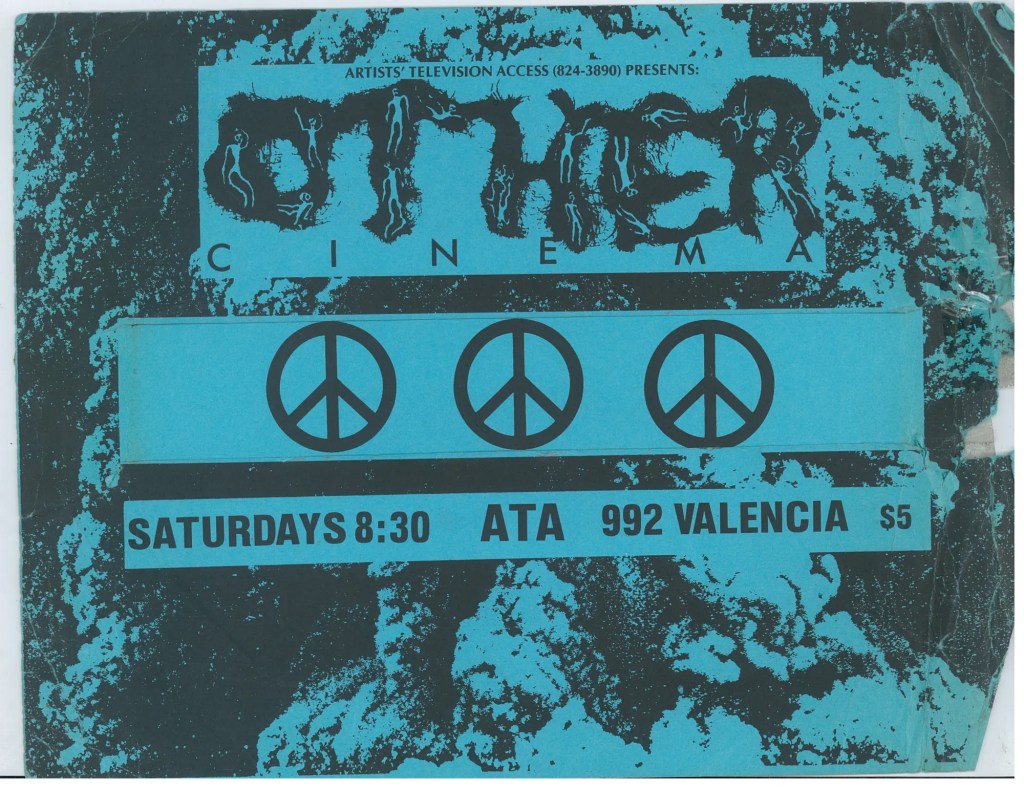
With traditional avenues of information exchange becoming more restricted, pockets of transgressive media resistance—inspired by the countercultural film and video collectives of the ‘60s and ‘70s—gained 501(c)(3) non-profit status in 1980s America. These artist-run community organizations championed alternative educational perspectives on media literacy and performance, such as Artists’ Television Access in the Mission District of San Francisco, California. Operating under the umbrella of this community space exists a cinematic collective with a subversive trajectory: a film screening series and analog archive curated from the margins of mainstream media and acceptable art practice. Under the stewardship of underground filmmaker and curator Craig Baldwin, Other Cinema stands as the vanguard of Baldwin’s personal artistic conviction—what he calls “cinema povera,” an anti-capitalist filmmaking creed where artists only use the materials at their disposal to create art. Combine this practice with an ethos of media archeology and mixed-media collage that predates our current remix culture activities and what’s generated is an exhibition calendar of the modern avant-garde—a thirty-six week screening schedule projecting experimental film and video to the masses. Every Saturday night, cartoons, B movies, and commercials hold equal ground with industrial, educational, documentary, personal essay, and public domain/orphan films, bringing together numerous artists and filmmakers from around the world under one cinematic ceiling for close to 40 years.

Specific details surrounding the origins of Other Cinema are hard to quantify, partially due to the vastly prolific yet oddly cryptic career of founder Craig Baldwin. Born into a self-admitted 1950s middle-class existence in the Sacramento suburb of Carmichael, California, Baldwin spent his teenage years nurturing a ravenous curiosity for subversive cultures and media. During high school, he was often at the local Towne Theater enjoying the latest midnight show of underground programming, absorbing the cinematic combustion of the ‘60s experimental scene led by filmmakers like George Kuchar and Bruce Conner, who as a teacher would later kick Baldwin out of his film class while attending San Francisco State University. In college Baldwin also indulged in subterranean films such as Peter Watkins’s 1966 pseudo-doc The War Game and exploitation flicks like Paul Bartel’s 1975 sci-fi dystopian romp Death Race 2000. Forming a fascination with film exhibition, Baldwin worked as a projectionist at several movie houses throughout the city, navigating the film worlds through an eclecticism of arthouse, exploitation, pornography, and political activism—including contributing programming and film services to El Salvador Film and Video Projects for the Salvadoran solidarity movement of northern California. His early activism with the artistic political action collective the Urban Rats saw him and his cohorts reclaim San Francisco’s urban landscape through adverse possession or “squatter’s rights,” which allowed Baldwin to experiment with expanded cinema performance, such as projecting film in abandoned buildings and other derelict dwellings. 

This direct approach towards genre and social action speaks to Baldwin’s personal opposition towards the status quo, an attitude that not only informs Other Cinema’s motion picture programming but also Baldwin’s own filmmaking forays. His early experiments with Super 8 film—such as the prototypical culture jam/situationist prank Stolen Movie—bled into his 16mm attacks on advertising, consumerism, and colonialism in Wild Gunman and RocketKitKongoKit before gaining maximum velocity with his Dexedrine-driven, countermyth conspiracy report Tribulation 99. Making up the pure found footage/collage aesthetic of his filmography until introducing live-action performance into the mix with his films !O No Coronado!Spectres of the Spectrum, and Mock Up on Mu, these early works draw heavily from Baldwin’s now massive archive of analog film. Housed beneath the Artists’ Television Access property, this subterranean scroll of marginalized media is continuously rescued from the bowels of civilization’s ever evolving technological burden and given new purpose. The shift from film in the 1970s to magnetic tape in the 1980s saw major institutions overhaul their audio/visual collections in favor of more economical video formats, sending reels of celluloid to the dumpsters and landfills. Much like the Dadaists of the early 20th century avant-garde, whose use of appropriation and photomontage expressed anti-bourgeois protest through their art, Baldwin and company salvaged these bastardized works from material obscurity and celebrated their ephemeral nature through collage and remix. These hybrid works of the late 20th century serve as precursor to many of our current 21st century new media innovations, resulting in the continued radicalization of modern artistic folklore, such as the mashups and supercuts of Everything Is Terrible! and the radical anti-authoritarian statements of the sister collective Soda Jerk

Baldwin and Other Cinema’s defense of the diminished and discarded extends not only to the physical media he interacts with but to the audience he exhibits for. Maintaining a dialectical attitude, Baldwin expresses both respect and disrespect towards film genre and classification by spinning one off the other and forming new categories. Each screening is meant to give equal weight to diverse voices and provoke participation amongst attendees—an ethos Baldwin codified with his underground screening series The RAD, The MAD & The BAD while programming film events for Artists’ Television Access during the organization’s formative years. A protean yet practical film genre grouping system sorted through three major categories stripped of pretense and soaked in punk rock colloquialism, each selection was designated its own time slot on Wednesdays and Saturdays with those represented creating a continuity across each section:

The RAD: showcasing political and social action films 

The MAD: mad genius or auteur cinema

The BAD: psychotronic themes of horror/sci-fi/exploitation

Defying the unspoken restraint behind many traditional classification systems that favor a false high-brow aesthetic to an honest low-brow sensibility, The RAD, The MAD & The BAD crossed the cultural demarcation line with an egalitarian stance towards genre representation, allowing for serious discussion about what constitutes a film’s importance and its commodification within society. More importantly, it displayed through example that poor production doesn’t always mean poor quality, and films created on the margins of capital contain a certain cultural influence and accessibility that corporate-backed productions can only hope to afford or inspire.

The authentic response audiences gave towards the weekly film schedule at Artists’ Television Access saw the prestigious San Francisco Cinematheque approach Baldwin to bring his street sensibility to their precocious crowd with Sub-Cinema, a RAD, MAD & BAD-inspired program that ran over the course of 1985. The creation of other pop-up programs like Anti-Films and Eyes of Hell inspired Baldwin to consolidate his film selections under his own programming umbrella, and soon the ethos that fueled The RAD, The MAD & The BAD manifested itself into the physical embodiment of Baldwin’s own psyche and practice with the foundation of Other Cinema. 

If the RAD, MAD & BAD helped bring acceptance to the concept of marginalization in film selection and exhibition during the 1980s, the programming behind Other Cinema built upon this provocation by introducing new alternative voices from the microcinema scene of the 1990s. One of the forefronts of this new cinematic experience, Other Cinema became a home for a subculture of film using and reusing old and new technologies to create future underground works, with filmmakers and exhibitors from across the country like Sam GreenMartha ColburnGreta SniderBill DanielOrgone Cinema3Ton Cinema, and “others” coalescing to this space like the children of Hamelin to the Pied Piper’s whimsical flute. Many of these groups and individuals appear in Baldwin’s upcoming career monograph Avant to Live!, a 500-page treatise detailing his cinematic trajectory in the media arts.

The decline of physical media coupled with our perpetual progression towards a digital state continues to divide us, with some championing the virtual realm and its democratization of new technologies and others questioning its effect on the human experience and how we interact with each other. The popularity of streaming services continues to challenge the economic longevity of physical media, forcing film formats into a wave of obsolescence. Despite this, Craig Baldwin and Other Cinema rise against the tide with an analog assault of expanded cinema every Saturday night. Filmmakers on the fringe and maverick media archeologists with an overwhelming responsibility to film history, yet hamstrung by a lack of resources, congregate at Other Cinema to embrace the struggle in an ever evolving motion picture renaissance. It’s a form of masochism one needs to make it on this side of the art world—the “masochism of the margins,” as Baldwin often says. It takes pain and sacrifice to live here, yet the psychic rewards far outweigh the material loss. 

Craig Baldwin: Avant to Live! is a collaborative project between San Francisco Cinematheque and INCITE: Journal of Experimental Media and was released on May 30, 2023.

Andy Prisbylla is an underground filmmaker and exhibitor from the rust belt apocalypse of Steel City, PA. His screening series SUBCINEMA showcases subterranean movies and art through digital programming and live pop-up events. Find out more through Letterboxd and Mastodon

Saturday Matinee: Yojimbo

A fistful of samurai

By Roger Ebert

Source: RogerEbert.com

Almost the first thing the samurai sees when he arrives is a dog trotting down the main street with a human hand in its mouth. The town seems deserted until a nervous little busybody darts out and offers to act as an employment service: He’ll get the samurai a job as a yojimbo — a bodyguard. The samurai, a large, dusty man with indifference bordering on insolence, listens and does not commit. He wants sake and something to eat.

So opens “Yojimbo” (1961), Akira Kurosawa’s most popular film in Japan. He was deliberately combining the samurai story with the Western, so that the wind-swept main street could be in any frontier town, the samurai (Toshiro Mifune) could be a gunslinger, and the local characters could have been lifted from John Ford’s gallery of supporting actors.

Ironic, that having borrowed from the Western, Kurosawa inspired one: Sergio Leone’s “A Fistful of Dollars” (1964), with Clint Eastwood, is so similar to “Yojimbo” that homage shades into plagiarism. Even Eastwood’s Man With No Name is inspired, perhaps, by the samurai in “Yojimbo.” Asked his name, the samurai looks out the window, sees a mulberry field, and replies, “Kuwabatake Sanjuro,” which means “30-year-old mulberry field.” He is 30, and that is a way of saying he has no name.

He also has no job. The opening titles inform us that in 1860, after the collapse of the Tokugawa Dynasty, samurai were left unemployed and wandered the countryside in search of work. We see Sanjuro at a crossroads, throwing a stick into the air and walking in the direction it points. That brings him to the town, to possible employment, and to a situation that differs from Hollywood convention in that the bad guys are not attacking the good guys because there are no good guys: “There is,” the critic Donald Richie observes, “almost no one in the whole town who for any conceivable reason is worth saving.” It’s said Kurosawa’s inspiration was Dashiell Hammett’s novel Red Harvest, in which a private eye sets one gang against another.

Sanjuro’s strategy is to create great interest about himself while keeping his motives obscure. He needs money and so presumably must hire himself out as a bodyguard to one of the two warring factions. There is the silk dealer and the sake merchant, both with private armies, who occupy headquarters at either end of the town. In between, the townspeople cower behind closed shutters and locked doors, and the film’s visuals alternate between the emptiness of the windswept street, shots looking out through the slats of shutters and the chinks in walls, and shots from outdoors showing people peering through their shutters.

Richie, whose writings on Kurosawa are invaluable, notes that Kurosawa’s shots are always at right angles to what they show; they either look straight up and down the street, or straight into or out of the buildings, and “there are very few diagonal shots.” The purpose may be to emphasize the simplicity of the local situation: Two armies face each other, the locals observe the main street as if it’s a stage, and the samurai himself embodies the diagonal — the visitor who stands at an angle to everyone and upsets the balance of power. Indeed, in a crucial early scene, as the two sides face each other nervously from either end of the street and dart forward fearfully in gestures of attack, Sanjuro sits high above the action in the central bell tower, looks down and is vastly amused.

His strategy is to hire himself out as a yojimbo to first one side and then the other, and do no actual bodyguarding at all. His amorality is so complete that we are a little startled when he performs a good deed. A farmer and his wife, possibly the only two good people in the town, are kidnapped. Sanjuro, employed by the side that kidnapped them, kills their six guards, frees them, tears up a house to make it look like there was a fierce struggle, and blames it on the other side. Disloyal to his employer? Yes, but early in the film, he is offered 50 ryo by one of the leaders, only to overhear the man’s wife telling him, “We’d save the whole 50 ryo if we killed him after he wins.”

Sanjuro’s strategy is an elaborate chess game in which he is playing for neither side but plans instead to upset the board. “In this town, I’ll get paid for killing,” he muses, “and this town would be better off if they were dead.” His planning is upset by the unexpected appearance of Unosuke (Tatsuya Nakadai), the younger brother of one of the sake dealer’s bodyguards. The samurai often walk about with their empty sleeves flapping at the sides, their arms folded inside their kimonos. (Eastwood, in the Leone movies, always keeps one hand under his poncho.) When Unosuke finally reveals one of his hands, it holds a pistol — the first one seen in the village. This upsets the balance of power and tilts against Sanjuro’s plans, which depend on his skill as a swordsman who can kill any number of the others without being wounded himself.

The gun provides Unosuke with a sneaky kind of self-confidence, and he produces the weapon gloatingly from time to time. Occasionally, he kills people in cold blood, just to prove that he can, in events leading up to a final bloodbath. One of the first people Sanjuro meets in the town is the coffin-maker, and there is a nice moment when he first goes out to do battle and advises him, “Two coffins. Noon, maybe three.” By the end there is no business for the coffin-maker, because there is no one to pay for coffins.

That kind of dark humor is balanced in the film by other moments approaching slapstick, as when the injured Sanjuro is smuggled away in a large barrel; when his bearers pause in the middle of the street, the samurai tilts up the lid of the barrel to provide a droll commentary on the progress of the manhunt for him.

Richie believes “Yojimbo” is the best-photographed of Kurosawa’s films (by Kazuo Miyagawa, who also shot “Rashomon” and such other Japanese classics as Ozu’s “Floating Weeds” and Mizoguchi’s “Ugetsu“). The wide screen is fully employed for dramatic compositions, as when the armies face each other across an empty space. And there is a dramatic sense of depth in scenes were Sanjuro holds the foreground while forces gather in the background. Shutters, sliding doors and foreground objects bring events into view and then obscure them, and we get a sense of the town as a collection of fearful eyes granted an uncertain view of certain danger.

“Yojimbo” was followed quickly by Kurosawa’s “Sanjuro” (1962), which also stars Mifune, the greatest modern Japanese actor, playing the same character or one so similar as makes no difference. He acts as the adviser for nine uncannily similar brothers who are remarkably inept samurai. The choreography in “Sanjuro” is one of its best jokes; the brothers do everything together: Nod, recoil, agree, laugh, gasp, and they follow Sanjuro in a kind of conga line, until he snaps, “We can’t move around like a centipede.”

The difference between the two films is that “Sanjuro” is a comedy in which ancient samurai traditions are exposed as ludicrous by the pragmatic hero, while “Yojimbo” is more subversive: The samurai were famed for their unyielding loyalty to their employers, but Sanjuro, finding himself unemployed because of the collapse of the feudal system, becomes a modern man and is able to manipulate both sides because they persist in thinking he will be faithful to those who pay him.

There is a moment at the end when old and new hang in the balance. The wounded Sanjuro no longer has his sword, but we have seen him practicing with a knife — skewering a bit of paper as it flutters around a room. He faces Unosuke, the gunman. Without revealing precisely what happens between them, let me ask you to consider the moment when Unosuke aims his pistol at Sanjuro. It may be loaded, it may not be. Sanjuro cannot be absolutely sure. He is free to move away or to disarm Unosuke, but instead he sits perfectly motionless, prepared to accept whatever comes. This, it strikes me, is the act of a samurai aware that his time has passed and accepting with perfect equanimity whatever the new age has to offer.

Saturday Matinee: A Life on the Farm

A LIFE ON THE FARM Review: Making Movies

By Ernesto Zelaya Miñano

Source: Screen Anarchy

“Charles Carson. Coombe End Farm.”

This story begins with a videotape. Director Oscar Harding finds an old tape he never got to watch in its entirety as a kid. Said video was titled “Life On The Farm”, a feature-length home movie made by Charles Carson, an elderly neighbor of his grandparents’. When looking into how this salt-of-the-earth, unassuming farmer managed to make a movie, Harding uncovers a great story. A Life On The Farm is the result.

At first, the contents of said tape –  a grainy home movie with bad tracking and all those other bugs that make one nostalgic for the VHS era – prove disturbing. Clad in a plaid red shirt and cowboy hat, Charles Carson takes Harding and his viewers on a tour of his laidback country life in Somerset, England, spending days looking after his animals, tending to the land, showing cows giving birth in graphic detail, talking incessantly to his dead cat and ultimately, taking the corpse of his deceased mother around the farm and posing her for pictures with the animals. It’s no wonder that one talking head compares him to Ed Gein, and you’ll probably be thinking of Norman Bates and his unhealthy attachment to Norma more than once.

But just as you expect Harding’s prized discovery to escalate into a full-blown snuff film or something similar, the director does a total bait-and-switch while digging into Charles Carson’s background, and discovers a simple, well-meaning guy who turned to filmmaking due to loneliness; meanwhile, all his interviewees go from laughing and pointing to sincerely admiring the man.

Carson’s story was pretty tragic; having lived nearly all his life on a remote farm, he lost both his parents, a brother, and his wife, who also did not live with him and only visited occasionally. Left alone in the company of cows, cats and other assorted animals, Carson turned to an old video camera and a photography hobby to have a link to the outside world, and one assumes to keep himself sane.

While he first regaled his neighbors with pictures of himself on his land along with funny captions, they soon started receiving what would be his legacy, “Life On The Farm”. Sadly, Carson passed away in the mid 00’s, alone and mostly forgotten. That is, until Harding and an entire community of found footage and vintage VHS enthusiasts got a hold of his film.

Harding’s doc goes from a budding backwoods horror picture to an uplifting story of an unlikely DIY guerrilla filmmaker whose unconventional work is being rediscovered. Carson’s VHS tape also highlights the love many film fans have for physical media, which is largely disappearing in this new era of streaming platforms; bizarre little gems like Carson’s magnum opus can disappear into the ether (though this one is uploaded to YouTube, so at least it’s safe for the time being), and this film is a rallying cry for their continued survival.

Even though it starts to lay the schmaltz on a bit thick, A Life On The Farm ends up as a portrait of a one-of-a-kind artist who’s finally getting his due, whose work for many will be nothing more than a passing curiosity, but who managed to make his mark. Movies are that one special thing that can bring people together, and for Carson, they’re what brought him to the rest of the world.

____________________

Watch A Life On The Farm on Kanopy here: https://www.kanopy.com/en/product/14052224

Saturday Matinee: Beau is Afraid

Beau Is Afraid (Film Review): A Baffling Nightmare

By Joseph Tomastik

Source: Loud and Clear

Beau is Afraid. And I’m afraid of what’s in Ari Aster’s head after watching his latest film. The director of Hereditary and Midsommar is back with Beau is Afraid, a baffling three-hour effort to make his other films look easily accessible in comparison. I love Hereditary and consider it one of the best horror films of the 2010s. I like Midsommar purely for the sensory experience of watching it, but its bare-bones, overblown story stops me from calling it good. Beau Is Afraid takes those strengths and weaknesses of Midsommar and cranks them up to eleven. And, fittingly enough, my feelings on that film are repeated twofold with this one.

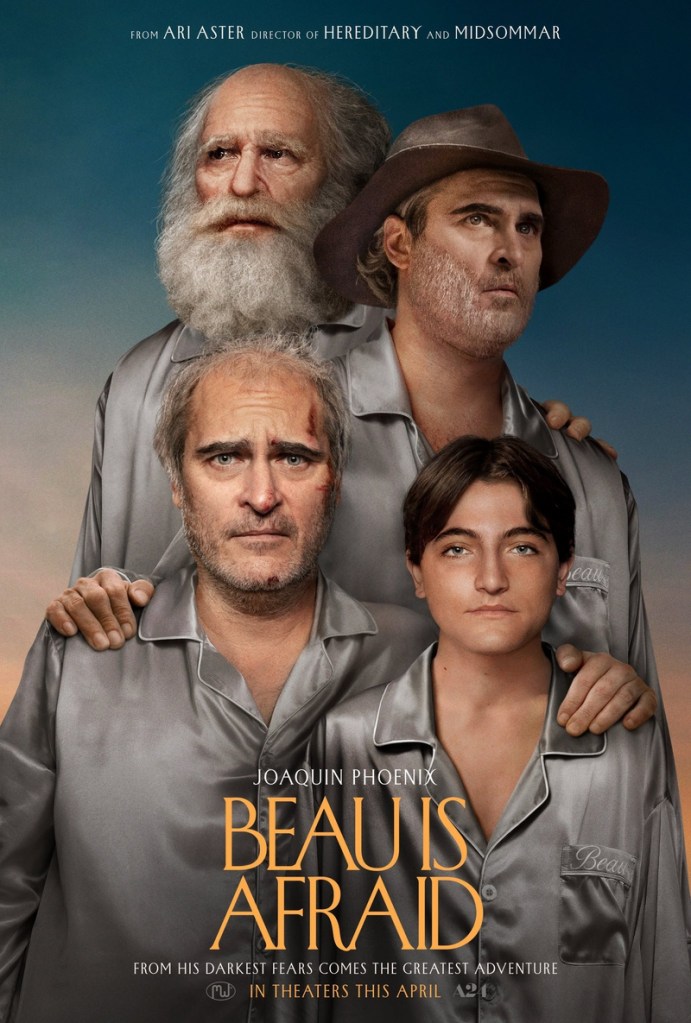
Beau (Joaquin Phoenix) is an anxious man who lives in a broken-down apartment in a corrupt, violent city. He’s set to go on a trip to visit his overbearing mother (Patti LuPone), but shocking news and unfortunate events derail his trip, forcing him to cross paths with a variety of bizarre characters and surreal events. That’s as much of the plot as I’ll be revealing. Not just to avoid spoiling any surprises, but also because that’s about all I feel I’m even capable of saying. Outside of Beau being tended to along his way by a seemingly caring couple (Amy Ryan and Nathan Lane), the events of Beau is Afraid are increasingly difficult to properly wrap one’s head around.

Beau is Afraid is the kind of film that I’ve become more open to over the years. I once had the impulse to dislike any film that I didn’t instantly understand, but now I can appreciate the experience of such a baffling film if I find myself sucked into the craft, performances, visuals, or overall feel. Beau is Afraid is an unshakable 10/10 in all of those aspects. This is Aster’s most skillfully shot, visually haunting film to date. He has such an insanely perfect grasp on his directorial style that I struggle to comprehend how any human being could bring some of this film’s beauty to reality. That sounds hyperbolic, but I really was that mesmerized by what was accomplished here.

There’s so much detail in almost every single shot that you could blink and potentially miss a jarring detail. This is not only impressive, but it guarantees that no matter where or when you look, some form of misery is happening. This is especially true early on when we see what kind of environment Beau lives in. It looks like your typical city, but it feels downright alien because of how relentlessly cruel everyone is and how well the nightmare of such a place is captured. The entirety of Beau is Afraid feels like a nightmare, in fact. The are sights, sounds, and ideas are like something straight out of a David Lynch movie, and they’re never going to leave my head. And, as is typical of Aster, the whole film is effectively raw and relentlessly unpleasant. Even if you don’t always understand what’s happening or why, you feel it.

The editing emphasizes that nightmarish feel as well, not letting you skip out on a single second of the discomfort that would exist in these scenarios. There are no loud tactics or cheap jump scares here, as every dark reveal is slowly thrust upon you. The editing also gets morbidly funny. Beau is about to take a bath, he gets bad news, and a match cut shows the water spilling out onto to the floor, showing how long he’s been standing there stunned. The blocking of characters from wide shots gives so many of them the physical presence of a creeping demon, even if you don’t always know why you’re afraid of them, and the lighting outlines so many set pieces and characters in a disarming otherworldly void.

The actors are all spectacular. Phoenix is amazing as always, getting across Beau’s frightened vulnerability, uncertainty, and buried anger in a heartbreakingly sympathetic way, especially when it’s met with so much hostility. Everyone else works so well with the material they’re given. Their lines get so excessively cruel and heightened that they could easily come across as inauthentic, but every performance brings enough painfully realistic conviction to sell them.

There’s also a sequence at the center of Beau is Afraid involving a stage play that tells its own little story. This entire stretch is stunning enough to work as its own Oscar-worthy short film. It combines a variety of styles and artistry and works them into the emotion of the story being told. If other filmmakers take away anything from Beau is Afraid, it should be how innovative they can get with their own storytelling. Aster’s recurring cinematographer Pawel Pogorzelski needs to become one of the most sought-after people in his field. I’m really doing very little justice in describing what he does here.

If only that play sequence felt like it mattered in the grand scheme of things. Which leads me to where Beau is Afraid falls short: the story. I don’t know whether to classify this movie as ridiculously simple or excessively convoluted, because its story is a very long, winding road to what feels like a very basic destination. Beau is Afraid is, above all else, meant to be about a man dealing with the damage his overprotective, abuse mother inflicted onto him, and how that’s molded his paranoia and anxiety. But additionally, you’re also supposed to be trying to figure out the nature of Beau’s reality. Yet the more I think about it (without the luxury of a rewatch, I must stress), the more the story and structure begin to fall apart.

A lot of this has to do with character motivations. Beau’s are fine and understandable, but everyone else makes so many nonsensical and sporadic decisions that don’t feel baked into the well-established natures of who they are. They feel like excuses to show upsetting content or move us to the next set piece. The couple that takes care of Beau has a daughter (Kylie Rogers) who believes Beau is replacing her … and I have no idea why that is, let alone why it drives her to the drastic actions she takes. They have a veteran son (Denis Ménochet) with a severe but pointless and almost tastelessly portrayed mental illness. The parents’ outlook on Beau also eventually flips in a way that feels almost pointless in the grand scheme of things.

The play I brought up initially seems like it may connect somehow to Beau’s past, present, and future, but it really doesn’t. A character supposedly from his past soon shows up, and there are no hints as to how he got there, what he’s been doing, or even what he’s even trying to accomplish, especially after another reveal later on. Flashbacks to Beau’s childhood see him interacting with a very deranged girl whose unnatural, almost sociopathic dialogue is seemingly written that way just to be weird and off-putting.

think I know the very, very basic nature of what’s going on … maybe. The ending and the hints of said ending definitely lead me down one road, along with a few other theories that may hold some weight when I factor in my own interpretations of other reveals. But that road still leaves a lot of other threads and sequences failing to click into place, at least in a way that contributes to whatever Aster is going for thematically … I think? I swear, there’s something here that could potentially justify a lot of what I’m unclear on. I can’t say specifically what that is, but I’m hesitant to just dismiss the whole story entirely.

By the time the ending rolls around, you understand the core of what Beau is Afraid is supposed to be about. It just stretches what little meat that core has to such an absurd degree, throwing in all kinds of self-indulgent hurdles that distract from the point of the film more than they add to it. I get that certain films are supposed to not follow conventional, natural logic. But they should still have some method to their madness. Beau is Afraid goes all over the place. It’s a few minutes short of being three hours long, and that length is partially due to the many non sequiturs and needless details that muddy up the ambiguous information that probably is relevant to the bigger picture.

To the film’s credit, I never once felt that length, I was never bored, and I never wanted the glacial pacing to speed up. I also, despite how little I can grasp the film’s intentions, still find myself feeling more positively about Beau is Afraid than negatively. I think I’ll even watch it again just to relive this astonishingly constructed fever dream. I must stress that my enjoyment is almost only due to the visceral experience of the entire nightmare playing out, and not from the meaning behind it. Ari Aster is becoming a frustrating director for me because he clearly has god-tier levels of talent behind the camera. But that talent seems to lose its focus when he’s writing, a problem he’s so far only avoided with Hereditary.

I’ll give full props to A24: they clearly don’t care whether or not all of their films make money. There’s no way in my mind they could have looked at this script with this running time and thought it was going to do well. This is the kind of film that’s destined to get a C or D grade on Cinemascore and leave many audiences at odds with the general critical praise the film is getting. In that regard, if you can see yourself enjoying a film for the same reasons I enjoyed Beau is Afraid, then you should absolutely give it a shot in theaters. The same applies if you just like weird, trippy, dark films regardless of their substance. I’m still going to see Aster’s next film, because everything he’s made has shown him to be on another level of directing. He’s one of the few filmmakers who can win me over solelywith his craft, even when his stories are lacking. I just hope he eventually regains control of that crucial other half.

____________________

Watch Beau is Afraid on Hoopla here: https://www.hoopladigital.com/movie/beau-is-afraid-joaquin-phoenix/16497118

Saturday Matinee: Everything Everywhere All at Once

“Everything Everywhere All at Once” Review — Don’t Forget To Breathe

By Sergiu Inizian

Source: Medium

In 2016, Daniel Scheinert and Daniel Kwan (known collectively as Daniels) premiered their feature debut at the Sundance Film Festival. Swiss Army Man stunned audiences with a bizarre premise and is still one of the oddest films to come out of the prestigious festival.

It is a movie in which the emotional weight gets swallowed by a nevertheless entertaining childish cinematic approach. But it’s also a test run for Everything Everywhere All at Once, a whirlwind of a movie that brings so much more to the screen than downright weirdness.

The Daniels tell the story of Evelyn (Michelle Yeoh), a Chinese-American woman who runs a laundromat with her easy-going husband, Waymond (Ke Huy Quan). She is discouraged by life, has marital problems, and is unable to communicate with her daughter, Joy (Stephanie Hsu). On top of it all, she is at a loss when trying to challenge her father (James Hong) about past trauma or present issues.

Yeoh infuses so much dignity into Evelyn, a struggling mother who quietly looks for answers to her personal problems while trying to put the family business in order. Her two priorities are organizing a Chinese New Year party and successfully dealing with an IRS audit.

But, in the IRS building, a wholly changed Waymond introduces her to the Multiverse, a collection of realities that hosts endless versions of Evelyn. This is revealed to her because she is the one powerful enough to combat an entity that desires to destroy the fabric of reality.

What ensues next is a kaleidoscopic montage of possibility that showcases the protagonist’s alternate lives with gripping vigor. This interdimensional music video entertains through dynamic genre mashups, marvelous colors, and an eclectic Son Lux soundtrack. The directors decorate their psychedelic narrative with an abundance of references that range from arthouse drama to “Avengers-style” heroics and to completely silly antics.

At the center of the polychromatic experience, Evelyn is tasked to make sense of it all. Michelle Yeoh is fearless in her multifaceted role, bringing nuance and honesty to a captivating madhouse of a film. Within the Multiverse, Yeoh’s wide-open eyes pierce through all the outlandish embroidery and stand as the film’s brightest marvels.

Underneath the sci-fi-infused cinematic experience, the Daniels reveal an attentive treatment of sorrow, generational conflict, and reconciliation. The portrayal of familial disconnect especially absorbed me: Evelyn is both a mother and daughter and yet she finds herself in the middle of a discord that spans three generations. In Everything Everywhere All at Once, the fractures of reality pale in comparison to the emotional ruptures that define Evelyn’s family.

While the visual experience of the massive Multiverse can be overwhelming at times, the directors know when to hit the pause button and insert quiet moments, allowing the characters to shine. Ke Huy Quan steals the show in these scenes, especially in the universe in which Evelyn is a famous actress. He brings so much authenticity to the kind, hopeful Waymond and his presence is a fitting companion to Yeoh’s mesmerizing performance.

In Everything Everywhere All at Once, the Daniels create so many layers for the seemingly mundane story of Evelyn. It’s a breathtaking journey that deals with life’s “what-ifs” and entertains through sheer ambition. It also embraces a charming message which showcases the wonder of cinema and the craft of the quirky directorial pair: regardless of how seemingly ordinary a destiny is, it always involves plenty of fantasy, mystery, and hope.

____________________

Watch Everything Everywhere All at Once on Hoopla here: https://www.hoopladigital.com/movie/everything-everywhere-all-at-once-michelle-yeoh/16497128

Saturday Matinee: Greener Grass

By Sheila O’Malley

Source: RogerEbert.com

There’s a scene in “Greener Grass,” written and directed by Jocelyn DeBoer and Dawn Luebbe (who also co-star), where four families in golf carts sit at a four-way intersection. Everyone gestures at everybody else: “You go,” “Oh, no, you go, I insist…” And so they sit at the intersection forever, smiles frozen on their faces, in a standoff of psychotic politeness. If you’re at a four-way intersection, someone has to go first, someone has to allow themselves to be waved on through. In “Greener Grass,” nobody dares.

DeBoer and Luebbe have created a psychotic suburban world where surface conformity is all, where everyone strives to look and be the same. The smiling faces perch on top of roiling emotions, not even necessarily anti-social emotions, just regular ones, like need, loss, pain. “Keeping up with the Joneses” is pushed to its most surreal extreme. Everyone in the town has braces. Everyone dresses the same, in pinks and light blues and light purples. Everyone drives golf carts. It’s like they live in a mini village placed on a country club golf course somewhere. 

The golf cart scene is an excellent example of what “Greener Grass” is attacking, and it’s a sharp and subversive critique: it would be great to live in a more civil world, but too much civility leads to golf carts stalled at a four-way intersection. In another scene, when two meals end up on the ground after a collision between two waiters, the patrons hasten to eat the food off the floor. To say, “Please bring me another meal” would just not be done. Every single interaction in “Greener Grass” is “competitive,” but it’s competition tamped down by friendly beaming smiles. These people live in an agony of one-upmanship.

“Greener Grass” starts out strong and strange in the first scene. Lisa (Luebbe) and Jill (DeBoer) sit in a group of parents on a blazing sunny day, watching their kids play soccer. Both women are immaculately dressed and made up, braces on their teeth. Jill holds a newborn baby and Lisa compliments the baby on being “cute.” Jill immediately hands the baby over to Lisa. Nobody seems to find this strange, not even Jill’s husband (Beck Bennett). Lisa wanted the baby, and so it’s polite to hand it over, it would be selfish to hang onto it. Later on, a neighbor (Mary Holland) expresses resentment that Jill didn’t give the baby to her. Jill clearly has mixed feelings about what she has done, and yet “mixed feelings” are not allowed in the world of “Greener Grass.” Jill’s remaining son (Julian Hilliard) is a handful, a bedwetter and a perceptive observer. His surprising transformation is matched by Jill’s total personality-disintegration.

Both DeBoer and Luebbe have performed with the improv comedy troupe Upright Citizens Brigade for over a decade. They bring that experience to their creation of this alternate universe, an unholy mix of “Blue Velvet,” “Invasion of the Body Snatchers,” and “The Stepford Wives.” The characters in “Greener Grass” watch a lot of television and DeBoer and Luebbe have a lot of fun creating these alternate-history shows, fake commercials, fake reality shows and soap operas. “Greener Grass” displays its sketch comedy origins, and sometimes the “bits” stand out as not fitting altogether properly, maybe not as fleshed out as they should be. This is a very unsettling film, with a color palette that manages to be blazing-vivid and dreary-muted at the same time, as though it’s all a regurgitated idea of an already-regurgitated idea. (That idea of regurgitation is made explicit in one of the fake television commercials.)

There are very funny details throughout. Pay close attention to the production design. The houses all look like toy houses, with interchangeable decor. People are just “playing house,” they don’t actually live there. In the grocery store, a sign is placed in a prominent position: “Not responsible for stolen lives.” In one surreal moment, Jill and Lisa make out with each others’ husbands, not even realizing their mistake. “Greener Grass” feels a little bit like a comedy sketch drawn out past its capabilities, but the film’s target is always clear.

Like all good satires, “Greener Grass” trucks in exaggeration. Anyone “getting ahead” of anyone else is looked on with suspicion. Personal relationships have a generic quality because if you say you’re “best friends” with someone, someone else might feel left out. Being “unselfish” can be a competition, especially when done performatively. In the leveling world of “Greener Grass,” “standing out” is terrifying. It’s Tall Poppy Syndrome on amphetamines. Even as Jill deteriorates, there’s no sense here of a possible escape to another place where things are different. In “Greener Grass,” Sylvia Plath’s suffocating “bell jar” covers the whole world.

Saturday Matinee: The Wandering Earth II

By Simon Abrams

Source: RogerEbert.com

Time runs out in carefully marked units in the mainland Chinese sci-fi disaster pic “The Wandering Earth II,” a sturdy prequel to the record-smashing adaptation of Liu Cixin’s novel. In “The Wandering Earth II,” the apocalyptic problems faced by this movie’s Chinese characters—along with their international peers from the United Earth Government (UEG)—have already happened. Because in “The Wandering Earth,” the planet has already left its orbit thanks to some high-powered rocket engines, which have pushed the Earth out of harm’s way (aka a crash course with the Sun). Set in the near-future—a range of dates that includes 2044, 2058, and 2065—“The Wandering Earth II” follows China’s men and women of action as they lead the planet out of the solar system and into the previous movie.

Both “The Wandering Earth” and its sequel are flashy, state-approved cornball spectacles about humanity’s resilience (especially the Chinese). Both movies were produced with gargantuan budgets that would make even James Cameron blink, and they both look fantastic thanks to director Frant Gwo’s eye for panoramic scope and paperback cover-worthy details. The main difference between these two blockbusters is that the protagonists of “The Wandering Earth II” must repeatedly choose to be hopeful despite perpetually impending disasters, each one of which is neatly labeled and foregrounded with pulpy on-screen text like “The Lunar Crisis in 12 hours” and “Nuclear explosion in 3 hours.”

In this way, Gwo (“The Sacrifice”) and his five credited co-writers succeed in refocusing our attention on scenes of ticking-clock suspense, sandwiched between syrupy—and mostly satisfying—melodramatic interludes, where square-jawed astronauts and UEG diplomats struggle to do what we know is a foregone conclusion.

Most of “The Wandering Earth II” follows the superhuman efforts needed to jumpstart the Moving Mountain Project, the mission to first build and then deploy the globe-shifting engines needed to push the Earth out of harm’s way. The UEG’s Chinese delegation, led by the paternal diplomat Zhezhi Zhou (Li Xuejian), recommends prioritizing the Moving Mountain Project instead of the Digital Life Project. This radical initiative would transfer human participants’ consciousnesses into artificially intelligent computer programs. Some Digital Life supporters try to sabotage the Moving Mountain Project, including a deadly attack on the Space Elevator transportation ships that send UEG representatives from the Earth to the Moon.

Nobody living through the events of “The Wandering Earth II” knows what we know: That the Moving Mountain project succeeds and eventually becomes the Wandering Earth project, which comes under threat by a HAL 9000-esque artificial intelligence (A.I.) named MOSS in the first film. Still, multiple scientists, government officials, and space adventurers—mostly Chinese—believe in their work’s vital necessity, whether they’re punching out saboteurs or detonating one of a couple hundred nuclear devices scattered around the moon. There’s a lot of hand-wringing and teeth-gnashing along the way, mostly from English and Russian-speaking UEG members, all of whom speak in stilted, poorly dubbed dialogue. But Chinese astronauts, like “The Wandering Earth” co-leads Liu Peiqiang (“Wolf Warrior 2” star Wu Jing) and Han Duoduo (Wang Zhi), always prove Zhou’s slogan-simple maxim: “In times of crisis, unity above all.”

Some melancholic (and occasionally maudlin) flashbacks and dialogue emphasize the personal motives of one-note characters who, in the movie’s best scenes, are just parts of a beautiful post-human landscape. Liu remembers his wife and young daughter while melancholic scientist Tu Hengyu (Andy Lau) talks with his dead child after he uploads her personality into an experimental A.I. program; she cries a lot and sometimes responds with existentially troubling questions like, “Where am I, daddy? I want to get out.” We’re then periodically reminded of the next impending crisis—“the moon disintegrates in 50 hours”—in between solar storms and nuclear explosions. Somehow, “The Wandering Earth II” never feels tonally unbalanced or narratively convoluted, partly because Gwo and his collaborators keep their movie’s plot focused on feats of action-adventure heroism.

“The Wandering Earth II” only seems relatively unambitious because it’s more focused on sap-happy human emotions than on dystopian intrigue. Both movies are still essentially showcases for beautiful and expensive-looking computer graphics. But “The Wandering Earth II”—a brittle and, at heart, old-fashioned space opera—would be insufferable if Gwo and his ensemble cast members didn’t sell you on the possibility that someday, people who are as selfless, monomaniacal, and capable as Liu and Tu could exist.

“The Wandering Earth II” is also like “The Wandering Earth” because it’s just the right mix of silly and somber. Hurt, scared people wonder about the recent past, but always from a rare position of forward-thinking emotional clarity. (“She’s dead, and that’s it. That’s the reality.”) So when humanity must inevitably save the day, their accomplishments are appropriately surreal and awesome.