Fukushima@5

radioaktivitaet-fukushima-ia

(Source: Fairewinds.org)

Modern ghost towns, abandoned houses, and far stretching roads lined with plastic bags of radioactive garbage have replaced the once bustling neighborhoods and cities of the Fukushima Prefecture. Formerly home to thousands, the massive release of radiation has forced residents to evacuate their beautiful homeland, leaving the land they love behind without knowing whether or not they may ever return without putting their lives at risk. Join the Fairewinds Crew and ask yourself this: With 99 operating atomic power reactors generating electricity in the U.S., what’s so different about your home, your town, your state that what happened to Fukushima couldn’t happen to you and your family?

Many Japanese and millions of Americans are currently living in the shadow of atomic reactors, plutonium reprocessing plants, and atomic waste dumps. It will be five years in March since the triple meltdown at Fukushima Daiichi began and the Japanese public and people around the world continue to search for the truth about nuclear risk and honest answers to their energy future. Fukushima@5 exposes the truth of the ongoing atomic devastation caused by the nuclear meltdown at Fukushima Daiichi.

Related Podcast: Project Censored 03.08.16

Mother Earth May Have Good Reason to Slaughter Us

jing-jang-yin-yang-planet-hd-high-definition-fullscreen

By Jack Balkwill

Source: Dissident Voice

Decades ago James Lovelock constructed a principle called the Gaia hypothesis, contending that a biosphere teeming with life works together with inorganic matter to self-regulate conditions for maintaining a livable planet.

The oxygen levels in our air are maintained, and the salinity of the seas – everything that’s needed to keep conditions within the zones which nurture life on the planet.  This is a theory embraced by many deep environmentalists because it offers hope for the future of life forms on the planet.

When one creature (such as man) gets to be so out of control that it threatens the other life forms, Gaia, or Mother Earth, pushes back toward a healthy balance, according to some theorists (the Gaia principle has many variations).

In the ancient Greek religion, before Zeus was king of the gods in the classical period, or Zeus’ father Cronus was king of the gods, or Cronus’ father Uranus was king of the gods, there was Gaia, the earth mother, who created the heavens, the various gods, and man.  Gaia regulated the growing of crops, healed the sick, and was the earth itself to her followers.

Many of the most ancient religions around the world had as their chief deity a female, and my guess is because they reasoned that since it is the female who gives birth, a creator must be female.

The universe within us

Each of us humans is a microcosm of the Gaia principle.  Within us, we have about a hundred trillion unique creatures which do not share our DNA.  Cells containing our DNA only number about ten trillion, so they are vastly outnumbered.  The microbes within us are in many forms — bacteria, fungi, archaea and viruses.

When our microbes are out of balance, it can be life-threatening, so a major function of our immune system is to regulate them, to keep one species from over reproducing, just as, in the Gaia theory, life forms are regulated within the massive biosphere.

If, for example, Candida reproduces to a high level, our immune system will try to destroy enough of it to get back to a balance.  Candida at normal levels may actually be beneficial, and is thought to attack some harmful invaders. At extreme levels of overgrowth Candida may become deadly to us.

Most of the life forms within us are friendly, and we would die without them.  They have a great many functions, working together to keep us alive.  In the end, if we die, they no longer have a home.

And most of the life forms outside of us are also beneficial, aiding Mother Nature in maintaining a delicate balance.

Symbioses

Oak trees have dropped their heavy acorns for millions of years, right beside their trunks.  In such a place, the acorn has little chance of growing with no sunlight under the canopy of mother tree.  But squirrels are happy to carry the acorns away from the tree to bury them in case they are needed for food during an extreme winter.  The squirrels don’t eat all of what they bury most years, giving the oak an opportunity to spread its genetic material.

In return the oak provides a home for the squirrel, which builds nests in oak trees and eats the acorns.  There are interactions between species all over the planet with which we are not yet familiar, but it is clear that species depend on one another for survival, just as the microbes within us are maintained in a balance that sustains life.

A flower may provide pollen to the bee, and in return the bee pollinates other flowers, benefiting both species.

But sometimes man gets in the way

Who would think a massive animal like a moose would rely on the lowly beaver for its well being?  When beaver hats were a popular fad, beaver were killed off in such large numbers that moose began to starve.  One of the favorite foods of moose is the shoots growing in wetlands, and without beavers to dam streams creating wetlands, moose began to go hungry and started feeding on tree bark, killing trees.

Of course, it was inadvertent that a fad of humans started killing off moose.  But we’ve done such things throughout our history and have more control over nature than we realize.

When sperm whales were slaughtered to near extinction, giant squid began to rise up to the surface in the oceans, no longer having to fear their primary enemy, the sperm whales that fed upon them.  Giant squid previously stayed in deep parts of the ocean to avoid sperm whales.  We have no idea what happens in the long term when a creature like the giant squid, with a ravenous appetite, begins feeding in a part of the biosphere from which it was banned for millions of years, but certainly it must upset the food chain.

It is thought that some animals, such as mammoths, became extinct at the hand of man.  Such creatures disappeared in North America about the time it was populated by humans.

Whether directly or indirectly, we are responsible for the extinction of a great many species.

Intelligence, whatever that is

Many people seem to think that humans are somehow superior creatures.  We have a formula for determining intelligence which predicts that a species is intelligent when its brain is large enough to take care of all of the functions of its body, with something left over.  That something left over is intelligence.  So it’s largely brain size in proportion to body size that suggests degrees of intelligence.

There is an old belief that elephants have a pea brain, but it is not true.  An elephant has a large brain, but needs most of it for maintaining its massive bodily functions, so what’s left over may not be great intelligence, but the elephant is certainly an intelligent animal.

The cetaceans, the large toothed whales, all have brains larger than human brains.  Some scientists have speculated that they may be more intelligent than humans.

When people say, “But cetaceans haven’t invented nuclear weapons,” they are showing, perhaps, a flaw in the human being, not a comparative virtue.

Those who support the theory that cetaceans are more intelligent theorize that they may understand that being more in harmony with nature is the intelligent thing to do for long term survival, rather than making automobiles which pollute the planet and the many other destructive things humans do.

At any rate the other creatures appear to help maintain the balance of life within the biosphere, interrelating in complex ways, while humans have reproduced out of control, crowding out other life forms, taking more than our share of resources, and polluting the planet.

So another way to look at the Gaia theory is to describe it as a kind of immune system for the biosphere.  When it has an organism that is overpopulating and causing other organisms to die, that organism must be regulated, just as for a Candida overgrowth or cancer within a human.

The traditional way that Mother Nature has regulated the human population is with disease.  It worked well up to the twentieth century, when humans began to poison their drinking water with chlorine or other agents to kill off water-borne diseases, which had previously wiped out the populations of entire cities.

Will humans be brought under control by Mother Nature?

In the 1970’s there was a movement to reduce the human population, quite popular with many.  I donated to that cause, and was surprised to see it vanish.  I suspected that it was killed by the capitalists, who have a vision that the population must continue to grow for there to be more consumers, hence, more profit.  Capitalists insist that “growth” continue without considering finite limits consistent with the size of the planet.

So how will Gaia maintain the delicate balance with the human organism out of control?  She might introduce a new disease for which we have no antidote.  It was the first thing I thought of when the AIDS epidemic began decades ago.  A perfect killer, to destroy the immune function, allowing almost anything to then kill the host.  But mankind seems to now have that disease under control.

Or Mother Nature might allow us to commit suicide by climate change from our nasty habit of spewing carbon emissions, and other anti-environmental things we are doing in destroying our little blue planet. We are releasing massive toxins into the environment in the form of dioxins from paper and plastic making, radiation from nuclear power plants and bomb making, insecticides, herbicides, and other dangerous chemicals.

A recent report by The World Economic Forum and Ellen MacArthur Foundation stated that at the current rate, the weight of plastic in the oceans will exceed the weight of the fish.  When I heard this a few weeks ago I posted on Facebook, “The epitaph for human beings will read ‘they thought they were an intelligent species.’”

As an old man I take heart that young people seem to be far more aware of the degradation of the planet’s environment, giving me hope that they will find a solution and assist Mother Gaia in her quest for purification and renewal.

The alternative is to leave her no choice but to see us as a cancer that must be eliminated for the good of the whole.


Jack Balkwill is an activist in Virginia. He can be reached at libertyuv@hotmail.com Read other articles by Jack.

Abandoning the Ship of Fools: Postmodernist and Wildist Responses to Civilization

220px-Narrenschiff_(1549)

By Jeriah Bowser

Source: The Hampton Institute

Once upon a time there was a people who lived with the Sea; living in connection, intimacy, and harmony with their aquatic environment for a very long time. Then one day a dangerous and powerful man had a bold idea. He thought that if he could build a Ship to sail over the Sea, he might find a better world to live in, a Paradise. He had a hard time convincing others that this Paradise was something to pursue, however, so in order to accomplish this he had to enslave lots of other sea-people to make the voyage possible. The sea-people, under threat of violence and death, built a large ship out of dead plant and animal people, stocked the ship with supplies, and took their place at the oars of the slave-galley. This great Ship then sailed away from the sea-people’s ancestral homeland and headed into the great unknown. After a long time at sea, the slaves forgot they were slaves. As they adapted to their new life of labor and hardship aboard the Ship, they forgot what life was like as sea-people and began identifying with the Ship and its mission. As they forgot how to live on their own away from the Ship, their survival and happiness became inextricably bound up with the Ship and the Captain, until they no longer saw themselves as slaves at all, but as willing participants onboard this fantastic adventure. Their language, culture, rituals, and mythology transformed to reflect their new way of life. They now worshipped the Captain and Paradise Gods as they saw themselves fundamentally separated from the Sea and its ways. The Captain created laws and morals with which to guide correct behavior aboard the Ship. They created rituals for themselves which gave them context for their roles on the Ship and gave meaning to their lives of labor and struggle. They lost all contact with their former ways of being and understanding the world. They were truly unanchored in the world; the Ship being their only reference point for Truth and Deception, Meaning and Nihilism, Beauty and Ugliness, Community and Individuality, Pleasure and Suffering, Sacredness and Profanity.

After a while, some of the slaves felt uncomfortable with what they perceived as unjust treatment aboard the Ship. They were tired of being beaten and starved and worked to death and wanted a better life. But instead of abandoning the Ship, they simply asked for more participation. The slaves had forgotten what life was like before the voyage, they couldn’t imagine living without the Ship and the Captain. They had begun identifying with the Ship and its mission so much that they wanted an equal role in participating.They were tired of just rowing and thought that the Navigator’s job might be fun, along with some of the other jobs on board the Ship that were usually reserved for the Captain’s friends. When this discontent reached a certain point, there would be mutinies where the slaves would demand equal access to the Ship, they demanded equal rights. The Captain, being a shrewd man, would listen to their requests and grant them greater access to the Ship. He even let some of the slaves take the wheel for a few minutes on special occasions; it was always a great spectacle when a slave would be called up from the galleys to the captain’s chair for a few minutes, turning the wheel this way and that, grinning idiotically as a rush of power, purpose, and meaning rushed through the slave until their turn was up and they were sent back down to the galleys. The hope of getting a turn at the wheel inspired much enthusiasm and loyalty to the project. Of course, no-one, not even the Captain perhaps, knew that the wheel had been broken for a long time now – it was merely a symbol. Even if the wheel did work, the Ocean current the Ship was now in was much too strong to break out of with a mere wheel turn. The Ship was now caught in a force much larger than itself, it had started on a voyage which it now had no control over.

One day, a few of the more clever slaves got together and started whispering to each other about some things that seemed strange about the whole affair. They couldn’t really put their finger on exactly what was wrong, they just felt that… something was wrong, so they began poking around and investigating. Some of these clever slaves had access to navigation equipment and, after much calculation, discovered that not only was the wheel broken, but the Ship was caught in a huge ocean current that was going in a giant circle and heading nowhere which meant that… there was no Paradise. This was very troubling news. Another member shared that he had discovered a mask with the Captain’s face on it – it seemed that the all-powerful Captain was a mere puppet. Was he in hiding? Was he still alive? Who had killed him? Was he ever real? These were even more troubling discoveries. A few others gained access to the forbidden areas of the Ship: the secret rooms and cellars where the Ships records were stored. As they began exploring the dark and musty belly of the Ship, they discovered that the Ship itself was starting to sink – water was slowly leaking in through the rotting hull and pulling the Great Ship down. Terrified and angry at having been lied to, they decided to try and jettison from the Ship as quickly as possible. They tore apart a section of a storeroom and, using the lumber and tools from the Ship, made a small dinghy together. They launched their dinghy one dark and stormy night, and spent a long time celebrating and high-fiving each other, full of self-congratulatory exhilaration at having escaped the fate of the other slaves. What they didn’t yet realize, however, was that they were caught in the same current as the Mother-Ship. They were headed for the same fate, they had no bearings in the great Sea, no ability to change their course even if they did know where they were, and their dinghy (having been made of the same tools and materials as the Mother-Ship) was already starting to rot and leak.
*****************
The mythology of the Ship of Fools is very old, it is first attributed to Plato, a 4th century BCE Greek philosopher. He used the Ship as an analogy for the fragility and irrationality of a democratic society, as only a strong Captain (a rigidly Rational and authoritarian political system) could maintain order and keep the Ship on course. Some have translated Plato’s metaphor (as well as the remainder of the Republic) as a work of psychology a well, as we mustn’t allow the chaos of our irrational desires and whims (the passengers) distract us or drown out the one voice of Reason (the Captain) in our heads. [1] Various philosophers and writers have since used this metaphor as a literary device and point of philosophical inquiry. Michel Foucault, a 20th century French postmodernist, used the story as a reference point in his book, “Madness and Civilization,” where he explored the history of the social construction of mental illness. In Foucault’s book, he talks about the mythological and historical legacy of the legend and discovered that there were indeed floating insane asylums – the “Narrenschiffs” – which carried those deemed insane from port to port in Europe, particularly in Germany, in the early 15th century. These floating asylums were eventually retired in favor of prison-like insane asylums, which eventually became our mental hospitals.[2] Sebastian Brant, a late-fifteenth century German theologian, used the mythology of the Ship of Fools as a satirical device as he mocked politicians, academics, and various prophets of Modernism during his time.[3] Ted Kaczynski used the Ship of Fools as a metaphor for industrial capitalism in order to critique the role that leftism/reformism plays in distracting and co-opting dissent, and his essay on the topic is considered to be Ted’s most coherent and accessible work.[4] In Max Horkheimer and Theodore Adorno’s landmark 1947 book, “Dialectic of Enlightenment,” they explore this myth by working from Homer’s epic poem, “The Odyssey.” Horkheimer and Adorno portray the epic story of Odysseus as a metaphor for humanity’s journey away from wildness and into civilization. [5]

Since my first introduction to this myth, I felt that it was heavy with archetypal symbolism which begged to be explored. I searched for an explanation which would satisfy my curiosity, but found none that sufficed. It looks like this task has fallen to me.

The Ocean is steeped in archetypal symbolism, most of it revolving around the theme of wildness, as it is the largest and most inaccessible wilderness on our planet. Jung described the Ocean as the very embodiment of the unconscious, with our consciousness a tiny island in the midst of it. [6] While every corner of land on our planet has been thoroughly mapped, every animal or plant we come across has been catalogued and placed on an evolutionary tree, and every “resource” depleted for human consumption, the Ocean still remains vast, mysterious, and elusive from the greedy hands of Science and Progress. The Sea still holds its own against those who would colonize it, although it is slowly being killed despite its resistance. As such, the Ocean holds great symbolism as our unconscious shadow side, our repressed hidden instincts and urges, the dark and dangerous animal that lies in us all.

In my retelling of the Ship of Fools, the Ocean also represents our ancestral homeland, as (according to evolutionary biologists) mammals came from the Ocean and I believe a part of us still recognizes that. I feel it when I stand on a beach and find myself staring out into the vast wild ancestral homeland of my species. I also made the Ocean our home because having a land-destination brings up to possibility of a destination and a potential rescue, it dangles the carrot of Paradise out in front of the Ship. No, there is no land, no destination, no possibility of a safe landing, there will be no survivors washing ashore. There is just more Ocean everywhere you look, more wildness, there is no escaping it. This also brings up the point that there never was a destination in the first place, just an inevitable return and release to wildness.

The Ship is an excellent metaphor for Civilization, as it is the great technological project that carries us to Paradise. Although I found scant mentions of ships in Jungian symbolism (not that I am an authority on Jung), the few mentions of it I did find present the Ship as the Animus (male quality) to the Anima (feminine quality) of the Sea. Therefore, ships refer to the Ego-consciousness and masculine energy, as these man-made floating islands rise above and ride on top of the vast feminine unconscious that is the Sea.[7] Trying my hand at depth psychology, I find that it also represents Technology, as a Ship is a piece of advanced technology which requires division of labor, slavery, private property, objectification, and anthropocentrism to exist. The presence of a slave-galley requires all of those ideas to become systemic and normalized, as well as the ever-present but invisible social violence of civilization which keeps the slaves rowing. A ship is made of dead trees, tar, rope, metal hardware, cloth sails, etc. It is a floating human container made of tree corpses, a vessel built out of and predicated on death. This technological vessel of death allows us to float a few feet above the reality of wildness, allowing us to act like the Ocean isn’t there while we go about our business aboard the floating Machine. It is literally a manufactured barrier between us and the cold, dark, mysterious reality of the Ocean. But no Ship is infinite. No matter what materials they are made out of, they will eventually succumb to the law of return: wood will eventually rot, metal will eventually rust, and fiberglass will eventually break down. The thin barrier between us and wildness will eventually erode; our model of infinite growth on a finite planet will have to face reality sooner or later.

The cultural transition of the slaves into willing participants represents the process of domestication. This is also known as trauma-bonding, colonization, or the Stockholm syndrome. When an animal becomes totally dependent on their domesticators for survival, approval, meaning, and validation, we begin to identify with our oppressors, releasing our hatred/resistance towards them and accepting their needs, beliefs, and desires as our own. [8] This takes place on many levels, and when a culture has become domesticated enough we will begin adapting our language, symbols, mythology, and rituals to correspond to our new reality. The old ways of understanding the world no longer make sense in a new world of separation, trauma, and domination. Mythology is a means of situating oneself within a community, a way of deriving meaning from a seemingly chaotic and uncontrollable reality. Ritual is a way of initiating one into and reaffirming cultural mythology. In the civilized world, our rituals reflect our mythology perfectly: we participate in self-destructive, dangerous, and meaningless rites of passage such as gang initiations, getting drunk, graduating high school, getting our driver’s license, or having sex, and our initiation societies are those which inculcate us further into Empire: academia, military, business, and street gangs invite us in, given us our identities, give us a role within a community, and use us until they are done with us and they find another young person desperate for meaning and purpose in their life. Aboard the Ship, we completely lose our bearings to reality as we are swept away into the future. All of our symbols reflect those of the Ship: we understand ourselves and the world around us only through the medium of Ship language and culture. We forget that another way of being in the world ever existed or even could exist.

The Captain represents God, Morality, Modernism, Science, and Objective Truth. The Captain is whatever or whomever currently holds Truth and Power. Of course, there actually is no Captain, nor was there ever, but that doesn’t stop everyone onboard from emphatically believing in his existence and striving to live their lives in ways that are acceptable to the Great Captain. His presence in this story is important for two reasons. One, it is important to realize that domestication is never a voluntary activity. That is, it is always done through oppression, violence, and Trauma. The slaves did not join this Ship voluntarily, they were forced into it – civilization is predicated on violent domination and slavery. Two, the Captain represents the ever-present specter of Morality/Truth/Power within civilized cultures. The Captain may have never existed, or he may have died a long time ago. It makes no difference to domesticated people, for once he has colonized us we reserve a special place for Him in our heads: He is always watching, and any infraction of His rules brings swift judgment from above in the form of conscience/guilt.

The slave revolts that take place aboard the Ship are the central focus of Kaczynski’s version of the story, as he was focused on exposing leftism/reformism as ultimately futile within the larger context of the Ship’s course. Conversations on “rights” or “equality” always take place within the larger context of civilization. “Granting Rights” is a legal term, it uses the language of Power, it means granting a person or a living thing a privileged position within the hierarchical structure of Power; it does not mean destroying the power structure. The critics of Wildism will point out that this itself is a privileged position: we must not care about the injustices of oppressed groups of people in order to take such a dismissive stand. This entirely misses the point. Do I want cops to be able to kill black people whenever they want? Do I want men to able to assault women whenever they want? Of course not. Leftism acts as a co-opting tool, it obfuscates power by playing with symbols. Police brutality in the US did not end with “racial equality,” because equality in this context means giving people with darker skin equal access to systems of oppressive power. I don’t want white cops killing anybody and I don’t want black cops killing anybody. I don’t want men assaulting anybody and I don’t want women assaulting anybody. I don’t want Latino lawyers or women presidents, I don’t think giving historically oppressed people an opportunity to share in oppression is progress at all… but of course it is Progress. Leftism serves as a safety-valve for cultural resistance. When the pressure gets a bit high, oppressed cultures can let off steam by participating in symbolic protests or fighting for equality, so long as they don’t actually challenge the dominant narrative, as long as they never question or challenge Civilization or Progress. Now, that doesn’t mean that resistance is always leftist/reformist, it just means that resistance to domination/oppression/domestication often gets subverted into some bullshit political agenda that challenges nothing and changes nothing.

The instances of slaves taking the wheel is of course a metaphor for the political system in general, as the entire puppet show is a complete distraction and has no bearing on the course of the Ship. The wheel has been broken for a long time, and even if a group of people genuinely tried to fix the wheel and steer the Ship somewhere else, they would find themselves trapped in the Ocean current. We are caught up in forces way beyond our comprehension or control. Civilization is experiencing massive overshoot, and the planet simply cannot continue supporting this way of being. But the wheel still sits there, tempting us to try and do something, fix something, if we can just be creative and committed enough… but even this great symbol of Hope and Progress will go down with the Ship.

The clever slaves represent the postmodernists – those who, having investigated the Ship and its Captain, have figured out that we have been duped, and are therefore trying to escape by jettisoning from the Mother-Ship. A noble effort, for sure, but ultimately doomed because they never looked past the Ship itself to see what lies beneath. Their survival craft is built with the same materials as the Mother-Ship, the postmodernists have not let go of any of the pillars of civilization but have instead tried to re-imagine them through language games and attempts at subjective Truth. Except for a thoroughly consistent rejection of Power and Objective Truth, the rest of the pillars of civilization remain present throughout much postmodern work: Anthropocentrism, Androcentrism, Progress, Atomization, Dualism, Hierarchy… the gang’s all here, sometimes questioned but never examined to their origins and then rejected. The postmodernists went all the way to the cellar of the Ship, but they stopped at the hull. They never tried to look past the thin barrier of death that lay between them and wildness, they never questioned what was on the other side, they simply took the Ship as an unfortunate but necessary reality and tried to rebuild a new Ship from some spare materials. Those clever slaves found themselves again stranded in the middle of nowhere in a rotting and leaking dinghy, this time without even the reassuring lies of Objective Truth to comfort them. They are truly a sorry lot. With no cultural mythology, context, or ritual to guide them, without connection, they are aimlessly and meaninglessly floating next to the Mother-Ship, caught in a current of impending destruction, in an Ocean of terrifying wildness.

Postmodernism has failed to provide meaning or connection primarily because it begins its search for meaning within the confines of civilization. Any course or book on Western philosophy begins with the Ancient Greeks: the Pre-Socratics. They call this period of time “Premodernism” and proceed from there, accepting the words and thoughts of these thoroughly domesticated humans as somehow representing our origins as humans. Postmodernism accepts radical disconnection/domestication/Trauma as a given, fast-forwards 8000 years, and then wonders why we are so disconnected/domesticated/Traumatized today.

Postmodernists ask a lot of really good questions; they relentlessly critique and question Power and Objective Truth, and they understand that Modernism has failed us miserably. However, they offer nothing better! In fact, one could make the argument that telling a thoroughly domesticated/traumatized person that Truth is subjective is almost a cruel joke; without context for understanding subjective experience, without connection, subjective Truth is terrifying and overwhelming. It is no favor to tell a civilized person that their entire framework for understanding reality is false, you leave them stranded on a leaky dinghy in the Ocean, with no context for how to find meaning in the universe, no guidance for situating themselves within their human and biotic communities, no advice for restoring connection and returning to wildness.

To return to the Ship metaphor, what other option is there? What are the anti-modernists, the anarcho-primitivists, the rewilders, and Wildists doing? Well, we are either actively sabotaging the Ship by attempting to burn it down and drilling holes in the hull, or we are literally jumping Ship – actively seeking a return to wildness and embracing the dark icy chill of the unknown. We know that the wheel of political change is a joke, there is no Paradise, the Captain is a lying sadistic tyrant (who doesn’t actually exist), the postmodernist dinghy is doomed to failure, and to stay aboard the Ship is to go down with it… so we are done with the whole thing. This does not mean that we will escape any of the consequences of civilization or that we will somehow survive the impending collapse of the Ship and the rise of Wildness, it simply means that we are done rowing and believing in the Ship, in Paradise, in the Captain, or in any false hope of rescue. Like the postmodernists, we emphatically reject any notion of Objective Truth, but our rejection is grounded in the context of relationship and connection. Our growing connection to the wildness both inside and outside of us orients us as we abandon Ship, as we allow the great terrifying, wild mystery of the Ocean consume us, destroy us, heal us, and take us home.

Notes


[1] “Republic: Book Six” – Plato

[2] “Madness and Civilization” – Michel Foucault (1964)

[3] “Ship of Fools” – Sebastian Brant (1494)

[5] “Dialectic of Enlightenment” – Max Horkheimer and Theodore Adorno (1944)

[6] “The Portable Jung” – C.G. Jung, edited by Joseph Campbell (1976)

[7] “The Archetypes and the Collective Unconscious” – C.G. Jung (1981)

[8] Frantz Fanon has explored this phenomenon of trauma-bonding, or colonization, exhaustively.I cannot more highly recommend his works for those interested in exploring the impacts of domestication on humans.

Tap runs brown in Louisiana’s impoverished northeast

CZTfXQlUkAAN0c7.jpg_large

With infrastructure funds going unspent, residents have lack of drinking supplies and iron sediment flowing from pipes

By

Source: Al Jazeera

ST. JOSEPH, Louisiana – “I’m scared to take a bath,” said Ethel Strum, who lives in St. Joseph, a community of barely 1,000 people in northeast Louisiana.

She turned on the tap in the bathroom sink of her tidy one-story home and the water flowed clear for a second before fading to a milky brown. In her kitchen, a few cases of bottled water, which she uses for everything from brushing her teeth to cooking, are stacked on the table.

“I drive to Newellton to shower. It’s a 20-minute drive but I can do it in 12,” she laughed.

But talking about the town’s water issues makes her visibly upset. Among the many problems are frequent outages, water thick with iron sediment from the aging pipes, and poorly communicated boil-water advisories. “Water should be free until it’s fixed,” she said.

Strum can’t even wash her car with town water because it leaves a rust coating. Despite minimal use, she says she has received high bills and has to buy 20 cases of bottled water every month.

While state officials and the EPA have deemed the water safe to drink, virtually no one risks it. Most here do not even use tap water to cook or brush teeth, and many, especially children, bathe with bottled water. Lots of residents spend several hundred a month on store-bought water.

To add to the mounting frustration, $6 million of state funds allocated to St. Joseph for water line repairs in 2013 are still being withheld because the town’s mayor, Edward Brown, has failed several times to turn in a mandatory financial audit on time. New Governor John Bel Edwards said this week his office was working with the town of St. Joseph and the Department of Health and Hospitals (DHH) to fast track the allocation of at least some of that money to start system repair work. Mayor Brown said he expects to file the overdue audit by the end of February.

“What we’ve experienced here is policy failures that have allowed these communities to fall through the cracks,” said St. Joseph resident Garrett Boyte, drawing a comparison to the disaster in Flint, Michigan.

Boyte, along with colleagues in the Servant Leadership Corps of the Episcopal Diocese of Western Louisiana, have sought to attract public attention on the issue through a recent social media push and an online petition to the Obama administration for federal assistance to St. Joseph. The effort has just over one-tenth of the 100,000 signatures it needs by Feb. 19 to reach its goal. The group notes, however, that with no evidence of lead contamination, the situation in St. Joseph is considerably less dire than in Flint.

Nevertheless, the town’s water woes illustrate a more slow-moving and commonplace catastrophe: failing infrastructure in small, impoverished communities that cannot afford to replace their systems, leaving residents with limited resources to cope on their own.

Established in 1834, St. Joseph lies squarely in the so-called Black Belt, a term coined by Booker T. Washington at the turn of the century to refer to the swath of dark, fertile soil that spans much of the American south. It has evolved to describe the largely black, poor communities that have been in decline since the mechanization of farming drove out small farmers, with no industry to replace it.

The town is the seat of Tensas Parish — one of the state’s poorest, with 34 percent of residents living in poverty and a median household income of around $27,000 (compared to $45,000 statewide). The least populous parish in the state, over half of its population is African-American. Unemployment in St. Joseph is likely higher than the official parish average of 9 percent, and the town’s poverty is written in its shoddy roads and houses in dire need of repair.

St. Joseph’s decaying water distribution system, installed in the 1930’s, is the main cause of the town’s water problems. “Over time, these old cast iron pipes that convey the water, they deteriorate and start to crack and leak,” said Davis Cole, a Baton Rouge-based civil engineer working on the redesign of St. Joseph’s water system. Leaks cost the town money; according to Mayor Brown, the system loses 50 percent of its water. And with resources already stretched thin, long-term repairs are out of reach. “This is typical of communities probably all over the U.S., especially poor communities,” Cole said.

The water’s rusty tint comes from naturally occurring iron and manganese sediment in the underground well that has built up in the water lines over the years. Every time the system has to be shut down for repairs, and then restarted, sediment is injected into the water flow. The problem started to become obvious over a decade ago, according to residents, but has gotten progressively worse. The water main reportedly broke four times last month alone.

While the state does monthly bacterial tests, the last detailed analysis of St. Joseph’s water was in 2013. It showed 32 times the EPA-recommended level of iron and 9 times that of manganese, according to an analysis by the local Sierra Club. But the EPA considers these contaminants to have merely “aesthetic” affects on the water. They are not regulated by the EPA or the state.

The state’s official approval of the water quality is of little comfort to most residents here. “We don’t know what’s in that water. They say it’s rust but there are so many ‘what if’s’,” said Marie, a grandmother and lifelong resident of St. Joseph who declined to give her real name because of the sensitivities around local politics.

“Who’s more important: the people or the paperwork?” asked Marie, implying that the audit issue was to blame. “Get the water straight and then work on that. It’s not the community’s fault, don’t make it hard on us.”

Iron contamination and aging infrastructure are not uncommon problems in the region. Dr. Jimmy Guidry, state health officer at the Department of Health and Hospitals, confirms that water discoloration caused by iron is a common complaint across the state. “There are probably several hundred water systems that deal with this,” Guidry said, out of approximately 1,360 local water systems in Louisiana.

“As a physician, I’m not going to tell you a lot of iron in your system is not going to affect your health,” Guidry said, when asked about the long-term effects of high iron exposure. “But that’s not something we regulate.” In light of renewed attention on the issue, he said the DHH would be looking again at an iron and manganese water rule that was legislated in 2014.

Of more pressing concern to Guidry was replacing St. Joseph’s decrepit water pipes, which pose a risk of bacterial contamination every time they break. Many Louisianans have been on high alert for water contamination after a brain-eating amoeba was found in four separate water systems last year.

Guidry also noted that frequent leaks in the St. Joseph water main present another threat — they have started to erode the nearby levee. The Mississippi River has swelled to record heights in some areas this winter following heavy rainfall.

“I understand their urgency to [fix the water color]. That will take time,” said Dr. Guidry. “The urgency to get their system back to where they are not at risk of contamination is most important to me.” He said that if they receive approval for two grants totaling around $600,000, the most-needed repairs on the town’s storage tank and water pipes could begin in a matter of weeks.

However, he noted that even with a full revamp of the system, which is planned once an additional $2 million in funding is secured, the brown water of St. Joseph might not disappear. “It may not get rid of it completely, because it doesn’t address the treatment part,” he said. While there are expensive chemicals and filters that can get rid of iron discoloration, “for a poor community, it’s not an easy option to address the iron,” he added.

“If you were born after 2000 in this parish, you were always taught not to drink that water,” said Rosalie Bouobda, who moved to St. Joseph two years ago as a consultant for the Servant Leadership Corps of the Episcopal Diocese of Western Louisiana. That group has been meeting with state and local officials about the water issue for the past two years. “Children are taught not to deal with [the water]. It’s a reflex to them…They’ve never known clean water.”

Bouobda, along with Garrett Boyte, who started posting pictures of the muddy water on Twitter, has been instrumental in garnering attention beyond social media. But many lifelong residents of St. Joseph have been reluctant to speak out, either because of a fatalistic sense that nothing will change, or out of deference to local politics in a town where so many people are related to each other.

“They just accept it as a fact of life, their water is dirty and there is nothing they can do about it,” Boyte says of people’s perceptions.

For St. Joseph, dirty water may be as much a fact of life as high unemployment and failing schools.

“It’s like nobody cares. That’s how people in this town feel,” Michael Thomas, Jr., a 25-year old father of two, said. His apartment in a small subsidized housing complex stands across from the overgrown ruins of a long-abandoned Tensas Rosenwald High School, one of many built in the early 20th century with funds from Julius Rosenwald, the president of Sears, Roebuck and Company, to educate African-Americans in the South.

“We gotta boil the water just to wash the babies,” he said. “If I could afford it, I’d move.” He said he spends as much as $300 every month on bottled water.

Sitting nearby, Kristi McWilliams, 23, and John Jackson, 24, echoed Thomas’ frustration. “I think about moving all the time, but we don’t have the jobs or the money,” said McWilliams.

“There is more they could be doing,” said Jackson of state officials. “They could drop the water bill. Water should be cheaper in the stores.”

Some residents, like Ann South, an elderly woman who recently suffered a stroke and a heart attack, were frustrated by the disparities with other communities. “Around the lake there is no water problem,” she said, referring to the more affluent, largely white area around Lake Bruin nearby. “Who in the world do we have to talk to about helping my people in St. Joseph?”

Others, like Ethel Strum, were more sharply critical of Mayor Brown’s role in the water crisis. “The Mayor – he’s doing nothing!” she said. Valerie and Chip Sloan, a white couple who own a large house by the levee, claims that Mayor Brown has kicked them out of multiple town hall meetings for asking questions about the water, and that he has ignored their Freedom of Information Act requests for data on town finances.

“There are residents who have spoken out and they are retaliated against, either by the community at large or someone from the city,” added Boyte.

For his part, Brown, the town’s first African-American mayor, says his hands are largely tied on the water issue. “The state of Louisiana is testing this water and is saying that it is safe. And for me to overrule, [the Department of] Health and Hospitals or EPA … I don’t have that expertise, and no one in this town does,” he told Al Jazeera.

He says that with a budget of around $1.5 million – including a $500,000 general fund and around $1 million in water and gas sales – he is left with around $50,000 a year. That would leave little cash for infrastructure upgrades.

As for the lapsed financial audits that have delayed water system funding, Brown says that after an audit firm pulled out mid-audit in 2013, the town was forced to file late. With various lawsuits looming over the town since then, he says he has struggled to find an audit firm that will take on his case.

Brown also points to tight oversight from legislative auditors closely monitoring the town, in light of its failure to comply with financial audit rules. He says state law requires him to cut off utility connections after two months of missed payments and that, in the past, he has been issued a citation by auditors for granting extensions to individuals. Now, he turns off about 10-15 utility connections per month, including houses where he knows there are children and elderly people.

“You tell me what the state cares about the people in this town,” said Brown. “Did they care about people in Flint? They care about them now.”

Meet the Indigenous Eco-feminists of the Amazon

In Ecuador, indigenous Kichwa women are resisting corporate interests that threaten their land.

By Lindsey Weedston

Source: Yes! Magazine

For episode two of A Woman’s Place, Kassidy Brown and Allison Rapson traveled to Ecuador and ventured deep into the Amazon rainforest. There, issues of indigenous rights and the rights of women intersect in many ways. Corporate exploitation of indigenous land directly affects women who rely on natural resources for important aspects of their culture and daily lives.

This is one reason why Brown and Rapson sought out Nina Gualinga, a member of the Ecuadorian Kichwa tribe, internationally known for her indigenous rights activism. “In every episode we tried to address a different angle of feminism and a different way that it could be expressed,” Rapson said. For Brown and Rapson, Gualinga represented the power of eco-feminism, which combines environmentalism with feminist theory.

“We were struck by lots of things, but really it was just understanding her relationship to Mother Earth,” Rapson explained. “It’s a very personal relationship, and fighting for the planet, for them, is like fighting for a really powerful woman who needs their protection.”

The episode explains how, after oil companies began exploiting their land for fossil fuels, the Kichwa people protested, sued the government, and convinced the Inter-American Court of Human Rights to force oil companies out of Kichwa territory. But even though Kichwa women stood up to Big Oil and won, they still have to be vigilant. For Gualinga, and other Ecuadorian women interviewed for this episode, the capitalist system that threatens their land is also a key element of the modern patriarchy.

“It’s the kind of capitalism where big oil is coming in with a very masculine approach,” said Brown. “With the worst form of masculinity—aggressive, not listening to the community leaders, and not hearing what the people want.”

“All people have both feminine and masculine attributes. It’s not that all men are bad and it’s not that all masculine expression is bad,” Rapson said. “It’s that we are living with the remnants of an outdated and antiquated system.”

Gualinga says another obstacle indigenous women face is the stereotype that their communities are “primitive.” So when she brought Brown and Rapson to her village of Sarayaku, Gualinga showed them how Kichwa people have mixed modern technology with ancient traditions. The village uses solar panels for electricity—and Rapson explained that they even have their own “tech center”—while things like traditional teas and beauty products are still made by hand.

“It’s incredible to walk around the forest with Nina. She would pull this flower and tell us about how this oil would clear up your skin,” said Brown. “Then she would pull another thing that I would never recognize out of the rest of the foliage and say ‘This is great for your hair, it will make it longer and stronger.’ They have what they need there.”

This is part of the reason protecting their land is so important to the Kichwa.“It’s kind of like someone coming into your town and saying ‘I’m going to destroy your grocery store and your bank and your beauty salon,’” explained Rapson. “‘I’m going to literally take every aspect of your life—everything involved in how you live every day-to-day moment—and I’m going to get rid of all of that.’” Because when Gualinga and her fellow tribe members talk about protecting their environment, it’s more than just land. It’s protecting their history, their traditions, and their culture.


Lindsey Weedston wrote this article for YES! Magazine. Lindsey is a Seattle-based feminist blogger with a creative writing degree that everyone told her would be useless. She spends her time writing about various human rights and social justice issues on her blog Not Sorry Feminism and dabbles in video game reviews and commentary. Find her on Twitter at @NotSorryFem.

Report: Flint lead filters provide inadequate protection for residents

12424867_102316463489123_1674206032_n

By Shannon Jones

Source: WSWS.org

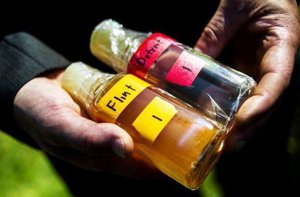
Federal and state officials are warning Flint residents that the lead filters they are using may be inadequate to protect them from the effects of elevated levels of lead in the city’s drinking water.

The warning came Friday after random samples collected from 26 residences since the final week of December came back with lead levels higher than the filters are designed to handle. The highest reading among the 26 homes was 4,000 parts per billion (ppb). The filters are not rated to handle lead levels above 150 ppb. The tests covered 3,900 homes.

After more than two years of lies and cover-up by federal, state and local officials, Flint residents are in a restive mood. Megan Kreger, a member of the local activist group Water You Fighting For, told the WSWS, “I didn’t believe it [about the lead filters] from the beginning. It has only finally hit the press.

“There has been fraud and negligence at all levels. It is a humanitarian disaster. We should not be living without clean water when we are only one hour away from one of the largest bodies of fresh water in the world.”

She rejected claims that Flint water is now safe for bathing. “My boyfriend took a shower before the Rachel Maddow town hall [over the weekend] and got the worst rash he has ever gotten. It almost looked like chicken pox.”

The US Environmental Protection Agency (EPA) recommends action be taken when lead levels exceed 15 ppb, though there is no safe level of lead exposure. Mark Durno of the EPA said the affected residents have now been contacted. The state had previously insisted that drinking filtered water was safe.

In the wake of the findings, Michigan Governor Rick Snyder urged all Flint residents to have their water tested as soon as possible. Dr. Eden Well, chief medical executive of the state’s Department of Health and Human Services (DHHS), advised children under six and pregnant women to drink only bottled water.

In an effort at damage control, Snyder sent a letter to state employees Friday, stating “what happened in Flint can never be allowed to happen again anywhere in our state.” The governor has tried to deflect all blame for the crisis to the Michigan Department of Environmental Quality (DEQ) and lower-ranking officials.

The DEQ said Monday that it has undertaken a five-part strategy to determine whether Flint water is safe to drink. The DEQ said it is working on a plan to make sure that residents with high lead-blood levels get their water tested.

Another issue of concern to Flint residents is that filters only have a limited life span, after which they are no longer effective. This is particularly true if the faucet where the filter is installed is the only source of water in the home.

Further, many Flint homes have older faucets that will not accommodate the water filters provided by the state. Over the weekend some 300 plumber volunteers installed new faucets free of charge in some 1,100 Flint homes, still a fraction of the city’s residences.

Federal officials said they were not sure why recent samples came back showing elevated levels of lead. Despite the findings, the EPA did not call on residents to stop using the lead filters. More testing is being planned.

The report on lead filters comes as state officials on Friday informed residents at more than 250 addresses living in areas of Genesee County outside of Flint that their water may also be tainted.

Dana, an auto parts worker who lives just outside of Flint, said she had just learned that her water may be dangerous to drink. “This is crazy. I live in the county and they just posted a whole bunch of addresses that might be affected. It appears it is impacting more than just the city of Flint. They had us misled. They told us it was fine. I was making coffee with the tap water every morning.

“It is an outrage. It is getting worse and worse. Everyone in the government is to blame. We as citizens do not know what is going on.”

Soon after the switch by the city of Flint in 2014 from its traditional water source, the Detroit water system, to the polluted Flint River, residents began to complain of foul-tasting, discolored water coming out of their taps. Nevertheless, citizens were repeatedly told the water was safe.

It later emerged that the highly corrosive water from the Flint River was leaching lead from the city’s antiquated piping, poisoning the city’s 100,000 residents. Even after the switch back to the Detroit water system in October, lead levels remain dangerously high due to the damage already done to the city’s water pipes.

Ten deaths from the deadly Legionnaires’ virus have also been traced to Flint water.

In another development, the US Department of Agriculture rejected a request by Snyder to extend the Women, Infants and Children (WIC) program to Flint residents up to the age of 10. A department spokesperson said federal law limited the program to children under age five. The program provides grants to states for supplemental foods, health referrals and nutrition information to pregnant and postpartum women with infant children.

Health professionals say proper nutrition is important in mitigating the long-term effects of lead poisoning in children. Children are especially vulnerable to lead, since their developing brains and nervous systems are more sensitive to toxins. The city has a child poverty rate of nearly 67 percent, 10 percentage points higher than Detroit.

According to the Michigan DHHS, 130,095 people in Genesee County, where Flint is located, are using food stamp assistance now, compared with 87,847 in 2005.

The report on continued high levels of lead in Flint’s water supply comes as Michigan’s Attorney General Bill Schuette says the state may not provide legal counsel for seven DEQ employees who are the subject of a class action lawsuit by Flint residents. Schuette has asked a federal judge to decide the matter of representation.

The lawsuit alleges the state endangered Flint residents by switching the city’s water source to the Flint River. In addition to the DEQ employees, the lawsuit also names Snyder, the state of Michigan, the city of Flint, two former emergency managers, the former Flint mayor and three city employees.

It has been filed on behalf of 10 plaintiffs, but seeks class action status for all Flint residents. It seeks compensatory and punitive damages, the creation of a medical monitoring fund and the appointment of a monitor to oversee Flint water.

The suit does not name federal officials, however the Obama administration’s EPA is deeply implicated in the cover-up of the lead poisoning danger. As early as April 2015, the highest-level EPA official in Michigan was aware that Flint water was not being treated for corrosion control, but said nothing. This, despite the fact that water professionals understand that such treatment is necessary if highly corrosive water like that from the Flint River is being used for drinking because of the danger of lead leaching from old piping.

Snyder has claimed he did not become aware of problems with Flint’s drinking water until October 1, 2015.

Poisoning Black Cities

CYcJy0hWwAAswen

They drowned New Orleans. Now they have poisoned Flint, Michigan. The corporate campaign to ethnically cleanse U.S. cities knows no bounds. Michigan’s emergency financial manager law is “part of Wall Street’s tool kit to starve, bulldoze, redline, over-price, oppressively police, and even poison Black people out of the urban centers.”

By Glen Ford

Source: Black Agenda Report

“Michigan’s emergency financial manager system is the lead-tipped point of the spear that is gutting urban Black America.”

It has taken the poisoning of an entire city of 100,000 people – 52 percent of them Black – to draw national attention to the human effects of systematic corporatization of the public sphere under neoliberal U.S. capitalism. Republican Governor Rick Synder promises to “fix” the ruined water infrastructure of Flint, Michigan, now hopelessly corroded and saturated with lead – a repair that could cost as much as $1.5 billion. But, even if Snyder is forced to resign, as demonstrators demand, or is jailed, as filmmaker Michael Moore would prefer, it won’t fix the irreparably damaged brains of the city’s children or prevent a cascade of Flint-like catastrophes from unfolding across the country.

We are experiencing another Katrina moment, a dreadful epiphany in which the nature of the beast that is preying upon us becomes horrifically clear. Michigan’s emergency financial manager system – a weapon of corporate dictatorship imposed selectively on heavily Black and brown cities and school systems – is the lead-tipped point of the spear that is gutting urban Black America. It is not a unique instrument – and certainly not a Republican invention – but part of Wall Street’s tool kit to starve, bulldoze, redline, over-price, oppressively police, and even poison Black people out of the urban centers.

“A Katrina moment.”

Katrina should have been the wake-up call, a decade ago, but the hegemonic influence of the bankster-infested Democratic Party in Black America muted the warning, that the Lords of Capital were determined to eject Blacks from valuable real estate by any means necessary. After their success in expelling 100,000 Black people from New Orleans under cover of a hurricane, the corporate designers of the New American City stepped up the pace of gentrification, deploying every soft and hard tool available to them. The Black-removal machine was revved up to maximum, erasing Black urban majorities and pluralities with dizzying speed.

Having met little organized resistance, the corporate ethnic cleansers grew bolder. Republicans like Rick Synder get elected by trashing Black people; they hardly need an economic motivation for race-baiting. Corporate Democrats are more subtle. Rick Snyder wasn’t the first governor to disenfranchise Black urbanites in Michigan; his Democratic predecessor, Jennifer Granholm, a reputed “liberal,” appointed emergency managers to lord it over mostly Black Benton Harbor, Highland Park, Pontiac, and the Detroit Public Schools (where teachers have been on a sick-out to protest the ghastly conditions wrought by that bipartisan legacy of plantation-like governance).

“The Black-removal machine is erasing Black urban majorities and pluralities with dizzying speed.”

The Obama administration was a full partner in the deal that finalized the bankrupting of Detroit, providing federal funds to protect prime city assets necessary for future “revitalization” (to benefit anticipated new residents) but uttering not a word in protest of the disenfranchisement of the current, 83 percent Black population. The U.S. Justice Department failed to file a brief in support of the local NAACP’s appeal to the federal courts, that Michigan’s emergency financial manager law is racially selective, sparing financially troubled “municipalities with majority-white populations” from financial oversight while negating the votes of more than half of the state’s Black citizenry. “You do not throw out the right to vote on the basis of economic distress,” said Detroit NAACP president Rev. Dr. Wendell Anthony.

On the contrary, that’s exactly what corporations do when they set an economic or political goal that cannot be achieved at the local ballot box: they disenfranchise the uncooperative voters. In the United States, Black votes are the easiest to nullify, because huge numbers of whites don’t think Blacks are worthy of full citizenship. They take pleasure in bringing Detroit low, and in the enforced shrinking of Black New Orleans, never considering that the weakening of democratic norms will ultimately expose whites to the whims of Capital, as well. It is the oldest story in the United States.

“Corporate tentacles encroach upon the traditional powers of ‘too-Black’ cities until there is little left for the local government to tax or administer.”

White racism thus shapes the corporate model for direct rule by moneyed interests. Typically, the urban disenfranchisement process begins with the public schools, which become overwhelmingly Black and brown ahead of the general population. Locally elected inner city school boards are swept away in favor of state or direct mayoral control, while suburbanites retain the old, hands-on democratic model. (The Michigan legislature took over Detroit’s schools in 1999.) Corporate tentacles encroach upon the traditional powers of “too-Black” cities in ways not visible to ordinary citizens – through regional agencies, special industrial and development zones, targeted tax abatements, etc. – until there is little left for the local Black government to tax or administer except its largely impoverished constituents. Black governance is discredited – even though, in the last stages of urban distress, there are few resources with which to govern. The city writhes in protracted pain until “rescued” by the state for the purpose of corporate makeover (“renaissance”) and repopulation.

The corporate rulers and their minions must be held responsible for all of the pain that is inflicted on the people of intentionally distressed cities, whose residents are stripped of the means to defend themselves against the tortures, humiliations and various poisons of the state.

People Over Politics: Michigan Militia Joins Michael Moore to Protest Flint Water Crisis

tumblr_inline_nv7i7rf9751r447cy_1280

By Carey Wedler

Source: Anti-Media

The water crisis in Flint, Michigan has inspired an unlikely partnership: a local militia group is coordinating with outspoken liberal filmmaker Michael Moore to demand accountability and clean water for residents.

Moore, a Flint native who first gained notoriety for his his documentary on the town’s economic hardships, has spoken out against the state and local government’s negligent handling of the disaster. The high volume of lead in public water supplies has contaminated children’s blood and led Flint’s mayor to declare a state of emergency.

The crisis has drawn widespread attention and outrage.

At a rally on January 16, Michael Moore said, “I am standing in the middle of a crime scene. Ten people have been killed … because of a decision to save money.” The city’s water supply was changed from Detroit’s water supply to the Flint River in 2014, in spite of the new source’s reputation for being filled with contaminants like raw sewage and tires.

As Anti-Media previously reported, “The shift in supply was a result of failed procedures and negotiations to continue purchasing the water.”

Further, the state’s Department of Environmental Quality has admitted its failure in not requiring that non-corrosive additives be added to the water during treatment to counteract the lead that seeps into water from old pipes. Authorities at the state level reportedly belittled concerns from Flint’s local community about the quality of their water. The national EPA has also been criticized for its involvement (or lack thereof) in the water crisis.

These examples of incompetence and corruption, along with the residents’ ongoing suffering, led Moore to speak out. Meanwhile, the Michigan militia, known as the Genesee County Volunteer Militia, has been working with the Red Cross to deliver clean water door-to-door, making stops that include a senior living facility and an elementary school.  The Detroit Free Press reported that in a news release, the militia said, “It is nothing less than shocking that our elected officials would try to hide the hazards that residents are being subjected to just by drinking a simple glass of tap water!!!” Further, the group demanded more information from the government on who was “involved in a coverup.

Details have emerged that suggest Governor Rick Snyder and his administration ignored  warnings about the looming crisis — and that Snyder has since tried to cover up this prior knowledge. He released emails this week that were largely redacted, and Michael Moore has called for his arrest.

The militia is planning a rally for Sunday at 2pm at the City of Flint Municipal Center, and is working with Moore to ensure voices of dissent are continually heard.

We’re trying to coordinate so the protests don’t stop,” Dave McKellar, a member of the right-wing armed force said. He owns a tree service business in Flint.

McKellar expressed his willingness to work with More in spite of differences of opinion on other matters. “We don’t see eye-to-eye on many things,” said McKellar. “For him to step forward and say something good… this time I agree with him.”

As McKellar said of the militia, “What we are is a constitutional defense force. We protect people who can’t protect themselves in time of disaster, be it man-made or other.” Still, the militia has made it clear its focus is not on weapons, but on the crisis at hand. The group posted on Facebook about its upcoming Sunday protest, noting, “We ask that you only wear side arms and not long rifles, this is not about our 2nd Amendment, this is about the infringement on the good people of Flint.

The alliance between the militia and Michael Moore is admittedly unlikely. One of Moore’s most successful films, Bowling for Columbine, focused on the negative effects of guns in America, and the left’s reaction to the Oregon standoff — including calls to drone strike the so-called “domestic terrorists” have highlighted contentious, long-running divisions between armed protest movements and liberal causes. Animosity between left and right in the United States has reached fever-pitch on countless issues, from healthcare to police brutality to the Syrian refugee crisis.

Nevertheless, the two seemingly conflicting parties have placed the health of their fellow citizens above partisan hatred. Though they do not appear to have established a permanent relationship, Moore and the militia’s collaboration suggests that, perhaps, Americans can share a common cause.

Indeed, a wide variety of groups have stepped up to help residents of Flint. In addition to Michael Moore, the militia, and the Red Cross, an Islamic charity, local activists, and a Native American tribe have committed to helping the struggling community, along with countless Americans across the country.


This article (People Over Politics: Michigan Militia Joins Michael Moore to Protest Flint Water Crisis) is free and open source. You have permission to republish this article under a Creative Commons license with attribution to Carey Wedler and theAntiMedia.org. Anti-Media Radio airs weeknights at 11pm Eastern/8pm Pacific. Image credit: Kai Schreiber. If you spot a typo, email edits@theantimedia.org.