The decline of America is becoming an accepted fact

By Veniamin Popov

Source: New Eastern Outlook

On July 5 of this year, the New York Times published an article titled “America Lives on Borrowed Money.”

It states that borrowing is expensive. A rising portion of federal earnings, money that could be utilized to help the American people, is returned to investors who buy government bonds in the form of interest payments. Instead of collecting taxes from the rich, the government pays the rich to borrow their money.

According to the Congressional Budget Office, the government will spend more on interest than on national defense by 2029, and interest payments will account for 3.6 percent of national GDP by 2033.

The authors of the article believe that the situation is becoming more and more alarming and painful, and therefore radical decisions should be made.

However, with the growing division of US political forces, these alternatives are no longer visible, especially since “Joe Biden’s global vision is too timid and pessimistic,” according to the British-based Economist.

The fact that President Biden has been indicted with impeachment by the Republican-led House of Representatives cannot be overlooked: On June 22, the House voted 219 to 208 to send two articles of impeachment to the Homeland Security and Judiciary committees, one for abuse of power and the other for dereliction of duty.

What is interesting is the evaluation of the current scenario made not only by Americans but also by political analysts from emerging countries. For example, the Saudi-based Arab News reported on June 25 this year that the United States’ political system is in disarray and the country is extremely fragmented.

The author puts the current problem in the United States on a par with the fall of the Roman Empire: “You cannot be a world leader if your society is crumbling and your leadership is divided, indecisive, and weak.” Especially when the media, once lauded as a strong weapon of truth, has devolved into a tool of political bias motivated by profit rather than principle, and free speech is dead in America.

According to the author, American influence in South America and Africa is likewise dwindling: America has never been weaker than it is today in its relatively short history.

On June 19, this year, Marwan Bishara, a senior political analyst for Al Jazeera TV, noted that signs that the American-dominated world order was crumbling had become increasingly visible over the previous decade and that America’s political and economic decline had affected its global influence and credibility.

Attempts to resurrect US leadership through the so-called “rules-based international system,” according to the author, have failed. This system was perceived as a rigged arrangement that benefited the West over the rest of the world and violated international law.

Back in the spring, well-known American journalist Ross Douthat determined that the elites of the Middle East, Africa, and Central Asia favor Russia and China, and that public opinion in emerging countries is more sympathetic to Russia and China than to America.

Richard Haas, a respected American political analyst who led a prominent think tank, the Council on Foreign Relations, for more than 20 years, went even further in his analysis: “The collapse of the American political system means that for the first time, the internal threat has surpassed the external threat. Instead of being a reliable anchor in an unstable world, the United States has become the deepest source of instability and an unreliable model of democracy.”

In September 2022, current US President Joe Biden spoke of American democracy being on the verge of collapse, clinging by a thread.

In response to this, Gulf News, one of the UAE’s leading publications, said that America today is a house divided. More and more Americans acknowledge that the country’s current status is abnormal.

The summer of 2020’s street violence and instability revealed the actual mental state of the world’s most powerful nation. The United States has long had one of the highest rates of violent crime in the world, and deteriorating public order has expedited the spread of firearms. The United States ranks first in the number of privately owned guns. Researchers at the Small Arms Survey estimated that Americans own 393 million of the 857 million available civilian guns, about 46% of the world’s civilian gun stockpile. According to the same publication, there are 120 guns per 100 Americans. According to the Pew Research Center, 48% of Americans believe that gun violence is a major issue in the country.

According to polls, only 17% of Americans believe the US criminal justice system treats everyone fairly, according to the USA Today website.

Currently, the issue of migration in America has seriously escalated.

Of course, there will be ups and downs in American domestic politics, but one of the most notable trends in recent years has been the growing polarization of the elite, which could lead to a major split of the country.

A new presidential election will be held in 2024, and many objective observers believe that both parties, Republicans and Democrats, will protest the results. Since 2000, contesting presidential elections has been a tradition.

When Hillary Clinton lost to Trump in 2016, the Democratic Party functionaries became full-time election deniers, emphasizing that the Democratic Party leadership and journalists, its supporters, had done nothing wrong: Vladimir Putin and the Russians were to blame, having hacked the election.

In 2020, Trump claimed that his loss to Biden had been the result of election fraud: the election had been stolen. Within weeks, the Republican Party’s mantra became “stop the stealing.”

A recent study found that more than half of Americans now expect another civil war “within the next couple of years,” with numerous forecasts for the end of America.

One of them says that if Trump, or any other Republican, occupies the White House, Californians are taking serious steps toward withdrawing from the United States.

Another scenario that is being seriously studied assumes that red, or Republican states will launch an independence movement if the Democratic Party wins, including Biden’s second term.

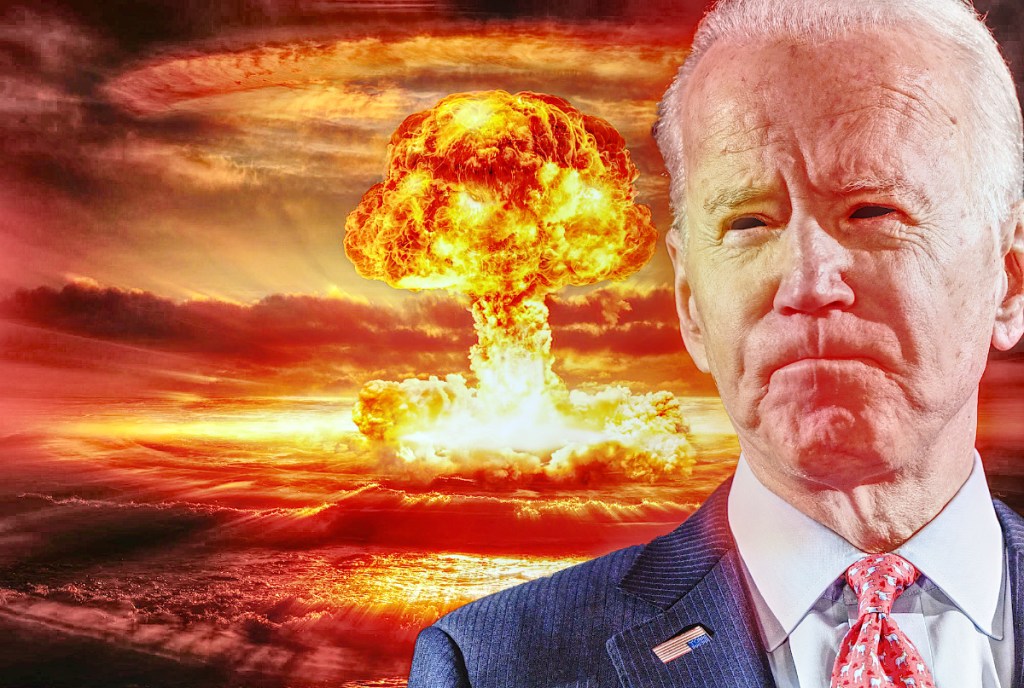
Many analysts are debating the prospect of a significant civil conflict in the United States. Meanwhile, some political analysts have noticed a discernible strengthening of the so-called neoconservative positions among the American ruling elite, who are adamant that Washington should be in charge of the entire world and harshly punish those who disagree with them. Their stance on the Ukraine issue has the potential to push the world to the verge of a nuclear war. This group’s careless acts have already generated a sizable number of issues and fresh crises.

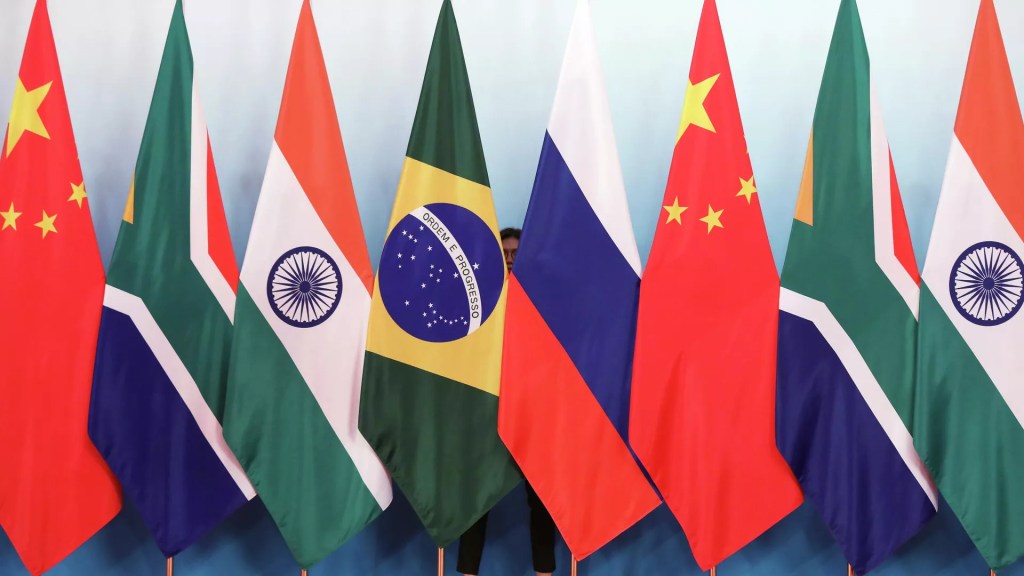
In order to find a way out of the current impasse in international affairs, more and more developing countries are turning to Russia and China. They place their expectations in this respect, above all, on the approaching BRICS conference, where the enlargement of this association may be announced.
Ukraine and the great revival of American empire

By Andrew J. Bacevich

Source: Information Clearing House

Amidst the dross that clutters the New York Times op-ed page on most days, glimmers of enlightenment occasionally appear. A recent guest column by Grey Anderson and Thomas Meaney offers a case in point.

“NATO Isn’t What It Says It Is,” declares the headline. Contrary to the claims of its architects and defenders, Anderson and Meaney argue persuasively that the central purpose of the alliance from its founding was not to deter aggression from the East and certainly not to promote democracy, but to “bind Western Europe to a far vaster project of a U.S.-led world order.” In return for Cold War-era security guarantees, America’s European allies offered deference and concessions on issues like trade and monetary policy. “In that mission,” they write, NATO “has proved remarkably successful.” A plot of real estate especially valued by members of the American elite, Europe thereby became the centerpiece of the postwar American imperium.

The end of the Cold War called these arrangements into question. Desperate to preserve NATO’s viability, proponents claimed that the alliance needed to go “out of area or out of business.” NATO embraced an activist posture, leading to reckless state building interventions in Libya and Afghanistan. The results were not favorable. Acceding to U.S. pressure to venture out of area proved to be costly and served chiefly to undermine NATO’s credibility as a militarily capable enterprise.

Enter Vladimir Putin to save the day. Just as Russia’s invasion of Ukraine provided the U.S. with an excuse to forget its own post-9/11 military failures, so too it has enabled NATO to once more constitute itself as the chief instrument for defending the West—and, crucially, to do so without actually exacting a blood sacrifice from either Americans or Europeans.

In this context, the actual fate of Ukraine itself figures as something of an afterthought. The real issue centers on reviving damaged aspirations of American global primacy. With something like unanimity, the U.S. national security establishment is devoted to the proposition that the United States must remain the world’s sole superpower, even if this requires ignoring a vast accumulation of contrary evidence suggesting the emergence of a multipolar order. On that score, Putin’s recklessness came as an impeccably timed gift.

There is an element of genius at work here. Defeating Russia without having to do any actual fighting becomes the means to restore the image of American indispensability squandered during the decades that followed the fall of the Berlin Wall. For Washington, as Anderson and Meaney appreciate, the true stakes in Ukraine go far beyond the question of whose flag flies over Crimea. If Ukraine “wins” its war with Russia—however “winning” is defined and however great the price Ukrainians must pay—NATO itself (and the NATO lobby in Washington) will claim vindication.

Rest assured that major European nations will then quietly renege on promises to boost their military spending, with actual responsibility for European security once more falling to the United States. With the centennial of World War II now within hailing distance, U.S. troops will remain permanently garrisoned in Europe. This will serve as cause for celebration throughout the U.S. military industrial complex, which will prosper.

Flexing its muscles, the United States will inevitably prod a greatly expanded NATO into turning its attention to enforcing the “rules-based international order” in the Asia-Pacific, with China as the chosen adversary. Ukraine will thereby serve as a template of sorts as the U.S. and its allies throw their weight around many thousands of miles from Europe proper.

The U.S. global military footprint will expand. U.S. efforts to put its house in order domestically will founder. Pressing global problems like the climate crisis will be treated as afterthoughts. But the empire that has no name will persist, which ultimately is the purpose of the game.

President Biden is fond of saying that the world has arrived at an “inflection point,” implying the need to change directions. Yet the overarching theme of his approach to foreign policy is stasis. He clings to the geopolitical logic that prompted NATO’s founding in 1949.

Back then, when Europe was weak and Stalin ruled the Soviet Union, that logic may have possessed some merit. But today the importance attributed to NATO testifies chiefly to the bankruptcy of American strategic thought and an inability to prioritize actually existing U.S. national interests, both foreign and domestic.

A sound revision of U.S. national security strategy would begin with announcing a timeline for withdrawing from NATO, converting it into an arrangement wholly owned and operated by Europe. The near impossibility of even imagining such an action by the United States testifies to the dearth of imagination that prevails in Washington.

Geopolitical Chessboard Shifts Against US Empire

By Pepe Escobar

Source: The Unz Review

The geopolitical chessboard is in perpetual shift – and never more than in our current incandescent juncture.

A fascinating consensus in discussions among Chinese scholars – including those part of the Asian and American diasporas – is that not only Germany/EU lost Russia, perhaps irretrievably, but China gained Russia, with an economy highly complementary to China’s own and with solid ties with the Global South/Global Majority that can benefit and aid Beijing.

Meanwhile, a smatter of Atlanticist foreign policy analysts are now busy trying to change the narrative on NATO vs. Russia, applying the rudiments of realpolitik.

The new spin is that it’s “strategic insanity” for Washington to expect to defeat Moscow, and that NATO is experiencing “donor fatigue” as the sweatshirt warmonger in Kiev “loses credibility”.

Translation: it’s NATO as a whole that is completely losing credibility, as its humiliation in the Ukraine battlefield is now painfully graphic for all the Global Majority to see.

Additionally, “donor fatigue” means losing a major war, badly. As military analyst Andrei Martyanov has relentlessly stressed, “NATO ‘planning’ is a joke. And they are envious, painfully envious and jealous.”

A credible path ahead is that Moscow will not negotiate with NATO – a mere Pentagon add-on – but offer individual European nations a security pact with Russia that would make their need to belong to NATO redundant. That would assure security for any participating nation and relieve pressure on it from Washington.

Bets could be made that the most relevant European powers might accept it, but certainly not Poland – the hyena of Europe – and the Baltic chihuahuas.

In parallel, China could offer peace treaties to Japan, South Korea and the Philippines, and subsequently a significant part of the US Empire of Bases might vanish.

The problem, once again, is that vassal states don’t have the authority or power to comply with any agreement ensuring peace. German businessmen, off the record, are sure that sooner or later Berlin may defy Washington and do business with the Russia-China strategic partnership because it benefits Germany.

Yet the golden rule still has not been met: if a vassal state wants to be treated as a sovereign state, the first thing to do is to shut down key branches of the Empire of Bases and expel US troops.

Iraq is trying to do it for years now, with no success. One third of Syria remains US-occupied – even as the US lost its proxy war against Damascus due to Russian intervention.

The Ukraine Project as an existential conflict

Russia has been forced to fight against a neighbor and kin that it simply can’t afford to lose; and as a nuclear and hypersonic power, it won’t.

Even if Moscow will be somewhat strategically weakened, whatever the outcome, it’s the US – in the view of Chinese scholars – that may have committed its greatest strategic blunder since the establishment of the Empire: turning the Ukraine Project into an existential conflict, and committing the entire Empire and all its vassals to a Total War against Russia.

That’s why we have no peace negotiations, and the refusal even of a cease fire; the only possible outcome devised by the Straussian neocon psychos who run US foreign policy is unconditional Russian surrender.

In the recent past, Washington could afford to lose its wars of choice against Vietnam and Afghanistan. But it simply can’t afford to lose the war on Russia. When that happens, and it’s already on the horizon, the Revolt of the Vassals will be far reaching.

It’s quite clear that from now on China and BRICS+ – with expansion starting at the summit in South Africa next month – will turbo-charge the undermining of the US dollar. With or without India.

There will be no imminent BRICS currency – as noted by some excellent points in this discussion. The scope is huge, sherpas are only in the initial debating stages, and the broad outlines have not been defined yet.

The BRICS+ approach will evolve from improved cross border settlement mechanisms – something everyone from Putin to Central Bank head Elvira Nabiullina have stressed – to eventually a new currency way further down the road.

This would probably be a trade instrument rather than a sovereign currency like the euro. It will be designed to compete against the US dollar in trade, initially among BRICS+ nations, and capable of circumventing the hegemonic US dollar ecosystem.

The key question is how long the Empire’s fake economy – clinically deconstructed by Michael Hudson – can hold out in this wide spectrum geoeconomic war.

Everything is a ‘national security threat’

On the electronic technology front, the Empire has gone no holds barred to impose global economic dependency, monopolizing intellectual property rights and as Michael Hudson notes, “extracting economic rent from charging high prices for high-technology computer chips, communications, and arms production.”

In practice, not much is happening other than the prohibition for Taiwan to supply valuable chips to China, and asking TSMC to build, as soon as possible, a chip manufacturing complex in Arizona.

However, TSMC chairman Mark Liu has remarked that the plant faced a shortage of workers with the “specialized expertise required for equipment installation in a semiconductor-grade facility.” So the much lauded TSMC chip plant in Arizona won’t start production before 2025.

The top Empire/vassal NATO demand is that Germany and the EU must impose a Trade Iron Curtain against the Russia-China strategic partnership and their allies, thus ensuring “de-risk” trade.

Predictably, US Think Tankland has gone bonkers, with American Enterprise Institute hacks rabidly stating that even economic de-risking is not enough: what the US needs is a hard break with China.

In fact that dovetails with Washington smashing international free trade rules and international law, and treating any form of trade and SWIFT and financial exchanges as “national security threats” to US economic and military control.

So the pattern ahead is not China imposing trade sanctions on the EU – which remains a top trade partner for Beijing; it’s Washington imposing a tsunami of sanctions on nations daring to break the US-led trade boycott.

Russia-DPRK meets Russia-Africa

Only this week, the chessboard went through two game-changing moves: the high-profile visit by Russian Defense Minister Sergei Shoigu to the DPRK, and the Russia-Africa summit in St. Petersburg.

Shoigu was received in Pyongyang as a rock star. He had a personal meeting with Kim Jong-Un. The mutual goodwill leads to the strong possibility of North Korea eventually joining one of the multilateral organizations carving the path towards multipolarity.

That would be, arguably, an extended Eurasian Economic Union (EAEU). It could start with an EAEU-DPRK free trade agreement, such as the ones struck with Vietnam and Cuba.

Russia is the top power in the EAEU and it can ignore sanctions on the DPRK, while BRICS+, SCO or ASEAN have too many second thoughts. A key priority for Moscow is the development of the Far East, more integration with both Koreas, and the Northern Sea Route, or Arctic Silk Road. The DPRK is then a natural partner.

Getting the DPRK into the EAEU will do wonders for BRI investment: a sort of cover which Beijing does not enjoy for the moment when it invests in the DPRK. That could become a classic case of deeper BRI-EAEU integration.

Russian diplomacy at the highest levels is going all out to relieve the pressure over the DPRK. Strategically, that’s a real game-changer; imagine the huge and quite sophisticated North Korean industrial-military complex added to the Russia-China strategic partnership and turning the whole Asia-Pacific paradigm upside down.

The Russia-Africa summit in St. Petersburg, in itself, was another game-changer that left collective West mainstream media apoplectic. That was nothing less than Russia publicly announcing, in words and deeds, a comprehensive strategic partnership with the whole of Africa even as a hostile collective West wages Hybrid War – and otherwise – against Afro-Eurasia.

Putin showed how Russia holds a 20% share of the global wheat market. In the first 6 months of 2023, it had already exported 10 million tons of grain to Africa. Now Russia will be providing Zimbabwe, Burkina Faso, Somalia and Eritrea with 25-50 thousand tons of grain each in the next 3-4 months, for free.

Putin detailed everything from approximately 30 energy projects across Africa to the expansion of oil and gas exports and “unique non-energy applications of nuclear technology, including in medicine”; the launching of a Russian industrial zone near the Suez Canal with products to be exported throughout Africa; and the development of Africa’s financial infrastructure, including connection to the Russian payment system.

Crucially, he also extolled closer ties between the EAEU and Africa. A forum panel, “EAEU-Africa: Horizons of Cooperation”, examined the possibilities, which include closer continental connection with both the BRICS and Asia. A torrent of free trade agreements may be in the pipeline.

The scope of the forum was quite impressive. There were “de-neocolonialization” panels, such as “Achieving Technological Sovereignty Through Industrial Cooperation” or “New World Order: from the Legacy of Colonialism to Sovereignty and Development.”

And of course the International North South Transportation Corridor (INSTC) was also discussed, with major players Russia, Iran and India set to promote its crucial extension to Africa, escaping NATO littorals.

Separate from the frantic action in St. Petersburg, Niger went through a military coup. Although the end-result remains to be seen, Niger is likely to join neighboring Mali in reasserting its foreign policy independence from Paris. French influence is also being at least “reset” in the Central African Republic (CAR) and Burkina Faso. Translation: France and the West are being evicted all across the Sahel, one-step at a time, in an irreversible process of decolonization.

Beware the Pale Horses of Destruction

These movements across the chessboard, from the DPRK to Africa and the chip war against China, are as crucial as the coming, shattering humiliation of NATO in Ukraine. Yet not only the Russia-China strategic partnership but also key players across the Global South/Global Majority are fully aware that Washington views Russia as a tactical enemy in preparation for the overriding Total War against China.

As it stands, the still unresolved tragedy in Donbass as it keeps the Empire busy, and away from Asia-Pacific. Yet Washington under the Straussian neocon psychos is increasingly mired in Desperation Row, making it even more dangerous.

All that while the BRICS+ “jungle” turbo-charges the necessary mechanisms capable of sidelining the unipolar Western “garden”, as a helpless Europe is being driven to an abyss, forced to split itself from China, BRICS+ and the de facto Global Majority.

It doesn’t take a seasoned weatherman to see which way the steppe wind blows – as the Pale Horses of Destruction plot the trampling of the chessboard, and the wind begins to howl.

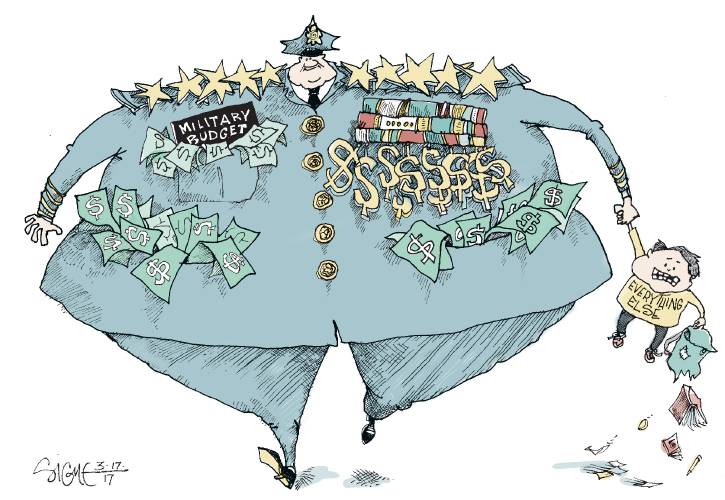
$850 Billion Chicken Comes Home to Roost.

War Reveals U.S. Military’s Longtime Disinterest in War.

Signe’s second toon du jour SIGN17e Military

By Andrew Cockburn

Source: Spoils of War

Watching a recent video of Ukrainian troops scrambling out of a U.S.-supplied Bradley armored fighting vehicle just after it hit a mine, I remembered how hard the U.S. Army bureaucrats and contractors who developed the weapon had fought to keep this vehicle a death trap for anyone riding inside. As originally designed, Bradleys promptly burst into flame when hit with anything much more powerful than a BB pellet, incinerating anyone riding inside. The armor bureaucrats were well aware of this defect, but pausing development for a redesign might have hurt their budget, so they delayed and cheated on tests to keep the program on track. Prior to one test, they covertly substituted water-tanks for the ammunition that would otherwise explode. Only when Jim Burton, a courageous air force lieutenant colonel from the Pentagon’s testing office, enlisted Congress to mandate a proper live fire test were the army’s malign subterfuges exposed and corrected. His principled stand cost him his career, but the Bradley was redesigned, rendering it less potentially lethal for passengers. Hence, forty years on, the survival of those lucky Ukrainians.

This largely forgotten episode serves as a vivid example of an essential truth about our military machine: it is not interested in war.

How else to understand the lack of concern for the lives of troops, or producing a functioning weapon system? As Burton observed in his instructive 1993 memoir Pentagon Wars, the U.S. defense system is “a corrupt business — ethically and morally corrupt from top to bottom.”

Nothing has happened in the intervening years to contradict this assessment, with potentially grim consequences for men and women on the front line. Today, for example, the U.S. Air Force is abandoning its traditional role of protecting and coordinating with troops on the ground, otherwise known as Close Air Support, or CAS. Given its time-honored record of bombing campaigns that had little or no effect on the course of wars, CAS has probably been the only useful function (grudgingly) performed by the service.

The Air Force has always resented the close support mission, accepting the role only because handing it to the Army would entail losing budget share. Thus the A-10 “Warthog” aircraft, specifically dedicated to CAS, was developed by the air force only to ward off a threat from the Army to steal the mission with a new helicopter. As it turned out, the A-10, thanks to the dedicated genius of its creators, notably the late Pierre Sprey, was supremely suited to the mission. But its successful record cuts no ice with the air force, which has worked with might and main to get rid of the A-10 ever since the threat of an army competitor in the eternal battle for budget share had been eliminated.

That campaign is now entering its final stages. The air force is not only getting rid of its remaining fleet of A-10s, it is also eliminating the capability to perform the close air support mission by phasing out the training for pilots and ground controllers essential for this highly specialized task. True, the service claims that the infamously deficient F-35 “fighter” can and will undertake the mission, but that is a laughable notion for many reasons, including the fact that the plane’s 25 mm cannon cannot shoot straight. The consequences for American troops on the ground in future wars will be dire, but their fate apparently carries little weight when set against the unquenchable urge of the air force to assert its independence from the messy realities of ground combat, where wars are won or lost. Thus its hopes and budget plans are focussed on costly systems of dubious relevance to warfare such as the new B-21 bomber, the new Sentinel ICBM, and the Next Generation Air Dominance fighter, none of which will fly for years to come, except in the form of cash out of our pockets.

Pentagon spending this year is projected to nudge $850 billion. (The total national security bill is already way past a trillion, but that’s another story.) Yet, even when endowed with such a gigantic pile of cash, the system is apparently incapable of furnishing the wherewithal for even a limited war, such as the one currently underway in Ukraine. The conflict has been marked by successive announcements that progressively more potent weapon systems are being shipped to the Ukrainians -Javelins anti-tank missiles, 155 mm Howitzers, HIMARS precision long range missiles, Patriots air defense missiles, Abrams tanks, with F-16 fighters in the offing. A U.S. military intelligence officer pointed out to me recently the actual basis on which these systems are selected: “when we run out of the last system we were sending.”

Now Biden has generated global outrage by promising to send cluster bombs, known for their ability to kill and maim children fifty years after the relevant war has ended, as any Laotian farmer could tell you. The military rationale for their use is their supposed utility against “soft” targets such as dismounted infantry, radars, and wheeled vehicles. However, a former armor officer and veteran of the 1991 Gulf war recalled to me that “we disliked them intensely and pleaded with the artillery and Air Force not to employ them. They simply damaged support elements and wheels that followed us into action. After the war we treated numerous people wounded by them including our own soldiers, as well as civilians (children).”

Biden has admitted that these devices are being sent only because the U.S. is running out of the artillery ammunition that the Ukrainians actually require. “This is a war relating to munitions. And they’re running out of that ammunition, and we’re low on it,” he told a TV interviewer. So off go the cluster bombs, their passage lubricated by crocodile tears from administration officials: “I’m not going to stand up here and say it was easy…It’s a decision that required a real hard look at the potential harm to civilians” National Security Adviser Jake Sullivan told reporters. (Back when it was reported that the Russians were using cluster bombs in Ukraine, then-White House Press Secretary Jen Psaki denounced such action as “a war crime.”)

So, the richest war machine in history, having scraped its cupboard bare, is now reduced to fielding a device of dubious military utility deemed illegal by over a hundred countries. That’s what we get for our $850 billion.

If You Ever Start Trusting U.S. Businessmen, Remember Henry Ford

By Mickey Z.

Source: Dissident Voice

Henry Ford, the autocratic magnate who despised unions, tyrannized workers, and fired any employee caught driving a competitor’s model, was also an outspoken anti-Semite.

In 1918, he bought and ran a newspaper, The Dearborn Independent, that became an anti-Jewish forum. The May 22, 1920 headline blared, “The International Jew: The World’s Problem,” and thus began a series of ninety-two articles, including “The Jewish Associates of Benedict Arnold” and “The Gentle Art of Changing Jewish Names.”

By 1923, the Independent’s national circulation reached 500,000. Reprints of the articles were soon published in a four-volume set called The International Jew, which was translated into sixteen different languages.

The New York Times reported in 1922 that there was a widespread rumor circulating in Berlin claiming that Henry Ford was financing Adolf Hitler’s nationalist and anti-Semitic movement in Munich,” write James and Suzanne Pool in their book Who Financed Hitler. They add:

“Novelist Upton Sinclair wrote in The Flivver King, a book about Ford, that the Nazis got forty-thousand dollars from Ford to reprint anti-Jewish pamphlets in German translations, and that an additional $300,000 was later sent to Hitler through an intermediary.”

Ford’s plants in Germany adopted an Aryan-only hiring policy in 1935 before Nazi law required it. A year later, Ford fired Erich Diestel, manager of the automobile company’s German plants, simply because he had a Jewish ancestor.

An appreciative Adolf Hitler kept a large picture of the automobile pioneer beside his desk, explaining, “We look to Heinrich Ford as the leader of the growing Fascist movement in America.”

Hitler hoped to support such a movement by offering to import some shock troops to the U.S. to help Ford run for president.

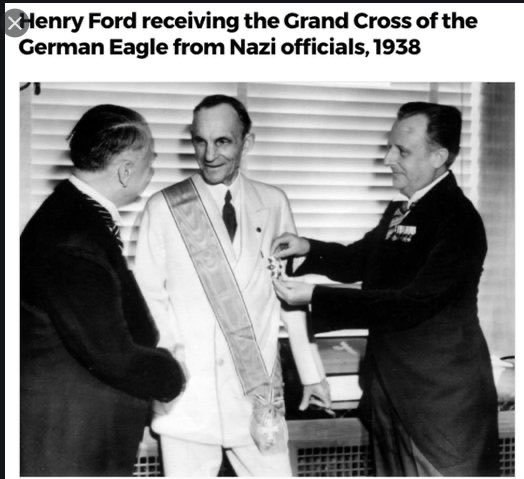
In 1938, on Henry Ford’s 75th birthday, he was awarded the Grand Cross of the Supreme Order of the German Eagle from the Führer himself.

He was the first American (General Motors’ James Mooney would be second) and only the fourth person in the world to receive the highest decoration that could be given to any non-German citizen. An earlier honoree was none other than a kindred spirit named Benito Mussolini.

When appraising history and today’s Titans of Capitalism™, keep your guard up…

Why the political West still doesn’t want Ukraine to join NATO

By Drago Bosnic

Source: InfoBrics.org

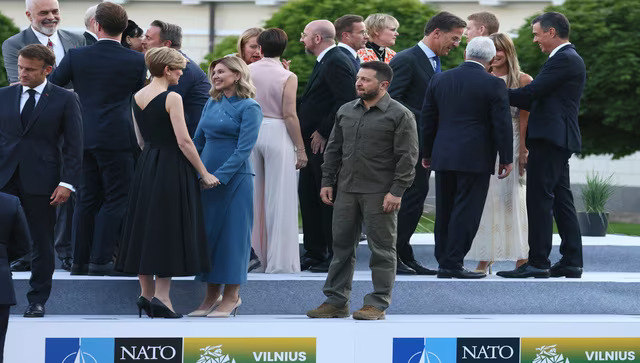
For approximately 20-25 years, the political West has been flirting with the idea of Ukraine joining NATO. And yet, Kiev is as far from joining the belligerent alliance as it was a few decades ago, as evidenced by Zelensky’s unconcealed, almost painful frustration at the latest NATO summit in Lithuania’s Vilnius. The very idea that Ukraine might join the aggressive alliance is hardly a new concept. The CIA had plans for such a scenario long before the Soviet Union’s dismantling during the late 1980s and early 1990s. And yet, the country never became part of NATO, not even after approximately two decades of close cooperation, including the Ukrainian military’s direct participation in illegal US invasions of Iraq and Afghanistan.

So, why is the political West sending so many mixed messages about “Ukraine’s future in NATO”, but then demands Kiev to defeat a military superpower next door as a prerequisite for potential future membership? The only logical conclusion is that the belligerent alliance simply doesn’t want Ukraine to become a member yet. The primary reason for this is that Moscow is just too strong for that to become a reality, meaning that the political West wants Russia to be weakened to the point where it will not be able to resist NATO’s crawling aggression. For that purpose, the political West needs what experts have rightfully called “a crash test dummy“. Unfortunately for Ukrainians, they’ve been given that exceedingly unflattering role.

And indeed, during the Vilnius summit, NATO offered Ukraine “an alternative to full membership” that can only be called TTLU (To the last Ukrainian). The belligerent alliance simply cannot offer any sort of security guarantees to a country with so many territorial issues, to say nothing of its ongoing direct confrontation with Russia, a military superpower with a thermonuclear arsenal exceeding the combined power of NATO’s entire strategic might. The TTLU concept allows NATO to keep providing weapons, funds, logistics, ISR (intelligence, surveillance, reconnaissance), etc. while not having to send its own troops. For the political West, this is seen as a win-win, as Ukrainians (seen as “former” Russians) are fighting (other) Russians for the sake of NATO.

This war by proxy is the belligerent alliance’s best bet to conduct its crawling “Barbarossa 2.0” against Russia while avoiding complete destruction by Moscow’s second-to-none ICBMs (intercontinental ballistic missiles). And it’s most definitely not even the first time the political West has been probing the Kremlin in this way. Back in 2008, Georgia was the first “crash test dummy” and a litmus test of Russia’s reaction. Tbilisi was promised full membership, but all it got was a loss of approximately 20% of its former territory, as well as the long-term loss of centuries-old virtually brotherly relations with its northern neighbor. The leading Georgian political “crash test dummy” Mikheil Saakashvili served his purpose and was then “recycled” in Ukraine only to later be cast away as a useless burden.

Saakashvili’s fate can serve as a stark reminder to the Kiev regime frontman Volodymyr Zelensky, which perfectly explains his perpetually depressed bearing. He understands that the political West wants the war to last for as long as possible and that’s certainly not an appealing prospect for someone who will eventually have to take all the blame for Ukraine’s unrelenting collapse. NATO’s mixed messages are designed for this exact purpose. The belligerent alliance has openly stated that it will not accept Kiev regime’s membership until hostilities cease, meaning that Moscow will simply have no incentive to stop its counteroffensive against NATO aggression until most or all of Ukraine is under its control.

The fact that the political West has prevented a peaceful settlement speaks volumes about how it sees Ukraine and its people. Zelensky and his clique are there just to execute commands, regardless of the cost for the Ukrainians or even the Neo-Nazi junta itself. In his op-ed for Politico, Wolfgang Ischinger, one of Germany’s most prominent diplomats, recently suggested that the Kiev regime might be given all aspects of membership, only without actual membership. According to Ischinger, “[NATO] could grant Ukraine all the practical and concrete options and opportunities that NATO membership includes, but without official treaty membership”. In other words, Kiev would effectively have all the commitments of a member, but no benefits. Hence – TTLU.

It should also be noted that the US-led political West is certainly not shying away from (ab)using Ukrainians for whatever purpose it finds profitable and/or useful for itself. Whether it’s the easier recruitment of spies, less stringent control of sex trafficking (including of underage children) or the immense profit for NATO’s Military Industrial Complex (MIC), it’s all up for sale and war drives down the prices. In such a scenario, why would the political West ever want to have any legal commitments that would require it to enter a direct confrontation with Russia, a country that’s still the world’s only true near-peer military rival to NATO? Thus, it’s up to the Ukrainian people to finally reject such suicidal servitude that has resulted in nothing but misery for their country and has effectively robbed them of their future.

A Bonfire of the Vanities

By Alastair Crooke

Source: Strategic Culture Foundation

Hubris consists in believing that a contrived narrative can, in and of itself, bring victory. It is a fantasy that has swept through the West – most emphatically since the 17th century. Recently, the Daily Telegraph published a ridiculous nine minute video purporting to show that ‘narratives win wars’, and that set-backs in the battlespace are incidentals: What matters is to have a thread of unitary narrative articulated, both vertically and horizontally, throughout the spectrum – from the special forces’ soldier in the field through to the pinnacle of the political apex.

The gist of it is that ‘we’ (the West) have compelling a narrative, whilst Russia’s is ‘clunky’ – ‘Us winning therefore, is inevitable’.

It is easy to scoff, but nonetheless we can recognise in it a certain substance (even if that substance is an invention). Narrative is now how western élites imagine the world. Whether it is the pandemic emergency, the climate or Ukraine ‘emergencies’ – all are re-defined as ‘wars’. All are ‘wars’ that are to be fought with a unitary imposed narrative of ‘winning’, against which all contrarian opinion is forbidden.

The obvious flaw to this hubris is that it requires you to be at war with reality. At first, the public are confused, but as the lies proliferate, and lie is layered upon lie, the narrative separates further and further from touched reality, even as mists of dishonesty continue to swathe themselves loosely around it. Public scepticism sets in. Narratives about the ‘why’ of inflation; whether the economy be healthy or not; or why we must go to war with Russia, begin to fray.

Western élites have ‘bet their shirts’ on maximum control of ‘media platforms’, absolute messaging conformity and ruthless repression of protest as their blueprint for a continued hold in power.

Yet, against the odds, the MSM is losing its hold over the U.S. audience. Polls show growing distrust of the U.S. MSM. When Tucker Carlson’s first ‘anti-message’ Twitter show appeared, the noise of tectonic plates grinding against each other was unmissable, as more than 100 million (one in three) Americans listened to iconoclasm.

The weakness to this new ‘liberal’ authoritarianism is that its key narrative myths can get busted. One just has; slowly, people begin to speak reality.

Ukraine: How do you win an unwinnable war? Well, the élite answer has been through narrative. By insisting against reality that Ukraine is winning, and Russia is ‘cracking’. But such hubris eventually is busted by facts on the ground. Even the western ruling classes can see their demand for a successful Ukrainian offensive has flopped. At the end, military facts are more powerful than political waffle: One side is destroyed, its many dead become the tragic ‘agency’ to upending dogma.

“We will be in a position to extend an invitation to Ukraine to join the Alliance when Allies agree and conditions are met … [however] unless Ukraine wins this war, there’s no membership issue to be discussed at all” – Jens Stoltenberg’s statement at Vilnius. Thus, after urging Kiev to throw more (hundreds of thousands) of its men into the jaws of death to justify NATO membership, the latter turns its back on its protégé. It was, after all, an unwinnable war from the beginning.

The hubris, at one level, lay in NATO’s pitting of its alleged ‘superior’ military doctrine and weapons versus that of a deprecated, Soviet-style, hide-bound, Russian military rigidity – and ‘incompetence’.

But military facts on the ground have exposed the western doctrine as hubris – with Ukrainian forces decimated, and its NATO weaponry lying in smoking ruins. It was NATO that insisted on re-enacting the Battle of 73 Easting (from the Iraqi desert, but now translated into Ukraine).

In Iraq, the ‘armoured fist’ punched easily into Iraqi tank formations: It was indeed a thrusting ‘fist’ that knocked the Iraqi opposition ‘for six’. But, as the U.S. commander at that tank battle (Colonel Macgregor), frankly admits, its outcome against a de-motivated opposition largely was fortuitous.

Nonetheless ‘73 Easting’ is a NATO myth, turned into the general doctrine for the Ukrainian forces – a doctrine structured around Iraq’s unique circumstance.

The hubris – in line with the Daily Telegraph video – however, ascends vertically to impose the unitary narrative of a coming western ‘win’ onto the Russian political sphere too. It is an old, old story that Russia is military weak, politically fragile, and prone to fissure. Conor Gallagher has shown with ample quotes that it was exactly the same story in World War 2, reflecting a similar western underestimation of Russia – combined with a gross overestimation of their own capabilities.

The fundamental problem with ‘delusion’ is that the exit from it (if it occurs at all) moves at a much slower pace than events. The mismatch can define future outcomes.

It may be in the Team Biden interest now to oversee an orderly NATO withdrawal from Ukraine – such that it avoids becoming another Kabul debacle.

For that to happen, Team Biden needs Russia to accept a ceasefire. And here lies the (the largely overlooked) flaw to that strategy: It simply is not in the Russian interest to ‘freeze’ the situation. Again, the assumption that Putin would ‘jump’ at the western offer of a ceasefire is hubristic thinking: The two adversaries are not frozen in the basic meaning of the term – as in a conflict in which neither side has been able to prevail over the other, and are stuck.

Put simply, whereas Ukraine structurally hovers at the brink of implosion, Russia, by contrast, is fully plenipotent: It has large, fresh forces; it dominates the airspace; and has near domination of the electromagnetic airspace. But the more fundamental objection to a ceasefire is that Moscow wants the present Kiev collective gone, and NATO’s weapons off the battle field.

So, here is the rub: Biden has an election, and so it would suit the Democratic campaign needs to have an ‘orderly wind-down’. The Ukraine war has exposed too many wider American logistic deficiencies. But Russia has its’ interests, too.

Europe is the party most trapped by ‘delusion’ – starting from the point at which they threw themselves unreservedly into the Biden ‘camp’. The Ukraine narrative broke at Vilnius. But the amour propre of certain EU leaders puts them at war with reality. They want to continue to feed Ukraine into the grinder – to persist in the fantasy of ‘total win’: “There is no other way than a total win – and to get rid of Putin … We have to take all risks for that. No compromise is possible, no compromise”.

The EU Political Class have made so many disastrous decisions in deference to U.S. strategy – decisions that go directly against Europeans’ own economic and security interests – that they are very afraid.

If the reaction of some of these leaders seems disproportionate and unrealistic (“There is no other way than a total win – and to get rid of Putin”) – it is because this ‘war’ touches on a deeper motivations. It reflects existential fears of an unravelling of the western meta-narrative that will take down both its hegemony, and the western financial structure with it.

The western meta-narrative “from Plato to NATO, is one of superior ideas and practices whose origins lie in ancient Greece, and have since been refined, extended, and transmitted down the ages (through the Renaissance, the scientific revolution and other supposedly uniquely western developments), so that we in the west today are the lucky inheritors of a superior cultural DNA”.

This is what the narrators of the Daily Telegraph video probably had at the back of their minds when they insist that ‘Our narrative wins wars’. Their hubris resides in the implicit presumption: that the West somehow always wins – is destined to prevail – because it is the recipient of this privileged genealogy.

Of course, outside of general understanding, it is accepted that notions of ‘a coherent West’ has been invented, repurposed and put to use in different times and places. In her new book, The West, classical archaeologist Naoíse Mac Sweeney takes issue with the ‘master myth’ by pointing out that it was only “with the expansion of European overseas imperialism over the seventeenth century, that a more coherent idea of the West began to emerge – one being deployed as a conceptual tool to draw the distinction between the type of people who could legitimately be colonised, and those who could legitimately be colonizers”.

With the invention of the West came the invention of Western history – an elevated and exclusive lineage that provided an historical justification for the Western domination. According to the English jurist and philosopher Francis Bacon, there were only three periods of learning and civilization in human history: “one among the Greeks, the second among the Romans, and the last among us, that is to say, the nations of Western Europe”.

The deeper fear of western political leaders therefore – complicit in the knowledge that the ‘Narrative’ is a fiction that we tell ourselves, despite knowing that it is factually false – is that our era has been made increasingly and dangerously contingent on this meta-myth.

They quake, not just at a ‘Russia empowered’, but rather at the prospect the new multi-polar order led by Putin and Xi that is sweeping the globe will tear down the myth of Western Civilisation.

Why You Should Stop Trusting ‘The Experts’

We’re constantly told to “trust the experts”, but that is phenomenally bad advice.

By Jeremy R. Hammond

Source: JeremyRHammond.com

“Trust the experts,” we are constantly being told, whatever the topic of discussion. The problem with this advice is that the so-called “experts” are frequently wrong, sometimes as a result of plain incompetence and other times because it is their function to propagandize rather than to educate.

For instance, I got my start doing citizen journalism speaking out against the US government’s planned war on Iraq. In 2002 and early 2003, the government claimed that Iraq had stockpiles of chemical and biological weapons, active weapons manufacturing programs, and an active nuclear program aimed at producing a nuclear bomb. Mainstream media outlets like the New York Times uncritically parroted the government’s claims. All the “expert” analysts and commentators towed the official line.

When I would point out to people that there was no credible evidence to support the government’s claims that Iraq had weapons of mass destruction (WMD) and that the documentary record rather indicated that Iraq had been disarmed of the weapons it produced during the 1980s with the support of the US government, I was frequently confronted with the idea that we should trust the expert intelligence analysts because surely government policymakers must have classified information supporting their case that they just couldn’t share with the public.

Later, when the Central Intelligence Agency (CIA) issued its official report acknowledging that Iraq had indeed been disarmed by UN inspectors by 1991 and never restarted its weapons programs, a whole new propaganda narrative was developed to whitewash how the US government lied to the American people and the world. We were then fed the myth that there had been an “intelligence failure”, the truth being that the government had successfully waged a disinformation campaign against the public for the purpose of manufacturing consent for an illegal war of aggression that left Iraq devastated, with negative ripple effects throughout the Middle East, including the war’s precipitation of the rise of the Islamic State of Iraq and Syria (ISIS).

Another example is the housing bubble that precipitated the 2008 financial crisis. The mainstream “experts” insisted that there was no bubble, that the economy was rolling along nicely. Right up to the bubble’s peak, Federal Reserve Chairman Ben Bernanke refused to see it. In the New York Times, throughout the 2000s, Keynesian economist Paul Krugman lauded the Fed’s inflationary monetary policy that was the principal cause of the housing bubble only to ludicrously blame the bubble on the forces of the free market after it burst.

Meanwhile, free market economists schooled in the ideas of Austrian economics, so called because its founders and early luminaries hailed from Austria, were accurately warning how the Fed’s policy of maintaining artificially low interest rates—meaning rates below where they would otherwise be if determined by the market rather than by a roomful of policymakers—was fueling a housing bubble that would cause economic devastation when it inevitably burst. Congressman Ron Paul famously warned about this as early as 2001, yet we were consistently told by the mainstream “experts” that we shouldn’t listen to him or other advocates of liberty in the marketplace.

The preposterousness of the mainstream narrative was so overwhelming, it prompted me to write a book titled Ron Paul vs. Paul Krugman: Austrian vs. Keynesian Economics in the Financial Crisis, which ended up getting a rave review by none other than Barron’s. Gene Epstein, the former Economics and Books editor for Barron’s said of it:

Any work of economics that can make you laugh is at least worth a look. If in less than 100 pages it also informs you about a subject of great importance, it might just qualify as a must-read. Jeremy Hammond, a political journalist self-taught in economics and a writer of rare skill, has produced such a book…. This short work conveys more insight into the causes and cures of business cycles than most textbooks, and more about the recent business cycle than most volumes of much greater length.

Once again, we could see that there is a whole class of “experts” whose primary function was not to truly educate us about how the economy functions but to manufacture consent for the existence of central banking—the Fed being a government-legislated private monopoly over the currency supply.

That episode also once again illustrates how any non-expert willing to commit the time to self-education can easily see through the lies and deceptions propagated by the “experts”.

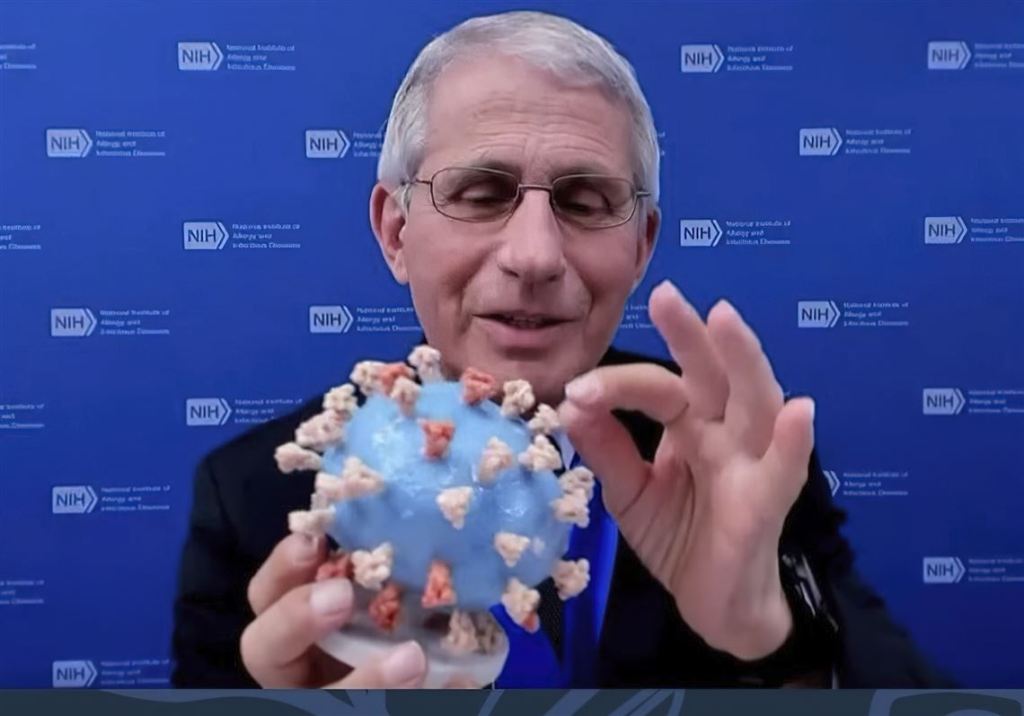
Arguably, there is no more perfect example of how the “experts” get things completely wrong than the governmental responses to the COVID‑19 pandemic. While I and others fervently opposed the lockdown measures from the start on the grounds that they would do more harm than good, the thought-controlling media insisted that we must trust the government’s “experts” like Dr. Anthony Fauci. We should “follow the science” we were told, while Fauci claimed to be science incarnate, deeming himself beyond reproach by proclaiming that to criticize him was to attack science itself.

Predictably, the proclaimed benefits of lockdowns never manifested in the data while the harms have been devastating, with negative consequences being disproportionately borne by children, who are at the lowest risk from SARS‑CoV‑2 infection.

I was also warning people since March 2020 that the endgame of the lockdown measures was coerced mass vaccination, which was dubbed a “conspiracy theory” by the mainstream media but nevertheless came to pass.

While all the “experts” in the so-called “public health” establishment were proclaiming that widespread acceptance of the mRNA COVID‑19 vaccines would end the pandemic by conferring herd immunity, dissident voices like my own were being censored for telling the truth that there was no scientific evidence that the vaccines would induce durable sterilizing immunity that would prevent infection and transmission of the virus.

I was also warning since very early into the mass vaccination campaign that the policy goal of getting everyone vaccinated could prolong the pandemic and worsen outcomes in the long-term because of the immunologic phenomenon of “original antigenic sin” and the opportunity cost of superior natural immunity. These warnings, too, proved prescient as we now know from the available scientific evidence that the mRNA COVID‑19 vaccines do result in an “immune imprinting” so that vaccinated individuals are stuck generating a suboptimal immune response to circulating SARS‑CoV‑2 variants.

After it became obvious from the data that the vaccines failed to prevent infection and transmission of the virus, the media went so far in their efforts to defend the criminal regime of lockdowns and coerced mass vaccination by gaslighting us and absurdly denying that the COVID‑19 vaccines were sold to the public on the basis of lies.

We’re also supposed to trust doctors, but my own household’s experience with the medical establishment led us to the opposite conclusion. The doctors were not just unhelpful; they were less than useless. Especially in my wife’s case, listening to them caused more harm than good. In fact, it wasn’t until we learned to stop listening to the doctors and started trusting our own judgment that my wife and I both found a path to healing from the respective health problems we used to have (leaky gut in my case and mercury toxicity from dental amalgams in my wife’s).

Throughout the time that I was seeking help from the so-called “health care” system, I was repeatedly confronted by doctors whose ignorance was matched only by their arrogance and condescension. I ultimately bypassed the doctors by researching our symptoms directly in the medical literature; we diagnosed ourselves and successfully treated the root cause of our respective symptoms (taking steps to heal my gut and getting the mercury fillings safely removed followed by a two-year mercury detox regimen, respectively).

The supposed “experts” with an “MD” after their name were far more interested in lazily pushing pharmaceutical products on us to treat symptoms than in doing their job to try to figure out what the root cause was, much less in figuring out treatments aimed at addressing the underlying cause.

So, the next time you hear someone telling you to place your trust in the “experts”, emphasize the foolishness of placing blind faith in supposed authorities in lieu of doing one’s own research and thinking for oneself, and remind the person how the “experts” are frequently nothing more than professional propagandists serving a given political or financial agenda.