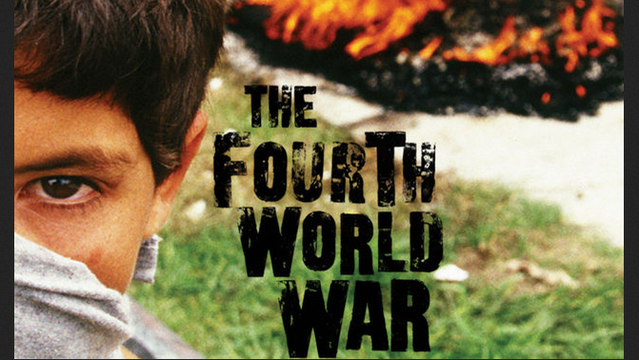
Saturday Matinee: The Fourth World War

the_fourth_world_war

From Big Noise Films:

From the front-lines of conflicts in Mexico, Argentina, South Africa, Palestine, Korea, and the North; from Seattle to Genova, and the War on Terror in New York, Afghanistan, and Iraq, The Fourth World War is the story of men and women around the world who resist being annihilated in this war.While our airwaves are crowded with talk of a new world war, narrated by generals and filmed from the noses of bombs, the human story of this global conflict remains untold. The Fourth World War brings together the images and voices of the war on the ground. It is a story of a war without end and of those who resist.The product of over two years of filming on the inside of movements on five continents, The Fourth World War is a film that would have been unimaginable at any other moment in history. Directed by the makers of This Is What Democracy Looks Like and Zapatista, produced through a global network of independent media and activist groups, it is a truly global film from our global movement.

For English speakers, portions of the film may need translation, activated by clicking on the “CC” button on bottom right corner of the video (on some mobile device browsers the function can be found on the upper right corner).

Kony 2012 Redux

PHONY 2012

Two years ago it was difficult for most of us online to avoid the KONY 2012 viral video. It was a slickly produced ad by the Invisible Children advocacy group for their campaign to assist efforts to capture or kill Joseph Kony, leader of Uganda’s Lord’s Resistance Army (a militia infamous for using child soldiers). The video spread rapidly through social media, getting millions of views. Criticism and suspicion towards Invisible Children spread just as rapidly as people spoke out against the group’s methods and started noticing how the majority of their money went towards advertising, staff, and transportation rather than children of Uganda. Many also questioned the group’s motives, pointing out that Kony hasn’t been seen for years and how Uganda happened to be a source of natural resources the U.S. government has an interest in such as oil and valuable minerals. Uganda’s President and friend of Obama, Yoweri Museveni, has also used child soldiers and was the focus of a recent Human Rights Watch report uncovering his government’s high-level corruption. Possibly as a result of the public pressure, about two weeks after the release of KONY 2012 leader and co-founder of Invisible Children, Jason Russell, had a very unusual and scandalous public breakdown.

Despite the rapid loss of much of their public support following the incident, Invisible Children’s campaign still impressed the U.S. government enough to extend a military advise-and-assist mission to central Africa the following month (if we are to believe their stated motives). In addition, the European Union established a Joint Operations Centre to assist central Africa’s counter-LRA regional task force in a show of support (again, if we take them for their word). Congress also passed the Rewards for Justice Bill authorizing $5 million for information leading to Kony’s capture in January 2013.

Just last Sunday, the Obama administration announced the deployment of about 150 Special Operations troops and military aircraft to Uganda, ostensibly to search for Joseph Kony. According to the Pentagon, at least four CV-22 Osprey aircraft will arrive in the country by midweek, together with refueling planes and Special Operations forces airmen to fly and maintain them.

For more information on Kony, Invisible Children and the recent troop surge, read Patrick Henningsen’s report at 21st Century Wire: KONY 2014: Obama Orders New Troop Surge to ‘Find Ugandan Warlord’

Obama to Putin: Do as I Say Not as I Do

ralph_nader

By Ralph Nader

Originally posted at Counterpunch.org

Dear President Obama:

As you ponder your potential moves regarding President Vladimir V. Putin’s annexation of Crimea (a large majority of its 2 million people are ethnic Russians), it is important to remember that whatever moral leverage you may have had in the court of world opinion has been sacrificed by the precedents set by previous American presidents who did not do what you say Mr. Putin should do – obey international law.

The need to abide by international law is your recent recurring refrain, often used in an accusatory context toward Mr. Putin’s military entry in Crimea and its subsequent annexation, following a referendum in which Crimean voters overwhelmingly endorsed rejoining Russia. True, most Ukrainians and ethnic Tatars boycotted the referendum and there were obstacles to free speech. But even the fairest of referendums, under UN auspices, would have produced majority support for Russia’s annexation.

Every day, presidential actions by you violate international law because they infringe upon national sovereignties with deadly drones, flyovers and secret forays by soldiers – to name the most obvious.

President Bush’s criminal invasion and devastation of Iraq in 2003 violated international law and treaties initiated and signed by the United States (such as the Geneva Conventions and the UN Charter). What about your executive branch’s war on Libya, now still in chaos, which was neither constitutionally declared, nor authorized by Congressional appropriations?

“Do as I say, not as I do,” is hard to sell to Russians who are interpreting your words of protest as disingenuous. This is especially the case because Crimea, long under the rule of the Ottoman Empire, became part of Russia over 200 years ago. In 1954, Soviet leader, Nikita Khrushchev gave Crimea to Ukraine, which was then part of the Soviet Union, out of sympathy for what Ukraine endured under the Nazi invasion and its atrocities. It mattered little then because both “socialist republics,” Ukraine and Crimea, were part of the Soviet Union. However, it is not entirely clear whether Khrushchev fully complied with the Soviet constitution when he transferred Crimea to Ukraine.

Compare, by the way, the United States’ seizure of Guantanamo from Cuba initially after the Spanish-American War, which was then retained after Cuba became independent over a century ago.

The Russians have their own troubles, of course, but they do have a legitimate complaint and fear about the United States’ actions following the collapse of the Soviet Union. Led by President William Jefferson Clinton, the United States pushed for the expansion of the military alliance NATO to include the newly independent Eastern European countries. This was partly a business deal to get these countries to buy United States fighter aircrafts from Lockheed Martin and partly a needless provocation of a transformed adversary trying to get back on its feet.

As a student of Russian history and language at Princeton, I learned about the deep sensitivity of the Russian people regarding the insecurity of their Western Front. Hitler’s attack on the Soviet Union took many millions of Russian lives. The prolonged Nazi siege of the city of Leningrad alone is estimated to have cost over 700,000 civilian lives, which is about twice the total number of United States soldiers killed in World War II.

The memories of that mass slaughter and destruction, and of other massacres and valiant resistance are etched deeply in Russian minds. The NATO provocation was only one of the West’s arrogant treatments of post-Soviet Russia, pointed out in the writings of Russian specialist, NYU professor Stephen Cohen (see his pieces in The Nation here:http://www.thenation.com/authors/stephen-f-cohen). That sense of disrespect, coupled with the toppling of the elected pro-Russian President of Ukraine in February, 2014 (which was not lawful despite his poor record) is why Mr. Putin’s absorption of Crimea and his history-evoking speech before the Parliament, was met with massive support in Russia even by many of those who have good reasons to not like his authoritarian government.

Now, you are facing the question of how far to go with sanctions against the Russian government, its economy and its ruling class. Welcome to globalization.

Russia is tightly intertwined with the European Union, as a seller and buyer of goods, services and assets, and to a lesser but significant degree with the United States government and its giant corporations such as oil and technology companies. Sanctions can boomerang, which would be far worse than just being completely ineffective in reversing the Russian annexation of Crimea.

As for sanctions deterring any unlikely future Russian moves westward into Ukraine, consider the following role reversal. If Russia moved for sanctions against the United States before Afghanistan, Iraq, Libya, Yemen and other attacks, would that have deterred either you or George W. Bush from taking such actions? Of course not. Such an outcome, politically and domestically, would not be possible.

If you want continued Russian cooperation, as you do, on the critical Iranian and Syrian negotiations, ignore the belligerent baying pack of neocons who always want more United States wars, which they and their adult children avoid fighting themselves. Develop a coalition of economic support for Ukraine, with European nations, based on observable reforms of that troubled government. Sponsor a global conference on how to enforce international law as early as possible.

Drop the nonsense of evicting Russia from the G8 – a get-together forum of leaders. Get on with having the United States comply with international law, and our constitution on the way to ending the American Empire’s interventions worldwide, as has been recommended by both liberal and conservative/libertarian lawmakers, along with much public opinion.

Concentrate on America, President Obama, whose long unmet necessities cry out from “sea to shining sea.”

Ralph Nader is a consumer advocate, lawyer and author of Only the Super-Rich Can Save Us! He is a contributor to Hopeless: Barack Obama and the Politics of Illusion, published by AK Press. Hopeless is also available in a Kindle edition.

Editor’s note: Those unfamiliar with the life and career of Ralph Nader should check out the excellent documentary “An Unreasonable Man” (2006), which happens to be available on YouTube:

The War Activists

By David Swanson

Originally posted at ConsortiumNews.com

War activists, like peace activists, push for an agenda.  We don’t think of war activists as “activists” because they rotate in and out of government positions, receive huge amounts of funding, have access to big media, and get meetings with top officials just by asking — without having to generate a protest first.

They also display great contempt for the public and openly discuss ways to manipulate people through fear and nationalism — further shifting their image away from that of popular organizers. But war activists are not journalists, not researchers, not academics. They don’t inform or educate. They advocate. They just advocate for something that most of the time, and increasingly, nobody wants.

William Kristol and Robert Kagan and their organization, the Foreign Policy Initiative, stand out as exemplary war activists. They’ve modified their tone slightly since the days of the Project for the New American Century, an earlier war activist organization. They talk less about oil and more about human rights. But they insist on U.S. domination of the world. They find any success by anyone else in the world a threat to the United States.

And they demand an ever larger and more frequently used military, even if world domination can be achieved without it. War, for these war activists, is an end in itself. As was much more common in the 19th century, these agitators believe war brings strength and glory, builds character, and makes a nation a Super Power.

Kristol recently lamented U.S. public opposition to war. He does have cause for concern. The U.S. public is sick of wars, outraged by those in Iraq and Afghanistan, and insistent that new ones not be begun. In September, missile strikes into Syria were successfully opposed by public resistance. In February, a new bill to impose sanctions on Iran and commit the United States to joining in any Israeli-Iranian war was blocked by public pressure. The country and the world are turning against the drone wars.

The next logical step after ending wars and preventing wars would be to begin dismantling the infrastructure that generates pressure for wars. This hasn’t happened yet. During every NCAA basketball game the announcers thank U.S. troops for watching from 175 nations. Weapons sales are soaring. New nukes are being developed. NATO has expanded to the edge of Russia. But the possibility of change is in the air. A new peace activist group at WorldBeyondWar.org has begun pushing for war’s abolition.

Here’s Kristol panicking:

“A war-weary public can be awakened and rallied. Indeed, events are right now doing the awakening. All that’s needed is the rallying. And the turnaround can be fast. Only 5 years after the end of the Vietnam war, and 15 years after our involvement there began in a big way, Ronald Reagan ran against both Democratic dovishness and Republican détente. He proposed confronting the Soviet Union and rebuilding our military. It was said that the country was too war-weary, that it was too soon after Vietnam, for Reagan’s stern and challenging message. Yet Reagan won the election in 1980. And by 1990 an awakened America had won the Cold War.”

Here’s Kagan, who has worked for Hillary Clinton and whose wife Victoria Nuland has just been stirring up trouble in Ukraine as Assistant Secretary of State. This is from an article by Kagan much admired by President Barack Obama:

“As Yan Xuetong recently noted, ‘military strength underpins hegemony.’ Here the United States remains unmatched. It is far and away the most powerful nation the world has ever known, and there has been no decline in America’s relative military capacity — at least not yet.”

This pair is something of a good-cop/bad-cop team. Kristol bashes Obama for being a wimp and not fighting enough wars. Kagan reassures Obama that he can be master of the universe if he’ll only build up the military a bit more and maybe fight a couple more wars here and there.

The response from some Obama supporters has been to point out that their hero has been fighting lots of wars and killing lots of people, thank you very much. The response from some peace activists is to play to people’s selfishness with cries to bring the war dollars home. But humanitarian warriors are right to care about the world, even if they’re only pretending or badly misguided about how to help.

It’s OK to oppose wars both because they kill huge numbers of poor people far from our shores and because we could have used the money for schools and trains. But it’s important to add that for a small fraction of U.S. military spending we could ensure that the whole world had food and clean water and medicine. We could be the most beloved nation. I know that’s not the status the war activists are after. In fact, when people begin to grasp that possibility, war activism will be finished for good.

David Swanson is a peace pundit, antiwar author and talk radio host. He is syndicated by PeaceVoice. His books include War No More. He hosts Talk Nation Radio.

More about the Foreign Policy Initiative from Abby Martin, who was recently a target of their attacks:

News Video Roundup

3/3: PressTV interviews Dan Dicks of Press for Truth on the erosion of freedom of the press in the U.S.

3/3: Gerald Celente speaks out on the rash of recent banker suicides and speculation on a connection to a coming global economic collapse at NextNewsNetwork.

3/4: At Global Research TV, geopolitical analysts from across the board explain how the Ukrainian coup has been deliberately provoked by outside agents to promote a combination of US, EU, NATO and IMF interests, and the possible implications.

3/4: Excellent episode of Breaking the Set in which Abby Martin covers the Ukraine conflict and Washington DC’s shadow lobbyists.

3/5: An inspiring story from WeAreChange.org about libertarian crossfit gym owner Danny Lopez-Calleja who overcame drug abuse and homelessness to become a catalyst for change.

3/6: Over 80 people were shot during riots in Kiev a few weeks ago. Now new evidence is coming out that opposition snipers were behind shootings of police and protesters on both sides:

On the lighter side, the Onion reports on disturbing findings from a new marijuana study. It’s even funnier (or more disturbing) watching it stoned.

Did the CIA Kill Hugo Chavez?

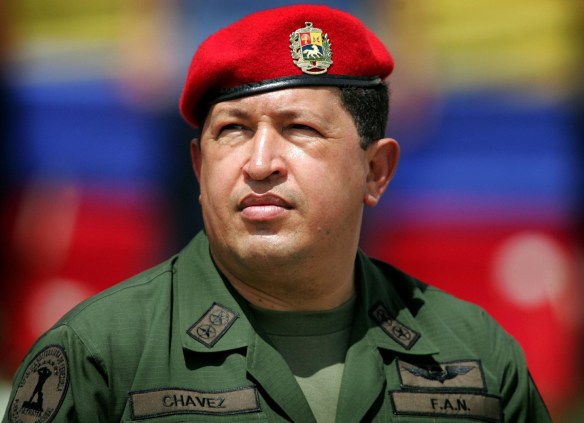
Chavez

Today marks the first anniversary of the death of Venezuelan President Hugo Chavez. As Washington DC and U.S. corporate media do everything in their power to shift popular support towards the conservative opposition, now is a good time to remember what Chavez and his party stood for, why the U.S. hated him so much, why his people loved him, and how and why the CIA may have assassinated him. These and other topics are discussed in the interview transcript below with author and historian William Blum by John Robles first published by Stop NATO. For more details about likely CIA involvement in the death of Hugo Chavez, read http://www.madcowprod.com/2013/03/08/who-killed-hugo-chavez/.

The CIA has Attempted to Assassinate 50 Foreign Leaders Including Chavez

The late Venezuelan President Hugo Chavez was warned by Fidel Castro to be careful of a very specific attack, namely a quick jab from an infected needle. Such a warning coming from a leader who has reportedly been the target of CIA assassination plots more than 600 times in over 50 years, was sure to be heeded.

Was the illness of Hugo Chavez a completely deniable assassination by the CIA? William Blum spoke with the VOR’s John Robles and discussed this issue and more.

Robles: I’ve read your Anti-Empire report regarding Hugo Chavez. Can you give us your comments on speculation that he was assassinated by the CIA?

Blum: I cannot prove it of course, but I believe he was. It would be totally in keeping with the entire history of the CIA and its attitude towards people like Hugo Chavez.

The CIA has attempted to assassinate more than 50 foreign leaders and successfully at least half the time. And very few of them were as despised by the US government as Chavez was, I would say. So, there would be no reason at all to expect that the CIA would not at least plan on killing, and the nature of his ailment is very odd.

He went from a cancer, which would not go away despite several sessions of chemotherapy and what have you. Then it went to serious lung infections, which would not go away no matter what they did. And then it went to, suddenly, a massive heart attack. All in the same man with no apparent cause, he was only 58-years-old, and as far as we know he was a very healthy until this happened, it is all very odd.

And given the great motivation that the US Government and the persons in the CIA has put for killing a man like Hugo Chavez, I’m pretty sure that the CIA played a role in this.

Robles: Do you know or have you heard of any credible new technology or new programs that could deliver such a cancer?

Blum: The means would be a needle with a quick, sharp jab and what you need is getting one person close enough to Chavez to do that.

Chavez was always in the public eye, he was always embracing people. There must have been countless occasions in the past few years when he was vulnerable to a quick jab by a needle that would be the method of transmitting the ailments.

Robles: Did he ever complain that he had been poked by something in public? Were there any reports of anything like that happening that you had heard about?

Blum: He did mention that Fidel Castro warned him about just that. He said: “A quick jab with a needle, and they’ll do…I don’t know what!” Actually he was told by Fidel.

Robles: A quick jab with a needle. Do you think that happened with Fidel because he had become very ill?

Blum: Well, Fidel…According to Cuban intelligence, there were more than 600 attempts on the life of Fidel Castro by the CIA. There is an entire book on that subject by Cuban intelligence.

And many of the methods were pretty bizarre, including an exploding cigar, but over the course of 50 years the Cubans claim there were more than 600 attempts on his life and it may have taken just one with Chavez.

Robles: Have you heard anything from your sources or from where you get some of your information? Have you heard anything detailing any connection between these two US Air Force attaches that were expelled from the country and the death of Hugo Chavez?

Blum: No. I would assume that there is a connection but I don’t know if the Venezuelan government has actually said so.

Getting back to Chavez’s case, we have to keep in mind that four other South American leaders, prominent people on the left, all came down with cancer within the past year or two.

Robles: I think it was seven, wasn’t it, altogether?

Blum: The four that I named in my report…You can add the ones that you know just for my information… were Cristina Fernandez…

Robles: De Kirchner, right…

Blum: of Argentina, Dilma Rousseff of Brazil, Fernando Lugo of Paraguay, the former Brazilian head of state Lula da Silva. Who would you add into that list?

Robles: Well, and then of course Hugo Chavez himself…

Blum: Castro is one of them…

Robles: I would add Castro to the list and Kirchner’s husband who died of a mysterious heart attack as well.

Blum: Right.

Robles: We might add that as a mysterious illness, not exactly a cancer but…

Blum: Right! If the CIA was involved it doesn’t have to be cancer necessarily of course.

Robles: Oh, sure, it could be anything. Have you heard anything about cancer strains or any kind of killing weapons like this, any kind of biological weapons that would give maybe cancer-like symptoms, not exactly a certain type of cancer?

Blum: I very well may have read of such over the years. I have read so much about the CIA, but at the moment I can’t think of anything to supply you with that information. Although we do know, it is well known, that for decades the CIA was looking for a method of killing somebody which would not leave a trace. The CIA itself has used those words. For the entire period of the Cold War that was a major stated project of the CIA. But where that stands today, I have no idea.

Robles: Yes, of course that is all very secret and no one is going to talk about it, but perhaps there are some echoes or some whispers? Maybe somebody has come out and said something? What other reasons would you give to back up the argument that he was assassinated?

Blum: I will mention there is no one in the entire universe who was more hated, no leader more hated than Chavez was by the US government. In the eyes of the US power that be, Chavez was worse than Fidel Castro and Salvador Allende.

Robles: Why was he so hated?

Blum: Because he was the most outspoken leader in the world when it came to criticizing US foreign policy. He never pulled his punches for a moment, he made a claim that it was all crimes against humanity and the US leaders were war criminals, and he said so explicitly. It is unusual for a head of state to be talking that way. And at the UN he attacked Bush in front of the whole world.

Robles: Oh yes, I remember he said that the Devil had been there the day before or something, and it still smelled like sulfur.

Blum: Yes, Bush had spoken to the UN before Chavez from the same platform. And Chavez said there was a smell of sulfur in the air because of that.

Robles: That’s usually the domain of the United States, I mean… Isn’t it? I mean Bush was calling everybody the axis of evil, and all this stuff, branding everyone evil. Wasn’t that kind of a shock to see the same thing done to an American leader?

Blum: Yeah, it is a shock for anyone under any circumstances to be so outspoken in the criticism of the US foreign policy. It is a point in Chavez’s favor that he could have the honesty and the courage to say such things, which very much needed to be said.

Robles: So, you supported the way he stood up?

Blum: Well, in general yes. I think there certainly were times when he may have overdone it, even for me. I mean, he felt obliged to comment on everything under the sun, and I thought several times that he could have held off on saying certain things, they were not serving any good purpose. But that’s a minor criticism of his overall marvelous record.

Robles: You say he had a marvelous record. What do you think were his major achievements in your opinion?

Blum: What he’s brought to the poor people of Venezuela in the way of education and healthcare, and housing, and what have you. And what he brought to the rest of the South America, he formed various anti-US empire blocs which stood in the way of expansion of the US influence.

He and others formed a new…A counter to the OAS, the Organization of American States, which for decades has been dominated and corrupted by the US and Canada. And they formed a new organization in South America excluding the US and Canada. So it was that simple.

Robles: Do you think his achievements will continue or do you think the US will be successful in rolling back everything he did? Which of course I assume they would want to.

Blum: Yes, they would want to. But if Maduro who was chosen and backed by Chavez, wins, and he is expected to win in the election next month, then most of it will continue, I assume.

Stop NATO e-mail list home page with archives and search engine:
http://groups. yahoo.com/ group/stopnato/ messages

Stop NATO website and articles:
http://rickrozoff. wordpress. com

Overthrowing other people’s governments: The Master List

Corporate-domination

By William Blum

Originally posted at RINF.com

Instances of the United States overthrowing, or attempting to overthrow, a foreign government since the Second World War. (* indicates successful ouster of a government)

  • China 1949 to early 1960s
  • Albania 1949-53
  • East Germany 1950s
  • Iran 1953 *
  • Guatemala 1954 *
  • Costa Rica mid-1950s
  • Syria 1956-7
  • Egypt 1957
  • Indonesia 1957-8
  • British Guiana 1953-64 *
  • Iraq 1963 *
  • North Vietnam 1945-73
  • Cambodia 1955-70 *
  • Laos 1958 *, 1959 *, 1960 *
  • Ecuador 1960-63 *
  • Congo 1960 *
  • France 1965
  • Brazil 1962-64 *
  • Dominican Republic 1963 *
  • Cuba 1959 to present
  • Bolivia 1964 *
  • Indonesia 1965 *
  • Ghana 1966 *
  • Chile 1964-73 *
  • Greece 1967 *
  • Costa Rica 1970-71
  • Bolivia 1971 *
  • Australia 1973-75 *
  • Angola 1975, 1980s
  • Zaire 1975
  • Portugal 1974-76 *
  • Jamaica 1976-80 *
  • Seychelles 1979-81
  • Chad 1981-82 *
  • Grenada 1983 *
  • South Yemen 1982-84
  • Suriname 1982-84
  • Fiji 1987 *
  • Libya 1980s
  • Nicaragua 1981-90 *
  • Panama 1989 *
  • Bulgaria 1990 *
  • Albania 1991 *
  • Iraq 1991
  • Afghanistan 1980s *
  • Somalia 1993
  • Yugoslavia 1999-2000 *
  • Ecuador 2000 *
  • Afghanistan 2001 *
  • Venezuela 2002 *
  • Iraq 2003 *
  • Haiti 2004 *
  • Somalia 2007 to present
  • Libya 2011*
  • Syria 2012

Q: Why will there never be a coup d’état in Washington?

A: Because there’s no American embassy there.

William Blum is an author, historian, and renowned critic of U.S. foreign policy. He is the author of Killing Hope: U.S. Military and CIA Interventions Since World War II and Rogue State: A Guide to the World’s Only Superpower, among others. Visit his blog.

Arrest of Middle Eastern Mercenary in Venezuela, a Possible Game Changer

By Arturo Rosales, writing from Caracas

Originally posted at Axis of Logic

In the conclusion to the recently published article on Axis of Logic Déjà vu – History tends to repeat itself we ask rhetorically what the next phase of destabilization will be in Venezuela in the US’ quest to secure the largest proven oil reserves in the world.

As of yesterday we may have the first evidence of an answer to this scary and ultimately decisive question. This could be a game changer in the development of the current destabilization effort in Venezuela by paid mercenaries masquerading as “disillusioned students”.

The breakthrough

At 4am on Monday 24th February in a hotel in northern part of the city of Maracay in Aragua state, an individual of Middle Eastern origin and two other people were captured by the Bolivarian Security Forces (SEBIN). Aragua governor, Tareck El Aissami reported the evidence available at that time in several posts on his Twitter account, @TareckPSUV.

El Aissami stated that they had captured a “big fish” in Aragua who was identified as Jayssam Mokded Mokded along with two other people in his company, both of whom have military backgrounds and training.

Jayssam Mokded Mokded


In the raid of the hotel room the security forces found electronic communications equipment – 11 satellite phones for communicating with the US and Colombia – computers and documents linking him with companies in Miami. His vehicle, a Toyota Model FJ was armored with bullet proofing and in it explosives, a keg of gun powder and logistical equipment to set up barricades in the streets were discovered.

It was also established that Mokded Mokded has access to a bank account in Miami with some US$250,000 and had made various transfers of hundreds of thousands of dollars to Miami and other destinations. In Colombia he has another bank account with a balance of some US$10,000. It was also noted that all his dealings with Venezuelan banks were limited to Banesco – a bank that had been involved in laundering finance for the 2002 – 2003 coup attempts but which was said to have changed its ways in recent years.

The purpose

All the evidence points to the fact that Mokded Mokded was fully equipped to carry out terrorist acts in Venezuela and it is known that he had been staying at the hotel in question since February 9th. The Venezuela security forces had been tailing him for several days and he had made visits to several upper and middle class urbanizations. The suspicion is that these visits were reconnaissance missions in order to find the most devastating spot to park car bombs and start sowing terror in Venezuela.

Bombs have been used in the last decade to sow terror in Venezuela and the perpetrators of the 2003 attacks, the Colina brothers, escaped to Florida where a judge refused to extradite them back to Venezuela. This is another example of the US protecting terrorists that carry out black operations against “unfriendly nations”. The last car bomb planted in that terror campaign by the opposition was the one placed under the seat of Danilo Anderson’s Toyota SUV, killing him on November 17th 2004. Anderson was the state prosecutor investigating those who carried out the April, 2002 coup attempt.

Reaction in Florida

Mokded Mokded lives in Doral, a city located in north-central Miami-Dade County in the US state of Florida where he is known as a “businessman”. Florida records show Mokded Mokded is president of CJ International Services, 10580 NW 27th St., in Doral.  He is also the president of Soloblackberry.net.inc with offices in Doral and Porlamar, Venezuela.

On Saturday, thousands met at J.C. Bermudez Park in Doral to express their solidarity with the opposition in Venezuela. Miami’s Doral area is known as “Doralzuela” for its anti-Chavez Venezuelan migrant population which is as radical and as permeated with hatred against chavista Venezuela as is the population of “Little Havana” against fidelista Cuba.

Concerns and Conclusions

The worrying aspects of the arrest of Mokded Mokded is that his possession of explosives, gunpowder and evidence of his reconnaissance for placing car bombs could mean that a new phase of terror is about to be unleashed on Venezuela.

Looking at this development from any angle, it could be a game changer,
escalating violence and hatred, the fuel of these protests throughout the country.

State Governor El Aissami has confirmed that authorities are already on the trail of other mercenaries and will hopefully be able to extract confessions and information from Mokded Mokded and his accomplices about other terror cells waiting to act in Venezuela.

In the hotel raid, a communiqué was found from Mokded Mokded to the Capriles Radonski presidential campaign in Venezuela demonstrating that politically, this “businessman” and apparent terrorist has been in contact with the Venezuela opposition. The opposition is getting nearer to full exposure as collaborators with terrorists “brought here” for the overthrow of the democratically-elected government of Nicolas Maduro.

Actually, none of this is a great surprise but cause for great concern as more innocent lives are now at risk. Massive loss of life due to any terrorist acts will be manipulated by the international media in cahoots with US imperialist lies to blame the Maduro government – as it has been in Syria against President Bashar al Assad.

It is the same script written either by writers in the CIA at Langley or by aides of John Kerry in the State Department – both consorting with the Father of the Paramilitary Death Squads, Colombia’s Alvaro Uribe Vélez.