Obama Accuses Russia of Going After America’s “Good Guy Terrorists”

obama_on_isis_10-1-2015_8-50-53_am

By Prof Michel Chossudovsky

Source: Global Research

Amply documented but rarely mentioned in news reports, the ISIS is a creation of US intelligence, recruited, trained and financed by the US and its allies including Britain, France, Saudi Arabia, Qatar, Turkey, Israel and Jordan.  

Until recently, the ISIS was known as Al Qaeda in Iraq (AQI). In 2014, it was renamed the Islamic State (Islamic State of Iraq and Syria, Islamic State of Iraq and the Levant).

Russia is Now Involved in the War on Terrorism

A major turning point in the dynamics of the Syria-Iraq war is unfolding. Russia is now directly involved in the counter-terrorism campaign in coordination with the Syrian and Iraqi governments.

While Washington has acknowledged Moscow’s resolve, Obama is now complaining that the Russians are targeting the “good guy terrorists” who are supported by Washington.

From the Horse’s Mouth

According to the Wall Street Journal:

Russian Airstrike in Syria Targeted CIA-Backed Rebels, U.S. Officials Say

One area hit was location primarily held by rebels receiving funding, arms, training from CIA and allies

One important piece of unspoken information conveyed in this WSJ report is that the CIA is supporting terrorists as a means to triggering “regime change” in Syria, implying the conduct of covert intelligence operations within Syrian territory:

“The U.S. spy agency has been arming and training rebels in Syria since 2013 to fight the Assad regime  (WSJ, September 30, 2015 emphasis added, author’s note: covert support to the terrorists was provided from the outset of the war in March 2011)

The above statement is something which is known and documented but which has barely been acknowledged by the mainstream media.

Al Nusra: “Good Guy Terrorists”

While the Pentagon now candidly acknowledges that the CIA is supporting Al Qaeda affiliated groups inside Syria, including Al Nusra, it nonetheless deplores the fact that Russia is allegedly targeting the “good guy terrorists”, who are supported by Washington:

One of the [Russian] airstrikes hit an area primarily held by rebels backed by the Central Intelligence Agency and allied spy services, U.S. officials said, …

Among seven areas that Syrian state media listed as targets of Russian strikes, only one—an area east of the town of Salamiyah in Hama province—has a known presence of Islamic State fighters. The other areas listed are largely dominated by moderate rebel factions or Islamist groups such as Ahrar al-Sham and the al Qaeda-affiliated Nusra Front.  (WSJ, September 30, 2015 emphasis added)

Affiliated to Al Qaeda, Al Nusra is a US sponsored  ”jihadist” terrorist organization which has been responsible for countless atrocities. Since 2012, AQI and Al Nusra — both supported by US intelligence– have been working hand in glove in various terrorist undertakings within Syria.

In recent developments, the Syrian government has identified its own priority areas for the Russian counter-terrorism air campaign, which consists essentially in targeting Al Nusra.  Al Nusra is described as the terrorist arm of the Free Syrian Army (FSA).

While Washington has categorized Al Nusra as a terrorist organization (early 2012), it nonetheless provides support to both Al Nusra and it’s so-called “moderate rebels” in the form of weapons, training, logistical support, recruitment, etc. This support is channeled by America’s Persian Gulf allies, including Qatar and Saudi Arabia as well as through Turkey and Israel.

Ironically, The UN Security Council in a May 2012 decision “blacklisted Syria’s al-Nusra Front as an alias of al-Qaeda in Iraq”, namely the ISIL:

a decision that will subject the group to sanctions including an arms embargo, travel ban and assets freeze, diplomats said.

The US mission to the United Nations said none of the 15 council members objected to adding al-Nusra as an alias of al-Qaeda in Iraq on Thursday.

Al-Nusra, one of the most effective forces fighting President Bashar al-Assad, last month pledged allegiance to al-Qaeda leader Ayman al-Zawahri. (Al Jazeera, May 2012)

And now Russia is being blamed for targeting a terrorist entity which is not only on the UN Security Council blacklist but which has ties to the Islamic State (ISIS).

What is the significance of these accusations?

While the media narrative acknowledges that Russia has endorsed the counter-terrorism campaign, in practice Russia is (indirectly) fighting the US-NATO coalition  by supporting the Syrian government against the terrorists, who happen to be the foot soldiers of the Western military alliance, with Western mercenaries and military advisers within their ranks. In practice, what Russia is doing is fighting terrorists who are supported by the US.

The forbidden truth is that by providing military aid to both Syria and Iraq, Russia is (indirectly) confronting America. 

Moscow will be supporting both countries in their proxy war against the ISIL which is supported by the US and its allies.

Putin’s Blitz Leaves Washington Rankled and Confused

putin-obama-620x350

By Mike Whitney

Source: Counterpunch

On Monday, Russian President Vladimir Putin delivered a blistering critique of US foreign policy to the UN General Assembly.

On Tuesday, Barack Obama shoved a knife in Putin’s back. This is from Reuters:

“France will discuss with its partners in the coming days a proposal by Turkey and members of the Syrian opposition for a no-fly zone in northern Syria, French President Francois Hollande said on Monday…

French Foreign Minister Laurent Fabius “in the coming days will look at what the demarcation would be, how this zone could be secured and what our partners think,” Hollande told reporters on the sidelines of the annual United Nations General Assembly…

Hollande said such a proposal could eventually be rubber-stamped with a U.N. Security Council resolution that “would give international legitimacy to what’s happening in this zone.”…(France, partners to discuss northern Syria ‘safe zone’: Hollande, Reuters)

Hollande is a liar and a puppet. He knows the Security Council will never approve a no-fly zone. Russia and China have already said so. And they’ve explained why they are opposed to it, too. It’s because they don’t want another failed state on their hands like Libya, which is what happened last time the US and NATO imposed a no-fly zone.

But that’s beside the point. The real reason the no-fly zone issue has resurfaced is because it was one of the concessions Obama made to Turkish President Recep Tayyip Erdogan for the use of Incirlik airbase.  Washington has kept the terms of that deal secret, but Hollande has let the cat out of the bag.

So who put sock-puppet Hollande up to this no-fly zone nonsense?

Why the Obama administration, of course. Does anyone seriously believe that Hollande is conducting his own independent policy in Syria?  Of course not.  Hollande is just doing what he’s been told to do, just like he did when he was told to scotch the Mistral deal that cost France a whopping $1.2 billion. Washington and NATO didn’t like the idea that France was selling state-of-the-art helicopter carriers to arch-rival Putin, so they ordered Hollande to put the kibosh on the deal. Which he did, because that’s what puppets do; they obey their masters.  Now he’s providing cover for Obama so the real details of the Incirlik agreement remain off the public’s radar. That’s why we say,  Obama shoved a knife in Putin’s back, because, ultimately, the no-fly zone damages Russia’s interests in Syria.

The significance of the Reuters article cannot be overstated. It suggests that there was a quid pro quo for the use of Incirlik, and that Turkey’s demands were accepted. Why is that important?

Because Turkey had three demands:

1–Safe zones in north Syria (which means that Turkey would basically annex a good portion of Syrian sovereign territory.)
2–A no-fly zone (which would allow either Turkish troops, US Special Forces or US-backed jihadi militants to conduct their military operations with the support of US air cover.)
3–A commitment from the US that it will help Turkey remove Assad.

Did Obama agree to all three of these demands before Erdogan agreed to let the USAF use Incirlik?

Yes, at least I think he did, which is why I think we are at the beginning of Phase 2 of the US aggression against Syria. Incirlik changes everything. US bombers, drones and fighters can enter Syrian airspace in just 15 minutes instead of 3 to 4 hours from Bahrain. That means more sorties, more surveillance drones, and more air-cover for US-backed militias and Special Forces on the ground.  It means the US can impose a de facto no-fly zone over most of Syria that will expose and weaken Syrian forces tipping the odds decisively in favor of Obama’s jihadi army. Incirlik is a game-changer, the cornerstone of US policy in Syria.  With access to Incirlik, victory is within Washington’s reach. That’s how important Incirlik is.

And that’s why the normally-cautious Putin decided to deploy his warplanes, troops and weaponry so soon after the Incirlik deal was signed. He could see the handwriting on the wall. He knew he had to either act fast and turn the tide or accept the fact that the US and Turkey were going to topple Assad sometime after Turkey’s snap elections on November 1. That was his timeline for action. So he did the right thing and joined the fighting.

But what does Putin do now?

On Wednesday, just two days after Putin announced to the UN General Assembly:  “We can no longer tolerate the current state of affairs in the world,” Putin ordered the bombing of targets in Homs, an ISIS stronghold in West Syria. The attacks, which were unanimously approved by the Russian parliament earlier in the day, and which are entirely legal under international law (Putin was invited by Syria’s sitting president, Assad, to carry out the airstrikes), have put US policy in a tailspin. While the Russian military is maintaining an open channel to the Pentagon and reporting when-and-where it is carrying out its airstrikes, U.S. State Department spokesman John Kirby said that the US plans to “continue to fly missions over Iraq and Syria” increasing the possibility of an unintended clash that could lead to a confrontation between the US and Russia.

Is that what Washington wants, a violent incident that pits one nuclear-armed adversary against the other?

Let’s consider one probable scenario: Let’s say an F-16 is shot down over Syria while providing air cover for Obama’s militants on the ground. Now that Russia is conducting air raids over Syria, there’s a good chance that Putin would be blamed for the incident like he was when the Malaysian airliner was downed over East Ukraine.

So what happens next?

Judging by similar incidents in the past,  the media would swing into full-propaganda mode exhorting the administration to launch retaliatory attacks on Russian military sites while calling for a broader US-NATO mobilization. That, in turn, would force Putin to either fight back and up-the-ante or back-down and face disgrace.  Either way, Putin loses and the US gets one step closer to its objective of toppling Bashar al Assad.

Putin knows all this. He understands the risks of military involvement which is why he has only reluctantly committed to the present campaign. That said; we should expect him to act in much the same way as he did when Georgian troops invaded South Ossetia in 2007. Putin immediately deployed the tanks to push the invading troops back over the border into Georgia and then quickly ended the hostilities. He was lambasted by critics on the right for not invading Georgia and removing their leader, Mikheil Saakashvili, in the Capital. But as it turned out, Putin’s restraint spared Russia the unnecessary hardship of occupation which can drain resources and erode public support. Putin was right and his critics were wrong.

Will his actions in Syria mirror those in South Ossetia?

It’s hard to say, but it’s clear that the Obama crew is thunderstruck by the speed of the intervention. Check this out from the UK Guardian:  “Back at the White House, spokesperson Josh Earnest suggests that Vladimir Putin did not give Barack Obama warning about his intentions to begin air strikes in Syria.

“We have long said we would welcome constructive Russian coordination,” Earnest says, before qualifying that the talks between US and Russian militaries will be purely tactical: “to ensure that our military activities and the military activities of coalition partners would be safely conducted.” (The Guardian)

What does Earnest’s statement mean?  It means the entire US political class was caught off-guard by Putin’s  blitz and has not yet settled on an appropriate response. They know that Putin is undoing years of work by rolling up proxy-units that were supposed to achieve US objectives, but there is no agreement among ruling elites about what should be done. And making a decision of that magnitude could take time, which means that Putin should be able to obliterate a fair number of the terrorist hideouts and restore control of large parts of the country to Assad before the US ever agrees to a strategy. In fact, if he moves fast, he might even be able to force the US and their Gulf allies to the bargaining table where a political solution could be reached.

It’s a long-shot, but it’s a much better option then waiting around for the US to impose a no-fly zone that would collapse the central government and reduce Syria to Libya-type anarchy. There’s no future in that at all.

MIKE WHITNEY lives in Washington state. He is a contributor to Hopeless: Barack Obama and the Politics of Illusion (AK Press). Hopeless is also available in a Kindle edition. He can be reached at fergiewhitney@msn.com.

isis_russia_10-1-2015_8-21-13_am

Capture, Smear, Contaminate: The Politics Of GMOs

gmo_crops_genfood_735_350-400x190

By Colin Todhunter

Source: RINF

When rich companies with politically-connected lobbyists and seats on public bodies bend policies for their own ends, we are in serious trouble. It is then that public institutions become hijacked and our choices, freedoms and rights are destroyed. Corporate interests have too often used their dubious ‘science’, lobbyists, political connections and presence within the heart of governments to subvert institutions set up to supposedly protect the public interest for their own commercial benefit. Once their power has been established, anyone who questions them or who stands in their way can expect a very bumpy ride.

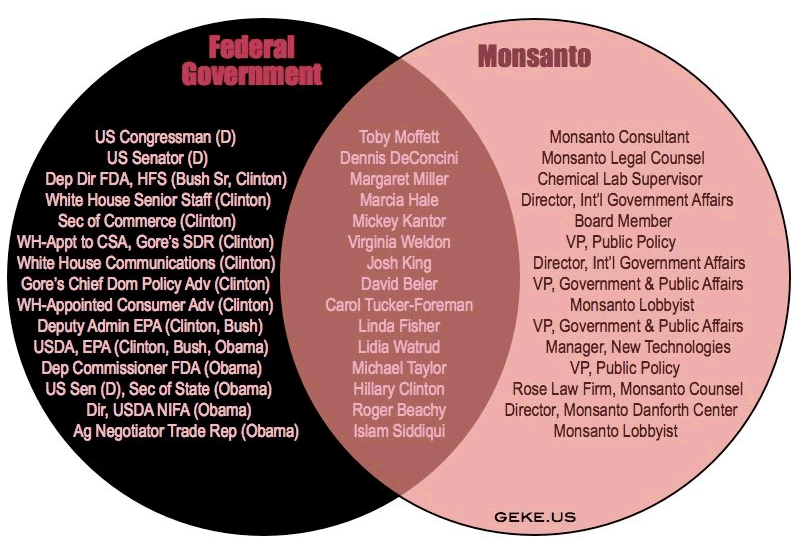
The revolving door between the private sector and government bodies has been well established. In the US, many senior figures from the Genetically Modified Organisms (GMOs) industry, especially Monsanto, have moved with ease to take up positions with the Food and Drug Administration and Evironmental Protection Agency and within the government. Writer and researcher William F Engdahl writes about a similar influence in Europe, noting the links between the GMO sector within the European Food Safety Authority. He states that over half of the scientists involved in the GMO panel which positively reviewed the Monsanto’s study for GMO maize in 2009, leading to its EU-wide authorisation, had links with the biotech industry.

“Monsanto should not have to vouchsafe the safety of biotech food. Our interest is in selling as much of it as possible. Assuring its safety is the FDA’s job” – Phil Angell, Monsanto’s director of corporate communications. “Playing God in the Garden” New York Times Magazine,October 25, 1998.

Phil Angell’s statement begs the question: then who should vouchsafe for it, especially when the public bodies have been severely comprised? Monsanto has all angles covered.

When corporate interests are able to gain access to such positions of power, little wonder they have some heavy-duty tools at their disposal to try to fend off criticism by all means necessary.

A well-worn tactic of the pro-GMO lobby is to slur and attack figures that have challenged the ‘science’ and claims of the industry. With threats of lawsuits and UK government pressure, some years ago top research scientist Dr Arpad Pusztai was effectively silenced over his research concerning the dangers of GM food. A campaign was set in motion to destroy his reputation. Professor Seralini and his team’s research was also met with intense industry pressure, with Monsanto effectively targeting the heart of science to secure its commercial interests. There are numerous examples of scientists being targeted like this. A WikiLeaks cable highlighted how GMOs were being forced into European nations by the US ambassador to France who plotted with other US officials to create a ‘retaliatory target list’ of anyone who tried to regulate GMOs. That clearly indicates the power of the industry.

What the GMO sector fails to grasp is that the onus is on it to prove that its products are safe. And it has patently failed to do this. No independent testing was done before Bush senior allowed GMOs onto the US market. The onus should not be on others to prove they are safe (or unsafe) after they are on the market, especially as public attorney Steven Druker‘s book ‘Altered Genes, Twisted Truth’ shows that GMOs are on the US market due to fraudulent practices and the bypassing of scientific evidence pointing to potential health hazards.

We therefore have the right to ask whether we should trust studies carried out by the sector itself that claims GM crops are safe? Let us turn to Tiruvadi Jagadisan for an answer.

He worked with Monsanto for nearly two decades, including eight years as the managing director of India operations. A few years ago, he stated that Monsanto “used to fake scientific data” submitted to government regulatory agencies to get commercial approvals for its products in India. The former Monsanto boss said government regulatory agencies with which the company used to deal with in the 1980s simply depended on data supplied by the company while giving approvals to herbicides. As reported in India Today, he is on record as saying that India’s Central Insecticide Board simply accepted foreign data supplied by Monsanto and did not even have a test tube to validate the data which at times was faked.

Now that scientists such as Professor Seralini are in a sense playing catch-up by testing previously independently untested GMOs, he is attacked. However, the attacks on Seralini and his study have been found to be based on little more than unscientific polemics and industry pressure. In fact, in new study, Seralini highlights the serious flaws of industry-backed studies that were apparently slanted to distort results. It remains to be seen whether he and his team are in for another bout of smears and attacks.

But this is symptomatic of the industry: it says a product is safe, therefore it is – regardless that science is being used as little more than an ideological smokescreen. We are expected to take its claims at face value. The revolving door between top figures at Monsanto and positions at the FDA makes it difficult to see where the line between lobbying and regulation is actually drawn. People are rightly suspicious of the links between the FDA and GMO industry in the US and the links between it and the regulatory body within the EU.

GM represents the so-called “Green Revolution’s” second coming. Agriculture has changed more over the last two generations than it did in the previous 12,000 years. Environmentalist Vandana Shiva notes that, after 1945, chemical manufacturers who had been involved in the weapons industry turned their attention to applying their chemical know-how to farming. As a result ‘dwarf seeds’ were purposively created to specifically respond to their chemicals. Agriculture became transformed into a chemical-dependent industry that has destroyed much biodiversity. What we are left with is crop monocultures, which negatively impact food security and nutrition. In effect, modern agriculture is part of the paradigm of control based on mass standardization and a dependency on corporate products.

The implications have been vast. Chemical-industrial agriculture has proved extremely lucrative for the oil and chemicals industry, courtesy of oil-rich Rockefeller interests which were instrumental in pushing for the green revolution throughout the world, and has served to maintain and promote Western hegemony, not least via ‘structural adjustment’ and the consequent uprooting of traditional farming practices in favour of single-crop export-oriented policies, dam building to cater for what became a highly water intensive industry, loans and indebtedness, boosting demand for the US dollar, etc.

Agriculture has been a major tool of US foreign policy since 1945 and has helped to secure its global hegemony. One must look no further than current events in Ukraine, where the strings attached to financial loans are resulting in the opening up of (GM) agriculture to Monsanto. From Africa to India and across Asia, the hijack of indigenous agriculture and food production by big corporations is a major political issue as farmers struggle for their rights to remain on the land, retain ownership of seeds, grow healthy food and protect their livelihoods.

Apart from tying poorer countries into an unequal system of global trade and reinforcing global inequalities, the corporate hijacking of food and agriculture has had many other implications, not least where health is concerned.

Dr Meryl Hammond, founder of the Campaign for Alternatives to Pesticides, told a Canadian parliament committee in 2009 that a raft of studies published in prestigious peer-reviewed journals point to strong associations between chemical pesticides and a vast range of serious life-threatening health consequences. Shiv Chopra, a top food advisor to the Canadian government, has documented how all kinds of food products that were known to be dangerous were passed by the regulatory authority and put on the market there due to the power of the food industry.

Severe anemia, permanent brain damage, Alzheimer’s, dementia, neurological disorders, reproductive problems, diminished intelligence, impaired immune system, behavioural disorders, cancers, hyperactivity and learning disability are just some of the diseases that numerous studies have linked to our food.

Of course, just like cigarettes and the tobacco industry before, trying to ‘prove’ the glaringly obvious link will take decades as deceit is passed off as ‘science’ or becomes institutionalized due to the hijacking of government bodies by the corporations involved in food production.

But anyone who questions the need for GMOs in the first place and the risks they bring and devastating impacts they have is painted as clueless and indulging in scare mongering and falsehoods, while standing in the way of human progress. But can we expect much better from an industry that has a record of smearing and attempting to ruin people who criticise it? Are those of us who question the political links of big agritech and the nature of its products ready to take lessons on ethics and high-minded notions of ‘human progress’ from anyone involved with it?

This is an industry that has contaminated crops and bullied farmers with lawsuits in North America, an industry whose companies have been charged with and most often found guilty of contaminating the environment and seriously damaging health with PCBs and dioxins, an industry complicit in concealing the deadly impact of GM corn on animals, an industry where bribery seems to be second nature (Monsanto in Indonesia), an industry associated with human rights violations in Brazil and an industry that will not label its foods in the US.

A great myth forwarded by the pro-GMO lobby is that governments are freely choosing to adopt GMOs. Any brief analysis of the politics of GM highlights that this is nonsense. Various pressures are applied and agritech companies have captured policy bodies and have a strategic hold over the WTO and trade deals like the TTIP.

For instance, take the 2005 US-India nuclear deal (allowing India to develop its nuclear sector despite it not being a signatory of the Non-Proliferation Treaty and allegedly pushed through with a cash for votes tactic in the Indian parliament). It was linked to the Knowledge Initiative on Agriculture, which was aimed at widening access to India’s agricultural and retail sectors. This initiative was drawn up with the full and direct participation of representatives from various companies, including Monsanto, Cargill and Walmart.

When the most powerful country comes knocking at your door seeking to gain access to your markets, there’s good chance that once its corporate-tipped jackboot is in, you won’t be able to get it out.

And it seems you can’t. So far, Bt cotton has been the only GM crop allowed in India, but the open field trials of many GM crops are now taking place around the country despite an overwhelming consensus of official reports warning against this. The work of numerous public bodies and research institutes is now compromised as a result of Monsanto’s strategic influence within India (see this and this).

If global victory cannot be achieved by the GMO biotech sector via the hijack of public bodies and trade deals or intimidation, then the politics of another form of contamination may eventually suffice:

“The hope of the industry is that over time the market is so flooded [with GMOs] that there’s nothing you can do about it. You just sort of surrender” – Don Westfall, biotech industry consultant and vice-president of Promar International, in the Toronto Star,January 9 2001.

Open field planting is but one way of achieving what Westfall states. Of course, there are numerous other ways too (see this).

As powerful agribusiness concerns seek to ‘consolidate the entire food chain’ with their seeds, patents and GMOs, it is clear that it’s not just the health of the nation (any nation) that is at stake but the global control of food and by implication nations.

“What you are seeing is not just a consolidation of seed companies, it’s really a consolidation of the entire food chain” – Robert Fraley, co-president of Monsanto’s agricultural sector 1996, in the Farm Journal. Quoted in: Flint J. (1998) Agricultural industry giants moving towards genetic monopolism. Telepolis, Heise.

Colin Todhunter is an independent writer: colintodhunter.com

America created and supports the Islamic State

obama-isis-cia

By Stephen Lendman

Source: Intrepid Report

Obama’s so-called war to degrade and destroy Islamic State is a complete fabrication. Defeating it is simple. Stop recruiting, arming, funding, training and directing its elements.

Stop using terrorists as US proxy foot soldiers. Wage peace, not war. Isolated on its own, it’ll wither over time and disappear, or be too impotent to rampage like now.

Washington bears full responsibility for human floods fleeing war ravaged areas for safe havens anywhere. Bashar al-Assad told RT International the crisis is “not about that Europe didn’t accept them or embrace them as refugees. It’s about not dealing with the cause. If you are worried about them, stop supporting terrorists.”

“If we ask any Syrian today about what they want, the first thing they would say: ‘We want security and safety for every person and every family.’ The international community should unite around what the Syrian people want.”

Ongoing conflict can only be resolved “through dialogue and the political process [as well as] unit[y] in the struggle against terrorism.”

With an approval rating of 89%, Vladimir Putin is likely the world’s most popular leader—for supporting nation-state sovereignty, multi-world polarity and opposing America’s ruthless imperial agenda, waging endless wars on humanity.

He’s vilified in the West for forthrightly supporting world peace and stability, as well as wanting all conflicts resolved diplomatically and proposing workable solutions if adopted.

At the Collective Security Treaty Organization (CSTO) summit in Dushanbe, Tajikistan, he urged the international community to set aside geopolitical differences and unite against a common enemy.

“Extremists from many countries of the world, including, unfortunately, European countries, Russia and the Commonwealth of Independent States (CIS) undertake ideological and military training in the ranks of Islamic State,” he explained. “[C]ertainly we are worried that they could possibly return” and make trouble.

“Russia, as you know, has proposed to form a wide coalition to fight extremists without any delay. It should unite everyone who is ready and is already contributing to tackling terrorism.”

“If Russia had not been supporting Syria, the situation in the country would have been worse than in Libya and the refugee flow would have been even bigger.”

Moscow didn’t ravage and destroy Afghanistan, Iraq, Libya, Syria, Yemen, Donbass, and other countries—or occupy any. It doesn’t use terrorist mercenaries as proxy foot soldiers—or wage endless wars on humanity.

It’s not responsible for exponentially growing human floods of desperate people fleeing war-torn areas for safe havens anywhere out of harm’s way.

It accepted over a million Ukrainian refugees fleeing Obama’s war on Donbass, treating them humanely, regularly supplying Donetsk and Lugansk with badly needed humanitarian aid—doing the same thing for Syrians.

Russia is Europe’s leading peace and stability proponent. Wherever America shows up, genocide, mass destruction and human misery follow.

Peace is anathema. So are democratic freedoms. America’s agenda intends a ruler/serf world unfit to live in—greed and rapaciousness triumphing over equity and justice for all.

Stephen Lendman lives in Chicago. He can be reached at lendmanstephen@sbcglobal.net. His new book as editor and contributor is “Flashpoint in Ukraine: US Drive for Hegemony Risks WW III.” Visit his blog at sjlendman.blogspot.com . Listen to cutting-edge discussions with distinguished guests on the Progressive Radio News Hour on the Progressive Radio Network. It airs three times weekly: live on Sundays at 1PM Central time plus two prerecorded archived programs.


Follow the trail of facts, hints, and allegations—connect the dots

images

By Edward Curtin

Source: Intrepid Report

“There were incidents and accidents/there were hints and allegations.—Paul Simon

Children love to trace, to connect the dots, to make connections, but often the connections they make frighten adults who try to ignore their points or offer some ridiculous circumlocutions. Maybe we adults are much like children in our desires to make connections, but the thought of it frightens us.

Suppose we could for a while calm those fears and concentrate long enough to trace through the dim glimmerings of a faded pattern a clarifying story that would jolt us into an awareness that could change our lives and society. I offer here an arc of history that you may consider tedious. Try patience. I could yell, I could scream, I could try all the classical argumentation and logic that comes “naturally” to me. I could be a wise guy, amuse you, try to provoke you, curse, sing a song, stomp my feet—even write post-modern gibberish. As Andre Vltchek says, it’s hard—I’m putting it nicely—to get through, to have an impact that counts. We desperately want to believe in a world where we really are children and BIG Daddy (apologies to Burl Ives) has told the truth. Obviously I have reached some stern conclusions, but I think the conclusions follow from the facts. See what you think.

  • 1957, Massachusetts Senator John Kennedy delivers a Senate speech in support of the Algerian liberation movement, in support of African liberation generally, and against colonial imperialism. The speech causes an international uproar, and Kennedy is harshly attacked by Eisenhower, Nixon, John Foster Dulles, and even liberals such as Adlai Stevenson. He is praised in the third world.
  • 1959, George H. W. Bush moves his oil company—Zapata Offshore—to Houston, Texas. One of Zapata’s drilling rigs, Scorpion, having been moved from the Gulf of Mexico the previous year, is now operating 54 miles north of Cuba
  • 1960. On March 17, President Eisenhower approves the Bay of Pigs project.
  • 1961. On January 17, in anticipation of Kennedy’s inauguration in three days, the Belgian government in complicity with the CIA assassinates Congolese nationalist leader Patrice Lumumba. On February 13, a devastated Kennedy receives a belated phone call informing him of Lumumba’s murder.
  • 1961, April. More than a week before the CIA led Bay of Pigs invasion of Cuba—code-named the Zapata Operation—the CIA discovers that the Soviets have learned the date of the invasion and informed Castro. Knowing the invasion is doomed in advance, the CIA Director Allen Dulles doesn’t tell Kennedy. When the invasion fails, the CIA blames JFK who angrily says he wants “to splinter the CIA into a thousand pieces and scatter it to the winds.” Kennedy fires Dulles.
  • 1962. On June 13, Lee Harvey Oswald, ex-Marine and alleged traitor, returns from the Soviet Union with a loan from the State Department that also arranges for him, together with his Russian wife, to be met at the dock in Hoboken, New Jersey by Spas T. Raikin, an official of an anti-communist organization with extensive intelligence connections. Oswald soon moves to Dallas, Texas where, at the behest of the CIA, he is chaperoned around by CIA asset and George H. W. Bush’s old friend, George de Mohrenschildt.
  • 1963, June 10. JFK delivers his famous American University address calling for an end to “a Pax Americana enforced on the world by American weapons of war.”
  • 1963. On October 11, Kennedy issues National Security Action Memorandum 263 calling for the withdrawal of 1,000 American troops from Vietnam by the end of 1963 and all of them by the end of 1965.
  • 1963, November 2. At the last minute JFK cancels his trip to Chicago to attend the Army-Air Force football game when it is learned that a four-man rifle team has plotted to assassinate him. The four are never charged or named, but an alienated ex-Marine scapegoat with CIA connections, Thomas Arthur Vallee, is arrested on a pretext. Vallee works in a building overlooking a dog-leg turn where JFK’s car was to pass.
  • 1963, November 22. JFK is shot in Dallas on a dog-leg turn at 12:30 P.M. and dies at 1 P.M. At 1:38 P.M. Walter Cronkite makes the first public announcement of the president’s death. At 1:45 P.M. George H. W. Bush, who is in Tyler, Texas an hour and a half southeast of Dallas, telephones Houston FBI agent Graham W. Kitchel to inform him that he’s heard gossip that a Houston man, James Parrot, has been talking about killing Kennedy when he comes to Houston (JFK had been in Houston the day before). Parrot is questioned and deemed harmless. Bush tells the FBI agent that he’ll be going to Dallas in the evening, though he fails to mention that he was there the night before. At 1:50 PM the Dallas police arrest Lee Harvey Oswald in the Texas theatre and charge him with the murder of Dallas police Officer J.D. Tippett. A few minutes after Oswald’s arrest and his exit out the front door to waiting police cars, a second Oswald is arrested in the theatre and surreptitiously taken out the back door. Later in the day Oswald is charged with also killing President Kennedy from behind from the 6th floor of the Texas School Book Depository. But the fatal shot to Kennedy’s head comes from the left front.
  • 1963. Two days later, Ruby kills Oswald, who claimed he was a patsy, in the Dallas police building. That same afternoon LBJ tells Henry Cabot Lodge that “I am not going to lose Vietnam.”
  • 1963, November 29. LBJ announces the formation of the Warren Commission whose key member is Allen Dulles, the former CIA Director fired by Kennedy.
  • 1963. On December 24, Johnson tells the Joint Chiefs of Staff: “Just get me elected, and then you can have your war.”
  • 1964, August. The fraudulent Tonkin Gulf Incidents and Tonkin Gulf Resolution. Johnson orders the bombing of North Vietnam. The Vietnam War starts in earnest.
  • 1964 ,September. The Warren Commission findings are made public. Oswald is declared the lone assassin with the magic bullet explanation being the key.
  • 1967. Martin Luther King delivers his Riverside Church speech—“A Time to Break Silence”—denouncing the Vietnam War and calling for opposition to it, while linking it to social and economic oppression at home.
  • 1968, April 4. Martin Luther King is assassinated in Memphis. The authorities blame it on James Earl Ray, a petty criminal loner.
  • 1968. On June 6 in Los Angeles, Senator Robert Kennedy. On the cusp of becoming the Democratic nominee for president, is assassinated. The accused lone assassin, Sirhan Sirhan, was standing in front and to the left of RFK. The autopsy shows Kennedy was killed by a bullet from behind and below that entered his head behind his right ear. Sirhan is subsequently convicted as the lone crazed gunman, despite many witnesses seeing a girl, in a polka dot dress, with a male companion, running down the back stairs of the hotel, shouting. “We shot him! We shot him! We shot Senator Kennedy.”
  • 1972, June 17. Five CIA employees and veterans of the Bay of Pigs operation are arrested inside the Watergate offices of the Democratic National Committee. Together with H. Howard Hunt (CIA) and G. Gordon Liddy, they are later indicted. The burglars are caught by a security guard who notices that these skilled undercover operatives have taped locks open from the outside so that the tape is showing.
  • The Watergate story is primarily reported by reporters Bob Woodward and Carl Bernstein who work at the Washington Post under Editor Ben Bradlee. Woodward had earlier served in Naval Intelligence, as had Bradlee, while Bradlee and the Washington Post have deep ties to the CIA and intelligence communities.
  • 1974, August 9. Nixon is forced to resign. He is the second president in eleven years to be removed from office. Gerald Ford, a former member of the Warren Commission assumes the presidency. Dick Cheney is named White House Chief of staff and Donald Rumsfeld, Secretary of Defense.
  • 1976, January 30. Having been nominated by Ford, George H. W. Bush assumes the directorship of the CIA, despite critics arguing that he has no intelligence experience. He serves in that capacity for 365 days.
  • 1976. George de Mohrenschildt, Oswald’s CIA chaperone and George H. W. Bush’s old friend, writes a letter to CIA Director Bush begging for help “we are being followed everywhere. . . .”
  • 1977, March 27. George de Mohrenschildt, about to be questioned by the House Select Committee on Assassinations, allegedly commits suicide in Florida.
  • 1979, November 4. Fifty-two Americans are taken hostage in the U.S. Embassy in Tehran.
  • 1980. Ronald Reagan is elected president and George H. W. Bush, vice-president. It is later alleged that Bush, CIA officer Robert Gates, and CIA Director William Casey met secretly with Iranian officials in Paris before the election and made a secret deal to insure Reagan/Bush an election victory by not releasing the hostages before the vote. The hostages were subsequently released a few minutes after Reagan and Bush were sworn in on January 20, 1981.
  • 1985-88. The Iran-Contra scandal plays out as it is discovered that the Reagan administration was secretly selling arms to Iran in exchange for hostages and using the proceeds to illegally arm the anti-Sandinista rebels in Nicaragua in violation of the Boland amendment. Oliver North becomes the public face of the secret machinations while Reagan and Bush plead ignorance. Many are indicted, while Bush, when running for president in 1988, claims he was “out of the loop.”
  • 1988, July 16. In the midst of the presidential campaign pitting Bush against Dukakis, the Nation magazine publishes an article by Joseph McBride, “The Man Who Wasn’t There, ‘George Bush,’ CIA Operative.” The article centers around a newly discovered memo from FBI Director J. Edgar Hoover, dated November 29, 1963, concerning the JFK assassination and an oral briefing the bureau had given on November 23 regarding the assassination to “Mr. George Bush of the Central Intelligence Agency.” A Bush spokesman denies it was candidate Bush.
  • 1988, July 3. The USS Vincennes shoots down in Iranian airspace civilian Iran Flight 655 killing 299, including 66 children. Vice President Bush says, “ I will never apologize for the U.S. I don’t care what the facts are . . . I’m not an apologize-for-America kind of guy.”
  • 1988. George H. W. Bush is elected president.
  • 1990-91. President Bush attacks Iraq, called the Gulf War, public and congressional support for which is given a huge boost on the testimony of a nurse who claims she witnessed Iraqi soldiers in Kuwait City hospital grabbing babies out of incubators and throwing them on the floor to die. It is later discovered that the “nurse” in question was the daughter of the Kuwaiti ambassador to the United States and that she hadn’t lived in Kuwait at the time. Her story had been hatched by the Hill and Knowlton public relations firm and was a lie—a successful lie.
  • 1991, May 19. A few weeks after filming had begun on Oliver Stone’s movie, JFK, the Washington Post’s national security reporter George Lardner, Jr., writes a scathing review of the film based on a stolen copy of the first draft of the screenplay.
  • 1991, December 20. Stone’s film, JFK, is released.
  • 1991,0n December 24, President Bush grants pardons to six former members of the Reagan/Bush administration facing prosecution in the Iran-Contra scandal.
  • 1993-2000. President Bill Clinton bombs Iraq, Yugoslavia, Afghanistan, Sudan . . . killing untold numbers of people, while maintaining economic sanctions on Iraq.
  • 1996, May 12. On CBS’s Sixty Minutes, Clinton’s Secretary of State Madeleine Albrecht says that the deaths of over 500,000 Iraqi children as a result of the sanctions are worth it.
  • 1997. The Project for the New American Century, a neoconservative enterprise, three of whose signatories are Dick Cheney, Donald Rumsfeld, and Jeb Bush, is launched. Among other things, they call for the overthrow of Saddam Hussein in Iraq. Ten signees of the statement of principles go on to serve in the George W. Bush administration.
  • 1999. On April 26, CIA headquarters was named the George Bush Center for Intelligence in honor of former president George H.W. Bush who served as CIA Director for 357 days.
  • 1999. A jury in Memphis, Tennessee returns a verdict in a civil trial brought by Martin Luther King’s family concluding that King was killed, not by James Earl Ray, but by a conspiracy involving agencies of the U. S. government and the Memphis police.
  • 2000, September. The Project for the New American Century releases a position paper, “Rebuilding America’s Defenses,” stating that the United States will not be able to enforce its will on Iraq, Iran, Syria, and Afghanistan and maintain a Pax Americana “absent some catastrophic and catalyzing event—like a new Pearl Harbor.” The paper introduces a new word to refer to the United States of America—“the homeland.”
  • 2000, November. George W. Bush is elected president after a disputed ballot count and the intervention of the Supreme Court. Dick Cheney becomes vice-president and Donald Rumsfeld is named secretary of defense.
  • 2001, May 1. George W. Bush gives a major foreign policy speech at the National Defense University and says that the U.S.A. must be willing to “rethink the unthinkable,” giving public notice that the U. S. planned to withdraw from the ABM treaty. He warns against “weapons of mass destruction” and “weapons of terror” in the hands of rogue actors. The speech closely follows the reasoning of the PNAC paper of the previous year in urging an aggressive foreign policy. Cheney and Rumsfeld are in the audience.
  • 2001, June 22-23. Exercise Dark Winter takes place at Andrews Air Force base. The scenario involves anonymous threatening letters sent to mainstream media. The letters threaten more letters to come with anthrax. Judith Miller, author of Germs, and a notoriously deceptive Iraq war hawk for The New York Times, participates, playing Judith Miller of the New York Times.
  • 2001, September 11. The terrorist attacks in NYC and Washington, D.C. occur. The media immediately starts referring to them as another Pearl Harbor, a new Pearl Harbor. CBS News reports that before going to bed at night George W. Bush wrote in his diary, “The Pearl Harbor of the 21st century took place today.” The site of the Twin Towers is first referred to as “ground zero,” a nuclear war term, by Mark Walsh, identified as a freelancer for Fox News by the Fox News interviewer on the street of lower Manhattan. Presciently anticipating the official explanation for the buildings collapse, Walsh adds that the towers obviously collapsed “mostly due to structural failure since the fires were too intense.”
  • 2001, September 12. The New York Times headlines a story: “Personal Accounts of a Morning Rush that Became the Unthinkable.” Another headline under the byline of future editor Bill Keller, Iraq war hawk, reads, “America’s Emergency Line: 9/11.” The endless emergency and war on terror begin. Henceforth, for the first time in American history, a very important day is referred to by numbers, not by name—an emergency phone number.
  • 2001, September 22. Tom Ridge is named director of the newly created Homeland Security and becomes in charge of politically motivated terror alerts.
  • 2001 September-October. Real and fake anthrax attacks occur. A sham investigation follows with the FBI eventually accusing government scientist Bruce Ivins on little to no evidence, resulting in Ivins alleged suicide.
  • 2001. Throughout the first three weeks of October the major media use the word “unthinkable” repetitively, echoing its association with nuclear war, just as the World Trade Center site is similarly referred to as “ground zero,” another nuclear term. A phony “anthrax” letter containing a harmless white powder, postmarked in St. Petersburg, Florida. On September 20, is sent to Tom Brokaw of NBC. The letter, not made public until October 22, after the media’s repeated use of the word “unthinkable,” begins: “The Unthinkabel” Sample Of How It Will Look. Judith Miller of the New York Times receives an anthrax threat letter also sent from St. Petersburg.
  • 2001, October 7. The U.S.A attacks Afghanistan.
  • 2001 October 27. The Patriot Act is passed.
  • 2001, December 4. George W. Bush says when he was outside the classroom in Florida on September 11, he “had seen this plane fly into the first building. There was a TV set on. . . .” Problem: No one saw the first plane hit the North Tower since it wasn’t televised live. Much later a tape someone had made was shown on television.
  • 2002, October 2. At the Cincinnati Museum Center President Bush gives a speech linking Saddam Hussein to the September 11 attacks and says that “we cannot wait for the final proof—the smoking gun—that that could come in the form of a mushroom cloud.” He urges the disarming of Iraq.
  • 2002-10. Regular color-coded terrorist alerts.
  • 2003, February. Secretary of State Colin Powell gives false testimony at the U.N., asserting that Iraq possesses chemical and biological weapons of mass destruction and must be confronted.
  • 2003, March. The U. S. attacks Iraq based on lies.
  • 2003-8. Bush wages war on Iraq, Afghanistan, etc. Homeland “security” leads to indefinite detention, black sites, torture, spying on Americans, the loss of constitutional rights, etc.
  • 2007, February 10. Barack Obama, having been a U.S. Senator for 2 years, 1 month, announces he is running for president.
  • 2008, September. An international financial meltdown occurs. The government claims it was unforeseen. The Bush administration bails out the big banks and financial institutions.
  • 2008, November. A seriously inexperienced Senator from Illinois, Barack Obama, comes out of nowhere to be elected president on a populist platform of “hope” and “change.” He receives more backing from Wall Street than his Republican rival. Liberals and progressives go wild for joy. Hope and change is proclaimed.
  • 2009. Lawrence Summers, former CEO of Goldman Sachs, takes up his position as head of Obama’s economic team. Timothy Geithner, former head of the New York Federal Reserve, whose father, Peter Geithner, oversaw the Ford Foundation’s programs in Indonesia developed by Obama’s mother, becomes secretary of the Treasury. And Robert Gates, former CIA Director and George W. Bush’s Secretary of Defense continues in that position for Obama.
  • 2009, March. Obama meets with the CEOs of fifteen big banks and tells them that “my administration is the only thing between you and the pitchforks. . . . I’m not out there to go after you. I’m protecting you.”
  • 2009. Obama intensifies the war on Afghanistan.
  • 2009, October 9. Obama is given the Nobel Peace Prize.
  • 2009, December. Obama sends 30,000 more American troops to Afghanistan, saying this “will bring this war to a successful conclusion.”
  • 2010. Obama vows to carry forward the Bush tax cuts for the richest Americans.
  • 2010 and ongoing. Obama chooses his drone war kill list every Tuesday; says the killing of American citizen Anwar al-Awlaki “is an easy one.”
  • 2011. Obama and partners attack Libya and brutally kill Muammar Gaddafi. Libya descends into chaos.
  • 2009 and ongoing. Obama attacks Afghanistan, Iraq, Syria, Yemen, Libya, Sudan, Somalia, etc. Does nothing to stop the Israeli slaughter of Palestinians. Supports and arms terrorists in Syria and other countries. Engineers a coup d’etat in Ukraine and supports neo-Nazi forces attacking eastern Ukraine. Encircles Russia with NATO troops and military exercises. Starts a new Cold War. Maintains military commissions and indefinite detention. Prosecutes more whistleblowers than all previous American presidents combined, but does not prosecute any banksters or torturers. Charges Edward Snowden, Thomas Drake, Jeffrey Sterling, Chelsea Manning, John Kiriakou, et al of violating the 1917 Espionage Act. Acquiesces in the military coup against the democratically elected leader of Egypt, Mohamed Morsi and his subsequent imprisonment. Spies on Americans and other countries. Maintains a national state of emergency and the Patriot Act with minor adjustments. Prosecutes “the war on terror” initiated by George W. Bush. Rules over a technological, computerized war of killing all over the globe and a technological, computerized spying apparatus here at home. And does all this and more with a smile.

It should be clear from this small portion of events over the years that there is a connecting link, that there is a bloody thread running through them connecting key players and the obvious ongoing presence of a secret structure that recruits its team to maintain this oppressive system. To see it should be gutsy child’s play. It is not an issue of either/or; we can’t explain how we have come to this terrifying situation of rule by a murderous, militarized national security apparatus serving the wealthy elites by concentrating on either individuals or structures. People such as Barack Obama, the Bushes, et al don’t emerge from thin air (though in Obama’s case it seems that way, and some have speculated on his CIA links). These people grow out of a system that has cultivated and nurtured them. They become spokesmen for the secretive and powerful monied forces some call the Deep State. (The scholar Peter Dale Scott sees a hidden link between the JFK assassination, Watergate, Iran-Contra, and 9/11.) Spokesmen, yes, but executive spokesmen; they are not innocent victims; they are free executioners. People and ongoing structures are intertwined. Individuals count, but so do structures. We are now living within a structure of non-stop and almost total propaganda that individuals, with the help of alternative structures of communication such as alternative media, can penetrate and understand, but only if they are willing to trudge through history that will allow for context and the connecting of dots. In the end, it takes desire and work. Many individuals concluding alike can lead to change. Connect and be outraged.

The psychiatrist Allen Wheelis once wrote a brilliant little book, called How People Change. His “childish” conclusion was that they change because they want to. Simple but true.

Edward Curtin is a sociologist and writer who teaches at Massachusetts College of Liberal Arts and has published widely.

Are Neocons an Existential Threat?

1-kagan-NEOCON

By Robert Parry

Source: Consortium News

The neoconservatives arguably have damaged American national interests more than any group in modern history. They have done more harm than the marginal Communists pursued by Sen. Joe McCarthy in the 1950s, more than the Yippies of the 1960s, more than Richard Nixon’s Watergate burglars in the 1970s or the Iran-Contra conspirators in the 1980s.

The neocons have plunged the U.S. government into extraordinarily ill-considered wars wasting trillions of dollars, killing hundreds of thousands if not millions of people, anddestabilizing large swaths of the planet including the Middle East, much of Africa and now Europe. Those costs include a swelling hatred against America and a deformed U.S. foreign policy elite that is no longer capable of formulating coherent strategies.

Yet, the neocons have remained immune from the consequences of their catastrophes. They still dominate Washington’s major think tanks as well as the op-ed pages of virtually all the leading newspapers, including The Washington Post, Wall Street Journal and New York Times. They hold down key positions in the State Department, and their “liberal interventionist” pals have the ear of President Barack Obama.

Clearly, the neocons are skilled operatives, knowing how to arrange a steady stream of funding for themselves, from military contractors donating to think tanks, from U.S. taxpayers footing the bill for organizations like the National Endowment for Democracy, and from ideological billionaires set on aligning U.S. foreign policy with hard-line Israeli desires.

The neocons are adept at writing op-ed articles that twist any set of facts into support for their ideological cause; they supply just the right quote that fits into the news cycle’s latest narrative; and they host policy conferences that attract powerful politicians and fawning media coverage.

But are the neocons a force that can coexist with the American Republic? Have they become an existential threat not only to the constitutional structure crafted in 1787 but to continued life on the planet? Are they locked on a course of action that could lead to a nuclear holocaust?

Clearly, the neocons’ commitment to Israeli interests violates a key principle established by the nation’s early presidents who all warned against “foreign entangling alliances” as a fundamental threat to a citizens’ republic that would transform America into a warrior state that would inevitably sap the nation’s liberties.

That loss of liberty has surely happened. Not only is there now bipartisan support for a surveillance state that can spy on the personal lives of American citizens, but the U.S. government has wedded itself to the concept of “strategic communications,” a catch-phrase that merges psychological operations, propaganda and P.R. into a seamless approach toward managing public perceptions at home and abroad.

When information is systematically pushed through a filter designed to ensure consent, the core democratic concept of an informed electorate has been turned on its head: The people no longer oversee the government; the government manipulates the people.

Neocon Tactics

All this has been part of the neocon approach dating back to the 1980s when key operatives, such as Robert Kagan and Elliott Abrams, were part of inter-agency task forces designed to whip the American people into line behind the government’s aggressive war policies. Guided by seasoned CIA propagandists, such as Walter Raymond Jr., the neocons learned their lessons well.

But the neocons are no longer just threatening the existence of the Republic; they are now endangering the continuation of life itself. They have decided to launch a new Cold War against Russia that will push the world toward the brink of thermo-nuclear war.

Of course, the neocons will frame their doomsday strategy as all Vladimir Putin’s fault. They will insist that they are just standing up to “Russian aggression” and that anyone who doesn’t join them is a “stooge of Moscow” or “weak.” They will dictate the shape of the debate just as they have in countless other situations, such as guiding Americans to war in Iraq over non-existent WMD stockpiles.

The neocon pundits will write seemingly authoritative op-eds about devious Kremlin strategies which will glue black hats on the Russians and white hats on whomever is on the other side, whether the neo-Nazis in Ukraine or the Islamic State/Al Qaeda terrorists in Syria. Americans will be whipped up into a frenzy that will demand a direct clash with the “Russ-kies” or “regime change” in Moscow.

There will be little or no concern about the risks. With the neocons, there never is. The assumption is that if “Amur-ika” is tough, the other side will back down. Then, with U.S.-led economic sanctions from the outside and U.S.-funded NGOs stirring up trouble from the inside, “regime change” becomes the cure-all.

Everyone who’s important in Official Washington – everyone on the talk shows and op-ed pages – knows that these disruptive situations always play out just the way they’re diagramed inside the top think tanks. A hand-picked “democratic reformer” who’s traveled the think-tank circuit and gotten the seal of approval – the likes of Iraq’s Ahmed Chalabi – will easily be installed and then the target country will do whatever the neocons dictate. After all, that approach worked so well in Iraq. The neocons always know best.

Raising the Stakes

Yet, with Russia, the stakes are even higher than with Iraq. Yes, it’s easy to find fault with Vladimir Putin. I myself have a personal rule that men over 40 should keep their shirts on when out in public (unless maybe they’re actors in a Bond film or going for a swim at the beach).

But Putin at least is a rational player in global affairs. Indeed, he has tried to cooperate with President Obama on a variety of key issues, including convincing Syria to surrender its chemical weapons and getting Iran to make concessions in the nuclear deal – two contributions to world peace that infuriated the neocons who favored bomb-bomb-bombing both Syria and Iran.

At a dinner party in Europe this summer, I was asked by a well-informed British woman what should be done with Putin. My answer was that Putin doesn’t frighten me; it’s the guy who comes after Putin who frightens me – because despite the neocons’ confidence that their “regime change” plans for Moscow will install a malleable moderate, the more likely result would be a much harder-line Russian nationalist than Putin.

The idea of the nuclear codes being handed to someone determined to defend the honor of Mother Russia is what scares me. Then, the clumsily aggressive neocons in Washington would have their reckless counterpart in Moscow, with neither side having the wisdom of a John F. Kennedy or a Nikita Khrushchev as displayed during the Cuban Missile Crisis in 1962.

Would American neocons or a Russian super-nationalist have the wisdom and courage to back down, to compromise, to make the concessions necessary to avoid plunging over the edge? Or would they assume that the other guy would blink first and that they would “win” the showdown?

I recall what William R. Polk, one of Kennedy’s mid-level aides during the Cuban Missile Crisis,wrote recently about what happens to the human mind under such stress.

“Since human beings make the decisions, we must be aware of decision makers’ vulnerabilities,” Polk wrote. “During the Cuban Missile Crisis, I was one of about 25 civilians fully engaged in the events. I was not at the center but in the second or third ‘echelon.’ So I did not feel the full strain, but by the Thursday of the Crisis, I was thoroughly exhausted. My judgment must have been impaired even though I was not aware of it.

“I do remember, however, a terrible episode – fortunately lasting only a few minutes – at which I thought to myself, ‘let’s just get it over with.’ When later I met with my Soviet counterparts, I got the impression, although they denied it, that my feelings were not unique. How the strain impacted on the inner group I can only guess.”

If someone as stable and serious as Bill Polk had such thoughts – “let’s just get it over with” – what might happen when American neocons or hyped-up Russian nationalists are inserted into the decision process? That is an existential question that I don’t want to even contemplate.

Endless Putin-Bashing

And, if you doubt that the neocons will engage in over-the-top Cold War-style Putin bashing, you should read the op-ed by The Washington Post’s neocon deputy editorial page editor Jackson Diehl on Monday, entitled “Putin shifts fronts: With a move into Syria, he continues his in-your-face maneuvers.”

Diehl delves into Putin’s psyche – a process that is so much easier than doing real reporting – and concludes that Putin’s decision to join the fight in Syria against the Islamic State and Al Qaeda is just another attempt to stick his finger in the eye of the righteous but clueless United States.

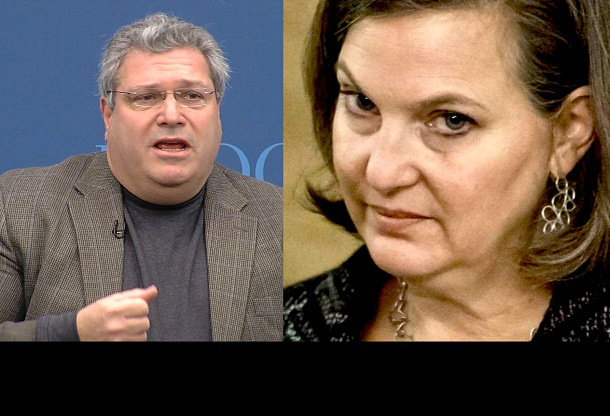
Diehl, of course, starts off with the neocon-approved narrative of the Ukraine crisis, ignoring the key role of neocon Assistant Secretary of State Victoria Nuland (Robert Kagan’s wife) in midwifing the Feb. 22, 2014 coup that overthrew democratically elected President Viktor Yanukovych and installed an intensely anti-Russian regime on Russia’s border. Nuland even handpicked the new Prime Minister Arseniy Yatsenyuk, telling U.S. Ambassador Geoffrey Pyatt in a phone call several weeks before the coup that “Yats is the guy.”

The coup-makers then dispatched neo-Nazi militias (and Islamist militants) to wage a bloody “anti-terrorism operation” against ethnic Russian Ukrainians who resisted the “regime change.” [See Consortiumnews.com’s “Ukraine Merges Nazis and Islamists.”]

But all that complexity is neatly boiled down by American neocons and the mainstream U.S. media as “Russian aggression.” Regarding the Syrian civil war, some neocons have even joined with senior Israeli officials in claiming that a victory by Al Qaeda is preferable to the continuation of Assad’s secular regime. [See Consortiumnews.com’s “Syria’s Nightmarish Narrative.”]

Yet, however the story goes, the biggest bad guy is Putin, always with sinister motives and evil intent. So, in explaining the situation in Ukraine and Syria, Diehl writes:

“Throughout the summer, Russia’s forces in eastern Ukraine kept up a daily drumbeat of attacks on the Ukrainian army, inflicting significant casualties while avoiding a response by Western governments. On Sept. 1, following a new cease-fire, the guns suddenly fell silent. Optimists speculated that Vladi­mir Putin was backing down.

“Then came the reports from Syria: Russian warplanes were overflying the rebel-held province of Idlib. Barracks were under construction at a new base. Ships were unloading new armored vehicles. Putin, it turns out, wasn’t retreating, but shifting fronts — and executing another of the in-your-face maneuvers that have repeatedly caught the Obama administration flat-footed.”

The rest of the op-ed is similarly didactic and one-sided: Putin is the villain and Obama is the rube. In Diehl’s world, only he and other neocons have what it takes to take on Putin and put Russia down.

Any alternative explanation for Russia’s action in Syria is brushed aside, such as Putin deciding that a victory by either Al Qaeda’s Nusra Front – as favored by Israel – or the even more bloodthirsty Islamic State is unacceptable and thus Assad’s regime must be stabilized to avert a major geopolitical catastrophe.

Typically, the neocons breeze past the frightening logic of what the collapse of Assad’s military would mean for the Middle East, Europe and the world. After all, once Israeli leaders decided to throw in their lot with Al Qaeda in Syria, the die was cast as far as the neocons were concerned.

But the notion that the neocons can micromanage the outcome in Syria, with “moderate” Al Qaeda taking Damascus rather than the more “radical” Islamic State, reflects the arrogant know-nothing-ism of these U.S. opinion leaders. More likely, Al Qaeda’s Nusra Front would coordinate with their former allies in the Islamic State and share in the Sunni revenge against Syria’s Christian, Alawite, Shiite and other minorities.

So, while the Islamic State would busy itself chopping off heads of “heretics,” Al Qaeda could use its new headquarters in Damascus to plot the next round of terror attacks against the West. And, as destabilizing as the current refugee flow into Europe has been, it would multiply astronomically as the survivors of the Islamic State/Al Qaeda bloodletting flee Syria.

With Europe in chaos and the neocons still insisting that the real enemy is Russia, the possible consequences would be frightening to contemplate. Yet, this is the course that the neocons have set for the world – and nearly all the Republican candidates for president have signed on for the journey along with Democratic frontrunner Hillary Clinton.

In 2014, arch-neocon Robert Kagan, whom Secretary of State Clinton selected as one of her advisers while also promoting his wife, Victoria Nuland, told The New York Times that he could embrace a Clinton presidency: “If she pursues a policy which we think she will pursue … it’s something that might have been called neocon, but clearly her supporters are not going to call it that; they are going to call it something else.” [For more, see Consortiumnews.com’s “Is Hillary Clinton a Neocon-Lite?” and “Obama’s True Foreign Policy ‘Weakness.’“]

So far, virtually no one in the 2016 presidential race or in the mainstream U.S. news media is seriously addressing the reality of the neocons’ “regime change” chaos spreading across the Middle East and the prospect of a destabilized Europe. What limited discussion there is on the campaign trail mostly echoes Jackson Diehl’s Putin-bashing.

No one dares confront the existential question of whether the United States and the world can continue to tolerate and accommodate the neoconservatives.

Investigative reporter Robert Parry broke many of the Iran-Contra stories for The Associated Press and Newsweek in the 1980s. You can buy his latest book, America’s Stolen Narrative, either in print here or as an e-book (from Amazon andbarnesandnoble.com). You also can order Robert Parry’s trilogy on the Bush Family and its connections to various right-wing operatives for only $34. The trilogy includesAmerica’s Stolen Narrative. For details on this offer, click here.
Living in a PNAC World: The Toxic Legacy of 9/11

pnac-criminals-2-1

By Chris Floyd

Source: Empire Burlesque

In September 2000, an advocacy group called “Project for New American Century,” led by Jeb Bush, Dick Cheney, Donald Rumsfeld, Paul Wolfowitz and others — published a “blueprint” for “transforming” America’s future. PNAC acknowledged that the “revolutionary” changes it envisaged could take decades to bring about — unless, they said, the United States was struck by “some catastrophic and catalyzing event – like a new Pearl Harbor.” One year later, after the disputed election of George W. Bush, came the “catalyzing” event of the 9/11 attacks — which indeed “transformed” America’s future in many “revolutionary” ways.

Here are some of the changes PNAC called for in 2000, all of which came about after the “new Pearl Harbor” they had hoped for: An attack on Iraq. Vast increases in military spending. Planting new American bases all over the world. Embracing the concept of “pre-emptive war” and unilateral action as cornerstones of national strategy. Developing sophisticated new technologies to “control the global commons of cyberspace” by closely monitoring communications and transactions on the Internet. Pursuing the development of “new methods of attack – electronic, ‘non-lethal, biological…in new dimensions, in space, cyberspace and perhaps the world of microbes.”

Oddly enough, although “regime change” in Iraq was clearly a priority for PNAC, it had little to do with Saddam Hussein and his brutal rule. Instead, removing Saddam was tied to the larger goal of establishing a permanent U.S. military presence in the Persian Gulf in order to “secure energy supplies” and preclude any other power from dominating the vital oil regions of the Middle East and Central Asia. The PNAC report puts it quite plainly:
“The United States has for decades sought to play a more permanent role in Gulf regional security. While the unresolved conflict with Iraq provides the immediate justification, the need for a substantial American force presence in the Gulf transcends the issue of the regime of Saddam Hussein.”

This is why the Bush Administration offered a constantly shifting menu of rationales for the impending attack on Iraq: because the decision to remove Saddam was taken long ago, as part of a larger strategic plan, and had little to do with any imminent threat from the broken-backed Iraqi regime, which at that time was constantly bombed, partially occupied (with U.S. forces already working in the autonomous Kurdish territories) and swarming with UN inspectors. If the strategic need for the attack “transcends the issue of the regime of Saddam Hussein,” then almost any rationale will do.

The same desire to “secure energy supplies” and prevent any other power from gaining dominance in the oil regions also underlies current and recent US policies in Libya, Syria, Yemen and elsewhere. That’s why we see the same shifting rationales, see policies that on the surface seem to make no sense: we fight al Qaeda in Iraq, we support al Qaeda in Yemen and Syria; we say defeating ISIS is of supreme global importance, but we prevent other countries (Iran, Russia) from joining the fight; we push “regime change” to “liberate” Libya and Syria while partnering with one of most repressive, extremists nations on earth, Saudi Arabia, and arming other dictators like Sisi in Egypt. We are “fighting” terrorism while turning whole nations (Iraq, Libya, Syria) into swamps of ruin and violence where terrorism can breed. None of these contradictory rationales make sense on the surface. But viewed as part of an ongoing, bipartisan agenda of securing American dominance of economically strategic lands — and of “discouraging advanced industrial nations from challenging our leadership or even aspiring to a larger regional or global role” (as an earlier Cheney-Wolfowitz document put it) — it becomes easier to see a pattern in today’s howling chaos.

This is not “conspiracy theory.” These motives and agendas are out in the open, and always have been. Our bipartisan leaders eagerly trumpet them, and declare that it is our right and our duty to dominate the world in this way. What’s more, any actions we take to accomplish this — wars, regime change, intrusive surveillance, drone campaigns, death squads, torture, killing thousands of innocent people (mere “collateral damage”), fomenting more hatred and extremism, breaking our own laws, turning our own people into fearful cowards ready to throw away their liberties to “stay safe,” etc. — are automatically just and righteous, because we are “exceptional.”

So yes, the “transformations” wrought in American policy — and the American psyche — since that “new Pearl Harbor” have indeed been “revolutionary.” Post-9/11, we are all living in a PNAC world.

Note: The above post was adapted (and updated) from a much more detailed piece originally written in 2002, which can be found here.


Was Afghanistan’s Invasion Also Based on Lies?

binladen01_04

It’s Time for a Real Investigation

By Jack Balkwill

Source: Dissident Voice

There appears to be a bigger lie than “weapons of mass destruction.”  It’s not simply that the illegal invasion of Iraq was based on lies, but that the entire “war on terrorism” is likely based on lies.

We were told by our government that Afghanistan was invaded for giving shelter to Osama bin Laden, who was responsible for the 9/11 attacks.  Mainstream press have pushed this so repeatedly that “9/11″ and “Osama bin Laden” have become interchangeable.

While working on this piece I asked the first three people I ran into at my local grocery store “Who was responsible for the 9/11 attacks?,”  three times getting “Osama bin Laden” for replies.  This is not scientific, yet it makes one wonder how this would work out in national polling.

But what if bin Laden was not responsible for the 9/11 attacks despite the drumbeat of government officials and the corporate press?  What if there has been a rush to judgment to make it appear the Bush regime was taking definitive action?

The invasion of Afghanistan certainly wasn’t about the Taliban – the Bush regime gave the Taliban $43 million in “aid” only four months before the 9/11 attacks, so were on friendly terms.

Following are three reasons to question official sources on their casus belli for invading Afghanistan.

Attempts to Peacefully Resolve the Issue

First, before the invasion of Afghanistan, the Taliban offered to try bin Laden in exchange for evidence that he was responsible for the 9/11 attacks.

President Bush provided no evidence, and invaded Afghanistan instead.

After the start of the U.S. air campaign, the Taliban offered to send bin Laden to a third country for trial if evidence could be provided that he had been involved in the 9/11 attacks – a proposal the United States also promptly rejected.

Why not provide evidence, if it were available, to prevent a war?  It was obvious that the people of Afghanistan would defend their country from a foreign invasion, as they had since Alexander the Great invaded, and there would be a great loss of life (see Roman Empire, British Empire, USSR, etc.).

There can only be two answers– that there was no evidence supporting the cause for invasion, or that former President Bush is a psychopath who doesn’t care about human life, so contemptuously ignored the request for evidence.

Bin Laden’s Denials

Second, bin Laden denied, more than once, in the months following 9/11, that he was involved in the dirty deed.  Less than a week after the 9/11 attacks, al Jazeera quoted bin Laden:  “The U.S. government has consistently blamed me for being behind every occasion its enemies attack it.  I would like to assure the world that I did not plan the recent attacks, which seem to have been planned by people for personal reasons.”

In an interview with Pakistan’s Karachi Ummat on 28 September 2001, bin Laden was quoted,

Neither I had any knowledge of these attacks nor I consider the killing of innocent women, children, and other humans as an appreciable act. Islam strictly forbids causing harm to innocent women, children, and other people. Such a practice is forbidden ever in the course of a battle. … I have already said that we are against the American system, not against its people, whereas in these attacks, the common American people have been killed.

This is a translation from Arabic to Urdu to English, and may not be entirely clear.  But for those who believe bin Laden was lying, I would suggest they come up with a motive for such a lie.  The USA had offered a $25 million reward for information leading to his capture, and President Bush had threatened “I want justice, and there’s an old poster out West that says, ‘Wanted Dead or Alive,’” so bin Laden had nothing to gain from such a lie – he was condemned either way.  Bin Laden’s followers would have admired him as a great hero for having taken on the USA, so he had much to gain by accepting responsibility for the 9/11 attacks, were it a fact.

Demonization

Third, there was an extensive effort to demonize bin Laden, at times with apparently false charges.  Why would this be necessary for one who was guilty?

Our government and corporate media, as one on National Security State issues, made him out to be abominable, and without providing evidence, unceasingly assumed his guilt.  Recordings were blasted and headlined in Western corporate print and electronic media of bin Laden accepting responsibility for 9/11.  The public were not given the same eyeball-grabbing headlines when the recordings were proven to be likely bogus.

Here is a Guardian report showing that Swiss Scientists suggested that an audio tape of bin Laden taking responsibility was likely faked, although widely broadcast in the corporate press as evidence of his involvement in 9/11 attacks.

Here’s a BBC report showing how the “smoking gun” video may have been faked, again, after the corporate press hyped the video as incontrovertible evidence.

Conclusion

The official version, that 19 Arab hijackers were responsible, has flaws.  One flaw was that many of the alleged hijackers have been found alive and well since 9/11.  Of course, it may be that the hijackers used pseudonyms to conceal their identities.

But getting beyond these 19 Arabs is difficult because they are all dead and cannot be interviewed.  Official government investigations into 9/11, much of which are classified, look like reflexive actions to neatly tie up loose ends rather than serious inquiries.

Certainly, as Ward Churchill pointed out (and lost his job for raising the issue), Arabs had a clear motive for the 9/11 attacks, with the UN revealing, only two years earlier, that the sanctions pushed mainly by the USA on the people of Iraq resulted in over 500,000 deaths of children under age five, mostly Arab, and most Arabs were aware of this and seething with anger.

To jump to the conclusion that bin Laden was behind the 9/11 attacks causes one to wonder, “Why then did the FBI never bring charges against bin Laden for the hijackings and murders?  Why did the wanted posters (up to his death he was on the FBI ten most wanted list) not mention the biggest crime, though they mentioned smaller terrorist incidents as reasons for his being on the list?

We may never know if bin Laden was responsible for 9/11, but his involvement was used as the excuse for invading Afghanistan and slaughtering a massive number of people, based on the assumption that they gave bin Laden refuge.

Just as nobody has been charged with a crime for the illegal invasion of Iraq based on lies, it would appear that an investigation is in order involving the justification behind invading Afghanistan, starting with the matter of proof that bin Laden was directly involved.  The American people and the people of Afghanistan have every right to be presented with the evidence.

Jack Balkwill is an activist in Virginia. He can be reached at libertyuv@hotmail.com Read other articles by Jack.

Related article: Who Was Really Behind the 9/11 Attacks?