Who knows? Who cares? If the Media Claim 50 Countries Reject Venezuela’s Elected President and Repeat It Enough It Must Be True

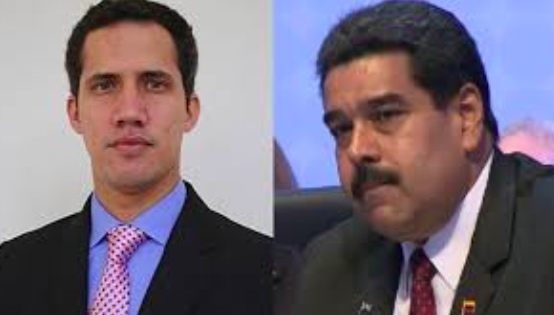
Wno’s the president of Venezuela? The elected Nicolas Maduro or the self-proclaimed unelected Juan Guaido?

By Dave Lindorff

Source: This Can’t Be Happening

American media still refer to Juan Guaidó, America’s hand-picked “legitimate leader” or “legitimate president” of Venezuela, as having an “administration.”

The truth is that his “administration” — consisting of advisors and other opposition leaders — are all either arrested and being held by the government, hiding, seeking asylum in various foreign embassies (Spanish, Italian, Brazilian and Argentinian) in the capital of Caracas, or have fled to other countries like Brazil and Colombia.

Guaidó, apparently a government of one, has so far avoided arrest probably because the elected Venezuelan President Maduro doesn’t want to give the US an excuse to try and rescue him, or to launch military actions of some kind against Venezuela as the White House keeps threatening to do.

Clearly, in calling for US military intervention, Guaidó has both demonstrated almost his total lack of backing among the masses of Venezuelan people, as well as his desperation, given Latin American’s visceral resentment of US interventions in their country, all of which have been designed to put autocrats or even military juntas in power, and many of which have openly overthrown popularly elected governments, as in Guatemala, Chile, Brazil, Nicaragua, Haiti, Dominican Republic, and elsewhere.

None of this gets reported in the US. Only recently has the New York Times, always a reliable backer of US imperial policy in Latin America, at least hinted at the possibility that the reason Maduro remains president and that Guaidó’s efforts to oust him are failing  so abysmally could be that the Venezuelan people want him to stay president, and do not want a US-backed coup or a US military intervention to replace him.

At this point the huffing and puffing coming from Secretary of State Mike Pompeo and especially from the White House National Security Advisor and chief militarist blowhard John Bolton, are looking pretty pathetic, with Bolton trying to sow dissension and distrust by hinting that Maduro “better not trust” his own generals’ loyalty, and by offering rewards to those generals willing to abandon Maduro.

It is an indication of the United States’s declining power and influence in Latin America that few outside the US with its insular mass media believe that the US would or even could successfully invade Venezuela and impose a government on that country of 32 million (a number that keeps declining as the upper middle class and rich flee).

If anything, US sabotage and threats and US backing for a government of the wealthy are probably galvanizing support for Maduro. While people in the US, if they are paying any attention at all to events in Venezuela, may believe that Maduro is a corrupt thug, people in Venezuela itself, and in most of Latin America know full well that the main problems in that oil-rich country have to do with the collapse in oil prices since the heady days of Hugo Chavez when it was going for $100 a barrel, to American efforts to block Venezuela from exporting its oil now, and to freeze or even seize Venezuelan assets and oil receipts from the oil it does manage to export, and to other forms of economic warfare engaged in by the United States. As in Cuba, this kind of strategy by the US only works to build support for the country’s existing government.

At some point Guaidó is going to go. He will either be written off by the US media — his main backer — or will be arrested. Probably the latter will follow the former since once he’s recognized as an impotent charlatan, his arrest will not make him a martyr for the opposition. Already he has lost what public support he had as Venezuela’s wealthy abandon the country for Florida. As well, the “50 countries” that we in the US keep hearing about which supposedly back Guaidó as Venezuela’s “legitimate leader” are realizing that they were hoodwinked by the US. The are now mostly calling for a calmer response to the crisis in Venezuela, and are refusing to buy into US military threats against the Maduro government. Meanwhile nobody in the US media mentions that over 140 countries in the world support Maduro as the leader of Venezuela. 

In truth it’s impossible to find that list of “more than 50 countries” backing a self-proclaimed and unelected Guaidó as Venezuela’s president. The closest I could come by running google searches was a map produced by Bloomberg News listing 13 countries besides the US as supporting Guaidó. These included Canada, the UK, Guatemala, Honduras, Costa Rica, Panama, Ecuador, Colombia, Peru, Chile, Argentina, Paraguay and Brazil. That is 13 plus the United States. Listed as supporting Maduro as elected President are Russia, China, Turkey, Bolivia, and Cuba, though I believe Bloomberg neglected to mention Nicaragua, a strong Maduro backer, which would make it six. All of Africa and much of Asia was left as “no opinion,” though in fact that means they are continuing to recognize the current Maduro government. 

For a time, most of the countries of Europe were lining up behind Guaidó, particularly after Germany announced that it was recognizing him as the new interim leader of Venezuela in late January, and after it ousted the country’s ambassador, but then by late March Germany was having second thoughts, and rejected the person sent there by Guaidó to assume the position of Venezuelan ambassador. At this point, except for the UK, the countries of Europe, along with Mexico and Uruguay, are simply calling for a dialogue and a negotiated solution to the Venezuela political crisis, and in addition to opposing any talk of military action or a coup, are seeking nothing more than a new election (which Maduro would probably win, given the alternative of the return of a government of the rich). The Europeans are no longer really backing Guaidó.

The reporters who continue to refer to “more than 50 countries” calling for Maduro’s ouster all must be using the same wrong or outdated news clip or some exaggerated and dated State Department press release.  (I asked the State Department for an updated list today but so far none has been forthcoming, though it would appear such a list shouldn’t take long to compile given how short it must be.)

The Great Unraveling Begins: Distraction, Lies, Infighting, Betrayal

By Charles Hugh Smith

Source: Of Two Minds

The good news is renewal becomes possible when the entire rotten status quo collapses in a putrid heap.

There are two basic pathways to systemic collapse: external shocks or internal decay. The two are not mutually exclusive, of course; it can be argued that the most common path is internal decay weakens the empire/state and an external shock pushes the rotted structure off the cliff.

As Dave of the X22 Report and I discuss in The World Is About To Change & It’s Going To Be Glorious, we are in the early stages of terminal internal decay.There are a number of dynamics shared by decaying empires/states:

1. The ruling elites lose the moral imperative to sacrifice for the good of the empire/state. Instead they use the power of the state to further their own private interests and agendas.

2. The ruling elites start “fudging” reports (i.e. lies are presented as truths) and promoting narratives to mask their self-aggrandizement and the erosion of the nation/empire under their self-interested rule.

In other words, the elites know the public would resist their leadership if the truth were widely known, so the ruling elites devote tremendous resources to massaging the news to distract the public from reality and reflect positively on their self-serving leadership.

Since the weaknesses of the empire are being hidden, they cannot be addressed, and so rot that could have been fixed early becomes widespread and fatal.

3. Flush with the state’s wealth and power, the ruling elite splinters into warring camps which squander the empire’s remaining wealth on private battles over which camp will rule what appears solid and eternal–the empire.

4. As the elites battle it out, the nation/empire falls apart as the leadership’s focus is on internecine conflicts over the spoils of the empire, rather than on preserving the foundations of the empire’s wealth and security.

5. As the truth inevitably leaks out, the public grasps the enormity of the elites’ betrayal of the nation and the public interest. Faith in the elites and the institutions they control plummets, and the Great Unraveling becomes unstoppable.

6. In a last-ditch effort to save their wealth and power, the elites distract the public with Bread and Circuses– “free money” in various guises (Universal Basic Income, Modern Monetary Theory, etc.)–and the distracting Circus of political theater and a surfeit of entertainment.

Whether the elites or the public are aware of it or not, America is well down the path to terminal internal decay: Distraction, Lies, Infighting, Betrayal.

The good news is renewal becomes possible when the entire rotten status quo collapses in a putrid heap of broken promises, dysfunctional institutions, blatant lies, unpayable debts and cascading defaults.

Stick to the Plan

Illustration by Mike Faille

Reclaiming central planning from the clutches of corporations

By Brendan James

Source: The Baffler

What do you think the Russians talk about in their councils of state—Karl Marx? They get out their linear programming charts, statistical decision theories, minimax solutions, and compute the price-cost probabilities of their transactions and investments, just like we do.

–CCA Chairman Arthur Jensen, Network

WHAT DO JEFF BEZOS AND JOSEPH STALIN have in common? A certain supervillain chic. Cold-blooded austerity. Iron discipline. A penchant for back-breaking output targets. A healthy appetite for terror.

Yet perhaps their most surprising overlap is that the General Secretary and the chairman of Amazon, Inc. built two of history’s largest centrally planned economies. Then again, maybe it’s not so surprising: What embodies the trademark Bezos-ethos of “Get Big Fast” better than the Five-Year Plan? Thanks to its cutting-edge logistics and coordinated supply chains, Amazon last year clocked a GDP of $230 billion[*]. To Jared Kushner’s recent demand that “the government should be run like a great American company,” let all communists raise a fist of solidarity!

In fact, write Leigh Phillips and Michal Rozworski in The People’s Republic of Walmart, Amazon is just one of thousands of firms, big and small, that centrally plan their inputs and outputs. Of the top hundred global economies, around sixty-nine of them are businesses, not countries; most, if not all, are internally planned. (Sears, which over the last decade broke its firm into an “internal market” of competing units thanks to CEO and Ayn Rand-devotee Eddie Lampert, is conspicuously absent from this list.) Despite the collapse of the USSR and the global gospel of markets that spread in its wake, it seems planning is still working all around us.

The problem is that planning is not working for most of us. Yes, automation and “Big Data” have conjured cheaper goods for consumers—unfortunately, most consumers are also laborers who remain ruthlessly exploited. As the promise of new technology expands each day, workers sleep while standing or collapse from heat exhaustion. Planning, once a revolutionary tool meant to reduce labor time and eliminate exploitation, has become just another vulgar mechanism for maximizing the profits of unelected, authoritarian, union-busting, planet-cooking, superrich vampires. The People’s Republic of Walmart makes the case that the left should reclaim the radical demand for a democratically planned economy and repurpose this corporate apparatus for the flourishing of all. Far from a dry pamphlet on logistics theory, the book raises crucial questions about justice, technology, and our capacity to build a new world in the face of economic and climate catastrophe.

The planned economy was supposed to have gone extinct three decades ago. The Soviet Union gasped its last breath, American capitalism sprayed a bottle of Cristal, European social democracy ordered another latte, and China pressed a big button labeled “Market Socialism.” But if you really put the time in, you could probably get a wonk from the Hoover Institution to grudgingly accept that government planning still beats the market in the realm of certain public services, such as health care or fire departments. The knives come out, though, when this approach is proposed for things like housing, pharmaceuticals, energy, or, heaven forbid, consumer goods in general.

What may surprise newcomers, however, is that many self-described Marxists are wary of planning, too. Despite being thanked in Phillips and Rozworski’s acknowledgements, Bhaskar Sunkara, editor of the left-wing magazine Jacobinidentifies as a market socialist. In a 2013 essay sketching an agenda for the left, Jacobin’s executive editor Seth Ackerman conceded that markets are necessary, so perhaps we’d best just find a way to socialize them. Vivek Chibber, professor of sociology and, along with Sunkara, one of several co-authors of The ABCs of Socialismdismisses planning as a dead-end: “We can want planning to work, but we have no evidence that it can.” One of the left’s “worst legacies” has been to “identify socialism with central planning.” Market socialism, we’re told, is communism for grown-ups.

Everyone from the market socialist to the Austrian economist has taken one side of an incredibly sexy academic exchange known as the “socialist calculation debate.” The argument should be familiar: market transactions provide producers with essential information about what consumers and other producers need, and therefore how much to make. To try and calculate (that is, plan) this galaxy of interdependent inputs and outputs is impossible in a fluid economy. It’s a matter of information, you fool. And like it or not, market prices are the best way to collect the information we need to map out supply and demand.

A rich tradition of heterodox economics, mathematics, and computer science has materialized to answer this problem of calculation. But it is modern processing power, dwarfing the bandwidth available in the twentieth century, that truly rebukes the argument above. Consider computer scientist and economist Paul Cockshott who, in about two minutes, using only university equipment, claims to have run models that were able to optimize an economy “roughly the size of Sweden.” You get the feeling that the mammoth data centers at Amazon, Ford, or Foxconn might be capable of even more impressive calculations. And besides, to insist communist theory prove some perfect equation is either disingenuous or missing the point. The question is not whether planning is mathematically pristine, but whether it can allocate better than the market.

The answer, to return to the material world, is yes it can. It’s true that under capitalism firms plan internally but compete with each other, a dance that keeps companies innovating new ways to capture surplus and, sometimes, inadvertently benefit regular people. This dynamic would not occur naturally in a planned economy; one cannot just seize Amazon or Walmart, socialize it, and call it a day. Phillips and Rozworski apparently recognize this (there is an entire chapter in The People’s Republic of Walmart titled “Nationalization Is Not Enough”) and point to an interesting line of thought from economist J. W. Mason: Banks tend to operate as a privatized Gosplan, where the slush fund of finance capital flows to whichever firm a group of Brooks Brothers-clad planners decide deserves investment, regardless of profitability. Market competition, in other words, is hardly the divine engine of innovation if so many firms are, as Mason writes, “born new each day by the grace of those financing it.”

Even so, could planning replicate the market’s capacity to innovate? Ford’s former CEO Mark Fields certainly seemed to think so, declaring in 2016 that his company would soon “be able to use analytics to anticipate people’s needs, as opposed to people trying to tell us what they want.” And to the perennial taunt of the lizard-brained conservative—“I love seeing idiot millennials protest capitalism on their Apple-made IPHONES”—one may point out it was largely the market-immune Pentagon and Department of Energy, not Apple, that developed the batteries, algorithms, touch screens, and microprocessors our right-wing friend uses to tweet about the Muslim Caravan. Once again, none of this is to celebrate the actual decisions or practitioners of planning as it exists under capitalism, but to recognize its power and how else it might be put to use.

So much for feasibility. Still, the left has good reason to harbor deeper techno-skepticism. When most of us hear the phrase “data collection,” we think not so much of social justice but of Facebook selling our personal information, NSA surveillance, and racist models of “predictive” policing. In Automating Inequality, Virginia Eubanks catalogs state policies that placed welfare applications, housing allocation, and child welfare investigations under algorithmic control. The results have been catastrophic for the poor and working class, of every race and gender. Algorithms, after all, are written by humans, and prejudices operate just as easily in digital form as they do in twentieth century analog—perhaps even more so. Phillips and Rozworski acknowledge this reality and rightfully urge vigilance. If planning is to make use of such technology, we must make sure not to bake this poison into the cake.

But hope lies in the very recognition that technology is a political construct, rather than some transcendental, neutral force. If we can program the reinforcement of hierarchies, we can certainly work to program their destruction. (There’s already encouraging research as to how to account for problems such as “disparate impact.”) As Eubanks writes, “if there is to be an alternative, we must build it on purpose, brick by brick and byte by byte.”

Beyond algorithmic justice, the real specter haunting socialism is, naturally, the Union of Soviet Socialist Republics, whose record in planning was less than exemplary. While capital-C Communism brought about modern industry, literacy, and social security, Phillips and Rozworski don’t deny the ultimate failure of the Soviet experiment. The October Revolution was contorted and compromised by a world war, a civil war, imperialist invasion, economic backwardness, another world war, and a half-century of military competition with the United States. For the sake of the revolution, democracy was indefinitely postponed. Even if Soviet and East German firms were just as or more efficient than their Western counterparts, this arrangement still resulted in workers resisting work and managers lying about output, i.e., bad information. (In a particularly cruel irony, Gosplan bureaucrats even took to sabotaging new computerized approaches to planning, lest they personally lose their political clout. Their unlikely co-conspirators were “reform” minded crypto-capitalists who worried the algorithms would actually succeed, leaving planning in place forever!)

For Phillips and Rozworski, it wasn’t communist planning that led to authoritarianism and disaster, but authoritarianism and disaster that led to bad planning. “Democracy,” they write, “is not some abstract ideal tacked on to all this, but essential to the process.”

A few years ago. Francis Spufford’s novel Red Plenty cast the very idea of Soviet planning as its hero, wherein it falls from grace, as all tragic heroes do. There’s no need to understate that tragedy, but it ispossible to overstate it. Let’s not forget what happened after the victorious arrival of the market in the former USSR: production of consumer goods, industrial output, and human life expectancy all cratered. A new class of homeless citizens emerged, frozen to death in streets, alleyways, and parks. We often discuss the millions of deaths in the Stalinist 1930s. We don’t discuss the millions of deaths in the post-Communist 1990s. Unsurprisingly, recent polling revealed that a majority of those surveyed in Russia still regret the collapse of the USSR and its planned economy. (In 1996 they nearly voted in Communist presidential candidate Gennady Zyuganov until—get this—right-wing hucksters colluded with a hostile foreign government to help install a widely unpopular and corrupt buffoon through a media campaign that peddled rank propaganda.) The Soviet experience was a lesson, all right, but not quite the one many smug market fetishists would have us believe.

And if all that can happen to a superpower, imagine what faced Chile, the would-be socialist alternative to Soviet technocracy: in 1970, buoyed by the support of the working class, Marxist president Salvador Allende was elected and set about building a nation-wide, participatory planning network. This novel approach was predictably stymied by a U.S. economic blockade and finally snuffed out by a CIA-backed military coup in 1973. Still, the pioneering spirit of this moment was poignantly captured by Eden Medina in her wonderful study Cybernetic Revolutionaries. What happened next is a depressing cliché: Chileans were placed under the rule of a distinctly not-left-wing dictatorship and enrolled as fresh test subjects in the mad laboratory of the market.

How will that same market treat the workers of tomorrow who fall victim to imminent waves of automation? Is the market really compatible long-term with progressive policy goals like universal basic income, or full employment? Will the market really permit the end of mass incarceration? Then there’s the C-word: last month we learned that potentially catastrophic climate change is now beyond prevention, and that even if we swore off carbon tomorrow, by 2099 the Arctic will still be 5°C hotter. The expression “glacial pace” doesn’t quite mean what it used to. In light of this, The Atlantic, official mouthpiece for the death god Nyarlathotep, predictably suggests that “any realistic plan to decarbonize the U.S. economy will almost surely require the sort of commercial technological breakthroughs that tend to come from private entrepreneurs.” Not to be outdone, the New York Times last month published an op-ed titled—no shit—“Can Exxon Mobil Protect Mozambique From Climate Change?

It doesn’t have to be this way. Converting industries to renewable energy, Phillips and Rozworski argue, is wholly within the power of America, India, and China. But, wouldn’t you know it, the principles of commerce just aren’t incentivizing them fast enough! Carbon-free agriculture is a trickier feat, but certainly less tricky as a state-sponsored venture freed from market meddling, à la Sputnik or the Manhattan Project. Climate reporter Kate Aronoff suggests: “If you create a successful drive to nationalize [the fossil fuel industry] or rapidly scale back their power that will create a real precedent for other industries . . . then you can nationalize Monsanto. Have that be the crux of a populist demand of a climate movement.” There are different schools on the left when it comes to ecology (Phillips, science writer by day, has been criticized for consumerist, growth-happy “ecomodernism”), but one hopes we can all agree that smashing the existing energy market is a necessary step.

More than any other crisis of capitalism, ecological calamity is the most self-evident reason to abandon the dumb, short-sighted, animal logic of the market for a rational and humane plan. It has been, to quote the superior critique of capital, Gremlins 2, “a complete failure of management.” And if the history of capitalist crises is any guide, the odds are that climate change will produce a bigger, bulkier, more controlling state no matter what. Before things really start to crack up, we may want to pick whether that state runs on egalitarian principles or the fascist death drive. Does anyone who doesn’t own a yacht called Fountainhead truly want to cede that decision to the invisible hand of the market?

To their credit, Phillips and Rozworksi return throughout the book to the necessity of mass mobilization. Planning is not One Weird Trick to Achieve Socialism. Unless we simply want state-capitalist profit optimization, the real thing will require continuous and brutal class struggle. It will require experimentation, failure and, as Marv Alpert once said, tenacious defense. Any hope of success lies in a rejuvenated, robust and, yes, global people’s movement to shatter the political, legal and physical barricades put up by governments and capital. But planning must be part of the agenda.

Here the cybernetic concept of feedback is useful: the very idea of a plan, of giving everyone control of their own lives, is just the kind of revolutionary notion that can energize, inspire, and keep such a movement alive. The final line of Spufford’s Red Plenty need not be read as the end of a dream, but the real beginning of history: “Can it be, can it be, can it ever be otherwise?”

Hope for the best, of course. And plan for the worst.

Understanding the American Dictatorship

By Eric Zuesse

Source: Washington’s Blog

The American dictatorship is by the aristocracy of the country’s 585 billionaires, and has been scientifically proven beyond any doubt, now, not only in the classic Gilens and Page study, which examined thousands of bills in Congress and their money-backers and their ultimate outcomes (passage or failure to pass), during the studied period, 1981-2002. But also another (though less rigorous) study suggests that this control of the U.S. Government by America’s billionaires is getting even worse. So, America is clearly a dictatorship, by America’s aristocracy.

This is not just one or the other of America’s two Parties — Democrats versus Republicans — representing only the super-rich. Both of the Parties do, but the Democratic Party represents liberal billionaires, while the Republican Party represents conservative billionaires. Each Party represents a different faction of the billionaires.

The conservative faction is well represented by Donald Trump, whose swash-buckling rhetoric — “I’d take the oil!” in Iraq, and in Syria, and in Venezuela, etc. — is more blatantly uncouth than Barack Obama’s more gentlemanly rhetoric, but not basically different than Obama’s even bloodier grabbing of Honduras, Ukraine, Libya, and Syria were. The prominent Obama-backer George Soros, however, was demanding that banks, backed up by taxpayers, should kick in an extra $50 billion to enable him and other billionaires to exploit that country successfully. (He said this while Ukraine was spending most of the money that it did have trying to conquer the people in the far-eastern part of the country who refused to accept Obama’s imposed ruler who replaced the democratically elected President for whom they had voted over 90%.) So, ‘liberal’ and ‘conservative’ are both neoconservative, or the old term for that was “imperialistic.” In such matters (international matters), the billionaires very much are unified, and their news-media also are. And they all do represent the billionaires — never the public.

One billionaire, the owner of the fake-progressive “The Intercept” news-site, was exposed recently for his grabbingness. The excellent and honest journalists Alexander Rubinstein and Max Blumenthal headlined at one of the few honest news-media, Mint Press, “Pierre Omidyar’s Funding of Pro-Regime-Change Networks and Partnerships with CIA Cutouts”, and reported:

A select group of national news ‘stakeholders’ gathered at an undisclosed location for what was described as a “semi-secret” workshop somewhere in Canada on January 26. The meeting had been convened to determine how and to whom a ‘news industry bailout’ of $645 million in Canadian government subsidies to private and supposedly independent media outlets would be disbursed. … 

Jesse Brown, a Canadian journalist who participated in the meeting, complained that the first thing he noticed about it “was that one major public ‘stakeholder’ wasn’t represented: the public.” Inside what amounted to a smoke filled room that was off limits to most Canadian citizens, Ben Scott — a former Obama administration official who also served in Hillary Clinton’s State Department — presided over the discussions. Today, as the director of policy and advocacy for the Omidyar Network, Scott works for one of the most quietly influential billionaires. …

Pierre Omidyar, the ebay founder [is] best known for his sponsorship of The Intercept, a flashy progressive publication that possesses the classified documents exfiltrated by NSA whistleblower Edward Snowden. Unlike rival Silicon Valley billionaires Peter Thiel, Jeff Bezos, and Eric Schmidt, Omidyar has mostly managed to keep his influential role in media below the radar. … Samantha Power, the former U.S. ambassador to the UN and liberal interventionist guru, has explicitly praised Omidyar as someone who is following in the footsteps of Soros.

While Samantha Power was Obama’s U.N. Representative, she joined with two other countries, Ukraine and Canada, to oppose a U.N. resolution condemning nazism and all forms of racism. (Only three nations opposed it at the U.N., and these were the three.) When Donald Trump became America’s President, his U.N. Representative, Nikki Haley, likewise was one of only three nations at the U.N. who opposed a similar resolution.

So, perhaps the only people in U.S. and Canada who don’t know that their Governments are among only three that march ideologically in today’s lockstep with the Axis powers that lost World War II, are those three nazi-supporting countries’ own citizens. What media will tell their citizens the truth about this? Who owns the major media, and who finances politicians’ careers there, in the three-or-so brazenly fascist and even pro-nazi countries — the three that vote shamelessly for it?

The extraordinarily fine Rubenstein-Blumenthal article continued:

While backing media outlets around the world that produce news and commentary, Omidyar supports a global cartel of self-styled fact-checking groups that determine which outlets are legitimate and which are “fake.” He has also thrown his money behind murky initiatives like the non-profit backing New Knowledge, the data firm that waged one of the most devious disinformation campaigns in any recent American election campaign; and he is a key backer of the International Consortium of Investigative Journalism (ICIJ), the outfit that holds the Panama Papers and oversees the strategic dissemination of that leaked trove of financial files to hand-picked journalists.

And this is only on the liberal side of the U.S. regime.

The present article is being submitted to all major and most of the smaller national news media throughout the U.S. and its allied countries. The sites that publish it will be the only national and international news-media worth subscribing to, because all the rest are simply censoring-out these basic truths — and are labeling as ‘fake news’ the few honest sites, such as the one you are reading now, the ones that publish such news.

The American dictatorship can’t be accurately understood by relying mainly upon the ‘news’ that the billionaires’ sites publish. That’s very sad, but it’s true. It’s bad news, but it is real news, and not (like the billionaires’ sites call it but actually they themselves are) “fake news” sites. Maybe they publish non-controversial news honestly, but that’s about all of the truth that their owners will allow.

The American dictatorship is increasingly becoming a lock-down against truth. No matter how ugly one might imagine it to be, it’s worse. No solution to this vast problem is being presented here, but the first step toward solving any problem is to understand accurately what that problem actually is, and how it actually functions. In the present case, it’s no malfunction. It’s not a mistake. It’s instead a plan. And it is very competently being imposed — by the billionaires’ agents, against the public. That’s how dictatorships normally are imposed, and that’s how they’re imposed here. Mussolini called it “corporationism.” The U.S. has become its center.

Assange and the Unforgivable Sin of Disemboweling Official Narratives

By Charles Hugh Smith

Source: Of Two Minds

The entire global status quo is on the cusp of the S-Curve decline phase.

There is really only one unforgivable sin in the political realm, and that’s destroying the official narrative by revealing the facts of the matter. This is why whistleblowers who make public the secret machinery of the elaborately artful lies underpinning all official narratives are hounded to the ends of the Earth.

Employees of state entities such as Ellsberg, Manning and Snowden are bound by vows of secrecy and threatened by the promise of severe punishment. Outsiders such as Assange are even further beyond the pale because they can’t be accused of being traitors, as they never took the vows of secrecy required by the Deep State.

The single most damaging revelation to all the elaborate lies that make up official narratives is the truth revealed in official emails, documents and conversations. This is why virtually every document and correspondence is now “classified,” so anyone releasing even a mundane scrap can be sentenced to rot in federal prison.

In a recent C-SPAN interview, author Nomi Prins explained the incredible difficulty of accessing papers in presidential libraries now due to virtually everything being classified. Freedom of Information Act (FOIA) applications must be filed, and researchers must wait years to gain access to routine correspondence that was freely available to all a decade or so ago.

Official paranoia has a 100% correlation with the amount of damage done to official narratives by any leaks of the facts of the matter. What are they so afraid of? Here’s the dynamic in play: the more fragile the narrative, the greater the dependence on half-truths and lies, the greater the official urgency to crush all whistleblowers and maintain a Stasi-like vigilance against any murmurs of dissent or doubt.

If the entire contraption wasn’t so vulnerable to exposure and so dependent on lies, why the infinite paranoia? This paranoia extends past the present system of lies into the past, as exposing the lies in decades past calls into question the official narratives of today.

Any doubt is extremely dangerous, as if even a single thread is pulled loose, the entire fabric of ginned-up statistics, false assurances, half-truths and outright lies unravels. Once the Pentagon Papers revealed the facts of the war in Vietnam, support for the official narrative collapsed essentially overnight.

In the immortal words of Jean-Claude Juncker, when it becomes serious you have to lie, and it’s now serious all the time.

The entire global status quo is on the cusp of the S-Curve decline phase. Hence the vulnerability to disruption of its official narratives and the panicky paranoia of its handlers.


Coup Attempt in Venezuela: What You’re Not Being Told

By Derrick Broze

Source: The Conscious Resistance

As self-proclaimed “Interim President” Juan Guaidó attempted to stage a military coup in Venezuela, the country’s U.N. ambassador declared President Nicolas Maduro victorious and called the United States a “rogue nation.”

The turbulent situation that has been unfolding in Venezuela for the last few years reached new heights on Tuesday as opposition leader and self-declared “Interim President” Juan Guaidó attempted to wrangle power away from Venezuelan President Nicolas Maduro, in what many are calling an attempted coup. Early Tuesday morning, Guaidó gave a press conference declaring that he has the support of the Venezuelan people and military, and demanded that Maduro step down. Guaidó also called on Venezuelans to take to the streets and call for an end to Maduro’s reign as president.

During the day’s events, cameras caught armored vehicles, reportedly belonging to the Bolivian military, running into crowds of protesters. Human Rights Watch (HRW) tweeted that 25 peopled were detained and dozens were wounded. HRW also noted that Venezuelan authorities shut down two international television channels and censored one radio station. “The regime should know that it will be held accountable for these abuses,” tweeted José Miguel Vivanco, Executive Director of HRW’s America Division.

Meanwhile, Venezuela’s U.N. ambassador Samuel Moncada held a press conference stating that President Maduro has “defeated” opposition leader Juan Guaidó and his supporters. Moncada stated “the country is right now in a situation of perfect normality.” Moncada criticized U.N. Secretary-General Antonio Guterres for not supporting Maduro’s government against Guaidó.

Moncada also attacked the United States for what he said was another example of their interventionist policies, singling out President Trump and Vice President Mike Pence for their support of Guaidó. “This is one of the most strange and weird situations we are in now, which the superpower of the world is the main rogue state going around, without care, destroying countries, invading countries, and threatening with the use of force,” Moncada stated.

The Ambassador to the UN also noted that the United States’ use of sanctions amounts to an act of war and only hurts the Venezuelan people. “Sanctions kill, as simple as that. Sanctions are criminal sanctions, are weapons of mass destruction. You don’t see the smoke, but you see the effect, you see the deleterious effect of killing and suffering,” Moncada said. “The sanctions use banks sanction, sanctions use ships, sanctions use insurance companies, and financial blockades. They cannot just say that they are concerned about liberty or freedom or the children in Venezuela, and then exercise a ghastly, nasty policy of calculated cruelty. They are acting like torturers, it is a collective punishment.”

Indeed, the Washington D.C.-based Center for Economic Policy Research published a reportlast week which determined that U.S. sanctions against Venezuela were likely responsible for 40,000 deaths in 2017-2018.

The harsh reality is that Maduro is by no means a perfect leader and his support of censoring media, use of the military to suppress protests (whether engineered or authentic), his suppression of the opposition, and other despicable acts do need to be called out. However, Ambassador Moncada is also correct that the United States does act as an imperialist “rogue” nation, using force on any nation that does not follow the Western Imperialist agenda. Unfortunately, it seems that the Venezuelan people are caught between a leader who is unpopular in some circles and an even more unpopular self-proclaimed “Interim President” with multiple connections to the Western Empire.

Of course, if our readers are unaware of these connections, it is because the corporate media (CNNWaPoThe Hill, and others) have been running non-stop coverage of why Guaidó should be accepted as the leader of Venezuela while ignoring any bit of evidence that the “uprising” might be less than genuine.

Despite the round the clock support of Guaidó, on April 13 the Grayzone exclusively reportedthat a who’s who of Trump advisors, right-wing Latin American officials, and Venezuelan opposition figures met to discuss “Assessing the Use of Military Force in Venezuela.” The meeting was hosted on April 10 at the Center for Strategic and International Studies (CSIS), a Washington-based think tank. This meeting included current and former State Department, National Intelligence Council, and National Security Council officials, along with Admiral Kurt Tidd, who was until recently the commander of the US Naval Forces Southern Command, overseeing operations in Central and South America.

The truth is that the Western Empire has been attempting to use Guaidó to install a puppet government in Venezuela. There is also evidence that the U.S. government and its intelligence agencies have attempted to take advantage of electricity blackouts in order to dethrone Maduro. In addition, there are a number of corporations and special interests who stand to benefit from the overthrow of Maduro and the crowning of Guaidó.

Although the American media has failed to report any of the above conflicts, there are still some Americans who are standing against the Venezuelan coup. A group calling itself the Embassy Protection Collective was invited by Venezuela’s government to protect the Venezuelan Embassy in Washington D.C. from illegal seizure by the U.S. government or opposition supporters. The group—which includes members of CODEPINK, Popular Resistance, the Answer Coalition, MintPress News and more—has been working to raise awareness on the attempts by the Western oligarchy to install another puppet government in Venezuela.

The reality of the situation in Venezuela is much more complicated than the likes of CNNwould have the American people believe. Only by dissecting the lies from the American media, the Maduro government, and the Guaidó contingent can we hope to get to the truth and support the people who really matter: The Venezuelan People.

Ecuador Has Been Hit by 40 Million Cyber Attacks Since Assange’s Arrest

By Elias Marat

Source: The Mind Unleashed

The government of Ecuador claims that the country has come under a broad and concerted cyber attack, with approximately 40 million attempts to compromise web portals connected to public institutions ever since the controversial decision to allow UK police to forcibly remove Wikileaks founder Julian Assange from their London Embassy.

Deputy Minister of Information and Communication Technologies Patricio Real told reporters that the wave of attacks began shortly after last Thursday’s arrest of Assange by British authorities. Real said that the attacks “principally come from the United States, Brazil, Holland, Germany, Romania, France, Austria and the United Kingdom, and also from here, from our territory.”

On April 11, Ecuadorian President Lenin Moreno revoked the diplomatic asylum extended to Asange by the South American nation in 2012. In a legally dubious move, Quito also revoked the Ecuadorian nationality granted to Assange in 2017.

Ecuador’s El Comercio reported that the telecommunications ministry’s undersecretary of electronic government, Javier Jara, claimed that following “threats received by these groups related to Julian Assange”–such as the shadowy network Anonymous–the country began suffering “volumetric attacks.

Volumetric attacks are a type of distributed denial of service (DDoS) attack in which servers are flooded with requests in an attempt to overload them with traffic, thus preventing users from accessing the network.

According to AFP, the targets included the foreign ministry, central bank, tax authorities, the office of the president, and a number of other government agencies’ websites. None of the attacks succeeded in destroying or stealing data.

The attacks also come amid the Ecuadorian government’s detention of Ola Bini, a Swedish national and software developer allegedly tied to Wikileaks who was detained last Thursday as he attempted to attend a martial arts event in Japan. Bini, as well as two unidentified Russian “hackers,” are being held for their alleged role in a “hackers’ network” based in the country. Bini, who is accused of having met with Assange 12 times, has also just been accused of playing a role in blackmail attempts targeting President Moreno.

Since 2017, Assange’s relationship with his Ecuadorean hosts sharply deteriorated amid President Lenin Moreno’s attempts to curry favor with international creditors and wealthy governments in the north such as the United States, the United Kingdom and Spain. Moreno began referring to Assange on various occasions as a “miserable hacker,” an “irritant,” and a “stone in the shoe” of his government.

Last year, the London embassy cut off his access to the internet for alleged political meddling following requests by Quito that he stop commenting on affairs in other countries.

Relations took a strong turn for the worse in March following the release of a batch of documents known as the “INA Papers,” which implicated the president in alleged corruption, including money-laundering, offshore bank accounts and a shell company named INA Investment Corporation that is based in Panama and was used by President Moreno’s family to procure furniture, property, and luxury goods.

It is widely speculated that while Wikileaks has still not been directly tied to the release of the INA Papers, President Moreno was enraged after personal photographs were released showing his opulent private life, including photos of the president enjoying lavish lobster breakfast-in-bed and lobster dinners–imagery considered damning by Ecuador’s electorate especially given Moreno’s prior boasting of a poverty diet of eggs and white rice, which he claimed to regularly eat as he rammed through austerity measures that led to thousands of layoffs in the poor yet resource-rich South American country.

Within Ecuador, opinions have been evenly split about Assange, with the country’s right-wing and centrists supporting the decision to end his asylum while the left and supporters of former President Rafael Correa have considered the move a scandalous act of outright prostration before the “imperialists” of the Global North.

As such, social media reactions to the government’s complaints of “cyber attacks” have provoked both outrage and mockery from the Ecuadorian public, with some social media users thanking Assange for releasing the INA Papers and others claiming that the attacks will serve as a convenient smokescreen for the country’s authorities to further plunder the public coffers of the South American country.

A Land Uncharted: the Persecution of Julian Assange

Drawing by Nathaniel St. Clair

By Kenn Orphan

Source: CounterPunch

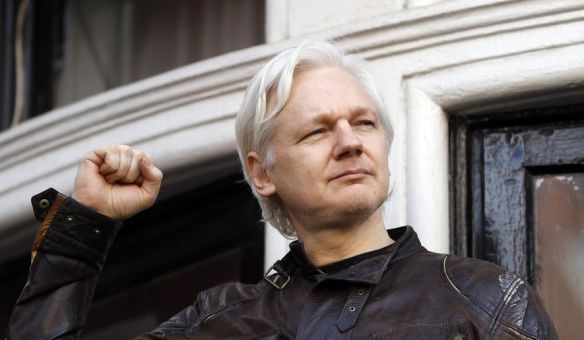
“The freedom of the press is not safe. It’s over. And I think our republic is in its last days, because unauthorized disclosures of this kind are the lifeblood of a republic.”

– Daniel Ellsberg

The persecution and arrest of Julian Assange is the first and most definitive step toward full blown global fascism. The symbolism of a gravely ill journalist being manhandled by uniformed henchmen is the exact imagery it needed to send a chilling message to whistleblowers and the press. The assault and eventual dismantling of what remains of a free press has always been that first step, and it is what lies on the horizon barring mass dissent. For decades the mainstream media has acquiesced to the demands of the corporate world of high finance that now owns them outright and the military and surveillance state that informs their narrative. To be sure, many of them must be trembling at the events that unfolded in London.

That so many prominent American liberals are cheering this on is hardly surprising. History is replete with examples of how the privileged bourgeoisie are the first to capitulate to fascism. It happened in the 1930’s in Germany, Spain and Italy. It happened in the 1970’s in Argentina and Chile. It is happening now across the supposedly “democratic” western world. The animus they possess for Assange is not over his personal ethics, politics or affiliations, which are indeed open for criticism and debate. Like any human being, he is flawed. It is rooted in sore feelings over Wikileaks exposure of the machinations of the corrupt Democratic Party and their Wall Street favoured war hawk, Hillary Clinton. None of what Wikileaks revealed was untrue, but they blame the failure of their deeply flawed candidate on it nonetheless. They care little about the war crimes the platform helped expose through the courage of Chelsea Manning or the threat his persecution represents to press freedom itself.

That the fascist despot Trump has disavowed Wikileaks is hardly surprising either. After all, he may have used the leaks to his benefit, but the man who has relentlessly demonized the press will undoubtedly use this moment to his benefit again. Wikileaks as an organization isn’t perfect and, like any other media outlet, it is not beyond criticism. But nearly every major news outlet has used and published its material, without appreciation or gratitude, because it provided an unprecedented glimpse into the nefarious activities and guiding principles of the ruling elite. The veil had been finally lifted. But with the arrest of Julian Assange this makes all of those news outlets vulnerable to state or corporate repression and censure.

With the Trump administration chomping at the bit to launch a war against Iran and Venezuela, this must come as welcome news to them. After all, it was Wikileaks that exposed the war crimes of the Bush administration in Iraq, not the corporate media. So they can be assured little reporting, aside from a few courageous citizen journalists or those embedded with the troops who parrot Pentagon talking points, will be done to expose the Empire’s war crimes now.

Indeed, Trump has been given a green light with this one event to continue and expand the American Empire, moribund as it is, without reproach. And like a bloated corpse, it will undoubtedly infect and defile everything it touches. More brutal violations of the global south, more coups against democratically elected governments, and bolder acts of authoritarian cruelty at home. He has made no pretense of this. His minions, Pompeo and Bolton, are working tirelessly constructing the next war. And in the past several weeks he has purged his administration of monsters he deemed “too weak” when it comes to crackdowns against immigrants and asylum seekers. A classic tactic of all tyrants. He has anointed the rabid white supremacist, Stephen Miller, in this 21st century pogrom and has also toyed with the idea of making the military in charge of internment camps for migrants. Only a fool would not find such a thing chilling to the bone.

Indeed fascist leaders around the world, along with the military/surveillance establishment and their neoliberal enablers, are celebrating the silencing of Assange. After all, Wikileaks has represented a major thorn in their sides for a decade. From Netanyahu to Duterte to Bolsonaro to Modi and even Putin, all will be emboldened to expand their own attacks on press freedom. All of them will feel empowered to be even more unrestrained in their brutality.

We are on the eve of a sweeping, global, fascist tyranny. Thanks to the continued proliferation of nuclear arms, endless corporate and military assaults on the life sustaining biosphere, catastrophic climate change and the systematic dismantling of democracy, it is a land uncharted. Journalists, especially those who are independent of the corporate stranglehold, are being routinely and relentlessly persecuted and even murdered around the world. They are a bulwark against fascism we dare not lose. But the arrest of Assange is representative of a free press now under constant threat of annihilation. And it will without a doubt grow even more difficult for them to navigate through the mendacity of a ruthless ruling order that has become utterly unrestrained.

Kenn Orphan is an artist, sociologist, radical nature lover and weary, but committed activist. He can be reached at kennorphan.com.