Masked, Homeless, and Desolate

By Edward Curtin

Source: Off-Guardian

Personality is persona, a mask…The mask is magic…Larva means mask; or ghost…it also means mad, a case of demoniacal possession.”
Norman O. Brown, Love’s Body

Walk the streets in the United States and many countries these days and you will see streaming crowds of people possessed by demons, masked and anonymous, whose eyes look like vacuums, staring into space or out of empty sockets like the dead, afraid of their own ghosts. Fear and obedience oozes from them. Death walks the streets with people on leashes in lockstep.

That they have been the victims of a long-planned propaganda campaign to use an invisible virus to frighten them into submission and shut down the world’s economy for the global elites is beyond their ken. This is so even when the facts are there to prove otherwise.

It is a clear case, as Peter Koenig tells Michel Chossudovsky in this must-see interview, that is not a conspiracy theory but a blatant factual plan spelled out in the 2010 Rockefeller Report, the October 18, 2019 Event 201, and Agenda 21, among other places.

Who can wake the sleepwalkers up in this cowardly new world where culture and politics collude to create and exploit ignorance?

Fifty-five years ago on, July 20, 1965, Bob Dylan released his song “Like a Rolling Stone.” It arrived like a rocking jolt into the placid pop musical culture of the day. It was not about wanting to hold someone’s hand or cry in the chapel. It wasn’t mumbo-jumbo like “Wooly Bully,” the number one hit. It wasn’t like the pop pap that dominates today’s music scene. It wasn’t Woody Guthrie in slow time.

It beat you up. It attacked. It confronted you. Maybe, if you were alive then, you thought Dylan was kidding you. You thought wrong. Bitching about his going electric was a dodge. He was addressing all of us, including himself.

Still is. But who wants to hear his recent “Murder Most Foul” and read Dylan’s scathing lyrics about the assassination of JFK, the killing that started the slow decay that has resulted in such masked madness. “And please, Don’t Let Me Be Misunderstood,” he tells us in capital letters for emphasis. Exactly what all the mainstream media have done, of course, and not by accident.

There are no alibis.

“How does it feel/To be on your own/with no direction home/A complete unknown/Like a rolling stone?”

It was in the mid-1960s when confidence in knowing where home was and how to get there disappeared into thin air. If you left mommy and daddy, could you ever get back from where you were going? Who had the directions?

Absolutes were melting and relativity was widespread. Life was wild and the CIA was planning to make it wilder and more confusing with the introduction of LSD on a vast scale. MKUltra was expanding its scope. Operation Mockingbird was singing so many tunes that heads were spinning, as planned.

The national security state killers were in the saddle, having already murdered President Kennedy and Malcolm X as they sharpened their knives for many more to come. The peace candidate, Lyndon Baines Johnson, had been elected nine months earlier with 61.1% of the popular vote and went immediately to work secretly expanding the war against Vietnam. War as an invisible virus. Who knew?

Who, but a small anti-war contingent, wanted to know?

War takes different forms, and the will to ignorance and historical amnesia endure. War is a disease. Disease is weaponized for war. In 1968 Richard Nixon was elected on a “secret plan” to end the Vietnam War and then ramped it up to monstrous proportions, only to be reelected in 1972 by carrying 49 out of 50 states.

Who wants to know now? The historian Howard Zinn once said correctly that this country’s greatest problem wasn’t disobedience but obedience.

What’s behind the masks? The lockstep?

On the same day that Dylan released “Like a Rolling Stone,” Secretary of Defense Robert McNamara, just back from a “fact-finding” trip to Vietnam, recommended to LBJ that U.S. troop levels in Vietnam be increased to 175,000 and that the U.S. should increase its bombing of North Vietnam dramatically.

This was the same McNamara who, in October 1963, had agreed with JFK when he signed NSAM 263 calling for the withdrawal of 1,000 military personnel from Vietnam by the end of 1963 and the remainder by the end of 1965. One of the moves that got Kennedy’s head blown open.

Poor McNamara, the fog of war must have clouded his conscience, confused the poor boy, just like Secretary of State Colin Powell holding up that vile vial of “anthrax” at the United Nations on February 5, 2003 and lying to the world about weapons of mass destruction in Iraq.

Powell recently said, “I knew I didn’t have any choice. He’s the President.” How “painful,” to use his word, it must have been for the poor guy, lying so that so many Iraqis could be slaughtered. Of course, he had no choice. These war criminals all wear masks. And have no choice.

Masks, or demonic possession, or both. You?

Also in that fateful year 1965, far out of sight and out of mind for most Americans, the CIA planned and assisted in the slaughter of more than a million Indonesians, led by their man, General Suharto. This led to the coup against President Sukarno, who two years earlier had been on good terms with JFK as they worked to solve the interrelated issues of Indonesia and Vietnam. Their meeting planned for early 1964 was cancelled in Dallas on November 22, 1963.

And the politicians and media luminaries came out in their masks and told the public that communists everywhere were out to get them.

It’s tough being on your own. It hurts to think too much. Or think for yourself, at least. To obey an authority higher than your bosses. “I was tricked” is some sort of mantra, is it not?

You never turned around to see the frowns on the jugglers and the clowns
When they all did tricks for you

Dylan was lost and disgusted when he wrote the song. His own music sickened him, which, for an artist, means he sickened himself. He had just returned from a tour of England and was sick of people telling him how much they loved his music when he didn’t. He needed to change.

What else is the point of art but change? If you’re dead, or afraid of getting dead, you aren’t going to change. You’re stuck. Stuck is dead. Why wear a mask if you know who you are?

Knowledge, or more accurately, pseudo-knowledge or mainstream media lies, is a tomb “the mystery tramp” sold to us, a place to hide to avoid pain and guilt.

I have read more books than anyone I know. It sickens me.
I know too much. That sickens me.
I sicken myself. All the news sickens me.
I know so much no one believes me.
As Francesco Serpico once told me: “It’s all lies.”
Of course. Dylan and Serpico are blood brothers.
Only art tells the truth. Real art.

Not bullshit pop art. Some say “Like a Rolling Stone” is about Edie Sedgwick, “the girl of the year” in 1965 and one of Andy Warhol’s superstars. Perhaps to a degree it is, but it’s far more than that. It’s about us.

Poor Edie was poisoned by her wealthy family at a young age and barely had a chance. She was an extreme example of a rather common American story. People poisoned in the cradle. Thinking of her got me thinking of Andy Warhol, the death obsessed hoarder, the guy who called his studio “The Factory” in a conscious or unconscious revelation of his art and persona, his wigs and masks and the hold he has had on American culture all these years. Isn’t he the ultimate celebrity?

Warhol once took my photo on a deserted street. His and my secret but this is the truth. West 47th Street on an early Sunday morning, 1980. I guess he thought he was doing art or collecting images for his museum of dead heads. When I asked him why, he said I had an interesting face.

I told him he did too, rather transparent and creepy, but I didn’t want to capture him. He was a ghost with a camera, a face like a death mask, trying to capture a bit of life. I told him I didn’t give him permission to shoot me, but he turned and walked away into the morning mist. The shooters always just walk away in pseudo-innocence.

I then went down the street to the Gotham Book Mart that was my destination and asked James Joyce why he had written “The Dead,” and Joyce, secretive as ever, quoted himself, “Ed,” he said, “Think you’re escaping and run into yourself. Longest way round is the shortest way home.” Now that was direction.

Only those who know how to play and be guided by intuition are able to escape the living tomb of so-called knowledge; what Dylan called, lifelessness. But that was from “Desolation Row,” released as the closing track of Highway 61 Revisited on August 30, 1965. The only acoustic song on the album. Slow it down to make the point another way. “Like a Rolling Stone” was the opening track.

Do you feel all alone or part of a masked gang roaming the streets incognito? Miss and Mr. Lonely, does that mask help? How do you feel?

Desolation means very lonely. From Latin, de, completely, solare, lonely.

Does that mask help? Do you feel alone together now, one of the crowd?

Do you really want to know about desolation row? It’s here. It was here in 1965, too. Only the true lonely know how it feels to really be all alone.

The Umbrella People, those who some call the deep state or secret government under whose protection all the politicians work, say they want to protect us all from death and disease. They are lying bastards who’ve gotten so many to imitate their masked ways. They can only sing a mockingbird’s song.

Listen to real singers. Dylan has arched the years, as true artists do. Who has paid close attention to what he said this year about the assassination of President Kennedy in his song, “Murder Most Foul”? Or were many caught up in the propaganda surrounding corona virus, and rather than contemplating his indictment of the U.S. government and its media accomplices, were they contemplating their navels to see if a virus had secreted itself in there. Viruses lurk everywhere, they say, and the corporate media made certain to circulate a vaccine about the truth in Dylan’s song. This is normal operating procedure.

We are still on Desolation Row.

“Take Off the Masks.” That was the title of a book by Rev. Malcolm Boyd that I reviewed long ago. He was a gay priest who decided that his mask was a lie. He came out into the light of truth. He had guts.

It is time for everyone to take off the masks. Escape from Desolation Row by seeing what’s going on behind our backs.
Listen to Dylan, long ago – today:

At midnight all the agents
And the superhuman crew
Come out and round up everyone
That knows more than they do
And they bring them to the factory
Where their heart attack machine
Is strapped across their shoulders
And then the kerosene
Is brought down from the castles
By insurance men who go
Check to see that nobody is escaping
To Desolation Row
Praise be to Nero’s Neptune
The Titanic sails at dawn
Everybody’s shouting
“Which side are you on?”


The Free Market Is A Failure

By TheHipcrimeVocab

Sorry for the deliberately click-bait-y headline, but I think this message is important to get out there.

In my discussions few months back on What is Neoliberalism, I noted that a core element of neoliberal philosophy is that markets are the only efficient, effective and rational way to distribute goods and services.

Neoliberals profess the idea that only competitive markets can allocate “scarce” resources efficiently, and that it is only such “free” markets that can lift people out of poverty and deliver broad prosperity. They pound it into our heads constantly.

Yet the Covid-19 crisis has illustrated spectacular and pervasive failures of such “free” markets all over the globe, and especially in the U.S. Instead of fairness or efficiency, we see systemic failure in every market we look: the food industry, the medical industry, the retail industry, the employment market. Resources are being destroyed and misallocated on a massive scale

Let’s start with the food industry, because food is the most important thing (nine means from anarchy, and all that). Thousands and thousands of pigs are being slaughtered, their meat left to rot, eaten by no-one, regardless of the forces of supply and demand:

The United States faces a major meat shortage due to virus infections at processing plants. It means millions of pigs could be put down without ever making it to table…

Boerboom, a third-generation hog farmer, is just one of the tens of thousands of US pork producers who are facing a stark reality: although demand for their products is high in the nation’s grocery stores, they may have to euthanise and dispose of millions of pigs due to a breakdown in the American food supply chain.

Meat shortage leaves US farmers with ‘mind-blowing’ choice (BBC)

Potatoes are sitting in Belgian warehouses and left to rot, only two short years after a drought threatened to produce a severe shortage:

Belgium: Lighthearted campaign to ‘eat more fries’ aims to lift heavy load (DW)

Meanwhile, dairy farmers in the U.S. heartland are dumping milk into the ground, to be drunk by no one.

Cows don’t shut off: Why this farmer had to dump 30,000 gallons of milk (USA Today)

In fact, the whole food situation is rather ugly, as this piece from The Guardian summarizes:

This March and April, even as an astounding 30 million Americans plunged into unemployment and food bank needs soared, farmers across the US destroyed heartbreaking amounts of food to stem mounting financial losses.

In scenes reminiscent of the Great Depression, dairy farmers dumped lakes of fresh cow’s milk (3.7m gallons a day in early April, now about 1.5 million per day), hog and chicken farmers aborted piglets and euthanized hens by the thousands, and crop growers plowed acres of vegetables into the ground as the nation’s brittle and anarchic food supply chain began to snap and crumble.

After delays and reports of concealing worker complaints, meatpacking plants that slaughter and process hundreds of thousands of animals a day ground to a halt as coronavirus cases spread like wildfire among workers packed tightly together on dizzyingly fast assembly lines.

Meanwhile, immigrant farmworkers toiled in the eye of the coronavirus storm, working and living in crowded dangerous conditions at poverty wages; at one Washington state orchard, half the workers tested positive for Covid-19. Yet many of these hardest working of Americans were deprived of economic relief, as they are undocumented. Advocates report more farmworkers showing up at food banks – and some unable to access food aid because they can’t afford the gas to get there.

None of this is acceptable or necessary and it’s not just about Covid-19, it’s also illustrative of a deeply deregulated corporate capitalism. America’s food system meltdown amid the pandemic has been long-developing, and a primary cause is decades of corporate centralization and a chaotic array of policies designed to prop up agribusiness profits at any cost.

Farmers are destroying mountains of food. Here’s what to do about it (Guardian)

That doesn’t sound very “efficient” to me, does it? How about you? Free market fundamentalists, care to weigh in?

Meanwhile, hospitals in the United States, which one would think are the most important thing to keep open during a pandemic, are actually closing across the country. These are the very things you want most to be open! Why is this happening? Because health care in the U.S. is a profit-driven enterprise that “competes” in the free market. Because elective procedures—their cash cow—have either been suspended or postponed. U.S. hospitals are closing because they are dependent upon these elective procedures to shore up their profits, and markets rely on profits.

As the deadly virus has spread beyond urban hotspots, many more small hospitals across the country are on the verge of financial ruin as they’ve been forced to cancel elective procedures, one of the few dependable sources of revenue. Williamson Memorial and similar facilities have been struggling since long before the pandemic — at least 170 rural hospitals have shut down since 2005, according to University of North Carolina research on rural hospital closures.

But even as hospitals in cities like New York City and Detroit have been deluged with coronavirus patients, many rural facilities now have the opposite problem: their beds are near-empty, their operating rooms are silent, and they’re bleeding cash.

More than 100 hospitals and hospital systems around the country have already furloughed tens of thousands of employees, according to a tally by industry news outlet Becker’s Hospital Review. They’ve sent home nurses and support staffers who would be deemed essential under state stay-home orders.

Rural hospitals are facing financial ruin and furloughing staff during the coronavirus pandemic (CNN)

And how about allocating labor via impersonal markets? How’s that going? Well, not so well. The workers with the skills most desperately needed on the front lines during the crisis are taking pay cuts and getting laid off left and right. Instead of contributing, they are sitting at home, unable to work even if they wanted to:

At a time when medical professionals are putting their lives at risk, tens of thousands of doctors in the United States are taking large pay cuts. And even as some parts of the US are talking of desperate shortages in nursing staff, elsewhere in the country many nurses are being told to stay at home without pay.

That is because American healthcare companies are looking to cut costs as they struggle to generate revenue during the coronavirus crisis.

“Nurses are being called heroes,” Mariya Buxton says, clearly upset. “But I just really don’t feel like a hero right now because I’m not doing my part.”

Ms Buxton is a paediatric nurse in St Paul, Minnesota, but has been asked to stay at home.

At the unit at which Ms Buxton worked, and at hospitals across most of the country, medical procedures that are not deemed to be urgent have been stopped. That has meant a massive loss of income.

Coronavirus: Why so many US nurses are out of work (BBC)

It’s an ironic twist as the coronavirus pandemic sweeps the nation: The very workers tasked with treating those afflicted with the virus are losing work in droves.

Emergency room visits are down. Non-urgent surgical procedures have largely been put on hold. Health care spending fell 18% in the first three months of the year. And 1.4 million health care workers lost their jobs in April, a sharp increase from the 42,000 reported in March, according to the Labor Department. Nearly 135,000 of the April losses were in hospitals.

As Hospitals Lose Revenue, More Than A Million Health Care Workers Lose Jobs (NPR)

So it doesn’t seem like “free and open” markets are doing so well with either health care or labor.

Meanwhile, U.S. states are competing against each other for desperately needed PPE equipment, bidding up the price and preventing scarce resources from going to where they are most badly needed, which would naturally be where Covid-19 has struck the hardest:

As coronavirus testing expands and more cases of infection are being identified, doctors, nurses and other healthcare workers are scrambling to find enough medical supplies to replenish their dwindling supply.

But state and local governments across the United States are vying to purchase the same equipment, creating a competitive market for those materials that drives up prices for everyone.

“A system that’s based on state and local governments looking out for themselves and competing with other state and local governments across the nation isn’t sustainable,” said John Cohen, an ABC News contributor and former acting Undersecretary of the Department of Homeland Security, “and if left to continue, we’ll certainly exacerbate the public health crisis we’re facing.”

“There’s a very real possibility,” he added, “that those state and local governments that have the most critical need won’t get the equipment they need.”

Competition among state, local governments creates bidding war for medical equipment (ABC News)

Yet neoliberals always tell us how important “competition” is in every arena of life.

Failure, failure, failure! Everywhere we look, we see failure. Pervasive, systematic failure. Resources going unused. Surpluses of food being dumped even while people go hungry and line up at food banks. Workers with necessary skills sitting at home, twiddling their thumbs. Other workers unable to even earn a living to support themselves and their families, no matter how badly they want to work. Masks and protective equipment NOT going to where they are most needed, their costs inflating, befitting no one except profiteers even as people die.

Tell me again about how the market is “efficient” at distributing resources. Tell me again about how central planning inevitably results in wasted resources, surfeits and shortages.

And here is the big, bold, underscored point:

The free-marketeers want to trumpet the market’s successes, but they don’t want to own its failures.

Free-market boosters always want to talk about the wonderful benefits of markets. How they allow multiple people to coordinate their activities across wide variations of space and time. How they allow knowledge to be distributed among many different actors. How they favor tacit knowledge that a single entity could not possess. Libraries of encomiums have been written celebrating the virtues of the “free” market. You know their names: The Provisioning of ParisEconomics in One LessonFree to ChooseI Pencil, and all of that. Much of what passes for economic “science” is simply cheerleading for markets– the bigger, freer and less-regulated the better.

Okay, fair enough.

But how about market failures? Why don’t they ever talk about that? Because if you read the economics books I cited above, you would come away with the idea that there are no market failures! That, in fact, there is no such thing. That markets, in effect, cannot fail!

If you want to own the successes, you need to own the failures.

Oh, they love, love, love to talk about central planning’s “failures”. They can’t get enough of that. They love to talk about empty shelves in the Soviet Union, long lines at supermarkets, the lack of toilet paper in Venezuela (amusingly, now a problem throughout the capitalist world), and the allegedly long waiting times in “socialized medicine” countries. We are constantly subjected to that drumbeat day after day after day. It’s part of every economics 101 course. Central planning doesn’t work. Central planning is inefficient. Central planning is “tyranny.”

But what about all that stuff I cited above?

Where are all the free-market fundamentalists now?

What is their excuse?

They’ll use special pleading. They’ll argue that it’s exceptional circumstances. That no one could have foreseen a “black swan” event like the global Covid-19 pandemic (despite numerous experts warning about it for years). They’ll tell us that markets work just fine under “normal” circumstances. They’ll say we cannot pass any kind of judgement on the failings of markets during such an unusual event.

Here’s why that argument is bullshit:

Pandemics are a real, and recurring phenomenon in human history. We’ve been incredibly fortunate that we’ve been in rare and atypical hundred-year period from 1918-1919 to today without a global pandemic or novel disease we couldn’t quickly contain and/or eradicate.

But pandemics are always—and always have always been—a societal threat, even if we’ve forgotten that fact. And the experts tell us that there will be a lot more of them in our future, with population overshoot, environmental destruction, encroachment on formerly unoccupied lands and climate change proceeding apace. What that means is this:

If your economic system can’t function properly during a pandemic, then your economic system is shit.

If your economic system only works when conditions are ideal, in fact depends upon conditions being ideal, then, your economic system doesn’t really work at all. If something like a pandemic causes it to seize up and fail, then your economic system is poorly designed and doesn’t work very well. Not only do the free markets graphed on economists’ chalkboards not exist in anywhere the real world, they apparently rely on a blissful Eden-like Arcadia to function as intended—a situation any causal glance at human history tells us is highly unusual. Any disruption and they fall like dominoes. They are about as resilient as tissue paper.

And the stresses are only going to get worse in the years ahead, with climate change making some areas uninhabitably hot, while other places are submerged under rising sea levels. And that’s before we get to the typical natural disasters like volcanic eruptions, tsunamis and earthquakes. And there will be new novel plant diseases as well, unfolding against the increasing resistance of germs to antibiotics.

Will the free market fundamentalists and libertarian market cheerleaders acknowledge this???

Don’t hold your breath.

No, they will continue to lionize “private initiative” at every opportunity, while completely ignoring the stuff I opened this post with. They’ll sweep it under the rug or, more likely, simply handwave it away. They’ll continue to say that we need to scale back government regulation and interference and let the invisible hand sort it all out.

Because discipline of modern economics as practiced today is not a science. It may not even rise to the level of a pseudoscience. It’s PR for laissez-faire capitalism.

Of course, we’ve had market failures before. They occurred all throughout the nineteenth century and during Great Depression, for example. These are well-documented. But many of the things that came out of those bygone market failures to prevent or mitigate them have been systematically and deliberately dismantled over the past generation due to rise of neoliberalism.

And now we’re paying the price.

Karl Polanyi made an important distinction between markets and Market Society. Markets are where people come together to buy, sell, and exchange surplus goods. These have existed throughout history. They are tangential to society; embedded in something larger than it. Such markets can be shut down without causing an existential threat to civilization.

But Market Society is dependent upon impersonal forces of supply and demand and functioning markets for absolutely everything in the society, from jobs to food to health care. Everything is oriented around maximizing private profits, and not human needs. Markets failing to function adequately lead to unemployment, sickness, starvation and death. Shutting them down is an existential threat to civilization.

As Dmitry Orlov wrote in his best-known work, the Russians survived the collapse of the Soviet Union precisely because they didn’t rely on the Market.

Naturalizing markets in this way is an abdication of both causal and moral responsibility for famines, a way to avoid reality and the ethical consequences for people in a position to change things. Markets are not given; they are predicated on a host of laws and social conventions that can, if the need arises, be changed. It makes no sense for American farmers to destroy produce they can’t sell while food banks are struggling to keep up with demand. This kind of thinking is a way for powerful people to outsource ethical choices to the market, but the market has no conscience.

Famine Is a Choice (Slate)

Now, to be clear I’m not necessarily making an argument for or against central planning as opposed to markets. That’s a different discussion.

But my core point is simply this: you cannot discuss market successes without discussing market failures. To do so is intellectually dishonest, disingenuous, and not to mention incredibly dangerous and irresponsible. If economics were a real science, instead of just PR for capitalism, it would take a look at the things I described above, and figure out ways they could have been avoided, regardless of any preconceived ideology or assumptions about the “right” way to arrange a society, or assumptions about how things “should” work. It would seek out ways for society to become, in Nassim Taleb’s terminology, “antifragile.”

But don’t hold your breath for that, either.

Remdesivir for Covid-19: $1.6 Billion for a “Modestly Beneficial” Drug?

By Elizabeth Woodworth

Source: Global Research

The U.S. Department of Health and Human Services has recently “bought” all of Gilead Science’s Remdesivir for $1.6 billion. “500,000 doses at $3,200 per patient – to be available to American hospitals but not for other countries”[6] 

That’s $1.6 billion tax dollars for a virtually untested drug showing only marginal efficacy in the hospital setting.

How could such a thing happen?

Introduction

If you believe an urgent call from the Yale School of Public Health that was recently published in the American Journal of Epidemiology— the top epidemiology journal in America — hydroxychloroquine (HCQ) + azithromycin is the quickest and most effective way to halt the Covid-19 pandemic.[1]

According to this Yale statement, hydroxychloroquine – a cheap, natural anti-malarial tree-bark known as quinine for 400 years – is highly effective during Phase 1 of Covid-19, while the virus is loading into the body.

As the first line of defense, it should be immediately, freely, and widely available to symptomatic high-risk patients – through doctors’ offices, outpatient clinics, and hospitals across the land.

Indeed, under the directorship of Dr. Anthony Fauci, a National Institute of Allergy and Infectious Diseases (NIAID) a clinical trial had been launched on May 14 to look into it.[2]

The HCQ + azithromycin protocol is being used successfully by France’s top, award-winning microbiologist, Dr. Didier Raoult.  He is director of the Infectious and Tropical Emergent Diseases Research Unit in Marseille (Institut Hospitalo-Universitaire) (IHU), with 200 staff.  Raoult, now almost a celebrity in France, has recently published his protocol and results, showing an overall 1.1% case fatality rate.[3]

The same protocol has also been highly successful in China, India, Senegal, and Brazil.[4]

So why suddenly is the U.S. government and the media ignoring recommendations from these top specialists,[5] and waiting, instead, until people get very sick and hospitalized to treat them with the relatively untested drug, Remdesivir, which is administered intravenously?

Why has the U.S. Department of Health and Human Services just bought up all the Remdesivir it could order – 500,000 doses at $3,200 per patient – to be available to American hospitals but not for other countries?[6]

To put Remdesivir’s cost in perspective, the CDC reports that the flu vaccine costs from $12-$18 a dose.[7]

The government, in order to justify its mind-boggling price, would need to show exceptional efficacy in saving lives. Efficacy, that is, once the disease has been allowed, through failure to use the HCQ + azithromycinearly preventive approach, to advance to Phase 2 (the dangerous inflammatory period) and Phase 3 (ICU ventilator intubation, often leading to death).[8]

What do studies say about the efficacy of remdesivir?

There are three main studies that have examined remdesivir as a treatment for Covid-19:

  1. The first, a study of seriously ill patients, was originally reported in the New England Journal of Medicine on April 10, 2020. Treated with “compassionate-use” remdesivir, clinical improvement was observed in 36 of 53 patients (68%).

The article was co-authored by 56 people, some of whom were on the staff of remdesivir’s producer, Gilead Sciences.[9] The study was funded by Gilead, and writing assistance was provided by David McNeel, also of Gilead.[10]

The following day, April 11, the Science Media Centre published expert reactions to the compassionate study from five British university professors. These assessments were not encouraging: “the research doesn’t prove anything at this point;” “the data is almost uninterpretable;” the research should be treated “with extreme caution.”[11]

  1. A Wuhan, China randomized, double-blind, placebo-controlled trial of 237 patients was accidentally leaked by the World Health Organization and published in The Lancet. It showed no statistically significant clinical benefits from remdesivir:

“The antiviral medicine remdesivir from Gilead Sciences failed to speed the improvement of patients with Covid-19 or prevent them from dying, according to results from a long-awaited clinical trial conducted in China.” [12]

This Lancet study also found that some 14% of patients in the treatment group died after 28 days, compared to 13% in the group that did not receive the treatment.

And it further reported that “remdesivir was stopped early because of adverse events in 18 (12%) patients versus four (5%) patients who stopped placebo early.”[13]

  1. The preliminary results of a NIAID remdesivir trial of 1063 patients showed a “modest” benefit in a controlled clinical trial:

“The infected people who received remdesivir, an experimental drug made by Gilead Sciences that cripples an enzyme several viruses use to copy their RNA, recovered in an average of 11 days versus 15 in patients who received a placebo. ‘Although a 31% improvement doesn’t seem like a knockout, 100% [success], it is a very important proof of concept,’ said Anthony Fauci, head of the National Institute of Allergy and Infectious Diseases (NIAID).”[14]

Health Policy Watch reported that “the death rate was 8% in the group that received remdesivir compared to 11.6% in the control group, although this result was not statistically significant.” Dr. Fauci told reporters that “what [this trial] has proven is that a drug can block the virus.”[15]

The excerpt below from a June 24 article in the British Medical Journal assesses the problems in the foregoing studies. (One of the four co-authors, Fiona Godlee, is the editor-in-chief of the BMJ):

“A serious imbalance in covid-19 research strongly favours the study of drug treatments over non-drug interventions, with many studies too small or too weak to produce reliable results.  Equally concerning is the release of partial or preliminary findings before peer review—often through commercial press releases—that is distorting public perceptions, ongoing evaluations efforts, and political responses to the pandemic.

Remdesivir is a key example. The antiviral drug, made by US company Gilead, was unapproved at the start of the pandemic, but in early April the New England Journal of Medicine published a small descriptive study of a compassionate use scheme for patients with covid-19. Gilead funded the study, a third of the authors were Gilead employees, and Gilead’s press release reported “clinical improvement in 68% of patients in this limited dataset.”  Despite being a non-randomised, uncontrolled, company funded study of just 53 patients, media headlines described “hopeful” signs and reported “two thirds” of patients showing improvement.[16]

Two weeks later, the Lancet published a randomised placebo controlled trial of remdesivir from China, finding no statistically significant clinical benefit in the primary outcome of time to clinical improvement. Twelve per cent of participants taking remdesivir stopped treatment early because of adverse events, compared with 5% taking placebo. The trial was stopped before meeting recruitment targets.”[17]

To summarize, the only study demonstrating even marginal efficacy for remdesivir shows it to reduce hospital recovery times 31%, from 15 days to 11 days.

What is the justification for spending $3,200 tax dollars per Covid-19 patient to save four days in hospital, unless it is to shorten hospital stays, thereby saving the average U.S. bed cost of approximately $2000 per day, while delaying hospital saturation that could leave some people untreated to die?

Leaving people untreated to die could cause civil unrest, which may be the covert political reason for spending the $1.6 billion.

None of the studies mention side effects of the drug. In the China study, kidney injury led to discontinuation for one patient, and in its use for ebola, liver risks were identified.[18]

How much does it cost to produce remdesivir?

The Institute for Clinical and Economic Review (ICER) is a non-profit organization seeking to improve healthcare value through clinical and cost-effective analyses.[19]

In a May 1, 2020 study, the ICER calculated that the cost of producing the remdesivir “final finished product,” including the pharmaceutical ingredients, formulation, packaging, and a small profit margin, was $9.32 US for a 10-day course of treatment.  They rounded this up to $10.[20]

Dr. Fauci’s NIAID Clinical Trial Evaluating Hydroxychloroquine and Azithromycin Closes Early

On June 20, 2020, nine days before the Department of Health and Human Services announced its $1.6 billion purchase of remdesivir on June 29, its NIAID branch closed a clinical trial that had been launched May 14 to investigate whether the inexpensive combination, hydroxychloroquine plus azithromycin, might be an effective treatment when given early in the course of the disease.[21]

The Department of Health and Human Services knew that hydroxychloroquine (aka chloroquine) was effective against coronavirus because chloroquine was tested against the SARS-1 virus during the outbreak in 2002. This work was written up in 2005, under the auspices of the U.S. Centers for Disease Control in Atlanta, which reports to the Department of Human Health and Services.[22]

Truth, as the saying goes, is stranger than fiction.

Who was responsible for this debacle?

Dr. Fauci has served in the National Institutes of Health under six presidents.

Were these bizarre decisions carried out under his authority? Or were they forced upon him from higher up?  Or has he become a victim of regulatory capture[23] by the drug industry?

Whatever the answer, this unprecedented fleecing of the American public should have been shouted from the rooftops, had there been a functioning US media.

*

Note to readers: please click the share buttons above or below. Forward this article to your email lists. Crosspost on your blog site, internet forums. etc.

Notes

[1] Harvey A. Risch, “Early Outpatient Treatment of Symptomatic, High-Risk Covid-19 Patients that Should be Ramped-Up Immediately as Key to the Pandemic Crisis,” Amer. J. Epid, 27 May 2020 (https://academic.oup.com/aje/advance-article/doi/10.1093/aje/kwaa093/5847586). Risch is Professor at the Yale Schools of both Medicine and Public Health.

[2] National Institute of Allergy and Infectious Diseases, “NIH Begins Clinical Trial of Hydroxychloroquine and Azithromycin to Treat COVID-19,” 14 May 2020 (https://www.niaid.nih.gov/news-events/nih-begins-clinical-trial-hydroxychloroquine-and-azithromycin-treat-covid-19).

[3] Jean-Christophe Lagier, et al, “Outcomes of 3,737 COVID-19 patients treated with hydroxychloroquine/azithromycin and other regimens in Marseille, France: A retrospective analysis,” Travel Medicine and Infectious Disease, 25 June 2020 (https://www.sciencedirect.com/science/article/pii/S1477893920302817). Rault has 2,300 indexed medical journals in print.

[4] The group “COVEXIT.com – News About Hydroxychloroquine & Other COVID-19 Treatments,” was founded March 29, 2020 by Jean-Pierre Kiekens. It keeps daily track of successful Covid treatments worldwide (https://www.facebook.com/groups/covexit)

[5] Elizabeth Woodworth, “The Media Sabotage of Hydroxychloroquine Use for COVID-19: Doctors Worldwide Protest the Disaster,” Global Research, 30 June 2020 (https://www.globalresearch.ca/media-sabotage-hydroxychloroquine-covid-19-doctors-worldwide-protest-disaster/5717382).

[6] US Department of Health and Human Services, “Trump Administration Secures New Supplies of Remdesivir for the United States,” June 29, 2010 (https://www.hhs.gov/about/news/2020/06/29/trump-administration-secures-new-supplies-remdesivir-united-states.html).

[7] Centers for Disease Control and Prevention, Vaccines for Children Program, “CDC Vaccine Price List,” updated 1 July 2020 (https://www.cdc.gov/vaccines/programs/vfc/awardees/vaccine-management/price-list/index.html#adflu).

[8] Dr. Raoult identified the three stages of Covid-19 while treating 3,737 patients with HCQ+azithromycin at his own clinic: “At the first viral stage, one must give medicines against the virus, in the second inflammatory phase, one needs to give medications against that [inflammatory] reaction, and then in the third phase, it’s work to be done in intensive care units.” Summarized from Didier Raoult, at: “The Marx Brothers are Doing Science: the Example of RECOVERY,” 9 June 2020 (http://covexit.com/professor-raoult-compares-the-oxford-recovery-trial-academics-to-the-marx-brothers/).

[9] Jonathan Grein, and 55 other authors, “Compassionate Use of Remdesivir for Patients with Severe Covid-19,” New England Journal of Medicine, 11 June 2020 (https://www.nejm.org/doi/full/10.1056/NEJMoa2007016), “Editor’s Note: This article was published on April 10, 2020, at NEJM.org.”

[10] Jason D. Goldman, et al., “Remdesivir for 5 or 10 days in Patients with Severe Covid,” New England Journal of Medicine, no date in header (https://www.nejm.org/doi/pdf/10.1056/NEJMoa2015301?articleTools=true). Sidebar:“This article was published on May 27, 2020, at NEJM.org.”

[11] Prof. Duncan Richards et al., “Expert reaction to a study about compassionate use of remdesivir for patients with severe COVID-19,” Science Media Centre, 11 April 2020 (https://www.sciencemediacentre.org/expert-reaction-to-a-study-about-compassionate-use-of-remdesivir-for-patients-with-severe-covid-19/).

[12] Ed Silverman, et al, “New data on Gilead’s remdesivir, released by accident, show no benefit for coronavirus patients. Company still sees reason for hope,” StatNews, 23 April 2020 (https://www.statnews.com/2020/04/23/data-on-gileads-remdesivir-released-by-accident-show-no-benefit-for-coronavirus-patients/).

[13] Yeming Wang, et al., “Remdesivir in adults with severe COVID-19: a randomised, double-blind, placebo-controlled, multicentre trial,” The Lancet, 16 May 2020 (original online publication 29 April 2020) (https://www.thelancet.com/journals/lancet/article/PIIS0140-6736(20)31022-9/fulltext).

[14] Jon Cohen, “Large trial yields strongest evidence yet that antiviral drug can help COVID-19 patients,” Science, 29 April 2020 (https://www.sciencemag.org/news/2020/04/large-trial-yields-strongest-evidence-yet-antiviral-drug-can-help-covid-19-patients).

[15] Grace Ren, “Conflicting Remdesivir Trial Results Released; Experts Urge More Research,” Health Policy Watch, 29 April 2020 (https://healthpolicy-watch.news/first-remdesivir-rct-shows-no-significant-clinical-benefit-for-severe-covid-19-patients-but-experts-urge-for-more-research/).

[16] Christopher Rowland, “Gilead’s experimental drug remdesivir shows ‘hopeful’ signs in small group of coronavirus patients,” Washington Post, 10 April 2020 (https://www.washingtonpost.com/business/2020/04/10/gileads-experimental-drug-remdesivir-shows-hopeful-signs-small-group-coronavirus-patients/).

[17] Ray Moynihan et al.,“Commercial influence and covid-19,” BMJ2020;369:m2456 (Published 24 June 2020) (https://www.bmj.com/content/369/bmj.m2456).

[18] Crystal Phend, “Remdesivir Safety Forecast: Watch the Liver, Kidneys,” Medpage Today, 19 May 2020 (https://www.medpagetoday.com/infectiousdisease/covid19/86582).

[19] https://en.wikipedia.org/wiki/Institute_for_Clinical_and_Economic_Review

[20] Melanie D. Whittington and Jonathan B. Campbell, “Alternative Pricing Models for Remdesivir and Other Potential Treatments for COVID-19,” Institute for Clinical and Economic Review, 1 May 2020 (https://icer-review.org/wp-content/uploads/2020/05/ICER-COVID_Initial_Abstract_05012020-3.pdf).

[21] National Institute of Allergy and Infectious Diseases, “BULLETIN—NIH Clinical Trial Evaluating Hydroxychloroquine and Azithromycin for COVID-19 Closes Early,” 20 June 2020 (https://www.niaid.nih.gov/news-events/bulletin-nih-clinical-trial-evaluating-hydroxychloroquine-and-azithromycin-covid-19).

[22] Martin J. Vincent et al., “Chloroquine is a potent inhibitor of SARS coronavirus infection and spread,” Journal of Virology, 22 August 2005 (https://www.ncbi.nlm.nih.gov/pmc/articles/PMC1232869/).

[23] “Regulatory capture is a theory that regulatory agencies may be dominated by the interests they regulate and not by the public interest.” In: Will Kenton, “Regulatory Capture,” Investopedia, 23 October 2019 (https://www.investopedia.com/terms/r/regulatory-capture.asp).

Having Sucked America Dry, Tech Giants Seek New Markets Beyond Reach of US Antitrust Laws

Sept. 27, 2015 Facebook CEO Mark Zuckerberg hugs Prime Minister of India Narendra Modi at Facebook in Menlo Park, Calif. (AP Photo/Jeff Chiu, File)

An aggressive push to consolidate companies in the tech sector, coupled with the world’s ever-increasing dependence on digital platforms and tools, is quickly leading to a crisis of sovereignty.

By Raul Diego

Source: MintPress News

The American consumer market for big tech gadgets appears to have reached the point of saturation as the novelty of mobile devices and laptops plateau and the persistent lockdown sees savings dwindle and discretionary spending disappear. Apple, which has enjoyed reigning over the smartphone market for more than a decade, has been forced to drop its prices over the last year as a result of a market at full capacity.

Nevertheless, one of the world’s most liquid companies, along with other tech giants like Facebook and Google – whose parent company, Alphabet, Inc. recently overtook Apple as the most cash-rich company in the world – are taking full advantage of their position to gobble up startups in emerging sectors in the Artificial Intelligence (AI) space like Natural Language Processing (NLP), Machine Learning (ML) and Deep Learning (DL), in order to solidify their place in other, mostly untapped markets in developing nations.

Big tech’s insatiable appetite, as manifested in this current sprint to further consolidate their assets, is bound to give them even more control over their already substantial access to our data and other digital activities of the population at large.  Earlier this year, then Presidential candidate Elizabeth Warren led the call to “Break Them Up,” in reference to the big tech companies, declaring that they had “bulldozed competition, used our private information for profit, and tilted the playing field against everyone else. And in the process, they have hurt small businesses and stifled innovation.” Her plan to “level the playing field,” however, seems to have gone away with her fleeting candidacy.

Nonetheless, they are all gearing up to face an election-year challenge to their growing power as a year-long House Judiciary subcommittee investigation is set to conclude and will more than likely provide plenty of fodder for the antitrust battles looming on the horizon. Some analysts have speculated that the U.S. government could impose fines on companies like Google in the tens of billions for past violations. But, whether or not this Congress implements measures with any real teeth remains to be seen.

Captive market shares

American tech giants are turning their focus to south-east Asia as their original markets in the U.S. can no longer support most of their quarterly profit projections. Apple’s recent acquisition of Seattle-based Xnor.ai, which specializes in “low-power, edge-based artificial intelligence tools” that will help them develop low-cost hardware for things like security cameras using artificial visual intelligence.

The Xnor.ai acquisition is just one of several made by Apple this year. Others include an Irish AI platform called Voysis that enables voice interactions with digital retailers; NextVR, a virtual reality headset company that holds over 40 patents in that space and will help Apple carve out a niche in the burgeoning world of streaming music and sporting events.

Google, which already has a virtual monopoly over Internet search capabilities and related tools, is aggressively pursuing startups in the cloud computing space, healthcare, and advertising market. A salient example is the ongoing $2.1 Billion-dollar acquisition of Fitbit, which has reportedly entered its final stages but has raised calls in some quarters for U.S. antitrust regulators to take a closer look.

The bank of Zuckerberg

Meanwhile, Facebook is continuing its incursion into the virtual entertainment arena with the purchase of Sanzaru Games in February as the social media giant solidifies its VR stake by taking over both hardware and software sides of that emerging market. Zuckerberg has also added to his social media empire with plans to acquire animated gif search engine Giphy for $400 Million, extending his consolidation over two of the most popular social media and communication platforms in its portfolio: Instagram and WhatsApp.

Facebook’s recent $5.7 Billion-dollar investment in India’s Jio Platforms also reveals how the tech giant is betting on Asia for its future growth. Facebook claims that Jio has “brought more than 388 million people online” and is poised to leverage its ubiquitous presence in the country through WhatsApp, boasting that the chat/call app has become a “commonly used verb across many Indian languages and dialects.”

The Indian telecom, led by that nation’s richest man, also includes a recently launched e-commerce site called JioMart, that further opens the door for Facebook’s digital payments platform and has the very real potential to put the social media company in a new class as a payment processing giant, shaking up the status quo in a space largely controlled by the banking sector.

Breaking out of the virtual gold cage

Having sucked the American market dry, these colossal corporations continue their unfettered growth and are increasingly beyond the reach of national anti-monopoly laws. Their aggressive push to consolidate across sectors in the technology space, coupled with the world’s ever-increasing dependence on digital platforms and tools is quickly leading us into a crisis of sovereignty.

If three companies own or have a stake in virtually all of the apps, gadgets and software that are ultimately responsible for collecting out data, performing our transactions and providing the content we consume, we will effectively become prisoners of these same corporations.

Even if Google were to re-instate the infamous “don’t be evil” motto in its code of conduct, such a state of affairs would render that promise moot. The slew of acquisitions by the world’s top tech companies in the midst of an economic depression for the rest of us does not bode well for a future of greater self-determination as the wealth and knowledge gaps grow larger.

Efforts to bridge these gaps are being undertaken by people like Dion Devow in Australia, an entrepreneur who is on a mission to close the gap between Indigenous Australians and IT. But, how effective can such efforts really be in the long run if the technological infrastructure continues to accumulate in the hands of so very few?

Is Data Our New False Religion?

By Charles Hugh Smith

Source: Of Two Minds

Here’s how every modern con starts: let’s look at the data. Every modern con starts with an earnest appeal to look at the data because the con artist has assembled the data to grease the slides of the con.

We have been indoctrinated into a new and false religion, the faith of data. We’ve been relentlessly indoctrinated with the quasi-religious belief that “data doesn’t lie,” when the reality is that data consistently misleads us because that is the intent.

Nobody in the False Religion of Data ever looks at what we don’t measure because that would uncover disruptive truths. My latest book Will You Be Richer or Poorer?: Profit, Power, and AI in a Traumatized World looks at everything consequential that we don’t measure, and since we don’t measure it, we assume it doesn’t exist. That’s the end-game of the False Religion of Datawhat’s actually important isn’t measured and therefore it doesn’t exist, while what is measured is artfully packaged to support a narrative that enriches those behind the screen of “objective data-based science.”

The data-based con can be constructed in any number of ways. A few data points can be cleverly extrapolated to “prove” some self-serving claim, a bit of data can be conjured into a model that just so happens to support the most profitable policy option, inconvenient data points can be covertly deleted via “filtering out the outliers,” statistical trickery can be invoked (with a wave of this magic wand…) to declare semi-random data “statistically significant,” and so on, in an almost endless stream of tricks.

Exhibit #1: the official rate of inflation. Here is the data con elevated to artistry. As I explained in Burrito Index Update: Burrito Cost Triples, Official Inflation Up 43% from 2001 (May 31, 2018), apples-to-apples unmanipulated data shows inflation is dramatically reducing the purchasing power of wages, a dynamic that is unevenly distributed: Inflation Isn’t Evenly Distributed: The Protected Are Fine, the Unprotected Are Impoverished Debt-Serfs (May 25, 2017).

While the official statistics on inflation claim an annual rate of 2.5%, unmanipulated estimates (the Chapwood Index for example) find inflation is north of 10% in major U.S. urban areas.

The official data soothsayers’ bag of tricks include completely bogus, made-up “hedonic adjustments” which magically lower the price of real-world goods and services. Autos are supposedly “cheaper” now because they’re so much safer and reliable. Perhaps, but can we be honest and admit they cost a lot more than they did a generation ago?

No, Autos Are Not “Cheaper Now” (June 28, 2019)

The poor fools giving hundreds of millions of dollars to the con artists of Big Data Marketing apparently don’t understand the flimsiness of the “science.” As Mark, Jesse and I discuss in our latest Salon, Algorithmic Guerrilla Warfare, a few purposefully misleading data points turn the entire Big Data Marketing “science” into the familar “garbage in, garbage out.”

And so here we are in the midst of a pandemic, and the battles over “what the data tells us” sound more like religious wars than science. Everybody’s in such a hurry to conjure up a profitable con or make grandiose claims for their narrative that what we aren’t measuring is ignored.

Here’s the raw data I’d like to see collected:

1. What percentage of people under the age of 50 who do not have chronic health conditions who test positive end up with severe symptoms that incapacitate them for weeks or months?

2. What percentage of these younger, healthier people who exhibit severe symptoms have organ damage that doesn’t heal in a few months?

3. What percentage of people who had antibodies for the virus end up coming down with the illness again a few months later?

Collecting this data is non-trivial, and so it may never be collected–partly because the results might not support the approved narratives: whatever data we don’t collect doesn’t exist and can’t disrupt our models, profit centers, narratives, policies, etc.

In the false religion of data, heresy is asking for data that is not being collected because it might reveal unpalatably unprofitable realities. Much safer to burn heretics at the stake than let them question the cons.

Americans Have Already Skipped Payments On More Than 100 Million Loans, And Job Losses Continue To Escalate

By Michael Snyder

Source: Economic Collapse Blog

Those that have been hoping for some sort of a “V-shaped recovery” have had their hopes completely dashed.  U.S. workers continue to lose jobs at a staggering rate, and economic activity continues to remain at deeply suppressed levels all over the nation.  Of course this wasn’t supposed to happen now that states have been “reopening” their economies.  We were told that things would soon be getting back to normal and that the economic numbers would rebound dramatically.  But that is not happening.  In fact, the number of Americans that filed new claims for unemployment benefits last week was much higher than expected

Weekly jobless claims stayed above 1 million for the 13th consecutive week as the coronavirus pandemic continued to hammer the U.S. economy.

First-time claims totaled 1.5 million last week, higher than the 1.3 million that economists surveyed by Dow Jones had been expecting. The government report’s total was 58,000 lower than the previous week’s 1.566 million, which was revised up by 24,000.

To put this in perspective, let me once again remind my readers that prior to this year the all-time record for a single week was just 695,000.  So even though more than 44 million Americans had already filed initial claims for unemployment benefits before this latest report, there were still enough new people losing jobs to more than double that old record from 1982.

That is just astounding.  We were told that the economy would be regaining huge amounts of jobs by now, but instead job losses remain at a catastrophic level that is unlike anything that we have ever seen before in all of U.S. history.

With the addition of this latest number, a grand total of nearly 46 million Americans have now filed initial claims for unemployment benefits since the COVID-19 pandemic began.

If you can read that statement and still believe that the U.S. economy is not imploding, I would like to know what you are smoking, because it must be pretty powerful.

Some of the things that we are seeing happen around the country right now are absolutely nuts.  For example, earlier this week in Kentucky it was being reported that people were waiting in line for up to 8 hours to talk with a state official face to face about their unprocessed unemployment claims…

This wasn’t supposed to happen.

By now, the U.S. economy was supposed to be roaring back to life and we were supposed to be entering a new golden age of American prosperity.

Unfortunately, the truth is that more bad economic news is hitting us on a continual basis, and that isn’t going to change any time soon.

Over the past few days, we have learned that Hilton is laying off 22 percent of its corporate staff, and AT&T has announced that it will be eliminating 3,400 jobs and closing 250 stores…

The wireless carrier AT&T is cutting 3,400 jobs and shutting down 250 stores over the next few weeks, according to a statement from the Communications Workers of America, a union representing AT&T workers.

The AT&T Mobility and Cricket Wireless retail closures will affect 1,300 jobs, while the other layoffs are said to be affecting technical and clerical workers.

Needless to say, all of these job losses are having a tremendous ripple effect throughout the economy.

Without paychecks coming in, a lot of Americans are having a really tough time paying their bills, and the Wall Street Journal is reporting that payments have already been skipped on more than 100 million loans…

Americans have skipped payments on more than 100 million student loans, auto loans and other forms of debt since the coronavirus hit the U.S., the latest sign of the toll the pandemic is taking on people’s finances.

The number of accounts that enrolled in deferment, forbearance or some other type of relief since March 1 and remain in such a state rose to 106 million at the end of May, triple the number at the end of April, according to credit-reporting firm TransUnion.

Wow.

To me, that is an almost unimaginable number, and it has become clear that a tremendous amount of pain is ahead for the financial institutions that are holding these loans.

A lot of people out there are going to keep hoping that there will be some sort of an economic rebound, but the cold, hard reality of the matter is that fear of COVID-19 is going to keep a large segment of the population from resuming normal economic activities for the foreseeable future.  And it certainly doesn’t help that the number of confirmed cases in the U.S. has been steadily rising over the past couple of weeks and that the mainstream media has been endlessly warning that a “second wave” is coming.

If you doubt what I am saying, just look at what is happening to the restaurant industry.  We had started to see a small bit of improvement in the numbers, but now fear of a “second wave” has caused restaurant traffic to start cratering again

After three months of slow but consistent improvement in restaurant dining data in the US and across the globe, in its latest update on “the state of the restaurant industry”, OpenTable today reported the biggest drop in seated restaurant diners (from online, phone and walk-in reservations) since the depth of the global shutdown in March.

As shown in the OpenTable graphic below, on Sunday, June 14, restaurant traffic suddenly tumbled, sliding from a -66.5% y/y decline as of June 13 to -78.8% globally.

This was mostly due to a sharp drop in US restaurant diners, which plunged by 13% – from -65% to -78% – the biggest one day drop since the start of the shutdown in the US, and the second biggest one day drop on record.

Business travel is another area where we are seeing signs of big trouble ahead.  The following comes from Yves Smith

Business travel is not coming back any time soon. People are getting accustomed to Zoom. And word may also get out that domestic flying is much worse than it used to be, which will be a deterrent to those who might be so bold as to want to get on a plane. That is a fundamental blow to airlines, airport vendors, hotels, restaurants, and convention centers. Hotel occupancy in April was 24.5% which if anything seems high based on my personal datapoints. The pricings I see say that hotel operators are not expecting much if any improvement through the summer.

Like many of you, I wish that economic conditions would go back to the way they used to be, but that simply is not going to happen.

Yes, we will see economic numbers go up and down over the coming months, but a return to “the good times” is not in the cards.

And what hardly anyone realizes is that this is just the beginning of our problems, and I am working on a new project right now which will explain why this is true in great detail.

So stay tuned, because things are about to get really, really “interesting”.

Meet BlackRock, the New Great Vampire Squid

By Ellen Brown

Source: Web of Debt

BlackRock is a global financial giant with customers in 100 countries and its tentacles in major asset classes all over the world; and it now manages the spigots to trillions of bailout dollars from the Federal Reserve. The fate of a large portion of the country’s corporations has been put in the hands of a megalithic private entity with the private capitalist mandate to make as much money as possible for its owners and investors; and that is what it has proceeded to do.

To most people, if they are familiar with it at all, BlackRock is an asset manager that helps pension funds and retirees manage their savings through “passive” investments that track the stock market. But working behind the scenes, it is much more than that. BlackRock has been called “the most powerful institution in the financial system,” “the most powerful company in the world” and the “secret power.” It is the world’s largest asset manager and “shadow bank,” larger than the world’s largest bank (which is in China), with over $7 trillion in assets under direct management  and another $20 trillion managed through its Aladdin risk-monitoring software. BlackRock has also been called “the fourth branch of government” and “almost a shadow government”, but no part of it actually belongs to the government. Despite its size and global power, BlackRock is not even regulated as a “Systemically Important Financial Institution” under the Dodd-Frank Act, thanks to pressure from its CEO Larry Fink, who has long had “cozy” relationships with government officials.

BlackRock’s strategic importance and political weight were evident when four BlackRock executives, led by former Swiss National Bank head Philipp Hildebrand, presented a proposal at the annual meeting of central bankers in Jackson Hole, Wyoming, in August 2019 for an economic reset that was actually put into effect in March 2020. Acknowledging that central bankers were running out of ammunition for controlling the money supply and the economy, the BlackRock group argued that it was time for the central bank to abandon its long-vaunted independence and join monetary policy (the usual province of the central bank) with fiscal policy (the usual province of the legislature). They proposed that the central bank maintain a “Standing Emergency Fiscal Facility” that would be activated when interest rate manipulation was no longer working to avoid deflation. The Facility would be deployed by an “independent expert” appointed by the central bank.

The COVID-19 crisis presented the perfect opportunity to execute this proposal in the US, with BlackRock itself appointed to administer it. In March 2020, it was awarded a no-bid contract under the Coronavirus Aid, Relief, and Economic Security Act (CARES Act) to deploy a $454 billion slush fund established by the Treasury in partnership with the Federal Reserve. This fund in turn could be leveraged to provide over $4 trillion in Federal Reserve credit. While the public was distracted with protests, riots and lockdowns, BlackRock suddenly emerged from the shadows to become the “fourth branch of government,” managing the controls to the central bank’s print-on-demand fiat money. How did that happen and what are the implications?

Rising from the Shadows

BlackRock was founded in 1988 in partnership with the Blackstone Group, a multinational private equity management firm that would become notorious after the 2008-09 banking crisis for snatching up foreclosed homes at firesale prices and renting them at inflated prices. BlackRock first grew its balance sheet in the 1990s and 2000s by promoting the mortgage-backed securities (MBS) that brought down the economy in 2008. Knowing the MBS business from the inside, it was then put in charge of the Federal Reserve’s “Maiden Lane” facilities. Called “special purpose vehicles,” these were used to buy “toxic” assets (largely unmarketable MBS) from Bear Stearns and American Insurance Group (AIG), something the Fed was not legally allowed to do itself.

BlackRock really made its fortunes, however, in “exchange traded funds” (ETFs). It gained trillions in investable assets after it acquired the iShares series of ETFs in a takeover of Barclays Global Investors in 2009. By 2020, the wildly successful iShares series included over 800 funds and $1.9 trillion in assets under management.

Exchange traded funds are bought and sold like shares but operate as index-tracking funds, passively following specific indices such as the S&P 500, the benchmark index of America’s largest corporations and the index in which most people invest. Today the fast-growing ETF sector controls nearly half of all investments in US stocks, and it is highly concentrated. The sector is dominated by just three giant American asset managers – BlackRock, Vanguard and State Street, the “Big Three” – with BlackRock the clear global leader. By 2017, the Big Three together had become the largest shareholder in almost 90% of S&P 500 firms, including Apple, Microsoft, ExxonMobil, General Electric and Coca-Cola. BlackRock also owns major interests in nearly every mega-bank and in major media.

In March 2020, based on its expertise with the Maiden Lane facilities and its sophisticated Aladdin risk-monitoring software, BlackRock got the job of dispensing Federal Reserve funds through eleven “special purpose vehicles” authorized under the CARES Act. Like the Maiden Lane facilities, these vehicles were designed to allow the Fed, which is legally limited to purchasing safe federally-guaranteed assets, to finance the purchase of riskier assets in the market.

Blackrock Bails Itself Out

The national lockdown left states, cities and local businesses in desperate need of federal government aid. But according to David Dayen in The American Prospect, as of May 30 (the Fed’s last monthly report), the only purchases made under the Fed’s new BlackRock-administered SPVs were ETFs, mainly owned by BlackRock itself. Between May 14 and May 20, about $1.58 billion in ETFs were bought through the Secondary Market Corporate Credit Facility (SMCCF), of which $746 million or about 47% came from BlackRock ETFs. The Fed continued to buy more ETFs after May 20, and investors piled in behind, resulting in huge inflows into BlackRock’s corporate bond ETFs.

In fact, these ETFs needed a bailout; and BlackRock used its very favorable position with the government to get one. The complicated mechanisms and risks underlying ETFs are explained in an April 3 article by business law professor Ryan Clements, who begins his post:

Exchange-Traded Funds (ETFs) are at the heart of the COVID-19 financial crisisOver forty percent of the trading volume during the mid-March selloff was in ETFs ….

The ETFs were trading well below the value of their underlying bonds, which were dropping like a rock. Some ETFs were failing altogether. The problem was something critics had long warned of: while ETFs are very liquid, trading on demand like stocks, the assets that make up their portfolios are not. When the market drops and investors flee, the ETFs can have trouble coming up with the funds to settle up without trading at a deep discount; and that is what was happening in March.

According to a May 3 article in The National, “The sector was ultimately saved by the US Federal Reserve’s pledge on March 23 to buy investment-grade credit and certain ETFs. This provided the liquidity needed to rescue bonds that had been floundering in a market with no buyers.”

Prof. Clements states that if the Fed had not stepped in, “a ‘doom loop’ could have materialized where continued selling pressure in the ETF market exacerbated a fire-sale in the underlying [bonds], and again vice-versa, in a procyclical pile-on with devastating consequences.” He observes:

There’s an unsettling form of market alchemy that takes place when illiquid, over-the-counter bonds are transformed into instantly liquid ETFs. ETF “liquidity transformation” is now being supported by the government, just like liquidity transformation in mortgage backed securities and shadow banking was supported in 2008.

Working for Whom?

BlackRock got a bailout with no debate in Congress, no “penalty” interest rate of the sort imposed on states and cities borrowing in the Fed’s Municipal Liquidity Facility, no complicated paperwork or waiting in line for scarce Small Business Administration loans, no strings attached. It just quietly bailed itself out.

It might be argued that this bailout was good and necessary, since the market was saved from a disastrous “doom loop,” and so were the pension funds and the savings of millions of investors. Although BlackRock has a controlling interest in all the major corporations in the S&P 500, it professes not to “own” the funds. It just acts as a kind of “custodian” for its investors — or so it claims. But BlackRock and the other Big 3 ETFs vote the corporations’ shares; so from the point of view of management, they are the owners. And as observed in a 2017 article from the University of Amsterdam titled “These Three Firms Own Corporate America,” they vote 90% of the time in favor of management. That means they tend to vote against shareholder initiatives, against labor, and against the public interest. BlackRock is not actually working for us, although we the American people have now become its largest client base.

In a 2018 review titled “Blackrock – The Company That Owns the World”, a multinational research group called Investigate Europe concluded that BlackRock “undermines competition through owning shares in competing companies, blurs boundaries between private capital and government affairs by working closely with regulators, and advocates for privatization of pension schemes in order to channel savings capital into its own funds.”

Daniela Gabor, Professor of Macroeconomics at the University of Western England in Bristol, concluded after following a number of regulatory debates in Brussels that it was no longer the banks that wielded the financial power; it was the asset managers. She said:

We are often told that a manager is there to invest our money for our old age. But it’s much more than that. In my opinion, BlackRock reflects the renunciation of the welfare state. Its rise in power goes hand-in-hand with ongoing structural changes; in finance, but also in the nature of the social contract that unites the citizen and the state.

That these structural changes are planned and deliberate is evident in BlackRock’s August 2019 white paper laying out an economic reset that has now been implemented with BlackRock at the helm.

Public policy is made today in ways that favor the stock market, which is considered the barometer of the economy, although it has little to do with the strength of the real, productive economy. Giant pension and other investment funds largely control the stock market, and the asset managers control the funds. That effectively puts BlackRock, the largest and most influential asset manager, in the driver’s seat in controlling the economy.

As Peter Ewart notes in a May 14 article on BlackRock titled “Foxes in the Henhouse,” today the economic system “is not classical capitalism but rather state monopoly capitalism, where giant enterprises are regularly backstopped with public funds and the boundaries between the state and the financial oligarchy are virtually non-existent.”

If the corporate oligarchs are too big and strategically important to be broken up under the antitrust laws, rather than bailing them out they should be nationalized and put directly into the service of the public. At the very least, BlackRock should be regulated as a too-big-to-fail Systemically Important Financial Institution. Better yet would be to regulate it as a public utility. No private, unelected entity should have the power over the economy that BlackRock has, without a legally enforceable fiduciary duty to wield it in the public interest.

The financialization of the end of the world

By Kurt Cobb

Source: resilience

For those who are fans of cartoons from The New Yorker magazine and consistent readers of this blog, you might be able to guess my two favorite cartoons. In the first one, a man in a coat and tie stands at a podium and tells his unseen audience the following: “And so, while the end-of-the-world scenario will be rife with unimaginable horrors, we believe that the pre-end period will be filled with unprecedented opportunities for profit.”

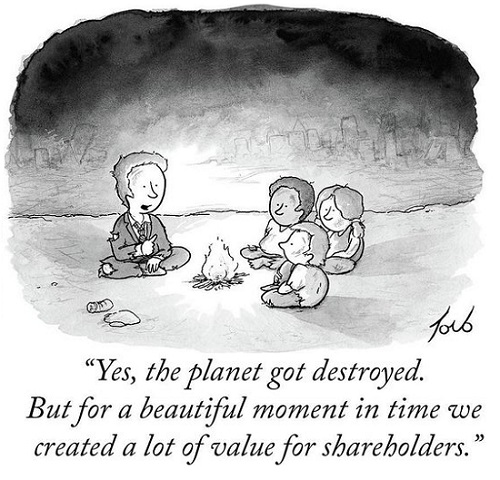
In the second, a man in a tattered suit sits cross-legged near a campfire with three children listening to him intently as he says this: “Yes, the planet got destroyed. But for a beautiful moment in time we created a lot of value for shareholders.”

Now, in the you-can’t-make-this-stuff-up category, financial writer Paul Farrell used the caption from the first cartoon in a 2015 piece for MarketWatch entitled: “Your No. 1 end-of-the-world investing strategy.” The subheading is: “How to pick stocks for the near term when long-term trends say collapse is near.” The subhead actually seems like it might be another caption from a New Yorker cartoon (or possibly one from The Onion). Why exactly would you invest in stocks—as opposed to seeds of food crops and sturdy garden implements—”when long-term trends say collapse is near”? But I’ll put that down to bad headline writing.

In Farrell’s defense, he frequently used his column in MarketWatch to warn his readers of the coming collapse of modern civilization if we don’t change our ways. He was obliged to give investment advice, of course, because that’s what the column was for.

Few other investment gurus are as intellectually honest as Farrell. Among prominent investment managers, only Jeremy Grantham comes close to understanding the scope of the challenges we face. Grantham wrote a piece in 2013 called “The Race of Our Lives” that outlines the myriad challenges humans face. He starts with a discussion of the fall of civilizations. (He updated his views in 2018.)

One would think that the coronavirus pandemic would allow for some sober reflection among those in the financial community as the pandemic-induced crash of the economy and the markets has called into question the stability of practically all the arrangements of modern civilization. Instead, the focus is on how stock markets could be back at or near all-times highs at the beginning of what is arguably the next Great Depression.

The New Yorker cartoons linked above appropriately characterize the madness that grips late-stage civilizations as their pillars begin to fall. Instead of attempting to adapt to new realities, every attempt is made to maintain the current fragile system. The trillions of dollars pumped into the world financial system by central banks and governments in the wake of the pandemic have done little except stoke renewed financial bubbles in practically all financial markets (and thereby bailed out the mostly wealthy owners of financial assets).

The disconnect is hard to miss. The latest reading of the U.S. Federal Reserve Bank of Atlanta’s GDPNow indicator, which is frequently updated as new data becomes available, now predicts that U.S. GDP will contract by 45.5 percent in the current quarter. (The number is annualized and seasonally adjusted.)

Even so the NASDAQ Composite Index hit a new all-time high earlier this month just three months after the recent trough reached during the crash. The S&P 500 is now very close to a new all-time high. Neither development makes sense in the middle of the worst economic downturn since the Great Depression. For comparison, it took more than two years for the NASDAQ Composite from the bottom in 2009 during the Great Financial Crisis to regain its 2007 highs. It took the S&P 500 more than four years.

Of course, the financialization of everything continues. Vaccine makers are in line for government funds. Naturally, it takes money to develop a vaccine. But drug makers aren’t in the business of keeping people healthy. They are in the business of making money. In the United States at least they are helped by the fact that they aren’t liable if their vaccine kills or injuries someone. And, executives in one money-losing pharmaceutical firm cashed in stock right after their company goosed the shares significantly higher with a very preliminary announcement about the company’s coronavirus vaccine research.

When it comes to real estate, it used to be that people bought it for income and as a store of value. Now firms buy real estate mostly with borrowed money and try to make gains mostly through property price appreciation. Often the real estate loans are packaged into securities that are sold and resold as part of the giant Wall Street and worldwide financial casino.

One of the surest signs of the financialization of everything and the growing disconnect of finance from reality is the credit default swap (CDS). The CDS is essentially insurance for loans and bonds. The buyer pays the seller a premium every month. If the instrument insured defaults, the seller provides a predetermined payment to reimburse the CDS buyer. Now here’s the weird thing: An investor doesn’t even have to own the loan or bond to insure it. It’s like me taking out an insurance policy on your home against fire when I have no ownership or interest in the home. In fact, I have every incentive to make sure your house burns down. Do you see any problem with that?

For normal insurance, the buyer must have an insurable interest. Typically, this means the buyer must actually own the thing he or she is insuring. The CDS, on the other hand, is an ideal instrument for those who want to bring on a financial end-of-the-world scenario. The buyers have every reason to want the economy to go down the drain as their payments may be 10 or even 20 times their initial investment.

Many wealthy people fear and even believe an end-of-the-world scenario is possible or probable. Some think they can hold up in luxury bunkers until the dust clears. But what if, when the dust clears, their wealth is gone and the financial world they used to inhabit has vanished.

Perhaps they will sit around campfires telling their grandchildren about the old days when finance was king and the real economy of goods and services was just a place where rubes got their daily bread—while, of course, simultaneously providing an outsized portion to the rich.