Wokeness is a Product of Neoliberalism

Why don’t more people make this connection?

By Chad C. Mulligan

Source: The Hipcrime Vocab Substack

One thing I haven’t seen people point out anywhere else is how much the current atmosphere of “wokeness” is an outcome of neoliberalism.

Let me explain.

There was a lot of analysis written about neoliberalism back in the 1990s when it was still a relatively new phenomenon, having only been enshrined as the dominant economic paradigm in the 1980s. Now that neoliberalism has become simply the water in which we swim and the horizon upon which we gaze, we don’t even notice it anymore. The idea that there could be other ways to organize the economy and society has completely vanished from the discourse even on the nominal “Left”—so utterly complete has been its intellectual victory.

I can’t recall all the books and articles I read during that time, but a couple of standouts were One Market Under God by Thomas Frank and No Logo by Naomi Klein. Frank’s The Baffler magazine published a lot of good articles about neoliberalism back in those days, and Klein’s subsequent The Shock Doctrine is indispensable for understanding how neoliberalism took over the world.

One of the things that those analyses pointed out was the fact that neoliberalism derided governments as universally incompetent and inefficient and argued that only market competition could distribute goods and services effectively.

Furthermore, those markets had to be global in scope and free from “interference,” which was broadly defined as anything that hindered profit maximization including worker and environmental protections. This, in theory, would lead to ideal outcomes—or at least as close to ideal as they could be in a world of inherent scarcity.

As a corollary of this, neoliberals argued that democratic politics—the idea that citizens could express their wishes and desires via their elected representatives—was a hopelessly naive and outdated notion in the age of globalism. Rather, they argued that people’s preferences and desires would be more accurately reflected by how people spent their money in “free and open” markets. People’s spending patterns—aggregated and allocated by markets—would therefore be a better agent of social change than ineffective political action according to neoliberal theory1.

The One Big Market under neoliberalism, therefore, was seen not just a method for coordinating economic activities and allocating goods and services, but as the highest expression of people’s fundamental valuesWe were now expected to change the world thru shopping. As a result of this, you were expected to be an “ethical consumer.” You were exhorted to “spend your values.” Markets, neoliberals argued—and not popularly elected governments—were the true expression of the democratic will. As our choices at the voting booth began to narrow and seem more and more alike, we were told to vote with your dollar!

Here’s a concrete, real-world example. If you were concerned about dolphins being ensnared and killed in fishing nets used to dredge the ocean for tuna, the solution was not to ban the practice. No, the solution was to spend ethically on products labeled “dolphin safe.” Since consumers would express their preferences via buying dolphin safe tuna instead of the ones not so labeled, eventually the Invisible Hand of the Market would cause this practice to die out without a single government regulation. Similarly, if you wanted to support sustainable farming practices, you would spend preferentially on products labeled “organic” rather than the alternatives.

So in the neoliberal world view, the best way to bring about positive social change was by individuals spending their money in markets. That’s why in a modern shopping center you see all kinds of labels festooned on every conceivable product proclaiming how it is “responsibly sourced,” or how environmentally-friendly it is, or how the package is biodegradable, or how the farmers were fairly compensated, or whatever. You never saw that in the 1960s or 1970s—this change was ushered in by neoliberalism.

Now when you went to the grocery store it was no longer just to buy groceries—you had the obligation to save the world! (As if your life wasn’t stressful enough with the ever-longer working hours that were also the result of neoliberalism). A recurring theme of those analyses I read back in the day was the replacement of citizens with consumers.

(Of course, what’s to stop corporations from slapping any old claim onto their products? How can shoppers evaluate these claims? How can they possibly know what’s accurate and what’s not? Into this void stepped literally hundreds of different (private) certification agencies to try and make sure that these labels accurately reflected what they claimed. Thus, in the effort to avoid regulating markets, neoliberalism actually caused a proliferation of far more regulations and regulatory agencies than ever before. And often these privatized agencies have nonexistent oversight, poor standards and lax enforcement).

Another fundamental aspect of neoliberalism was the notion that competition would bring about ideal social outcomes. Therefore competition, neoliberals argued, had to be introduced into absolutely every aspect of human affairs. In this regard, neoliberalism a was really not just about economics, but was rather a radical totalitarian vision for remaking human society.

This extended even to social issues. For example, the philosophy behind “school choice” came from the notion that the problem with public schools was the lack of free market competition because schools were a state-owned monopoly. State-owned monopolies are the greatest possible evil under neoliberalism because they are not subject to market competition. By unleashing “choice,” schools would be forced to compete for students just like businesses compete for customers. This would make public education better, the thinking went, by eliminating bad schools and teachers and creating “lean and mean” educational institutions.

Even environmentalism has been colonized by neoliberalism. Instead of limiting the emission of fossil fuels, for example, new and exotic markets would be established so that polluters could trade opaque “carbon credits” in order to theoretically allocate pollution the same way we allocate any other resource under neoliberalism. This also demonstrates how neoliberalism is not anti-regulation or “small government” as is often portrayed, since creating these kinds of artificial markets takes massive amounts of government regulation and bureaucracy.

As this all-encompassing philosophy gradually took over the world, social protections were dismantled, regulations were abolished, and untrammeled, cutthroat competition was unleashed in every arena of life.

But it was Karl Polanyi who pointed out that such a vision of turning over society to anarchic markets with no protections and no refuge from its capricious dictates would lead to the “demolition of society.” No one could long withstand the never-ending whipsaws and bullwhips of “pure”relentless market competition—not consumers, not workers, and not even the businesses themselves! That’s why its has never existed, he said, and cannot exist.

So what actually happened in the real world due to unleashing this radical philosophy was an unprecedented wave of mergers, acquisitions, and consolidations in every sector of the economy, enabled by high finance (which was also “unleashed” thanks to neoliberalism).

You see, competition is expensive. It is also highly inefficientIt’s much more effective for parties to cooperate than to compete. That’s just game theory 101. It’s true of human affairs just as it is in nature. That’s why you see cooperation everywhere throughout the animal kingdom as Peter Kropotkin pointed out long ago. Any species where every single member was perennially locked in existential competition with every other member of the species would quickly die out, he said. Even where competition does exist in nature, it is in very limited in scope and in circumscribed contexts like mate choice.

Competition is also inherently unstable. You can’t just have an endless tournament going on forever and ever as free market theory depicts. Eventually there has to be a winner. Again, this is simply game theory 101. You can observe this everywhere you look.

So the current wave of consolidations and mergers in every sector of the economy can be seen as the logical outcome of neoliberal philosophy when applied to the real world as opposed to the world depicted in economic textbooks and think-tank policy papers. Want to know why the entire economy is dominated by a handful of mega-monopolies these days? That’s the reason why.

But getting back to our initial topic, here’s the point that’s absolutely critical: as a result of this neoliberal transformation, corporations had to portray themselves as agents of positive social change.

Read that again. And again and again and again until it sinks in.

This is what has lead to the rise of the modern “socially conscious” corporation and to so-called “woke capitalism.”

Think about it. Back in the pre-neoliberal 1960s, did any company bend over backwards to convey what it believed about absolutely anything? About any social issue whatsoever? No, because corporations weren’t expected to do that. Corporations were widely seen as anonymous entities devoid of values designed to make money by producing the goods and services consumers wanted. Back in the 1960’s—an era of rapid social change—no one cared about what IBM, Boeing, McDonalds, DuPont, General Electric, Coca Cola, General Motors, Prudential, Chevron, or any other big corporation thought about anything, much less the prevailing social issues of the day. That’s what politics was for! Businesses were expected to make money, full stop. Besides, how could a corporation really “think” anything? A corporation is a faceless bureaucratic enterprise composed of hundreds, or even thousands of individuals, each with their own personal set of values and beliefs. The very idea that a corporation could “believe” anything would have been seen as preposterous and absurd back then.

Spending money in “free” markets has subsequently become the only acceptable form of social protest or fomenting change under globalized neoliberalism—and not, for example, people banding together in popular movements to advocate for a better world. Government and politics have become passé and irrelevant—or so we’re told by those in charge. The sole option you have as a lone individual in the face of this relentless onslaught is to become an ethical consumer—in other words, to “spend your values.” Therefore, in order to meet this solemn obligation, you have to be sure that when you hand your money over to a corporation, that corporation reflects your values! That is a fundamental tenet of neoliberalism and its emphasis on markets—and not governments—as the highest arbiter of social values and preferences.

Yet very few commentators on the (fake) Left and the (pseudo) populist Right seem to grasp this. Instead they just shake their fists and rage.

So in order to get their hands on those precious “ethical” dollars, faceless bureaucratic corporations have to fashion themselves as “socially responsible.” As “ethical.” As being “positive change agents.” To that end they have launched wave after wave of PR campaigns designed to proclaim just how ethical and virtuous they are, from Amazon to Dove to Gillette, and every other big business has to follow suit.

Consider, for instance, those Dove advertisements that promised to let plus-size women believe they were beautiful—and publicly paraded them in their bras and panties in a commercial for cellulite-reducing cream. Or the Heineken “Worlds Apart” ad that showed people of disparate backgrounds and races coming together (eventually) over the beer. Or—to bring things back to the strategic positioning of carbonated sugar water as a proto-revolutionary product—the (thankfully short-lived) Kendall Jenner Pepsi spot that portrayed the soda as the means to bring Occupy-style protesters back into a grateful posture of consumer-abundance connoisseurship…

Believe in Something (The Baffler)

This also ties in with the “doing well by doing good” ethos of philanthropic capitalism as described by Anand Giridharadas in his book, Winners Take All. Once again, elected governments and politicians are portrayed as hopelessly inept and incompetent (sense a pattern?). In place of governments installed by the will of the people, therefore, “social entrepreneurs” will step into the void and solve the most pressing social problems of the day—and make a killing $$$ by doing so. This is portrayed as a “win-win” scenario in the media, which is owned and controlled by those same rich people (the fact that every single social problem seems to be getting exponentially worse has not deterred this policy approach in the slightest).

So if you wonder where all that cloying, patronizing Silicon Valley bullshit about “changing the world” and “making the world a better place” comes from—that’s where it comes from. It’s basically a form of neofeudalism in practice.

So the end result of all this is that under neoliberalism corporations are now obligated to portray themselves as ethical and moral in order to attract precious consumer dollars. Hence the rise of the modern “woke” corporation expressing it’s opinion on absolutely every hot-button issue of the day—from Black Lives Matter, to gay marriage, to the abortion debate, to transgender rights, to sexual harassment, to gun control, to multiculturalism, to whatever contentious wedge issue the political Right will dream up next.

And whether you like it or not, the people who tend to earn the most under globalized, technocratic monopoly capitalism really do strongly support cosmopolitan values like diversity, tolerance and inclusiveness. And since we are obligated to “spend our values” under neoliberalism, corporations have to cater to them—and to make sure that everyone knows about it. Thus they have to “officially” support things like Black Lives Matter. They have to speak out against discrimination against gay and transgender people. They have to be “antiracist.” They have to extol “empowering women and girls.” All because they need to attract the kinds of people who “spend their values,” and those values are more likely to be socially liberal for the kinds of people that corporations want to attract both as employees and consumers. That’s just the reality, and it’s not likely to change anytime soon.

And even though conservatives may not like it, socially regressive people and reactionaries tend to be poorer and less educated overall—and hence are less desirable as workers and consumers. That’s also just how it is. Therefore, corporations are “woke” based on a cynical, self-interested calculation of what will net them the most consumer dollars under neoliberal capitalism, and no amount of conservative grousing is going to change that. As a result, reactionaries and authoritarians are increasingly turning to politics to force their values upon people which they can’t enforce via the kinds of free market choices that they believe should dictate every other aspect of life.

When it became clear that the NFL supporters—largely white, male, and older—were outnumbered by the corporation’s brand loyalists—more diverse and younger—Nike went ahead and now even claims that it inaugurated the campaign because it believes that Kaepernick “is one of the most inspirational athletes of his generation.”

Believe in Something (The Baffler)

Of course, if we had a healthy and functioning political system none of this would be necessary. And it follows that if neoliberalism had not become the dominant social and economic paradigm of the twenty-first century there would be no such thing as “woke” capitalism in the first place.

So it’s truly amusing to watch the political Right rage to the heavens at the result of their own economic philosophy being applied in practice.

It’s also funny that, to my knowledge, no one appears to have made this connection. After all, why did corporations only relatively recently (i.e. after the 1990s) begin virtue signalling at every opportunity? It’s not just because everyone suddenly became “based” at approximately the same time. It’s the economic system, stupid!

Of course, it’s a win-win situation for political conservatives since they now have something to permanently complain about to rally people to their side, even though they are still just as pro-wealth and anti-worker as ever, and even though they still fervently believe in the most toxic tenets of neoliberalism (such as its contempt for democratically elected governments and its antipathy toward regulations and constraining the rich in any way). That’s the natural result of gutting civil society in favor of apotheosizing an all-powerful Market.

Of course, the bad news is that the end result of neoliberalism will probably be the rise of a twenty-first century form of fascist authoritarianism based on what I’m seeing in the media and across the political spectrum these days.

In conclusion, I find all of these “culture war” topics utterly inane and ridiculous (despite all the money you can make by endlessly bellyaching about them on Sub$tack). In a country where many citizens can’t even access basic health care, homelessness is endemic and rising, higher education is unaffordable, crime and suicide are rampant, people are mired in debt, wages have stagnated and mass shootings occur on a weekly basis2, I find it hard to get worked up over “wokeness” and “cancel culture.” And, as many besides me have pointed out, the idea that this cynical virtue signalling by mega-corporations means that they are in any way “left-of-center” by any reasonable definition of that term is absurd. After all, we’re talking about some of the most vile, sociopathic billionaires since the Gilded Age and some of the most brutal working conditions since the era of George Pullman. And the saddest thing is, we’ll never be able to unite to stop them since—thanks to neoliberalism—we will be kept perennially at each other’s throats while they continue to Tweet from their luxury yachts, penthouses, villas, and private jets about diversity and inclusiveness for ever and ever.

1 A good book about this is Undoing the Demos: Neoliberalism’s Stealth Revolution by Wendy Brown. Here’s an interview with the author.

2 It’s worth noting that I wrote this post before the latest massacre in Texas.

The War in Ukraine Marks the End of the American Century. “What’s Left is a Steaming Pile of Dollar Denominated Debt”

By Mike Whitney

Source: Global Research

“The ferocity of the confrontation in Ukraine shows that we’re talking about much more than the fate of the regime in Kiev. The architecture of the entire world order is at stake.” Sergei Naryshkin, Director of Russia’s Foreign Intelligence.

***

Here’s your ‘reserve currency’ thought for the day: Every US dollar is a check written on an account that is overdrawn by 30 trillion dollars.

It’s true. The “full faith and credit” of the US Treasury is largely a myth held together by an institutional framework that rests on a foundation of pure sand. In fact, the USD is not worth the paper it is printed onit is an IOU flailing in an ocean of red ink.

The only thing keeping the USD from vanishing into the ether, is the trust of credulous people who continue to accept it as legal tender.

But why do people remain confident in the dollar when its flaws are known to all? After all, America’s $30 trillion National Debt is hardly a secret, nor is the additional $9 trillion that’s piled up on the Fed’s balance sheet. That is a stealth debt of which the American people are completely unaware, but they are responsible for all the same.

In order to answer that question, we need to look at how the system actually works and how the dollar is propped up by the numerous institutions that were created following WW2. These institutions provide an environment for conducting history’s longest and most flagrant swindle, the exchange of high-ticket manufactured goods, raw materials and hard-labor for slips of green paper with dead presidents on them.

One can only marvel at the genius of the elites who concocted this scam and then imposed it wholesale on the masses without a peep of protest. Of course, the system is accompanied by various enforcement mechanisms that swiftly remove anyone who tries to either break free from the dollar or, God help us, create an alternate system altogether. (Saddam Hussein and Muammar Qaddafi come to mind.) But the fact is– aside from the institutional framework and the ruthless extermination of dollar opponents– there’s no reason why humanity should remain yoked to a currency that is buried beneath a mountain of debt and whose real value is virtually unknowable.

It wasn’t always like this. There was a time when the dollar was the strongest currency in the world and deserved its spot at the top of the heap. Following WW1, the US was “the owner of the majority of the world’s gold” which was why an international delegation “decided that the world’s currencies would no longer be linked to gold but could be pegged to the U.S. dollar, “because the greenback was, itself, linked to gold.” Here’s more from an article at Investopedia:

“The arrangement came to be known as the Bretton Woods Agreement. It established the authority of central banks, which would maintain fixed exchange rates between their currencies and the dollar. In turn, the United States would redeem U.S. dollars for gold on demand….

The U.S dollar was officially crowned the world’s reserve currency and was backed by the world’s largest gold reserves thanks to the Bretton Woods Agreement. Instead of gold reserves, other countries accumulated reserves of U.S. dollars. Needing a place to store their dollars, countries began buying U.S. Treasury securities, which they considered to be a safe store of money.

The demand for Treasury securities, coupled with the deficit spending needed to finance the Vietnam War and the Great Society domestic programs, caused the United States to flood the market with paper money….

The demand for gold was such that President Richard Nixon was forced to intervene and de-link the dollar from gold, which led to the floating exchange rates that exist today. Although there have been periods of stagflation, which is defined as high inflation and high unemployment, the U.S. dollar has remained the world’s reserve currency.” (“How the U.S. Dollar Became the World’s Reserve Currency”, Investopedia)

But now the gold is gone and what’s left is a steaming pile of debt. So, how on earth has the dollar managed to preserve its status as the world’s preeminent currency?

Proponents of the dollar system, will tell you it has something to do with “the size and strength of the U.S. economy and the dominance of the U.S. financial markets.” But that’s nonsense.

The truth is, reserve currency status has nothing to do with “the size and strength” of America’s post-industrial, service-oriented, bubble-driven, third-world-sh**hole economy. Nor does it have anything to do with the alleged safety of US Treasuries” which– next to the dollar– is the biggest Ponzi flim-flam of all time.

The real reason the dollar has remained the world’s premier currency is because of the cartelization of Central Banking.

The Western Central Banks are a de facto monopoly run by a small cabal of inter-breeding bottom-feeders who coordinate and collude on monetary policy in order to preserve their maniacal death-grip on the financial markets and the global economy. It’s a Monetary Mafia and– as George Carlin famously said: “You and I are not in it. You and I are not in the big club.” Bottom line: It is the relentless manipulation of interest rates, forward guidance and Quantitative Easing (QE) that has kept the dollar in its lofty but undeserved spot.

But all that is about to change due entirely to Biden’s reckless foreign policy which is forcing critical players in the global economy to create their own rival system. This is a real tragedy for the West that has enjoyed a century of nonstop wealth extraction from the developing world.

Now– due to the economic sanctions on Russia– an entirely new order is emerging in which the dollar will be substituted for national currencies (processed through an independent financial settlement system) in bilateral trade deals until– later this year– Russia launches an exchange-traded commodities-backed currency that will be used by trading partners in Asia and Africa.

Washington’s theft of Russia’s foreign reserves in April turbo-charged the current process which was further accelerated by banning of Russia from foreign markets. In short, US economic sanctions and boycotts have expanded the non-dollar zone by many orders of magnitude and forced the creation of a new monetary order.

How dumb is that? For decades the US has been running a scam in which it exchanges its fishwrap currency for things of genuine value. (oil, manufactured goods and labor) But now the Biden troupe has scrapped that system altogether and divided the world into warring camps.

But, why?

To punish Russia, is that it?

Yes, that’s it.

But, if that’s the case, then shouldn’t we try to figure out whether the sanctions actually work or not before we recklessly change the system?

Too late for that. The war on Russia has begun and the early results are already pouring in. Just look at the way we’ve destroyed Russia’s currency, the ruble. It’s shocking! Here’s the scoop from an article at CBS:

“The Russian ruble is the best-performing currency in the world this year….

Two months after the ruble’s value fell to less than a U.S. penny amid the swiftest, toughest economic sanctions in modern history, Russia’s currency has mounted a stunning turnaround. The ruble has jumped 40% against the dollar since January.

Normally, a country facing international sanctions and a major military conflict would see investors fleeing and a steady outflow of capital, causing its currency to drop….

The ruble’s resiliency means that Russia is partly insulated from the punishing economic penalties imposed by Western nations after its invasion of Ukraine…” (“Russia’s ruble is the strongest currency in the world this year“, CBS News)

Huh? You mean the attack on the ruble didn’t work after all?

Sure looks that way. But that doesn’t mean the sanctions are a failure. Oh, no. Just at look at the effect they’ve had on Russian commodities. Export receipts are way-down, right? Here’s more from CBS:

“Commodity prices are currently sky-high, and even though there is a drop in the volume of Russian exports due to embargoes and sanctioning, the increase in commodity prices more than compensates for these drops,” said Tatiana Orlova, lead emerging markets economist at Oxford Economics.

Russia is pulling in nearly $20 billion a month from energy exports. Since the end of March, many foreign buyers have complied with a demand to pay for energy in rubles, pushing up the currency’s value.” (“Russia’s ruble is the strongest currency in the world this year“, CBS News)

You’re kidding me? You mean the ruble is surging and Putin is raking in more dough on commodities than ever before?

Yep, and it’s the same deal with Russia’s trade surplus. Take a look at this excerpt from an article in The Economist:

“Russia’s exports… have held up surprisingly well, including those directed to the West. Sanctions permit the sale of oil and gas to most of the world to continue uninterrupted. And a spike in energy prices has boosted revenues further.

As a result, analysts expect Russia’s trade surplus to hit record highs in the coming months. The IIF reckons that in 2022 the current-account surplus, which includes trade and some financial flows, could come in at $250bn (15% of last year’s GDP), more than double the $120bn recorded in 2021. That sanctions have boosted Russia’s trade surplus, and thus helped finance the war, is disappointing, says Mr Vistesen. Ms Ribakova reckons that the efficacy of financial sanctions may have reached its limits. A decision to tighten trade sanctions must come next.

But such measures could take time to take effect. Even if the EU enacts its proposal to ban Russian oil, the embargo would be phased in so slowly that the bloc’s oil imports from Russia would fall by just 19% this year, says Liam Peach of Capital Economics, a consultancy. The full impact of these sanctions would be felt only at the start of 2023—by which point Mr Putin will have amassed billions to fund his war.” ( “Russia is on track for a record trade surplus”, The Economist)

Let me get this straight: The sanctions are actually hurting the US and helping Russia, so the experts think we should impose more sanctions? Is that it?

Precisely. Now that we have shot ourselves in the foot, the experts think it would be wise to shoot the other one too.

Am I the only one who is struck by the insanity of this policy? Check out this clip from an article at RT:

Russia could earn a record $100 billion from gas sales to European countries in 2022 due to the sharp rise in energy prices, French newspaper Les Echos reported this week, citing Citibank analysts.

According to the paper, the projected income from gas sales will be almost twice as much as last year. The analysis does not take into account profits from the sale of other Russian commodities, such as oil, coal, and other minerals.

Les Echos reports that, despite sanctions and warnings of a sweeping embargo on Russian energy, the 27 EU countries continue to send roughly $200 million per day to Gazprom.”(“Russian gas revenues projected to hit new highs”, RT)

So the revenues from gas and oil sales are literally flooding Moscow’s coffers like never before. Meanwhile, energy prices in the EU and America have skyrocketed to 40-year highs.

Can you see how counterproductive this policy is?

The EU is sinking into recession, supply lines have been severely disrupted, food shortages are steadily emerging, and gas and oil prices are through-the-roof. By every objective standard, the sanctions have not only failed, but backfired spectacularly. Can’t the Biden people see the damage they’re doing? Are they completely divorced from reality?

Imagine if the Ukrainians use Biden’s new artillery battery (HIMARS) to shell cities in Russia? Then what?

Then Putin takes off the gloves and shuts off the flow of hydrocarbons to Europe immediately. That’s what’s going to happen if Washington continues to escalate. You can bet on it. If Russia’s “Special Military Operation” suddenly becomes a war, the lights across Europe will go dark, homes will begin to freeze, factories will go silent, and the continent will slide headlong into a protracted and painful depression.

Does anyone in Washington think about these things or are they all so drunk on their own press clippings they’ve completely lost touch with reality?

Here’s more from an article at RT:

“Even as the collective West continues to insist – against all observable reality – that the conflict in Ukraine is going well for Kiev, major media outlets are becoming increasingly uneasy with the situation on the economic front. More and more observers are admitting that the embargoes imposed by the US and its allies aren’t crushing the Russian economy, as originally intended, but rather their own.

“Russia is winning the economic war,” the Guardian’s economics editor Larry Elliott declared on Thursday. “It is now three months since the west launched its economic war against Russia, and it is not going according to plan. On the contrary, things are going very badly indeed,” he wrote…

In a May 30 essay, Guardian columnist Simon Jenkins also said that the embargo had failed…

As Jenkins points out, the sanctions have actually raised the price of Russian exports such as oil and grain – thus enriching, rather than impoverishing, Moscow while leaving Europeans short of gas and Africans running out of food.” (“As sanctions fail to work and Russia’s advance continues, Western media changes its tune on Ukraine”, RT)

Did you catch that part about “Russia winning the economic war”? What do you think that means in practical terms?

Does it mean that Washington’s failed attempt to maintain its global hegemony by “weakening” Russia is actually putting enormous strains on the Transatlantic Alliance and NATO that will trigger a re-calibration of relations leading to a defiant rejection of the “rules-based system.”

Is that what it means? Is Europe going to split with Washington and leave America to sink beneath its $30 trillion ocean of red ink?

Yes, that’s exactly what it means.

Uncle Sam’s 30 Year Bender

Proponents of Washington’s proxy-war have no idea of the magnitude of their mistake or how much damage they are inflicting on their own country. The Ukraine debacle is the culmination of 30 years of bloody interventions that have brought us to a tipping point where the nation’s fortunes are about to take a dramatic turn-for-the-worse. As the dollar-zone shrinks, standards of living will plunge, unemployment will soar, and the economy will go into a downward-death spiral.

Washington has greatly underestimated its vulnerability to catastrophic geopolitical blowback that is about to bring the New American Century to a swift and excruciating end.

A wise leader would do everything in his power to pull us back from the brink.

U.S. Effort to Hurt Russia Undermines Itself and the World

African Union Chairman and Senegal president Macky Sall meeting President Vladimir Putin, June 3, 2022 (Photo:Sputnik/Mikhail Klimentyev/Kremlin via REUTERS)

By Margaret Kimberley

Source: Black Agenda Report

The U.S. drive to dominate creates self-inflicted wounds and self-imposed crises. It also creates suffering around the world with only the most servile vassal states willing to do what Washington wants. 

The United States continues to shoot itself in the foot in its futile effort to damage the Russian economy. It is also asking other nations to do likewise and live with inflation, food scarcity, and rising energy prices. European countries have gone along with the sanctions which cut off their natural gas supplies from Russia when there is no logical alternative source for them. However, the rest of the world has refused to join in U.S. and EU condemnations or accept that they must live with privations caused by the reckless actions of other nations.

Of course, the ongoing state of delusion just continues the fantasy foreign policy decision making in Washington. The Countering Malign Russian Influences in Africa Act, HR 7311 , is just one example. But while the U.S. makes up nonsense as it goes along, the real problems that African nations have with the U.S. and their desire to have good relations with Russia go unaddressed.

Russian president Vladimir Putin recently welcomed Macky Sall, president of Senegal and Chairman of the African Union (AU) to a summit meeting. African countries are particularly hard hit by sanctions against Russia. They depend on Russia and Ukraine for supplies of wheat and other grains. When the sanctions regime removed Russia from the Society for Worldwide Interbank Financial Telecommunication (SWIFT) system, it impeded Africans ability to pay for commodities, including food and fertilizer. In a virtual meeting with the EU, Sall said, “When the SWIFT system is disrupted, it means that even if the products exist, payment becomes complicated, if not impossible.” In other words, Africa has to go hungry because of the U.S. obsession with an impossible mission of breaking up Russia or turning back the clock to the 1990s when compromised Russian leadership allowed their country to be open to international thievery.

African nations are not the only ones who face serious crises because of anti-Russian sanctions. The U.S. expects India and China to give up supplies of Russian oil and cause hardships in those countries. Biden will soon visit Saudi Arabia and ask for an increase in oil production, which of course means that OPEC nations will make less money. Of course, Sall’s visit to Russia could have been a wakeup call to Washington that policy changes were needed, instead they fell back on old strategies, warning African countries not to buy grain from Russia, calling it “stolen ” from Ukraine. At a moment of opportunity, the Biden administration just added insult to injury.

The United States is still the country with the world reserve currency and 800 military bases around the world. This power is never used for the benefit of humanity. The drive to dominate never ends, and people throughout the planet are expected to go along and suffer due to American whims.

That is what the U.S. told the people of Venezuela, who had the gall to elect and re-elect left wing governments. The Trump administration demanded “maximum pressure” against Venezuela, enacting harsh sanctions that killed 50,000 people, cutting off access to foreign markets and even choosing to recognize a phony president.

But a funny thing happened on the way to destroying Russia. The Europeans who go along like good little vassals still need oil, and according to reports the U.S. has decided to allow Venezuela to sell some of its resources to their puppets in their time of need. The U.S. whiplashes from trying to punish one country, to lifting their punishments on another, while telling others they have to starve and just be quiet about it.

While the Congressional Black Caucuses (CBC) takes part in fairy tales about “malign Russian influence,” Africans are taking matters into their own hands and talking directly with Putin. They know they must ignore U.S. dictates if they are to survive. Of course Russia will ultimately create its own payment system with African countries, just as it did with China.

Meanwhile Russian victories in Ukraine continue. The Ukrainian counter attacks that have become a staple of corporate media are mostly imaginary, more grist for the war propaganda mill. Joe Biden undermines himself by blurting out that Ukraine may have to negotiate a settlement, while also announcing that the U.S. will keep sending money and military equipment.

The U.S. is once again undermining itself. An empire in crisis will inevitably behave irrationally. It demands control but creates the circumstances which undo the very systems, such as SWIFT, that it depends upon. But there will be more meetings with Putin, and more countries saying that they will not undermine themselves because Washington asks them to.

The Worst Economic Gloom In 50 Years

By Michael Snyder

Source: Activist Post

We haven’t seen anything like this in decades.  Energy prices are soaring to unprecedented heights.  Food shortages in some parts of the world are starting to become quite severe.  Rampant inflation is out of control all over the globe.  Meanwhile, economic activity is slowing down everywhere that you look.  Some are comparing this current crisis to the “stagflation” of the 1970s, but I believe that is a far too optimistic assessment.  Just about everyone can see that economic conditions are rapidly deteriorating, and there is a tremendous amount of alarm about what the months ahead will bring.

According to a brand new Wall Street Journal-NORC survey that was just released, the percentage of Americans that believe that the state of the U.S. economy is “poor or not so good” is 83 times larger than the percentage of Americans who believe that the state of the U.S. economy is “excellent”…

A severe pessimism grips the U.S. economy and Americans report the highest level of dissatisfaction with their financial situation in at least half a century, poll results released Monday show.

Eighty-three percent of Americans describe the state of the economy as poor or not so good, according to a Wall Street Journal-NORC Poll. Only one percent describe the economy as “excellent.”

I would like to talk to someone from the one percent of Americans who still believe that the U.S. economy is in “excellent shape”.

To me, it is always fascinating to find someone who can completely deny reality even when all of the evidence points in the other direction.

The same survey found that the percentage of Americans who are “not at all satisfied with their financial condition” is the highest in at least 50 years

Thirty-five percent said they are not at all satisfied with their financial condition, the highest level of dissatisfaction since NORC began asking the question every few years starting in 1972.

Sixty-three percent of Americans say they are extremely or very concerned about the price of gas. Fifty-four percent say they are extremely or very concerned about the impact of high grocery prices on their household’s financial situation. Just 13 percent say they not very or not at all concerned about gas prices and 19 percent about grocery prices.

In other words, this is the gloomiest that Americans have been about their own personal finances in at least five decades.

Wow.

One of the big reasons why people feel this way is because the price of just about everything is going up.

In particular, the price of gasoline has been making national headlines just about every day.  On Tuesday, it set another brand new record

The national average price of gas is now $4.955, reflecting an over three-cent jump overnight, 28-cent rise in the last week, and nearly 64-cent rise in the last month. Diesel also hit another record on Tuesday, reaching $5.719.

Currently, 16 states are experiencing an average price of gas of $5.00 or more. That includes Maine ($5.023), Massachusetts ($5.21), New Jersey ($5.032), Pennsylvania ($5.031), Michigan ($5.214), Ohio ($5.061), Indiana ($5.234), Illinois ($5.532), Idaho ($5.025), Alaska ($5.469), Hawaii ($5.493), Washington ($5.489), Oregon ($5.485), Nevada ($5.564), Arizona ($5.181), and California ($6.390). California’s Mono County appears to be reporting the highest gas price average in the Golden State — $7.213.

Unfortunately, there is a growing consensus among the experts that this is just the beginning.  Here is one example

With the summer travel season just getting underway, demand for gasoline, coupled with the cut-off of Russian oil shipments due to the war in Ukraine, is sending oil prices higher on global markets.

The national average for gasoline could be close to $6 by later this summer according to Tom Kloza, global head of energy analysis for the OPIS, which tracks gas prices for AAA.

And here is another example

GasBuddy head of petroleum analysis Patrick De Haan provided insight into record-high gas prices, warning on Wednesday that “we’re going to be swimming in these high prices for a while.”

Speaking on “Varney & Co.” on Wednesday, De Haan also revealed his forecasts for how high prices at the pump will climb, arguing that they could reach a national average of $6 a gallon in the coming months, but “what seems like more of a guarantee is that $5 mark.”

Others are even more pessimistic.  In fact, the head of commodity trading giant Trafigura just warned that the price of oil could actually make a “parabolic ” move in the months ahead.

Needless to say, energy prices have a domino effect throughout the entire economy.  When commentator Anthony B. Sanders contacted moving companies about his coming move out of state, he could hardly believe the quotes that he was given

As I line up my move from Fairfax VA to Columbus OH, I am getting a variety of quotes from moving companies. And wow! The cost of moving using a national moving company for a 4 bedroom house is $15,000 to $20,500. That includes International, North American and Bekins.

One of the reasons for the high cost of moving is the massive increase in diesel fuel used for trucking. Diesel fuel under Biden has risen 117%. And since it was revealed that natural gas often is used for electric charging stations, and NATGAS is up 281% under Biden (but there aren’t many electric moving trucks yet).

Could you imagine paying $20,000 to move from Virginia to Ohio?

In the old days, you could purchase your own new vehicle for that much money.

In this crazy environment, some companies are attempting to hide inflation by shrinking their package sizes

“Joining the parade of downsized products is cereal stalwart Honey Bunches of Oats, which has seen the weight of its standard box, previously 14.5 ounces, lessen to 12 ounces — a reduction of roughly 17 percent,” the U.K. paper said.

Angel Soft toilet paper has also reduced its size from 425 sheets per roll to 320, while Bounty paper towels have cut their rolls from 165 sheets per roll to 147 late last year. Gatorade also cut its bottle size from 32 ounces to 28 ounces.

Do they actually believe that we will not notice that the packages have changed?

And this isn’t just happening here in the United States.  At this point, this is taking place all over the globe

In the U.S., a small box of Kleenex now has 60 tissues; a few months ago, it had 65. Chobani Flips yogurts have shrunk from 5.3 ounces to 4.5 ounces. In the U.K., Nestle slimmed down its Nescafe Azera Americano coffee tins from 100 grams to 90 grams. In India, a bar of Vim dish soap has shrunk from 155 grams to 135 grams.

Our standard of living is falling with each passing day, and that process is only going to accelerate during the second half of this year.

In a desperate attempt to keep living the way that they always have, many Americans are turning to their credit cards at an alarming rate.

Needless to say, that is only a short-term solution.

And at the same time, overall economic activity continues to slow down

A closely followed measurement from the Atlanta Federal Reserve Bank suggests the economy could be headed for a second-quarter decline in gross domestic product, the broadest measure of goods and services produced in a country. The GDPNow tracker shows the economy grew at an annualized pace of just 0.9% in the spring, a steep decline from its previous estimate of 1.3% on June 1.

If U.S. GDP is actually negative for the second quarter, that will be two quarters in a row, and that will mean that we are officially in a recession right now.

But what we are heading into in 2023 and beyond is not going to be just a “recession”.

Ultimately, we are heading into the sort of “nightmare scenario” that I have warned about for years.

It took decades of very foolish decisions for us to reach this point, and our leaders in Washington continue to make very foolish decisions.

So the truth is that there are no long-term solutions in sight.

Only pain.

So if the American people are this upset about the economy now, how will they be feeling six months down the road?

The REAL agenda behind the created food crisis

The created food crisis, whether real or a smoke-and-mirrors psy-op, is all about tearing down the global food system and “building back better” – a new dystopian food system built by corporate monoliths and rigidly controlled in the name of the greater good.

By Kit Knightly

Source: Off-Guardian

We’re in the early stages of a food crisis.

The press has been predicting this for years, but  up until now it always appeared to be nothing more than fearmongering, designed to worry or distract people, but the signs are there that this time, to quote Joe Biden, it “is going to be real”.

Nobody knows how bad it could get, except the people who are creating it.

Because the evidence is pretty clear, it is being deliberately & cold-bloodedly created. We’ve been documenting it for months.

We have Russia’s “special operation” in Ukraine driving up the price of staple foods, wheat and sunflower oil, as well as fertiliser.

We have the sudden “bird flu outbreak” driving up the price of poultry and eggs.

The soaring price of oil is driving up the cost of food distribution.

The inflation caused by huge influxes of fiat currency means families are spending more money on less food.

And as all this is happening, the US and UK (and maybe others, we don’t know) are literally paying farmers not to farm.

It’s pretty clear this is The Great Reset: Food Edition. The lockdown melody with slightly different lyrics. A process of breaking down the structures already in place so we can “build back better” with a more controlled and more corporatised food system

Just as the Covid “pandemic” was said to highlight “weaknesses in the multilateral system”, so this food crisis will show that our “unstable food systems are in need of reform” and we need to ensure our “food security”…or a thousand variations on that theme.

That’s not supposition. They already started, over a year ago.

The Journal of Agriculture, Food Systems & Community Developments published a paper in February 2021 titled:

Dismantling and rebuilding the food system after COVID-19: Ten principles for redistribution and regeneration

In an interview from July last year, Ruth Richardson the Executive Director of the NGO Global Alliance for the Future of Food literally said:

Our Dominant Food System Needs to Be Dismantled and Rebuilt”

Later, in September 2021, the UN convened the first-ever “Food Systems Summit”, whose mission statement included the line:

Rebuilding the food systems of the world will also enable us to answer the UN Secretary-General’s call to “build back better” from COVID-19.

Writing in the Guardian two weeks ago, George Monbiot, weathervane for every deep state agenda, states with his trademark lack of subtlety:

The banks collapsed in 2008 – and our food system is about to do the same…The system has to change.

But what does “change” and “rebuilt” actually mean in this context?

Well, that’s no mystery, they’ve been talking it up for years.

Almost all of these are stories from just the past month or so, many of them talking points at the World Economic Forum’s Davos Conference.

As is almost always the case, the problem to which they’re currently “reacting” already has a series of pre-ordained solutions.

Just as we saw lockdowns break the economy to pieces whilst the billionaire class land record profits whilst corporate megaliths expanded their monopolies, so too will any proposed food security policies end up benefiting the already mega-rich or installing infrastructure for corporate control.

They just announced the building of the largest “cultured meat factory” in the world. Fake meat, of course, can’t be raised at home and is subject to patented processes of creation. Genetically edited or modified plants and animals are likewise subject to patents.

Supranational companies, with profits larger than the budget of some nations, are developing carbon footprint tracker apps which reward people for making the “right decisions”. That could easily be applied to food.

Bill Gates has quietly become the largest owner of agricultural land in the United States. Land on which he can grow new Frankencrops, or which the US government will pay him not to use.

The play is clear: Right now they’re getting ready to tear all our old food systems down, with the stated aim of building them back better.

But better for them, not us.

Livelihoods in a Degrowth Economy

By Charles Hugh Smith

Source: Of Two Minds

Let’s consider livelihood options in an unsustainable economy of extremes that are unraveling, an economy that is being forced to transition to Degrowth.

Nassim Taleb’s book Antifragile explains the differences between fragile systems (systems that cannot survive instability), resilient systems (systems that can survive instability and stay the same) and antifragile systems (systems that adapt and emerge stronger).

The ideal way of life is antifragile: resilient enough to survive adversity and adaptable enough to evolve solutions to whatever comes our way.

The key antifragile traits are adaptability and rapid, flexible evolution. Adversity puts selective pressure on organisms: only those organisms which adapt successfully survive.

The more antifragile our livelihood and way of life, the better prepared we will be to recognize and pursue opportunities.

An unsustainable, unstable economy puts a great deal of pressure on its participants. Only those with the skills and agency to move, adapt and experiment will emerge stronger.

Adaptability requires agency. Those without much control are stuck with the consequences of others’ decisions and actions.

In my experience, self-reliance is integral to an antifragile way of life.Self-reliance and self-sufficiency are similar but not identical.

Self-sufficiency means reducing our dependence on resources provided by others: growing our own food, doing our own repairs, etc. Self-sufficiency can also be understood as shortening dependency chains.

Compare being dependent on food shipped thousands of miles to relying mostly on food grown within 50 miles of home. There are so many ways long supply chains can break down because the entire system breaks down if even one link in the dependency chain breaks.

Total self-sufficiency isn’t practical. We all rely on industrial production of metals, tools, plastics, fertilizers, etc. But reducing our dependence on systems that are fragile by consuming less and wasting nothing increases our antifragility.

Self-reliance is being able to take care of oneself, being independent in thought and action, and maintaining control of decision-making–what I’ve been calling agency.

Self-reliance means being able to go against the crowd. This requires independence and confidence in one’s inner compass.

Being able to take care of oneself means drawing upon inner resources, being able to identify the essentials of a situation and coming up with solutions that are within reach.

Since households with multiple incomes are far more resilient than households with all their eggs in one basket, our goal is to develop income streams that we control. The ownership is more important than the scale of the income. A modest income we control is far more antifragile than a larger income we have little control over.

Developing income streams is easier if we approach the task with an entrepreneurial mindset.

This mindset looks at work in terms of markets, unmet demand, pricing power, networks of trustworthy peers, trial and error (experiments), optimizing new skills, seeking mentors, learning to make clear-eyed assessments of what’s working and what isn’t, and then acting decisively on the conclusions.

All these skills can be developed. They are very useful in navigating unstable conditions because they prepare us to act decisively rather than passively await others to decide what happens to us.

Some skills can be applied to virtually every field: project management, bookkeeping, working well with others, computer skills and communicating clearly. Being a fast learner is valuable in every field.

In my books and blog posts, I’ve covered the difference between tradable work–work that can be done anywhere–and untradable work, work that can only be done locally. Having skills that are untradable is advantageous, as the competition is local rather than global.

Skills that can’t be automated are also advantageous. Robots are optimized for repetitive tasks and factory / warehouse floors with sensors. They are not optimized for tasks that must be figured out on the fly and that require multiple skills.

Who fixes the robot when it fails out in the field? Another robot? Who replaces the dead battery in the drone? Another drone? The point is there are real-world limits on robotics, artificial intelligence, machine learning and automation that proponents gloss over or ignore.

Those with multiple skills who can problem-solve on the fly will continue to be valuable.

The models of work are changing, and this offers a wider range of options which is especially valuable to those emerging from burnout.

Combining various kinds and modes of work is called hybrid work. This could be mixing work from home (remote work) with occasional visits to an office, or it could be mixing a part-time job with self-employment.

I’ve written about one example in Japan called Half Farmer, Half X, where young urban knowledge workers move to the countryside to pursue small-scale farming while keeping a part-time, high-pay tech job they do online. Since the cost of living is so much lower in the countryside, these hybrid workers don’t need to work many hours remotely to cover their expenses, nor do they need their small-scale farming to be highly profitable.

Not all work is paid. Indeed, only a slice of human work globally is paid. The work that gives us the greatest fulfillment may well be unpaid or poorly paid. We may have to do some work to pay the bills while looking forward to the work we do that doesn’t earn much money.

Personally, I have always been drawn to both knowledge work and hands-on work. I worked my way through my university with a part-time job in construction. This was the ideal mix for my enthusiasms. Whenever I’ve been limited to one or the other, I feel dissatisfied. For me, hybrid work means having both knowledge work and hands-on physical labor, and having control of both.

Many people believe they need additional credentials to expand their opportunities. The alternative is to accredit yourself.

Since I’m enthusiastic about working with fruit trees and vegetable gardens, let’s say I decide to offer my services to potential customers.

One avenue is to spend money and time to get a certificate in horticulture. Alternatively, I could take photos of my own yard to document the trees I planted and how fast they’ve grown under my care. In other words, I could accredit myself, providing direct evidence of my skills and experience.

Employers have learned that completing a credential doesn’t mean the graduate will be productive. The diploma doesn’t prove the graduate learned much or has what it takes to work well with others.

The diploma actually tells us very little about the graduate. We learn much more from someone who accredits themselves by documenting projects they’ve completed.

The only real source of prosperity is improving productivity: doing more with fewer resources and labor. Economists expected the adoption of computers and the Internet to boost productivity. Instead, productivity gains have been extremely modest, 1% or 2% per year, far lower than the 10% annual gains achieved during industrialization.

This productivity paradox has puzzled economists for decades. One reason why the productivity of knowledge work ((white-collar work) has barely improved when compared to factory productivity (blue-collar work) is the methodical optimization of tasks is more difficult to apply to knowledge work. Much of this work is done by rule of thumb and what was passed down by senior workers.

There are a number of reasons for this. One is it’s easier to study the assembly of products than it is to break down the production of services.

Another is that many fields of knowledge work are so new that it’s difficult to optimize tasks because they’re constantly changing.

A third factor is that we’ve been wealthy enough to waste labor and capital on unproductive bureaucratic friction. Just as we waste water when it’s abundant and free, we also waste energy and money when they’re abundant.

In Global Crisis, National Renewal I describe the changes in the process of obtaining a building permit in the past 40 years.

In the early 1980s, I could submit a set of plans for a modest house in the morning and pick up the approved plans and building permit that afternoon. Now the process takes many months, even though the house being built hasn’t changed much at all. What changed was the permit approval process became terribly inefficient.

Since there’s few incentives to improve efficiencies in bureaucracies, it now takes a decade or longer to approve a bridge or landfill While the number of professors and doctors has increased modestly, the number of university and hospital administrators has soared.

Now that energy will no longer be cheap over the long term, incentives to improve the productivity of knowledge work will increase.

Unsustainable economies are prone to sudden changes in finance and the availability of essentials. We’re accustomed to predictable stability, and so few are prepared to respond effectively to instability.

If our lives only work when things are stable, our way of life is fragile. Recall Sun Tzu’s advice: “If a battle cannot be won, do not fight it.” If we’re only prepared for everything to stay the same, we’re fighting a battle we can’t win. We want to be prepared for sudden changes and scarcities by planning ahead and being flexible, nimble and responsive.

One facet of being antifragile is having a buffer or cushion against sudden shocks. In a 2018 interview, Nassim Taleb said, “Money can’t buy happiness, but the absence of money can cause unhappiness. Money buys freedom… to choose what you want to do professionally.”

Taleb went on to note that it takes great discipline to keep enough money stashed to give us the freedom to maintain our agency when faced with adversity. Self-reliance requires a buffer so we have time to figure out solutions and the means to pursue them.

In my experience, our willingness to consider all options, our ability to make careful decisions and take decisive action are just as important as a cushion of cash. Cash widens our options, but if we’re frozen by inexperience and fear then our options are severely limited.

The wider our range of skills, the greater our opportunities to add value. The basic needs of human life must be met and so those who can meet those needs will always be valued. This range of skills is also a buffer because it gives us more options in adversity.

How much money do we need as a cushion? The less we need, the lighter our expenses and the more options we have. If we need $10,000 a month just to pay our basic expenses, that demands a large cushion. If we’ve simplified and downsized our way of life so $1,000 a month is enough to keep us going, our cushion can be much smaller.

In other words, frugality, self-reliance and simplicity are key parts of antifragility, for they lower the cost of freedom. Money can lose its value in crisis, but our buffer of skills and self-reliance cannot be taken from us or devalued by a global crisis.

One final consideration is timing. The sooner we start preparing for degrowth, the better off we’ll be. A Chinese proverb captures this succinctly: By the time you’re thirsty, it’s too late to dig a well.

Is Housing a Bubble That’s About to Crash?

By Charles Hugh Smith

Source: Of Two Minds

Are we heading into another real estate bubble / crash? Those who say “no” see the housing shortage as real, while those who say “yes” see the demand as a reflection of the Federal Reserve’s artificial goosing of the housing market via its unprecedented purchases of mortgage-backed securities and “easy money” financial conditions.

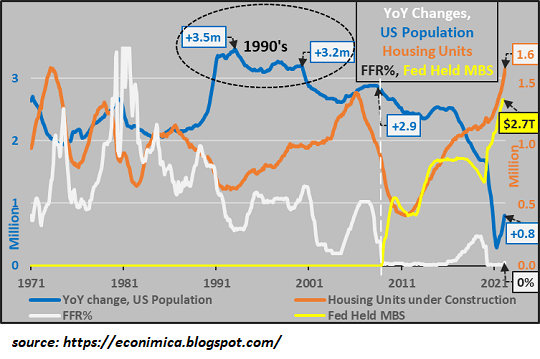
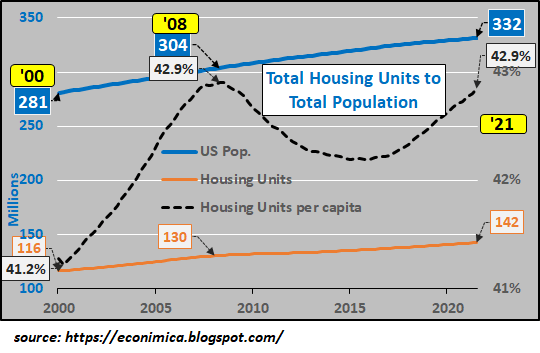
My colleague CH at econimica.blogspot.com recently posted charts calling this assumption into question. The first chart (below) shows the U.S. population growth rate plummeting as housing starts soar, and the second chart shows housing unit per capita, which has just reached the same extreme as the 2008 housing bubble.

Demographics and housing do not reflect a housing shortage nationally, though there could be scarcities locally, of course, and other factors such as thousands of units being held off the market as short-term rentals or investments by overseas buyers who have no interest in renting their investment dwellings.

On a per capita basis, housing has reached previous bubble levels. That suggests housing shortages are artificial or local, not structural.

Next, let’s consider how the current housing bubble differs from previous bubbles in the late 1970s and 2000s. In my view, the previous bubbles were driven by demographics, inflation and monetary policy: in the late 70s, the 65 million-strong Baby Boom generation began buying their first homes, pushing demand higher while inflation soared, making real-world assets such as housing more desirable.

Once the Federal Reserve pushed interest rates to 18%, mortgage rates rose in lockstep and housing crashed as few could afford sky-high housing prices at sky-high mortgage rates.

The housing bubble of 2007-08 was largely driven by declines in mortgage rates (as the Fed pursued an “easy money” policy to escape the negative effects of the Dot-Com stock market bubble crash) and a loosening of credit/mortgage standards. These fueled a bubble that morphed into a speculative free-for-all of no-down payment and no-document loans.

This decline in the cost of borrowing money (mortgage rates) enabled a sharp rise in the price of housing, a speculative boom that was greatly accelerated by “innovations” in the mortgage market such as zero down payments loans, interest-only loans, home equity loans, and no-document “liar loans”–mortgages underwritten without the usual documentation of income and net worth.

These forces generated a speculative frenzy of house-flipping, leveraging the equity in the family home to buy two or three homes under construction and selling them before they were even completed for fat profits, and so on.

Needless to say, the pool of potential buyers expanded tremendously when people earning $25,000 a year could buy $500,000 houses on speculation.

Once the bubble popped, the pool of buyers shrank along with the home equity.

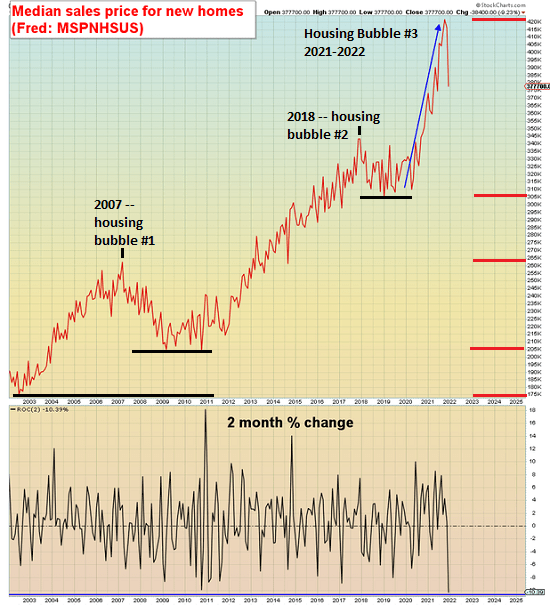
If we study this chart below of new home prices (courtesy of Mac10), we can see that the 21st century’s Bubble #2 rose as the Federal Reserve pushed mortgage rates far below historic norms. Once rates reached a bottom, the 7-year inflation of home prices (from 2011 to 2018) began rolling over.

This deflation of home prices was reversed by the pandemic recession, as the Fed’s vast expansion of credit and mortgage-buying, which pushed mortgage rates to new lows. Trillions of dollars in new credit and cash stimulus ignited a speculative frenzy in stocks, bonds and real estate, a frenzy which drove bubble #3 to extraordinary heights.

All this unprecedented fiscal and monetary stimulus also ignited inflation, and so rates are rising in response. Bubble #3 is already deflating, at least by the measure of new home prices.

But the current bubble has a number of dynamics that weren’t big factors in previous bubbles.

One is the rise of remote work. Many people have been working remotely since the late 1990s enabled Internet-based work, but the pandemic greatly increased the pool of employers willing to accept remote work as a permanent feature of employment.

This trend has been well documented, but the consequences are still unfolding: remote workers are no longer trapped in unaffordable, congested cities and suburbs.

Several other trends have attracted much less attention, but I see them as equally consequential.

1. Housing in many urban zones are out of reach of all but the top 10% without extraordinary sacrifice, and now that employment isn’t necessarily tied to urban zones, the bottom 90% of young people without family wealth or high incomes are coming to realize the benefits of urban living are not worth the extreme sacrifices needed to buy an overvalued house.

A middle-class life–home ownership, financial security, leisure and surplus income to invest in one’s family and well-being–is no longer affordable for the majority of young Americans.

Few are willing to concede this because it reveals the neofeudal nature of American life. Those who bought homes in coastal urban zones 20+ years ago are wealthy due to soaring housing valuations while young people can’t even afford the rent, much less buying a house.

If you’re not making $250,000 or more a year as a couple, the only hope for a middle-class life that includes leisure and some surplus income to invest is top move to some place with much lower housing and other costs. That place is rural America.

2. The benefits of urban living are deteriorating while the sacrifices and downsides are increasing. Urban living is fun if you’re wealthy, not so fun if you don’t have plenty of surplus income to spend.

Urban problems such as homelessness, traffic congestion and crime are endemic and unresolvable, though few are willing to state the obvious. Americans are expected to be optimistic and to count on some new whiz-bang technology to solve all problems.

Unfortunately, problems generated by dysfunctional, overly complex institutions, corruption and unaffordable costs can’t be solved by some new technology, and so the decay of cities will only gather momentum.

The hope that billions of federal stimulus funding would solve these problems is about to encounter reality as the funds dry up and all the problems remain or have actually expanded despite massive “investments” in solutions.

Few analysts have looked at the finances of high-cost cities. The decline in bricks-and-mortar retail, rising crime, soaring junk fees, rents and property taxes have all made urban small business insanely costly and therefore risky.

Small businesses are the core sources of employment and taxes. As high costs, crime, etc. choke small businesses, employment and tax revenues drop and commercial real estate sits empty, generating decay and defaults.

Once office and retail space is no longer affordable or necessary, commercial real estate crashes in value as owners who bought at the top default and go bankrupt.

People need shelter but they don’t need office space or to start a bricks-and-mortar retail business.

As urban finances unravel, cities won’t have the funding to run their bloated, inefficient, overly complex and unaccountable bureaucracies.

3. In geopolitics, we speak of the core and the periphery. Empires have a core (Rome and central Italy in the Roman Empire) and a periphery (Britain, North Africa, Egypt, the Levant).

As finances and trade decay and costs soar, the periphery is surrendered to maintain the core.

In urban zones, the same dynamic will become increasingly visible: the peripheral neighborhoods will be underfunded to continue protecting the wealthy enclaves.

Crime will skyrocket in the periphery even as residents of the wealthy enclaves see little decay in their neighborhoods.

This asymmetry–already extreme–will drive social unrest and disorder. This is a self-reinforcing feedback: as the periphery neighborhoods deteriorate, the remaining businesses flee and the smart money sells and moves away.

Tax revenues plummet and city services decay even further, persuading hangers-on to move before it gets even worse. Cities compensate for the lower revenues by increasing taxes on the remaining residents and cutting services.

Each turn of the screw triggers more closures and selling and fewer tax revenues.

4. Dependency chains will become increasingly consequential: the greater a city’s dependency on essentials trucked/shipped from hundreds or thousands of of kilometers/miles away, the more prone that city will be to disruptions of essentials: food, energy, materials and infrastructure.

Though few are willing to dwell on such vulnerabilities, most cities are totally dependent on diesel fueled fleets of trucks, rail and jet fuel for luxuries flown in from afar for virtually all goods. Cities produce very little in the way of essentials such as food and energy.

The past reliability of long supply chains has instilled a confidence that these supply chains stretching thousands of kilometers and miles are unbreakable and forever. They aren’t, and the initial disruptions will be a great shock to Americans who believe full gas tanks and fully stocked store shelves are their birthright.

5. As I’ve explained in my new book Global Crisis, National Renewalthe era of cheap, reliable abundance has drawn to a close and now we are entering an era of scarcity in essentials.

Another reality few discuss is the relative stability of global weather over the past 40 years. As weather becomes less reliable, so too do crop yields and food supplies.

Globalization has poured capital into expanding acreage under cultivation to the point that the planet’s forests are being decimated to grow more soy to feed animals to be slaughtered for human consumption.

On the margins, land that was once productive has been lost to desertification. Fresh water aquifers have been drained and glaciers feeding rivers are melting away. Soil fertility has declined even as fertilizer use has expanded.

The low-hanging fruit of GMO seeds, fertilizers, insecticides, herbicides and Green Revolution hybrids have all been plucked. The gains have been reaped but now the downsides of these dependencies are becoming increasingly consequential: fertilizer costs are rising fast, insects and diseases are evading chemicals and vaccines, and the vulnerabilities of mono-crop, industrialized agriculture and animal husbandry threaten to cascade into crop failures, soaring prices and shortages.

6. This will have two consequences: rural incomes which have been falling for decades due to globalization (i.e. bringing in cheap food from places with no environmental standards, cheap labor and few taxes / social costs) will start rising sharply, fueling a reversal in the long decline of rural communities based on agricultural income.

The soaring costs of essentials will reduce the disposable income of the bottom 90%, reducing the money they’ll have to spend on eating out, retail shopping, etc.–all the surplus spending that drives cities’ economies and tax revenues.

Few (if any) commentators forecast a cyclical reversal of the demographic trend of people moving from rural locales to cities. I think this trend has already reversed and will gather momentum as cities become increasingly unlivable, disposable incomes decline as scarcities push prices higher and people flee for lower cost, more secure environs.

7. As I often note, following what the super-wealthy are doing is a pretty sound investment strategy because the super-wealthy spend freely to buy the best advice and are highly motivated to protect their wealth.

People who live in well-known, highly desirable rural towns (Telluride, Jackson Hole, Lake Tahoe, etc.) are describing a feeding frenzy of wealthy urbanites buying multi-million dollar homes. Small cities such as Bozeman, MT and Ashville, NC are experiencing a flood of new residents that is straining infrastructure and pushing housing prices out of reach for local residents with average wages.

8. Rural towns in the U.S., Italy, Japan and even Switzerland are trying to attract new residents with offers of free land, subsidized rent, low cost homes, etc. This shows that the trends are global and not limited to any one nation. Would you take free land in rural America?

The decay of urban life isn’t yet consequential enough to push people into making a major move, but once someone has been robbed, repeatedly found human feces on their doorstep or experienced scarcities that trigger the madness of crowds, the decision to leave becomes much, much easier.

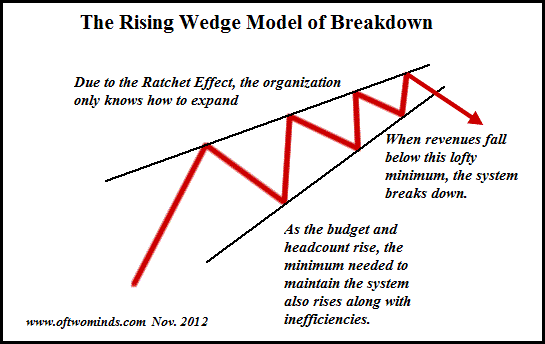
Some cities will manage the decline of employment and tax revenues more gracefully than others. Most will suffer from the dynamic I’ve often described on the blog: the Ratchet Effect. Costs move effortlessly higher as tax revenues have increased in one speculative bubble after another, but once revenues drop, cities have no mechanisms or political constituency to manage a sharp, long-term decline in revenues.

They then become prone to the other dynamic I’ve described, the Rising Wedge Breakdown (see chart below): as agencies and institutions become sclerotic, unaccountable and self-serving, even a relatively modest cut in revenues triggers institutional collapse, as the system requires 100% funding to function. A 10% reduction doesn’t cause a 10% decline in service, it causes an 50% decline in service, on the way to complete dysfunction.

Few believe cities can unravel, but remote work, geographic arbitrage (discussed below), tightening credit, rising crime, the decline of commercial real estate, end of massive stimulus, scarcities, the madness of crowds, the decline of civic services and amenities and an insanely high cost of living all have consequences and second-order effects.

What were beneficial synergies become fatal synergies as dynamics reverse and begin reinforcing each other.

So let’s put all this together.

A. The cycle of declining interest rates and inflation has ended and a cycle of much higher interest and mortgage rates and inflation is beginning. Higher mortgages rates will depress housing prices as only the highest income households will be able to afford today’s prices once mortgage rates rise.

B. The decay of urban finances and quality of life will accelerate as stimulus ends, credit dries up and inflation decimates disposable income.

C. The stress of trying to make enough money to afford the high costs of city/suburban living as the real estate bubble pops and the benefits of city living decline will burn out increasing numbers of people who will have no choice but to find more affordable, more secure and more livable places.

D. While the wealthy have already secured second or third homes in the toniest desirable towns, there are still opportunities for lower cost, more secure residences in rural areas.

E. This migration, even at the margins, will further depress urban housing prices and push prices in desirable rural locales higher.

F. This migration will have regional, ethnic and cultural variations. For example, some African-Americans leaving the upper Midwest are finding favor with communities in the South where family, church and cultural ties beckon.

G. Correspondent John F. used the phrase geographic arbitrage which means earning money remotely in high-wage sectors while living some place that’s low cost and secure.

I wrote about this many years ago in my post about young Japanese maintaining a part-time remote-work gig while pursuing farming in rural communities: Degrowth Solutions: Half-Farmer, Half-X (July 19, 2014).

H. Though monetary / inflationary forces will pop housing prices based solely on low mortgage rates, this doesn’t mean housing everywhere will decline: as burned out urbanites seek lower cost, more secure and livable places in rural locales, homes in desirable towns and small cities could rise sharply because they’re starting from such low levels.

I. If urban areas decay rapidly, housing prices could plummet much faster than most people think possible.

When cities lose employment, tax revenues and desirability, they can go down fast. Property values can fall in half and then by 90%.

How is this possible? Supply and demand: if demand falls off a cliff, there won’t be buyers for thousands of homes that come on the market all at once. This is just like a stock market in which buyers disappear, as no one wants to buy an asset that’s rapidly losing value.

As I’ve noted many times, prices for assets are set on the margins: the last sale of a house resets the price for the entire neighborhood.

The stock market is easily manipulated by the big players, who can stop a slide in prices by buying huge chunks of stocks and call options. There are no equivalent forces which can stop a decline in housing prices.

And since rates will rise regardless of what the Federal Reserve does because global capital is demanding a real return above inflation, then the hope for lower mortgage rates to support bubble-level housing prices will be in vain.

How low could housing go? As explained above, there will likely be very asymmetric declines and increases in housing valuations going forward. But on a technical-analysis level, we can anticipate a general decline to previous lows, first to the 2019 lows and then to the 2011 lows.

Some analysts believe inflation will funnel capital into housing as investors seek assets that will go up with inflation, but this is a murky forecast: the bottom 90% of American households are already priced out of coastal housing, so inflation only robs their wages of purchasing power. They don’t have any hope of buying a house anywhere near current prices.

Corporations are buying thousands of houses for the rental income, but once all the stimulus runs out and the excesses of speculation reverse, they’ll find few renters can afford their sky-high rents. At that point corporate buyers become corporate sellers, but they won’t find buyers willing or able to pay their asking prices, which are based on bubble pricing, not reality.

All these swirling currents will affect housing valuations in different places differently. Some areas could see 50% declines while others see 50% increases, regardless of mortgage rates or Fed policy.

What will become most desirable is a low cost of living, security and livability, which includes community, reduced dependency on long supply chains and local production of essentials.

We are all prone to believing the recent past is a reliable guide to the future. But in times of dynamic reversals, the past is an anchor thwarting our progress, not a forecast.

No Way Out but War

Permanent war has cannibalized the country. It has created a social, political, and economic morass. Each new military debacle is another nail in the coffin of Pax Americana.

By Chris Hedges

Source: ScheerPost


The United States, as the near unanimous vote to provide nearly $40 billion in aid to Ukraine illustrates, is trapped in the death spiral of unchecked militarism. No high speed trains. No universal health care. No viable Covid relief program. No respite from 8.3 percent inflation. No infrastructure programs to repair decaying roads and bridges, which require $41.8 billion to fix the 43,586 structurally deficient bridges, on average 68 years old. No forgiveness of $1.7 trillion in student debt. No addressing income inequality. No program to feed the 17 million children who go to bed each night hungry. No rational gun control or curbing of the epidemic of nihilistic violence and mass shootings. No help for the 100,000 Americans who die each year of drug overdoses. No minimum wage of $15 an hour to counter 44 years of wage stagnation. No respite from gas prices that are projected to hit $6 a gallon.

The permanent war economy, implanted since the end of World War II, has destroyed the private economy, bankrupted the nation, and squandered trillions of dollars of taxpayer money. The monopolization of capital by the military has driven the US debt to $30 trillion, $ 6 trillion more than the US GDP of $ 24 trillion. Servicing this debt costs $300 billion a year. We spent more on the military, $ 813 billion for fiscal year 2023, than the next nine countries, including China and Russia, combined.

We are paying a heavy social, political, and economic cost for our militarism. Washington watches passively as the U.S. rots, morally, politically, economically, and physically, while China, Russia, Saudi Arabia, India, and other countries extract themselves from the tyranny of the U.S. dollar and the international Society for Worldwide Interbank Financial Telecommunication (SWIFT), a messaging network banks and other financial institutions use to send and receive information, such as money transfer instructions. Once the U.S. dollar is no longer the world’s reserve currency, once there is an alternative to SWIFT, it will precipitate an internal economic collapse. It will force the immediate contraction of the U.S. empire shuttering most of its nearly 800 overseas military installations. It will signal the death of Pax Americana.

Democrat or Republican. It does not matter. War is the raison d’état of the state. Extravagant military expenditures are justified in the name of “national security.” The nearly $40 billion allocated for Ukraine, most of it going into the hands of weapons manufacturers such as Raytheon Technologies, General Dynamics, Northrop Grumman, BAE Systems, Lockheed Martin, and Boeing, is only the beginning. Military strategists, who say the war will be long and protracted, are talking about infusions of $4 or $5 billion in military aid a month to Ukraine. We face existential threats. But these do not count. The proposed budget for the Centers for Disease Control and Prevention (CDC) in fiscal year 2023 is $10.675 billion. The proposed budget for the Environmental Protection Agency (EPA) is $11.881 billion. Ukraine alone gets more than double that amount. Pandemics and the climate emergency are afterthoughts. War is all that matters. This is a recipe for collective suicide.

There were three restraints to the avarice and bloodlust of the permanent war economy that no longer exist. The first was the old liberal wing of the Democratic Party, led by politicians such as Senator George McGovern, Senator Eugene McCarthy, and Senator J. William Fulbright, who wrote The Pentagon Propaganda Machine. The self-identified progressives, a pitiful minority, in Congress today, from Barbara Lee, who was the single vote in the House and the Senate opposing a broad, open-ended authorization allowing the president to wage war in Afghanistan or anywhere else, to Ilhan Omar now dutifully line up to fund the latest proxy war. The second restraint was an independent media and academia, including journalists such as I.F Stone and Neil Sheehan along with scholars such as Seymour Melman, author of The Permanent War Economy and Pentagon Capitalism: The Political Economy of War. Third, and perhaps most important, was an organized anti-war movement, led by religious leaders such as Dorothy Day, Martin Luther King Jr. and Phil and Dan Berrigan as well as groups such as Students for a Democratic Society (SDS). They understood that unchecked militarism was a fatal disease.

None of these opposition forces, which did not reverse the permanent war economy but curbed its excesses, now exist. The two ruling parties have been bought by corporations, especially military contractors. The press is anemic and obsequious to the war industry. Propagandists for permanent war, largely from right-wing think tanks lavishly funded by the war industry, along with former military and intelligence officials, are exclusively quoted or interviewed as military experts. NBC’s “Meet the Press” aired a segment May 13 where officials from Center for a New American Security (CNAS) simulated what a war with China over Taiwan might look like. The co-founder of CNAS, Michèle Flournoy, who appeared in the “Meet the Press” war games segment and was considered by Biden to run the Pentagon, wrote in 2020 in Foreign Affairs that the U.S. needs to develop “the capability to credibly threaten to sink all of China’s military vessels, submarines and merchant ships in the South China Sea within 72 hours.” 

The handful of anti-militarists and critics of empire from the left, such as Noam Chomsky, and the right, such as Ron Paul, have been declared persona non grata by a compliant media. The liberal class has retreated into boutique activism where issues of class, capitalism and militarism are jettisoned for “cancel culture,” multiculturalism and identity politics. Liberals are cheerleading the war in Ukraine. At least the inception of the war with Iraq saw them join significant street protests. Ukraine is embraced as the latest crusade for freedom and democracy against the new Hitler. There is little hope, I fear, of rolling back or restraining the disasters being orchestrated on a national and global level.  The neoconservatives and liberal interventionists chant in unison for war. Biden has appointed these war mongers, whose attitude to nuclear war is terrifyingly cavalier, to run the Pentagon, the National Security Council, and the State Department.

Since all we do is war, all proposed solutions are military. This military adventurism accelerates the decline, as the defeat in Vietnam and the squandering of $8 trillion in the futile wars in the Middle East illustrate. War and sanctions, it is believed, will cripple Russia, rich in gas and natural resources. War, or the threat of war, will curb the growing economic and military clout of China.

These are demented and dangerous fantasies, perpetrated by a ruling class that has severed itself from reality. No longer able to salvage their own society and economy, they seek to destroy those of their global competitors, especially Russia and China. Once the militarists cripple Russia, the plan goes, they will focus military aggression on the Indo-Pacific, dominating what Hillary Clinton as secretary of state, referring to the Pacific, called “the American Sea.” 

You cannot talk about war without talking about markets. The U.S., whose growth rate has fallen to below 2 percent, while China’s growth rate is 8.1 percent, has turned to military aggression to bolster its sagging economy. If the U.S. can sever Russian gas supplies to Europe, it will force Europeans to buy from the United States. U.S. firms, at the same time, would be happy to replace the Chinese Communist Party, even if they must do it through the threat of war, to open unfettered access to Chinese markets. War, if it did break out with China, would devastate the Chinese, American, and global economies, destroying free trade between countries as in World War I. But that doesn’t mean it won’t happen.

Washington is desperately trying to build military and economic alliances to ward off a rising China, whose economy is expected by 2028 to overtake that of the United States, according to the UK’s Centre for Economics and Business Research (CEBR). The White House has said Biden’s current visit to Asia is about sending a “powerful message” to Beijing and others about what the world could look like if democracies “stand together to shape the rules of the road.” The Biden administration has invited South Korea and Japan to attend the NATO summit in Madrid.

But fewer and fewer nations, even among European allies, are willing to be dominated by the United States. Washington’s veneer of democracy and supposed respect for human rights and civil liberties is so badly tarnished as to be irrecoverable. Its economic decline, with China’s manufacturing 70 percent higher than that of the U.S., is irreversible. War is a desperate Hail Mary, one employed by dying empires throughout history with catastrophic consequences. “It was the rise of Athens and the fear that this instilled in Sparta that made war inevitable,” Thucydides noted in the History of the Peloponnesian War. 

A key component to the sustenance of the permanent war state was the creation of the All-Volunteer Force. Without conscripts, the burden of fighting wars falls to the poor, the working class, and military families. This All-Volunteer Force allows the children of the middle class, who led the Vietnam anti-war movement, to avoid service. It protects the military from internal revolts, carried out by troops during the Vietnam War, which jeopardized the cohesion of the armed forces.

The All-Volunteer Force, by limiting the pool of available troops, also makes the global ambitions of the militarists impossible. Desperate to maintain or increase troop levels in Iraq and Afghanistan, the military instituted the stop-loss policy that arbitrarily extended active-duty contracts. Its slang term was the backdoor draft. The effort to bolster the number of troops by hiring private military contractors, as well, had a negligible effect. Increased troop levels would not have won the wars in Iraq and Afghanistan but the tiny percentage of those willing to serve in the military (only 7 percent of the U.S. population are veterans) is an unacknowledged Achilles heel for the militarists.

“As a consequence, the problem of too much war and too few soldiers eludes serious scrutiny,” writes historian and retired Army Colonel Andrew Bacevich in After the Apocalypse: America’s Role in a World Transformed. “Expectations of technology bridging that gap provide an excuse to avoid asking the most fundamental questions: Does the United States possess the military wherewithal to oblige adversaries to endorse its claim of being history’s indispensable nation? And if the answer is no, as the post-9/11 wars in Afghanistan and Iraq suggest, wouldn’t it make sense for Washington to temper its ambitions accordingly?”

This question, as Bacevich points out, is “anathema.” The military strategists work from the supposition that the coming wars won’t look anything like past wars. They invest in imaginary theories of future wars that ignore the lessons of the past, ensuring more fiascos. 

The political class is as self-deluded as the generals. It refuses to accept the emergence of a multi-polar world and the palpable decline of American power. It speaks in the outdated language of American exceptionalism and triumphalism, believing it has the right to impose its will as the leader of the “free world.” In his 1992 Defense Planning Guidance memorandum, U.S. Under Secretary of Defense Paul Wolfowitz argued that the U.S. must ensure no rival superpower again arises. The U.S. should project its military strength to dominate a unipolar world in perpetuity. On February 19, 1998, on NBC’s “Today Show”, Secretary of State Madeleine Albright gave the Democratic version of this doctrine of unipolarity. “If we have to use force it is because we are Americans; we are the indispensable nation,” she said. “We stand tall, and we see further than other countries into the future.”

This demented vision of unrivaled U.S. global supremacy, not to mention unrivaled goodness and virtue, blinds the establishment Republicans and Democrats. The military strikes they casually used to assert the doctrine of unipolarity, especially in the Middle East, swiftly spawned jihadist terror and prolonged warfare. None of them saw it coming until the hijacked jets slammed into the World Trade Center twin towers. That they cling to this absurd hallucination is the triumph of hope over experience.

There is a deep loathing among the public for these elitist Ivy League architects of American imperialism. Imperialism was tolerated when it was able to project power abroad and produce rising living standards at home. It was tolerated when it restrained itself to covert interventions in countries such as Iran, Guatemala, and Indonesia. It went off the rails in Vietnam. The military defeats that followed accompanied a steady decline in living standards, wage stagnation, a crumbling infrastructure and eventually a series of economic policies and trade deals, orchestrated by the same ruling class, which deindustrialized and impoverished the country.

The establishment oligarchs, now united in the Democratic Party, distrust Donald Trump. He commits the heresy of questioning the sanctity of the American empire. Trump derided the invasion of Iraq as a “big, fat mistake.” He promised “to keep us out of endless war.” Trump was repeatedly questioned about his relationship with Vladimir Putin. Putin was “a killer,” one interviewer told him. “There are a lot of killers,” Trump retorted. “You think our country’s so innocent?” Trump dared to speak a truth that was to be forever unspoken, the militarists had sold out the American people.

Noam Chomsky took some heat for pointing out, correctly, that Trump is the “one statesman” who has laid out a “sensible” proposition to resolve the Russia-Ukraine crisis. The proposed solution included “facilitating negotiations instead of undermining them and moving toward establishing some kind of accommodation in Europe…in which there are no military alliances but just mutual accommodation.”

Trump is too unfocused and mercurial to offer serious policy solutions. He did set a timetable to withdraw from Afghanistan, but he also ratcheted up the economic war against Venezuela and reinstituted crushing sanctions against Cuba and Iran, which the Obama administration had ended. He increased the military budget. He apparently flirted with carrying out a missile strike on Mexico to “destroy the drug labs.” But he acknowledges a distaste for imperial mismanagement that resonates with the public, one that has every right to loath the smug mandarins that plunge us into one war after another. Trump lies like he breathes. But so do they.

The 57 Republicans who refused to support the $40 billion aid package to Ukraine, along with many of the 19 bills that included an earlier $13.6 billion in aid for Ukraine, come out of the kooky conspiratorial world of Trump. They, like Trump, repeat this heresy. They too are attacked and censored. But the longer Biden and the ruling class continue to pour resources into war at our expense, the more these proto fascists, already set to wipe out Democratic gains in the House and the Senate this fall, will be ascendant. Marjorie Taylor Greene, during the debate on the aid package to Ukraine, which most members were not given time to closely examine, said: “$40 billion dollars but there’s no baby formula for American mothers and babies.”

“An unknown amount of money to the CIA and Ukraine supplemental bill but there’s no formula for American babies,” she added. “Stop funding regime change and money laundering scams. A US politician covers up their crimes in countries like Ukraine.”

Democrat Jamie Raskin immediately attacked Greene for parroting the propaganda of Russian president Vladimir Putin.

Greene, like Trump, spoke a truth that resonates with a beleaguered public. The opposition to permanent war should have come from the tiny progressive wing of the Democratic Party, which unfortunately sold out to the craven Democratic Party leadership to save their political careers. Greene is demented, but Raskin and the Democrats peddle their own brand of lunacy. We are going to pay a very steep price for this burlesque.