Monsanto Shill Patrick Moore Fails “Glyphosate Challenge”

safe_image.php

France is not without it’s share of free speech issues, but much credit should be given to the Canal+ network and a recent documentary they aired, “Bientôt dans vos assiettes” (Soon on your plate), produced by investigative journalist Paul Moreira. During an interview for the show, corporate green-washer Patrick Moore claims that glyphosate, the key ingredient in Monsanto’s Roundup herbicide, is safe enough to drink (an oft-repeated claim for Monsanto chemicals). Moreira’s response is brilliant: offering Moore an opportunity to drink glyphosate in front of the cameras. This is a transcript of the PR nightmare moment:

Moore: Do not believe that glyphosate in Argentina is causing increases in cancer. You can drink a whole quart of it and it won’t hurt you.

Moreira: You want to drink some? We have some here.

Moore: I’d be happy to actually… Not, not really, but…

Moreira: Not really?

Moore: I know it wouldn’t hurt me.

Moreira: If you say so, I have some glyphosate.

Moore: No, I’m not stupid.

Moreira: OK. So you… So it’s dangerous, right?

Moore: No. People try to commit suicide with it and fail, fairly regularly.

Moreira: Tell the truth. It’s dangerous.

Moore: It’s not dangerous to humans. No, it’s not.

Moreira: So you are ready to drink one glass of glyphosate?

Moore: No, I’m not an idiot.

Moore then abruptly ends the interview losing what little dignity he had left by calling the interviewer “a complete jerk.” This is the man Monsanto and the Biotech industry would have us believe is a suitable science Ambassador for EXPO 2015 whose theme will be “Feeding the planet, energy for life”. Moore has also been vocal on social media in response to the decision of the World Health Organization’s panel of scientists to list glyphosate as a probable carcinogen.

Enjoy the schadenfreude with James Corbett through the following Corbett Report video:

It could only be better had Moore actually drank it.


Gates Foundation’s Seed Agenda in Africa ‘Another Form of Colonialism,’ Warns Protesters

Screen-Shot-2015-03-24-at-8.27.09-AM

‘This neoliberal agenda of deregulation and privatization poses a serious threat to food sovereignty and the ability of food producers and consumers to define their own food systems and policies,’ says campaigners

By Lauren McCauley

Source: CommonDreams.org

Food sovereignty activists are shining a light on a closed-door meeting between the Bill and Melinda Gates Foundation (BMGF) and the United States Agency for International Development (USAID), which are meeting in London on Monday with representatives of the biotechnology industry to discuss how to privatize the seed and agricultural markets of Africa.

Early Monday, protesters picketed outside the Gates Foundation’s London offices holding signs that called on the foundation to “free the seeds.” Some demonstrators handed out packets of open-pollinated seeds, which served as symbol of the “alternative to the corporate model promoted by USAID and BMGF.” Others smashed a piñata, which they said represented the “commercial control of seed systems;” thousands of the seeds which filled the pinata spilled across the office steps. A similar protest is expected later Monday in Seattle, Washington, where BMGF is headquartered.

The meeting was convened to discuss a report put forth by Monitor-Deloitte, which was commissioned by BMGF and USAID to develop models for the commercialization of seed production in Africa, especially “early generation seed,” and to identify ways in which the African governmental sectors could facilitate private involvement in African seed systems. The study was conducted in Ethiopia, Ghana, Nigeria, Tanzania and Zambia on maize, rice, sorghum, cowpea, common beans, cassava and sweet potato.

However, food sovereignty activists are sounding the alarm over the secret meeting. Heidi Chow, food sovereignty campaigner with Global Justice Now, which organized Monday’s protest, warned that the agenda being promoted by these stakeholders will only increase corporate control over seeds.

“This is not ‘aid’ – it’s another form of colonialism,” said Chow. “We need to ensure that the control of seeds and other agricultural resources stay firmly in the hands of small farmers who feed the majority of the population in Africa, rather than allowing big agribusiness to dominate even more aspects of the food system.”

In a blog post, Chow further explained:

For generations, small farmers have been able to save and swap seeds. This vital practice enables farmers to keep a wide range of seeds which helps maintain biodiversity and helps them to adapt to climate change and protect from plant disease. However, this system of seed saving is under threat by corporations who want to take more control over seeds. Big seed companies are keen to grow their market share of commercial seeds in Africa and alongside philanthropic organizations like the Gates Foundation and aid donors, they are discussing new ways to increase their market penetration of commercial seeds and displacing farmers own seed systems.

Corporate-produced hybrid seeds often produce higher yields when first planted, but the second generation seeds will produce low yields and unpredictable crop traits, making them unsuitable for saving and storing. This means that instead of saving seeds from their own crops, farmers who use hybrid seeds become completely dependent on the seed companies that sell them.

Further, many of the seeds produced by these biotechnology giants are sold alongside chemical fertilizer and pesticides, manufactured by the very same companies, the use of which often leads to widespread environmental destruction and other health problems.

As others noted, while the meeting attendees included representatives from the World Bank and Syngenta, the world’s third biggest seed and biotechnology company, no farmers or farming organizations were represented at the talks.

“Seeds are vital for our food system and our small farmers have always been able to save and swap seeds freely,” Ali-Masmadi Jehu-Appiah, chair of Food Sovereignty Ghana, said in a press statement. “Now our seed systems are increasingly under threat by corporations who are looking to take more control over seeds in their pursuit of profit. This meeting will push this corporate agenda to hand more control away from our small farmers and into the hands of big seed companies.”

Reporting on the Monitor-Deloitte study, Ian Fitzpatrick, a food sovereignty researcher for Global Justice Now, said that documents circulated ahead of the meeting revealed a neo-liberal agenda “laid bare.”

Fitzpatrick writes:

The report recommends that in countries where demand for patented seeds is weaker (i.e. where farmers are using their own seed saving networks), public-private partnerships should be developed so that private companies are protected from ‘investment risk’. It also recommends that that NGOs and aid donors should encourage governments to introduce intellectual property rights for seed breeders and help to persuade farmers to buy commercial, patented seeds rather than relying on their own traditional varieties.

Finally, in line with the broader neoliberal agenda of agribusiness companies across the world, the report suggests that governments should remove regulations (like export restrictions) so that the seed sector is opened up to the global market.

“This neoliberal agenda of deregulation and privatization, currently promoted in almost every sphere of human activity—from food production to health and education—poses a serious threat to food sovereignty and the ability of food producers and consumers to define their own food systems and policies,” Fitzpatrick adds.

AGRA Watch, a program of the grassroots group Community Alliance for Global Justice, notes that the BMGF-USAID commercial seed agenda further “extends U.S. foreign policy into Africa on behalf of corporate interests.”

Phil Bereano, food sovereignty campaigner with AGRA Watch and an Emeritus Professor at the University of Washington added: “This is an extension of what the Gates Foundation has been doing for several years—working with the US government and agribusiness giants like Monsanto to corporatize Africa’s genetic riches for the benefit of outsiders. Don’t Bill and Melinda realize that such colonialism is no longer in fashion? It’s time to support African farmers’ self-determination.”

5 Things Busy People Can Do to Fight the Rising Control System

maxresdefault

By Bernie Suarez

Source: Truth and Art TV

Want to implement small-scale, realistic tasks in your own life to strike back at the control system? Have you been seeing the daily headlines, the lies, the deceit and the global enslavement agenda in full swing and feeling that you aren’t doing enough to fight back because of your busy schedule? Feeling helpless and overwhelmed by the idea that a small group of psychopaths at the very top would push for a global order that involves their full enjoyment of life while you and the rest of humanity live as miserable slaves forever? Don’t have time to be a full-time activist, be involved in marches, or downright challenge the court system? Wondering what small things you can do to fight back as you deal with the hustle and bustle of your own life working to pay bills, obtain an education, or raising children?

Here are five subtle actions you can incorporate into your busy schedule to start pushing back and start making a difference. If you think any of these simple steps is too difficult then give yourself time to adapt. Work on weaning yourself off of your usual habits and slowly changing the hard-to-break habits keeping you from maximally fighting back while continuing your busy life.

1- Turn off your TV and shut off mindless entertainment

This is for some people a difficult thing to do so for those people it may be more realistic to wean down how much entertainment and TV you absorb. A key to this commitment is realizing that TV watching is a medical-physiological issue. Realize that when you watch TV there is a real physical reaction going on in your brain and that addiction to TV and entertainment (like gambling and alcohol) is one problem among many others associated with TV watching.

When someone is an addict they are taught that overcoming denial is a big part of the recovery process and you can’t recover if you deny that you have a problem to begin with. Likewise being addicted to TV and entertainment must not be underestimated as just another incidental habit. It is a real addiction and TV flicker rates have a lot to do with it. I recall for year I watched TV and during that time of my life whenever I was in a room without TV it felt very uncomfortable. I couldn’t understand why it felt so uncomfortable but I knew it was. I now realize that was because there is a physiological addiction involved in TV watching.

As you can imagine, successfully committing to watching less or no TV while living a busy life will free up a lot of time which can then be used for doing creative things, improving relationships, starting a group, picking up a book, doing research, and a lot of other pro-active things you thought you didn’t have time for.

2- Optimize your online privacy

Another subtle thing you can do to strike back at the control system while managing a busy schedule is to learn a few things about online privacy. Start cleaning up your computer and unplugging some of the links put in place for private corporations and even government to potentially spy on you. Learn about what an IP address is. Realize that an IP address can be used to track where you are. Go to your browser and type in the address ‘myipaddress.com’ and this website will read back to you your own IP address.

Become familiar with this concept then become familiar with the concept of ‘Proxy Servers’ and Tor browsers. Do some basic research on the issue and decide for yourself if you want to occasionally (or always) go online using a privacy optimized server. This may not be for everyone but at least be familiar with what it is in case you want or feel you need to use one some day. A proxy server or Tor browser will allow you to browse online without your IP address being traced or tracked.

Also, here’s something you should be doing every day. Depending on which browser you are using, become familiar on how to delete cookies from you computer. Cookies are like tiny robot programs installed on your computer by sites you visit. These robots are installed without your permission and are used to track you. For many browsers (Firefox, Google Chrome) it will be under ‘privacy’ options and/or ‘clear browsing data’. Then look for a link or option for deleting cookies. As I said, know that these cookies are installed on your private computer every single time you go a website. Get in the habit of clearing these cookies unless you want every site you visit to also know what other sites you are visiting. By using cookies many corporations are able to monitor your shopping habits and many other things about you. They rely on the fact that you don’t know how to clear your cookies or perhaps are too lazy to delete them every time you go online. Why not become familiar with cookies and what they do? Still not sure? Just do an online search for “how to clear cookies” then specify the browser you are using.

The point is to start doing little things that will make surveillance more difficult and to educate yourself about some small things that add up and can make a difference later on.

3- Use technology strategically

This topic in some ways is a continuation of the online privacy. Start doing small things to make the police surveillance state a bit more difficult for them to carry out. Be smart about how you use your smart phone. If possible, consider reverting back to a not-so-smart phone. If your phone company allows you to use an older phone it’s something you MAY want to consider.

Remember the time when we all bought small cameras to take pictures and we purchased video cameras to make videos? Why can’t we go back to using individual electronics again? Why do we need to use our phones for everything we do? Why have we become conditioned to living our entire lives using our phones? Have you considered this may have been planned to help enslave humanity? Studies now show smart phones are proven to have a negative impact on human relationships making people more selfish, more easily distracted and more stressed out among other things.

Furthermore, have you read the ‘Terms and Conditions‘ of the license agreements you agree to every time you download a cell phone (or any) app? Do you realize that for many of these redundant and often useless apps you sign away your privacy? Read the agreements very carefully, that is exactly what you are doing almost every time you download a cell phone app. Is this lifestyle really necessary? No it isn’t, and it’s one of the small things you can do to fight back. Take back your privacy and commit to a smart life instead of a smart phone.

Also, you can stop taking “selfies” and broadcasting your image all over your own cell phone. Realize the control system has mastered the facial recognition technology and these self produced images only help the opposition keep track of your facial features and what you look like recently, information that can be added to whatever information the system may already have about you. Remember every bit of content you pack your smart phone with can be legally stolen from your phone and given to anyone including law enforcement or even a fusion center that may have created a file for you without you knowing. Since the revelations of Edward Snowden we all know how NSA is violating the privacy of average Americans and although these measures may not entirely prevent NSA from doing what it does, at least you are doing something to fight back and you are making it more difficult for them to get your information. Imagine if everyone does their part to resist in some way how much harder it becomes for NSA.

Other things you can do is periodically change your contact information like your phone number(s), emails, and addresses. There is no law that says you can’t have multiple emails, addresses and phone numbers if for no other reason than to make yourself harder to track. Be creative instead of being predictable. It’s not about being paranoid it’s about smartly preparing for the worse case scenario, being a tiny bit smarter than the next person, being creative, and being vigilant about the world we now factually live in. Not all of these measures are for everyone but again, these are subtle things some of us can do while living a busy hectic life.

4- Be mindful where you spend your money

This is an issue that everyone can and should do something about. Each of us makes decisions every day about where we spend our money and who we give our money to. If you know a corporation is a part of the problem stop giving them your money. Is a decision like this not practical to implement immediately? Then decrease how much money you spend with that store. Here are a few other suggestions:

Buy only what you need. Resist mindless advertisements that try to get you to spend money on things you don’t need. Realize that like TV, shopping is another subtle addiction that you may need to break. Break away from the habit of going shopping as a form of entertainment and instead practice saving and smartly investing your money.

So where should you spend your money? Support alternative media with donations and online purchases. Support organizations and stores that share your values. Identify those entities that support the freedom and liberty we all wish to see come to fruition and then support those platforms. Invest in your own health and survival. Instead of spending money on things you don’t need buy things that empower you and your ability to survive free from government. Do your part to buy smartly, and if everyone does this we can greatly contribute to a shift in paradigm even as we live our busy lives.

5- Don’t give government a reason to arrest or fine you

Finally, regardless of what you do, know that government (City, State and Federal) needs your money badly and they pay a lot of people to look for reasons to take your money (or your freedom which is worth money to them) away from you. We’ve all seen the big city parking police scouring neighborhoods looking for any car parked in front of a meter that is one minute over the limit. We’ve seen throughout the U.S. how police often set up hidden speed traps so they can pull you over for a speeding ticket. Realize that police are rewarded for giving out tickets and the cities have quotas for tickets. The control system NEEDS your money or your freedom to fund its very own control over you. This is why they set up traffic light cameras, create stringent rules and DUI checkpoints throughout the city in hopes of catching violators. Realize this and stay focused every day being careful to not give the control system an excuse to transfer any of your hard earned money into their pockets. Do what you can to not be arrested, not get a ticket and not be harassed for money by the control system.

If none of this works, if you end up with tickets or arrested, or if you simply want to become a more effective change agent while living a busy life then educate yourself about the legal system and how it is rigged against you. Take time on your off days to learn some of the basics of how the system tricks each and every one of us from the time of birth into consenting to be ruled, robbed and controlled. Again, some may feel they don’t have time to learn about the legal system but, like learning about online privacy, learning how to legally take control of your own life is a priceless piece of knowledge to obtain in your spare time.

So there it is. All of these things can be done by someone caught up in a busy hectic lifestyle. All of us have spare time, some of us have more spare time than others. Ultimately, you choose your road and what kind of life you want to live. These ideas are for those you really care and really want to make a difference but realize that time is precious. Go ahead, start making your list and put some of things into action. Don’t worry about not being able to do all of this, just start somewhere. This is a guideline not a set of rules. Peace and love.

Against All Bosses: Government AND Corporate

bill-lumbergh-office-space-boss

By Kevin Carson

Source: Center for a Stateless Society

I keep resolving not to comment on any more of Alternet‘s by-the-numbers anti-libertarian puff pieces, but a recent one from David Masciotra (“You’re Not the Boss of Me: Why Libertarianism is a Childish Sham,” February 26) is in its own category of wretchedness.

Masciotra’s commentary includes two seemingly contradictory lines of argument. In the first, he dismisses anti-authoritarianism, as such, as the ethos of a spoiled toddler:

the protest of children who scream through tears, “You’re not the boss of me.” The rejection of all rules and regulations, and the belief that everyone should have the ability to do whatever they want, is not rebellion or dissent. It is infantile naïveté.

He associates this infantile rejection of all authority with selfishness and anti-sociality. In fact it “does not even rise to the most elementary level of politics,” which Aristotle defined as “the things concerning the polis,” or the community. Confucius associated politics with an ethics of “communal service with a moral system based on empathy.” This, in contrast to libertarianism, which “eliminates empathy, and denies the collective,” and opposes “any concept of the common good” or organizing communities “in the interest of solidarity.”

And of course because this is an Alternet attack on libertarianism, he can’t get through it without mentioning Ayn Rand — “the rebel queen of their icy kingdom.” Oddly enough, he didn’t manage to drag in the Koch brothers.

Just in passing, it’s a bit odd that none of Alternet‘s stable of center-left critics of libertarianism seem to have any idea that the movement might have ideological roots older than last Tuesday. American libertarianism as an organized political movement — the movement that later gave birth to the Libertarian Party — has its origins more or less in the radicals who dropped out of Young Americans for Freedom in 1968. But radical free market thought didn’t start with them, or with Ayn Rand, or even with Ludwig von Mises. It goes back to the classical liberalism of two hundred and more years ago.

And classical liberalism was a very diverse and varied movement, including some quite left-leaning strands, who considered themselves socialists as well as free market libertarians. This shouldn’t be surprising, given that the origins of classical liberalism, socialism and anarchism are so closely intertwined in the culture of the Enlightenment, and overlapped so heavily in their formative period of the 1820s through 1840s.

Two of my strongest ideological influences were the free market libertarians Thomas Hodgskin in England and Benjamin Tucker in the U.S., both of whom were socialists and saw the state’s primary role as intervening in the market on behalf of landlords and capitalists to enforce rents on the artificial scarcity of land and capital. And left-wing strands (like the thought of Henry George) persisted in American classical liberalism afterwards, and have continued to exist even in the modern libertarian movement.

Although contemporary American libertarianism is generally right-leaning and much of it is corporate-influenced, it still contains leftward-oriented strands — many of them quite anti-corporate, or (like me) even anti-capitalist. At his most left-friendly phase in the late ’60s, for example, prominent libertarian Murray Rothbard collaborated with New Left scholars like Ronald Radosh and the Studies on the Left group. During this period Rothbard described the main function of “our corporate state” as subsidizing the operating costs of big business and the accumulation of capital.

After all this, though, Masciotra dismisses libertarians as not being rebellious enough. Their rebellion disguises “their subservience to — for all their protests against the ‘political elite’ — the real elite.”

Who then are the libertarians rebelling against? The most powerful sector of the society is corporate America, and it profits and benefits most from the deregulatory and anti-tax measures libertarians champion. That sector of society also happens to own the federal government. Through large campaign donations and aggressive lobbying — the very corruption that libertarians help enable by defending Citizens United and opposing campaign finance reform — they have institutionalized bribery, transforming the legislative process into an auction. Libertarians proclaim an anti-government position, but they are only opposing the last measures of protection that remain in place to prevent the government from full mutation into an aristocracy.

Masciotra might be surprised to know I actually agree with most of this, and I’m a libertarian. My understanding of government as something that serves the interest of propertied classes, protects big business from competition, and funnels rents on artificial scarcity and artificial property upward from the producing classes to the plutocracy is one of the reasons I became a libertarian and an anarchist.

And one of the primary targets of my writing has been the right-leaning sort of libertarian who ignores the extent to which Corporate America owns the federal government. These people pass over the primary function of government — intervening in the market to facilitate rent extraction by the propertied ruling classes — and focus entirely on eliminating the secondary functions like partially restricting abuses of those ruling classes’ power and stabilizing the worst side-effects of corporate power.

My hatred of bosses is at the root of my identification, not only as a libertarian — but as a Leftist. My instinctive affinity for the “you’re not the boss of me” sentiment, which Masciotra dismisses contemptuously, is the reason I so strongly support labor struggle and radical unions like the I.W.W.

I believe that institutional hierarchies of all kinds are bad — corporate, government, university, etc. — because they suppress the free flow of information and feedback that those in authority don’t want to hear. They create conflicts of interest in which those at the top appropriate the gains from contributions to productivity from those below, and shift costs and blame downward — basically kind of stuff anyone who’s worked under a boss, or reads Dilbert, knows instinctively.

And my belief in free markets doesn’t mean that I lionize “rugged individualism,” or believe that the cash nexus should dominate most aspects of social life. It just means I don’t think the state should interfere with voluntary exchange where it exists. In fact I strongly support a solidaritarian society build on the kinds of self-organized working class institutions for mutual aid that Pyotr Kropotkin and E.P. Thompson described in their writing. I’m strongly influenced by Elinor Ostrom’s views on the governance of common pool resources. And I think that most economic activity in a free society would take place through forms of voluntary interaction other than money exchange — the social and gift economy and commons-based peer production, among them.

If Masciotra took a break from constructing his libertarian strawmen for a minute and checked out the diverse array of real people within our movement, he might find he actually has stuff in common with some of us.


Podcast Roundup

3/11: Srini Rao has an interesting conversation with animal rights activist Peter Young covering community activism, communication, survival tips, and his former life as a fugitive on the “Unmistakable Creative” podcast.

https://sitebuilderio.s3.amazonaws.com/unmistakablecreative/audios/012b5fac-3695-42b3-9a2d-ffd7d4d7f213/lessons-in-communication-from-a-fugitive-peter-young.mp3

3/11: On the latest “Guns and Butter”, Bonnie Faulkner interviews John Whitehead of  the Rutherford Institute. They discuss aspects of  “Police State America” including the Corporate State, American Legislative Exchange Council (ALEC), Offices of Inspector General (OIG), SWAT Teams, No-Knock Raids, the Schoolhouse to Jailhouse Track, the New York Prototype, MRAPs, Operation Vigilant Eagle, Atlas Four Androids, TSA and VIPR Teams, the Google/NSA connection and Fusion Centers.

http://archives.kpfa.org/data/20150311-Wed1300.mp3

3/11: Host Dave Lindorff discusses the recent coup plan disrupted by police in Venezuela with veteran journalist Alfredo Lopez — a story largely blacked out or mocked as bogus by the US corporate media despite solid evidence of a plot, and of US involvement in that plot on “This Can’t Be Happening”. Lindorff and Lopez, who are colleagues on the news site thiscantbehappening.net, also talk about why President Obama on Tuesday declared Venezuela an “unusual and extraordinary national security threat” to the US, and what that declaration means to Venezuela and Latin America.

http://s36.podbean.com/pb/0c1337348a3a2a92b0bdb73308121756/5503328c/data1/blogs18/661545/uploads/ThisCantBeHappening_031115.mp3

3/12: On the first of their recent “Media Roots” podcasts, Robbie and Abby Martin discuss the ending of the RT program “Breaking the Set”, the establishment’s Cold War resurrection, and the splintering of the left over Obama’s military policies. The second program features an interview with Mark Weisbrot, co-director of the Center for Economic and Policy Research, on current U.S. government actions against Venezuela.

Useful Idiots: The Clueless Gooberism of First Look’s Fallen Heroes

Quote

First-Look-Media2-600x400

By Chris Floyd

Source: Empire Burlesque

I don’t really want to go too far down the road on this when there are far more important things happening in the world, but really, take just a moment to look at the language in the Ken Silverstein piece on the world-historical tragedy of him finding out that it was less than ideal to work for a rapacious, dodgy billionaire:

“[Matt Taibbi] hired some incredible writers, including Alex Pareene, Edith Zimmerman and other insanely talented people [for the oligarch-funded vehicle called Racket] …. During my short time at Racket, we talked about how we should have the courage to write whatever we wanted—and not to worry about whether First Look management liked what we did or whether we offended potential future employers. At bottom, that is the true formula to produce fearless, independent journalism. You will never produce fearless, independent journalism if you live in fear of angering your media boss or to please your sources or even your friends.”

I mean, just look at that phrasing. All of Silverstein’s pals at racket were not just good journalists, they weren’t just talented people; no, they had to be INSANELY talented. They were all (him included) people endowed with talent beyond all normal measuring.

And then, in those deep, soulful conversations he reports having with Taibbi and the other god-like creatures assembled at Racket, Silverstein talks of the “fearless, independent journalism” (a phrase repeated in two successive sentences) they were all courageously pledged to create, no matter what the oligarch who was giving them tens of millions of dollars might think.

But really: who on god’s green earth talks about themselves in this way? Who beats their chests and shouts about how FEARLESS and INDEPENDENT they are, how INSANELY TALENTED all their colleagues are? Who, who actually was fearless and independent, would sign up with a bloated billionaire techno-oligarch in the first place? And what genuinely talented person needs to proclaim anxiously to all the world how talented — sorry, not just talented but INSANELY talented — they and their friends are?

And again, really: Alex Parene, INSANELY talented? You might, at a stretch, say that Tolstoy or Shakespeare were INSANELY talented; that is, that their talents seem to exceed those of most other writers. But some guy who used to write pieces for Salon? He’s incomprehensibly talented, is he? Couldn’t he be, like, just talented, or even less hyperbolically, just a good writer? Is that not good enough?

And again, as with Glenn Greenwald, who famously declared that he took no interest at all in Omidyar’s background or politics before he took his multimillion dollar checks, Silverstein too declares that he “knew little” about Omidyar when he took the oligarch’s money, and that the oligarch — whatever he did or stood for — “wasn’t a big part of my decision-making.”

Not to belabor the point, but again we are talking about self-proclaimed FEARLESS INDEPENDENT journalists — Greenwald and Silverstein — who freely admit that they did virtually no due diligence, no FEARLESS investigation, of the oligarch who was waving fat wads of money at them. They just took the money. And now we are supposed to feel sorry for Silverstein and Taibbi and the other INSANELY TALENTED FEARLESS INDEPENDENT JOURNALISTS who discovered that working on Petey’s Farm was not the utopia they thought it would be. I suppose being INSANELY TALENTED and FEARLESSLY INDEPENDENT doesn’t preclude you from being MONUMENTALLY STUPID and WILFULLY IGNORANT. But such glaring evidence of the latter does tend to tarnish somewhat one’s savvy, dissident cred, does it not?

So what is the upshot of the whole Omidyar FUBAR? The end result has been 1) to shut down for months on end some of the few ‘dissident’ writers able to publish in the mainstream media; and 2) undermine their credibility and make them all look like stupid, self-aggrandizing, money-grubbing goobers. If you had deliberately designed a scheme to cripple the already minuscule portion of mildly oppositional stances toward our militarist empire allowed to surface on the margins of the national discourse, you could not have been more effective than the long slow-motion train wreck of First Look Media.

Is the Web Destroying the Cultural Economy?

Internet-devices-globe-world-connected

By Charles Hugh Smith

Source: Of Two Minds

Are we entering a cultural Dark Age, where the talented cannot earn a living creating culture?

Longtime correspondent G.F.B. recently sent me this 13-minute Interview with Andrew Keen. This is my first exposure to Keen, and his view that the democratization of the Web is great for politics but a disaster for what he calls the Cultural Economy— the relatively small but important slice of the economy that pays creators and artists to make culture: music, literature, art and serious journalism.

The title of Keen’s 2007 book encapsulates his dire perspective: The Cult of the Amateur: How blogs, MySpace, YouTube, and the rest of today’s user-generated media are destroying our economy, our culture, and our values.

(His 2012 book had a similar theme: Digital Vertigo: How Today’s Online Social Revolution Is Dividing, Diminishing, and Disorienting Us)

(Author Scott Timberg makes some of the same points in his new book Culture Crash: The Killing of the Creative Class (via Cheryl A.)

Keen touches on a great many ideas and themes in this brief interview, but his core point is this: by enabling everyone to express themselves on an essentially equal footing, the Web has undermined legitimate journalism and buried the talented few in an avalanche of mediocrity–in his words, talent is “lost in a sea of garbage.”

By eliminating the middleman who added value by sorting the wheat from the chaff–the film studio, the music labels, the publishers–the Web has created a cultural landscape where “soft, ordinary” content such as cute cat videos garner the most “likes” and clicks–the digital world’s metric for popularity and thus value in the marketplace.

Keen tossed off one of his most interesting ideas as an aside: that the break-up of community and the resulting loss of identity has generated a universal drive to establish an identity via self-expression: everybody feels they can compose a song, write a novel or make a movie.

Keen is at his most provocative (to the democratized ideal of the amateur making it big) when he declares the vast majority of people are talentless: talent is by definition scarce. We can’t all be equally talented, nor can anyone generate culturally valuable content without mastering their craft over thousands of hours of practice.

Keen unapologetically calls the previous arrangement an “industrial meritocracy.” He feels this hierarchical meritocracy is being destroyed and there is nothing to replace it.  This will result in a cultural Dark Age where the talented cannot earn a living creating culture. The only avenue left for creators of content that can be copied and distributed digitally (music, digital art, writing) is to find wealthy patrons to support their work.

One of G.F.B.’s points in our conversation was the Web’s “level playing field” is an artificial construct, much like the playing field in a stadium. But outside the stadium, the geography is anything but level.  Put other way, global corporations have great advantages in the supposedly “level playing field” of the Web.

Keen mentions that what will remain scarce in this tsunami of digital content is access to the artist, live performances and art that cannot be digitized, such as sculpture and paintings. As I have discussed in previous Musings, musicians who perform constantly can make a living in this environment, because their free music on the web builds an audience for their live performances.  But not every band performs enough to make a go of this model.

In Keen’s  view, it is now essentially impossible for bands, artists and writers to create a “brand” that will generate an income. Only those creators who entered the digital age with an established brand can leverage their recognition into an income.

As a completely marginal creator of content who never rose within the industrial meritocracy lauded by Keen, I  think Keen makes some excellent points but overstates his case for a cultural Dark Age.

As G.F.B. pointed out in our conversation on this topic, a new class of curators is arising within the Web, people who sift through the vast outpouring of content and select the best or most interesting (in their view). Those curators who succeed are adding value just as the industrial middlemen did in the pre-digital model. In some small way, I think Of Two Minds performs a bit of this curation.

It seems to me that the digital age requires every creator of content to not only be perseverant but to focus a great deal of time and energy on marketing their content–precisely what the industrial media and cultural industrial-model companies once did for their talent.

There is no longer enough money in creating content to pay an office full of people to issue press releases and arrange book tours.  In the publishing world, promotion is increasingly up to the authors; as Keen noted, only those authors with brands that were established in the pre-digital age can sell enough content to support industrial-type promotion.

We can bemoan this, or we can grasp the nettle and realize that  it is no longer enough to practice one’s craft for the fabled 10,000 hours–one must also invest another 10,000 hours in promoting and marketing one’s content/cultural creations.  That dual process (creation and marketing) is so arduous, so impoverishing, so demanding, only the driven few can sustain it long enough to claw their way through the mountains of mediocrity.

Making a living at cultural content was always brutally Darwinian; perhaps all that’s changed is the nature of the Darwinian selection process.

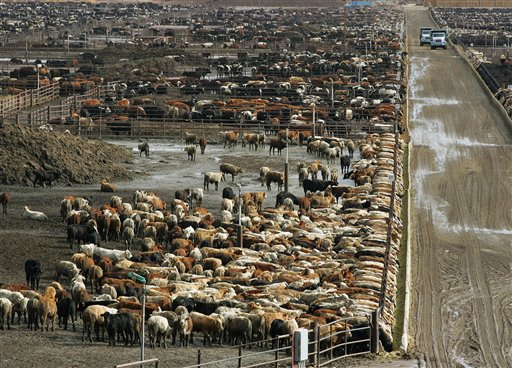
People as Livestock: The Cult of Fundamentalist Materialism and the Cheapening Life

Farm to Fork

I first encountered the term “Fundamentalist-Materialism” in the work of Robert Anton Wilson; it appears in several of his non-fiction works, including “The Cosmic Triggger” series. As far as I know R.A.W. was the originator of this philosophical designation.”

Is there any inherent value to an individual human life? 

By Dan Mage

Source: OpEdNews.com

Authoritarians of the left, libertarians of the right, objectivists, conservatives and even liberals and progressives fixated on “jobs” and “rehabilitation” of the socioeconomically dysfunctional give the answer “no; ” sometimes directly (as in the case of the Stalinist and the American conservative) and other times through actions, policies, and preferences (as in the case of elements of the “occupation” movement distancing themselves from “homeless bums,” “drug users,” and “ex-cons”).

Most of all, those with the power to set wages, prices, working conditions and societal expectation for those who have nothing left but their time and “docile bodies”*(Foucault) to sell, control and trade in human lives as commodities. While most of the supposedly civilized world frowns on chattel slavery (although a good bit of it goes on, especially in the sex trade, where prosecution of traffickers is the exception rather than the rule), the legal technicality of ownership is superfluous to the trade in human lives, time, labor, and in Reichian terms orgones.

What do Stalinism, objectivism, authoritarian capitalism, and global corporatism all have in common ? They are in my opinion fundamentalist-materialist cults that value the inanimate over the living, the concrete over the abstract and have effectively reduced the vast majority of the human race to livestock, or wild beasts to be hunted down, captured, contained, broken, or in the alternative, simply slaughtered and destroyed.

I have been told that it has always been thus, and perhaps in terms of humanity’s historical failings this is true. There is however no historical precedent for the establishment of a global value system through electronic multi-sensory media. Even the best efforts of the Catholic Church, Protestant missionaries and Islamic holy-warriors do not equal the technology and level of sophistication in the application of “industrial psychology.”

The message remains the same though, as it has been throughout history: “Obey or suffer.” Individual disobedience or even mere failure to “produce” in spite of the individual’s best efforts will result in stigmatization, marginalization, a degrading dependency on the state and, as state support for the economically disengaged is cut back and removed, starvation, homelessness and imprisonment; even the fact of homelessness is defined as a criminal offense by more local jurisdictions with each passing year.

The fact is that life is cheap; the idealistic visions of humanitarians are swept aside by those advocates of “austerity” and “tough choices,” whose calculations in service of usury on a global scale will determine the level of human suffering in each nation up to and including death by starvation, disease, and the inevitable outcome of manufactured scarcity, war.

The blurry and dim imagery of the concretes of suffering fades from vision in the glare of the deadly abstractions; political ideologies, religions, money that does not exist anywhere other than in the record keeping of the money lenders remains in clear focus. The conclusion returns stark, glaring and obvious: human life is a commodity, the value of which is consistently decreasing. The devaluation of an individual human life to a unit of production and consumption, which therefore can be discarded if determined to have no economic value, is all that is required for the machinery of mass exterminations and genocide to be set in motion.

Arguing about wages, prices, social systems and ways of arranging economies, even in cases where “progress” is made, will be useless. The dominance of the fundamentalist-materialist cults, as well as the authoritarian religions that create legitimacy for them in the eyes of the masses (and even Stalin, the ultimate fundamentalist-materialist, allowed for the return of religion as an adjunct of the state when he realized its value) will continue to crush and compress human life, until the perverted and inverted values themselves are overthrown, shattered, burned and buried.

When will the biocentric (life centered) ethos replace the thanatocentric (death centered) ethos as the dominant culture’s value system? I cannot answer even the “if” of this question, let alone the question itself. The fact that the power to collect interest on nonexistent money and the lifestyles that such usury on a global scale supports is presented, and apparently accepted, as an immutable law of nature rather than as an imposition of culture’s order on the true nature of humanity seems by way of this very acceptance to be a “natural law.” Images of vultures waiting for starving children to crawl to their deaths and mothers weeping over infants at the bottoms of pits do not move the master manipulators of numbers. If anything, only the fact that the die-offs are not more extensive is cause for lamentation.

Do we care anymore? I’m not speaking of our little “jobs” and “futures,” and relative degree of comfort/discomfort in oppression that seems to be everyone’s primary concern. I’m demanding of myself, of you and above all of those who have declared themselves to be “leaders;” what is it that matters to you? Do you feel anything at all? Can we set aside all calculations save for those needed to ease human suffering? The primary demand of all protests, occupations, strikes, boycotts and further actions of increasing effect and extremity will be “Life First!”

The life of one human being hanging on the edge of death, in suffering, is too high a price to pay, for all the glorious achievements of the fundamentalist-materialist cults, their leaders and their adherents. The cult of power, authority, war, and property as a weapon of coercion has, for all its trillions of dollars and stockpiled weapons of mass destruction, a single and fatal vulnerability; to function it depends on obedience. For obedience to be guaranteed, the “obey or suffer” directive must be enforceable. This directive is only enforceable if the doctrine of fundamentalist-materialism enjoys continued acceptance as a “fact of life,” rather than the monstrous fraud that it is.

*The term “docile bodies” is a chapter title in Michel Foucault’s “Discipline and Punish: The Birth of the Prison” 1977, Random House, NY, NY.