After the Crash

Dispatches From a Long Recovery (Est. 10/2024)

After the Crash

The Prison Industry in the United States: Big Business or a New Form of Slavery?

national-occupy-day-in-support-of-prisoners-022012-by-kevin-rashid-johnson-web

By Vicky Pelaez

Source: Global Research

Human rights organizations, as well as political and social ones, are condemning what they are calling a new form of inhumane exploitation in the United States, where they say a prison population of up to 2 million – mostly Black and Hispanic – are working for various industries for a pittance. For the tycoons who have invested in the prison industry, it has been like finding a pot of gold. They don’t have to worry about strikes or paying unemployment insurance, vacations or comp time. All of their workers are full-time, and never arrive late or are absent because of family problems; moreover, if they don’t like the pay of 25 cents an hour and refuse to work, they are locked up in isolation cells.

There are approximately 2 million inmates in state, federal and private prisons throughout the country. According to California Prison Focus, “no other society in human history has imprisoned so many of its own citizens.” The figures show that the United States has locked up more people than any other country: a half million more than China, which has a population five times greater than the U.S. Statistics reveal that the United States holds 25% of the world’s prison population, but only 5% of the world’s people. From less than 300,000 inmates in 1972, the jail population grew to 2 million by the year 2000. In 1990 it was one million. Ten years ago there were only five private prisons in the country, with a population of 2,000 inmates; now, there are 100, with 62,000 inmates. It is expected that by the coming decade, the number will hit 360,000, according to reports.

What has happened over the last 10 years? Why are there so many prisoners?

“The private contracting of prisoners for work fosters incentives to lock people up. Prisons depend on this income. Corporate stockholders who make money off prisoners’ work lobby for longer sentences, in order to expand their workforce. The system feeds itself,” says a study by the Progressive Labor Party, which accuses the prison industry of being “an imitation of Nazi Germany with respect to forced slave labor and concentration camps.”

The prison industry complex is one of the fastest-growing industries in the United States and its investors are on Wall Street. “This multimillion-dollar industry has its own trade exhibitions, conventions, websites, and mail-order/Internet catalogs. It also has direct advertising campaigns, architecture companies, construction companies, investment houses on Wall Street, plumbing supply companies, food supply companies, armed security, and padded cells in a large variety of colors.”

According to the Left Business Observer, the federal prison industry produces 100% of all military helmets, ammunition belts, bullet-proof vests, ID tags, shirts, pants, tents, bags, and canteens. Along with war supplies, prison workers supply 98% of the entire market for equipment assembly services; 93% of paints and paintbrushes; 92% of stove assembly; 46% of body armor; 36% of home appliances; 30% of headphones/microphones/speakers; and 21% of office furniture. Airplane parts, medical supplies, and much more: prisoners are even raising seeing-eye dogs for blind people.

CRIME GOES DOWN, JAIL POPULATION GOES UP

According to reports by human rights organizations, these are the factors that increase the profit potential for those who invest in the prison industry complex:

. Jailing persons convicted of non-violent crimes, and long prison sentences for possession of microscopic quantities of illegal drugs. Federal law stipulates five years’ imprisonment without possibility of parole for possession of 5 grams of crack or 3.5 ounces of heroin, and 10 years for possession of less than 2 ounces of rock-cocaine or crack. A sentence of 5 years for cocaine powder requires possession of 500 grams – 100 times more than the quantity of rock cocaine for the same sentence. Most of those who use cocaine powder are white, middle-class or rich people, while mostly Blacks and Latinos use rock cocaine. In Texas, a person may be sentenced for up to two years’ imprisonment for possessing 4 ounces of marijuana. Here in New York, the 1973 Nelson Rockefeller anti-drug law provides for a mandatory prison sentence of 15 years to life for possession of 4 ounces of any illegal drug.

.The passage in 13 states of the “three strikes” laws (life in prison after being convicted of three felonies), made it necessary to build 20 new federal prisons. One of the most disturbing cases resulting from this measure was that of a prisoner who for stealing a car and two bicycles received three 25-year sentences.

. Longer sentences.

. The passage of laws that require minimum sentencing, without regard for circumstances.

. A large expansion of work by prisoners creating profits that motivate the incarceration of more people for longer periods of time.

. More punishment of prisoners, so as to lengthen their sentences.

HISTORY OF PRISON LABOR IN THE UNITED STATES

Prison labor has its roots in slavery. After the 1861-1865 Civil War, a system of “hiring out prisoners” was introduced in order to continue the slavery tradition. Freed slaves were charged with not carrying out their sharecropping commitments (cultivating someone else’s land in exchange for part of the harvest) or petty thievery – which were almost never proven – and were then “hired out” for cotton picking, working in mines and building railroads. From 1870 until 1910 in the state of Georgia, 88% of hired-out convicts were Black. In Alabama, 93% of “hired-out” miners were Black. In Mississippi, a huge prison farm similar to the old slave plantations replaced the system of hiring out convicts. The notorious Parchman plantation existed until 1972.

During the post-Civil War period, Jim Crow racial segregation laws were imposed on every state, with legal segregation in schools, housing, marriages and many other aspects of daily life. “Today, a new set of markedly racist laws is imposing slave labor and sweatshops on the criminal justice system, now known as the prison industry complex,” comments the Left Business Observer.

Who is investing? At least 37 states have legalized the contracting of prison labor by private corporations that mount their operations inside state prisons. The list of such companies contains the cream of U.S. corporate society: IBM, Boeing, Motorola, Microsoft, AT&T, Wireless, Texas Instrument, Dell, Compaq, Honeywell, Hewlett-Packard, Nortel, Lucent Technologies, 3Com, Intel, Northern Telecom, TWA, Nordstrom’s, Revlon, Macy’s, Pierre Cardin, Target Stores, and many more. All of these businesses are excited about the economic boom generation by prison labor. Just between 1980 and 1994, profits went up from $392 million to $1.31 billion. Inmates in state penitentiaries generally receive the minimum wage for their work, but not all; in Colorado, they get about $2 per hour, well under the minimum. And in privately-run prisons, they receive as little as 17 cents per hour for a maximum of six hours a day, the equivalent of $20 per month. The highest-paying private prison is CCA in Tennessee, where prisoners receive 50 cents per hour for what they call “highly skilled positions.” At those rates, it is no surprise that inmates find the pay in federal prisons to be very generous. There, they can earn $1.25 an hour and work eight hours a day, and sometimes overtime. They can send home $200-$300 per month.

Thanks to prison labor, the United States is once again an attractive location for investment in work that was designed for Third World labor markets. A company that operated a maquiladora (assembly plant in Mexico near the border) closed down its operations there and relocated to San Quentin State Prison in California. In Texas, a factory fired its 150 workers and contracted the services of prisoner-workers from the private Lockhart Texas prison, where circuit boards are assembled for companies like IBM and Compaq.

[Former] Oregon State Representative Kevin Mannix recently urged Nike to cut its production in Indonesia and bring it to his state, telling the shoe manufacturer that “there won’t be any transportation costs; we’re offering you competitive prison labor (here).”

PRIVATE PRISONS

The prison privatization boom began in the 1980s, under the governments of Ronald Reagan and Bush Sr., but reached its height in 1990 under William Clinton, when Wall Street stocks were selling like hotcakes. Clinton’s program for cutting the federal workforce resulted in the Justice Departments contracting of private prison corporations for the incarceration of undocumented workers and high-security inmates.

Private prisons are the biggest business in the prison industry complex. About 18 corporations guard 10,000 prisoners in 27 states. The two largest are Correctional Corporation of America (CCA) and Wackenhut, which together control 75%. Private prisons receive a guaranteed amount of money for each prisoner, independent of what it costs to maintain each one. According to Russell Boraas, a private prison administrator in Virginia, “the secret to low operating costs is having a minimal number of guards for the maximum number of prisoners.” The CCA has an ultra-modern prison in Lawrenceville, Virginia, where five guards on dayshift and two at night watch over 750 prisoners. In these prisons, inmates may get their sentences reduced for “good behavior,” but for any infraction, they get 30 days added – which means more profits for CCA. According to a study of New Mexico prisons, it was found that CCA inmates lost “good behavior time” at a rate eight times higher than those in state prisons.

IMPORTING AND EXPORTING INMATES

Profits are so good that now there is a new business: importing inmates with long sentences, meaning the worst criminals. When a federal judge ruled that overcrowding in Texas prisons was cruel and unusual punishment, the CCA signed contracts with sheriffs in poor counties to build and run new jails and share the profits. According to a December 1998 Atlantic Monthly magazine article, this program was backed by investors from Merrill-Lynch, Shearson-Lehman, American Express and Allstate, and the operation was scattered all over rural Texas. That state’s governor, Ann Richards, followed the example of Mario Cuomo in New York and built so many state prisons that the market became flooded, cutting into private prison profits.

After a law signed by Clinton in 1996 – ending court supervision and decisions – caused overcrowding and violent, unsafe conditions in federal prisons, private prison corporations in Texas began to contact other states whose prisons were overcrowded, offering “rent-a-cell” services in the CCA prisons located in small towns in Texas. The commission for a rent-a-cell salesman is $2.50 to $5.50 per day per bed. The county gets $1.50 for each prisoner.

STATISTICS

Ninety-seven percent of 125,000 federal inmates have been convicted of non-violent crimes. It is believed that more than half of the 623,000 inmates in municipal or county jails are innocent of the crimes they are accused of. Of these, the majority are awaiting trial. Two-thirds of the one million state prisoners have committed non-violent offenses. Sixteen percent of the country’s 2 million prisoners suffer from mental illness.

Overcoming the American Dream

george-carlin-american-dream

By Frank Castro

Source: The Hampton Institute

“Anyone who has ever struggled with poverty knows how extremely expensive it is to be poor.” – James Baldwin
My house sat tucked a mile deep, wrapped in 500 acres of sprawling oaks and towering pines. Dense thickets crisscrossed the land like formidable barricades protecting masses of forests from the intrusions of bored, yet curious children. They would leave you picking daggers from your sides and forearms if you journeyed too far. I grew up in a remote place called Farmhaven, the midway point between Canton and Carthage, Mississippi. Driving through you would never know you were somewhere with a name. Farmhaven is one of those places marked by only an intersection and a road that always goes somewhere else. It is here though, with my father and my brother, in the heart of the South, that I learned the most important lesson life could teach me.

When I was very young the world was a place of limitless potential. Like a naïve summer breeze still clinging to the fantasy that winter will never come, I was no different than most children who believe the world is theirs. You do not have to be rich to dream such dreams. A swift run and leap off the South end of our porch, where the ground was soft and the magnolia leaves puddled, was all it took. With my arms stretched wide I pretended to be a fighter pilot leaving the deck of an aircraft carrier. I never really knew or cared what fighter pilots do; I just wanted to see the world through a bird’s eyes. It was my own American Dream. And the further from the porch I landed, the more I believed I would someday soar.

It’s probably not an unfamiliar story. After all, in children imagination abounds. About this time we start being told to follow our dreams, as if the world were built in such a way that the realization of all our dreams is possible. Certainly that’s what I believed, that people just out to make the imagined real. Life is not without a cruel sense of irony though, and elders rarely mention to adolescents the kind of world in which we live. They shield us from it, understandably not wanting to damage the authenticity and fragility of our youthful ambition. But reality will come knocking. It always does. It will come to tell us that the world has been built in such a way that our dreams will be withheld from us, that the joys of making them real cannot be ours, but rather, with and atop our backs, they must be forfeited to erect someone else’s.

This is the price of poverty.
Knock, Knock

“Capitalism is cruel and heartless and tears people apart, mentally, physically and socially.” - Susan Rosenthal

My father taught me the value of work. For all his faults, I could never question how hard he labored to provide for my brother and me, or how determined he was to instill in us a love for building with our own hands. He tried to teach us how to work the land. We plowed and planted. We built homes for our chickens, turkeys, and ducks. We constructed wooden and wire fences for rotating our goats and horses from one field to another. During the winter months when our grazing fields turned to tundra, I hoisted buckets of feed to the troughs I had built. My brother and I became so proficient with our hands that often my father would drop us off in the woods with supplies and expect a job to be done when he returned with lunch.

But neither our farm nor all the work we put into it was ever what kept a roof over our heads. Even after the fruits of our labor yielded plates for our table, we still needed money. I knew this all too well, even as a seven year old. My room was in the middle of our house. You could not get from the kitchen to the living room without first walking through it. Often a door was left cracked open, not intentionally, but because door frames shift with age and require a firm snug to be pulled completely shut. Through the years while I had a step-mother I heard my father and her argue about bills when the doors where ajar. Always more bills. They both worked in addition to our farm. She worked at a cigarette store. His job always changed. And still it was never enough. Sometimes they got loud. Her voice screeched. His slurred. And mine would make lists in my head of everything I was going to do the next day to make it all better.

I began doing my own laundry about that time because I wanted my step-mother to stay. My child’s mind thought it would make a difference. She left after a few more years though, and when it happened I really could not blame her. My father had begun turning to his bottles more often than he turned to her. When he got drunk enough one night to put a shotgun to my brother’s head, she lost all composure. Refrigerator doors flung open. Voices thundered. Walls shook. Glass bottles clanked and flew further off the porch than I ever had, exploding all over the lawn - just like my family, exploding. My screams were equal only to my tears. Every little list I had made in my head was useless. The gun landed in the yard too after my step-mother snatched it. My brother and I spent that night in the shadow of two people we loved parting ways forever. Soon we lost the farm… and our father too.

I never soared into those magnolia leaves again. In the years to come dreams of a family and a home where I belonged replaced all desire to fly.

Not till much later did I realize that nothing I did then would have made a significant difference. Neither my brother nor I held fault for our poverty and, despite his drinking, it was not entirely my father’s fault either. Addiction, I learned, is most often endemic of a society that generates addicts. Something bigger loomed, something far more pervasive and far-reaching than the lives of a few backwoods Mississippians. Reflecting on how expensive poverty had been for my family, asking why I was poor and why were we ripped apart, I found myself on an inescapable trajectory to discover the origins of inequality.
Their Gluttony Is Our Starvation

“The class which has the power to rob upon a large scale has also the power to control the government and legalize their robbery.” - Eugene V. Debs

My family’s farm was bought by a group of wealthy men who wanted a hunting resort. For the majority of the year our old home sits empty and rotting. It is a reminder that in the halls of country clubs and on the decks of overpriced yachts, poverty is, in the most acute sense of the word, the abundant currency of the rich. Their very existence is predicated on the existence of the poor.

This is not a fact we like to grapple with in America. Here everybody believes they can get rich. We believe the realization of ALL of our dreams is possible. We call this belief the American Dream, and it has been incredibly successful at stifling plausible attempts at equality outside the capitalist framework. To paraphrase John Steinbeck, socialism never took root in America because the poor see themselves not as an exploited proletariat but as temporarily embarrassed millionaires. It is the worst sort of fabrication because it makes us believe the preposterous - my family could have our house, our farm, a decent living with ample food, and an environment where addiction would stymy, while simultaneously rich folks could use it all to shoot animals for sport.

If it sounds ridiculous, it’s because it is.

Under capitalism one party was always going to lose, and generally the party which loses is the one with significantly less money. Our socioeconomic realities are structured this way. “Losers” are a necessity for capitalism’s survival. My family’s misfortune was a microcosm of structured events that play out against billions of poor people in orchestrated symphony every day. They (we) find ourselves in battles with people, organizations, and nations who have enormous financial capabilities, and therefore power, and because our global political system was built around empowering the moneyed class, before the battle ever starts our circumstances are engineered for defeat. Scaled up or down, this predisposition between those with power and those without is consistent. It is why my family lacked the financial agency over our lives to survive. But it is also why entire poor communities are displaced and gentrified by wealthy developers, or entire swaths of the planet are exploited by wealthy nations and their corporations. Where ever we are, our struggles are connected.

The American Dream then has at least two primary functions. Its first is to generate a mythology around itself which can effectively negate the reality that within capitalism not everybody can realize their dreams, that there must be an oppressed class. Such a mythology atomizes people from collective struggle. It induces a form of hyper individualism often seen in the “Boot-Strap Myth,” or the idea that anybody of little means, with hard work and determination, can lift themselves to the highest rungs of bourgeoisie society (the richest of the rich). By focusing on individual stories of capitalist success, the Bill Gates and Sam Waltons of the world, the vast poverty and suffering required for the emergence of massive fortunes is left out of the picture. One can point to Gates and believe their own ascendance is possible without understanding its possibility is predicated on the systematic exploitation of tens of thousands of workers in mines and factories across the globe. And more importantly, focus on the few success stories of the super-rich invisibilizes the structure which keeps wealth within their hands at the direct expense of the poor and makes it beyond examination or reproach.

A second primary function of the American Dream is to facilitate an overpowering sense of entitlement through exploitive competition. It cleaves us from cooperative modes of thinking and existing by constantly pitting us against each other. Through competing with fellow human beings for the necessities of life - work, housing, education, affection, nourishment, social belonging, etc. - an individual is conditioned to accept that competition is the natural state of human existence, and therefore competition necessitates winners and losers. Here, belief of capitalist mythology graduates into acceptance of capitalist power structures, and then finally into the endorsement and full-fledged participation in them. The latter is crucial, for in order to amass a huge fortune a person has to endorse a sort self-maximizing choice which, in their minds, justifies widespread exploitation. At this point it is believed that “losers” (the exploited) are inevitable, thus the more losers, or the greater number of exploited, the richer (and fewer) the winners. If you play the game ruthlessly enough to win, or even thrive, the logic follows that you are entitled to all the rewards and privileges expropriated from the oppressed.

With little doubt, I imagine the men who bought our farm thought nothing of it. In their minds having the money for it was the only requisite needed, and since they had played by the rules of capitalism well enough to be rewarded with the money needed to purchase it, they were “entitled” to it. But it was never their home. They had never toiled in the fields for crops. They had never spent a birthday or Christmas Eve in the house. They had never fished the ponds. They had never run around the yard filling the trees with laughter, or fed the hummingbirds from the clotheslines. They had never made peace with the bees that burrowed into the oak joists beneath the porch. They had never labored with an axe to stock firewood or climbed beneath the house and wrapped the pipes for winter. They knew nothing of the land or the house but its acreage and price. And that was enough, because the memories of children don’t fetch power when money talks.
Poverty Is a Weapon of Mass Destruction

“You cannot call a society which has 3.5 million homeless and 18.5 million vacant homes civil. That’s violent and morally bankrupt.” - Frank Castro

Poverty is a weapon of mass destruction. We just do not see it that way because we have a very limited understanding of what violence looks like. Statistics paint a broad picture, like the fact that 7.7 million people die of hunger every year (21,000 a day), or the fact that 3.5 Americans remain homeless despite 18.5 million vacant homes; but unless we know those individuals’ stories, and they resonate with us in some way, a culture of competition and entitlement keeps us preoccupied with trying to realize our own ambitions - or resolve our own problems. Whatever the reason, often we are concerned more with ourselves than our collective struggle.

Myths like the American Dream condition us to accept that an elite minority profiting off widespread misery is the way of the world. But remember, the hungry don’t choose to starve, and few houseless people choose homelessness. They are starved and put on the streets by a system which structurally denies them access to food and shelter. If we are to get a realistic picture of how destructive global capitalism is, it requires a broader and deeper understanding of violence.

In 2013, Peter Joseph tried reframing the parameters of violence:

“If I put a gun to someone’s head, say, a 30-year-old healthy male, pull the trigger, and kill him, assuming an average life expectancy of, say, 84, you can argue that possibly 54 years of life [were] stolen from that person in a direct act of violence.
However, if a person is born into poverty in the midst of an abundant society where it is statistically proven that it would hurt no one to facilitate meeting the basic needs of that person and yet they die at the age of 30 due to heart disease, which has been found to statistically relate to those who endure the stress and effects of low socioeconomic status, is that death, the removal of those 54 years once again, an act of violence? And the answer is “Yes, it is.” You see, our legal system has conditioned us to think that violence is a direct behavioral act. The truth is that violence is a process, not an act, and it can take many forms. You cannot separate any outcome from the system by which it is oriented.”

***Distributed equally, the grains produced throughout the world would provide each person 3,600 calories per day . The average person requires 2,000 calories a day to maintain a healthy diet.

If we can understand the scenario Peter explains as a process of violence multiplied by millions of starving and homeless people, then little more evidence is needed to indict and convict capitalism as the sadistic, murderous, and megalomaniacal system it is. Contrary to what the Boot Straps Myth and the American Dream tell us, poverty sits infinitely more on the shoulders of structures we are born into than it does personal choice, ambition, or determination. If more understood this, perhaps then finally the lie that billions like me were born into poverty because our parents were lazy, untalented, or lack the ambition to succeed, could die.
Dream Differently

“You have to act as if it were possible to radically transform the world. And you have to do it all the time.” - Angela Davis

When poverty consumed my family it destroyed any understanding of unity I had. To this day my dream remains to rediscover what family means for me, what it will look and feel like; but through the pain and the loss this much has become clear: There is no room left for “America” in my dreams. I imagine a world where families are no longer faced with the looming pistol of starvation and homelessness. No borders, rules, or regulations will rip our homes from us. No person or institution will dangle over us the future we strive toward like a tree that grows inches with every stretch for fruit. Instead we will live in cooperation with each other, a cooperation which builds beyond blood and yields families the breadth of communities. I have survived this long by doing what most people with dreams do - by continuing to live every day to make them reality. And while I struggle every day to keep mine alive, I am inspired by the building happening all around me, and by the friends who have been my family.

My story is only one of billions across the globe though - one among a sea of poverty’s victims. Ensuring billions more are not to follow suit requires shedding America’s myths. When we tell children to follow their dreams without empowering them to envision a world beyond global capitalism, and beyond America, we limit them to the possibilities afforded through oppression. We preclude the possibility of starting our lives with visions of a world that centers liberation, cooperation, love, and justice.

As Wolfi Landstreicher once said, “If one loves life, if one wants to expand and flourish, it is absolutely necessary to free desire from the channels to constrain it, to let it flood our minds and hearts with passion that sparks the wildest dreams. Then one must grasp these dreams and from them hone a weapon with which to attack this reality, a passionate rebellious reason capable of formulating projects aimed at the destruction of that which exists and the realization of our most marvelous desires. For those of us who want to make our lives our own, anything less would be unrealistic.”

To us then has fallen the challenge of taking back the power of imagination, of dreaming beyond ourselves and beyond America.

Liberation Is Unprofitable

c91b81d1dcb043acfb1eed41207da8b5

By Charles Hugh Smith

Source: Of Two Minds

12 examples of how liberation is not profitable and therefore it must be marginalized, outlawed, proscribed or ridiculed.

If we had to summarize the sickness of our economy and society, we could start by noting that liberation is unprofitable, and whatever is not profitable to vested interests is marginalized, outlawed, proscribed or ridiculed. Examples of this abound.

Liberation from digital communication servitude is not profitable. Don’t have a smart phone on 18 hours a day, every day? Loser! Luddite! Liberation from digital communication servitude is not profitable, therefore it is ridiculed.

Liberation from debt is not profitable. Only the wealthy can afford to buy a vehicle without debt, a home without debt or a university education without debt. For everyone else, liberation from debt is not an option, because debt is highly profitable to our financial Overlords and the politicos they buy/own.

This Is How Little It Cost Goldman To Bribe America’s Senators (Zero Hedge)

Liberation from political elites is not profitable. Dependence on the state for monthly payments binds the recipients to the political elites that control the money and payments, and to the financial elites who control the political elites.

Liberation from the staged, soap-opera political drama of elections is not profitable. Election advertising generates staggering profits for media companies, and the ceaseless nurturing of fear, resentment and indignation fuels acceptance of centralized power and control.

Vote all you want. The secret government won’t change.

Liberation from the consumerist mindset is not profitable. Aspirational purchases in the pursuit of appearances are the most profitable of all spending; re-use, repair and informal peer-to-peer sharing are all intrinsically unprofitable.

Narcissistic Consumerism and Self-Destruction (October 20, 2012)

Liberation from the tyranny of central banks is not profitable. Our entire financial system is built on the simple dynamic that everyone is forced to use money issued by the central bank (Federal Reserve) to its member banks and their financier cronies.

Money that is decentralized and not issued by central banks is not profitable.

Common-sense, minimal regulations are not profitable. Regulations feed government fiefdoms and the revolving-door spoils system between the state and private industry, and erect formidable barriers to new competitors. As a result, over-regulation is immensely profitable.

Regulation Run Amok—And How to Fight Back

The ability to think independently is not profitable. The control mechanisms that keep the various classes of serfs in permanent servitude all depend on a dumbed-down populace that has been stripped of the ability to think independently by propaganda, group-think, medications, the education industry and lifelong dependency on the state.

Anti-Intellectualism and the “Dumbing Down” of America

An economy/society without corruption is not profitable. Buying favors, cronyism and cartel control of pricing are the primary sources of corruption. Cartels and the auctioning of favors are highly profitable to politicos and the vested interests who control the tollways of finance, political influence and social mobility.

America’s Main Problem: Corruption

Degrowth is not profitable. Needing fewer, quality things that last for decades is not profitable. Reparing things for nearly-free is not profitable. Giving stuff away to others for free is not profitable. Making do with what you have is not profitable.

Degrowth, Anti-Consumerism and Peak Consumption (May 9, 2013)

A scarcity of stress and anxiety is not profitable. Stress, anxiety and financial insecurity are all highly profitable, as these drive profitably addictive behaviors such as going deep into debt, shopaholic binge buying, multiple anti-anxiety/anti-depression medications, costly therapy and various forms of self-medication.

The Silent Epidemic in a Broken, Deranged System: Stress (April 18, 2013)

Opting out is not profitable. Opting out of debt-serfdom and the burdens of being a tax donkey is not profitable to vested interests or the state. Adopting self-reliance and low-cost/low-impact living and opting out of the status quo culture of consumerism, debt and complicity with a parasitic, exploitive cartel-state Aristocracy/ Plutocracy/ Oligarchy/ Kleptocracy (take your pick–it’s still the same rapacious Elite whatever name you choose)–is not profitable.

Tune In, Turn On, Opt Out (May 17, 2013)


On the State of “Careers”

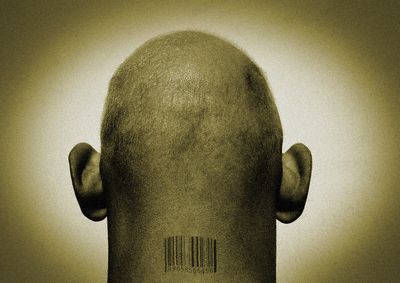
Bar Code on Bald Man's Neck

By Klint Finley

Source: Technoccult

Is digital journalism a viable career? Financial journalist and media pundit Felix Salmon says no.

His lengthy and dismal assessment of the future of journalism as a career path — ie, a job where your salary increases over time and you make enough money to support a family — was, shall we say, widely panned by other journalists who think he’s being a negative nancy and discouraging young people from entering the field. Personally, I think things are even worse than Salmon says.

Now, Salmon and I are in pretty good posiitons. Him more so than I, but neither of us is cranking out Examiner.com articles for $0 a pop just to build a portfolio in hopes of landing a staff writer job at a community newspaper that pays less than an entry level job at Home Depot. Neither of us is cranking out 10+ “stories” a day for a clickbait site just to make rent. Neither one of us just got laid off from a major urban daily after 20 years. We’re part of the lucky few that get paid a living wage, or better, to produce journalism.

But it’s not just journalism. The entire economy is now geared towards turning humans into fungible commodities. And it’s hard to build a career in an environment where there’s no point in asking for a raise because there are hundreds, perhaps thousands, of people who would do your job for even less than you do.

This is nothing new to billions of manual laborers who are used to being treated like cogs in a machine. But once upon a time unions were able to help workers actually band together to demand things like predictable hours and livable working conditions. That has changed. but the do what you love mantra managed to turn those few jobs that robots can’t yet do into sub-minimum wage gigs that require graduate degrees.

You might think you can escape this fate by becoming a programmer. But code bootcamps are cranking out hundreds of people who can crank out CRUD apps all day. And when you start to go grey, the tech industry will toss you out like an 8-track tape.

I don’t mean to imply that all precariat — from the middle class white guy with a PhD to Rwandan woman who came to the U.S. with nothing — are equally affected by this mechanization of humanity. But we are all affected.

The answer isn’t in picking the right career for the machine age. It’s changing the system.

Never Mind FIFA, How about a Crackdown on the Banksters?

banker-thief

By Finian Cunningham

Source: Strategic Culture Foundation

FIFA boss Sepp Blatter’s sudden resignation this week only days after being re-elected shows that the US campaign to bust the football federation over alleged financial corruption is probably going to intensify during the weeks and months ahead.

Blatter had been re-elected for the fifth time last Friday as the federation’s president. He had earlier brushed off calls for his resignation from the American and British governments, amid a storm of media allegations over corruption at the World Cup organising body. Now only four days after being re-elected, the FIFA chief executive is quitting, saying somewhat cryptically that he does not have a sufficient mandate in the world of football to continue at the helm of the organisation.

The dramatic bust in a Zurich hotel last week of FIFA executives is «just the beginning», top US law enforcement officials have warned. British authorities have also jumped on the bandwagon with their own announced probe into financial irregularities at the World Cup organiser.

With seven FIFA officials arrested so far and seven more indicted, and the US authorities vowing to pursue others in the footballing federation over alleged financial corruption, it can be anticipated that this scandal will run and run into interminable extra-time.

An ulterior political agenda behind the apparent American-led crackdown on the international footballing federation could very well be the desire by US and British governments to scupper the 2018 World Cup venue in Russia. Both the Americans and the British lost out when Russia won the bid back in 2010 to host the forthcoming quadrennial tournament, following last year’s event in Brazil. A re-run of the selection process would give the US and Britain a second chance to pitch their bids, and with a generated cloud hanging over Russia due to the FIFA scandal, they both stand a better chance of winning if it comes to a re-selection.

The sporting event is highly coveted, being the most popularly watched on the planet – even exceeding the Olympics. Billions of dollars are at stake for corporations, from construction, hospitality, sportswear and media. There is also the immense national prestige that comes with hosting the global spectacle.

A second, more important, political objective for Washington and its British ally is to augment their ongoing campaign to isolate Moscow over the Ukraine crisis. The West accuses Vladimir Putin’s government of annexing Crimea last year and they have mounted a barrage of economic sanctions on Russia seemingly in retribution. Washington and London have been most gung-ho among Western countries in pushing the anti-Russian agenda over Ukraine.

President Putin has shown no sign of weakening under this relentless Western pressure. Moscow denies any impropriety over Ukraine. Indeed, it accuses the West of fomenting an illegal coup in that country and of trying to use the resulting conflict as a way to destabilise Russia. Moscow has retaliated to Western sanctions by imposing its own bans on European trade exports and, in recent days, imposing travel restrictions on 89 European Union parliamentarians.

So, very plausibly, the Americans and their trusty British ally are using the issue of alleged corruption in World Cup organising body, FIFA, as a stalking horse to further get at Russia over the geopolitical tensions in Ukraine.

US law enforcement officials at the highest level – including attorney-general Loretta Lynch and FBI chief James Comey – say their investigation into FIFA will continue until all suspicions of corruption in the organisation are uncovered. This high-level US involvement in targeting FIFA strongly suggests a political direction being given by the Obama administration.

The concerted nature of the American corruption onslaught against FIFA also points to a top-level decision to go after the Swiss-based federation. The British government, from prime minister David Cameron to his foreign secretary Philip Hammond, quickly stepped into the FIFA scandal following the American lead, making highly unusual public calls for the federation’s president Sepp Blatter to resign.

Both the timing of the US-launched corruption probe – in the week of FIFA’s annual conference and leadership election – plus the way that senior American and British officials, not to mention the publicity of Western news media, have weighed-in to rebuke FIFA suggests that it is all part of a coordinated political campaign authored at the highest level of government. That, in turn, suggests that there is an ulterior political agenda behind the supposed criminal crackdown on FIFA, and that the ulterior agenda is the Western objective to undermine Russia.

Another measure for assessing the credibility of the US-led corruption campaign against FIFA is to put the alleged wrongdoing in perspective with other known spheres of financial corruption. Few people believe that FIFA is free from sleaze and dodgy kickbacks. With so much corporate advertising at stake and broadcasting rights for global media audiences, it would be naive to assume that large wads of money have not crossed palms with a wink and a nod.

The US authorities are throwing a book of charges at the organisation, ranging from bribery to commercial fixing, racketeering to tax evasion. It is claimed by the Americans that the corruption at FIFA amounts to $150 million.

That sounds like a lot of sleazy money, but this figure pales in significance to the amount of corruption and criminality attributable to Wall Street banks and other Western financial institutions. For example, British bank HSBC alone has been caught running tax evasion, money-laundering for drug cartels and other illicit schemes that is estimated at $180 billion – or more than a thousand-fold the scale of criminality alleged at FIFA.

Wall Street banks, including JP Morgan, are accused of massive, systematic rigging of gold price markets all in a shady bid to shield the US dollar value. That criminality, affecting the price of basic commodities and livelihoods for billions of people worldwide, is estimated to be in the order of trillions of dollars – or a thousand, thousand-fold the FIFA debacle.

Moreover, these same banks, along with a slew of other global names – Citibank, Bank of America, Goldman Sachs, Barclays, Deutsche Bank, Credit Agricole among many others – were all directly responsible for the explosion in toxic financial derivatives that made their executives multimillionaires but which led to the global financial and economic meltdown in 2008.

That meltdown – which persists seven years on from its inception – has resulted in millions of lives ruined from unemployment and the collapse of pensions and savings funds. Added to that are the myriad social hardships and crippled lives from the ensuing austerity imposed on the general Western public to pay for the financial catastrophe – a catastrophe that was deliberately and recklessly engineered by the major banks, hedge funds and other capitalist investment agencies.

As Michel Chossudovsky writes in his co-authored book, The Global Economic Crisis: «The meltdown of financial markets in 2008-2009 was the result of institutionalised fraud and financial manipulation. The ‘bank bailouts’ were implemented on the instruction of Wall Street, leading to the largest transfer of money wealth in recorded history, while simultaneously creating an unsurmountable public debt».

It is probable that generations of children to come will be forced to pay for the trillions of dollars of debt that was created by American and European banks, which have now been offloaded on to the public by governments in so-called «bail-outs». Make no mistake, thousands of people have already died from the austerity that Western governments have imposed on their public in order to pay for the corporate fraud, tax evasion, fixing and embezzlement that has taken place in front of our eyes on a massive scale in the order of trillions of dollars.

Yet in the face of this gargantuan, genocidal criminality not one board member or executive from the major banks involved in precipitating the global crash has been charged, let alone prosecuted or imprisoned. In fact, the Wall Street banking elite and their counterparts in the City of London are among the main political donors that helped to re-elect Barack Obama and David Cameron.

The belated focus of American and British authorities on the alleged wrongdoings at FIFA can thus be readily seen as both ludicrous and laughable when we compare that with the absolute dearth of interest by these same authorities in applying law enforcement where it ought to be applied – on the Wall Street and City of London banksters.

Obviously, then, the self-righteous campaign to «root out fraud at FIFA is just so much pious nonsense. The astounding hypocrisy of US and British authorities leaves one with the unmistakable conclusion that the whole media-driven campaign against FIFA is nothing but a self-serving and cynical political agenda. And top of that agenda is to score geopolitical points against Russia.

Until Washington and London governments go after priority financial crime in their midst, then anything they say about FIFA can be taken as very wide off the mark.

Terrorism, Violence, and the Culture of Madness

aa-American-Empire-statue-of-liberty-and-military

By Henry A. Giroux

Source: Counterpunch

The thought of security bears within it an essential risk. A state which has security as its sole task and source of legitimacy is a fragile organism; it can always be provoked by terrorism to become more terroristic.

— Giorgio Agamben

George Orwell’s nightmarish vision of a totalitarian society casts a dark shadow over the United States. The consequences can be seen clearly in the ongoing and ruthless assault on the social state, workers, unions, higher education, students, poor minorities and any vestige of the social contract. Free market policies, values, and practices with their emphasis on the privatization of public wealth, the elimination of social protections, and the deregulation of economic activity now shape practically every commanding political and economic institution in the United States. Public spheres that once offered at least the glimmer of progressive ideas, enlightened social policies, non-commodified values, and critical dialogue and exchange have been increasingly militarized—or replaced by private spaces and corporate settings whose ultimate fidelity is to increasing profit margins. Citizenship is now subsumed by the national security state and a cult of secrecy, organized and reinforced by the constant mobilization of fear and insecurity designed to produce a form of ethical tranquilization and a paralyzing level of social infantilism.

Chris Hedges crystalizes this premise in arguing that Americans now live in a society in which “violence is the habitual response by the state to every dilemma,” legitimizing war as a permanent feature of society and violence as the organizing principle of politics.[1] Under such circumstances, malevolent modes of rationality now impose the values of a militarized neoliberal regime on everyone, shattering viable modes of agency, solidarity, and hope. Amid the bleakness and despair, the discourses of militarism, danger and war now fuel a war on terrorism “that represents the negation of politics—since all interaction is reduced to a test of military strength war brings death and destruction, not only to the adversary but also to one’s side, and without distinguishing between guilty and innocent.”[2] Human barbarity is no longer invisible, hidden under the bureaucratic language of Orwellian doublespeak. Its conspicuousness, if not celebration, emerged in the new editions of American exceptionalism ushered in by the post 9/11 exacerbation of the war on terror.

In the aftermath of these monstrous acts of terrorism, there was a growing sense among politicians, the mainstream media, and conservative and liberal pundits that history as we knew it had been irrefutably ruptured. If politics seemed irrelevant before the attacks on the World Trade Center and the Pentagon, it now seemed both urgent and despairing. But history cannot be erased, and those traditional public spheres in which people could exchange ideas, debate, and shape the conditions that structured their everyday lives increasingly continued to appear to have little significance or political consequence. Already imperiled before the aftershocks of the terrorists’ attacks, democracy became even more fragile in the aftermath of 9/11. Almost fourteen years later, the historical rupture produced by the events of 9/11 has transformed a terrorist attack into a war on terror that mimics the very crimes it pledged to eliminate. The script is now familiar. Security trumped civil liberties as shared fears replaced any sense of shared responsibilities. Under Bush and Cheney, the government lied about the war in Iraq, created a torture state, violated civil liberties, and developed new antiterrorist laws, such as the USA PATRIOT ACT. It imposed a state of emergency that

justified a range of terrorist practices, including extraordinary rendition and state torture, which made it easier to undermine those basic civil liberties that protect individuals against invasive and potentially repressive government actions.[3]

Under the burgeoning of what James Risen has called the “homeland security-industrial complex,” state secrecy and organized corporate corruption filled the coffers of the defense industry along with the corporate owned security industries—especially those providing drones– who benefited the most from the war on terror.[4] This is not to suggest that security is not an important consideration for the United States. Clearly, any democracy needs to be able to defend itself, but it cannot serve, as it has, as a pretext for abandoning civil liberties, democratic values, and any semblance of justice, morality, and political responsibility. Nor can it serve as a pretext for American exceptionalism and its imperialist expansionist goals. The philosopher Giorgio Agamben has suggested rightly that under the so war on terrorism, the political landscape is changing and that “we are no longer citizens but detainees, distinguishable from the inmates of Guantanamo not by an indifference in legal status, but only by the fact that we have not yet had the misfortune to be incarcerated—or unexpectedly executed by a missile from an unmanned aircraft.”[5]

The war on terror morphed into a legitimation for state terrorism as was made clear under the willingness of the Obama administration to pardon the CIA torturers, create a “kill list”, expand the surveillance state, punish whistleblowers, and use drones to indiscriminately kill civilians—all in the name of fighting terrorists. Obama expanded the reach of the militarized state and along with Democratic and Republican Party extremists preached a notion of security rooted in personal fears rather than in a notion of social security that rallied against the deprivations and suffering produced by war, poverty, racism, and state terrorism. The war on terrorism extended the discourse, space, location, and time of war in ways that made it unbounded and ubiquitous making everyone a potential terrorists and the battlefield a domestic as well as foreign location, a foreign as well as a domestic policy issue. Obama has become the master of permanent war seeking to increase the bloated military budget—close to a trillion dollars–while “turning to lawless violence….translated into unrestrained violent interventions from Libya to Syria and back to Iraq,” including an attempt “to expand the war on ISIS in Syria and possibly send more heavy weapons to its client government in Ukraine.”[6] Fear became total and the imposition of punitive standards included not only the bombing, abduction, and torture of enemy combatants, but also the use of the police and federal troops for drug interdictions, the enforcement of zero tolerance standards in public schools, and the increasing criminalization of a range of social behaviors that extended from homelessness to violating dress codes in school.

Under the regime of neoliberalism with its war-like view of competition, its celebration of self-interest, and its disdain for democratic values and shared compassion for others, any notion of unity has been contaminated by the fog of misguided patriotism, a hatred of the other now privileged as an enemy combatant, and an insular retreat into mindless consumerism and the faux safety of gated communities. With the merging of militarism, the culture of surveillance, and a neoliberal culture of cruelty, solidarity and public trust have morphed into an endless display of violence and the ongoing militarization of visual culture and public space.[7]

The war on terror has come home as poor neighborhoods are transformed into war zones with the police resembling an occupying army. The most lethal expressions of racism have become commonplace as black men and boys such as Eric Garner and Tamir Rice are repeatedly beaten, and killed by the police.[8] As Jeffrey St. Clair has pointed out, one index of how state terrorism and lawlessness have become normalized is evident not only by the fact that the majority of Americans support torture, even though they know “it is totally ineffective as a means of intelligence gathering,” but also by the American public’s growing appetite for violence, whether it parades as entertainment or manifests itself in the growing demonization and incarceration of black and brown youth, adults, Muslims, immigrants, and others deemed as disposable.[9] It should come as no surprise that the one issue the top 2016 GOP presidential contenders agree on is that guns are the ultimate symbol of freedom in America, a “bellwether of individual liberty, a symbol of what big wants and shouldn’t have.”[10] Guns provide political theater for the new political extremists and are symptomatic less of some cockeyed defense of the second amendment than willingness to maximize the pleasure of violence and building a case for the use of deadly force both at home and abroad. As Rustom Bharacuha and Susan Sontag have argued in different contexts, “There is an echo of the pornographic in maximizing the pleasure of violence,”[11] one “that dissolves politics into pathology.”[12]

Notions of democracy increasingly appear to be giving way to the discourse of revenge, domestic security, stupidity, and war. The political reality that has emerged since the shattering crisis of 9/11 increasingly points to a set of narrow choices that are being largely set by the jingoistic right wing extremists, the defense department, conservative funded foundations, and fueled by the dominant media. War and violence now function as an aphrodisiac for a public inundated with commodities and awash in celebrity culture idiocy. This surrender to the pleasure of violence is made all the more easy by the civic illiteracy now sweeping the United States. Climate change deniers, anti-intellectuals, religious fundamentalists, and others who exhibit pride in displaying a kind of thoughtlessness exhibit a kind of political and theoretical helplessness, if not corruption, that opens the door to the wider public’s acceptance of foreign and domestic violence.

The current extremists dominating Congress are frothing at the mouth to go to war with Iran, bomb Syria into the twilight zone, and further extend the reach of the American empire through its over bloated war machine to any country that questions the use of American power. One glaring example can be found in the constant and under analyzed televised images and stories of homegrown terrorists threatening to blow up malls, schools, and any other conceivable space where the public gathers.

Other examples can be found in the militarized frothing and Islamophobia perpetrated by the Fox News Network, made concrete by the an almost fever pitched bellicosity that informs the majority of its commentaries and reactions to war on terror. Missing from the endless call for security, vengeance, and the use of state violence is the massive lawlessness produced by the United States government through targeted drone attacks on enemy combatants, the violation of civil liberties, and the almost unimaginable human suffering and hardship perpetrated through the American war machine in the Middle East, especially Iraq. Also missing is a history of lawlessness, imperialism, and torture that supported a host of authoritarian regimes propped up by the United States.

Capitalizing on the pent up emotions and needs of an angry and grieving public for revenge, fueled by an unchecked Islamophobia, almost any reportage of a terrorist attack throughout the globe, further amplifies the hyped-up language of war, patriotism, and retaliation.   Similarly, conservative talking-heads write numerous op-eds and appear on endless talk shows fanning the fires of “patriotism” by calling upon the United States to expand the war against any one of a number of Arab countries that are considered terrorist states. For example, John Bolton, writing an op-ed for the New York Times insists that all attempts by the Obama administration to negotiate an arms deal with Iran is a sign of weakness. For Bolton, the only way to deal with Iran is to launch an attack on their nuclear infrastructure. The title of his op-ed sums up the organizing idea of the article: “To Stop Iran’s Bomb, Bomb Iran.”[13]

In the current historical moment, the language of indiscriminate revenge and lawlessness seems to be winning the day. This is a discourse unconscious of its own dangerous refusal to acknowledge the important role that democratic values and social justice must play in a truly “unified” rationale response, so as to prevent the further killing of innocent people, regardless of their religion, culture, and place of occupancy in the world. Instead of viewing the current crisis as simply a new and more dangerous historical conjuncture that has nothing to learn from the past, it is crucial for the American public to begin to understand how the past might be useful in addressing what it means to live in a democracy at a time when democracy is not only viewed as an excess, but as a liability to the wishes and interests of the new extremists who now control the American government. The anti-democratic forces that define American history cannot be forgotten in the fog of political and cultural amnesia. State violence and terrorism have a long history in the United States, both in its foreign and domestic policies, and ignoring this dark period of history means that nothing will be learned from the legacy of a politics that has indulged authoritarian ideologies and embraced violence as a central measure of power, national identity, and patriotism.[14]

At stake here is the need to establish a vision of society and a global order that safeguards its most basic civil liberties and notions of human rights. Any struggle against terrorism must begin with the pledge on the part of the United States that it will work in conjunction with international organizations, especially the United Nations, a refusal to engage in any military operations that might target civilians, and that it will rethink those aspects of its foreign policy that have allied it with repressive nations in which democratic liberties and civilian lives are under siege. Crimes overlooked will be repeated and intensified just as public memory is rendered a liability in the face of the discourse of revenge, demonization, and extreme violence.

Many news commentators and journalists in the dominant press have taken up the events of September 11 within the context of World War II, invoking daily the symbols of revenge, retaliation, and war. Nostalgia is now used to justify and fuel a politics of in-security, fear, precarity, and demonization. The dominant media no longer functions in the interests of a democracy. Mainstream media supported Bush’s fabrications to justify the invasion of Iraq and never apologized for such despicable actions. It has rarely supported the heroic actions of whistleblowers such as Edward Snowden, Chelsea Manning, Thomas Drake, John Kiriakou, Jeffrey Sterling, and others.[15]

Mainstream media has largely remained mute about the pardoning of those who tortured as a matter of state policy. Against an endless onslaught of images of jets bombing countries extending from Syria and Iraq to Afghanistan and Gaza, amply supplied by the Defense Department, the dominant media connects the war abroad with the domestic struggle at home by presenting numerous stories about the endless ways in which potential terrorists might use nuclear weapons, poison the food supply, or unleash biochemical agents on the American population. The increased fear and insecurity created by such stories simultaneously serve to legitimatize a host of anti-democratic practices at home-including “a concerted attack on civil liberties, freedom of expression, and freedom of the press,”[16] and a growing sentiment on the part of the American public that people who suggest that terrorism is, in part, caused by American foreign policy should not be allowed “to teach in the public schools, work in the government, and even make a speech at a college.”[17]

This legacy of suppression has a long history in the United States, and it has returned with a vengeance in academia, especially for those academics, such as Norman Finkelstein and Steven G. Salaita, who have condemned America’s policies in the Middle East and the government’s support of the Israeli government’s policies towards Palestinians. Language itself has become militarized fed by an onslaught of extreme violence that now floods Hollywood films and the violence that dominates American television. Hollywood blockbusters such asAmerican Sniper glorify war crimes and produce demonizing views of Islam.[18] Television programs such as Spartacus, The Following,Hannibal, True Detective, Justified, and Top of the Lake intensify the pleasure quotient for viewing extreme and graphic violence to an almost unimaginable degree. Graphic violence appears to provide one of the few outlets for Americans to express what has come to resemble what could be construed as a spiritual release. Extreme violence, including the sanctioning of state torture, may be one of the few practices left that allows the American people to feel alive, to mark what it means to be close to the register of death in a way that reminds them of the ability to feel within a culture that deadens every possibility of life. Under such circumstances, the reality of violence is infantilized, transformed into forms of entertainment that produce and legitimate a carnival of cruelty. The privatization of violence does more than maximize the pleasure quotient and heighten macho ebullience, it also gives violence a fascist edge by depoliticizing a culture in which the reality of violence takes on the form of state terrorism. Authoritarianism in this context becomes hysterical because it turns politics and neoliberalism “into a criminal system and keeps working towards the expansion of the realm of pure violence, where its advancement can proceed unhindered.”[19]

The extreme visibility of violence in American culture represents a willful pedagogy of carnage and gore designed to normalize its presence in American society and to legitimate its practice and presence as a matter of common sense. Moreover, war making and the militarization of public discourse and public space also serve as an uncritical homage to a form of hyper-masculinity that operates from the assumption that violence is not only the most important practice for mediating most problems, but that it is also central to identity formation itself. Agency is now militarized and almost completely removed from any notion of civic values. We get a glimpse of this form of violent hyper-masculinity not only in the highly publicized brutality against women dished out by professional football players, but also in the endless stories of sexual abuse and violence now taking place in frat houses across America, many in some of the most prestigious colleges and universities. Violence has become the DNA of war making in the United States, escalating under Bush and Obama into a kind of war fever that embraces a death drive. As Robert J. Lifton points out,

Warmaking can quickly become associated with “war fever,” the mobilization of public excitement to the point of a collective experience with transcendence. War then becomes heroic, even mythic, a task that must be carried out for the defense of one’s nation, to sustain its special historical destiny and the immortality of its people. ..War fever tends always to be sporadic and subject to disillusionment. Its underside is death anxiety, in this case related less to combat than to fears of new terrorist attacks at home or against Americans abroad–and later to growing casualties in occupied Iraq.[20]

The war on terror is the new normal. Its adoration and intensification of violence, militarization, and state terrorism reach into every aspect of American life. Americans complain over the economic deficit but say little about the democracy and moral deficit now providing the foundation for the new authoritarianism. A police presence in our major cities showcases the visible parameters of the authoritarian state. For example, with a police force of 34,000 New York City resembles an armed camp with a force that as Thom Hartman points out is “bigger—that the active militaries of Austria, Bulgaria, Chad, the Czech Republic, Hungary, Kenya,” and a number of other countries.[21] At the same time, the Pentagon has given billions of dollars’ worth of military equipment to local police forces all over America. Is it any wonder, that minorities of color fear the police more than the gangs and criminals that haunt their neighborhoods? Militarism is one of the breeding grounds of violence in the United States and is visible in the ubiquitous gun culture, the modeling of schools after prisons, the exploding incarceration state, the paramilitarization of local police forces, the burgeoning military budget, and the ongoing attacks on protesters, dissidents, black and brown youth, and women.

Under the war on terrorism, moral panic and a culture of fear have not only redefined public space as the “sinister abode of danger, death and infection” and fueled the collective rush to “patriotism on the cheap”, it has also buttressed a “fear economy” and refigured the meaning of politics itself.[22] Defined as “the complex of military and security firms rushing to exploit the national nervous breakdown,”[23] the fear economy promises big financial gains for both the defense department, and the anti-terrorist-security sectors, primed to terror-proof everything from trash cans and water systems to shopping malls and public restrooms. The war on terrorism has been transformed into a new market, a consumer goods for the hysterical war mongers and their acolytes in the media while making politics and extension of war. Fear is no longer an attitude as much as it is a culture that functions as “the enemy of reason [while distorting] emotions and perceptions, and often leads to poor decisions.”[24] But the culture of fear does more than undermine critical judgment and suppress dissent, as Don Hazen points out, it also: “breeds more violence, mental illness and trauma, social disintegration, job failure, loss of workers’ rights, and much more. Pervasive fear ultimately paves the way for an accelerating authoritarian society with increased police power, legally codified oppression, invasion of privacy, social controls, social anxiety and PTSD.”[25]

Fear and repression reproduce rather than address the most fundamental anti-democratic elements of terrorism. Instead of mobilizing fear, people need to recognize that the threat of terrorism cannot be understood apart from the crisis of democracy itself. The greatest struggle faced by the American public is not terrorism, but a struggle on behalf of justice, freedom, and democracy for all of the citizens of the globe. This is not going to take place, as President Obama’s policies will tragically affirm, by shutting down democracy, eliminating its most cherished rights and freedoms, and deriding communities of dissent. Engaging terrorism demands more than rage and anger, revenge and retaliation. American society is broken, corrupted by the financial elite, and addicted to violence and a culture of permanent war.

The commanding institutions of American life have lost their sense of public mission, just as leadership at all levels of government is being stripped of any viable democratic vision. The United States is now governed by an economic and social orthodoxy informed by the dictates of religious and political extremists. Reform efforts that include the established political parties have resulted in nothing but regression, a form of accommodation that serves to normalized the new authoritarianism and its war on terrorism. Politics has to be thought anew and must be informed by powerful vision matched by durable organizations that include young people, unions, workers, diverse social movements, artists, and others. In part, this means reawakening the radical imagination so as to address the intensifying crisis of history and agency, and engage the ethical grammars of human suffering. To fight the neoliberal counter-revolution, workers, young people, unions, artists, intellectuals, and social movements need to create new public spaces along with a new language for enabling the American public to relate the self to public life, social responsibility, and the demands of global citizenship.

The left in the United States is too fractured and needs to develop a more comprehensive understanding of politics, oppression, and struggles as well as a discourse that arises to the level of ethical assessment and accountability. Against the new authoritarianism, progressives of all stripes need an inspiring and energizing politics that embraces coalition building, rejects the notion that capitalism equals democracy, and challenges the stolid vocabulary of embodied incapacity stripped of any sense of risk, hope, and possibility. If the struggle against the war on terrorism, militarization, and neoliberalization is to have any chance of success, it is crucial for a loyal and dedicated left to embrace a commitment to understanding the educative nature of politics, economic and social justice, and the need to build a sustainable political formation outside of the established parties.[26]

The United States is in a new historical conjuncture and as difficult as it is to admit, it is a conjuncture that shares more with the legacies of totalitarianism than with America’s often misguided understanding of democracy. Under the merging of the surveillance state, warfare state, and the harsh regime of neoliberalism, we are witnessing the death of the old system of social welfare supports and the emergence of a new society marked by the heavy hand of the national security state, the depoliticization of the American public, extreme inequities in wealth, power, income, and a new politics and mode of governance now firmly controlled by the major corporations, banks, and financial elite. This is a politics in which there is no room for democracy, and no room for reformism. The time has come to name the current historical moment as representative of the “dark times” Hannah Arendt warned us against and to begin to rethink politics anew through social movements in which the promise of a radical democracy can be reimagined in the midst of determined and systemic collective struggles. The war on terrorism has morphed into a new form of authoritarianism and its real enemy is no longer limited to potential terrorists, but includes democracy itself.

Henry A. Giroux currently holds the McMaster University Chair for Scholarship in the Public Interest in the English and Cultural Studies Department and a Distinguished Visiting Professorship at Ryerson University. His most recent books are America’s Education Deficit and the War on Youth (Monthly Review Press, 2013) and Neoliberalism’s War on Higher Education (Haymarket Press, 2014). His web site is www.henryagiroux.com.

Notes. 

[1] Chris Hedges, “America’s ‘Death Instinct’ Spreads Misery Across the World,” AlterNet, (September 30, 2014). Online:

http://www.alternet.org/world/americas-death-instinct-spreads-misery-across-world

[2] Tzvetan Todorov, Torture and the War on Terror, Translated by Gila Walker with photographs by Ryan Lobo, (Chicago, IL: Seagull Books, 2009), pp. 2-3.

[3] See, for instance, Mark Danner, Torture and Truth: America, Abu Ghraib, and the War on Terror (New York: New York Review of Books, 2004); Jane Mayer, The Dark Side: The Inside Story of How the War on Terror Turned into a War on American Ideals (New York: Doubleday, 2008); and Phillipe Sands, Torture Team (London: Penguin, 2009). On the torture of children, see Michael Haas, George W. Bush, War Criminal?: The Bush Administration’s Liability for 269 War Crimes(Westport: Praeger, 2009). Also, see Henry A. Giroux, Hearts of Darkness: Torturing Children in the War on Terror (Boulder: Paradigm, 2010).

[4] James Risen, Pay at Any Price (New York: Houghton Mifflin Harcourt, 2014).

[5] Agamben cited in Malcolm Bull, “States don’t Really Mind Their Citizens Dying: They Just don’t Like anyone Else to Kill Them,” London Review of Books (December 16, 20054), p. 3.

[6] Ajamu Baraka, “Obama’s Legacy: Permanent War and Liberal Accommodation,” Counterpunch (February 18, 2015). Online:http://www.counterpunch.org/2015/02/18/obamas-legacy-permanent-war-and-liberal-accommodation/

[7]Glenn Greenwald, No Place to Hide: Edward Snowden, the NSA, and the U.S. Surveillance State (New York: Metropolitan, 2014) and Nick Turse , The Complex: How the Military Invades Our Everyday Lives(New York: Metropolitan, 2009).

[8] Henry A. Giroux, “State Terrorism and Racist Violence in the Age of Disposability: From Emmett Till to Eric Garner – Expanded Version,”Truthout (December 2014). Online: http://truth-out.org/opinion/item/27832-state-terrorism-and-racist-violence-in-the-age-of-disposability-from-emmett-till-to-eric-garner

[9] Jeffrey St. Clair, “When Torturers Walk,” Counterpunch (March 20-22, 2015), Online: http://www.counterpunch.org/2015/03/20/when-torturers-walk/

[10] David A. Fahrenthold, ““In the hunt to be the 2016 GOP pick, top contenders agree on 1 thing: Guns,” The Washington Post (March 28, 2015). Online: http://www.washingtonpost.com/politics/republican-presidential-hopefuls-sticking-to-their-guns/2015/03/28/b2ef4a1c-d3c4-11e4-8fce-3941fc548f1c_story.html

[11] Rustom Bharacuha, “Around Adohya: Aberrations, Enigmas, and Moments of Violence,” Third Text (Autumn 1993), p. 45.

[12] Sontag cited in in Carol Becker, “The Art of Testimony,” Sculpture(March 1997), p. 28

[13] John R. Bolton, “To Stop Iran’s Bomb, Bomb Iran,” New York Times (March 26, 2015). Online:http://www.nytimes.com/2015/03/26/opinion/to-stop-irans-bomb-bomb-iran.html?_r=0

[14]  There are many valuable sources that document this history. Some exemplary texts include: A.J. Langguth, Hidden Terrors: The Truth About U.S. Police Operations in Latin America (New York: Pantheon Books, 1979); Gordon Thomas, Journey Into Madness: The True Story of Secret CIA Mind Control and Medical Abuse (New York: Bantam, 1989); Danner, Torture and Truth; Jennifer K. Harbury, Truth, Torture, and the American Way: The History and Consequences of U.S. Involvement in Torture (Boston: Beacon Press, 2005); Alfred McCoy, A Question of Torture: CIA Interrogation, from the Cold War to the War on Terror (New York: Metropolitan Books, 2006).

[15] Jamie Tarabay, “Obama and leakers: Who are the eight charged under the Espionage Act?” Aljazeerra (December 5, 3013). Online:http://america.aljazeera.com/articles/2013/12/5/obama-and-leakerswhoaretheeightchargedunderespionageact.html

[16] Eric Alterman, “Patriot Games,” The Nation (October 29, 2001), p. 10.

[17] Cited in the National Public Radio/Kaiser Family foundation/Kennedy School of Government Civil Liberties Poll. Available on line at wsiwyg:5http://www.npr.org/news…civillibertiespll/011130.poll.html (November 30, 2001), p. 3

[18] See, Henry A. Giroux, “Celluloid Heroism and Manufactured Stupidity in the Age of Empire,” Counterpunch (February 12, 2015). Online: http://www.counterpunch.org/2015/02/12/celluloid-heroism-and-manufactured-stupidity-in-the-age-of-empire/

[19] Franco Bifo Berardi, Precarious Rhapsody (New York, Autonomedia, 2009), p. 52

[20] Robert Jay Lifton, “American Apocalypse,” The Nation (December 22, 2003), pp. 12, 14.

[21] Tom Engelhardt, “Walking Back the American Twenty-First Century,” TomDispatch (February 17, 2015). Online: http://www.tomdispatch.com/dialogs/print/?id=175957

[22] Mike Davis, “The Flames of New York,” New Left Review 12 (November/December 2001), p. 44

[23] Ibid. Mike Davis, “The Flames of New York,” Ibid., p. 45.

[24] Don Hazen, “Fear Dominates Politics, Media and Human Existence in America—and it is Getting Worse,” Alternet (March 1, 2015). Online:http://www.alternet.org/fear-america/fear-dominates-politics-media-and-human-existence-america-and-its-getting-worse

[25]. Ibid.

[26]. See, for instance, Adolph Reed Jr., “Nothing Left,” Harper’s Magazine (March 2014), pp. 28-36; Stanley Aronowitz, “Democrats in Disarray: This Donkey Can’t Save Our Asses,” The Indypendent, Issue #202. (December 16, 2014) Online:

https://www.indypendent.org/2014/12/16/democrats-disarray-donkey-can%E2%80%99t-save-our-asses

The Mall of American Progress

a-grand-canyon-strip-mall

By Scott Beauchamp

Source: The Baffler

Malls may not be an American monopoly, but America’s not really thinkable without them. They’re where we come together, octogenarian mall walkers and teen Goths alike, as we aim for that perfect, elusive balance between over- and under-stimulation. They’re our own controlled-climate variation on the outdoor European arcade; only in the multipurposed American mallspace, you don’t simply exchange money for goods: you exercise, see movies, attend concerts, go to school, and worship God. They’re our culture’s vapid response to the depletion of the commons. And their increasingly empty and abandoned carapaces mottle the American landscape like munition-citadels in the war between consumerism and community.

If the war metaphor seems too dramatic, consider the name of latest big American mall project to announce itself: The Grand Canyon Escalade Project. An “escalade” is a form of military attack that uses ladders to scale a wall.  (Though civilian American consumers probably know the word as a synonym for “gargantuan Cadillac SUV.”) And the Grand Canyon is, well, the Grand Canyon. The Grand Canyon Escalade Project is a proposal to build a mall on the eastern rim of the world’s largest canyon. It’s also a handy metaphor for everything debauched, short-sighted, and self-infatuated about our consumer culture: a belligerent outpost of gaudy merchandise, perched on the very cusp of the void. It doesn’t make much economic sense, it doesn’t make much environmental sense, and it’s an exercise in rapaciousness that represents the worst of American attitudes about unbridled growth.

The Escalade Project has been in the works for some time. The moneymen behind the project call themselves the Confluence Group, LLC, after the confluence of the Colorado and Little Colorado Rivers, where the mall will be built. According to James Joiner’s dispatch on the development in the Daily Beast, the mall will occupy 420 acres “of remote land” and offer a wide array of “retail shops, restaurants, and hotels on the upper rim.” The lowest level of the project would continue to tickle the shopping and appetites of mall visitors, while also offering “stadium seating to take in the views, a museum, visitors center, and elevated river walk.” An IMAX theater will wow moviegoers for whom the splendors of erosion across the millennia may not sufficiently diverting. Meanwhile, the stubborn holdouts who still want to experience the canyon floor beneath their feet will at least be able to do so in the comfort of a people-moving tram. Hiking and donkey-packs are, like nature itself, just a series of needless trials for the single-minded shopper.

The Confluence Group isn’t the only significant regional backer of the Escalade Project. Another key player is the Navajo Nation, which, much to the consternation of some of its members, is promoting the as a claiming it will provide thousands of jobs. Others aren’t so convinced. A group of people opposing the project, calling themselves Save the Confluence, stress that the river confluence is a sacred site to 18 American Indian tribes. Renae Yellowhorse, who has lived on Navajo land her entire life, recently led a New York Times reporter to the precipice of the canyon and surveyed the land below, saying, “This is where the tram would go. This is the heart of our Mother Earth. This is a sacred area. This is going to be true destruction.”

And pace the advocates of commercial development everywhere, at all costs, this doesn’t necessarily promise to be creative (or even merely profitable) destruction. Malls are not guaranteed moneymakers. Crestwood Court Mall, the local mall in my suburban St. Louis hometown, where I would go as a teenager to eat Panda Express and buy discount CD’s as all the music stores slowly closed, is now a “ghost mall,”—a mordant coinage that’s become distressingly common along the American interior. Indeed, the desiccated caverns of Crestwood Court are something of a Grand Canyon unto itself. Crestwood was the first mall to open in the St. Louis area in 1957; now it’s an eerie one million square feet of shopping space, completely devoid of shoppers, stores, and products. It is, fittingly enough, now part of an art project called “Contemporary Ruins.”

The empty, dead mall has become a ubiquitous part of pop culture. Movies like Gone Girl and Tim and Eric’s Billion Dollar Movie have employed ghost malls as spooky and/or comic backdrops. There’s even a website devoted to the exploration of ghost malls.

And the retail decline evoked in all this ominous imagery is real enough. According to numbers reported by the New York Times, 94 percent of American malls were still economically viable in 2006; today, that rate is down to something just shy of 80 percent. They’re being carved out from the inside, with almost 20 percent of malls being at least 10 percent vacant. The trend continues unabated, in what D.J. Busch, a senior analyst at Green Street, calls a “death spiral.” Filling a million square feet or more of retail space, and keeping it filled, while even more big box stores and malls are built just neighborhoods away is quite a tall order.

Still, boosters of the Escalade Project insist that they enjoy the time-honored commercial advantages conferred by a prime location: it’s on the edge of a national park in the middle of a relatively undeveloped landscape. But in broader environmental terms, that means that things might be even worse if the mall does survive. Saying that it’s going to be “bad for the environment” is a bit like saying that being shot in the head would “impair thinking.” The pressure that the influx of visitors and the population boom of permanent residence would put on the already scant water supply could be catastrophic. The rivers are already strained and dirty from overuse. The group American Rivers recently named the Colorado River, which already serves 35 million people, the most endangered river in the United States. As Bob Irvin, president of American Rivers, recently told the New York Times, “Building this suburban development there would have an impact on the lifeblood of the national park. It’s a threat to the groundwater supply of the Colorado River.”

On top of the project’s all-but certain disastrous impact on the region’s severe water strain and waste issues, there’s also the pending repeal of twenty-year ban on uranium mining near the proposed building site. Where’s J.G. Ballard when you need him?

The Escalade Project embodies and amplifies the worst aspects of the American myth of progress. It’s cheap, of course—and stunningly heedless of the sacred meaning of the site to the region’s original inhabitants. But it’s also disrespectful to our own humanity. The Grand Canyon isn’t just “beautiful” in the sense that a travel brochure or IMAX exhibition might glibly characterize it. It’s sublime, in the way that Edmund Burke famously defined the notion as an otherworldly compound of astonishment and terror. As Burke argued, the full impact of the sublime should overwhelm our minds, and lift us out of the stupor of everyday life: it is, he wrote, “productive of the strongest emotion which the mind is capable of feeling.”

As the callow progress of the Escalade Project has made all too clear, we’ve all but lost our ability to recognize, and properly revere, the sublime. Instead, we’ve traded it for food courts, tram-conducted group tours, and emojis. In his introduction to Oakley Hall’s magisterial novel of the myth of the American West, Warlock, Thomas Pynchon observes that “we are a nation that can, many of us, toss with all aplomb our candy wrapper into the Grand Canyon itself, snap a color shot, and drive away; and we need voices . . . to remind us how far that piece of paper, still fluttering brightly behind us, has to fall.


Scott Beauchamp is a veteran and writer. His work has appeared in The Atlantic, The Daily Beast, and Deadspin, among other places.

Breaking Out of the Invisible Prison: The Ten-Point Global Paradigm Revolution

fdd6bbdb9e13032615137

By Prof. John McMurtry

Source: GlobalResearch.ca

As we enter 2015, the global corporate system deepens and spreads in its eco-genocidal effects. But the dots are not joined in their common cause across domains. Money-value coordinates like gross domestic product (GDP), commodity productivity and stock market indexes are still adopted as the measures of “economic performance” rather than life capital development which is systemically depredated.

More than any prior stage of history, we know not what we are doing at the macro level of life organization, nor why no uptick of American sales can remotely solve the problem of collapsing social and natural life support systems. Greece – the world’s emblem of the sacrifice of society to bank debt servicing – is now 45 per cent more in debt than it was before the “austerity” programs started. Global social and ecological collapse proceed in lock-step with predatory corporate and bank globalization, but the connection is taboo to examine.

Fatal mind blocks now rule that no economists see from within received models of understanding, and that no cognitive science lays bare. Unconnected spectacles of crisis are alone reported. Obviously, no recovery from the most wasteful and destructive economic disorder in history is possible so long as it is unseen. This is why we continue over the long cliff of catastrophe without an evident clue of what is happening at the macro level. As another new year opens with all degenerate trends deepening, a point-by-point resetting of our economic parameters to life reality is more than ever demanded. The fatally absurd economic box within which we have been conditioned to conform at a preconscious level remains life-blind at every step without knowledge of it.

Every one of the 10 points of re-framing the economy to life coherence is self-evident once seen. But every step is also revolutionary in paradigm shift from money-capital sequence to life-capital sequence as primary system decider. Once our thought is freed from the bars of the eco-genocidal disorder that now misrules, no step can be reasonably denied.

1. The One-Way Eco-Genocidal Trends

The evidence is now overwhelming that life on earth is in systematic decline toward collapse on all levels. But the meaning is nowhere recognized by any economic model. We have come to know that the climates destabilize to ever greater extremes, but do not connect this long denied reality to the deeper macro facts that the air, soil, forests and water sources are all cumulatively despoiled across the planet as the oceans themselves die back. Vertebrate species simultaneously become extinct at a spasm rate across cultures and continents, but no macro policy arrests their one-way collapse from song birds to coral reefs to pollinators to large animals all at once. Pollution cycles and volumes increase to endanger life systems at all levels, but no global system reduction has been made since the Ozone protocol over 25 years ago.

All the while, public sectors, services and regulators are defunded and dismantled to leave ever more tens of millions of people dispossessed, but tax evasion by the rich multiplies at the same time in one-way disastrous trend. The global food system produces more disabling and contaminated junk than it does food with nutritional value, while man-made non-contagious diseases from obesity to cancer escalate into the world’s biggest killer. Corporate state wars for the resources of the majority world never stop under false pretexts, while transnational corporate-rights treaties to the life capital (means of life that can produce more means of life without loss and cumulative gain) of all societies multiply at the same time. At the core of the system, the global financial system ceases to function for productive investment in life goods, while the future of the next generations collapses toward 25-50 per cent real unemployment, and a world where no birds sing. Yet nowhere is the common cause investigated or even conceived in the business press, education or high theory.

2. The Moral DNA of the Cancer Stage of Capitalism

In fact, the underlying value code driving every degenerate trend is never defined. It is, rather, assumed without question or examination and set into mathematical disconnect as the sole meaning of economic inquiry. Bertrand Russell’s warning here is apposite. “Mathematics may be defined as the subject where we never know what we are talking about, nor whether what we say is true.” The co-author of Principia Mathemtica thus nailed “neo-classical economics” over a century ago. Yet no-one knew what it would come to mean. An academically coded corporate rule in a completely life-blind “Economics” was instituted with its assumption drivers hidden in symbols and closed to disconfirmation by facts. Behind all the self-referential hocus-pocus incapable of predicting its predictable disasters, a ruling value code crystallized to drive the world to ruin with no-one knowing why. This moral DNA of globalization regulates beneath consciousness by four absolute equations assumed in every moment of what is now still masked as “the neoliberal turn.”

Rationality = Self-Maximizing Choice
= Always More Money-Value for Self is Good
= Self-Multiplying Sequences of Ever More Money to the Top Under 1%
= the Ruling Growth System with No Committed Life Functions
= All Else is Disposable Means to this Multiplying Pathogenic Growth

One can test this ruling moral meta program on every degenerate trend. But because it is not seen, the greatest of all fatal confusions comes to be built into societies’ ruling meaning: that money-sequence growth = life value growth. No more malignant mutation of value and meaning has ever occurred. As on the micro level where the surrounding cell community does not recognise the multiplying gross cells eating the life-host alive, so too on the macro social level. Leading the mutant tides of hollowing-out dispossession and ruin of social and ecological life hosts is a private bank system creating tidal notes of bets, credit and debt without legal tender, and partnering with transnational corporations in predation of local economies across the world. It loots life and life bases as ‘necessary reforms’ everywhere it is allowed to move.

This is why there is not inflation while trillions of new dollars are printed for private banking operations with no life productive function. Endless slashing of life goods in wages, benefits, social security and environmental security take corresponding tides of money demand away from people’s lives and life support systems as money-demand powers multiply to the non-producing top. One can track back every step to the ruling value code at work that is taboo to see.

3. Contemporary Economics is a Pseudo-Science

None of this can be seen by ‘Economics’ because it is a pseudo-science. Its ruling categories are disconnected from reality with no life coordinates, and its defining postulates are unfalsifiable by any facts of the world. All organic, social and ecological life requirements are assumed away a-priori. Infinite demand on finite resources is presupposed as sustainable. Reversibility of all processes is taken for granted in a nineteenth-century liquid mechanics model. Consequences follow in the long run that are predictably fatal to human and planetary life organization.

Yet whatever does not fit this a-priori life-blind construction is heretical in graduate schools supplying economic advisers to governments and corporations, and taboo in the corporate press and media to the extent of its contradiction. It is not only a mechanical model, but is absurdly “freedom” and “well-being” at the same time. Whatever deviates from it, conversely, is “irrational” or “despotic.” At the system-wide level of ruling story, the plot is universal for all societies. Purely self-maximizing atomic selves in the market are believed to necessitate the best of possible worlds by an invisible hand of competition ensuring lowest money costs. Life costs do not compute, and “economic growth” is consistent with destroying all life support systems.

We find here, in fact, the underlying form of a fanatic religion. Supra-human laws dictate commands across peoples, and no deadly consequences diminish certitude in its production of the optimal state for all by the perfect design of the system. With the supreme conceit of a just-so story of dyadic market exchange producing the best of possible worlds multiplied to infinity with no possibility of being wrong, we find the inner logic of the global disorder. It rules as a totalitarian creed blind to all but its own growth free of any life value, standard or regulator.

4. Knowledge Wins in the End, but Not Until It is Known

Societies have thus been everywhere ‘restructured’ as subordinate functions to the inexorable transformation of humanity and the world into ever more private commodities and profits. This mutant value system is malignant to the marrow with no consciousness of its derangement or ill consequences. It is taboo to recognize what is everywhere confirmed – deregulated borderless money sequences multiplying themselves by life-blind models, treaties and wars through all that exists on earth whatever their destruction of human and ecological life systems.

Alarm at the growing deadly symptoms increases across thoughtful people, but without decoding connection. Top-down embargo on any other economic view or reality – including by NATO wars – suppresses alternative at every level. Policies of ‘solution’ only extend the pathogenic system further. Even as the reversal of life evolution on earth becomes undeniable under the global rule of private money-sequence multiplication, life-coherent restructuring is anathema and prohibited a-priori by the unexamined value system. It all seems hopeless, but knowledge wins in the end if not suffocated. Behind every step of degeneration lie failures of social knowledge:

(1) failure to diagnose the regulating value mechanism at work;

(2) failure to connect across the domains of life despoliation as predictable from the system’s blind money-demand multiplications;

(3) failure to define or demand any public policies against its despoiling and devouring life support systems with the public increasingly financing the out-of-control feeding cycles;

(4) failure to recognise any life-value principle or ground of the real economy itself.

5. Re-Grounding in Real Capital and Goods, True Supply and Demand

The failure to recognise the life ground and processes of “the economy” is built into the ruling paradigm in principle. As in the prior ruling religion, disconnection of categories and system from empirical reality and life needs rules out disbelief. But disconnect is in the name of “science” and “the invisible hand” rather than “God’s commands” and “divine design.” Adam Smith the founder of modern economics was a Deist, but doctrinal abdication of life ground and reality became totalized in so-called “neo-classical economics” which displaces the class divisions of classical economics and the possibility of any alternative social order.

Thus an absurd metaphysics comes to rule which cannot be decoded because its first principles and axioms are a-priori dictates not subject to critical examination. The first principle of this life-blind economics begins by disconnection from all life requirements, grounds and needs – thus mutating the economy’s provision of otherwise scarce material life goods into an opposite meaning where life goods and life capital do not exist. Capital is assumed as private money-sequences multiplying themselves with life capital blinkered out. Private commodities are assumed to be ‘goods’ although they are in fact increasingly bads for organic, social and ecological life hosts.

The ‘laws of supply and demand’ are simultaneously reduced to self-maximizing private money exchanges indifferent to the real economy of providing life goods otherwise in short supply. Demand is not need or necessity as in any real economy. It is money demand minted by private banks without the legal tender to back over 97 per cent of it: which is ever more unequally held by those serving no productive function, and which nowhere today stands for any life need whatever. The fatal metaphysic built into first principles does not end here. ‘Supply’ is not the life goods people need to survive and flourish, but increasingly the opposite – ever more priced commodities for profit now promoting ever more human and ecological ill-being across the world. Capital is not life wealth that can produce more life wealth without loss, but increasing transnational private money sequences hollowing out life capital on every plane.

6. Knowing Good from Bad as the Baseline of Life-Coherent Economics

At the normative level of this doctrine, a ludicrous and fatal doctrine of freedom rules the war and peace of nations beneath consciousness of it. Freedom = freedom for private money demand only = in proportion to the amount controlled = ever less freedom for those with less of it = no right to life for those without it.

Sane people, in contrast, recognise that life value matters more, the more coherently inclusive in self and world the better. But this ultimately self-evident value ground has been reversed without recognition. People called ‘pro-life’ usurp women’s choice of how they live. Nations assume that ‘standard of living’ is measured by private money spent. ‘Life sciences’ sacrifice billions of animal lives a year for the private money-sequence gains of big corporations. Animal rights theory itself has no criterion to tell the life value of a slug from a person. ‘New and better technology’ is the ruling panacea, but no life-value standard exists to decide better from worse.

What then are we to ground in as life value that the real economy must provide? The objective standard and measure can be stated in three incisive steps:

    1. all value whatever is life value,
    2. good versus bad equals the extent to which life is more coherently enabled versus disabled, by
    3. greater/lesser ranges or capacities of thought, felt being and action through time.

This criterion of life value is no more a matter of opinion than people’s life necessities are. But what are these life needs that no economic paradigm – orthodox or revolutionary – defines? They are in every case that without which life capacities are reduced. Life capital, in turn, is that which produces and reproduces these life goods – from literacy and extending knowledge to the soil we grow in and air we breathe. The ruling value mechanism miscalled ‘the global economy’ is the opposite. It attacks life goods and capital everywhere as ‘externalities’ to its self-multiplying money-sequence and commodity cycles. But because such growth is assumed to be growing life value, the greatest value reversal in history is unseen.

7. Life Capital Base and Growth as the Real Economy Across Cultures

The moving line of the war of liberation begins with what we are able to control, our own lives. Here we can recognise that every value we enjoy, lose or gain has a bottom line – its life capital, that is, the life wealth that produces more life wealth without loss and with cumulative gain. We defend it by life goods to ensure our life capacities are not reduced but grow through time. Most are unpriced – the sun and air, the learning, the home environment, the delight in nature, the play, the love, the raising of children, the fellow arts, and so on. On the social level, the same holds and any well-governed society provides for them in many ways. All may recognise the principle of life capital in their own lives as self-evident, and that all which lasts through time that is worthwhile is life capital. But life capital does not exist as a concept in received economics. It is ruled out a-priori by money capital, the social instrument made the lord without life function.

Addictive internalization is how the system disorder grows on. Knowledge of life goods and bads is how it is rooted out, the unrecognised through-line of human evolution. That is why we find we live far better without corporate-ad television, regular private gas-vehicle use, any junk food or beverage, any throwaway item, any new fashion or commodity not more life enabling than the old, any business with big private banks. The organizing principle is as old as the good life, but is forgotten. The life-capital code is not stated, but becomes ever clearer in our time: minimize market demand that disables life capacities to enable life capital to grow and flourish. This principle is unthinkable within the ruling thought system, but defines transformation to true economy and life emancipation on earth. It liberates life wherever it moves.

The underlying turning point is as old as human evolution itself. Every human advance is by knowing what enables life through time from what does not. Collective life advance is transmitting this life-and-death knowledge across selves and generations. The life capital code holds across cultures. Life goods are always that without which life capacities decline and die. All real needs, all real demand, all real supply, and all real economics are known by this criterion. The lost line between good and evil is found in this principle, and so too human freedom and well-being.

We can define the meaning more concretely as follows Every human life suffers and degenerates toward disease and death without breathable and unpolluted air, clean water and waste cycles, nourishing food and drink, protective living space, supportive love, healthcare when needed, a life-coherent environment, symbolic interaction, and meaningful work to perform. All are measurable in sufficiency across cases. All are now degraded, polluted or perverted by the self-multiplying money-capital system defined above.

8. Collective Life Capital the Missing Link across Divisions

Collective life capital is the long-missing principle of the common interest and collective agency. The life capital code goes deeper than gender, culture or individual differences, and includes past as well as future generations by definition. It is objective, impartial, and universally applicable. It is the ultimate regulator of the economic principles of efficiency, productivity and development. It grounds political legitimacy and supersedes ruinous man-nature, economy-environment splits and individual-social conflicts of interest. By its regulation, freedom is made responsible to its own conditions of possibility. Life capital defines an inner logic of life value which cannot in principle go wrong within or beyond economics.

Collective life capital is the missing common ground and measure across the lines of death itself. It is the this-worldly bridging concept across the impasse of global culture wars, economy-versus – environment thinking, present-versus-future interests, male versus female conflicts, and all other warring dichotomies wrenching us from our shared life ground beneath property lines and the mors immortalis of reality on earth.

The difference from received ultimate principles of value across time and theories is in the objective precision of meaning and direction when value judgement and decision are governed by its laws of:

    1. life value regulator from start to finish,
    2. production of more life value capacity through generational time,
    3. life-value measure to tell greater from lesser in any domain by margins of capacity loss or gain,
    4. cumulative life gain as the organizing goal of the process throughout, and
    5. the meta principle: the more coherently inclusive any decision or action is in enabling life capacities, the better it always is for the world.

9. The Life-and-Death War of the World

In fact, the global corporate commodity and money-sequence system usurps these life capital principles with impunity across continents, while captive corporate states increasingly subsidize, de-regulate, privatize and militarily enforce this life-blind rule over all ecological and human requirements and rights.But who sees the moving lines of the global life-and-death war?

Obviously a real economy would regulate for life capital conservation and advance with money sequences only as means – as is already is the case in a human way of life. Societies and individuals would transform to better lives if the paradigm revolution was enacted in their spheres of choice. Victory or loss in the war of the world lies as always in how we live. Knowledge of bads versus goods is always the inner logic of human evolution at individual and collective levels of action. It is the mark of being human, and begins in what we do not demand – for example, any new fashion or commodity not more life enabling than the old or the used.

The organizing principle of real economy is long anticipated by China’s Tao-te Ching and the West’s autarkia of human self-realization, and many prove it in their own lives. Minimal demand on short resources to enable maximum life capacities is the war of recovery on social as well as individual levels. While every corporate state now presses for ever more energy extraction and use with no limit of public and life costs at every imaginable level, the root of economic rationality – ration to need – is effectively taboo in official culture.

Once the life-capital system decider kicks in, the rules of selection for what compossibly enables rather than disables human and fellow life on earth become evident to reason and learning from mistakes – the ultimate incapacity of the now ruling global system. This is the transformation to true economy and life emancipation, and it can only proceed in accord with the life capital principle that holds across individual, social and environmental life hosts.

10. The Ultimate Choice Space of Humanity

Collective life capital is now fatally endangered on almost every plane across generational and ecological time. The common life interest has no meaning in the ruling global system because its sole law of growth is to multiply the very private commodities and money sequences without life function that mindlessly drive the end-game world disorder.

It follows that humanity’s very provision for the universal human life necessities that have evolved over millennia are blinkered out by the life-blind value measures of what is miscalled ‘the economy.’ Everything that makes a society civilized or liveable is excluded from view – life-protective laws including sufficient minimum wages and environmental regulations, common water and sewage systems for all, free movement pathways and life spaces without cost to use, non-profit healthcare and disease-prevention by public institution, public income security from disemployment, old age and disability, primary to higher education without multiplying debts, family housing, food and life means assistance for children without sufficient parental money, and public libraries and arts facilities with accessible books, films and works of art and art creation. This is more or less a complete index of the collective life capital bases modern society has evolved, but all are dismantled by the global corporate disorder to maximally profit from.

In truth, the organizing principles of common life interest and human agency cross the lines of death itself in the life capital code of value that steers any real economy in any place through generational time. It is the system-deciding choice all societies face without knowing it. History is the record of successes and failures at what still remains unconscious in economic thought. It is nowhere defined beyond slogan even in communism, and ‘the public interest’ has no life coordinates or ground in known modern politics across the spectrum. Yet life goods and life capital denote the only true economic necessity and growth – that without which human life capacities degrade and die. ‘The economy’ is not run by natural or divine laws, as the modern paradigm assumes. It is a social construction of binding rules which directs toward how we live better by what is not otherwise there.

The ruling value code fails more momentously in world waste and destruction than all other systems in history, but beneath recognition. Its built-in contempt for all life requirements and indifference to life ruin multiplies its demands across the planet in a fanaticism beyond ISIL in attacking life capital and goods with no committed life functions. Yet no economics yet allows the recognition of its predictably rising catastrophe through time as a global economic system.

The life capital economy is opposite in its regulating value logic. It grounds in common life capital and produces more of it by life measure as its goal and moral science. Its logic of value is not utopian, but the ultimate through-line of human development since language and cooperative provision of human means of life. It lives in all the civil commons we are made human by in the life security of a free humanity. It is invaded wherever its life capital and goods are turned into more private money demand, resource depletion and waste without limits – the moral cancer of the ruling system. The ultimate choice space of humanity and society lies in this unrecognised life and death meaning. •

John McMurtry is an elected Fellow of the Royal Society of Canada and his work is published and translated from Latin America to Japan. He is the author and editor of the three-volume Philosophy and World Problems published by UNESCO’s Encyclopedia of Life Support Systems (EOLSS), and his latest book is The Cancer Stage of Capitalism: from Crisis to Cure.

Lara Trace Hentz

INDIAN COUNTRY NEWS

In Saner Thought

"It is the duty of every man, as far as his ability extends, to detect and expose delusion and error"..Thomas Paine

ZEDJournAI

Human in Algorithms

Rooster Crows

From the Roof Top

Aisle C

I See This

The Free

blog of the post capitalist transition.. Read or download the novel here + latest relevant posts

अध्ययन-अनुसन्धान(Essential Knowledge of the Overall Subject)

अध्ययन-अनुसन्धानको सार