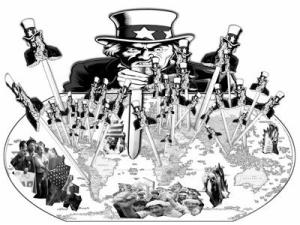
The 1% Versus the 99%: Realignment, Repression or Revolution

640px-Standard_oil_octopus_loc_color

Wealth Inequality Is Putting the US on Course for a Showdown

By Klaus Marre

Source: WhoWhatWhy.org

The richest 20 Americans now own as much wealth as the country’s poorest 152 million people combined.

That is just one of the findings of noted inequality scholar and author Chuck Collins’s most recent report, “Billionaire Bonanza, The Forbes 400 and the Rest of Us.”

In a wide-ranging interview, which will be available in its entirety as a podcast tomorrow, Collins likened the current situation to the “Gilded Age,” the time just before the turn of the 20th century, when there was a similar accumulation of wealth at the top and political power was concentrated in the hands of a few rich men.

And Americans are slowly realizing that the extreme accumulation of wealth at the very top is hurting their own prospects.  But grassroots efforts to redress economic inequality must contend with the political power that comes with great wealth.

This is an unstable situation. With pressure building for change but potent forces stacked against it, there are only three options, Collins told WhoWhatWhy: “Realignment, revolution or repression.”

Rules Rigged, and the Rich Get Richer

Back in the Gilded Age, the country managed to convert the pressure that was building from the bottom up into meaningful changes that resulted in a realignment of political power and the rise of the middle class. Those gains, however, are now being reversed. In fact, a new report found that, for the first time in decades, the middle class no longer constitutes the economic majority in the United States.

The shift toward increasing inequality began in the 1970s. At that time, Collins says (and research shows), “we stopped being an economy in which most people grew together” and instead became a “society that is dramatically pulled apart.”

Wages have now been stagnant for three decades and the median wealth of Americans has actually declined since 1990. At the same time, the rich have gotten richer. A lot richer.

Like the Great Depression in the early 1930s, the economic crisis of 2008 has been a wake-up call for the country. Polls historically have shown that people are indifferent to great wealth as long as they feel the rules are fair and that they at least have the option of moving up the ladder. But for many, the latest crash is changing that perception.

“In the economic meltdown of 2008, people realized the rules are rigged, that the big financial industry people … are tipping the scale in their favor,” Collins said. This has led to a perception that upward mobility in America is stalled — a perception supported by statistical data.

Collins believes that this sentiment has helped boost the candidacies of presidential hopefuls as diverse as Donald Trump and Bernie Sanders.

The collapsing middle class, including groups like recent college students whose prospects are blighted by crushing debt burdens, represents an “angry and mobilized constituency.” These are the people whose dissatisfactions are articulated by populists like Trump.

At the other end of the spectrum, the success of self-avowed “democratic socialist” Sanders shows how fluid the situation is. Collins pointed out that the Vermont senator has been saying the same things for 30 years — but only now are they resonating with a larger proportion of the electorate.

Collins pointed out that Sanders is the only major candidate who does not need a billionaire bankrolling his primary campaign to do well in the polls.

One bloc of voters who can cause a tectonic shift in the near future are millennials, many of whom are resentful of the obstacles they face in pursuing the American dream while paying off their college loans. With 40 million households shouldering a burden of $1.2 trillion in college debt, Collins believes that if this segment of the population were to organize, they could force significant change.

“Otherwise, the machinery of inequality will just keep chugging along as it currently is and it will get more concentrated,” Collins said. In any case, all of the ingredients are there for a major political realignment.

“We’re headed for a showdown.”

[audio http://www.whowhatwhy.org/files/Chuck%20Collins%20WWW%20Final.mp3 ]

http://www.whowhatwhy.org/files/Chuck%20Collins%20WWW%20Final.mp3

Colonialism and Imperialism: Two Most Deadly Forms of Terrorism

imperialism_usa

By Andre Vltchek

Source: Dissident Voice

Terrorism has many forms and many faces, but the most terrible of them is cold cruelty.

We are asked to believe that terrorists consist of dirty lunatics, running around with bombs, machine guns and explosive belts. That’s how we are told to imagine them.

Many of them are bearded; almost all are “foreign looking”, non-white, non-Western. In summary they are wife beaters, child rapists and Greek and Roman statue destroyers.

Actually, during the Cold War, there were some white looking “terrorists” – the left-wingers belonging to several revolutionary cells, in Italy and elsewhere in Europe. But only now we are learning that the terrorist acts attributed to them were actually committed by the Empire, by several European right-wing governments and intelligence services. You remember, the NATO countries were blowing up those trains inside the tunnels, or bombing entire train stations…

It “had to be done”, in order to discredit the Left, just to make sure that people would not become so irresponsible as to vote for the Communists or true Socialists.

There were also several Latin American ‘terror’ groups – the revolutionary movements fighting for freedom and against oppression, mainly against Western colonialism. They had to be contained, liquidated, and if they held power, overthrown.

But terrorists became really popular in the West only after the Soviet Union and the Communist Block were destroyed through thousands of economic, military and propaganda means, and the West suddenly felt too exposed, so alone without anyone to fight. Somehow it felt that it needed to justify its monstrous oppressive acts in Africa, the Middle East, Latin America and Asia.

It needed a new “mighty”, really mighty, enemy to rationalize its astronomical military and intelligence budgets. It was not good enough to face a few hundred ‘freaks’ somewhere inside the Colombian jungle or in Northern Ireland or Corsica. There had to be something really huge, something matching that ‘evil’ Soviet “threat”.

Oh how missed that threat was, suddenly! Just a threat of course; not the danger of egalitarian and internationalist ideals…

And so the West linked terrorism with Islam, which is one of the greatest cultures on earth, with 1.6 billion followers. Islam is big and mighty enough, to scare the shit out of the middle class housewives in some Western suburb! And on top of that, it had to be contained anyway, as it was essentially too socialist and too peaceful.

At that time in history, all great secular and socialist leaders of Muslim countries, (like in Iran, Indonesia and Egypt), were overthrown by the West, their legacy spat on, or they were simply banned.

But that was not enough for the West!

In order to make Islam a worthy enemy, the Empire had to first radicalize and pervert countless Muslim movements and organizations, then create the new ones, consequently training, arming and financing them, so they could really look frightening enough.

There is of course one more important reason why “terrorism”, particularly Muslim “terrorism”, is so essential for the survival of Western doctrines, exceptionalism and global dictatorship: it justifies the West’s notion of absolute cultural and moral superiority.

This is how it works:

For centuries, the West has been behaving like a mad bloodthirsty monster. Despite the self-glorifying propaganda being spread by Western media outlets all over the world, it was becoming common knowledge that the Empire was raping, murdering and plundering in virtually all corners of the Globe. A few more decades and the world would see the West exclusively as a sinister and toxic disease. Such a scenario had to be prevented by all means!

And so the ideologues and propagandists of the Empire came up with a new and brilliant formula: Let’s create something that looks and behaves even worse than we do, and then we could trumpet that we are still actually the most reasonable and tolerant culture on earth!

And let’s make a real pirouette: let’s fight our own creation – let’s fight it in the name of freedom and democracy!”

This is how the new generation; the new breed of “terrorist” was born. And it lives! It is alive and well! It is multiplying like Capek’s Salamanders.

*****Western terrorism is not really discussed, although its most extreme and violent forms are battering the world relentlessly and have for a long time, with hundreds of millions of victims piling up everywhere.

Even the legionnaires and gladiators of the Empire, like the Mujaheddin, Al-Qaida, or ISIS, can never come close to the savagery that has been demonstrated time and again by their British, French, Belgian, German or US masters. Of course they are trying very hard to match their gurus and bread-givers, but they are just not capable of their violence and brutality.

It takes “Western culture” to butcher some 10 million people in just one single geographic area, in almost one go!

*****So what is real terrorism, and how could ISIS and others follow its lead? They say that ISIS is decapitating their victims. Bad enough. But who is their teacher?

For centuries, the empires of Europe were murdering, torturing, raping and mutilating people on all continents of the world. Those who were not doing so directly, were “investing” into colonialist expeditions, or sending its people to join genocidal battalions.

King Leopold II and his cohorts managed to exterminate around 10 million people of Western and Central Africa, in what is now known as the Congo. He was hunting people down like animals, forcing them to work on his rubber plantations. If he thought that they were not filling up his coffers fast enough, he did not hesitate to chop off their hands, or burn entire village populations inside their huts, alive.

10 million victims vanished. 10 million! And it did not take place in some distant past, in the “dark ages”, but in the 20th century, under the rule of so-called constitutional monarchy, and self-proclaimed democracy. How does it compare with the terrorism that is ruling over the territories occupied by ISIS? Let’s compare numbers and brutality level!

And the Democratic Republic of Congo has, since 1995, lost again close to 10 million people in a horrid orgy of terror, unleashed by the West’s proxies, Rwanda and Uganda (see the trailer to my film “Rwanda Gambit”).

Germans performed holocausts in South-Western Africa, in what is now Namibia. The Herero tribe was exterminated, or at least close to 90% of it was. People were first kicked out from their land and from their homes, and driven into the desert. If they survived, the German pre-Nazi expeditions followed, using bullets and other forms of mass killing. Medical experiments on humans were performed, to prove the superiority of the Germanic nation and the white race.

These were just innocent civilians; people whose only crime was that they were not white, and were sitting on land occupied and violated by the Europeans.

The Taliban never came close to this, or even ISIS!

To this day, the Namibian government is demanding the return of countless heads severed from its people: heads that were cut off and then sent to the University of Freiburg and several hospitals in Berlin, for medical experiments.

Just imagine, ISIS chopping thousands of European heads, in order to perform medical experiments aiming to demonstrate the superiority of the Arab race. It would be absolutely unthinkable!

Local people were terrorized in virtually all colonies grabbed by Europe, something that I have described in detail in my latest 840-page book “Exposing Lies of the Empire”.

What about the Brits and their famines, which they were using as population control and intimidation tactics in India! In Bengal at least 5 million died in 1943 alone, 5.5 million in 1876-78, 5 million in 1896-97, to name just a few terrorist acts committed by the British Empire against a defenseless population forced to live under its horrid and oppressive terrorist regime!

What I have mentioned above are just 3 short chapters from the long history of Western terrorism. An entire encyclopedia could be compiled on the topic.

But all this sits far from Western consciousness. European and North American masses prefer not to know anything about the past and the present. As far as they are concerned, they rule the world because they are free, bright and hard working. Not because for centuries their countries have plundered and murdered, and above all terrorized the world forcing it into submission.

The elites know everything, of course. And the more they know, the more they put that knowledge to work.

Terrorist trade and experience are passed on from Western masters to their new Muslim recruits.

The Mujahideen, Al-Qaida, ISIS – on closer examination, their tactics of intimidation and terrorization are not original at all. They are built on imperialist and colonialist practices of the West.

News about this, or even about the terror that has been inflicted on the Planet by the West, is meticulously censored. You would never see them on the programs broadcast by the BBC, or read about them in mainstream newspapers and magazines.

On the other hand, the violence and ruthlessness of the client terrorist organizations are constantly highlighted. They are covered in their tiniest detail, repeated, and “analyzed”.

Everybody is furious, horrified! The UN is “deeply concerned”, Western governments are “outraged”, and the Western public “has had enough – it does not want immigrants from those terrible countries that are breeding terrorism and violence”.

The West “simply has to get involved”. And here comes the War on Terror.

It is a war against the West’s own Frankenstein. It is a war that is never meant to be won. Because if it is won, god forbid, there would have to be peace, and peace means cutting defense budgets and also dealing with the real problems of our Planet.

Peace would mean the West looking at its own past. It would mean thinking about justice and rearranging the entire power structures of the Planet. And that can never be allowed.

And so the West is “playing” war games; it is “fighting” its own recruits (or pretending to fight them), while innocent people are dying.

No part of the world, except the West, would be able to invent and unleash something so vile and barbaric as ISIS or Al-Nusra!

Look closer at the strategy of these group-implants: it has no roots in Muslim culture whatsoever. But it is fully inspired by the Western philosophy of colonialist terrorism: “If you don’t fully embrace our dogmas and religion, then we will cut off your head, slash your throat, rape your entire family or burn your village or city to the ground. We will destroy your grand cultural heritage as we did in South America 500 years ago, and in so many other places.”

And so on and so on! It would really require great discipline not to see the connections!

*****In 2006 I was visiting my friend, a former President of Indonesia, and a great progressive Muslim leader, Abdurrahman Wahid, (known in Indonesia as “Gus Dur”). Our meeting was held at the headquarters of his massive Muslim body Nahdlatul Ulama (NU). At that time the NU was the biggest Muslim organization in the world.

We were discussing capitalism and how it was destroying and corrupting Indonesia. Gus Dur was a “closet socialist”, and that was one of the main reasons why the servile pro-Western Indonesian “elites” and the military deposed him out of the Presidency in 2001.

When we touched on the topic of “terrorism”, he suddenly declared in his typically soft, hardly audible voice: “I know who blew up the Marriott Hotel in Jakarta. It was done by our own intelligence services, in order to justify the increase in their budget, as well as aid that they have been receiving from abroad.”

Of course, the Indonesian army, intelligence services and police consist of a special breed of humans. For several decades, since 1965, they have been brutally terrorizing their own population, when the pro-Western coup toppled the progressive President Sukarno and brought to power a fascist military clique, backed by the predominantly Christian business gang. This terror took between 2-3 million lives in Indonesia itself, as well as in East Timor and (until now) in occupied and thoroughly plundered Papua.

3 genocides in only 5 decades!

The Indonesian coup was one of the greatest terrorist acts in the history of mankind. The rivers were clogged with corpses and changed their color to red.

Why? So that capitalism would survive and Western mining companies could have their booty, at the expense of a completely ruined Indonesian nation. So the Communist Party of Indonesia (PKI) would not be able to win elections, democratically.

But in the West, those 1965 intensive massacres planned by the Empire were never described as “terrorism”. Blowing up a hotel or a pub always is however, especially if they are frequented by Western clientele.

Now Indonesia has its own groups of “terrorists”. They returned from Afghanistan where they fought on behalf of the West against the Soviet Union. They are returning from the Middle East now. The recent attacks in Jakarta could be just a foreplay, a well-planned beginning of something much bigger, maybe an opening of the new “front” of toy soldiers of the Empire in Southeast Asia.

For the West and its planners – the more chaos the better.

Had Abdurrahman Wahid been allowed to stay as the President of Indonesia, there would, most likely, have been no terrorism. His country would have undergone socialist reforms, instituted social justice, rehabilitated Communists and embraced secularism.

In socially balanced societies, terrorism does not thrive.

That would be unacceptable to the Empire. That would mean – back to Sukarno’s day! The most populous Muslim nation on earth cannot be allowed to go its own way, to aim for socialism, and to annihilate terrorist cells.

It has to be at the edge. It has to be ready to be used as a pawn. It has to be scared and scary! And so it is.

*****The games the West is playing are complex and elaborate. They are murky and nihilist. They are so destructive and brutal that even the sharpest analysts are often questioning their own eyes and judgments: “Could all this be really happening?”

The brief answer is: “Yes it can. Yes it is, for many long decades and centuries.”

Historically, terrorism is a native Western weapon. It was utilized freely by people like Lloyd George, a British PM, who refused to sign the agreement banning aerial bombardment of civilians, using unshakeable British logic: “We reserve the right to bomb those niggers.” Or Winston Churchill who was in favor of gassing the ‘lower grade’ of races, like Kurds and Arabs.

That is why, when some outsider, a country like Russia, gets involved, launching its genuine war against terrorist groups, the entire West is consumed by panic. Russia is spoiling their entire game! It is ruining a beautifully crafted neo-colonialist equilibrium.

Just look how lovely everything is: after killing hundreds of millions all over the Globe, the West is now standing as the self-proclaimed champion of human rights and freedom. It is still terrorizing the world, plundering it, fully controlling it – but it is being accepted as the supreme leader, a benevolent advisor, and the only trustworthy part of the world.

And almost nobody is laughing.

Because everyone is scared!

Its brutal legions in the Middle East and Africa are destabilizing entire countries, their origins are easily traceable, but almost no one is daring to do such tracing. Some of those who have tried – died.

The more frightening these invented, manufactured and implanted terrorist monsters, the more beautiful the West looks. It is all gimmicks. It has roots in advertisement, and in hundreds of years of propaganda apparatus.

The West then pretends to fight those deep forces of darkness. It uses powerful, “righteous” language, which has clear bases in Christian fundamentalist dogma.

An entire mythology is unleashed; it feels like Wagner’s “Ring”.

The terrorists represent evil, not the enormous expenditure from the coffers of the US State Department, the European Union and NATO. They are more evil than the Devil himself!

And the West, riding on the white horse, slightly pissed on wine but always in good humor, is portrayed as both a victim and the main adversary of those satanic terrorist groups.

It is one incredible show. It is one terrible farce. Look underneath the horseman’s mask: look at those exposed teeth; that deadly grin! Look at his red eyes, full of greed, lust and cruelty.

And let us never forget: colonialism and imperialism are two most deadly forms of terrorism. And these are still the two main weapons of that horseman who is choking the world!

André Vltchek is a novelist, filmmaker, and investigative journalist. He has covered wars and conflicts in dozens of countries. His latest book is Exposing Lies of the Empire. He also wrote, with Noam Chomsky, On Western Terrorism: From Hiroshima to Drone Warfare. Andre is making films for teleSUR and Press TV. After living for many years in Latin America and Oceania, Vltchek presently resides and works in East Asia and the Middle East. He can be reached through his website or his Twitter. Read other articles by Andre.

Prison Town Selling Its Jails to Grow Cannabis to Save their Economy — And It’s Working

Screen-shot-2012-08-31-at-9.55.31-PM

By Justin Gardner

Source: Activist Post

A tiny California desert town is making a drastic change to reverse its downward spiral and embrace an enlightened future. For 24 years, Adelanto tried unsuccessfully to sustain its economy through prisons, but now it will be hosting a very different kind of business—cannabis cultivation.

The town became only the second city in California to permit commercial cultivation of medical cannabis, after a year of heated debate in the City Council. The persistence of John “Bug” Woodard, Jr. paid off in a 4-1 vote on Nov. 23 to allow cultivation.

“I had nothing to lose,” said Woodard. “The city could not get in any worse shape than it was. It was broke.”

Brooke Edwards Staggs of The Orange County Register describes Adelanto’s declining prison economy and the land rush that is now taking place after their decision to go to pot.

Its first prison was built in 1991, as the city braced itself for the closure of nearby George Air Force Base.

That didn’t stop Adelanto’s long slide into high unemployment and depressed property values. More than a third of the city’s nearly 33,000 residents now live below the poverty line. So it kept welcoming more prisons, banking on the promise of jobs and steady revenue in the form of an annual bed tax.

The town sold one of its four prisons to a private firm in 2010 for $28 million, and that cash is about to run out. Solar energy developers also had an interest in Adelanto, but only four projects have been constructed, producing a handful of jobs.

Now, a new kind of developer is flocking to the town.

Ky-Mani Marley, one of Bob Marley’s sons, has already signed on to license a strain of cannabis that will be grown there, according to Freddy Sayegh, the attorney on the project. Tommy Chong has also shown interest. So has B-Real of Cypress Hill fame, plus other high-profile musicians and professional athletes whose names are being kept under wraps.

One commercial real estate firm says they went from one call a week to five calls a day about purchasing land in Adelanto. Real estate prices have skyrocketed as “investors, cultivators, doctors, architects and record executives” fly across the country to see about getting in on the budding industry.

Twenty-seven companies have been permitted to set up grow operations in Adelanto, with two more pending. The first crop is expected to be produced by summer, and when it reaches full capacity, the town will be producing about 50,000 pounds of cannabis six times a year for the medical industry.

Since California approved medical cannabis use in 1996, it has finally gotten around to creating a licensing program for cannabis businesses under the Medical Marijuana Regulations and Safety Act. The state is expected to legalize recreational use this November, which will greatly increase demand for legitimate operations.

The trend of cities allowing commercial-scale cannabis cultivation is a relief for those concerned about the environmental impact of illegal grow operations. Last year we reported how many growers are carelessly polluting aquatic ecosystems with rat poison and other toxic chemicals, while drying up already stressed streams.

As more towns and cities in California permit large-scale cannabis cultivation, demand will shift to these responsible growers, which should begin to reduce the pressure on the state’s fragile aquatic ecosystems.

Adelanto, which means “progress” in Spanish, will indeed prove to be a model of progress as it transitions from a depressing economy of prisons to one that actually helps human and environmental health.

“Tomorrow, they’ll be on the correct side of history and be recognized as a city that actually embraced safety and embraced something that heals people,” said Randall Longwith, an attorney representing investors.

Not only will cannabis businesses be producing exclusive strains for distribution, but Adelanto will also serve as a hub of medical research for ailments such as pediatric epilepsy, brain tumors, and post-traumatic stress disorder. Cannabis is showing great promise in all of these areas.

As a bonus, the medical cannabis research company Ecologies Laboratories will be pushing out a merchant of death. General Atomics Aeronautical Systems, which makes the Predator drone, will have to give up its storage facility in Adelanto as the landlord has decided to lease it to Ecologies Laboratories instead.

Adelanto joins another California city, Desert Hot Springs, to become a new kind of western pioneer. It will save its economy by making millions in tax revenue and securing hundreds of jobs, and, more importantly, is embracing a future where cannabis will prove to be a medical wonder.

The US economy has not recovered and will not recover

6a00d83451d87169e2014e8c142d89970d

By Paul Craig Roberts

Source: Intrepid Report

The US economy died when middle class jobs were offshored and when the financial system was deregulated.

Jobs offshoring benefitted Wall Street, corporate executives, and shareholders, because lower labor and compliance costs resulted in higher profits. These profits flowed through to shareholders in the form of capital gains and to executives in the form of “performance bonuses.” Wall Street benefitted from the bull market generated by higher profits.

However, jobs offshoring also offshored US GDP and consumer purchasing power. Despite promises of a “New Economy” and better jobs, the replacement jobs have been increasingly part-time, lowly-paid jobs in domestic services, such as retail clerks, waitresses and bartenders.

The offshoring of US manufacturing and professional service jobs to Asia stopped the growth of consumer demand in the US, decimated the middle class, and left insufficient employment for college graduates to be able to service their student loans. The ladders of upward mobility that had made the United States an “opportunity society” were taken down in the interest of higher short-term profits.

Without growth in consumer incomes to drive the economy, the Federal Reserve under Alan Greenspan substituted the growth in consumer debt to take the place of the missing growth in consumer income. Under the Greenspan regime, Americans’ stagnant and declining incomes were augmented with the ability to spend on credit. One source of this credit was the rise in housing prices that the Federal Reserve’s low interest rate policy made possible. Consumers could refinance their now higher-valued home at lower interest rates and take out the “equity” and spend it.

The debt expansion, tied heavily to housing mortgages, came to a halt when the fraud perpetrated by a deregulated financial system crashed the real estate and stock markets. The bailout of the guilty imposed further costs on the very people that the guilty had victimized.

Under Fed Chairman Bernanke, the economy was kept going with Quantitative Easing, a massive increase in the money supply in order to bail out the “banks too big to fail.” Liquidity supplied by the Federal Reserve found its way into stock and bond prices and made those invested in these financial instruments richer. Corporate executives helped to boost the stock market by using the companies’ profits and by taking out loans in order to buy back the companies’ stocks, thus further expanding debt.

Those few benefitting from inflated financial asset prices produced by Quantitative Easing and buy-backs are a much smaller percentage of the population than was affected by the Greenspan consumer credit expansion. A relatively few rich people are an insufficient number to drive the economy.

The Federal Reserve’s zero interest rate policy was designed to support the balance sheets of the mega-banks and denied Americans interest income on their savings. This policy decreased the incomes of retirees and forced the elderly to reduce their consumption and/or draw down their savings more rapidly, leaving no safety net for heirs.

Using the smoke and mirrors of under-reported inflation and unemployment, the US government kept alive the appearance of economic recovery. Foreigners fooled by the deception continue to support the US dollar by holding US financial instruments.

The official inflation measures were “reformed” during the Clinton era in order to dramatically understate inflation. The measures do this in two ways. One way is to discard from the weighted basket of goods that comprises the inflation index those goods whose price rises. In their place, inferior lower-priced goods are substituted.

For example, if the price of New York strip steak rises, round steak is substituted in its place. The former official inflation index measured the cost of a constant standard of living. The “reformed” index measures the cost of a falling standard of living.

The other way the “reformed” measure of inflation understates the cost of living is to discard price rises as “quality improvements.” It is true that quality improvements can result in higher prices. However, it is still a price rise for the consumer as the former product is no longer available. Moreover, not all price rises are quality improvements; yet many prices rises that are not can be misinterpreted as “quality improvements.”

These two “reforms” resulted in no reported inflation and a halt to cost-of-living adjustments for Social Security recipients. The fall in Social Security real incomes also negatively impacted aggregate consumer demand.

The rigged understatement of inflation deceived people into believing that the US economy was in recovery. The lower the measure of inflation, the higher is real GDP when nominal GDP is deflated by the inflation measure. By understating inflation, the US government has overstated GDP growth.

What I have written is easily ascertained and proven; yet the financial press does not question the propaganda that sustains the psychology that the US economy is sound. This carefully cultivated psychology keeps the rest of the world invested in dollars, thus sustaining the House of Cards.

John Maynard Keynes understood that the Great Depression was the product of an insufficiency of consumer demand to take off the shelves the goods produced by industry. The post-WW II macroeconomic policy focused on maintaining the adequacy of aggregate demand in order to avoid high unemployment. The supply-side policy of President Reagan successfully corrected a defect in Keynesian macroeconomic policy and kept the US economy functioning without the “stagflation” from worsening “Philips Curve” trade-offs between inflation and employment. In the 21st century, jobs offshoring has depleted consumer demand’s ability to maintain US full employment.

The unemployment measure that the presstitute press reports is meaningless as it counts no discouraged workers, and discouraged workers are a huge part of American unemployment. The reported unemployment rate is about 5%, which is the U-3 measure that does not count as unemployed workers who are too discouraged to continue searching for jobs.

The US government has a second official unemployment measure, U-6, that counts workers discouraged for less than one-year. This official rate of unemployment is 10%.

When long term (more than one year) discouraged workers are included in the measure of unemployment, as once was done, the US unemployment rate is 23%. (See John Williams, shadowstats.com)

Fiscal and monetary stimulus can pull the unemployed back to work if jobs for them still exist domestically. But if the jobs have been sent offshore, monetary and fiscal policy cannot work.

What jobs offshoring does is to give away US GDP to the countries to which US corporations move the jobs. In other words, with the jobs go American careers, consumer purchasing power and the tax base of state, local, and federal governments. There are only a few American winners, and they are the shareholders of the companies that offshored the jobs and the executives of the companies who receive multi-million dollar “performance bonuses” for raising profits by lowering labor costs. And, of course, the economists, who get grants, speaking engagements, and corporate board memberships for shilling for the offshoring policy that worsens the distribution of income and wealth. An economy run for a few only benefits the few, and the few, no matter how large their incomes, cannot consume enough to keep the economy growing.

In the 21st century US economic policy has destroyed the ability of real aggregate demand in the US to increase. Economists will deny this, because they are shills for globalism and jobs offshoring. They misrepresent jobs offshoring as free trade and, as in their ideology, free trade benefits everyone, claim that America is benefitting from jobs offshoring. Yet, they cannot show any evidence whatsoever of these alleged benefits. (See my book, The Failure of Laissez Faire Capitalism and Economic Dissolution of the West.)

As an economist, it is a mystery to me how any economist can think that a population that does not produce the larger part of the goods that it consumes can afford to purchase the goods that it consumes. Where does the income come from to pay for imports when imports are swollen by the products of offshored production?

We were told that the income would come from better-paid replacement jobs provided by the “New Economy,” but neither the payroll jobs reports nor the US Labor Department’s projections of future jobs show any sign of this mythical “New Economy.”

There is no “New Economy.” The “New Economy” is like the neoconservatives promise that the Iraq war would be a six-week “cake walk” paid for by Iraqi oil revenues, not a $3 trillion dollar expense to American taxpayers (according to Joseph Stiglitz and Linda Bilmes) and a war that has lasted the entirety of the 21st century to date, and is getting more dangerous.

The American “New Economy” is the American Third World economy in which the only jobs created are low productivity, low paid nontradable domestic service jobs incapable of producing export earnings with which to pay for the goods and services produced offshore for US consumption.

The massive debt arising from Washington’s endless wars for neoconservative hegemony now threaten Social Security and the entirety of the social safety net. The presstitute media are blaming not the policy that has devastated Americans, but, instead, the Americans who have been devastated by the policy.

Earlier this month I posted readers’ reports on the dismal job situation in Ohio, Southern Illinois, and Texas. In the March issue of Chronicles, Wayne Allensworth describes America’s declining rural towns and once great industrial cities as consequences of “globalizing capitalism.” A thin layer of very rich people rule over those “who have been left behind”—a shrinking middle class and a growing underclass. According to a poll last autumn, 53 percent of Americans say that they feel like strangers in their own country.

Most certainly these Americans have no political representation. As Republicans and Democrats work to raise the retirement age in order to reduce Social Security outlays, Princeton University experts report that the mortality rates for the white working class are rising. The US government will not be happy until no one lives long enough to collect Social Security.

The United States government has abandoned everyone except the rich.

In the opening sentence of this article, I said that the two murderers of the American economy were jobs offshoring and financial deregulation. Deregulation greatly enhanced the ability of the large banks to financialize the economy. Financialization is the diversion of income streams into debt service. When debt service absorbs a large amount of the available income, the economy experiences debt deflation. The service of debt leaves too little income for purchases of goods and services and prices fall.

Michael Hudson, whom I recently wrote about, is the expert on financialization. His book, Killing the Host, which I recommended to you, tells the complete story. Briefly, financialization is the process by which creditors capitalize an economy’s economic surplus into interest payments to themselves. Perhaps an example would be a corporation that goes into debt in order to buy back its shares. The corporation achieves a temporary boost in its share prices at the cost of years of interest payments that drain the corporation of profits and deflate its share price.

Michael Hudson stresses the conversion of the rental value of real estate into mortgage payments. He emphasizes that classical economists wanted to base taxation not on production, but on economic rent. Economic rent is value due to location or to a monopoly position. For example, beachfront property has a higher price because of location. The difference in value between beachfront and non-beachfront property is economic rent, not a produced value. An unregulated monopoly can charge a price for a service that is higher than the price that would bring that service unto the market.

The proposal to tax economic rent does not mean taxing you on the rent that you pay your landlord or taxing your landlord on the rent that you pay him such that he ceases to provide the housing. By economic rent Hudson means, for example, the rise in land values due to public infrastructure projects such as roads and subway systems. The rise in the value of land opened by a new road and housing and in commercial space along a new subway line is not due to any action of the property owners. This rise in value could be taxed in order to pay for the project instead of taxing the income of the population in general. Instead, the rise in land values raises appraisals and the amount that creditors are willing to lend on the property. New purchasers and existing owners can borrow more on the property, and the larger mortgages divert the increased land valuation into interest payments to creditors. Lenders end up as the major beneficiaries of public projects that raise real estate prices.

Similarly, unless the economy is financialized to such an extent that mortgage debt can no longer be serviced, when central banks lower interest rates property values rise, and this rise can be capitalized into a larger mortgage.

Another example would be property tax reductions and legislation such as California’s Proposition 13 that freeze in whole or part the property tax base. The rise in real estate values that escape taxation are capitalized into larger mortgages. New buyers do not benefit. The beneficiaries are the lenders who capture the rise in real estate prices in interest payments.

Taxing economic rent would prevent the financial system from capitalizing the rent into debt instruments that pay interest to the financial sector. Considering the amount of rents available to be taxed, taxing rents would free production from income and sales taxation, thus lowering consumer prices and freeing labor and productive capital from taxation.

With so much of land rent already capitalized into debt instruments shifting the tax burden to economic rent would be challenging. Nevertheless, Hudson’s analysis shows that financialization, not wage suppression, is the main instrument of exploitation and takes place via the financial system’s conversion of income streams into interest payments on debt.

I remember when mortgage service was restricted to one-quarter of household income. Today mortgage service can eat up half of household income. This extraordinary growth crowds out the production of goods and services as less of household income is available for other purchases.

Michael Hudson and I bring a total indictment of the neoliberal economics profession, “junk economists” as Hudson calls them.

Markets Ignore Fundamentals And Chase Headlines Because They Are Dying

DIY_Preparedness_Normalcy_Bias_Head_In_Sand_2

By Brandon Smith

Source: Alt-Market.com

Normalcy bias is a rather horrifying thing. It is so frightening because it is so final; much like death, there is simply no coming back. Rather than a physical death, normalcy bias represents the death of reason and simple observation. It is the death of the mind and cognitive thought instead of the death of the body.

Ever since the derivatives collapse of 2008 the public has been regaled with wondrous stories of recovery in the mainstream to the point that such fantasies have become the “new normal”. These are grand tales of the daring heroics of central bankers who “saved us all” from impending collapse through gutsy monetary policy and no-holds-barred stimulus measures.

Alternative economists have not been so easy to dazzle. Most of us found that the recovery narrative lacked a certain something; namely hard data that took the wider picture into account. It seemed as though the mainstream media (MSM) as well as the establishment was attempting to cherry-pick certain numbers out of context while demanding we ignore all other factors as “unimportant.”

We just haven’t been buying into the magic show of the so called “professional economists” and the academics, and now that the real and very unstable fiscal reality of the world is bubbling to the surface, the general public will begin to see why we have been right all these years and the MSM has been utterly wrong.

Mainstream economists have done absolutely nothing in the way of investigative journalism and have instead joined a chorus cheerleading for the false narrative, singing a siren’s song of misinterpreted statistics and outright lies drawing the masses ever nearer to the deadly shoals of financial crisis.

Why do they do this? Are they part of some vast conspiracy to mislead the public?

Not necessarily. While central banks and governments have indeed been proven time and again to collude in efforts to cover up financial dangers, most economists in the media are simply greedy and ignorant. You have to remember, they have a considerable stake in this game.

Many mainstream economists tend to have sizable investment portfolios and they base their careers partly on the successes they garner in the annual profits they accumulate playing the equities roulette. They also have invested so much of their public image into their pro-market and recovery arguments that there is no going back. That is to say, they have a personal interest in using their positions in the media to engineer positive market psychology (if they are able) so that their portfolios remain profitable. Not to mention, their professional image is at stake if they ever acknowledge that they were wrong for so long about the underlying health of the real economy.

This atmosphere of deluded self interest also generates a cult-like collectivist attitude. There is a lot of mutual back scratching and mutual ego stroking in the MSM; a kind of inbred conduit of regurgitated arguments and unoriginal talking points, and people in the club rarely step out of line because they not only hurt their own investment future and career, they also hurt everyone in their professional circles.  Meaning, no more cocktail party invitations to the Forbes rumpus room…

This is not to say that I am excusing their self interested lies and disinformation. I think that many of these people should be tarred and feathered in a public square for attempting to dissuade the public from preparing in a practical way for severe economic instability. I do not think they see themselves as being responsible to the people who actually take their nonsense seriously and their attitude needs adjustment. I am only explaining how it is possible for an entire profession of supposed “experts” to be so wrong so often. Mainstream financial analysts WANT to believe their own lies as much as many in the public want to believe them.

Like I said, normalcy bias is a rather horrifying thing.

One of the root pieces of disinformation in the mainstream that feeds all other lies is the disinformation surrounding falling global demand. MSM pundits cannot and will never fully admit to the cold hard reality of collapsing demand within the global economy. If they are forced to admit to falling demand, then the facade of a steady or recovering U.S. economy crumbles.

I covered the facts behind falling global demand for raw goods and consumer goods last year in part one of my six-part article series, ‘One Last Look At The Real Economy Before It Implodes.’ The hard evidence and numbers I presented have only become more important in recent months.

For example, U.S. inventories are building and freight shipments are declining in the U.S. as retailers cite falling demand for goods as the primary culprit. Official retail sales numbers for the holiday season of 2015 have come in flat. When one takes into account real inflation in prices, consumer sales are actually far in the negative. According to the more accurate methods the U.S. government used to use in their calculations of CPI in the 1980’s, we are looking at annual price inflation rate of around 7%. Price inflation does not necessarily equal improved sales.

Energy usage has been crushed since 2008. Despite a growing population and supposedly a growing economic system, oil consumption in 2014 according to the World Economic Forum dropped to levels not seen since 1997.

This is the exact opposite of what should be happening and it is the opposite of mainstream projections for oil consumption made back in 2003. This is why inventories and storage for oil across the globe are reaching capacity in a manner never seen before. American demand for oil is not growing exponentially as expected because Americans cannot afford to support such growth anymore. Falling energy demand at these extreme levels is an undeniable indicator of a failing economic system.

Of course, mainstream economists in their desperation to keep market psychology rolling forward and the equities casino producing profits seek to spin this problem as an “oversupply” issue rather than a demand issue. And this is where the disparity in their arguments begins to bleed through.

Here is the problem presented in the mainstream; what came first, the chicken or the egg? Did falling demand lead to oversupply and thus a fall in prices? Or, is demand remaining steady and is overproduction the cause of falling prices?  Yes, let’s confuse the issue instead of looking at the obvious.

As already linked above, it was falling demand which came first in 2008, and demand which continues to fall in relation to past trends. Have producers failed to reduce oil production to match falling demand? Yes. But this does not change the fact that oil demand today is well below levels needed to sustain the kind of economic growth markets have come to expect. Mainstream economists attempt to distract by hyper-focusing on supply, or twisting the discussion into an either/or scenario. Either it is a supply problem, or it is a demand problem, and they assert it is only a supply problem. This is not reality.

In fact, both can and often do exist at the same time, though one problem usually feeds the other. Falling demand does tend to result in oversupply in any particular sector of the economy. The bottom line, however, is that in our current crisis demand is the driving force and supply is a secondary issue. Supply is NOT the driving force behind the volatility in oil markets. Period.

This same chicken and egg distraction rears its ugly head in discussions on shipping markets as well.

The mainstream claim that the historic implosion of the Baltic Dry Index is nothing more than a problem of “too many ships” operating in the cargo market has been throttled, dissected and debunked so many times that you would think that it is surely dead. But the lie just will not die.

Mainstream propaganda houses like The Economist and Forbes continue to produce articles on a regular basis which deny the issue of falling demand for raw goods and claim that oversupply of vessels is the root cause of the BDI losing around 98 percent of its value since its highs in 2008.

I haven’t seen any of these articles offer actual stats or evidence to back their claims that oversupply of ships is the culprit and that demand is not a legitimate issue. But beyond that, why does the mainstream seem so hell bent on dismissing the BDI as a reliable economic indicator? Well, because shipping rates fall when demand falls, thus, when the BDI falls, it signals a lack of global demand. This is a fact they refuse to accept. When the BDI falls by 98 percent since the 2008 highs preceding the derivatives crisis, this signals a disaster in the making.

So, let’s stamp out the “too many ships came first” disinformation once and for all, shall we?

Shipping companies like Maersk Lines have already publicly admitted that falling global demand is the core problem behind falling rates and that supply is a secondary driver. They view the current financial crisis to be “worse than 2008”.

The fact that the largest shipping company in the world is warning of falling demand does not seem to be having any effect on the mainstream talking heads, though.

So, what do major shipping companies do when demand is falling and too many ships are operating on the market? Do they field those ships anyway and drive rates down even further? No, that makes no sense.

What companies do is either leave ships idle in port or scrap them. According to BIMCO (Baltic And International Maritime Council), 2015 was the busiest year since 2012 for the scrapping of older ships to make way for new arrivals. This process of scrapping ships or storing them idle destroys the argument that too many ships are driving falling rates in the BDI. In fact, as chief shipping analyst Peter Sand of BIMCO stated last year:

“The increase in Capesize scrapping comes at a much needed time for the market. Looking at the development so far this year the fleet growth has actually been negative, with a reduction of 0.8 %.”

I hope the garbage peddlers at Forbes and The Economist caught that — NEGATIVE growth of ship supply, not massive over-growth of ship supply. The scrapping increase was also across the board for other models of ships, not just the Capsize, and the increase of cargo capacity by new ships has been negligible.  Yet, shipping rates continue to plummet to historical lows.  Only falling demand, as Maersk Lines admits, explains the crash of the BDI in light of this information.

China in particular has been offering considerable incentives to those companies that do scrap older ships, to the point that some are even scrapping semi-new ships in order to cash in.

Now, this is not to say there is not an “oversupply” of ships. There are indeed many ships within cargo fleets that are not in operation. But again, this is because demand has declined so completely that even with increased scrapping and idling, shipping companies cannot keep up.  Falling demand OCCURRED FIRST, and oversupply is nothing more than a symptom of this root problem.

So, mainstream hacks, can we please put the “too many ships” nonsense to rest and get on with a real discussion on obvious issues of demand?  Stop focusing on the symptoms and examine the cause for once.

These are just a few of the hundreds of fundamental problems plaguing the global economy today, and they are all problems that the mainstream continues to ignore or dismiss out of hand. Which brings us to the now accelerating volatility in stock markets.

Stock markets are crashing, there is no other way to paint it. They are crashing incrementally, but crashing nonetheless. When you have violent swings in equities and commodities between 5 percent and 10 percent a day, then something is very wrong with your economy and has been wrong for some time. If global consumption and demand were really steady or growing, then you would not see the kind of systemic backlash in the financial system that we are now seeing.  If companies listed on the Dow were making legitimate profits due to a healthy consumer base and enjoying solid expansion, stocks would not be increasingly volatile.  If investors and mainstream analysts actually looked at the real numbers in demand (among other things), then the strange behavior in markets would be easy for them to understand. They will not look at such numbers until it is too late.

Instead, markets have chosen to chase headlines, and here is where the ugly circle of normalcy bias and cognitive dissonance completes itself. There are no positive indicators within the fundamentals today to energize market faith or market investment. So, investors and algorithmic trading computers track news headlines instead. The MSM hacks now have the power (along with central banks and governments) to create massive stock rallies with one or two carefully placed news tags, such as “Russia To Discuss Oil Production Cuts With OPEC.”

Market speculators and trading computers jump on these headlines without verifying if they are true. In most cases, they end up being false or just hearsay from an “unnamed source.” And so, the markets then crash further down into the abyss, waiting for the next headline to bolster activity even for a day.

The sad truth is, if any of these headlines turned out to be legitimate, their effect would still be meaningless in the long run as the overwhelming weight of the fundamentals continues to topple poorly placed optimism. Now that the investment world no longer has the certainty of central bank intervention as a useful tool, they don’t know if bad news is good news or if good news is bad news. The fact that the system is moving into a death spiral without the psychological crutch of central bank stimulus measures should tell you all you need to know about the supposed recovery since 2008.

No society wants to admit economic failure or economic sabotage, and this is why the con-game is able to continue in the face of so much concrete truth. Ultimately, the market trends and economic trends will flow into the negative. In the meantime, expect massive market rallies, rallies which will then disintegrate in a matter of days. And, whatever happens, never take what mainstream economists say very seriously. They have failed the public for long enough.

From Shanghai to San Francisco, the rent is too damn high

homeless-read-tweets

By Jerome Roos

Source: RoarMag.org

Capitalism is a strange beast. Though incredibly resilient in the face of systemic crises and remarkably adaptive to ever-changing conditions, it never truly overcomes its structural contradictions. As the Marxist geographer David Harvey often points out, it merely displaces them in space and time.

The global financial crisis of 2008-’09 has been no exception in this regard. In fact, the very response to that calamity has already laid the foundations for the next big crisis. And just like its immediate predecessor, it looks like this one will be centered, at least in part, on a massive speculative housing bubble.

Officials and investors may still be turning a blind eye, but the warning signs are flashing red everywhere. From Shanghai to San Francisco, from London to L.A., a wave of real-estate speculation is washing over the world, gentrifying popular neighborhoods, pushing housing prices and rents to historically unprecedented highs, and forcing low-income tenants out of their increasingly unaffordable homes. The result is widespread social displacement and deepening discontent.

Unlike the subprime mortgage crisis of 2007-’08, which was centered on the complex packaging of risky loans to low-income households across the U.S., the new housing crisis is a product of real-estate speculation in the world’s major metropolitan areas. Take London, which according to the Financial Times finds itself confronted with “its biggest housing challenge since the Victorian era.” Residential property prices in the British capital have risen 44 percent since 2008, and are now well above their pre-crisis highs.

According to an analysis by the UK charity Shelter, there are currently only 43 homes in Greater London that could still be considered affordable to the average first-time buyer, pushing everyone but the richest of the rich into the rental market, where landlords are known to exact more than a pound of flesh in return for a roof and running water. In the majority of London boroughs, the median rent for a one-bedroom apartment is now over £1,000 per month. On average, Londoners spend about 60 percent of their income on rent.

A similar picture has emerged in New York, where property prices — in the words of the BBC — “have gone turbo-ballistic, as global capital in search of a safe haven has rocketed in.” The average monthly rent in Manhattan now exceeds $3,800, even as half of New York’s urban population lives near or below the poverty line. As a gubernatorial candidate for New York once aptly pointed out, “the rent is too damn high.”

Again, the unsurprising result has been widespread social displacement. Al Jazeera recently reported that “evictions [in New York] have reached epidemic proportions and created a new homeless crisis born out of an affordable housing shortage.” Other major cities like Boston and Los Angeles are not doing much better, as gentrification proceeds apace from coast to coast. Today, even the downtown area of derelict Detroit is rapidly gentrifying, while much of the city still languishes in a state of post-industrial decline.

It is San Francisco, however, that has emerged in recent years as the most paradigmatic case of unbridled gentrification. With median monthly rent hitting $3,530, the city has become the most expensive in the U.S. Desperate to get rid of old tenants who still enjoy rent controls and attract high-income professionals from the tech industry in their place, landlords have gone on an eviction spree: in the past five years, the eviction rate has soared more than 50 percent. Immigrant and working class neighborhoods like the Mission have been reduced to multi-million dollar playgrounds for the “bohemian bourgeois”, complete with snazzy coffee places and expensive vegan restaurants.

The urban sociologist Saskia Sassen has encapsulated the nature of this violent process in strikingly succinct terms: the social reality of financialized capitalism, she argues in her book Expulsions, is all about “systemic complexity producing simple brutality.” And as usual, those feeling the brunt of this brutality are the urban poor and marginalized communities, especially immigrants and people of color, who — along with artists and precarious youths — are increasingly being displaced from city centers towards the periphery.

It is not just cities in the advanced capitalist countries that have been undergoing this turbulent process of urban stratification: the major metropolitan areas of the Global South are firing on all cylinders as well — with the notable difference being that the bubble in emerging markets already appears to be in the process of popping, raising fears of a new international financial crisis centered on China, Brazil and Turkey, among others.

In China’s biggest cities, property prices shot up 60 percent between 2008 and 2014, with residential prices in Shanghai and Beijing rapidly closing in on those of London, Paris and New York. According the consultancy firm McKinsey, some$9 trillion — almost half of China’s total debt, excluding financial sector debt — “is directly or indirectly tied to real estate.” Price increases have exceeded the rise in income by 30 percent in Shanghai and by 80 percent in Beijing.

Other major cities that have been experiencing similar real-estate booms include São Paulo and Rio de Janeiro in Brazil, where residential property prices in the most-desired neighborhoods doubled between 2008 and 2013, and Istanbul, along with the other big cities of Turkey, where a credit-fueled construction boom has accounted for 30 percent of GDP in the period since Erdogan’s AKP came to power on the heels of a previous financial crisis in 2002. Since 2007, property prices in Turkey have shot up 36 percent.

To be sure, the local specificities vary from place to place. In London, the housing crisis has been fueled at least in part by massive capital inflows from wealthy elites in countries like China, Saudi Arabia and the Gulf States, as well as the municipality’s failure to build adequate housing for the large influx of new inhabitants. In Barcelona, by contrast, it has been driven primarily by the tourism industry, while in San Francisco it is largely driven by the tech industry. In Rio, the process has been intensified by preparations for the FIFA World Cup and the Olympic Games, while widespread cronyism and corruption have been an important catalyst for the construction boom in Istanbul.

Yet for all differences between them, the gentrification processes and housing crises in each of these global cities share two crucial commonalities: first in their causes, and second in their consequences.

In terms of the underlying causes, the new housing crisis should be seen as a direct outcome of the response to the previous crisis, which was based on massive bank bailouts and central banks opening the floodgates of cheap credit. With the notable exception of the ECB, which only embarked on quantitative easing earlier this year, the world’s largest central banks dropped interest rates to historic lows, kept them there for years on end, and pumped trillions of dollars of fresh liquidity into the global financial system, effectively subsidizing private investors out of bankruptcy.

This unlimited flow of free money (for the 1% only, of course) produced a tide of surplus capital that had to be absorbed somewhere. With “secular stagnation” taking hold across the developed world, investors were still wary to direct this surplus towards the productive economy, where profit margins remained relatively low. And so, in their insatiable quest for yield, they turned to speculative investment in various asset classes instead: stocks, bonds — and, once again, real-estate. The profits were phenomenal. By 2012-’13, the resulting speculative boom had led U.S. corporate profits back to a new all-time high.

But now that the first signs of overheating have become apparent, we can already begin to identify the second crucial commonality between today’s urban housing crises; a commonality that sets the current crisis apart from the last one: in almost all of the major world cities today, ordinary citizens are already actively mobilizing and fighting back against processes of gentrification, dispossession and displacement, building innovative social movements and powerful political platforms in the process.

From urban insurrections to defend the last-remaining green space of Istanbul or the favelas and public transport system of Rio, to the local direct action of anti-gentrification activists targeting Google buses in the San Francisco Bay Area and reclaiming housing projects in London, it is already clear that the next major crisis, unlike the last one, will not go uncontested.

Of all the urban struggles that have ignited across the globe in recent years, the radically democratic municipal platforms of Spain are undoubtedly among the most advanced and the most promising. With the left-wing anti-eviction activist Ada Colau now holding the mayoralty of Barcelona, an important sign is being sent to the landlords, gentrifiers and real-estate speculators of the world: even in the deepest crises, there will be a limit to your capacity to evict us from our homes and destroy our cities — and that limit, ultimately, is us.

Jerome Roos is a PhD researcher in International Political Economy at the European University Institute, and founding editor of ROAR Magazine. Follow him on Twitter at @JeromeRoos.

The Fine Edge Between Comedy and Horror: The Millions Interviews Margaret Atwood

atwood-the_heart_goes_last

By Claire Cameron

Source: The Millions

The Heart Goes Last Margaret Atwood’s first standalone novel since The Blind Assassin, which won the Man Booker in 2000 — is a novel that teeters on the fine edge between comedy and horror. The writing is full of Atwood’s wry humor, but the dystopian world in which the characters live, whether they are a sleeping in a car and fleeing thugs or under surveillance in a tightly controlled community, is an alternate world that is full of horror.

The novel tells the story of Stan and Charmaine. After a great financial crash, their home is repossessed, their credit is frozen, and they are left to eek out a meager life living in their cramped Honda for shelter. Stan sleeps in the driver’s seat so they can flee quickly during the night if need be. With only Charmaine’s money from a bartending job, they dumpster dive, eat day old doughnuts, and have no viable prospects for their future. When Charmaine sees an ad on TV for Consilience, a suburban utopia and a ‘social experiment,’ she signs them up to take a look. Participants are given a home of their own in exchange for going to prison every other month.

The idea behind Consilience is that a full prison creates full employment and all prosper. While Charmaine and Stan do their month in jail, they swap places with an alternate couple who live their life, drive their scooters, and sleep in their bed until the month is up and they trade places again. In a set up that recalls a Midsummer’s Night Dream-like mix up, unknown to each other both Stan and Charmaine have chance encounters with their alternates. Confusion, obsession, and mistrust turn into revelations about the truth about Consilience.

The more I read, the more I questioned whether I could describe the community of Consilience and the chaos outside its gates as taking place in an alternate world. So much of what happens in this novel, from foreclosed houses to private prisons, is already part of our world. The world of The Heart Goes Last feels more like a twisted version of our current reality. Only small changes would be needed to make it all ‘true.’ Just as Charmaine and Stan’s lives contort when they seek out their alternates, utopian turns dystopian and comedy bends into horror with, as Atwood says, “one small turn of the wrench.”

I interviewed Atwood over the phone from her hotel room in New York. We spoke about not having sex with furniture, Pepper the greeting robot, themes in Victorian literature, and quotas in private prisons.

The Millions: The Heart Goes Last has your trademark humor, but the circumstances that Stan and Charmaine find themselves in are horrifying.

Margaret Atwood: A lot of things are funny to those watching them, but not to the person undergoing them. The person who slips on the banana peel doesn’t think it’s funny as a rule.

TM: Charmaine says near the beginning of the book that, “comedy is so cold and heartless, it makes fun of people’s sadness.”

MA: It does, unfortunately. Sometimes people make fun of themselves, but if you dig down there’s a bit of that too. On the other hand, where would we be if we couldn’t laugh? I think they’ve always been joined at the hip.

TM: At the beginning of the novel, you quote Ovid, William Shakespeare, and a blog post by writer Adam Frucci[1] — who sets out to test an ottoman with a fake vagina. I have to ask: Did you have sex with furniture to research this novel?

MA: I think that piece of furniture is intended only for men?

TM: Frucci warned that it was, “no Kleenex clean up, my friends.” Actually, what he endured to test the ottoman is a good example of something that is funny for the reader, but not so for the person going through the experience.

MA: One of the headlines of that post is “I did this so you don’t have to.” Frucci has probably woken to find himself strangely famous. A lot of people are reading that blog post.

The other thing that has to trouble your mind is — who had this idea for this piece of furniture? And would you have this in your living room? I have many questions.

TM: Maybe you’ve given the ottoman maker a little sales bump?

MA: I have a feeling that a piece of furniture with a sex thing built into it came and went fairly swiftly. If that blog post was written in 2009, the furniture has fairly quickly been superseded by the advances in robotics.

Do you know about Pepper the robot? Pepper is not a sex robot. In fact, Pepper comes with instructions that say explicitly that you are not supposed to use it for sex, though I don’t know how you could.

Pepper is a greeting robot, like one that Stan, the main character in The Heart Goes Last, is working on before he gets fired at Dimple Robotics. Except that Stan’s is a grocery bagging robot. It is supposed to smile at you.

Pepper is supposed to be able to read your emotions. They were installing Pepper as a greeting robot in Japan where greeting is a social custom. And then they put him/her on for private sale and he/she sold out very quickly. Apparently we want someone who can read our emotions.

TM: At Dimple Robotics, Stan’s job, before he looses it, was working on the empathy module of his robot.

MA: Personally, I don’t want someone who can read my emotions, because then you can’t dissimulate, can you? If somebody asks if you are having a nice day and you say yes, but you’re actually not…it spoils your act.

TM: It’s the white lies that get us through.

MA: I’m afraid that’s correct. They do. “That’s a lovely dress! You look wonderful!”

TM: The novel is filled with this kind of joke — your humor is always close to hand. I love a line on writing from Sheila Heti’s How Should a Person Be?: “You have to know where the funny is, and if you know where the funny is, you know everything.” Do you agree?

MA: No, but it’s a good hint. You don’t know everything if you know that, but you know some things. It’s true in a negative way. If something is unintentionally funny, you ought to know. If you intended it to be very serious and dramatic, but actually it’s funny, then you are in trouble.

There is a wonderful book called The Stuffed Owl. It’s an anthology of good, but bad, verse. It’s well worth reading. It is full of writers who were aiming for the heights and tripped on the banana peel.

TM: As I was reading The Heart Goes Last, I kept thinking back to Survival, your thematic guide to Canadian literature that was published in 1972. In it you said: “I read then primarily to be entertained.” Do you still?

MA: Go back to what the ancients used to say, that art should entertain and instruct. They didn’t say to what degree. If it doesn’t entertain, and by entertain I don’t mean just frivolous, I mean engage your attention and keep you going. If that doesn’t happen, you’re not going to turn the page. So there has to be something engaging enough to keep you reading.

That is why first chapters are so important. If you can’t get the reader through the first chapter, they are never going to get to your pithy piece of wisdom on page 85.

On the other hand, if there is nothing serious in it, you may be entertained on a superficial level and it’s a one time read. Or it’s what we call a “beach read.” Or what I sometimes call a “hotel room drawer read.” I leave them there for others to enjoy. I did that in Hong Kong once and they were so screamingly honest that they collected the books and mailed them back to me. I thought that was so sweet.

TM: The Heart Goes Last is about characters who give up their freedom for comfort. When Stan and Charmaine tour Consilience for the first time they both feel reason to worry about how it runs. However, after experiencing the discomfort and fright of life in a car, they opt for comfort, “the bath towels clinched the deal.”

MA: Yes. It’s also about how circumstances cause people to do things that they would otherwise not do. That is a human universal truth. Stan and Charmaine give up their freedom, but of what does their freedom consist? They don’t have a lot of money, they are living in their car, they are subject to every thug and criminal that stumbles across them, so that is maybe “freedom,” but of a very limited kind.

TM: Can we expect a scared or thirsty human to make good decisions?

MA: You can’t. Self-preservation kicks in. A person will make the decision that you think gives him or her the best chance of getting through.

TM: In that way, is The Heart Goes Last a survival story?

MA: A lot of people lived that, or something close to it, when the 2008 crash happened. They were thrown out onto their front lawn or living in their cars. That is ongoing.

There’s a movie that just came out that I must go and see called 99 Homes — it’s the story of a man who evicts people from their houses because they couldn’t pay their mortgages. As I said, the situation is ongoing.

I was listening to the radio in London, England, and there was a show about people who had moved back into their parents’ houses, or parents who have had their kids move back in, because they could not afford to either rent or buy in London. It was too expensive.

TM: The set up of your novel felt so real.

MA: It is real.

TM: But it’s not necessarily your reality. David Mitchell wrote about how he imagines the far past or the far future, that to get in the right mindset he thinks about the things that the characters might take for granted in life.

MA: We did a lot of car travel when I was a child. We also did a lot of camping out. So that wasn’t under duress, but I know what it’s like to sleep in a car.

TM: There are other parts of the book that could be taken as speculative fiction, but aren’t, like private prisons.

MA: There are private prisons in the U.S. The Atlantic just did a huge piece on this. There is nothing in the U.S. constitution that says you can’t make people do enforced labor if they are convicted criminals.

There’s a history of that kind of prison as enterprise. The Australian penal colony was one of them. They would send people to work off their sentence. Someone was making money out of it.

TM: I also read that in Arizona there are three private prisons that require 100 percent inmate occupancy.

MA: You have to keep them full to make them profitable and that is a recipe for creating more prisoners.

TM: In 2008, when you published Payback, a book of non-fiction about the nature of debt, it almost felt like the world of finance had collapsed at your feet. The timing was quite something. Tell me about your crystal ball?

MA: I don’t actually have a crystal ball, but I do read advertisements when I’m sitting on the subway. I was seeing a lot of them that said “let us help you get out of debt.” I thought, boy, if there are all these enterprises doing that, there must be an awful lot of people in debt.

The other thing is that, if you are a student of Victorian literature, as once I was, debt is a big theme. Not only with Dickens, but a number of other writers as well. So is the prison system.

TM: In Survival you wrote, “Literature is not only a mirror; it is also a map.” Can The Heart Goes Last be read as a map?

MA: Maybe a map, but also a door. Open the door and what’s inside? Stan and Charmaine are in a planned prison system, a for-profit enterprise. What they don’t know when they go in is how the enterprise is making its money. The thing to ask about private prisons is who is making the profit? And how much are they making. Maybe it’s time to rethink. What should we have instead?

__

[1] I contacted Adam Frucci, author of “I Had Sex with Furniture: The Shameful (NSFW) Fleshlight Motion Review,” to comment about the honor of becoming an Atwood epigraph: “I didn’t really believe it at first — Ovid, Shakespeare, and my goofy blog post from 2009. I can’t say that of all of the things I’ve ever written that this is the one I want people to remember and attach to my name, but what can you do? All I can really do is be honored and assume that Margaret Atwood is a huge fan of all of my work and looks to me for inspiration all the time. That’s about accurate, right?”


Tap runs brown in Louisiana’s impoverished northeast

CZTfXQlUkAAN0c7.jpg_large

With infrastructure funds going unspent, residents have lack of drinking supplies and iron sediment flowing from pipes

By

Source: Al Jazeera

ST. JOSEPH, Louisiana – “I’m scared to take a bath,” said Ethel Strum, who lives in St. Joseph, a community of barely 1,000 people in northeast Louisiana.

She turned on the tap in the bathroom sink of her tidy one-story home and the water flowed clear for a second before fading to a milky brown. In her kitchen, a few cases of bottled water, which she uses for everything from brushing her teeth to cooking, are stacked on the table.

“I drive to Newellton to shower. It’s a 20-minute drive but I can do it in 12,” she laughed.

But talking about the town’s water issues makes her visibly upset. Among the many problems are frequent outages, water thick with iron sediment from the aging pipes, and poorly communicated boil-water advisories. “Water should be free until it’s fixed,” she said.

Strum can’t even wash her car with town water because it leaves a rust coating. Despite minimal use, she says she has received high bills and has to buy 20 cases of bottled water every month.

While state officials and the EPA have deemed the water safe to drink, virtually no one risks it. Most here do not even use tap water to cook or brush teeth, and many, especially children, bathe with bottled water. Lots of residents spend several hundred a month on store-bought water.

To add to the mounting frustration, $6 million of state funds allocated to St. Joseph for water line repairs in 2013 are still being withheld because the town’s mayor, Edward Brown, has failed several times to turn in a mandatory financial audit on time. New Governor John Bel Edwards said this week his office was working with the town of St. Joseph and the Department of Health and Hospitals (DHH) to fast track the allocation of at least some of that money to start system repair work. Mayor Brown said he expects to file the overdue audit by the end of February.

“What we’ve experienced here is policy failures that have allowed these communities to fall through the cracks,” said St. Joseph resident Garrett Boyte, drawing a comparison to the disaster in Flint, Michigan.

Boyte, along with colleagues in the Servant Leadership Corps of the Episcopal Diocese of Western Louisiana, have sought to attract public attention on the issue through a recent social media push and an online petition to the Obama administration for federal assistance to St. Joseph. The effort has just over one-tenth of the 100,000 signatures it needs by Feb. 19 to reach its goal. The group notes, however, that with no evidence of lead contamination, the situation in St. Joseph is considerably less dire than in Flint.

Nevertheless, the town’s water woes illustrate a more slow-moving and commonplace catastrophe: failing infrastructure in small, impoverished communities that cannot afford to replace their systems, leaving residents with limited resources to cope on their own.

Established in 1834, St. Joseph lies squarely in the so-called Black Belt, a term coined by Booker T. Washington at the turn of the century to refer to the swath of dark, fertile soil that spans much of the American south. It has evolved to describe the largely black, poor communities that have been in decline since the mechanization of farming drove out small farmers, with no industry to replace it.

The town is the seat of Tensas Parish — one of the state’s poorest, with 34 percent of residents living in poverty and a median household income of around $27,000 (compared to $45,000 statewide). The least populous parish in the state, over half of its population is African-American. Unemployment in St. Joseph is likely higher than the official parish average of 9 percent, and the town’s poverty is written in its shoddy roads and houses in dire need of repair.

St. Joseph’s decaying water distribution system, installed in the 1930’s, is the main cause of the town’s water problems. “Over time, these old cast iron pipes that convey the water, they deteriorate and start to crack and leak,” said Davis Cole, a Baton Rouge-based civil engineer working on the redesign of St. Joseph’s water system. Leaks cost the town money; according to Mayor Brown, the system loses 50 percent of its water. And with resources already stretched thin, long-term repairs are out of reach. “This is typical of communities probably all over the U.S., especially poor communities,” Cole said.

The water’s rusty tint comes from naturally occurring iron and manganese sediment in the underground well that has built up in the water lines over the years. Every time the system has to be shut down for repairs, and then restarted, sediment is injected into the water flow. The problem started to become obvious over a decade ago, according to residents, but has gotten progressively worse. The water main reportedly broke four times last month alone.

While the state does monthly bacterial tests, the last detailed analysis of St. Joseph’s water was in 2013. It showed 32 times the EPA-recommended level of iron and 9 times that of manganese, according to an analysis by the local Sierra Club. But the EPA considers these contaminants to have merely “aesthetic” affects on the water. They are not regulated by the EPA or the state.

The state’s official approval of the water quality is of little comfort to most residents here. “We don’t know what’s in that water. They say it’s rust but there are so many ‘what if’s’,” said Marie, a grandmother and lifelong resident of St. Joseph who declined to give her real name because of the sensitivities around local politics.

“Who’s more important: the people or the paperwork?” asked Marie, implying that the audit issue was to blame. “Get the water straight and then work on that. It’s not the community’s fault, don’t make it hard on us.”

Iron contamination and aging infrastructure are not uncommon problems in the region. Dr. Jimmy Guidry, state health officer at the Department of Health and Hospitals, confirms that water discoloration caused by iron is a common complaint across the state. “There are probably several hundred water systems that deal with this,” Guidry said, out of approximately 1,360 local water systems in Louisiana.

“As a physician, I’m not going to tell you a lot of iron in your system is not going to affect your health,” Guidry said, when asked about the long-term effects of high iron exposure. “But that’s not something we regulate.” In light of renewed attention on the issue, he said the DHH would be looking again at an iron and manganese water rule that was legislated in 2014.

Of more pressing concern to Guidry was replacing St. Joseph’s decrepit water pipes, which pose a risk of bacterial contamination every time they break. Many Louisianans have been on high alert for water contamination after a brain-eating amoeba was found in four separate water systems last year.

Guidry also noted that frequent leaks in the St. Joseph water main present another threat — they have started to erode the nearby levee. The Mississippi River has swelled to record heights in some areas this winter following heavy rainfall.

“I understand their urgency to [fix the water color]. That will take time,” said Dr. Guidry. “The urgency to get their system back to where they are not at risk of contamination is most important to me.” He said that if they receive approval for two grants totaling around $600,000, the most-needed repairs on the town’s storage tank and water pipes could begin in a matter of weeks.

However, he noted that even with a full revamp of the system, which is planned once an additional $2 million in funding is secured, the brown water of St. Joseph might not disappear. “It may not get rid of it completely, because it doesn’t address the treatment part,” he said. While there are expensive chemicals and filters that can get rid of iron discoloration, “for a poor community, it’s not an easy option to address the iron,” he added.

“If you were born after 2000 in this parish, you were always taught not to drink that water,” said Rosalie Bouobda, who moved to St. Joseph two years ago as a consultant for the Servant Leadership Corps of the Episcopal Diocese of Western Louisiana. That group has been meeting with state and local officials about the water issue for the past two years. “Children are taught not to deal with [the water]. It’s a reflex to them…They’ve never known clean water.”

Bouobda, along with Garrett Boyte, who started posting pictures of the muddy water on Twitter, has been instrumental in garnering attention beyond social media. But many lifelong residents of St. Joseph have been reluctant to speak out, either because of a fatalistic sense that nothing will change, or out of deference to local politics in a town where so many people are related to each other.

“They just accept it as a fact of life, their water is dirty and there is nothing they can do about it,” Boyte says of people’s perceptions.

For St. Joseph, dirty water may be as much a fact of life as high unemployment and failing schools.

“It’s like nobody cares. That’s how people in this town feel,” Michael Thomas, Jr., a 25-year old father of two, said. His apartment in a small subsidized housing complex stands across from the overgrown ruins of a long-abandoned Tensas Rosenwald High School, one of many built in the early 20th century with funds from Julius Rosenwald, the president of Sears, Roebuck and Company, to educate African-Americans in the South.

“We gotta boil the water just to wash the babies,” he said. “If I could afford it, I’d move.” He said he spends as much as $300 every month on bottled water.

Sitting nearby, Kristi McWilliams, 23, and John Jackson, 24, echoed Thomas’ frustration. “I think about moving all the time, but we don’t have the jobs or the money,” said McWilliams.

“There is more they could be doing,” said Jackson of state officials. “They could drop the water bill. Water should be cheaper in the stores.”

Some residents, like Ann South, an elderly woman who recently suffered a stroke and a heart attack, were frustrated by the disparities with other communities. “Around the lake there is no water problem,” she said, referring to the more affluent, largely white area around Lake Bruin nearby. “Who in the world do we have to talk to about helping my people in St. Joseph?”

Others, like Ethel Strum, were more sharply critical of Mayor Brown’s role in the water crisis. “The Mayor – he’s doing nothing!” she said. Valerie and Chip Sloan, a white couple who own a large house by the levee, claims that Mayor Brown has kicked them out of multiple town hall meetings for asking questions about the water, and that he has ignored their Freedom of Information Act requests for data on town finances.

“There are residents who have spoken out and they are retaliated against, either by the community at large or someone from the city,” added Boyte.

For his part, Brown, the town’s first African-American mayor, says his hands are largely tied on the water issue. “The state of Louisiana is testing this water and is saying that it is safe. And for me to overrule, [the Department of] Health and Hospitals or EPA … I don’t have that expertise, and no one in this town does,” he told Al Jazeera.

He says that with a budget of around $1.5 million – including a $500,000 general fund and around $1 million in water and gas sales – he is left with around $50,000 a year. That would leave little cash for infrastructure upgrades.

As for the lapsed financial audits that have delayed water system funding, Brown says that after an audit firm pulled out mid-audit in 2013, the town was forced to file late. With various lawsuits looming over the town since then, he says he has struggled to find an audit firm that will take on his case.

Brown also points to tight oversight from legislative auditors closely monitoring the town, in light of its failure to comply with financial audit rules. He says state law requires him to cut off utility connections after two months of missed payments and that, in the past, he has been issued a citation by auditors for granting extensions to individuals. Now, he turns off about 10-15 utility connections per month, including houses where he knows there are children and elderly people.

“You tell me what the state cares about the people in this town,” said Brown. “Did they care about people in Flint? They care about them now.”