Inventing a ‘Russian Threat’: Washington’s Full-Spectrum Subversion

By Mark Hackard

Source: 21st Century Wire

What do postmodern exhibitionists, Islamic holy warriors and marauding ultra-nationalists share in common?

Seemingly little, aside from the fact that these bizarre bedfellows are the star assets of US policy in Eurasia. And despite their use of very different tactics, they all are tasked with the same mission: to undermine Russia, the only great power consistently opposed to American hegemony.

The Sochi Diversion

Today East and West contemplate the possibility of war over the fate of Ukraine, but the popular narrative was tailored for just such a standoff well in advance. Any attentive reader of Western press sources over recent months will have noticed that a dramatic upswing of negative Russia coverage began after Vladimir Putin thwarted Washington’s planned assault on Syria last summer. For just one example of the establishment’s dissemination of absurd Russophobia, look no further than the recent spy film Jack Ryan: Shadow Recruit, which features Kremlin-directed Orthodox Christian suicide bombers attacking Mammonism’s Holy of Holies, the New York Stock Exchange.

As the 2014 Sochi Winter Olympics got underway, executives at the six US media giants plus their counterparts at the BBC and elsewhere had a green light to inflict maximum damage. Journalists were looking to fan the flames of any possible scandal at the games, but the stories didn’t add up to their hype.

A number of issues were used to paint Russia in an unflattering light, one at times approaching caricature. Was there some amount of corruption, mismanagement and inefficiency in constructing the new Olympic village in Sochi? Few Russians would doubt it, yet were American reporters really so insular as to expect nothing less than Switzerland? Exposure of bribery and fraud, lest we forget, featured as the epilogue to squeaky-clean Salt Lake City’s 2002 Winter Games. Meanwhile, threats by Islamic terrorists – the same Mujahedin operatives serving as proxies of US policy from Libya and Syria to Kosovo and Chechnya – against the Black Sea resort were amplified considerably with helpful leaks from “concerned” officials in Washington, to the point of convincing American Olympians’ families to stay home in fear[i]. But where were such warnings before two Chechens with connections to US intelligence allegedly bombed the Boston Marathon in April of 2013?

The media’s favorite manufactured controversy at the Olympics, moreover, had nothing at all to do with winter sports. Western audiences were led to believe that Russia’s laws banning the promotion of sodomy to children had cast a sinister pall over the games; in an expression of unfeigned displeasure, President Barack Obama skipped attendance (Killing Pashtun and Yemeni villagers with drone-launched Hellfire missiles is praiseworthy – upholding any measure of traditional morality is not[ii]). Try as they might, the press corps could find no evidence of “oppression” of homosexuals at Sochi, with the gay American skater Johnny Weir stating that he was treated “fantastically” by the Russian people during his stay. Even State Department-sponsored provocateurs from the cultural Marxist outfit Pussy Riot, famous for previous acts of obscenity and sacrilege, made a sorry attempt at spectacle before beating a hasty retreat. Unfazed, the Russian national team would go on to win first place for both gold medals and the overall count.

Flashpoint: Ukraine

Western vitriol over the Sochi Olympics represents one component of an information campaign, itself part of a wider US-led geopolitical offensive against Moscow. A variety of policy instruments are used for the objective of “containment,” from NATO expansion and power projection to sanctions against Russian companies. Yet by far the most economical means in the quest to weaken and demoralize Russia has been covert action, operations run under plausible deniability and comprising a broad range of activities. From the years of the Cold War, the Trans-Atlantic establishment has built an entire covert-action apparatus that encompasses not only intelligence services and special units of the military, but also nationalist paramilitaries, crime syndicates, transnational terror networks and a host of well-funded NGOs deeply intertwined with academia, major corporations and the media. In other words, an arsenal for full-spectrum subversion[iii].

Secret wars are waged just as intensively as the overt ones, and on multiple fronts. All the commotion over the Olympics amounted to a distraction from the central theater of action – Ukraine. As the curtain closed on Sochi, political unrest in Kiev climaxed with the overthrow of the undoubtedly corrupt but still legitimate President Viktor Yanukovych by pro-Western forces on February 22nd. The liberal-nationalist coalition that took power through mass protests and street fighting enjoyed extensive support – both public and clandestine – from the United States government. Timed for precisely the moment when Russia’s leadership was absorbed with showcasing its Olympics to the world, the coup’s main objective was to finally incorporate Ukraine as an EU/NATO satrapy.  The Washington-Wall Street agenda envisions stripping the country of its agricultural and industrial wealth and the deployment of US missile defense architecture just a day’s drive from Red Square.

What the events of early 2014 show is how quickly “soft power” can transition to the hard variant; subversion makes inroads for aggression. Washington spent two decades and $5 billion to make Ukraine safe for Chevron and Exxon-Mobil, but now it is reaping far more than it anticipated. Moscow has moved decisively to secure its vital interests in the region, leading to Crimea and the key naval base of Sevastopol being reunited with Russia after 60 years of estrangement. And the Russian-oriented south and east of Ukraine are also rising against an illegitimate regime resolved on virtually giving away strategic assets to multinationals – while sending ultra-nationalist militias to enforce the sales[iv]. From the port of Odessa to the Don River Basin, both Russians and Ukrainians share one thousand years of a unified Eastern Slavic civilization, an ideal that endures in blood and spirit; this reality will long outlive predatory IMF “structural adjustments” and the deformed chauvinism on offer from the current junta in Kiev.

After twenty years of eastward encroachment, the US push into Ukraine is the logical application of a policy to cripple Russia’s recovery and attain unchallenged dominance over the Eurasian heartland and its natural resources. Several consecutive rounds of NATO enlargement, the criminal bombardment of Serbia and subsequent overthrow of Slobodan Milosevic, a string of CIA-orchestrated color revolutions in the former Soviet space and the 2008 Georgia War – far from isolated occurrences, these events show an ever-tightening ring of encirclement. For Kremlin strategists, the Maidan takeover in Kiev proved the point of no return; they’ve seen that the Pax Americana plays for keeps. With their very future on the line, the Russians are fighting back.

Targeted for destabilization, Russia has demonstrated the will to use force in order to protect its people and interests. Short of outright military action, it possesses formidable covert capabilities. The ruthless Cheka-KGB pioneered the practice of human intelligence, and we should remember that most of Ukrainian territory was once the arena of unrelenting partisan campaigns during the Second World War. Given Ukraine’s importance to Russia’s overall geopolitical position, it’s a safe assumption that the contemporary FSB and GRU have developed robust agent networks and operational infrastructure for just the sort of contingency that Moscow confronts today. At the same time, the West’s feverish search for spetsnaz troops in the country is wholly beside the point; resistance in the pro-Russian southeast is organic and growing.

Russia is perhaps the one nation preventing the United States from becoming the last empire, the progenitor of a tyrannical world-state; it is therefore positioned squarely on the front line of a sustained twilight struggle. Globalist oligarchs, the actual controllers of the liberal order, employ multiple vectors of subversion in their ferocious attack on faith, sovereignty and identity. Whether our telescreens depict jihadists wreaking destruction from the Levant to the Caucasus, cells of NGO “activists” waging psychological warfare through the propagation of deviance, or deranged Ukrainian nationalists bent on fratricide, we are assured that all are heroes marching in the grand cause of democracy.

Though retaining effective deterrence is essential for any independent state, the ultimate strength of a Third Rome resurgent lies in its eternal tradition, that ancient Christianity once adopted by a rough-hewn Viking ruler from Kiev. When the Russian lands were threatened by ideological aggression from the West some eight centuries ago, soldier-prince Aleksandr Nevsky defended his people with spirit and sword:

From Adam to the flood, from the flood to the division of tongues, from the mixing of tongues to the beginning of Abraham, from Abraham until Israel’s passing through the Red Sea, from Israel’s Exodus to the death of Tsar David, from the beginning of Solomon’s reign to Tsar Augustus, from the beginning of Augustus to Christ’s Birth, from Christ’s birth unto the Passion and Resurrection of Our Lord, from His Resurrection to His Ascension into heaven, from His Ascension into heaven until the reign of Constantine, from the beginning of Constantine’s reign to the First Council, from the First Council until the Seventh – all of this we know well, and from you we accept no doctrine.

In our age Russia is accused by American officialdom of “betraying the New World Order” when the New World Order is betrayal itself, the very crowning of modern apostasy. Let the words of Aleksandr Nevsky be the answer of every free and noble people to the masters of subversion: From you we accept no doctrine.


[i] Dmitro Yarosh, the leader of Ukraine’s fascist Right Sector, called upon the Chechen militant Doku Umarov to carry out terror attacks in Russia just weeks before the latter was killed in March by an FSB special unit. Ukrainian nationalists are known to have fought on the side of Chechen rebels during the 1990s and 2000s. One such figure, the now-deceased Oleksandr Muzychko, “Sashko Biliy,” tortured and murdered at least 20 captured Russian soldiers.

[ii] Coincidentally or otherwise, the top financial donors for the Human Rights Campaign, America’s premiere homosexual lobbying organization, are drone manufacturers from the military-industrial complex.

[iii] Many are unaware that the CIA is far from a simple intelligence service; like Britain’s MI5 and MI6, its business has been social engineering both at home and abroad. Under the guidance of tax-exempt foundations, its programs have included funding and promoting not just jihadists and nationalist paramilitaries, but control of the media, feminism, the arts, the psychedelic revolution and narcotics trade. This is only a short rendering of cases of dialectics in action, giving one nonetheless a more definite sense of the aims of the “New World Order.”

[iv] Another odd partnership forged on the Maidan against Moscow has been that of Right Sector and Ukrainian oligarch Igor Kolomoisky, the head of the European Jewish Congress and a prominent patron of Zionist causes.

Read this and more of Mark Hackard’s work at his online project, Soul of the East.

 Author Mark Hackard is an independent foreign policy analyst. He earned a BA in Russian Language from Georgetown University and an MA in Russian, Eastern European and Eurasian Studies from Stanford University. He studies the intersection of political culture, religion and strategic issues, which he approaches from a traditionalist-conservative position. Some of his major influences are Joseph de Maistre, Juan Donoso Cortes, Fyodor Dostoevsky, Rene Guenon and Fr. Seraphim Rose.

Saturday Matinee: Memorial Triple Feature

Today happens to be the day of two pivotal events in American history: the WACO massacre (1993) and the Oklahoma City bombing (1995). In both cases there’s much evidence pointing towards state terrorism and cover-up. Two of the best documentaries which build convincing cases in support of this are “WACO: Rules of Engagement” and “A Noble Lie: Oklahoma City 1995”, both presented here in their entirety.

Lastly, I have recently and belatedly heard the news that whistleblower, investigative journalist and author of “Crossing the Rubicon” Michael C. Ruppert is dead. He reportedly killed himself last Sunday shortly after his final broadcast. Given the nature of Ruppert’s research it would be natural to suspect foul play, but the story is supported by the following statement from a close friend:

Sunday night following Mike’s Lifeboat Hour radio show, he was found dead of a self-inflicted gunshot wound. This was not a “fake” suicide. It was very well planned by Mike who gave us few clues but elaborate instructions for how to proceed without him. His wishes were to be cremated, and as of this moment, there are no plans for a memorial service. However, I will be taking his show this coming Sunday night, April 20, and the entire show will be an In Memoriam show for Mike with opportunities for listeners to call in. It was my privilege to have known Mike for 14 years, to have worked with him, to have been mentored by him, and to have supported him in some of his darkest hours, including the more recent ones. I am posting this announcement with the blessing of his partner Jesse Re and his landlord, Jack Martin. Thank you Mike for all of the truth you courageously exposed and for the legacy of truth-telling you left us. Goodbye my friend. Your memory will live in hour hearts forever. I have no more details to share than I am posting here. We should have much more information by Sunday night.

Carolyn Baker

Many including myself discovered Ruppert’s work through his early independent 9/11 research on his From the Wilderness website. A few years ago his work on Peak Oil was brought to a larger audience through the critically acclaimed documentery “Collapse” (2009). Rest in peace, Mike Ruppert.

Mass Incarceration: The Whole Pie

Source: Prison Policy Initiative

A Prison Policy Initiative briefing

By Peter Wagner and Leah Sakala

Wait, does the United States have 1.4 million or more than 2 million people in prison? And do the 688,000 people released every year include those getting out of local jails? Frustrating questions like these abound because our systems of federal, state, local, and other types of confinement — and the data collectors that keep track of them — are so fragmented. There is a lot of interesting and valuable research out there, but definitional issues and incompatibilities make it hard to get the big picture for both people new to criminal justice and for experienced policy wonks.

On the other hand, piecing together the available information offers some clarity. This briefing presents the first graphic we’re aware of that aggregates the disparate systems of confinement in this country, which hold more than 2.4 million people in 1,719 state prisons, 102 federal prisons, 2,259 juvenile correctional facilities, 3,283 local jails, and 79 Indian Country jails as well as in military prisons, immigration detention facilities, civil commitment centers, and prisons in the U.S. territories.

pie chart showing the number of people locked up on a given day in the United States by facility type and, where available, the underlying offense


Jail churn is particularly high because at any given moment most of the 722,000 people in local jails have not been convicted….

While the numbers in each slice of this pie chart represent a snapshot cross section of our correctional system, the enormous churn in and out of our confinement facilities underscores how naive it is to conceive of prisons as separate from the rest of our society. In addition to the 688,000 people released from prisons each year, almost 12 million people cycle through local jails each year. Jail churn is particularly high because at any given moment most of the 722,000 people in local jails have not been convicted and are in jail because they are either too poor to make bail and are being held before trial, or because they’ve just been arrested and will make bail in the next few hours or days. The remainder of the people in jail — almost 300,000 — are serving time for minor offenses, generally misdemeanors with sentences under a year.

So now that we have a sense of the bigger picture, a natural follow-up question might be something like: how many people are locked up in any kind of facility for a drug offense? While the data don’t give us a complete answer, we do know that it’s 237,000 people in state prison, 95,000 in federal prison, and 5,000 in juvenile facilities, plus some unknowable portion of the population confined in military prisons, territorial prisons and local jails.

There are almost 15,000 children behind bars whose “most serious offense” wasn’t a crime.

Offense figures for categories such as “drugs” carry an important caveat here, however: all cases are reported only under the most serious offense. For example, a person who is serving prison time for both murder and a drug offense would be reported only in the murder portion of the chart. This methodology exposes some disturbing facts, particularly about our juvenile justice system. For example, there are almost 15,000 children behind bars whose “most serious offense” wasn’t anything that most people would consider a crime: almost 12,000 children are behind bars for “technical violations” of the requirements of their probation or parole, rather than for a new specific offense. More than 3,000 children are behind bars for “status” offenses, which are, as the U.S. Department of Justice explains: “behaviors that are not law violations for adults, such as running away, truancy, and incorrigibility.”

Turning finally to the people who are locked up because of immigration-related issues, more than 22,000 are in federal prison for criminal convictions of violating federal immigration laws. A separate 34,000 are technically not in the criminal justice system but rather are detained by U.S. Immigration and Customs Enforcement (ICE), undergoing the process of deportation, and are physically confined in special immigration detention facilities or in one of hundreds of individual jails that contract with ICE. (Notably, those two categories do not include the people represented in other pie slices who are in some early stage of the deportation process because of their non-immigration-related criminal convictions.)

This whole-pie approach can give Americans, who seem increasingly ready for a fresh look at the criminal justice system, some of the tools they need to demand meaningful changes.

Now that we can, for the first time, see the big picture of how many people are locked up in the United States in the various types of facilities, we can see that something needs to change. Looking at the big picture requires us to ask if it really makes sense to lock up 2.4 million people on any given day, giving us the dubious distinction of having the highest incarceration rate in the world. Both policy makers and the public have the responsibility to carefully consider each individual slice in turn to ask whether legitimate social goals are served by putting each category behind bars, and whether any benefit really outweighs the social and fiscal costs. We’re optimistic that this whole-pie approach can give Americans, who seem increasingly ready for a fresh look at the criminal justice system, some of the tools they need to demand meaningful changes to how we do justice.

Notes on the data

This briefing draws the most recent data available as of March 13, 2014 from:

Several data definitions and clarifications may be helpful to researchers reusing this data in new ways:

  • The state prison offense category of “public order” includes weapons, drunk driving, court offenses, commercialized vice, morals and decency offenses, liquor law violations, and other public-order offenses.
  • The state prison “other” category includes offenses labeled “other/unspecified” (7,900), manslaughter (21,500), rape (70,200), “other sexual assault” (90,600), “other violent” (43,400), larceny (45,900), motor vehicle theft (15,000), fraud (30,800) and “other property” (27,700).
  • The federal prison “other” category includes people who have not been convicted or are serving sentence of under 1 year (19,312), homicide (2,800), robbery (8,100), “other violent” (4,000), burglary (400), fraud (7,700), “other property” (2,500), “other public order offenses” (17,100) and a remaining 7,850 records that could not be put into specific offense types because the “2011 data included individuals commiting drug and public-order crimes that could not be separated from valid unspecified records.”
  • The juvenile prison “other” category includes criminal homicide (924), sexual assault (4,638), simple assault (5,445), “other person” (1,910), theft (3,759), auto theft (2,469), arson (533) “other property” (3,029), weapons (3,013) and “other public order” (5,126).
  • To minimize the risk of anyone in immigration detention being counted twice, we removed the 22,870 people — cited in Table 8 of Jail Inmates at Midyear 2012 — confined in local jails under contract with ICE from the total jail population and from the numbers we calculated for those in local jails that have not been convicted. (Table 3 reports the percentage of the jail population that is convicted (60.6%) and unconvicted (39.4%), with the latter category also including the immigration detainees held in local jails.)
  • At least 17 states and the federal government operate facilities for the purposes of detaining people convicted of sexual crimes after their sentences are complete. These facilities and the confinement there are technically civil, but in reality are quite like prisons. They are often run by state prison systems, are often located on prison grounds, and most importantly, the people confined there are not allowed to leave.

Acknowledgements

Thanks especially to Drew Kukorowski for collecting the original data for this project and to Alex Friedmann for both identifying ways to update the data, and for locating the civil commitment data. We thank Tracy Velázquez and Josh Begley for their insights on how to use color to tell this story. Thanks to Holly Cooper, Cody Mason, and Judy Greene for helping to untangle the immigration-related statistics. Thanks also to Arielle Sharma and Sarah Hertel-Fernandez for their copy editing assistance.

Footnotes

  1. The number of state and federal facilities is from Census of State and Federal Correctional Facilities, 2005, the number of juvenile facilities from Census of Juveniles in Residential Placement, 2010, the number of jails from Census of Jail Facilities, 2006 and the number of Indian Country jails from Jails in Indian Country, 2012. We aren’t currently aware of a good source of data on the number of the facilities of the other types.  ↩
  2. U.S. Department of Justice, Prisoners in 2011, page 1, reporting that 688,384 people were released from state and federal prisons in 2011.  ↩
  3. See page 3 of Bureau of Justice Statistics, Jail Inmates at Midyear 2012 – Statistical Tables for this shocking figure of 11.6 million.  ↩
  4. See Office of Juvenile Justice and Delinquency Prevention, Census of Juveniles in Residential Placement, 2010 page 3.  ↩
  5. Of all of the confinement systems discussed in this report, the immigration system is the most fragmented and the hardest to get comprehensive data on. We used Congress Mandates Jail Beds for 34,000 Immigrants as Private Prisons Profit, Bloomberg News, Sept 24, 2013. Other helpful resources include Privately Operated Federal Prisons for Immigrants: Expensive. Unsafe. Unnecessary, Dollars and Detainees The Growth of For-Profit Detention and The Math of Immigration Detention.  ↩
  6. It is important to remember that the correctional system pie is far larger than just prisons and includes another 3,981,090 adults on probation, and 851,662 adults on parole. See Appendix tables 2 and 4 in Bureau of Justice Statistics, Probation and Parole in the United States, 2012.  ↩

Mass Incarceration in the US Viral Video

imgpress

Though many of us may be aware of the widespread societal harm caused by the prison-industrial complex, as is the case with many complex issues, it’s helpful to compile and organize the multitude of relevant data through infographics or short videos to drive the message home for others who may be less familiar with the issues. This is exactly what the Vlogbrothers did in collaboration with Visual.y, Kurzgesagt and The Prison Policy Initiative with this recently released video:

Notes from the vlogbrothers YouTube channel:

Thanks to Visually (http://Visual.ly) for facilitating the creation of this video, to http://youtube.com/kurzgesagt for the animation, and to The Prison Policy Initiative for research help and fact checking. (http://www.prisonpolicy.org).

It wasn’t easy to pick this topic, but I believe that America’s 40-year policy of mass incarceration is deeply unethical, not very effective, and promotes the security of the few at the expense of the many.

It’s hard for me, as a person who was born into privilege, to imagine the challenges convicted criminals face, often for crimes that are utterly non-violent.

If you’re feeling like you want to do something about this, I’m mostly just making this video as an informational resource and to encourage people to think of felons not as bad, scary people but just as people.

The people at The Prison Policy Initiative were very helpful in the creation of this video and if you want to learn more about their work and how to get involved go to http://www.prisonpolicy.org


A lot of people have been asking why I didn’t cover race in this video. It is absolutely true that our justice system has serious racial bias at every step: arrest, prosecution, conviction, and sentencing. But as I researched this video (I started this project three months ago) it was very clear that I wouldn’t be doing anyone any favors if I tried to make this a comprehensive study of the US criminal justice system.

Racism, the war on drugs, sentencing laws, class bias…I found that as soon as I started hitting those topics there was no way to do it justice without a lot more time. It’s not a simple discussion (though many would have you believe that it is). So I decided to make this video a top-down introduction for people who know very little about our incarceration policy (the vast majority of people.) I wanted to discuss how this policy is bad for /everyone/ whether you’re black or white, privileged or not.

Do I feel bad about not talking about race? Absolutely…but I had a goal and I determined what I thought was the best path for accomplishing it.


New Cover-up in Boston Bombing Saga—Blaming Moscow

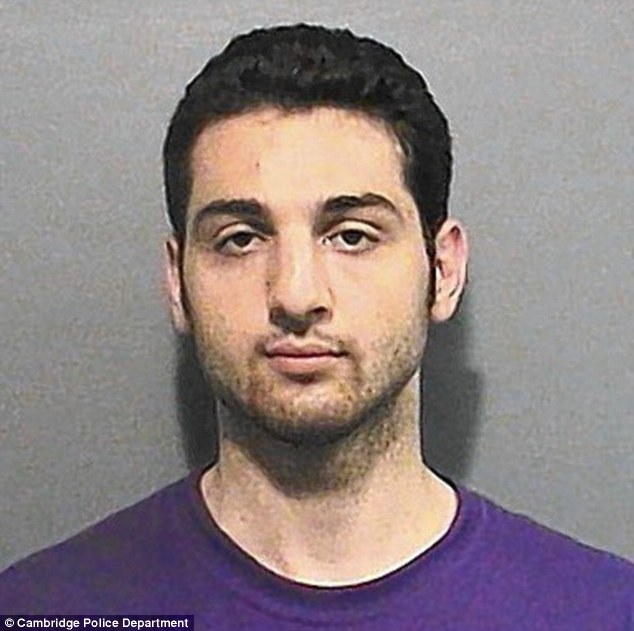
article-0-1CFA75C300000578-914_634x631

By Russ Baker

Source: WhoWhatWhy.com

Maybe you heard: the Russians are responsible for the Boston Marathon Bombing. At least indirectly.

That’s what the New York Times says. Had the Russians told the Americans everything they knew about Tamerlan Tsarnaev, the bombing might have been averted by the FBI. The Times knows this because it was told so by an anonymous “senior American official” who got an advance look at a report from the “intelligence community.”

***

Anyone who still entertains the fantasy that America is a vigorous, healthy democracy with an honest and reliable security apparatus and an honest, competent, vigilant media need only consider this major news leak just published as a New York Times exclusive. It pretty much sums up the fundamental corruption of our institutions, the lack of accountability, and the deep-dyed complicity of the “finest” brand in American journalism.

Killing Two Birds with One Stone

Just days before the first anniversary of the Boston bombing on April 15, some unnamed “senior American official” puts the blame for the bombing squarely on…Vladimir Putin.

It takes a keen understanding of certain members of the American media to know they will promote, without question, the latest “intelligence community” version of events. Which is that responsibility for the second largest “terror attack” after 9/11 should be pinned on the Russians, currently America’s bête noir over Ukraine.

Consider the cynical manipulation of public opinion involved here. The government permits, presumably authorizes, a high official—the Attorney General or someone of that status, perhaps even the Vice President—to leak confidential information for no apparent purpose beyond seeking to put a damper on legitimate inquiries into the behavior of the American government at the most fundamental level.

And the world’s vaunted “newspaper of record”—its brand largely based on insider access and the willingness of powerful figures to give it “hot stuff” in return for controlling public perceptions— shamelessly runs this leak with no attempt to question its timing or provenance.

Let’s look at what this article actually says. Here’s the opening paragraph:

The Russian government declined to provide the FBI with information about one of the Boston marathon bombing suspects two years before the attack that likely would have prompted more extensive scrutiny of the suspect, according to an inspector general’s review of how U.S. intelligence and law enforcement agencies could have thwarted the bombing.

And here’s the “takeaway”:

While the review largely exonerates the FBI, it does say that agents in the Boston area who investigated the Russian intelligence in 2011 could have conducted a few more interviews when they first examined the information.

The FBI agents also could have ordered turkey sandwiches instead of pastrami, which surely would have been a little healthier.

***

So, New York Times, should we trust the anonymous individual, or more importantly, the report that none of us have seen?

The report was produced by the inspector general of the Intelligence Community, which has responsibility for 17 separate agencies, and the inspectors general from the Department of Homeland Security and the Central Intelligence Agency.

Now, the Times doesn’t offer any useful context on why these reviews took place, beyond a pro forma effort to respond to complaints from a handful of congressional members (see this and this). The article does not address the quality or credibility of this “self-investigation” and the overall track record of these investigators. Nor does it express undue interest in why the report appears to have been finished just in time for the anniversary of the bombing.

In our view, the article is one hundred percent “stovepiping.” That’s when claimed raw intelligence is transmitted directly to an end user without any attempt at scrutiny or skepticism. This is irresponsible journalism, and it is the kind of behavior (from The New York Times again) that smoothed the way for the U.S. to launch the Iraq war in 2003.

The Times doesn’t even point out how self-serving the report is, coming from an “intelligence community” that has been publicly criticized for its actions leading up to the Boston Marathon bombing and its behavior since. (For more on the dozens of major reasons not to trust anything the authorities say about the Boston Bombing, see this, this, and this. For perspective on the media’s cooperation with the FBI in essentially falsifying the Bureau’s record throughout its history, see this).

Now let’s consider the core substance of the new revelations:

[A]fter an initial investigation by the F.B.I., the Russians declined several requests for additional information about Mr. Tsarnaev….

Did the Times ask the Russians about this? Did they find out if the Russians actually “declined” several requests, or whether they ever got back to the FBI?

The anonymous official notes one specific piece of evidence that the Russians did not share until after the bombing: that intercepted telephone conversations between Tamerlan Tsarnaev and his mother included discussions of Islamic jihad. The official speculates that this information might have given the FBI greater authority to conduct surveillance of the suspects.

However, the reality is that the Russians had already warned that Tamerlan was an Islamic radical, and it is not clear how this additional information would necessarily have provided anything truly substantive to add to a request for spying authority.

It’s also highly questionable, based in part on Edward Snowden’s revelations, whether the FBI or the NSA were actually adhering to such restrictions on spying anyway. Finally, it’s worth noting how truly remarkable it is that the Russians shared such intelligence at all. That they didn’t want to volunteer that they were capturing telephone calls is not that surprising, on the other hand.

Hiding the Real Story?

The Times does mention, almost in passing, what should have been the key point of an article: the timing of the “news” regarding the report:

It has not been made public, but members of Congress are scheduled to be briefed on it Thursday, and some of its findings are expected to be released before Tuesday, the first anniversary of the bombings.

This leak, which clears the FBI of all charges of incompetence or worse, comes just when the “American conversation” will again intensely focus on the nature of the “war on terror” and the trustworthiness of our vast secret state.

It also comes, most conveniently for the Bureau, at the precise moment when Dzhokhar Tsarnaev’s defense counsel has been seeking to learn the exact chronology and nature of the FBI’s interaction with the Tsarnaev family.

Months ago, we ran Peter Dale Scott’s rumination on whether the FBI could have recruited Tamerlan Tsarnaev as an informant, as it has done thousands of times before with other immigrants of a similar profile. Recently, the defense for Tamerlan’s younger brother, Dzhokhar, essentially claimed this was correct—that the Bureau at least attempted to recruit the older Tsarnaev. That has been cursorily reported by the major media, but no one seems to have connected the dots linking this claim to the new report that conveniently exonerates the FBI for failing to take action against the Tsarnaevs in time to stop the bombing.

A Curious Little Slip

As we have previously reported, it was the same duo of New York Times national security reporters, Schmidt and Schmitt, who had first, inadvertently it seems, raised a tremendously important question: when did the Tsarnaev family first come to the attention of the FBI?

The Russian warning to the US about Tamerlan Tsarnaev purportedly came in March 2011.

But according to an earlier article by Schmitt and Schmidt (along with a third reporter), the Bureau’s first contact with the Tsarnaevs came in January 2011. Though the Times did not make anything of this fact, it would be enormously consequential—because it would mean that the FBI was interacting with the Tsarnaevs two months before the Russians suggested the US take a close look at Tamerlan Tsarnaev.

If that was in error, the Times should have issued a correction. But it hasn’t. (Neither Schmidt nor Schmitt responded to WhoWhatWhy’s emails requesting comment.)

Interestingly, Schmidt and Schmitt, in subsequent articles, including the recent one, make no more mention of this early FBI contact. As it stands, the New York Times is on record of having asserted, again based on what sources told it, that the FBI was interacting with the Tsarnaevs before the Russians ever contacted it. If that early report was true, then by definition, the Inspector General’s report (and the leaked article about it) would be calculated parts of a cover-up about an FBI foul-up.

Conversely, if the early report was in error, then we need to know who provided it, or how they got that information wrong. Serious investigators know not to reject anomalies and “wrong” early reports as simply the result of haste or rumor without at least checking out the possibility that the early reports were right—but were later suppressed because they might cause problems to someone in power.

***

It is worth noting that the revelations in the new report—sure to be picked up by other media outlets that tend to repeat unquestioningly whatever the Times publishes—will be all the average American remembers about the FBI’s failure to prevent the Marathon bombing, and what may lie behind that failure.

Most members of the public will never know of the substantial indications that something is seriously wrong with what the government has put out about this affair. They will only recall that the FBI was somehow “cleared.” And they will probably remember that Putin’s Russia was somehow at fault.

In the final analysis, what we have just witnessed is the kind of arrant manipulation that shows the contempt of the “system” for the “people.” The “best” news organization gets another exclusive story. The US government gets to point its finger again at the Russian bogeyman. The FBI and the security apparatus get another free pass.

And the American people, once again, are fed pig slop and told to imagine sirloin.

Arrest of Middle Eastern Mercenary in Venezuela, a Possible Game Changer

By Arturo Rosales, writing from Caracas

Originally posted at Axis of Logic

In the conclusion to the recently published article on Axis of Logic Déjà vu – History tends to repeat itself we ask rhetorically what the next phase of destabilization will be in Venezuela in the US’ quest to secure the largest proven oil reserves in the world.

As of yesterday we may have the first evidence of an answer to this scary and ultimately decisive question. This could be a game changer in the development of the current destabilization effort in Venezuela by paid mercenaries masquerading as “disillusioned students”.

The breakthrough

At 4am on Monday 24th February in a hotel in northern part of the city of Maracay in Aragua state, an individual of Middle Eastern origin and two other people were captured by the Bolivarian Security Forces (SEBIN). Aragua governor, Tareck El Aissami reported the evidence available at that time in several posts on his Twitter account, @TareckPSUV.

El Aissami stated that they had captured a “big fish” in Aragua who was identified as Jayssam Mokded Mokded along with two other people in his company, both of whom have military backgrounds and training.

Jayssam Mokded Mokded


In the raid of the hotel room the security forces found electronic communications equipment – 11 satellite phones for communicating with the US and Colombia – computers and documents linking him with companies in Miami. His vehicle, a Toyota Model FJ was armored with bullet proofing and in it explosives, a keg of gun powder and logistical equipment to set up barricades in the streets were discovered.

It was also established that Mokded Mokded has access to a bank account in Miami with some US$250,000 and had made various transfers of hundreds of thousands of dollars to Miami and other destinations. In Colombia he has another bank account with a balance of some US$10,000. It was also noted that all his dealings with Venezuelan banks were limited to Banesco – a bank that had been involved in laundering finance for the 2002 – 2003 coup attempts but which was said to have changed its ways in recent years.

The purpose

All the evidence points to the fact that Mokded Mokded was fully equipped to carry out terrorist acts in Venezuela and it is known that he had been staying at the hotel in question since February 9th. The Venezuela security forces had been tailing him for several days and he had made visits to several upper and middle class urbanizations. The suspicion is that these visits were reconnaissance missions in order to find the most devastating spot to park car bombs and start sowing terror in Venezuela.

Bombs have been used in the last decade to sow terror in Venezuela and the perpetrators of the 2003 attacks, the Colina brothers, escaped to Florida where a judge refused to extradite them back to Venezuela. This is another example of the US protecting terrorists that carry out black operations against “unfriendly nations”. The last car bomb planted in that terror campaign by the opposition was the one placed under the seat of Danilo Anderson’s Toyota SUV, killing him on November 17th 2004. Anderson was the state prosecutor investigating those who carried out the April, 2002 coup attempt.

Reaction in Florida

Mokded Mokded lives in Doral, a city located in north-central Miami-Dade County in the US state of Florida where he is known as a “businessman”. Florida records show Mokded Mokded is president of CJ International Services, 10580 NW 27th St., in Doral.  He is also the president of Soloblackberry.net.inc with offices in Doral and Porlamar, Venezuela.

On Saturday, thousands met at J.C. Bermudez Park in Doral to express their solidarity with the opposition in Venezuela. Miami’s Doral area is known as “Doralzuela” for its anti-Chavez Venezuelan migrant population which is as radical and as permeated with hatred against chavista Venezuela as is the population of “Little Havana” against fidelista Cuba.

Concerns and Conclusions

The worrying aspects of the arrest of Mokded Mokded is that his possession of explosives, gunpowder and evidence of his reconnaissance for placing car bombs could mean that a new phase of terror is about to be unleashed on Venezuela.

Looking at this development from any angle, it could be a game changer,
escalating violence and hatred, the fuel of these protests throughout the country.

State Governor El Aissami has confirmed that authorities are already on the trail of other mercenaries and will hopefully be able to extract confessions and information from Mokded Mokded and his accomplices about other terror cells waiting to act in Venezuela.

In the hotel raid, a communiqué was found from Mokded Mokded to the Capriles Radonski presidential campaign in Venezuela demonstrating that politically, this “businessman” and apparent terrorist has been in contact with the Venezuela opposition. The opposition is getting nearer to full exposure as collaborators with terrorists “brought here” for the overthrow of the democratically-elected government of Nicolas Maduro.

Actually, none of this is a great surprise but cause for great concern as more innocent lives are now at risk. Massive loss of life due to any terrorist acts will be manipulated by the international media in cahoots with US imperialist lies to blame the Maduro government – as it has been in Syria against President Bashar al Assad.

It is the same script written either by writers in the CIA at Langley or by aides of John Kerry in the State Department – both consorting with the Father of the Paramilitary Death Squads, Colombia’s Alvaro Uribe Vélez.

Pearl Harbor: The Original 9/11

pearl-harbor

Yesterday marked the 72nd anniversary of the Pearl Harbor attack, which from today’s perspective can be viewed as the template on which 9/11 was modeled after. In both cases, documentation exists implicating the U.S. government. In the case of Pearl Harbor, there’s the McCollum Memo which describes in detail the strategy used to successfully provoke the Japanese government into attacking. Shortly before the Pearl Harbor attack, Secretary of State Hull presented “peace terms” to the Japanese government that all but guaranteed an inevitable attack.

In the case of 9/11, there’s a policy document from Project for a New American Century called Rebuilding America’s Defenses, which provides a clear motive to create a “catastrophic and catalyzing event – like a new Pearl Harbor”. It’s not conclusive proof they were behind the attacks, but it’s suspicious to say the least that the people with established motives for conducting an event like 9/11 were responsible for national security at the time multiple unlikely and implausible coincidences made such a successful attack possible.

A number of other dubious aspects of the Pearl Harbor attack were compiled at Washington’s Blog last year, including:

Active Interference with Military’s Ability to Defend

It has also recently been discovered that the FDR administration took numerous affirmative steps to ensure that the Japanese attack would be successful. These steps included taking extraordinary measures to hide information from the commanders in Hawaii about the location of Japanese war ships (information of which they would normally be informed), denying their requests to allow them to scout for Japanese ships, and other actions to blind the commanders in Hawaii so that the attacks would succeed. See, for example, this book (page 186).

Key Military Players Incommunicado

In addition, the heads of the Army and Navy suddenly disappeared and remained unreachable on the night before Pearl Harbor. And they would later testify over and over that they “couldn’t remember” where they were (pages 320 and 335).

Gagging Whistleblowers

Two weeks after Pearl Harbor, the Navy classified all documents top secret, and the Navy Director of Communications sent a memo ordering all commanders to “destroy all notes or anything in writing” related to the attacks. More importantly, all radio operators and cryptographers were gagged on threat of imprisonment and loss of all benefits. (page 256).

Media Complicity

Amazingly, the Army’s Chief of Staff informed the Washington bureau chiefs of the major newspapers and magazines of the impending attacks before they occurred, and swore them to an oath of secrecy, which the media honored (page 361); and listen to interview here (we personally spent an hour speaking with Stinnett, and find him to be a highly credible and patriotic American.)

Postscript: Coincidentally, Philip Zelikow – the Executive Director of the 9/11 Commission, the administration insider whose area of expertise is the creation and maintenance of “public myths” thought to be true, even if not actually true, who controlled what the 9/11 Commission did and did not analyze, then limited the scope of the Commission’s inquiry so that the overwhelming majority of questions about 9/11 remained unasked – also happened to be the main guy defending the alleged unforeseeablity of the Pearl Harbor attack, who wrote a hit piece on Pearl Harbor historians like Stinnett.

Just like 9/11, Pearl Harbor was used as a tool to focus mass hatred on a race demonized by propaganda. The attack created a culture of fear allowing for suspension of civil liberties while crushing opposition to the war. Most importantly (for powerful interests pushing for war) the attacks were a pretense for pursuing and expanding global political and economic hegemony.

For a comprehensive compilation of evidence of U.S. government involvement in the Pearl Harbor conspiracy, see: http://whatreallyhappened.com/WRHARTICLES/pearl/www.geocities.com/Pentagon/6315/pearl.html

On Typhoon Haiyan and Veterans Day

View of Typhoon Haiyan from the International Space Station. PHOTO: AP

View of Typhoon Haiyan from the International Space Station. PHOTO: AP

While I mean no disrespect towards veterans, I feel Veterans Day has become so archaic and obsolete it should no longer be observed. Veterans Day is an artifact of simpler times, when America was seen by the world as an honorable and benevolent country and when many still believed in “good wars”. However, the more historical truths are revealed over time, the more apparent it becomes that all wars are based on deception. This fact in no way diminishes the sacrifice and courage of those who enlisted and fought, though it adds a dimension of tragedy to realize the ideals many believed in were not necessarily those of the government and corporate interests that put them in jeopardy.

Because of the National Defense Authorization Act (NDAA), anyone including U.S. citizens can potentially be declared an “enemy combatant”, tortured, detained indefinitely or killed. Everyone is now spied on by intelligence agencies such as the FBI, CIA and NSA. Because we are all treated by government as potential “enemy combatants” does that not also make everyone of a certain age “veterans” of a perpetual war?

The main reason I don’t feel a need to celebrate Veterans Day nor Memorial Day and the Fourth of July, is because I don’t believe in American exceptionalism. Every government would like their people to believe their country is exceptional in some way. Some might be better in some respects than others, but the danger of believing one’s country to be exceptional and superior is that it often misleads people to believe the lives of citizens of one particular nation to be of more inherent value than others. In this day and age, we need to understand that those who facilitate military-industrial agendas by killing or dominating others are objectively no better than armies and civilians of other countries. It’s true that veterans do deserve more appreciation from systems that benefit most from their actions (ie. government and corporations), but it makes little sense for average Americans, who are in many ways oppressed by those systems and treated similarly to enemies of the state, to applaud and celebrate the military. The true heroes are those who value all life and do the most to put a stop to the insanity: war resisters (including some current and former soldiers), whistleblowers, activists, independent journalists, freethinkers, etc.

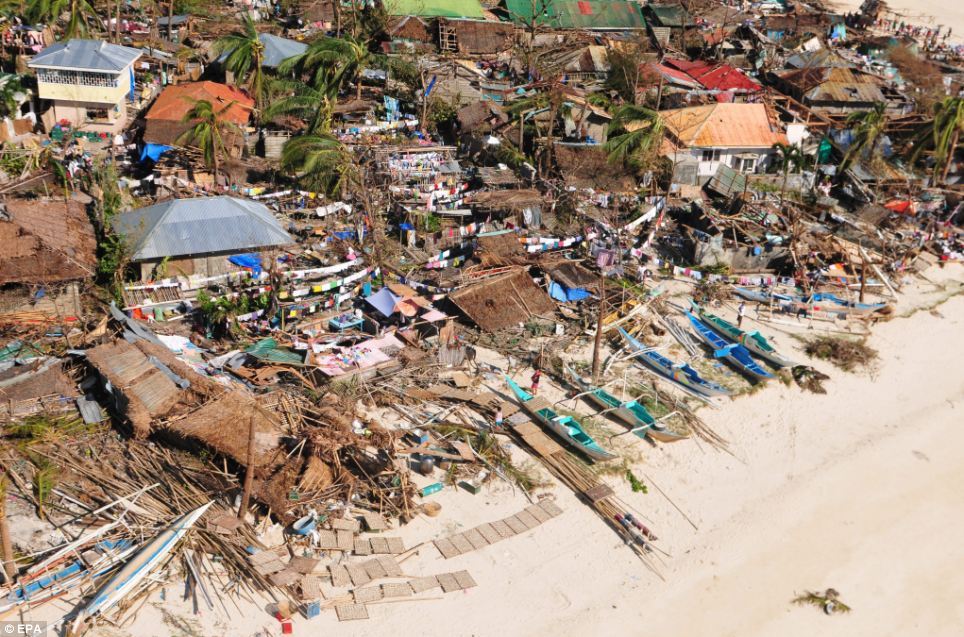
That being said, the people we should be paying our respects to today are the ~10,000 dead and hundreds of thousands displaced by Typhoon Haiyan. When Haiyan first hit the Philippines last Friday it was a maximum category 5 storm. Fortunately it has been weakening as it went over Vietnam earlier today and continues towards China. The following images from the UK’s Daily Mail online convey the scope of the devastation and suffering:

City of the dead: Dazed survivors survey the damaged houses in Tacloban city, Leyte province. At least 10,000 people are believed to have died there

City of the dead: Dazed survivors survey the damaged houses in Tacloban city, Leyte province. At least 10,000 people are believed to have died there

Force of nature: One of the many ships which have been swept into the Tacloban by the power of the typhoon

Force of nature: One of the many ships which have been swept into the Tacloban by the power of the typhoon

A Filipino father and his children wait for food relief outside their makeshift tent.

Desperate measures: A Filipino father and his children wait for food relief outside their makeshift tent. Survivors have foraged for food as supplies dwindled, with some uncovering the bodies of the dead

Trail of destruction: Those who escaped the awesome power of Haiyan now face a grim battle to rebuild their lives among the sprawling wreckages

Trail of destruction: Those who escaped the awesome power of Haiyan now face a grim battle to rebuild their lives among the sprawling wreckages

Survivors in Tacloban told reporters they are so desperate for food that they have been forced to loot shops and steal from the dead

Survivors in Tacloban told reporters they are so desperate for food that they have been forced to loot shops and steal from the dead

Action: President Benigno Aquino has deployed troops to the area in a bid to restore calm after Philipine Red Cross aid trucks were attacked by hungry mobs

Action: President Benigno Aquino has deployed troops to the area in a bid to restore calm after Philipine Red Cross aid trucks were attacked by hungry mobs

Aftermath: Resident gather in the remains of a structure in Tacloban. Those left homeless have been forced to plunder the houses belonging to the dead. One local councillor admitted he has stepped on corpses in a desperate bid to find food

Aftermath: Resident gather in the remains of a structure in Tacloban. Those left homeless have been forced to plunder the houses belonging to the dead. One local councillor admitted he has stepped on corpses in a desperate bid to find food saying: ‘If you have not eaten in three days, you do shameful things to survive’

Remains: Survivors have begun to rummage through the wreckages of houses in a bid to find food to feed their families

Remains: Survivors have begun find corpses as they rummage through the wreckages of houses in a bid to find food to feed their starving families

Making do: Survivors have been forced to forage for food and supplies after many homes were submerged by flood water and landslides

Making do: Survivors have been forced to forage for food and supplies after many homes were submerged by flood water and landslides

The Philippines president is considering introducing martial law in Tacloban city (pictured), where up to 10,000 people are feared dead, to enforce security after serious looting

The Philippines president is considering introducing martial law in Tacloban city (pictured), where up to 10,000 people are feared dead

Holy house: Churches in the storm torn city have become temporary aid centres offering washing facilities and handing out emergency food supplies

Holy house: Churches in the storm torn city have become temporary aid centres offering washing facilities and handing out emergency food supplies

Shelter from the storm: While the Catholic church in Tacloban has welcomed victims, many buildings have been broken into by desperate looters

Shelter from the storm: While the Catholic church in Tacloban has welcomed victims, many buildings have been broken into by desperate looters

This image taken by astronaut Karen L. Nyberg and released by NASA shows Super Typhoon Haiyan from the International Space Station yesterday

This image taken by astronaut Karen L. Nyberg and released by NASA shows Super Typhoon Haiyan from the International Space Station yesterday

Washing still hangs on the lines but dozens of bamboo houses have been flattened by the storm in Baladian in the municipality of Concepcion, Iloilo Province

Washing still hangs on the lines but dozens of bamboo houses have been flattened by the storm in Baladian in the municipality of Concepcion, Iloilo Province

Loss: A mother weeps beside the dead body of her son at a chapel in the aftermath of Typhoon Haiyan in Tacloban

Loss: A mother weeps beside the dead body of her son at a chapel in the aftermath of Typhoon Haiyan in Tacloban

A ship was washed ashore in the huge storm. Surging sea water strewed debris for miles and survivors said the devastation was like a tsunami

A ship was washed ashore in the huge storm. Surging sea water strewed debris for miles and survivors said the devastation was like a tsunami

The storm is one of the most powerful ever recorded

The storm is one of the most powerful ever recorded and huge waves swept away entire coastal villages and destroyed up to 80 per cent of the area in its path

More than 330,900 people were displaced and 4.3million 'affected' by the typhoon in 36 provinces, the U.N. has said

More than 330,900 people were displaced and 4.3million ‘affected’ by the typhoon in 36 provinces, the U.N. has said

Residents try to salvage belongings in Tacloban city, Leyte province.

Residents try to salvage belongings in Tacloban city, Leyte province. Rescuers have not even been able to contact some towns on the coast where the storm first hit

Villagers walk past a body of victim laying on a pier in the super typhoon devastated city of Tacloban, Leyte province

Villagers walk past a body of victim laying on a pier in the super typhoon devastated city of Tacloban, Leyte province

This afternoon, the Typhoon Haiyan - believed to be the strongest storm to ever hit land - made landfall in Sanya in south China's Hainan province.

This afternoon, Typhoon Haiyan – believed to be the strongest storm to ever hit land – made landfall in Sanya in south China’s Hainan province

Workers remove a tree that has fallen onto a car in the aftermath of Typhoon Haiyan after it struck Sanya

Workers remove a tree that fell onto a car during the deadly storm, which is the 30th typhoon to strike China this year

Vehicles move slowly by a fallen billboard in Sanya in south China's Hainan province

The typhoon is now making its way towards Vietnam and mainland China – with locals bracing themselves for the onslaught of the deadly typhoon

Heavy winds had already caused damage to China's Hainan island before the super typhoon made landfall this afternoon. Above, a billboard is blown over by the strong winds

Heavy winds had already caused damage to China’s Hainan island before the super typhoon made landfall. Above, a billboard is blown over by the strong winds

A man carries boxes of milk as he passes by ships washed ashore by enormous waves in Tacloban city, Leyte province

A man carries boxes of milk as he passes by ships washed ashore by enormous waves in Tacloban city, Leyte province

One survivor said the scenes of utter devastation caused by the typhoon was 'like the end of the world'

One survivor said the scenes of utter devastation caused by the typhoon was ‘like the end of the world’

Aid agencies have made emergency appeals for funds and are trying to reach survivors who are in desperate need of clean water and shelter

Aid agencies have made emergency appeals for funds and are trying to reach survivors who are in desperate need of clean water and shelter

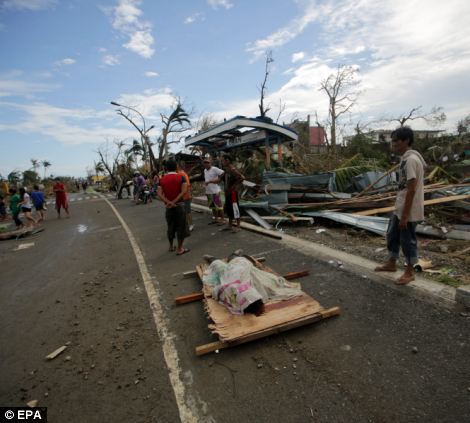
Bodies still lie in the roads and thousands of homes lie destroyed near the fish port after super Typhoon Haiyan battered Tacloban city

Bodies still lie in the roads and thousands of homes lie destroyed near the fish port after super Typhoon Haiyan battered Tacloban city

This NASA MODIS Aqua satellite image shows what is possibly the strongest storm ever - Super Typhoon Haiyan

This NASA MODIS Aqua satellite image shows what is possibly the strongest storm ever – Super Typhoon Haiyan

Local and foreign medical teams prepare to board a Philippines air force C-130 transport plane in Manila

Local and foreign medical teams prepare to board a Philippines air force C-130 transport plane in Manila

Survivors walk towards the evacuation center to get relief goods after super Typhoon Haiyan battered Tacloban city, central Philippines

Survivors walk towards the evacuation center to get relief goods after super Typhoon Haiyan battered Tacloban city, central Philippines

City administrators in Tacloban said about 400 bodies have been collected so far but said the death toll in the city alone could be 10,000

City administrators in Tacloban said about 400 bodies have been collected so far but said the death toll in the city alone could be 10,000

A girl looks out from a makeshift shelter in Tacloban.

A girl looks out from a makeshift shelter in Tacloban. The World Food Programme said it was airlifting 40 tonnes of high-energy biscuits to the region

A woman holds her umbrella stands on debris of houses in Tacloban

A woman holds her umbrella stands on debris of houses in Tacloban. Millions of people are believed to have been ‘affected’ by the storm, including hundreds of thousands who have lost their homes

Children pull sacks of goods they recovered from abandoned stores as they go past the rubble of houses in Tacloban

Children pull sacks of goods they recovered from abandoned stores as they go past the rubble of houses in Tacloban

A woman mourns in front of her husband's dead body, which lies no the street under tarpaulin alongside other bodies

A woman mourns in front of her husband’s dead body, which lies no the street under tarpaulin alongside other bodies

An injured Filipino boy stand in front of the rubble of houses in Tacloban - destroyed by the typhoon that has left thousands of people dead

An injured Filipino boy stand in front of the rubble of houses in Tacloban – destroyed by the typhoon that has left thousands of people dead

A man with an injured leg is carried through the devastation of former residential roads in Tacloban

A man with an injured leg is carried through the devastation of former residential roads in Tacloban

Operation: A Vietnamese soldier carries a young girl from a lorry as villagers are evacuated to a safe place by the military

Operation: A Vietnamese soldier carries a young girl from a lorry as villagers are evacuated to a safe place by the military


Desolation: This heartbreaking picture shows an flattened area of Tacloban city covered by debris and flood water

Desolation: This picture shows an flattened area of the destroyed Tacloban city covered by debris and flood water

Flattened: A Filipino boy stands among the debris in Tacloban, Leyte province - one of the worst hit areas of Typhoon Haiyan

Flattened: A Filipino boy stands among the debris in Tacloban, Leyte – one of the worst areas hit by category five storm Typhoon Haiyan

Death: It has been estimated by the Red Cross that 1,000 of the 1,200 people killed by the typhoon were residents of Tacloban

Death: It has been estimated by the Red Cross that 1,000 of the 1,200 people killed by the typhoon were residents of Tacloban

Widespread: This picture shows acres of flooded rice fields in the Iloilo Province

Widespread: This picture shows acres of flooded rice fields in the Iloilo Province, another area devastated by the typhoon

Assistance: An elderly woman is evacuated from her home by Red Cross staff in Vietnam
Plans: The Vietnamese Government has started to evacuate more than 100,000 people from the path of Typhoon Haiyan, according to state media

Plans: An elderly woman is taken from her home in Danang, Vietnam, as the government begins to evacuate 100,000 people lying in the path of typhoon Haiyan

From above: An aerial view shows badly damaged houses, including many without a roof, and blocked roads in the Philippine province of Iloilo

From above: An aerial view shows badly damaged houses, including many without a roof, and blocked roads in the Philippine province of Iloilo

Residents return to their houses after leaving an evacuation site in the aftermath of Super Typhoon Haiyan
Residents sit outside their damaged house

Recovery: A child is lifted to safety from a house in Tacloban, left, and two residents sit on the pavement in front of their home in the same city, right

Flattened: The typhoon has ravaged most of the city of Tacloban and destroyed the airport

Flattened: The typhoon has ravaged most of the city of Tacloban and destroyed the airport

Ruins: A resident sifts through rubbish inside his home that has been flattened by 235mph winds in the devastated city of Tacloban

Ruins: A resident sifts through rubbish inside his ruined home, flattened by 235mph winds in the devastated city of Tacloban

Scale: This image shows Typhoon Haiyan taken by Astronaut Karen L. Nyberg aboard the Internatioal Space Station

Scale: This image shows the enormous Typhoon Haiyan taken by Astronaut Karen L. Nyberg aboard the Internatioal Space Station

Satellite: A picture posted on Twitter by NASA at 8.00pm GMT shows the centre of the moving across the South China Sea towards the coast of Vietnam

Satellite: A picture posted on Twitter by NASA at 8.00pm GMT shows the centre of the moving across the South China Sea towards the coast of Vietnam

Path: Once the typhoon has reached the coast of Vietnam it is expected to moved towards the capital, Hanoi, with parts of Laos and Cambodia also likely to be affected

Path: Once the typhoon has reached the coast of Vietnam it is expected to moved towards the capital, Hanoi, with parts of Laos and Cambodia also likely to be affected

 Typhoon Haiyan
A boy walks past the devastation brought about by powerful typhoon Haiyan at Tacloban city

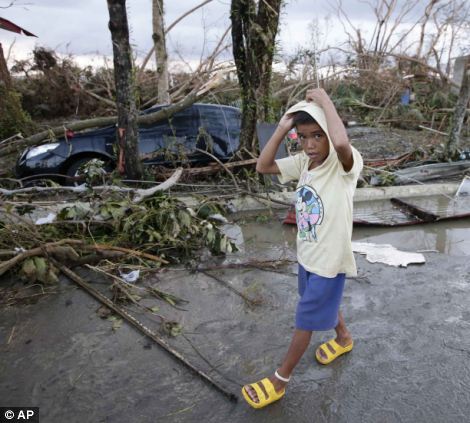
Loss: A pregnant woman, left, walks around the remains of her home while a young boy, right, walks past a crushed car in the destroyed town of Tacloban

Biggest storm in history Typhoon Haiyan flattens Philippines

Bodies wrapped in blankets are placed inside a damaged chapel
A Filipino elderly woman views the recovered victims in the typhoon

Temporary: Bodies of victims lay in a deserted chapel in Tacloban. A woman and child, right, view the distressing scene

Flooding: Locals in Coron, Palawan walk among damaged buildings after the typhoon - the most powerful in three decades

Flooding: Locals in Coron, Palawan, walk among damaged buildings and flooded streets after the typhoon – one of the most powerful to ever hit land

Terrifying: Filipino children are seen in the city of Tacloban, Leyte. Behind them is a scene of devastation with homes flattened and debris lying in the street

Terrifying: Filipino children are seen in the city of Tacloban, Leyte. Behind them is a scene of devastation with homes flattened and debris lying in the street

Picking up the pieces: Some residents try to go about their daily business despite the large-scale destruction

Picking up the pieces: Some residents try to go about their daily business despite the large-scale destruction

Victim
 resident recover a body of a victim

Tragedy: Bodies of residents can be seen in the streets of Tacloban, while one local is forced to transport a body in a wheelbarrow

Collapsed: A resident walks past her destroyed home - flattened by piles of wood and branches from nearby trees - in Tacloban city

Collapsed: A resident walks past her destroyed home – flattened by piles of wood and branches from nearby trees – in Tacloban city

Workers: Local Red Cross staff place sand bags on the roof of a house in Danang, Vietnam

Workers: Local Red Cross staff place sand bags on the roof of a house in Danang, Vietnam

Debris: Helicopters hover over the damaged area of Tacloban city, which was battered with strong winds yesterday

Debris: Helicopters hover over the damaged area of Tacloban city, which was battered with strong winds yesterday

Victim: A resident walks past dead bodies that lie on the street in Tacloban city, Leyte province

Victim: A resident walks past dead bodies that lie on the street in Tacloban city, Leyte province

Under water: Residents wade through a flooded street in Mindoro, Philippines this morning following the typoon

Under water: Residents wade through a flooded street in Mindoro, Philippines this morning following the typoon

Pile up: Vehicles and rubbish are pictured strewn across a flooded street in Tacloban, Leyte

Pile up: Vehicles and rubbish are pictured strewn across a flooded street in Tacloban, Leyte

Upside down: A devastated airport in Tacloban city, Leyte province - where roofs were ripped on hundreds of houses

Upside down: A devastated airport in Tacloban city, Leyte province – where roofs were ripped on hundreds of houses

 Coron, Palawan
 Coron, Palawan

Shock: These two pictures show the devastation in Coron, Palawan where buildings have been flattened, left and right, leaving residents helplessly walking the streets.

‘We thought is was a Tsunami’ – panic as storm lashes Philippines

Space: A digital composite of Typhoon Haiyan approaching the Philippines, made using images captured at 1pm

Space: A digital composite of Typhoon Haiyan approaching the Philippines, made using images captured geostationary satellites of the Japan Meteorological Agency

Rebuilding their lives: Two men in Iloilo move some of their belongings through flood waters covering the streets

Rebuilding their lives: Two men in Iloilo move some of their belongings through flood waters covering the streets

Devastation: Debris which was washed in by the storm litters the road by the coastal village in Legazpi city. Residents now face a long clean up operation to repair the damage to their homes

Devastation: Debris which was washed in by the storm litters the road by the coastal village in Legazpi city. Residents now face a long clean up operation

No chance: A house is engulfed by the storm surge brought about by powerful typhoon Haiyan, many homes like it could not stand up to the force of the gales
A fisherman secures his wooden fishing boat along the sea wall amidst strong winds as Typhoon Haiyan hit the city of Legaspi, Albay province, south of Manila

Hanging on: A fisherman in Manila is forced to cling on to his equipment, left, while there was little hope for other less stable buildings in the storm’s path, right

Higher ground: Residents of Legaspi, Albay province, south of Manila resident, were forced to flee the coast as Haiyan continued to pound the sea wall today

Higher ground: Residents of Legaspi, Albay province, south of Manila resident, were forced to flee the coast as Haiyan continued to pound the sea wall today

Downpour: As well as strong winds, the typhoon brought with it torrential rain which caused landslides in rural parts of the country

Downpour: As well as strong winds, the typhoon brought with it torrential rain which caused landslides in rural parts of the country

Terrifying: Residents run for their lives as the terrible gusts of the typhoon rush buffet the popular tourist city of Cebu

Terrifying: Residents run for their lives as the terrible gusts of the typhoon buffet the popular tourist city of Cebu. Trees and roofs were torn off by the storm

Blocked: Residents clear the road in the island province of Cebu after a tree was toppled by strong winds during typhoon Haiyan

Blocked: Residents clear the road in the island province of Cebu after a tree was toppled by strong winds during typhoon Haiyan

TYPHOON HAIYAN aftermath: Two dead, thousands displaced

Aid effort: Volunteers pack relief goods inside a Department of Social Welfare and Development warehouse before shipping out to devastated provinces

Aid effort: Volunteers pack relief goods inside a Department of Social Welfare and Development warehouse before shipping out to devastated provinces

Shelter: Filipino residents sleep on the floor of a gymnasium turned into an evacuation center in Sorsogon City in the Bicol region

Shelter: Filipino residents sleep on the floor of a gymnasium turned into an evacuation center in Sorsogon City in the Bicol region

If you would like to help: Médecins Sans Frontières (MSF)