Saturday Matinee: Dust

220px-Dust2“Dust” (2001) is an audacious Southeastern European Western directed by Milcho Manchevski. The film’s narrative cross-cuts between two stories: one in which a thief is cornered at gunpoint in a New York apartment by an elderly woman and a second involving love and vengeance between two brothers caught up in a revolutionary struggle in Macedonia. The parallel narratives are unified by themes of greed, redemption, and the transformative power of storytelling.

Note: Video may not work on some portable devices.

http://www.hulu.com/watch/316653

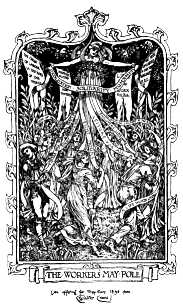
MAY DAY – The International Labor Day

crane13

Source: The Anarchist International

May 1st, International Workers’ Day, commemorates the historic struggle of working people throughout the world, and is recognized in most countries. The United States of America and Canada are among the exceptions. This despite the fact that the holiday began in the 1880s in the USA, linked to the battle for the eight-hour day, and the Chicago anarchists.

The struggle for the eight-hour day began in the 1860s. In 1884, the Federation of Organized Trades and Labor Unions of the United States and Canada, organized in 1881 (and changing its name in 1886 to American Federation of Labor ) passed a resolution which asserted that “eight hours shall constitute a legal day’s work from and after May 1, 1886, and that we recommend to labor organizations throughout this district that they so direct their laws as to conform to this resolution”. The following year the Federation repeated the declaration that an eight-hour system was to go into effect on May 1, 1886. With workers being forced to work ten, twelve, and fourteen hours a day, support for the eight-hour movement grew rapidly. In the months prior to May 1, 1886, thousands of workers, organized and unorganized, members of the organization Knights of Labor and of the federation, were drawn into the struggle. Chicago was the main center of the agitation for a shorter day. The anarchists were in the forefront of the Central Labor Union of Chicago, which consisted of 22 unions in 1886, among them the seven largest in the city.

During the Railroad strikes of 1877, the workers had been violently attacked by the police and the United States Army. A similar tactic of state terrorism was prepared by the bureaucracy to fight the eight-hour movement. The police and National Guard were increased in size and received new and powerful weapons financed by local business leaders. Chicago’s Commercial Club purchased a $2000 machine gun for the Illinois National Guard to be used against strikers. Nevertheless, by May 1st, the movement had already won gains for many Chicago workers. But on May 3, 1886, police fired into a crowd of strikers at the McCormick Harvester Machine Company, killing at least one striker, seriously wounding five or six others, and injuring an undetermined number. Anarchists called for a mass meeting the next day in Haymarket Square to protest the brutality.

The meeting proceeded without incident, and by the time the last speaker was on the platform, the rainy gathering was already breaking up, with only about two hundred people remaining. It was then a police column of 180 men marched into the square and ordered the meeting to disperse. At the end of the meeting a bomb was thrown at the police, killing one instantly, six others died later. About seventy police officers were wounded. Police responded by firing into the crowd. How many civilians were wounded or killed from police bullits never was ascertained exactly. Although it was never determined who threw the bomb, the incident was used as an excuse to attack anarchists and the labor movement in general. Police ransacked the homes and offices of suspected radicals, and hundreds were arrested without charge. A reign of police terror swept over Chicago. Staging “raids” in the working-class districts, the police rounded up all known anarchists and other socialists. “Make the raids first and look up the law afterward!” publicly counseled the state’s attorney.

Anarchists in particular were harassed, and eight of Chicago’s most active were charged with conspiracy to murder in connection with the Haymarket bombing. A kangaroo court found all eight guilty, despite a lack of evidence connecting any of them to the bomb-thrower, and they were sentenced to die. In October 9, 1886, the weekly journal Knights of Labor published in Chicago, carried on page 1 the following announcement: “Next week we begin the publication of the lives of the anarchists advertised in another column.”

The advertisement, carried on page 14, read: “The story of the anarchists, told by themselves; Parsons, Spies, Fielden, Schwab, Fischer, Lingg, Engle, Neebe. The only true history of the men who claim that they are condemned to suffer death for exercising the right of Free Speech: Their association with Labor, Socialistic and Anarchistic Societies, their views as to the aims and objects of these organizations, and how they expect to accomplish them; also their connection with the Chicago Haymarket Affair. Each man is the author of his own story, which will appear only in the “Knights of Labor” during the next three months, – the great labor paper of the United States, a 16-page weekly paper, containing all the latest foreign and domestic labor news of the day, stories, household hints, etc. A co-operative paper owned and controlled by members of the Knights of Labor, and furnished for the small sum of $1.00 per annum. Adress all communications to Knights of Labor Publishing Company, 163 Washington St., Chicago, Ill.“ Later this journal and the paper Alarm published the autobiographies of the Haymarket men.

Albert Parsons, August Spies, Adolf Fischer and George Engel were hanged on November 11, 1887. Louis Lingg committed suicide in prison. The authorities turned over the bodies to friends for burial, and one of the largest funeral processions in Chicago history was held. It was estimated that between 150,000 to 500,000 persons lined the route taken by the funeral cortege of the Haymarket martyrs. A monument to the executed men was unveiled June 25, 1893 at Waldheim Cemetery in Chicago. The remaining three, Samuel Fielden, Oscar Neebe and Michael Schwab, were finally pardoned in 1893.

On June 26, 1893, the governor of Illinois, John Peter Altgeld, issued the pardon message in which he made it clear that he was not granting the pardon because he believed that the men had suffered enough, but because they were innocent of the crime for which they had been tried, and that they and the hanged men had been the victims of hysteria, packed juries and a biased judge. He noted that the defendants were not proven guilty because the state “has never discovered who it was that threw the bomb which killed the policeman, and the evidence does not show any connection whatsoever between the defendants and the man who threw it.”

International Workers’ Day is the commemoration of the Haymarket Event in Chicago in 1886. In 1889, the first congress of the Second International, meeting in Paris for the centennial of the French Revolution and the Exposition Universelle (1889), following an initiative from the American Federation of Labor, called for international demonstrations on the 1890 anniversary of the Chicago protests. These were so successful that May Day was formally recognized as an annual event at the International’s second congress in 1891.

It is not surprising that the state, business leaders, mainstream union officials, and the media would want to hide the true history of May Day. In its attempt to erase the history and significance of May Day, the United States government declared May 1st to be “Law Day”, and gave the workers instead Labor Day, the first Monday of September – a holiday devoid of any historical significance.

Nevertheless, rather than suppressing the labor and anarchist movements, the events of 1886 and the execution of the Chicago anarchists, spokesmen of the movement for the eight-hour day, mobilized many generations of radicals. Emma Goldman, a young immigrant at the time, later pointed to the Haymarket affair as her political birth. Instead of disappearing, the anarchist movement only grew in the wake of Haymarket.

As workers, we must recognize and commemorate May Day not only for it’s historical significance, but also as a time to organize around issues of vital importance of today for the working-class broadly defined, i.e. the grassroots – the people seen as a class in contrast to the superiors in income and/or rank – economically and/or political/administrative.

The May Day Manifestos of the International Workers of the World affiliated to the Anarchist International, from the latest years are published on its Webpage, click here!

Baltimore and the Human Right to Resistance: Rejecting the Framework of the Oppressor

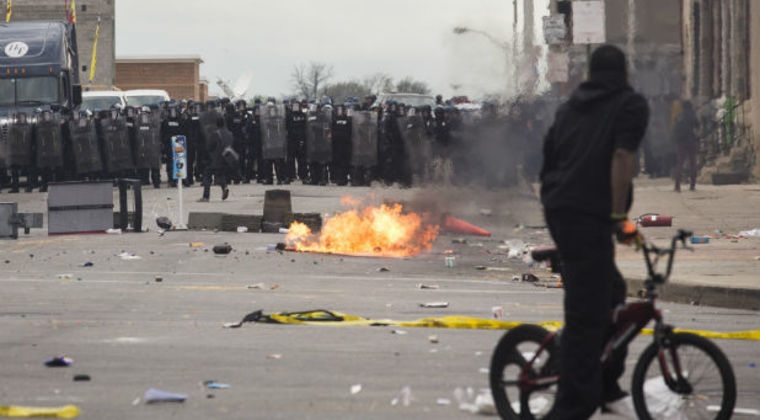
Baltimore-Riots.jpg_23790e32da49a4d09d45db82b7634b69To hear President Obama and Baltimore mayor Rawlings tell it, politeness, nonviolence and respect for law and property are the fundamental obligations of those confronting the brazen and lawless violence of police in Baltimore and beyond. This is a truly upside-down reality.

By Ajamu Baraka

Source: Black Agenda Report

Anti-Black racism, always just beneath the surface of polite racial discourse in the U.S., has exploded in reaction to the resistance of black youth to another brutal murder by the agents of this racist, settler-colonialist state. With the resistance, the focus shifted from the brutal murder of Freddie Gray and the systematic state violence that historically has been deployed to control and contain the black population in the colonized urban zones of North America, to the forms of resistance by African Americans to the trauma of ongoing state violence.

The narrative being advanced by corporate media spokespeople gives the impression that the resistance has no rational basis. The impression being established is that this is just another manifestation of the irrationality of non-European people – in particular, Black people – and how they are prone to violence. This is the classic colonial projection employed by all white supremacist settler states, from the U.S., to South Africa and Israel.

The accompanying narrative is that any kind of resistance that does not fit the narrow definition of “non-violent” resistance is illegitimate violence and, therefore, counter-productive because – “violence doesn’t accomplish anything.”  Not only does this position falsely equate resistance to oppression as being morally equivalent to the violence of the oppressor, it also attempts to erase the role of violence as being fundamental to the U.S. colonial project.

The history of colonial conquest saw the U.S. settler state shoot and murdered its’ way across the land mass of what became the U.S. in the process of stealing indigenous land to expand the racist White republic from “sea to shining sea.”  And the marginalization of the role of violence certainly does not reflect the values of the Obama administration that dutifully implements the bi-partisan dictates of the U.S. strategy of full spectrum dominance that privileges military power and oppressive violence to protect and advance U.S. global supremacy. The destruction of Libya; the reinvasion of Iraq; the civil war in Syria; Obama’s continued war in Afghanistan; the pathological assault by Israel on Palestinians in Gaza and the U.S. supported attack on Yemen by the Saudi dictatorship, are just a few of the horrific consequences of this criminal doctrine.

Race and oppressive violence has always been at the center of the racist colonial project that is the U.S. It is only when the oppressed resist — when we decide, like Malcolm X said, that we must fight for our human rights — that we are counseled  to be like Dr. King, including by war mongers like Barack Obama. However, resistance to oppression is a right that the oppressed claim for themselves. It does not matter if it is sanctioned by the oppressor state, because that state has no legitimacy.

No rational person exalts violence and the loss of life. But violence is structured into the everyday institutional practices of all oppressive societies. It is the deliberate de-humanization of the person in order to turn them into a ‘thing’ — a process Dr. King called “thing-afication.” It is a necessary process for the oppressor in order to more effectively control and exploit. Resistance, informed by the conscious understanding of the equal humanity of all people, reverses this process of de-humanization. Struggle and resistance are the highest expressions of the collective demand for people-centered human rights – human rights defined and in the service of the people and not governments and middle-class lawyers.

That resistance may look chaotic at this point – spontaneous resistance almost always looks like that. But since the internal logic of neoliberal capital is incapable of resolving the contradiction that it created, expect more repression and more resistance that will eventually take a higher form of organization and permanence. In the meantime, we are watching to see who aligns with us or the racist state.

The contradictions of the colonial/capitalist system in its current expression of neoliberalism have obstructed the creation of decent, humane societies in which all people are valued and have democratic and human rights. What we are witnessing in the U.S. is a confirmation that neoliberal capitalism has created what Chris Hedges called “sacrificial zones” in which large numbers of black and Latino people have been confined and written off as disposable by the system. It is in those zones that we find the escalation of repressive violence by the militarized police forces. And it is in those zones where the people are deciding to fight back and take control of their communities and lives.

These are defining times for all those who give verbal support to anti-racist struggles and transformative politics. For many of our young white comrades, people of color and even some black ones who were too young to have lived through the last period of intensified struggle in the 1960s and ‘70s and have not understood the centrality of African American resistance to the historical social struggles in the U.S., it may be a little disconcerting to see the emergence of resistance that is not dependent on and validated by white folks or anyone else.

The repression will continue, and so will the resistance. The fact that the resistance emerged in a so-called black city provides some complications, but those are rich and welcoming because they provide an opportunity to highlight one of the defining elements that will serve as a line of demarcation in the African American community – the issue of class.  We are going to see a vicious ideological assault by the black middle class, probably led by their champion – Barack Obama – over the next few days. Yet the events over the last year are making it more difficult for these middle-class forces to distort and confuse the issue of their class collaboration with the white supremacist capitalist/colonialist patriarchy. The battle lines are being drawn; the only question that people must ask themselves is which side they’ll be on.

Ajamu Baraka is a human rights activist, organizer, geo-political analyst and editor and contributing columnist for the Black Agenda Report. Baraka serves as the Public Intervenor for Human Rights as a member of the Green Shadow Cabinet and coordinates the International Affairs Committee of the Black Left Unity Network. He is also an Associate Fellow at the Institute for Policy Studies (IPS) in Washington, D.C.

Why Mumia Must Live, and US imperialism Must Die: The Link Between Political Prisoners and the War on Terror

mumia

The so-called War on Terror and the national security state did not emerge full-blown from the rubble of 9/11. Both are products of previous waves of police repression, mainly targeting Black radicals. “The FBI’s counter insurgency war on the Black Panther Party chapters and leaders like Mumia established for local police departments a direct link to Washington’s war and surveillance arsenal.”

By Danny Haiphong

Source: Black Agenda Report

“The fear of the Muslim/Arab terrorist rekindles the same fear in white America that the Black liberation movement ignited over four decades ago.”

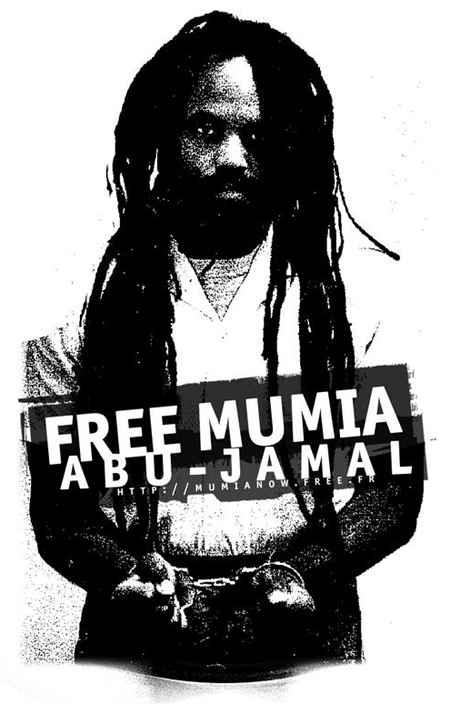
Political Prisoner and journalist Mumia Abu-Jamal has been subjected to over three decades of torture from the US prison gulag. His political imprisonment has placed his life in serious danger, this time not from state execution but instead from extra-legal medical neglect. The prison state has continuously failed in its efforts to murder Mumia through official means and has thus decided to refuse the former Black Panther adequate medical treatment for diabetes. Meanwhile, Boston residents of all classes await the verdict of whether the alleged “Boston bomber” Dzokhar Tsarnaev will receive the death penalty or life in prison. The event that faithful day remains shrouded in questions , but most of the city has accepted the dominant narrative put forth by the FBI and Boston Police Department. The War on Terror that produced the “Boston Bombing” and Mumia’s struggle against the prison state are intimately connected. For Mumia to live with freedom and dignity, the US imperial order behind the War on Terror must die.

Mumia Abu-Jamal’s existence as a political prisoner has been repressed by the establishment, while the War on Terror is a household name in the US. This is because the War on Terror serves the objectives of imperialism and Mumia does not. Mumia joined the Black Panther Party at fifteen and served as the Philadelphia Chapter’s Ministry of Information. He used his talents in journalism in service of Black people both in the BPP and after. This landed him on J. Edgar Hoover’s COINTEPRO list of Black liberation fighters to watch and suppress. In 1978, Mumia covered the Philadelphia police department’s siege on the MOVE Organization. His critical investigation of the Philly PD’s role in repressing MOVE led to his ouster from the journalism industry. In 1982, Mumia was framed for the murder of police officer Daniel Faulkner and sentenced to death.

“He used his talents in journalism in service of Black people both in the BPP and after.”

The context of Mumia’s imprisonment is at the essence of US imperialism’s War on Terror, which could be better named its war of terror. In the film Manufacturing Guilt​ , Mumia’s frame-up is blatantly exposed through court documents and investigations. Yet, Mumia has lived much of his life in prison, mostly in solitary confinement. What explains this injustice and how does it relate to the current War on Terror? In Still Black, Still Strong, Dhoruba Bin-Wahad explains how the FBI’s counter insurgency war on the Black Panther Party chapters and leaders like Mumia established for local police departments a direct link to Washington’s war and surveillance arsenal. Washington’s war on Black liberation fighters precipitated the first SWAT team operation in 1969 and the FBI’s declaration that the Black Panther Party was the “greatest threat to the internal security” of the US. The war on Black freedom that jailed Mumia created the technical capacity for the War on Terror.

The recent bombing of the 2013 marathon, and 9/11 before that, created the conditions for a massive expansion of the surveillance state and police state throughout the US mainland. The hundreds of illegally detained prisoners at Guantanamo Bay, the increased surveillance of Muslims and Black people in the US, and the massive spy program instituted by the Patriot Act and similar legislation are daily reminders of US imperialism’s ever expanding repressive apparatus. Internationally, the US led War on Terror interventions have caused the loss of life of millions of people in the Middle East and Africa alongside the thousands more from US aerial drone strikes and proxy war. All of this has been justified as necessary to “counter” the so-called threat of “terrorism.”

“The war on Black freedom that jailed Mumia created the technical capacity for the War on Terror.”

Mumia’s story, one shared by numerous US political prisoners sentenced to die in the cages of the prison state, contains in it the seeds that sprouted the rise of the massive War on Terror. Russell Maroon Shoatz, Oscar Lopez Rivera, Leonard Peltier and scores more faced trumped up charges from the state as part of US imperialism’s counter insurgency war on dissent generally and the Black liberation movement in particular. This war has been expanded to meet the needs of US imperialism, which in its current form has produced a potentially explosive situation domestically and globally. The sharpening contradictions of never-ending war and increasing poverty and privatization wouldn’t last long if the counter insurgency war on Mumia and the Panthers hadn’t provided the blueprints and technical support for the mass expansion of the War on Terror’s primary tools: war and surveillance state.

Mumia Abu-Jamal and the rest of the Empire’s political prisoners are caught in the cross hairs of US imperialism’s war of survival. Not only has the material basis of the counter insurgency war that murdered and imprisoned the Black liberation movement grown, but so too has the racist logic behind the repression. The War on Terror’s racist logic has permeated so deeply into the minds of the US public that the mere questioning of the agenda’s blatant deceit is subject to dismissal or defense by most people living in the US mainland. These conditions have left political prisoners with few fighters on the outside pressuring their release. The War on Terror has attempted to erase the memory of political prisoners by reframing the racist justifications for political imprisonment as common sense in what George Jackson called the “Amerikan mind.”

“The War on Terror’s racist logic has permeated so deeply into the minds of the US public that the mere questioning of the agenda’s blatant deceit is subject to dismissal.”

So, even though the justification for each and every War on Terror intervention or policy since 2001 are dubious at best, the fear of the Muslim/Arab terrorist rekindles the same fear in white America that the Black liberation movement ignited over four decades ago. The Black Panther Party and their partners in struggle were deemed criminal in every way and many were falsely charged with the murder of police officers, the highest form of offense in the eyes of white America. The War on Terror built off this strategy by throwing the Muslim community into the racist war on the oppressed as a means to control the dissent of the entire population. That the US imperial machinery is complicit in, and a sponsor of, jihadist terror and proxy war matters as little as the innocence of political prisoners when it comes to preserving the Empire and criminalizing all resistance to its rule.

Mumia Abu-Jamal’s life needs to be saved by any means necessary, but fighting to free him based on his criminal case alone won’t develop the movement we need. One of the primary obstacles to building a concrete movement for the freedom of political prisoners is the privileging of innocence over a movement that links political prisoners to the repression of the imperial state. But Mumia’s innocence teaches us the real purpose of political imprisonment. The War on Terror is a consolidation of the forces that were built by imperialism to suppress the revolutionary ideas of Mumia Abu-Jamal. What we need is a reexamination of those ideas in the service of the freedom of all political prisoners. By studying the War on Terror and the repression of the Black Liberation movement from which it grew, it becomes increasingly clear that imperialism must die for Mumia to truly live.

Danny Haiphong is an organizer for Fight Imperialism Stand Together (FIST) in Boston. He is also a regular contributor to Black Agenda Report. Danny can be reached at wakeupriseup1990@gmail.com and FIST can be reached at bostonfist@gmail.com.

Two Stories the Same Day Show That the U.S. is Rotten to the Core

drone_attacks_281210

By Ted Rall

Source: Ted Rall Blog

Still think the United States is governed by decent people? That the system isn’t totally corrupt and obscenely unfair?

Two stories that broke April 23rd ought to wake you up.

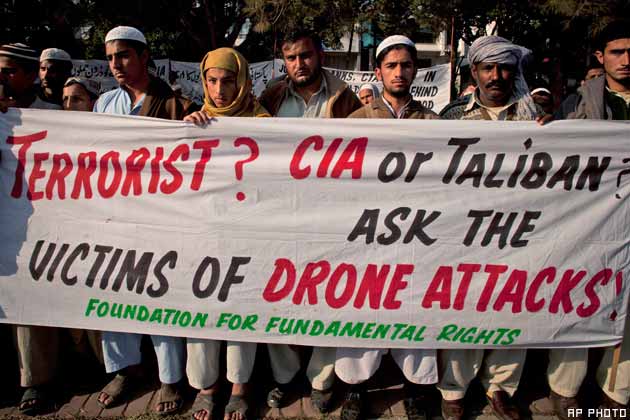
Story 1: President Obama admitted that one of his Predator drones killed two aid workers, an American and an Italian, who were being held hostage by Al Qaeda in Pakistan. As The Guardian reports, “The lack of specificity [about the targets] suggests that despite a much-publicized 2013 policy change by Barack Obama restricting drone killings by, among other things, requiring ‘near certainty that the terrorist target is present,’ the U.S. continues to launch lethal operations without the necessity of knowing who specifically it seeks to kill, a practice that has come to be known as a ‘signature strike.’”

“Lack of specificity” is putting it mildly. According to a report by the group Reprieve, the U.S. targeted 41 “terrorists” — actually, enemies of the corrupt Yemeni and Pakistani regimes — with drones during 2014. Thanks to “lack of specificity,” a total of 1,150 people were killed. Which doesn’t even include the 41 targets, many of whom got away clean.

Obama’s hammy pretend grief was Shatner-worthy. Biting his lip in that sorry/not sorry Bill Clinton way, the president summed up mock sadness for an event that happened back in January. Come on, dude. You seriously expect us to believe you’ve been all weepy for the last three months, except for all those speeches and other public appearances in which you were, you know, laughing and cracking jokes?

Including, um, the same exact day when he pretend-sadded, when he yukked it up with the Super Bowl champion New England Patriots? “That whole story got blown a little out of proportion,” he jibed. (Cuz: “deflate-gate.”) While sad. But laughing.

So. Confusing.

I swear, the right-wing racists are right to hate him. But they hate him for totally the wrong reasons.

Anyway, what took so long for the White House to admit they killed one of our best citizens? “It took weeks to correlate [the hostages’] reported deaths with the drone strikes,” The New York Times quoted White House officials. But in his prepared remarks, Obama said “capturing these terrorists was not possible” — thus the drone strike.

How stupid does the Administration think we are?

The fact that it is possible to find out who dies in a drone fact (albeit after the fact) indicates that there is reliable intelligence coming out of the targeted areas, presumably provided by local police and military sources. If there are cops and troops there who are friendly enough to give us information, then it obviously is possible to ask them to capture the targeted individuals.

Bottom line: the U.S. government is blowing up people with drones willy-nilly, without the slightest clue who they’re blowing up. Which, as political assassinations, are illegal. And which they specifically said was what they were no longer doing. Then they have the nerve to pretend to be sad about the completely avoidable consequences of their actions. They’re disgusting and gross and ought to be locked in prison forever.

Story 2: David Petraeus, former hotshot media-darling general of the Bush and early Obama years, received a slap on the wrist — probation plus a $100,000 fine — for improperly passing on classified military documents to unauthorized people and lying about it to federal agents when they questioned him about it.

Here we go again: more proof that, in the American justice system some people fly first-class while the rest of us go coach.

In this back-asswards world, people like Petraeus who ought to be held to the highest standard because they were entrusted with immense power and responsibility, walk free while low-ranking schlubs who committed the same crime get treated like Al Capone. Private Chelsea Manning, who released warlogs documenting U.S. war crimes in Iraq to Wikileaks, rots in prison for 35 years. Edward Snowden, the 31-year-old systems administrator for a private NSA outsourcing firm who revealed that the U.S. government is reading all our emails and listening to all our phone calls, faces life in prison.

Two years probation. Meanwhile, teachers who helped their students cheat on standardized tests got seven years in prison. To Petraeus, who went to work for a hedge fund, $100,000 is a nice tip for the caddy.

Adding insanity to insult is the fact that Petraeus’ motive for endangering national security was venal: he gave the documents to his girlfriend, who wrote his authorized biography. Manning and Snowden, heroes who in a sane society would receive ticker-tape parades and presidential medals of freedom, weren’t after glory. They wanted to inform the American people about atrocities committed in their name, and about wholesale violations of their basic freedoms, including the right to privacy.

Before he was caught and while he was sharing classified info with his gf, Petraeus had the gall to hypocritically pontificate about a CIA officer who disclosed sensitive information. Unlike Petraeus, the CIA guy got coach-class justice: 30 months in prison.

“Oaths do matter,” Petraeus pompously bloviated in 2012, “and there are indeed consequences for those who believe they are above the laws that protect our fellow officers and enable American intelligence agencies to operate with the requisite degree of secrecy.”

If you’re a first-classer, the consequences are very small.

(Ted Rall, syndicated writer and the cartoonist for The Los Angeles Times, is the author of the new critically-acclaimed book “After We Kill You, We Will Welcome You Back As Honored Guests: Unembedded in Afghanistan.” Subscribe to Ted Rall at Beacon.)

Infuriating Video Shows City Official Calling Vietnam Vet “The Enemy” for His Use of Medical Pot

images

By Matt Agorist

Source: The Free Thought Project

Maricopa County, AZ — A video was submitted to the Free Thought Project Sunday, which illustrates the brutal insanity of the state’s War on Drugs.

The video was taken during a heated debate on whether or not to legalize marijuana in Arizona. Maricopa County Attorney, Bill Montgomery, and Attorney Marc Victor went head to head on the topic of prohibition. Victor advocated to end prohibition and Montgomery held the position to continue locking people in cages for a plant.

At the end of the nearly 2 hour long debate, the two debaters took questions from the audience. That is when Vietnam veteran Don Ream stood up to explain to Montgomery how calling people who use marijuana for medicine, “Pot Heads,” was offensive.

Ream explained how he has been a patient for four years, and he is off all of his pharmaceutical medicine. All he uses for his symptoms is his medical marijuana. He then politely invited Mr. Montgomery to come and learn about the benefits of the substance and how safe marijuana actually is.

As Ream began to close his statement, Montgomery took to the podium ready to fire back.

“There is a difference between medical application of marijuana and recreational use of the substance,” said Montgomery, who is an attorney, not a doctor.

Ream then admitted that he uses his marijuana recreationally as well.

“Well, then you’re violating the law, and I have no respect for you,” Montgomery said. “I have no respect for someone who would try to claim that you served this country and took an oath to uphold the Constitution and protect against all enemies foreign and domestic – because you’re an enemy.”

Montgomery was then met with several “Boos” from the audience.

How exactly does ingesting a plant make you an enemy?

The person who wants to ingest a substance for medical or recreational reasons is not the criminal. However, the person that would kidnap, cage, or kill someone because they have a different lifestyle is a villain on many fronts.

The only “enemy” in the interchange below is the person who would deprive someone of their freedom by using government violence to enforce their personal preference. Shame on you Bill Montgomery.

Freedom – A Condition of the Human Heart

Freedom

By Kingsley L. Dennis

Source: Waking Times

“Loving freedom, to me, means having the freedom to love yourself deeply, others deeply, and accepting the never-ending truth of change. It means having the freedom to be happy on your own and happy with others as they come in and out of our lives. It means having the freedom to connect wonderfully with those you meet and deal successfully with those who are difficult to relate to well.” – Owen Fitzpatrick

In my previous ‘Reflections’ article (Toward Synthesis), I noted how the humanistic philosopher Erich Fromm viewed the modern world as suffering from the  contradictory struggle between having and being. The human need to find meaning, well-being, and personal growth was in conflict with a different type of world external to us. For Fromm, the resolution of this conflict was to be found in ‘a radical change of the human heart.’ For me, the issue of personal well-being revolves around the perception and experience of freedom. The ability to recognize, and internalize, well-being is fundamentally linked to how a person experiences their freedom.

Freedom is not simply a condition linked to battlefields, nations, and human rights. On an essential level it concerns the freedom within the self, and our battle to maintain this personal freedom within our everyday life. Erich Fromm himself wrote much on our human fear of freedom[i]. Fromm concluded that our in-born fear of pursuing freedom against social conditioning originates in our human birth process. The helplessness of the newly born child and the need for extra long dependency upon protection continues into adulthood in our need for human security. Fromm views our susceptibility to social conditioning as thus based upon a biological predisposition. This can perhaps explain why we often reach out to an outside authority (parent, teacher, partner/lover) as a power or force to recompense us for a sense of personal isolation. Modern society has exploited this tendency by approving and supporting our dependency upon external social systems. In the same way, our cultures often disapprove of those individuals that show high levels of self-reliance and independence. In a world moving toward greater connectedness, collaboration, and shared compassion, the presence of personal freedom is critical. For too long we have been focused upon the play of freedom as it is exhibited outside of us – by external powers – whilst blinded to the inner restraints of personal freedom. For me, freedom is nothing if it is not a freedom of the heart.

We often talk about freedom, or hear other people talk about it, in terms of having. In this way it becomes a value of possession. We either have it or we don’t; other people have it, or manipulate it, or control it, etc. In our modern understanding of freedom we have turned it into a commodity – a material object that we bargain with. In many situations and for many people this has been true. Also, if a person has been kidnapped, or held in prison/confinement, then freedom becomes a very real physical reality. Yet this is just one manifestation of the essence of human freedom. For my purposes I wish to discuss freedom as a state of being.

On an interior level freedom is not about what we have; it is more about where we are and what we do. It is about having the right attitude and perspective. In this context freedom is a process: we need freedom from something or freedom to something. We don’t have or possess freedom – we do freedom. It is important we create a freedom to move into, otherwise where are we going? We can create our freedom from the past – and even the present – if we wish to move toward a different place or state of being. For example, our past should not define how we wish our present to be. We can learn from it, and develop from its experience; yet if it is no longer useful, or even detrimental, then we need to learn how to leave it behind. We all have this choice of where we want To Be.

If we are unable to create this freedom within ourselves then we become, in the words of Doris Lessing, the ‘prisons we choose to live inside.’[ii] Let us not forget also that our interior freedom goes with us wherever we go. If we feel a lack of true freedom within then this will still travel with us whether we are in a meditation retreat in India, or in the Andes of South America. After all, we cannot escape from our very self. It is thus essential that we have the freedom to deal with the events that affect us on a daily basis. We cannot control what events happen to us, yet we do have the freedom of choice to choose how we respond to them. By progressing through our experiences, and by choosing connections and situations that are aligned with our heart, we can become an intentional traveler rather than a random one. The fundamental question to ask ourselves is: how do we want to live?

For me, how we answer this question is part of what I call the ‘living work’ – the work we do inside ourselves to prepare us and make us better for living in the outer world. This is where both aspects of freedom converge – at the intersection where interior and exterior worlds meet. This is where our image of the world and the physical reality of the world also merge. If we can realize that we only experience the world as ‘we are’, then the freedom we find in the world is but a reflection of the freedom we consciously – or unconsciously – perceive within us. In other words, our sense of freedom is as near or as far away as we make it. It may sound contradictory, yet what we need to achieve is the liberation of our own perceptions of freedom. The reason why many of us do not stop to consider this, or perhaps we don’t see it as necessary, is because we do not yet have the freedom to assess the state of our own freedom! As I stated earlier, freedom is not a possession, it is a process – an action – and therefore something to be worked for, to be involved with. Our own freedom is a participatory process.

Perhaps this process involves the freedom to do the small things that are important for our lives; not necessarily the freedom to ‘save the world’ or make a grand gesture. What we need within ourselves is the freedom to make a choice; to act as we feel best; to create moments of joy that can be shared. Or it could be the freedom to begin making a change by changing one thing at a time. Our lives are part of a grand human, living tapestry. By making one small change we can influence change in many other ways through countless visible and invisible connections. Freedom is about having the choice to make these changes, and to take responsibility for our participation in the living tapestry that is life.

Personal freedom is also an expression of intelligence: not intellectual learning but rather social intelligence, spiritual intelligence, emotional intelligence, and instinctive intelligence. All this is the intelligence of personal freedom. I am reminded of Rumi who wrote of the difference between instinctive and acquired intelligence: ‘There are two kinds of intelligence: One acquired/as a child in school memorizes facts and concepts/from books and from what the teacher says, collecting information from the traditional sciences/……There is another kind/…one already completed and preserved inside you./A spring overflowing its spring box. A freshness/in the center of the chest…/This second knowing is a fountainhead/from within you, moving out.’ This second knowing – our instinctual intelligence – is already within each one of us. As a human being we inherently have this knowing. For me, freedom is being able to connect with this internal knowing – and to act from it. In the end, true freedom is a condition of the human heart.

[i] See his book ‘Fear of Freedom’

[ii] See Doris Lessing, Prisons We Choose To Live Inside (1987)

About the Author

Kingsley L. Dennis, author of The Phoenix Generation: A New Era of Connection, Compassion, and Consciousness. Visit him on the web at http://www.kingsleydennis.com/.