
Dictators Bent on Building Military Empires: The Cost of the Nation’s Endless Wars

By John & Nisha Whitehead

Source: The Rutherford Institute

“Autocrats only understand one word: no, no, no. No you will not take my country, no you will not take my freedom, no you will not take my future… A dictator bent on rebuilding an empire will never be able to ease the people’s love of liberty. Brutality will never grind down the will of the free.”—President Biden

Oh, the hypocrisy.

To hear President Biden talk about the Russia’s aggression against Ukraine, you might imagine that Putin is the only dictator bent on expanding his military empire through the use of occupation, aggression and oppression.

Yet the United States is no better, having spent much of the past half-century policing the globe, occupying other countries, and waging endless wars.

What most Americans fail to recognize is that these ongoing wars have little to do with keeping the country safe and everything to do with propping up a military industrial complex that has its sights set on world domination.

War has become a huge money-making venture, and the U.S. government, with its vast military empire, is one of its best buyers and sellers.

America’s part in the showdown between Russia and the Ukraine has already cost taxpayers more than $112 billion and shows no signs of abating.

Clearly, it’s time for the U.S. government to stop policing the globe.

The U.S. military reportedly has more than 1.3 million men and women on active duty, with more than 200,000 of them stationed overseas in nearly every country in the world.

American troops are stationed in Somalia, Iraq and Syria. In Germany, South Korea and Japan. In Saudi Arabia, Jordan and Oman. In Niger, Chad and Mali. In Turkey, the Philippines, and northern Australia.

Those numbers are likely significantly higher in keeping with the Pentagon’s policy of not fully disclosing where and how many troops are deployed for the sake of “operational security and denying the enemy any advantage.” As investigative journalist David Vine explains, “Although few Americans realize it, the United States likely has more bases in foreign lands than any other people, nation, or empire in history.”

Incredibly, America’s military forces aren’t being deployed abroad to protect our freedoms here at home. Rather, they’re being used to guard oil fields, build foreign infrastructure and protect the financial interests of the corporate elite. In fact, the United States military spends about $81 billion a year just to protect oil supplies around the world.

The reach of America’s military empire includes close to 800 bases in as many as 160 countries, operated at a cost of more than $156 billion annually. As Vine reports, “Even US military resorts and recreation areas in places like the Bavarian Alps and Seoul, South Korea, are bases of a kind. Worldwide, the military runs more than 170 golf courses.”

This is how a military empire occupies the globe.

After 20 years of propping up Afghanistan to the tune of trillions of dollars and thousands of lives lost, the U.S. military may have finally been forced out, but those troops represent just a fraction of our military presence worldwide.

In an ongoing effort to police the globe, American military servicepeople continue to be deployed to far-flung places in the Middle East and elsewhere.

This is how the military industrial complex, aided and abetted by the likes of Joe Biden, Donald Trump, Barack Obama, George W. Bush, Bill Clinton and others, continues to get rich at taxpayer expense.

Yet while the rationale may keep changing for why American military forces are policing the globe, these wars abroad aren’t making America—or the rest of the world—any safer, are certainly not making America great again, and are undeniably digging the U.S. deeper into debt.

War spending is bankrupting America.

Although the U.S. constitutes only 5% of the world’s population, America boasts almost 50% of the world’s total military expenditure, spending more on the military than the next 19 biggest spending nations combined.

In fact, the Pentagon spends more on war than all 50 states combined spend on health, education, welfare, and safety.

The American military-industrial complex has erected an empire unsurpassed in history in its breadth and scope, one dedicated to conducting perpetual warfare throughout the earth.

Since 2001, the U.S. government has spent more than $4.7 trillion waging its endless wars.

Having been co-opted by greedy defense contractors, corrupt politicians and incompetent government officials, America’s expanding military empire is bleeding the country dry at a rate of more than $32 million per hour.

In fact, the U.S. government has spent more money every five seconds in Iraq than the average American earns in a year.

Future wars and military exercises waged around the globe are expected to push the total bill upwards of $12 trillion by 2053.

Talk about fiscally irresponsible: the U.S. government is spending money it doesn’t have on a military empire it can’t afford.

Unfortunately, even if we were to put an end to all of the government’s military meddling and bring all of the troops home today, it would take decades to pay down the price of these wars and get the government’s creditors off our backs.

As investigative journalist Uri Friedman puts it, for more than 15 years now, the United States has been fighting terrorism with a credit card, “essentially bankrolling the wars with debt, in the form of purchases of U.S. Treasury bonds by U.S.-based entities like pension funds and state and local governments, and by countries like China and Japan.”

War is not cheap, but it becomes outrageously costly when you factor in government incompetence, fraud, and greedy contractors. Indeed, a leading accounting firm concluded that one of the Pentagon’s largest agencies “can’t account for hundreds of millions of dollars’ worth of spending.”

Unfortunately, the outlook isn’t much better for the spending that can be tracked.

A government audit found that defense contractor Boeing has been massively overcharging taxpayers for mundane parts, resulting in tens of millions of dollars in overspending. As the report noted, the American taxpayer paid:

$71 for a metal pin that should cost just 4 cents; $644.75 for a small gear smaller than a dime that sells for $12.51: more than a 5,100 percent increase in price. $1,678.61 for another tiny part, also smaller than a dime, that could have been bought within DoD for $7.71: a 21,000 percent increase. $71.01 for a straight, thin metal pin that DoD had on hand, unused by the tens of thousands, for 4 cents: an increase of over 177,000 percent.

That price gouging has become an accepted form of corruption within the American military empire is a sad statement on how little control “we the people” have over our runaway government.

Mind you, this isn’t just corrupt behavior. It’s deadly, downright immoral behavior.

Americans have thus far allowed themselves to be spoon-fed a steady diet of pro-war propaganda that keeps them content to wave flags with patriotic fervor and less inclined to look too closely at the mounting body counts, the ruined lives, the ravaged countries, the blowback arising from ill-advised targeted-drone killings and bombing campaigns in foreign lands, or the transformation of our own homeland into a warzone.

That needs to change.

The U.S. government is not making the world any safer. It’s making the world more dangerous. It is estimated that the U.S. military drops a bomb somewhere in the world every 12 minutes. Since 9/11, the United States government has directly contributed to the deaths of around 500,000 human beings. Every one of those deaths was paid for with taxpayer funds.

The U.S. government is not making America any safer. It’s exposing American citizens to alarming levels of blowback, a CIA term referring to the unintended consequences of the U.S. government’s international activities. Chalmers Johnson, a former CIA consultant, repeatedly warned that America’s use of its military to gain power over the global economy would result in devastating blowback.

The 9/11 attacks were blowback. The Boston Marathon Bombing was blowback. The attempted Times Square bomber was blowback. The Fort Hood shooter, a major in the U.S. Army, was blowback.

The U.S. military’s ongoing drone strikes will, I fear, spur yet more blowback against the American people.

The war hawks’ militarization of America—bringing home the spoils of war (the military tanks, grenade launchers, Kevlar helmets, assault rifles, gas masks, ammunition, battering rams, night vision binoculars, etc.) and handing them over to local police, thereby turning America into a battlefield—is also blowback.

James Madison was right: “No nation could preserve its freedom in the midst of continual warfare.” As Madison explained, “Of all the enemies to public liberty war is, perhaps, the most to be dreaded because it comprises and develops the germ of every other. War is the parent of armies; from these proceed debts and taxes… known instruments for bringing the many under the domination of the few.”

We are seeing this play out before our eyes.

The government is destabilizing the economy, destroying the national infrastructure through neglect and a lack of resources, and turning taxpayer dollars into blood money with its endless wars, drone strikes and mounting death tolls.

Clearly, our national priorities are in desperate need of an overhauling.

At the height of its power, even the mighty Roman Empire could not stare down a collapsing economy and a burgeoning military. Prolonged periods of war and false economic prosperity largely led to its demise. As historian Chalmers Johnson predicts:

The fate of previous democratic empires suggests that such a conflict is unsustainable and will be resolved in one of two ways. Rome attempted to keep its empire and lost its democracy. Britain chose to remain democratic and in the process let go its empire. Intentionally or not, the people of the United States already are well embarked upon the course of non-democratic empire.

This is the “unwarranted influence, whether sought or unsought, by the military-industrial complex” that President Dwight Eisenhower warned us more than 50 years ago not to let endanger our liberties or democratic processes.

Eisenhower, who served as Supreme Commander of the Allied forces in Europe during World War II, was alarmed by the rise of the profit-driven war machine that emerged following the war—one that, in order to perpetuate itself, would have to keep waging war.

We failed to heed his warning.

As I make clear in my book Battlefield America: The War on the American People and in its fictional counterpart The Erik Blair Diaries, war is the enemy of freedom.

As long as America’s politicians continue to involve us in wars that bankrupt the nation, jeopardize our servicemen and women, increase the chances of terrorism and blowback domestically, and push the nation that much closer to eventual collapse, “we the people” will find ourselves in a perpetual state of tyranny.
War Certainly Is A Racket

By Iain Davis

Source: Off-Guardian

In 1935, Major General Smedley Butler’s seminal book “War Is A Racket” warned of the dangers of the US military-industrial complex, more than 25 years before the outgoing US President Eisenhower implored the world to “guard against” the same thing.

One of the most decorated soldiers in US military history, Butler knew what he was talking about, famously writing that war is “…conducted for the benefit of the very few, at the expense of the very many.”

While he lamented the loss of his fallen comrades and despite the gongs he received for defending his country, Butler came to understand that he was actually a “high class muscle man for big business, for Wall Street and the bankers.” Later, the historian Antony C. Sutton proved that Butler was right.

When the US administration of George Bush passed its Foreign Operations Appropriation Law in 1991, it ended all US credit to the former, thriving socialist republic of Yugoslavia. At the time the perception on the Hill was that Yugoslavia was no longer required as a buffer zone between the NATO states and their former Warsaw Pact adversaries, so its independent socialism was no longer tolerated.

The US military industrial complex, that Butler and Eisenhower told everyone to tackle, effectively destabilised the entire Balkan region, destroyed hitherto relatively peaceful countries and then fuelled the resultant wars with its pet Islamist terrorists. Ably assisted by the World Bank and the IMF.

So-called “assistance,” via the Train and Equip Program, gave US taxpayers the opportunity to funnel $500M to private security contractors like DynCorp. DynCorp put taxpayer’s money to use, seemingly by training terrorists and child trafficking to paedophiles.

The US and its Western allies’ military industrial complex pulled off more or less the same trick in Iraq, Libya and nearly in Syria. In hindsight this doesn’t appear to have been a very good idea. That is, if you think wars are fought for the reasons we are told.

Having bombed Iraq into the stone age, to stop its regime producing the WMDs it didn’t have, the US then “rescued” the country, from the horrific violence and starvation sanctions the US government itself visited upon the Iraqi people, by establishing the US led coalition’s puppet Coalition Provisional Authority (CPA) government. Once installed, the CPA did things like award US engineering firm Kellogg Brown & Root (KBR) a ‘sole source contract’ to fix and operate all of Iraq’s oil wells.

That US Vice President Dick Cheney, who lied passionately about Iraqi WMD, was also in receipt of an annual $2M stipend from KBR was just a coincidence. As was the massive boost to the value of his Halliburton shareholdings as a direct result of the war he was instrumental in starting.

When the former UK Prime Minister Teresa May OK’d missile trikes upon Syrian civilians, the fact that her husband made millions out of it, as his investments in missile manufactures went through the roof, was also just a coincidence. In no way did she personally profit from killing children and the fact that her family continues to make a fortune by killing more children in Yemen does not undermine Theresa’s very public profile as a champion of good causes. Although, it appears, not killing children isn’t one of them.

So we shouldn’t be surprised when, once again, we discover that war, far from an impediment to business, actually improves operational margins, increases production, boosts markets and offers white collar criminal enterprises industrial scale profits.

Sure, people, including children, die in huge numbers but so what? Where there’s muck there’s brass. War certainly is a racket.

It turns out that Ukraine has been buying Russian fuel from the EU member state Bulgaria throughout the Ukraine War. An odd oversight for alleged combatants in a war. It is similar to the Ukrainian government’s decision to allow the continuing transit of Russian gas from Gazprom to EU markets through its resident pipelines.

The Russian energy giant Lukoil, whose former CEO Ravil Maganov accidentally fell out of a window a few months ago—a common problem for the wrong Russian executives—has been shipping Russian oil to its refinery in the Bulgarian port city of Burgas. The Burgas refinery is the only one in Bulgaria and the largest in the Balkans. From there the refined gas-oil (red diesel) is exported to Russia’s supposed enemy, Ukraine.

This was all being done in secret, says the Russian MSM, although this is just perception management, pro-war propaganda. There has also been a lot of nonsense written by the Western MSM, alleging that Bulgaria has been illicitly circumnavigating EU “sanctions.” Regardless of the fact that this too is monumental tripe.

There isn’t anything “secret” about it. In truth, the door was left open for Russia and Bulgaria to continue this trade, at least until the end of 2024, because the EU inserted a loophole to ensure that they could. Presumably, the Russian government knew nothing about the massive oil shipments, which is why it remained a “secret,” according to Russian MSM.

Given that the “secrecy” narrative is total claptrap, why would both the Western and the Russian MSM want to peddle essentially the same disinformation? Let’s spend a moment to reflect upon the EU’s non-sanction sanctions shall we?

It means that third party non-EU trading nations, like Kazakhstan for instance, can ship Russian oil to the EU unhindered by the inconvenience of alleged sanctions. The sanctions are for reordering global energy flows, not ending them.

While the switch-over has plunged European citizens into an energy crisis, that’s OK. It is essential for the future of the planet that Europeans are convinced to accept ever increasing energy prices. Otherwise they might not welcome the transition to the “sustainable energy” that will make their lives much worse.

Red diesel in Ukraine is used for industrial and heavy machinery, in agriculture and manufacturing for example. It is also used for, oh I don’t know, fuelling tanks and armoured personnel carriers, mobile artillery units and stuff like that.

Stories from European news outlets that Bulgaria provides nearly 40% of Ukrainian military fuel are all nonsense because reasons. Officials have denied the evidence, such as confirmation from the former Bulgarian President, so it isn’t “officially approved” evidence. Consequently, it can safely be discounted by anyone gullible enough to do so.

Don’t forget, according to Western and Russian MSM outlets, it’s all a secret. Which may come as a relief to some, because otherwise the Russian government would have been colluding with the EU to ensure that the Ukrainian military could stay in the fight wouldn’t it?

Recently, despite apparently running out of weaponry, if you believe Western propaganda that is, Russia has launched a massive missile strike on Ukraine, targeting Ukraine’s energy infrastructure. According to Russian MSM this is part of the Russian governments efforts to undermine Ukraine’s “military capabilities.”

The fact that it ensures that Ukraine will need to be rebuilt by borrowing enormous sums from international financiers, with the diligent assistance of Gazprom investors BlackRock, is not relevant. So ignore this too please.

Gazprom sells gas to Moldova which is now going to provide gas to Ukraine via the Ukrainian transit gas pipelines that Russian bombing has accidentally missed entirely. The Moldovan government is keen to stress that this is not the gas it buys from Gazprom but is rather the gas it buys from somewhere else it hasn’t specified despite admitting that it is completely reliant upon Russian energy.

If the energy and the fuel from countries like Moldova, Bulgaria and Kazakhstan is used by the Ukrainian government’s military, which it won’t under any official circumstances whatsoever, and Gazprom gas helps keep Ukrainian’s lights on, despite the missile strikes, it looks like the Russian government’s objective is to keep Ukraine at war while hobbling it just enough to ensure it can’t win.

This can’t be true because NATO appears to be doing exactly the same thing and Russia and NATO are enemies. Although NATO’s not quite enough assistance differs from the Russian governments not quite enough aggression, it essentially amounts to the same thing.

The piddly number of tanks offered to Ukraine by its NATO “partners,” the reluctance from NATO to give Ukraine military aircraft and the tepid reception for Ukraine’s more recent pleas to join NATO, appears to signal that NATO isn’t prepared to provide, or perhaps isn’t capable of providing, the military support Ukraine would need for victory. But it is seemingly willing to give it just enough old used scrap to keep it loosing.

This means Ukrainians, the new Russian populations in the Donbas, and troops on both sides, though primarily the Ukrainians, will continue to die while the geopolitical landscape continues to shift around them. Meanwhile the military industrial complex and the billionaires it enriches, such as Elon Musk, are making a fortune. When the conflict is concluded, multinational corporations on both sides will be awarded the contracts to rebuild the stuff their government partners have just destroyed.

Butler wrote:

Let the officers and the directors and the high-powered executives of our armament factories and our munitions makers and our shipbuilders and our airplane builders and the manufacturers of all the other things that provide profit in war time as well as the bankers and the speculators, be conscripted.

While some might think it wise to add politician’s to that list, for some unfathomable reason, far more people seem to think this is a good point but that it isn’t a serious proposal. Why not? Do they not get it, do they not understand what Butler, Eisenhower, Sutton and many more like them have been trying to tell them for nearly a century?

What is it about the military industrial complex that they assume to be inevitable? Why on Earth do they think it is a “necessary evil?”

It is only necessary because millions, perhaps billions, of us accept that war is the “failure” of foreign policy and diplomacy, instead of understanding the obvious fact that it is the extension of foreign policy. As we are seeing right now with the warmongering posturing of the West and China, war is the intended product of foreign policy and sledgehammer diplomacy.

Wars don’t just “happen” by accident. They are planned, engineered and delivered as required. Our’s and our children’s deaths mean nothing to the people who we allow to lead us into war. They don’t have skin in the game but they should and we have the power to make sure that they do. All we have to do is refuse to fight. It really isn’t rocket science. Obedience is not a virtue.

But we won’t because we continue to fall for the same old lies, time and time again. We continue to imagine, like amnesiac slaves, that we can only be led to a better future by following another bunch of parasitic criminals.

Around and around we go: blowing up and starving children to death, condemning pensioners to freezing fuel poverty and accepting that we might just have to sacrifice ourselves and our loved ones along the way.

When the warmongers next press gang our sons and daughters into dying for their ambitions, we will again say it is in a good cause: for the defence of our country, our culture or our way of life.

It isn’t, it never was and it never will be as long as we continue to go along with it.

Prostitutes of the Press

By Stephen Lendman

Source: The Stephen Lendman Blog

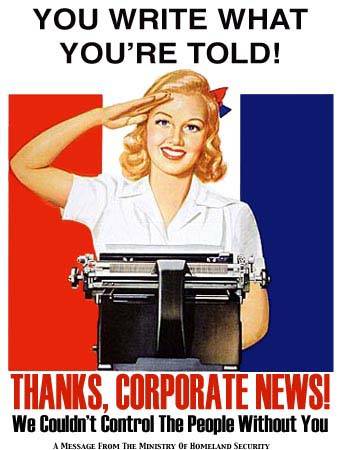
Western MSM operate as fake news ministries of truth in nations where they’re located.

They’re bribed with big bucks to lie and mass-deceive by sticking exclusively to the fabricated official narrative.

On major world and national issues, what’s reported on TV, radio or in print is based on state-approved talking points.

Orwell long ago explained today’s reality, his no longer fiction dystopian “1984” novel saying the following:

“The Ministry of Peace concerns itself with war, the Ministry of Truth with lies, the Ministry of Love with torture and the Ministry of Plenty with starvation.” 

“These contradictions are not accidental, nor do they result from from ordinary hypocrisy.”

“They are deliberate exercises in doublethink.”

Orwell’s Ministry of Truth was all about controlling the message, eliminating whatever conflicts with it, memory holes used for this purpose.

What’s suppressed is “whirled away (in) enormous furnaces…devoured by flames,” Orwell, adding:

“(T)here were the directing brains who co-ordinated the whole effort and laid down policy which made it necessary that this fragment of the past should be preserved, that one falsified, and the other rubbed out of existence.”

No memory holes are needed today throughout the decadent, depraved West.

MSM operate as willing co-conspirators in support of manipulating the public mind with rubbish unfit to print or report electronically.

A daily diet of fake news over the real thing includes drug pushing by heavily promoting health-destroying kill shots, the scourge of Nazism in Ukraine and use of its criminal class for perpetual war on Russia because it’s free from hegemon USA control.

Truth and full disclosure are mortal enemies of peace, equity, justice, imperial rampaging and the rule of law.

So MSM are used to suppress what conflicts with the fabricated official narrative in support of hegemon USA-dominated NATO’s war on humanity domestically and worldwide.

Russia and China are targeted for regime change because they alone stand in the way of the US war party’s drive for unchallenged hegemony by a policy of perpetual war-making on invented enemies.

Throughout the US/West, free and open societies, including democracy as it should be, are virtually banned.

Nor do their ruling regimes tolerate these notions anywhere, targeting them for elimination where exist.

Yet state-approved MSM-proliferated fake news, information and opinion pretend otherwise.

Turning reality on its head and trampling on it, they pretend that Nazi-infested Ukraine is democratic, that its battered and degraded military is defeating overwhelmingly superior Russian firepower.

And well over $100 billion worth of weapons, munitions and equipment supplied to Ukrainian Nazis by US/Western regimes since 2014 were largely destroyed by Russia or resold by Kiev kleptocrats for self-enrichment.

Unable to defeat Russia’s military superiority on the battlefield, regime troops largely focus on terror-shelling of its residential areas in Donetsk, Lugansk and elsewhere to kill, injure and terrorize noncombatants in harm’s way.

Yet US/Western regimes, Kiev Nazis and their MSM press agents falsely blame Russia for war crimes committed against the state and its people.

There’s been no ambiguity about the ability of Russian forces to demilitarize and deNazify Ukraine from day-one of its liberating SMO.

And sanctions war on Russia by US/Western regimes is deindustrializing Europe as planned by the empire of lies, while leaving the Russian Federation largely unscathed. 

Separately on Wednesday, Sergey Lavrov stressed the following:

Hegemon USA-dominated Western regimes “closed ranks” against Russia.

“Their mentality of domination” is hard-wired with no signs of “moderat(ing).”

Russia is “at war with the collective West led by” nuclear armed and recklessly dangerous USA.

“China is next in line.”

“It poses the most formidable and systemic longterm challenge and is the only country capable of surpassing (hegemon USA) in almost all areas” to eventually become the dominant world power politically, economically, financially and militarily.

The notion has both wings of the US war party planning for war on a nation it cannot win.

Yet with Taiwan as an invented pretext like Ukraine is used against Russia, the threat of war on China by the empire of lies is ominously real. 

Built on a one-China foundation a half century ago, normalized Sino/US relations no longer exist.

A state of war exists by hegemon USA against nonthreatening Russia, China earmarked for regime change by its war party in similar fashion.

Brave new dystopian world order proponent/notorious international con man, George Soros, once said we need a global sheriff.

Did he have hegemon USA or himself in mind by enforcing a policy of perpetual war on humanity?

More Billions to Ukraine as America Falls Apart

By Ron Paul

Source: Ron Paul Institute

There is a video clip making the rounds showing President Biden speaking at a recent NATO summit about the seven billion dollars the US government had – at that time – provided to Ukraine. Attached to that is another clip showing the horrific state of several US major cities, including in Pennsylvania, California, and Ohio. The video of American cities is shocking: endless landscapes of filth, trash, homelessness, open fires on the street, drug-addicted zombies. It doesn’t look like the America most of us remember.

Watching Biden bragging about sending billions of dollars to corrupt leaders overseas with American cities looking like bombed-out Iraq or Libya is US foreign policy in a nutshell. The Washington elites tell the rest of America that they must “promote democracy” in some far-off land. Anyone who objects is considered in league with the appointed enemy of the day. Once it was Saddam, then Assad and Gaddafi. Now it’s Putin. The game is the same, only the names are changed.

What is seldom asked, is what is in this deal for those Americans who suffer to pay for our interventionist foreign policy. Do they really think a working American in Ohio or Pennsylvania is better off or safer because we are supposedly protecting Ukraine’s borders? I think most Americans would wonder why they aren’t bothering to protect our own borders.

A reported 200,000 illegals crossed the border into the US in July alone. You can believe they are learning quickly about the free money provided by the US government to illegals. They’ll probably get a voting card as well.

Last Friday the Pentagon announced that yet another $775 million would be sent to Ukraine. As Antiwar.com reported, it was the eighteenth weapons package to Ukraine in six months. Has there ever been a more idiotic US intervention in history?

Supporters of this proxy war may celebrate more aid to Ukraine, but the reality is that it is in no way aid to Ukraine. That’s not how the system works. It is money created out of thin air by the Fed and appropriated by Congress to be spent propping up the politically-connected military-industrial complex. It is a big check written by middle America to rich people who run Raytheon and Lockheed Martin. Americans watch their budget being stretched to the limit while the Beltway fat-cats loosen their belts to continue enjoying the gravy train.

Bloomberg reported earlier this summer that inflation is costing the average American household more than $5,200 this year. Inflation is a tax on middle class and poor Americans. The wealthy – like those who run Raytheon and Lockheed Martin – always get the new money first, before prices go up. The rest of us watch as the dollar buys less and less.

As Washington salivates over fighting Russia in Ukraine, the rest of America feels like we’re becoming Zimbabwe. How long until it takes a trillion dollars for a loaf of bread? Will there be a run on wheelbarrows?

There is a way out. It’s called “non-interventionism.” The war in Ukraine was caused by the US regime change in 2014 and the neocon insistence that Ukraine join NATO. The State Department and CIA thought it was a great victory to overthrow the elected government, but meanwhile the rest of us get the bill. No NATO and not one more penny for Ukraine!

‘We the People’ Are the New, Permanent Underclass in America

By John W. Whitehead & Nisha Whitehead

Source: The Rutherford Institute

“We are now speeding down the road of wasteful spending and debt, and unless we can escape we will be smashed in inflation.”—Herbert Hoover

This is financial tyranny.

The U.S. government—and that includes the current administration—is spending money it doesn’t have on programs it can’t afford, and “we the taxpayers” are the ones who must foot the bill for the government’s fiscal insanity.

We’ve been sold a bill of goods by politicians promising to pay down the national debt, jumpstart the economy, rebuild our infrastructure, secure our borders, ensure our security, and make us all healthy, wealthy and happy.

None of that has come to pass, and yet we’re still being loaded down with debt not of our own making.

Let’s talk numbers, shall we?

The national debt (the amount the federal government has borrowed over the years and must pay back) is $30 trillion and growing. That translates to roughly $242,000 per taxpayer.

Now the Biden administration is proposing a $5.8 trillion spending budget that notably includes $813 billion for national defense, $30 billion to “fund the police,” and a plan to reduce the national deficit by roughly $1 trillion over 10 years through additional tax hikes.

It’s estimated that the amount this country owes is now 130% greater than its gross domestic product (all the products and services produced in one year by labor and property supplied by the citizens).

The U.S. ranks as the 12th most indebted nation in the world, with much of that debt owed to the Federal Reserve, large investment funds and foreign governments, namely, Japan and China.

Essentially, the U.S. government is funding its very existence with a credit card.

In 2021, we paid more than $562 billion in interest on that public debt, which according to journalist Rob Garver, “is more than the annual budget of every individual federal agency except for the Treasury, the Department of Health and Human Services (which manages the Medicare and Medicaid government health insurance programs), and the Department of Defense.”

According to the Committee for a Reasonable Federal Budget, the interest we’ve paid on this borrowed money is “nearly twice what the federal government will spend on transportation infrastructure, over four times as much as it will spend on K-12 education, almost four times what it will spend on housing, and over eight times what it will spend on science, space, and technology.”

Clearly, the national debt isn’t going away anytime soon, especially not with government spending on the rise and interest payments making up such a large chunk of the budget.

Still, the government remains unrepentant, unfazed and undeterred in its wanton spending.

Indeed, the national deficit (the difference between what the government spends and the revenue it takes in) remains at more than $1.5 trillion.

If Americans managed their personal finances the way the government mismanages the nation’s finances, we’d all be in debtors’ prison by now.

Despite the government propaganda being peddled by the politicians and news media, however, the government isn’t spending our tax dollars to make our lives better.

We’re being robbed blind so the governmental elite can get richer.

We’re not living the American dream. We’re living a financial nightmare.

In the eyes of the government, “we the people, the voters, the consumers, and the taxpayers” are little more than pocketbooks waiting to be picked.

“We the people” have become the new, permanent underclass in America.

Consider: The government can seize your home and your car (which you’ve bought and paid for) over nonpayment of taxes. Government agents can freeze and seize your bank accounts and other valuables if they merely “suspect” wrongdoing. And the IRS insists on getting the first cut of your salary to pay for government programs over which you have no say.

We have no real say in how the government runs, or how our taxpayer funds are used, but we’re being forced to pay through the nose, anyhow.

We have no real say, but that doesn’t prevent the government from fleecing us at every turn and forcing us to pay for endless wars that do more to fund the military industrial complex than protect us, pork barrel projects that produce little to nothing, and a police state that serves only to imprison us within its walls.

If you have no choice, no voice, and no real options when it comes to the government’s claims on your property and your money, you’re not free.

It wasn’t always this way, of course.

Early Americans went to war over the inalienable rights described by philosopher John Locke as the natural rights of life, liberty and property.

It didn’t take long, however—a hundred years, in fact—before the American government was laying claim to the citizenry’s property by levying taxes to pay for the Civil War. As the New York Times reports, “Widespread resistance led to its repeal in 1872.”

Determined to claim some of the citizenry’s wealth for its own uses, the government reinstituted the income tax in 1894. Charles Pollock challenged the tax as unconstitutional, and the U.S. Supreme Court ruled in his favor. Pollock’s victory was relatively short-lived. Members of Congress—united in their determination to tax the American people’s income—worked together to adopt a constitutional amendment to overrule the Pollock decision.

On the eve of World War I, in 1913, Congress instituted a permanent income tax by way of the 16th Amendment to the Constitution and the Revenue Act of 1913. Under the Revenue Act, individuals with income exceeding $3,000 could be taxed starting at 1% up to 7% for incomes exceeding $500,000.

It’s all gone downhill from there.

Unsurprisingly, the government has used its tax powers to advance its own imperialistic agendas and the courts have repeatedly upheld the government’s power to penalize or jail those who refused to pay their taxes.

While we’re struggling to get by, and making tough decisions about how to spend what little money actually makes it into our pockets after the federal, state and local governments take their share (this doesn’t include the stealth taxes imposed through tolls, fines and other fiscal penalties), the government continues to do whatever it likes—levy taxes, rack up debt, spend outrageously and irresponsibly—with little thought for the plight of its citizens.

To top it all off, all of those wars the U.S. is so eager to fight abroad are being waged with borrowed funds. As The Atlantic reports, “U.S. leaders are essentially bankrolling the wars with debt, in the form of purchases of U.S. Treasury bonds by U.S.-based entities like pension funds and state and local governments, and by countries like China and Japan.”

Of course, we’re the ones who will have to repay that borrowed debt.

For instance, American taxpayers have been forced to shell out more than $5.6 trillion since 9/11 for the military industrial complex’s costly, endless so-called “war on terrorism.” That translates to roughly $23,000 per taxpayer to wage wars abroad, occupy foreign countries, provide financial aid to foreign allies, and fill the pockets of defense contractors and grease the hands of corrupt foreign dignitaries.

Mind you, that staggering $6 trillion is only a portion of what the Pentagon spends on America’s military empire.

The United States also spends more on foreign aid than any other nation, with nearly $300 billion disbursed over a five-year period. More than 150 countries around the world receive U.S. taxpayer-funded assistance, with most of the funds going to the Middle East, Africa and Asia. That price tag keeps growing, too.

As Forbes reports, “U.S. foreign aid dwarfs the federal funds spent by 48 out of 50 state governments annually. Only the state governments of California and New York spent more federal funds than what the U.S. sent abroad each year to foreign countries.”

Most recently, in response to Russia’s military aggression against Ukraine, the Biden Administration approved $13.6 billion in military and humanitarian aid for Ukraine, with an additional $200 million for immediate military assistance.

As Dwight D. Eisenhower warned in a 1953 speech, this is how the military industrial complex will continue to get richer, while the American taxpayer will be forced to pay for programs that do little to enhance our lives, ensure our happiness and well-being, or secure our freedoms.

This is no way of life.

Yet it’s not just the government’s endless wars that are bleeding us dry.

We’re also being forced to shell out money for surveillance systems to track our movements, money to further militarize our already militarized police, money to allow the government to raid our homes and bank accounts, money to fund schools where our kids learn nothing about freedom and everything about how to comply, and on and on.

It’s tempting to say that there’s little we can do about it, except that’s not quite accurate.

There are a few things we can do (demand transparency, reject cronyism and graft, insist on fair pricing and honest accounting methods, call a halt to incentive-driven government programs that prioritize profits over people), but it will require that “we the people” stop playing politics and stand united against the politicians and corporate interests who have turned our government and economy into a pay-to-play exercise in fascism.

Unfortunately, we’ve become so invested in identity politics that pit us against one another and keep us powerless and divided that we’ve lost sight of the one label that unites us: we’re all Americans.

Trust me, we’re all in the same boat, folks, and there’s only one real life preserver: that’s the Constitution and the Bill of Rights.

The Constitution starts with those three powerful words: “We the people.”

There is power in our numbers.

As I make clear in my book Battlefield America: The War on the American People and in its fictional counterpart The Erik Blair Diaries, that remains our greatest strength in the face of a governmental elite that continues to ride roughshod over the populace. It remains our greatest defense against a government that has claimed for itself unlimited power over the purse (taxpayer funds) and the sword (military might).

Where we lose out is when we fall for the big-talking politicians who spend big at our expense.

Saving Capitalism or Saving the Planet? 

By Colin Todhunter

Source: Dissident Voice

The UK government’s Behavioural Insights Team helped to push the public towards accepting the COVID narrative, restrictions and lockdowns. It is now working on ‘nudging’ people towards further possible restrictions or at least big changes in their behaviour in the name of ‘climate emergency’. From frequent news stories and advertisements to soap opera storylines and government announcements, the message about impending climate catastrophe is almost relentless.

Part of the messaging includes blaming the public’s consumption habits for a perceived ‘climate emergency’. At the same time, young people are being told that we only have a decade or so (depending on who is saying it) to ‘save the planet’.

Setting the agenda are powerful corporations that helped degrade much of the environment in the first place. But ordinary people, not the multi-billionaires pushing this agenda, will pay the price for this as living more frugally seems to be part of the programme (‘own nothing and be happy’). Could we at some future point see ‘climate emergency’ lockdowns, not to ‘save the NHS’ but to ‘save the planet’?

A tendency to focus on individual behaviour and not ‘the system’ exists.

But let us not forget this is a system that deliberately sought to eradicate a culture of self-reliance that prevailed among the working class in the 19th century (self-education, recycling products, a culture of thrift, etc) via advertising and a formal school education that ensured conformity and set in motion a lifetime of wage labour and dependency on the products manufactured by an environmentally destructive capitalism.

A system that has its roots in inflicting massive violence across the globe to exert control over land and resources elsewhere.

In his 2018 book The Divide: A Brief Guide to Global Inequalities and its solutions, Jason Hickel describes the processes involved in Europe’s wealth accumulation over a 150-year period of colonialism that resulted in tens of millions of deaths.

By using other countries’ land, Britain effectively doubled the size of arable land in its control. This made it more practical to then reassign the rural population at home (by stripping people of their means of production) to industrial labour. This too was underpinned by massive violence (burning villages, destroying houses, razing crops).

Hickel argues that none of this was inevitable but was rooted in the fear of being left behind by other countries because of Europe’s relative lack of land resources to produce commodities.

This is worth bearing in mind as we currently witness a fundamental shift in our relationship to the state resulting from authoritarian COVID-related policies and the rapidly emerging corporate-led green agenda. We should never underestimate the ruthlessness involved in the quest for preserving wealth and power and the propensity for wrecking lives and nature to achieve this.

Commodification of nature

Current green agenda ‘solutions’ are based on a notion of ‘stakeholder’ capitalism or private-public partnerships whereby vested interests are accorded greater weight, with governments and public money merely facilitating the priorities of private capital.

A key component of this strategy involves the ‘financialisation of nature’ and the production of new ‘green’ markets to deal with capitalism’s crisis of over accumulation and weak consumer demand caused by decades of neoliberal policies and the declining purchasing power of working people. The banking sector is especially set to make a killing via ‘green profiling’ and ‘green bonds’.

According to Friends of the Earth (FoE), corporations and states will use the financialisation of nature discourse to weaken laws and regulations designed to protect the environment with the aim of facilitating the goals of extractive industries, while allowing mega-infrastructure projects in protected areas and other contested places.

Global corporations will be able to ‘offset’ (greenwash) their activities by, for example, protecting or planting a forest elsewhere (on indigenous people’s land) or perhaps even investing in (imposing) industrial agriculture which grows herbicide-resistant GMO commodity crop monocultures that are misleadingly portrayed as ‘climate friendly’.

FoE states:

Offsetting schemes allow companies to exceed legally defined limits of destruction at a particular location, or destroy protected habitat, on the promise of compensation elsewhere; and allow banks to finance such destruction on the same premise.

This agenda could result in the weakening of current environmental protection legislation or its eradication in some regions under the pretext of compensating for the effects elsewhere. How ecoservice ‘assets’ (for example, a forest that performs a service to the ecosystem by acting as a carbon sink) are to be evaluated in a monetary sense is very likely to be done on terms that are highly favourable to the corporations involved, meaning that environmental protection will play second fiddle to corporate and finance sector return-on-investment interests.

As FoE argues, business wants this system to be implemented on its terms, which means the bottom line will be more important than stringent rules that prohibit environmental destruction.

Saving capitalism

The envisaged commodification of nature will ensure massive profit-seeking opportunities through the opening up of new markets and the creation of fresh investment instruments.

Capitalism needs to keep expanding into or creating new markets to ensure the accumulation of capital to offset the tendency for the general rate of profit to fall (according to writer Ted Reese, it has trended downwards from an estimated 43% in the 1870s to 17% in the 2000s). The system suffers from a rising overaccumulation (surplus) of capital.Reese notes that, although wages and corporate taxes have been slashed, the exploitability of labour continued to become increasingly insufficient to meet the demands of capital accumulation. By late 2019, the world economy was suffocating under a mountain of debt. Many companies could not generate enough profit and falling turnover, squeezed margins, limited cashflows and highly leveraged balance sheets were prevalent. In effect, economic growth was already grinding to a halt prior to the massive stock market crash in February 2020.

In the form of COVID ‘relief’, there has been a multi-trillion bailout for capitalism as well as the driving of smaller enterprises to bankruptcy. Or they have being swallowed up by global interests. Either way, the likes of Amazon and other predatory global corporations have been the winners.

New ‘green’ Ponzi trading schemes to offset carbon emissions and commodify ‘ecoservices’ along with electric vehicles and an ‘energy transition’ represent a further restructuring of the capitalist economy, resulting in a shift away from a consumer oriented demand-led system.

It essentially leaves those responsible for environmental degradation at the wheel, imposing their will and their narrative on the rest of us.

Global agribusiness

Between 2000 and 2009, Indonesia supplied more than half of the global palm oil market at an annual expense of some 340,000 hectares of Indonesian countryside. Consider too that Brazil and Indonesia have spent over 100 times more in subsidies to industries that cause deforestation than they received in international conservation aid from the UN to prevent it.

These two countries gave over $40bn in subsidies to the palm oil, timber, soy, beef and biofuels sectors between 2009 and 2012, some 126 times more than the $346m they received to preserve their rain forests.

India is the world’s leading importer of palm oil, accounting for around 15% of the global supply. It imports over two-­thirds of its palm oil from Indonesia.

Until the mid-1990s, India was virtually self-sufficient in edible oils. Under pressure from the World Trade Organization (WTO), import tariffs were reduced, leading to an influx of cheap (subsidised) edible oil imports that domestic farmers could not compete with. This was a deliberate policy that effectively devastated the home-grown edible oils sector and served the interests of palm oil growers and US grain and agriculture commodity company Cargill, which helped write international trade rules to secure access to the Indian market on its terms.

Indonesia leads the world in global palm oil production, but palm oil plantations have too often replaced tropical forests, leading to the killing of endangered species and the uprooting of local communities as well as contributing to the release of potential environment-damaging gases. Indonesia emits more of these gases than any country besides China and the US, largely due to the production of palm oil.

The issue of palm oil is one example from the many that could be provided to highlight how the drive to facilitate corporate need and profit trumps any notion of environmental protection or addressing any ‘climate emergency’. Whether it is in Indonesia, Latin America or elsewhere, transnational agribusiness – and the system of globalised industrial commodity crop agriculture it promotes – fuels much of the destruction we see today.

Even if the mass production of lab-created food, under the guise of ‘saving the planet’ and ‘sustainability’, becomes logistically possible (which despite all the hype is not at this stage), it may still need biomass and huge amounts of energy. Whose land will be used to grow these biomass commodities and which food crops will they replace? And will it involve that now-famous Gates’ euphemism ‘land mobility’ (farmers losing their land)?

Microsoft is already mapping Indian farmers’ lands and capturing agriculture datasets such as crop yields, weather data, farmers’ personal details, profile of land held (cadastral maps, farm size, land titles, local climatic and geographical conditions), production details (crops grown, production history, input history, quality of output, machinery in possession) and financial details (input costs, average return, credit history).

Is this an example of stakeholder-partnership capitalism, whereby a government facilitates the gathering of such information by a private player which can then use the data for developing a land market (courtesy of land law changes that the government enacts) for institutional investors at the expense of smallholder farmers who find themselves ‘land mobile’? This is a major concern among farmers and civil society in India.

Back in 2017, agribusiness giant Monsanto was judged to have engaged in practices that impinged on the basic human right to a healthy environment, the right to food and the right to health. Judges at the ‘Monsanto Tribunal’, held in The Hague, concluded that if ecocide were to be formally recognised as a crime in international criminal law, Monsanto could be found guilty.

The tribunal called for the need to assert the primacy of international human and environmental rights law. However, it was also careful to note that an existing set of legal rules serves to protect investors’ rights in the framework of the WTO and in bilateral investment treaties and in clauses in free trade agreements. These investor trade rights provisions undermine the capacity of nations to maintain policies, laws and practices protecting human rights and the environment and represent a disturbing shift in power.

The tribunal denounced the severe disparity between the rights of multinational corporations and their obligations.

While the Monsanto Tribunal judged that company to be guilty of human rights violations, including crimes against the environment, in a sense we also witnessed global capitalism on trial.

Global conglomerates can only operate as they do because of a framework designed to allow them to capture or co-opt governments and regulatory bodies and to use the WTO and bilateral trade deals to lever influence. As Jason Hickel notes in his book (previously referred to), old-style colonialism may have gone but governments in the Global North and its corporations have found new ways to assert dominance via leveraging aid, market access and ‘philanthropic’ interventions to force lower income countries to do what they want.

The World Bank’s ‘Enabling the Business of Agriculture’ and its ongoing commitment to an unjust model of globalisation is an example of this and a recipe for further plunder and the concentration of power and wealth in the hands of the few.

Brazil and Indonesia have subsidised private corporations to effectively destroy the environment through their practices. Canada and the UK are working with the GMO biotech sector to facilitate its needs. And India is facilitating the destruction of its agrarian base according to World Bank directives for the benefit of the likes of Corteva and Cargill.

The TRIPS Agreement, written by Monsanto, and the WTO Agreement on Agriculture, written by Cargill, was key to a new era of corporate imperialism. It came as little surprise that in 2013 India’s then Agriculture Minister Sharad Pawar accused US companies of derailing the nation’s oil seeds production programme.

Powerful corporations continue to regard themselves as the owners of people, the planet and the environment and as having the right – enshrined in laws and agreements they wrote – to exploit and devastate for commercial gain.

Partnership or co-option?

It was noticeable during a debate on food and agriculture at the United Nations Climate Change Conference in Glasgow that there was much talk about transforming the food system through partnerships and agreements. Fine-sounding stuff, especially when the role of agroecology and regenerative farming was mentioned.

However, if, for instance, the interests you hope to form partnerships with are coercing countries to eradicate their essential buffer food stocks then bid for such food on the global market with US dollars (as in India) or are lobbying for the enclosure of seeds through patents (as in Africa and elsewhere), then surely this deliberate deepening of dependency should be challenged; otherwise ‘partnership’ really means co-option.

Similarly, the UN Food Systems Summit (UNFSS) that took place during September in New York was little more than an enabler of corporate needs. The UNFSS was founded on a partnership between the UN and the World Economic Forum and was disproportionately influenced by corporate actors.

Those granted a pivotal role at the UNFSS support industrial food systems that promote ultra-processed foods, deforestation, industrial livestock production, intensive pesticide use and commodity crop monocultures, all of which cause soil deterioration, water contamination and irreversible impacts on biodiversity and human health. And this will continue as long as the environmental effects can be ‘offset’ or these practices can be twisted on the basis of them somehow being ‘climate-friendly’.

Critics of the UNFSS offer genuine alternatives to the prevailing food system. In doing so, they also provide genuine solutions to climate-related issues and food injustice based on notions of food sovereignty, localisation and a system of food cultivation deriving from agroecological principles and practices. Something which people who organised the climate summit in Glasgow would do well to bear in mind.

Current greenwashed policies are being sold by tugging at the emotional heartstrings of the public. This green agenda, with its lexicon of ‘sustainability’, ‘carbon neutrality’, ‘net-zero’ and doom-laden forecasts, is part of a programme that seeks to restructure capitalism, to create new investment markets and instruments and to return the system to viable levels of profitability.

America’s Bottom 50% Have Nowhere To Go But Down

By Charles Hugh Smith

Source: Of Two Minds

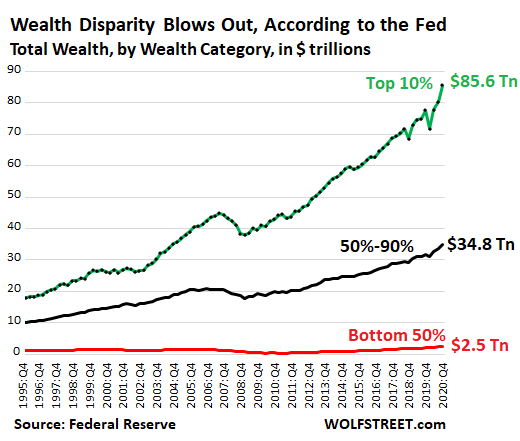
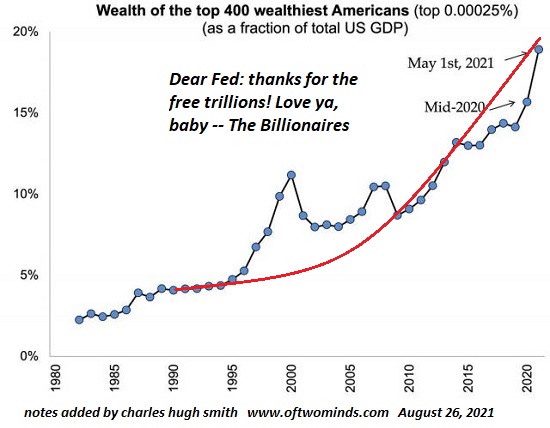
One might anticipate that the bottom 50%’s meager share of the nation’s exploding wealth would have increased as smartly as the wealth of the billionaires, but alas, no.

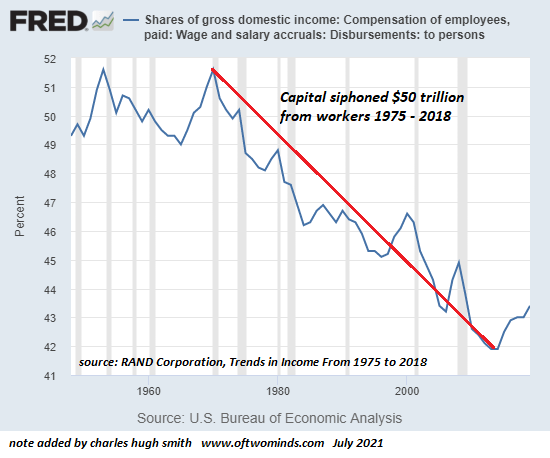
America’s economy has changed in ways few of the winners seem to notice, as they’re too busy cheerleading their own brilliance and success. In the view of the winners, who just so happen to occupy all the seats at the media-punditry-Federal Reserve, etc. table–the rising tide of stock, bond and real estate bubbles are raising all boats. What’s left unsaid is except for the 50% of boats with gaping holes below the waterline, i.e. stagnant wages and a fast-rising cost of living.

The truth the self-satisfied winners don’t include in their self-congratulatory rah-rah is there’s no place for the bottom 50% of American households to go but down. All the winnings flow to those who already owned assets back when they were affordable– the already-wealthy–whose wealth has soared as assets have shot to the moon while the the burdens of inflation and debt service hit the bottom 50% the hardest.

Meanwhile, the Federal Reserve is whining that inflation isn’t high enough yet for their refined tastes. Boo-hoo, how sad for the Fed–inflation isn’t yet high enough. Oh wait–didn’t they each mint millions by front-running their own policies? No wonder they’re not worried about inflation.

The reality few acknowledge is that globalization and financialization have stripped the American economy of low-skilled jobs that don’t demand much of the employee. The reality is that a great many people don’t have what it takes to learn high-level skills and work at a demanding pace under constant pressure–the description of the average job in America.

There were once millions of low-skill, low-pay jobs for people who for whatever mix of reasons were unable to muster the wherewithal to fulfill the fantasy of working extra hard, going to night school, soaking up high-level skills, moving quickly up the ladder to higher pay, buying the starter home and then moving up the food chain to middle class security from there.

The cost of living was low enough that those working these low-skill, low-pay jobs could still have an independent life. There were still low-cost rentals, often derided by the wealthy, in nooks and crannies of even the costliest cities. (I once lived in a room stuffed with old tax records in a poolside shack in an upscale neighborhood. The room had been cleared for a single bed and a path to the decrepit bathroom. Its most important attribute was that I could afford it on my low earnings.)

Affordable housing has vanished, eliminated by the financialization of America’s economy. Once landlords pay double the price for the property, rents have to double to pay their higher expenses. The apartment didn’t double in size or amenities–the rent doubled without any increase in utility to the renter. You get nothing more for double the price–nice.

Yes, people could make better choices, and some do. The point here is the game is rigged against those in the lower tier of the economy who can no longer afford a house or other stake in the only winning game in town–speculative asset bubbles. Go ahead and work a second job and go to night school–you’ll still be left behind the already-rich.

Globalization opened every job in America to global competition via offshoring or the influx of undocumented workers so desperate to support their families back home that no pay was too low and no working condition too wretched to refuse.

Many overindulged pundits who never worked an honest day in their lives sneer about burger flippers without realizing how hard those burger flippers have to work. I doubt the well-dressed pundits, snobbish about their university degrees and general brilliance, could manage to work a single day in a demanding fast-food job.

As the price of housing and other assets have soared, enriching the already rich, they’re out of reach for the bottom 50% who struggle to pay their bills as wages have stagnated and the costs of essentials have skyrocketed.

The rising cost of parking tickets, junk fees, user fees, utilities and food don’t impact the well-paid top 5% technocrat class, whose stake in the Everything Bubble keeps expanding by tens or hundreds of thousands of dollars. But for the bottom 50%, those incremental increases are, when added to higher rents, absolutely crushing.

As for getting high-quality healthcare that includes mental health support–those are reserved for the rich. But no worries, self-medication is always a “choice.”

Getting a boost in pay from $12 an hour to $15 an hour is welcome, but that doesn’t put the worker any closer to affording a house or equivalent stake in the Everything Bubble.

The new feudalism is masked by the glossy SillyCon Valley PR of a gig economy where (per the PR fantasy) bright, shiny and totally independent workers freely choose to serve the winners in the rigged sweepstakes for low pay and zero benefits.

In the SillyCon Valley PR, serfs freely choose to serve their noble masters for nothing but survival because they love the “freedom” and “choice” of kissing the nobility’s plump derrieres. (After all, there were “choices” even back in the good old days of feudalism–one could join the brigands in the forest, or enlist in a poorly paid mercenary army where the odds of dying were high–you know, “choices” of “gigs.”)

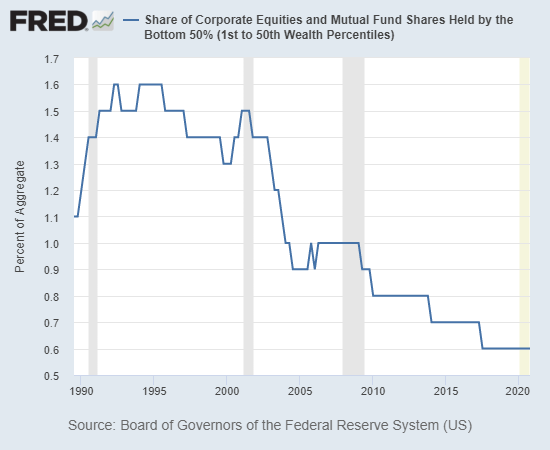
One might anticipate that the bottom 50%’s meager share of the nation’s exploding wealth would have increased as smartly as the wealth of the billionaires, but alas, no–the bottom 50%’s share of stocks (equities) actually plummeted in the the glorious decades of Federal Reserve free money for financiers, stock buy-backs and asset bubbles.

All this suits the billionaires and those collecting the crumbs of the Everything Bubble just fine. So what if the bottom 50% have nowhere to go but down? There’s plenty of room in the homeless encampment for another broken down station wagon or an old camper. There’s lots of “choices.”

And no consequences for the winners, of course, because The Fed has our backs.

Why Don’t Billionaires Pay the Same High Tax Rates the Rest of Us Pay?

By Charles Hugh Smith

Source: Of Two Minds

The truth is America has lost its way if commoners pay a rate of 40% but its billionaires pay next to nothing.

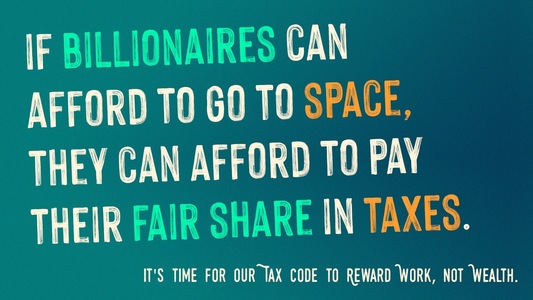
As with everything else in polarized America, billionaires proclaiming space tourism is the next big thing for humanity neatly divides opinion into two camps: those who laud the initiative, hard work and innovations of the billionaires as examples of the American Can-Do Dream, and those who wished the billionaire space tourists had taken a one-way flight to a distant orbit of blissful silence.

Setting aside that bitter divide, let’s explore another divide: how our two-tier tax system enables billionaires to become billionaires while the rest of us get poorer. Whenever I discuss the taxes of the non-billionaire self-employed, armies of apologists leap to the defense of the status quo with various quibbles: the 0.9% Medicare surcharge only kicks in above $200,000, the cap on Social Security taxes is $142,800, and so on.

Setting aside the quibbles–and recall the tax code with regulatory notes is thousands of pages–let’s deal with the real issue, which is that billionaires and their corporations pay a thin slice of taxes as a percentage of total income/gains if they pay any at all, while self-employed and small business pay extraordinarily high tax rates.

To all the quibblers: please add the 15.3% Social Security/Medicare tax rate (self-employed / sole proprietors pay both the employee and employer share of this tax) to the federal tax rate of 24% for income above $85,520. It’s 39.3%.

Just how hard would it be to conclude that everyone earning more than $142,000 should pay at least the same rate the rest of us pay? Aren’t we demonstrating all those same laudable traits of the billionaires, just on a smaller scale? Why should we pay 40% and the billionaires pay essentially zero?

Gee, do you reckon paying no taxes might help folks become richer? Garsh, nobody ever asked that question before. And do you reckon paying 40% of your income might make you poorer over time? Golly gee, how come the talking heads worshiping the billionaires never ask these questions?

Since Social Security and Medicare/Medicaid are the bedrock of America’s social safety net, why shouldn’t billionaires pay to support these programs? Well, why not? Just how lame do the excuses have to be to be recognized as laughably self-serving?

Here’s the trick billionaires use to evade taxes. There are countless ways for the super-wealthy to evade taxes–funnel earnings through an Irish post office box, buy a tax break in Washington DC, slide the money into one of dozens of global tax havens, and so on.

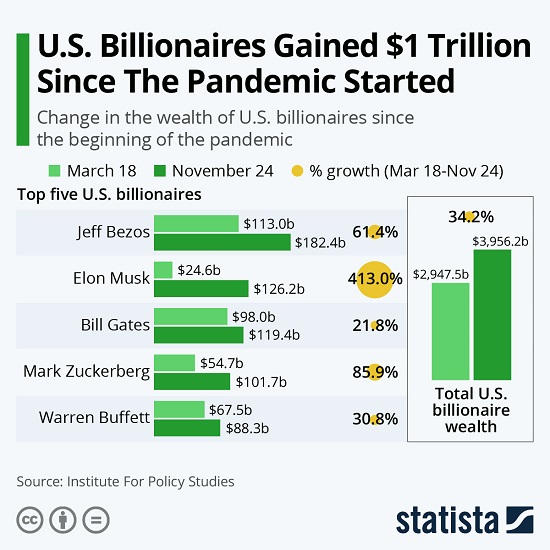
But a simple one is to report no income and live large off borrowed money. As the billions of dollars in capital gains pile up as the billionaire’s stock holdings soar (thanks, Federal Reserve, for the free trillions; awful swell of you to give us all that free money), there’s no income generated until the billionaire sells some shares. No sale, no income. Just pay yourself $1 a year in salary, borrow against your billions at super-low rates of interest, and voila, you’re tax-free while you build your super-yacht, buy your private island, and so on.

Just as a thought experiment, suppose the first $50,000 in earnings for everyone were tax-free, and a 40% tax rate was collected on all income above $1 million, both earned and unearned (capital gains), not when the gains were realized in a sale but at the end of every tax year, whether the shares that rose in value were sold or not.

So Billionaire Space Tourist reaped $10 billion in capital gains from the appreciation of stocks held, then the Billionaire pays 40% of those gains: $4 billion. There is a way to not pay any taxes on capital gains–have your portfolio lose value. No gains, no taxes. And to close all the loopholes, the tax rate is on all assets and income connected in any way, shape or form with the U.S. First they pay the U.S. taxes, then if they want to pay other nations’ taxes as well, be my guest. But the 40% is due and payable regardless of any other conditions.

You don’t like it, then stop selling any products in the U.S. or holding any assets in the U.S. Why should billionaires get to set up immensely profitable monopolies, quasi-monopolies, cartels and corporations in the U.S. but pay near-zero in taxes? Why should billionaires be free to profit from America’s economy but pay nothing to support its citizenry?

What precisely is the logic of reducing taxes on the wealthiest few to near-zero? If there is no logic, then we’re left with corruption: America is a moral cesspool.

The truth is America has lost its way if commoners pay a rate of 40% but its billionaires pay next to nothing. Please note Karma and Divine Retribution are not controlled by the billionaire’s lackeys and apparatchiks in the Federal Reserve. The pendulum of exploitation has reached its extreme, and the reversal to the opposite extreme is underway.