Reality and its enemies

By Lawrence Davidson

Source: Intrepid Report

There is an ongoing reality that is destroying hundreds of thousands of lives in the Middle East. And though most Americans are ignorant of the fact, and many of those who should be in the know would deny it, the suffering flows directly from decisions taken by Washington over the last 27 years.

Some of the facts of the matter have just been presented by the first Global Conflict Medicine Congress held at the American University of Beirut (AUB) earlier this month (11–14 May 2017). It has drawn attention to two dire consequences of the war policies Americans have carried on in the region: cancer-causing munition material and drug-resistant bacteria.

Cancer-causing munition material: Materials such as tungsten and mercury are found in the casing of penetrating bombs used in the first and second Gulf wars. These have had long-term effects on survivors, especially those who have been wounded by these munitions. Iraqi-trained and Harvard-educated Dr. Omar Dewachi, a medical anthropologist at AUB fears that “the base line of cancers [appearing in those exposed to these materials] has become very aggressive. . . . When a young woman of 30, with no family history of cancer, has two different primary cancers—in the breast and in the oesophagus—you have to ask what is happening.” To this can be added that doctors are now “overwhelmed by the sheer number of [war] wounded patients in the Middle East.”

Drug-resistant bacteria: According to Glasgow-trained Professor Ghassan Abu-Sittah, head of plastic and reconstructive surgery at AUB Medical Center, drug resistance was not a problem during the Iran-Iraq War of 1980–1988. However, after the fiasco of Iraq’s invasion of Kuwait, things began to change. In the period after 1990, Iraq suffered under a vicious sanctions regime imposed by the United Nations at U.S. insistence. During the next 12 years “Iraqis were allowed to use only three antibiotics” and bacterial resistance quickly evolved.

Those resistant bacteria spread throughout the region, particularly after the American invasion of the country in 2003. Today, according to a Medecins Sans Frontieres analysis, “multidrug resistant [MDR] bacteria now accounts for most war wound infections across the Middle East, yet most medical facilities in the region do not even have the laboratory capacity to diagnose MDR, leading to significant delays and clinical mismanagement of festering wounds.”

Insofar as these developments go, it is not that there aren’t contributing factors stemming from local causes such as factual fighting. However, the major triggers for these horrors were set in motion in Washington. As far as I know, no American holding a senior official post has ever accepted any responsibility for this ongoing suffering.

Hiding reality

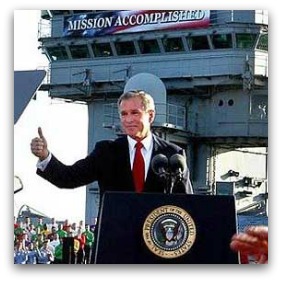
As the cancers and untreatable infections grow in number in the Middle East, there is here in the United States a distressing effort to rehabilitate George W. Bush—the American president whose decisions and policies contributed mightily to this ongoing disaster. It is this Bush who launched the unjustified 2003 invasion of Iraq and thereby—to use the words of the Arab League—“opened the gates of hell.” His rehabilitation effort began in earnest in April 2013, and coincided with the opening of his presidential library.

In an interview given at that time, Bush set the stage for his second coming with an act of self-exoneration. He said he remained “comfortable with the decision making process” that led to the invasion of Iraq—the one that saw him fudging the intelligence when it did not tell him what he wanted to hear—and so also “comfortable” with the ultimate determination to launch the invasion. “There’s no need to defend myself. I did what I did and ultimately history will judge.”

The frivolous assertion that “history will judge” is often used by people of suspect character. “History” stands for a vague future time. Its alleged inevitable coming allows the protagonist to fantasize about achieving personal glory unchallenged by present, usually significant, ethical concerns.

Those seeking George W. Bush’s rehabilitation now like to contrast him to Donald Trump. One imagines they thereby hope to present him as a “moderate” Republican. They claim that Bush was and is really a very smart and analytical fellow rather than the simpleton most of us suspect him to be. In other words, despite launching an unnecessary and subsequently catastrophic war, he was never as ignorant and dangerous as Trump. He and his supporters also depict him as a great defender of a free press, again in contrast to Donald Trump. However, when he was president, Bush described the media as an aider and abettor of the nation’s enemies. This certainly can be read as a position that parallels Trump’s description of the media as the “enemy of the American people.”

But all of this is part of a public relations campaign and speaks to the power of reputation remodeling—the creation of a facade that hides reality. In order to do this you have to “control the evidence”—in this case by ignoring it. In this endeavor George W. Bush and his boosters have the cooperation of much of the mainstream media.

No sweat here: the press has done this before. Except for the odd editorial the mainstream media also contributed to Richard Nixon’s rehabilitation back in the mid-1980s. These sorts of sleights-of-hand are only possible against the background of pervasive public ignorance.

Closed information environments

Local happenings are open to relatively close investigation. We usually have a more or less accurate understanding of the local context in which events play out, and this allows for the possibility of making a critical judgment. As we move further away, both in space and time, information becomes less reliable, if for no other reason than it comes to us through the auspices of others who may or may not know what they are talking about.

As a society, we have little or no knowledge of the context for foreign events, and thus it is easy for those reporting on them to apply filters according to any number of criteria. What we are left with is news that is customized—stories designed to fit pre-existing political or ideological biases. In this way millions upon millions of minds are restricted to closed information environments on subjects which often touch on, among other important topics, war and its consequences.

So what is likely to be more influential with the locally oriented American public: George W. Bush’s rehabilitated image reported on repeatedly in the nation’s mainstream media, or the foreign-based, horror-strewn consequences of his deeds reported upon infrequently?

This dilemma is not uniquely American, nor is it original to our time. However, its dangerous consequences are a very good argument against the ubiquitous ignorance that allows political criminals to be rehabilitated even as their crimes condemn others to continuing suffering. If reputation remodelers can do this for George W. Bush, then there is little doubt that someday it will be done for Donald Trump. Life, so full of suffering, is also full of such absurdities.


Dr. Davidson has done extensive research and published in the areas of American perceptions of the Middle East, and Islamic Fundamentalism. His two latest publications are “Islamic Fundamentalism” (Greenwood Press, 1998) and “America’s Palestine: Popular and Official Perceptions from Balfour to Israeli Statehood” (University Press of Florida, 2001). He has published thirteen articles on various aspects of American perceptions of the Middle East. Dr. Davidson holds a BA from Rutgers, an MA from Georgetown University and a Ph.D. in history from the University of Alberta.

Orwell, Freud, and the Syrian Ruse

Reality by other means

By Jason Hirthler

Source: Dissident Voice

We’re an empire now, and when we act, we create our own reality.

— Karl Rove speaking to a small group of reporters at a cocktail party in 2004…… printed in the Washington Post

The adjective ‘Orwellian’ is so overused mostly because it is so incredibly apt on a daily basis. George Orwell’s basic concept reflects a simple tenet of propaganda: the thing you are hiding is often hid behind its exact opposite. Orwell expressed this concept in 1984 with the government slogans, “War is Peace,” “Ignorance is Strength,” and “Freedom is Slavery.” The Austrian psychologist Sigmund Freud evidently suggested something similar about human nature: that to discover our true human nature, we need merely to reverse society’s moral maxims: if a commandment forbids adultery, it’s because we want to commit it. In other words, for both Orwell and Freud, we often disguise what we are doing behind claims that we are doing the opposite. We aren’t committing adultery; we’re practicing fidelity. We aren’t precipitating war; we’re pressing for peace. We aren’t seeking our own self-interest; we’re doing it all for others.

When applied to U.S. propaganda, the formula is revealing. To discover what your government is hiding, just reverse the media narrative. If the papers all say Russia is an imperial aggressor, it’s likely because Washington is. If the news networks say that Assad is a murderous monster, it’s likely because the groups we’re backing are. If the mainstream says Communism is a dire threat, it’s likely because capitalism is a dire threat. All of these examples are demonstrably true.

What confuses many readers is the fact that the first premise–that Russia, Assad, and Communism are all threats–usually has an element of truth to it, though not to the degree that it is portrayed. And so intelligent propaganda doesn’t simply traffic in lies, but rather half-truths, distortions, and omissions that themselves further distort a narrative. It is this sophisticated blend of fact, fiction, hyperbole and omission that makes propaganda so difficult to unpack for the average reader, who has little time, inclination, and practice in deciphering state-directed doctrine.

Reversing Reality

If Freud was correct, then we tend to publicly deny our greatest desires when they run counter to prevailing morality, shielding our base wishes behind a curtain of rectitude, even as we quietly pursue them. The modern instances of this in government are boundless. Example: FISA legitimates the surveillance it was designed to deter. Example: Congress abets the executive it was created to check. Example: ‘Defense’ becomes the aggression it was devised to defend against. Example: Healthcare becomes a bureaucracy built on denial of care in the name of its provision. Example. Journalism: the adversarial role of the fourth estate, becomes the adversary of the truth it was intended to protect. Journalists transcribe the diktats of power. Like the senators that notarize the mandates of the executive. Like the federal agents that entrap citizens in order to protect them. Like the drones that destroy lives to save them. Like the citizens who signal liberal values in support of imperial conquerors. Like the social justice warriors who legislate the intolerance they seek to eradicate. It seems to be a socio-political reality that the forcible assertion of one value guarantees a renaissance of its antitheses. Or is it that we forcibly assert a moral value to disguise a flowering of vice?

The process of turning a story into its opposite is fairly straightforward. If the U.S. is aggressively violating human rights, it needs to be rewritten as a defender of human rights. What this means in practice is switching the roles each of the actors assume in the narrative. Heroes become villains; villains become heroes; and victims are either genuine victims or villains depicted as martyrs for a righteous cause. This requires a good bit of romanticizing your side, demonizing the enemy, and eulogizing the victims. And then, as the author of Mein Kampf recommended, keep it simple. Your side wants one thing: peace. Your enemy wants one thing: war. And the victims want one thing: freedom.

Exhibit A

Take Syria as a recent example. The media narrative states that the U.S. and its freedom-loving allies have cautiously backed a loose confederation of rebels who rose up against Syrian tyrant Bashar al-Assad in 2011. In actuality, the U.S. and its freedom-hating allies have incautiously backed a loose confederation of foreign terrorists who have been paid to overthrow the elected Syrian President Bashar al-Assad. Only occasionally is the real backstory hinted at, which includes weakening Shia strongholds and destabilizing independent states in the region.

In turning the truth around to justify its war of aggression, the state and its supplicant media seized upon a handful of facts as the bedrock on which it constructed a false historical narrative. Which is what you’d expect from the Orwell-Freud model. And so…Are there elements of Syrian civil society that protested Assad in 2011? Absolutely. Are there actual Syrians fighting against Assad now? Sure. Are there elements of corruption and repression in Assad’s history? Definitely. But each of these truths are used to disguise the much larger facts of unmitigated U.S. aggression.

Upon this foundation, the typical narrative is constructed. The United States government is romanticized as a virtuous mediator concerned with supporting the freedom fighters and helping them achieve the freedoms they’ve yearned for. Assad is demonized as the autocratic mass murderer who repeatedly denies these freedoms, and tortures thousands before destroying the bodies. And the Syrian people, engine of the largest refugee crisis since World War Two, are shown as the valiant victims of the war, particularly in Aleppo, where the destruction of the city in an attempt to uproot the terrorist army is leveraged to milk as much emotional content from the war as possible and to further cement Assad’s reputation as a moral monster.

The MSM didn’t stop there. It followed with a series of attempts to further demonize Assad. A massive cache of photos purportedly detailing “regime” torture. This cache was delivered from somebody named “Caesar,” a defector not unlike the fake defector, “Curveball” from the run-up to the Iraq War. Twice false flags have been utilized to claim that the evil optometrist in Damascus has in a fit of pique demanded that innocent Syrians be sprayed with chemical weapons. Now a “crematorium” where Assad supposedly cremates all the Syrian citizens he is slaughtering (supposedly because he hates humanity so much). It doesn’t particularly matter if these stories eventually unravel when evidence is shown to be lacking. The damage is done to the psyche of readers and listeners, who absorb the media reports with the uncritical acceptance of animals entering an abattoir.

The takfiri mercenaries brought in by the West to topple Assad are likewise romanticized by the press. Instead of labeling the terrorists we backed as extremists, the New York Times peddled a story that they were moderates. Beheading of children, tossing gays from rooftops, using citizens as human shields, staging rescue operations, and many other atrocities failed to prevent the media from intransigently pushing this storyline.

No Quick Fix

As you can see, there is no shortage of opportunities to apply the Orwellian label to modern reportage. That said, I’m not suggesting that the authors at The New York Times and the Washington Post are all conniving propagandists consciously preparing deceitful reportage. For every Edward Bernays, there are a dozen Brian Williams. Often, they have simply internalized the values of the institution that employs them. They recognize, perhaps consciously or subconsciously, that their careers depend on their willingness to follow a particular narrative. And they make their choice, rationalizing themselves into a clean conscience.

Which is no surprise. The human species could give a master class in self-deception. And there are psychological needs that appear more urgent for us than truth. Namely, the need to feel good about oneself and believe in one’s tribe. Set aside the need to situate the world in a comprehensible narrative, the need to fit in with one’s peer group, and the need to do meaningful work and self-actualize in society. The point is that all of these needs are undermined by the counter-narratives of the left. Counter-narratives destabilize our cleanly delineated understanding of the world; they often ostracize us from our peer group; and they threaten our ability to contribute to society in a manner approved of by society (i.e., generally contributing to the machinery of consumerism). Who has time for a reconstruction of one’s worldview, especially if it might lead to social alienation? This is why just throwing facts at heavily propagandized people doesn’t often work. There are other forces in play, which may remind us that politics is often little more than a value signaling device for human beings.

So most of us, whatever inklings we may receive of an alternative reality, will settle for doing nothing untoward, recusing ourselves from political debates, and hewing as closely to inoffensive blandishments in our speech as we can. (The only other major path is to adopt the ideologically bankrupt cop-out of lesser evilism and rant about how horrible the other party is. This provides the frisson of feeling at one with the herd, but does nothing to improve society.) In other words, we shackle ourselves to political groupthink and play the role of the conscientious centrist like any good straight man would. We have no time for the revolutionary urgency of the disenfranchised. It was Dostoevsky’s Grand Inquisitor who argued that people don’t want intellectual freedom, but rather to be told what to believe. Only then will they be happy. Otherwise, we ruin our peace of mind through choice paralysis or some variety of existential angst, or through a lack of religious faith that leaves us with no guiding myth to sustain us. Given all these apolitical factors that inform whether or not one challenges the received narrative, is it any surprise that mental slavery and ignorance are as prevalent today as in Orwell’s time?

Non-Alignment and Dissent to Challenge US-Russia-China’s New World Order

(News Junkie Post)

In groups of people there are always bullies who feel entitled, for no particular reason, to want more than the rest and to dominate the others in complete disregard of the common good. Fortunately for convivial people, bullies tend to have the psychological subtlety of dominant male gorillas who beat loudly on their chests and fight over food and females. Therefore bullies often annihilate each other. The more serious social problems occur when they collaborate to gang up on others. A primal impulse to dominate is the motivation for the insatiable quest for wealth and power, and it is a curse of the human condition. Altruism and the common global good are not why big world powers like the United States, Russia and China try to impose their rule on smaller countries; raw geopolitical dominance is the reason, and this is similar to the British, French and Spanish imperial-colonial era when countries were arbitrarily determined on maps drawn in London, Paris or Madrid. Our challenge is to break away, as countries and individuals, from the cynical and degrading notion, “to the victor belongs the spoils,” which seems to govern most behaviors. Our esteemed colleague Dady Chery initiated this important discussion in her essay, “Other People’s Countries.” To extract ourselves from the despair of corporate neocolonialism, courtesy of what looks like a new grand-bargaining era between the US, Russia and China, where other nations’ resources are assigned to spheres of influences, a two-fold solution should be considered: first, revamp the nonaligned movement (NAM); second, mount a concerted and systematic dissent, and ultimately a worldwide rebellion, against the global ruling elite apparatus.

Nonaligned movement redux

The nonaligned movement has to be understood in the context of the cold war. Even though most leaders of its founding nations were Marxists or neo-Marxists, the movement was clearly an effort to curtail the influence of the Soviet Union. The NAM officially started in Belgrade in 1961. It was founded by Tito, Nasser, Nehru, Sukarno, and Nkrumah, then the respective leaders of Yugoslavia, Egypt, India, Indonesia, and Ghana. The intention was for those countries, in joining forces with each other, to distance themselves from the spheres of influence of both the US and USSR. The nonaligned doctrine was probably best defined by a champion of the movement, Fidel Castro, who said that the organization’s goal was to guarantee “the national independence, sovereignty, territorial integrity, and security of non-aligned countries in their struggle against imperialism, colonialism, neo-colonialism, racism and all forms of foreign aggression, occupation, domination, interference or hegemony as well as against great powers.”

The NAM still exists and includes 120 members, but it has largely lost its impact and forgotten its core ideology of presenting a united front against the dominant economic powers or permanent members of the United Nations Security Council (UNSC). One can easily argue that the creation of BRICS, which includes the superpowers Russia and China, in addition to Brazil, India and South Africa, has helped to undermine the NAM. The reality that all NAM nations should consider from the recent events in Syria and North Korea, is that a triumvirate deal was apparently reached  despite some unconvincing rhetoric of outrage, and that Russia and China, respectively, can throw their allies unceremoniously under the proverbial bus. One can easily speculate that Iran and Venezuela, both targets for regime-change by Washington, have learned their lesson and seriously doubt that Moscow and Beijing would valiantly rescue them from US attack.

US-Russia-China: corporate imperialism’s new world order

The Alternative Right in the West fancies itself as being nationalist and therefore anti-globalist. Its discourse is so sketchy and inarticulate, however, that it fails to acknowledge that one cannot be anti-globalist without also being anti-capitalist. Capitalism, and especially supra-national capitalism, is a problem that the AltRight movement seems unable to identify. In the ideological fog of the nationalist right, globalism is wrongly identified as being a leftist notion. After a succession of meaningless palace intrigues, the incidental tenant of the White House has become an empty suit tailored from the flag of corporate imperialism. Gone are the vague populist promises of less US interventionism. A father-figure to represent the common man, a mad-dog general, and an oil-man diplomat have been given carte blanche by the military-industrial complex.

What deals were made with Russia to greenlight the April 7, 2017 US missile strike in Syria? Could it have been: if you promise to lift the economic sanctions, we’ll let you bomb Bashar al-Assad to boost Trump in the polls and, to sweeten the deal, Exxon will get favored treatment in Russian oil-extraction ventures. The US no longer philosophically clashes with China and Russia. Despite their communist heritage, the latter have more or less scrapped any remotely Marxist principle from their governing ideology. Just like in the West, Russia and China have their class of oligarchs. As long as all the world’s elite agree on how to carve the global pie, there’s no reason to fight. In recent weeks, the number of inquiries about World War III have skyrocketed on search engines worldwide. Is the fear justified or is this a psychological operation to force people into despair and submission? Would China retaliate against the US, Japan and South Korea if the US would break the taboo of using a nuclear bomb against China’s ally North Korea, or would Russia risk World War III in case of a joint attack against Iran by the US and Israel? Probably not.

The virtue of dissent and rebellion

Superpowers tend to call independent nations “rogue.” This is the spirit of nonalignment. Once in a while, a small nation like Cuba or Vietnam dares to give an imperialist geopolitical bully like Spain, the US, Japan, or France a bloody nose. Bullies fear even the slightest resistance. The little guy does have a chance, against all odds. Oppression can be overcome. The fear of war, and continuously fabricated threat of terrorism in everybody’s daily life, is a good way for government to get a society to accept policing and militarization, and continue to feed the voracious beast that is the global military-industrial complex. The state and corporate controlled media’s various flavors of propaganda serve only to induce passivity and the acceptance of a brutal world order. These can only be overcome with dissent, global rebellion and the refusal to become shadows of what we once were; the refusal to become humans without basic decency, self respect and love for our neighbors; the refusal to become humans without quality; the refusal to settle for survival in a cannibalistic world order.


Gilbert Mercier is the author of The Orwellian Empire. Photograph one by Thomas Ricker; photograph two from the archive of Zeinab Mohamed; composites three and five by Mark Rain; photograph four by David Shankbone; composite six by New 1lluminati; and photograph seven by Joe Brusky.

Seth Rich, Craig Murray and the Sinister Stewards of the National Security State

By Mike Whitney

Source: Information Clearing House

Why is it a “conspiracy theory” to think that a disgruntled Democratic National Committee staffer gave WikiLeaks the DNC emails, but not a conspiracy theory to think the emails were provided by Russia?

Why?

Which is the more likely scenario: That a frustrated employee leaked damaging emails to embarrass his bosses or a that foreign government hacked DNC computers for some still-unknown reason?

That’s a no-brainer, isn’t it?

Former-DNC employee, Seth Rich, not only had access to the emails, but also a motive. He was pissed about the way the Clinton crowd was “sandbagging” Bernie Sanders. In contrast, there’s neither evidence nor motive connecting Russia to the emails. On top of that,  WikiLeaks founder, Julien Assange (a man of impeccable integrity) has repeatedly denied that Russia gave him the emails which suggests the government investigation is completely misdirected. The logical course of action, would be to pursue the leads that are most likely to bear fruit, not those that originate from one’s own political bias. But, of course, logic has nothing to do with the current investigation, it’s all about politics and geopolitics.

We don’t know who killed Seth Rich and we’re not going to speculate on the matter here.  But we find it very strange that neither the media nor the FBI have pursued leads in the case that challenge the prevailing narrative on the Russia hacking issue. Why is that? Why is the media so eager to blame Russia when Rich looks like the much more probable suspect?

And why have the mainstream news organizations put so much energy into discrediting the latest Fox News report, when– for the last 10 months– they’ve showed absolutely zero interest in Rich’s death at all?

According to Fox News:

“The Democratic National Committee staffer who was gunned down on July 10 on a Washington, D.C., street just steps from his home had leaked thousands of internal emails to WikiLeaks, law enforcement sources told Fox News.

A federal investigator who reviewed an FBI forensic report detailing the contents of DNC staffer Seth Rich’s computer generated within 96 hours after his murder, said Rich made contact with WikiLeaks through Gavin MacFadyen, a now-deceased American investigative reporter, documentary filmmaker, and director of WikiLeaks who was living in London at the time….

Rod Wheeler, a retired Washington homicide detective and Fox News contributor investigating the case on behalf of the Rich family, made the WikiLeaks claim, which was corroborated by a federal investigator who spoke to Fox News….

“I have seen and read the emails between Seth Rich and Wikileaks,” the federal investigator told Fox News, confirming the MacFadyen connection. He said the emails are in possession of the FBI, while the stalled case is in the hands of the Washington Police Department.” (“Family of slain DNC staffer Seth Rich blasts detective over report of WikiLeaks link”, Fox News)

Okay, so where’s the computer? Who’s got Rich’s computer? Let’s do the forensic work and get on with it.

But the Washington Post and the other bogus news organizations aren’t interested in such matters because it doesn’t fit with their political agenda. They’d rather take pot-shots at Fox for running an article that doesn’t square with their goofy Russia hacking story. This is a statement on the abysmal condition of journalism today. Headline news has become the province of perception mandarins who use the venue to shape information to their own malign specifications, and any facts that conflict with their dubious storyline, are savagely attacked and discredited. Journalists are no longer investigators that keep the public informed, but paid assassins who liquidate views that veer from the party-line.

WikiLeaks never divulges the names of the people who provide them with information. Even so, Assange has not only shown an active interest in the Seth Rich case, but also offered a $20,000 reward for anyone providing information leading to the arrest and conviction of Rich’s murder. Why? And why did he post a link to the Fox News article on his Twitter account on Tuesday?

I don’t know, but if I worked for the FBI or the Washington Post, I’d sure as hell be beating the bushes to find out. And not just because it might help in Rich’s murder investigation, but also, because it could shed light on the Russia fiasco which is being used to lay the groundwork for impeachment proceedings. So any information that challenges the government version of events, could actually change the course of history.

Have you ever heard of Craig Murray?

Murray should be the government’s star witness in the DNC hacking scandal, instead, no one even knows who he is. But if we trust what Murray has to say, then we can see that the Russia hacking story is baloney. The emails were “leaked” by insiders not “hacked” by a foreign government. Here’s the scoop from Robert Parry at Consortium News:

“Former British Ambassador to Uzbekistan Craig Murray, has suggested that the DNC leak came from a “disgruntled” Democrat upset with the DNC’s sandbagging of the Sanders campaign and that the Podesta leak came from the U.S. intelligence community….He (Murray) appears to have undertaken a mission for WikiLeaks to contact one of the sources (or a representative) during a Sept. 25 visit to Washington where he says he met with a person in a wooded area of American University. ….

Though Murray has declined to say exactly what the meeting in the woods was about, he may have been passing along messages about ways to protect the source from possible retaliation, maybe even an extraction plan if the source was in some legal or physical danger…Murray also suggested that the DNC leak and the Podesta leak came from two different sources, neither of them the Russian government.

“The Podesta emails and the DNC emails are, of course, two separate things and we shouldn’t conclude that they both have the same source,” Murray said. “In both cases we’re talking of a leak, not a hack, in that the person who was responsible for getting that information out had legal access to that information…

Scott Horton then asked, “Is it fair to say that you’re saying that the Podesta leak came from inside the intelligence services, NSA [the electronic spying National Security Agency] or another agency?”

“I think what I said was certainly compatible with that kind of interpretation, yeah,” Murray responded. “In both cases they are leaks by Americans.”

(“A Spy Coup in America?”, Robert Parry, Consortium News)

With all the hullabaloo surrounding the Russia hacking case, you’d think that Murray’s eyewitness account would be headline news, but not in Homeland Amerika where the truth is kept as far from the front page as humanly possible.

Bottom line: The government has a reliable witness (Murray) who can positively identify the person who hacked the DNC emails and, so far, they’ve showed no interest in his testimony at all.  Doesn’t that strike you as a bit weird?

Did you know that after a 10 month-long investigation, there’s still no hard evidence that Russia hacked the 2016 elections?  In fact, when the Intelligence agencies were pressed on the matter, they promised to release a report that would provide iron-clad proof of Russian meddling.  On January 6, 2017, theDirector of National Intelligence, James Clapper, released that report. It was called The Intelligence Community Assessment (ICA).  Unfortunately, the report fell far-short of the public’s expectations. Instead of a smoking gun, Clapper produced a tedious 25-page compilation of speculation, hearsay, innuendo and gobbledygook.  Here’s how veteran journalist Robert Parry summed it up:

“The report contained no direct evidence that Russia delivered hacked emails from the Democratic National Committee and Hillary Clinton’s campaign chairman John Podesta to WikiLeaks….The DNI report…as presented, is one-sided and lacks any actual proof. Further, the continued use of the word “assesses”….suggests that the underlying classified information also may be less than conclusive because, in intelligence-world-speak, “assesses” often means “guesses.” (“US Report Still Lacks Proof on Russia ‘Hack’”, Robert Parry, Consortium News)

Repeat: “the report contained no direct evidence”, no “actual proof”, and a heckuva a lot of “guessing”. That’s some “smoking gun”, eh?

If this ‘thin gruel’ sounds like insufficient grounds for removing a sitting president and his administration, that’s because it is.  But the situation is even worse than it looks,  mainly because the information in the assessment is not reliable. The ICA was corrupted by higher-ups in the Intel food-chain who selected particular analysts who could be trusted to produce a document that served their broader political agenda. Think I’m kidding? Take a look at this excerpt from an article at Fox News:

“On January 6, 2017, the U.S. Intelligence Community issued an “Intelligence Community Assessment” (ICA) that found Russia deliberately interfered in the 2016 presidential election to benefit Trump’s candidacy…  (but) there are compelling reasons to believe this ICA was actually a politicized analysis that violated normal rules for crafting intelligence assessments…… to ensure this one reached the bottom line conclusion that the Obama administration was looking for. …

….Director of National Intelligence James Clapper explained in his testimony that two dozen or so “seasoned experts” were “handpicked” from the contributing agencies” and drafted the ICA “under the aegis of his former office” …  While Clapper claimed these analysts were given “complete independence” to reach their findings, he added that their conclusions “were thoroughly vetted and then approved by the directors of the three agencies and me.”

This process drastically differed from the Intelligence Community’s normal procedures.  Hand-picking a handful of analysts from just three intelligence agencies to write such a controversial assessment went against standing rules to vet such analyses throughout the Intelligence Community within its existing structure.  The idea of using hand-picked intelligence analysts selected through some unknown process to write an assessment on such a politically sensitive topic carries a strong stench of politicization….

A major problem with this process is that it gave John Brennan, CIA’s hyper-partisan former director, enormous influence over the drafting of the ICA.  Given Brennan’s scathing criticism of Mr. Trump before and after the election, he should have had no role whatsoever in the drafting of this assessment.  Instead, Brennan probably selected the CIA analysts who worked on the ICA and reviewed and approved their conclusions….

The unusual way that the January 6, 2017 Intelligence Community Assessment was drafted raises major questions as to whether it was rigged by the Obama administration to produce conclusions that would discredit the election outcome and Mr. Trump’s presidency.”

(“More indications Intel assessment of Russian interference in election was rigged”, Fox News)

Repeat: “A politicized analysis that violated normal rules for crafting intelligence assessments.” That says it all, doesn’t it?

Let’s take a minute and review the main points in the article:

1–Was the Intelligence Community Assessment the summary work of all 17 US Intelligence Agencies?

No, it was not. “In his May 8 testimony to a Senate Judiciary subcommittee hearing, Clapper confirmed …(that) the ICA reflected the views of only three intelligence agencies — CIA, NSA and FBI – not all 17.”

2–Did any of the analysts challenge the findings in the ICA?

No, the document failed to acknowledge any dissenting views, which suggests that the analysts were screened in order to create consensus.

3– Were particular analysts chosen to produce the ICA?

Yes, they were “handpicked from the contributing agencies” and drafted the ICA “under the aegis of his former office” (the Office of the Director of National Intelligence.)

4– Was their collaborative work released to the public in its original form?

No,  their conclusions “were thoroughly vetted and then approved by the directors of the three agencies and me.” (Clapper) This of course suggests that the document was political in nature and crafted to deliver a particular message.

5–Were Clapper’s methods “normal” by Intelligence agency standards?

Definitely not. “This process drastically differed from the Intelligence Community’s normal procedures.”

6–Are Clapper and Brennan partisans who have expressed their opposition to Trump many times in the past calling into question their ability to be objective in executing their duties as heads of their respective agencies?

Absolutely. Check out this clip from Monday’s Arkansas online:

“I think, in many ways, our institutions are under assault, both externally — and that’s the big news here, is the Russian interference in our election system,” said James Clapper, the former director of national intelligence. “I think as well our institutions are under assault internally.”

When he was asked, “Internally, from the president?” Clapper said, “Exactly.” (Clapper calls Trump democracy assailant”, arkansasonline)

Brennan has made numerous similar statements. (Note: It is particularly jarring that Clapper– who oversaw the implementation of the modern surveillance police state– feels free to talk about “the assault on our institutions.”)

7–Does the ICA prove that anyone on the Trump campaign colluded with Russia or that Russia meddled in the 2016 elections?

No, it doesn’t.  What it shows is that –even while Clapper and Brennan may have been trying to produce an assessment that would ‘kill two birds with one stone’, (incriminate Russia and smear Trump at the same time) the ICA achieved neither. So far, there’s no proof of anything.   Now take a look at this list I found in an article at The American Thinker:

“12 prominent public statements by those on both sides of the aisle who reviewed the evidence or been briefed on it confirmed there was no evidence of Russia trying to help Trump in the election or colluding with him:

The New York Times (Nov 1, 2016);
House Speaker Paul Ryan (Feb, 26, 2017);
Former DNI James Clapper , March 5, 2017);
Devin Nunes Chairman of the House Intelligence Committee, March 20, 2017);
James Comey, March 20, 2017;
Rep. Chris Stewart, House Intelligence Committee, March 20, 2017;
Rep. Adam Schiff, House Intelligence committee, April 2, 2017);
Senator Dianne Feinstein, Senate Intelligence Committee, May 3, 2017);
Sen. Joe Manchin  Senate Intelligence Committee, May 8, 2017;
James Clapper (again) (May 8, 2017);
Rep. Maxine Waters, May 9, 2017);
President Donald Trump,(May 9, 2017).
Senator Grassley, Chairman of the Senate Judiciary committee, indicated that his briefing confirmed Dianne Feinstein’s view that the President was not under investigation for colluding with the Russians.”
(“Russian Hacking and Collusion: Put the Cards on the Table”, American Thinker)

Keep in mind, this is a list of the people who actually “reviewed the evidence”, and even they are not convinced. It just goes to show that the media blitz is not based on any compelling proof, but on the determination of  behind-the-scenes elites who want to destroy their political rivals. Isn’t that what’s really going on?

How does former FBI Director James Comey fit into all this?

First of all, we need to set the record straight on Comey so readers don’t get the impression that he’s the devoted civil servant and all-around stand-up guy he’s made out to be in the media. Here’s a short clip from an article by Human Rights First that will help to put things into perspective:

“Five former FBI agents…raised concerns about his (Comey’s) support for a legal memorandum justifying torture and his defense of holding an American citizen indefinitely without charge. They note that Comey concurred with a May 10, 2005, Office of Legal Counsel opinion that authorized torture. While the agents credited Comey for opposing torture tactics in combination and on policy grounds, they note that Comey still approved the legal basis for use of specific torture tactics.

“These techniques include cramped confinement, wall-standing, water dousing, extended sleep deprivation, and waterboarding, all of which constitute torture or cruel, inhuman, or degrading treatment in contravention of domestic and international law,” the letter states.

Those signing the letter to the committee also objected to Comey’s defense of detaining Americans without charge or trial and observed, “Further, Mr. Comey vigorously defended the Bush administration’s decision to hold Jose Padilla, a United States citizen apprehended on U.S. soil, indefinitely without charge or trial for years in a military brig in Charleston, South Carolina.” (“FBI Agents Urge Senate Judiciary Committee to Question Comey on Torture, Indefinite Detention”, Human Rights First)

Get the picture?

Comey is a vicious political opportunist who doesn’t mind breaking a few legs if it’ll advance his career plans. I wouldn’t trust the man as far as I could throw him. Which isn’t far.

American Thinker’s Clarice Feldman explains why Comey launched his counter-intel investigation in July 2016 but failed to notify Congress until March 2017, a full eight months later. Here’s what she said:

“There is only one reasonable explanation for FBI Director James Comey to be launching a counter-intel investigation in July 2016, notifying the White House and Clapper, and keeping it under wraps from congress. Comey was a participant in the intelligence gathering for political purposes — wittingly, or unwittingly.” (“Russian Hacking and Collusion: Put the Cards on the Table”, American Thinker)

Are we suggesting that the heads of the so called Intelligence Community are at war with the Trump Administration and paving the way for impeachment  proceedings?

Yep, we sure are. The Russia hacking fiasco is a regime change operation no different than the CIA’s 50-or-so other oustings in the last 70 years. The only difference is that this operation is on the home field which is why everyone is so flustered. These things are only suppose to happen in those “other” countries.

Does this analysis make me a Donald Trump supporter?

Never.  The idea is ridiculous. Trump might be the worst US president of all time, in fact, he probably is. But that doesn’t mean there aren’t other nefarious forces at work behind the smokescreen of democratic government. There are. In fact, this whole flap suggests that there’s an alternate power-structure that operates completely off the public’s radar and has the elected-government in its death-grip. This largely invisible group of elites controls the likes of  Brennan, Clapper and Comey. And, apparently,  they have enough influence to challenge and maybe even remove an elected president from office. (We’ll see.)

And what’s more surprising, is that the Democrats have aligned themselves with these deep state puppetmasters.  They’ve cast their lot with the sinister stewards of the national security state and hopped on the impeachment bandwagon. But is that a wise choice for the Dems?

Author Michael J. Glennon doesn’t think so. Here’s what he says in the May edition of Harper’s Magazine:

“Those who would counter the illiberalism of Trump with the illiberalism of unfettered bureaucrats would do well to contemplate the precedent their victory would set. …

American history is not silent about the proclivities of unchecked security forces, a short list of which includes the Palmer Raids, the FBI’s blackmailing of civil rights leaders, Army surveillance of the antiwar movement, the NSA’s watch lists, and the CIA’s waterboarding. …. Who would trust the authors of past episodes of repression as a reliable safeguard against future repression?”

(“Security Breach– Trump’s tussle with the bureaucratic state”, Michael J. Glennon, Harper’s Magazine)

“Who?”

The Democrats, that’s who.


Mike Whitney lives in Washington state. He is a contributor to Hopeless: Barack Obama and the Politics of Illusion (AK Press). Hopeless is also available in a Kindle edition. He can be reached at fergiewhitney@msn.com.

Manufactured Reality: Two Steps Forward, One Step Back

(Editor’s note: though this article was originally published in 2008 it remains sadly relevant. We’ve appended it with a more recent video from Truthstream Media which needs to be seen and shared.)

Source: Global Research

In order to force a new reality upon any targeted populace, the masters of the universe follow a simple strategy – they immediately make things twice as bad as they intend to keep them, only to take one step back after a short while, so that the new manufactured reality will be easier to accept.  This strategy holds constant from the manipulation of oil prices to the military strategy to rule the world by force.

In the terror war, nuclear terrorism has become the weapon of both first choice and last resort for American war planners.  It was more important to create the impression that nuclear war was imminent than it was to convince the world that we intended to use nuclear weapons as our ace in the hole.  The world had to be terrorized into believing that our insane cowboy president was about to unleash nuclear war upon the world, so that it could be held over the people’s heads.  The world had to be shocked and awed by American military supremacy into submitting to Bush’s demands.

America took two giant steps forward militarily, intending in the end to take one step back from the precipice of actual global thermonuclear war, to a more limited approach that only called for a limited use of “tactical” nukes.  A two-track approach to the war was undertaken; one path leading to immediate global nuclear war and another “democratic” approach, which put-off the use of nuclear weapons until some future action, in order to create unlimited opportunities for subversion where America’s full military might could be brought to bear upon more specific targets.  (Have they already been used?)  http://webwarper.net/ww/~av/www.redress.cc/global/dhalpin20080517

The threat that full-scale nuclear war in the center of the world’s primary energy basket was imminent created a global atmosphere of mortal fear and dread, while covert limited wars were simultaneously pursued.  This was intended to cow both the American people and the people in the targeted countries into submission to presidential dictates. The threat of general nuclear war was used to intimidate the targeted governments into “playing nice” diplomatically, while America interfered in their national affairs, introducing its revolutionary “democratic” form of politics, which included backing extremist groups.

Fear of US nuclear forces provided cover to American agitation in the Middle East region along the lines of “Operation Gladio,” which was used against our own allies in Europe.   In both operations, sympathetic right-wing leaders were found who could be bought, to be groomed by the CIA, to cultivate and organize local opposition groups.  From these agitated groups more violent radicals were found and hired to stage terrorist (“false flag”) attacks upon civilians and the governments, to be blamed upon their local opposition, which were usually actual patriot groups.

The second leg of the neoconservative war doctrine is the spreading of subversion under the cover of implanting democracy by force, and its companion, the spreading of force through democratic means.  Divisive political campaigns in targeted nations (including staged attacks by extremists) were engineered, to split the tribal societies into heavily-armed polarized factions waiting for retribution.

We have this apt description of this divisive American strategy from former Pakistani  ISI agent, turned human rights activist, Khalid Khawaja:

“Many of us call it a battle between East and West, between the Islamic and Judeo-Christian world, but it is neither of these. It is in fact the ruling regimes that want to dictate their will…

Ninety percent of people accept to be ruled, but there always remain some elements who refuse to succumb. They fight for freedom and resist till their last. However, in this conflict of two minorities – those who impose their will and those who resist it – the majority remains the sole victim. Yet people talk about Islam versus Christianity or Judaism. The basic theme remains the same. There is a group of people who want to impose their will, whether they happen to be Christian or Muslim, and there is a group of people who want to resist, and there is a silent majority which is trampled in between.”

http://www.atimes.com/atimes/South_Asia/GF22Df04.html

Mr. Khawaja continues to delve into the under-discussed cause of the whole war on terror:

“In Afghanistan’s case, a similar game was carried out on a massive scale when Muslim youths from all over the world were brought in by Pakistan and the US [to fight against the Soviets in the 1980s]. They were tools for the empires’ proxy war. The name of jihad was used…it is a question of a state imposing its will. The message is clear: if you are against us, we will kill you and your sympathizers. In this state terrorism, there is no exception, be it Christianity, Judaism, Islam, Pakistan, India, the US or Israel. All are the same.

When two elephants fight, it is the grass that gets crushed. When two elephants make love, it is again the grass that gets crushed. Whether states fight with each other or make friendships, it is only the tools who became victims.”

The same deception has been practiced in both Iraq and Afghanistan, to prolong both of those wars until the doctrine could be spread beyond them.  Both countries had been targeted for regime change, but nonetheless, even after the first regime was replaced, the doctrine of creating surrogate militias to promote democratic revolution was still developed in each one, targeting the new regimes.  In each country violent extremist groups, usually identified as “al Qaida related,” were put on the American payroll to fight against US troops and US installed governments.  The hiring and training of these “militia” mercenary groups falls within the recognized definition of treason, “levying war against [the United States].”

That destabilizing doctrine is now being exported into Iran from Iraq, Afghanistan and Pakistan, where beachheads have been established for a planned assault upon the entire neighborhood. These training centers are terrorist camps, plain and simple.  These are the American trained terrorists who will carry the limited warfare scenario into Iran under cover of the greater threat of nuclear terrorism.  The United States of America is the world’s number one supporter and exporter of terrorism; it always has been.

In order to carry out the Israeli-centric PNAC (Project for a New American Century) terror war plan that they have committed to, Bush and Cheney have doggedly undermined America’s national interests at home and all over the world.  America’s national interest has always been based on advancing liberty and human rights to the whole world, but now, under the neocon plan, these are rights that must be earned.  Bush was sent unto the world to turn reality upon its head.

On a rotating basis, America and Israel took turns slinging threats of nuclear annihilation and libelous invective at Iran and Syria, hyping the threats to intensify the notion that a nuclear attack was becoming imminent.  As Israel and America ramp-up the war-mongering against Iran and Syria, Israel sings out the threats first, then America will provide the chorus and hopefully the highly desired “money shot” afterwards.

As a final machination, to seal America and Israel’s position, the neocon doctrine unlocked the prohibition of the offensive use of nuclear weapons, even in civilian areas.  It is this new free use of nuclear weapon doctrine that is the icing on the cake for those who are plotting to seize the world under the threat of American nuclear terrorism.  Because it is now possible, it is easy to convince us all that our cowboy administration of religious zealots is about to commit an insane act, i.e., unleashing nuclear war to eliminate the possibility of a nuclear war.

Patriotic anti-government voices in this country and in the targeted countries, helped to create a strong public perception that nuclear war was imminent.  Antiwar voices of protest like mine sound a warning to alert the people to the crimes being planned that must be heard, but in so doing, we play into the government scheme by helping to hype the threat.  It is both necessary and natural that patriots arise to defend their nations in the face of American invasion or aggression.  We play a vital role in the planned drama, as it unfolds.  We have convinced the world that Bush and Cheney were insane enough to radiate the Middle Eastern oil fields, in order to steal the world’s oil.  We now may have to convince the world that the crazies themselves are the source of most of the terrorism which we fight.

It is pretty obvious that they really are that insane, but it should be even more obvious that their greedy masters don’t want their world destroyed, they only want to control it.  Why should they actually nuke Iran, if they can persuade the locals to overthrow the regime for us, causing less collateral damage (it would be difficult to operate the Middle East oil facilities, if they were all radioactive).  We have to convince the American people that Bush even though the little dictator is both stupid and insane, the real deciders are neither of those things.  It is their wills which will prevail, meaning that there are other less final, less costly ways to takeover the oil reserves and the pipeline routes.

We have to concentrate on stopping the secret war, without being blinded by the glare of nuclear terrorism.  Exposure of American sponsorship of world terrorism (some of the very “terrorism” we are fighting) must become our top priority.  Legal actions must be taken to stop the illegal support of terrorism upon civilians by our government.  Further legal actions must be taken to separate American foreign policy from Israel, in order to bring the terror war to an end.

Israel has been the primary source for most of the “intelligence” that launched the war on Iraq, the Iranian reactors and hypothetical nuclear weapons, as well as the alleged Syrian reactors.  America turned Israel’s evidence into grounds for waging war, even nuclear war.  They are behind the new push to find other Syrian nuclear facilities as well as the alleged Iranian warhead blueprint.

Israel is behind every military move against Iran that is being brought-up in the press.  It was the first to suggest taking out Iranian reactors, the first to recommend a naval blockade of Iran and an embargo on air flights between Iran and Syria and Lebanon.  American Zionist Congressional leaders gladly took up the torches lit by Israel, to create Israeli security at America’s expense.  A Congressional resolution is awaiting passage in the Senate, which demands that our government carry-out these acts of war, both the naval blockade and the air embargo, House Resolution 1194.

The American people must rise-up in outrage to the terrorists who rule over us and stop the planned escalation, as a first step to de-escalating the war.  It is time for us to take our own two steps forward, to force the aggressors to take one step back and begin to tear-down their manufactured reality.


Contact author: peter.chamberlin@yahoo.com

Related Video:

A Monster Eating the Nation

By James Howard Kunstler

Source: Kunstler.com

Is there any question now that the Deep State is preparing to expel President Donald Trump from the body politic like a necrotic organ? The Golden Golem of Greatness has floundered pretty badly on the job, it’s true, but his mighty adversaries in the highly politicized federal agencies want him to fail spectacularly, and fast, they have a lot of help from the NY Times / WashPo / CNN axis of hysteria, as well as such slippery swamp creatures as Lindsey Graham.

There are more problematic layers in this matter than in a Moldavian wedding cake. America has been functionally ungovernable for quite a while, well before Trump arrived on the scene. His predecessor managed to misdirect the nation’s attention from the cumulative dysfunction with sheer charm and supernatural placidity — NoDrama Obama. But there were a few important things he could have accomplished as chief exec, such as directing his attorney general to prosecute Wall Street crime (or fire the attorney general and replace him with someone willing to do the job). He could have broken up the giant TBTF banks. He could have aggressively sponsored legislation to overcome the Citizens United SOTUS decision (unlimited corporate money in politics) by redefining corporate “citizenship.” Stuff like that. But he let it slide, and the nation slid with him down a greasy chute of political collapse.

Which we find embodied in Trump, a sort of tragicomic figure who manages to compound all of his weaknesses of character with a childish impulsiveness that scares folks. It is debatable whether he has simply been rendered incompetent by the afflictions heaped on by his adversaries, or if he is just plain incompetent in, say, the 25th Amendment way. I think we’ll find out soon enough, because impeachment is a very long and arduous path out of this dark place.

The most curious feature of the current crisis, of course, is the idiotic Russia story that has been the fulcrum for levering Trump out of the White House. This was especially funny the past week with the episode involving Russian Foreign Minister Lavrov and Ambassador Kislyak conferring with Trump in the White House about aviation security around the Middle East. The media and the Lindsey Graham wing of the Deep State acted as if Trump had entertained Focalor and Vepar, the Dukes of Hell, in the oval office.

Why do you suppose nations employ foreign ministers and ambassadors, if not to conduct conversations at the highest level with other national leaders? And might these conversations include matters of great sensitivity, that is, classified information? If you doubt that then you have no understanding of geopolitics or history.

The General Mike Flynn story is especially a crack-up. Did he accept a twenty thousand dollar speaking fee from the Russian news outlet RT in his interlude as a private citizen? How does that compare to the millions sucked in by the Clinton Foundation in pay-to-play deal when Madame was secretary of state? Or her six-figure speeches to Goldman Sachs and their ilk. Are private citizens forbidden to accept speaking fees or consulting fees from countries that we are not at war with? I’d like to know how many other alumni of the Bill Clinton, Bush-II and Obama admins have hired themselves out on this basis. Scores and scores, I would bet.

Trump’s adversaries might not get any traction on the Russia story, but they may enrage the rogue elephant Trump enough in the process that he will appear sufficiently incompetent to run him over with the 25th Amendment, and I think that is the plan for now. Of course, there are some jokers in the deck. A really striking one is the story of murdered DNC staffer Seth Rich last July. He was shot in the back on the street outside his apartment one night by persons as yet unknown, and twelve days later over 40,000 DNC emails landed at Wikileaks. His laptop is reportedly in the possession of the DC cops — if it hasn’t been dumped in the Potomac. I’m generally allergic to conspiracy theories, but this looks like an especially ugly story, which might ultimately be clarified if-or-when Julian Assange of Wikileaks ever divulges the source of that data dump. Anyway, the new Special Counsel at the DOJ, former FBI Director Robert Mueller, may have to venture down that dark trail.

One way or another, though, the Deep State is determined to drive Trump from office. In the final rounds of this struggle, Trump might conceivably undertake a sudden swamp-draining operation: the firing of a great many politicized Intelligence Community officers, especially the ones legally culpable for leaking classified information to media — another area that Mr. Mueller could also shine a light on. The colossal security apparatus of this country — especially the fairly new giant NSA — has become a monster eating America. Somebody needs to literally cut it down to size. Perhaps that’s the Deep State’s main motive in moving heaven and earth to dump Trump.

When they do, of course, they are libel to foment an insurrection every bit as ugly as the dust-up that followed the shelling of Fort Sumter. Trump, whatever you think of him — and I’ve never been a fan, to put it mildly — was elected for a reason: the ongoing economic collapse of the nation, and the suffering of a public without incomes or purposeful employment. That part of the common weal is liable to completely whirl down the drain later this year in something like a currency crisis or a depressionary market meltdown engineered by yet another Deep State player, the Federal Reserve. That and the ejection of Trump could coincide with disastrous results.

The Russian Hacking Fiasco

By Mike Whitney

Source: CounterPunch

There’s no proof that Russia hacked the US elections.

There’s no proof that Russian officials or Russian agents colluded with members of the Trump campaign.

There’s no proof that Russia provided material support of any kind for the Trump campaign or that Russian agents hacked Hillary Clinton’s emails or that Russian officials provided Wikileaks with emails that were intended to sabotage Hillary’s chances to win the election.

So far, no one in any of the 17 US intelligence agencies has stepped forward and verified the claims of Russian meddling or produced a scintilla of hard evidence that Russia was in anyway involved in the 2016 elections.

No proof means no proof.  It means that the people and organizations that are making these uncorroborated claims have no basis for legal action, no presumption of wrongdoing, and no grounds for prosecution. They have nothing. Zilch.  Their claims, charges and accusations are like the soap bubbles we give to our children and grandchildren. The brightly-colored bubbles wobble across the sky for a minute or two and then, Poof, they vanish into the ether. The claims of Russia hacking are like these bubbles. They are empty, unsubstantiated rumors completely devoid of substance. Poof.

It has been eight months since the inception of this unprecedentedly-pathetic and infinitely-irritating propaganda campaign, and in those eight months neither the media nor the politicos nor the Intel agents who claim to be certain that Russia meddled in US elections, have produced anything that even remotely resembles evidence. Instead, they have trotted out the same lie over and over again ad nauseam from every newspaper, every tabloid and every televised news program in the country. Over and over and over again. The media’s persistence is nearly as impressive as its cynicism, which is the one quality that they seem to have mastered. The coverage has been relentless, ubiquitous, pernicious and mendacious. The only problem is that there’s not a grain of truth to any of it. It is all 100 percent, unalloyed baloney.

So it doesn’t matter how many Democratic senators and congressmen disgrace themselves by lighting their hair on fire and howling about “evil Putin” or the imaginary “threats to our precious democracy”. Nor does it matter how many hyperbolic articles appear in media alleging sinister activities and espionage by diabolical Moscow Central.  It doesn’t matter because there is have absolutely zero solid evidence to support their ludicrous and entirely politically-based claims.

Whether Russia was involved in the US elections or not, is a matter of pure speculation. But speculation is not sufficient grounds for appointing a special prosecutor, nor are the lies and misinformation that appear daily in our leading newspapers, like the dissembling New York Times, the dissembling Washington Post and the dissembling Wall Street Journal. The call for a special prosecutor is not based on evidence, it is based on politics, the politics of personal destruction. The Democrats and the media want this tool so they can rummage through whatever private information or paperwork anyone in the Trump administration might possess. So while they might not dig up anything relevant to the Russia hacking investigation, they will certainly gather enough sordid or suspicious information to annihilate the people in their crosshairs. And that’s precisely what the special prosecutor provision is designed to do; it provides the  administration’s rivals with the weapons they need to conduct a massive fishing expedition aimed at character assassination and, ultimately, impeachment.

But, why?

Because Donald Trump had the audacity to win an election that was earmarked for establishment favorite and globalist warmonger-in-chief, Hillary Clinton. That’s what this witch hunt is all about, sour grapes.

But why has Russia been chosen as the target in this deep state-media scam? What has Russia done to deserve all the negative press and unsupported claims of criminal meddling?

That’s easy. Just look at a map. For the last 16 years, the US has been rampaging across North Africa, the Middle East and Central Asia. Washington intends to control critical oil and natural gas reserves in the ME, establish military bases across Central Asia, and remain the dominant player in an area of that is set to become the most populous and prosperous region of the world. It’s the Great Game all over again, only this time-around, Uncle Sam is in the drivers seat not the Queen of England.

But one country has upset that plan, blocked that plan, derailed that plan.

Russia.

Russia has stopped Washington’s murderous marauding and genocidal depredations in Ukraine and Syria, which is why the US foreign policy establishment is so pissed-off.  US elites aren’t used to obstacles.

For the last quarter of a century– since the fall of the Berlin Wall and the dissolution of the Soviet Union– the world had been Washington’s oyster. If the president of the United States  wanted to invade a country in the Middle East, kill a million people, and leave the place in a smoldering pile of rubble, then who could stop him?

Nobody.  Because Washington owns this fu**ing planet and everyone else is just a visitor.

Capisce?

But now all that’s changed. Now evil Putin has thrown up a roadblock to US hegemony in Syria and Ukraine. Now Washington’s landbridge to Central Asia has been split in two, and its plan to control vital pipeline corridors from Qatar to the EU is no longer viable. Russia has stopped Washington dead-in-its tracks and Washington is furious.

The anti-Russia hysteria in the western media is equal to the pain the US foreign policy establishment is currently experiencing. And the reason the foreign policy establishment is in so much pain, is because they are not getting their way.  It’s that simple. Their global strategy is in a shambles because Russia will not let them topple the Syrian government, install their own puppet regime, redraw the map of the Middle East, run roughshod over international law, and tighten their grip on another battered war-torn part of the world.

So now Russia must pay. Putin must be demonized and derided. The American people must be taught to hate Russia and all-things Russian. And, most of all, Russia must be blamed for anything and everything under the sun, including the firing of a completely worthless sack of sh** FBI Director, James Comey, who– at various times in his career– “approved or defended some of the worst abuses of the Bush administration….including  torture, warrantless wiretapping, and indefinite detention.” (ACLU)

This is the low-down, good-for-nothing scalawag that the Democrats are now defending tooth in nail.

It’s pathetic.

Russia has become the all-purpose punching bag because Washington’s plans for global domination have gone up in smoke.

The truth is,  Putin’s done us all a big favor.


MIKE WHITNEY lives in Washington state. He is a contributor to Hopeless: Barack Obama and the Politics of Illusion (AK Press). Hopeless is also available in a Kindle edition. He can be reached at fergiewhitney@msn.com.
Forbidden Questions? 24 Key Issues That Neither the Washington Elite Nor the Media Consider Worth Their Bother

By Andrew J. Bacevich

Source: TomDispatch.com

Donald Trump’s election has elicited impassioned affirmations of a renewed commitment to unvarnished truth-telling from the prestige media.  The common theme:  you know you can’t trust him, but trust us to keep dogging him on your behalf.  The New York Times has even unveiled a portentous new promotional slogan: “The truth is now more important than ever.” For its part, the Washington Post grimly warns that “democracy dies in darkness,” and is offering itself as a source of illumination now that the rotund figure of the 45th president has produced the political equivalent of a total eclipse of the sun. Meanwhile, National Public Radio fundraising campaigns are sounding an increasingly panicky note: give, listener, lest you be personally responsible for the demise of the Republic that we are bravely fighting to save from extinction.

If only it were so.  How wonderful it would be if President Trump’s ascendancy had coincided with a revival of hard-hitting, deep-dive, no-holds-barred American journalism.  Alas, that’s hardly the case.  True, the big media outlets are demonstrating both energy and enterprise in exposing the ineptitude, inconsistency, and dubious ethical standards, as well as outright lies and fake news, that are already emerging as Trump era signatures.  That said, pointing out that the president has (again) uttered a falsehood, claimed credit for a nonexistent achievement, or abandoned some position to which he had previously sworn fealty requires something less than the sleuthing talents of a Sherlock Holmes.  As for beating up on poor Sean Spicer for his latest sequence of gaffes — well, that’s more akin to sadism than reporting.

Apart from a commendable determination to discomfit Trump and members of his inner circle (select military figures excepted, at least for now), journalism remains pretty much what it was prior to November 8th of last year: personalities built up only to be torn down; fads and novelties discovered, celebrated, then mocked; “extraordinary” stories of ordinary people granted 15 seconds of fame only to once again be consigned to oblivion — all served with a side dish of that day’s quota of suffering, devastation, and carnage.  These remain journalism’s stock-in-trade.  As practiced in the United States, with certain honorable (and hence unprofitable) exceptions, journalism remains superficial, voyeuristic, and governed by the attention span of a two year old.

As a result, all those editors, reporters, columnists, and talking heads who characterize their labors as “now more important than ever” ill-serve the public they profess to inform and enlighten.  Rather than clearing the air, they befog it further.  If anything, the media’s current obsession with Donald Trump — his every utterance or tweet treated as “breaking news!” — just provides one additional excuse for highlighting trivia, while slighting issues that deserve far more attention than they currently receive.

To illustrate the point, let me cite some examples of national security issues that presently receive short shrift or are ignored altogether by those parts of the Fourth Estate said to help set the nation’s political agenda. To put it another way: Hey, Big Media, here are two dozen matters to which you’re not giving faintly adequate thought and attention.

1. Accomplishing the “mission”: Since the immediate aftermath of World War II, the United States has been committed to defending key allies in Europe and East Asia.  Not long thereafter, U.S. security guarantees were extended to the Middle East as well.  Under what circumstances can Americans expect nations in these regions to assume responsibility for managing their own affairs?  To put it another way, when (if ever) might U.S. forces actually come home?  And if it is incumbent upon the United States to police vast swaths of the planet in perpetuity, how should momentous changes in the international order — the rise of China, for example, or accelerating climate change — affect the U.S. approach to doing so?

2. American military supremacy: The United States military is undoubtedly the world’s finest.  It’s also far and away the most generously funded, with policymakers offering U.S. troops no shortage of opportunities to practice their craft.  So why doesn’t this great military ever win anything?  Or put another way, why in recent decades have those forces been unable to accomplish Washington’s stated wartime objectives?  Why has the now 15-year-old war on terror failed to result in even a single real success anywhere in the Greater Middle East?  Could it be that we’ve taken the wrong approach?  What should we be doing differently?

3. America’s empire of bases: The U.S. military today garrisons the planet in a fashion without historical precedent.  Successive administrations, regardless of party, justify and perpetuate this policy by insisting that positioning U.S. forces in distant lands fosters peace, stability, and security.  In the present century, however, perpetuating this practice has visibly had the opposite effect.  In the eyes of many of those called upon to “host” American bases, the permanent presence of such forces smacks of occupation.  They resist.  Why should U.S. policymakers expect otherwise?

4. Supporting the troops: In present-day America, expressing reverence for those who serve in uniform is something akin to a religious obligation.  Everyone professes to cherish America’s “warriors.”  Yet such bountiful, if superficial, expressions of regard camouflage a growing gap between those who serve and those who applaud from the sidelines. Our present-day military system, based on the misnamed All-Volunteer Force, is neither democratic nor effective.  Why has discussion and debate about its deficiencies not found a place among the nation’s political priorities? 

5. Prerogatives of the commander-in-chief: Are there any military actions that the president of the United States may not order on his own authority?  If so, what are they?  Bit by bit, decade by decade, Congress has abdicated its assigned role in authorizing war. Today, it merely rubberstamps what presidents decide to do (or simply stays mum).  Who does this deference to an imperial presidency benefit?  Have U.S. policies thereby become more prudent, enlightened, and successful?

6. Assassin-in-chief: A policy of assassination, secretly implemented under the aegis of the CIA during the early Cold War, yielded few substantive successes.  When the secrets were revealed, however, the U.S. government suffered considerable embarrassment, so much so that presidents foreswore politically motivated murder. After 9/11, however, Washington returned to the assassination business in a big way and on a global scale, using drones.  Today, the only secret is the sequence of names on the current presidential hit list, euphemistically known as the White House “disposition matrix.” But does assassination actually advance U.S. interests (or does it merely recruit replacements for the terrorists it liquidates)?  How can we measure its costs, whether direct or indirect?  What dangers and vulnerabilities does this practice invite?

7. The war formerly known as the “Global War on Terrorism”: What precisely is Washington’s present strategy for defeating violent jihadism?  What sequence of planned actions or steps is expected to yield success? If no such strategy exists, why is that the case?  How is it that the absence of strategy — not to mention an agreed upon definition of “success” — doesn’t even qualify for discussion here?

8. The campaign formerly known as Operation Enduring Freedom: The conflict commonly referred to as the Afghanistan War is now the longest in U.S. history — having lasted longer than the Civil War, World War I, and World War II combined. What is the Pentagon’s plan for concluding that conflict?  When might Americans expect it to end?  On what terms?

9. The Gulf: Americans once believed that their prosperity and way of life depended on having assured access to Persian Gulf oil.  Today, that is no longer the case.  The United States is once more an oil exporter. Available and accessible reserves of oil and natural gas in North America are far greater than was once believed. Yet the assumption that the Persian Gulf still qualifies as crucial to American national security persists in Washington. Why?

10. Hyping terrorism: Each year terrorist attacks kill far fewer Americans than do auto accidents, drug overdoses, or even lightning strikes.  Yet in the allocation of government resources, preventing terrorist attacks takes precedence over preventing all three of the others combined. Why is that?

11. Deaths that matter and deaths that don’t: Why do terrorist attacks that kill a handful of Europeans command infinitely more American attention than do terrorist attacks that kill far larger numbers of Arabs? A terrorist attack that kills citizens of France or Belgium elicits from the United States heartfelt expressions of sympathy and solidarity.  A terrorist attack that kills Egyptians or Iraqis elicits shrugs.  Why the difference?  To what extent does race provide the answer to that question?

12. Israeli nukes: What purpose is served by indulging the pretense that Israel does not have nuclear weapons?

13. Peace in the Holy Land: What purpose is served by indulging illusions that a “two-state solution” offers a plausible resolution to the Israeli-Palestinian conflict?  As remorselessly as white settlers once encroached upon territory inhabited by Native American tribes, Israeli settlers expand their presence in the occupied territories year by year.  As they do, the likelihood of creating a viable Palestinian state becomes ever more improbable. To pretend otherwise is the equivalent of thinking that one day President Trump might prefer the rusticity of Camp David to the glitz of Mar-a-Lago.

14. Merchandizing death: When it comes to arms sales, there is no need to Make America Great Again.  The U.S. ranks number one by a comfortable margin, with long-time allies Saudi Arabia and Israel leading recipients of those arms.  Each year, the Saudis (per capita gross domestic product $20,000) purchase hundreds of millions of dollars of U.S. weapons.  Israel (per capita gross domestic product $38,000) gets several billion dollars worth of such weaponry annually courtesy of the American taxpayer.  If the Saudis pay for U.S. arms, why shouldn’t the Israelis? They can certainly afford to do so.

15. Our friends the Saudis (I): Fifteen of the 19 hijackers on September 11, 2001, were Saudis.  What does that fact signify?

16. Our friends the Saudis (II): If indeed Saudi Arabia and Iran are competing to determine which nation will enjoy the upper hand in the Persian Gulf, why should the United States favor Saudi Arabia?  In what sense do Saudi values align more closely with American values than do Iranian ones?

17. Our friends the Pakistanis: Pakistan behaves like a rogue state.  It is a nuclear weapons proliferator.  It supports the Taliban.  For years, it provided sanctuary to Osama bin Laden.  Yet U.S. policymakers treat Pakistan as if it were an ally.  Why?  In what ways do U.S. and Pakistani interests or values coincide?  If there are none, why not say so?

18. Free-loading Europeans: Why can’t Europe, “whole and free,” its population and economy considerably larger than Russia’s, defend itself?  It’s altogether commendable that U.S. policymakers should express support for Polish independence and root for the Baltic republics.  But how does it make sense for the United States to care more about the wellbeing of people living in Eastern Europe than do people living in Western Europe?

19. The mother of all “special relationships”: The United States and the United Kingdom have a “special relationship” dating from the days of Franklin Roosevelt and Winston Churchill.  Apart from keeping the Public Broadcasting Service supplied with costume dramas and stories featuring eccentric detectives, what is the rationale for that partnership today?  Why should U.S. relations with Great Britain, a fading power, be any more “special” than its relations with a rising power like India?  Why should the bonds connecting Americans and Britons be any more intimate than those connecting Americans and Mexicans?  Why does a republic now approaching the 241st anniversary of its independence still need a “mother country”?

20. The old nuclear disarmament razzmatazz: American presidents routinely cite their hope for the worldwide elimination of nuclear weapons.  Yet the U.S. maintains nuclear strike forces on full alert, has embarked on a costly and comprehensive trillion-dollar modernization of its nuclear arsenal, and even refuses to adopt a no-first-use posture when it comes to nuclear war.  The truth is that the United States will consider surrendering its nukes only after every other nation on the planet has done so first.  How does American nuclear hypocrisy affect the prospects for global nuclear disarmament or even simply for the non-proliferation of such weaponry?

21. Double standards (I): American policymakers take it for granted that their country’s sphere of influence is global, which, in turn, provides the rationale for the deployment of U.S. military forces to scores of countries.  Yet when it comes to nations like China, Russia, or Iran, Washington takes the position that spheres of influence are obsolete and a concept that should no longer be applicable to the practice of statecraft.  So Chinese, Russian, and Iranian forces should remain where they belong — in China, Russia, and Iran.  To stray beyond that constitutes a provocation, as well as a threat to global peace and order.  Why should these other nations play by American rules?  Why shouldn’t similar rules apply to the United States?

22. Double standards (II): Washington claims that it supports and upholds international law.  Yet when international law gets in the way of what American policymakers want to do, they disregard it.  They start wars, violate the sovereignty of other nations, and authorize agents of the United States to kidnap, imprison, torture, and kill.  They do these things with impunity, only forced to reverse their actions on the rare occasions when U.S. courts find them illegal.  Why should other powers treat international norms as sacrosanct since the United States does so only when convenient? 

23. Double standards (III): The United States condemns the indiscriminate killing of civilians in wartime.  Yet over the last three-quarters of a century, it killed civilians regularly and often on a massive scale.  By what logic, since the 1940s, has the killing of Germans, Japanese, Koreans, Vietnamese, Laotians, Cambodians, Afghans, and others by U.S. air power been any less reprehensible than the Syrian government’s use of “barrel bombs” to kill Syrians today?  On what basis should Americans accept Pentagon claims that, when civilians are killed these days by U.S. forces, the acts are invariably accidental, whereas Syrian forces kill civilians intentionally and out of malice?  Why exclude incompetence or the fog of war as explanations?  And why, for instance, does the United States regularly gloss over or ignore altogether the noncombatants that Saudi forces (with U.S. assistance) are routinely killing in Yemen?

24. Moral obligations: When confronted with some egregious violation of human rights, members of the chattering classes frequently express an urge for the United States to “do something.”  Holocaust analogies sprout like dandelions.  Newspaper columnists recycle copy first used when Cambodians were slaughtering other Cambodians en masse or whenever Hutus and Tutsis went at it.  Proponents of action — typically advocating military intervention — argue that the United States has a moral obligation to aid those victimized by injustice or cruelty anywhere on Earth.  But what determines the pecking order of such moral obligations?  Which comes first, a responsibility to redress the crimes of others or a responsibility to redress crimes committed by Americans?  Who has a greater claim to U.S. assistance, Syrians suffering today under the boot of Bashar al-Assad or Iraqis, their country shattered by the U.S. invasion of 2003?  Where do the Vietnamese fit into the queue?  How about the Filipinos, brutally denied independence and forcibly incorporated into an American empire as the nineteenth century ended?  Or African-Americans, whose ancestors were imported as slaves?  Or, for that matter, dispossessed and disinherited Native Americans?  Is there a statute of limitations that applies to moral obligations?  And if not, shouldn’t those who have waited longest for justice or reparations receive priority attention?

Let me suggest that any one of these two dozen issues — none seriously covered, discussed, or debated in the American media or in the political mainstream — bears more directly on the wellbeing of the United States and our prospects for avoiding global conflict than anything Donald Trump may have said or done during his first 100 days as president.  Collectively, they define the core of the national security challenges that presently confront this country, even as they languish on the periphery of American politics.

How much damage Donald Trump’s presidency wreaks before it ends remains to be seen.  Yet he himself is a transient phenomenon.  To allow his pratfalls and shenanigans to divert attention from matters sure to persist when he finally departs the stage is to make a grievous error.  It may well be that, as the Times insists, the truth is now more important than ever.  If so, finding the truth requires looking in the right places and asking the right questions.


Andrew J. Bacevich, a TomDispatch regular, is the author of America’s War for the Greater Middle East: A Military History, now out in paperback. His next book will be an interpretive history of the United States from the end of the Cold War to the election of Donald Trump.