
Privatized Ebola

Red Cross workers burry 14 May Italian nun Dinaros

By Margaret Kimberly

Source: Black Agenda Report

“The world of private dollars played a role in consigning thousands of people to death.”

Sierra Leone has waved the white flag in the face of Ebola Virus Disease (EVD). Its meager infrastructure has buckled under the onslaught of a disease which could have been curtailed. The announcement that infected patients will be treated at home because there is no longer the capacity to treat them in hospitals is a surrender which did not have to happen. Not only did Europe and the United States turn a blind eye to sick and dying Africans but they did so with the help of an unlikely perpetrator.

The World Health Organization is “the directing and coordinating authority for health within the United Nations system.” Its very name implies that it takes direction from and serves the needs of people all over the world but the truth is quite different. The largest contributor to the WHO budget is not a government. It is the Bill and Melinda Gates Foundation which provides more funding than either the United States or the United Kingdom. WHO actions and priorities are no longer the result of the consensus of the world’s people but top down decision making from wealthy philanthropists.

The Bill and Melinda Gates Foundation may appear to be a savior when it provides $300 million to the WHO budget, but those dollars come with strings attached. WHO director general Dr. Margaret Chan admitted as much when she said, “My budget [is] highly earmarked, so it is driven by what I call donor interests.” Instead of being on the front line when a communicable disease crisis appears, it spends its time administering what Gates and his team have determined is best.

The Ebola horror continues as it has for the last ten months in Guinea, Liberia and Sierra Leone. The cruelty of the world’s lack of concern for Africa and all Africans in the diaspora was evident by the inaction of nations and organizations that are supposed to respond in times of emergencies. While African governments and aid organizations sounded the alarm the WHO did little because its donor driven process militates against it. The world of private dollars played a role in consigning thousands of people to death.

Critics of the Gates Foundation appeared long before this current Ebola outbreak. In 2008 the WHO’s malaria chief, Dr. Arata Kochi, complained about the conflicts of interest created by the foundation. In an internal memo leaked to the New York Times he complained that the world’s top malaria researchers were “locked up in a ‘cartel’ with their own research funding being linked to those of others within the group.” In other words, the standards of independent peer reviewed research were cast aside in order to please the funder.

Private philanthropy is inherently undemocratic. It is a top down driven process in which the wealthy individual tells the recipient what they will and will not do. This is a problematic system for charities of all kinds and is disastrous where the health of world’s people is concerned. Health care should be a human right, not a charity, and the world’s governments should determine how funds to protect that right are spent. One critic put it very pointedly. “…the Gates Foundation, Bill & Melinda Gates, do not believe in the public sector, they do not believe in a democratic, publically owned, publically accountable system.”

There is little wonder why the Ebola outbreak caught the WHO so flat footed as they spent months making mealy mouthed statements but never coordinating an effective response. The Gates foundation is the WHO boss, not governments, and if they weren’t demanding action, then the desperate people affected by Ebola weren’t going to get any.

Privatization of public resources is a worldwide scourge. Education, pensions, water, and transportation are being taken out of the hands of the public and given to rich people and corporations. The Ebola crisis is symptomatic of so many others which go unaddressed or improperly addressed because no one wants to bite the hands that do the feeding.

The Bill and Melinda Gates Foundation has pledged an additional $50 million to fight the current Ebola epidemic but that too is problematic, as Director General Chan describes. “When there’s an event, we have money. Then after that, the money stops coming in, then all the staff you recruited to do the response, you have to terminate their contracts.” The WHO should not be lurching from crisis to crisis, SARS, MERS, or H1N1 influenza based on the whims of philanthropy. The principles of public health should be carried out by knowledgeable medical professionals who are not dependent upon rich people for their jobs.

The Gates are not alone in using their deep pockets to confound what should be publicly held responsibilities. Facebook founder Mark Zuckerberg announced that he was contributing $25 million to fight Ebola. His donation will go to the Centers for Disease Control Foundation. Most Americans are probably unaware that such a foundation even exists. Yet there it is, run by a mostly corporate board which will inevitably interfere with the public good. The WHO and its inability to coordinate the fight against Ebola tells us that public health is just that, public. If the CDC response to Ebola in the United States fails it may be because it falls prey to the false siren song of giving private interests control of the people’s resources and responsibilities.


Margaret Kimberley’s Freedom Rider column appears weekly in BAR, and is widely reprinted elsewhere. She maintains a frequently updated blog as well as at http://freedomrider.blogspot.com. Ms. Kimberley lives in New York City, and can be reached via e-Mail at Margaret.Kimberley(at)BlackAgendaReport.com.

8 Facts About American Inequality

income-inequality-graphic

By Pierce Nahigyan

Source: Nation of Change

…that dream of a land in which life should be better and richer and fuller for everyone, with opportunity for each according to ability or achievement. It is a difficult dream for the European upper classes to interpret adequately, and too many of us ourselves have grown weary and mistrustful of it. It is not a dream of motor cars and high wages merely, but a dream of social order in which each man and each woman shall be able to attain to the fullest stature of which they are innately capable, and be recognized by others for what they are, regardless of the fortuitous circumstances of birth or position.”

– James Truslow Adams, The Epic of America (1931)

The American Dream has been defined many ways by writers of both poetic and prosaic bent, but its essentials tend to involve life, liberty and the pursuit of happiness (or property, depending on your source).

The Declaration of Independence, upon which an entire nation was radically brought into existence, asserts that not only are all men created equal but that this is a “self-evident” truth. The significance of this fact lies not in its semantics, which epistemologists would challenge, but in its utilization as a primary foundational creed. By this “unanimous Declaration of the thirteen united States of America,” a contract was agreed to, that their union would be founded on this principle. Furthermore, life, liberty and the pursuit of happiness are rights that governments are created to uphold. Thus, America was endowed with its dream at the moment of its conception: the freedom to succeed.  

The United States has promoted a self-congratulating exceptionalism for decades, waving its Declaration and Constitution in the faces of other sovereign nations as if the latter had never beheld such concepts. Our capital F “Freedom” sets us apart from the rest of the world, as the political rhetoric has repeated ad nauseam, no matter the freedoms enjoyed by democracies on every continent. And yet our basic freedom, the freedom to succeed, America’s contractual promise, has been shrinking for thirty years.

The freedom to succeed transcends economic systems but it is most potently expressed by capitalist gains. The ability to go “from rags to riches” is ingrained in this nation’s ethos and there is nothing intrinsically immoral about that goal. However, the current state of American inequality reveals a very real and expanding gap between the rich and poor that betrays the foundational endowment of this Union. When the freedom to succeed is denied every citizen, their equality is equally denied. 

The wealth and income inequalities in America do not require socialist reforms to fix, and capitalism is not the problem. The problem is that we have let inequality advance in this country so gradually that its obviousness is masked by its familiarity. Below I outline eight facts about inequality in America that every American should know. 

1) 400 Americans have more wealth than half of all Americans combined. To put that into context, as of 2013 there are an estimated 316,128,839 people living in the United States, according to the U.S. Census Bureau. Just 400 Americans have more money than over 158 million of their fellow citizens. Their net worth is over $2 trillion, which is approximate to the Gross Domestic Product of Russia. This ratio has been verified by Politifact and former Labor Secretary Robert Reich. One explanation for the vast discrepancy in wealth is the definition of “worth,” which includes everything a person or household owns. This means savings and property but also mortgages, bills and debt. Poorer households can owe so much in debt that they possess a negative net worth.

2) America has the second-highest level of income inequality, after Chile. The Organization for Economic Cooperation and Development studies thirty-four developed countries and ranks them both before and after taxes and government transfers take effect (government transfers include Social Security, income tax credit and unemployment insurance). Before taxes and government transfers, America ranks tenth in income inequality. After taxes and transfers, it ranks second. Whereas its developed peers reduce inequality through government programs, the United States’ government exacerbates it. 

3) The current state of inequality can be traced back to 1979. After the Stock Market Crash of 1929, the gap between the rich and the poor began to narrow. For fifty years, wages still differed greatly between the upper- and working-classes, but a robust middle-class took shape, as well as the opportunity for working-class individuals to ascend. In his book, “The Great Divergence,” journalist Timothy Noah traces today’s inequality to the beginning of the 1980s and the widening gap between the middle- and upper-classes. This gap was influenced by the following factors: the failure of American schools to prepare students for new technology; poor immigration policies that favor unskilled workers and drive down the price of already low-income labor; federally-mandated minimum wage that has failed to keep pace with inflation; and the decline of labor unions.

4) Non-union wages are also affected by the decline of unions. The Economic Policy Institute claims that 20% of the growth in the wage gap between high-school educated and college educated men can be attributed to deunionization. Between 1978 and 2011, union representation for blue-collar and high-school educated workers declined by more than half. This has also diminished the “union wage effect,” whereby the existence of unions (more than 40% of blue-collar workers were union members in ’78) was enough to boost wages in non-union jobs – in high school graduates by as much as 8.2%. Not only did unions protect lower- and middle-class workers from unfair wages, they also established norms and practices that were then adopted by non-union employers. Two prime examples are employee pensions and healthcare. Today about 13% of workers belong to unions, which has reduced their bargaining power and influence. 

5) There is less opportunity for intergenerational mobility. In December 2011, President Obama spoke at Osawatomie High School in Kansas. He was very clear about the prospects of the poor in today’s United States:

“[O]ver the last few decades, the rungs on the ladder of opportunity have grown farther and farther apart, and the middle class has shrunk. You know, a few years after World War II, a child who was born into poverty had a slightly better than 50-50 chance of becoming middle class as an adult. By 1980, that chance had fallen to around 40 percent. And if the trend of rising inequality over the last few decades continues, it’s estimated that a child born today will only have a one-in-three chance of making it to the middle class – 33 percent.”

As refreshing as that honesty is, Obama promised no fix beyond $1 trillion in spending cuts and a need to work toward an “innovation economy.” 

In a speech one month later, Obama’s Chairman of Economic Advisers, Alan Krueger, elaborated on the dire state of America’s shrinking middle-class. The contraction, he stated, could partially be attributed to “skill-biased technical change”: work activities that have become automated over time, reducing the need for unskilled labor and favoring those with analytical training. He also highlighted the 50 year decline in tax rates for the top 0.1%, increased competition from overseas workers, and a lack of educational equality for children. Poor children are denied the private tutors, college prep and business network of family and friends available to their wealthier peers, which locks them into the class they are born into.

6) Tax cuts to the wealthiest have not improved the economy or created more jobs. Krueger also revealed that the tax cuts of the 2000s for top earners did not improve the economy any better than they did in the 1990s (meanwhile, income growth was stronger for lower- and middle-class families in the 1990s than in the last forty years). Tax rates for the top income earners in America peaked in 1945 at 66.4 percent. Following decades of gradual reductions, they have since been cut in half. During the same time, the payroll tax has increased since the 1950s and individual income tax has bounced between 40-50% through the present day. Conversely, corporate tax declined from above 30% in the 1950s to under 10% in 2011. All of these tax cuts are made ostensibly to improve the economy and create jobs. However, the National Bureau of Economic Research has concluded that it is young companies, “regardless of their size,” that are the real job creators in America. Tax cuts to the wealthiest do not create jobs

7) Incomes for the top 1% have increased (but the top 0.01% make even more). Between 1979 and 2007, the average incomes of the 1% increased 241%. Compare that to 19% growth for the middle fifth of America and 11% for the bottom fifth. Put another way, in 1980 the average American CEO earned forty-two times as much as his average worker. In 2001, he earned 531 times as much

Average income across the 1% is actually stratified into widely disparate echelons. Compare the $29,840 average income for the bottom 90% to the $161,139 of the top 10%. Compare the $1 million average income of the top 1% to the $2.8 million of the top 0.1%. Yet both still pale beside the $23 million average income of the top 0.01%. 

If those numbers seem a bit overwhelming, Politizane has created a video that illustrates this staggering inequality:

8) The majority of Congress does not feel your pain. Empowered by the Constitution to represent their constituents, United States Congress members are, for the first time in history, mostly millionaires. The 2012 financial disclosure information of the 534 current Congress men and women reveals that over half of them have a net worth of $1 million or more. After the past seven facts it is difficult to read this last one and believe that these 268 legislators have the best interests of the remaining 99% at heart. But if that is too presumptuous a leap, it is not too bold to say that wealthier donors, lobbyists and special interest groups enjoy greater access to these lawmakers than the average American. 

Life, and the Liberty to Go Hungry

Last week Congress failed to extend emergency benefits for unemployment, leaving 1.3 million people without federal aid. Congress is currently on a weeklong recess that will keep them from debating the issue until their return on January 27. The bill was too divisive for Republicans and Democrats to reach an agreement on, though unemployment is still above 7% nationally. 

Thankfully, the unemployed have their Congress working for them. And at $174,000 annual pay, those representatives are sure to return from vacation committed to fresh solutions. 

The pursuit of happiness is an ephemeral affair, but the freedom to succeed is not. It is something one possesses or lacks. It is the difference between enjoying a more prosperous life than one’s parents and believing there is no way out. A “self-evident” truth is one that is meaningful without proof, much akin to faith. If inequality continues to rise in America, the self-evident truths of its founding will be no more than words on an old piece of paper, its American Dream a tattered faith paid lip service by the deceitful and the blind.

Perceptions of Power

Fascism-s-b-called-Corporatism-Mussolini

By

Source: Center for a Stateless Society

Parsing Political Divides in the Mainstream and in Anarchism

CNBC describes the Corporate Perception Indicator as “a far-reaching survey of business executives and the general population from 25 markets,” “research firm Penn Schoen Berland survey[ing] 25,012 individuals and 1,816 business executives.” The results of the survey show quite unsurprisingly that the general public associates government with words like “corruption,” “lies,” “incompetence,” and “thieves.” As for big business, the words that came to the minds of those surveyed included, again, “corruption” and “thieves,” also “monopoly” and “power.” Interestingly, overall perceptions of both corporations and government appear to be largely negative. In American political discourse, the political right is characterized by a perceptible overpraise of business, devoted to a view of corporations that sees them as essentially free market actors, “creators” and “doers” that give us progress and innovation. Even if this is not true of everyone on the American right, certainly such sentiments are important to the right’s narrative on free markets. The right looks on government, in contrast, as the bungling and inept meddler attempting to hold back our industrious and our productive, the supporter of the lazy and parasitic who would rather live on the government dole than work for a living.

On the left, corporations are perceived as putting profits above people, as willing to do anything to suck more and more of the world’s natural wealth into the hands of a grasping, extravagant one percent. Government, on the other hand, is treated as the agent of “the greater good” or “the public good,” a kind of benevolent, altruistic mother to us all.

In the United States, people who identify themselves as free marketers or libertarians are much more likely to align with the former of these competing narratives, the right’s assertion that the corporation is the home of the movers and the shakers, the creative and energetic champions of free enterprise. This relationship between self-identified libertarians and the American right helps explain the broader anarchist movement’s pardonable reluctance to accept individualist or market anarchists as the genuine article. Further, hostility toward communism has a long history in individualist anarchism, typified by Benjamin Tucker’s frequent denunciations, yet certainly preceding them.[1]

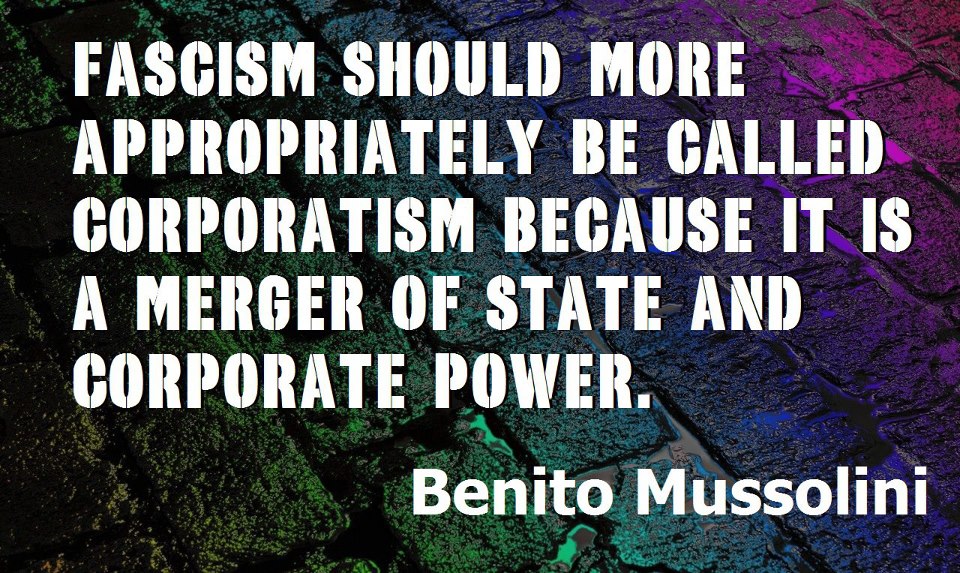
We may observe at this juncture that both the right and the left share the historically and empirically ridiculous theory that government and corporate power are locked in an eternal war. But it is a great politico-economic myth that governments and large corporations operate at variance with one another, that one must align herself in her political commitments with one or the other, never both, never neither. For left wing individualists, surveys which demonstrate dissatisfaction with and negative attitudes toward both actually make perfect sense. That big business should be associated with greed and governments with corruption is hardly astonishing or remarkable. Further, these results underline the problem with seeing corporate power and government power as rivals, rather than seeing them much more accurately as codependent partners in crime, mutually reinforcing components parts of a larger phenomenon we might call a ruling class or power elite.

We needn’t risk the cognitive dissonance that comes with treating the State as the great restraint upon the socially destructive avarice of multinational corporations. For we find, whenever we bother to look, that elites in the business community regularly work with the public sector to create conditions accommodating to monopolism. The ideal of free and open competition, however championed in corporate press releases and political campaigning, is nowhere to be found and indeed never has been. Thus do market anarchists prosecute our laissez faire critique of capitalism. We come from an older tradition of American libertarians, radicals who contemned capitalism as much as any communist, but understood the importance of individual rights and mutually beneficial trade.

It is interesting to witness anarchist communists and syndicalists develop strict, exclusionary criteria for anarchism, particularly insofar as the arguable father of our doctrine, Pierre-Joseph Proudhon, was neither, his mutualism containing many market-friendly if not outright pro-market elements. No less important for anarchism as it developed in America is Josiah Warren, whose first forays into anarchist thought antedate Proudhon. If market or individualist anarchism represents a form of “pseudo-intellectualism,” then some of the anarchist tradition’s brightest lights must apparently be relegated to the dustbin of history. Granting that opposition to not only political but also economic authority is a necessary condition for the true anarchist, individualists like Warren (and his followers such as Benjamin Tucker) more than qualify.

Whether our communist and syndicalist comrades admit it or not, free market ideas figured prominently in fledgling anarchist thought, regarded as perfectly consistent with and a natural outgrowth of, to quote Warren, “the absolute right of supreme individuality.” Considering Warren as an example, many contemporary anarchists may not know that anarchist luminary Peter Kropotkin acknowledged Warren as an inspiration and, in the words of Crispin Sartwell, “a precursor of (and influence on?) Proudhon.” In discussing Warren’s legacy, Sartwell observes one of the major, continuing tensions between the individualist and communist strains of anarchism, the debate on “lifestyle anarchism.” Sartwell argues, quite correctly in the author’s view, that Warren “belongs squarely in what is called by its opponents ‘lifestyle anarchism’: that strain concerned with creating alternatives within the interstices in the existing system rather than arming to overthrow it.” “Peaceful Revolutionist” that he was, Warren emphasized experiments in the creation of practical alternatives to dominant economic and social modalities. To Warren, the whole of life was open to and the subject of reform. This holistic approach, the universality of his critique of the existing state of affairs, he likely inherited from Robert Owen, even while dispensing with other aspects of Owenite thinking. Indeed, Warren’s departure from Owen and his ideas offers us an illuminative proxy for the tensions and debates that still divide individualist from communist elements within anarchism. Warren worried about the overwhelming of the individual within combinations and, paraphrasing Sartwell, imposed a priori schemes. Communists often tend to see the undisciplined “lifestylism” of Warren-type experimentation as essentially bourgeois, outside of or ancillary to genuine class struggle.

Discussing early figures in anarchism such as Warren opens opportunities to reflect on the similarities that unite all anarchists. We can pause to wonder what someone with Warren’s breadth of interests and hopes for reform might think of twenty-first century problems and perceptions thereof.

As all anarchists understand, politics is at bottom conquest, spoliation and rape. Everything else, everything peaceful, voluntary and consensual is something different, throwing the distinction between the “politics means” and the “economic means” once again into sharp relief. The economic means to wealth is defined by the normal, even obvious standards we refer to in interactions with merchants, our friends, and family, the mutually beneficial guidelines we use to cooperate and trade with coequals. The political means, by contrast, is the acquisition of wealth by aggression, by forcible extraction through systematic privilege. The State, being the organization with a monopoly on the legal use of force, is the wellspring of such privilege. As Josiah Warren pointed out in Equitable Commerce:

Theorists have told us that laws and governments are made for the security of person and property; but it must be evident to most minds, that they never have, never will accomplish this professed object; although they have had the world at their control for thousands of years, they have brought it to a worse condition than that in which they found it, in spite of immense improvements in mechanism, division of labor, and other elements of civilization to aid them. On the contrary, under the plausible pretext of securing person and property, they have spread wholesale destruction, famine, and wretchedness in every frightful form over all parts of the earth, where peace and security might otherwise have prevailed. They have shed more blood, committed more murders, tortures, and other frightful crimes in the struggles against each other for the privilege of governing, than society ever would or could have suffered in the total absence of all government whatever.

A deep, principled loathing of both big business and government unites all anarchists. Confronted with the alarming realities of the present moment, its authoritarian repressions and economic maladies, anarchists ought to help one another in peaceful projects to build a freer, better world. Data such as those contained in the Corporate Perception Indicator survey show a world fully primed for our anti-authoritarian, anti-capitalist critiques. It falls upon us to communicate our message, to do the constructive work of inaugurating a new order.

[1] Relatedly, in True Civilization, Josiah Warren wrote, “What is called conservatism has all the time been entirely right in its objections to communism, and in insisting on individual ownership and individual responsibilities both of which communism annihilates; conservatism has also shown wisdom in its aversion to sudden and great changes, for none have been devised that contained the elements of success.”


Another “Gift” From Monsanto: Cancer-Causing Astroturf

images

Could artificial turf cause cancer?

Source: La Opinion

Artificial turf has always been seen as practical; not only are old tires being put to good use, athletic facilities are spared the expense and maintenance costs of keeping up with real grass. There appears to be a huge potential down-side to this common athletic tool, however–it may be giving people cancer.

Artificial turf is made of synthetic grass fibers, filled in with black or green pieces of re-purposed rubber, typically gained from old tires. It was first introduced to the public in 1965 by Donald L. Elbert, James M. Faria, and Robert T. Wright, employees of Monsanto Company, a company now best-known for its genetically modified crop products. The University of Connecticut Health Center indicates in 1967, Indiana State built the first stadium with outdoor artificial turf, a product called Astroturf.

Since then, many debates have surfaced as to the health risks of artificial turf exposure. Concerns have ranged from an increase in athletic injuries to cancer, with parents, teachers and other officials worried what prolonged exposure to tire particles might mean for children. The rubber in artificial turf heats up on hot days, causing the rubber particles to release small amounts of chemicals. The question is: Are these chemicals being released in enough quantity to actually cause someone harm?

What the research says about artificial turf and cancer

First and foremost, there are no studies linking artificial turf to cancer, and the Synthetic Turf Council, an industry group, says that the evidence collected so far by scientists and state and federal agencies proves that artificial turf is safe.

“We’ve got 14 studies on our website that says we can find no negative health effects,” said to NBC News, Dr. Davis Lee, a Turf Council board member. While those studies aren’t “absolutely conclusive,” he added, “There’s certainly a preponderance of evidence to this point that says, in fact, it is safe.”

Other research and a number of case studies suggest otherwise, though, like the inconclusive evidence saying artificial turf is safe, these studies and individual accounts also don’t prove the turf causes cancer. What has been proven is that, in its natural setting, artificial turf does leech out potentially dangerous substances.

Environment and Human Health, Inc. (EHHI) notes artificial turf was examined in the Connecticut Agricultural Experiment Station report, and found to leech more than two dozen chemicals into the environment, some of which have been linked to cancer in other studies, with four compounds conclusively identified with confirmatory tests: benzothiazole; butylated hydroxyanisole; n-hexadecane; and 4-(t-octyl) phenol.

“Those chemicals identified with confirmatory analytical studies at the Connecticut Agricultural Experiment Station study have the following reported actions:

  • Benzothiazole: Skin and eye irritation, harmful if swallowed. There is no available data on cancer, mutagenic toxicity, teratogenic toxicity, or developmental toxicity.
  • Butylated hydroxyanisole: Recognized carcinogen, suspected endocrine, gastrointestinal toxicant, immunotoxicant, neurotoxicant, skin and sense-organ toxicant. There is no available data on cancer, mutagenic toxicity, teratogenic toxicity, or developmental toxicity.
  • n-hexadecane: severe irritant based on human and animal studies. There is no available data on cancer, mutagenic toxicity, teratogenic toxicity, or developmental toxicity.
  • 4-(t-octyl) phenol: corrosive and destructive to mucous membranes. There is no available data on cancer, mutagenic toxicity, teratogenic toxicity, or developmental toxicity.

The study also detected metals that were leached from the tire crumbs. Zinc was the predominant metal, but selenium, lead and cadmium were also identified,” states EHHI.

In addition to the substances found in the Connecticut Agricultural Experiment Station study, in 2013, the Centers for Disease Control (CDC) updated their artificial turf data, stating another concern for individuals in close contact with this athletic product was exposure to lead.

“The risk for harmful lead exposure is low from new fields with elevated lead levels in their turf fibers because the turf fibers are still intact and the lead is unlikely to be available for harmful exposures to occur,” stated the CDC. “As the turf ages and weathers, lead is released in dust that could then be ingested or inhaled, and the risk for harmful exposure increases. If exposures do occur, CDC currently does not know how much lead the body will absorb; however, if enough lead is absorbed, it can cause neurological development symptoms (e.g., deficits in IQ). Additional tests are being performed by NJDHSS to help us better understand the absorption of lead from these products.”

While no link between these risks and actual cancer cases have been established, some experts believe the individual reports speak for themselves.

In the NBC News report, soccer coach Amy Griffin said she was visiting athletes in the hospital during 2009, two of which were goalkeepers diagnosed with non-Hodgkin lymphoma. She hadn’t thought much about the correlation between the illness and artificial turf until a nurse made the comment, “Don’t tell me you guys are goalkeepers. You’re the fourth goalkeeper I’ve hooked up this week.”

Since then, Griffin has compiled a list of 38 American soccer players who have been diagnosed with cancer. Thirty-four of those players are goalies, individuals who have the most contact with the turf compared to other players.

The case reports suggest athletes and those spending time on artificial turf may be putting themselves at-risk in a manner similar for people who work in rubber and tire plants.

“Use of recycled tire shreds or crumbs in athletic fields, gardening and playgrounds involves repeated and direct exposures for both children and adults to tire dust and some chemicals similar to those in tire plants,” stated EHHI. “A comprehensive assessment of the information known about the health risks to the public is necessary to assess safety.”

9 Ominous Signals Coming From The Financial Markets That We Have Not Seen In Years

Meltdown-Secret-History-of-Global-Financial-Collapse

By Michael Snyder

Source: The Economic Collapse

Is the stock market about to crash?  Hopefully not, and there definitely have been quite a few “false alarms” over the past few years.  But without a doubt we have been living through one of the greatest financial bubbles in U.S. history, and the markets are absolutely primed for a full-blown crash.  That doesn’t mean that one will happen now, but we are starting to see some ominous things happen in the financial world that we have not seen happen in a very long time.  So many of the same patterns that we witnessed just prior to the bursting of the dotcom bubble and just prior to the 2008 financial crisis are repeating themselves again.  Hopefully we still have at least a little bit more time before stocks completely crash, because when this market does implode it is going to be a doozy.

The following are 9 ominous signals coming from the financial markets that we have not seen in years…

#1 By the time the markets closed on Monday, we had witnessed the biggest three day decline for U.S. stocks since 2011.

#2 On Monday, the S&P 500 moved below its 200 day moving average for the first time in about two years.  The last time this happened after such an extended streak of success, the S&P 500 ended up declining by a total of 22 percent.

#3 This week the put-call ratio actually moved higher than it was at any point during the collapse of Lehman Brothers in 2008.  This is an indication that there is a tremendous amount of fear on Wall Street right now.

#4 Everybody is watching the VIX at the moment.  According to the Economic Policy Journal, the VIX has now risen to the highest level that it has been since the heart of the European debt crisis.  This is another indicator that there is extraordinary fear on Wall Street…

US stock market volatility has jumped to the highest since the eurozone debt crisis, according to a closely watched index, the the CBOE Vix index of implied US share price volatility.

It jumped to 24.6 late on Monday and is up again this morning. On Thursday, it was as low as 15.

That’s a very strong move, but things have been much worse. At height of the recent financial crisis – the Vix index peaked at 80.1 in November 2008.

Could we get there again? Yeah.

#5 The price of oil is crashing.  This also happened in 2008 just before the financial crisis erupted.  At this point, the price of oil is now the lowest that it has been in more than two years.

#6 As Chris Kimble has pointed out, the chart for the Dow has formed a “Doji Star topping pattern”.  We also saw this happen in 2007.  Could this be an indication that we are on the verge of another stock market crash similar to what happened in 2008?

#7 Canadian stocks are actually doing even worse than U.S. stocks.  At this point, Canadian stocks have already dropped more than 10 percent from the peak of the market.

#8 European stocks have also had a very rough month.  For example, German stocks have already dropped about 10 percent since July, and there are growing concerns about the overall health of the German economy.

#9 The wealthy are hoarding cash and precious metals right now.  In fact, one British news report stated that sales of gold bars to wealthy customers are up 243 percent so far this year.

So what comes next?

Some experts are saying that this is the perfect time to buy stocks at value prices.  For example, USA Today published a story with the following headline on Tuesday: “Time to ‘buy’ the fear? One Wall Street pro says yes“.

Other experts, however, believe that this could represent a major turning point for the financial markets.

Just consider what Abigail Doolittle recently told CNBC

Technical strategist Abigail Doolittle is holding tight to her prediction of market doom ahead, asserting that a recent move in Wall Street’s fear gauge is signaling the way.

Doolittle, founder of Peak Theories Research, has made headlines lately suggesting a market correction worse than anyone thinks is ahead. The long-term possibility, she has said, is a 60 percent collapse for the S&P 500.

In early August, Doolittle was warning both of a looming “super spike” in the CBOE Volatility Index as well as a “death cross” in the 10-year Treasury note. The former referenced a sharp move higher in the “VIX,” while the latter used Wall Street lingo for an event that already occurred in which the fixed income benchmark saw its 50-day moving average cross below its 200-day trend line.

Both, she said, served as indicators for trouble ahead.

Diary of an American Terrorist

91aDKdJ-UHL._SL1500_

While searching for some light reading a few months ago I was delighted to discover the work of Thomas Ligotti. His unique take on the horror genre in “My Work is Not Yet Done” was so powerful and relevant to our times, it made me wonder why are there not more writers exploring Corporate Horror?

It seems Brian Whitney at Disinfo.com has found another voice that, judging from his description in the following article, may be just as compelling:

The Wall Street bankers and billionaires had better watch out. A new novel, Diary of an American Terrorist, by Chuck Darwin, pictures them mowed down by machine gun fire, dropped from high places, and having their throats slit – in general, being rubbed out in increasingly gruesome and wholesale ways.

“This is a startling document,” says Patrick Quinlan, president of Strawberry Books, the publisher of Diary. “There’s a lot of anger in it, and why not? The bankers have been getting up to all kinds of mayhem for a long time. A lot of jobs have gone overseas. Let’s face it: we’ve all been waiting for a novel where an ordinary working person decides to strike them back.”

In the story, an unnamed middle-aged man has lost everything – his family, his job, his very life. His humiliation becomes anger, which boils over into a murderous rage. He turns it toward the people he blames for his predicament – the very wealthy, who so often profit from the misery of working people.

The man is a military veteran and has wide ranging technology skills. He doesn’t go berserk. Instead, he slowly and methodically begins to choose targets, stalk them, and kill them. Most of the book takes the form of a diary, in which the man – who renames himself Spartacus, after the leader of the Roman slave revolt – records his preparations for each murder, then describes the murder itself in graphic detail. Readers embark on a vicarious kill spree, hunted by both the FBI and an elite secret society.

“People worry about Islamic terrorists from the Middle East,” says author Chuck Darwin. “I think they’re looking in the wrong direction. Who do you think is joining these terrorist organizations in the Middle East, the poor? That’s wrong. Study after study shows that terrorist groups recruit from the same pool as the American military – people from the former middle class who no longer have other options.”

According to Darwin, it’s only a matter of time before well-educated, once middle class people in America begin to turn their daunting skill sets against their oppressors. Who are their oppressors? The ones who sent their jobs to low-paying countries so the company could reap bigger profits.

“My hero is a guy whose life has been ruined. He has no prospects. It’s really the end of the line for him. But he has a lot of skills. He knows how to use weaponry. He knows how to use technology. He knows how to plan and how to cover his tracks. He’s patient. He’s ambitious. He has determination. All those good American things. He starts picking soft targets, wealthy people, ones he has no obvious relationship to.

“How do you stop someone like this, once he gets going? Simple answer: you don’t.”

Diary of an American Terrorist is available for pre-order  at Amazon.

See more at: http://disinfo.com/2014/09/diary-american-terrorist/#sthash.Q36h9Wlw.dpuf

Multi Billion Dollar Bonanza: Companies which Make Money By Keeping Americans “Terrified of Terror Attacks”

images

A massive industry profits off the government-induced fear of terrorism.

By Alex Kane

Source: Alternet

Michael Hayden, the former director of the National Security Agency, has invaded America’s television sets in recent weeks to warn about Edward Snowden’s leaks and the continuing terrorist threat to America.

But what often goes unmentioned, as the Guardian’s Glenn Greenwald pointed out, is that Hayden has a financial stake in keeping Americans scared and on a permanent war footing against Islamist militants. And the private firm he works for, called the Chertoff Group, is not the only one making money by scaring Americans.

Post-9/11 America has witnessed a boom in private firms dedicated to the hyped-up threat of terrorism. The drive to privatize America’s national security apparatus accelerated in the aftermath of the terrorist attacks, and it’s gotten to the point where 70 percent of the national intelligence budget is now spent on private contractors, as author Tim Shorrock reported. The private intelligence contractors have profited to the tune of at least $6 billion a year. In 2010, the Washington Post revealed that there are 1,931 private firms across the country dedicated to fighting terrorism.

What it all adds up to is a massive industry profiting off government-induced fear of terrorism, even though Americans are more likely to be killed by a car crash or their own furniture than a terror attack.

Here are five private companies cashing in on keeping you afraid.

1. The Chertoff Group

On August 11, former NSA head Michael Hayden, the man at the center of the Bush administration’s 2005 surveillance scandal, was defending his former agency on CBS News in the wake of the latest NSA spying scandal. Commenting on President Obama’s half-hearted promises to reform some NSA practices, Hayden told host Bob Schieffer that “the President is trying to take some steps to make the American people more comfortable about what it is we’re doing. That’s going to be hard because, frankly, Bob, some steps to make Americans more comfortable will actually make Americans less safe.”

Former Homeland Security chief Michael Chertoff had a similar message when he appeared on ABC News August 4. Speaking about the purported threat from an Al Qaeda affiliate in Yemen that led to the closure of 19 U.S. embassies, Chertoff said that “the collection of this warning information [about Al Qaeda] came from the kinds of programs we’ve been discussing about, the ability to capture communications overseas.”

CBS and ABC did not see fit to inform viewers that both Hayden and Chertoff are employees of the Chertoff Group, a private firm created in 2009 that companies hire to consult on best practices for security and combatting terrorism. Some of the companies the firm advises go on to win government contracts. Chertoff is the founder and chairman of the group, while Hayden serves as a principal. So they profit off a war on terror they say is crucial to keeping Americans safe.

Though it’s unclear how much in total exactly the firm makes, there are some known numbers. After the failed attempt in 2010 to blow up an airliner on Christmas Day with a bomb hidden in underwear, Chertoff pushed for better airport security procedures. One of the suggestions Chertoff made was for the Transportation Security Agency to use full-body scanners like the ones Rapiscan, one of the Chertoff Group’s clients, made. And sure enough, after the Christmas Day plot, the TSA ordered 300 Rapiscan machines. The Huffington Post reported that Rapiscan made $118 million from the government between 2009-2010.

2. Booz Allen Hamilton

This private intelligence contractor has become a household name in the wake of the NSA scandal. Edward Snowden, the man responsible for leaking secret documents that exposed the breadth of NSA surveillance, was working for Booz Allen when he downloaded the documents he handed off to media outlets. As the New York Times reported in June, the company parlays its technology expertise for intelligence uses into massive government contracts. Thousands of employees of the company provide services to the NSA, like analyzing the massive amounts of data the government agency collects every day. The company is also the shining symbol of the government-private security complex’s revolving door: its vice president is the former director of national intelligence, while the current director of national intelligence is a former employee of Booz Allen.

Despite the Snowden security breach, Booz Allen continues to work with the government. And they’re making a lot of money from the U.S. In the last fiscal year, the company made $1.3 billion from working in U.S. intelligence. In total, Booz Allen Hamiltion made over $5 billion last fiscal year. And the cash keeps coming: in January, the company announced that it had won a contract with the Defense Department to provide intelligence services. The amount of money it could make from the deal is up to $5.6 billion.

And like Hayden and Chertoff, Booz Allen’s vice president Mike McConnell has publicly hyped up the threat of terrorism to blast Snowden’s leaks. McConnell told a government contracting conference in July 2013 that Snowden’s leaks have done “irrevocable damage” to the U.S.’s ability to stop terrorism. “It’s going to inhibit our ability to understand nuclear activity in North Korea, what’s going on in Syria, what might be happening with the Taliban in Afghanistan,” said McConnell.

3. Science Applications International Corporation

Sometimes referred to as “NSA West” because so many former NSA employees go on to work for the formerly California-based Science Applications International Corporation (SAIC), this firm makes a ton of cash off government contracts. And they do so by hawking their expertise in combatting the terrorist threat.

Browse through SAIC’s website and you’re constantly greeted with the words “terrorist threat” and information on how the SAIC can help the government and others battle it. SAIC developed a “Terrorism Protection Manual” for Florida law enforcement that was developed to fight “today’s national terrorist threat and implement recommended security best practices.” They boast of their “experience meeting the terrorism incident response training needs of a wide variety of customers, from training for a national Weapons of Mass Destruction (WMD) scenario, applicable at agency response levels, to lesser levels of incidents affecting a city, a military installation or a special facility.”

Back when John P. Jumper, the current CEO of SAIC, was an Air Force general, he said the threat of terrorism is “greater than Nazism, greater than communism. This threat that we have of terrorist zealots is the most dangerous because these are people who care nothing about life. They care nothing about our lives, for sure, and they care nothing about their own lives.” And Larry Prior, a U.S. intelligence veteran who used to run the company’s Intelligence and Security Group, said in an internal newsletter that “the future of the nation rests on their backs,” referring to employees in his group.

SAIC is an immensely lucrative and large company. It boasts 42,000 employees—20,000 of whom hold U.S. government security clearances. It is the NSA’s largest contractor, according to CorpWatch, and is deeply involved in the NSA’s collection of intelligence. Last year it reported a net income of $525 million.

4. Center for Counterintelligence and Security Studies 

U.S. intelligence agencies aren’t the only sectors of government where the private sector has cashed in on the fear of terrorism. The post-9/11 world has seen the blossoming of a cottage industry of self-styled “experts” on Islam from private companies that market their supposedly ironclad analysis of the threat from Islamists to other federal agencies and state and local law enforcement. These companies have profited from law enforcement taking part in the “war on terror.”

Through Homeland Security grant programs like the State Homeland Security Program and the Urban Areas Security Initiative, the federal government has doled out over billions of dollars to these private companies to provide Islamophobic training. One of these companies is called the Center for Counterintelligence and Security Studies.

Based in Virginia, the center “posits radical Islam as a new global ideological menace on the order of the old communist threat from the Soviet Union,” as Political Research Associates (PRA) noted in a 2011 report on private firms doing counter-terror training. Staff members include former FBI, CIA and Defense Department personnel.

Their claim to fame is providing education and training to members of the U.S. national security community—including law enforcement agencies, according to their website. They say they have trained over 67,000 people over the past decade.

It’s unclear exactly how much this firm makes per year. But according to the PRA report, a five-day course for government employees on the “Global Jihadist Threat Doctrine” costs $39,280. The firm also lists the costs of individual courses on their website. For a 30-person class titled “Dying to Kill Us: Understanding the Mindset of Suicide Operations,” the cost is $7,856. For a three-day course for 30 people on “Informant Development for Law Enforcement to FighTerrorism,” the cost is $23,568.

The training pushes anti-Muslim ideology. On the section of their website where they list feedback from participants of the courses, one wrote: “An eye-opener. Especially how many Muslim Brotherhood front organizations there are and that the government doesn’t get it.”

5. Security Solutions International

Security Solutions International is yet another private firm hawking anti-Muslim training to law enforcement. This Miami-based company founded in 2004 uses its Israeli security connections to boost its standing in the market. They use Israeli security trainers in their courses and their president, Henry Morgenstern, is a dual Israeli-U.S. citizen who says he “developed excellent high level contacts with the Security Establishment [in Israel], making SSI the premiere training company for counter-terror related subjects.”

The company has trained over 700 law enforcement agencies since 2004. Officials from law enforcement agencies like the Massachusetts Bay Transportation Authority and the Department of Homeland Security have participated in the conferences they put on for profit. While SSI claims that they don’t cast aspersions on the whole of Islam, an examination of their trainings, conferences and the speakers they use indicate otherwise.

At a 2009 conference sponsored by Police magazine, an SSI instructor who is the company’s “expert” on Islam used a video that showed a terrorist beheading a hostage. After the course was met with criticism, the company’s CEO said “their religion got linked to terrorism a long time ago.”

The conferences they hold are usually well-attended, and this year SSI is putting on a conference in Orlando, Florida for three days. The cost for each attendee is $400. The keynote speaker this year is Steve Emerson, a well-known member of what’s been termed the “Islamophobia industry.” SSI also makes money off its Counter Terrorist magazine. A yearly subscription is $35, and the company says it has 15,000 subscribers.

Editor’s note: Dishonorable mentions that should be added to the list include corporate news media, all crony contractors including Boeing, Lockheed Martin, Halliburton, Bechtel, etc., Neocon Pro-war Activists, and the SITE Intelligence Group.

Why Has Classical Capitalism Devolved to Crony-Capitalism?

Crony-Capitalism_200x200

By Charles Hugh Smith

Source: OfTwoMinds.com

Here is the quote that perfectly captures our era: “People of privilege will always risk their complete destruction rather than surrender any material part of their advantage.” (John Kenneth Galbraith) The trick, of course, is to mask the unspoken second half of of that statement: everybody else gets destroyed along with the Elites when the system implodes.

Union pension funds: toast. Government employees’ pension funds: toast. 401Ks: toast. IRAs: toast. The echo-bubble in housing: toast. The Fed’s favorite PR cover to cloak the enrichment of their financier cronies, the wealth effect:toast.

The primary tool the Elites use to mask the risk of complete destruction is magical thinking–specifically, that “given enough time, the system will heal itself.”

That’s rich, considering that the Elites’ primary tool of avoiding destruction is crippling the market’s self-healing immune system: price discovery. Thanks to ceaseless interventions by central banks, the price discovery mechanism has been shattered: want to know the price of risk? It’s near-zero. Yield on sovereign bonds? Near-zero. And so on.

Prices have been so distorted (the ultimate goal of Central Planning everywhere, from China to the EU to Japan to the U.S.) that the illusion of stability is impossible without more intervention.

This leads to two self-liquidating dynamics: diminishing returns (every intervention yields less of the desired result) and the Darwinian selection of only those money managers who believe risk has been vanquished.

Everyone who pursues prudent risk management has either been fired or saw the writing on the wall and exited stage right. So the only people left at the gaming tables of the big institutional players are those individuals who are genetically incapable of responding appropriately to rising risk. Those who did have long been fired for “underperformance.”

So how did classical free-market capitalism become state-cartel crony-capitalism, a Ponzi scheme of epic proportions that is entirely dependent on ceaseless central bank perception management and interventions on a scale never before seen?

We can start with these six factors:

1. Those who control most of the wealth are willing to risk systemic collapse to retain their privileges and wealth. Due to humanity’s virtuosity with rationalization, those at the top always find ways to justify policies that maintain their dominance and downplay the distortions the policies generate. This as true in China as it is in the U.S.

2. Short-term thinking: if we fudge the numbers, lower interest rates, etc. today, we (politicians, policy-makers, money managers, etc.) will avoid being sacked tomorrow. The longer term consequences of these politically expedient policies are ignored.

3. Legitimate capital accumulation has become more difficult and risky than buying political favors. Global competition and the exhaustion of developed-world consumers has made it difficult to reap outsized profits from legitimate enterprise. In terms of return-on-investment (ROI), buying political favors is far lower risk and generates much higher returns than expanding production or risking investment in R&D.

4. The centralization of state/central bank power has increased the leverage of political contributions/lobbying. The greater the concentration of power, the more attractive it is to sociopaths and those seeking to buy state subsidies, sweetheart contracts, protection from competition, etc.

5. Any legitimate reform will require dismantling crony-capitalist/state-cartel arrangements. Since that would hurt those at the top of the wealth/power pyramid, reform is politically impossible.

6. Understood in this light, it’s clear that central bank monetary policy—zero-interest rates, asset purchases, cheap credit to banks and financiers, QE, etc.—is designed to paper over the structural problems that require real reform.

Japan is a case in point: the Powers That Be in Japan have put off real reforms of the Japanese economy and political system for 25 years, and they’ve enabled this avoidance by pursuing extremes of fiscal and monetary policy that have eroded the real economy and created long-term structural imbalances.

In this 24 minute video Gordon T. Long and Charles Hugh Smith discuss through the aid of 17 slides the rapid advancement of Crony Capitalism in America. The facts are undeniable, but why is it becoming so obvious and undeniable? Why is it accelerating without any apparent ‘checks and balances’? Where have the safeguards against this happening gone?