Ferguson and the Logic of Neoliberalism

Ferguson-RiotA Political Economy Premised on Exploitation and Social Repression

By Rob Urie

Source: Counterpunch.org

While the U.S. Department of Justice report on racist policing practices in Ferguson, Missouri provides direct evidence for skeptical Whites that institutional racism is fact, limiting the investigation to Ferguson implausibly delimits the scope of race based repression in the U.S. Additionally, from slavery to convict leasing to funding the Ferguson city budget with fines and penalties overwhelmingly extracted from poor and middle class Blacks, the economic basis of police repression is isolated in an improbable present. And in fact, the ‘tricks and traps’ used by the Ferguson police for economic extraction closely resembles corporate practices of using contract law, state institutions and monopoly power to take economic resources from those who lack the social power to resist.

A cognitive challenge for White Americans (and ‘conservative’ Blacks) is the distance between facts like police repression in Ferguson and the mythology of capitalist democracy that we live by. Use of the police for economic extraction in Ferguson, for funding the town budget through racial repression, ties state power to economic power within the particular circumstances of American racial and economic history. In a most basic sense this integration reframes state-market relations claimed to relate capitalism to democracy. More broadly, the TPP and TIPP ‘trade’ deals being pushed by President Obama are a variation on the racist shakedown in Ferguson. Their intent is to replace state power with corporate power while leaving Western states intact to provide state services for the benefit of corporations and the illusion of democratic control.

Discovery of a police ‘black site’ in Chicago, the prevalence of racist violence by the police across the U.S., the return of debtor’s prisons and ‘civil forfeiture’ laws that allow the police to take belongings without evidence of a crime illustrate the growing lawlessness of the police. When tied to illegal surveillance carried out by the NSA, DEA and FBI against citizens and non-citizens alike and the extra-judicial powers claimed by Mr. Obama a picture of widespread state lawlessness emerges. When considered in the context of no criminal prosecutions for war crimes against the (George W) Bush administration or against prominent bankers in the financial and economic debacle of the last decade a picture of widespread elite lawlessness emerges. Clearly the state, including local police departments, exists for purposes other than enforcing fealty to the law.

Based on supporting economic theories it is superficially ironic that the resurgence of neo-liberalism since the 1970s is coincident with this growing integration of state and ‘private’ power. Premised on clearly delineated state and market roles, neo-liberalism was / is in theory the economic realm unhindered by state restrictions. This state-market delineation facilitates the facade that capitalism is related to democracy— political freedom in the realm of the political and economic freedom in the realm of the economic. As fact and metaphor the role of the Ferguson police using asymmetrical social power to take economic wealth from vulnerable citizens demonstrates the implausibility of this theorized differentiation in the realm of the political. And new debtor’s prisons (link above) have police and the prison system acting as collection agents for Payday Lenders.

The TPP and TTIP trade deals being pushed by Mr. Obama are designed with analogous levers for extorting wealth. The investor resolution clauses in TTIP have a supranational judiciary ruling on ‘investor’ lawsuits against governments for hypothetical lost profits and taxpayers on the hook for adverse rulings. The relative absence of remaining trade restrictions and tariffs is well covered territory. What remains to be accomplished with these ‘agreements’ is the consolidation of economic power as the power to extract wealth. As with proposals for tradable carbon credits, the ‘product’ of the agreements combines the right to extort by putting forward projects never intended to be built with guarantees against adverse economic developments.

The police in Ferguson used a particular social lever, the residual of slavery, for gratuitous racial repression and for economic extraction. Slavery is a social institution, but it most particularly is an economic institution. It is a social mechanism for accruing the product of slave labor to the slave master. And slavery in the U.S. was ‘legal’ until it wasn’t. Convict leasing was explicit use of ‘the law’ and the judicial system to force poor Blacks to work for little or no pay. ‘The law’ was used as an instrument of economic exploitation and extraction. The push back from Whites and conservative Blacks that the murdered Mike Brown was a criminal because he likely stole a box of cigars takes this same law at face value. This view of the law depends on a similarly improbable separation of political and economic realms as neo-liberal theory.

As political theory might have it, if all of the citizens of Ferguson were intended to benefit from city resources while poor and middle class Blacks were disproportionately forced to pay for them that represents economic taking by some citizens for the benefit of others. The racial character of this taking places it in history. The history of Western colonialism, neo-colonialism and imperialism places it in broader internal and external context. And this history is evidence that distinct realms of the economic and the political never described existing circumstance. The practical relevance is that it places the actions of the police in Ferguson, past and pending ‘trade’ agreements and global economic relations in the space where economic and political power act in an integrated social dimension.

The effect is to reframe ‘the law’ in terms of who is committing particular acts rather than the acts being committed. The police in Ferguson can murder with impunity and shake down citizens at their discretion to fund the city budget (and their paychecks) while poor and middle class Blacks are disproportionately murdered and sent to prison for similar acts. What is legal and what isn’t is determined by who has social power, not by the acts themselves. In a racist and classist society the law is codification of class and race interests. If a black citizen of Ferguson puts a gun to someone’s head and demands their valuables they are a criminal but if the same act is committed by a cop it is within the law. Here events in Ferguson are fact and metaphor— overwhelming evidence (links above) suggests that similar social relations exist across much of the country.

This view of the law has precedence in Richard Nixon’s contention that “when the President does it that means that it is not illegal.” Earlier precedence can be found in Nazi law and in the laws of fascist Italy in the 1930s and 1940s. This isn’t to call anyone who isn’t a self-proclaimed Nazi a Nazi. The precedence lies in the view that the law is the will of a leadership class, be it the Nazi leadership in Germany or city government in Ferguson. One problem with this theory is that it makes the law capricious and ultimately impossible to follow. Race based law enforcement criminalizes race, not nominally proscribed acts. Stories of the Chicago police department’s black site (link above) have political protesters and poor Blacks accused of no crimes taken there. If people can be arrested without evidence that a crime was committed then what is the difference in outcomes between committing and not committing crimes?

A relation of neo-liberalism to fascism can be made through replacement of civil governance with corporate governance that subordinates the rights and privileges of civil society to corporate interests. The investor-state dispute mechanisms (link above) being broadened and formally codified in the TTIP trade deal will be used to demand compensation for environmental regulations that keep drinking water safe and limit greenhouse gas emissions, the metaphorical equivalent of threatening to end the planet if we don’t pay up. Civil forfeiture has the police taking valuables they might want at the point of a gun if necessary. The Ferguson police shake down poor Blacks using the law as a weapon. At the same time a ruling elite has immunity from prosecution for well documented crimes.

Much of what is written here was well understood in the 1950s, 1960s and 1970s. It hardly seems an accident that this collective memory was lost to narrow ideological dogma. Across the country property taxes are being cut with partial differences made up through regressive fees and penalties. This fits the neo-liberal preference for property over labor incomes. And neo-liberal theory has no place for history because all acts within it take place in a temporally isolated present. This dissociates racist policing in Ferguson, Chicago, New York, Detroit and Philadelphia from the roles of the legislature, judiciary, police and prisons in reconstituting the economic exploitation of slavery under the guise of free choice in capitalist democracy. Race is the particular case in America; class is the broader expression of economic power.

The tension between the DOJ report (link above) on racist policing in Ferguson and the Obama administration’s broad support for neo-liberal policies will likely produce a tight circle drawn around events in Ferguson. Already supporters of police repression are raising the argument that the words “hands up, don’t shoot” never transpired. What bearing does precise wording have on a Black child being murdered by the police? And why wouldn’t Black youth have a right to be hostile to police who, as the DOJ reports concludes, are running a racist shakedown operation to force poor and middle class Blacks to fund city government? How would White readers react to being harassed, intimidated, disproportionately jailed and forced to pay for the privilege? Ultimately the problem is larger than Ferguson and social accountability should address political economy premised in exploitation and social repression.

Rob Urie is an artist and political economist. His book Zen Economics is written and awaiting publication.


Confronting Industrialism

cost-of-coal_detail

By Derrick Jensen

Source: Counterpunch.org

Some of the most important questions confronting us are: what should we do about this culture’s industrial wastes, from greenhouse gases to pesticides to ocean microplastics?

Can the capitalists clean up the messes they create? Or is the whole industrial system beyond reform? The answers become clear with a little context.

Let’s start the discussion of context with two riddles that aren’t very funny.

Q: What do you get when a cross a long drug habit, a quick temper, and a gun?

A: Two life terms for murder, with earliest release date 2026.

And,

Q: What do you get when you cross a large corporation, two nation states, 40 tons of poison, and at least 8,000 dead human beings?

A: Retirement with full pay and benefits. Warren Anderson, CEO of Union Carbide. Bhopal.

The point of these riddles is not merely that when it comes to murder and many other atrocities, different rules apply to the poor than to the rich. And it’s not merely that ‘economic production’ is a get-out-of-jail free card for whatever atrocities the ‘producers’ commit, whether it’s genocide, gynocide, ecocide, slaving, mass murder, mass poisoning, and so on.

Do we even care? We already know they don’t …

The point here is that this culture is clearly not particularly interested in cleaning up its toxic messes. Obviously, or it wouldn’t keep making them. It wouldn’t allow those who make these messes to do so with impunity. It certainly wouldn’t socially reward those who make them.

This may or may not be the appropriate time to mention that this culture has created, for example, 14 quadrillion (yes, quadrillion) lethal doses of Plutonium 239, which has a half-life of over 24,000 years, which means that in a mere 100,000 years that number will be all the way down to only about 3.5 quadrillion lethal doses: Yay!

And socially reward them it does. I could have used a whole host of examples other than Warren Anderson, who was playing on the back nine long after he should have been hanging by the neck (he was sentenced to death in absentia, but the US refused to extradite him).

There’s Tony Hayward, who oversaw BP’s devastation of the Gulf of Mexico and who was ‘punished’ for this with a severance package worth well over $30 million. Or we could throw another couple of riddles at you, which are really the same riddles:

Q: What do you call someone who puts poison in the subways of Tokyo?

A: A terrorist.

Q: What do you call someone who puts poison (cyanide) into groundwater?

A: A capitalist: CEO of a gold mining corporation.

We could talk about frackers, who make money as they poison groundwater. We could talk about anyone associated with Monsanto. You can add your own examples. I’d say you can ‘choose your poison’ but of course you can’t. Those are chosen for you by those doing the poisoning.

Civilization’s ability to overcome our native common sense

I keep thinking about one of the most fundamentally sound (and fundamentally disregarded) statements I’ve ever read. After Bhopal, one of the doctors trying to help survivors stated that corporations (and by extension, all organizations and individuals) “shouldn’t be permitted to make poison for which there is no antidote.”

Please note, by the way, that far from having antidotes, nine out of ten chemicals used in pesticides in the US haven’t even been thoroughly tested for (human) toxicity.

Isn’t that something we were all supposed to learn by the time we were three? Isn’t it one of the first lessons our parents are supposed to teach us? Don’t make a mess you can’t clean up!

Yet that is precisely the foundational motivator of this culture. Sure, we can use fancy phrases to describe the processes of creating messes we have no intention of cleaning up, and in many cases cannot clean up.

And so we get phrases like ‘developing natural resources’, or ‘sustainable development’, or ‘technological progress’ (like the invention and production of plastics, the bathing of the world in endocrine disruptors, and so on), or ‘mining’, or ‘agriculture’, or ‘the Green Revolution’, or ‘fueling growth’, or ‘creating jobs’, or ‘building empire’, or ‘global trade’.

But physical reality is always more important than what we call it or how we rationalize it. And the truth is that this culture has been based from the beginning to the present on privatizing benefits and externalizing costs. In other words, on exploiting others and leaving messes behind.

Hell, they call them ‘limited liability corporations’ because a primary purpose is to limit the legal and financial liability of those who benefit from the actions of corporations for the harm these actions cause.

Internalizing insanity

This is no way to run a childhood, and it’s an even worse way to run a culture. It’s killing the planet. Part of the problem is that most of us are insane, having been made so by this culture. We should never forget what RD Laing wrote about this insanity:

“In order to rationalize our industrial-military complex [and I would say this entire way of life, including the creation of messes we have neither the interest nor capacity to clean up], we have to destroy our capacity to see clearly any more what is in front of, and to imagine what is beyond, our noses. Long before a thermonuclear war can come about, we have had to lay waste to our own sanity.

“We begin with the children. It is imperative to catch them in time. Without the most thorough and rapid brainwashing their dirty minds would see through our dirty tricks. Children are not yet fools, but we shall turn them into imbeciles like ourselves, with high IQs, if possible.”

We’ve all seen this too many times. If you ask any reasonably intelligent seven-year-old how to stop global warming caused in great measure by the burning of oil and gas and by the destruction of forests and prairies and wetlands, this child might well say, “Stop burning oil and gas, and stop destroying forests and prairies and wetlands!”

If you ask a reasonably intelligent thirty-year-old who works for a ‘green’ high tech industry, you’ll probably get an answer that primarily helps the industry that pays his or her salary.

Part of the brainwashing process of turning us into imbeciles consists of getting us to identify more closely with-and care more about the fate of-this culture rather than the real physical world. We are taught that the economy is the ‘real world’, and the real world is merely a place from which to steal and on which to dump externalities.

Does nature have to adapt to us? Or us to nature?

Most of us internalize this lesson so completely that it becomes entirely transparent to us. Even most environmentalists internalize this. What do most mainstream solutions to global warming have in common? They all take industrialism as a given, and the natural world as having to conform to industrialism.

They all take empire as a given. They all take overshoot as a given. All of this is literally insane, in terms of being out of touch with physical reality. The real world must always be more important than our social system, in part because without a real world you can’t have any social system whatsoever. It’s embarrassing to have to write this.

Upton Sinclair famously said that it’s hard to make a man understand something, when his job depends on him not understanding it.

I would add that it’s hard to make people understand something when the benefits they accrue through their exploitative and destructive way of life depend on it. So we suddenly get really stupid about the waste products produced by this culture.

When people ask how we can stop polluting the oceans with plastic, they don’t really mean, “How can we stop polluting the oceans with plastic?” They mean, “How can we stop polluting the oceans with plastic and still have this way of life?”

And when they ask how we can stop global warming, they really mean, “How can we stop global warming without stopping this level of energy usage?”. When they ask how we can have clean groundwater, they really mean, “How can we have clean groundwater while we continue to use and spread all over the environment thousands of useful but toxic chemicals that end up in groundwater?”

The answer to all of these is: you can’t.

First we must recover our sanity. Then we must act

As I’ve been writing this essay about the messes caused by this culture, there’s an allegorical image I can’t get out of my mind. It’s of a half-dozen Emergency Medical Technicians putting bandages on a person who has been assaulted by a knife-wielding psychopath.

The EMTs are trying desperately to stop this person from bleeding out. It’s all very tense and suspenseful as to whether they’ll be able to staunch the flow of blood before the person dies.

But here’s the problem: as these EMTs are applying bandages as fast as they can, the psychopath is continuing to stab the victim. Worse, the psychopath is making wounds faster than the EMTs are able to bandage them. And the psychopath is paid very well for stabbing the victim, while most of the EMTs are bandaging in their spare time.

And in fact the health of the economy is based on how much blood the victim loses – as in this culture, where economic production is measured by the conversion of living landbase into raw materials, e.g., living forests into two-by-fours, living mountains into coal.

How do we stop the victim from bleeding out? Any child can tell you. And any sane person who cares more about the health of the victim than the health of the economy that is based on dismembering the victim can tell you. The first thing you need to do is stop the stabbing. No amount of bandages will make up for an assault that is ongoing, indeed, one that is accelerating.

What do we do about this culture’s fabrication of industrial wastes? The first step is stop their production. Actually the first step is that we regain our sanity, that is, we transfer our loyalty away from the psychopaths, and toward the victim, toward, in this case, the planet that is our only home.

Once we do that, everything else is technical. How do we stop them? We stop them.

Derrick Jensen is Member of the Steering Committee of Deep Green Resistance. See more details. Read Derrick Jensen’s blog.


Breaking: Moguls Fear AI Apocalypse

Matrix-Machines-Best-Movie-AI

By Jacob Silverman

Source: The Baffler

A funny thing happened on the way to the Singularity. In the past few months, some of the tech industry’s most prominent figures (Elon Musk, Bill Gates), as well as at least one associated guru (Stephen Hawking), have publicly worried about the consequences of out-of-control artificial intelligence. They fear nothing less than the annihilation of humanity. Heady stuff, dude.

These pronouncements come meme-ready—apocalyptic, pithy, trading on familiar Skynet references—grade-A ore for the viral mill. The bearers of these messages seem utterly serious, evincing not an inkling of skepticism. “I think we should be very careful about artificial intelligence,” Elon Musk said. “If I had to guess at what our biggest existential threat is, it’s probably that.”

“The development of full artificial intelligence could spell the end of the human race,” said Stephen Hawking, whose speech happens to be aided by a comparatively primitive artificial intelligence.

Gates recently completed the troika, sounding a more circumspect, but still troubled, position. During a Reddit AMA, he wrote: “I agree with Elon Musk and some others on this and don’t understand why some people are not concerned.”

It’s easy to see why these men expressed these fears. For one thing, someone asked them. This is no small distinction. Most people are not, in their daily lives, asked whether they think super-smart computers are going to take over the world and end humanity as we know it. And if they are asked, the questioner is usually not rapt with attention, lingering on every word as if it were gospel.

This may sound pedantic, but the point is that it’s pretty fucking flattering—to one’s ego, to every nerd fantasy one has ever pondered about the end of days—to be asked these questions, knowing that the answer will be immediately converted (perhaps, by a machine!) into headlines shared all over the world. Musk, a particularly skilled player of media hype for vaporous ideas like his Hyperloop, must have been aware of these conditions when he took up the question at an MIT student event in October.

Another reason Silicon Valley has begun spinning up its doomsday machine is that the tech industry, despite its agnostic leanings, has long searched for a kind of theological mantle that it can drape over itself. Hence the popularity of Arthur C. Clarke’s maxim: “Any sufficiently advanced technology is indistinguishable from magic.” Any sufficiently advanced religion needs its eschatological prophecies, and the fear of AI is fundamentally a self-serving one. It implies that the industry’s visionaries might create something so advanced that even they might not be able to control it. It places them at the center of the mechanical universe, where their invention—not God’s, not ExxonMobil’s—threatens the human species.

But AI is also seen as a risk worth taking. Rollo Carpenter, the creator of Cleverbot, an app that learns from its conversations with human beings, told the BBC, “I believe we will remain in charge of the technology for a decently long time and the potential of it to solve many of the world problems will be realised.”

There’s a clever justification embedded in here, the notion that we have to clear the runway for technologies that might solve our problems, but that might also, Icarus-like, become too bold, and lead to disaster. Carpenter’s remarks are, like all of the other ones shared here, conveniently devoid of any concerns about what technologies of automation are already doing to people and economic structures now. For that’s really the fear here, albeit in a far amplified form: that machines will develop capabilities, including a sense of self-direction, that render human beings useless. We will become superfluous machines—which is the same thing as being dead.

For many participants in today’s technologized marketplace, though, this is already the case. They have been replaced by object-character recognition software, which can read documents faster than they can; or by a warehouse robot, which can carry more packages; or by an Uber driver, who doesn’t need a dispatcher and will soon be replaced by a more efficient model—that is, a self-driving car. The people who find themselves here, among the disrupted, have been cast aside by the same forces of technological change that people like Gates and Musk treat as immutable.

Of course, if you really worry about what a business school professor might call AI’s “negative externalities,” then there all kinds of things you can do—like industry conclaves, mitigation studies, campaigns to open-source and regulate AI technologies. But then you might risk deducing that many of the concerns we express regarding AI—a lack of control, environmental devastation, a mindless growth for the sake of growth, the rending of social and cultural fabric in service of a disinterested higher authority ravenous for ever-more information and power—are currently happening.

Take a look out the window at Miami’s flooded downtown, the e-waste landfills of Ghana, or the fetid dormitories of Foxconn. To misappropriate the prophecy of another technological sage: the post-human dystopia is already here; it’s just not evenly distributed yet.

Jacob Silverman’s book, Terms of Service: Social Media and the Price of Constant Connection, will be published in March.

Monsanto Shill Patrick Moore Fails “Glyphosate Challenge”

safe_image.php

France is not without it’s share of free speech issues, but much credit should be given to the Canal+ network and a recent documentary they aired, “Bientôt dans vos assiettes” (Soon on your plate), produced by investigative journalist Paul Moreira. During an interview for the show, corporate green-washer Patrick Moore claims that glyphosate, the key ingredient in Monsanto’s Roundup herbicide, is safe enough to drink (an oft-repeated claim for Monsanto chemicals). Moreira’s response is brilliant: offering Moore an opportunity to drink glyphosate in front of the cameras. This is a transcript of the PR nightmare moment:

Moore: Do not believe that glyphosate in Argentina is causing increases in cancer. You can drink a whole quart of it and it won’t hurt you.

Moreira: You want to drink some? We have some here.

Moore: I’d be happy to actually… Not, not really, but…

Moreira: Not really?

Moore: I know it wouldn’t hurt me.

Moreira: If you say so, I have some glyphosate.

Moore: No, I’m not stupid.

Moreira: OK. So you… So it’s dangerous, right?

Moore: No. People try to commit suicide with it and fail, fairly regularly.

Moreira: Tell the truth. It’s dangerous.

Moore: It’s not dangerous to humans. No, it’s not.

Moreira: So you are ready to drink one glass of glyphosate?

Moore: No, I’m not an idiot.

Moore then abruptly ends the interview losing what little dignity he had left by calling the interviewer “a complete jerk.” This is the man Monsanto and the Biotech industry would have us believe is a suitable science Ambassador for EXPO 2015 whose theme will be “Feeding the planet, energy for life”. Moore has also been vocal on social media in response to the decision of the World Health Organization’s panel of scientists to list glyphosate as a probable carcinogen.

Enjoy the schadenfreude with James Corbett through the following Corbett Report video:

It could only be better had Moore actually drank it.


Gates Foundation’s Seed Agenda in Africa ‘Another Form of Colonialism,’ Warns Protesters

Screen-Shot-2015-03-24-at-8.27.09-AM

‘This neoliberal agenda of deregulation and privatization poses a serious threat to food sovereignty and the ability of food producers and consumers to define their own food systems and policies,’ says campaigners

By Lauren McCauley

Source: CommonDreams.org

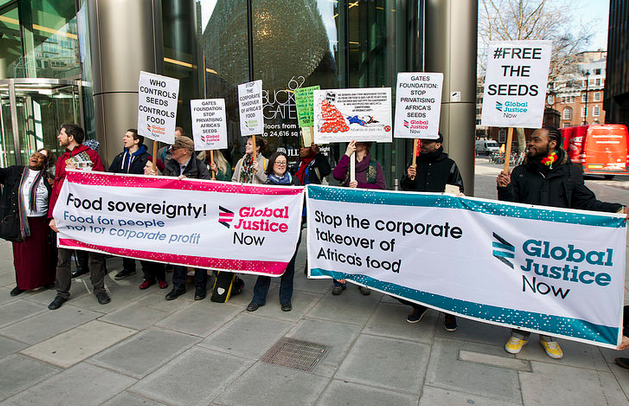
Food sovereignty activists are shining a light on a closed-door meeting between the Bill and Melinda Gates Foundation (BMGF) and the United States Agency for International Development (USAID), which are meeting in London on Monday with representatives of the biotechnology industry to discuss how to privatize the seed and agricultural markets of Africa.

Early Monday, protesters picketed outside the Gates Foundation’s London offices holding signs that called on the foundation to “free the seeds.” Some demonstrators handed out packets of open-pollinated seeds, which served as symbol of the “alternative to the corporate model promoted by USAID and BMGF.” Others smashed a piñata, which they said represented the “commercial control of seed systems;” thousands of the seeds which filled the pinata spilled across the office steps. A similar protest is expected later Monday in Seattle, Washington, where BMGF is headquartered.

The meeting was convened to discuss a report put forth by Monitor-Deloitte, which was commissioned by BMGF and USAID to develop models for the commercialization of seed production in Africa, especially “early generation seed,” and to identify ways in which the African governmental sectors could facilitate private involvement in African seed systems. The study was conducted in Ethiopia, Ghana, Nigeria, Tanzania and Zambia on maize, rice, sorghum, cowpea, common beans, cassava and sweet potato.

However, food sovereignty activists are sounding the alarm over the secret meeting. Heidi Chow, food sovereignty campaigner with Global Justice Now, which organized Monday’s protest, warned that the agenda being promoted by these stakeholders will only increase corporate control over seeds.

“This is not ‘aid’ – it’s another form of colonialism,” said Chow. “We need to ensure that the control of seeds and other agricultural resources stay firmly in the hands of small farmers who feed the majority of the population in Africa, rather than allowing big agribusiness to dominate even more aspects of the food system.”

In a blog post, Chow further explained:

For generations, small farmers have been able to save and swap seeds. This vital practice enables farmers to keep a wide range of seeds which helps maintain biodiversity and helps them to adapt to climate change and protect from plant disease. However, this system of seed saving is under threat by corporations who want to take more control over seeds. Big seed companies are keen to grow their market share of commercial seeds in Africa and alongside philanthropic organizations like the Gates Foundation and aid donors, they are discussing new ways to increase their market penetration of commercial seeds and displacing farmers own seed systems.

Corporate-produced hybrid seeds often produce higher yields when first planted, but the second generation seeds will produce low yields and unpredictable crop traits, making them unsuitable for saving and storing. This means that instead of saving seeds from their own crops, farmers who use hybrid seeds become completely dependent on the seed companies that sell them.

Further, many of the seeds produced by these biotechnology giants are sold alongside chemical fertilizer and pesticides, manufactured by the very same companies, the use of which often leads to widespread environmental destruction and other health problems.

As others noted, while the meeting attendees included representatives from the World Bank and Syngenta, the world’s third biggest seed and biotechnology company, no farmers or farming organizations were represented at the talks.

“Seeds are vital for our food system and our small farmers have always been able to save and swap seeds freely,” Ali-Masmadi Jehu-Appiah, chair of Food Sovereignty Ghana, said in a press statement. “Now our seed systems are increasingly under threat by corporations who are looking to take more control over seeds in their pursuit of profit. This meeting will push this corporate agenda to hand more control away from our small farmers and into the hands of big seed companies.”

Reporting on the Monitor-Deloitte study, Ian Fitzpatrick, a food sovereignty researcher for Global Justice Now, said that documents circulated ahead of the meeting revealed a neo-liberal agenda “laid bare.”

Fitzpatrick writes:

The report recommends that in countries where demand for patented seeds is weaker (i.e. where farmers are using their own seed saving networks), public-private partnerships should be developed so that private companies are protected from ‘investment risk’. It also recommends that that NGOs and aid donors should encourage governments to introduce intellectual property rights for seed breeders and help to persuade farmers to buy commercial, patented seeds rather than relying on their own traditional varieties.

Finally, in line with the broader neoliberal agenda of agribusiness companies across the world, the report suggests that governments should remove regulations (like export restrictions) so that the seed sector is opened up to the global market.

“This neoliberal agenda of deregulation and privatization, currently promoted in almost every sphere of human activity—from food production to health and education—poses a serious threat to food sovereignty and the ability of food producers and consumers to define their own food systems and policies,” Fitzpatrick adds.

AGRA Watch, a program of the grassroots group Community Alliance for Global Justice, notes that the BMGF-USAID commercial seed agenda further “extends U.S. foreign policy into Africa on behalf of corporate interests.”

Phil Bereano, food sovereignty campaigner with AGRA Watch and an Emeritus Professor at the University of Washington added: “This is an extension of what the Gates Foundation has been doing for several years—working with the US government and agribusiness giants like Monsanto to corporatize Africa’s genetic riches for the benefit of outsiders. Don’t Bill and Melinda realize that such colonialism is no longer in fashion? It’s time to support African farmers’ self-determination.”

Against All Bosses: Government AND Corporate

bill-lumbergh-office-space-boss

By Kevin Carson

Source: Center for a Stateless Society

I keep resolving not to comment on any more of Alternet‘s by-the-numbers anti-libertarian puff pieces, but a recent one from David Masciotra (“You’re Not the Boss of Me: Why Libertarianism is a Childish Sham,” February 26) is in its own category of wretchedness.

Masciotra’s commentary includes two seemingly contradictory lines of argument. In the first, he dismisses anti-authoritarianism, as such, as the ethos of a spoiled toddler:

the protest of children who scream through tears, “You’re not the boss of me.” The rejection of all rules and regulations, and the belief that everyone should have the ability to do whatever they want, is not rebellion or dissent. It is infantile naïveté.

He associates this infantile rejection of all authority with selfishness and anti-sociality. In fact it “does not even rise to the most elementary level of politics,” which Aristotle defined as “the things concerning the polis,” or the community. Confucius associated politics with an ethics of “communal service with a moral system based on empathy.” This, in contrast to libertarianism, which “eliminates empathy, and denies the collective,” and opposes “any concept of the common good” or organizing communities “in the interest of solidarity.”

And of course because this is an Alternet attack on libertarianism, he can’t get through it without mentioning Ayn Rand — “the rebel queen of their icy kingdom.” Oddly enough, he didn’t manage to drag in the Koch brothers.

Just in passing, it’s a bit odd that none of Alternet‘s stable of center-left critics of libertarianism seem to have any idea that the movement might have ideological roots older than last Tuesday. American libertarianism as an organized political movement — the movement that later gave birth to the Libertarian Party — has its origins more or less in the radicals who dropped out of Young Americans for Freedom in 1968. But radical free market thought didn’t start with them, or with Ayn Rand, or even with Ludwig von Mises. It goes back to the classical liberalism of two hundred and more years ago.

And classical liberalism was a very diverse and varied movement, including some quite left-leaning strands, who considered themselves socialists as well as free market libertarians. This shouldn’t be surprising, given that the origins of classical liberalism, socialism and anarchism are so closely intertwined in the culture of the Enlightenment, and overlapped so heavily in their formative period of the 1820s through 1840s.

Two of my strongest ideological influences were the free market libertarians Thomas Hodgskin in England and Benjamin Tucker in the U.S., both of whom were socialists and saw the state’s primary role as intervening in the market on behalf of landlords and capitalists to enforce rents on the artificial scarcity of land and capital. And left-wing strands (like the thought of Henry George) persisted in American classical liberalism afterwards, and have continued to exist even in the modern libertarian movement.

Although contemporary American libertarianism is generally right-leaning and much of it is corporate-influenced, it still contains leftward-oriented strands — many of them quite anti-corporate, or (like me) even anti-capitalist. At his most left-friendly phase in the late ’60s, for example, prominent libertarian Murray Rothbard collaborated with New Left scholars like Ronald Radosh and the Studies on the Left group. During this period Rothbard described the main function of “our corporate state” as subsidizing the operating costs of big business and the accumulation of capital.

After all this, though, Masciotra dismisses libertarians as not being rebellious enough. Their rebellion disguises “their subservience to — for all their protests against the ‘political elite’ — the real elite.”

Who then are the libertarians rebelling against? The most powerful sector of the society is corporate America, and it profits and benefits most from the deregulatory and anti-tax measures libertarians champion. That sector of society also happens to own the federal government. Through large campaign donations and aggressive lobbying — the very corruption that libertarians help enable by defending Citizens United and opposing campaign finance reform — they have institutionalized bribery, transforming the legislative process into an auction. Libertarians proclaim an anti-government position, but they are only opposing the last measures of protection that remain in place to prevent the government from full mutation into an aristocracy.

Masciotra might be surprised to know I actually agree with most of this, and I’m a libertarian. My understanding of government as something that serves the interest of propertied classes, protects big business from competition, and funnels rents on artificial scarcity and artificial property upward from the producing classes to the plutocracy is one of the reasons I became a libertarian and an anarchist.

And one of the primary targets of my writing has been the right-leaning sort of libertarian who ignores the extent to which Corporate America owns the federal government. These people pass over the primary function of government — intervening in the market to facilitate rent extraction by the propertied ruling classes — and focus entirely on eliminating the secondary functions like partially restricting abuses of those ruling classes’ power and stabilizing the worst side-effects of corporate power.

My hatred of bosses is at the root of my identification, not only as a libertarian — but as a Leftist. My instinctive affinity for the “you’re not the boss of me” sentiment, which Masciotra dismisses contemptuously, is the reason I so strongly support labor struggle and radical unions like the I.W.W.

I believe that institutional hierarchies of all kinds are bad — corporate, government, university, etc. — because they suppress the free flow of information and feedback that those in authority don’t want to hear. They create conflicts of interest in which those at the top appropriate the gains from contributions to productivity from those below, and shift costs and blame downward — basically kind of stuff anyone who’s worked under a boss, or reads Dilbert, knows instinctively.

And my belief in free markets doesn’t mean that I lionize “rugged individualism,” or believe that the cash nexus should dominate most aspects of social life. It just means I don’t think the state should interfere with voluntary exchange where it exists. In fact I strongly support a solidaritarian society build on the kinds of self-organized working class institutions for mutual aid that Pyotr Kropotkin and E.P. Thompson described in their writing. I’m strongly influenced by Elinor Ostrom’s views on the governance of common pool resources. And I think that most economic activity in a free society would take place through forms of voluntary interaction other than money exchange — the social and gift economy and commons-based peer production, among them.

If Masciotra took a break from constructing his libertarian strawmen for a minute and checked out the diverse array of real people within our movement, he might find he actually has stuff in common with some of us.


Colluders in Crude: The Oily Politics of How the Obama Administration Sided with BP Over the American People

gulf-oil-spill17

By Stuart H. Smith

Source: WhoWhatWhy

The explosion and sinking of the Deepwater Horizon oil rig on April 21, 2010,  was the largest accidental marine oil spill in the history of the petroleum industry. The resulting devastation to human health and the environment continues to this day. A new Florida State University study, published on Jan. 20 in the journal Environmental Science & Technology, reports that up to 10 million gallons of crude oil “missing” from the spill settled at the bottom of the Gulf of Mexico, imperiling wildlife and marine ecosystems.

Stuart H. Smith, an environmental plaintiff attorney who served as lead counsel on more than 100 oil pollution cases and has won major litigation against oil giants Chevron and ExxonMobil, came to represent thousands of claimants against BP. He saw from the inside how BP and the American government really responded to the crisis. This article is adapted from his book, Crude Justice: How I Fought Big Oil and Won, and What You Should Know about the New Environmental Attack on America (BenBella Books, 2015). 

I am a first-hand witness to the Obama administration’s complicity in putting the interests of a foreign company above and beyond the health and safety of American workers.

The tragedy began on April 21, 2010, with the explosion and fire on British Petroleum’s Deepwater Horizon oil rig in the Gulf of Mexico off the Louisiana coast. It killed 11 workers and caused a leak that would ultimately spew nearly five million barrels of oil into the Gulf.

Denying Workers Protective Gear

BP hired workers to clean up the spill, but no one was publicly addressing what the prolonged exposure to oil—which is laden with carcinogens such as benzene—might do to them. There was little talk about the threat of volatile organic compounds (VOCs) in the air along the Gulf Coast, even for workers traveling to the edge of the spill in boats and removing oil from the beaches. Cleanup crews were attaching oil-catching booms to their shrimp boats and driving their boats directly through the oil slicks to corral and collect the oil spilling from BP’s broken well—and largely tackling their jobs without serious protective gear, because BP had not supplied it.

“BP knew that providing protective equipment would be an admission that the oil exposure was dangerous and sought to avoid that at all costs,” says Marylee Orr, the founder and longtime executive director of the Louisiana Environmental Action Network (LEAN), a leading environmental group in the state.

It wasn’t long before the fishermen began reporting headaches, vomiting, nausea, dizziness, and chest pains.

In early June, two key Democratic members of Congress—Minnesota Representative James Oberstar, then-chairman of the House Transportation and Infrastructure Committee, and New York Representative Jerrold Nadler, a senior committee member—sent a letter to the EPA and the Department of Labor demanding that Gulf workers be provided with “proper protective equipment, including respirators.”

Incredibly, the Obama administration said “no.”

David Michaels, assistant secretary in the Labor Department, who oversaw the Occupational Safety and Health Administration, told the Wall Street Journal that their tests showed “minimal” risk from exposure to airborne toxins—despite the fact that EPA’s air monitors along the Gulf Coast were picking up substantial airborne VOC readings from the spill, and despite scores of alarming medical reports from cleanup workers.

Protecting BP Stockholders

Around the same time, President Barack Obama was on the phone to the British prime minister. David Cameron was in a tizzy because so many English pensioners had their retirement money tied up in BP stock.

“The president made clear that he had no interest in undermining BP’s value,” Cameron’s office announced after the phone call.

Indeed, on June 16, 2010—one month before the leaking well had been capped and the full extent of the damage could be investigated—the White House announced an unprecedented deal with BP in which the oil company would finance a relief fund of up to $20 billion.

This escrow fund was good politics—$20 billion sounded impressive to the average voter—but would prove to be music to the ears of BP’s board. Historically, such escrow funds had been effective means for companies to limit their liability. They were tools for persuading vulnerable people in desperate need to sign away their legal rights to recover full compensation for the damages they’d suffered.

Sure enough, just before Christmas 2010, Kenneth Feinberg, who’d been appointed to oversee the fund, made a blatant attempt to boost the number of cases the fund could say were “settled” by offering the spill’s victims one-time bonus payments of $5,000 for individuals and $25,000 for businesses, contingent upon his settlement terms.

In fact, the $20 billion fund had set a preliminary target for damage claims that would turn out to be tens of billions of dollars less than the actual damages. Moreover, the agreement allowed BP to secure the fund using future productions from its leases in the Gulf of Mexico as collateral, exempting all of BP’s holdings elsewhere.  This locked the federal government into a partnership with BP, forcing it to continue to allow its offshore drilling in the Gulf to pay back the claims.

Hiding the Oil, Spreading the Toxins

In the early days of the spill, BP began unleashing gallons of a toxic chemical called Corexit.  Corexit was able to get rid of the thick black oily plumes on the water’s surface that had been visible for miles across the Gulf and were becoming such a public relations disaster on the nightly TV news.

But Corexit wasn’t solving the oil problem, only the PR problem.  Corexit was merely hiding the oil and spreading toxins over a larger area. This created even greater risks for the cleanup workers—risks they had not been trained to deal with.

Weeks after the spill, LEAN’s Marylee Orr pressed for admission to the main command centers, to which her NGO was supposed to have access. Eventually she and other Gulf environmental activists got a private meeting with a top federal official—EPA administrator and Louisiana native Lisa Jackson. They argued that the feds needed to force BP to stop spraying Corexit in the Gulf and produced evidence that Corexit was merely masking the oil and dispersing toxins over a bigger area.

(Hugh Kaufman, longtime EPA employee and whistleblower, said government officials were well aware of the hazards of Corexit, telling an interviewer that “in the Exxon Valdez case, people who worked with dispersants, most of them are dead now.  The average death age is around 50.”)

At first it seemed like Jackson was listening to their plea. A short time later, in late May, the EPA and the Coast Guard issued a joint order to BP telling the company to “eliminate” surface spraying of Corexit—unless the firm got a waiver from the Coast Guard because of exceptional circumstances.

You can guess how that all played out. BP asked for and routinely got a waiver from the Coast Guard to spray Corexit—day after day, including nine days in a row immediately after Lisa Jackson’s “order,” and ultimately 74 times over 54 days. An estimated million gallons of the toxic dispersant were deployed in the Gulf after the government’s supposed command to eliminate much of its use.

Later, independent laboratory tests performed for me confirmed what the experts had feared about the Corexit spraying: dispersing the oil actually meant taking the toxic elements of the oil from the surface, where they were highly concentrated but weren’t harming marine life below, and spreading them deep into Gulf waters.  Our lab tests showed toxic pollution of water at levels 35 times higher than before the oil was dispersed.

Claiming “Gulf Seafood Is Safe”

Early on, the federal government’s public relations initiative was in full gear. On June 14—54 days into the crisis of the oil spill—President Obama came down to the Florida Panhandle and decreed that he was launching “a comprehensive, coordinated, and multiagency initiative” to make sure the catch from the Gulf waters was safe to eat.  “Now,” he said into the bank of cameras, “I had some of that seafood for lunch, and it was delicious….So let me be clear. Seafood from the Gulf today is safe to eat.  But we need to make sure that it stays that way.”

In essence, Obama was telling Americans to eat first and ask questions later.  But how could the president assure the public that seafood was safe to eat when, as he acknowledged, in-depth testing hadn’t yet even been carried out?”

At the Pentagon, a massive order for shrimp, crab cakes, and pre-packaged jambalaya was placed and sold at base commissaries around the world.  The executive chef at the White House bought and served more than 2,000 pounds of shrimp and other Gulf goodies at an array of holiday parties for Barack and Michelle Obama and their guests, commenting: “We at the White House are so happy to play our part in reminding Americans that Gulf seafood is not only safe but delicious.”

Around the Gulf, news accounts quoted fishermen who were reeling in red snapper with sores and lesions—some the size of a 50 cent piece—the likes of which they had never seen before.  Crab fishermen were reporting that their hauls had dropped by 70% and that the few crabs they did pull up suffered similar lesions and disease.  It made sense. Red snapper were bottom feeders—eating the shrimp and crabs that live on the sea floor—and independent scientists had already shown that oil from the leaking BP rig was coating the bottom of the Gulf.

Practicing Faulty and Deceptive Testing

In late 2010, the government stated that it had tested more than 10,000 seafood samples from the Gulf and found no evidence of problems. But the vast majority of those tests were what the National Oceanic and Atmospheric Administration called “sensory testing,” and what you and I might call a smell test. This test was hardly adequate for finding traces of hydrocarbons that are odorless, yet highly toxic.

Moreover, in conducting the smell tests, specimens that were clearly oiled in the spill or possibly diseased were tossed aside, skewing the lab results. When the seafood that would have produced the worst numbers was transferred to trash buckets, the polynuclear aromatic hydrocarbon numbers looked a lot better.

In addition, according to the government testing structure, the “safe” consumption level for a grown man is four shrimp a week.  Who the hell living on the Gulf of Mexico eats only four shrimp per week?

Conducting his own test analysis, Paul Orr, Marylee’s son and the unofficial river keeper for the lower Mississippi, gathered samples of shrimp, crab, and finfish from 20 different locations in the Gulf off the Louisiana and Mississippi coastlines. His results showed high levels of total petroleum hydrocarbons, including in seafood from areas that had been declared safe for fishing. Testing by other independent environmentalists showed high levels of cadmium, a long-lasting carcinogen.

Alleging “Swimming Is Safe”

The seafood shilling was just the beginning.

The government also issued reports that beaches were safe for swimming. President Obama dramatized this, allowing a photo of him swimming with his daughter—in an unimpacted bay, of course—along the Florida Panhandle coast.

The passage of time did not diminish the assault on the beaches.  Tropical Storm Lee washed tar balls and patches of asphalt-like gunk up and down the Gulf in 2011, as did Hurricane Isaac in the summer of 2012.  In 2013, more than three years after the BP catastrophe, a blob of oil from the Macondo field that was roughly half the size of a football field came ashore in Grand Terre Island off the coast of Louisiana.

Attempting to Bar Independent Testing

The U.S. government seemed to have two agendas—both of them bad.  One was siding with large commercial fishing operations in the Gulf, whose livelihood depended on public confidence in the safety of their catch, and not with the broader U.S. public of seafood consumers.  The other was to get the PR nightmare of BP out of the headlines.

Almost immediately after the spill, the FAA implemented a temporary flight restriction across the entire eastern Gulf of Mexico that continued for months.  They refused to let the media get anywhere close to the offshore slicks. The Coast Guard turned the entire zone over to private security goons hired by BP who would not let anyone near the spill to photograph and take samples. BP’s guards blocked many of the roads leading to oil-gunked beaches. Never before had America ceded its sovereign police power to a corporation, and a foreign one at that.

Key governmental agencies involved in the Gulf Coast recovery seemed to be working harder to prevent independent scientists from doing their own testing than they were in conducting their own rigorous studies.

As a Big Oil litigator, I knew that the fastest way to lose an environmental law case was to rely on industry or government data, which rarely painted the full picture. It was critical to perform your own testing using your own experts.  I’d never had an environmental case where the government was on the side of the victim.

***

To prove toxic exposure and resulting damages in the BP disaster, I hired Dr. William Sawyer, a top Florida-based research toxicologist with 30 years of experience, and Worcester Polytechnic civil engineer Marco Kaltofen, considered one of the top engineers in the field, who described himself as “specializing in when things go really bad.”

Marco and William decided that the best approach to overcoming the restricted access was simply to look and act like they belonged.  “We dressed the way the BP guys dressed,” Marco told me later.   “We had the story, we had the business cards and lab notebook and all the equipment.  And you just go out there and you mix it up.”

Soon the BP cleanup contractors were giving Marco and his coworker access to their refreshment tent.

“I got a Louisiana oysterman’s license,” Marco said. “I would get out to these sites and they would say, ‘I’m sorry—you can’t be collecting specimens out here.’  I’d say, ‘I got a Louisiana scientific collection permit,’ and I would get BP escorts when I produced this document.  It looked really official—it said I could collect oysters around this area….It had dates, stamps….”

From that, Marco collected a treasure trove of shellfish and marine life, as well as water, sand, and spilled oil.

Marco and William’s initial data showed alarming levels of toxic hydrocarbons, first in the Gulf water columns, and then in seafood. Even before they issued a formal report, they posted some of their raw data on the Internet.

That’s when they started receiving phone calls from staffers on the president’s commission investigating the oil spill.

“There was a grave concern as to why we were finding contamination,” William recalled, “and then the questions were geared toward whether we had sampling permits.”

Instead of expressing concern about the danger that might be posed to American consumers from eating oil-contaminated seafood, federal investigators were questioning whether Marco and William had permits to collect the samples.

It was only after a TV news crew investigated the calls and a New Orleans-area congressman called for a full-blown investigation that the Oil Spill Commission pulled a 180-degree turn.  One staffer even tried to explain that the calls to Marco and his associate had gone out because the commission had been impressed with their work.

Much later, our team learned about some of the intense pressure that was taking place behind the scenes.  At the same time that we were pressing for a more open investigation of environmental impact, in-fighting was ensuing between other independent scientists, who were finding equally troubling data, and government officials, who were finding ways to cover up the discoveries. The Reuters news agency learned that wildlife biologists who’d been hired by the National Marine Fisheries Service to document an “unusual marine event”—the dramatic rise in dolphin deaths—were told they couldn’t make their findings known because it was part of a law enforcement probe into the BP spill.

Denying Evidence

Mounting evidence revealed that oil-spill cleanup workers and other Gulf residents were suffering respiratory illnesses, skin rashes, and other more serious maladies.  But federal authorities insisted that the rise in such ailments was merely a coincidence. Donald Boesch, a member of Obama’s Oil Spill Commission, summed up their response: “We were charged with being evidence-driven, and the fact is, we’ve asked for and sought out evidence that the oil spill is the proximate cause of these health problems, and we just haven’t found it.”

But all Boesch had to do was walk into any of the doctors’ crowded waiting rooms and health clinics scattered across the Gulf region.

Dr. Michael Robichaux of Mathews, Louisiana, on the Gulf Coast, was among those examining the ailing cleanup workers and other coastal residents. At first the doctor was dubious that the ailments were linked to the workers’ and residents’ exposure to BP’s oil and Corexit. But after he began treating them, he converted and became an evangelist for their cause.  Of the 113 patients he treated who had been exposed to toxic pollution, he wrote that about 100 of them had severe chronic health effects, to the point that many were unable to work. “It appears that the interests of a large, foreign corporation have superseded the needs of thousands of Americans who reside along the coast of the Gulf of Mexico,” Dr. Robichaux told U.S. District Judge Carl Barbier.

Settlement Deals

In May 2012, BP announced that it had reached a settlement deal—estimated at the time to be worth $7.8 billion—with a circle of well-connected tort lawyers called the Plaintiffs Steering Committee on behalf of the Gulf Coast residents and small businesses.  Joining a handful of other lawyers, I appeared before Judge Barbier that September to object to the proposed deal.  How, we asked, could a proper price be fixed on the damage caused by BP when new oil kept coming ashore, as had happened when Hurricane Isaac hit the Gulf Coast just days before the courtroom arguments?  We also argued that the deal was woefully inadequate, both for those who had been made ill and for many coastal businesses.

We didn’t win that skirmish, but other penalties for the British oil giant are finally adding up. In early 2015, a federal judge was nearing a final ruling on civil penalties against BP under the federal Clean Water Act, which could reach some $13.7 billion.

To date, my firm has successfully handled claims against BP for about three quarters of our thousands of clients.  Hundreds of them remain, fighting for their fair share.

The extreme efforts of a Big Oil giant to avoid liability for its actions have been sadly familiar to me.  But the actions of the U.S. government to side with a huge multinational corporation against the health and safety of American workers are unconscionable.

Adapted from CRUDE JUSTICE:  How I Fought Big Oil and Won, And What You Should Know About the New Environmental Attack on America by Stuart H. Smith (BenBella Books, 2015).