Here’s Why Hillary Won’t Allow Her Corporate Speeches to be Published

UTI1781548_r900x493

By Eric Zuesse

Source: RINF

In a previous report, I indicated “Why Hillary Clinton’s Paid Speeches Are Relevant”, but not what they contained. The present report indicates what they contained. 

One speech in particular will be cited and quoted from as an example here, to show the type of thing that all of her corporate speeches contained, which she doesn’t want the general public to know about. 

This is the day’s keynote speech, which she gave on Wednesday, 25 June 2014, to the Biotechnology Industry Organization, a lobbying organization in DC, at their annual convention, which in 2014 was held in San Diego. The announcement for attendees said: “Wednesday’s Keynote session is sponsored by Genentech, and is open to Convention registrants with Convention Access and Convention Access & Partnering badges only. Seating is limited.” Somehow, a reporter from a local newspaper, the Times of San Diego, managed to get in. Also, somehow, an attendee happened to phone-video the 50-minute interview that the BIO’s CEO did of Clinton, which took place during the hour-and-a-half period, 12-1:30, which was allotted to Clinton.

The Times of San Diego headlined that day, “Hillary Clinton Cheers Biotechers, Backing GMOs and Federal Help”, and gave an excellent summary of her statements, including of the interview. Here are highlights:

It was red meat for the biotech base. Hillary Rodham Clinton, in a 65-minute appearance at the BIO International Convention on Wednesday, voiced support for genetically modified organisms and possible federal subsidies. … 

“Maybe there’s a way of getting a representative group of actors at the table” to discuss how the federal government could help biotechs with “insurance against risk,” she said.

Without such subsidies, she said, “this is going to be an increasing challenge.” …

She said the debate about GMOs might be turned toward the biotech side if the benefits were better explained, noting that the “Frankensteinish” depictions could be fought with more positive spin.

“I stand in favor of using seeds and products that have a proven track record,” she said [at 29:00 in the video next posted here], citing drought-resistant seeds she backed as secretary of state. “There’s a big gap between the facts and what the perceptions are.” [that too at 29:00] …

Minutes earlier, Gov. Jerry Brown made a rousing 3-minute pitch for companies to see California as biotech-friendly.

“You’ve come to the right place.” …

Brown had some competition for biotech boosterism in the form of Virginia Gov. Terry McAuliffe, the longtime Clinton ally who pitched his own state as best for biotech. …

[Clinton was] Given a standing ovation at the start and end of her appearance.

In other words: As President, she would aim to sign into law a program to provide subsidies from U.S. taxpayers to Monsanto and other biotech firms, to assist their PR and lobbying organizations to eliminate what she says is “a big gap between the facts and what the perceptions are” concerning genetically modified seeds and other GMOs. In other words: she ignores the evidence that started to be published in scientific journals in 2012 showing that Monsanto and other GMO firms were selectively publishing studies that alleged to show their products to be safe, while selectively blocking publication of studies that — on the basis of better methodology — showed them to be unsafe. She wants U.S. taxpayers to assist GMO firms in their propaganda that’s based on their own flawed published studies, financed by the GMO industry, and that ignores the studies that they refuse to have published. She wants America’s consumers to help to finance their own being poisoning by lying companies, who rake in profits from poisoning them.

Her argument on this, at 27:00 to 30:00 in the video of the 50-minute interview of Clinton, starts by her citing the actual disinformation (that’s propagandized by the fossil-fuels industries, which actually back her Presidential campaign) that causes the American public to reject the view that humans have caused global warming. At 27:38 in the video, she said “98% of scientists in the world agree that man has caused the problem” of global warming, and she alleged that the reason why there is substantial public resistance to GMOs is the same as the reason why there’s substantial public resistance to the reality that global warming exists and must be actively addressed: Americans don’t know the science of the matter. She received several applauses from this pro-GMO audience, for making that false analogy. The reality, that it’s false, is that on 15 May 2013, the definitive meta-study, which examined the 11,944 published studies that had been done relating to the question of global warming and its causes, reported that “97.1% endorsed the consensus position that humans are causing global warming.” The meta-study was titled “Quantifying the consensus on anthropogenic global warming in the scientific literature”. So, Clinton’s statement “98%” was only 0.9% off regarding the size of the scientific consensus. However, her implication that the public’s rejection of that actual 97.1% of experts’ findings on global warming, is at all analogous to the public’s rejection of the actually bogus finding by GMO industry ‘experts’ that GMOs are safe, is pure deception by her. The reality is the exact contrary: The fossil-fuels industries have financed the propaganda ‘discrediting’ the scientists’ consensus about global warming, much like the GMO industries have financed the deception of the public to think that ‘scientists’ ‘find’ that GMOs are safe. In fact, as was reported in Scientific American, on 23 December 2013, “’Dark Money’ Funds Climate Change Denial Effort”, and the study they were summarizing, from the journal Climate Change, was titled “Institutionalizing delay: foundation funding and the creation of U.S. climate change counter-movement organizations”. It found that:

“From 2003 to 2007, the Koch Affiliated Foundations and the ExxonMobil Foundation were heavily involved in funding CCCM [climate change counter-movement] organizations. But since 2008, they are no longer making publicly traceable contributions to CCCM organizations. Instead, funding has shifted to pass through [two] untraceable sources [both of which had been set up by the Kochs: Donors Trust, and Donors Capital Fund].

On 23 April 2016, Politico headlined “Charles Koch: ‘It’s possible’ Clinton is preferable to a Republican for president”, but this isn’t the only indication that Hillary is merely pretending to be their enemy. On 24 February 2016, I headlined “Hillary Clinton’s Global-Burning Record” and summarized and linked to news reports such as the opening there: “On 17 July 2015, Paul Blumenthal and Kate Sheppard at Huffington Post bannered, ‘Hillary Clinton’s Biggest Campaign Bundlers Are Fossil Fuel Lobbyists’ and the sub-head was ‘Clinton’s top campaign financiers are linked to Big Oil, natural gas and the Keystone pipeline.’”

In other words: the same pro-GMO lobbyists who applaud Hillary for verbally endorsing the science that affirms global warming, applaud her for endorsing their own fake ‘science’ which asserts that GMOs have been proven safe. They just love her lie, which analogizes them to the authentic scientists who (97.1%) say that global warming exists and is caused by humans’ emissions of global-warming gases.

Also, she expressed the wish that: “the federal government could help biotechs with ‘insurance against risk,’ she said. Without such subsidies, she said, this is going to be an increasing challenge,” because otherwise, biotech companies might get bankrupted by lawsuits from consumers who might have become poisoned by their products. She wants the consuming public to bear the risk from those products — not the manufacturers of them to bear any of the risks that could result from those manufacturers’ rigged ‘safety’ ‘studies’ (a.k.a.: their propaganda).

In other words: the reason why Hillary Clinton won’t allow her 91 corporate speeches, for which she was paid $21,667,000, to be published, is the lying political cravenness of her pandering to those corporations there. Each group of lobbyists is happy to applaud her lying, regardless of whether her lies include insults against another group of lobbyists, to whom she might be delivering similar lies to butter them up at a different annual convention or etc.

In other words: she’s telling all of them collectively: You’re my type of people, and the public who despise you are merely misguided, but as President I’ll set them straight and they’ll even end up paying part of the bill to be ‘educated’ about these matters, by my Administration, and even part of the bill to pay corporations’ product-liability suits.

The reason why Clinton doesn’t want those speeches to be made public is that she doesn’t want the voters to know that she intends to use their money to propagandize to them for the benefit of those corporations, and also to protect those corporations from liability for harms their products cause the public.

This is called (by the propagandists) ‘capitalism’ and ‘democracy’. Mussolini, with pride, called it sometimes “fascism,” and sometimes “corporationism.” But whatever it’s called, it’s what she supports, and what she represents, to the people who are paying her. And even most of her own voters would find it repulsive, if they knew about it. So: she can’t let them know about it. And she doesn’t.

Did the Clinton Foundation Steal from the Poor?

clinton-foundation

By Dady Chery

Source: News Junkie Post

Introduction

The Clintons have many problems these days, but the worst of them is probably the information that Charles Ortel started to release from his website and Twitter account (@charlesortel) in early May 2016. Ortel is the financial analyst who exposed General Electric’s stock as being overvalued before it took a dive in 2008. After 15 months’ examination of the public records of the Clinton Foundation entities, he finds that huge sums of money cannot be accounted for, and he believes that it is a family affair for Bill, Hillary and Chelsea Clinton to harm the victims of disasters and the desperately poor throughout the planet. Educated and privileged people like the Clintons should know better, yet they preen, even now, believing we will fall for the hype manufactured by their handlers. The true, damning facts, however, are out there for each of us to see. There is a special revulsion against charity fraud that we did not cover in an earlier interview. We discuss this with Charles Ortel.

Dady Chery: For you, this is a moral issue.

Charles Ortel: It is reprehensible to operate a supposed charity in gross violation of applicable laws and simultaneously seek adulation and the highest political office in the most powerful nation on earth. Such conduct needs to be fully exposed and then punished to set an example.

Charity, the notion of actually helping less fortunate and deserving souls, is an ancient practice prevalent in most cultures. In the United States, it happens that the poorest among us are also the most generous, if you measure their annual donations relative to their annual incomes. Much great work is done by the charitable sector and this important, generally selfless conduct, should be encouraged and admired.

That said, to corrupt a presidential charity under the glare of the publicity that surrounds celebrity followers of the Clinton Foundation is gross, indefensible conduct by educated persons who seem to have no moral compass and no shame.

DC: In your discussions of the Clinton Foundation on your website and elsewhere, Charles, you often bring up the absence of tax audits by the Clinton entities. What is the problem there?

CO: By audits, I mean detailed income statements, balance sheets, cash-flow statements, and footnotes that are double-checked, that is “audited,” by competent, informed and licensed accounting firms. Accounting firms understand the numerous detailed requirements that must be followed as these audits are completed. Furthermore, the management and trustees of large entities, like those of the Clintons, are required to certify that the information contained in these audits is true, accurate, and complete. This is different from the process by which the IRS might decide to audit a given tax return. All financial information provided to the IRS by charities whose revenues are above a low threshold must procure financial statements and supporting information that are audited and must make this work available to taxing authorities and to the general public.

The Clinton entities have repeatedly failed to get their financial statements properly audited. This is an ongoing abuse. I believe they got away with this probably because Lois Lerner was a key person in the IRS who oversaw tax-exempt charities, including the Clinton entities, from 2001 through 2013. She left her post in disgrace. She is alleged to have used the IRS to target conservative and Tea Party groups, and she might also have used her influence with regulators not to target charities of politically allies.

DC: A lot of funds were collected by Clinton entities for recovery from natural disasters.

CO: Shortly after leaving the White House in January 2001, Bill Clinton teamed with Rajat Gupta, then managing partner of consulting giant McKinsey, and since convicted of criminal misconduct, to, in theory, aid victims of an earthquake that struck on January 26, 2001 in Gujarat, India. Records available in the public domain for this charity, American India Foundation, show clearly that it was organized on the basis of a false and materially misleading application to the IRS, that it failed to provide compliant financial audits, and that it failed to make complete, truthful and regular filings in numerous US states where it continues to solicit donations using the mails, telephones, and digital media, in stark violation of applicable laws. Bill Clinton has served as Honorary Chairman for this entity since inception, a fact that is used prominently in fundraising campaigns. Nevertheless, his role with this illegally operated charity is not disclosed in Clinton Foundation filings with state, federal and foreign authorities.

Starting in January 2001, Bill Clinton became involved in international activities that he pursued invoking the name of the Clinton Foundation; these included disaster relief in India and fighting HIV/AIDS in many nations, including in Haiti starting in 2003. None of these international activities were validly authorized in advance by the IRS, US state governments, or foreign governments, as is legally required. Especially in the early period, Bill Clinton and the Clinton Foundation did not have adequate and sufficiently trained staff to exercise tight and effective controls over these international activities. As a result, it appears that substandard and even adulterated drugs manufactured by an Indian supplier then called Ranbaxy may have been distributed in numerous countries under the auspices of the Clinton Foundation.

Later, Bill Clinton became involved with George H. W. Bush, starting in 2005, in fundraising efforts to, in theory, aid victims of the Tsunami that devastated many Asian nations in the December 2004. Fundraising efforts in this case were also not documented properly or organized in full compliance with applicable state, federal, and foreign laws.

Beginning in August 2005, former presidents Clinton and George H.W. Bush mounted additional illegal and improperly organized efforts to, in theory, aid victims of Hurricane Katrina. Defective forms and filings related to this effort are available, following persistent digging, but omitted from the Clinton Foundation website, though some of the purported financial effects and other supposed accomplishments are covered in various materials found there, including press releases, annual reports and tax filings, that are riddled with accounting errors for 2005, in particular.

DC: What do you perceive as being the most serious problem with fund collection for disaster relief?

CO: When natural disasters strike, many of us are motivated to help however we may be able to do so. As we became more connected on the internet and more comfortable sending money using internet services, larger and larger sums started flowing towards those who represented they might be capable to aid victims of natural disasters. Unfortunately, this incoming money flow, in tiny bites is a perfect opportunity for fraud. Fraudsters realize that portions of this money might be picked off operating unregistered charities with names and websites that seem legitimate. This is why the FBI warns donors to be wary when it comes to making contributions after natural disasters.

DC: I often say: “What happens in Haiti doesn’t stay in Haiti.” Given the real prospect of another Clinton presidency, should Americans worry?

CO: It is more than ironic that the United Homeless Organization, which used to have seemingly poor people at tables all over New York with glass jars to collect money, was revealed as a fraud back in November 2009.

As it happens, the Clinton family was homeless and in severe financial distress back in 1998. Since then, public reports suggest they have acquired vast wealth during a period when most in America have struggled. It seems more than fair to ask exactly how one squares reaping massive financial gains with efforts supposedly led by the Clintons to engage in “charitable” work, particularly given rampant and material defects in all public filings of Clinton-related charities from inception to date.

When the Clintons last occupied the White House they were destitute, according to published reports, and America was in a far stronger position strategically and economically, compared to other nations, than now.

Absent controls, and a US president is difficult to stop, an enriched Hillary Clinton and her extended family are likely to run roughshod over political enemies and competitors in ways that are terrifying to contemplate.

DC: Could some good come from this?

CO: It is certainly possible that Hillary Clinton may win the presidency before the whole truth becomes known regarding operation of and fundraising for the Clinton Foundation and all its related entities.

Alternatively, if the general public digs into the facts and goes to the public record, justice may be administered to all those centrally involved in perpetrating what seems to be the largest and most far-reaching charity fraud ever attempted anywhere on earth.

The downfall of Hillary Clinton and of her family  for having, in my view, illegally used a charity to derive personal financial gains might then become an example not to follow: a cautionary tale useful, in future, to constrain others from even daring to consider such pursuits.

DC: Thank you Charles.

Related Podcast:

The Opperman Report – 5/27/16

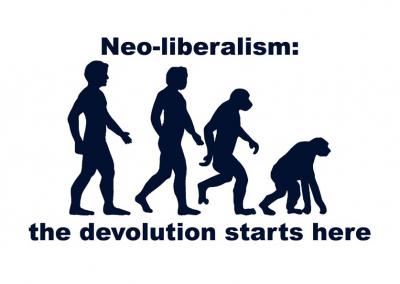
This Is Our Neoliberal Nightmare: Hillary Clinton, Donald Trump, and Why the Market and the Wealthy Win Every Time

neo_liberalism_devolution_via_permanentculturenow.com_

The rage driving our politics stems from cruelty of capitalism. So why do we vote for those who worship the market?

By Anis Shivani

Source: AlterNet

Over the last fifteen years, editors often asked me not to mention the word “neoliberalism,” because I was told readers wouldn’t comprehend the “jargon.” This has begun to change recently, as the terminology has come into wider usage, though it remains shrouded in great mystery.

People throw the term around loosely, as they do with “fascism,” with the same confounding results. Imagine living under fascism or communism, or earlier, classical liberalism, and not being allowed to acknowledge that particular frame of reference to understand economic and social issues. Imagine living under Stalin and never using the communist framework but focusing only on personality clashes between his lieutenants, or likewise for Hitler or Mussolini or Mao or Franco and their ideological systems! But this curious silence, this looking away from ideology, is exactly what has been happening for a quarter century, since neoliberalism, already under way since the early 1970s, got turbocharged by the Democratic party under the Democratic Leadership Council (DLC) and Bill Clinton. We live under an ideology that has not been widely named or defined!

Absent the neoliberal framework, we simply cannot grasp what is good or bad for citizens under Cruz versus Trump, or Clinton versus Sanders, or Clinton versus Trump, away from the distraction of personalities. To what extent does each of them agree or disagree with neoliberalism? Are there important differences? How much is Sanders a deviation? Can we still rely on conventional distinctions like liberal versus conservative, or Democrat versus Republican, to understand what is going on? How do we grasp movements like the Tea Party, Occupy, and now the Trump and Sanders insurgencies?

Neoliberalism has been more successful than most past ideologies in redefining subjectivity, in making people alter their sense of themselves, their personhood, their identities, their hopes and expectations and dreams and idealizations. Classical liberalism was successful too, for two and a half centuries, in people’s self-definition, although communism and fascism succeeded less well in realizing the “new man.”

It cannot be emphasized enough that neoliberalism is not classical liberalism, or a return to a purer version of it, as is commonly misunderstood; it is a new thing, because the market, for one thing, is not at all free and untethered and dynamic in the sense that classical liberalism idealized it. Neoliberalism presumes a strong state, working only for the benefit of the wealthy, and as such it has little pretence to neutrality and universality, unlike the classical liberal state.

I would go so far as to say that neoliberalism is the final completion of capitalism’s long-nascent project, in that the desire to transform everything—every object, every living thing, every fact on the planet—in its image had not been realized to the same extent by any preceding ideology. Neoliberalism happens to be the ideology—unlike the three major forerunners in the last 250 years—that has the fortune of coinciding with technological change on a scale that makes its complete penetration into every realm of being a possibility for the first time in human history.

From the early 1930s, when the Great Depression threatened the classical liberal consensus (the idea that markets were self-regulating, and the state should play no more than a night-watchman role), until the early 1970s, when global instability including currency chaos unraveled it, the democratic world lived under the Keynesian paradigm: markets were understood to be inherently unstable, and the interventionist hand of government, in the form of countercyclical policy, was necessary to make capitalism work, otherwise the economy had a tendency to get out of whack and crash.

It’s an interesting question if it was the stagflation of the 1970s, following the unhitching of the United States from the gold standard and the arrival of the oil embargo, that brought on the neoliberal revolution, with Milton Friedman discrediting fiscal policy and advocating a by-the-numbers monetarist policy, or if it was neoliberalism itself, in the form of Friedmanite ideas that the Nixon administration was already pursuing, that made stagflation and the end of Keynesianism inevitable.

It should be said that neoliberalism thrives on prompting crisis after crisis, and has proven more adept than previous ideologies at exploiting these crises to its benefit, which then makes the situation worse, so that each succeeding crisis only erodes the power of the working class and makes the wealthy wealthier. There is a certain self-fulfilling aura to neoliberalism, couched in the jargon of economic orthodoxy, that has remained immune from political criticism, because of the dogma that was perpetuated—by Margaret Thatcher and her acolytes—that There Is No Alternative (TINA).

Neoliberalism is excused for the crises it repeatedly brings on—one can think of a regular cycle of debt and speculation-fueled emergencies in the last forty years, such as the developing country debt overhang of the 1970s, the savings and loan crisis of the 1980s, the Asian currency crisis of the 1990s, and the subprime mortgage crisis of the 2000s—better than any ideology I know of. This is partly because its very existence as ruling ideology is not even noted by the population at large, which continues to derive some residual benefits from the welfare state inaugurated by Keynesianism but has been led to believe by neoliberal ideologues to think of their reliance on government as worthy of provoking guilt, shame, and melancholy, rather than something to which they have legitimate claim.

It is not surprising to find neoliberal multiculturalists—comfortably established in the academy—likewise demonizing, or othering, not Muslims, Mexicans, or African Americans, but working-class whites (the quintessential Trump proletariat) who have a difficult time accepting the fluidity of self-definition that goes well with neoliberalism, something that we might call the market capitalization of the self.

George W. Bush’s useful function was to introduce necessary crisis into a system that had grown too stable for its own good; he injected desirable panic, which served as fuel to the fire of the neoliberal revolution. Trump is an apostate—at least until now—in desiring chaos on terms that do not sound neoliberal, which is unacceptable; hence Jeb Bush’s characterization of him as the “candidate of chaos.” Neoliberalism loves chaos, that has been its modus operandi since the early 1970s, but only the kind of chaos it can direct and control.

To go back to origins, the Great Depression only ended conclusively with the onset of the second world war, after which Keynesianism had the upper hand for thirty-five years. But just as the global institutions of Keynesianism, specifically the IMF and the World Bank, were being founded at the New Hampshire resort of Bretton Woods in 1944, the founders of the neoliberal revolution, namely Friedrich Hayek, Ludwig von Mises, Milton Friedman, and others were forming the Mount Pelerin Society (MPS) at the eponymous Swiss resort in 1947, creating the ideology which eventually defeated Keynesianism and gained the upper hand during the 1970s.

So what exactly is neoliberalism, and how is it different from classical liberalism, whose final manifestation came under Keynesianism?

Neoliberalism believes that markets are self-sufficient unto themselves, that they do not need regulation, and that they are the best guarantors of human welfare. Everything that promotes the market, i.e., privatization, deregulation, mobility of finance and capital, abandonment of government-provided social welfare, and the reconception of human beings as human capital, needs to be encouraged, while everything that supposedly diminishes the market, i.e., government services, regulation, restrictions on finance and capital, and conceptualization of human beings in transcendent terms, is to be discouraged.

When Hillary Clinton frequently retorts—in response to demands for reregulation of finance, for instance—that we have to abide by “the rule of law,” this reflects a particular understanding of the law, the law as embodying the sense of the market, the law after it has undergone a revolution of reinterpretation in purely economic terms. In this revolution of the law persons have no status compared to corporations, nation-states are on their way out, and everything in turn dissolves before the abstraction called the market.

One way to sum up neoliberalism is to say that everything—everything—is to be made over in the image of the market, including the state, civil society, and of course human beings. Democracy becomes reinterpreted as the market, and politics succumbs to neoliberal economic theory, so we are speaking of the end of democratic politics as we have known it for two and a half centuries. As the market becomes an abstraction, so does democracy, but the real playing field is somewhere else, in the realm of actual economic exchange—which isnot, however, the market. We may say that all exchange takes place on the neoliberal surface.

Neoliberalism is often described—and this creates a lot of confusion—as “market fundamentalism,” and while this may be true for neoliberal’s self-promotion and self-presentation, i.e., the market as the ultimate and only myth, as were the gods of the past, I would argue that in neoliberalism there is no such thing as the market as we have understood it from previous ideologies.

The neoliberal state—actually, to utter the word state seems insufficient here, I would claim that a new entity is being created, which is not the state as we have known it, but an existence that incorporates potentially all the states in the world and is something that exceeds their sum—is all-powerful, it seeks to leave no space for individual self-conception in the way that classical liberalism, and even communism and fascism to some degree, were willing to allow.

There are competing understandings of neoliberal globalization, when it comes to the question of whether the state is strong or weak compared to the primary agent of globalization, i.e., the corporation, but I am taking this logic further, I am suggesting that the issue is not how strong the state is in the service of neoliberalism, but whether there is anything left over beyond the new definition of the state. Another way to say it is that the state has become the market, the market has become the state, and therefore both have ceased to exist in the form we have classically understood them.

Of course the word hasn’t gotten around to the people yet, hence all the confusion about whether Hillary Clinton is more neoliberal than Barack Obama, or whether Donald Trump will be less neoliberal than Hillary Clinton. The project of neoliberalism—i.e., the redefinition of the state, the institutions of society, and the self—has come so far along that neoliberalism is almost beyond the need of individual entities to make or break its case. Its penetration has gone too deep, and none of the democratic figureheads that come forward can fundamentally question its efficacy.

I said almost. The reason why Bernie Sanders, self-declared democratic socialist, is so threatening to neoliberalism is that he has articulated a conception of the state, civil society, and the self that is not founded in the efficacy and rationality of the market. He does not believe—unlike Hillary Clinton—that the market can tackle climate change or income inequality or unfair health and education outcomes or racial injustice, all of which Clinton propagates. Clinton’s impending “victory” (whatever machinations were involved in engineering it) will only strengthen neoliberalism, as the force that couldn’t be defeated even when the movement was as large and transcendent as Sanders’s. Although Sanders doesn’t specify “neoliberalism” as the antagonist, his entire discourse presumes it.

Likewise, while Trump supporters want to take their rebellion in a fascist direction, their discomfort with the logic of the market is as pervasive as the Sanders camp, and is an advance, I believe, over the debt and unemployment melancholy of the Tea Party, the shame that was associated with that movement’s loss of identity as bourgeois capitalists in an age of neoliberal globalization. The Trump supporters, I believe, are no longer driven by shame, as was true of the Tea Party, and as has been true of the various dissenting movements within the Republican party, evangelical or otherwise, in the recent past. Rather, they have taken the shackles off and are ready for a no-holds barred “politically incorrect” fight with all others: they want to be “winners,” even at the cost of exterminating others, and that is not the neoliberal way, which doesn’t acknowledge that there can be winners and losers in the neoliberal hyperspace.

In the current election campaign, Hillary Clinton has been the most perfect embodiment of neoliberalism among all the candidates, she is almost its all-time ideal avatar, and I believe this explains, even if not articulated this way, the widespread discomfort among the populace toward her ascendancy. People can perceive that her ideology is founded on a conception of human beings striving relentlessly to become human capital (as her opening campaign commercialso overtly depicted), which means that those who fail to come within the purview of neoliberalism should be rigorously ostracized, punished, and excluded.

This is the dark side of neoliberalism’s ideological arm (a multiculturalism founded on human beings as capital), which is why this project has become increasingly associated with suppression of free speech and intolerance of those who refuse to go along with the kind of identity politics neoliberalism promotes.

And this explains why the 1990s saw the simultaneous and absolutely parallel rise, under the Clintons, of both neoliberal globalization and various regimes of neoliberal disciplining, such as the shaming and exclusion of former welfare recipients (every able-bodied person should be able to find work, therefore under TANF welfare was converted to a performance management system designed to enroll everyone in the workforce, even if it meant below-subsistence wages or the loss of parental responsibilities, all of it couched in the jargon of marketplace incentives).

The actual cost to the state of the AFDC program was minimal, but its symbolism was incalculable. The end of welfare went hand in hand with the disciplinary “crime bill” pushed by the Clintons, leading to an epidemic of mass incarceration. Neoliberalism, unlike classical liberalism, does not permit a fluidity of self-expression as an occasional participant in the market, and posits prison as the only available alternative for anyone not willing to conceive of themselves as being present fully and always in the market.

I believe that the generation of people—in their forties or older—supporting Hillary have already internalized neoliberal subjectivity, which they like to frame as realism or pragmatism, refusing for instance to accept that free college or health care are even theoretical possibilities. After all, they have maintained a measure of success in the past three or four decades after conceptualizing themselves as marketplace agents. Just as the Tea Party supporters found it intolerable that government should help irresponsible homeowners by bailing them out of unsustainable debt, the Clinton supporters hold essentially the same set of beliefs toward those who dare to think of themselves outside the discipline of the market.

I spoke of the myth of the market, as something that has no existence in reality, because none of the elements that would have to exist for a market to work are actually in place; this is even more true for neoliberalism than it was for the self-conscious annihilation of the market by communism, because at least in that system the market, surreptitiously, as in various Eastern European countries, kept making an appearance. But when the market takes neoliberal shape, i.e., the classical conceptions of the buyer and seller as free agents are gone, then radical inequality is the natural outcome. And inequality in the last four decades, as statistics for the U.S. and everywhere neoliberalism has made inroads prove beyond a doubt, has exploded, thereby invalidating neoliberalism’s greatest claim to legitimacy, that it brings about a general increase in welfare. So neoliberalism, to the extent that the inequality discourse has made itself manifest recently, must insist all the more vocally on forms of social recognition, what Clinton, for example, likes to call the “fall of barriers.”

Neoliberalism likes to focus on public debt—in the Clinton years debt reduction became a mania, though George W. Bush promptly spent all the accumulated surpluses on tax cuts for the wealthy and on wars of choice—rather than inequality, because the only way to address inequality is through a different understanding of public debt; inequality can only be addressed through higher taxation, which has by now been excluded from the realm of acceptable discourse—except when Sanders, Trump, or Jeremy Corbyn in England go off script.

So to recapitulate neoliberalism’s comprehensive success, let us note that we have gone from a liberal, Keynesian, welfare state to a neoliberal, market-compliant, disciplinary state.

Neoliberalism expects—and education at every level has been redesigned to promote this—that economic decision-making will be applied to all areas of life (parenthood, intimacy, sexuality, and identity in any of its forms), and that those who do not do so will be subject to discipline. Everyone must invest in their own future, and not pose a burden to the state or anyone else, otherwise they will be refused recognition as human beings.

This supposed economic “rationality” (though it is the greatest form of irrationality) applies to civil society as much as the state, so that none of the ideals of classical liberalism, or previous ideologies rooted in humanism, are valid any longer, the only value is the iteration of the market (as myth, not reality); in other words, neoliberalism, unlike the elevation of the individual in classical liberalism or the state in fascism or the collectivity in communism, has erected something, the market, that has no real existence, as the only god to serve! And it is just like a god, with an ethereal, unchallengeable, irrefutable, ubiquitous presence. Whatever in state policy does not serve market-conformity is to be banned and banished from memory (the secular scriptures are to be rewritten), which explains neoliberalism’s radical narrowing of public discourse, including the severance of identity politics from any class foundation.

Neoliberalism will continue to perpetuate reduced opportunity, because one of its characteristics—as in any system that wants to thrive on the world stage—is to constantly refine the field upon which the human subject can operate.

As such, those displaced workers who have suffered the most from the erosion of the old industries in the former manufacturing centers of the world are not even factors to contend with, they are invisible and cannot be part of the policy equation. To the extent that their actual presence is reckoned with, the economy can be said to have crashed; but the problem doesn’t arise because of the management of unemployment or underemployment statistics, unlike a housing crash which is palpable and cannot escape statistical definition.

The danger for neoliberalism—as is clear from the support of millions of displaced human beings for Trump—is that with each crisis neoliberalism sheds more workers, makes individuals and firms more “disciplined,” narrows the scope of opportunity even further. At times, the disciplining of the non-neoliberal other—as with the killing of Michael Brown or Eric Garner—explodes to surface consciousness in an unsavory way, so an expert manager like Clinton or Obama is required to tamp down the emotions of such unruly entities as Black Lives Matter which arise in response. If climate change, according to Clinton and her cohort, can and should have market solutions, then surely racial disparity, or police violence, should also have market solutions and no others; it is here that neoliberal multiculturalism, operating in the academy, is so insidious, because at the elite level it functions to validate market discourse, it does not step outside it.

The present breakdown of both major political parties can be explained by the frustration that has built up in the body politic over the past decade, because after the crash there was no sustained intellectual movement to question the myth of the market. The substitution of economic justice with identity politics is something Ralph Nader, Howard Dean, and now Bernie Sanders have contested in a humane manner, while the same process is at work, admittedly in an inhumane way, in the Trump phenomenon.

Thus, also, Hillary Clinton’s animus against free college education; that form of expansion of opportunity, which was a reality from the 1950s to the 1980s, cannot be allowed to return, human beings are supposed to invest in their own future earnings potential, they are not entitled to a transcendent experience without barriers manifesting in discipline and self-correction. Education, like everything else, including one’s own health, becomes an expensive consumer good, not a right, no longer an experience that might lead to a consciousness beyond the market but something that should be fully encapsulated by the market. If one is a capable market player, education as we have classically understood it becomes redundant.

Unlike the interregnum between 1945-1973, the rising tide—no matter the befuddlements Arthur Laffer and his fellow Reaganite ideologues proffered—does not lift all boats today, it is outside the logic of neoliberalism that it do so, so the idea of reforming neoliberalism, or what is often called “globalization with a human face,” is a rhetorical distraction. All of the policy innovations—interpreted as “socialism” by the Tea Partiers—offered by Barack Obama fall within the purview of neoliberalism, above all the Affordable Care Act, whose genesis was hatched in neoliberal think tanks decades ago.

It is important to note that neoliberal economic restructuring necessarily means social restructuring, i.e., a movement toward disciplinarity and away from liberalism; the disciplinarity can take a Bushian, Clintonian, or Trumpian form, but these are manifestations of the same tendency.

When wage growth is decoupled from economic growth (as it has been since Friedman and others inaugurated the revolution in the early 1970s), this means that the human subject is ripe for discipline. Furthermore, wage fairness cannot be rationally discussed (hence the obfuscation surrounding the $15 minimum wage orchestrated by Clinton and others) because the concept of the market has been disembedded from society; the market as abstraction, not a concrete reality, makes any notion of reform or restructuring impossible. Like the minimum wage, something like free child care also remains outside the bounds of discourse, because public policy cannot accommodate discussions that do not take the self-regulating market as unassailable myth.

What neoliberalism can accommodate is relentless tax cuts (Trump has already offered his huge tax cut plan, as Bush did as his first order of business), which only exacerbate the problem, leading to increasing concentrations of wealth. It has to be said, though, that Ted Cruz more comfortably fit the neoliberal paradigm, with his familiar calls for lower taxes along with reduced regulation and further limits on social welfare, whereas Trump shows, for now, some elements of apostasy. If neoliberalism were to get a Cruz, it would have no problem working with him, or rather, Cruz would have had no problem executing neoliberalism, beyond the surface dissimilarities from Hillary Clinton.

As Sanders has consistently noted, economic inequality leads to political inequality, which means that democracy, after a certain point, becomes only theoretical (viz. Citizens United and the electoral influence of such powerful entities as the Koch brothers). Both processes—economic inequality and political inequality—have accelerated after each downturn in the forty-five-year history of neoliberalism, therefore a downturn is always exciting, and even preordained, for a Bush, a Trump, or a Clinton. Again, economic inequality and political polarity (polarity is simply a manifestation of democracy having become dysfunctional) strongly correlate, and both have come to a head in this election.

Neoliberalism’s task, from this point on, is to mask and manage the increasing inequalities that are likely to befall humanity, especially as the planet reaches a crisis point in its health. In a way, George W. Bush threw a wrench—he was a perverted Keynesian in a way, believing in war to prime the pump, or inflating unsustainable bubbles, or spending exorbitantly on grandiose gestures—into the process of neoliberal globalization that was going very smoothly indeed under Bill Clinton and would likely have flourished under Al Gore as well. With Hillary Clinton, the movement will be toward further privatization of social welfare, “reforming” it along market principles, as has been true of every neoliberal avatar, whether it was Bill Clinton’s incentives to work in the performance management makeover of welfare, George Bush’s proposed private social security accounts, Mitt Romney’s proposed private health care accounts, or the school vouchers that tempt all of them from time to time.

What remains to be seen is the extent to which the millennial generation might be capable of thinking outside the neoliberal paradigm, i.e., they don’t just want more of what neoliberal promises to give them yet fails to deliver, but want things that neoliberalism does not or cannot promise. On this rests the near-term future of the neoliberal project.

Beyond Sanders himself, the key question is the ability of the millennial generation to conceive of themselves outside the neoliberal subjectivity they have been pushed to internalize. They have been encouraged to think of themselves as capital producers, turning their intellectuality into social media popularity for the benefit of capital, in the service of the same abstract market that has no place, no role, no definition beyond the fallen liberal calculus. Does the millennial generation believe, even about its most intimate core, that everything has been privatized?

I am not necessarily making a pessimistic prediction. I am merely outlining the strength of an opponent that has refused to be named for forty-five years, although it has been the ruling ideology that long! In defining neoliberalism, I have sought to distance myself from the distraction of personalities, and tried to expose the dark side of our politics which we can only see when we name and understand the ideology as such. We are up against a system that is so strong that it has survived, for the most part, the last crash, as citizens couldn’t get their heads around the idea of nationalizing banks or health care.

It is existentially imperative to ponder what happens beyond Sanders, because neoliberalism has its end-game in sight, letting inequality continue to escalate past the crash point (meaning the point where the economy works for most people), past any tolerable degradation of the planet (which is being reconceptualized in the shape of the market).

What, indeed, does happen beyond Sanders, because as we have seen Hillary Clinton is one of the founders of neoliberal globalization, one of its central historical figures (having accelerated the warehousing of the poor, the attack on trade unions, and the end of welfare and of regulatory prowess), while Trump is an authoritarian figure whose conceptions of the state and of human beings within the state are inconsistent with the surface frictionlessness neoliberalism desires? To go back to Hillary Clinton’s opening campaign commercial, to what extent will Americans continue to believe that the self must be entrepreneurially leveraged toward maximum market gains, molded into mobile human capital ever ready to serve the highest bidder?

As to whether a non-neoliberal globalization is possible and what that might look like on the international stage after a quarter-century of Clinton, Bush, and Obama—which is essentially the frustration Trump is tapping into—I’ll take that up in a follow-up essay, which will further clarify the differences between Sanders versus Clinton, and Trump versus Clinton.

I would suggest that it is not that globalization causes or has caused neoliberalism, but that neoliberalism has pushed a certain form of globalization that suits its interests. This is a crucial distinction, on which everything else hinges. The neoliberal market doesn’t actually exist; at the moment it is pure abstraction; what is actually filling up economic and political space can only be discussed when we step away from this abstraction, as Sanders has so ably done, and as the Occupy and Black Lives Matter movements tentatively set in motion.

 

Anis Shivani is the author of several books of fiction, poetry, and criticism, including, most recently, My Tranquil War and Other Poems. His novel Karachi Raj (HarperCollins/Fourth Estate) was released this summer. His next book is the poetry collection Whatever Speaks on Behalf of Hashish, out in October.

Hillary Clinton and American Empire

1015636467

By

Source: CounterPunch

Despite the lack of evidence linking Orlando mass murderer Omar Mateen to Daesh (ISIS) in any operational (direct) sense, the first inclination of U.S. Presidential hopeful Hillary Clinton was to renew American bombing of Syria, Iraq and Libya— the very nations that were destroyed by U.S. bombs directed by Mrs. Clinton and from whence Daesh arose. In so doing Mrs. Clinton made it evident that she is an unrepentant militarist whose bloodlust, combined with her longstanding interest in promoting American business interests, ties her to the U.S. imperial project of the last century and one-half. The precise moral difference between mass murders for personal and state reasons depends on a theory of the state at odds with this imperial project.

The company that employed Omar Mateen, G4S, is a British-based ‘security’ company that operates in 120 countries and as a ‘private’ supplier of public services to the Department of Homeland Security, the U.S. Army and to the very same State Department that Mrs. Clinton led as Secretary of State. The company advertises itself capable of ‘mitigating liability’ for the U.S. government— the ruse used by the CIA and other clandestine and quasi-clandestine government agencies to circumvent civil prohibitions on their activities by employing ‘private’ companies to carry them out. The NSA’s domestic surveillance programs tie to those of the FBI, DEA and CIA through this legalistic dodge. And ‘private contractors’ were behind some of the more grotesque slaughters in recent American wars.

The classical liberal separation of economic from political interests used to legitimate state violence is one that the Clintons have spent their ‘public’ careers undermining. As leading proponents of neoliberalism, the Clintons have spent three decades conflating ‘private’ interests with the public interest. In history this tie of U.S. business interests to U.S. military incursions runs from residual European imperialism, including genocide against the indigenous population and slavery, to direct wars, proxy wars, coups, assassinations, murders and particularly odious ‘wars of attrition.’ What is corruption in the liberal worldview is the nature of the capitalist-state acting in / on imperial interests in a Marxian frame. If this corruption is ‘solvable,’ such has yet to be demonstrated in the U.S.

Hillary Clinton’s use of the horrific crime in Orlando to instigate further crimes against untold innocents abroad is hidden behind manufactured fears of a lunatic and craven enemy (ISIS) that is in fact both a product of earlier U.S. atrocities across the Middle East and but a pale ghost of the savagery of combined U.S. actions in the region. The American leadership’s practice of creating crises that it must then ‘respond’ to led the way to the sequential slaughters, disruptions and dislocations that now finds substantial portions of the Middle East in ruins and millions of refugees flooding an increasingly xenophobic Europe. That this leadership never seems to learn from its ‘mistakes’ suggests motivations at work other than those presented at press conferences.

Where G4S, Omar Mateen’s employer, fits in is that Mr. Mateen was in many respects the perfect mercenary— ‘our psychopath’ if we were paying for his services. Murdering 49 people and wounding 50 more is, in addition to being an atrocity, a crime and a moral calamity, a complicated logistical feat. In 2004 U.S. Colonel James Steele was brought to Iraq, in a war that Bill Clinton publicly supported and Hillary Clinton voted for, to engineer like atrocities. Mr. Mateen’s crimes would have been business-as-usual in U.S. led slaughters of innocent civilians in Nicaragua and El Salvador in the 1980s and in Iraq in the 2000s. And G4S is precisely the type of ‘public-private partnership’ favored by the Clintons to ‘mitigate liability’ behind a veil of ‘private’ actions.

This isn’t to suggest that Hillary Clinton had any part in the murders carried out by Mr. Mateen. It is to suggest that in any human and / or moral sense she is congenitally unfit for public office. The most generous explanation of her support for George W. Bush’s criminal slaughter in Iraq is that she was misled by the manufactured evidence proffered by the Bush administration. That the war tied through history to the Clinton’s own sanctions against Iraq that resulted in half a million innocents dying from privation and to eight years of bombing that left much of the country in ruins suggests that Mrs. Clinton probably well understood that Iraq posed no threat to the U.S. in 2001. That the war was coincidentally a boon to Western business interests was / is as grotesque as it was predictable.

If conceptual clarity around these issues seems wanting here— that is the point. Neoliberalism as some unified theory of political economy ties through history to the Washington Consensus that in turn ties to American imperial history. Western imperialism— state-corporatism as division of the global economic spoils through insertion / assertion of ‘national’ interests, has five centuries of reasonably well defined history behind it. In this regard Donald Trump’s relative rhetorical reticence to use military force as a first choice is a threat to this imperial order whereas Hillary Clinton’s willingness to destroy an entire region of the world on a whim to benefit Exxon Mobil and Goldman Sachs makes her the ‘safe’ choice from the institutional perspective.

Washington Consensus precepts are:

*Fiscal discipline

*A redirection of public expenditure priorities toward fields offering both high economic returns and the potential to improve income distribution, such as primary health care, primary education, and infrastructure

*Tax reform (to lower marginal rates and broaden the tax base)

*Interest rate liberalization

*A competitive exchange rate

*Trade liberalization

*Liberalization of inflows of foreign direct investment

*Privatization

*Deregulation (to abolish barriers to entry and exit)

*Secure property rights

Against this imperial history the U.S. view that national elections are an internal matter places U.S. voters as the nominal ‘choosers’ of political economy for much of the world. In political terms, the 800+ military bases that the U.S. keeps around the globe serve as quasi-private security forces to assure repatriation of ‘profits’ for multi-national corporations in the form of resources, plentiful, cheap labor and the broader economy of imperial conquest. In fact, as opposed to theory, these profits are the reciprocal of the death, misery, subjugation and immiseration inevitably put forward by Western economists and politicians as the result of ‘free-choice’ by those on the losing end of American imperial fortune. That increasing numbers of Americans are on this losing end helps explain current (and heretofore slight) political unrest and its reciprocal in establishment support for Mrs. Clinton.

Hillary Clinton’s toxic jargon that “America never stopped being great” poses a seeming conundrum for her supporters who aren’t dedicated sociopaths. If U.S. wars in Southeast Asia, Central America, the Middle East and Northern Africa are evidence of this greatness, then what are the moral and political bases of such a judgment? Mrs. Clinton’s nostalgia for the days of alleged national unity following the attacks of September 11, 2001 is apparently for the erasure of the history that led to the attacks and not for unity per se. Conversely, given the absence of any operational link to Daesh, Omar Mateen could just as well have claimed that his crimes were motivated by Napoleon Bonaparte or Jesus Christ were ISIS not such a well-implanted foe.

Externally, and in contradiction of to the exceptionalists, the democratists and Western neoliberals, the U.S. is broadly considered the greatest threat to world peace on the planet. Brought to the fore in the current Presidential election cycle is that Western elites— inherited wealth, bailout-dependent bankers, the corporate lootocracy dependent on wildly goosed (by the Federal Reserve) asset prices and various and sundry agents, functionaries and court pleaders, are now well-understood to have interests diametrically opposed to those of the vast majority of Americans. The conceptual leap not yet taken by the American electorate is the international nature of this class divide.

bipartychart

Chart: the bi-Party system of electoral control in the U.S. is put forward as representing majority political views when combined it represents less than one-third of voting-age political affiliation. In terms of global political reach, the American political leadership represents such a small minority’s interests that even relatively minor rebellions could quickly overwhelm it. Source: Gallup, Pew Research.

This international ‘footprint’ is fact regardless of whether or not Americans consider it when voting. Internal economic dislocations, such as jobs lost and stagnant wages from trade agreements, find their reciprocals in indigenous economies destroyed, in ‘developing market’ industries shut out through subsidized ‘competition,’ in IMF ‘workouts’ that place ownership of developing industries in Western hands and through commodification and expropriation of millennia of accumulated knowledge to be put back as alien product against the peoples and cultures that developed it. In this respect, the ‘Clinton model’ of sweatshop labor as economic development joins the ‘Obama model’ of subverting civil law in the interests of corporate-state plutocrats.

Calls to unify behind Hillary Clinton in her bid to become President pose the heavily engineered outcome of the Democratic primaries as the popular will. In this sense they are roughly analogous to the calls to unite behind George W. Bush following the Bush v. Gore Supreme Court decision in 2000. The Clintons paved the way for Mr. Bush’s brutal militarism much as Barack Obama maintained the institutional infrastructure of the ‘unitary Presidency’ and the capacity for launching criminal wars of opportunity. Between Hillary Clinton and Donald Trump, it is Mrs. Clinton who has the proven record as guardian of empire and imperial prerogative. Her unbridled militarism is an expression of this prerogative.

The question for Democrats is how evil can someone be to still be worthy of voting for? Alleged stark differences between Hillary Clinton and George W. Bush find very high degrees of synchronicity between their actual policies (and those of Barack Obama). And lest this be unclear, it is the Democratic establishment that chose Mrs. Clinton as its candidate (chart above), and not the politically and economically dispossessed electorate. The grift that American elections reflect the popular will, and therefore confer political legitimacy, contrasts with the facts that the dominant Parties are largely and increasingly unpopular and that the popular will bears no relation to the policies decided upon and enacted by the American political establishment.

Rob Urie is an artist and political economist. His book Zen Economics is published by CounterPunch Books.

After Empowering the 1% and Impoverishing Millions, IMF Admits Neoliberalism a Failure

neoliberalizam

By

Source: CounterPunch

Last week a research wing of the International Monetary Fund came out with a report admitting that neoliberalism has been a failure. The report, entitled, “Neoliberalism: Oversold?” is hopefully a sign of the ideology’s death. They were only about 40 years late. As Naomi Klein tweeted about the report, “So all the billionaires it created are going to give back their money, right?”

Many of the report’s findings which strike to the core of the ideology echo what critics and victims of neoliberalism have been saying for decades.

“Instead of delivering growth,” the report explains that neoliberal policies of austerity and lowered regulation for capital movement have in fact “increased inequality.” This inequality “might itself undercut growth…” As a result, the report states that “policymakers should be more open to redistribution than they are.”

However, the report leaves out a few notable items on neoliberalism’s history and impact.

The IMF suggests neoliberalism has been a failure. But it has worked very well for the global 1%, which was always the IMF and World Bank’s intent. As Oxfam reported earlier this year, the wealthiest 1% in the world now has as much wealth as the rest of the planet’s population combined. (Similarly, investigative journalist Dawn Paley has proven in her book Drug War Capitalism that far from being a failure, the Drug War has been a huge success for Washington and multinational corporations.)

The IMF report cites Chile as a case study for neoliberalism, but never mentions once that the economic vision was applied in the country through the US-backed Augusto Pinochet dictatorship – a major omission which was no casual oversight on the part of the researchers. Across Latin America, neoliberalism and state terror typically went hand in hand.

The fearless Argentine journalist Rodolfo Walsh, in a 1977 Open Letter to the Argentine Military Junta, denounced the oppression of that regime, a dictatorship which orchestrated the murder and disappearance of over 30,000 people.

“These events, which stir the conscience of the civilized world, are not, however, the greatest suffering inflicted on the Argentinean people, nor the worst violation for human rights which you have committed,” Walsh wrote of the torture and killing. “It is in the economic policy of this government where one discovers not only the explanation for the crimes, but a greater atrocity which punishes millions of human beings through planned misery. . . . You only have to walk around greater Buenos Aires for a few hours to check the speed with which such a policy transforms the city into a ‘shantytown’ of ten million people.”

This “planned misery,” as Naomi Klein’s Shock Doctrine vividly demonstrates, was the neoliberal agenda the IMF has pushed for decades.

The day after Walsh mailed the letter to the Junta he was captured by the regime, killed, burned, and dumped into a river, one of neoliberalism’s millions of casualties.


Benjamin Dangl has worked as a journalist throughout Latin America, covering social movements and politics in the region for over a decade. He is the author of the books Dancing with Dynamite: Social Movements and States in Latin America, and The Price of Fire: Resource Wars and Social Movements in Bolivia. Dangl is currently a doctoral candidate in Latin American History at McGill University, and edits UpsideDownWorld.org, a website on activism and politics in Latin America, and TowardFreedom.com, a progressive perspective on world events. Twitter: https://twitter.com/bendangl Email: BenDangl(at)gmail(dot)com

Lifting the Veil of Psychopathic Intrusion in Everyday Life

what-people-think-psychopaths-are-streetdemocracy

By Nozomi Hayase

Source: Dissident Voice

In recent years, the conception of the psychopath has gained a new upsurge of interest. Popular culture’s sensational image of Hannibal Lecter in the movie Silence of the Lambs and notorious killers like Ted Bundy have long cultivated public fascination. Now, awareness is spreading beyond these portrayals of outlandish criminals. More people are beginning to recognize the existence of socialized psychopaths who are not so outwardly violent.

Psychopaths walk among us, quietly blending into society. They could be corporate CEOs who exploit their workers, politicians who lie to get elected or Don Juan-like womanizers who inspire love to play with others hearts. Roughly 1-2 % of individuals in overall society are estimated to have been affected by this pervasive personality disorder (Neumann & Hare, 2008), yet some suggest these numbers are conservative and that many go unnoticed (Kantor, 2006).

The difficulty of accurately identifying psychopaths partly lies in a significant ambiguity among mental health professionals. Psychopathy expert, Robert D. Hare (1996) described the pivotal shift that occurred in 1980 with the publication of the third edition of the American Psychiatric Association’s Diagnostic and Statistical Manual of Mental Disorders (DSM-3), concerning the diagnosis of psychopathy. He noted how in this standard classification of mental disorder that has become the clinician’s bible, psychopathy was renamed antisocial personality disorder (ASPD), and defined by “persistent violations of social norms, including lying, stealing, truancy, inconsistent work behavior and traffic arrests” (para. 5).

Hare (1996) explained how this change was made based on the reasoning that affective and interpersonal traits that play a primary role in understanding psychopathy were difficult to measure. As a result, this diagnostic criteria of ASPD that mainly refer to criminal and outwardly observable antisocial behaviors, stripped off personality traits that are critical factors inherent in psychopathy. The trend of omitting the traits unique to this pathology has not been overturned to this day in the latest version of diagnostic manual DSM-5.

Along with this blurring of diagnosis, the very nucleus of this psychiatric disorder seems to have contributed to creating this lack of clarity. In his seminal work The Mask of Sanity, first published in 1941, psychiatrist Hervey M. Cleckley articulated how, among other personality traits such as their superficial charm, emotional poverty and egocentricity, the essential characteristic of psychopathy lies in its deceitful nature; hiding their lack of internal structure in a façade of normalcy.

Without knowing what to look for, even for professionals it is extremely hard to detect the psychopathic individual. This is made even more difficult when the very characteristics involve deception. All this has unleashed this dangerous population with few restraints, bringing great risk to the public. Their ability to fake and hide makes their exploitation invisible to the public eye. Oftentimes, people do not recognize abuse in a relationship until much of the damage is done. There are even cases where those who suffered harm do not realize they are victims.

Now, with the Internet and social media, a new level of education is happening. Through YouTube channels and online forums, those who experienced significant pain inflicted by these deranged individuals are coming together to gain validation that is desperately needed, yet often lacking in formal therapy. They are spouses, friends and co-workers, whose life had been ruined financially, mentally or emotionally. Those who had close encounters with these unknown members of society have seen the true face of psychopathy. With this sharing of first hand experience and witnesses outside lab experiments, the mystery of psychopathy is slowly being unveiled.

Hollowness as Elusive Core

In Without Conscience, Hare (1993) describes a psychopath as “a self-centered, callous, and remorseless person profoundly lacking in empathy and the ability to form warm emotional relationships with others, a person who functions without the restraints of conscience” (p. 2). The elusive core of this pathology is an absence of empathy. This sets those affected apart from the rest. People equipped with the ability to put themselves into another’s shoes often take this attribute for granted and don’t recognize the crucial role this seemingly innate aspect of human nature plays in forming a sense of one’s own self.

Humans are social beings. We exist in relation and develop identity through making connections with others at an emotional level. For instance, mother’s validation and proper attuning to her baby’s needs is crucial for infants to cultivate their sense of reality.

Psychopaths do not bond in the same way most people do and have not secured healthy attachment to caregivers. Because of this lack of attachment, argued by Hare (1993) as being a symptom of psychopathy, they cannot develop their identity based upon concrete reality.

Empathy unlocks the door into the world of a larger humanity, allowing one to experience higher emotions of joy, love and compassion. As the foundation of their identity is divorced from an empathic ground, psychopaths are emotionally held down in a “pre-socialized world”, lacking the full range of emotions (Meloy, 1988).

There is nothing inside to hold their identity together. As described in a T.S. Eliot’s poem, they are “hollow men… stuffed men -leaning together, headpiece filled with straw” (1934/1951, p. 56). Out of this vacuousness at the center of their personality, a head grows with an intelligence that is cunning and clever and primarily serves narrow selfish interests.

The being personified in this entity is enslaved by an internal void. They are a nobody and are driven to fill an insatiable hunger at any cost. Hare (1993) describes how they are “social predators who charm, manipulate, and ruthlessly plow their way through life, leaving a broad trail of broken hearts, shattered expectations, and empty wallets” (p. xi). Like going out on a hunt, they trespass people’s boundaries, dragging those who enter their proximity into their dark hole of nothingness. Anyone can become a target and once trapped, they are often sucked dry if not completely destroyed.

Idealization, Prelude to Seduction

The psychopath’s predation follows certain destructive relationship patterns that they repeat throughout their life. Regardless of differences in background, the victims all share similar cycles of abuse. Claudia Moscovici (2010) on her blog Psychopathyawareness describes these patterns in three stages; idealization, devaluation and then discard.

The first stage of a psychopathic relationship is idealization. This is a powerful and seductive period when psychopaths allure their potential victims. With superficial charm, this cunning and manipulative population enchants their targets. They put their new love interest on a pedestal, saying whatever the person wants to hear, transfixing whoever has become the unfortunate prey. It could be a whirlwind romance or promising partnership. Showered with flattery and adulation, targets often feel they are finally getting the appreciation they deserve in life.

In Snakes in Suits: When Psychopaths Go to Work, Hare and leading organizational psychologist Paul Babiak (2006) described this period as an assessment phase, where psychopaths examine their targets’ value and utility. They outlined the four main messages that psychopaths convey to their targets to create an instant connection, which they call the “psychopathic bond”. These are: 1) “I like who you are”; 2) “I am just like you”; 3) “Your secrets are safe with me”; 4) “I am the perfect friend, lover, partner for you” (p. 74-78).

If you are chosen, you will be adored and made to feel special. In their idealizing gaze, you are a center of the universe and can do no wrong. This newly acquainted friend or lover taps into fears, insecurity and deep wishes and morphs themselves into becoming anything their victim wants them to be.

Their seemingly caring gestures appear very genuine and many mistake this as empathy. Later, targets would reflect back on that exciting beginning and feel that they had been fooled. Hare describes how, unlike other mental disorders, psychopaths are rational and that “their behavior is the result of choice, freely exercised” (1993, p. 22). Although it is true that some of the deviants are calculative and indeed plot all the way through, at the same time, as Hare suggests, it is often done more instinctively and is not necessarily planned out. Their love-bombing during this phase rather appears to be an effect of their pathology, caused by impaired emotional processing.

Narcissistic Mirror and Erosion of Identity

So, why do they idealize? The idealization is a part of their pathological makeup. Psychopaths are truly outsiders. Without being a part of the world informed by empathy, they live in isolation and develop a sense of self that is divergent from the majority of society. Researchers point to the psychopath as having a “narcissistic and grossly inflated view of their self-worth and importance” (Hare, 1993 p. 38), a “grandiose self-structure” and a “psychopathology of narcissism” (Meloy, 2001, p. 11).

Although psychopathy is different from the other severe personality dysfunction recognized in the psychiatric community as Narcissistic Personality Disorder (NPD), its core of empathy deficit encompasses some of the features exhibited by NPD. Like those who suffer from excessive narcissism, they are trapped in mirrors of self-absorption and can’t recognize others as having their own autonomous thoughts and feelings. Through not being grounded in a consensual reality, they lack objectivity in their assessment of their own selves. For them, reality is constructed not based on who they really are, but who they want and believe themselves to be.

Being cut off from emotional reality, they are dead inside and can’t harvest their own energy. So they become parasites and feed off others’ emotional reactions. When they idealize their partners, they are unconsciously wanting to establish a connection to a source of creativity, that which gives emotional sustenance. Through weaving a fantasy and duping the other into their web of deception, they extract the life forces of the victim.

For psychopaths, relationship is the stage on which they enact their grandiose fantasy. Others are seen as an extension of themselves, as props that can be used. Anyone who comes their way is screened for their ability to perform a role that serves their plot. Their chosen targets become an object of desire and are pursued with great passion. With beam-like attention, they turn the spotlight on the victims. Through mirroring the victims’ positive qualities, predators disarm their prey and bring them under the luminary light of their narcissistic mirror. In this, the victim’s identity is eroded, yet with constant flattery and attention, they feel pumped up and elated.

This internal casting process can be seen as the psychopath launching a parallel persona upon their targets’ identity and then using it as a mask to create a rapport with their target. Yet, this mirroring is not consciously carried out. It is an automatic reflex that happens when they see something they want in others. Also, in some cases, in others’ positive attributes, these self-absorbed individuals see an idealized image of themselves. Like the Greek myth of Narcissus who falls in love with his own reflection in the water and then pines away, this is the effect of psychopaths seeing themselves in another’s reflection that is created by victims favorably responding to idealization and then trying to claim that image for themselves.

This mirroring starts to fade after the psychopaths successfully attach themselves to their hosts and is then replaced with mind games. Without being able to feel genuine emotions, the psychopath from a young age studied human behavior and learned how to effectively create a favorable response. They will slowly start to use this acquired skill of clever manipulation to keep their victims inside their delusional bubble and maintain control.

Devaluation and the Broken Mirror

What comes next is devaluation, marked as a betrayal with broken promises. This is when psychopaths who had always seen their partners in a positive light will begin to criticize and withdraw their attention. They slowly tear down the pedestal they once put victims up on and engage in subtle ridicule and condescension. Confused, the targets often internalize these criticisms and start becoming convinced that they are not as perfect as the psychopaths initially made them feel and that they have faults just like everyone else.

So, why does this devaluation happen? Many who have been taken for a ride wonder why this person who once seemed to love them so much, changes all of sudden. After psychopaths absorb their targets’ good traits, they cannot truly make them their own. There is nothing that can fill their bottomless pit and soon the void starts to grow again. When the initial thrill and excitement of a new target wears off, they get bored. This is the point where those who have been taken in by the charm start to see the mask slipping.

While victims begin to have a glimpse of the hollow man behind the mask of the manufactured persona, in the eyes of the psychopath, the victim ceases to be the perfect mirror that reflects back their delusions of grandeur. This happens because those who were made to be reflections in their mirror are living human beings. When victims start to act autonomously, as every human being is meant to do, these malignantly narcissistic individuals experience their self-image fluctuating and their mirror of absorption beginning to shatter.

In a sense, psychopaths are like bullets that have been fired by a gun they themselves barely understand. Distortion in the mirror that occurs during this devaluation process is experienced by them as an attack on their very existence. When they start to realize their idealized partner is fallible, they experience injury and believe that what pulled the trigger is coming from outside them. The love of life that they once declared quickly becomes malformed or damaged goods and the victim can even be seen as an object of hatred and contempt. The idealized self-image projected onto their partners now disappears from the mirror and they have to look for it elsewhere. Thus, rinse and repeat. They start chasing a new object of ‘affection’ and begin the idealization phase all over again.

Discarded

Little does the victim know, but the person they had fallen for is now gone. The psychopath has already abandoned their masks. At this point, if the target remains useful to them, they would be kept around, but otherwise, the psychopath moves on, as if the previous victim never existed. The duration of each stage leading up to the final discard depends on how fast the targets catch on to their ploy or whether they cease to be useful.

After being cast aside, the victims might feel they were handled dishonestly. They realize that their partners were fraudulent and that what they thought was love or true friendship was an illusion. Those who were wronged ask themselves if their partners really cared about them at all. When the psychopath’s mask is finally blown off and one begins to glimpse the monster behind that mask, one is flooded with questions that may never be answered.

It is important not to forget that these are ‘hollow men’. They suffer from shallow emotions and don’t have the same capacity for feeling as most people do. Hare (1993) describes their apparent lack of emotional depth, noting how they “seem to know the dictionary meanings of words but fail to comprehend or appreciate their emotional value or significance” (p. 128). They are “like a color-blind person who sees the world in shades of gray but who has learned to function in a colored world” (p. 129). Without having vital emotional understanding, they mimic experiences they can’t really understand through simulating emotions and parroting words that others use.

Without this understanding, those with empathy assume the other has a similar orientation and they fill in the blanks by projecting good attributes and interpreting words of those who lack feeling for others according to how they themselves use language. As the relationship unfolds beyond the initial stage, the differences eventually begin to emerge and the shallow consciousness behind the beautiful words starts to unravel.

As they are not tied to others by empathy, psychopaths have little connection to their own history and are uprooted from the shared narrative of humanity. They live in the present moment and are driven by immediate needs and instinctual desires. Just like the hollowness of their soul, their words are empty, rarely matching actions. They promise eternal devotion and love to describe their transient and fleeting desires of the here and now. For them there is no future; there is no past. There is nothing lasting that deeply connects them with other human fellows. They try on one personality and then drop it when it becomes inconvenient and move on to the next as needed.

The Anesthetized Heart

Who are these empty souls, masquerading as friends, lovers and good Samaritans, whose self-gratifying deeds in the end always leave their victims bewildered? The beast inside this small minority of society seizes everything that moves. They conquer the other, turning constantly evolving images of their targets into frozen snapshots of abstraction, which they then possess. In extreme cases, this is seen in the example of serial killers cutting up victims’ dead bodies and sleeping with them. Although the degree might be different, this deadening force that works within is the same. Psychopaths try to wipe out victims’ identity, so to make them a clean slate that can more perfectly mirror their grandiose self. Through lies and re-framing events, they attack their target’s memory, making them doubt their own sense of self. What awaits one toward the end of the relationship, if one does not disentangle themselves in time, can even be a total annihilation of the self.

The horror displayed by psychopathy and this moral bankruptcy often provokes an image of evil. In People of the Lie: The Hope for Healing Human Evil, psychiatrist and author Scott Peck (1983) defined evil as a reversal of the word ‘live’, and portrayed it as something that crushes life. They have what psychologist James Hillman (1992) characterized as an “anesthetized heart, the heart that has no reaction to what it faces, thereby turning the variegated sensuous face of the world into monotony, sameness, oneness” (p. 64).

Empathy is the foundation of conscience. It is to think with the heart and to feel with others. As the psychopath is delinked from the heart; from that which ties all living beings together, they are in a kind of darkness, where the light of conscience cannot reach. They lack insight about the situations they are in. They can intellectually understand what they are doing, but they cannot be fully conscious of their own actions and their devastating effects.

This state of numbness blinds them to the beast within that is devouring their victims. It makes them become deaf to the cries of those who are slowly dying. After the initial honeymoon phase, when their partners don’t defer to the psychopath’s version of reality and question this pretend world, they rush out and punish the victims. When victims strike back, psychopaths often fail to see how those abused are trying to defend themselves and instead twist reality. They deflect, misconstrue conversations to fit a narrative where they are constantly aggrieved and injured, making the victims look like the perpetrators.

No amount of love is enough for them. In the effort to communicate with these disordered individuals, words bounce back off their hardened hearts and become echos that the psychopath cannot hear. They rationalize and make one feel what they can’t feel about themselves, transmitting these emotions like poison. Victims are called too sensitive, crazy or imagining things and are further dragged into the predator’s one-sided reality.

Recovery and Path Back to the Self

How can those who are captured in a toxic web escape this snare and stop the bleeding that has been feeding this beast? These hungry carnivores sink their claws into their prey through the innate human trait of empathy and exploit our trusting nature. Most people relate to others in dialogue, giving a space for another’s perspective to enter in the interaction. Psychopaths on the other hand, not abiding by empathy, live in solipsism and operate in a monologue. While victims are trying to understand their perspective, these emotional vampires move quickly to direct the narrative, giving no chance for their targets to participate in the unfolding story as a co-creator. Through being nitpicky and accusative, they make victims back off from asserting their needs and make them walk on eggshells.

In relationship with these deadly individuals, what remains unconscious, both the dark and bright parts of oneself become vulnerable for manipulation. During idealization, the psychopath, like a puppeteer, attaches invisible heartstrings to their targets. They promise to fill a void, play on one’s vanity, mirroring back desires and enamoring victims with their own reflected beauty. Victims would not know until much later how this idealization was conditioning them to act in a certain way. What happens is a transfer of authority, where without realizing it, victims slowly begin to seek for approval from this pretend friend or partner.

When the devaluation phase sets in, if victims begin to become aware of what is happening and try to fortify their boundaries, they are often so deep in the fantasy and the fog of confusion becomes so thick that they cannot even see the path from which they came. They often suppress their emotions and take the blame in confrontational situations, so as not to ruin this idealized image.

Master manipulators know their prey, their insecurities and desires and know very well which buttons to push to get what they want. Chosen targets become like rats in a maze that leads to a shadow of one’s former self. As long as one performs according to the master’s plot, they will be rewarded, yet when one derails from their story, they are punished. Many desperately try to mend the broken mirror that once reflected their idealized self and focus on fixing what they have been brainwashed to believe as their ‘issues’.

For those who have been abducted into psychopaths’ illusory world, the path back to the self lies within. Recovery from the terror of the anesthetized heart calls for fully reclaiming one’s own empathy. This first requires one to have empathy for oneself; to claim all that was disowned within. Through accepting one’s own emotions without judgment no matter what they are, one can make a more conscious relationship with them and recognize how these emotions have been used as a tool for control. One can then break this hypnotic spell and take back the power to define one’s own reality.

Larger Social Implications

The relationship with a psychopath is like nothing experienced before. Until it is lived on a personal level, it is difficult to understand the depth of its destruction. This is a kind of psychological warfare being quietly waged upon victims. Psychopaths build up their targets and then knock them down under the rug. In the aftermath, victims may come to realize that they have been in a battle for their own life and that what is at stake is something even larger. This psychopathic invasion into one’s life is an infiltration of our deeper humanity. So, what is the agenda behind this dark force and where is it taking us?

Those with imperiled empathy are haunted by an eternal emptiness. They are thirsty, yet they can’t drink from the water of life. All they see are frozen images on the surface. This internal vacuum can turn into a monstrous desire for power that boils below consciousness. Philosopher Friedrich Nietzsche (1920) once signified this force when he urged his readers to make themselves “superior to humanity in power, in loftiness of soul, —contempt” (p. 38). This fighter for human freedom revealed to us the fall of human nature in his call for the will to power. He asked:

What is good? —Whatever augments the feeling of power, the will to power, power itself, in man. What is evil? —Whatever that springs from weakness. What is happiness? —The feeling that power increases—that resistance is overcome. (p. 42-43)

In praise of independence, psychopaths condemn human emotions such as attachment and jealousy as weakness and deny attributes like compassion and cooperation. They hijack and pull the development of the individual into becoming a reflection of their dry and deserted soul.

The encounter with psychopaths brings forth the fundamental question of evil; how can humanity confront what has become so terrifying in the world? Austrian philosopher Rudolf Steiner (1943/1977) once elucidated how the role of evil is to educate us to freedom and love:

Love would be impossible for man and freedom would be impossible for man without the possibility of sailing down into the abyss. A man unable of his own free decision to choose good or evil, would be a being only led on a leading string to a good which must be attained of necessity and who had no power to choose the good of his own fully purified will, by the love which springs from freedom. (p. 206)

We are born into the cradle of nature and unconsciously carried by affects and desires that stem from deep obligation to one another. Governed by this internal law of empathy, emotions that arise from a communal ground such as the sense of guilt or shame or simply feelings for the other, naturally regulate self-interests and restrain actions in consideration of others’ needs.

Unless we are ripped away from this protective world of empathy, how will we become aware of it and understand its true value? Psychopaths make us fight against ourselves. Their assault on empathy awakens us to the force that denies and breaks the bond of brotherhood. It gives us an opportunity to find the strength within to resist this will to power. By being pushed to the edge, we are asked to uphold out of free will all that makes us human.

When one fights this battle consciously, one can see this ‘evil’ for what it truly is. Hare (1993) shared a view held by some investigators that “behind Cleckley’s ‘mask of sanity’ lies not insanity but a young child of nine or ten” (p. 169). Like poet Rainer Maria Rilke’s myth of dragons being transformed into princesses at the last moment, perhaps these frightening members of society are a part of our own humanity that is “waiting to see us just once being beautiful and courageous” (1992, P. 85).

When we find courage to turn to what has become so dark, we find ourselves anew in those who are forgotten or condemned –within the shadows of man. We become survivors and begin to understand the true meaning of this battle.

One day, a stranger knocked at the door and opened our eyes to a side of humanity that we didn’t know existed. Darkness had a gift. It let us see the light that shines from within. With this light, mankind may find its true path toward evolution, becoming a species that can truly love. This is our salvation, where lies the potential for redemption of ourselves and the world.


Nozomi Hayase, Ph.D., is a writer who has been covering issues of freedom of speech, transparency, and decentralized movements. Her work is featured in many publications. Find her on twitter @nozomimagine Read other articles by Nozomi.

Bayer and Monsanto: A Marriage Made in Hell

146122_600

By Steven MacMillan

Source: New Eastern Outlook

In a world infected with a plethora of immoral multinational corporations, it is hard to think of two corporations who have more nefarious histories than Bayer AG and Monsanto. Considering this, it is a harrowing prospect that the two corporations could potentially strike a deal in the near future.

As Bloomberg reported earlier this month, Bayer AG – the German pharmaceutical and chemical corporation – is reportedly considering a bid for the agrochemical and biotechnology corporation, Monsanto. This comes two months after Monsanto showed some interest in acquiring Bayer Crop Sciences, a branch of Bayer AG.

Founded in 1863, Bayer may be familiar to many readers as the first company to widely sell and trademark Aspirin in the late nineteenth century. But there is a far more sinister history to this company that is often omitted. 

The Inception of Chemical Warfare

April 22nd, 1915 is widely considered to be the first successful large-scale use of poison gas in warfare, when the Germany army deployed chlorine gas against the French lines at the start of the Second Battle of Ypres. In January of that year, German forces had released gas against Russian forces, yet the cold conditions inhibited the main agents in the weapon from having the desired impact.

Even as far back as the First World War, Bayer was playing a major role in the development of Germany’s chemical weapons apparatus. Along with other German chemical giants at the time, Bayer was a key player in producing and supplying the German army with chemical weapons during WWI (it should be noted that other powers were developing and deploying chemical weapons during the Great War, not just Germany). 

Bayer and the Nazi War Machine

Fast-forward a decade or so, and Bayer was playing an integral part in amalgamating numerous chemical companies into one. The merger resulted in the creation of the most infamous chemical company in modern history – I.G. Farben. As the late Anthony C. Sutton – a former Economics Professor at California State University and Research Fellow at Stanford University’s Hoover Institution – wrote in his book, Wall Street and the Rise of Hitler:

“The Farben cartel dated from 1925, when organizing genius Hermann Schmitz (with Wall Street financial assistance) created the super-giant chemical enterprise out of six already giant German chemical companies – Badische Anilin, Bayer, Agfa, Hoechst, Weiler-ter-Meer and Griesheim-Elektron. There companies were merged to become I.G. Farben. Twenty years later the same Hermann Schmitz was put on trial at Nuremburg for war crimes committed by the I.G. cartel. Other I.G. Farben directors were placed on trial but the American affiliates of I.G. Farben and the American directors of I.G. itself were quietly forgotten; the truth was buried in the archives… Without the capital supplied by Wall Street, there would have been no I.G. Farben in the first place and almost certainly no Adolf Hitler and World War II.”

In more modern times, a division of Bayer was accused of ‘knowingly’ selling HIV-contaminated blood products to haemophiliacs, and has paid millions in damages in legal settlements.

Brothers in Death

During the Vietnam War, Monsanto was contracted to produce and supply the US government with a malevolent chemical for military application. Along with other chemical corporations at the time such as Dow Chemical, Monsanto produced the military herbicide Agent Orange which contained high quantities of the deadly chemical Dioxin. Between 1961 and 1971, the US Army sprayed between 50 and 80 million litres of Agent Orange across Vietnamese jungles, forests and strategically advantageous positions.

It was deployed in order to destroy forests and fertile lands which provided cover and food for the opposing troops. The fallout was devastating, with Vietnam estimating that 400,000 people died or were maimed due to Agent Orange, as well as 500,000 children born with birth defects and up to two million people suffered from cancer and other diseases. Millions of US veterans were also exposed and many have developed similar illnesses. The consequences are still felt today, and will continue to be felt for decades to come; with cancer rates, birth defects and other diseases still causing devastation to the victims and their families.

And today, Monsanto is still involved in producing chemical poison. Last year, the World Health Organisations (WHO) cancer agency – the International Agency for Research on Cancer (IARC) – conducted a study on glyphosate, the main ingredient in the most widely used weedkiller in the world, Monsanto’s Roundup – which is heavily sprayed on GMO crops. The IARC study revealed that glyphosate was “classified as probablycarcinogenic to humans”.

Given the history of these corporations and the atrocities they have been complicit in, the last sector they should be involved in is the agricultural industry.

Related Podcast: Radio WhoWhatWhy – Monsanto’s 50 Years of Death From Above and Below Is About to End

The Man Who Bought the Clintons: the Political Business of Terry McAuliffe

1081055032

(Editor’s note: In light of yesterday’s announcement that Hillary Clinton’s former campaign chairman Terry McAuliffe is being investigated by federal prosecutors for illegal foreign campaign donations made directly to him and through the Clinton Foundation, it’s worth revisiting this article from 10/15 to learn more about his shady history.)

By

Source: CounterPunch

In May 1999, the Labor Department brought suit against Jack Moore and John Grau, charging the two men with mismanaging the pension fund for the International Brotherhood of Electrical Workers. Moore was the longtime secretary of the union, while Grau was the vice-president of the National Electrical Contractor’s Association, which was partner in the fund. At issue was a series of sweetheart real estate deals in central Florida, which regulators labeled “imprudent”, and cost the fund money. Moore and Grau eventually settled the case for more than six figures. The union was forced to kick in another $5 million to cover the losses to the pension fund. The person at the center of the scandal, however, made out in the deal very well, indeed. His name: Terry McAuliffe, former head of the DNC, now governor of Virginia.

McAuliffe met Moore in 1988, when both were raising money for the doomed presidential bid of Dick Gephardt. They became close friends, allies in a campaign to redesign the Democratic Party into a more moderate political vessel, along the lines of the pre-Reagan Republicans. Moore controlled the $6 billion IBEW pension fund and had a reputation for investing money in businesses run by friends and political cronies.

So it was that in November 1990, McAuliffe approached Moore and his friend Grau with a proposal for a real estate partnership in central Florida with an investment company called American Capital Management, which McAuliffe owned with his wife Dorothy. The deal involved the purchase of the Woodland Square Shopping Center and five apartment complexes outside Orlando, Florida. It was a lopsided partnership. The pension fund put up $39 million to purchase the property. McAuliffe shelled out $100, yet he and his wife enjoyed 50 percent ownership in the project. He eventually parlayed his $100 investment into a $2.45 million profit.

Fresh from this triumph, McAuliffe approached Moore with a new proposal. He asked Moore to dip into the pension fund one more time for $6 million so that he could purchase a parcel of land south of Orlando called Country Run, which McAuliffe planned to subdivide into 500 single-family homes. Moore obliged and loaned McAuliffe the money. The development soon proved to be a bust. Only half the homes were built and many of them didn’t sell. Years passed, but McAuliffe never bothered to make a single payment to the pension fund on the loan. According to Labor Department records, McAuliffe was in default from December 1992 through October 1997. The managers of the pension fund never demanded payment or called in the loan. The only collateral they had required was the nearly worthless Country Run property itself.

Eventually, McAuliffe found a buyer for the property and repaid the loan. But the aroma of the deals attracted the attention of the Labor Department, which had been looking into the looting of worker pension funds. In May of 1999, the agency brought a suit against Moore and Grau for mismanagement of the fund. Both eventually settled, agreeing to six figure fines, and resigned their positions. The IBEW was compelled to reimburse the pension fund to the tune of five million dollars. The Labor Department didn’t have any authority to go after McAuliffe. That was up to the Clinton Justice Department and they took a pass. He wasn’t sued or otherwise inconvenienced. So a labor fund got looted and Terry McAuliffe got very rich.

This wasn’t the only time McAuliffe steered a labor union toward dangerous legal and financial shoals. In 1996, McAuliffe helped devise a political money-cycling scheme that led to the downfall of several leaders of the Teamster’s Union, including the union’s reform-minded president Ron Carey and his political director William Hamilton. At Hamilton’s trial on corruption charges, Richard Sullivan, the former director of finance for the Democratic National Committee, testified that McAuliffe asked Sullivan and other top DNC fundraisers to approach big Democratic donors who could make a contribution of at least $50,000 to the re-election campaign of Ron Carey, then in a pitched battle with James Hoffa, Jr. Under McAuliffe’s scheme, Sullivan testified, the Teamster’s Union would later recycle that $50,000 back into various Democratic Party accounts. Once again, McAuliffe was never charged with wrongdoing and his lawyer, Richard Ben-Veniste, repeatedly said there’s was nothing illegal in his client’s plan. He lives a charmed life.

* * *

Terry McAuliffe was born in 1957 in Syracuse, New York. His father was a longtime Democratic powerbroker in upper state New York and a top fundraiser for the party. Terry got into politics at a young age. But as anyone can tell there’s not much evidence that he was ever excited about policy issues. The environment, abortion rights, civil rights, peace. These great issues didn’t turn Terry on. Instead, he was entranced by the mechanics of political fundraising, party planning and schmoozing with business elites and Hollywood celebrities.

He made a beeline for the Beltway, attending Catholic University. Through his father’s influence, he got a position as a fundraiser for Jimmy Carter. And then he was off and running, renting his financial services to House and senate races and gubernatorial elections.

In the meantime, McAuliffe managed to earn the obligatory law degree from Georgetown University. Then in 1984, he began to fine-tune his craft under the wing of Tony Coelho, the longtime House whip and master fundraiser from California. At the time, Coelho was heading up the Democratic Congressional Campaign Committee, the main DNC fundraising apparatus for House races.

More than anyone, Coelho laid the foundations for the Democratic Party’s open courting of big business. And Terry McAuliffe, working from the master’s Rolodex, served as Coelho’s chief apprentice, sprinting from one Beltway lobby shop to the next offering prime access to Democratic powerbrokers for political cash, hard and soft money, the new coin of the realm.

The young fundraiser learned an early lesson. No enterprise was off-limits, no matter how tarnished the reputation of the company: weapons-makers, oil companies, chemical manufacturers, banks, sweatshop tycoons. Indeed, McAuliffe made his mark by targeting corporations with festering problems, ranging from liability suits to environmental and worker safety restraints to bothersome federal regulators. The more desperate these enterprises were for political intervention, the more money McAuliffe knew he could seduce into DNC coffers. What about environmental groups? Big labor? The traditional core of the Democratic Party? Not only didn’t their objections (assuming they voiced any) matter, they actually made McAuliffe’s pitch more appealing to the corporadoes. After all, the Republicans didn’t have any sway over these organizations. Triangulation, the backstabbing political playbook of Clintontime, originated as a fundraising gimmick. A very lucrative one.

In the early 90s, really big money began to pour into the DNC. McAuliffe recruited robust donations from Arco and Chevron, Entergy and Enron, Phillip Morris and Monsanto, Boeing and Lockheed, Citibank and Weyerhaeuser. Many of these corporations had all but abandoned the Democrats during the Reagan era. McAuliffe lured them back with promises of favorable treatment by a new generation of anti-regulatory Democrats attuned to the special needs of multinational corporations. This was the mulch bed from which the Clinton presidency took root.

By 1994, Clinton himself had aligned himself to McAuliffe’s magic touch. He tapped him as the chief fundraiser for the 1996 reelection campaign. In this capacity, McAuliffe masterminded some of the more risqué political fundraising operations since the Kennedy era. There were the fundraisers at Buddhist temples in California. There were the notorious coffee klatches, where for a six-figure contribution to the DNC, corporate executives were brought to the White House for some face-time with Bill and Hillary, Al and Tipper, and a retinue of cabinet secretaries, with pen in hand ready to address any nagging problem. McAuliffe also devised the plan to rent out the Lincoln Bedroom to top contributors for slumber parties with the president.

Over the course of the next six years, McAuliffe was personally responsible for raising, largely from corporate sources, more than $300 million for the DNC.

* * *

The scene: the MCI Center in Washington, D.C. The date: May 14, 2000. The Event: “BBQ and Blue Jeans Gala.” It’s Terry McAuliffe’s biggest party yet. A star-studded gathering of DC lobbyists, corporate executives and Hollywood liberals, all in dressed in blue jeans, eating BBQ and listening to the blues and country music. It was also the single biggest fundraiser in history. More than $25 million was raised for the DNC in a single night.

Toward the end of the evening, Al Gore lumbered his way onto the stage and seized the microphone. He directed the spotlight turned on McAuliffe, the real star of the evening. “Terry”, Gore said, “You are the greatest fundraiser in the history of the universe.” The crowd thundered with applause for the man who had just lightened their wallets of several thousands of dollars.

Gore would soon come to rue those fervent words. While most Democrats blamed Katherine Harris or the Supreme Court for the loss of the White House to George W. Bush, McAuliffe pointed the finger at Gore. The fundraiser believed that Gore ran an inept campaign, misspending the precious millions he had worked so diligently to raise. McAuliffe detested the way that Gore distanced himself from the Clintons and refused to allow the president to campaign for him even in key southern states. Even worse from McAuliffe’s perspective, Gore had subtly dissed Clinton on the campaign trail, suggesting that he himself was a man of firmer moral sinew than the embattled president.

When Gore lost, the party fell back into the control of the Clintons and their chief emissary, Terry McAuliffe. The fundraiser swiftly took his revenge out on Gore. In late January, as the moving vans where pulling away from the White House, McAuliffe planned a major send off for the Clintons at Andrews Air Base. All the top Democrats were there; many were invited to give tributes to the first couple in front of the national TV cameras. Al Gore, naturally, expected to give the keynote farewell address. But McAuliffe refused to allow Gore even near a microphone. Gore wasn’t permitted to speak a single word. “McAuliffe didn’t want Gore to speak”, a top aide at the DNC told the Washington Post. “McAuliffe didn’t even want Gore there. The send off was about good memories, success stories. And the VP wasn’t either.”

McAuliffe’s implacable loyalty to Clinton was soon rewarded. Later in 2001, Bill Clinton engineered the ouster of Joe Andrew as head of the DNC and installed McAuliffe, who only months earlier had offered to purchase the Clintons a house in Chappaqua, New York for $1.3 million, as the chief of the party. As the head of the DNC, McAuliffe was now in a position to protect the Clintons’ legacy, reward loyalists, punish party dissidents and select the next presidential nominee.

When Gore began to flirt with the notion of challenging Bush in 2004, McAuliffe went to work to kill off his campaign before it even started. He went straight to Gore’s top political sponsors and advised them to withhold funds from the Gore campaign chest. He was tremendously persuasive, convincing even some of Gore’s most loyal backers, such as financier James Tisch, to deny money to their old friend.

The sabotage of the nascent Gore 2004 campaign was just a run-up for demolition job McAuliffe directed against the unauthorized campaign of Vermont governor Howard Dean. The Dean threat had almost nothing to do with any perceived ideological heresy from the Vermonter. After all Dean was a run-of-the-mill neoliberal who pretty much aped the centrist economic policies of Clinton. The real threat posed by Dean came from his determination to raise millions in campaign contributions outside of the precincts of the DNC. McAuliffe’s control over the party stemmed from his role as the prime dispenser of campaign cash, the elixir necessary to keep political recipients loyal to the party leadership and its policies. Dean showed another way was possible and he had to be put down.

But after the Dean juggernaut was scuttled, McAuliffe reached out a helping hand to the defeated candidate. As usual, the hand proffered money. The Dean campaign was in debt, the legions of Deaniacs seething with rage over the demolition of their hero. McAuliffe offered to help pay off Dean’s debts and set up his new institute, Democracy for America. In return, Dean worked to calm his troops, imploring them not to abandon the party for the independent campaign of Ralph Nader.

* * *

Terry McAuliffe didn’t just use his business contacts to fatten the accounts of the Democratic National Committee; he also deftly exploited them to inflate his own fortune, which now nudges toward nine figures. A similar fruitful intimacy with corporate cronies led to Tony Coelho’s stunning fall from grace, but McAuliffe never looked back. His trajectory has been decidedly prosperous and, to this point, utterly immune to the slumping fortunes of the economy outside the confines of the Beltway. These days McAuliffe says he wants to resurrect the Misery Index, but he’s not acquainted with any of the numbers.

In 1996, McAuliffe met a young corporate tycoon named Gary Winnick, who had once referred to himself as the richest man in Los Angeles. Winnick ran Global Crossing, a fiber-optics company chartered in the tax-friendly haven of Bermuda. At the time McAuliffe met Winnick, Global Crossing was a privately held company, poised to cash in on the deregulation of the telecom industry and the new opportunities in China. In 1997, Winnick offered McAuliffe the opportunity to purchase $100,000 worth of Global Crossing stock.

When Global Crossing shares went public in 1998, the value of the stock soared. Operating with an acute sensitivity to the fluctuations of the market bordering on ESP, McAuliffe sold his shares at the precise moment the stock peaked. McAuliffe told the New York Times he pocketed $18 million in the deal. Within a few months, Global Crossing’s stock collapsed, the company plunged into bankruptcy and more than a third of its workforce were tossed into the ranks of the unemployed.

McAuliffe also served as an on-call DC fixer for Winnick in those optimistic days following the Clinton reelection. In early 1997, McAuliffe set up shop in an office in downtown DC owned by a Winnick company called Pacific Capital Group. According to a boastful McAuliffe, Winnick hired him as a consultant to “help work some deals” with the federal government. “Gary was looking for some political action”, McAuliffe told Worth magazine. “He wanted a stable of people around him with great contacts.”

Few people inside the Beltway enjoyed better contacts than McAuliffe, as Winnick would soon discover. At an appearance in Los Angeles later that year, Bill Clinton lavished on Winnick his personal endorsement. “Gary Winnick has been a friend of mine for some time now and I’m thrilled by the success that Global Crossing has had.”

There’s no evidence that Winnick and Clinton had even met each other before that evening. But the endorsement proved fruitful. It signaled not only Clinton’s faith in the company, but also sent a message to federal agencies that Global Crossing was a firm that they should do business with. It soon paid off. A few months later Global Crossing won a $400 million contract from the Pentagon after repeated prodding from the White House.

After the contract was awarded, McAuliffe arranged for Winnick to play a round of golf with Clinton. Shortly after the afternoon on the links, Winnick donated $1 million to the Clinton presidential library.

Winnick’s joy was short lived, however. In the winter of 2001, the Pentagon rescinded the Global Crossing deal following an investigation by the Inspector General of the Defense Department, which raised questions over how the contract was awarded and Global Crossing’s ability to fulfill its obligations. Later, the company fell into the financial death noted above.

The attack dogs in the Bush White House never really made much of McAuliffe’s ripe ties to Global Crossing. Why? Global Crossing had been almost equally generous to the Bush family.

In 1997, Global Crossing invited former President George H.W. Bush to address company executives in Tokyo, Japan. At the time, Bush’s standard speaking fee was $80,000. The morning after the speech, Bush had breakfast with Winnick. Winnick advised Bush that it would prove much more profitable for the former president to accept payment in Global Crossing stock, then privately held, than cash. Bush agreed. Soon the company went public and the value of Bush’s stock swelled to more than $14 million. Not a bad pay-off for an hour’s speech. To complete the symmetry, one of Winnick’s top executives also serves as a trustee of the G.H.W. Presidential Library Fund.

Winnick tried to cover all of his bases. Yet as with Enron and Tyco, even the most judicious dispensation of money across the political spectrum couldn’t save a company that had been looted from the inside out. Global Crossing went down and so did Winnick. But the politicians who made it all possible remain indemnified from any liability for the carnage, protected by a mutually advantageous non-aggression pact.

Never bite the hands that feed the system.


This essay will appear in “An Orgy of Thieves: Scenes from the Counter-Revolution” coming in 2016 from CounterPunch Books.

Jeffrey St. Clair is editor of CounterPunch. His new book is Killing Trayvons: an Anthology of American Violence (with JoAnn Wypijewski and Kevin Alexander Gray). He can be reached at: sitka@comcast.net.