

View of Typhoon Haiyan from the International Space Station. PHOTO: AP
While I mean no disrespect towards veterans, I feel Veterans Day has become so archaic and obsolete it should no longer be observed. Veterans Day is an artifact of simpler times, when America was seen by the world as an honorable and benevolent country and when many still believed in “good wars”. However, the more historical truths are revealed over time, the more apparent it becomes that all wars are based on deception. This fact in no way diminishes the sacrifice and courage of those who enlisted and fought, though it adds a dimension of tragedy to realize the ideals many believed in were not necessarily those of the government and corporate interests that put them in jeopardy.
Because of the National Defense Authorization Act (NDAA), anyone including U.S. citizens can potentially be declared an “enemy combatant”, tortured, detained indefinitely or killed. Everyone is now spied on by intelligence agencies such as the FBI, CIA and NSA. Because we are all treated by government as potential “enemy combatants” does that not also make everyone of a certain age “veterans” of a perpetual war?
The main reason I don’t feel a need to celebrate Veterans Day nor Memorial Day and the Fourth of July, is because I don’t believe in American exceptionalism. Every government would like their people to believe their country is exceptional in some way. Some might be better in some respects than others, but the danger of believing one’s country to be exceptional and superior is that it often misleads people to believe the lives of citizens of one particular nation to be of more inherent value than others. In this day and age, we need to understand that those who facilitate military-industrial agendas by killing or dominating others are objectively no better than armies and civilians of other countries. It’s true that veterans do deserve more appreciation from systems that benefit most from their actions (ie. government and corporations), but it makes little sense for average Americans, who are in many ways oppressed by those systems and treated similarly to enemies of the state, to applaud and celebrate the military. The true heroes are those who value all life and do the most to put a stop to the insanity: war resisters (including some current and former soldiers), whistleblowers, activists, independent journalists, freethinkers, etc.
That being said, the people we should be paying our respects to today are the ~10,000 dead and hundreds of thousands displaced by Typhoon Haiyan. When Haiyan first hit the Philippines last Friday it was a maximum category 5 storm. Fortunately it has been weakening as it went over Vietnam earlier today and continues towards China. The following images from the UK’s Daily Mail online convey the scope of the devastation and suffering:

City of the dead: Dazed survivors survey the damaged houses in Tacloban city, Leyte province. At least 10,000 people are believed to have died there

Force of nature: One of the many ships which have been swept into the Tacloban by the power of the typhoon

Desperate measures: A Filipino father and his children wait for food relief outside their makeshift tent. Survivors have foraged for food as supplies dwindled, with some uncovering the bodies of the dead

Trail of destruction: Those who escaped the awesome power of Haiyan now face a grim battle to rebuild their lives among the sprawling wreckages

Survivors in Tacloban told reporters they are so desperate for food that they have been forced to loot shops and steal from the dead

Action: President Benigno Aquino has deployed troops to the area in a bid to restore calm after Philipine Red Cross aid trucks were attacked by hungry mobs

Aftermath: Resident gather in the remains of a structure in Tacloban. Those left homeless have been forced to plunder the houses belonging to the dead. One local councillor admitted he has stepped on corpses in a desperate bid to find food saying: ‘If you have not eaten in three days, you do shameful things to survive’

Remains: Survivors have begun find corpses as they rummage through the wreckages of houses in a bid to find food to feed their starving families

Making do: Survivors have been forced to forage for food and supplies after many homes were submerged by flood water and landslides

The Philippines president is considering introducing martial law in Tacloban city (pictured), where up to 10,000 people are feared dead

Holy house: Churches in the storm torn city have become temporary aid centres offering washing facilities and handing out emergency food supplies

Shelter from the storm: While the Catholic church in Tacloban has welcomed victims, many buildings have been broken into by desperate looters

This image taken by astronaut Karen L. Nyberg and released by NASA shows Super Typhoon Haiyan from the International Space Station yesterday
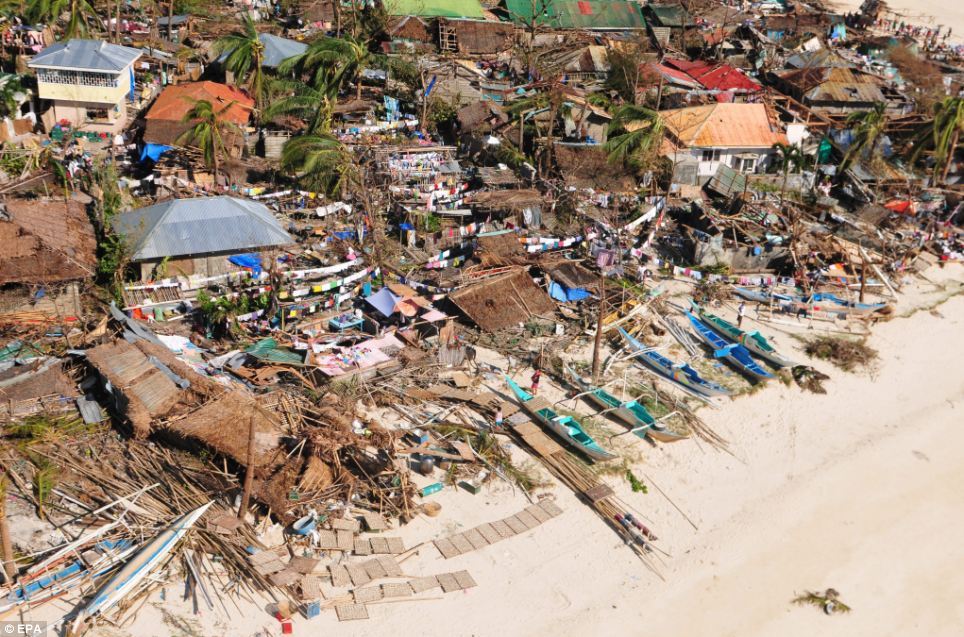
Washing still hangs on the lines but dozens of bamboo houses have been flattened by the storm in Baladian in the municipality of Concepcion, Iloilo Province

Loss: A mother weeps beside the dead body of her son at a chapel in the aftermath of Typhoon Haiyan in Tacloban

A ship was washed ashore in the huge storm. Surging sea water strewed debris for miles and survivors said the devastation was like a tsunami

The storm is one of the most powerful ever recorded and huge waves swept away entire coastal villages and destroyed up to 80 per cent of the area in its path

More than 330,900 people were displaced and 4.3million ‘affected’ by the typhoon in 36 provinces, the U.N. has said

Residents try to salvage belongings in Tacloban city, Leyte province. Rescuers have not even been able to contact some towns on the coast where the storm first hit

Villagers walk past a body of victim laying on a pier in the super typhoon devastated city of Tacloban, Leyte province

This afternoon, Typhoon Haiyan – believed to be the strongest storm to ever hit land – made landfall in Sanya in south China’s Hainan province

Workers remove a tree that fell onto a car during the deadly storm, which is the 30th typhoon to strike China this year

The typhoon is now making its way towards Vietnam and mainland China – with locals bracing themselves for the onslaught of the deadly typhoon

Heavy winds had already caused damage to China’s Hainan island before the super typhoon made landfall. Above, a billboard is blown over by the strong winds

A man carries boxes of milk as he passes by ships washed ashore by enormous waves in Tacloban city, Leyte province

One survivor said the scenes of utter devastation caused by the typhoon was ‘like the end of the world’

Aid agencies have made emergency appeals for funds and are trying to reach survivors who are in desperate need of clean water and shelter

Bodies still lie in the roads and thousands of homes lie destroyed near the fish port after super Typhoon Haiyan battered Tacloban city

This NASA MODIS Aqua satellite image shows what is possibly the strongest storm ever – Super Typhoon Haiyan

Local and foreign medical teams prepare to board a Philippines air force C-130 transport plane in Manila

Survivors walk towards the evacuation center to get relief goods after super Typhoon Haiyan battered Tacloban city, central Philippines

City administrators in Tacloban said about 400 bodies have been collected so far but said the death toll in the city alone could be 10,000

A girl looks out from a makeshift shelter in Tacloban. The World Food Programme said it was airlifting 40 tonnes of high-energy biscuits to the region

A woman holds her umbrella stands on debris of houses in Tacloban. Millions of people are believed to have been ‘affected’ by the storm, including hundreds of thousands who have lost their homes

Children pull sacks of goods they recovered from abandoned stores as they go past the rubble of houses in Tacloban

A woman mourns in front of her husband’s dead body, which lies no the street under tarpaulin alongside other bodies

An injured Filipino boy stand in front of the rubble of houses in Tacloban – destroyed by the typhoon that has left thousands of people dead

A man with an injured leg is carried through the devastation of former residential roads in Tacloban

Operation: A Vietnamese soldier carries a young girl from a lorry as villagers are evacuated to a safe place by the military

Desolation: This picture shows an flattened area of the destroyed Tacloban city covered by debris and flood water

Flattened: A Filipino boy stands among the debris in Tacloban, Leyte – one of the worst areas hit by category five storm Typhoon Haiyan

Death: It has been estimated by the Red Cross that 1,000 of the 1,200 people killed by the typhoon were residents of Tacloban

Widespread: This picture shows acres of flooded rice fields in the Iloilo Province, another area devastated by the typhoon


Plans: An elderly woman is taken from her home in Danang, Vietnam, as the government begins to evacuate 100,000 people lying in the path of typhoon Haiyan

From above: An aerial view shows badly damaged houses, including many without a roof, and blocked roads in the Philippine province of Iloilo


Recovery: A child is lifted to safety from a house in Tacloban, left, and two residents sit on the pavement in front of their home in the same city, right

Flattened: The typhoon has ravaged most of the city of Tacloban and destroyed the airport

Ruins: A resident sifts through rubbish inside his ruined home, flattened by 235mph winds in the devastated city of Tacloban

Scale: This image shows the enormous Typhoon Haiyan taken by Astronaut Karen L. Nyberg aboard the Internatioal Space Station

Satellite: A picture posted on Twitter by NASA at 8.00pm GMT shows the centre of the moving across the South China Sea towards the coast of Vietnam

Path: Once the typhoon has reached the coast of Vietnam it is expected to moved towards the capital, Hanoi, with parts of Laos and Cambodia also likely to be affected

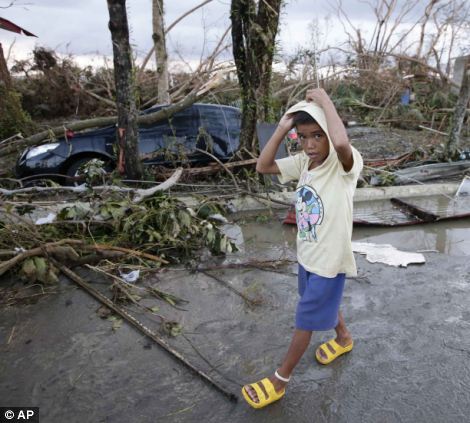
Loss: A pregnant woman, left, walks around the remains of her home while a young boy, right, walks past a crushed car in the destroyed town of Tacloban


Temporary: Bodies of victims lay in a deserted chapel in Tacloban. A woman and child, right, view the distressing scene

Flooding: Locals in Coron, Palawan, walk among damaged buildings and flooded streets after the typhoon – one of the most powerful to ever hit land

Terrifying: Filipino children are seen in the city of Tacloban, Leyte. Behind them is a scene of devastation with homes flattened and debris lying in the street

Picking up the pieces: Some residents try to go about their daily business despite the large-scale destruction
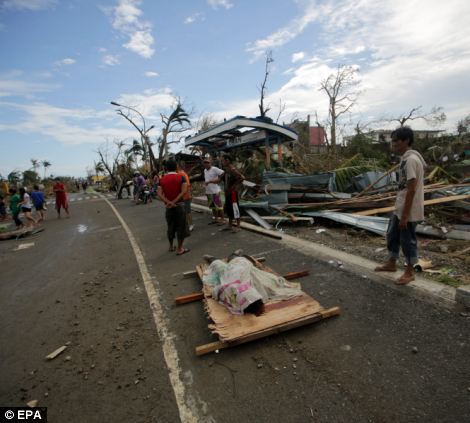

Tragedy: Bodies of residents can be seen in the streets of Tacloban, while one local is forced to transport a body in a wheelbarrow

Collapsed: A resident walks past her destroyed home – flattened by piles of wood and branches from nearby trees – in Tacloban city

Workers: Local Red Cross staff place sand bags on the roof of a house in Danang, Vietnam

Debris: Helicopters hover over the damaged area of Tacloban city, which was battered with strong winds yesterday

Victim: A resident walks past dead bodies that lie on the street in Tacloban city, Leyte province

Under water: Residents wade through a flooded street in Mindoro, Philippines this morning following the typoon

Pile up: Vehicles and rubbish are pictured strewn across a flooded street in Tacloban, Leyte

Upside down: A devastated airport in Tacloban city, Leyte province – where roofs were ripped on hundreds of houses


Shock: These two pictures show the devastation in Coron, Palawan where buildings have been flattened, left and right, leaving residents helplessly walking the streets.

Space: A digital composite of Typhoon Haiyan approaching the Philippines, made using images captured geostationary satellites of the Japan Meteorological Agency

Rebuilding their lives: Two men in Iloilo move some of their belongings through flood waters covering the streets

Devastation: Debris which was washed in by the storm litters the road by the coastal village in Legazpi city. Residents now face a long clean up operation


Hanging on: A fisherman in Manila is forced to cling on to his equipment, left, while there was little hope for other less stable buildings in the storm’s path, right

Higher ground: Residents of Legaspi, Albay province, south of Manila resident, were forced to flee the coast as Haiyan continued to pound the sea wall today

Downpour: As well as strong winds, the typhoon brought with it torrential rain which caused landslides in rural parts of the country

Terrifying: Residents run for their lives as the terrible gusts of the typhoon buffet the popular tourist city of Cebu. Trees and roofs were torn off by the storm

Blocked: Residents clear the road in the island province of Cebu after a tree was toppled by strong winds during typhoon Haiyan

Aid effort: Volunteers pack relief goods inside a Department of Social Welfare and Development warehouse before shipping out to devastated provinces

Shelter: Filipino residents sleep on the floor of a gymnasium turned into an evacuation center in Sorsogon City in the Bicol region

Morgellons fibers embedded in skin. PHOTO: PLOS ONE
Influential singer/songwriter Joni Mitchell just turned 70 last Thursday. In a retrospective piece about her career published by U-T San Diego, this particular line caught my attention:
She no longer performs because she has a rare medical condition, Morgellons syndrome, and because decades of chain-smoking have ravaged her once-angelic voice.
It’s a huge tragedy that someone of her talent can no longer sing, but what was truly surprising to me was the revelation that she has Morgellons syndrome. It’s truly courageous for someone as well-known and widely respected as Mitchell to go public about it because people suffering from Morgellons have often been dismissed by the medical establishment as being “delusional”. The issue is clouded by the fact that reported physical symptoms of Morgellons syndrome are indeed similar to delusional parasitosis and in some cases it may also have neurological symptoms (though in most reported cases the symptoms include brain fog, fear, depression, decreased coordination and personality changes rather than delusions).
Joni Mitchell related her personal experience with Morgellons in this excerpt from a 2010 LA Times interview:
LAT: You’ve come out in the media as a sufferer of a controversial condition known as Morgellons. How is your health currently?
JM: I have this weird, incurable disease that seems like it’s from outer space, but my health’s the best it’s been in a while, Two nights ago, I went out for the first time since Dec. 23: I don’t look so bad under incandescent light, but I look scary under daylight. Garbo and Dietrich hid away just because people became so upset watching them age, but this is worse. Fibers in a variety of colors protrude out of my skin like mushrooms after a rainstorm: they cannot be forensically identified as animal, vegetable or mineral. Morgellons is a slow, unpredictable killer — a terrorist disease: it will blow up one of your organs, leaving you in bed for a year. But I have a tremendous will to live: I’ve been through another pandemic — I’m a polio survivor, so I know how conservative the medical body can be. In America, the Morgellons is always diagnosed as “delusion of parasites,” and they send you to a psychiatrist. I’m actually trying to get out of the music business to battle for Morgellons sufferers to receive the credibility that’s owed to them.
As disturbing as symptoms of Morgellons Syndrome are, just as frightening is the fact that we know so little about what it is, what causes it, hows it’s transmitted, and how to cure people who have it. However, in this article recently reposted at GlobalResearch, they uncovered the following information linking Morgellons to GMOs:
In the Sept. 15-21 issue of New Scientist magazine, Daniel Elkan describes a patient he calls “Steve Jackson,” who “for years” has “been finding tiny blue, red and black fibers growing in intensely itchy lesions on his skin.” He quotes Jackson as saying, “The fibers are like pliable plastic and can be several millimeters long. Under the skin, some are folded in a zigzag pattern. These can be as fine as spider silk, yet strong enough to distend the skin when you pull them, as if you were pulling on a hair.”
Doctors say that this type of disease could only be caused by a parasite, but anti-parasitic medications do not help. Psychologists insist that this is a new version of the well-known syndrome known as “delusional parasitosis.” While this is a “real” disease, it is not a physically-caused one.
But now there is physical evidence that Morgellons is NOT just psychological. When pharmacologist Randy Wymore offered to study some of these fibers if people sent them to him, he discovered that “fibers from different people looked remarkably similar to each other and yet seem to match no common environmental fibers.”
When they took them to a police forensic team, they said they were not from clothing, carpets or bedding. They have no idea what they are.
Researcher Ahmed Kilani says he was able to break down two fiber samples and extract their DNA. He found that they belonged to a fungus.
An even more provocative finding is that biochemist Vitaly Citovsky discovered that the fibers contain a substance called “Agrobacterium,” which, according to New Scientist, is “used commercially to produce genetically-modified plants.” Could GM plants be “causing a new human disease?”
To learn more about Morgellons Disease, visit the Charles E. Holman Foundation.
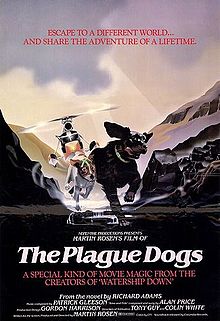
Many of us may have read the Richard Adams book “Watership Down” or have seen the film adaptation, but less known is the film version of his even darker follow-up, “The Plague Dogs” (1982). Like a Disney film, it features anthropomorphized animals and lessons about friendship and courage, but less like Disney, it also has lessons about scientific cruelty, mass media hype, mental illness and mortality. Never in a Disney film would the protagonists be hunted by humans after narrowly escaping vivisection and possibly being exposed to bubonic plague, as happens to Rowf and Snitter, the main characters of The Plague Dogs. It’s an undeniably harrowing and sad story, but it’s also emotionally engaging, intelligent, unsentimental, and an underrated animated masterpiece.
Though The Plague Dogs may be suitable for some kids, it’s also for all film lovers because the artwork is beautiful and the voice acting is subtle yet emotive (especially the voice of John Hurt, who played Winston Smith two years later in a film version of “1984”). It even features a great theme song by Alan Price, former keyboardist for The Animals and best known by cult movie fans as the lead singer of the band featured in Lindsay Anderson’s “O Lucky Man”. Most importantly, The Plague Dog’s message of empathy and arguments for ethical considerations in science are as timely as ever.
If you’re interested in learning more about The Plague Dogs, I recommend this detailed review by the Film Walrus (though it’d be best to read only after watching the film as it reveals spoilers): http://www.filmwalrus.com/2008/08/review-of-plague-dogs.html

I recently rediscovered the following article (through Disinfo.com) which seems more applicable to the world today than when it was originally written more than ten years ago. It may help explain certain questions about our culture such as:
These may all be symptoms of a multitude of complex problems, but they’re also examples of the unhealthy ways we cope with them. In my view, being open to and understanding dark emotions are necessary to attain true emotional resiliency to endure life’s challenges. It’s important not just for survival, but to enable us to more effectively act to rectify socio-economic problems which are connected to personal and global problems.
By Miriam Greenspan
Originally posted at Shambhala Sun
Grief, fear and despair are part of the human condition. Each of these emotions is useful, says psychotherapist Miriam Greenspan, if we know how to listen to them.
I was brought to the practice of mindfulness more than two decades ago by the death of my first child. Aaron died two months after he was born, never having left the hospital. Shortly after that, a friend introduced me to a teacher from whom I learned the basics of Vipassana meditation: how to breathe mindfully and meditate with “choiceless” awareness. I remember attending a dharma talk in a room full of fifty meditators. The teacher spoke about the Four Noble Truths. Life is inherently unsatisfactory, he said. The ego’s restless desires are no sooner fulfilled than they find new objects. Craving and aversion breed suffering. One of his examples was waiting in line for a movie and then not getting in.
I asked: “But what if you’re not suffering because of some trivial attachment? What if it’s about something significant, like death? What if you’re grieving because your baby was born with brain damage and died before he had a chance to live?” I wept openly, expecting that there, of all places, my tears would be accepted.
The teacher asked, “How long has your son been dead?” When I told him it had been two months, his response was swift: “Well then, that’s in the past now, isn’t it? It’s time to let go of the past and live in the present moment.”
I felt reprimanded for feeling sad about my son’s death. The teacher’s response baffled me. Live in the present? My present was suffused with a wrenching sorrow—a hole in my heart that bled daily. But the present moment, as he conceived of it, could be cleanly sliced away from and inured against this messy pain. Divested of grief, an emotionally sanitized “present moment” was served up as an antidote for my tears. However well meaning, the message was clear: Stop grieving. Get over it. Move on.
This is a familiar message. Its unintended emotional intolerance often greets those who grieve, especially if they do so openly. I call this kind of intolerance “emotion-phobia”: a pervasive fear and reflexive avoidance of difficult emotions in oneself and/or others. This is accompanied by a set of unquestioned normative beliefs about the “negativity” of painful feelings.
Emotion-phobia is endemic to our culture and perhaps to patriarchal culture in general. You’ll find it in sub-cultures as different as spiritual retreats, popular self-help books and psychiatric manuals. In fact, my teacher’s supposedly Buddhist response was very much in line with the prevailing psychiatric view of grief. According to the Diagnostic and Statistical Manual IV (the “bible” of psychiatry), the patient who is grieving a death is allotted two months for “symptoms” such as sadness, insomnia and loss of appetite before being diagnosable with a “Major Depressive Disorder.” Grief, perhaps the most inevitable of all human emotions, given the unalterable fact of mortality, is seen as an illness if it goes on too long. But how much is too long? My mother, a Holocaust survivor, grieved actively for the first decade of my life. Was this too long a grief for genocide? Time frames for our emotions are nothing if not arbitrary, but appearing in a diagnostic and statistical manual, they attain the ring of truth. The two month limit is one of many examples of institutional psychiatry’s emotion-phobia.
Emotions like grief, fear and despair are as much a part of the human condition as love, awe and joy. They are our natural and inevitable responses to existence, so long as loss, vulnerability and violence come with the territory of being human. These are the dark emotions, but by dark, I don’t mean that they are bad, unwholesome or pathological. I mean that as a culture we have kept these emotions in the dark—shameful, secret and unseen.
Emotion-phobia dissociates us from the energies of these emotions and tells us they are untrustworthy, dangerous and destructive. Like other traits our culture distrusts and devalues—vulnerability, for instance, and dependence—emotionality is associated with weakness, women and children. We tend to regard these painful emotions as signs of psychological fragility, mental disorder or spiritual defect. We suppress, intellectualize, judge or deny them. We may use our spiritual beliefs or practices to bypass their reality.
Few of us learn how to experience the dark emotions fully—in the body, with awareness—so we end up experiencing their energies in displaced, neurotic or dangerous forms. We act out impulsively. We become addicted to a variety of substances and/or activities. We become depressed, anxious or emotionally numb, and aborted dark emotions are at the root of these characteristic psychological disorders of our time. But it’s not the emotions themselves that are the problem; it’s our inability to bear them mindfully.
Every dark emotion has a value and purpose. There are no negative emotions; there are only negative attitudes towards emotions we don’t like and can’t tolerate, and the negative consequences of denying them. The emotions we call “negative” are energies that get our attention, ask for expression, transmit information and impel action. Grief tells us that we are all interconnected in the web of life, and that what connects us also breaks our hearts. Fear alerts us to protect and sustain life. Despair asks us to grieve our losses, to examine and transform the meaning of our lives, to repair our broken souls. Each of these emotions is purposeful and useful—if we know how to listen to them.
But if grief is barely tolerated in our culture, even less are fear and despair. The fact is we are all afraid and act as if we’re not. We fear the sheer vulnerability of existence; we fear its unpredictability. When we are unable to feel our fear mindfully, we turn it into anger, psychosomatic ailments or a host of “anxiety disorders”—displacements of fears we can’t feel or name.
According to experts, some 50 million people in this country suffer from phobias at some point in their lives, and millions more are diagnosed with other anxiety disorders. One reason is that we’ve lost touch with the actual experience of primal, natural fear. When fear is numbed, we learn little about what it’s for—its inherent usefulness as an alarm system that we ignore at our peril. Benumbed fear is especially dangerous when it becomes an unconscious source of vengeance, violence and other destructive acts. We see this acted out on the world stage as much as in the individual psyche.
As for despair, how many among us have not experienced periods of feeling empty, desolate, hopeless, brooding over the darkness in our world? This is the landscape of despair. Judging from my thirty years of experience as a psychotherapist, I would say that despair is common, yet we don’t speak of despair anymore. We speak of clinical depression, serotonin-deficiency, biochemical disorder and the new selective serotonin-reuptake inhibitors. We treat the “illness” with a host of new medications. In my view, “depression” is the word we use in our highly medicalized culture for a condition of chronic despair—despair that is stuck in the body and toxified by our inability to bear it mindfully. When we think of all despair as a mental disorder or a biochemical illness, we miss the spiritual metamorphosis to which it calls us.
In retrospect, a more helpful answer from my meditation teacher (and one more in line with the Buddha’s teachings) might have been, If you are grieving, do so mindfully. Pay attention to your grief. Stop and listen to it. Befriend it and let it be. The dark emotions are profound but challenging spiritual teachers, like the Zen master who whacks you until you develop patience and spiritual discipline. When grief shattered my heart after Aaron’s death, that brought with it an expansion, the beginning of my experience of a Self larger than my broken ego. Grieving mindfully—without recourse to suppression, intellectualization or religious dogmatism—made me a happier person than I’d ever been.
What I learned by listening closely to grief was a transformational process I call “the alchemy of the dark emotions.” Many years after Aaron’s death, after a second radiantly healthy child and a third who was born with a mysterious neuromotor disorder, I began to write about these alchemies—from grief to gratitude, fear to joy, and despair to faith—that I had experienced in my own life and witnessed countless times in my work as a psychotherapist.
The alchemy of the dark emotions is a process that cannot be forced, but it can be encouraged by cultivating certain basic emotional skills. The three basic skills are attending to, befriending and surrendering to emotions that make us uncomfortable. Attending to our dark emotions is not just noticing a feeling and then distancing ourselves from it. It’s about being mindful of emotions as bodily sensations and experiencing them fully. Befriending emotion is how we extend our emotional attention spans. Once again, this is a body-friendly process—getting into the body, not away from it into our thoughts. At the least, it’s a process of becoming aware of how our thoughts both trigger emotions and take us away from them. Similarly, surrender is not about letting go but about letting be. When you are open to your heart’s pain and to your body’s experience of it, emotions flow in the direction of greater healing, balance and harmony.
Attending to, befriending and surrendering to grief, we are surprised to discover a profound gratitude for life. Attending to, befriending and surrendering to fear, we find the courage to open to our vulnerability and we are released into the joy of knowing that we can live with and use our fear wisely. Attending to, befriending and surrendering to despair, we discover that we can look into the heart of darkness in ourselves and our world, and emerge with a more resilient faith in life.
Because we are all pretty much novices at this process, we need to discipline ourselves to be mindful and tolerant of the dark emotions. This is a chaotic, non-linear process, but I have broken it down to seven basic steps: 1) intention, 2) affirmation, 3) sensation, 4) contextualization, 5) the way of non-action, 6) the way of action and 7) the way of surrender.
Intention is the means by which the mind, heart and spirit are engaged and focused. Transforming the dark emotions begins when we set our intention on using our grief, fear and despair for the purpose of healing. It is helpful to ask yourself: What is my best intention with regard to the grief, fear and despair in my life? What would I want to learn or gain from this suffering?
The second step in using the dark emotions for growth is affirming their wisdom. This means changing the way we think about how we feel, and developing and cultivating a positive attitude toward challenging feelings.
Emotional intelligence is a bodily intelligence, so you have to know how to listen to your body. The step I call “sensation” includes knowing how to sense and name emotions as we experience them in the body. We need to become more familiar and friendly with the actual physical sensations of emotional energy. Meditation, T’ai chi, yoga and other physical practices that cultivate mindfulness are particularly useful. How does your body feel when you are sad, fearful or despairing? What kinds of stories does your mind spin about these emotions? What happens when you simply observe these sensations and stories, without trying to understand, analyze or change anything?
In step four, contextualization, you acquaint yourself with the stories you usually tell yourself about your emotional suffering, and then place them in a broader social, cultural, global or cosmic context. In enlarging your personal story, you connect it to a larger story of grief, fear or despair in the world. This gets us out of the isolation and narcissism of our personal history, and opens us to transforming our suffering into compassion.
Step five, the way of non-action, is the skill that psychologists call “affect tolerance.” This step extends our ability to befriend the pain of the dark emotions in the body. When you can tolerate the pain of grief, fear and despair without acting prematurely to escape it, you are practicing the way of non-action. Again, it is helpful to meditate on your emotions with the intention of really listening to them. What does your grief, fear or despair ask of you? In meditation, listen to the answers that come from your heart, rather than from your analytic mind.
The dark emotions ask us to act in some way. While the way of non-action builds our tolerance for dark emotional energy, step six is about finding an action or set of actions that puts this energy to good use. In the way of action, we act not in order to distract ourselves from emotion but in order to use its energy with the intention of transformation. The dark emotions call us to find the right action, to act with awareness and to observe the transformations that ensue, however subtle. Action can be strong medicine in times of trouble. If you are afraid, help someone who lives in fear. For example, volunteer at a battered women’s shelter. If you’re sad and lonely, work for the homeless. If you’re struggling with despair, volunteer at a hospice. Get your hands dirty with the emotion that scares you. This is one of the best ways to find hope in despair, to find connection in a shared grief and to discover the joy of working to create a less broken world. Finally, step seven, the way of surrender, is the art of conscious emotional flow. Emotional flow is something that happens automatically when you know how to attend to and befriend your emotions. When we are in flow with emotion, the energy becomes transformative, opening us to unexpected vistas.
When we look deeply into the dark emotions in our lives, we find both the universality of suffering and how much suffering is unnecessary, the result of social inequities, oppression, large scale violence and trauma. Our awareness both of the universality of suffering and of its socially created manifestations is critical to the healing journey. Knowing how our grief, fear and despair may be connected to larger emotional currents and social conditions de-pathologizes these emotions, allowing us to accept and tolerate them more fruitfully, and with more compassion for ourselves and others. We begin to see the dark emotions as messengers, information-bearers and teachers, rather than “negative” energies we must subdue, tame or deny. We tend to think of our “negative” emotions as signs that there’s something wrong with us. But the deepest significance of the feelings is simply our shared human vulnerability. When we know this deeply, we begin to heal in a way that connects rather than separates us from the world.
Investigative journalist Susanne Posel of OccupyCorporatism.com just posted a disturbing yet informative article that touches on a number of societal trends. She cited a recent study from the National Institutes of Health (NIH), Molecular Epidemiology in Children’s Environmental Health (MECEH), and the Avon Foundation (AF), which found obesity to be the largest factor for the early onset of puberty. Posel points out that links to BPA and other estrogen-mimicking chemicals were suspiciously left out of the report. In her own words:
BPA is a highly toxic estrogen accelerator that is used in all plastic products commercially produced. The chemical mimics natural estrogen when leeched into the body.
It offsets natural estrogen levels, causing the body to hasten its pubescent generation. Nearly all children are exposed to this chemical through plastic toys, pacifiers, bottles, sippy cups. Its influence on natural hormone distribution within the body has proven to be incredibly damaging.
Girls are finding they are coming into puberty earlier and earlier.
Boys are showing retardation of their sexual anatomy, halting their pubescent maturity.
As our children enter adulthood, these hormonal imbalances cause breast cancer. Because of the lack of mainstream information concerning this chemical, the connection between this trend and BPA is dismissed. The effects of BPA are cumulative and therefore not readily connected as the causation of early pubescent development.
Read the full article here: http://www.occupycorporatism.com/doctors-use-sterilants-cure-early-puberty-obesity/
Typical of the modern medical establishment, rather than address root causes of a problem they focus on the symptoms. Rather than calling for a reduction of BPAs and similar chemicals in products and the environment, or even suggesting healthier lifestyles and diets as the recent study seems to endorse, they have so far been dealing with the problem by recommending earlier sex education and pharmaceutical treatments.
One of the drugs, Lupon Depot, is a fertility drug with a long list of dangerous side effects including hot flashes, memory loss, tachycardia, hematura, hypotension, dizziness, insomnia, anxiety, depression, Vitamin D deficiency, constant gnawing bone/joint pain, osteoarthritis, osteopenia, osteoporosis, fibromyalgia, degenerative disc disease, autoimmune diseases, blood disorders, cancer and death. The other medication, Depo-Provera, is a sterility drug used by the Bill and Melinda Gates Foundation in poverty-stricken nations.
Though Posel doesn’t delve too deeply into this issue in the article, the advocacy of sterilization in the global south by NGOs and “charitable foundations” is a huge issue in itself. Just like the medical establishment, elites like Bill Gates tend to focus on symptoms rather than root causes. Unwanted pregnancies are a problem, but studies have shown that empowering women and providing greater access to education is the most effective way to end poverty and encourage smaller and more stable families. The Gates Foundation is also known for pushing GMOs in Africa through their Alliance for a Green Revolution in Africa (AGRA) as a solution to feeding the world’s hungry. As Raj Patel and others have pointed out, global hunger and starvation has more to do with economic inequity than availability of food. Then again, The Gates Foundation is more about getting tax benefits, funneling money to corporate cronies like Monsanto and getting good PR for appearing to be charitable than actually helping the poor.

As ballots in Washington state are still being counted, current results show that No votes for Ballot Initiative 522 (which would requiring labeling of foods containing GMOs) are leading the Yes votes 54.8% to 45.2%. Though at this point it’s still too close to call, no matter what the outcome there’s important lessons we can learn from the campaign.
Despite increasing awareness of the real dangers of GMOs, thanks largely to independent media and grass-roots organizations, huge influxes of corporate cash can cloud the issue and sway public opinion in an incredibly short period of time. As reported by Al Jazeera:
…in Washington, where television ads of varying levels of accuracy have been running since early September, pro-labeling sentiment has dropped roughly 41 percent in less than 60 days.
Obviously, biotech and processed food companies are extremely alarmed by the notion of people knowing what foods contain GMOs. They must realize there’s enough awareness of the dangers of GMOs for a significant percentage of the population to act on such information and hurt their profits. Why else would they spend a record amount of money in Washington state elections (over $21 million) to defeat I-522? The average donation against I-522 was more than 20,000 times larger than the average donation in support of it. Not surprisingly, the largest percentage was spent by Monsanto. Emma Goldman famously said: “If voting changed anything, they’d make it illegal”. There’s definitely some truth to that, but on the other hand if voting did nothing, corporations like Monsanto wouldn’t spend so much money to influence the outcome.
Not only do they not want the public to know what’s in their foods, they don’t want the public to know who’s spending the money to keep them in the dark. The Grocery Manufacturer’s Association refused to reveal the names of their anti-GMO labeling corporate donors until they were forced to by a lawsuit from the WA State Attorney General. Storylink.com published the following list with respective donation amounts and contact information links:
PepsiCo, Inc. – $1,620,899
Nestle USA Inc. – $1,052,743
The Coca-Cola Company – $1,047,332
General Mills Inc. – $598,819
ConAgra Foods – $285,281
Campbell Soup Company – $265,140
The Hershey Company – $248,305
The J.M. Smucker Company – $241,091
Kellogg Company – $221,852
Mondelez Global LLC – $144,895
Flowers Foods Inc. – $141,288
Abbott Nutrition – $127,459
Pinnacle Foods Group LLC – $120,846
Dean Foods Company – $120,245
McCormick & Company Inc – $102,208
Land O’Lakes, Inc. – $99,803
Cargill Inc. – $98,601
The Hillshire Brands Company – $97,398
Bunge North America, Inc. – $94,993
Bimbo Bakeries USA – $94,693
Del Monte Foods Company – $86,576
Ocean Spray Cranberries Inc. – $55,313
Hormel Foods Corporation – $52,908
Bumble Bee Foods LLC – $36,073
Welch Foods, Inc. $28,859
Shearer’s Foods, Inc. $25,251
Rich Products Corporation – $24,049
Clement Pappas & Company Inc. – $21,043
Sunny Delight Beverages Company – $21,043
Bush Brothers & Company – $16,233
Knouse Foods Cooperative Inc. – $14,429
The Clorox Company – $12,024
Bruce Foods Corporation – $3,006
Moody Dunbar Inc. – $1,804
As can be deduced from this list, there’s probably a lot more GMOs in supermarkets than most people realize. With or without GMO labeling, if one is concerned for personal and planetary health it’d be best to get into the practice of avoiding all processed foods as much as possible and look specifically for foods labeled as “non-GMO”.
As an alternative to the GMO labeling movement, activists such as Jon Rappoport, Mike Adams and others have suggested organizing around banning GMOs as 26 countries have already done and the Los Angeles City Council has recently proposed.
On the lighter side, this should come as no surprise to anyone, but corporate assholes apparently don’t know how to throw a party. While they should’ve been celebrating last night, this is what Seattle’s weekly alternative paper The Stranger reported:

The No on GMO labeling campaign is supposedly hosting a party at the Westin Hotel. They have burned some serious bucks opposing Initiative 522, almost all of it coming from out of state. As for the party? No one is here. There is bottled water, Coca Cola, and cookies on a table. No real food. Seriously, three people in the room—one from Seattle Times. It’s all very strange.
THE MONSANTO MORGUE
8:58 PM
This is what it must feel like to be in a conference room in the Death Star. No one has anything to do. No one is around. But those checking names at the door have to wait and wait like something might happen. Power functions with no one. Power does not need people. People are democracy.
INDIAN COUNTRY NEWS
"It is the duty of every man, as far as his ability extends, to detect and expose delusion and error"..Thomas Paine
Human in Algorithms
100% Accurate Google Sheets + KDP Book Formatting | 24hr Delivery
From the Roof Top
I See This
blog of the post capitalist transition.. Read or download the novel here + latest relevant posts
अध्ययन-अनुसन्धानको सार


