I Speak, You Speak, We All Speak Newspeak

By Joziah Thayer

Source: Activist Post

In George Orwell’s infamous book 1984, Big Brother imposes Newspeak on the people of Oceania. Newspeak is defined as “a controlled language of restricted grammar and limited vocabulary, meant to limit the freedom of thought — personal identity, self-expression, and free will — that threatens the ideology of the regime of Big Brother and the Party, who have criminalized such concepts into thoughtcrime.”

Society today has dimensions of Newspeak infused into our everyday lives. We are all polarized penguins waddling our way through the masses, blocking, deleting or belittling anyone who has opposing views until we find ourselves face first in a corner. After waddling like penguins into the walls of our echo-chambers, we turn around and face the world, but by then we have become territorial terriers ready to attack anyone who threatens to breach the walls of our carefully crafted echo-chambers. Instead of protecting the truth, we protect our truth.

The consequences of this are that instead of the truth being known, there are two truths; and this process will duplicate and recycle itself until there is no truth, there are only lies and propaganda. People like Marc Lamont Hill are a perfect example of Newspeak being in full effect in our society today. Hill made comments about the Israeli oppression of Palestinians and he was fired, not because he said something anti-Semitic, but because he said something unacceptable in society today — in Orwellian terms Marc Lamont Hill committed a thoughtcrime.

Instead of having actual free speech, we have accepted speech. We protect the illusion of free speech— like a lonely man in the desert, protecting his paradise, which in reality is just a mirage. The will of the people will never be honored so long as we elect monetarist gargoyles in suits that are afraid of change because it means their demise. In America, we have a representative democracy and what we need is a direct democracy. A democracy in which our votes as citizens mean something and our elected officials are held accountable or voted out.

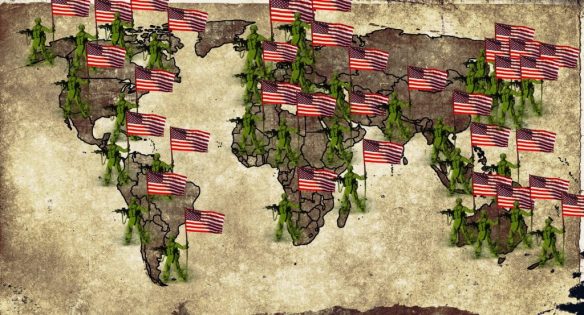
Perhaps the worst case of Newspeak in society today is when it involves war. Major news networks have long-winded debates about what they call “America’s role in the world.” This is a form of Newspeak. Instead of saying that we are actively bombing eleven sovereign nations, killing innocent men, women, and children, mainstream media casually calls it “America’s role in the world.” Another term commonly used as a form of Newspeak is: “Our troops are protecting American interest overseas,” How is it Newspeak? The accepted language for America’s endless wars is that America is only spreading democracy around the world. This “accepted language” couldn’t be any further from the truth, yet anything that deviates from this accepted language is deemed an unacceptable thoughtcrime and that is what makes it Newspeak.

War is fought in this fog of falsehood, a great deal of it undiscovered and accepted as truth. The fog arises from fear and is fed by panic. Any attempt to doubt or deny even the most fantastic story has to be condemned at once as unpatriotic, if not traitorous. This allows a free field for the rapid spread of lies. – Arthur Ponsonby (Falsehood In War-time)

We often acknowledge the faults of our government, our media, and our financial system, but in doing so we neglect to acknowledge our faults. Our way is the only way! It is as if the masses have been rocked to sleep or hypnotized into being binary static robots incapable of walking outside of the dotted line or thinking outside of the box.

Newspeak is not to be confused with “Political Correctness,” it is far more dangerous than that. Political Correctness is divided among party lines. What is politically correct to a Republican is most likely going to be politically incorrect to a Democrat and vice versa. Newspeak is not divided among party lines, Newspeak foments at will in both parties and if left uncorrected politics will remain the cesspool of polarization that it is today. The powers-that-be have no interest in fixing our political system — in their eyes, it’s working just fine.

It’s Time to Declare Your Independence from Tyranny, America

Photo by Alla Sokolova

By John W. Whitehead

Source: The Rutherford Institute

“These are the times that try men’s souls. The summer soldier and the sunshine patriot will, in this crisis, shrink from the service of their country; but he that stands it now deserves the love and thanks of man and woman. Tyranny, like hell, is not easily conquered; yet we have this consolation with us, that the harder the conflict, the more glorious the triumph.”—Thomas Paine, December 1776

It’s time to declare your independence from tyranny, America.

For too long now, we have suffered the injustices of a government that has no regard for our rights or our humanity.

Too easily pacified and placated by the pomp and pageantry of manufactured spectacles (fireworks on the Fourth of July, military parades, ritualized elections, etc.) that are a poor substitute for a representative government that respects the rights of its people, the American people have opted, time and again, to overlook the government’s excesses, abuses and power grabs that fly in the face of every principle for which America’s founders risked their lives.

We have done this to ourselves.

Indeed, it is painfully fitting that mere days before the nation prepared to celebrate its freedoms on the anniversary of the Declaration of Independence, the City Council for Charlottesville, Virginia—the home of Thomas Jefferson, author of the Declaration—voted to do away with a holiday to honor Jefferson’s birthday, because Jefferson, like many of his contemporaries, owned slaves. City councilors have opted instead to celebrate “Liberation and Freedom Day” in honor of slaves who were emancipated after the Civil War.

This is what we have been reduced to: bureaucrats dithering over meaningless trivialities while the government goosesteps all over our freedoms.

Too often, we pay lip service to those freedoms, yet they did not come about by happenstance. They were hard won through sheer determination, suffering and sacrifice by thousands of patriotic Americans who not only believed in the cause of freedom but also had the intestinal fortitude to act on that belief. The success of the American revolution owes much to these men and women.

In standing up to the British Empire and speaking out against an oppressive regime, they exemplified courage in the face of what seemed like an overwhelming foe.

Indeed, imagine living in a country where armed soldiers crash through doors to arrest and imprison citizens merely for criticizing government officials.

Imagine that in this very same country, you’re watched all the time, and if you look even a little bit suspicious, the police stop and frisk you or pull you over to search you on the off chance you’re doing something illegal.

Keep in mind that if you have a firearm of any kind (or anything that resembled a firearm) while in this country, it may get you arrested and, in some circumstances, shot by police.

If you’re thinking this sounds like America today, you wouldn’t be far wrong.

However, the scenario described above took place more than 200 years ago, when American colonists suffered under Great Britain’s version of an early police state. It was only when the colonists finally got fed up with being silenced, censored, searched, frisked, threatened, and arrested that they finally revolted against the tyrant’s fetters.

No document better states their grievances than the Declaration of Independence, drafted by Thomas Jefferson.

A document seething with outrage over a government which had betrayed its citizens, the Declaration of Independence was signed on July 4, 1776, by 56 men who laid everything on the line, pledged it all—“our Lives, our Fortunes, and our sacred Honor”—because they believed in a radical idea: that all people are created to be free.

Labeled traitors, these men were charged with treason, a crime punishable by death. For some, their acts of rebellion would cost them their homes and their fortunes. For others, it would be the ultimate price—their lives.

Yet even knowing the heavy price they might have to pay, these men dared to speak up when silence could not be tolerated. Even after they had won their independence from Great Britain, these new Americans worked to ensure that the rights they had risked their lives to secure would remain secure for future generations.

The result: our Bill of Rights, the first ten amendments to the Constitution.

Imagine the shock and outrage these 56 men would feel were they to discover that 243 years later, the government they had risked their lives to create has been transformed into a militaristic police state in which exercising one’s freedoms—at a minimum, merely questioning a government agent—is often viewed as a flagrant act of defiance.

In fact, had the Declaration of Independence been written today, it would have rendered its signers extremists or terrorists, resulting in them being placed on a government watch list, targeted for surveillance of their activities and correspondence, and potentially arrested, held indefinitely, stripped of their rights and labeled enemy combatants.

The danger is real.

We could certainly use some of that revolutionary outrage today.

Certainly, we would do well to reclaim the revolutionary spirit of our ancestors and remember what drove them to such drastic measures in the first place.

Then again, perhaps what we need to do is declare our independence from the tyranny of the American police state.

It’s not a radical idea.

It has been done before.

The Declaration of Independence speaks volumes about the abuses suffered by early Americans at the hands of the British police state.

Read the Declaration of Independence again, and ask yourself if the list of complaints tallied by Jefferson don’t bear a startling resemblance to the abuses “we the people” are suffering at the hands of the American police state.

If you find the purple prose used by the Founders hard to decipher, here’s my translation of what the Declaration of Independence would look and sound like if it were written in the modern vernacular:

There comes a time when a populace must stand united and say “enough is enough” to the government’s abuses, even if it means getting rid of the political parties in power.

Believing that “we the people” have a natural and divine right to direct our own lives, here are truths about the power of the people and how we arrived at the decision to sever our ties to the government:

All people are created equal.

All people possess certain innate rights that no government or agency or individual can take away from them. Among these are the right to Life, Liberty and the pursuit of Happiness.

The government’s job is to protect the people’s innate rights to Life, Liberty and the pursuit of Happiness. The government’s power comes from the will of the people.

Whenever any government abuses its power, it is the right of the people to alter or abolish that government and replace it with a new government that will respect and protect the rights of the people.

It is not wise to get rid of a government for minor transgressions. In fact, as history has shown, people resist change and are inclined to suffer all manner of abuses to which they have become accustomed.

However, when the people have been subjected to repeated abuses and power grabs, carried out with the purpose of establishing a tyrannical government, people have a right and duty to do away with that tyrannical Government and to replace it with a new government that will protect and preserve their innate rights for their future wellbeing.

This is exactly the state of affairs we are under suffering under right now, which is why it is necessary that we change this imperial system of government.

The history of the present Imperial Government is a history of repeated abuses and power grabs, carried out with the intention of establishing absolute Tyranny over the country.

To prove this, consider the following:

The government has, through its own negligence and arrogance, refused to adopt urgent and necessary laws for the good of the people.

The government has threatened to hold up critical laws unless the people agree to relinquish their right to be fully represented in the Legislature.

In order to expand its power and bring about compliance with its dictates, the government has made it nearly impossible for the people to make their views and needs heard by their representatives.

The government has repeatedly suppressed protests arising in response to its actions.

The government has obstructed justice by refusing to appoint judges who respect the Constitution and has instead made the Courts march in lockstep with the government’s dictates.

The government has allowed its agents to harass the people, steal from them, jail them and even execute them.

The government has directed militarized government agents—a.k.a., a standing army—to police domestic affairs in peacetime.

The government has turned the country into a militarized police state.

The government has conspired to undermine the rule of law and the constitution in order to expand its own powers.

The government has allowed its militarized police to invade our homes and inflict violence on homeowners.

The government has failed to hold its agents accountable for wrongdoing and murder under the guise of “qualified immunity.”

The government has jeopardized our international trade agreements.

The government has overtaxed us without our permission.

The government has denied us due process and the right to a fair trial.

The government has engaged in extraordinary rendition.

The government has continued to expand its military empire in collusion with its corporate partners-in-crime and occupy foreign nations.

The government has eroded fundamental legal protections and destabilized the structure of government.

The government has not only declared its federal powers superior to those of the states but has also asserted its sovereign power over the rights of “we the people.”

The government has ceased to protect the people and instead waged domestic war against the people.

The government has plundered our seas, ravaged our Coasts, and destroyed the lives of the people.

The government has employed private contractors and mercenaries to carry out acts of death, desolation and tyranny, totally unworthy of a civilized nation.

The government through its political propaganda has pitted its citizens against each other.

The government has stirred up civil unrest and laid the groundwork for martial law.

Repeatedly, we have asked the government to cease its abuses. Each time, the government has responded with more abuse.

An Imperial Ruler who acts like a tyrant is not fit to govern a free people.

We have repeatedly sounded the alarm to our fellow citizens about the government’s abuses. We have warned them about the government’s power grabs. We have appealed to their sense of justice. We have reminded them of our common bonds.

They have rejected our plea for justice and brotherhood. They are equally at fault for the injustices being carried out by the government.

Thus, for the reasons mentioned above, we the people of the united States of America declare ourselves free from the chains of an abusive government. Relying on God’s protection, we pledge to stand by this Declaration of Independence with our lives, our fortunes and our honor.

That was 243 years ago.

In the years since early Americans first declared and eventually won their independence from Great Britain, we—the descendants of those revolutionary patriots—have through our inaction and complacency somehow managed to work ourselves right back under the tyrant’s thumb.

Only this time, the tyrant is one of our own making: the American Police State.

The abuses meted out by an imperial government and endured by the American people have not ended. They have merely evolved.

“We the people” are still being robbed blind by a government of thieves.

We are still being taken advantage of by a government of scoundrels, idiots and monsters.

We are still being locked up by a government of greedy jailers.

We are still being spied on by a government of Peeping Toms.

We are still being ravaged by a government of ruffians, rapists and killers.

We are still being forced to surrender our freedoms—and those of our children—to a government of extortionists, money launderers and corporate pirates.

And we are still being held at gunpoint by a government of soldiers: a standing army in the form of a militarized police.

Given the fact that we are a relatively young nation, it hasn’t taken very long for an authoritarian regime to creep into power.

Unfortunately, the bipartisan coup that laid siege to our nation did not happen overnight.

It snuck in under our radar, hiding behind the guise of national security, the war on drugs, the war on terror, the war on immigration, political correctness, hate crimes and a host of other official-sounding programs aimed at expanding the government’s power at the expense of individual freedoms.

The building blocks for the bleak future we’re just now getting a foretaste of—police shootings of unarmed citizens, profit-driven prisons, weapons of compliance, a wall-to-wall surveillance state, pre-crime programs, a suspect society, school-to-prison pipelines, militarized police, overcriminalization, SWAT team raids, endless wars, etc.—were put in place by government officials we trusted to look out for our best interests and by American citizens who failed to heed James Madison’s warning to “take alarm at the first experiment on our liberties.”

In so doing, we compromised our principles, negotiated away our rights, and allowed the rule of law to be rendered irrelevant.

There is no knowing how long it will take to undo the damage wrought by government corruption, corporate greed, militarization, and a nation of apathetic, gullible sheep.

The problems we are facing will not be fixed overnight: that is the grim reality with which we must contend.

Frankly, as I make clear in my book Battlefield America: The War on the American People, we may see no relief from the police state in my lifetime or for several generations to come.

That does not mean we should give up or give in or tune out.

Remember, there is always a price to be paid for remaining silent in the face of injustice.

That price is tyranny.

As Edmund Burke, the eighteenth-century British statesman and author who supported the American colonists warned, “The only thing necessary for the triumph of evil is for good men to do nothing.”

Tackling the ‘Impossible’: Ending Violence

By Robert J. Burrowes

Whenever, in ordinary circumstances, the subject of violence comes up, most people throw up their hands in horror and comment along the lines that it is ‘in our genes’, ‘nothing can be done about it’ or other words that reflect the powerlessness that most people feel around violence.

It is true that violence is virtually ubiquitous, has a near-infinite variety of manifestations and, at its most grotesque (as nuclear war or run-away climate catastrophe), even threatens human extinction in the near-term.

Nevertheless, anyone who pays attention to the subject of violence in any detail soon discovers that plenty of people are interested in tackling this problem, even if it is ‘impossible’. Moreover, of course, at least some people recognize that while we must tackle each manifestation of violence, understanding the cause of violence is imperative if we are to successfully tackle its many manifestations at their source. To do all of this effectively, however, is a team effort. And hopefully, one day, this team will include all of us.

In the meantime, let me start by telling you a little about some of the people who are already working to end violence by tackling one or more of its many manifestations. These individuals are part of a worldwide network set up to focus on ending violence – ‘The People’s Charter to Create a Nonviolent World’ – and they have signed a pledge to do so.

Concerned about US government threats to Iran and Venezuela, several Charter signatories were part of one or both recent peace delegations to Iran and Venezuela respectively. These delegations were designed to open more lines of communication and to demonstrate solidarity with those who do not submit to US hegemony.

The 28-member US peace delegation to Iran from 25 February to 6 March 2019 included long-term nonviolent activists Margaret Flowers, Kevin Zeese and David Hartsough. Unfortunately for David, author of Waging Peace: Global Adventures of a Lifelong Activist and director of Peaceworkers, his trip didn’t go as planned. If you would like to read a compelling account of his time in Iran with some wonderful Iranians, while learning something about what it means to be on the wrong end of US sanctions, you will find it here: ‘An American Casualty of U.S. Economic Sanctions on Iran’. Glad you got the lifesaving medical treatment from our Iranian friends that you needed David, despite the sanctions! And it is a tragedy that Iran has recently suffered even more, as a result of the devastating floods that have hit the country, with the sanctions cruelly denying them vital emergency assistance. See ‘Stop the ongoing U.S. economic terrorism against Iran and help its people!’

In relation to Venezuela, a 13-member peace and solidarity delegation from North America landed in Caracas, Venezuela on the weekend of 9-10 March 2019. The delegation included leaders of antiwar groups from the US and Canada and, once again, Kevin Zeese and Margaret Flowers of ‘Popular Resistance’ and ‘Clearing the Fog’ podcasts. You can read an account of this delegation’s findings in Kevin and Margaret’s highly informative report ‘Venezuela: US Imperialism Is Based On Lies And Threats’.

Another initiative to support Venezuelans was outlined in the article A Nonviolent Strategy to Defeat a US Military Invasion of Venezuela.

Traveling widely to witness and demonstrate solidarity with those on the receiving end of US military violence, another long-term nonviolent activist, Kathy Kelly, recently wrote an article pointing out that ‘Every War Is a War against Children’ in which she evocatively documented examples of what this means for those children living in the war zones we call Yemen and Afghanistan. In an earlier article, Kathy questioned the morality of those corporations – such as Lockheed Martin, Boeing, General Dynamics and Raytheon – that profit from the killing their weapons inflict. See ‘Can We Divest from Weapons Dealers?’

Environmental journalist Robert Hunziker continues to fearlessly research and truthfully document the ongoing assaults that humans are inflicting on Earth’s biosphere. In his most recent article ‘The Blue Ocean Event and Collapsing Ecosystems’, Robert straightforwardly explains the content of a recent interview of Dr. Peter Wadhams, the world’s leading Arctic scientist. Robert notes that ‘Currently, the Arctic is heating up about 4 times faster than the rest of the planet… the temp difference between the Arctic and the tropics is dropping precipitously… thus, driving the jet streams less… creating meandering jet streams… in turn, producing extreme weather events throughout the Northern Hemisphere, especially in mid-latitudes where most of the world’s food is grown.’ Robert also notes that the study of ancient ice cores by a team from the British Antarctic Survey, University of Cambridge and University of Birmingham found ‘major reductions in sea ice in the Arctic’ which will crank up (via temperature amplification as a result of no Arctic sea ice) Greenland regional temperatures ‘by 16°C in less than a decade’ with horrific implications for life on Earth. Thank you, Robert, for reporting what the corporate media won’t touch and even many activists find too terrifying to seriously contemplate.

In Chile, Pía Figueroa continues her heavy involvement in efforts to network those committed to peace and nonviolence and to develop media channels that report the truth. Pía reports that ‘Pressenza International Press Agency’, which celebrated its tenth anniversary last November ‘in more than 40 places of the world’, continues to advance its contribution ‘with a journalism focused on peace and nonviolence, to a world in which all human beings have a place and their rights are fully respected, in a framework of disarmed and demilitarized societies, capable of re-establishing the ecological balance through governments of real and participatory democracy.’

Since attending the Media Forum organized in the city of Chongqing, China, by CCTV+ and CGTN, in October last year, Pía has been busy organizing the upcoming Latinamerican Humanist Forum in Santiago with the objective of ‘Building Convergences’, as its slogan points out. It will be held on 10-12 May with the participation of many grassroots and social organizations involved in more than twenty networks of nonviolent action and inspired by the European Humanist Forum that took place in Madrid, Spain, in May 2018.

Anwar A. Khan was born into ‘a liberal Muslim family in Bangladesh’. As a 16 year old college student, he participated in the ‘Bangladesh Liberation War of 1971, which resulted in horrendous loss of life, genocide against Bangladesh’s intelligentsia and systematic rapes.’ This experience taught him the nature of the US establishment as he was ‘on the battle field along with so many friends of mine and Indian soldiers to fight back the obnoxious nexus of the Pakistani military regime and the Whitehouse establishment’ to create Bangladesh. Khan Bhai went on to complete a post-graduate education, before embarking on a 43-year (so far) business career, involving many different levels of corporate engagement and which took him to many countries of the world, including Venezuela in 2010 where he met both Hugo Chavez and Nicolás Maduro.

He also writes regularly in his spare time and recently wrote an article highlighting the adverse impact of the lack of infrastructure under which many impoverished countries suffer, given the way in which the global economy functions to exploit them. In the article, he describes an inferno that started on the night of 20 February 2019 in a building at Chawkbazar, a 300-year-old Dhaka neighbourhood, ‘where chemicals for making deodorants and other household uses were illegally stored’. The fire ‘quickly spread to four nearby buildings where many people were trapped. Hundreds of firefighters rushed to the scene but traffic jams in the narrow streets held them up. It took almost 12 hours to bring the fire under control….’ The horrific inferno claimed about 100 lives and more were injured. For the full account, see ‘After Nimtali, now Chawkbazar inferno hell, a crisis of humanity’.

Commenting on the current project that she is organizing with friends, Lori Lightning outlines the rationale behind ‘Bear Bones Parenting’:

‘There’s no course or exam to pass to become a parent, and most try to figure this out once a parent, and usually in an exhausted overwhelmed state. Bedtimes, meals, chores, and healthy open communication all become a task without a trusted framework in place.

‘Based on 51 years of combined wisdom as educators, counselors, health practitioners, moms, step moms and foster moms, Bear Bones Parenting offers an intuitive formula to demystify the basics of parenting and a workbook with tools for reflection and wellness practices to take you actively through day to day living no matter where you are at in your life. You dedicate 15 minutes a day and in trade stop being overwhelmed. A “do it yourself” workbook filled with tools to turn life into what you envision for yourself and your family.

‘Our cast of puppets help to inspire playful reflection on our children’s temperaments and our own. Eventual creation of short videos will be easily accessible for busy parents and provide some examples of how things typically play out with temperaments and inspiration of the Bear way, which is curious, intuitive, firm and loving.

‘We hope that BBP can help reduce parental stress and frustration so there is time to connect in joy and curiosity with our children and foster their independence.’

For more information, you can contact Lori at this email address: <BearBonesParenting@gmail.com>

Professor Mazin Qumsiyeh is volunteer Director of The Palestine Institute for Biodiversity and Sustainability (PIBS) and the Palestine Museum of Natural History (PMNH) but he is also actively engaged in the Palestinian struggle for liberation from Israeli occupation. As he evocatively noted in a recent Easter reflection: ‘This is the tenth Easter I celebrate after returning to Palestine in 2008. When we native Christian Palestinians have a few moments to meditate and reflect in this season, we reflect that some 2.5 billion human beings believe in a message that originated with a Palestinian baby born in a manger here and was crucified for being the first revolutionary Palestinian to push for caring for the sick and the poor.

‘We reflect on the real message of Jesus, a message of love and coexistence. The harsh reality on the ground reminds us of our responsibility to shape a better future.

‘We are hopeful because we take a long view of history. Some 150,000 years ago, humans migrated from Africa using Palestine as the passage way to Western Asia and then the rest of the world. 12,000 years ago, this area became the center of development for agriculture (the Fertile Crescent). This was where we humans first domesticated animals like goats and donkeys and plants like wheat, barley, chickpeas, and lentils. This transformation allowed our ancestors time to evolve what we now call “civilization”. Hence, the first writings, the first music, and art, and the first thoughts of deities. From our Aramaic alphabet came the Latin, Arabic, Syriac, and Hebrew alphabets. Aramaic was the language of Jesus and much of our current Palestinian Arabic is still Aramaic words.’

Mazin continues to travel regularly, lecturing about initiatives of the museum but also about the political reality in Palestine. If you would like to volunteer to assist the museum’s projects, or to donate money, books, natural history items or anything else that would be useful, you are welcome to contact Mazin and his colleagues at <info@palestinenature.org>

Finally, we are deeply saddened to report the passing of Tom Shea, a long-time stalwart in the struggle for a better world and one of the original team of individuals who launched ‘The People’s Charter to Create a Nonviolent World’ on 11 November 2011. We include below the testament of his great friend and fellow nonviolent activist, Leonard Eiger:

‘For Tom Shea, Peace WAS the Way

‘My dear friend and fellow Ground Zero member Tom Shea passed away peacefully in the early morning hours of April 3rd surrounded by his family.

‘Earlier in his life Tom had been a Jesuit, a high school teacher, and had started an alternative high school and Jesuit Volunteer Corp: Midwest. He had also been involved in social justice issues on the national level with the Jesuits. Ground Zero member Bernie Meyer remembers Tom with great fondness, from being a student at St. Ignatius High School in Cleveland where Tom was teaching, to resisting together at Ground Zero many years later.

‘Tom was 47 when he left Cleveland for Traverse City, Michigan in 1977. There he met his partner Darylene, and they were inseparable from then on. Together, they participated in the Nuclear Freeze movement, and were part of the Michigan Peace Team. They traveled to New York for the second Conference on Disarmament in 1982. They protested both the first Gulf War and the war in Iraq. They also engaged in war tax resistance.

‘At Darylene’s suggestion, they attended a course in conflict mediation in the early ‘80s at a time when there was little written on the subject. That experience led them to a course taught by Quakers at Swarthmore College in 1986. In 1990 Tom and Darylene founded the five-county Conflict Resolution Service in Northern Michigan and trained the first group of volunteer mediators. Their mission was to promote peace and civility in the community through the use of mediator guided dialogue. In the early days of the program, volunteers met in church basements and around kitchen tables to train, role play and share experiences. They would travel to the homes of people needing mediation, focusing on resolving family and neighborhood conflicts.

‘Tom and Darylene moved to Snoqualmie, Washington in 2007 to spend more time with Darylene’s children. Tom got involved in community issues and continued his war tax resistance work. You could find him every April 15th, in front of the local post office, offering tax resistance information.

‘I was still leading a social justice ministry at the Snoqualmie United Methodist Church when one day Tom called the church office and asked who was doing social justice work in the area. We connected immediately due to common work and friends. Soon, Tom and I were making the pilgrimage together across the water to Ground Zero Center for Nonviolent Action, and the rest (as they say) is history.

‘I have spent countless hours with Tom and Darylene, discussing world affairs and working together on strategies and tactics for our work with Ground Zero. Tom and Darylene have been inseparable as both life partners and co-conspirators for peace. Tom once said that Darylene is like a Jesuit herself: “Jesuits are taken as very scholarly people and she’s very scholarly.”

‘In addition to working on media and communications for Ground Zero, and planning vigils and nonviolent direct actions at the Bangor Trident nuclear submarine base, Tom put himself on the line many times, often entering the roadway blocking traffic, both on the County and Federal sides, symbolically closing the base and risking arrest. Tom also created street theatre scripts that have been used during vigils at the submarine base to entertain and educate people.

‘Robert Burrowes, who cofounded ‘The People’s Charter to Create a Nonviolent World’, said that “Tom was one of the true legends in my life. A long-standing symbol of, and nonviolent fighter for, everything that could be in our world.” When all is said and done, Tom’s life can be summed up by A.J Muste: “There is no way to peace. Peace is the way.”

‘We will be scattering some of Tom’s ashes (per his wishes) at Ground Zero Center during our August Hiroshima-Nagasaki weekend of remembrance and action.

‘I invite you to honor Tom’s memory by supporting the work of the National War Tax Resistance Coordinating Committee. There are many ways we can engage in war tax resistance in the context of a broad range of nonviolent strategies for social change.’

While diminished by the passing of Tom, the Ground Zero Center for Nonviolent Action continues ‘to explore the meaning and practice of nonviolence from a perspective of deep spiritual reflection, providing a means for witnessing to and resisting all nuclear weapons, especially Trident. We seek to go to the root of violence and injustice in our world and experience the transforming power of love through nonviolent direct action.’ You can read about their ongoing efforts on their website, Ground Zero, which also features a ‘Current Action Alert: Stop the “Low-Yield” Trident Warhead!’

Each of the individuals mentioned above is part of the ongoing and steadily expanding effort to end the violence in our world. They refuse to accept that violence cannot be ended, and each has chosen to focus on working to end one or more manifestations of violence, according to their particular interests. If you would like to join these people, you are welcome to sign the online pledge of ‘The People’s Charter to Create a Nonviolent World’.

If your own interest is campaigning on a peace, climate, environment or social justice issue, consider doing it strategically. See Nonviolent Campaign Strategy.

If your focus is a defense or liberation struggle being undertaken by a national group, consider enhancing its strategic impact. See Nonviolent Defense/Liberation Strategy.

If your preference is addressing the climate and environmental catastrophes systematically, consider participating in ‘The Flame Tree Project to Save Life on Earth’.

If you would like to tackle violence at its source, consider revising your parenting in accordance with ‘My Promise to Children’. If you want the evidence to understand why this is so crucial, see ‘Why Violence?’ and ‘Fearless Psychology and Fearful Psychology: Principles and Practice’.

If you are aware enough to know that you are not dealing effectively with our deepening crisis, consider doing the personal healing necessary to do so. See ‘Putting Feelings First’.

It may be that ending human violence is impossible, as many believe. But there are a great number of people around the world who do not accept this and who are struggling, relentlessly, to end violence before it ends us. What about you?


Biodata: Robert J. Burrowes has a lifetime commitment to understanding and ending human violence. He has done extensive research since 1966 in an effort to understand why human beings are violent and has been a nonviolent activist since 1981. He is the author of ‘Why Violence?’ His email address is flametree@riseup.net and his website is here.


From Jesus Christ to Julian Assange: When Dissidents Become Enemies of the State

By John W. Whitehead

Source: The Rutherford Institute

“In a time of universal deceit, telling the truth is a revolutionary act.” — George Orwell

When exposing a crime is treated as committing a crime, you are being ruled by criminals.

In the current governmental climate, where laws that run counter to the dictates of the Constitution are made in secret, passed without debate, and upheld by secret courts that operate behind closed doors, obeying one’s conscience and speaking truth to the power of the police state can render you an “enemy of the state.”

That list of so-called “enemies of the state” is growing.

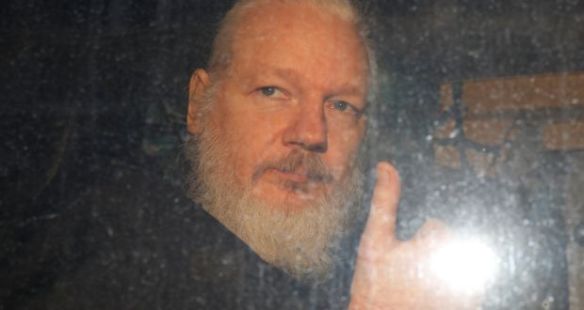
Wikileaks founder Julian Assange is merely the latest victim of the police state’s assault on dissidents and whistleblowers.

On April 11, 2019, police arrested Assange for daring to access and disclose military documents that portray the U.S. government and its endless wars abroad as reckless, irresponsible, immoral and responsible for thousands of civilian deaths.

Included among the leaked materials was gunsight video footage from two U.S. AH-64 Apache helicopters engaged in a series of air-to-ground attacks while American air crew laughed at some of the casualties. Among the casualties were two Reuters correspondents who were gunned down after their cameras were mistaken for weapons and a driver who stopped to help one of the journalists. The driver’s two children, who happened to be in the van at the time it was fired upon by U.S. forces, suffered serious injuries.

There is nothing defensible about crimes such as these perpetrated by the government.

When any government becomes almost indistinguishable from the evil it claims to be fighting—whether that evil takes the form of war, terrorism, torture, drug trafficking, sex trafficking, murder, violence, theft, pornography, scientific experimentations or some other diabolical means of inflicting pain, suffering and servitude on humanity—that government has lost its claim to legitimacy.

These are hard words, but hard times require straight-talking.

It is easy to remain silent in the face of evil.

What is harder—what we lack today and so desperately need—are those with moral courage who will risk their freedoms and lives in order to speak out against evil in its many forms.

Throughout history, individuals or groups of individuals have risen up to challenge the injustices of their age. Nazi Germany had its Dietrich Bonhoeffer. The gulags of the Soviet Union were challenged by Aleksandr Solzhenitsyn. America had its color-coded system of racial segregation and warmongering called out for what it was, blatant discrimination and profiteering, by Martin Luther King Jr.

And then there was Jesus Christ, an itinerant preacher and revolutionary activist, who not only died challenging the police state of his day—namely, the Roman Empire—but provided a blueprint for civil disobedience that would be followed by those, religious and otherwise, who came after him.

Indeed, it is fitting that we remember that Jesus Christ—the religious figure worshipped by Christians for his death on the cross and subsequent resurrection—paid the ultimate price for speaking out against the police state of his day.

A radical nonconformist who challenged authority at every turn, Jesus was a far cry from the watered-down, corporatized, simplified, gentrified, sissified vision of a meek creature holding a lamb that most modern churches peddle. In fact, he spent his adult life speaking truth to power, challenging the status quo of his day, and pushing back against the abuses of the Roman Empire.

Much like the American Empire today, the Roman Empire of Jesus’ day had all of the characteristics of a police state: secrecy, surveillance, a widespread police presence, a citizenry treated like suspects with little recourse against the police state, perpetual wars, a military empire, martial law, and political retribution against those who dared to challenge the power of the state.

For all the accolades poured out upon Jesus, little is said about the harsh realities of the police state in which he lived and its similarities to modern-day America, and yet they are striking.

Secrecy, surveillance and rule by the elite. As the chasm between the wealthy and poor grew wider in the Roman Empire, the ruling class and the wealthy class became synonymous, while the lower classes, increasingly deprived of their political freedoms, grew disinterested in the government and easily distracted by “bread and circuses.” Much like America today, with its lack of government transparency, overt domestic surveillance, and rule by the rich, the inner workings of the Roman Empire were shrouded in secrecy, while its leaders were constantly on the watch for any potential threats to its power. The resulting state-wide surveillance was primarily carried out by the military, which acted as investigators, enforcers, torturers, policemen, executioners and jailers. Today that role is fulfilled by the NSA, the FBI, the Department of Homeland Security and the increasingly militarized police forces across the country.

Widespread police presence. The Roman Empire used its military forces to maintain the “peace,” thereby establishing a police state that reached into all aspects of a citizen’s life. In this way, these military officers, used to address a broad range of routine problems and conflicts, enforced the will of the state. Today SWAT teams, comprised of local police and federal agents, are employed to carry out routine search warrants for minor crimes such as marijuana possession and credit card fraud.

Citizenry with little recourse against the police state. As the Roman Empire expanded, personal freedom and independence nearly vanished, as did any real sense of local governance and national consciousness. Similarly, in America today, citizens largely feel powerless, voiceless and unrepresented in the face of a power-hungry federal government. As states and localities are brought under direct control by federal agencies and regulations, a sense of learned helplessness grips the nation.

Perpetual wars and a military empire. Much like America today with its practice of policing the world, war and an over-arching militarist ethos provided the framework for the Roman Empire, which extended from the Italian peninsula to all over Southern, Western, and Eastern Europe, extending into North Africa and Western Asia as well. In addition to significant foreign threats, wars were waged against inchoate, unstructured and socially inferior foes.

Martial law. Eventually, Rome established a permanent military dictatorship that left the citizens at the mercy of an unreachable and oppressive totalitarian regime. In the absence of resources to establish civic police forces, the Romans relied increasingly on the military to intervene in all matters of conflict or upheaval in provinces, from small-scale scuffles to large-scale revolts. Not unlike police forces today, with their martial law training drills on American soil, militarized weapons and “shoot first, ask questions later” mindset, the Roman soldier had “the exercise of lethal force at his fingertips” with the potential of wreaking havoc on normal citizens’ lives.

A nation of suspects. Just as the American Empire looks upon its citizens as suspects to be tracked, surveilled and controlled, the Roman Empire looked upon all potential insubordinates, from the common thief to a full-fledged insurrectionist, as threats to its power. The insurrectionist was seen as directly challenging the Emperor.  A “bandit,” or revolutionist, was seen as capable of overturning the empire, was always considered guilty and deserving of the most savage penalties, including capital punishment. Bandits were usually punished publicly and cruelly as a means of deterring others from challenging the power of the state.  Jesus’ execution was one such public punishment.

Acts of civil disobedience by insurrectionists. Much like the Roman Empire, the American Empire has exhibited zero tolerance for dissidents such as Julian Assange, Edward Snowden and Chelsea Manning who exposed the police state’s seedy underbelly. Jesus branded himself a political revolutionary starting with his act of civil disobedience at the Jewish temple, the site of the administrative headquarters of the Sanhedrin, the supreme Jewish council. When Jesus “with the help of his disciples, blocks the entrance to the courtyard” and forbids “anyone carrying goods for sale or trade from entering the Temple,” he committed a blatantly criminal and seditious act, an act “that undoubtedly precipitated his arrest and execution.” Because the commercial events were sponsored by the religious hierarchy, which in turn was operated by consent of the Roman government, Jesus’ attack on the money chargers and traders can be seen as an attack on Rome itself, an unmistakable declaration of political and social independence from the Roman oppression.

Military-style arrests in the dead of night. Jesus’ arrest account testifies to the fact that the Romans perceived Him as a revolutionary. Eerily similar to today’s SWAT team raids, Jesus was arrested in the middle of the night, in secret, by a large, heavily armed fleet of soldiers.  Rather than merely asking for Jesus when they came to arrest him, his pursuers collaborated beforehand with Judas. Acting as a government informant, Judas concocted a kiss as a secret identification marker, hinting that a level of deception and trickery must be used to obtain this seemingly “dangerous revolutionist’s” cooperation.

Torture and capital punishment. In Jesus’ day, religious preachers, self-proclaimed prophets and nonviolent protesters were not summarily arrested and executed. Indeed, the high priests and Roman governors normally allowed a protest, particularly a small-scale one, to run its course. However, government authorities were quick to dispose of leaders and movements that appeared to threaten the Roman Empire. The charges leveled against Jesus—that he was a threat to the stability of the nation, opposed paying Roman taxes and claimed to be the rightful King—were purely political, not religious. To the Romans, any one of these charges was enough to merit death by crucifixion, which was usually reserved for slaves, non-Romans, radicals, revolutionaries and the worst criminals.
Jesus was presented to Pontius Pilate “as a disturber of the political peace,” a leader of a rebellion, a political threat, and most gravely—a claimant to kingship, a “king of the revolutionary type.” After Jesus is formally condemned by Pilate, he is sentenced to death by crucifixion, “the Roman means of executing criminals convicted of high treason.”  The purpose of crucifixion was not so much to kill the criminal, as it was an immensely public statement intended to visually warn all those who would challenge the power of the Roman Empire. Hence, it was reserved solely for the most extreme political crimes: treason, rebellion, sedition, and banditry. After being ruthlessly whipped and mocked, Jesus was nailed to a cross.

As Professor Mark Lewis Taylor observed:

The cross within Roman politics and culture was a marker of shame, of being a criminal. If you were put to the cross, you were marked as shameful, as criminal, but especially as subversive. And there were thousands of people put to the cross. The cross was actually positioned at many crossroads, and, as New Testament scholar Paula Fredricksen has reminded us, it served as kind of a public service announcement that said, “Act like this person did, and this is how you will end up.”

Jesus—the revolutionary, the political dissident, and the nonviolent activist—lived and died in a police state. Any reflection on Jesus’ life and death within a police state must take into account several factors: Jesus spoke out strongly against such things as empires, controlling people, state violence and power politics. Jesus challenged the political and religious belief systems of his day. And worldly powers feared Jesus, not because he challenged them for control of thrones or government but because he undercut their claims of supremacy, and he dared to speak truth to power in a time when doing so could—and often did—cost a person his life.

Unfortunately, the radical Jesus, the political dissident who took aim at injustice and oppression, has been largely forgotten today, replaced by a congenial, smiling Jesus trotted out for religious holidays but otherwise rendered mute when it comes to matters of war, power and politics.

Yet for those who truly study the life and teachings of Jesus, the resounding theme is one of outright resistance to war, materialism and empire.

What a marked contrast to the advice being given to Americans by church leaders to “submit to your leaders and those in authority,” which in the American police state translates to complying, conforming, submitting, obeying orders, deferring to authority and generally doing whatever a government official tells you to do.

Telling Americans to march in lockstep and blindly obey the government—or put their faith in politics and vote for a political savior—flies in the face of everything for which Jesus lived and died.

Ultimately, this is the contradiction that must be resolved if the radical Jesus—the one who stood up to the Roman Empire and was crucified as a warning to others not to challenge the powers-that-be—is to be an example for our modern age.

As I make clear in my book Battlefield America: The War on the American People, we must decide whether we will follow the path of least resistance—willing to turn a blind eye to what Martin Luther King Jr. referred to as the “evils of segregation and the crippling effects of discrimination, to the moral degeneracy of religious bigotry and the corroding effects of narrow sectarianism, to economic conditions that deprive men of work and food, and to the insanities of militarism and the self-defeating effects of physical violence”—or whether we will be transformed nonconformists “dedicated to justice, peace, and brotherhood.”

As King explained in a powerful sermon delivered in 1954, “This command not to conform comes … [from] Jesus Christ, the world’s most dedicated nonconformist, whose ethical nonconformity still challenges the conscience of mankind.”

We need to recapture the gospel glow of the early Christians, who were nonconformists in the truest sense of the word and refused to shape their witness according to the mundane patterns of the world.  Willingly they sacrificed fame, fortune, and life itself in behalf of a cause they knew to be right.  Quantitatively small, they were qualitatively giants.  Their powerful gospel put an end to such barbaric evils as infanticide and bloody gladiatorial contests.  Finally, they captured the Roman Empire for Jesus Christ… The hope of a secure and livable world lies with disciplined nonconformists, who are dedicated to justice, peace, and brotherhood.  The trailblazers in human, academic, scientific, and religious freedom have always been nonconformists.  In any cause that concerns the progress of mankind, put your faith in the nonconformist!

…Honesty impels me to admit that transformed nonconformity, which is always costly and never altogether comfortable, may mean walking through the valley of the shadow of suffering, losing a job, or having a six-year-old daughter ask, “Daddy, why do you have to go to jail so much?”  But we are gravely mistaken to think that Christianity protects us from the pain and agony of mortal existence.  Christianity has always insisted that the cross we bear precedes the crown we wear.  To be a Christian, one must take up his cross, with all of its difficulties and agonizing and tragedy-packed content, and carry it until that very cross leaves its marks upon us and redeems us to that more excellent way that comes only through suffering.

In these days of worldwide confusion, there is a dire need for men and women who will courageously do battle for truth.  We must make a choice. Will we continue to march to the drumbeat of conformity and respectability, or will we, listening to the beat of a more distant drum, move to its echoing sounds?  Will we march only to the music of time, or will we, risking criticism and abuse, march to the soul saving music of eternity?

Defending Julian Assange; Defending the Truth

By Robert J. Burrowes

On 11 April 2019, WikiLeaks editor Julian Assange was dragged from the Ecuadorian Embassy in London by UK police and arrested for breaching a bail condition. See ‘Arrest update – SW1’. Upon arrival at a London police station, Julian was ‘further arrested’ on behalf of the United States government to satisfy an extradition warrant under Section 73 of the UK Extradition Act. See ‘UPDATE: Arrest of Julian Assange’.

Following a brief court hearing in which the extraordinary prejudice of the district judge was on clear display – see ‘Chelsea and Julian Are in Jail. History Trembles’ – Julian is now imprisoned in south London’s maximum security Belmarsh Prison. He will appear in custody at Westminster Magistrates’ Court for a preliminary extradition hearing on 2 May and the US must produce its case for requesting Julian’s extradition from the UK by 12 June but, as Nicholas Weaver reports, Julian could be in UK custody for years as the extradition is contested in court. See ‘The Wikileaks Case Is Just Beginning’.

Prior to his arrest, Julian had been living in the Ecuadorian Embassy since 2012, having been granted citizenship of Ecuador and asylum by that country because many people were well aware of the risk he faced if he was tried in a kangaroo court in the United States. This asylum, to which Julian was entitled under long-standing provisions of international law, had been granted by previous Ecuadorian President Rafael Correa, who clearly understood this law (and the moral principles on which it is based).

As a result of his recent arrest however, Julian is under threat of extradition to the United States so that he can face criminal prosecution/persecution – see the US indictment of Julian Assange or ‘Read the Julian Assange indictment’ – for his role in exposing the truth about US war crimes in Afghanistan (the Afghan War Diary) and Iraq (the Iraq War Logs), as did The Guardian and The New York Times, by publishing leaked evidence of these crimes – including the ‘Collateral Murder’ video – as well as publishing evidence of widespread government corruption on the WikiLeaks website. It was this threat of persecution by US authorities that led Julian to seek asylum in the Ecuadorian Embassy in the first place.

However, since the election in Ecuador on 24 May 2017 of the criminal and cowardly president Lenín Moreno, Julian’s asylum has been under threat and the conditions of his stay in the Embassy have rapidly deteriorated. This is because Moreno has been anxious to divert public attention from the spotlight of corruption currently shining directly on him – see ‘Ecuador National Assembly to Start Corruption Probe of Moreno’ – and to secure the loans offered as bribes by US officials while capitulating to US government pressure to illegally terminate Julian’s political asylum. See ‘Ecuador Bowed to US Pressure, Violated Law – Assange’s Associate’ and ‘WikiLeaks Founder Julian Assange Arrested, Activists Rally to Stop US Extradition’.

Of course, the criminal and cowardly nature of Moreno’s action is highlighted by the fact that the decision of the Ecuadorian government to terminate Julian’s asylum was done in violation of article 79 of Ecuador’s constitution which forbids extradition of its own citizens. See ‘Republic of Ecuador Constitution of 2008’. As Moreno’s predecessor, Rafael Correa noted simply in one Facebook post: ‘Moreno is a corrupt man’. See ‘Facebook Removes Page of Ecuador’s Former President on Same Day as Assange’s Arrest’.

Unfortunately, as further evidence of its function as an elite agent, rather than facilitating free speech, Facebook promptly ‘unpublished’ Correa’s Facebook page. Clearly, Moreno’s corruption is not a subject that Facebook wants advertised. See ‘Facebook Removes Page of Ecuador’s Former President on Same Day as Assange’s Arrest’. Still, it should be pointed out, Twitter’s function as an elite agent is no different. See ‘Twitter Restricts Account of Julian Assange’s Mother’.

Naturally enough, despite elite efforts to control the narrative, many people and organizations around the world have been outraged at the treatment of Julian (as well as other truthful journalists and whistleblowers such as Chelsea Manning, who has recently been imprisoned yet again, and Edward Snowden) who act courageously on the basis that the public has a right to know about the criminality of their governments as well as to know the truth generally.

As long ago as 5 February 2016, the Office of the High Commissioner for Human Rights (OHCHR) at the United Nations issued a statement in which they ‘called on the Swedish and British authorities to end Mr. Assange’s deprivation of liberty, respect his physical integrity and freedom of movement, and afford him the right to compensation’ noting that its opinions are ‘legally-binding to the extent that they are based on binding international human rights law, such as the International Covenant on Civil and Political Rights (ICCPR)’. See Julian Assange arbitrarily detained by Sweden and the UK, UN expert panel finds.

Moreover, in recent days, UN officials have spoken openly of their serious concern if Julian’s asylum was illegally revoked. See ‘UN expert on privacy plans to visit Julian Assange’ and ‘Two UN Rapporteurs Are Concerned About Julian Assanges’ Situation’.

And just recently, on 11 April 2019, the American Civil Liberties Union issued its response to Julian’s arrest, noting that ‘Criminally prosecuting a publisher for the publication of truthful information would be a first in American history, and unconstitutional.’ The report added that ‘Any prosecution by the United States of Mr. Assange for Wikileaks’ publishing operations would be unprecedented and unconstitutional, and would open the door to criminal investigations of other news organizations. Moreover, prosecuting a foreign publisher for violating U.S. secrecy laws would set an especially dangerous precedent for U.S. journalists, who routinely violate foreign secrecy laws to deliver information vital to the public’s interest.’ See ACLU Comment on Julian Assange Arrest’.

So once extradited, would Julian have any chance of defending himself with the truth? As US attorney Bill Simpich explains, Julian will be prevented from presenting the essential elements of his defense because ‘The [US] government doesn’t want a fair fight. In a fair fight, the government will lose.’ See ‘The Julian Assange Case: Revealing War Crimes Is Not a Crime’.

More bluntly, Jonathan Turley points out:

‘[T]he Justice Department is likely to move aggressively to strip Assange of his core defenses. Through what is called a motion in limine, the government will ask the court to declare that the disclosure of intelligence controversies is immaterial. This would leave Assange with only the ability to challenge whether he helped with passwords and little or no opportunity to present evidence of his motivations or the threat to privacy.

‘The key to prosecuting Assange has always been to punish him without again embarrassing the powerful figures made mockeries by his disclosures. That means to keep him from discussing how the U.S. government concealed attacks and huge civilian losses, the type of disclosures that were made in the famous Pentagon Papers case. He cannot discuss how Democratic and Republican members either were complicit or incompetent in their oversight. He cannot discuss how the public was lied to about the program.’ See ‘Julian Assange Will Be Punished for Embarrassing the DC Establishment’.

Hence, while the Ecuadorian, British and US governments are flagrantly violating the law in persecuting Julian, it is being left to individuals and civil society organizations to defend him and many are mobilizing to do so already.

As a result, people have signed petitions – see Don’t extradite Assange!’ and Block Extradition & Prosecution of Julian Assange for First Amendment-Protected Journalism’ – some have participated in demonstrations at UK embassies and consulates around the world – see, for example, ‘Protesters Call on UK to #FreeAssange Outside British Embassy in DC’ – and others have engaged in other acts of solidarity as suggested, for example, by Julian’s mother Christine or on the website ‘Defend WikiLeaks’ and in this article: ‘Julian Assange Arrested, Take Action Now’.

Given the importance of defending our access to accurate information about our world, rather than the propaganda marketed as ‘news’ by the corporate media, it is worth reflecting on how best we can do this and, in doing so, defend people like Julian and Chelsea (who play such a vital role in giving us access to the truth in particular contexts) at the same time.

Hence, because of my own longstanding interest in developing thoughtfully-designed nonviolent strategies in our struggle to make our world one of peace, justice and ecological sustainability, let me suggest a strategic way forward that will honor the courage of Julian and Chelsea by maximizing the impact of their truth-telling on the longer-term struggles just mentioned while also taking separate action to provide some additional pressure to assist them in the short and medium terms.

In order to design this strategy well, let us first analyze the issue of why those who tell the truth are persecuted. If we do not understand, precisely, why this happens, we cannot respond powerfully.

Accurate Strategic Analysis Depends on Knowing the Truth

If we are to understand, accurately, the context and structural dimensions of a conflict (that is, the ‘big picture’ in which it is contained) so that we can identify and analyze the underlying drivers of the conflict in order to develop a coherent strategy to address these drivers, then the very first prerequisite is that we have truthful information. Without this truthful information, activists have zero prospect of accurately understanding and analyzing what is happening in the world (such as in relation to war and the climate catastrophe, for example).

Because the global elite is highly aware of the importance of the truth, it goes to enormous effort to make it difficult, if not impossible, to access the truth, particularly in certain critical contexts. And there are some classic historical examples, among many others, where not knowing the truth has allowed elites to inflict monumental atrocities in our name while crippling efforts to strategically mobilize opposition to these atrocities.

The most obvious examples of this phenomenon include ‘false flag’ attacks such as those conducted by US authorities and their allies on 9/11 as the prelude to launching their ‘war on terror’ which has caused immeasurable damage to, if not virtually destroyed, entire countries across west Asia and north Africa. If the truth about those behind the 9/11 attacks had been immediately available, rather than still ‘dribbling out’ nearly 20 years later, then it would have been far easier to mobilize resistance to the US-led wars on other countries and to campaign, strategically, for the profound changes needed to ensure that our world is spared the scourge of such atrocities in future. To access the definitive account of the overwhelming evidence in relation to 9/11 as a false flag attack, see 9/11 Unmasked: An International Review Panel Investigation which is reviewed in ‘The Fakest Fake News: The U.S. Government’s 9/11 Conspiracy Theory’. For a long but incomplete list of false flag attacks, see ‘The Ever-Growing List of ADMITTED False Flag Attacks’.

So if we ask the question ‘Who played the primary role in deceiving us about 9/11 and molding the desired public response?’, the answer is that it was some key government, corporate, military and bureaucratic spokespeople and, particularly, the corporate media projecting the words of these official spokespeople far and wide. But if we ask the question ‘Who was controlling these spokespeople and the corporate media?’ the answer is ‘the global elite’.

This is because a primary function of the global elite, which it has long understood, is to create (using individuals employed within its think tanks as well as compliant academics) and maintain (through education systems, the entertainment industry and the corporate media) the dominant narrative in society so that the information available to the public is the information that the elite needs to shape public perception in favor of elite interests, such as perpetual war and chronic over-consumption, which ensure perpetuation of elite power, profit and privilege.

Hence, as you can see, people like Julian Assange and Chelsea Manning and organizations like WikiLeaks represent a fundamental threat to elite power, profit and privilege precisely because their truth-telling functionally undermines the elite narrative, for example, that our ‘enemy’ is a bunch of terrorists somewhere rather than the global elite itself.

While the false flag examples offered above highlight how suppression of the truth disempowers activists and populations thus helping to minimize any effective mobilization in response, there are also a great many examples where the truth was critical to informing and helping to mobilize activists to resist injustice, in one form or another. For example, Kevin Zeese superbly illustrates the crucial importance of WikiLeaks in facilitating awareness of the truth during the uprisings in 2011 across north Africa and west Asia. See ‘Julian Assange: At the Forefront of 21st Century Journalism’.

In essence then, it is individuals like Julian and Chelsea, rather than the sycophantic editors, reporters and journalists working for the corporate media, who give us the information we need to know so that we can better understand how our dysfunctional and violent world works and campaign effectively to change it.

And so they are enemies of the elite who must be silenced and discredited, legally or otherwise.

If you would like to read other accounts by individuals who astutely warn us of the deeper implications of what is happening to Julian, see the recent articles by Chris Hedges The Martyrdom of Julian Assange’ and John Pilger The Assange Arrest Is a Warning from History’.

So what do we do?

Well, I believe we honor individuals like Julian and Chelsea by using the truths they reveal to us to develop and implement thoughtfully-designed nonviolent strategies to make our world one of peace, justice and ecological sustainability. This is why they risk paying (and are now paying) such a high personal price to get us the truth that must inform these struggles. But we can also assist courageous individuals like Julian and Chelsea in the short-term too. So let me also add to the suggestions made by others mentioned above.

If we are to make the most use of the truth that Julian and Chelsea have risked (and paid) so much to get to us, then we must campaign strategically. By doing this, as I just mentioned, we truly honor their efforts and sacrifice. So, for example, if you want to campaign to end the elite’s wars and destruction of our climate from which it profits so enormously, then consider doing it strategically. See Nonviolent Campaign Strategy. This site identifies, among other key elements of strategy, the two strategic aims and the basic list of strategic goals necessary to achieve these outcomes. See ‘Campaign Strategic Aims’.

Irrespective of whether or not you are keen on campaigning in this way, there is a fifteen-year strategy for tackling all elements of our environmental crisis in The Flame Tree Project to Save Life on Earth.

If you would like to tackle the problem at its core, consider making ‘My Promise to Children’ so that your children grow up with the conscience and courage of Julian and Chelsea. Unfortunately, individuals of their conscience and courage are incredibly rare in our world: not a powerful place to start in tackling a global elite that is utterly insane.

‘Insane?’ you might ask. Remember this: the global elite and many of its political, corporate, bureaucratic, military and academic agents, spend their time planning and implementing strategies to kill people (using military violence and economic exploitation) to make a profit. Do you really believe that this is something that a sane person would spend their time doing? I know you have been inundated with propaganda throughout your life to make you accept (or ignore) the violence in our world without question but pause and ponder it now: is it really sane? Are we not capable, as a species, of organizing our world to achieve peace, justice and ecological sustainability? See ‘The Global Elite is Insane Revisited’ with a lot more detail in Why Violence?’ and Fearless Psychology and Fearful Psychology: Principles and Practice.

Moreover, individuals who are not incredibly psychologically damaged do not manipulate elite institutions – such as the legal system: see ‘The Rule of Law: Unjust and Violent’ – to persecute powerful individuals like Julian and Chelsea. The conscience and courage of Julian and Chelsea are readily recognized by those who are not psychologically damaged: they are qualities of exceptional individuals whom we should honor.

If you would like to join the worldwide movement to end all violence, you are welcome to sign the online pledge of The Peoples Charter to Create a Nonviolent World.

But we do not need to confine our acts of solidarity with Julian and Chelsea to those regarding strategies for profound change or the others mentioned above either. If you want to act powerfully in their support, consider the following five options as well and do as many as you can:

  1. Boycott The Guardian and The New York Times (because they were two of the original outlets that published material sourced from WikiLeaks but now hypocritically engage in the persecution of Julian and Chelsea). And suggest to others that they also boycott these media outlets.
  2. Boycott all media outlets (anywhere in the world) that advocate or support the arrest, trial and/or imprisonment of Julian and/or Chelsea. And suggest to others that they boycott these media outlets too. If you want the truth about our world, get it from news outlets like the one you are reading now.
  3. Boycott Facebook. And suggest to others that they boycott this medium too.
  4. Boycott Twitter. And suggest to others that they boycott this medium too.
  5. Write letters of solidarity to Julian and Chelsea. Tell them what you are doing to make best use of the truths they have revealed.

Given elite control of all political, economic, commercial, legal, social and media institutions of any consequence in our world, it will not be easy to liberate Julian (and, perhaps, even Chelsea) in the short term. UK and US elites may even conspire to secretly put Julian on a rendition flight to the US or simply be content with a protracted legal struggle which distracts many of us from the issues that Julian and Chelsea so courageously put in the spotlight.

For that reason, while we struggle to liberate them we can also struggle to liberate the vast number of other people who suffer the elite’s military violence and economic exploitation so that the efforts of Julian and Chelsea are not in vain.


Biodata: Robert J. Burrowes has a lifetime commitment to understanding and ending human violence. He has done extensive research since 1966 in an effort to understand why human beings are violent and has been a nonviolent activist since 1981. He is the author of Why Violence? His email address is flametree@riseup.net and his website is here.


Assange arrest: The turning point is here—don’t let them win

Will we wait until they come for us because our homes are built atop resources they wish to plunder, because we shared information online they found objectionable, because we dared to question why madmen are in control of our country and much of the world?

By Whitney Webb

Source: Intrepid Report

LONDON—Yesterday morning, the London-based branch of Empire made good on its threat and boldly moved to begin dismantling the vestiges of democracy and press freedom that still remain, vestiges that have allowed people throughout the Western world to pretend that their government and politicians still respect their rights and the rule of law.

Julian Assange, the man who has helped expose a litany of crimes and the in-your-face corruption of the world’s most powerful people and governments, was pulled from the embassy of the country where he not only holds citizenship but had been granted asylum. The dangerous precedents Assange’s arrest has set—not just for journalism, but also for national sovereignty and international law—are staggering.

With Assange now in U.K. custody, his fate will mirror our own, as Assange’s fate and that of journalists around the world, as well as the public itself, are increasingly intertwined. After all, those who are after Assange and seek to rob him of his freedom—the U.S. Empire, the “deep state,” the shadow government, the global elite, etc.—are after our freedom as well.

If we remain silent as they jail, extradite, torture or even kill this man, we may expect a similar fate for ourselves. It will not come tomorrow. It will not come next week. It could be years away. But make no mistake, the global empire, whose core is the U.S. government, will now be empowered to charge and imprison anyone it deems a threat to its operations.

Those operations, including those that Assange helped to expose, often involve the mass murder of innocent civilians—untold numbers of children among them—in order to loot the resources of other sovereign nations. They also often involve the installation of puppet governments by either covert (e.g., election “meddling”) or overt (e.g., regime-change wars) means.

Those responsible for the most egregious violations of international law, for war crimes, for the slaughter of innocent life, are not imprisoned, degraded or tortured—they are rewarded and promoted. As we have seen today—and in recent weeks, particularly following Chelsea Manning’s imprisonment—those who seek to expose these crimes are the ones who are threatened, tortured and punished.

Like it or not, we are all already a part of this war

The world has known for years that Assange would meet this fate. Little was done. Now, the turning point is here. Will we continue to escape into the false realities of television, cinema, video games, and whatever we use to distract us and numb our pain while the actual world in which we live devolves into a technocratic, imperial dictatorship? Will we continue to ignore the obvious threats to our lives and our children’s lives because confronting these threats is uncomfortable and often difficult?

Will we wait until they come for us because our homes are built atop resources they wish to plunder, because we shared information online they found objectionable, because we dared to question why madmen are in control of our country and much of the world?

Such an eventuality may seem laughable to some, but those days are not far away and are already here for many people around the world, even in the West. Assange’s arrest is the first shot of a war to which all of us, like it or not, have already been drafted because it is a war for the very world in which we live—a war for our society, our planet, our livelihood, our right to self-determination. You can try to escape to the ends of the Earth, thousands of miles away from “the West” (as I myself did), only to find that there is no country anywhere in the world that is not currently under siege.

Never before in history has the global oligarchy been more powerful. The concentration of power and wealth in the hands of the few is unprecedented, worse even than in the Gilded Age or the final days of the Roman Empire. These people do not plan to cede any of this power to you. They do not want you to have control over your own lives. To them, we are already slaves. And those who are silent, especially now, are sending a signal to the elites that they embrace that servitude.

The revolution will not be televised and the war will not be won on social media

For too long, actions in defense of Assange, and more broadly in protest of Empire, have been focused in the virtual realm—that is, on the Internet and social media. While the Internet and social media are important tools for sharing information, their use for that end is being suppressed like never before and it will not be long before social media is entirely censored and devoid of dissent. If we wait until that day comes, and put all our eggs in the social media basket, we will have shot ourselves in the foot and it could well be a fatal blow.

We can no longer run from the world, escape into our remaining comforts—particularly those online—while the world burns. Assange may be the first journalist to be arrested and extradited under these circumstances, but he will not be the last. What we do now will determine how far they go.

The U.S. and its allies are prepping for several wars, many of them against countries much larger than Iraq, and such wars could make Iraq and Afghanistan look like skirmishes by comparison. The people behind Assange’s arrest and perpetual imperial wars do not care about your tweets or Facebook posts. They want your focus to remain on the virtual world and away from the real one over which they are consolidating their control.

Now is the time to resist. Now is the time to insist. Now is the time to take to the streets, to talk to your neighbors, family and co-workers of the dangers facing us all. Your voice and your actions matter. The longer we wait, the worse things will become. The turning point is here. Don’t let them win.


Whitney Webb is a MintPress News journalist based in Chile. She has contributed to several independent media outlets including Global Research, EcoWatch, the Ron Paul Institute and 21st Century Wire, among others. She has made several radio and television appearances and is the 2019 winner of the Serena Shim Award for Uncompromised Integrity in Journalism.

Oceania, Eurasia and Eastasia Merger: Global Empire of Dystopia?

By Gilbert Mercier

Source: News Junkie Post

The nature of reality in times of universal confusion

The world and our interpretation of it are often at best an idea and, at worse, a figment of our imagination. In our full-blown Orwellian construct, the truths of some are the fake news of others. Invisible forces and undisclosed interests rule the world and its so-called leaders, who are mostly actor-puppets directed from scripted narratives. They largely live in an alternate universe where, if you repeat outlandish lies often and loudly enough, the disinformation becomes the unquestionable reality for countless people. Reality has become stranger than fiction because the conflicting narratives about what is supposed to be real are, by and large, fictional. They are cleverly crafted propaganda that manipulate by maximizing confusion. The masters of this craft have gutted familiar words of all meaning.

For example, at the heart of Oceania, the white-orange clown emperor, obsessed with walls to protect his subjects from southern brown invaders, told his adoring patrons and sycophants, “we renew our resolve that Oceania shall never be socialist!” The aging patricians gathered for the obligatory annual feast gave him a standing ovation, and loudly chanted “Oceania, Oceania, Oceania!…” This enthusiastic chanting from Oceania’s Patricians, except for the more dignified Supreme Elders and Commanders of the Praetorian Guard, repeated itself on cue at least four of five times, to celebrate the great universal superiority of the invincible mighty empire of the free and the brave! The egotistical emperor’s writers must have laughed as he served up their outstanding fictions to the empire’s docile subjects!

Schopenhauer’s relevant pessimism

In his essential book, The World as Will and Idea, the German philosopher Arthur Schopenhauer (1788-1860) contested the rationalist notion that reason alone gave humans the universal key to an infinitely complex, and often irrational, reality. He took the assessments Immanuel Kant had made in his Critique of Pure Reason a step further by adding the fundamental notion of sufficient reason. This was a less absolute concept of the relation of cause to effect, which he anchored in what he deemed to be four categories of human knowledge: science, morality, logic, and metaphysics. Schopenhauer’s work was in part a reaction to the overly optimistic vision of the rationalists, with Rene Descartes in the lead.

In his inherent pessimism, Schopenhauer turned out to be more realistic about the limitations of humans to grasp, not only the full elusive scope of reality, but also their own frailty and insignificance as a self. In these gloomy times of uncertainty and of a general dumbing-down effect in our impoverished global culture, Schopenhauer’s work helps to explain why most aspects of our existence, including our relationship with nature, are beyond most people’s comprehension. For most humans, the absolute reality is an extremely fragmented knowledge filtered through the prism of their perceptions.

Global empire of dystopia?

In other words, whether one lives in Oceania, Eurasia, or Eastasia, the definitions of reality and information have been tailored in these different places to different needs, but almost all the narratives fulfill opaque agendas whose main objectives are to keep people on edge and in despair. The brainwashing from most media makes nearly everybody thoroughly dazed and confused. The goal is to break the will of populations and beat their souls into submission. For this to work, dissent must be eradicated. Let’s face it, if we stay on course, Oceania, Eurasia and Eastasia could soon merge into the global Empire of Dystopia where 2+2=5. For example, Oceania claims that, with its satellite-vassals, the empire defeated ISIS, which it had worked to create, although it is the leader of sovereign Syria (with the help of Eurasia and the former empire of Persia) who defeated both Oceania and ISIS after seven years of war.

From one manufactured crisis to another, always in what my esteemed colleague Dady Chery calls “other people’s countries,” the mad circus goes on and on like a merry-go-round. And it works, so long as the big lies are salted with a little truth for seasoning. As world citizens, we are tasked with dismantling this monstrous global Orwellian Empire of many faces that is tightening its grip everywhere.

Empires of the past and present, which are in flux, have always extended their powers through satellite provinces and spheres of influence. Empires dislike dissent from within, as well as nearby states that are eager to stay independent and sovereign. During the simpler times of the Cold War when the United States and USSR tried to divide the world in two, some independently minded head of states, such as Tito, Nasser and Castro, refused to submit to this bipolarity and initiated the nonaligned movement. This notion must be urgently revisited, for the sake of the little that is left of smaller nations’ sovereignty.

Of course, Orwell’s cartography of the three entities of Oceania, Eurasia and Eastasia no longer reflects the geopolitical reality, but his principle of mass indoctrination is at play on a global scale. The narratives appear to be in conflict, but the nitty-gritty mechanics below the radar are similar. Under the surface, and despite the veneers of ideological or religious clashes, a global scheme of wealth and power concentration has been unleashed. Worldwide, the super-rich, and the corporate entities they control, are getting richer while the middle-class is vanishing and the poor are becoming enslaved. Merciless capitalism is the true god of the Orwellian Empire’s three subdivisions. Capitalism demands daily sacrifices of sweat, tears and blood. The system’s blatant contradictions do not trouble its ruling class. On one hand, pseudo nationalist-populists are the servants of a supra-national corporatism, and on the other, the so-called liberals and neoliberals can, on short notice, adopt the worst methods of authoritarian repression.

Two examples of this are unfolding that serve as valuable case studies. First, there is Oceania’s effort to grab a critical piece of what it views as its birthright continent. This is, of course, Venezuela. Secondly, in La Macronie, an eastern asset of Oceania that used to be an empire in its own right, there is the intent to create an authoritarian neoliberal regime with a metrosexual humanitarian touch, to curtail widespread popular protests.

Venezuela: Revolution is imperialism

Oceania has in its crosshair the sovereign state of Venezuela, founded by Simon Bolivar. All empires have precepts or doctrines that conveniently serve to expand their territories and influence by various means, including military invasions, organization of coups and, lately, severe economic sanctions to engineer failed states that become ripe for orchestrated revolutions. The nervous system of Oceania, in Washington DC, views Venezuela as a natural appendage, based on one of the oldest formative tenets of the empire: the Monroe Doctrine, concocted in 1823. It came about using the seemingly altruistic but false notion that the newly independent countries of Central and South America had to be protected from their old colonial masters. In time, it became a claim to all the Americas as the United States’ domain and backyard.

To topple the legitimately elected Venezuelan President, Nicolas Maduro, whom Washington does not like, the empire is again trying to manufacture a revolution led by someone it handpicked and groomed. The name of the man who currently aspires to be Oceania’s Governor in Venezuela hardly matters. Through the years, the strategy of fake revolution following economic sanctions has had mixed results: it failed in Iran in 2009; it worked against Qaddafi in Libya, combined with a small military intervention; it partially worked in Ukraine until Eurasia stepped in; it failed entirely in Syria, where Bashar al-Assad remains in power. With Venezuela’s military still firmly on his side, this strategy is unlikely to work with the heir of Hugo Chavez.

So far the aggression against Venezuela has served as a thorough head count of Oceania’s vassals and enemies. In the Americas, Bolivia, Cuba, Mexico, Nicaragua, and Uruguay have defied the with-or-against-us litmus test. The rest, including Canada, have aligned themselves with the imperial diktat that Maduro must go. It is the same with most of the European imperial colonies of Oceania, except for Italy and Greece. This is a clear demonstration that the leaders of most states in the European Union lack a foreign policy independent from Oceania and operate largely as governors for Oceania rather than heads of state.

Indeed, according to Mr. Temir Porras, who has worked as Nicolas Maduro’s chief-of-staff and a foreign-policy advisor to Hugo Chavez, the position of most EU countries in supporting Guaido reeks of “neocolonialist interference.” The eight-day “ultimatum to hold presidential elections before recognizing Juan Guaido is a schizophrenic and incomprehensible position.” Porras elaborates that it is “absurd to say that Juan Guaido represents a consensus with Maduro’s opposition in Venezuela,” and that Guaido from the far-right populist party, Voluntad Popular, was almost unknown in Venezuela two weeks ago.

On the opposite side, to go back to Orwell’s cartography lexicon, those that claim so far that “Maduro must stay,” besides the four Latin American countries named above, involve an interesting alliance of Eurasia, Eastasia, and the former Persian and Ottoman empires.

Gilets Jaunes: rays of sunshine on a bleak horizon

Meanwhile, in La Macronie, a beautiful land with a soil rich in its bounty of bread, wine and revolution, a real revolution is brewing from the streets. A little light flickers at the end of the tunnel of our gloomy path, it is like countless little rays of sunshine that try to brighten our dark days, it is the Gilets Jaunes movement. The little governor for Oceania, an arrogant and imperious man who might have liked to be king in a parallel universe, is trying to stop the flow of a tempestuous Gilets Jaunes river with rubber-bullet guns, riot-police shields, and repressive legislation. The disparity between his actions and his almost humanitarian discourse have lost him all credibility. In La Macronie, the governor, by curtailing the freedom to protest and freedom of the press, is testing a brand new form of oppression. It is a young elegant authoritarian regime, with a smile, that caters to the global elite of murderous capitalism. This is an important test, and many worldwide are counting on the Gilets Jaunes to prevail.


Editor’s Notes: Gilbert Mercier is the author of The Orwellian Empire. Photographs one, five, six, seven and eight from the archives of Jakob Reimann; two from the archive of Wackystuff; three from the archive of Philip Pacemaker; four by Daryn Moffitt; nine by Nicholas J. Potter; ten and eleven by Joka Madruga; and fourteen by Urban Nauth.

Wall Street, Banks, and Angry Citizens

The Inequality Gap on a Planet Growing More Extreme

By Nomi Prins

Source: TomDispatch.com

As we head into 2019, leaving the chaos of this year behind, a major question remains unanswered when it comes to the state of Main Street, not just here but across the planet. If the global economy really is booming, as many politicians claim, why are leaders and their parties around the world continuing to get booted out of office in such a sweeping fashion?

One obvious answer: the post-Great Recession economic “recovery” was largely reserved for the few who could participate in the rising financial markets of those years, not the majority who continued to work longer hours, sometimes at multiple jobs, to stay afloat. In other words, the good times have left out so many people, like those struggling to keep even a few hundred dollars in their bank accounts to cover an emergency or the 80% of American workers who live paycheck to paycheck.

In today’s global economy, financial security is increasingly the property of the 1%. No surprise, then, that, as a sense of economic instability continued to grow over the past decade, angst turned to anger, a transition that — from the U.S. to the Philippines, Hungary to Brazil, Poland to Mexico — has provoked a plethora of voter upheavals. In the process, a 1930s-style brew of rising nationalism and blaming the “other” — whether that other was an immigrant, a religious group, a country, or the rest of the world — emerged.

This phenomenon offered a series of Trumpian figures, including of course The Donald himself, an opening to ride a wave of “populism” to the heights of the political system. That the backgrounds and records of none of them — whether you’re talking about Donald Trump, Viktor Orbán, Rodrigo Duterte, or Jair Bolsonaro (among others) — reflected the daily concerns of the “common people,” as the classic definition of populism might have it, hardly mattered. Even a billionaire could, it turned out, exploit economic insecurity effectively and use it to rise to ultimate power.

Ironically, as that American master at evoking the fears of apprentices everywhere showed, to assume the highest office in the land was only to begin a process of creating yet more fear and insecurity. Trump’s trade wars, for instance, have typically infused the world with increased anxiety and distrust toward the U.S., even as they thwarted the ability of domestic business leaders and ordinary people to plan for the future. Meanwhile, just under the surface of the reputed good times, the damage to that future only intensified. In other words, the groundwork has already been laid for what could be a frightening transformation, both domestically and globally.

That Old Financial Crisis

To understand how we got here, let’s take a step back. Only a decade ago, the world experienced a genuine global financial crisis, a meltdown of the first order. Economic growth ended; shrinking economies threatened to collapse; countless jobs were cut; homes were foreclosed upon and lives wrecked. For regular people, access to credit suddenly disappeared. No wonder fears rose. No wonder for so many a brighter tomorrow ceased to exist.

The details of just why the Great Recession happened have since been glossed over by time and partisan spin. This September, when the 10th anniversary of the collapse of the global financial services firm Lehman Brothers came around, major business news channels considered whether the world might be at risk of another such crisis. However, coverage of such fears, like so many other topics, was quickly tossed aside in favor of paying yet more attention to Donald Trump’s latest tweets, complaints, insults, and lies. Why? Because such a crisis was so 2008 in a year in which, it was claimed, we were enjoying a first class economic high and edging toward the longest bull-market in Wall Street history. When it came to “boom versus gloom,” boom won hands down.

None of that changed one thing, though: most people still feel left behind both in the U.S. and globally. Thanks to the massive accumulation of wealth by a 1% skilled at gaming the system, the roots of a crisis that didn’t end with the end of the Great Recession have spread across the planet, while the dividing line between the “have-nots” and the “have-a-lots” only sharpened and widened.

Though the media hasn’t been paying much attention to the resulting inequality, the statistics (when you see them) on that ever-widening wealth gap are mind-boggling. According to Inequality.org, for instance, those with at least $30 million in wealth globally had the fastest growth rate of any group between 2016 and 2017. The size of that club rose by 25.5% during those years, to 174,800 members. Or if you really want to grasp what’s been happening, consider that, between 2009 and 2017, the number of billionaires whose combined wealth was greater than that of the world’s poorest 50% fell from 380 to just eight. And by the way, despite claims by the president that every other country is screwing America, the U.S. leads the pack when it comes to the growth of inequality. As Inequality.org notes, it has “much greater shares of national wealth and income going to the richest 1% than any other country.”

That, in part, is due to an institution many in the U.S. normally pay little attention to: the U.S. central bank, the Federal Reserve. It helped spark that increase in wealth disparity domestically and globally by adopting a post-crisis monetary policy in which electronically fabricated money (via a program called quantitative easing, or QE) was offered to banks and corporations at significantly cheaper rates than to ordinary Americans.

Pumped into financial markets, that money sent stock prices soaring, which naturally ballooned the wealth of the small percentage of the population that actually owned stocks. According to economist Stephen Roach, considering the Fed’s Survey of Consumer Finances, “It is hardly a stretch to conclude that QE exacerbated America’s already severe income disparities.”

Wall Street, Central Banks, and Everyday People

What has since taken place around the world seems right out of the 1930s. At that time, as the world was emerging from the Great Depression, a sense of broad economic security was slow to return. Instead, fascism and other forms of nationalism only gained steam as people turned on the usual cast of politicians, on other countries, and on each other. (If that sounds faintly Trumpian to you, it should.)

In our post-2008 era, people have witnessed trillions of dollars flowing into bank bailouts and other financial subsidies, not just from governments but from the world’s major central banks. Theoretically, private banks, as a result, would have more money and pay less interest to get it. They would then lend that money to Main Street. Businesses, big and small, would tap into those funds and, in turn, produce real economic growth through expansion, hiring sprees, and wage increases. People would then have more dollars in their pockets and, feeling more financially secure, would spend that money driving the economy to new heights — and all, of course, would then be well.

That fairy tale was pitched around the globe. In fact, cheap money also pushed debt to epic levels, while the share prices of banks rose, as did those of all sorts of other firms, to record-shattering heights.

Even in the U.S., however, where a magnificent recovery was supposed to have been in place for years, actual economic growth simply didn’t materialize at the levels promised. At 2% per year, the average growth of the American gross domestic product over the past decade, for instance, has been half the average of 4% before the 2008 crisis. Similar numbers were repeated throughout the developed world and most emerging markets. In the meantime, total global debt hit $247 trillion in the first quarter of 2018. As the Institute of International Finance found, countries were, on average, borrowing about three dollars for every dollar of goods or services created.

Global Consequences

What the Fed (along with central banks from Europe to Japan) ignited, in fact, was a disproportionate rise in the stock and bond markets with the money they created. That capital sought higher and faster returns than could be achieved in crucial infrastructure or social strengthening projects like building roads, high-speed railways, hospitals, or schools.

What followed was anything but fair. As former Federal Reserve Chair Janet Yellen noted four years ago, “It is no secret that the past few decades of widening inequality can be summed up as significant income and wealth gains for those at the very top and stagnant living standards for the majority.” And, of course, continuing to pour money into the highest levels of the private banking system was anything but a formula for walking that back.

Instead, as more citizens fell behind, a sense of disenfranchisement and bitterness with existing governments only grew. In the U.S., that meant Donald Trump. In the United Kingdom, similar discontent was reflected in the June 2016 Brexit vote to leave the European Union (EU), which those who felt economically squeezed to death clearly meant as a slap at both the establishment domestically and EU leaders abroad.

Since then, multiple governments in the European Union, too, have shifted toward the populist right. In Germany, recent elections swung both right and left just six years after, in July 2012, European Central Bank (ECB) head Mario Draghi exuded optimism over the ability of such banks to protect the financial system, the Euro, and generally hold things together.

Like the Fed in the U.S., the ECB went on to manufacture money, adding another $3 trillion to its books that would be deployed to buy bonds from favored countries and companies. That artificial stimulus, too, only increased inequality within and between countries in Europe. Meanwhile, Brexit negotiations remain ruinously divisive, threatening to rip Great Britain apart.

Nor was such a story the captive of the North Atlantic. In Brazil, where left-wing president Dilma Rouseff was ousted from power in 2016, her successor Michel Temer oversaw plummeting economic growth and escalating unemployment. That, in turn, led to the election of that country’s own Donald Trump, nationalistic far-right candidate Jair Bolsonaro who won a striking 55.2% of the vote against a backdrop of popular discontent. In true Trumpian style, he is disposed against both the very idea of climate change and multilateral trade agreements.

In Mexico, dissatisfied voters similarly rejected the political known, but by swinging left for the first time in 70 years. New president Andrés Manuel López Obrador, popularly known by his initials AMLO, promised to put the needs of ordinary Mexicans first. However, he has the U.S. — and the whims of Donald Trump and his “great wall” — to contend with, which could hamper those efforts.

As AMLO took office on December 1st, the G20 summit of world leaders was unfolding in Argentina. There, amid a glittering backdrop of power and influence, the trade war between the U.S. and the world’s rising superpower, China, came even more clearly into focus. While its president, Xi Jinping, having fully consolidated power amid a wave of Chinese nationalism, could become his country’s longest serving leader, he faces an international landscape that would have amazed and befuddled Mao Zedong.

Though Trump declared his meeting with Xi a success because the two sides agreed on a 90-day tariff truce, his prompt appointment of an anti-Chinese hardliner, Robert Lighthizer, to head negotiations, a tweet in which he referred to himself in superhero fashion as a “Tariff Man,” and news that the U.S. had requested that Canada arrest and extradite an executive of a key Chinese tech company, caused the Dow to take its fourth largest plunge in history and then fluctuate wildly as economic fears of a future “Great Something” rose. More uncertainty and distrust were the true product of that meeting.

In fact, we are now in a world whose key leaders, especially the president of the United States, remain willfully oblivious to its long-term problems, putting policies like deregulation, fake nationalist solutions, and profits for the already grotesquely wealthy ahead of the future lives of the mass of citizens. Consider the yellow-vest protests that have broken out in France, where protestors identifying with left and right political parties are calling for the resignation of neoliberal French President Emmanuel Macron. Many of them, from financially starved provincial towns, are angry that their purchasing power has dropped so low they can barely make ends meet.

Ultimately, what transcends geography and geopolitics is an underlying level of economic discontent sparked by twenty-first-century economics and a resulting Grand Canyon-sized global inequality gap that is still widening. Whether the protests go left or right, what continues to lie at the heart of the matter is the way failed policies and stop-gap measures put in place around the world are no longer working, not when it comes to the non-1% anyway. People from Washington to Paris, London to Beijing, increasingly grasp that their economic circumstances are not getting better and are not likely to in any presently imaginable future, given those now in power.

A Dangerous Recipe

The financial crisis of 2008 initially fostered a policy of bailing out banks with cheap money that went not into Main Street economies but into markets enriching the few. As a result, large numbers of people increasingly felt that they were being left behind and so turned against their leaders and sometimes each other as well.

This situation was then exploited by a set of self-appointed politicians of the people, including a billionaire TV personality who capitalized on an increasingly widespread fear of a future at risk. Their promises of economic prosperity were wrapped in populist platitudes, normally (but not always) of a right-wing sort. Lost in this shift away from previously dominant political parties and the systems that went with them was a true form of populism, which would genuinely put the needs of the majority of people over the elite few, build real things including infrastructure, foster organic wealth distribution, and stabilize economies above financial markets.

In the meantime, what we have is, of course, a recipe for an increasingly unstable and vicious world.