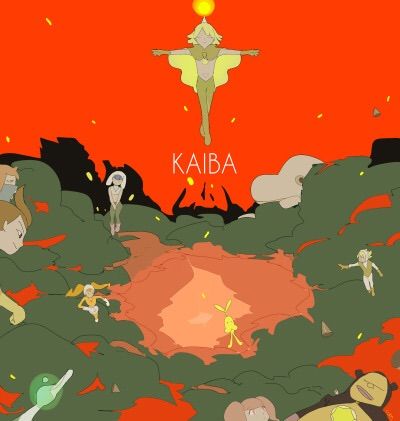
Saturday Matinee: Kaiba

A young man awakens without memories. There’s a hole in his chest, a symbol on his belly, and a blurry picture of a girl in a locket he has. Knowing nothing, he tries to escape a twisted city of stolen memories and exchangeable bodies in a world where minds are stored on chips when individuals die and the manipulation of other people’s memories has become the norm.

A surreal series of thirteen 26 minute episodes written and directed by Masaaki Yuasa (“Mind Game”).

Watch the full series here.

How to Create a DIY Sticker Campaign

This is a simple how-to guide for creating a surprisingly effective sticker campaign on a limited budget. Before commencing, one might first ask “why a sticker campaign?”

A sticker of the right image in the right place is in essence a form of guerrilla marketing. While not as permanent as a graffiti stencil, it can still get a message across without damaging whatever objects or surfaces they happen to be placed on. Well-designed stickers can be viewed as a physical meme, which in internet culture has come to mean a combination of (usually humorous) images and words which transmit ideas. As social media monopolies continue to assert their power to censor any ideas which they, their corporate sponsors and government partners might disagree with, we need to be more creative about how to spread memes through society in a multitude of ways which can bypass censorship, contradict the mainstream consensus and have positive impacts.

As a user of mass transit, I began noticing small stickers on buses and bus stops along the routes I take featuring images mocking certain multinational corporations known to harm the community. The more I thought about the method and motives behind them, the more attractive the concept became. It’s a relatively low risk and low investment action that can have great results if even just a few with the right mindset see them and are nudged towards critical thoughts and actions. For example, I was moved to attempt to recreate the stickers, strategically place them in public spaces, and also share the method of producing them with the hope that others will do the same.

The first step is to choose an image. The meme content of your sticker is limited only by your imagination and the issues you wish to address.

Regardless of message, make sure it grabs attention and is still legible even if the sticker is small. I found that upping the contrast and converting images to black and white usually makes them more effective (and saves on color toner).

Next, acquire a box of Avery 5160 address stickers (or something similar) which can be purchased for a few bucks at thrift shops or found at most corporate workplaces.

Using Microsoft Word, click on “Tools” dropdown menu, then “Labels” and set it for “Avery standard, 5160” (or whatever type of label one happens to use).

Drag and drop image onto the Word label template so it looks something like this:

Print and trim with a paper cutter so all white portions are removed and each image is separated. This size of label and image creates 60 individual stickers per page. Granted, they’re pretty small so should ideally be placed in areas in which people come in close proximity to them such as on buses, bus stops, elevators, bathrooms, eye-level store shelves, etc. Smaller sizes have the advantage of making them easier to place more discretely however.

With bundles of strips of stickers in your pockets, have fun doing something admittedly immature but with the potential to support intelligent and worthy causes ЁЯЩВ

Saturday Matinee: Evidence

Evidence, Godfrey ReggioтАЩs Short Film on What TV Does to KidsтАЩ Brains

By DC

Source: Open Culture

Between 1982 and 2002, director Godfrey Reggio shot his well known Qatsi trilogy – Koyaanisqatsi, Powaqqatsi, and Naqoyqatsi. Somewhere between the 2nd and 3rd installment, Reggio took a little detour and directed a short eight minute film called Evidence. The main characters? Kids watching cartoons (Dumbo, actually) and looking “drugged,” “like the patients of a mental hospital,” he writes on his web site.

The villain? “Television technology,” which “is eating the subjects who sit before its gaze.” The weapon? Television again. That “radiation gun aimed at the viewer” “holds its subjects in total control.”┬аA little house of horrors, to be sure. We have added┬аKoyaanisqatsi (featuring the music of Philip Glass) and┬аEvidence to our collection of┬аFree Movies Online.

Saturday Matinee: The Case of the Grinning Cat

Synopsis from Icarus Films:

In his newest film, French documentarian and cinema-essayist Chris Marker reflects on French and international politics, art and culture at the start of the new millennium. In November 2001, the filmmaker became intrigued, as did many other Parisians, by the sudden appearance of alluring portraits of grinning yellow cats on buildings, Metro walls and other public surfaces. Marker’s cinematic efforts to document the mysterious materializations of this charming feline throughout Paris are a recurring theme of THE CASE OF THE GRINNING CAT.

This engaging record of Marker’s cinematic peregrinations throughout the city, visually energized by his free-association montage style, chronicles strikes, demonstrations, memorials, election campaigns, celebrity scandals, international political incidents, and a seemingly endless variety of political protests (against the Iraq War, against China’s occupation of Tibet, against the government’s ban on the wearing of Muslim headscarves). The personalized commentary running throughout THE CASE OF THE GRINNING CAT offers the simultaneously learned and witty reflections of the filmmaker, now in his early eighties, on both the contemporary and historical implications of these varied events and personalities.

The mysterious grinning yellow cats soon begin to appear amidst the banners and signs in some of the political demonstrations. Eventually, the creator of the grinning cats is revealed to be an art collective known as Mr. Cat, whose members are shown painting a massive representation of their mascot on the plaza before the Pompidou Center. The filmmaker’s own famous cat caricature soon allies with Mr. Cat, as Marker speculates on the political possibilities of such a feline association.

Chris Marker concludes THE CASE OF THE GRINNING CAT with thoughts on the vital importance of such expressions of imagination in our public lives, echoing the May ’68 slogan that “La po├йsie est dans la rue” (“Poetry is in the street”).

Saturday Matinee: Metamorphosis

(In memory of Terence McKenna, November 16, 1946 –┬аApril 3, 2000)

CHAOS AND THE WORLD SOUL

By┬аRichard Kadrey

Source: Wired

METAMORPHOSIS – A┬аvideo “trialogue” featuring Ralph Abraham, Terence McKenna, and Rupert Sheldrake – is part shamanic journey and part New Physics 101. It’s mostly talk, with touches of simple computer graphics and music adorning the presentation. But what talk it is. We’ve got Abraham, a mathematician and the godfather of chaos theory; McKenna, a shamanologist, ethnopharmacologist, and psychedelic philosopher; and Sheldrake, a radical biologist and originator of the idea of “morphic resonance,” a memory embedded in all natural systems. Their free-form discussion ranges from drug experiments to the anima mundi (world soul), chaos and complexity, and the effects of language and imagination on the shape of the universe – all in search of a new field theory that encompasses art, science, and philosophy.

In this particular chaotic system, McKenna is the strange attractor around which Abraham and Sheldrake orbit. The three unite in a quest for knowledge and an exchange about the sciences they’ve studied. Sheldrake talks passionately about trying to redefine biology in terms of living organisms, not the abstract dead things found in textbooks and labs. Abraham, not surprisingly, explains how protests over the Vietnam War lead him to leave his sheltered academic life, pursue meditation in the Himalayas, and study chaos theory.

With McKenna as the ringleader (and biggest talker), imagination and chaos are the principal themes. Chaos, as McKenna describes it, is a science to study, an opportunity to reshape the world by looking through the lens of nonlinear processes, and a metaphor to help us think about our place in the universe. In McKenna’s words, chaos “is telling us that the intimation of mysticism, the intimation of a possibility of transcendence, is all firmly grounded in science.”

This is heady stuff. Though you half expect the psychedelic proselytizing to drift off into some kind of Birkenstock-and-bean-sprout dead end, the rigor, intelligence, and wit of these three minds keep the ideas sharp and fast. For anyone interested in the edge of science, this video is both entertaining and inspiring.