Dystopia Isn’t Sci-Fi—for Me, It’s the American Reality

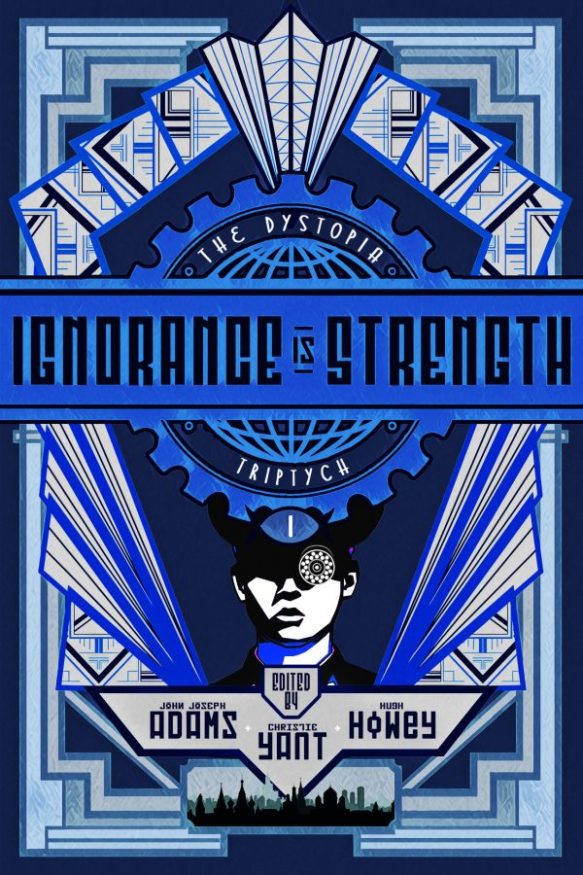
Cadwell Turnbull is a contributing author of The Dystopia Triptych. Photograph: Broad Reach Publishing

By Cadwell Turnbull

Source: Wired

Imagine a city where a group of people have managed against all odds to carve out prosperity for themselves, at least for a little while. These people used to be owned by other people. Now, they are permitted freedom, but only so much, subject to the whims of the once-masters.

Prosperity is a dangerous thing for the oppressed. It is a dry hot day in a forest bound to catch fire. And so, eventually, there is spark. A teenage boy assaults a teenage girl of the once-master class in an elevator, or so the story is told. Truth doesn’t matter here. A story is enough. The once-masters want justice, which means all the once-slaves must be punished. Men, women, and children are dragged from their homes and shot, their stores and houses bombed or burned. The exact number of dead will remain uncertain, the story buried for so long that people will watch it in a television show almost a century later and mistake the dramatization of the event for pure fiction.

Imagine another city where the once-slaves are told they are getting treatment for a devastating illness, when they are in fact receiving a placebo. Imagine four decades of this lie, the originally infected passing on this disease to their spouses, their children, so that the once-masters can study the long-term effects of the disease on people they don’t consider fully human.

Imagine these cities are part of a great nation. The once-slaves are tired of their second-class citizenship so they begin a movement for justice and equity. This movement is met with a violent backlash. The once-slaves are attacked by dogs, blasted by hoses. Their churches are burned, their institutions subject to random acts of retaliation by the once-masters. Their activists are monitored. Their leaders are jailed or assassinated. There are victories, but even after the successes, once-slaves are shot down in the street for minor offenses or looking “suspicious.” Their neighborhoods are over-policed. Their children are denied quality education. Many of them are sent to prison, where they work for pennies or for nothing. But it isn’t called slavery. It is treated as coincidence that this forced labor disproportionately affects the oppressed class, the once-slaves.

These are the makings of dystopian fictions, and yet many in America don’t need to imagine them. It is their reality. However, most Americans would not call America a dystopia.

If the edges are filed off, the names of places and events changed, a few injustices amplified, Americans can pretend the sorts of things that happen in dystopias don’t happen in their backyards. They can call it fiction, create enough distance to make themselves comfortable with their country’s own sins. But this doesn’t change the fact that the American experience is dystopian for many marginalized people. And like in any dystopia, real or imagined, it is up to all Americans to recognize this storyline, imagine a better society outside of the current reality, and then work toward it. Otherwise, America consents to a normal that is grotesque.

I read my first dystopia in high school. As a teenager, 1984 terrified the hell out of me. I didn’t read it as a warning, but as a mirror to my own experience. I identified with the protagonist Winston Smith’s feeling that something was deeply wrong with his society and the overwhelming sense of helplessness that followed. In college, I read my first utopia. The Dispossessed, by Ursula K. Le Guin, in every sense, was an antidote to that despair I felt when reading 1984.

And then, many years later, I read “The Day Before the Revolution,” the prequel short story to The Dispossessed, and found in it the practical application of the novel’s revolutionary ideas. The story is beautifully quiet. It follows Odo, the founder of the radical movement at the heart of The Dispossessed, as she goes through her day and remembers important moments in her political and personal journey. Le Guin prefaced “The Day Before the Revolution” with a brief definition of the Odonian belief system: “Odonianism is anarchism … its principal and moral-practical theme is cooperation (solidarity, mutual aid). It is the most idealistic, and to me the most interesting, of all political theories.”

To be clear, the Odonians are not perfect. They are resistant to change and have allowed other forms of institutional privilege to develop and calcify in their society. But, because they believe in their utopia and have lived their lives in accordance with that belief, they’ve managed to build a reasonably just and equitable society

And this is where, in life just as in science fiction, a distinction must be made. A just and equitable society is not the same as a perfect one. I’d argue that everyone would benefit if we defined utopia as a move toward justice and equity, and not just the state of perfection. But in America, especially in discussions about social justice, “just” and “perfect” are treated as synonymous objectives. And because perfect is never attainable, justice, too, becomes out of reach. Under this framing, injustice becomes normal, oppression is realistic, and any move towards justice and equity must come from struggle. A disturbing unspoken belief is born from this framing, that marginalized people will never receive full humanity because a just society is not possible. By failing to recognize the dystopia, and dismissing the possibility of a utopia, America has resigned itself to its current, dark narrative.

As a result, in America, universal social welfare is too costly and politically unfeasible, while trillion-dollar corporate bailouts and endless wars go unquestioned. Police and prison reform are aimed towards harm reduction for marginalized communities, instead of daring to imagine a society where these institutions are mostly unnecessary. In American discourse, a society can’t take care of all its citizens or remedy the causes of crime.

In a society where injustice is normalized, justice becomes a goal that can only be achieved through sacrifice—tragedy becomes currency, a thing to be used, not prevented. It takes decades of confirmed police brutality before America considers even the most minor reforms. This is not by accident. Black and brown bodies have been the fuel used to drive this society towards slightly lesser states of injustice since the very beginning. The oppressed have always paid the price for progress.

And yet, Americans have never shown this kind of defeatism when it comes to technological advancements. When this nation decided to go to the moon, it was framed in terms of “How do we get there?” not “Is this possible?” And no one ever said, “This rocket may only get half-way to the moon, but first many must die.”

Americans once oblivious to the dystopia are waking up. That’s good. But the price of waking up should be considered, and the lives sacrificed to incrementalism must be mourned. It is easy for a pragmatist to ask for incremental change when the current reality favors them. But pragmatism hits differently when it is forced at gunpoint. Every loss on the way to justice is a collective sin, because it was decided that the road must be long and the oppressed must struggle for every inch.

Do not normalize the losses happening right now because of the gains. Assume where America has always been is a tragedy. What is done in hell isn’t romantic; sacrificing bodies to dystopia isn’t beautiful. As I write this, people protesting brutality are dying at the hands of law enforcement. No one should pay for progress with their life. And it isn’t naive to believe every member of society should have a healthy, empowering, and fulfilling time on earth. The ones that have suffered deserve nothing less than faith in that possibility. This moment may provide a way out of dystopia, but there has to be a collective reckoning with the dystopian aspects of American society as well as the cruel price of progress repeatedly placed on the backs of the oppressed. Through solidarity there is a way out of these bitter realities, but the way there must be just if the destination is to be just.

In science fiction there is a notion that the universe is filled with possible worlds just waiting for humanity to come settle. It has some of its more troubling roots in manifest destiny, but also in hope, and the idea that better worlds are possible. But what if this corner of Earth could be that imagined place? Imagine a better world right here, instead of elsewhere. The price is in going all the way, doing all the work, believing all the work can be done. That’s the only way to get to the moon. Human beings have to believe it exists.
Saturday Matinee: Orson Welles Short Double Feature

Orson Welles Narrates Animations of Plato’s Cave and Kafka’s “Before the Law,” Two Parables of the Human Condition

By Colin Marshall

Source: Open Culture

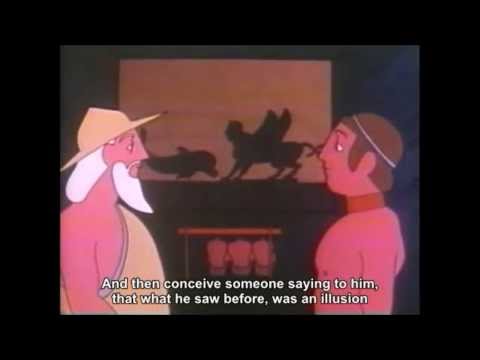
You’re held captive in an enclosed space, only able faintly to perceive the outside world. Or you’re kept outside, unable to cross the threshold of a space you feel a desperate need to enter. If both of these scenarios sound like dreams, they must do so because they tap into the anxieties and suspicions in the depths of our shared subconscious. As such, they’ve also proven reliable material for storytellers since at least the fourth century B.C., when Plato came up with his allegory of the cave. You know that story nearly as surely as you know the ancient Greek philosopher’s name: a group of human beings live, and have always lived, deep in a cave. Chained up to face a wall, they have only ever seen the images of shadow puppets thrown by firelight onto the wall before them.

To these isolated beings, “the truth would be literally nothing but the shadows of the images.” So Orson Welles tells it in this 1973 short film by animator Dick Oden. In his timelessly resonant voice that complements the production’s hauntingly retro aesthetic, Wells then speaks of what would happen if a cave-dweller were to be unshackled.

“He would be much too dazzled to see distinctly those things whose shadows he had seen before,” but as he approaches reality, “he has a clearer vision.” Still, “will he not be perplexed? Will he not think that the shadows which he formerly saw are truer than the objects which are now shown to him?” And if brought out of the cave to experience reality in full, would he not pity his old cavemates? “Would he not say, with Homer, better to be the poor servant of a poor master and to endure anything rather than think as they do and live after their manner?”

Plato’s cave wasn’t the first parable of the human condition Welles narrated. Just over a decade earlier, he engaged pinscreen animator Alexandre Alexeieff (he of Night on Bald Mountain and and “The Nose,” previously featured here on Open Culture) to illustrate his reading of Franz Kafka’s story “Before the Law.” The law, in Kafka’s telling, is a building, and before that building stands a guard. “A man comes from the country, begging admittance to the law,” says Welles. “But the guard cannot admit him. May he hope to enter at a later time? That is possible, said the guard.” Yet somehow that time never comes, and he spends the rest of his life awaiting admission to the law. “Nobody else but you could ever have obtained admittance,” the guard admits to the man, not long before the man expires of old age. “This door was intended only for you! And now, I’m going to close it.”

“Before the Law” describes a grimly absurd situation, as does Welles’ The Trial, the film to which it serves as an introduction. Adapted from another work of Kafka’s, specifically his best-known novel, it also concerns itself with the legal side of human affairs, at least on the surface. But when it becomes clear that the crime with which its bureaucrat protagonist Josef K. has been charged will never be specified, the story plunges into an altogether more troubling realm. We’ve all, at one time or another, felt to some degree like Joseph K., persecuted by an ultimately incomprehensible system, legal, social, or otherwise. And can we help but feel, especially in our highly mediated 21st century, like Plato’s immobilized human, raised in darkness and made to build a worldview on illusions? As for how to escape the cave — or indeed to enter the law — it falls to each of us individually to figure out.


Saturday Matinee: Storm Center

Source: Wikipedia

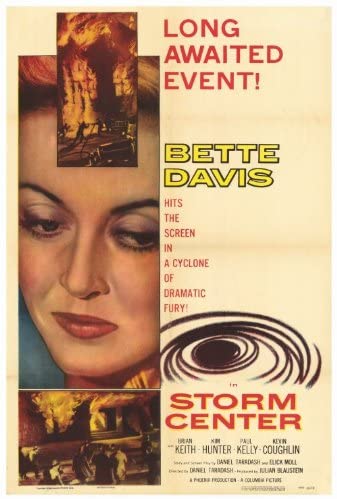
Storm Center is a 1956 American film noir drama directed by Daniel Taradash. The screenplay by Taradash and Elick Moll focuses on what were at the time two very controversial subjects – Communism and book banning – and took a strong stance against censorship. The film stars Bette Davis, and was the first overtly anti-McCarthyism film to be produced in Hollywood.

Synopsis

Alicia Hull is a widowed small town librarian dedicated to introducing children to the joy of reading. In exchange for fulfilling her request for a children’s wing, the city council asks her to withdraw the book The Communist Dream from the library’s collection. When she refuses to comply with their demand, she is fired, and branded as a subversive. Especially upset by this is young Freddie Slater, a boy with a deep love of books whom Alicia has closely mentored.

Judge Ellerbe feels Alicia has been treated unfairly, and calls a town meeting, hoping to rally support for her. However, ambitious attorney and aspiring politician Paul Duncan, who is dating assistant librarian Martha Lockeridge, undermines those efforts by publicly revealing Alicia’s past associations with organizations that turned out to be Communist fronts. Alicia notes that she resigned as soon as she found out the true nature of the organizations, but Duncan’s incendiary revelations result in only a handful of people showing up to the meeting. Those that do attend express concern about being branded Communists themselves if they stand with Alicia. Upon hearing their concerns, Alicia informs the meeting that she no longer wishes to fight the city council, and wants to let the matter drop. With no opposition to her removal mounted, virtually the entire town eventually turns against Alicia.

Freddie, convinced by the opinions of others, particularly his narrow-minded father, that Alicia is a bad person, is unable to handle the resulting feelings of betrayal. He becomes increasingly fearful even of books themselves, and he begins to break down completely, culminating in his setting fire to the library. His actions cause the residents to have a change of heart, and they ask Alicia to return and supervise the construction of a new building. Alicia agrees, lamenting her earlier decision not to fight and vowing never again to allow a book to be removed from the library.

Saturday Matinee: Under the Silver Lake

By Michael Hewis

Source: Cinema of the Abstract

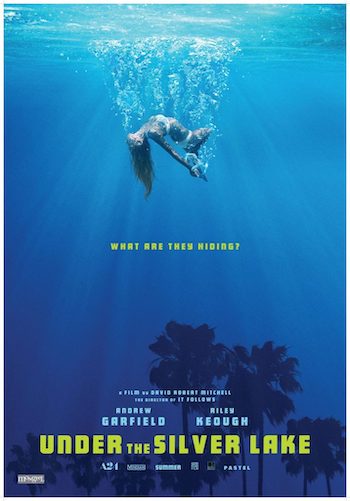
Director: David Robert Mitchell

Screenplay: David Robert Mitchell

Cast: Andrew Garfield as Sam, Riley Keough as Sarah, Topher Grace as the Man at the Bar, Laura-Leigh as Mae, Zosia Mamet as Troy, Jimmi Simpson as Allen, Patrick Fischler as the Comic Fan

Synopsis: Sam (Andrew Garfield) is a slacker who becomes fixated on his new female neighbour Sarah (Riley Keough), only for her to immediately vanish. His search for her across — Los Angeles will include the King of the Homeless, conspiracies, a serial killer of dogs, and codes in Nintendo games.

Well, at least David Robert Mitchell was ambitious, which is not something you say a lot when, frankly, most American directors (and some beyond the States) when they have just made something interesting now get sucked into blockbusters with no creative control in the slightest. It’s a view easily bias to how Under the Silver Lake is absolutely indulgent and not without faults, but God only knows how many filmmakers, when they’ve done well even in art house cinema, tend to now go for the blandest and predictable of routes with their newest films too. The comparisons to Richard Kelly have been apt – Kelly gained a reputation for Donnie Darko (2001), less when it actually debuted theatrically but from word of mouth, the follow up the notorious Southland Tales (2006)Tales was even more ambitious, comic book prologues and all tied in, and was also debuted at the Cannes Film Festival as Under the Silver Lake was, getting a good thrashing between them. Time is looking to potential give Southland Tales a chance, but Under the Silver Lake’s too young to start asking about this.

Mitchell’s journey is curious as, three films in when Kelly’s was just a debut before he got to Southland Tales, he started with an indie The Myth of the American Sleepover (2010), then suddenly got a surprise hit by entering the horror genre, It Follows (2014) getting a lot of traction. So he decides to take his chips accumulated and gamble them all on this two and a half hour neo-noir pastiche which gets through so many weird tangents I don’t know when to begin. Definitely, absolutely, the legacy of Thomas Pynchon is growing even outside of literature into cinema – amazingly, there’s only been one official Pynchon adaptation in Inherent Vice (2014), but filmmakers like Mitchell have instead appropriated his style of numerous tangents and conspiracies interweaving into each other, loose ends, eccentrics and a lot of pop culture. Under the Silver Lake, whether you like it or not, is surprisingly faithful to his style even if by accident, even the length befitting some of his monolithic tomes like Gravity’s Rainbow.

Mitchell’s film is strange, a farce to be honest whose central figure, an obsessive compulsive conspiracy nut and slacker, is inherently a dick, who indulges in his old Playboys and Nintendo Power magazines, and is a peeping tom who gets distracted by eyeing up women. Andrew Garfield imbues him with some charisma, but he’s having sex with an on-and-off-again girlfriend whilst having women’s tennis on the television at the same time, beating up children for vandalising his car the next. The voyeurism has put people off with the film, and I’ll admit that whilst we get to see Garfield’s bared arse a lot for balance, the amount of female nudity is not helped by how the female characters really blur into each other; its far more problematic than the nudity itself, or that our protagonist thinks with his smallest head too much, or that it’s roping in noir tropes of mysterious femme fatales. And Mitchell does make it clear he’s flawed, a little pathetic, even sprayed by a skunk for a lasting plot effect, even having a voyeuristic scene involving a drone deliberately being a challenge to the viewer when the woman being spied on in a screen on screen is in tears.

Sympathy is to be had for him as much as failure, the film a long journey for him to potentially grow. A weird journey, crammed to the point it’s wrong to follow the story as a concise one but, like Pynchon, a tangent factory. LA here is a place of odd events and mysteries, just from the outset with a squirrel dropping to its death off a tree in front of our lead and (visibly a puppet) gasping in a way that’s sickly humorous, an immediate warning Under the Silver Lake is going to get silly on purpose. Independent comics talk of a spate of dog serial killers and killer owl women, that the secrets of the city can be found in an old fifties cereal’s game on the box, or how the elite and rich are naturally getting up to hysterical hodgepodges out of boredom. The only sane ones, or in a way in control, are naturally the homeless or coyotes. The fact I first though the film was set in the nineties, because of the strange logic gap where our lead was able to see Kurt Cobain but is still young, does also suggest that, eventually, the nostalgia for the eighties is finally going to be punted off the throne in favour of a much more interesting and weirder nostalgia that is the nineties, where Cornershop is on the soundtrack side-by-side with R.E.M.

It’s also, dangerously, riffing on the past whilst constantly undercutting it as being merely a distraction. It’s an odd paradox that it gets a lot of humour from even a help guide for a video game being actually of importance, but that we also encounter a master songwriter who undercuts any sense even the most rebellious of pop culture is of actual subversion if it’s mainstream. It comes off as bleaker, as a film, than anything I’ve yet read of Thomas Pynchon, and does show the real issue I have about Under the Silver Lake for all my enjoyment of it, a second viewing allowing any clouding of judgement to take place, that Mitchell’s visibly crammed numerous obsessions together but the underlying idea that should tie it all together isn’t cognitive enough. Even a much weirder, scattershot experimental film would at least lean on atmosphere and dream logic more, whilst Under the Silver Lake still plays out as a quirky mystery.

This also includes some of the mysteries and conspiracies as well, playing off coincidence or just an insane amount of planning for a New World Order to make reality – it does make an argument that such a conspiracy doesn’t make sense in real life, due to how chaotic on a large scale it would be, unless one takes the idea that it’s as shambolic of everything on the surface or that some really coordinated calculations make us all sheep. Either way, going for the obvious like the sexual suggestions of advertisement and such parts are the weakest moments in Under the Silver Lake, “duh” moments no way near as simple and crisp as when They Live (1988) just had signs everywhere, black text on white, just telling us all to marry and procreate.

This is more so as a lot is brought in – silent cinema, Hollywood itself, hobo sign language, fifties culture, and poignantly sixties and seventies cults alongside the type of modern art performances you’d get now. The centre of this film is, arguably, that nothing is resolved, which is a huge risk to take – details, without spoiling anything, allow for interpretation, such as Sam carrying dog biscuits and having dreams of women literally barking at him, or how the owl woman’s identity is resolved. (Then there’s the caged bird whose one word he says everyone including the viewer is trying to figure out). It’s as much this why I liked Under the Silver Lake immensely, but I will be the first to throw out (if it hasn’t already) that even Southland Tales, the notorious film it’s compared to from a decade earlier, was at least circling the idea of how mad, chaotic and strange America had gotten and exaggerated it in terms of a plot. Whilst it took multiple viewings to get and love the film, which it at least went a direction with progression. Here, aware of its clear leanings to the idea of lack of resolution, or that the final scene at least has Sam finding a serenity seeing the apartment he’s about to be evicted from through a new light, it was a gamble that a few people didn’t like to be a lot more vaguer in terms of plot expectations.

A lot of this is as well why the languid pace and sense of nonsense is a good thing for Under the Silver Lake, less a mystery in the conventional sense but an Alex in Wonderland tale of Andrew Garfield encountering strange figures. A literal layabout, a semblance of (legitimate) skill to be a good detective when he’s actually focused, but he’s lead on a wild goose chase that we follow as confused as he is. This is the best way to view the film, and thankfully, it’s a well made accomplishment technically to work in this direction, right down to the funny end credits animation. Bright, colourful and vivid in a way that’s drastically different from It FollowsDisasterpiece, who made his name known to the public conscious through his score for that earlier work, comes with Mitchell here too and also takes a new direction, an orchestral score which does riff on Bernard Herrmann’s work with Alfred Hitchcock but has its own playful richness to it.

The resulting film’s a divisive one even for a defender like myself, just for the fact that it’s decision to be a maximalist work in detail, but ensue a primary theme, is going to cause a lot of misreading or confused ones over multiple viewings. There’s also just the fact it’s a director going into his foibles despite the mystery/noir genre suggesting there’ll be a conclusion at the end of everything.

What is there though, beyond this, is still a playful, very funny and sometimes poignant work. A brave risk which was worth taking, but what David Robert Mitchell is going to do next after this one is up in the air now.


Watch the full film on Hoopla here: https://www.hoopladigital.com/title/13468085