Two for Tuesday
Reply


By Cynthia Chung
Source: Waking Times
“But I don’t want to go among mad people,” Alice remarked.
“Oh, you can’t help that,” said the Cat: “we’re all mad here. I’m mad. You’re mad.”
“How do you know I’m mad?” said Alice.
“You must be,” said the Cat, “or you wouldn’t have come here.”– Lewis Carroll’s “Alice’s Adventures in Wonderland”
We are living in a world where the degree of disinformation and outright lying has reached such a state of affairs that, possibly for the first time ever, we see the majority of the western world starting to question their own and surrounding level of sanity. The increasing frenzied distrust in everything “authoritative” mixed with the desperate incredulity that “everybody couldn’t possibly be in on it!” is slowly rocking many back and forth into a tighter and tighter straight jacket. “Question everything” has become the new motto, but are we capable of answering those questions?
Presently the answer is a resounding no.
The social behaviourist sick joke of having made everyone obsessed with toilet paper of all things during the start of what was believed to be a time of crisis, is an example of how much control they have over that red button labelled “commence initiation of level 4 mass panic”.
And can the people be blamed? After all, if we are being lied to, how can we possibly rally together and point the finger at the root of this tyranny, aren’t we at the point where it is everywhere?
As Goebbels infamously stated,
“If you tell a lie big enough and keep repeating it, people will eventually come to believe it. The lie can be maintained only for such time as the State can shield the people from the political, economic and/or military consequences of the lie. It thus becomes vitally important for the State to use all of its powers to repress dissent, for the truth is the mortal enemy of the lie, and thus by extension, the truth is the greatest enemy of the State [under fascism].”
And here we find ourselves today, at the brink of fascism. However, we have to first agree to forfeit our civil rights as a collective before fascism can completely dominate. That is, the big lie can only succeed if the majority fails to call it out, for if the majority were to recognise it for what it is, it would truly hold no power.
“Politicians, Priests, and psychiatrists often face the same problem: how to find the most rapid and permanent means of changing a man’s belief…The problem of the doctor and his nervously ill patient, and that of the religious leader who sets out to gain and hold new converts, has now become the problem of whole groups of nations, who wish not only to confirm certain political beliefs within their boundaries, but to proselytize the outside world.”
– William Sargant “Battle of the Mind”
It had been commonly thought in the past, and not without basis, that tyranny could only exist on the condition that the people were kept illiterate and ignorant of their oppression. To recognise that one was “oppressed” meant they must first have an idea of what was “freedom”, and if one were allowed the “privilege” to learn how to read, this discovery was inevitable.
If education of the masses could turn the majority of a population literate, it was thought that the higher ideas, the sort of “dangerous ideas” that Mustapha Mond for instance expresses in “The Brave New World”, would quickly organise the masses and revolution against their “controllers” would be inevitable. In other words, knowledge is freedom, and you cannot enslave those who learn how to “think”.
However, it hasn’t exactly played out that way has it?
The greater majority of us are free to read whatever we wish to, in terms of the once “forbidden books”, such as those listed by The Index Librorum Prohibitorum. We can read any of the writings that were banned in “The Brave New World”, notably the works of Shakespeare which were named as absolutely dangerous forms of “knowledge”.
We are now very much free to “educate” ourselves on the very “ideas” that were recognised by tyrants of the past as the “antidote” to a life of slavery. And yet, today, the majority choose not to…
It is recognised, albeit superficially, that who controls the past, controls the present and thereby the future. George Orwell’s book “1984”, hammers this as the essential feature that allows the Big Brother apparatus to maintain absolute control over fear, perception and loyalty to the Party cause, and yet despite its popularity, there still remains a lack of interest in actually informing oneself about the past.
What does it matter anyway, if the past is controlled and rewritten to suit the present? As the Big Brother interrogator O’Brien states to Winston, “We, the Party, control all records, and we control all memories. Then we control the past, do we not? [And thus, are free to rewrite it as we choose…]”
Of course, we are not in the same situation as Winston…we are much better off. We can study and learn about the “past” if we so desire, unfortunately, it is a choice that many take for granted.
In fact, many are probably not fully aware that presently there is a battle waging for who will “control the past” in a manner that is closely resembling a form of “memory wipe”.
* * *
William Sargant was a British psychiatrist and, one could say, effectively the Father of “mind control” in the West, with connections to British Intelligence and the Tavistock Institute, which would influence the CIA and American military via the program MK Ultra. Sargant was also an advisor for Ewen Cameron’s LSD “blank slate” work at McGill University, funded by the CIA.
Sargant accounts for his reason in studying and using forms of “mind control” on his patients, which were primarily British soldiers that were sent back from the battlefield during WWII with various forms of “psychosis”, as the only way to rehabilitate extreme forms of PTSD.
The other reason, was because the Soviets had apparently become “experts” in the field, and out of a need for national security, the British would thus in turn have to become experts as well…as a matter of self-defence of course.
The work of Ivan Pavlov, a Russian physiologist, had succeeded in producing some disturbingly interesting insights into four primary forms of nervous systems in dogs, that were combinations of inhibitory and excitatory temperaments; “strong excitatory”, “balanced”, “passive” and “calm imperturbable”. Pavlov found that depending on the category of nervous system temperament the dog had, this in turn would dictate the form of “conditioning” that would work best to “reprogram behaviour”. The relevance to “human conditioning” was not lost on anyone.
It was feared in the West, that such techniques would not only be used against their soldiers to invoke free-flowing uninhibited confessions to the enemy but that these soldiers could be sent back to their home countries, as zombified assassins and spies that could be set off with a simple code word. At least, these were the thriller stories and movies that were pumped into the population. How horrific indeed! That the enemy could apparently enter what was thought the only sacred ground to be our own…our very “minds”!
However, for those who were actually leading the field in mind control research, such as William Sargant, it was understood that this was not exactly how mind control worked.
For one thing, the issue of “free will” was getting in the way.
No matter the length or degree of electro-shock, insulin “therapy”, tranquilizer cocktails, induced comas, sleep deprivation, starvation etc induced, it was discovered that if the subject had a “strong conviction” and “strong belief” in something, this could not be simply erased, it could not be written over with any arbitrary thing. Rather, the subject would have to have the illusion that their “conditioning” was in fact a “choice”. This was an extremely challenging task, and long term conversions (months to years) were rare.
However, Sargant saw an opening. It was understood that one could not create a new individual from scratch, however, with the right conditioning that was meant to lead to a physical breakdown using abnormal stress (effectively a reboot of the nervous system), one could increase the “suggestibility” markedly in their subjects.
Sargant wrote in his “Battle of the Mind”:
“Pavlov’s clinical descriptions of the ‘experimental neuroses’ which he could induce in dogs proved, in fact, to have a close correspondence with those war-neuroses which we were investigating at the time.”
In addition, Sargant found that a falsely implanted memory could help induce abnormal stress leading to emotional exhaustion and physical breakdown to invoke “suggestibility”. That is, one didn’t even need to have a “real stress” but an “imagined stress” would work just as effectively.
Sargant goes on to state in his book:
“It is not surprising that the ordinary person, in general, is much more easily indoctrinated than the abnormal…A person is considered ‘ordinary’ or ‘normal’ by the community simply because he accepts most of its social standards and behavioural patterns; which means, in fact, that he is susceptible to suggestion and has been persuaded to go with the majority on most ordinary or extraordinary occasions.”
Sargant then goes over the phenomenon of the London Blitz, which was an eight month period of heavy bombing of London during WWII. During this period, in order to cope and stay “sane”, people rapidly became accustomed to the idea that their neighbours could be and were buried alive in bombed houses around them. The thought was “If I can’t do anything about it what use is it that I trouble myself over it?” The best “coping” was thus found to be those who accepted the new “environment” and just focused on “surviving”, and did not try to resist it.
Sargant remarks that it is this “adaptability” to a changing environment which is part of the “survival” instinct and is very strong in the “healthy” and “normal” individual who can learn to cope and thus continues to be “functional” despite an ever changing environment.
It was thus our deeply programmed “survival instinct” that was found to be the key to the suggestibility of our minds. That the best “survivors” made for the best “brain-washing” in a sense.
Sargant quotes Hecker’s work, who was studying the dancing mania phenomenon that occurred during the Black Death, where Hecker observed that heightened suggestibility had the capability to cause a person to “embrace with equal force, reason and folly, good and evil, diminish the praise of virtue as well as the criminality of vice.”
And that such a state of mind was likened to the first efforts of the infant mind “this instinct of imitation when it exists in its highest degree, is also united a loss of all power over the will, which occurs as soon as the impression on the senses has become firmly established, producing a condition like that of small animals when they are fascinated by the look of a serpent.”
I wonder if Sargant imagined himself the serpent…
Sargant does finally admit:
“This does not mean that all persons can be genuinely indoctrinated by such means. Some will give only temporary submission to the demands made on them, and fight again when strength of body and mind returns. Others are saved by the supervention of madness. Or the will to resist may give way, but not the intellect itself.”
But he comforts himself as a response to this stubborn resistance that “As mentioned in a previous context, the stake, the gallows, the firing squad, the prison, or the madhouse, are usually available for the failures.”
“He whom the gods wish to destroy, they first of all drive mad.”
– Henry Wadsworth Longfellow “The Masque of Pandora”
For those who have not seen the 1944 psychological thriller “Gaslight” directed by George Cukor, I would highly recommend you do so since there is an invaluable lesson contained within, that is especially applicable to what I suspect many of us are experiencing nowadays.
The story starts with a 14 year old Paula (played by Ingrid Bergman) who is being taken to Italy after her Aunt Alice Alquist, a famous opera singer and caretaker of Paula, is found murdered in her home in London. Paula is the one who found the body, and horror stricken is never her old self again. Her Aunt was the only family Paula had left in her life. The decision is made to send her away from London to Italy to continue her studies to become a world-renowned opera singer like her Aunt Alice.
Years go by, Paula lives a very sheltered life and a heavy somberness is always present within her, she can never seem to feel any kind of happiness. During her singing studies she meets a mysterious man (her piano accompanist during her lessons) and falls deeply in love with him. However, she knows hardly anything about the man named Gregory.
Paula agrees to marry Gregory after a two week romance and is quickly convinced to move back into her Aunt’s house in London that was left abandoned all these years. As soon as she enters the house, the haunting of the night of the murder revisits her and she is consumed with panic and fear. Gregory tries to calm her and talks about the house needing just a little bit of air and sun, and then Paula comes across a letter written to her Aunt from a Sergis Bauer which confirms that he was in contact with Alice just a few days before her murder. At this finding, Gregory becomes bizarrely agitated and grabs the letter from Paula. He quickly tries to justify his anger blaming the letter for upsetting her. Gregory then decides to lock all of her Aunt’s belongings in the attic, to apparently spare Paula any further anguish.
It is at this point that Gregory starts to change his behaviour dramatically. Always under the pretext for “Paula’s sake”, everything that is considered “upsetting” to Paula must be removed from her presence. And thus quickly the house is turned into a form of prison. Paula is told it is for her best not to leave the house unaccompanied, not to have visitors and that self-isolation is the best remedy for her “anxieties” which are getting worst. Paula is never strictly forbidden at the beginning but rather is told that she should obey these restrictions for her own good.
Before a walk, he gives as a gift a beautiful heirloom brooch that belonged to his mother. Because the pin needs replacing, he instructs Paula to keep it in her handbag, and then says rather out of context, “Don’t forget where you put it now Paula, I don’t want you losing it.” Paula remarks thinking the warning absurd, “Of course I won’t forget!” When they return from their walk, Gregory asks for the brooch, Paula searches in her handbag but it is not there.
It continues on like this, with Gregory giving warnings and reminders, seemingly to help Paula with her “forgetfulness” and “anxieties”. Paula starts to question her own judgement and sanity as these events become more and more frequent. She has no one else to talk to but Gregory, who is the only witness to these apparent mishaps. It gets to a point where completely nonsensical behaviour is being attributed to Paula by Gregory. A painting is found missing on the wall one night. Gregory talks to Paula like she is a 5 year child and asks her to put it back. Paula insists she does not know who took it down. After her persistent passionate insistence that it was not her, she walks up the stairs almost like she were in a dream state and pulls the painting from behind a statue. Gregory asks why she lied, but Paula insists that she only thought to look there because that is where it was found the last two times this occurred.
For weeks now, Paula thinks she has been seeing things, the gas lights of the house dimming for no reason, she also hears footsteps above her bedroom. No one else seems to take notice. Paula is also told by Gregory that he found out that her mother, who passed away when she was very young, had actually gone insane and died in an asylum.
Despite Paula being reduced to a condition of an ongoing stupor, she decides one night to make a stand and regain control over her life. Paula is invited, by one of her Aunt Alice’s close friends Lady Dalroy, to attend a high society evening with musical performances. Recall that Paula’s life gravitated around music before her encounter with Gregory. Music was her life. Paula gets magnificently dressed up for the evening and on her way out tells Gregory that she is going to this event. Gregory tries to convince her that she is not well enough to attend such a social gathering, when Paula calmly insists that she is going and that this woman was a dear friend of her Aunt, Gregory answers that he refuses to accompany her (in those days that was a big deal). Paula accepts this and walks with a solid dignity, undeterred towards the horse carriage. In a very telling scene, Gregory is left momentarily by himself and panic stricken, his eyes bulging he snaps his cigar case shut and runs after Paula. He laughingly calls to her, “Paula, you did not think I was serious? I had no idea that this party meant so much to you. Wait, I will get ready.” As he is getting ready in front of the mirror, a devilish smirk appears.
Paula and Gregory show up to Lady Dalroy’s house late, the pianist is in the middle of the 1st movement of Beethoven’s Piano Sonata #8 in C minor. They quickly are escorted to two empty seats. Paula is immediately immersed in the piece, and Gregory can see his control is slipping. After only a few minutes, he goes to look at his pocket watch but it is not in his pocket. He whispers into Paula’s ear, “My watch is missing”. Immediately, Paula looks like she is going to be sick. Gregory takes her handbag and Paula looks in horror as he pulls out his pocket watch, insinuating that Paula had put it there. She immediately starts losing control and has a very public emotional breakdown. Gregory takes her away, as he remarks to Lady Dalroy that this is why he didn’t want Paula coming in the first place.
When they arrive home, Paula has by now completely succumbed to the thought that she is indeed completely insane. Gregory says that it would be best if they go away somewhere for an indefinite period of time. We later find out that Gregory is intending on committing her to an asylum. Paula agrees to leave London with Gregory and leaves her fate entirely in his hands.
In the case of Paula it is clear. She has been suspecting that Gregory has something to do with her “situation” but he has very artfully created an environment where Paula herself doubts whether this is a matter of unfathomable villainy or whether she is indeed going mad.
It is rather because she is not mad that she doubts herself, because there is seemingly no reason for why Gregory would put so much time and energy into making it look like she were mad, or at least so it first appears. But what if the purpose to her believing in her madness was simply a matter of who is in control?
Paula almost succeeds in gaining the upper-hand in this power-struggle, the evening she decided to go out on her own no matter what Gregory insisted was in her best interest. If she would have held her ground at Lady Dalroy’s house and simply replied, “I have no idea why your stupid watch ended up in my handbag and I could care less. Now stop interrupting this performance, you are making a scene!” Gregory’s spell would have been broken as simple as that. If he were to complain to others about the situation, they would also respond, “Who cares man, why are you so obsessed about your damn watch?”
We find ourselves today in a very similar situation to Paula. And the voice of Gregory is represented by the narrative of false news and the apocalyptic social behaviourist programming in our forms of entertainment. The things most people voluntarily subject themselves to on a daily, if not hourly, basis. Socially conditioning them, like a pack of salivating Pavlovian dogs, to think it is just a matter of time before the world ends and with a ring of their master’s bell…be at each other’s throats.
Paula ends up being saved in the end by a man named Joseph Cotten (a detective), who took notice and quickly discerned that something was amiss. In the end Gregory is arrested. It is revealed that Gregory is in fact Sergis Bauer. That he killed Alice Alquist and that he has returned to the scene of the crime after all these years in search for the famous jewels of the opera singer. The jewels were in fact rather worthless from the standpoint that they were too famous to be sold, however, Gregory never intended on selling these jewels but rather had become obsessed with the desire to merely possess them.
That is, it is Gregory who has been entirely mad all this time.
A Gregory is absolutely dangerous. He would have been the end of Paula if nothing had intervened. However, the power that Gregory held was conditional to the degree that Paula allowed it to control her. Paula’s extreme deconstruction was thus entirely dependent on her choice to let the voice of Gregory in. That is, a Gregory is only dangerous if we allow ourselves to sleep walk into the nightmare he has constructed for us.
“When I use a word,” Humpty Dumpty said in rather a scornful tone,
“it means just what I choose it to mean — neither more nor less.”
“The question is,” said Alice, “whether you can make words mean so many different things.”
“The question is,” said Humpty Dumpty, “which is to be master – – that’s all.”– Lewis Carroll’s “Through the Looking Glass”
By Matt Zoller Seitz
Source: RogerEbert.com
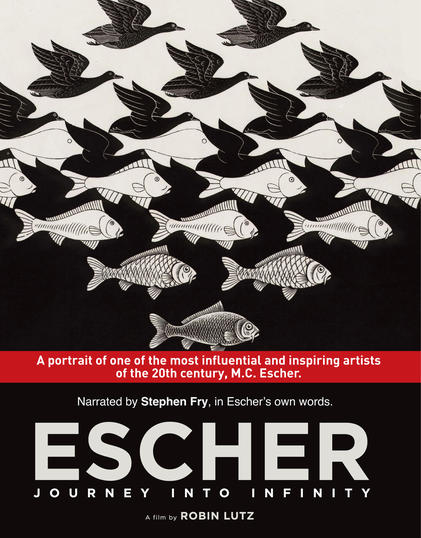
Documentaries about visual artists tend to be so boringly conceived—talk about the life, show a picture, talk about the life, show another picture—that you may not realize what you’ve been missing until you see one as excellent as “M.C. Escher: Journey to Infinity.”
Written and directed by Robin Lutz, this is a rare feature that takes the trouble not just to understand its subject and communicate his significance, but find ways to show us, visually, how his style evolved, and the principles behind that evolution.
The tale begins with the standard-issue “This is a movie about a great artist, here are a few summary details abut his life and art,” with some landscape and architecture shots and images of Escher’s work. Then it becomes increasingly daring and fanciful, yet always remaining in service to the M.C. Escher, the Dutch draftsman and printmaker whose art became internationally famous during the post-World War II era.
Escher was a rare artist who managed to combine his influences into something genuinely new. His work is a geometric/mathematical surrealist vision of the objectively perceivable world, but also a subjective interior, evoking ancient Arabic-North African graphics; the Salvador Dali-Pablo Picasso-Georges Braque anti-realist sensibilities of the ’20s and ’30s, and computer models that would not become popular until decades after Escher’s own experiments.
Lutz and his collaborators, including a team of graphic designers and animators, make Escher’s art come to life in surprising and amusing ways, from having one of his trademark salamanders appear in an otherwise “realistic” frame and travel across increasingly “unreal” panoramas until we’re in an Escher print, to re-imagining intricately patterned Escher artworks so that we seem to glide along them, or into them/through them. This happens slowly enough so that we can appreciate how deftly the artist translated negative space into positive space, in ways that made the distinction seem arbitrary: for instance, the black spaces between joined silhouettes of lizards or amphibians might become black birds with white spaces between them, then go back again. Or people and animals might move along one stretch of diagonal stairs and jump to another, seeming to go upside down or sideways, in defiance of gravity, emphasizing the brain-teasing techniques Escher perfected.
Lutz and his team have found a cinematic analogy for the movement of the eye over static pictorial art reproduced in a book or hanging on a museum wall. The movie is especially good at evoking that “wow” moment when you realize that a thing you were looking at has turned into another thing. It’s explaining the magic trick without ruining the magic, a magic trick of a different sort.
This approach is so dazzling that one wishes the filmmakers had pushed it a bit further, deploying it even more often, or in more and subtler variations—perhaps figuring out a way to have the film itself flip back on itself structurally at key points, or end precisely where it started, so that the project itself seemed to have no beginning or end. (There’s a hint of this, but not much more.)
Musician Graham Nash, a devotee of Escher who contacted him late in his life, says Escher dismissed the idea that he was an artist. Throughout the movie, we hear Escher align himself with scientists and mathematicians, often trashing his own skills as a representational draftsman and speaking of his heroes and colleagues with awe.
This isn’t to say that Escher was down on himself at all times, or that that he entirely rejected the notion he was making art. Escher’s letters, performed in voice-over by actor Stephen Fry, make it clear that he challenged himself to improve his abilities and expand his vision and grew irritable when stuck in a groove. And yet there was always a sense—particularly once Escher hit his forties and realized he was indeed a global phenomenon—that a “real” artist wouldn’t be as entertaining. This is the world’s misconception, not Escher’s, but it’s still a shame that he let himself feel diminished by it. There’s power and profundity in Escher’s art, yet the puzzle-box aspect is what pulls you into it.
The movie makes a case that we should talk about Escher the way we talk about one of his inspirations, Johann Sebastian Bach, who like Escher was clever as well as substantive. Escher earned the comparison. Why do we resist it? Perhaps there’s still something in us, even this late into human development, that worries that if you’re having fun, it can’t be art. Escher struggled with that misconception, too, right up to the end.
Watch M.C. Escher: Journey to Infinity on Kanopy here: https://www.kanopy.com/product/mc-escher-journey-infinity
Synopsis by Kino Lorber
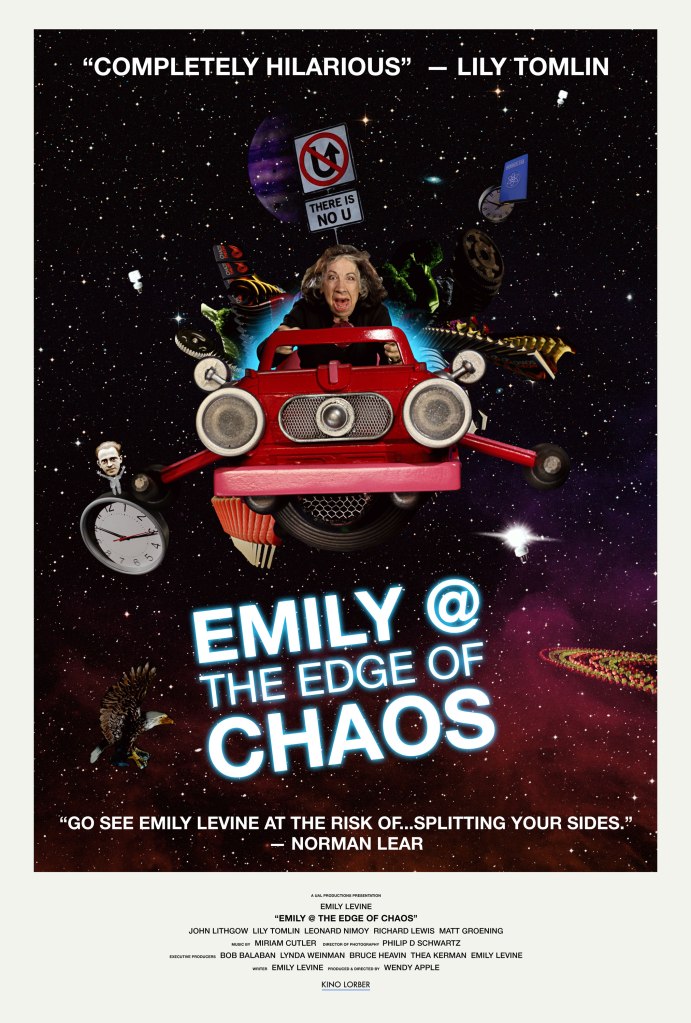
The brilliantly illuminating Emily @ the Edge of Chaos interweaves Emily Levine’s live performance with animation, appearances by scientists, and animated characters (John Lithgow as Sir Isaac Newton, Lily Tomlin as Ayn Rand, Leonard Nimoy as Sigmund Freud, Richard Lewis as Aristotle, Matt Groening as Aldo Leopold). The film uses physics – which explains how the universe works – to explain our metaphysics – the story of our values, our institutions, our interactions. Using her own experience and a custom blend of insight and humor, provocation and inspiration, personal story and social commentary, Emily takes her audience through its own paradigm shift: from the Fear of Change to the Edge of Chaos.
Emily Levine, like her film, was one-of-a-kind. She was a television writer, a stand-up performer, and an out-of-the box-thinker, whose brilliant TED talks have been seen by millions. She made this film with Wendy Apple, who produced and directed it. Wendy died in 2017 and Emily continued working on the film until she also passed away in 2019.
Watch Emily @ The Edge of Chaos on Kanopy here: https://www.kanopy.com/product/emily-edge-chaos

Review by Odie Henderson
Source: RogerEbert.com
The documentary “Meet the Patels” bills itself as a real-life romantic comedy. It embraces this notion by interspersing its subject’s quest for love with clips from successful examples of the rom-com genre. For this is the story of a man out to find a soulmate, and the film dramatically hinges on the outcome. While his camera-wielding sister films his quest, he is aided and abetted by his parents in scenes that all but guarantee a Hollywood remake. They can even get this film’s subject, actor-director Ravi Patel, to play himself.
Ravi’s older sister, Geeta, directs “Meet the Patels” with a tone of mischief recognizable to anyone who has a sibling. You can hear her laughing behind the camera at Ravi’s mistakes, and at one point she calls him an idiot with a mixture of love and disdain. She keeps Ravi’s biggest secret from her parents (but not from us). When he goes off on tangents, Geeta brings him back to the topic at hand. And though very supportive, she never lets him off the hook. She even pulls an older sibling’s “for your own good” move that is the film’s strongest moment: The documentarian in her overrides her brother’s reasonable request to shut the camera off. She shuts it off, but sneakily turns it back on, capturing a moment of high drama.
This probably sounds like someone’s home movies—Ravi jokes about this by pointing out the occasionally present boom mike and the shaky framing of some scenes—but “Meet the Patels” is about more than Geeta’s family. It tells a culturally specific story about love and marriage. Additionally, it speaks to the generational struggles over tradition and societal expectations, highlighting that children often have different ideas about life than their parents. These are universal subjects, so one does not have to be of Indian descent to appreciate “Meet the Patels.” You’ll either learn something new or nod your head with amused familiarity.
Geeta and Ravi are the unmarried children of Vasant and Champa Patel. Their single status is of concern to their father and a major point of ironic aggravation for their Mom. Mrs. Patel, who steals this movie from her son, has an unmatched reputation as a matchmaker, yet like a psychic she can’t use her powers for her own benefit. On a trip back to the area from which his parents emigrated, the question of marriage is on everyone’s mind. People already know of Ravi’s marital status, and every other person then tries to hook him up. “Think of that annoying relative who is always up in your business,” Ravi says. “Now imagine an entire village full of that person.”
With so much pressure to get married (“after a certain age, a single status becomes a code red,” Ravi warns), one can understand why Mrs. Patel has agita over her lack of grandchildren. When “Meet the Patels” opens, Ravi has just broken up with Audrey, a White woman he has been keeping from his parents for the past two years. It seems like she’s the one, but Ravi knows this relationship is controversial. Feeling the pull toward the expected tradition of marrying an Indian woman, Ravi finally decided to use his Mom’s services. This yearlong, cross-country search takes up most of the film.
Mr. Patel tells his son that Mrs. Patel was the twelfth woman his family introduced him to, and their one date before marriage consisted of a chaperoned visit where his future wife said very little. “There was a guy there, so no hanky-panky!” Mr. Patel says of his date. “Things are different now. You can go on multiple dates before deciding.” Ravi goes on date after date, none successful. When Geeta nonchalantly mentions that she’s gone on 200 dates without success, Ravi tells her she should be in front of the camera instead of him. Perhaps for the sequel.
Multiple dates may be ok, but some rules haven’t changed. As if finding a mate weren’t difficult enough, for Ravi and Geeta, It is strongly preferred that they find another Patel. If they chose one from India, there is also a geographical restriction regarding where one can find another Patel. I found this section fascinating, especially the sense of fraternity that accompanied one’s last name. If you’re a Patel, any other Patel will welcome you as if you were family, even if your interaction is temporary. There’s a hilarious animated vignette at an American motel where Mr. Patel’s driver’s license becomes a golden ticket for services the motel would never offer regular patrons. If only this fraternity/exclusive club thing worked for me with other Hendersons!
But I digress. In today’s Indian culture, the matchmaking game has been upped exponentially. Now there are websites and conferences devoted to getting one betrothed. The technology follows the standard rules for matchmaking. The most fascinating piece of non-technical marketing assistance is the biodata, a sort of personal resume that, like an employment resume, is usually full of bent truths. “I’ve never even seen my biodata!” one talking head reveals. “It creates a rosy picture of you that’s not you,” says another.
On the biodata is a specific detail that took “Meet the Patels” to another place for me. Reading his own biodata, Ravi mentions “skin tone, wheatish brown.” He then lists other descriptions of brown skin, all of which are explicit about skewering toward the lighter shades. “The lighter you are, the more attractive you are,” one of the interviewees tells us. “Good luck finding a mate for your dark daughter with the pH.D!” Ravi jokes. We learn that some people buy skin-lightening cream or keep their kids out of the Sun so they can stay “wheatish brown.”
Now, as a brown person myself, I could not let the notion escape my head that, like my people, Indians have a “paper bag test”. It was a darkly funny revelation that, regardless of race, if you were brown you had to deal with both society at large and your own crew in this regard. “Meet the Patels” sneaks up on you with these mentions and subtle explorations of intraracial and interracial bias, and it does so without destroying the film’s light tone.
Like the rom-coms it emulates, the ending of “Meet the Patels” is never in doubt. But this film is about the journey, not the destination. I liked how, during the film, your allegiances change back and forth. Sometimes I agreed with the parents, sometimes with Ravi, and at times I grew irritated with both of them. If there’s a flaw, it’s in how the film presents the women Ravi encounters. There’s a detachment that doesn’t often work. Many times, Ravi comes off as shallow in regard to these women he’s meeting, and the dates all tend to blur together. I also wish I’d known more about his relationship with Audrey; the lack of this information makes the ending feel rushed.
Those issues aside, “Meet the Patels” is still a charming, informative and funny documentary.
INDIAN COUNTRY NEWS
"It is the duty of every man, as far as his ability extends, to detect and expose delusion and error"..Thomas Paine
Human in Algorithms
From the Roof Top
I See This
blog of the post capitalist transition.. Read or download the novel here + latest relevant posts
अध्ययन-अनुसन्धानको सार
 After the Crash