Two for Tuesday
Reply

Don’t Skip SAMURAI MARATHON, the Best Film of its Kind Since 13 ASSASSINS
By Austin Vashaw
Source: Cinapse
Samurai Marathon reteams Bernard Rose and Philip Glass, the director and musical composer of Candyman, and it turns out this unexpected duo have crafted the best chanbara film in a very long time, and certainly my favorite since Takashi Miike’s 13 Assassins (2010).
If that’s enough to whet your appetite, and it should be, then congratulations — you don’t really need to read the rest of this review. Just know that this movie is damn great and that despite the odd title, it is definitely a samurai film with all the drama and swordplay that that suggests (not a “sports movie”). The opening is a little disorienting as it sets the stage with a large cast of characters, but stay with it and narratives soon become beautifully intertwined.
Despite the team-up of Rose and Glass who set the film’s tone with beautiful direction and score, this is in nearly all other respects a Japanese film: in cast, language, and setting.
The film revolves around a clan of samurai in service to the lord of their domain, Annaka. Sensing that the relative peace has dulled their skills, and fearful of new threats posed by political developments and western influence, he assigns them a grueling task: to run a 36-mile foot-race through the region’s rugged terrain, carrying their swords.
Several primary characters emerge: A retired samurai desperate to demonstrate his resilience and usefulness. His new student, a young boy desperate to prove his readyness. The clan’s best runner, tempted by a wealthy gambler’s bribe to throw the race. Various heroes, scoundrels, and cheaters each spurred by the generous prize offered to the winner. Even the lord’s sheltered daughter, the princess, flees the palace and joins in secret as a show of independence.
At the center of the tale is Jinnai, a secret ninja spy whose family has been loyal to the central government for generations. He mistakes the clan’s sudden mobilization as preparation for war and fires off a false warning to Edo, only to realize that his mistake could start a war.
At the height of the marathon, a team of Edo’s assassins attack the defenseless village emptied of its protectors, and as the samurai become aware of the trouble at home, they must run back to Annaka to battle at the very height of their exhaustion. This is where the film truly gets magnificent, as the weary, depleted fighters make their return and try to find their second wind, attacking their invaders (the leader of whom brandishes a pair of death-dealing pistols).
Meanwhile the anguished Jinnai deals with a crisis of conscience, to remain loyal to his family’s secret creed which he is sworn to uphold, or betray his life’s purpose and defend his home and friends from an unjustified attack which he caused.
As I mentioned, the film is dense at the start, as it sets up a lot of framing and context and multiple characters before settling into the narrative. In fact the opening segment (featuring Danny Huston as US Commodore Matthew Perry) is only indirectly tied to the plot, mostly serving as a preface placing the story in historical context: a time when western influence has introduced firearms to Japan, creating a sudden technological disparity and hailing the end of the samurai age with the innovation of instantaneous, convenient, long-range death.
The structure of the film is such that it takes awhile to get to the actual swordplay, but once it starts the action is furious and dramatic, and even a bit humorous — one particular beheading cracked me up because of the convulsive expressions on the relieved head. Overall, I found the level of violence pleasing — appropriately bloody without being gratuitous.
I really loved Samurai Marathon more and more as it went on, and by the end I was fully enamored — my second viewing started the moment the credits rolled on the first (and the first 20 minutes or so made a lot more sense the second time around, given the additional context).
____________________

By Sam Prime
Source: Alamo Drafthouse
Unleashed from the vaults of Austin’s American Genre Film Archive, we present a meticulously-curated selection of the best, strangest, and most amazing coming attraction trailers in the world! Most have never been available in any home format, and all are presented in TRAILER WAR!
From the high flying, explosive metal mayhem of STUNT ROCK to THUNDER COPS’ disembodied flying head chaos, each 3 minute masterpiece is like a beckoning portal to another, more exciting dimension. It’s a crippling overdose of towering flames, mechanized destruction, lurking fear, poor sexual choices and spiritual devastation on an apocalyptic scale. You might want to have a cornea donor standing by just in case…because THIS IS GOING TO BURN!
Presented in collaboration with the American Genre Film Archive, with additional support from Drafthouse Films, we look forward to sharing this evening of eye-popping, gut-punching glory with you!
____________________
Watch Trailer War on Hoopla here: https://www.hoopladigital.com/title/15503471
Midnight Cowboy
Whatever you hear about Midnight Cowboy is true.
By Scott Nash
Source: Three Movie Buffs
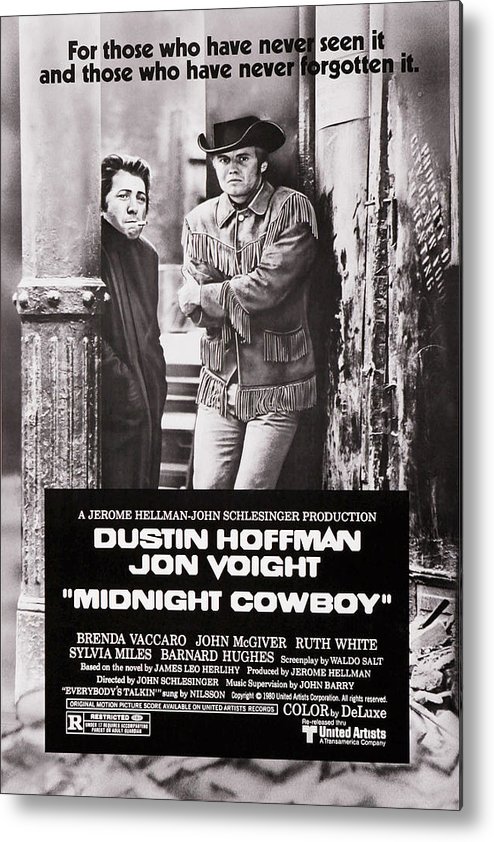
Midnight Cowboy is one of those movies that is so famous that even though this was the first time I’d ever actually watched it, I already felt familiar with it. I mean everybody knows the line, “I’m walking here!” by Dustin Hoffman. The AFI named that line the 27th greatest movie quote of all time (The movie itself is also on the AFI’s 100 greatest movies list). Most film fans also know that it is the only X-Rated film to ever win the Best Picture Oscar. Ratso Rizzo and Joe Buck are iconic cinematic characters. And yet, despite all that I’d never actually watched it until now.
Although Hoffman is top billed, Jon Voight stars as Joe Buck; a young, not very bright Texan who decides to head to New York where he thinks he’ll be able earn money as a male escort to rich New York women. Buck has a troubled past that is revealed through stream-of-consciousness flashbacks. Voight is good as the naive cowboy and his performance not only brought him to stardom, but also earned him an Oscar nomination.
As good as Voight is though, Hoffman steals the film as Enrico “Ratso” Rizzo; the streetwise, hustling New Yorker. His accent, his limp and his mannerisms form a character for the ages. His nickname is an apt one because he is very rat like as he crawls the streets of the city. Like Voight, Hoffman was also nominated for an Oscar for his role.
Together Buck and Rizzo form an unlikely friendship after a rough start when Rizzo cons Buck. As a pair they prove that the protagonists of a film don’t have to be likable for a movie to be good. You wouldn’t want to hang out with either of these two guys but at the same time you want to see what happens to them. Despite being fairly unlikable, you can empathize with their feelings of isolation, loneliness and the need to cling to another person for companionship no matter how unlikely the pairing.
The third main character in the story is New York City, but not the Disneyfied New York of today. This was a time when Times Square wasn’t a place you took the family to see. It was filled with adult theaters and male and female prostitutes on the prowl. Abandoned buildings had yet to be torn down and replaced by Condos, McDonalds and Baby Gaps. Director Schlesinger does a great job of capturing the gritty essence of that bygone city.
While the central characters are interesting and the acting is superb, the plot isn’t a cohesive whole. A series of events happen that aren’t always connected rather than a true story being told. The real story of the movie is the friendship between Joe and Ratso, but too often that is obscured by different episodes. It’s a platonic love story between two men essentially.
The fact that this movie was rated X at one time now seems quite quaint. The nudity is incredibly brief and the language is mild. Sex is talked about a great deal but only shown in a way that you could now practically get away with showing on network television. I imagine the biggest reason for the X might have been the scene when Joe gets a blow job from a strange man in a Times Square theater, although nothing is really shown of it. It has since been re-rated and now stands at the more sensible R rating.
Not every classic film lives up to its fame and I’m not sure as a whole if I’d say Midnight Cowboy does. Pieces of it though are brilliant, especially the performances of its two leads. They are the real reason this movie is remembered so well and they are the reason to watch it again or for the first time.
____________________
Watch Midnight Cowboy on Hoopla here: https://www.hoopladigital.com/title/11080259
INDIAN COUNTRY NEWS
"It is the duty of every man, as far as his ability extends, to detect and expose delusion and error"..Thomas Paine
Human in Algorithms
100% Accurate Google Sheets + KDP Book Formatting | 24hr Delivery
From the Roof Top
I See This
blog of the post capitalist transition.. Read or download the novel here + latest relevant posts
अध्ययन-अनुसन्धानको सार
 After the Crash