I would prefer not to relay the following very strange story given to me by a fellow sociologist, but he had done me a number of favors, and since he asked me to do him a favor in return, I feel obligated. I don’t know what to make of the whole thing. Following this brief introduction, you will find the manuscript he handed me. I realize you are getting this third hand, but there’s nothing I can do about that. I don’t know his friend. When he asked me to print it for him, I told him I would prefer not to, but then guilt got the best of me, so here it is.
This is one of those stories hard to believe. When I first heard it, I thought it was a joke, some sort of parable, and my friend who was telling it to me had had too much to drink or was just pulling my leg. I’m not sure. Like so much in today’s world, the difference between fiction and fact has become very blurry.
Let me call him Sean, since these days holding a strong dissenting opinion can cost you your job. He is a professor who, like the character David in John Fowles’ story, “The Ebony Tower,” teaches art history. And like Fowles’ character he is a very frustrated academic. In Sean’s case, he has had to contend with the transformation of his college from a place of learning to a place where “Woke” ideology stifles dissent. Perhaps more importantly, he has suffered from extreme writer’s block. He had just been telling me how, after years of writing copiously in his private journals, he had grown nauseated by it because it seemed so self-involved, concerning self and family stuff he was sick of. He wanted to write articles and books, yet when he tried, he couldn’t. All his energy had been going into his futile daily journals, where he felt trapped by family matters. Until one recent day at the bar where we regularly meet, he heard this strange story. It jolted him.
Here is what he told me over beer at the tavern. I am paraphrasing, but because his tale was so startling, I know I have the essentials right. He said:
“It was late in the afternoon last Wednesday when I came in here for a beer. I was feeling very tired that day, though depressed would be more accurate. The teaching routine seemed absurd to me. I wasn’t writing. I felt at a dead end. I guess I was. Anyway, you know that guy Tom whom we’ve talked to here before? Well, he was here and we got talking. The place was empty. It turns out his last name is Finn – Tom Finn. His father was Russell Finn, the famous painter, you know, the one the mainstream media gush over. A realistic sentimentalist is the way I’ve heard him described, although I would say he was a sick fabulist trying to repaint history for Hallmark Cards. Anyway, so this Tom Finn had had a few beers, and as he got talking, the both of us had a few more. It became obvious that he was obsessed with his father. He didn’t say that exactly, but I could guess it from the snide remarks about him he’d laugh out of the side of his mouth. I asked him about a big traveling exhibit of his father’s paintings which I had recently read about in the newspapers; had he seen it? ‘No,’ he said, ‘I don’t go to that kind of crap. That’s his bag of marbles.’ Things like that.
“It turns out the son is also a painter, but he said nothing about his own work, just that he painted. He talked all about his father’s work, how his father stole ideas, wasn’t very good, etc. I told him I agreed that his father’s work was overhyped and mediocre, but that my experience studying art taught me that was true for every era. I was trying to be nice, something I tend to overdo. I got the impression he turned to painting by default, it being some kind of knee-jerk reaction to his father, some kind of Oedipal contest.
“It turns out his real obsession is toys, no shit, and he got very animated as he talked about them. He wanted me to come over to his house to see his vast toy collection. The invitation was so weird, and with the beer’s effects, I couldn’t refuse. It was nearly dinner time, so I called Sara and told her I’d be late. I was actually interested in what made him tick. I mean, why would a grown man – I’d say he is in his mid-forties – collect fucking toys? And weirder still, he said his specialty was tiny plastic figures of all sorts. Of these he had more than 25,000 – for some reason he emphasized that number – that he’d periodically put on display at local libraries.
“So I followed him over to his house which is on that street adjoining the university where a number of art history professors live. Oak Terrace, I think it is. I couldn’t help laughing when I saw all those abstract sculptures decorating their lawns. It was getting dark and they were spotlighted. What a juxtaposition – so perfect – so-called realism and cerebral abstraction side-by-side. And both utter bullshit. I was reminded of a description of Russell Finn’s paintings that I once read: Cute wallpaper for readers of Reader’s Digest.
“Actually, Finn’s house is quite cute itself. When we were going in, I had to restrain myself from saying to him, ‘Life’s cute, isn’t it?’ I don’t think he would have appreciated that, although it’s very possible that he wouldn’t have known what the hell I was getting at. He’s a toy collector after all and what’s cuter than that.
“I’ll tell you this. I wasn’t prepared for what he showed me. He took me down to his finished basement, which he called ‘the laboratory.’ When he switched on the lights the room was empty except for the walls. They were covered with shelves about six inches apart that ran from wall to wall and ceiling to floor. It gave the large room this incredibly bizarre look as though it were a prison cell. There were even spotlights that illuminated the shelves, upon which, right along the outer edges looking out, he had lined up his collection of little figures. As we stood in the middle of the room, it was as though thousands of little people were staring at us, the giants. I felt as though I was hallucinating. Finn just chuckled when I said, ‘Pretty fucking amazing!” Then he said, ‘I like the perspective, don’t you?’ I knew he didn’t expect an answer and I could only chuckle in response, even as I felt a chill on the back of my neck. It was so eerie that I had to contain a shudder. For a brief moment I had the feeling that the door we had entered was going to shut and be bolted and that something terrifying was about to unfold.
“But at that moment he gestured to me to follow him to another door, over which a sign read, ‘The Family Fun Room.’ ‘This is my favorite,’ he said with a smile.
“In the middle of this pink painted room there was a cage that extended from floor to ceiling, and in the cage, sitting on stools, were two life-sized and very realistic figures of a man and a woman. They were both dressed in those black and white stripped prison uniforms you’ve seen in old movies. The woman was facing away from the man. I couldn’t tell who the woman was, but I immediately recognized the man. It was Finn’s father, down to the most realistic detail. He was holding a small toy figurine and was looking into its face. The door to the cell was padlocked shut. ‘That’s to make sure they can’t escape,’ Finn said with a straight face. ‘Now that I got them where I want them, I can’t take any chances. They’re dangerous and can cause me a lot of grief.’
“He then closed the door and we went upstairs. Neither of us said a word. He offered me a beer, but I declined. I felt spooked, some dreadful feeling in my gut. I told him I had to be leaving, which I did. On the way out I noticed a framed photograph in the foyer. It was a picture of Finn at about the age of nine or ten with his parents and sister. They are sitting together on a couch, the two kids caught between the parents. No one is smiling. Behind them on the wall is the father’s famous painting of a family of four sitting on a couch. In that one, everyone is smiling and the father in the painting is Finn’s father. As you probably know, that was one of his father’s favorite techniques – to put himself in his paintings. Such a cute double-message: I did it, of course, but how could I have done it when I’m in it. You’re left wondering: who really did it? Who executed the painting of these happy people. But since it’s all supposed to be so amusing, you’re left to chuckle, to think, how cute, how tricky. You’re supposed to smile. But no one was smiling in the picture on the wall. It seemed like a house of smoke and mirrors and I was damn glad to leave.
“As I drove home, I sure as hell wasn’t smiling. There was something terribly disturbing about it all. I felt nauseated, disgusted, really disturbed. Maybe it seems obvious, but I felt there was a connection between this weird experience and myself. A double connection, actually. I won’t go into all the details now, and you know about my writer’s block, but this bizarre experience has left me with a new sense of freedom, some kind of opening to a new way to write that at the time I couldn’t put my finger on. I’ve come to think of it as writing beyond a cage of categories.
“I thought about all the stuff we talk about, the political propaganda about everything, the loss of a sense of reality, the illusions and delusions with the digital technology, the warmongering by the U.S against Russian, the covid bullshit, all of it, all the stuff we share over beers. Especially the disconnect between the private and the public and the two-faced nature of a way of living that is so fucking phony. I realized why I had been hiding in my notebooks, how they had become my cage.
“To top it all off, when I got home and told Sara about my experiences with Tom Finn, the cage and all, she didn’t believe me. She accused me of having drunk too much, which I had to admit I did. She said I was scaring her with such a ridiculous tale and that I was sounding like a deluded conspiracy nut.
“Anyway, I’ve told no one else about Finn. I’m afraid they wouldn’t believe me either. You’re a sociologist and know all about Max Weber’s prediction of a coming disenchanted world with its iron cage. Shit, I feel like I had a small glimpse of it. Do you think anyone would believe me if I told this story?
A cult film originally released in 1973, Belladonna of Sadness can be read as a second-wave feminist work. However, in order to understand the film as feminist, it is important to emphasize that the film’s plot is based on Jules Michelet’s La Sorcière(translated as Satanism and Witchcraft or The Witch of the Middle Ages in English), originally published in 1862. In his book Michelet discusses his conception of the Witch’s way of life and the persecution the Witch faced by feudal Christian societies in the Middle Ages. Michelet defends the Witch in his book as a champion of love and healing and defends witchcraft as a prelude to science: “…we shall mark the beginning of the professional man as juggler, astrologer, or prophet, necromancer, priest, physician. But at first the woman is everything”. Belladonna of Sadness follows Michelet’s same view, combining this 19th century vision of the liberated witch with second-wave feminist ideology to create a flawed but fascinating work that invites revisiting even all these years later.
To those unfamiliar with the film, Belladonna of Sadness is the story of Jeanne and the persecution she faces as a woman in a feudal society. The story begins when newlywed Jeanne is gang-raped by the local baron and his attendants under the justification of “prima nocta”. When her husband falls ill, Jeanne becomes desperate and a clitoral/phallic demon appears to her and gives Jeanne wealth and influence as the village money-lender. She holds this role and this power until she is stripped of it–literally–and chased out of town. She ultimately “sells her soul to the devil”, which is the grown version of the initial phallic creature, and becomes a witch who lives apart from the village. Plague breaks out in the feudal society, and the villagers eventually join Jeanne, who builds a society that celebrates herbal medication and sexuality. Having lost power over the villagers, the baron offers her power as a means to control her knowledge; when she refuses to tell him, she is burnt at the stake.
This is a film written and directed by men (Yamamoto Eiichi and Fukuda Yoshiyuki) and is considered a Japanese “pink film”’ as it is includes graphic depictions of sex and nudity. Belladonna of Sadness uses its “pink film” attributes in order to demonstrate the plight of the main character Jeanne as an example of Michelet’s Witch. Jeanne’s sexuality is the focal point of her journey and the catalyst for the social changes that occur throughout the story.
Created during the Japanese feminist movement of the early 1970s, Belladonna of Sadness is a second-wave feminist film, and it’s impossible to talk about Japan’s women’s liberation without discussing the ideas of Tanaka Mitsu, arguably its most prominent leader. Tanaka fought against the popular notion of the woman as either a housewife or an object for male sexual pleasure. Instead, she advocated for the woman to be seen as an individual with agency over her own sexuality and shared her own life experiences with sexual assault, including rape and harassment, to inspire other women to support women’s liberation, a.k.a. uuman libu.
This seems to pair nicely with Jeanne:she’s initially (and presumably) destined to fulfill a wifely role in marrying her lover Jean but instead is forced into the role of sex object when brutally raped by the baron and his cronies, and gains agency as an individual through the awakening of her own sexuality. After this awakening she does not fall into the housewife/male-sex-object binary but gains power and instead assumes a leadership role in the village. However, the phallic nature of Jeanne’s sexual awakening complicates this viewpoint. To explore this, it’s crucial to look at Jeanne’s initial encounter with the little creature who awakens her sexuality before “it” becomes “him”– the devil/phallus character.
When she first meets the devil/phallus character, Jeanne is in a desperate position. Not only is she emotionally scarred from being raped, but she lives in poverty with her ill husband who, despite telling her they would move on from her assault, later attempted to strangle her. One night while her husband is asleep, a small clitoral-esque creature appears.
The clitoral creature states that it is her. It does not deny being “the devil”, but it is born of her desire. Her sexual awakening has begun. The clitoral creature then tickles her all over her body, making her laugh, and she questions how this small thing could give her power. Then it “teaches” her how to make it grow by rubbing itself in her hand, which turns “it” into a phallic creature that gives her sexual pleasure as she lays next to her sleeping husband. This is Jeanne’s first experience with masturbation, initiated by a clitoral-to-phallic creature, a personification of her individual sexuality—“I am you”—and summoned by her “screaming soul”. The agency of the “soul” is another important aspect of 1970s Japanese feminism, as Tanaka stated, “I want to have a stronger soul with which I can burn myself out either in heartlessness or in tenderness. Yes, I want a stronger soul.” Tanaka’s soul calls out for strength as Jeanne’s does for power, both qualities that were specifically reserved for men.
Jeanne’s individual sexual agency is exactly the kind of liberation Japanese feminists of the early 1970s envisioned, and in the film, it sets in motion Jeanne’s success within feudal society. Her sexual awakening was triggered not by the horrific rape she experienced beforehand but by her own, albeit guided, exploration of sexual pleasure without another person. However, it must be noted that this devil creature is gendered with a distinct male voice and phallic appearance.To discuss this, it’s helpful to bring in another element of the 1970s: the psychoanalytic female subject. This idea comes from Jacques Lacan’s theory of sexuation, conceived in 1972-1973. While Belladonna was in production as this theory was being published, it’s a useful way to boil down 1970s psychoanalysis to one analytical lens for the purpose of this essay.
Why use psychoanalysis and, of all psychoanalytic theorists, why Lacan, a man who once said that his brand of psychoanalysis wasn’t applicable to the Japanese? Both psychoanalysis and second-wave feminism were popular ways of thinking in the early 1970s that sometimes overlapped and often-times butted heads. Jeanne may be a feminist character, but she is also one created by men. Jeanne may be a character in a Japanese film, but she is also one based on a French man’s story of a witch in the European Middle Ages within a European social structure. And while Lacan might be thoroughly outdated in real life, his influential work still makes for a compelling tool of literary analysis.
Sexuation, to be dangerously brief, is Lacan’s theory of how a subject becomes a desiring subject through his/her sexuality. This theory relies on a binary, and there are different roles for male and female subjects. The female subject in sexuation fits one of three roles, two of which are to cater to the male subject and one that seeks what the male subject seeks: the “phallus”, otherwise known as power. Jeanne is the latter of the three. The phallus manifests when her sexuality is awakened; the phallus gives her power; when she is destitute and chased from the village, she seeks the phallus; again, the phallus gives her power. Jeanne fits the mold almost too perfectly… but does she?
If Jeanne were to truly fit Lacan’s mold as female-subject-who-seeks-the-phallus/power, then she would not be able to dismantle the patriarchal social structure once she becomes the leader of the village. Why? Because she would then be playing into a patriarchal structure herself, adhering to an identity constructed by men for a woman in power. When she first gains power and wealth in the feudal system, she continues to lead in accordance with it. She still pays and collects taxes—in fact, her husband becomes the tax collector—and she still meets with her superiors in the feudal system. Nothing systemic really changes except that she becomes the leader of the villagers and brings them wealth.
Jeanne is exposed to the violence and greed of those men for which the system was created once they deem her a threat to their power, and so she is eventually chased out of the village and away from the system completely. This is the moment when she “sells her soul to the devil”. It is a desperate moment, as was the very first time the clitoral-phallic creature appeared to her. This time, though, the creature is entirely phallic, monstrously large and referred to as the devil, but there is one very important detail to remember: “I am you.”
This phallic character, once a small creature on a spool of thread, is a manifestation of her sexuality. Yes, it is exceedingly heterosexual, and a product of male writers and animators, but Joanne still has agency to engage with the manifestation of sexual desire and independence she herself has cultivated. Albeit clearly depicted as masculine, the devil phallus does not adhere to the feudal social structure but rather an invitation to the possibility of something new, born of embodiment rather than socially constructed.
Bodily knowledge, although depicted heteronormatively, is what creates Jeanne’s new society. The beautifully animated scene of Jeanne’s sexual experience with the devil is also full of Yonic imagery. When the devil appears to her, he parts the clouds by flying down in a circular motion, revealing a clear sky without a sun. Just before the devil lands, however, he shoots out of a shape in this clear blue sky: vaginally-shaped pink, red and purple oval. This vaginal space appears to stand in for the sun and allows the devil to manifest on the earth. This phallus originates from the vaginal.
Once Jeanne and the devil’s intercourse climaxes, images of modern—okay, 1973-modern—entertainment, technology and everyday life flash before the viewer’s eyes, signifying that she made it happen. This is in accordance with Michelet’s message that it is the woman who was first to create and resonates with 1970s Japanese feminist Raicho Hiratsuka’s sentiment that “in the beginning woman was the sun”, evidence of the importance of the aforementioned Yonic imagery in the film. Jeanne’s embodied sexuality sparks the possibility for all that will be created, even that which is phallic.
Jeanne gets another chance at dismantling the feudal patriarchal social structure when the black death, better known as the Plague, destroys the village. One of the not-dead-yet villagers finds himself near her, and she cures him with what he refers to as “poison,” telling him “poison is medicine.” He goes back to tell the others, who spread rumors that she is a witch but run to join her because of her healing powers, sympathy toward others, and rejection of social hierarchies and sexual norms. On these foundations she builds her own society, one that is inclusive, even to those who have wronged her and come to her for help. She builds a society based on liberation, kindness, and open-mindedness.
She provides antidotes specifically related to female reproduction such as labor pain medication and birth control, access to which was a large part of the Japanese women’s liberation movement in the 1970s (and remains an issue there as it does abroad). People are free to have sex as often as they wish without worrying about the potential financial burden of having children. People are free to experiment sexually, shown in the orgy scene in Jeanne’s hair. Her new society is not a patriarchal one, but she also did not have to dismantle the previous patriarchal society to create her own. The Plague provides the conditions to build her feminist society separate from the existing feudal structure. Her society is not a rebellion or antithesis of the feudal structure but a revolutionary system of its own making.
Jeanne and her sexuality—from “selling her soul” to the devil/phallus, who is also a part of herself—demonstrate that a feminist society is possible, though its conception of what that might encompass is limited due in part to the restrictions of Michelet’s source material. The sexual symbolism in the villager’s activities are heterosexually binary, and the villagers all form man/woman pairs when they first engage with Jeanne’s society. The bodies of the villagers continue to be drawn as either clearly heteronormatively male or female as well.
The major exception is the non-heteronormative sexuality depicted in Jeanne’s alternative society during the long orgy scene in Jeanne’s hair, where the villagers are all connected in sexual positions and occasionally break out to showcase various other non-hetero sexual scenarios.There are moments of bisexuality seen in the orgy and one flash of two men together, but anytime a person strays from being either cis male or female, they are merged with an animal and meant to be comical. This lack of tender, intimate queerness even under liberation becomes the biggest failing of the film’s vision.
Ultimately, however, Jeanne and the villagers are forced to go back to feudal society. Jeanne’s husband comes to her, telling her she will be forgiven by the lord if she returns. She isn’t fooled by the lord’s blatant lie, but she knows that if she doesn’t go back, the lord will send troops to capture and kill her. She is in a lose-lose situation. The patriarchal structure proves its all-powerful authority, and that her separatism is impossible without dismantling the oppressive structures she fled. When she goes back, the lord does, in fact, offer her land in exchange for her knowledge.
He not only wants her power—the lord wants to indoctrinate her power into a patriarchal system, taking the feminine healer’s “witchcraft” and rebranding it as “science”. The lord desperately tries to get her to reveal her healing power by offering her more and more power in the feudal system, but Jeanne is not interested in being a part of his patriarchal hierarchy. She’s experienced the possibility of a feminist society and desires revolution over anything she could obtain in the existing structure.
During the film’s final moments, when Jeanne is burned at the stake, the faces of the women villagers watching her begin to change one by one to resemble her face, symbolizing the perpetuation of Jeanne’s influence. These villagers’ faces reflecting Jeanne’s face is a sign of Jeanne’s legacy. It is revolutionary in its admission that it’s possible to envision a society outside of the existing oppressive structure.
Watching the film in 2022 through an intersectional lens informed by evolving feminist and queer theories, Belladonna of Sadness may no longer seem progressive. The “girl power” message its male writers were trying to get across may be lost in its overwhelmingly graphic heterosexuality, and Michelet’s vision of The Witch may not resonate or hold the same power for contemporary viewers.
The homogeneity of the womens’ faces at the end of the film demonstrate that the “girl power” Jeanne had put in motion is homogenous. It suggests that there is only one type of woman that can grasp and perpetuate Jeanne’s vision. Through a lens of queer and critical race theory, the womens’ faces merely play into existing power structures, as the faces are all the same and, most importantly, all white with feminine traits such as big eyes, dark eyelashes, full pink lips. A truly radical depiction of Jeanne’s society in these face changes to push against patriarchal power structures would include a wide array of faces.
Through hindsight it may not hold up today in some regards, but I firmly believe that it is still revolutionary in that it depicts the possibility of a society based in the power of sexual freedom, healing, and care, rather than one that merely reconfigures existing patriarchal structures. The society Jeanne creates outside the feudal land is radical. Her society is necessarily birthed of the female body; even the phallus cannot come into being without her sexuality. Belladonna of Sadness is a historically important film that deserves to be revisited and reconsidered. It helps us better understand current feminist thought by knowing where we’ve come from and, in analyzing its flaws as well as its more deeply embedded subversions, allows us to push current critical theory even further.
Finally, a Korean period drama that is all action, and more importantly, devoid of mindless zombies. If you’re looking for a gritty action film filled with spectacular sword-wielding stunt work, Joseon era drama and good ol’ warriors’ code, The Swordsman will definitely deliver enough to whet the appetite of any action fan.
Directed and written by Choi Jae-Hoon, the film is designed with meticulous care to costume and makeup while incorporating a whole trove of weaponry for satisfying fight sequences, showcasing a winning formula of mixing a period drama with martial arts. If the “Die Hard on a…” trope defined action cinema in the 90s, audiences are now in the realm of hyper-violent action films as defined by the likes of The Raid and John Wickfranchises.
While the nature of The Swordsman leans it more towards a martial arts film with action taking precedence over an admittedly predictable plot, we can’t deny that the story moves along at a well-timed pace packed with amazing action sequences. It wastes no time on unnecessary romances or over-glorified gratuitous fight scenes, and we are thrown right into the heart of an intense chase scene right off the bat.
The prologue sees the protagonist, Tae-Yul (Jang Hyuk) desperately protecting the emperor against a coup led by Tae-Yul’s mentor Seung-Ho (Jeong Man-Sik). After the doomed battle and fall of Gwanghaegun of Joseon, Tae-Yul retires his sword and leaves for a peaceful life in the mountains. We find out that he does so for his daughter, Tae-Ok (Kim Hyun-Soo).
The movie takes place during the tumultuous transition times of the Ming-Qing dynasty, so peace for the retired swordsman is unfortunately broken. Like how most Hero’s journeys are written, Tae-Yul receives a call to adventure when he first encounters the thugs from Qing and led by Gurutai (Joe Taslim) in the market. However, like any hero’s journey goes, he refuses the call in favour of maintaining his hermit days to protect Tae-Ok.
However, we see that Tae-Yul now suffers from deteriorating eyesight and this spurs Tae-Ok to venture down the mountain alone. Tae-Yul’s world is soon shattered when his daughter is taken from him and he is forced to cross the threshold and return to the world of the swordsmen.
Despite its gentle start, featuring sunny days in the mountains for the father-daughter duo, violence and swordplay soon permeate the plot. The swelling score that rolls through the film propels the momentum of the action as Tae-Yul slashes down enemy after enemy.
The wall-to-wall action hits its climax when Tae-Yul makes his way to Lee Mok-Yo’s (a minor unscrupulous noble played by Choi Jin-Ho) residence to face endless waves of Gurutai’s men. The scene is made all the more climatic by Tae-Yul’s quiet entry as compared to the carnage onscreen seconds before when the men, armed with guns, shot down Lee’s entire platoon of guards.
Cue wild barrage of gunfire and some Matrix-like slow-mo bullet-dodging action, Tae-Yul’s onslaught against the men is relentless. With only a sword, he is able to slice through the first wave of gunmen and power through a group of ninja-like masked assassins. Coupled with smooth continuous shots of the action, the entire scene was bloody with a capital B. But, the blood at some points did tend to look obviously digital and could have worked better with more realistic spurts.
Amidst all the action in The Swordsman, we see a build-up to the final boss fight with Gurutai via the menacing hold he has over both the Joseon officials and the three barbaric thugs. Being the cream of the crop in terms of sword skills, the final fight is an escalating intensive sword slashing sequence. The only issue we had with the scene was that it felt as though the final fight ended too soon and we’d love to have seen more of the two characters pitted directly against each other.
So yes, this leads to the few gripes we have with the film. Seung-ho’s first battle against Tae-Yul implies that he is a much better swordsman than our protagonist, but in the film, he ends up doing very little swordwork. Maybe, it could have been related to the aged warrior’s philosophical outlook on swordsmanship changing due to the regressive state the nation was in after he led the coup. Most of his action is only ever mentioned in passing or through small fights that seem ornamental compared to his opening battle in the prologue.
Similarly for Gurutai, who is played by martial-arts expert Joe Taslim (of The Raid fame). As a fierce swordsman with his own albeit twisted code of honour, he struts around with an air of superiority as the Joseon warriors are unable to touch him in fear of retaliation from the powerful Qing kingdom. Gurutai is first introduced in a scene with a suaveness in contrast with the flittering Joseon nobles and doesn’t hesitate to expose his menacing aura. One would expect more action from the character throughout the movie, considering that the actor playing him is known for his spectacular long take fight sequences, though we can understand that they may have curbed this due to the want for a more intense foreshadowing and build-up of mystery surrounding the “final boss” of this action film.
Yet, aside from these small action woes, the film hits the nail on the head characterisation wise.
Jang Hyuk was able to express so much with so little said as Tae-Yul is a man of few words but with a strong code of honour. He spends the first half taking down enemies with a cane, thwarting villains without unsheathing his sword and just glaring them down, attesting to his skills as a warrior and morals (and ramping up his coolness points). He would rather avoid fights when possible, even lowering himself on his knees at one point for his daughter’s safety.
However, despite being a silent warrior with a puppy-dog face portrayed by Jang Hyuk, the swordsman doesn’t hesitate to switch back to killing with actual weapons when he realises that submission is no longer a way to maintain his peace.
K-pop fans will also be pleasantly surprised to see BTOB’s Minhyuk transform into a rugged swordsman as he portrays the younger version of Tae-Yul. The Swordsman marks his big-screen debut, and here, the singer shows off his acting chops with strong facial expressions, swift movements and intense gazes.
Tae-Yul shares a close bond with his bubbly daughter who adds a breath of fresh air to his quiet life. We appreciate how the film doesn’t go with the overused trope of a warrior retiring his blade due to a painful past and instead see that Tae-Yul did so in order to protect Tae-Ok with a peaceful sheltered life away from the brewing chaos. When Tae-Yul drops the line, “My daughter my nation,” it can be taken figuratively. But, there is another explanation behind that line which viewers will have to watch to find out.
Kim Hyun-Soo plays the daughter who is bold, yes; and acts with a will well ahead of her time but not in a brash manner. She cares deeply for her father and respects him, only showing defiance out of concern for his ailing eyesight which he refuses to tend to. How the film was trying to portray Tae-Yul’s onset of blindness could discombobulate audiences though, as the weird ringing and wooziness made it seem that he had some bad head trauma and was not simply going blind. The film itself doesn’t elaborate on the illness either so everything is based on speculation.
Through Tae-Ok, the film takes a break from the action at times and opens up towards the period drama aspect with her adventure down the mountain and frolicking through the colourful market streets. It’s too bad that she didn’t get more screen time to show off her character and demonstrate more of her spunk. But perhaps, it wouldn’t have fit into the narrative or may have taken up too much time.
Unlike Tae-Yul, Gurutai is a man of many words and has a lot to say about the Joseon people and their nobles. It is pretty impressive with how well Taslim, an actor from Indonesia, is able to pronounce and delivers each line without faltering and even manages to infuse the right amount of menace in each syllable. He even executes the older historical accent that some Korean period dramas will use, with a natural lilt which is a huge achievement even for native Korean speakers. What’s more, this is also his first time doing action with a sword, yet he executed the moves flawlessly, showing his true martial art prowess.
Leading a trio of ruthless thugs and a band of bandits they terrorise the Joseon villages with slave debts which the Joseon guards have no choice but to close both eyes too. And for all his code of honour dictates, it becomes his weakness as he is quickly blindsided by it when Tae-Yul makes an unexpected move in the final confrontation.
The trio of thugs burst into the scene in a flurry of hoofbeats and over-the-top hairdos. Their brutality is established with their merciless beatings of a defenceless villager and savage choice of weaponry. Yet, despite all their bullying, they are easily overwhelmed by our protagonist. Though the fact that they could sense that Tae-Yul was skilled with a sword, without being fooled by his meek demeanour as others were, could attest to their experience in fighting and swordplay.
And as with how most period dramas are fashioned to match the ways of that time period, the women are treated more as mere decorative figures or transactional goods. Thankfully, the film does not have drawn out gratuitous scenes with regards to their low treatment. Moreover, we do have some girls inside who attempt to subvert the norms such as the trading port lady and Tae-Ok herself.
Furthermore, aside from the epic choreographed fight scenes, the film pays diligent attention to detail too. The costume designs for the main characters are simple but effective in portraying their personalities and statuses. Even the makeup is top-notch and consistent throughout, paying special care to the cuts and old injuries that the characters bear.
The sound design is nothing to ignore too and if anything has to be lauded for its ability to feed to the action. Every draw and swing of the sword is accompanied by an answering ring and the thuds and thumps help every blow feel more weighted and real. Even the simple sounds such as the clicks and clacks of the nobles’ accessories and the crunching of gravel beneath the guard’s boots helped to develop the look of the character beyond what can be seen visually (ASMR anyone?). These small sound effects help build the intensity of blood-pumping scenes due to its contrast with the escalation of noises brought about by the chaos.
The Swordsman is a wonderful blend of meticulously choreographed swordplay and enough drama to make us invested in the characters despite its simple plot. The film’s ruminative tone is interspersed with well-paced action and gentle moments and even ends on a bittersweet heartwarming note. It truly is up to scratch with what a good action film should look like and is a huge accomplishment as a directorial debut for Choi.
Summary
The Swordsman is an impressive Korean period action film filled with meticulously choreographed swordplay and complex characters which will satisfy any die-hard fans of this genre.
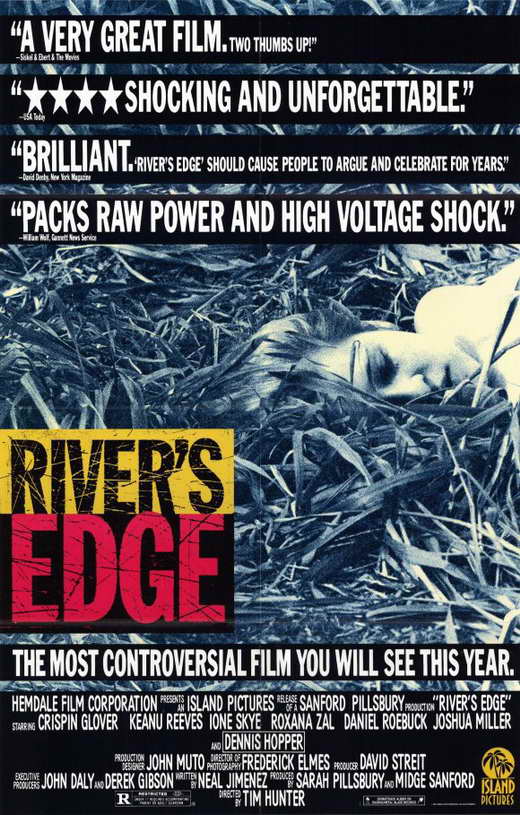
I remember reading about the case at the time. A high school kid killed his girlfriend and left her body lying on the ground. Over the next few days, he brought some of his friends out to look at her body, and gradually word of the crime spread through his circle of friends. But for a long time, nobody called the cops.
A lot of op-ed articles were written to analyze this event, which was seen as symptomatic of a wider moral breakdown in our society. “River’s Edge,” which is a horrifying fiction inspired by the case, offers no explanation and no message; it regards the crime in much the same way the kid’s friends stood around looking at the body. The difference is that the film feels a horror that the teenagers apparently did not.
This is the best analytical film about a crime since “The Onion Field” and “In Cold Blood.” Like those films, it poses these questions: Why do we need to be told this story? How is it useful to see limited and brutish people doing cruel and stupid things? I suppose there are two answers. One, because such things exist in the world and some of us are curious about them as we are curious in general about human nature. Two, because an artist is never merely a reporter and by seeing the tragedy through his eyes, he helps us to see it through ours.
“River’s Edge” was directed by Tim Hunter, who made “Tex,” about ordinary teenagers who found themselves faced with the choice of dealing drugs. In “River’s Edge,” that choice has long since been made. These teenagers are alcoholics and drug abusers, including one whose mother is afraid he is stealing her marijuana and a 12-year-old who blackmails the older kids for six-packs.
The central figure in the film is not the murderer, Sampson (Daniel Roebuck), a large, stolid youth who seems perpetually puzzled about why he does anything. It is Layne (Crispin Glover), a strung-out, mercurial rebel who always seems to be on speed and who takes it upon himself to help conceal the crime. When his girlfriend asks him, like, well, gee, she was our friend and all, so shouldn’t we feel bad, or something, his answer is that the murderer “had his reasons.” What were they? The victim was talking back.
Glover’s performance is electric. He’s like a young Eric Roberts, and he carries around a constant sense of danger. Eventually, we realize the danger is born of paranoia; he is reflecting it at us with his fear.
These kids form a clique that exists outside the mainstream in their high school. They hang around outside, smoking and sneering. In town, they have a friend named Feck (Dennis Hopper), a drug dealer who lives inside a locked house and once killed a woman himself, so he has something in common with the kid, you see? It is another of Hopper’s possessed performances, done with sweat and the whites of his eyes.
“River’s Edge” is not a film I will forget very soon. Its portrait of these adolescents is an exercise in despair. Not even old enough to legally order a beer, they already are destroyed by alcohol and drugs, abandoned by parents who also have lost hope. When the story of the dead girl first appeared in the papers, it seemed like a freak show, an aberration. “River’s Edge” sets it in an ordinary town and makes it seem like just what the op-ed philosophers said: an emblem of breakdown. The girl’s body eventually was discovered and buried. If you seek her monument, look around you.
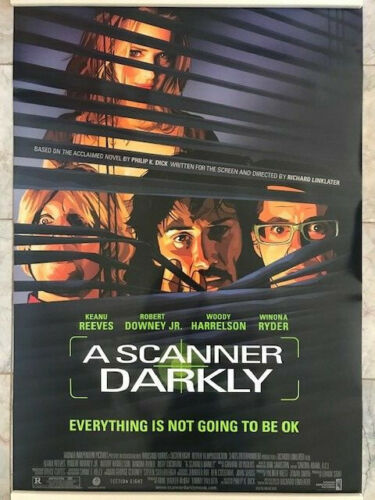
Based on the acclaimed novel by Philip K. Dick, Richard Linklater’s 2006 film of A Scanner Darkly presents a cautionary tale on drugs, surveillance, and perception in a unique formal arrangement. Set “seven years from now,” the film considers a tyrannical post-9/11 world oppressed by an ever-watchful government, widespread paranoia, corporate subjection, and pervasive pharmaceutical addiction—all elements further fuelled by the obsessive fear that governments, corporations, and even your friends conspire against you. Linklater’s decision to produce his film with rotoscoped animation turns his adaptation into one of the most visually and thematically original motion pictures in decades, and the most faithful of all Dick adaptations. The film’s world contains several Dickian existential and metaphysical dilemmas and paradoxes, from the notion of spying on oneself to becoming willing participants in one’s drug addiction. This unsettling and tragic world becomes deliciously skewed from the excessive filtering of surveillance technology and a crazed dystopian culture, so much so that it remains impossible to see anyone for who or what they really are. A Scanner Darkly beautifully, and chillingly, considers Dick’s persistent theme that our culture has destroyed its own ability to perceive objective reality.
Philip K. Dick was born in 1928 and became interested in science fiction at an early age. He attended the Berkeley, California, high school and graduated in 1947, alongside another future science fiction author, Ursula K. Le Guin, and briefly attended the University of California, Berkeley. He published his first science fiction story in 1951. From there on out, he would become one of the most prolific authors in his genre, publishing some 44 novels and more than 100 short stories until his death in 1982, just before the release of his first book-to-film adaptation, Blade Runner, based on his 1966 novel Do Androids Dream of Electric Sheep? Though science fiction was typically considered unsophisticated and a lower form of fiction, Dick’s caustic wit and social satires elevated sci-fi to the level of art. His self-proclaimed title was not that of an author but rather a truth-teller. He wrote his truth, and it consisted of a vast fictionalized philosophy, which some might argue was—and is—not necessarily fiction. His most enthusiastic followers might say his work is visionary, if not prophetic. Dick claimed his work spoke, and still speaks, to disturbed, troubled, and “off” members of society. His writing is for those who cannot rationalize society or reality: for those who need a satire, base, or frame of reference to rely on as coping mechanisms. Science fiction creates the desired satirical reality for readers, just as his characters in A Scanner Darkly see drugs as the only sane choice to escape the insane world.
Written in 1977, A Scanner Darkly stands as an ode to the drug counter-culture of Dick’s own Berkeley underground. But it’s also a thoughtful exploration of the metaphysical existence of drug users, as well as a mournful commentary on the government’s involvement in drug culture. Standing against the blatantly autocratic Nixon administration, marked by a reputation for undue suspicion and conspicuous surveillance, his Berkeley group purveyed conspiracy theories and widespread mistrust. And yet, this counter-culture also included a vast set of respected thinkers, unafraid to speak out—not just mindless stoners. According to an interview with French TV, Dick claims the group’s paranoia was not unjustified. During the interview, Dick speaks of secret CIA and FBI files on him, covert operations to get at his personal documents, and rampant spying led by the heads of various government organizations. To Nixon and his administration, the Berkeley group was an unknown element—a misunderstood collection of hippies seen through a distorted set of the administration’s famously paranoid views and political mechanisms. Fuelling this conflict between the two factions of Nixon’s administration and the Berkeley group, the author had a lifetime’s worth of experience with drugs, psychosis, and a slight case of schizophrenia. But in no way should those characteristics hinder the author’s message. Instead, Dick’s distinctiveness within the Berkeley group should reinforce that A Scanner Darkly may be more autobiographical than his other novels.
The story’s main character is Bob Arctor (Keanu Reeves), an addict of a drug called Substance D, also known as Slow Death. But Bob is also Fred, an undercover narc spying on Arctor’s group of Substance D-using friends. Arctor has lost sight of his identity because of Substance D, which chemically separates brain functions in the hemispheres; after prolonged use, the left and right sides of his brain are unaware of each other. Furthermore, the Fred portion of the main character must conceal his identity from his supervisors for his own safety. No one knows who Fred is; no one knows who Bob is—including himself. The sole man representing both the narc and the addict does not realize he is spying on himself, and in a way, informing on himself. This self-betrayal is tantamount to suicide, rendering him prey to both Substance D and the totalitarian police state that employs him. According to the novel, the drug is made from a flower called “mors ontological”—Latin for ontological death. To be sure, Dick saw first-hand the damage substance abuse caused his friends. He was not entirely unaffected himself; he relied on methamphetamines and psychedelics for much of his early career. But he weaned himself off drugs before writing this book. And at the very end of his novel, Dick dedicates his fiction to several friends who died or retained permanent physical and mental dysfunction due to excessive drug use (a dedication abbreviated at the end of Linklater’s film). He writes that users are punished excessively and even unknowingly for attempting to “play” with something dangerous.
So often, society deems drug users worthless or mindless junkies for their habits, but A Scanner Darkly—the story and the title itself—asks that we do not pass judgment until we can see, in its entirety, the role of users. However, because of the elaborate system of filters between our eyes and that which we wish to see, how can we ever trust that we see reality and not some malformed version of reality skewed through surveillance tools? These filters exist in the form of monitoring equipment such as cameras and scanners, but also the mind-altering Substance D. Drugs are the obscuring mechanism by which the narrative challenges audiences to accept and ultimately forgive the characters within. Throughout the film, viewers must accept drug use as a fact of the story rather than a downfall of the characters. The book’s title refers to a verse from the bible, namely 1 Corinthians 13: 11-12, a verse that is paradoxically read both at weddings and funerals:
For we know in part, and we prophesy in part. But when that which is perfect is come, then that which is in part shall be done away. When I was a child, I spake as a child, I understood as a child, I thought as a child: but when I became a man, I put away childish things. For now, we see through a glass, darkly; but then face to face: now I know in part; but then shall I know even as also I am known.
A pattern of dualism exists in this passage, particularly after its application to popular culture. Both in the novel and the film of A Scanner Darkly (not to mention Swedish director Ingmar Bergman’s film Through a Glass Darkly), the idea of childhood versus adulthood, known and knowing, and parts versus the whole, are circumscribed so that the reader or audience cannot reconcile metonym from metaphor.
Dick’s writing often tells of worlds that are not what they seem. With A Scanner Darkly, the world remains undefined, distorted through a complicated filtration process. Linklater magnificently captures that undercurrent through his use of rotoscoped animation. Throughout the narrative, we remain unsure about Reeves’ character’s identity—in part due to the setting’s massive use of surveillance technology. The protagonist is not altogether Bob, nor is he altogether Fred; he comprises several constructs that never assemble into a single, understandable symbol. Agent Fred watches Bob on numerous holo-scanners, located everywhere; scanners see every moment of every day in every location. Someone is always watching (or that is what they want you to think). Undoubtedly, there was a time when Fred realized he was Bob, but Substance D has destroyed his understanding of his dual roles. Now, Fred cannot fully understand or see Bob. Who is this mysterious figure? Fred wonders. Is he the mastermind behind the whole thing? When Fred looks, he watches through a filter: the scanner. He cannot see clearly because his mind has been altered. At the same time, Bob has an unsettling sensation that he’s being watched. Though Bob and Fred are the same person, they cannot fully understand themselves. Meanwhile, the overwhelming network of observational devices only puts the truth at a greater distance.
The main character questions his culture’s scoptophilia-driven ways of looking and its authenticity: “What does a scanner see?” he asks himself. “Into the head? Down into the heart? Does it see into me? Into us? Clearly or darkly? I hope it sees clearly because I can’t any longer see into myself. I see only murk. I hope for everyone’s sake the scanners do better, because if the scanner sees only darkly the way I do, then I’m cursed and cursed again, too.” The protagonist’s hopes are in vain, as scanners prevent authorities from seeing their suspects clearly. Drugs debatably prevent the film’s main characters from seeing reality clearly, just as Linklater’s innovative use of animation in the film prevents audiences from seeing clearly. All these devices—scanners, drugs, animation—are filtering devices within the film. They distance the viewer or the subject from the truth, for which knowledge thereof is impossible, thus brilliantly placing us on the same disjointed plane of existence as the protagonist. We see through these filters as if a sfumato haze lingered between our eyes, and what we see is a distortion that impedes an accurate understanding.
With the film’s animation, the distortion does not take away from the audience’s understanding of the story’s message. It adds to it. The rotoscoping technique postponed the film’s scheduled release yet made the lengthy, nearly two-year production worth every moment to waiting audiences. A Scanner Darkly’s journey to the screen actually struggled for well over a decade with interested directors and forgotten scripts. In the 1990s, filmmakers ranging from Terry Gilliam to David Cronenberg attempted but failed to get their proposed adaptation before cameras. Charlie Kaufman, the writer of Being John Malkovich and the very Philip K. Dick-esque Eternal Sunshine of the Spotless Mind, also wrote a screenplay for Dick’s much-praised drug novel, although the script was never produced. Eventually, writer and director Richard Linklater wrote an adaptation. He had previously wanted to adapt Dick’s fast-paced Ubik, but settled on A Scanner Darkly for its metaphysical pondering and sense of paranoia, both themes which Linklater had explored before. George Clooney and Steven Soderbergh’s production company Section Eight agreed to produce. And eventually, the film was sanctioned by the Philip K. Dick Trust.
Based in Austin, Texas, Linklater helped launch a movement in American independent cinema with his 1991 debut, Slacker, an ultra-low-budget film that follows a group of college-age thinkers and vagabonds in loosely connected conversational vignettes. Before that, Linklater demonstrated his love of cinema when he founded The Austin Film Society in 1985, a non-profit group devoted to rare and important filmic works, which today has an Advisory Board consisting of filmmakers such as Steven Soderbergh, Quentin Tarantino, Robert Rodriguez, Tobe Hooper, and Les Blank. After Slacker, Linklater released Dazed and Confused (1993), a box-office flop that has since become a cult favorite, along with launching the careers of Ben Affleck, Matthew McConaughey, and Parker Posey. He continued with films rooted in thoughtful conversations, such as Before Sunrise (1995), the first chapter in the transcendent Before trilogy, and subUrbia (1997), adapted from Eric Bogosian’s acidic play. Eventually, Linklater experimented with commercial work, such as The Newton Boys (1998), an underwhelming Prohibition-era bank robber story, and the underrated Jack Black comedy School of Rock (2003). But the writer-director’s real talents flourish in artistic films with a sly commercial appeal—such as the highly praised sequels to Before Sunrise, 2004’s Before Sunset and 2013’s Before Midnight; his part-documentary, part-dramatized real-life murder story Bernie(2011); or his ambitious 12-year project Boyhood (2014).
Outwardly, A Scanner Darkly remains most closely tied to Linklater’s 2001 release, Waking Life, a most meandering and philosophizing work that uses rotoscoped animation to follow an ongoing series of thought-provoking conversations. The process was originally used in 1914 by cartoonist Max Fleischer, and then next by Walt Disney, to help cartoonists simulate natural movement. By painting or inking on live-action footage, the characters in a film such as Sleeping Beauty (1959) were given more realistic bodily actions and facial expressions. But A Scanner Darkly would use the method for much more than merely painting over photography; the film uses animation to establish both reality and create hallucinatory images. As a result, the original plan scheduled nine months’ worth of post-production animation, but the process took eighteen months to allow for the detail and imagination Linklater wanted in his animation. The outcome, even in seemingly insignificant scenes, is breathtaking. The flawless animation appears to be a comic book with a pulse. Combine that with the bravado performances of the film’s actors, and the animation becomes just another piece of the apparatus that disappears in the glory of a great story. Some may hold reservations towards the technique, believing that the animation takes away from the actors’ performances or the narrative. Still, the approach helps rather than hinders the actors’ places in A Scanner Darkly’s bizarre, paranoid reality, aligning perfectly with Dick’s themes of reality distortion.
The most impressive piece of animation in the picture is Fred’s ever-shifting “scramble suit,” which prevents Fred’s supervisors from identifying him, maximizing the security of his cover. Fred’s boss wears a similar suit, and neither Fred nor his boss knows who is behind the other’s suit. The “scramble suit” projects false identities via constantly shifting characteristics so that no surveillance mechanism can pinpoint the wearer’s identity, therein eliminating any possibility of exposure. Animating the suit consists of creating hundreds, if not thousands, of facial and bodily fragments that dizzily rotate at random. But each momentary identity has to maintain an overall silhouette and still project the actor underneath. When Keanu Reeves’ Fred moves, even from under the continually changing scramble suit, the audience can still recognize Reeves’ movements and body language. The performances themselves were given by actors chosen not only for their sheer talent but, seemingly, for their off-screen reputation with drugs. Keanu Reeves, Robert Downey Jr., Woody Harrelson, Winona Ryder, and Rory Cochrane have all had or even lived similar roles to theirs in A Scanner Darkly. Somehow rotoscoping wipes away that stigma, compiling a new face literally painted over the actor’s old one. The performers are made whole again, permitting the audience to forget about Downey Jr.’s reoccurring drug problems or Harrelson’s history with pot. They are no longer actors but rather characters given free-range because of the innovative medium. Their off-screen reputations linger in our subconscious, to be remembered later upon reflecting on the film’s artistry.
The most notable performance of the group is Robert Downey Jr. as Barris—a suspicious character so burnt out from the drugs and constant onslaught of paranoia that he’s become sadistically mistrusting, if only internally, of his friends. Downey Jr. plays Barris as a fast-talking, often brilliant individual that can turn at any moment. Downey’s maniacal rapid-flow speech and brazen waving of the arms bring Barris—the most conniving, intelligent, humorous, sadistic, and strangely most likable character from the novel—to life. Reeves and Cochrane’s performances deserve acknowledgment as well, as each actor completely embodies their respective role. Reeves takes Bob (or is it Fred, or later Bruce?) to the ambiguous level demanded. While Reeves has taken his share of guff for his inexpressive acting, he seems at ease and perfectly cast here. Looking back, no other actor could have given Bob-Fred-Bruce the same ambivalence to the world and himself without making it appear too unintentional (or too intentional, for that matter). Cochrane plays Freck, an overdosing Substance D fiend and one of Arctor’s group of stoner friends. The first scenes in the film involve Freck attempting to wash and kill hallucinatory aphids from his body and out of his hair. Cochrane gives Freck the perfect helpless-yet-fearful twitch of a user who knows he has gone too far. Freck is pitiable in how prey is pitiable: although aware of his deteriorating state, he is too far gone to change the situation and helpless to prevent his eventual collapse.
This could be said for any of the characters in the film. Each floats like a moth on a calm pond—having landed on the water, they are now helpless to escape. They wait for some hideous predator from the murky bottom to float up and gulp them down. Both the film and Dick’s novel share a potent message—particularly in the story’s climax, which reveals that the foundation set up to cure people of Substance D addiction is the very organization creating it, a corporation called New Path. This turn speaks against the type of suspicious world where people have no choice but to escape. Neither the film nor the book condones drug use, but they understand it. They do not blame users for attempting to distract themselves from the ever-encroaching watchful eye of society and the government looming in. Or as Dick writes in his Author’s Note at the end of his novel:
Like children playing in the street; they could see one after another of them being killed—run over, maimed, destroyed—but they continued to play anyway. We really all were very happy for a while, sitting around not toiling but just bullshitting and playing, but it was for such a terrible brief time, and then the punishment was beyond belief; even when we could see it, we could not believe it.
Indeed, through A Scanner Darkly, Dick seems to indirectly remark on the allegations that the CIA participated in the Secret War in Laos, which in turn moved commercial opiates, including heroin, into the United States. Those who wished to “play” could do so thanks to their government, and in turn, they were destroyed for it. Surely Dick’s story would anticipate accusations of CIA cocaine trafficking, specifically during the Reagan and Clinton administrations: there are questions about how closely the government has worked alongside the Mexican Cartels; how the CIA has allowed drop points at the Mena Intermountain Municipal Airport; if the CIA collaborated to import cocaine and marijuana as part of the Contra war in Nicaragua; or how the CIA targeted certain Black neighborhoods during the 1980s crack epidemic. But, as with Freck and eventually Bob, we do not judge the users in A Scanner Darkly; instead, we see them as the product of ignorance, corruption, and an irresponsible government. Dick and his Berkeley group, which one can imagine were not dissimilar from Arctor’s group, were neither victims nor criminals for their usage.
Even today, several decades after his death, Dick’s work remains futurist and visionary, yet also reflective of our society. Since Blade Runner‘s release in 1982, Dick has become one of the most adapted-to-film authors, from Paul Verhoeven’s ruthless actioner Total Recall (1990, based on Dick’s short story “We Can Remember It For You Wholesale”) to Steven Spielberg’s breathless thriller Minority Report (2002, based on the short story of the same name). More recently, Amazon has turned Dick’s Hugo Award-winning book The Man in the High Castle into a triumphant series. But where other adaptations often abandon the author’s insights on the nature and illusion of existence in favor of sci-fi genre fun, Linklater’s A Scanner Darkly fully embraces Dick’s penchant for damaged souls and their metaphysical line of questioning. Linklater’s film has been praised, even by Philip K. Dick’s daughter Isa, as an accurate, generous, and artistic adaptation. Unfortunately, Dick’s work has a notorious reputation for being slaughtered by screenwriters, as viewers of Paycheck (2003) and Next (2007) can attest. The few good adaptations out there still stray from the writer’s original text, though in spirit, they remain faithful. But Linklater captured the plot, spirit, and most importantly, the questions of Dick’s original work. Instead of losing himself in science-fiction, he used the book to emphasize further the story’s focus on a particular subculture and what races through their minds.
Wondrous and curious sights are shown in this film—so wondrous that, quite intentionally, we begin to mistrust our eyes. When we cannot trust what we see and how we feel, when we suspect our senses, and when a world like the one depicted in A Scanner Darkly succeeds so well in drawing us in and making us as paranoid as its characters, we find ourselves involved in the story more so than we realized. Therein lies the subtle genius of A Scanner Darkly. Like the characters in the film, we’re involved in the long, drug-fueled conversations and skewed perceptions of reality, forgetting about the inherent dangers until all at once, we realize that Freck, Arctor, and eventually the rest, will succumb to a slow death. The film’s last shots are at once melancholy and hopeful. They find Arctor inside one of New Path’s many farms that produce the flower behind Substance D, though his brain has been fried beyond help. Perhaps, somehow, his presence and police work will lead to New Path’s end. Or perhaps not. Linklater superbly captures the sobering theme of Dick’s novel—how people are forced to rely on escape, either from their own psychosis or the world around them. Ultimately, they become willing casualties of their own addiction and complicit in their own demise; through their attempt to escape, they turn themselves into slaves of the very system they hoped to avoid.




 After the Crash