Two for Tuesday
Reply


By Eric Zuesse
Source: The Duran
First of all, the U.S. regime blocks from the public the scientifically proven fact that America IS a regime — a dictatorship — instead of a democracy (just click onto the link there in order to get to the evidence on that fact).
Of course, all of the evidence that there was a U.S. coup in February 2014 in Ukraine, and that Ukraine has been controlled by the U.S. regime ever since, is likewise hidden from the public.
For example, there is no mention of this fact in an 18 December 2023 Washington Post ‘news’-report that headlined “Listening devices found in office of Ukraine’s top general, Valery Zaluzhny”, though the fact that a power-struggle is now taking place within that U.S. colony (‘ally’) is crucially important to understanding what’s happening there; and, so, that WP ‘news’-story blocks truthful understanding of what is going on. (That ‘news’-story even fails to mention, or even hint, that what is going on is a power-struggle within Ukraine’s government; and, then, it is even so bold as to speculate that this spying upon Ukraine’s General Zaluzhny was done “possibly by Russian special services,” and the WP provided zero evidence for that extremely unlikely alternative explanation.)
Here is a 26-minute-long video discussion of these events which comes from a non-regime news-source and provides the necessary context in order to understand what’s actually happening to Ukraine’s government now — and it makes clear that a ferocious power-struggle is now going on within the government of Ukraine. Here is a different presentation — an article instead of a video — that likewise is from a non-Establishment news-site that’s not censored. Both the video and the article offer facts that the billionaires want the public not to know: that Ukraine’s government is now falling apart.
Similarly, the fact that (as I documented on 17 December 2023) “Polls Show Americans Wildly Deceived About Gaza War” is blocked from the public, by the U.S. regime (which censorship actually explains WHY “Polls Show Americans Wildly Deceived About Gaza War”).
What happens when a public are so extremely deceived, as this? How is it even POSSIBLE for such a nation to BE a democracy? IS it possible?
Americans were blatantly lied-to by our Government and by its ‘news’-media (both Republican and Democratic) in the lead-up to our invasion and destruction of Iraq in 2003, which ‘news’ not only failed to expose and contradict the regime’s lies about “Saddam’s WMD” which were provably lies even at the time they were being reported; and, yet, despite the Government’s and media’s having lied in order to produce popular support to perpetrate that atrocity, Americans continue, even to this day, to subscribe to these same lying ‘news’-media, a full twenty years after the fact. First, the lies were reported as-if they were instead truths; then when the falsehoods could no longer be denied to have been falsehoods, ‘intelligence errors’ were said to have caused the falsehoods; but never was the truth published: that both the Government and its ‘news’-media had intentionally deceived their public in order to carry-out the U.S. empire’s program as being the result of a ‘democracy’ — not as it actually was: the result of a dictatorship. It is a dictatorship by and for an ‘elite’ who consist of the richest 1% (and mainly by the richest 0.1%) of the richest 1% of the American public, an aristocracy of extreme wealth.
America’s aristocrats do not themselves and directly do the censoring-out of the key facts, but, instead, their corporations carefully hire (and, when dissatisfied, demote or fire) the employees and agents who do this dirty-work of deceiving the public, on their behalf. This is the way that the empire — and ANY empire — functions.
It has become not merely the norm but the rule within the U.S. empire, and it is yet another historical example of the solidly established fact that censorship is essential to any dictatorship and toxic to any democracy.
Seeing the naked truth is usually the first step before we can go on to realize the truth of beauty and decency. We might hope that the world is taking that first step.

By SCF Editorial
Source: Strategic Culture Foundation
American President Joe Biden likes to talk about “inflexion points” when he is lecturing about world affairs and the supposed superiority of the United States. This year is indeed an inflexion point.
It was the year that the entire world saw the truly hideous and criminal nature of U.S. power.
Washington’s fuelling of the futile conflict in Ukraine and the despicable slaughter in Gaza is a wake-up call for the entire world. The United States stands barefaced and grotesque as the primary purveyor of war. There can be no doubt about that. For many it is shocking, scandalous and frightening.
Tragically, it seems, for the world, every year’s end is an occasion to witness and lament conflicts, wars and suffering over the preceding 12 months. Often the causes of wars and suffering are seemingly unfathomable.
However, this year seems to be unique. The year ends with a horrendous massacre in Gaza that is unprecedented and perpetrated by Israel with the full support of the United States. The scale of deliberate mass killing in Gaza makes it a genocide. The fact that this abomination is occurring at Christmas time when the world is supposed to celebrate the divine birth of Jesus Christ – the Prince of Peace – in the very place where he was born some 2,000 years ago makes the abomination all the more profane and damning.
What is particularly wretched is that the heinous destruction of children is happening in full view of the world. There is no remorse or pretence. It is full-blown premeditated murder done with cruelty and sickening impunity.
Virtually the whole world is horrified by the devastating, relentless violence and absolute violation of international law. The butchery by the Israeli regime cannot in any way be rationalized by the previous attack on Israel by Palestinian militants on October 7. Those killings by Hamas have been cynically used as a pretext for the subsequent and ongoing annihilation of Palestinian civilians.
This genocide could not happen without the crucial support of the United States for the Israeli regime. Financially, militarily and diplomatically, Washington is sponsoring the horror in Gaza as well as the Occupied West Bank.
This week saw the U.S. once again obstructing calls at the United Nations for a ceasefire and the urgent supply of humanitarian aid to more than two million people. The World Food Program has declared a catastrophic famine in the coastal enclave after more than 70 days of bombing and blockade by the Israeli regime. More than 20,000 people – mainly women and children – have been slaughtered with up to 7,000 more missing, presumably dead. Israeli troops are carrying out mass executions of terrified and traumatized human beings, according to UN rights monitors.
The United States is arming Israel to the hilt and enabling it. U.S. President Joe Biden has pointedly refused to join international demands for a ceasefire. The United Nations has voted by an overwhelming majority for a cessation of the violence. Washington has repeatedly rejected the world’s pleas because the Biden administration is obscenely amplifying Israeli lies and distortions. “Unwavering, unshakable support” is how the White House arrogantly boasts about it without a hint of shame that it is self-indicting.
Tens of thousands of tonnes of munitions have been flown to Israel to carry out “indiscriminate bombing” (Biden’s own admission). One-tonne bunker-buster bombs have been dropped deliberately on refugee camps and hospitals. And still, the Pentagon shamelessly refuses to impose any red lines on the use of its munitions.
This genocide has Israeli fingers on the triggers but it is ultimately an American-sponsored genocide. Based on Nuremberg principles, Joe Biden and Benjamin Netanyahu would be both in the dock, accompanied by Antony Blinken, Jake Sullivan, Lloyd Austin and their counterparts in Tel Aviv.
If there were previous international doubts about Washington’s systematic criminality, the whole world knows for certain now.
Significantly, too, American citizens are also repulsed by the barbarity and the fact that their government is an accomplice in a historic crime against humanity. Polls show that Biden is one of the most unpopular presidents ever, and his culpability for the genocide in Gaza is a primary reason for the widespread disgust, especially among younger Americans.
As things stand, there is a fair chance that 81-year-old incumbent Democrat will lose the presidential election in 2024 – less than 11 months away. Not that any of the Republican contenders are qualitatively better. American politics are in a crisis of chaos.
But this is not just about Biden or other individual U.S. politicians. The United States government and much of the corporate-controlled media stand full square behind Israel’s crimes. That has always been the case since the Israeli state was formed in 1948 through Washington’s skulduggery at the newly established United Nations, together with the old colonial power, Britain – the author of the infamous and treacherous Balfour Declaration that instigated Zionist dispossession of the indigenous people in the Holy Land, or what London called its Palestinian Mandate.
Decades of duplicity and dissembling as a peace broker in the Middle East have been blown away by the horrendous massacre that has culminated at the end of 2023. Israel is carrying out a Final Solution that is comparable to the atrocities of Nazi Germany. The Zionist regime has cynically used the Holocaust against Jews as a cover for its genocide against Palestinians. And many decent Jews around the world, including Holocaust survivors, are rightly mortified by the depraved association exploited by the Zionist regime.
What is happening in Gaza may be seen as a shocking revelation for the world of historic proportions. It is an eye-opener of the violence and lawlessness that the U.S. emperor has been systematically engaged in since it became the dominant world power almost a century ago. Following the Second World War and the defeat of European fascism – largely by the Soviet Union – the United States has taken up the fascist mantle, albeit unspoken and disguised with pretensions claims of democratic virtue. No other nation has waged as many wars and conflicts over the past eight decades as the U.S. The death toll from American imperialism runs to tens of millions of people with victims on every continent.
The conflict that erupted in Ukraine in February 2022 is another manifestation of Washington’s imperialist machinations. That war is approaching its third year and shows no sign of ending because the U.S. continues to weaponize the Neo-Nazi regime in Kiev, a regime that Washington and its European NATO allies installed in 2014 through a coup d’état. The hostilities in Ukraine – the biggest in Europe since the Second World War – were fomented by the United States as a proxy war to defeat Russia. The war could have been avoided if the U.S. and its European vassals had negotiated a diplomatic solution to NATO’s expansionist threat to Russia.
Russian President Vladimir Putin did not want a war in Ukraine. Respected American commentators like John Mearsheimer, Jeffrey Sachs and Scott Ritter have all confirmed with extensive analysis that Washington and its European allies are primarily responsible for creating the conflict – one that has cost the lives of as many as 400,000 Ukrainian soldiers and the displacement of 10 million civilians across Europe. Nearly $200 billion in Western public money has been wasted so far. Biden and the European Union want to donate another $100 billion to prolong this futile war.
America’s wars were always officially rationalized with some seeming plausible cause or mission. In the early decades of the Cold War, Washington claimed to be defending the “Free World” against Communist aggression in Korea, Vietnam, Africa and Latin America. When the Cold War supposedly ended in 1990-91 after the collapse of the Soviet Union due to its internal political problems, we then saw a spate of U.S. wars around the world against drugs, terrorism, weapons of mass destruction and – most absurdly – defense of human rights.
The latest war in Ukraine is purportedly to defend democracy and sovereignty (of a Nazi Waffen SS-adulating regime in Kiev installed by the CIA!).
Nonetheless, the genocide in Gaza is the culmination, the final act. This is where all the history of U.S. crimes and fraudulence as a “noble exceptional democratic leader” finally comes unstuck.
It is an infernal climax for a global power, arguably the world’s first and last imperialist global hegemon. The whole of humanity can now see that all the American rhetoric and vanity is nothing but an ugly lie. The emperor is naked in all his crimes. The blood of children on his hands, his mouth drooling with lies. It was always so, but now universally evident.
One might ask, where do we go from here? Despite the abominable cruelty, suffering and misery, one can still hope that humanity will eventually find a way to live in peaceful coexistence. By respecting all those who abide by international law and basic moral precepts. Arguably, most of humanity is willing and capable of living in peace.
But to achieve that peace there must be no illusions and lies. There must be accountability and genuine atonement.
U.S. imperial power is damned. There’s no going back or reform. The capitalist economic system – evolved as oligarchic fascism and its two-party puppet show – driving imperialist barbarism must be called out and overturned. Biden is doomed, and Trump and so on are just more false prophets.
Seeing the naked truth is usually the first step before we can go on to realize the truth of beauty and decency. We might hope – for the sake of peace and ending much of the suffering – that the world is taking that first step.

By Lucas Leiroz
Source: South Front
In 2023, the West was unable to contain the advance of multipolarity. Despite continuing to finance aggression against Russia and fomenting chaos in several regions to avoid the geopolitical transition process, the US and its allies are weakened in the current world scenario and have not been able to make their projects successful.
On the Russian-Ukrainian battlefield, Kiev was unable to achieve any significant victory throughout the entire year. Since late 2022, the neo-Nazi regime has been betting on the possibility of launching a major “counteroffensive” in the spring-summer season of 2023. According to Western media, this counterattack would be strong enough to retake all the territories claimed by Kiev, including Crimea.
However, the Ukrainian measures have absolutely failed. Neo-Nazi forces were unable to inflict damage on the strong Russian defense lines and thus failed to achieve territorial gains. The Ukrainians’ focus then shifted from the battlefield to the media, with the launch of a series of terrorist attacks on demilitarized Russian territory with the aim of showing Western public opinion that at least some harm was being inflicted on the Russians – thus justifying continued military support.
Russian strong defense capabilities and high-precision strikes, however, disrupted Ukrainian plans once again and neutralized all terrorist incursions. In the end, the Ukrainians had no more arguments to disguise their failures and publicly admitted that the counteroffensive was not successful. As a result, the situation on the front lines became even more disadvantageous for NATO’s proxy forces. With more than half a million Ukrainians dead – tens of thousands of them in the failed “counteroffensive” alone – and with increasingly greater territorial losses, Ukraine already appears to be a “lost battle” in the West, having a growing critical opinion regarding the support for the regime.
Some other relevant military events also took place in 2023, such as a new war in the Nagorno-Karabakh region. In September, Azerbaijani forces launched a series of attacks against the Armenian resistance in the former separatist republic and achieved a quick military victory, gaining complete territorial control over the region. Without support from Armenia or sufficient military force to resist Azerbaijani aggression, the separatist government declared the extinction of the Republic of Artsakh, formally handing over the territory to Baku.
Since 2018, Armenia has been governed by a pro-Western regime that has moved it away from Russia and closer to the US and EU. Local politicians were led to believe that with such an approach it would be possible to contain the Azerbaijani advance, but indeed they got precisely the contrary. NATO is interested in generating as much instability as possible in the Russian [and Iranian] strategic environment and therefore encourages the worsening of crises in the Caucasus.
The scenario in the region now is one in which on one side there are Azerbaijani forces supported by the Turks and on the other Americans and Europeans backing Armenia. Both sides share common anti-Russian interests and want to make the region a NATO occupation zone. In this scenario, Moscow only tries to avoid new conflicts and works diplomatically so that peace between the parties is achieved as quickly as possible.
However, it was in the Middle East that the biggest “geopolitical news” of the year emerged. In October, Hamas-led Palestinian Resistance’s forces launched a military incursion into areas illegally occupied by Israel. Called “Al Aqsa Flood Operation“, the action was successful in causing real damage to the Israeli armed forces and settlers, but it prompted a brutal response from Tel Aviv, with Netanyahu declaring war on the Palestinians and launching a series of bombings that already killed thousands of innocent civilians.
Israeli brutality, however, was not enough to give Israel victory. On the contrary, on the battlefield there is a complicated scenario in which Zionist troops are suffering to obtain gains. There are many difficulties on the ground, mainly due to the fact that Hamas maintains a complex network of underground tunnels and knows the local terrain much better than the Israelis. Furthermore, Israel’s tanks are not able to circulate easily due to the amount of debris from bombed buildings, making frictions more favorable to Palestinian guerrillas.
Suffering heavy military losses and simultaneously killing thousands of civilians, the Zionist government is in a situation of serious crisis, both domestically and diplomatically. Globally, Israel is isolated, gaining support from only a few Western countries. Internally, the pressure for his impeachment is great, with part of his armed forces and the intelligence sector joining the opposition.
In this regional context, the Yemeni Houthi government showed solidarity with the Palestinians through a declaration of war on Israel. The Houthis have been conducting operations in the Red Sea, hindering naval flow and severely damaging the Israeli economy. The US tried to neutralize Yemen by launching a multinational naval operation, but the coalition collapsed before it even started fighting, with European countries refusing to participate.
It is also important to note how Iran has acted in this crisis scenario in the Middle East. Tehran’s proxies in the so-called “Axis of Resistance” are acting in deep support of Palestine, as can be seen, for example, in the role of Hezbollah. The Lebanese militia has launched multiple attacks against Israeli positions, severely damaging the Zionist intelligence system.
In practice, it is possible to say that the crisis in the Middle East harmed American war plans. Until recently, the US had a clear strategy to avoid the multipolarization of the world order. The plan consisted of waging a proxy war against Russia and a direct conflict with China. It was expected to defeat China and wear down Russia, but none of that happened.
Ukraine proved inefficient in causing damage to Moscow, and the West was unable to generate more conflicts in the region. Attempts at regime change to radicalize anti-Russian positions have failed – as in Georgia -, preventing the emergence of new flanks. The US has also tried to provoke a proxy war against the Russians in Africa, financing terrorist groups against the revolutionary governments of the former “Françafrique”. But this is also failing because, in partnership with the Russian PMC Wagner Group, local governments have achieved several victories against Western-backed gangs.
In the same sense, China did not “take the bait” and continued to act only diplomatically and economically, without engaging in any conflict. And, in the meantime, the Palestinians – with Iranian support – launched a military operation that forced Washington to ignore its previous plans and focus on supporting Israel. With a strong Zionist lobby in the US, there is pressure for total support for Israel, even if it means an end of the aid to Ukraine or anti-China plans.
Until October, the US was preparing to fight on the two fronts. Now, with the emergence of a third flank, the situation has become much more complicated. Washington does not seem to have enough strength to fight being involved in the three conflicts at the same time. Faced with this situation, it remains to be seen whether there will be diplomatic willingness or whether the US will irrationally opt for total war. But, in any case, what is clear is that in 2023 the West proved to be weaker than ever.

By Matt Zoller Seitz
Source: RogerEbert.com
Brutal, sad, funny, and disarmingly sweet-natured, “Riders of Justice” is not so much a revenge movie as a movie about revenge. That might seem like a distinction without a difference until you get to the end of this surprising feature from writer/director Anders Thomas Jensen (“After the Wedding,” “Red Road,” “The Salvation“) and look back on every place that it has taken you.
The story starts a few days before Christmas in Estonia. A girl walking along a holiday-decorated street with her grandfather spots a red bicycle offered for sale by a street vendor but asks for a blue one instead. The vendor is part of a crime ring and calls an associate, who steals a blue bike belonging to Mathilde (Andrea Heick Gadeberg), which causes Mathilde’s mother Emma (Anne Birgitte Lind) to have to pick her up at the train station, only to have their car fail to start, which causes them to take a commuter train home. A statistics and probability expert named Otto (Nikolaj Lie Kaas) gives the girl’s mother his seat, and shortly after that, a freight train smashes into the commuter train and several passengers are killed, including Mathilde’s mother and a tattooed, bald, scowling fellow who was supposed to testify against a fearsome gang, Riders of Justice. Otto saw another man get off the train before the crash, oddly dropping a full beverage and a nearly uneaten sandwich in the trash on his way out, and becomes convinced that the crash was an assassination and the other victims were collateral damage. As it happens, Mathilde’s father is a stony-faced soldier named Markus (Mads Mikkelsen, a frequent leading man for the writer/director).
If this were almost any other movie, you’d be able to write the rest of this review yourself. But you soon figure out that this is not the sort of film that sets up the standard elements and switches to autopilot. For one thing, Jensen makes Otto not merely the messenger who sets the tale in motion and then disappears, but a crucial second lead, and part of a trio filled out by a fellow probability expert named Lennart (Lars Brygmann), whose secret manias and aversions are a constant source of plot complications; and a tightly wound, emotional computer hacker named Emmenthaler (Nicolas Bro). All three characters are written and performed with such skill that they form a comedy trio: a motor-mouthed intellectual answer to the Three Stooges. Like Mathilde, Markus, and everyone else who passes in front of Jensen’s viewfinder, Otto, Lennart and Emmenthaler are given endearing backstories that feed into the script’s fascination with fate, chance, justice, karma, and other subjects rarely discussed in films where the hero is a scary bald dude who can snap a man’s neck like a shingle.
“All events are products of a series of preceding events,” Otto tells an assembled panel of corporate clients who reject an algorithm he and Lennart are trying to sell them. “Because we often have insufficient data, we categorize events as coincidences.” His statement echoes through later scenes, including the church service where Mathilde’s mother and Markus’s wife is laid to rest. “When miracles happen,” the priest says, “we often attribute a divine character to them. However, when lightning strikes, when tragedy becomes reality, we have a hard time assigning a return address, and thus we refer to it as coincidence.” Once the stooges enter Markus’ life, bloodshed follows, but not in a lockstep, predictable way, thanks to the pinball-machine collisions of all the strong personalities involved (particularly Markus’s; he’s both hot-tempered and lethal, not an ideal combination).
The big question here is whether the train crash was a premeditated crime or the culmination of a series of things that quite simply happened. A large part of the charm of “Riders of Justice” (what an ironic title, in retrospect!) comes from the way that it keeps us guessing as to what side of the equation, so to speak, it’ll come down on, or whether it’ll take a position at all. What are we to make, for instance, of a seemingly precise calculation by Otto that the odds of that crash with that outcome were 234,287,121 to one? Or, for that matter, the movie’s wry awareness that no matter how bad things get, they could always be worse? “Only thing is, after all this crap, it’s unlikely more is going to happen,” Mathilde tells Otto. “That’s not how things work,” Otto replies. “A lot of awful things can happen in your life.”
Plots like the one that drive “Riders of Justice” tend to appear in crash-and-burn action thrillers wherein a curtain-raising death or atrocity is there to give the hero (or heroes) a pretext to embark on a spectacular and largely guilt-free rampage, stacking up bodies like firewood. Jensen and his cast and crew go in a different direction, creating a cast of main characters (and several colorful minor characters) with complex, contradictory psychologies that are unveiled a layer at a time, each revelation informing our understanding of what they did in a prior scene, or what they may be capable of later on. It’s hard to imagine the improvisatory, digressive, character-focused filmmaker Mike Leigh (“Secrets and Lies“) making a revenge thriller, but if he did, it might look like this. Sometimes the tangents are so out-of-nowhere, and are developed in such detail, that you and the characters sorta forget about the vengeance thing, which is the entire point.
This is a film that teaches you how to watch it. Once you’ve gotten acclimated, you understand that when a major character makes a decision that seems massively stupid—or simply counter to their self-interest—it’s always rooted in a traumatic past incident or secret, and they had no conscious control over it: it was something that had to happen, thanks to how they’re wired. Mikkelsen, the most still and reactive performer, seems a granite-faced question mark until you spend a bit of time with his character and understand the origins of his stoicism as well as his eruptions of fury. Unexpected connection points are made between him and the stooges and, more pointedly, between Mathilde and Emmenthaler, who are both sensitive about their weight; and Mathilde, Otto and Markus, who have a specific type of loss in common, and fill voids in each other’s lives.
Any of these characters could’ve been the main character in his or her own project, so attentive is the screenplay to the nuances of personality. Emmenthaler, especially, is one of the great secondary characters in action thrillers, up there with Al Powell from the original “Die Hard“—a sensitive man who sheds an angry tear when a friend makes fun of his weight, and has clearly been carrying around an unexploded bomb of suppressed rage throughout his life. He’s the first of the stooges to ask for weapons training.
But even that thread doesn’t go the way you anticipate, because this is a genre picture in which story is driven by characterization rather than the other way around. Not only are there no easy answers, the film goes out of its way to make you think it’s going to tie something off neatly, only to confound you by asking, “What would happen if these characters actually existed?” and doing that instead.
“Did a therapist write this?” is not a sentence once expects to see in one’s notes on a movie where Mads Mikkelsen guns men down with an assault rifle. But it’s consistent with the apparent mission statement of this odd, beguiling film, which is filled with philosophical, theological, moral, and ethical notions (and takes care to distinguish between them) and that weaves images of churches and snippets of religious chorales throughout its running time, as if to remind us of the Christian ideals of grace, healing, and redemption that, for many characters, remain just out of reach. The movie’s contextual scaffolding is constructed with such care that when a character insists that chess is the only game ever invented where luck isn’t a factor, your instinct is to think, “Is that true?” It is, and it isn’t. The closest Jensen gets to summing everything up is Mathilde’s statement that life “is just easier when there’s someone you can get mad at.”
What are we left with? In the best of all possible worlds, a line from Otto, offered when the gang is en route to a bloody showdown: “Let’s get this over with as a team so we can go home and eat banana cake.”
____________________
Watch Riders of Justice on Kanopy here: https://www.kanopy.com/en/product/12898202
The BBC and others keep revisiting Hamas crimes that day, but fail to report on growing evidence that Israel killed its own citizens, often in grotesque fashion

By Jonathan Cook
Source: Jonathan Cook Blog
Barely a day has passed since the 7 October attack by Hamas when the western media has not revisited those events, often to reveal what it claims are new details of astonishing atrocities carried out by the Palestinian group.
These disclosures have served to sustain public indignation in the West, and kept Palestinian solidarity activists on the back foot.
In turn, the outrage has smoothed Israel’s path as it has levelled vast swaths of Gaza; killed more than 18,700 Palestinians, most of them women and children; and denied the enclave’s population of 2.3 million access to food, water and fuel.
Critically, it has also made it far easier for western governments to throw their weight behind Israel – and arm it – even as Israeli leaders have repeatedly engaged in genocidal talk and carried out ethnic cleansing operations.
Israel’s intense bombing campaigns have herded nearly two million Palestinians into a small section of Gaza, pressed up against its short border with Egypt, while starvation and fatal disease start to take their toll.
Many of the claims about 7 October have been shocking beyond belief, such as stories that Hamas beheaded 40 babies, baked another in an oven, carried out mass, systematic rapes, and cut a foetus from its mother’s womb.
US Secretary of State Antony Blinken even described in graphic detail – and wholly falsely – a Hamas attack on an Israeli family: “The father’s eye gouged out in front of his kids. The mother’s breast cut off, the girl’s foot amputated, the boy’s fingers cut off before they were executed.”
Atrocities were undoubtedly committed that day by Hamas and other gunmen in Israel, as groups like Human Rights Watch have been documenting.
They have continued to occur in Gaza every day since, not least through Israel’s continuing and relentless bombing of civilians, and through Hamas’ refusal to free the remaining Israeli hostages without an exchange of Palestinians held in Israeli prisons.
But in respect of the more shocking allegations against Hamas promoted by the western media – which have bolstered the case for Israel’s two-month rampage in Gaza – often little or no evidence has been forthcoming beyond claims made by Israeli officials and highly partisan and unreliable first responders.
Last week the BBC and others led again with stories of systematic Hamas mass rapes on 7 October. Efforts by the United Nations to investigate these claims are being obstructed by Israel.
Nonetheless, once more, coverage of the growing devastation in Gaza was sidelined.
Media readiness to re-examine 7 October long after those events took place has operated within strict limits, however. Only claims that support Israel’s narrative about what happened that day are being aired.
A growing body of evidence suggesting a far more complex reality, one that paints Israel’s own actions in a far more troubling light, is being ignored or suppressed.
This deeply dishonest approach from the western media indicates that they are not, as they declare, fearlessly pursuing the truth. Rather, they are regurgitating talking points being fed to them by Israel.
That is not only unconscionable – particularly given Israel’s long track record of promoting lies, both small and large – but it violates all basic journalistic codes.
What did Hamas have to gain from expending so much energy and ammunition on horror-show theatrics rather than its plan to seize hostages?
For many western leaders and journalists, it appears no rational answer is needed. Hamas – and possibly all Palestinians – are simply barbarians for whom murdering Israelis, Jews or maybe all non-Muslims comes as second nature.
But for those whose minds are less bent by racist assumptions, an alternative picture of events has been steadily cohering, prompted by the testimonies of Israeli survivors and officials, as well as reporting from the Israeli media. Much of the evidence has been collected by the independent journalist Max Blumenthal and the Electronic Intifada website.
Because they contradict Israel’s official story, these testimonies have been studiously ignored by the western media.
Surprisingly, the person whose statements have most confounded the official narrative is Mark Regev, the spokesman for Israeli Prime Minister Benjamin Netanyahu.
In an interview on MSNBC on 16 November, Regev noted that Israel had reduced the official death toll by 200 after its investigations had shown that the charred remains it had counted included not just Israelis but Hamas fighters too. The fighters, burned alive, had been too disfigured to easily identify.
Regev told MSNBC host Mehdi Hasan: “There were actually bodies that were so badly burned we thought they were ours. In the end, apparently, they were Hamas terrorists.”
There was an obvious problem with Regev’s disclosure that went unchallenged by the MSNBC interviewer, and has been ignored by the media since. How did so many Hamas fighters end up burned – and in exactly the same locations as Israelis, meaning their remains could not be identified separately for many weeks?
Did Hamas fighters carry out some strange ritual, self-immolating in cars and homes alongside their hostages? And if so, why?
There is a likely explanation, confirmed by an Israeli survivor of the 7 October events, as well as by a security guard, and a variety of military personnel. But these accounts starkly undermine the official narrative.
Yasmin Porat, who fled the Nova festival and ended up hiding in Be’eri, was one of the few to survive that day. Her partner, Tal Katz, was killed.
She has repeatedly explained to the Israeli media what happened.
According to Porat’s account to Kan radio on 15 November, the Hamas fighters in Be’eri barricaded themselves into a house with a group of a dozen or so Israeli hostages – either planning to use them as human shields or as bargaining chips for an exit.
The Israeli military, however, was in no mood for bargaining. Porat escaped only because one of the Hamas fighters vacated the house early on, using her as a human shield, before giving himself up.
Porat describes Israeli soldiers engaging in a four-hour firefight with the Hamas gunmen, despite the presence of Israeli civilians. But not all of the hostages were killed in the crossfire. Israel ended the clash with an Israeli tank firing two shells into the house.
In Porat’s account, when she asked why this had been done, “they explained to me that it was to break the walls, in order to help purify the house”.
The only other survivor, Hadas Dagan, who was lying face down on the lawn in front of the house during the firefight, reported to Porat what happened after the two shells hit the house. Dagan saw both of their partners lying near her, killed by shrapnel from the explosions.
A 12-year-old girl, Liel Hatsroni, who had been screaming inside the house throughout the firefight, also fell silent.
Hatsroni and her aunt, Ayalan, were both incinerated. It took weeks to identify their bodies.
Notably, Liel Hatsroni’s charred remains have been one of the emotive pieces of evidence cited by Israel for accusing Hamas of killing and burning Israelis.
In reporting the deaths of Liel, her aunt, her twin brother and her grandfather, the Israeli news website Ynet stated that Hamas fighters “murdered them all. Afterwards, they set the house alight”.
Porat’s testimony is far from the only source showing that Israel is likely to have been responsible for a significant proportion of the civilian deaths that day – and for the burned bodies.
The security coordinator at Be’eri, Tuval Escapa, effectively confirmed Porat’s account to the Haaretz newspaper. He said: “Commanders in the field made difficult decisions – including shelling houses on their occupants in order to eliminate the terrorists along with the hostages.”
The burnt-out cars at the Nova festival and their occupants appear to have suffered a similar fate. Worried that Hamas gunmen were fleeing the area with hostages in cars, it seems, helicopter pilots were told to open fire, incinerating the cars and all the occupants.
There is a likely explanation for this. The Israeli army has long had a secret protocol – known as the Hannibal directive – in which soldiers are instructed to kill any captured comrades to avoid their being taken hostage. It is less clear how this directive applies to Israeli civilians, though it appears to have been used in the past.
The goal is to prevent Israel from facing demands to release prisoners.
In at least one case, an Israeli military official, Col Nof Erez, has stated that “the Hannibal directive was apparently applied”. He called the Israeli air strikes on 7 October “a mass Hannibal”.
Haaretz has reported that police investigators concluded that “an IDF combat helicopter that arrived at the scene and fired at terrorists there apparently also hit some festival participants”.
In a video released by the Israeli military, Apache helicopters are shown randomly firing missiles at cars leaving the area, presumably on the assumption that they contained Hamas fighters trying to smuggle hostages back into Gaza.
The Ynet news website cited an Israeli air force assessment of its two dozen attack helicopters in the skies above the Nova festival: “It was very difficult to distinguish between terrorists and [Israeli] soldiers or civilians.” Nonetheless, pilots were instructed “to shoot at everything they see in the area of the fence” with Gaza.
“Only at a certain point did the pilots begin to slow their attacks and carefully choose the targets,” the outlet reported.
Another Israeli publication, Mako, noted that “there was almost no intelligence to assist in making fateful decisions”, adding that the pilots “emptied the ‘belly of the helicopter’ in minutes, flew to re-arm and returned to the air, again and again”.
In another Mako report, the commander of an Apache unit is quoted stating: “Shooting at people in our territory – this is something I never thought I would do.” Another pilot recalled of the attack: “I find myself in a dilemma as to what to shoot at.”
Quite extraordinarily, in reporting the devastation of ravaged houses and burnt and crumpled cars, reporters have completely ignored the visual evidence staring them in the face, and simply amplified the official Israeli narrative.
There are plenty of more-than-obvious questions no one is asking – and for which no answers are ever likely to be forthcoming.
How did Hamas wreak such widescale and intense devastation when its fighters’ own videos show them mostly bearing light arms?
Were those carrying basic RPGs capable of accurately tracking and hitting hundreds of fast-moving vehicles fleeing the festival – and doing so from ground level?
Video footage from Hamas body-cams shows cars leaving the Nova festival with both gunmen and hostages inside. Why would Hamas risk incinerating its own people?
Given Hamas’ keenness to film its triumphs, why is there no footage of such actions? And why would Hamas waste its most prized ammunition on random attacks on cars rather than save it for the far more difficult task of attacking Israeli military bases?
Israel appears not to be interested in investigating the burnt-out cars and wrecked homes, possibly because it already knows the answers and fears that others may one day find out the truth too.
With religious organisations demanding that the cars be hurriedly buried to preserve the sanctity of the dead, the metal skeletons will take their secrets to the grave.
What seems certain from this growing body of evidence – and from the trail of visual clues – is that on 7 October many Israeli civilians were killed either in the crossfire of gun battles between Israel and Hamas or by Israeli military directives to stop Hamas fighters returning to Gaza and taking hostages with them.
This week, an Israeli commentator in the Haaretz newspaper called the testimonies “earth-shattering”, and added: “Was the Hannibal directive applied to civilians? An investigation and public debate need to happen now, no matter how difficult they are.”
But as the army has made clear, it has no intention to investigate when its whole genocidal campaign against Gaza is premised on lurid claims that appear to bear a limited relationship to reality.
None of that justifies Hamas’ atrocities, especially the killing and taking hostage of civilians. But it does paint a very different picture of that day’s events.
Remember, Israel and its supporters have sought to compare the Hamas attack on 7 October with the Nazi Holocaust. They have concocted grotesque fables to present Palestinians as bloodthirsty savages deserving of any fate that befalls them.
And those fables have served as the basis for western indulgence and sympathy for Israel as it has carried out ethnic cleansing and genocide in Gaza.
The truth is it would have been much harder for western governments to sell Israel’s rampage in Gaza to their publics had Hamas’ crimes been seen, sadly, as all too typical of modern militarised confrontations in which civilians become collateral damage.
What western governments and institutions should have done is demand an independent investigation to clarify the extent of Hamas atrocities that day rather than echo Israeli officials who wanted an excuse to trash Gaza and drive its inhabitants into neighbouring Sinai.
The western media’s performance has been even more dismal – and dangerous. It professes to be a watchdog on power. But it has repeatedly amplified the Israeli occupier’s evidence-free claims, peddled libels against Palestinians with little or no scrutiny, and actively suppressed evidence challenging Israel’s official narrative.
For that reason alone, western journalists are entirely complicit in the crimes against humanity currently being perpetrated in Gaza – crimes being committed right now, not two months ago.
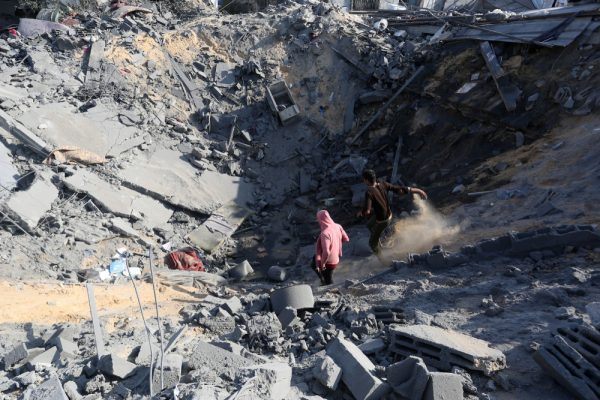
John J. Mearsheimer
Source: The 4th Media
I do not believe that anything I say about what is happening in Gaza will affect Israeli or American policy in that conflict. But I want to be on record so that when historians look back on this moral calamity, they will see that some Americans were on the right side of history.
What Israel is doing in Gaza to the Palestinian civilian population – with the support of the Biden administration – is a crime against humanity that serves no meaningful military purpose. As J-Street, an important organization in the Israel lobby, puts it, “The scope of the unfolding humanitarian disaster and civilian casualties is nearly unfathomable.”[1]
Let me elaborate.
First, Israel is purposely massacring huge number of civilians, roughly 70 percent of whom are children and women. The claim that Israel is going to great lengths to minimize civilian casualties is belied by statements from high level Israeli officials. For example, the IDF spokesman said on 10 October 2023 that “the emphasis is on damage and not on accuracy.” That same day, Defense Minister Yoav Gallant announced: “I have lowered all the restraints – we will kill everyone we fight against; we will use every means.”[2]
Moreover, it is clear from the results of the bombing campaign that Israel is indiscriminately killing civilians. Two detailed studies of the IDF’s bombing campaign – both published in Israeli outlets – explain in detail how Israel is murdering huge numbers of civilians. It is worth quoting the titles of the two pieces, which succinctly capture what each has to say:
“‘A Mass Assassination Factory’: Inside Israel’s Calculated Bombing of Gaza”[3]
“The Israeli Army Has Dropped the Restraint in Gaza, and the Data Shows Unprecedented Killing.”[4]
Similarly, the New York Times published an article in late November 2023 titled: “Gaza Civilians, Under Israeli Barrage, Are Being Killed at Historic Pace.”[5] Thus, it is hardly surprising that the UN Secretary General, Antonio Guterres, said that “We are witnessing a killing of civilians that is unparalleled and unprecedented in any conflict since” his appointment in January 2017.[6]
Second, Israel is purposely starving the desperate Palestinian population by greatly limiting the amount of food, fuel, cooking gas, medicine, and water that can be brought into Gaza. Moreover, medical care is extremely hard to come by for a population that now includes approximately 50,000 wounded civilians.
Not only has Israel greatly limited the supply of fuel into Gaza, which hospitals need to function, but it has targeted hospitals, ambulances, and first aid stations.
Defense Minister Gallant’s comment on 9 October captures Israeli policy: “I have ordered a complete siege on the Gaza Strip. There will be no electricity, no food, no fuel, everything is closed. We are fighting human animals, and we are acting accordingly.”[7]
Israel has been forced to allow minimal supplies into Gaza, but the amounts are so small that a senior UN official reports that “half of Gaza’s population is starving.” He goes on to report that, “Nine out of 10 families in some areas are spending ‘a full day and night without any food at all’.”[8]
Third, Israeli leaders talk about Palestinians and what they would like to do in Gaza in shocking terms, especially when you consider that some of these leaders also talk incessantly about the horrors of the Holocaust. Indeed, their rhetoric has led Omar Bartov, a prominent Israeli-born scholar of the Holocaust, to conclude that Israel has “genocidal intent.”[9]
Other scholars in Holocaust and genocide studies have offered a similar warning.[10]
To be more specific, it is commonplace for Israeli leaders to refer to Palestinians as “human animals, ”human beasts,” and “horrible inhuman animals.”[11] And as Israeli President Isaac Herzog makes clear, those leaders are referring to all Palestinians, not just Hamas: In his words, “It is an entire nation out there that is responsible.”[12]Unsurprisingly, as the New York Times reports, it is part of normal Israeli discourse to call for Gaza to be “flattened,” “erased,” or “destroyed.”[13]
One retired IDF general, who proclaimed that “Gaza will become a place where no human being can exist,” also makes the case that “severe epidemics in the south of the Gaza Strip will bring victory closer.”[14]
Going even further, a minister in the Israeli government suggested dropping a nuclear weapon on Gaza.[15] These statements are not being made by isolated extremists, but by senior members of Israel’s government.
Of course, there is also much talk of ethnically cleansing Gaza (and the West Bank), in effect, producing another Nakba.[16] To quote Israel’s Agriculture Minister, “We are now rolling out the Gaza Nakba.”[17]
Perhaps the most shocking evidence of the depths to which Israeli society has sunk is a video of very young children singing a blood-curdling song celebrating Israel’s destruction of Gaza: “Within a year we will annihilate everyone, and then we will return to plow our fields.”[18]
Fourth, Israel is not just killing, wounding, and starving huge numbers of Palestinians, it is also systematically destroying their homes as well as critical infrastructure – to include mosques, schools, heritage sites, libraries, key government buildings, and hospitals.[19]
As of 1 December 2023, the IDF had damaged or destroyed almost 100,000 buildings, including entire neighborhoods that have been reduced to rubble.[20] Consequently, a stunning 90 percent of Gaza’s 2.3 million Palestinians have been displaced from their homes.[21]
Moreover, Israel is making a concerted effort to destroy Gaza’s cultural heritage; as NPR reports, “more than 100 Gaza heritage sites have been damaged or destroyed by Israeli attacks.”[22]
Fifth, Israel is not just terrorizing and killing Palestinians, it is also publicly humiliating many of their men who have been rounded up by the IDF in routine searches.
Israeli soldiers strip them down to their underwear, blindfold them, and display them in a public way in their neighborhoods – sitting them down in large groups in the middle of the street, for example, or parading them through the streets – before taking them away in trucks to detention camps. In most cases, the detainees are then released as they are not Hamas fighters.[23]
Sixth, although the Israelis are doing the slaughtering, they could not do it without the Biden administration’s support. Not only was the United States the only country to vote against a recent UN Security Council resolution demanding an immediate ceasefire in Gaza, but it has also been providing Israel with the weaponry necessary to wage this massacre.[24]
As one Israeli general (Yitzhak Brick) recently made clear: “All of our missiles, the ammunition, the precision-guided bombs, all the airplanes and bombs, it’s all from the U.S. The minute they turn off the tap, you can’t keep fighting. You have no capability.… Everyone understands that we can’t fight this war without the United States. Period.”[25]
Remarkably, the Biden administration has sought to expedite sending Israel additional ammunition, by-passing the normal procedures of the Arms Export Control Act.[26]
Seventh, while most of the focus is now on Gaza, it is important not to lose sight of what is simultaneously going on in the West Bank. Israeli settlers, working closely with the IDF, continue to kill innocent Palestinians and steal their land.
In an excellent article in the New York Review of Books describing these horrors, David Shulman relates a conversation he had with a settler, which clearly reflects the moral dimension of Israeli behavior toward the Palestinians.
“What we are doing to these people is actually inhuman,” the settler freely admits, “But if you think about it clearly, it all follows inevitably from the fact that God promised this land to the Jews, and only to them.”[27]
Along with its assault on Gaza, the Israel government has markedly increased the number of arbitrary arrests in the West Bank. According to Amnesty International, there is considerable evidence that these prisoners have been tortured and subjected to degrading treatment.[28]
As I watch this catastrophe for the Palestinians unfold, I am left with one simple question for Israel’s leaders, their American defenders, and the Biden administration: have you no decency?
Settler colonial states have a terminal shelf life. Israel is no exception.
By Chris Hedges
Source: The Chris Hedges Report
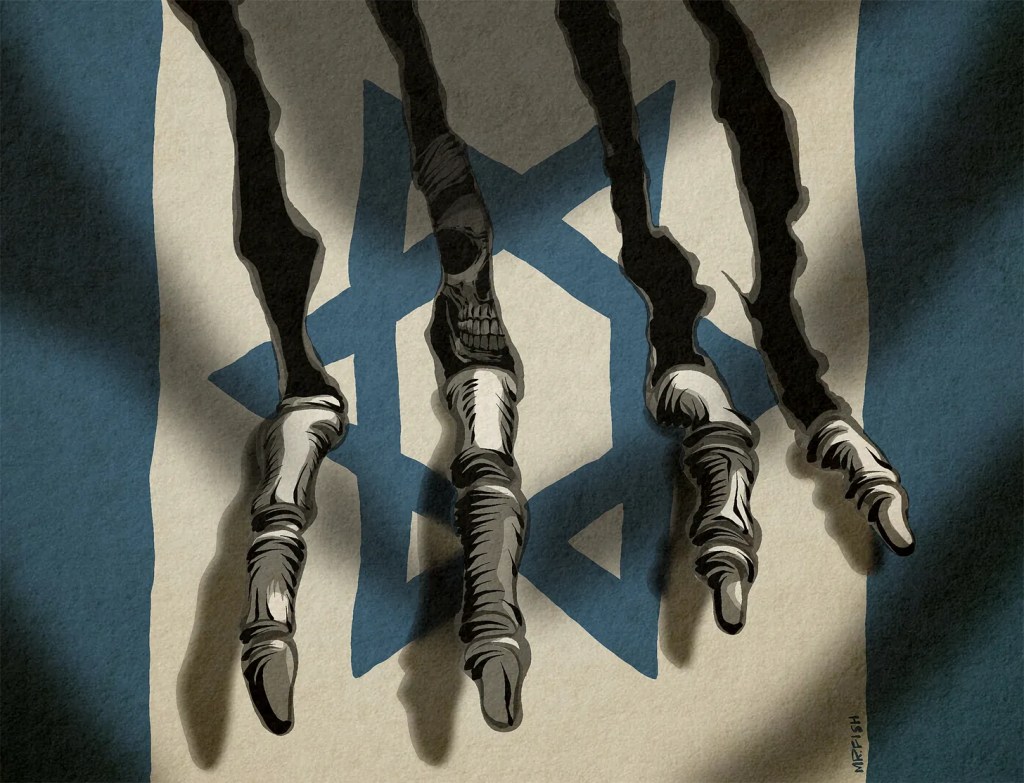
Israel will appear triumphant after it finishes its genocidal campaign in Gaza and the West Bank. Backed by the United States, it will achieve its demented goal. Its murderous rampages and genocidal violence will exterminate or ethnically cleanse Palestinians. Its dream of a state exclusively for Jews, with any Palestinians who remain stripped of basic rights, will be realized. It will revel in its blood-soaked victory. It will celebrate its war criminals. Its genocide will be erased from public consciousness and tossed into Israel’s huge black hole of historical amnesia. Those with a conscience in Israel will be silenced and persecuted.
But by the time Israel achieves its decimation of Gaza — Israel is talking about months of warfare — it will have signed its own death sentence. Its facade of civility, its supposed vaunted respect for the rule of law and democracy, its mythical story of the courageous Israeli military and miraculous birth of the Jewish nation, will lie in ash heaps. Israel’s social capital will be spent. It will be revealed as an ugly, repressive, hate-filled apartheid regime, alienating younger generations of American Jews. Its patron, the United States, as new generations come into power, will distance itself from Israel the way it is distancing itself from Ukraine. Its popular support, already eroded in the U.S., will come from America’s Christianized fascists who see Israel’s domination of ancient Biblical land as a harbinger of the Second Coming and in its subjugation of Arabs a kindred racism and white supremacy.
Palestinian blood and suffering — 10 times the number of children have been killed in Gaza as in two years of war in Ukraine — will pave the road to Israel’s oblivion. The tens, perhaps hundreds, of thousands of ghosts will have their revenge. Israel will become synonymous with its victims the way Turks are synonymous with the Armenians, Germans are with the Namibians and later the Jews, and Serbs are with the Bosniaks. Israel’s cultural, artistic, journalistic and intellectual life will be exterminated. Israel will be a stagnant nation where the religious fanatics, bigots and Jewish extremists who have seized power will dominate public discourse. It will find its allies among other despotic regimes. Israel’s repugnant racial and religious supremacy will be its defining attribute, which is why the most retrograde white supremists in the U.S. and Europe, including philo-semites such as John Hagee, Paul Gosar and Marjorie Taylor Greene, fervently back Israel. The vaunted fight against anti-Semitism is a thinly disguised celebration of White Power.
Despotisms can exist long after their past due date. But they are terminal. You don’t have to be a Biblical scholar to see that Israel’s lust for rivers of blood is antithetical to the core values of Judaism. The cynical weaponization of the Holocaust, including branding Palestinians as Nazis, has little efficacy when you carry out a live streamed genocide against 2.3 million people trapped in a concentration camp.
Nations need more than force to survive. They need a mystique. This mystique provides purpose, civility and even nobility to inspire citizens to sacrifice for the nation. The mystique offers hope for the future. It provides meaning. It provides national identity.
When mystiques implode, when they are exposed as lies, a central foundation of state power collapses. I reported on the death of the communist mystiques in 1989 during the revolutions in East Germany, Czechoslovakia and Romania. The police and the military decided there was nothing left to defend. Israel’s decay will engender the same lassitude and apathy. It will not be able to recruit indigenous collaborators, such as Mahmoud Abbas and the Palestinian Authority — reviled by most Palestinians — to do the bidding of the colonizers. The historian Ronald Robinson cites the inability to recruit indigenous allies by the British Empire as the point at which collaboration inverted into noncooperation, a defining moment for the start of decolonization. Once noncooperation by native elites morphs into active opposition, Robinson explains, the Empire’s “rapid retreat” is assured.
All Israel has left is escalating violence, including torture, which accelerates the decline. This wholesale violence works in the short term, as it did in the war waged by the French in Algeria, the Dirty War waged by Argentina’s military dictatorship and during Britain’s conflict in Northern Ireland. But in the long term it is suicidal.
“You might say that the battle of Algiers was won through the use of torture,” the British historian Alistair Horne observed, “but that the war, the Algerian war, was lost.”
The genocide in Gaza has turned Hamas fighters into heroes in the Muslim world and the Global South. Israel may wipe out the Hamas leadership. But the past — and current — assassinations of scores of Palestinian leaders has done little to blunt resistance. The siege and genocide in Gaza has produced a new generation of deeply traumatized and enraged young men and women whose families have been killed and whose communities have been obliterated. They are prepared to take the place of martyred leaders. Israel has sent the stock of its adversary into the stratosphere.
Israel was at war with itself before Oct. 7. Israelis were protesting to prevent Prime Minister Benjamin Netanyahu’s abolition of judicial independence. Its religious bigots and fanatics, currently in power, had mounted a determined attack on Israeli secularism. Israel’s unity since the attacks is precarious. It is a negative unity. It is held together by hatred. And even this hatred is not enough to keep protestors from decrying the government’s abandonment of Israeli hostages in Gaza.
Hatred is a dangerous political commodity. Once finished with one enemy, those who stoke hatred go in search of another. The Palestinian “human animals,” when eradicated or subdued, will be replaced by Jewish apostates and traitors. The demonized group can never be redeemed or cured. A politics of hatred creates a permanent instability that is exploited by those seeking the destruction of civil society.
Israel was far down this road on Oct. 7 when it promulgated a series of discriminatory laws against non-Jews that resemble the racist Nuremberg Laws that disenfranchised Jews in Nazi Germany. The Communities Acceptance Law permits exclusively Jewish settlements to bar applicants for residency on the basis of “suitability to the community’s fundamental outlook.”
Many of Israel’s best educated and young have left the country to places like Canada, Australia and the U.K., with as many as one million moving to the United States. Even Germany has seen an influx of around 20,000 Israelis in the first two decades of this century. Around 470,000 Israelis have left the country since Oct. 7. Within Israel, human rights campaigners, intellectuals and journalists — Israeli and Palestinian — are attacked as traitors in government-sponsored smear campaigns, placed under state surveillance and subjected to arbitrary arrests. The Israeli educational system is an indoctrination machine for the military.
The Israeli scholar Yeshayahu Leibowitz warned that if Israel did not separate church and state and end its occupation of the Palestinians, it would give rise to a corrupt Rabbinate that would warp Judaism into a fascistic cult. “Israel,” he said, “would not deserve to exist, and it will not be worthwhile to preserve it.”
The global mystique of the U.S., after two decades of disastrous wars in the Middle East and the assault on the Capitol on Jan. 6, is as contaminated as its Israeli ally. The Biden administration, in its fervor to unconditionally support Israel and appease the powerful Israel lobby, has bypassed the congressional review process with the Department of State to approve the transfer of 14,000 rounds of tank ammunition to Israel. Secretary of State Antony Blinken argued that “an emergency exists that requires the immediate sale.” At the same time he has cynically called on Israel to minimize civilian casualties.
Israel has no intention of minimizing civilian casualties. It has already killed 18,800 Palestinians, 0.82 percent of the Gazan population — the equivalent of around 2.7 million Americans. Another 51,000 have been wounded. Half of Gaza’s population is starving, according to the U.N. All Palestinian institutions and services that sustain life — hospitals (only 11 out of 36 hospitals in Gaza are still “partially functioning”), water treatment plants, power grids, sewer systems, housing, schools, government buildings, cultural centers, telecommunications systems, mosques, churches, U.N. food distribution points — have been destroyed. Israel has assassinated at least 80 Palestinian journalists alongside dozens of their family members and over 130 U.N. aid workers along with members of their families. Civilian casualties are the point. This is not a war against Hamas. It is a war against the Palestinians. The objective is to kill or remove 2.3 million Palestinians from Gaza.
The shooting dead of three Israeli hostages who apparently escaped their captors and approached Israeli forces with their shirts off, waving a white flag and calling out for help in Hebrew is not only tragic, but a glimpse of Israel’s rules of engagement in Gaza. These rules are — kill anything that moves.
As the retired Israeli Major General Giora Eiland, who formerly headed the Israeli National Security Council, wrote in Yedioth Ahronoth, “[T]he State of Israel has no choice but to turn Gaza into a place that is temporarily or permanently impossible to live in…Creating a severe humanitarian crisis in Gaza is a necessary means to achieve the goal.” “Gaza will become a place where no human being can exist,” he wrote. Major General Ghassan Alian declared that in Gaza, “there will be no electricity and no water, there will only be destruction. You wanted hell; you will get hell.”
Settler colonial states that endure, including the United States, exterminate through diseases and violence nearly the entirety of their indigenous populations. Infectious diseases brought by the colonizers to the Americas, such as smallpox, killed an estimated 56 million indigenous people over about 100 years in South, Central and North America. By 1600 less than a tenth of the original population remained. Israel cannot kill on this scale, with nearly 5.5 million Palestinians living under occupation and another 9 million in the diaspora.
The Biden presidency, which ironically may have signed its own political death certificate, is tethered to Israel’s genocide. It will try to distance itself rhetorically, but at the same time it will funnel the billions of dollars of weapons demanded by Israel — including $14.3 billion in supplemental military aid to augment the $3.8 billion in annual aid — to “finish the job.” It is a full partner in Israel’s genocide project.
Israel is a pariah state. This was publically on display on Dec. 12 when 153 member states at the U.N. General Assembly voted for a ceasefire, with only 10 — including the U.S. and Israel — opposed and 23 abstaining. Israel’s scorched earth campaign in Gaza means there will be no peace. There will be no two state solution. Apartheid and genocide will define Israel. This presages a long, long conflict, one the Jewish State cannot ultimately win.
INDIAN COUNTRY NEWS
"It is the duty of every man, as far as his ability extends, to detect and expose delusion and error"..Thomas Paine
Human in Algorithms
From the Roof Top
I See This
blog of the post capitalist transition.. Read or download the novel here + latest relevant posts
अध्ययन-अनुसन्धानको सार
 After the Crash