In Redux of Iraq War Run Up, Media Cheers on Assassination of Soleimani

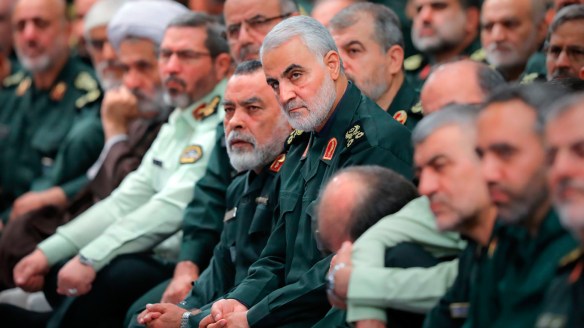
Gen. Qassim Soleimani, center, attends a meeting of a group of the Guard members with Iranian Leader Ayatollah Ali Khamenei, in Tehran, Iran on Oct. 2, 2019. Photo | AP

With echoes of Iraq, media are once again cheering an attack against a Middle Eastern country on the grounds of a supposedly imminent strike against the United States.

By Alan Macleod

Source: Mint Press News

Early Friday morning, a U.S. airstrike assassinated Iranian Lt. General Qassem Soleimani as he traveled from Baghdad’s international airport. A charismatic and capable military figure, Soleimani was widely considered to be one of the most powerful and influential individuals in Iran. Two years to the day since MintPress News reported that the U.S. government had given the green light to assassinate him, Soleimani’s convoy was struck from the air. Secretary of State Mike Pompeo presented the decision as a defensive one, claiming that Soleimani was preparing an “imminent attack” against the U.S. When pressed, he refused to give any more evidence or details. Despite claiming the strike made Americans much safer, the government immediately instructed all U.S. citizens to leave Iraq and avoid the American Embassy.

Assassinating foreign leaders is a major international war crime under international law, yet across the corporate spectrum, media applauded the bombing, or “precision targeting,” as CNN described it. Unsurprisingly, many conservative media outlets supported the Trump administration’s decision to potentially spark a huge international conflict. The Washington Examiner quoted one “expert” celebrating the killing as more important than Bin Laden’s death and a “massive blow to the regime.” Fox News quickly published an opinion piece from Christian Whiton of the strongly hawkish Center for the National Interest, praising Trump for acting “correctly and decisively,” preventing further American bloodshed by taking out a major “terrorist.” It also immediately invited major Neoconservative hawks and public faces of the Iraq War, Karl Rove and Ari Fleischer, on air to discuss the situation and inform its audience what to think.

Media with more liberal audiences ­– who claim to be leading the resistance against a dangerous fascist commander-in-chief – were no less supportive of Trump’s latest aggressive actions. Just as it had done with U.S.-supported coup attempts in Venezuela and Bolivia, resistance media lined up shoulder-to-shoulder with the president and condemned Soleimani as guilty of a myriad of crimes against humanity. CNBC’s headline read, “America just took out the world’s no. 1 bad guy,” accusing him of being the leader of the world’s “most active and pervasive terrorist army.” It claimed that Trump’s decision had “saved current lives” and represented “justice” to his many victims. It also claimed that it saved further American lives as it would “deter future Iranian attack plans.” “There’s no question Soleimani had American blood on his hands” claimed one source in USA Today; “he was an enemy.” It is worth noting, however, that the American deaths being referenced are not civilians, but members of an invading and occupying army in Iraq who were killed by locals resisting a foreign occupier.

The New York Times claimed he had “spent the last decade replicating the Hezbollah model in Iraq, Syria and Yemen, propping up local militias with precision weapons and tactical know-how” and held him responsible for “driving over 10 million [Syrian] people from their homes” not mentioning the American role in any of those warzones. Meanwhile, CNN’s Alex Marquardt claimed that, “US lawmakers are united in their support of the killing of Soleimani” and that Republicans and Democrats alike agreed that, “this is a man who deserved to be killed because of everything he has done against American forces” and were busy “congratulating” Trump for his heroism. The message from corporate media was clear: “Soleimani is a ruthless killer. He’s a horrible human being,” (CNN). The evidence presented for this claim was that “he commanded a division in the Iran/Iraq War” – a war in which the United States armed, funded and supported its then ally Saddam Hussein to invade Iran, causing around one million deaths.

In reality, corporate media are not celebrating Soleimani’s assassination because of his many (real) faults, but rather because of his qualities as an effective leader and organizer, someone who has constantly stymied American efforts to further dominate the region. In Syria, where the U.S. has all but allied with Al-Qaeda/Al-Nusra in order to overthrow the Assad dynasty, Iran has provided a significant counterweight to American-backed forces. Likewise, it continues to support groups such as Hezbollah that resist the U.S. and its allies across the region. It has also, rhetorically at least, supported the Houthi rebels fighting against a U.S./Saudi onslaught, although the extent of Iranian involvement is questionable.

The U.S. government has announced that it is preparing to increase its presence in the wake of the Soleimani assassination, sending at least 3,000 more troops to the region. With echoes of Iraq, media are once again cheering an attack and a military build-up against a Middle Eastern country on the grounds of a supposedly imminent strike against the United States. History, they say, never repeats itself. But it often rhymes.


Related Video

The Scourge of US Hostility to World Peace and Stability

By Stephen Lendman

Source: StephenLendman.org

The US is a warrior state, a global menace hostile to peace, stability, equity, justice, and the rule of law.

Its agenda is all about advancing its imperium by achieving control over nations and resources, especially their oil and gas.

Dollar hegemony is key. Maintaining it as the world’s reserve currency facilitates corporate takeovers, finances militarism, endless wars, and America’s global empire of bases.

Large dollar inflows into US Treasuries finance the nation’s budget deficit.

As long as world central banks buy US dollars and they dominate international trade, its hegemony is preserved.

De-dollarization, nations increasingly trading more in their own currencies, could undermine US imperial aims if the trend continues.

“Without the dollar’s function as the vehicle for world saving – in effect, without the Pentagon’s role in creating the Treasury debt that is the vehicle for world central bank reserves – the US would find itself constrained militarily and hence diplomatically constrained,” economist Michael Hudson explained.

Russia, China, Iran and other nations the US doesn’t control threaten dollar hegemony, the source of its strength on the world stage.

Soleimani was assassinated because of his success in combatting US-supported ISIS and other terrorists, undermining its regional imperial aims.

In Iraq on a peace mission, according to its PM Mahdi, not plotting imminent attacks on US regional interests as Trump falsely claimed, Hudson explained the following:

“(E)very indication is that he was in Iraq to work with that government seeking to regain control of the oil fields that President Trump has bragged so loudly about grabbing.”

Along with maintaining dollar hegemony, controlling Middle East and global energy resources are key US imperial objectives.

Without them, its hegemonic aims are undermined — furthered by endless wars and other hostile actions, its key strategies.

Independent nations controlling their own hydrocarbon resources are targeted by the US for regime change, including Russia, China and Iran.

For the Islamic Republic, wanting its government replaced by pro-Western puppet rule is also about eliminating Israel’s main regional rival.

Netanyahu, other regime hardliners, and their Jewish state counterparts need the US to wage its wars. Achieving Israeli regional hegemony depends on it.

Trump overstepped by assassinating Soleimani and Iraqi deputy PMU head Muhandis, connected to the country’s military.

His action backfired, uniting tens of millions of Iranians, Iraqis, others in the region and elsewhere against the menace that the US poses.

US troops occupy Iraq to control the country and its oil. Expelling them, if things turn out this way, would eliminate this lever of control.

It’s why policymakers in Washington are resisting Baghdad’s demand to leave, things uncertain so far whether they’ll stay or go.

By letter on Monday, US Task Force Iraq commander General William Seely discussed “measures to ensure that the movement (of US forces) out of Iraq is conducted in a safe and efficient manner,” adding:

They’ll “be reposition(ed) over the course of the coming days and weeks to prepare for onward movement.”

Not so, according to US war secretary Mark Esper, indicating no preparations for “movement out of Iraq…no decision whatsoever to leave” the country, adding:

Seely’s letter is “inconsistent with where we are right now.” Joint Chiefs Chairman Mark Milley said “(i)t shouldn’t have been sent.”

Trump warned Baghdad of sanctions “like they’ve never seen before” if US forces are expelled from the country — what Iraqi parliamentarians voted for, PM Mahdi supporting their demand.

According to the CIA-connected Washington Post, the Trump regime began drafting possible sanctions on Iraq, citing anonymous sources.

Separately on Monday, Russia and China blocked a US sponsored Security Council statement to condemn last week’s storming of Baghdad’s heavily fortified Green Zone by angry Iraqis in response to the Trump regime’s assassination of Soleimani and Muhandis.

This action more greatly destabilized the region already embroiled in multiple US wars of aggression.

Do its hardliners have another one in mind against Iran? Will the Trump regime strike a nation able to retaliate strongly against US regional interests and its allies?

Year 2020 began with a bang. It’s an ominous sign for what may lie ahead in the new year and beyond.

The Final Act

By Dmitry Orlov

Source: Club Orlov

In processing the flow of information about the goings on in the US, it is impossible to get rid of a most unsettling sense of unreality—of a population trapped in a dark cave filled with little glowing screens, all displaying different images yet all broadcasting essentially the same message. That message is that everything is fine, same as ever, and can go on and on. But whatever it is that’s going on can’t go on forever, and therefore it won’t. More specifically, a certain coal mine canary has recently died, and I want to tell you about it.

It’s easy to see why that particular message is stuck on replay even as the situation changes irrevocably. As of 2019, 90% of the media in the United States is controlled by four media conglomerates: Comcast (via NBCUniversal), Disney, ViacomCBS (controlled by National Amusements), and AT&T (via WarnerMedia). Together they have formed a corporate media monoculture designed to most effectively maximize shareholder value.

As I wrote in Reinventing Collapse in 2008, “…In a consumer society, anything that puts people off their shopping is dangerously disruptive, and all consumers sense this. Any expression of the truth about our lack of prospects for continued existence as a highly developed, prosperous industrial society is disruptive to the consumerist collective unconscious. There is a herd instinct to reject it, and therefore it fails, not through any overt action, but by failing to turn a profit because it is unpopular.”

Two years earlier, in a slideshow optimistically titled “Closing the Collapse Gap” (between the USSR and the USA), I wrote: “…It seems that there is a fair chance that the US economy will collapse sometime within the foreseeable future. It also would seem that we won’t be particularly well-prepared for it. As things stand, the US economy is poised to perform something like a disappearing act.” And now, 12 years later, I believe I am finally watching what amounts to preparations for that act’s final rehearsal; the ballet troupe is doing stretching exercises and the fat lady is singing arpeggios to warm up…

Clearly, this final act is yet to be performed. The media replay loop continues to play, keeping the populace convinced that the future will resemble the past (except, perhaps, it will have more wind generators, solar panels and electric cars). The populace continues to be persuaded to go out and shop for (or, more frequently now, order online) things it doesn’t need, to be paid for by money it doesn’t have.

Of course, there have been changes. The populace in the US has been doing progressively worse. Drug addiction and suicide rates have skyrocketed while rates of childbirth have plummeted. The purchase of a home is now out of reach for the vast majority of young couples. Artificially rosy unemployment statistics hide the 100 million or so people who are considered “not in labor force” (because they lost their jobs some time ago and haven’t been able to find another one). Uniquely among developed nations, life expectancy among white males—historically the most economically active and prosperous part of the population—has been dropping. These are all negatives, but neither any one of them nor any combination of them adds up to anything that could cause the US economy to undergo a spontaneous existence failure.

Nevertheless, it is possible to build a convincing case that Rome is, to put it figuratively, burning. To continue with the metaphor, evidence that there is some fiddling going on is particularly compelling. Overall, there is a steady backing away from addressing the substance of any problem and a concerted effort to maintain appearances at all cost.

Take the trade war with China, which has been going on since early 2018. Trump has recently declared a major victory in it, but upon examination signs of victory are impossible to discern. In 2017 the US ran a $750 billion trade deficit with China on $3.3 trillion of trade (22.7%). In 2018 it has jumped to $930 billion on $3.8 trillion of trade (24.4%). China has found ways to parry each of Trump’s thrusts by imposing countertariffs. After two years of this sort of World War I-style trench warfare, in which the US has been slowly losing ground, it became clear that the US doesn’t have any means to put pressure on China.

And so Trump suddenly declares victory; not a full victory (that will have to wait until after Trump is reelected for his second term) but a victory nonetheless, because the Chinese have supposedly agreed to buy an extra $200 billion worth of US exports, $50 billion of them of agricultural exports from states that voted for Trump in 2016. But Trump is lying to his supporters. Over the past two years the Chinese have imported roughly $24 billion of agricultural commodities from the US, and sources close to the trade talks have said that the Chinese have agreed to increase these imports by just $16 billion, putting the total $10 billion short of the $50 billion mark. Even then, the US agricultural sector would have to rapidly scale up production by a factor of 1.6—and this is not at all likely.

The farmers will discover this only after they vote to reelect Trump, but that’s not Trump’s problem. Nor was it Trump’s problem when in 2017 the Chinese promised to buy $120 billion of US liquefied natural gas exports and then the US wasn’t able to provide anywhere near that volume. And now that Russia’s Power of Siberia pipeline is operational and ramping up volumes, while US fracking companies are going bankrupt left and right, the question has become largely moot. The AG promise is just a replay of the LNG promise at a smaller scale. Appearances are all that matter, and appearances are what Trump delivers every time. And if his voters want to believe—who’s to stop them? Even though it is clearly heading toward a defeat for the US as a whole, the trade war with China is definitely a huge positive for Trump: all he has to do to win personally is periodically deliver promises that others won’t keep—but that’s not his problem.

Another net benefit for Trump is the never-ending impeachment saga. It has kept him in the media limelight and has allowed him to pretend that he is prevailing heroically against great odds while making his opposition look ridiculous in the eyes of his supporters. After the “Russian meddling” fable unraveled, an even more preposterous rationale for impeachment has taken its place. An attempt to impeach Trump for refusing to cooperate with a congressional investigation is in the process of failing, since anyone with more intelligence than a bucket of California penis fish should know that it is up to the courts, not up to the legislature, to resolve disputes between the legislature and the executive. All that remains now is an alleged abuse of power by Trump. Apparently, it is a no-no for a US president to ask a foreign leader to investigate a US presidential candidate for a variety of crimes such as corruption, bribery and money-laundering. This may all seem quite ridiculous, but it serves a purpose: it allows Trump to clean up on free publicity and to continue fiddling (tweeting, in his case) as Rome burns.

But what has set fire under Rome is not the decrepitating state of US society, or the permanent and permanently worsening trade imbalance with China, or the never-ending impeachment farce. It is the incipient failure of the US dollar. For those who have been paying careful attention, the surreal nature of the proceedings, and the fact that results no longer matter—only appearances do—have become perfectly obvious, but they are a tiny minority. What has allowed the politicians and the media to exploit the general public’s innate normalcy bias and to keep the media replay loop going without too many people catching on to what’s really happening was (note the past tense!) the ability of the US government (with the assistance of the Federal Reserve, which is a government-linked but essentially private entity) to paper over the gaping chasm in the nation’s finances by issuing debt, in the form of US Treasury paper.

The US Treasury has been able to exploit its “exorbitant privilege” to issue internationally recognized and traded debt instruments denominated in its own currency—the US dollar—which has been the world’s main reserve currency for many decades. The reserve currency status has conveyed a certain aura of security and reliability (paper money is, after all, pretty much just a confidence game) and has supported the world’s largest and most liquid financial market. Anybody anywhere could put up US Treasury paper as collateral for a loan and get a low interest rate because that paper was considered as good as “real money” (whatever that means). And then that scheme suddenly broke.

It is difficult to say what caused the confidence game to fail. It could be just the inexorable and ever-accelerating increase in US government debt. It could be the blatant decoupling between the growth rate of the US economy and the rate of increase of its indebtedness. It could also be the fact that much of the world is making a concerted effort to walk away from the US dollar as a reserve currency and as a means of exchange in international trade (Russia has sold off almost all of its US debt; China’s hoard is much larger but it is also gradually selling it off). It is unclear what was the ultimate cause, but what is clear is that in August of 2019 something finally snapped, and USTs went from “good as real money” to “stuff nobody wants to hold.”

I first wrote about this in September when it became clear that real trouble was brewing in the market for US debt. Now, three months later, the situation has gone from bad to worse, and it would appear that the market for USTs definitively broke. I will try to sketch out what that means for the US economy and society later on (spoiler alert: nothing good) but for now I just want to lay out some of what has happened. In the meantime please take your normalcy bias and put it some place safe (in case you need it later, although I have no idea what for).

Previously, when it was clear that an overburden of bad debt could trigger financial collapse at any moment, the Federal Reserve (which is in charge of printing money) engaged in something it euphemistically called “quantitative easing” (“QE”). It printed lots of US dollars in exchange for various bits of USTs, along with other financial garbage, with the goal of later selling the USTs while hiding the garbage, thereby preserving the appearance that USTs are sovereign debt supported by the full faith and credit of the US government rather than just some waste paper clogging up its vaults. But when it declared “quantitative easing” to be over and tried selling the USTs, all hell immediately broke loose and it was forced to go right back to buying them up, in a scheme that has been sarcastically referred to as “not QE.” Euphemisms aside, what is happening is properly called “debt monetization”: it’s when a government “borrows” money not by selling its debt in exchange for money that already exists but simply printing the money using paper and ink, or magic digits inside a very secure computer.

Let’s go over some of the relevant details. “Not QE” actually started well before it was announced and proceeded in stealth mode. Over six weeks starting in September 2019, the Fed monetized an average of $20.5 billion per week. This rate is compatible with the extent of its previous efforts at “quantitative easing” at their height. It was forced to do so because the REPO rate on USTs spiked to 10 times the rate set by the Fed. (REPO stands for “repurchase agreement”; it is where one party borrows short-term from another party, using USTs (and other supposedly very safe debt instruments) as collateral, much as a pawn shop will give you money for a watch and then allow you to buy it back.) The huge spike in interest rates signaled that USTs were no longer seen as particularly safe collateral and the Fed had to step in and start throwing freshly minted dollars at the problem. And it never stopped. In fact, the problem grew larger; so large, that now, at the year’s end, the Fed has committed $500 billion of printing press output to making sure that nobody runs out of cash.

It is commonly thought that the Fed’s action has to do with short-term debt, and is therefore a short-term problem, but that’s simply not the case. Since early August (the start of stealth-mode “not QE”) the Fed has vacuumed up $179 billion with of USTs, of which USTs with terms longer than a year made up $108 billion, or 60%. Compare these numbers to the total borrowing by the US government over the same period, which amounted to $659 billion, of which $368 billion was short-term debt and $291 billion long-term. Thus, over this period the Fed has monetized 29.4% of new long-term debt and 24.4% of short-term debt. This should help put your mind at ease if you suspected that this isn’t a short-term problem but weren’t sure. It’s a long-term, structural problem.

Next, let’s consider whether the problem is being solved or is getting worse. Rest assured, it is getting worse. Looking at the numbers for October and November, the Fed monetized over half (50.7%) of new US government debt. A straight-line projection is that if it took the Fed to go from 0% to 50% in four months, then it will go from 50% to 100% in another four—by April Fool’s 2020. But who’s to say that the increase will be linear rather than exponential? Whichever it is, the trend is unmistakable: the market in US government debt—once the deepest and most liquid market in the world—is dead. The only thing propping up the value of USTs is the Fed’s printing press. And the only thing propping up the value of the output of the Fed’s printing press is… what is it, exactly? Exactly!

Let’s add one more salient detail. Over the course of 2020, $4.665 trillion of USTs will mature and will need to be rolled over into new USTs. This is an all-time record, and this is on top of new debt that will have to be issued in order for the US government to be able to stay open. Over the past year the US budget deficit has amounted to $1.022 trillion, which is a 15.8% increase over the previous year. If this trend continues, the new deficit will be around $1.183 trillion. In order to keep the wheels of finance from grinding to a halt, over 2020 the Fed will have to monetize, or print, close to $6 trillion.

It appears likely that at some point over the coming months Fed chairman Jerome Powell will have to announce “not not QE,” and then “not not not QE,” and then “Milk-milk-lemonade, ’round the corner fudge is made!” and run for the unigender restroom sobbing inconsolably. And then Donald Trump will be forced to channel Boris Yeltsin, who, on August 14, 1998, summoned all the presidential gravitas he could muster and spoke the following sage words:

«Девальвации рубля не будет. Это твердо и четко. Мое утверждение — не просто моя фантазия, и не потому, что я не хотел бы девальвации. Мое утверждение базируется на том, что все просчитано. Работа по отслеживанию положения проводится каждые сутки. Положение полностью контролируется».

“There will be no ruble devaluation. This is my firm and clear position. My assertion is not just a product of my fantasy, and not because I don’t want devaluation to happen. My assertion is based on the fact that everything is taken into account. The work on reassessing the situation is being conducted daily. The situation is entirely under control.” (My translation.)

And then three days later the Russian government declared sovereign default. The ruble dropped by 2/3 against the US dollar and the Russian economy, which was at that time extremely import-dependent, crashed hard. In a similar scenario, the US economy will crash much harder. Like Russia in 1998, the US is extremely import-dependent. But here the US government is not the only large borrower: most of US corporations are zombified corpses bloated with debt. For many years they have been borrowing at artificially low interest rates in order to buy up their own shares and prop up their value in a ridiculous effort to maximize shareholder value in the face of stalling economic growth. If they become unable to roll over their debt at artificially low interest rates (which will go away once the Fed definitively loses control of the situation) then they will automatically be forced to declare bankruptcy and liquidate.

If you want to maintain an optimistic outlook in spite of all of this, here is a book you might want to read.

US assassinates top Iranian general as 4,000 troops readied for Iraq intervention

Revolutionary Guard Gen. Qassem Soleimani, center, attends a meeting in Tehran, Iran. (Office of the Iranian Supreme Leader via AP, File).jpg

By Bill Van Auken

Source: WSWS.org

The targeted assassination of the commander of the Islamic Revolutionary Guard Corps’ (IRGC) Quds Force commander Major General Qasem Soleimani at Baghdad’s international airport early Friday morning has sharply intensified the spiraling conflict between the US and Iran, placing the outbreak of a catastrophic new war in the Middle East on a hair trigger.

The Iraqi and Lebanese media, as well as officials in Iraq’s Shia militia movement, reported that a US missile strike killed Soleimani after he had disembarked from a plane that had brought him to Iraq from either Syria or Lebanon. Also slain in the attack was Abu Mahdi al-Muhandis, the second in command of the Popular Mobilization Forces (PMF), the powerful coalition of Iraqi Shia militias.

The Pentagon issued a statement taking responsibility for the killing: “The U.S. military has taken decisive defensive action to protect U.S. personnel abroad by killing Qasem Soleimani, the head of the Iranian Revolutionary Guard Corps-Quds Force, a U.S.-designated Foreign Terrorist Organization.”

For its part, Iran’s Revolutionary Guards confirmed the killing, telling the Iranian media that “Honored supreme commander of Islam Soleimani was martyred in attack by U.S. helicopters.”

Soleimani has been a major figure within the Iranian military since the Iran-Iraq war of 1980-88. As head of the Quds Force, he played a central role in defeating the US-backed Al Qaeda-linked militias unleashed by Washington and its allies against the government of President Bashar al-Assad in Syria, and subsequently helped lead Iraqi militia forces in routing the Islamic State of Iraq and Syria (ISIS). While mentioned as a possible candidate for the Iranian presidency, he rejected any run for office, insisting that he would serve his country as a soldier.

He was well known to US officials and military commanders who had engaged in back-channel communications with the Iranian general since Tehran’s collaboration with Washington in the 2001 US invasion of Afghanistan.

The assassination came as the Pentagon dispatched another 750 US paratroopers to the Middle East, while 4,000 more have been placed on high alert for deployment to the region.

The deployment follows this week’s storming of the US Embassy in Baghdad by Iraqi demonstrators, an act of popular anger over US militarism that Washington blamed upon Iran.

Defense Secretary Mark Esper claimed on Thursday that there were “indications out there” that Iran is planning “additional attacks” on US forces or interests in the region and that Washington was prepared to “take preemptive action” if it received any “word of attacks or some kind of indication.”

“The game has changed,” Esper said. “Do I think they might do something? Yes, and they will likely regret it.”

Thus, US imperialism has arrogated to itself the “right” to launch not only assassinations, but devastating military attacks on Iran based on the claim that it is acting to “preempt” rumored or invented threats from any entity in the Middle East that Washington deems an Iranian “proxy.” This category stretches from Iraqi Shia militias to the Hezbollah mass political and militia movement in Lebanon to Hamas, the Islamist party that governs the Israeli-occupied territory of Gaza.

On Tuesday, the US Embassy in Baghdad came under siege by thousands of protesters outraged over the December 29 US air strikes against bases in both Iraq and Syria of Kata’ib Hizbullah, an Iraqi Shia militia. The bombings, carried out by US F-15E fighters, killed 25 of the militia’s members and wounded at least 55 others.

The Trump administration claimed that the airstrikes were in retaliation for a missile attack on Iraq’s K-1 military base outside of Kirkuk in which an American civilian contractor was killed. While Washington blamed Kata’ib Hizbullah for the attack, it has presented no evidence of its responsibility.

The protesters, including many militia members and supporters, had marched on the embassy, located in Baghdad’s heavily fortified Green Zone, following funeral services for the slain militia fighters that had brought thousands into the streets of the Iraqi capital.

They scaled the wall surrounding the US Embassy and laid siege to it, hurling Molotov cocktails and rocks. The embassy complex, the largest US diplomatic facility in the world, sprawls over 104 acres on the Tigris River and, at its high point in 2012, housed 16,000 US personnel, an effective continuation of the American occupation that formally ended in 2011.

The protesters managed to storm the main entrance to the complex, setting alight a guard booth and two reception rooms. Photographs released by the Associated Press on Wednesday showed the charred interiors of these areas of the embassy, with smashed furniture and windows and smoke still rising from the ruins.

Walls to the embassy compound were left covered with graffiti, including slogans such as “US embassy closed by order of the people” and “Death to America and Israel.”

US Marines manning the embassy’s interior fired continuous rounds of tear gas, stun grenades and warning shots in an attempt to disperse the protesters. Apache attack helicopters circled overhead firing flares toward the crowds in what was described as a “show of force.”

While the December 29 airstrikes were meant as a demonstration of US power and a blow to the Kata’ib Hizbullah militia, the popular response expressed in the siege of the embassy has exposed the immense crisis of Washington’s policy in Iraq and across the region.

The crowds of protesters were able to reach and enter the embassy only because the elite US-trained Iraqi antiterror troops deployed to protect the Green Zone, which also houses government buildings, other embassies and villas of the Iraqi oligarchy, offered no resistance whatsoever.

The event further exposes the predominant role played in the Iraqi government and its security forces by Shia militias—many of which originated in the fight against American troops following the criminal US invasion of Iraq in 2003—organized under the umbrella of the Popular Mobilization Forces (PMF). This had already become clear in 2014, when the Islamic State of Iraq and Syria (ISIS) was able to overrun roughly a third of Iraq after US-trained security forces collapsed, and the main opposition was mounted by the forces that would be organized into the PMF.

Infuriating the Trump administration, among those present at the embassy protest were Faleh al-Fayyadh, the nominal head of the PMF, who also serves as the country’s national security advisor, Hadi al-Amiri, the former minister of transport and leader of the Badr Brigades, one of the largest militias within the PMF, and other leading members of parliamentary factions tied to the Shia militias.

While the US ambassador had been meeting with these figures in recent months, US Secretary of State Mike Pompeo fired off an angry tweet, including a photograph of four of them, branding them as “terrorists.”

All of Iraq’s key government leaders, including the president, prime minister and head of the parliament, have denounced the US airstrikes as a violation of Iraqi sovereignty. Iraqi Prime Minister Abdul Mahdi, who heads a caretaker government after resigning in the face of mass protests against unemployment, social inequality and government corruption that have swept the country since last October, described the strikes as an “unacceptable vicious assault” against a militia that is considered part of Iraq’s armed forces and warned of its “dangerous consequences.” He described being notified by US Defense Secretary Esper of the impending bombings shortly before they were launched and pleading with him, unsuccessfully, to call them off.

The country’s President Barham Salih, who also condemned the US attack, described a similar conversation with a US diplomatic official.

While Trump fired off a tweet Wednesday thanking Abdul Mahdi and Salih for their “rapid response” to Washington’s demand that they provide security for the embassy, the US-trained Iraqi antiterrorism force charged with protecting the Green Zone, issued a pointed statement to the media denying that it had received an order to protect “any entity.”

The protesters left the Green Zone chanting “Yeah, we burned them!” after being told by militia leaders that they had achieved their purpose, and that legislation would be introduced in the Iraqi parliament demanding the expulsion of all US troops from the country.

While similar proposals have been introduced in the past without success, the present crisis may well have produced the conditions for the approval of such a measure. Leaders of a number of the blocs in the Iraqi legislature have signaled their support for ending the US military presence.

According to the Pentagon’s figures, some 5,000 uniformed US personnel are deployed in Iraq along with an unknown number—undoubtedly greater than that amount—of civilian military contractors. Their presence in the country was justified in the name of the “war on ISIS,” in which the US played a massively destructive role, reducing Mosul, previously Iraq’s second city, along with a number of other urban centers in Anbar province, into rubble and killing tens of thousands.

With ISIS smashed, Trump early last year allowed that having “spent a fortune on building this incredible base” in Iraq, Washington should keep it to “watch” Iran. The remark drew a swift rebuke from the Iraqi president, who stated that Iraq’s constitution “does not allow our territory … to be used against our neighbors” and that Baghdad did not want to be “part of any axis.”

If the Iraqi parliament were to vote for legislation mandating an end to the US military presence in Iraq, it is by no means clear that Washington would withdraw its troops. A continuation of the American occupation, initiated by an unprovoked and criminal invasion, would initiate a new stage in the protracted war that has devastated Iraqi society.

While Washington postures as the victim of missile attacks and an embassy invasion, the conflicts and tensions that continue to roil the Middle East are the product of decades of US military aggression and crippling economic sanctions against Iraq, Iran and Syria that have claimed well over a million lives.

This has culminated in the Trump administration’s abrogation last year of the 2015 nuclear accord between Tehran and the major world powers, followed by the initiation of a “maximum pressure” campaign aimed at reducing Iranian oil exports to zero and starving the Iranian population into accepting regime change and the installation of a US puppet government.

The recklessness and criminality that characterize Washington’s acts against Iran are not a sign of strength, but rather an expression of the deep-going social tensions, economic instability and political crisis gripping American capitalism, which the ruling financial oligarchy seeks to divert outward in an explosion of military violence.

A war against Iran would eclipse the horrific bloodshed of the Iraq war launched in 2003, drawing in the entire region and all of the major powers, including US imperialism’s so-called “great power” rivals Russia and China, bringing humanity face-to-face with the threat of a nuclear Third World War.

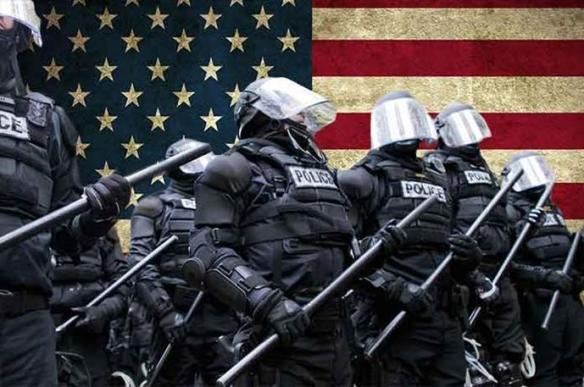
Nullify Government Tyranny: In 2020, Harness the Power of Your Discontent

By John W. Whitehead

Source: The Rutherford Institute

“The people have the power, all we have to do is awaken that power in the people. The people are unaware. They’re not educated to realize that they have power. The system is so geared that everyone believes the government will fix everything. We are the government.”—John Lennon

Twenty years into the 21st century, and what do we have to show for it?

Government corruption, tyranny and abuse have propelled us at warp speed towards a full-blown police state in which egregious surveillance, roadside strip searches, police shootings of unarmed citizens, censorship, retaliatory arrests, the criminalization of lawful activities, warmongering, indefinite detentions, SWAT team raids, asset forfeiture, police brutality, profit-driven prisons, and pay-to-play politicians have become the new normal.

Here’s just a small sampling of the laundry list of abuses—cruel, brutal, immoral, unconstitutional and unacceptable—that have been heaped upon us by the government over the past two decades.

The government failed to protect our lives, liberty and happiness. The predators of the police state wreaked havoc on our freedoms, our communities, and our lives. The government didn’t listen to the citizenry, refused to abide by the Constitution, and treated the citizenry as a source of funding and little else. Police officers shot unarmed citizens and their household pets. Government agents—including local police—were armed to the teeth and encouraged to act like soldiers on a battlefield. Bloated government agencies were allowed to fleece taxpayers. Government technicians spied on our emails and phone calls. And government contractors made a killing by waging endless wars abroad.

The American President became more imperial. Although the Constitution invests the President with very specific, limited powers, in recent years, American presidents (Trump, Obama, Bush, Clinton, etc.) claimed the power to completely and almost unilaterally alter the landscape of this country for good or for ill. The powers that have been amassed by each successive president through the negligence of Congress and the courts—powers which add up to a toolbox of terror for an imperial ruler—empower whomever occupies the Oval Office to act as a dictator, above the law and beyond any real accountability. The presidency itself has become an imperial one with permanent powers.

Militarized police became a power unto themselves, 911 calls turned deadly, and traffic stops took a turn for the worse. Lacking in transparency and accountability, protected by the courts and legislators, and rife with misconduct, America’s police forces became a growing menace to the citizenry and the rule of law. Despite concerns about the government’s steady transformation of local police into a standing military army, local police agencies acquired even more weaponry, training and equipment suited for the battlefield. Police officers were also given free range to pull anyone over for a variety of reasons and subject them to forced cavity searches, forced colonoscopies, forced blood draws, forced breath-alcohol tests, forced DNA extractions, forced eye scans, forced inclusion in biometric databases.

The courts failed to uphold justice. With every ruling handed down, it becomes more apparent that we live in an age of hollow justice, with government courts more concerned with protecting government agents than upholding the rights of “we the people.” This is true at all levels of the judiciary, but especially so in the highest court of the land, the U.S. Supreme Court, which is seemingly more concerned with establishing order and protecting government agents than with upholding the rights enshrined in the Constitution. A review of critical court rulings over the past two decades, including some ominous ones by the U.S. Supreme Court, reveals a startling and steady trend towards pro-police state rulings by an institution concerned more with establishing order and protecting the ruling class and government agents than with upholding the rights enshrined in the Constitution.

The Surveillance State rendered Americans vulnerable to threats from government spies, police, hackers and power failures. Thanks to the government’s ongoing efforts to build massive databases using emerging surveillance, DNA and biometrics technologies, Americans have become sitting ducks for hackers and government spies alike. Billions of people have been affected by data breaches and cyberattacks. On a daily basis, Americans have been made to relinquish the most intimate details of who we are—our biological makeup, our genetic blueprints, and our biometrics (facial characteristics and structure, fingerprints, iris scans, etc.)—in order to navigate an increasingly technologically-enabled world.

Mass shootings claimed more lives. Mass shootings have taken place in virtually every venue, including at churches, in nightclubs, on college campuses, on military bases, in elementary schools, in government offices, and at concerts. However, studies make clear that the government’s gun violence—inflicted on unarmed individuals by battlefield-trained SWAT teams, militarized police, and bureaucratic government agents trained to shoot first and ask questions later—poses a greater threat to the safety and security of the nation than any mass shooter.

Debtors’ prisons made a comeback. Not content to expand the police state’s power to search, strip, seize, raid, steal from, arrest and jail Americans for any infraction, no matter how insignificant, state courts were given the green light to resume their practice of jailing individuals who are unable to pay the hefty fines imposed by the American police state. These debtors’ prisons play right into the hands of the corporations that make a profit by jailing Americans. This is no longer a government “of the people, by the people, for the people.” It has become a government “of the rich, by the elite, for the corporations,” and its rise to power has been predicated on shackling the American taxpayer to a debtors’ prison guarded by a phalanx of politicians, bureaucrats and militarized police with no hope of parole and no chance for escape.

The cost of endless wars drove the nation deeper into debt. America’s war spending has already bankrupted the nation to the tune of more than $20 trillion dollars. Policing the globe and waging endless wars abroad hasn’t made America—or the rest of the world—any safer, but it has made the military industrial complex rich at taxpayer expense. Approximately 200,000 US troops are stationed in 177 countries throughout the world, including Africa, where troops reportedly carry out an average of 10 military exercises and engagements daily. Meanwhile, America’s infrastructure is falling apart. The interest on the money America has borrowed to wage its wars will cost an estimated $8 trillion.

“Show your papers” incidents skyrocketed. We are not supposed to be living in a “show me your papers” society. Despite this, the U.S. government has introduced measures allowing police and other law enforcement officials to stop individuals (citizens and noncitizens alike), demand they identify themselves, and subject them to patdowns, warrantless searches, and interrogations. These actions fly in the face of longstanding constitutional safeguards forbidding such police state tactics.

The government waged war on military veterans. The government has done a pitiful job of respecting the freedoms of military veterans and caring for their needs once out of uniform. Despite the fact that the U.S. boasts more than 20 million veterans who have served in World War II through the present day, the plight of veterans today is America’s badge of shame, with large numbers of veterans impoverished, unemployed, traumatized mentally and physically, struggling with depression, suicide, and marital stress, homeless, subjected to sub-par treatment at clinics and hospitals, left to molder while their paperwork piles up within Veterans Administration offices, and increasingly treated like criminals—targeted for surveillance, censorship, threatened with incarceration or involuntary commitment, labeled as extremists and/or mentally ill, and stripped of their Second Amendment rights—for daring to speak out against government misconduct.

Free speech was dealt one knock-out punch after another. Protest laws, free speech zones, bubble zones, trespass zones, anti-bullying legislation, zero tolerance policies, hate crime laws, shadow banning on the Internet, and a host of other legalistic maladies dreamed up by politicians and prosecutors (and championed by those who want to suppress speech with which they might disagree) conspired to corrode our core freedoms, purportedly for our own good. On paper—at least according to the U.S. Constitution—we are technically free to speak. In reality, however, we are only as free to speak as a government official—or corporate entities such as Facebook, Google or YouTube—may allow. The reasons for such censorship varied widely from political correctness, so-called safety concerns and bullying to national security and hate crimes but the end result remained the same: the complete eradication of free speech.

The government waged a renewed war on private property. The battle to protect our private property has become the final constitutional frontier, the last holdout against our freedoms being usurped. We no longer have any real property rights. That house you live in, the car you drive, the small (or not so small) acreage of land that has been passed down through your family or that you scrimped and saved to acquire, whatever money you manage to keep in your bank account after the government and its cronies have taken their first and second and third cut…none of it is safe from the government’s greedy grasp. At no point do you ever have any real ownership in anything other than the clothes on your back. Everything else can be seized by the government under one pretext or another (civil asset forfeiture, unpaid taxes, eminent domain, public interest, etc.).

Schools became even more like prisons. So-called school “safety” policies—which run the gamut from zero tolerance policies that punish all infractions harshly to surveillance cameras, metal detectors, random searches, drug-sniffing dogs, school-wide lockdowns, active-shooter drills and militarized police officers—have turned schools into prisons and young people into prisoners. From the moment a child enters one of the nation’s 98,000 public schools to the moment she graduates, she will be exposed to a steady diet of draconian zero tolerance policies that criminalize childish behavior, overreaching anti-bullying statutes that criminalize speech, school resource officers (police) tasked with disciplining and/or arresting so-called “disorderly” students, standardized testing that emphasizes rote answers over critical thinking, politically correct mindsets that teach young people to censor themselves and those around them, and extensive biometric and surveillance systems that, coupled with the rest, acclimate young people to a world in which they have no freedom of thought, speech or movement.

The Deep State took over. The American system of representative government was overthrown by the Deep State—a.k.a. the police state a.k.a. the military/corporate industrial complex—a profit-driven, militaristic corporate state bent on total control and global domination through the imposition of martial law here at home and by fomenting wars abroad. The “government of the people, by the people, for the people” has perished. In its place is a shadow government, a corporatized, militarized, entrenched bureaucracy that is fully operational and staffed by unelected officials who are, in essence, running the country and calling the shots in Washington DC, no matter who sits in the White House. Mind you, by “government,” I’m not referring to the highly partisan, two-party bureaucracy of the Republicans and Democrats. Rather, I’m referring to “government” with a capital “G,” the entrenched Deep State that is unaffected by elections, unaltered by populist movements, and has set itself beyond the reach of the law. This is the hidden face of a government that has no respect for the freedom of its citizenry. This shadow government, which “operates according to its own compass heading regardless of who is formally in power,” makes a mockery of elections and the entire concept of a representative government.

The takeaway: Everything the founders of this country feared has come to dominate in modern America. “We the people” have been saddled with a government that is no longer friendly to freedom and is working overtime to trample the Constitution underfoot and render the citizenry powerless in the face of the government’s power grabs, corruption and abusive tactics.

So how do you balance the scales of justice at a time when Americans are being tasered, tear-gassed, pepper-sprayed, hit with batons, shot with rubber bullets and real bullets, blasted with sound cannons, detained in cages and kennels, sicced by police dogs, arrested and jailed for challenging the government’s excesses, abuses and power-grabs?

No matter who sits in the White House, politics won’t fix a system that is broken beyond repair.

For that matter, protests and populist movements also haven’t done much to push back against an authoritarian regime that is deaf to our cries, dumb to our troubles, blind to our needs, and accountable to no one.

So how do you not only push back against the police state’s bureaucracy, corruption and cruelty but also launch a counterrevolution aimed at reclaiming control over the government using nonviolent means?

You start by changing the rules and engaging in some (nonviolent) guerilla tactics.

Take part in grassroots activism, which takes a trickle-up approach to governmental reform by implementing change at the local level (in other words, think nationally, but act locally).

And then, nullify everything the government does that flies in the face of the principles on which this nation was founded.

If there is any means left to us for thwarting the government in its relentless march towards outright dictatorship, it may rest with the power of juries and local governments to invalidate governmental laws, tactics and policies that are illegitimate, egregious or blatantly unconstitutional.

In an age in which government officials accused of wrongdoing—police officers, elected officials, etc.—are treated with general leniency, while the average citizen is prosecuted to the full extent of the law, nullification is a powerful reminder that, as the Constitution tells us, “we the people” are the government.

For too long we’ve allowed our so-called “representatives” to call the shots. Now it’s time to restore the citizenry to their rightful place in the republic: as the masters, not the servants.

Nullification is one way of doing so.

Various cities and states have been using this historic doctrine with mixed results on issues as wide ranging as gun control and healthcare to “claim freedom from federal laws they find onerous or wrongheaded.” Most recently, a growing number of communities—including more than a 100 counties, cities and towns in Virginia—have declared themselves to be Second Amendment sanctuaries and adopted resolutions opposing any “unconstitutional restrictions” on the right to keep and bear arms. It is mass movements such as these that the government fears most.

Indeed, any hope of freeing ourselves rests—as it always has—at the local level, with “we the people.” One of the most important contributions an individual citizen can make is to become actively involved in local community affairs, politics and legal battles. As the adage goes, “Think globally, act locally.”

America was meant to be primarily a system of local governments, which is a far cry from the colossal federal bureaucracy we have today. Yet if our freedoms are to be restored, understanding what is transpiring practically in your own backyard—in one’s home, neighborhood, school district, town council—and taking action at that local level must be the starting point.

Responding to unmet local needs and reacting to injustices is what grassroots activism is all about. Attend local city council meetings, speak up at town hall meetings, organize protests and letter-writing campaigns, employ “militant nonviolent resistance” and civil disobedience, which Martin Luther King Jr. used to great effect through the use of sit-ins, boycotts and marches.

Let’s not take the mistakes, carnage, toxicity and abuse of this past decade into 2020.

As long as we continue to allow callousness, cruelty, meanness, immorality, ignorance, hatred, intolerance, racism, militarism, materialism, meanness and injustice—magnified by an echo chamber of nasty tweets and government-sanctioned brutality—to trump justice, fairness and equality, there can be no hope of prevailing against the police state.

As I make clear in my book Battlefield America: The War on the American People, we could transform this nation if only Americans would work together to harness the power of their discontent and push back against the government’s overreach, excesses and abuse.

Saturday Matinee: The Corporation

MV5BMTQxMjMzMTczM15BMl5BanBnXkFtZTcwNzg5MzUyMQ@@._V1_SY317_CR4,0,214,317_AL_

Director Jennifer Abbott and Mark Achbar’s “The Corporation” (2003) is a comprehensively researched film exploring the history of corporations, how they operate and how they’ve come to attain so much political power. Related topics include the 1933 attempted corporate coup exposed by General Smedley Butler, the Fox news coverup of the dangers of Monsanto’s Bovine Growth Hormone, and the mass protests in Bolivia sparked by the attempted privatization of their water supply in 2000.

Neoliberal Economics Destroyed the Economy and the Middle Class

By Paul Craig Roberts

Source: PaulCraigRoberts.com

According to official US government economic data, the US economy has been growing for 10.5 years since June of 2009. The reason that the US government can produce this false conclusion is that costs that are subtrahends from GDP are not included in the measure. Instead, many costs are counted not as subtractions from growth but as additions to growth. For example, the penalty interest on a person’s credit card balance that results when a person falls behind his payments is counted as an increase in “financial services” and as an increase in Gross Domestic Product. The economic world is stood on its head.

It is aggregate demand that drives the economy. Payments made on a rise in interest rates on credit card balances from 19% to a 29% penalty rate reduce consumers’ ability to contribute to aggregate demand by purchasing goods and the services of doctors, lawyers, plumbers, electricians, and carpenters. Contrary to logic, the fee is magically counted in the “financial services” category as a contributor to GDP growth. The extortion of a fee that reduces aggregate demand lowers GDP, but builds paper wealth in the financial services sector.

GDP growth is also artificially inflated by counting as GDP abstract concepts that do not produce income streams. For example, for homeowners the US Department of Commerce estimates the rental values of owner-occupied housing, that is, the amount owners would be paying if they rented instead of owned their homes, and counts this imputed rent as GDP.

These and other absurdities have caused economist Michael Hudson to conclude correctly that the “financial reality of how the U.S. economy works is no longer captured in GDP statistics.”
https://michael-hudson.com/2019/10/asset-price-inflation-and-rent-seeking/

Today we have two economies. One is the real economy of production and consumption. The other is the financialized economy of paper wealth. The former is doing poorly, and the latter is doing well. The financialized economy is growing much faster than the real economy. Indeed, the real economy might not be growing at all.

Michael Hudson describes the difference. The stock market is at all time highs that have created massive wealth in financial assets for stock and bond owners. In the real economy the situation is totally different: “The Federal Reserve’s Report on the Economic Well-Being of U.S. Households in 2018 reports that 39% of Americans do not have $400 cash available for a medical or other emergency, and that a quarter of adults skipped medical care in 2018 because they could not afford it ( https://www.federalreserve.gov/publications/files/2018-report-economic-well-being-us-households-201905.pdf ). The latest estimates by the U.S. Government Accountability Office (GAO) report that nearly half (48 percent) of households headed by someone 55 and older lack any retirement savings or pension benefits ( https://www.aarp.org/retirement/retirement-savings/info-2019/no-retirement-money-saved.html ). Even in what the press calls an economic boom, most Americans feel stressed and many are chronically angry and worried. According to a 2015 survey by the American Psychological Association, financial worry is the “number one cause of stress in America today” ( https://www.apa.org/news/press/releases/2015/02/money-stress ).

The data is completely clear. The rich are becoming much richer, and the rest are becoming poorer. Michael Hudson explains:

“The creation and trading of property and financial assets at rising prices has been fueled by rising debt levels owed to the financial sector. This sector’s returns therefore are best seen not as real wealth on the asset side of the balance sheet, but as overhead on the liabilities side. And the process is multi-layered: income accruing to the financial wealth owned by the top 10 Percent is paid mainly by the bottom 90 percent in the form of rising debt service and other returns to financial and other property.

“In the textbook models of industrial capitalism’s mass production and consumption, an asset’s price is determined by its cost of production. If the price rises above this level, competitors will offer it cheaper. But in the financialized economy an asset’s price is determined by how much credit buyers can borrow to buy it, not by its cost of production. A home is worth as much as a bank will lend to a bidder.

“The engine of industrial capitalism and its consumer society is a positive feedback loop in which widely shared income growth, expanding consumption and markets generated yet more investment and growth. By contrast, the feedback loop of financial capitalism is an exponential growth of credit-driven debt, driving up asset prices and hence requiring yet more borrowing to buy homes, retirement income and other assets. Corporate management and investment today is mainly about obtaining capital gains for real estate, stocks and bonds than about earning income.

“We illustrate this by charting the flow of income and capital gains in the real estate sector to show the dominance of asset-price gains over net rental income – and how rental income is used up paying interest in our financialized economy. Likewise, corporate income is spent (and new debt taken on) largely for stock buybacks to raise share prices. The resulting dynamic is exponential and destabilizing.”

This dynamic is destabilizing, because as more of consumers’ discretionary income is drawn off to service mortgage, credit card, automobile and student debt and for compulsory health insurance, less is left to purchase the goods and services in the real economy. Consequently, credit-driven debt grows faster than the income that services it, and this impoverishes the 90%. However, for the 10%, money creation by the Federal Reserve in order to protect the balance sheets of the “banks too big to fail or jail” drives up the values of financial assets. As a result the distribution of income and wealth becomes hightly polarized.

Think about the many Americans who meet their living expenses by making only the minimum payment on their credit card balance. At 19% interest their debt grows monthly. Eventually they hit a credit card debt cap and can no longer use the card to cover their living expenses. But they have the burden of a large debt balance to service without an income stream capable of servicing it.

Think about the corporation that decapitalizes itself in order to produce short to intermediate term capital gains for shareholders and executives by indebting the firm in order to buy back the firm’s shares. The end result is that all income goes for debt service.

In a financialized economy, the only possible outcomes are debt forgiveness or collapse.

As Michael Hudson makes clear, the combination of nonsensical categories in the National Income and Product Accounts and a financialized economy means we have no accurate picture of the economy’s condition. Michael Hudson has a proposal for correcting these problems and making GDP accounting more accurate, but as ecological economists such as Herman Daly have made clear, GDP measurement also omits the external costs of production. This means that we do not know whether GDP is growing or declining. It is entirely possible that the ecological and social costs of an increase in GDP (as currently measured) are greater than the value of the increased output. (See Paul Craig Roberts, The Failure of Laissez-Faire Capitalism, https://www.amazon.com/Failure-Laissez-Faire-Capitalism/dp/0986036250/ref=sr_1_2?crid=16NHZEQ9G3JRW&keywords=paul+craig+roberts+books&qid=1576440032&s=books&sprefix=Paul+Craig%2Caps%2C173&sr=1-2 )

Perhaps the major way in which GDP is overstated is the exclusion of external or social costs. External or social costs are costs of producing a product that the producer does not incur but imposes on third parties or on the environment. For example, untreated sewage dumped into a stream imposes costs on people downstream. Runoff of chemical fertilizers from commercial farming produces dead zones in the Gulf of Mexico and toxic algal blooms such as Red Tide that result in massive fish kills, make seafood unsafe, cause human ailments and adversely impact the tourist trade of beach areas. The result is lost incomes, ruined vacations, health expenses, and none of these costs are born by the commercial farmers.

Real estate development produces massive external costs. Scenic views from existing properties are blocked, thus reducing their values. Construction noise and congestion impose costs on existing residents and reduces the quality of their lives. Water runoff problems are often created. Infrastructure has to be provided, such as larger highways to provide evacuation from hurricane-impacted areas, usually financed by taxpayers. If the global warming case is correct, the external cost of human economic activity can be the life of the planet.

Lakshmi Sarah in the May/June, 2019, issue of the Sierra Club magazine provides an excellent detailed account of the external costs of coal-fired power plants being built in India by the Indian conglomerate Tata with a loan from the International Finance Corporation, a branch of the World Bank. The ground water in the area has been ruined and is no longer drinkable. Farmers are no longer able to grow crops on half of the area farmland. Heated wastewater that is dumped into the Gulf of Kutch is destroying fishing. The ecology and the livelihoods of the population are essentially destroyed. None of these costs are born by the private power companies.

Tired of being doormats for capitalists and the World Bank, the residents of the affected provinces rebelled. They have succeeded in getting their case before the US Supreme Court. It seems that the International Finance Corporation is so accustomed to financing projects that produce large external costs that it overlooked its obligation to examine the environmental impact of the projects it finances. This oversight resulted in Indian farmers and fishermen getting their case before the US Supreme Court. The International Finance Corporation’s lawyers argued that the World Bank lending agency had “absolute immunity.” The Supreme Court said no and remanded the case to the circuit court to rule on the damages.

Perhaps the most surprising thing about this apparent victory for ordinary faraway little people in an American court against the World Bank, a principle instrument of American imperialism, is that the Trump administration appeared in court as a friend of the Indian farmers and fishermen. The US Solicitor General, represented by Jonathan Ellis, rejected the notion that international orgnizations have absolute immunity. The Establishment exists on its immunity. Here we see the ultimate reason that the ruling Establishment wants rid of Trump.

Already the senior staff of the International Finance Corporation have come to the realization that they have other responsibilities than just to shuffle money out the lending shute. If the Indian farmers and fishermen succeed in protecting themselves from ruination by external costs, perhaps Americans who suffer external costs will follow their lead.

Perhaps economists will also come to the realization that they owe us accurate GDP accounting and not fanciful accounts that serve elite wealth in the financialized economy.