On the Unasked Question of Morality in Police Shootings of Black Bodies

15713475938_299bf78d0b

By Dr. Jason Michael Williams

Source: The Hampton Institute

In the past year much has happened regarding police shootings of Black bodies, and the majority of these shootings go unpunished. They go unpunished due to defensive statements such as, “I followed procedure” or “I feared for my life”. Nevertheless, these two quintessential defense statements are disproportionately applied to instances where Blacks are killed by police, yet as a society the United States does or says very little to contextualize the impact such defensive statements have on our collective consciousness and morality. However, it should be noted that this silence is deliberate, historical, and quintessentially American. Thus, morality, to many on the margins, is nonexistent at the foundation of the criminal justice system and many of the laws that govern society specifically laws that disproportionately target the poor.

There is a social-historical pathology attached to the ways in which the American public responds to the killing of Black bodies. Just as police officers claim fear today, so did white mobs during Jim Crow. Black men were hunted and killed countless times out of so-called fear due to often false allegations of rape, murder, and a myriad of other unreasonable accusations. Black women were often murdered for trivial reasons too. Nevertheless, these false and unreasonable accusations were justifiable to the American public whose barbarity knew no measures when directed at Black bodies. This pathology exists today, in the hearts and minds of many mainstreamers who dare utter “#AllLivesMatter”, as if to suppose that the murdering of Black bodies is somehow contemporary. Some mainstreamers have considered #BlackLivesMatter as a form of reverse racism. Thus arguing that the statement is somehow exclusive to other people who are killed, but this is, of course, a testament to the lack of critical thinking and historical intelligence writ large in America.

In modern society, this pathology is played out most vividly via the tumultuous relationship between Blacks and police officers. There had been countless murders of Black citizens by police, and yet many of them have been legally justified-that is, these cases have gone through the investigative processes of so-called fact-finding and rendered permissible. However, every so often, there are cases that wreck the consciousness of even the greatest conformers to the social order. For example, the case of Eric Garner, to many Americans of all colors was a prima facie case of wrongdoing, and yet the officer involved in Mr. Garner’s death faced no punishment. Another case in Cleveland where two Black bodies were shot 137 times by police officers has too failed to accomplish moral justice. Cleveland police officer, Michael Brelo cried as he heard his verdict of not-guilty. Brelo was accused of firing 49 shots of which 15 were shot while on the hood of the victims’ car. In clear opposition to an increasingly irritated public regarding police brutality, Judge John P. O’Donnell uttered, “I will not sacrifice him to a public frustrated by historical mistreatment at the hands of other officers.” If the judge were truly neutral to the concerns of the irritated public, such a reckless and defining statement would not have been made.

Nevertheless, the Judge’s rationale coexists with the feelings of many throughout the country. Whether one is scrolling through social media commentary, internet articles or watching mainstream media, the mainstream narrative is quite clear: Black lives don’t matter! And the insistence of this reality is cemented each time a Black is immorally murdered by the state. These ceremonial constants have caused many people throughout the nation to lose faith in the American justice system, including mainstreamers. Although Judge O’Donnell in the Cleveland case believed that the evidence was not solid to convict Officer Brelo, like the Garner case, many feel discontent. This discontentment is the proper manifestation of people realizing that justice in America isn’t always the moral outcome, a concept that a true justice system would strive to achieve. In fact, when “fact-finding” exist within an adversarial system easily corrupted by extralegal factors (race, gender, wealth, power, etc.), justice will undoubtedly fail those who aren’t privy to the game. Thus, American justice isn’t always about siding with moral rights, but rather it often swings on the side of barbarity and injustice as it falsely masquerades as one of the world’s most advanced and civilized systems.

The countless cases of police officers walking free from killing American citizens who happen to be Black is a testament to the limitations of American justice. Black lives don’t matter. As a result, demonstrators of late have continued to take to the streets against the immorality of American justice. They have continued to expose lady justice for the two-faced symbolism that she represents, as the global community pays witness. For these courageous individuals, the legality of justice and the majoritarian trickery invested in trying fact does not seem to fit within a moralistic frame. To these people, lives were unjustly lost, and police officers can get away with murder for simply stating what White men were able to hide behind since slavery: Fear of a Black body.

The Black lives matter movement at best should force the public to question the purpose of the criminal justice system seriously, and whether or not the processes that are currently embraced serve the interest of justice. The subjective citizenship of Black Americans should be the next topic of discussion. For instance, are Blacks to be treated as human beings, citizens, and, therefore, worthy of the right to live, breathe, and seek justice? These are key discussions that must begin to happen if justice is to be taken seriously in America. This conversation should also be raw, wide-reaching, and aided by both historical and contemporary facts. Certain acts of “justice” should be studied as violence. For example, the deliberate mass incarceration of minorities and poor people is, in fact, violence. Mass incarceration breaks up families (much like how slavery did), predisposes people to crime, destroys communities (politically, economically, and ecologically) thus pushing these spaces further beyond the margins, and render most to a life of poverty and outcast. The effects of so-called justice seem to perpetuate further inequality. In a real democracy, the state would not engage in such violence.

Furthermore, the creation of immoral laws like the war on drugs that create the contexts for Michael Browns are inhumane and violent. Such laws are neither safe for its targets (predominantly Black and Brown although now increasingly White) nor police officers. Also, the over policing of the poor is violent and extremely telling for a nation that considers itself a democracy. Over policing is violent, repressive, and undemocratic, as it mandates surveillance for the bottom and liberty for those at the top. While many people advocate for community policing in America’s ghettos, such arguments should be met with extreme caution, as community policing furthers the paternalistic mindset that the poor must be governed. Meanwhile, there are zero discussions regarding the need for community policing or surveillance programs on Wall Street or within other corporate spaces that are obviously privileged against the criminal justice system. These basic statements are more than enough for a conversation to be had on the purpose of the criminal justice system. Who does it serve? Who is most affected by it? What are the collateral consequences? Is a system of violence capable of delivering justice? Is the system morally bankrupt? Does there need to be a revolution regarding the criminal justice system?

The Root of Support for the Drug War

war-on-drugs

By Laurence M. Vance

Source: The Future of Freedom Foundation

Although many states have legalized the use of marijuana for medical purposes, some states have decriminalized the possession of certain amounts of marijuana, and four states (Alaska, Colorado, Oregon, and Washington) have legalized the recreational use of marijuana, bipartisan support for the drug war throughout the United States continues unabated and unquestioned.

Why?

Why do so many Americans think that the property of other Americans should be confiscated, and that some of their fellow Americans should be fined, arrested, put on probation, subject to no-knock SWAT team raids, be treated as criminals, or locked in a cage for growing, manufacturing, processing, buying, selling, distributing, “trafficking in,” using, or possessing some substance the government doesn’t approve of?

Why do so many Americans support a war on drugs that

  • unnecessarily makes criminals out of otherwise law-abiding Americans, clogs the judicial system with noncrimes, and expands the prison population with nonviolent offenders;
  • violates the Constitution, the principle of federalism, and increases the size and scope of government;
  • has utterly failed to prevent drug use, reduce drug abuse, or end drug overdoses;
  • fosters violence, corrupts law enforcement, and militarizes the police;
  • hinders legitimate pain management, hampers the treatment of debilitating diseases, and turns doctors into criminals;
  • destroys personal and financial privacy, and negates personal responsibility and accountability;
  • has been unsuccessful in keeping drugs out of the hands of addicts, teenagers, and convicts;
  • assaults individual liberty, private property, and the free market; or
  • wastes billions of taxpayer dollars and has financial and human costs that far exceed any of its supposed benefits?

I see a number of reasons that Americans in general support a government war on the mind-altering and mood-altering substances we refer to as drugs.

For some the reason is history. As far as many Americans are concerned, drugs have always been illegal and should therefore always remain so. It is simply unthinkable that it should be any other way. Yet, for the first half of our nation’s history there were no prohibitions against anyone’s possessing or using any drug.

For some the reason is society. The use of marijuana — for medical reasons or not — is still viewed negatively. And of course the use of other drugs such as cocaine, LSD, and heroin is disparaged even more. There is almost universal support for the drug war among all facets of society: engineers, teachers, preachers, physicians, clerks, accountants, secretaries, and housewives. But, of course, it doesn’t follow that because a majority of society supports something the power of government should be used against those who don’t.

For some the reason is political. The war on drugs enjoys widespread bipartisan support. Liberals, conservatives, Democrats, Republicans, moderates, populists, progressives, centrists, Tea Partiers — they all generally support government prohibition of certain drugs. The drug war is never an issue in any congressional primary or general election. As long as their party or their political group supports the drug war, most Americans will follow suit. The decision to use drugs should be an ethical, religious, medical, or moral decision, not a political decision.

For some the reason is religion. Support for the drug war can be found across the religious spectrum, encompassing Christians and Jews, Protestants and Catholics, liberals and conservatives, fundamentalists and progressives, and Trinitarians and Unitarians. Yet, there is no ethical precept in any religion that should lead anyone to believe that it is the job of government to prohibit, prevent, regulate, restrict, or otherwise control any substance that any adult desires to ingest of his own free will.

For some the reason is morality. Because, some assert, it is immoral to alter one’s mind or mood with illegal drugs, the government should ban the use of these substances. Do drug warriors likewise believe that it is immoral to alter one’s mind or mood with alcohol? If not, then they are woefully inconsistent in their proscription; if so, then they are woefully inconsistent in their prescription.

Dangers and vices

For some the reason is safety. Because it can be dangerous to use illicit drugs, some think the government should ban them. Yet there is no question that smoking marijuana is less dangerous than drinking alcohol. Alcohol abuse is a factor in many drownings; home, pedestrian, car, and boating accidents; and fires. How many drug warriors propose that the government ban alcohol? There are plenty of things that are much more dangerous than using illicit drugs: skydiving, bungee jumping, coal mining, boxing, mountain climbing, cliff diving, drag racing — even crossing the street at a busy intersection. According to the Journal of Forensic Sciences, there are more than 28,000 chainsaw-related injuries annually in the United States. Shouldn’t governments across the country declare war on chainsaws?

For some the reason is vice. Using drugs is said to be a vice like gambling, profanity, drunkenness, using pornography, and prostitution. But as only the latter is actually banned outright by the government, arguments for government action against select drugs are extremely weak. And what about the vices of pride, envy, wrath, sloth, avarice, gluttony, and lust? Why don’t drug warriors advocate government action against them? Vices in 2014 are still as the 19th-century political philosopher Lysander Spooner explained:

Vices are those acts by which a man harms himself or his property. Crimes are those acts by which one man harms the person or property of another. Vices are simply the errors which a man makes in his search after his own happiness. Unlike crimes, they imply no malice toward others, and no interference with their persons or property.

For some the reason is health. The use of mind-altering and mood-altering substances is said to be unhealthy. The federal government classifies marijuana as a Schedule I drug with “no currently accepted medical use in treatment in the United States.” But even if drugs such as marijuana don’t provide benefits for certain diseases and medical conditions, they are certainly not nearly as deadly as the drugs administered by physicians that kill thousands of Americans every year, the drugs that cause thousands of hospital patients every year to have adverse reactions, and nonsteroidal anti-inflammatory drugs such as aspirin that kill thousands every year. The most unhealthy drug is alcohol, which is a contributing factor in many cases of cancer, mental illness, fetal abnormalities, and cirrhosis of the liver. Alcohol abuse is one of the leading causes of premature deaths in the United States. There is no question that smoking marijuana is less dangerous than smoking tobacco. Common sense would dictate that it is tobacco that should be banned, not marijuana. And of course, the greatest health threat Americans face is obesity, not illegal drugs.

For some the reason is addiction. Certain drugs should be illegal, we are told, because they are addictive. The federal government says that marijuana “has a high potential for abuse.” But is that because it is addictive or because some people just want to get high? Legal drugs prescribed by physicians are certainly just as addictive as any drugs that are illegal. And of course, pornography, smoking, gambling, sex, shopping, and eating can be addictive. Drug warriors are very selective about which addictive behaviors deserve government action.

For some the reason is irrationality. Although every bad thing that could be said about drugs could also be said about alcohol, some drug warriors hold the irrational belief that drugs are just different from alcohol. Why? Because they just are.

For all, the reason is government. I believe the root of support for the drug war is simply this: trust in government. Unnecessary, irrational, and naive trust in government.

What’s so disturbing is that nowhere does the Constitution authorize the federal government to intrude itself into the personal eating, drinking, or smoking habits of Americans or concern itself with the nature and quantity of any substance Americans want to ingest. The Constitution is supposed to be the foundation of American government. The federal government is not supposed to have the authority to do anything unless it is included in the limited, enumerated powers granted to it in the Constitution. Yet some of the ardent enthusiasts of the Constitution are some of the most rabid drug warriors.

The war on drugs is a war on individual liberty, private property, limited government, the Constitution, American taxpayers, personal responsibility, the free market, and a free society that has ruined more lives than drugs themselves.

Every facet of government that contributes in some way to the monstrous evil that is the war on drugs should be dismembered, root and branch, and cast to the four winds.

This article was originally published in the January 2015 edition of Future of Freedom.

Terrorism, Violence, and the Culture of Madness

aa-American-Empire-statue-of-liberty-and-military

By Henry A. Giroux

Source: Counterpunch

The thought of security bears within it an essential risk. A state which has security as its sole task and source of legitimacy is a fragile organism; it can always be provoked by terrorism to become more terroristic.

— Giorgio Agamben

George Orwell’s nightmarish vision of a totalitarian society casts a dark shadow over the United States. The consequences can be seen clearly in the ongoing and ruthless assault on the social state, workers, unions, higher education, students, poor minorities and any vestige of the social contract. Free market policies, values, and practices with their emphasis on the privatization of public wealth, the elimination of social protections, and the deregulation of economic activity now shape practically every commanding political and economic institution in the United States. Public spheres that once offered at least the glimmer of progressive ideas, enlightened social policies, non-commodified values, and critical dialogue and exchange have been increasingly militarized—or replaced by private spaces and corporate settings whose ultimate fidelity is to increasing profit margins. Citizenship is now subsumed by the national security state and a cult of secrecy, organized and reinforced by the constant mobilization of fear and insecurity designed to produce a form of ethical tranquilization and a paralyzing level of social infantilism.

Chris Hedges crystalizes this premise in arguing that Americans now live in a society in which “violence is the habitual response by the state to every dilemma,” legitimizing war as a permanent feature of society and violence as the organizing principle of politics.[1] Under such circumstances, malevolent modes of rationality now impose the values of a militarized neoliberal regime on everyone, shattering viable modes of agency, solidarity, and hope. Amid the bleakness and despair, the discourses of militarism, danger and war now fuel a war on terrorism “that represents the negation of politics—since all interaction is reduced to a test of military strength war brings death and destruction, not only to the adversary but also to one’s side, and without distinguishing between guilty and innocent.”[2] Human barbarity is no longer invisible, hidden under the bureaucratic language of Orwellian doublespeak. Its conspicuousness, if not celebration, emerged in the new editions of American exceptionalism ushered in by the post 9/11 exacerbation of the war on terror.

In the aftermath of these monstrous acts of terrorism, there was a growing sense among politicians, the mainstream media, and conservative and liberal pundits that history as we knew it had been irrefutably ruptured. If politics seemed irrelevant before the attacks on the World Trade Center and the Pentagon, it now seemed both urgent and despairing. But history cannot be erased, and those traditional public spheres in which people could exchange ideas, debate, and shape the conditions that structured their everyday lives increasingly continued to appear to have little significance or political consequence. Already imperiled before the aftershocks of the terrorists’ attacks, democracy became even more fragile in the aftermath of 9/11. Almost fourteen years later, the historical rupture produced by the events of 9/11 has transformed a terrorist attack into a war on terror that mimics the very crimes it pledged to eliminate. The script is now familiar. Security trumped civil liberties as shared fears replaced any sense of shared responsibilities. Under Bush and Cheney, the government lied about the war in Iraq, created a torture state, violated civil liberties, and developed new antiterrorist laws, such as the USA PATRIOT ACT. It imposed a state of emergency that

justified a range of terrorist practices, including extraordinary rendition and state torture, which made it easier to undermine those basic civil liberties that protect individuals against invasive and potentially repressive government actions.[3]

Under the burgeoning of what James Risen has called the “homeland security-industrial complex,” state secrecy and organized corporate corruption filled the coffers of the defense industry along with the corporate owned security industries—especially those providing drones– who benefited the most from the war on terror.[4] This is not to suggest that security is not an important consideration for the United States. Clearly, any democracy needs to be able to defend itself, but it cannot serve, as it has, as a pretext for abandoning civil liberties, democratic values, and any semblance of justice, morality, and political responsibility. Nor can it serve as a pretext for American exceptionalism and its imperialist expansionist goals. The philosopher Giorgio Agamben has suggested rightly that under the so war on terrorism, the political landscape is changing and that “we are no longer citizens but detainees, distinguishable from the inmates of Guantanamo not by an indifference in legal status, but only by the fact that we have not yet had the misfortune to be incarcerated—or unexpectedly executed by a missile from an unmanned aircraft.”[5]

The war on terror morphed into a legitimation for state terrorism as was made clear under the willingness of the Obama administration to pardon the CIA torturers, create a “kill list”, expand the surveillance state, punish whistleblowers, and use drones to indiscriminately kill civilians—all in the name of fighting terrorists. Obama expanded the reach of the militarized state and along with Democratic and Republican Party extremists preached a notion of security rooted in personal fears rather than in a notion of social security that rallied against the deprivations and suffering produced by war, poverty, racism, and state terrorism. The war on terrorism extended the discourse, space, location, and time of war in ways that made it unbounded and ubiquitous making everyone a potential terrorists and the battlefield a domestic as well as foreign location, a foreign as well as a domestic policy issue. Obama has become the master of permanent war seeking to increase the bloated military budget—close to a trillion dollars–while “turning to lawless violence….translated into unrestrained violent interventions from Libya to Syria and back to Iraq,” including an attempt “to expand the war on ISIS in Syria and possibly send more heavy weapons to its client government in Ukraine.”[6] Fear became total and the imposition of punitive standards included not only the bombing, abduction, and torture of enemy combatants, but also the use of the police and federal troops for drug interdictions, the enforcement of zero tolerance standards in public schools, and the increasing criminalization of a range of social behaviors that extended from homelessness to violating dress codes in school.

Under the regime of neoliberalism with its war-like view of competition, its celebration of self-interest, and its disdain for democratic values and shared compassion for others, any notion of unity has been contaminated by the fog of misguided patriotism, a hatred of the other now privileged as an enemy combatant, and an insular retreat into mindless consumerism and the faux safety of gated communities. With the merging of militarism, the culture of surveillance, and a neoliberal culture of cruelty, solidarity and public trust have morphed into an endless display of violence and the ongoing militarization of visual culture and public space.[7]

The war on terror has come home as poor neighborhoods are transformed into war zones with the police resembling an occupying army. The most lethal expressions of racism have become commonplace as black men and boys such as Eric Garner and Tamir Rice are repeatedly beaten, and killed by the police.[8] As Jeffrey St. Clair has pointed out, one index of how state terrorism and lawlessness have become normalized is evident not only by the fact that the majority of Americans support torture, even though they know “it is totally ineffective as a means of intelligence gathering,” but also by the American public’s growing appetite for violence, whether it parades as entertainment or manifests itself in the growing demonization and incarceration of black and brown youth, adults, Muslims, immigrants, and others deemed as disposable.[9] It should come as no surprise that the one issue the top 2016 GOP presidential contenders agree on is that guns are the ultimate symbol of freedom in America, a “bellwether of individual liberty, a symbol of what big wants and shouldn’t have.”[10] Guns provide political theater for the new political extremists and are symptomatic less of some cockeyed defense of the second amendment than willingness to maximize the pleasure of violence and building a case for the use of deadly force both at home and abroad. As Rustom Bharacuha and Susan Sontag have argued in different contexts, “There is an echo of the pornographic in maximizing the pleasure of violence,”[11] one “that dissolves politics into pathology.”[12]

Notions of democracy increasingly appear to be giving way to the discourse of revenge, domestic security, stupidity, and war. The political reality that has emerged since the shattering crisis of 9/11 increasingly points to a set of narrow choices that are being largely set by the jingoistic right wing extremists, the defense department, conservative funded foundations, and fueled by the dominant media. War and violence now function as an aphrodisiac for a public inundated with commodities and awash in celebrity culture idiocy. This surrender to the pleasure of violence is made all the more easy by the civic illiteracy now sweeping the United States. Climate change deniers, anti-intellectuals, religious fundamentalists, and others who exhibit pride in displaying a kind of thoughtlessness exhibit a kind of political and theoretical helplessness, if not corruption, that opens the door to the wider public’s acceptance of foreign and domestic violence.

The current extremists dominating Congress are frothing at the mouth to go to war with Iran, bomb Syria into the twilight zone, and further extend the reach of the American empire through its over bloated war machine to any country that questions the use of American power. One glaring example can be found in the constant and under analyzed televised images and stories of homegrown terrorists threatening to blow up malls, schools, and any other conceivable space where the public gathers.

Other examples can be found in the militarized frothing and Islamophobia perpetrated by the Fox News Network, made concrete by the an almost fever pitched bellicosity that informs the majority of its commentaries and reactions to war on terror. Missing from the endless call for security, vengeance, and the use of state violence is the massive lawlessness produced by the United States government through targeted drone attacks on enemy combatants, the violation of civil liberties, and the almost unimaginable human suffering and hardship perpetrated through the American war machine in the Middle East, especially Iraq. Also missing is a history of lawlessness, imperialism, and torture that supported a host of authoritarian regimes propped up by the United States.

Capitalizing on the pent up emotions and needs of an angry and grieving public for revenge, fueled by an unchecked Islamophobia, almost any reportage of a terrorist attack throughout the globe, further amplifies the hyped-up language of war, patriotism, and retaliation.   Similarly, conservative talking-heads write numerous op-eds and appear on endless talk shows fanning the fires of “patriotism” by calling upon the United States to expand the war against any one of a number of Arab countries that are considered terrorist states. For example, John Bolton, writing an op-ed for the New York Times insists that all attempts by the Obama administration to negotiate an arms deal with Iran is a sign of weakness. For Bolton, the only way to deal with Iran is to launch an attack on their nuclear infrastructure. The title of his op-ed sums up the organizing idea of the article: “To Stop Iran’s Bomb, Bomb Iran.”[13]

In the current historical moment, the language of indiscriminate revenge and lawlessness seems to be winning the day. This is a discourse unconscious of its own dangerous refusal to acknowledge the important role that democratic values and social justice must play in a truly “unified” rationale response, so as to prevent the further killing of innocent people, regardless of their religion, culture, and place of occupancy in the world. Instead of viewing the current crisis as simply a new and more dangerous historical conjuncture that has nothing to learn from the past, it is crucial for the American public to begin to understand how the past might be useful in addressing what it means to live in a democracy at a time when democracy is not only viewed as an excess, but as a liability to the wishes and interests of the new extremists who now control the American government. The anti-democratic forces that define American history cannot be forgotten in the fog of political and cultural amnesia. State violence and terrorism have a long history in the United States, both in its foreign and domestic policies, and ignoring this dark period of history means that nothing will be learned from the legacy of a politics that has indulged authoritarian ideologies and embraced violence as a central measure of power, national identity, and patriotism.[14]

At stake here is the need to establish a vision of society and a global order that safeguards its most basic civil liberties and notions of human rights. Any struggle against terrorism must begin with the pledge on the part of the United States that it will work in conjunction with international organizations, especially the United Nations, a refusal to engage in any military operations that might target civilians, and that it will rethink those aspects of its foreign policy that have allied it with repressive nations in which democratic liberties and civilian lives are under siege. Crimes overlooked will be repeated and intensified just as public memory is rendered a liability in the face of the discourse of revenge, demonization, and extreme violence.

Many news commentators and journalists in the dominant press have taken up the events of September 11 within the context of World War II, invoking daily the symbols of revenge, retaliation, and war. Nostalgia is now used to justify and fuel a politics of in-security, fear, precarity, and demonization. The dominant media no longer functions in the interests of a democracy. Mainstream media supported Bush’s fabrications to justify the invasion of Iraq and never apologized for such despicable actions. It has rarely supported the heroic actions of whistleblowers such as Edward Snowden, Chelsea Manning, Thomas Drake, John Kiriakou, Jeffrey Sterling, and others.[15]

Mainstream media has largely remained mute about the pardoning of those who tortured as a matter of state policy. Against an endless onslaught of images of jets bombing countries extending from Syria and Iraq to Afghanistan and Gaza, amply supplied by the Defense Department, the dominant media connects the war abroad with the domestic struggle at home by presenting numerous stories about the endless ways in which potential terrorists might use nuclear weapons, poison the food supply, or unleash biochemical agents on the American population. The increased fear and insecurity created by such stories simultaneously serve to legitimatize a host of anti-democratic practices at home-including “a concerted attack on civil liberties, freedom of expression, and freedom of the press,”[16] and a growing sentiment on the part of the American public that people who suggest that terrorism is, in part, caused by American foreign policy should not be allowed “to teach in the public schools, work in the government, and even make a speech at a college.”[17]

This legacy of suppression has a long history in the United States, and it has returned with a vengeance in academia, especially for those academics, such as Norman Finkelstein and Steven G. Salaita, who have condemned America’s policies in the Middle East and the government’s support of the Israeli government’s policies towards Palestinians. Language itself has become militarized fed by an onslaught of extreme violence that now floods Hollywood films and the violence that dominates American television. Hollywood blockbusters such asAmerican Sniper glorify war crimes and produce demonizing views of Islam.[18] Television programs such as Spartacus, The Following,Hannibal, True Detective, Justified, and Top of the Lake intensify the pleasure quotient for viewing extreme and graphic violence to an almost unimaginable degree. Graphic violence appears to provide one of the few outlets for Americans to express what has come to resemble what could be construed as a spiritual release. Extreme violence, including the sanctioning of state torture, may be one of the few practices left that allows the American people to feel alive, to mark what it means to be close to the register of death in a way that reminds them of the ability to feel within a culture that deadens every possibility of life. Under such circumstances, the reality of violence is infantilized, transformed into forms of entertainment that produce and legitimate a carnival of cruelty. The privatization of violence does more than maximize the pleasure quotient and heighten macho ebullience, it also gives violence a fascist edge by depoliticizing a culture in which the reality of violence takes on the form of state terrorism. Authoritarianism in this context becomes hysterical because it turns politics and neoliberalism “into a criminal system and keeps working towards the expansion of the realm of pure violence, where its advancement can proceed unhindered.”[19]

The extreme visibility of violence in American culture represents a willful pedagogy of carnage and gore designed to normalize its presence in American society and to legitimate its practice and presence as a matter of common sense. Moreover, war making and the militarization of public discourse and public space also serve as an uncritical homage to a form of hyper-masculinity that operates from the assumption that violence is not only the most important practice for mediating most problems, but that it is also central to identity formation itself. Agency is now militarized and almost completely removed from any notion of civic values. We get a glimpse of this form of violent hyper-masculinity not only in the highly publicized brutality against women dished out by professional football players, but also in the endless stories of sexual abuse and violence now taking place in frat houses across America, many in some of the most prestigious colleges and universities. Violence has become the DNA of war making in the United States, escalating under Bush and Obama into a kind of war fever that embraces a death drive. As Robert J. Lifton points out,

Warmaking can quickly become associated with “war fever,” the mobilization of public excitement to the point of a collective experience with transcendence. War then becomes heroic, even mythic, a task that must be carried out for the defense of one’s nation, to sustain its special historical destiny and the immortality of its people. ..War fever tends always to be sporadic and subject to disillusionment. Its underside is death anxiety, in this case related less to combat than to fears of new terrorist attacks at home or against Americans abroad–and later to growing casualties in occupied Iraq.[20]

The war on terror is the new normal. Its adoration and intensification of violence, militarization, and state terrorism reach into every aspect of American life. Americans complain over the economic deficit but say little about the democracy and moral deficit now providing the foundation for the new authoritarianism. A police presence in our major cities showcases the visible parameters of the authoritarian state. For example, with a police force of 34,000 New York City resembles an armed camp with a force that as Thom Hartman points out is “bigger—that the active militaries of Austria, Bulgaria, Chad, the Czech Republic, Hungary, Kenya,” and a number of other countries.[21] At the same time, the Pentagon has given billions of dollars’ worth of military equipment to local police forces all over America. Is it any wonder, that minorities of color fear the police more than the gangs and criminals that haunt their neighborhoods? Militarism is one of the breeding grounds of violence in the United States and is visible in the ubiquitous gun culture, the modeling of schools after prisons, the exploding incarceration state, the paramilitarization of local police forces, the burgeoning military budget, and the ongoing attacks on protesters, dissidents, black and brown youth, and women.

Under the war on terrorism, moral panic and a culture of fear have not only redefined public space as the “sinister abode of danger, death and infection” and fueled the collective rush to “patriotism on the cheap”, it has also buttressed a “fear economy” and refigured the meaning of politics itself.[22] Defined as “the complex of military and security firms rushing to exploit the national nervous breakdown,”[23] the fear economy promises big financial gains for both the defense department, and the anti-terrorist-security sectors, primed to terror-proof everything from trash cans and water systems to shopping malls and public restrooms. The war on terrorism has been transformed into a new market, a consumer goods for the hysterical war mongers and their acolytes in the media while making politics and extension of war. Fear is no longer an attitude as much as it is a culture that functions as “the enemy of reason [while distorting] emotions and perceptions, and often leads to poor decisions.”[24] But the culture of fear does more than undermine critical judgment and suppress dissent, as Don Hazen points out, it also: “breeds more violence, mental illness and trauma, social disintegration, job failure, loss of workers’ rights, and much more. Pervasive fear ultimately paves the way for an accelerating authoritarian society with increased police power, legally codified oppression, invasion of privacy, social controls, social anxiety and PTSD.”[25]

Fear and repression reproduce rather than address the most fundamental anti-democratic elements of terrorism. Instead of mobilizing fear, people need to recognize that the threat of terrorism cannot be understood apart from the crisis of democracy itself. The greatest struggle faced by the American public is not terrorism, but a struggle on behalf of justice, freedom, and democracy for all of the citizens of the globe. This is not going to take place, as President Obama’s policies will tragically affirm, by shutting down democracy, eliminating its most cherished rights and freedoms, and deriding communities of dissent. Engaging terrorism demands more than rage and anger, revenge and retaliation. American society is broken, corrupted by the financial elite, and addicted to violence and a culture of permanent war.

The commanding institutions of American life have lost their sense of public mission, just as leadership at all levels of government is being stripped of any viable democratic vision. The United States is now governed by an economic and social orthodoxy informed by the dictates of religious and political extremists. Reform efforts that include the established political parties have resulted in nothing but regression, a form of accommodation that serves to normalized the new authoritarianism and its war on terrorism. Politics has to be thought anew and must be informed by powerful vision matched by durable organizations that include young people, unions, workers, diverse social movements, artists, and others. In part, this means reawakening the radical imagination so as to address the intensifying crisis of history and agency, and engage the ethical grammars of human suffering. To fight the neoliberal counter-revolution, workers, young people, unions, artists, intellectuals, and social movements need to create new public spaces along with a new language for enabling the American public to relate the self to public life, social responsibility, and the demands of global citizenship.

The left in the United States is too fractured and needs to develop a more comprehensive understanding of politics, oppression, and struggles as well as a discourse that arises to the level of ethical assessment and accountability. Against the new authoritarianism, progressives of all stripes need an inspiring and energizing politics that embraces coalition building, rejects the notion that capitalism equals democracy, and challenges the stolid vocabulary of embodied incapacity stripped of any sense of risk, hope, and possibility. If the struggle against the war on terrorism, militarization, and neoliberalization is to have any chance of success, it is crucial for a loyal and dedicated left to embrace a commitment to understanding the educative nature of politics, economic and social justice, and the need to build a sustainable political formation outside of the established parties.[26]

The United States is in a new historical conjuncture and as difficult as it is to admit, it is a conjuncture that shares more with the legacies of totalitarianism than with America’s often misguided understanding of democracy. Under the merging of the surveillance state, warfare state, and the harsh regime of neoliberalism, we are witnessing the death of the old system of social welfare supports and the emergence of a new society marked by the heavy hand of the national security state, the depoliticization of the American public, extreme inequities in wealth, power, income, and a new politics and mode of governance now firmly controlled by the major corporations, banks, and financial elite. This is a politics in which there is no room for democracy, and no room for reformism. The time has come to name the current historical moment as representative of the “dark times” Hannah Arendt warned us against and to begin to rethink politics anew through social movements in which the promise of a radical democracy can be reimagined in the midst of determined and systemic collective struggles. The war on terrorism has morphed into a new form of authoritarianism and its real enemy is no longer limited to potential terrorists, but includes democracy itself.

Henry A. Giroux currently holds the McMaster University Chair for Scholarship in the Public Interest in the English and Cultural Studies Department and a Distinguished Visiting Professorship at Ryerson University. His most recent books are America’s Education Deficit and the War on Youth (Monthly Review Press, 2013) and Neoliberalism’s War on Higher Education (Haymarket Press, 2014). His web site is www.henryagiroux.com.

Notes. 

[1] Chris Hedges, “America’s ‘Death Instinct’ Spreads Misery Across the World,” AlterNet, (September 30, 2014). Online:

http://www.alternet.org/world/americas-death-instinct-spreads-misery-across-world

[2] Tzvetan Todorov, Torture and the War on Terror, Translated by Gila Walker with photographs by Ryan Lobo, (Chicago, IL: Seagull Books, 2009), pp. 2-3.

[3] See, for instance, Mark Danner, Torture and Truth: America, Abu Ghraib, and the War on Terror (New York: New York Review of Books, 2004); Jane Mayer, The Dark Side: The Inside Story of How the War on Terror Turned into a War on American Ideals (New York: Doubleday, 2008); and Phillipe Sands, Torture Team (London: Penguin, 2009). On the torture of children, see Michael Haas, George W. Bush, War Criminal?: The Bush Administration’s Liability for 269 War Crimes(Westport: Praeger, 2009). Also, see Henry A. Giroux, Hearts of Darkness: Torturing Children in the War on Terror (Boulder: Paradigm, 2010).

[4] James Risen, Pay at Any Price (New York: Houghton Mifflin Harcourt, 2014).

[5] Agamben cited in Malcolm Bull, “States don’t Really Mind Their Citizens Dying: They Just don’t Like anyone Else to Kill Them,” London Review of Books (December 16, 20054), p. 3.

[6] Ajamu Baraka, “Obama’s Legacy: Permanent War and Liberal Accommodation,” Counterpunch (February 18, 2015). Online:http://www.counterpunch.org/2015/02/18/obamas-legacy-permanent-war-and-liberal-accommodation/

[7]Glenn Greenwald, No Place to Hide: Edward Snowden, the NSA, and the U.S. Surveillance State (New York: Metropolitan, 2014) and Nick Turse , The Complex: How the Military Invades Our Everyday Lives(New York: Metropolitan, 2009).

[8] Henry A. Giroux, “State Terrorism and Racist Violence in the Age of Disposability: From Emmett Till to Eric Garner – Expanded Version,”Truthout (December 2014). Online: http://truth-out.org/opinion/item/27832-state-terrorism-and-racist-violence-in-the-age-of-disposability-from-emmett-till-to-eric-garner

[9] Jeffrey St. Clair, “When Torturers Walk,” Counterpunch (March 20-22, 2015), Online: http://www.counterpunch.org/2015/03/20/when-torturers-walk/

[10] David A. Fahrenthold, ““In the hunt to be the 2016 GOP pick, top contenders agree on 1 thing: Guns,” The Washington Post (March 28, 2015). Online: http://www.washingtonpost.com/politics/republican-presidential-hopefuls-sticking-to-their-guns/2015/03/28/b2ef4a1c-d3c4-11e4-8fce-3941fc548f1c_story.html

[11] Rustom Bharacuha, “Around Adohya: Aberrations, Enigmas, and Moments of Violence,” Third Text (Autumn 1993), p. 45.

[12] Sontag cited in in Carol Becker, “The Art of Testimony,” Sculpture(March 1997), p. 28

[13] John R. Bolton, “To Stop Iran’s Bomb, Bomb Iran,” New York Times (March 26, 2015). Online:http://www.nytimes.com/2015/03/26/opinion/to-stop-irans-bomb-bomb-iran.html?_r=0

[14]  There are many valuable sources that document this history. Some exemplary texts include: A.J. Langguth, Hidden Terrors: The Truth About U.S. Police Operations in Latin America (New York: Pantheon Books, 1979); Gordon Thomas, Journey Into Madness: The True Story of Secret CIA Mind Control and Medical Abuse (New York: Bantam, 1989); Danner, Torture and Truth; Jennifer K. Harbury, Truth, Torture, and the American Way: The History and Consequences of U.S. Involvement in Torture (Boston: Beacon Press, 2005); Alfred McCoy, A Question of Torture: CIA Interrogation, from the Cold War to the War on Terror (New York: Metropolitan Books, 2006).

[15] Jamie Tarabay, “Obama and leakers: Who are the eight charged under the Espionage Act?” Aljazeerra (December 5, 3013). Online:http://america.aljazeera.com/articles/2013/12/5/obama-and-leakerswhoaretheeightchargedunderespionageact.html

[16] Eric Alterman, “Patriot Games,” The Nation (October 29, 2001), p. 10.

[17] Cited in the National Public Radio/Kaiser Family foundation/Kennedy School of Government Civil Liberties Poll. Available on line at wsiwyg:5http://www.npr.org/news…civillibertiespll/011130.poll.html (November 30, 2001), p. 3

[18] See, Henry A. Giroux, “Celluloid Heroism and Manufactured Stupidity in the Age of Empire,” Counterpunch (February 12, 2015). Online: http://www.counterpunch.org/2015/02/12/celluloid-heroism-and-manufactured-stupidity-in-the-age-of-empire/

[19] Franco Bifo Berardi, Precarious Rhapsody (New York, Autonomedia, 2009), p. 52

[20] Robert Jay Lifton, “American Apocalypse,” The Nation (December 22, 2003), pp. 12, 14.

[21] Tom Engelhardt, “Walking Back the American Twenty-First Century,” TomDispatch (February 17, 2015). Online: http://www.tomdispatch.com/dialogs/print/?id=175957

[22] Mike Davis, “The Flames of New York,” New Left Review 12 (November/December 2001), p. 44

[23] Ibid. Mike Davis, “The Flames of New York,” Ibid., p. 45.

[24] Don Hazen, “Fear Dominates Politics, Media and Human Existence in America—and it is Getting Worse,” Alternet (March 1, 2015). Online:http://www.alternet.org/fear-america/fear-dominates-politics-media-and-human-existence-america-and-its-getting-worse

[25]. Ibid.

[26]. See, for instance, Adolph Reed Jr., “Nothing Left,” Harper’s Magazine (March 2014), pp. 28-36; Stanley Aronowitz, “Democrats in Disarray: This Donkey Can’t Save Our Asses,” The Indypendent, Issue #202. (December 16, 2014) Online:

https://www.indypendent.org/2014/12/16/democrats-disarray-donkey-can%E2%80%99t-save-our-asses

ISIS Psyop Continues With “Counter Terror” Blackwater Commander

bwisis

By Bernie Suarez

Source: Activist Post

In the latest installment of the ISIS show the newest CNN report is pulling out a new storyline. The latest script now admits that a major Blackwater operative is an ISIS “counter-terror commander” leader training ISIS and sharing his combat secrets with them. Yes, the new ISIS psyop script is actually being spun in a way that the script writers are now admitting (one story at a time) that ISIS fighters are part of U.S.’s Blackwater. This is a way to admit that the U.S. continues to train ISIS, while at the same time maintaining the psyop. As usual, they are pretending this happened out of sheer coincidence and bad luck.

Why the change of script? Because it is now common knowledge amongst anyone not plugged into the CIA’s mainstream media that the West and its allies created ISIS; and in order to buffer and dodge future stories showing the connections, they are feeding the “crossover” and “defecting” narratives. Thus, anyone caught fighting for ISIS in the future who has clear ties to Israel or the U.S. can be disavowed as “defectors” (think plausible deniability!)

When the ISIS show began in the summer of 2014, many of us including yours truly were suspecting that at least some of the ISIS members are probably Blackwater (aka Academy, XE) continuing their terrorism of the Middle East under the control of course of U.S./Israeli Intelligence. Blackwater terrorists after all were the perfect foot soldiers in the U.S. occupation in Iraq; Iraq is essentially the birthplace of the Islamic State, Blackwater terrorist mercenaries are criminals that operate outside the law. Everything seemed to fit, the marriage seemed to be made in heaven. Well now we know for sure thanks to the latest CNN report which essentially admits that this is the case.

The new ISIS show script says that Gulmurod Khalimov, a special forces commander from Tajikistan, “disappeared” since April of 2014 and of course now has resurfaced with brand new pledged allegiance to the Islamic State! Coincidence? It gets better. The report claims that-

Gulmurod Khalimov is perhaps the highest-profile defector from the majority-Muslim ex-Soviet republic in central Asia.

The convenience of this supposed Blackwater Russian-speaking defector with super James Bond skills cannot be overstated. With this latest ISIS psyop CNN report we are asked by U.S./Israel Intelligence to believe that this super skilled killing machine operative is not only siding with ISIS, but for good measure he’s planning and training for ways to attack America and (the report implies) he and his trained ISIS fighter friends will come and get you in your city dwelling place wherever you live!

Above and beyond all of this, the report is careful to insert anti-Russian propaganda directly into the script. The suggestion in this latest episode is that there is a growing allegiance somehow building between Russia and ISIS! CNN is careful to show you the usual HD super high quality ISIS marketing-style videos, showing you ISIS fighters training, winning and being great. Even the background music is proper Middle Eastern style, perfect background that makes ISIS seem even greater and more intimidating.

As I’ve indicated in the past, no entity on the planet has received more promotion and marketing than ISIS at the hands of the Western CIA-controlled mainstream media. This promotional and marketing campaign has been very aggressive and has spanned the globe. If we consider the cost of advertising  today with any media platform it would be fair to say that the ISIS show is a multi-billion dollar marketing campaign that the U.S. created terror group is getting for free. That alone should wake readers up to the magnitude of this ISIS story being told predominantly since the summer of 2014. This should also help others realize how important the new world order is to the globalists who are using ISIS as a tool to advance their plans for world domination.

Since ISIS now represents one of the greatest hopes for the new world order, no one should be surprised that they are getting such incredible multi-billion dollar promotion and marketing effort. And no one should be surprised by the continued super marketing campaign the terror group will continue to get from CNN and the other CIA front media organizations. The reality of the matter is now becoming crystal clear to many – and is quite clear to those who had been paying attention all along – that without CNN’s and the rest of the mainstream media’s careful HD high quality coverage and glorification of the organization there will be no new world order.

So for now, arm yourself with knowledge, study the origins of ISIS, and see the truth about this fake terror group whose only purpose is to serve as a tool to advance the PNAC new world order plans. Once you see their role in the bigger picture you will probably never not see it again. Then as you do your part to expose this reality show, sit back and take note of this real-time reality show – It has a lot of money behind it, it has a sense of adventure, shock, irony, and it knows no boundaries in terms of believability.

Clearly the ISIS show has emerged as one of the central surreal psyop events of the century, and that alone makes it deserving of our individual attention. Let’s pay attention and consider some solutions.

Solutions

We must think in multiple dimensions when dealing with government psychological operations. Realize that as human beings we have to maintain simultaneous awareness of the greater (conspiratorial) picture, while at the same time maintaining an effective awareness of the real-time (matrix) deception that many people are still under. This will give us an operating dual consciousness – one mentally placing one foot in each side of the matrix. That allows us to tactfully, patiently and carefully wake others up from the ISIS show (in this case) and into the simple truth of the emerging, determined super fast moving globalist new world order plans.

For those who are wide awakened let’s realize that it is up to us to continue exposing the ISIS show at any cost. Let us prepare for the soon to be repeating future. Remember that the globalists like to repeat their tactics. Just look at the similarities between JFK and 9/11. Keep in mind the two events were about 40 years apart, yet the mindset, the script, and the propaganda logic behind the two events were the same, coming from the same primitive predictable minds.

I believe it is more important to focus on putting out solutions and ideas that appeal and resonate with those who get it not those who don’t get it. Worrying about those who still don’t get it could be a trap and energy/time waster because truth is realized.

Those who are still asleep will either realize the ISIS show or they will seek out the ending to the show and logically continue to try to rationalize it into their reality.

The RESTORED version of humanity, which is what many of us are, should pursue perfection, improvement and should strive to thrive. That’s right. The “restored” version of humanity means that you have been mentally rescued from the great human self-experiment propagated by the controllers. The species has been mentally enslaved for very long and you are awakened from that enslavement. As with any disease, those that are disease-free only look to care for those still diseased, not take on their disease. If the disease is mental, where the subject could represent a threat to you, (just as in medicine/psychiatry) the best thing to do is to isolate the subject. Similarly, in this case it is up to those who are awakened to intellectually isolate those who are still diseased by the deception and mental enslavement. Nurture them when possible with care (timely information) but don’t burden yourself with their disease (of not understanding or not accepting the truth outside their personal paradigm and illusions).

Part of practicing solutions is knowing how to deal with disinformation agents and those who are part of the system and thus part of the problem. Both those who are fooled and those who spread deliberate lies and disinformation on behalf of the control system suffer from a disease of mental enslavement. They are infected by their circumstances which may include the pressure to go along with the government paradigm for fear of losing their job, the offer of money and riches, government and CIA’s mainstream media mind control, etc.

So, in the end, it all comes down to mental enslavement versus mental freedom. Mental enslavement is the key to going along with the stories we’re told by CIA’s mainstream media and is the key to leading us to their new world order. Mental freedom, on the other hand, is the state humanity is in when it realizes, just like all the creatures on the planet, that it is free to express whatever it wants and be whatever nature leads it into being. This “freedom” and the quest to express this simple freedom is truly the story of humanity. The perception of being free can thus become the obstacle to actually being free as George Orwell outlines in his novel Animal Farm. This false perception of freedom in combination with learned helplessness thus accounts for the perpetual struggle to be free. True freedom therefore consists of the combination of perceiving that one is free plus ACTUALLY being free from the control system. This final stage of true freedom cannot be reached without the understanding of what it is to be truly (mentally) free. The ISIS show is nothing more than an obstacle to that understanding, an obstacle which utilizes the fear factor, one of the greatest historic tools for keeping humanity mentally enslaved and disconnected from the concept of freedom.

Bernie is a revolutionary writer with a background in medicine, psychology, and information technology. He has written numerous articles over the years about freedom, government corruption and conspiracies, and solutions. A former host of the 9/11 Freefall radio show, Bernie is also the creator of the Truth and Art TV project where he shares articles and videos about issues that raise our consciousness and offer solutions to our current problems. His efforts are designed to encourage others to joyfully stand for truth, to expose government tactics of propaganda, fear and deception, and to address the psychology of dealing with the rising new world order. He is also a former U.S. Marine who believes it is our duty to stand for and defend the U.S. Constitution against all enemies foreign and domestic. A peace activist, he believes information and awareness is the first step toward being free from enslavement from the globalist control system which now threatens humanity. He believes love conquers all fear and it is up to each and every one of us to manifest the solutions and the change that you want to see in this world, because doing this is the very thing that will ensure victory and restoration of the human race from the rising global enslavement system, and will offer hope to future generations.

Saturday Matinee: Kung Fury

kung-fury-poster-600x851-600x851

Source: twitch

Review: Struck By Lightning. Bitten By A Cobra. KUNG FURY Is A Giddy Blast Of B-Movie Entertainment.

By Todd Brown

Ladies and gentlemen, I could write quite a lot here about how the internet has democratized filmmaking and storytelling, and how that has had impacts both good and bad. I could cite statistics about crowd funding, viewership patterns and the generational split between the thirty and fortysomethings who continue to drive theatrical exhibition and the children growing up having never known a world without broadband, who consume their media instantly, on demand, on whatever size screen happens to be handy. But what all those numbers would boil down to is this: Kung Fury changes everything.

Yes, yes, you’re thinking hyperbole and all that. But, no. Think about it. What we have here is an online phenomenon, a kitschy video game and b-movie pastiche dreamt up by some guy in Sweden whose only previous IMDB entries were as an account manager on two episodes of television. Released online as a goofy trailer with its creator in the lead, it then became a crowd funding phenomenon that then recruited David Hasselhoff to the cause, and finally had its world premiere in selection as part of Directors Fortnight at Cannes. Let that sink in for a moment. We’ve arrived at a bizarre moment in time where some kid in Sweden can make a YouTube video presenting a concept that then goes on to premiere in fucking Cannes. And why? Because, good god, it’s bloody well brilliant. After years of online ‘sensations’ that have tended to over promise and under deliver, Kung Fury shows up and blows the fucking doors off.

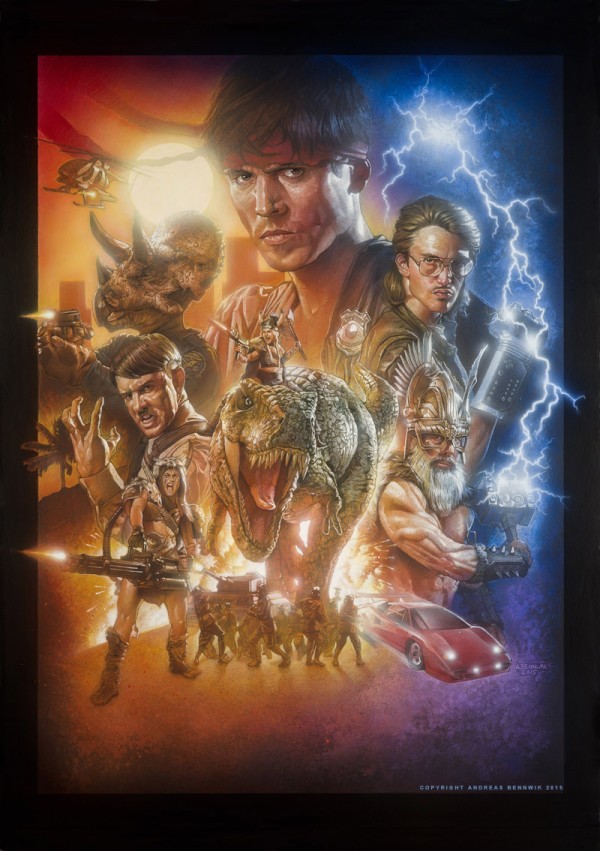
Written, directed by and starring David Sandberg in the title role, Kung Fury is the nostalgia drenched tale of a renegade Miami cop / kung fu master who realizes he must travel back in time to kill Adolf Hitler – the Kung Fuhrer – before Hitler has the chance to travel in time to ‘modern’ day Miami himself to wreak havoc in the present. Along the way we’re treated to a physical confrontation with an angry video game, reptilian partner Triceracop, Viking maidens with machine guns, more deadpan one liners than you can shake a stick at, and David Hasselhoff.

To be clear, narrative cohesion is not the greatest strength of Kung Fury. Character arcs and insight into the human condition do not abound in these parts. What we do get, however, is a thirty-minute long, nonstop assault of some of the most astounding visual gags ever assembled in one place. Kung Fury knows its audience, knows it damn well, and while it has little to offer to anyone outside of its particular niche, for people within that niche this is absolute gold.

A huge percentage of what makes Kung Fury works rests on the many talents of Sandberg himself. As a leading man he is blessed with a deliciously deadpan delivery and wicked comic timing blended with a legitimately compelling physical presence. As a writer he is an absolutely unstoppable idea machine. And as a director he is bold, ambitious, and enormously gifted on the technical side of things. Take Sandberg’s talent and then throw in SNL veteran Jorma Taccone’s utterly hysterical take on Hitler, Andreas Cahling’s Thor, and the work of his brilliant VFX team and you end up with something that feels like Dario Russo and David Ashby’s Danger 5 on speed.

Who is Afraid of Conspiracy Theories?

conspiracy-theory-definition

By Lance deHaven-Smith

Source: Waking Times

In his book Philosophical Investigations, philosopher of science Ludwig Wittgenstein demonstrated that words are more than designations or labels. They are signals in a context of activity, and are invested with many assumptions about the roles and social status of speakers and listeners.

In the 20th century, men often called women “girls.” This term, while indeed referring to something real – to women – was more than merely a label; it was demeaning and implicitly conveyed a subservient status. Wittgenstein called the common sense view of words standing for things, the “naming theory of language.” However, he pointed out, if words were merely labels, you could not teach language to children. If you pointed at a table and said “table,” how would a child know you are referring to the piece of furniture and not to the rectangular shape of its top, or the table’s colour, or its hardness, or any number of other attributes? Language is taught in the context of activity. You say to the child, “the cup is on the table,” “slide the cup across the table top,” “I am setting the table for dinner,” and slowly the child learns what a table is and how the word table is used.

Wittgenstein’s observation may seem simple, but it posed a profound challenge to all of Western philosophy since Plato, who had asked: What is beauty? What is truth? What is justice? Wittgenstein’s critique of the naming theory of language suggested these were the wrong questions. What needs philosophical investigation is who uses such words in what circumstances and with what implications.

The term conspiracy theory did not exist as a phrase in everyday conversation before 1964. The conspiracy theory label entered the lexicon of political speech as a catchall for criticisms of the Warren Commission’s conclusion that US President Kennedy was assassinated by a lone gunman with no assistance from, or foreknowledge by any element of the United States government. Since then, the term’s prevalence and range of application have exploded. In 1964, the year the Warren Commission issued its report, the New York Times published five stories in which conspiracy theory appeared. In recent years, the phrase has occurred in over 140 New York Times stories annually. On Amazon.com, the term is a book category that includes in excess of 1,300 titles. In addition to books on conspiracy theories of particular events, there are conspiracy theory encyclopedias, photographic compendiums, website directories, and guides for researchers, sceptics and debunkers.

Initially, conspiracy theories were not an object of ridicule and hostility. Today, however, the conspiracy theory label is employed routinely to dismiss a wide range of anti-government suspicions as symptoms of impaired thinking akin to superstition or mental illness. For example, in his 2007 book on the assassination of President Kennedy, former prosecutor Vincent Bugliosi says people who believe JFK conspiracy theories are “as kooky as a three dollar bill in their beliefs and paranoia.” Similarly, in Among the TruthersCanadian journalist Jonathan Kay refers to 9/11 conspiracy theorists as “political paranoiacs” who have “lost their grip on the real world.” Making a similar point, if more colourfully, in his popular book Wingnuts journalist John Avlon refers to conspiracy believers as “moonbats,” “Hatriots,” “wingnuts,” and the “Fright Wing.”

As these examples illustrate, conspiracy deniers adhere unwittingly to the naming theory of language. They assume that what qualifies as a conspiracy theory is self-evident. In their view, the phrase conspiracy theory as it is conventionally understood, simply names this objectively identifiable phenomenon. Conspiracy theories are supposedly easy to spot because they posit secret plots that are too wacky to be taken seriously. Indeed, the theories are deemed so far-fetched they require no reply or rejoinder; they are objects of derision, not ideas for discussion. In short, while ridiculing conspiracy beliefs, conspiracy deniers take the conspiracy theory concept itself for granted.

This is remarkable, not to say shocking, because the concept is both fundamentally flawed and in direct conflict with English legal and political traditions. As a label for irrational political suspicions about secret plots by powerful people, the concept is obviously defective because political conspiracies in high office do, in fact, happen. Officials in the Nixon administration did conspire to steal the 1972 presidential election. Officials in the Reagan administration did participate in a criminal scheme to sell arms to Iran and channel profits to the Contras, a rebel army in Nicaragua. The Bush-Cheney administration did collude to mislead Congress and the public about the strength of its evidence for Iraqi weapons of mass destruction. If some conspiracy theories are true, then it is nonsensical to dismiss all unsubstantiated suspicions of elite intrigue as false by definition.

This fatal defect in the conspiracy theory concept makes it all the more surprising that most scholars and journalists have failed to notice that their use of the term to ridicule suspicions of elite political criminality betrays the civic ethos inherited from British legal and political traditions. The Magna Carta placed limitations on the King, guaranteed trial by one’s peers, assigned historic revenue sources to London, and in other ways recognised the dangers of unrestrained political authority. More generally, the political institutions of the English speaking peoples presuppose political power is a corrupting influence which makes political conspiracies against the people’s interests and liberties almost inevitable. One of the most important questions in Western political thought is how to prevent top leaders from abusing their powers to impose arbitrary rule or tyranny. The men and women who fought for citizens’ rights, the rule of law, and constitutional systems of checks and balances would view today’s norms against conspiratorial suspicion as not only arrogant, but also dangerous and historically illiterate.

The founders of English legal and political traditions would also be shocked that conspiracy deniers attack and ridicule individuals who voice conspiracy beliefs, and yet ignore institutional purveyors of conspiratorial ideas, even though the latter are the ideas that have proven truly dangerous in modern history. Since at least the end of World War II, the citadel of theories alleging nefarious political conspiracies has been, not amateur investigators of the Kennedy assassination and other political crimes and tragedies, but political elites and governments. In the first three decades of the post-World War II era, officials asserted that communists were conspiring to take over the world, Western governments were riddled with Soviet spies, and various social movements of the 1960s were creatures of Soviet influence. More recently, Western governments have accepted US claims that Iraq was complicit in 9/11, failed to dispose of its biological weapons, and attempted to purchase uranium in Niger so it could construct nuclear bombs. Although these ideas were untrue, they influenced millions of people, fomented social panic, fuelled wars, and resulted in massive loss of life and destruction of property. If conspiracy deniers are so concerned about the dangers of conspiratorial suspicions in politics and civic culture, why have they ignored the conspiracism of top politicians and administrators?

In my book Conspiracy Theory in America, I reorient analysis of the phenomenon that has been assigned the derisive label of conspiracy theory. In a 2006 peer-reviewed journal article, I introduced the concept of State Crimes Against Democracy (SCAD) to displace the term conspiracy theory. I say displace rather than replace because SCAD is not another name for conspiracy theory; it is a name for the type of wrongdoing which the conspiracy theory label discourages us from speaking. Basically, the term conspiracy theory is applied pejoratively to allegations of official wrongdoing that have not been substantiated by public officials themselves.

Deployed as a derogatory putdown, the label is a verbal defence mechanism used by political elites to suppress mass suspicions that inevitably arise when shocking political crimes benefit top leaders or play into their agendas, especially when those same officials are in control of agencies responsible for preventing the events in question, or for investigating them after they have occurred. It is only natural to wonder about possible deception when a US president and vice president bent on war in the Middle East are warned of impending terrorist attacks, and yet fail to alert the public or increase the readiness of their own and allies’ armed forces. Why would people not expect answers when Arabs with poor piloting skills manage to hijack four planes, fly them across the eastern United States, somehow evade America’s multilayered system of air defence, and then crash two of the planes into the World Trade Center in New York City and one into the Pentagon in Washington, DC? By the same token, it is only natural to question the motives of President Bush and Vice President Cheney when they dragged their feet investigating this seemingly inexplicable defence failure and then, when the investigation was finally conducted, they insisted on testifying together, in secret, and not under oath. Certainly, citizen distrust can be unwarranted and overwrought, but often citizen doubts make sense. People around the world are not crazy to want answers when a US president is assassinated by a lone gunman with mediocre shooting skills who manages to get off several lucky shots with an old bolt-action carbine that had a misaligned scope. Why would there not be doubts when an alleged assassin is apprehended, publicly claims he is just a patsy, interrogated for two days but no one makes a recording or even takes notes, and then shot to death at point-blank range while in police custody at police headquarters?

In contrast, the SCAD construct does not refer to a type of allegation or suspicion; it refers to a special type of transgression: an attack from within on the political system’s organising principles. For these extremely grave crimes, English legal and political traditions use the term high crime and included in this category istreason and conspiracies against the people’s liberties. SCADs, high crimes, and antidemocratic conspiracies can also be called elite political crimes and elite political criminality. The SCAD construct is intended not to supersede traditional terminology or monopolise conceptualisation of this phenomenon, but rather to add a descriptive term that captures, with some specificity, the long-recognised potential for representative democracy to be subverted by people on the inside – the very people who have been entrusted to uphold the constitutional order.

If political conspiracies in high office do, in fact, happen; if it is therefore unreasonable to assume conspiracy theories are, by definition, harebrained and paranoia; if constitutional systems of checks and balances are based on the idea that power corrupts and elite political conspiracies are likely; if, because it ridicules suspicion, the conspiracy theory label is inconsistent with the traditional Western ethos of vigilance against conspiracies in high office; if, in summary, the conspiracy theory label is unreasonable and dangerous, how did the label come to be used so widely to begin with?

Most people will be shocked to learn the conspiracy theory label was popularised as a pejorative term by the Central Intelligence Agency (CIA) in a global propaganda program initiated in 1967. This program was directed at criticisms of the Warren Commission Report. The propaganda campaign called on media corporations and journalists around the world to criticise conspiracy theorists and raise questions about their motives and judgments. The CIA informed its contacts that “parts of the conspiracy talk appear to be deliberately generated by communist propagandists.” In the shadows of McCarthyism and the Cold War, this warning about communist influence was delivered simultaneously to hundreds of well-positioned members of the press in a global CIA propaganda network, infusing the conspiracy theory label with powerfully negative associations. In my book, I refer to this as the “conspiracy theory conspiracy.”

About the Author

LANCE DEHAVEN-SMITH is Professor in the Reubin O’D. Askew School of Public Administration and Policy at Florida State University. A former President of the Florida Political Science Association, deHaven-Smith is the author of more than a dozen books, including The Battle for Florida, which analyses the disputed 2000 US presidential election, as well as The Hidden Teachings of Jesus: The Political Meaning of the Kingdom of God (Phanes Press, 2001). His latest book is Conspiracy Theory in America (University of Texas Press, 2013). DeHaven-Smith has appeared on Good Morning America, the Today Show, NBC Nightly News with Tom Brokaw, CBS Nightly News with Dan Rather, the NewsHour with Jim Lehrer, and other US TV and radio shows. His website is www.dehaven-smith.com.

The Mall of American Progress

a-grand-canyon-strip-mall

By Scott Beauchamp

Source: The Baffler

Malls may not be an American monopoly, but America’s not really thinkable without them. They’re where we come together, octogenarian mall walkers and teen Goths alike, as we aim for that perfect, elusive balance between over- and under-stimulation. They’re our own controlled-climate variation on the outdoor European arcade; only in the multipurposed American mallspace, you don’t simply exchange money for goods: you exercise, see movies, attend concerts, go to school, and worship God. They’re our culture’s vapid response to the depletion of the commons. And their increasingly empty and abandoned carapaces mottle the American landscape like munition-citadels in the war between consumerism and community.

If the war metaphor seems too dramatic, consider the name of latest big American mall project to announce itself: The Grand Canyon Escalade Project. An “escalade” is a form of military attack that uses ladders to scale a wall.  (Though civilian American consumers probably know the word as a synonym for “gargantuan Cadillac SUV.”) And the Grand Canyon is, well, the Grand Canyon. The Grand Canyon Escalade Project is a proposal to build a mall on the eastern rim of the world’s largest canyon. It’s also a handy metaphor for everything debauched, short-sighted, and self-infatuated about our consumer culture: a belligerent outpost of gaudy merchandise, perched on the very cusp of the void. It doesn’t make much economic sense, it doesn’t make much environmental sense, and it’s an exercise in rapaciousness that represents the worst of American attitudes about unbridled growth.

The Escalade Project has been in the works for some time. The moneymen behind the project call themselves the Confluence Group, LLC, after the confluence of the Colorado and Little Colorado Rivers, where the mall will be built. According to James Joiner’s dispatch on the development in the Daily Beast, the mall will occupy 420 acres “of remote land” and offer a wide array of “retail shops, restaurants, and hotels on the upper rim.” The lowest level of the project would continue to tickle the shopping and appetites of mall visitors, while also offering “stadium seating to take in the views, a museum, visitors center, and elevated river walk.” An IMAX theater will wow moviegoers for whom the splendors of erosion across the millennia may not sufficiently diverting. Meanwhile, the stubborn holdouts who still want to experience the canyon floor beneath their feet will at least be able to do so in the comfort of a people-moving tram. Hiking and donkey-packs are, like nature itself, just a series of needless trials for the single-minded shopper.

The Confluence Group isn’t the only significant regional backer of the Escalade Project. Another key player is the Navajo Nation, which, much to the consternation of some of its members, is promoting the as a claiming it will provide thousands of jobs. Others aren’t so convinced. A group of people opposing the project, calling themselves Save the Confluence, stress that the river confluence is a sacred site to 18 American Indian tribes. Renae Yellowhorse, who has lived on Navajo land her entire life, recently led a New York Times reporter to the precipice of the canyon and surveyed the land below, saying, “This is where the tram would go. This is the heart of our Mother Earth. This is a sacred area. This is going to be true destruction.”

And pace the advocates of commercial development everywhere, at all costs, this doesn’t necessarily promise to be creative (or even merely profitable) destruction. Malls are not guaranteed moneymakers. Crestwood Court Mall, the local mall in my suburban St. Louis hometown, where I would go as a teenager to eat Panda Express and buy discount CD’s as all the music stores slowly closed, is now a “ghost mall,”—a mordant coinage that’s become distressingly common along the American interior. Indeed, the desiccated caverns of Crestwood Court are something of a Grand Canyon unto itself. Crestwood was the first mall to open in the St. Louis area in 1957; now it’s an eerie one million square feet of shopping space, completely devoid of shoppers, stores, and products. It is, fittingly enough, now part of an art project called “Contemporary Ruins.”

The empty, dead mall has become a ubiquitous part of pop culture. Movies like Gone Girl and Tim and Eric’s Billion Dollar Movie have employed ghost malls as spooky and/or comic backdrops. There’s even a website devoted to the exploration of ghost malls.

And the retail decline evoked in all this ominous imagery is real enough. According to numbers reported by the New York Times, 94 percent of American malls were still economically viable in 2006; today, that rate is down to something just shy of 80 percent. They’re being carved out from the inside, with almost 20 percent of malls being at least 10 percent vacant. The trend continues unabated, in what D.J. Busch, a senior analyst at Green Street, calls a “death spiral.” Filling a million square feet or more of retail space, and keeping it filled, while even more big box stores and malls are built just neighborhoods away is quite a tall order.

Still, boosters of the Escalade Project insist that they enjoy the time-honored commercial advantages conferred by a prime location: it’s on the edge of a national park in the middle of a relatively undeveloped landscape. But in broader environmental terms, that means that things might be even worse if the mall does survive. Saying that it’s going to be “bad for the environment” is a bit like saying that being shot in the head would “impair thinking.” The pressure that the influx of visitors and the population boom of permanent residence would put on the already scant water supply could be catastrophic. The rivers are already strained and dirty from overuse. The group American Rivers recently named the Colorado River, which already serves 35 million people, the most endangered river in the United States. As Bob Irvin, president of American Rivers, recently told the New York Times, “Building this suburban development there would have an impact on the lifeblood of the national park. It’s a threat to the groundwater supply of the Colorado River.”

On top of the project’s all-but certain disastrous impact on the region’s severe water strain and waste issues, there’s also the pending repeal of twenty-year ban on uranium mining near the proposed building site. Where’s J.G. Ballard when you need him?

The Escalade Project embodies and amplifies the worst aspects of the American myth of progress. It’s cheap, of course—and stunningly heedless of the sacred meaning of the site to the region’s original inhabitants. But it’s also disrespectful to our own humanity. The Grand Canyon isn’t just “beautiful” in the sense that a travel brochure or IMAX exhibition might glibly characterize it. It’s sublime, in the way that Edmund Burke famously defined the notion as an otherworldly compound of astonishment and terror. As Burke argued, the full impact of the sublime should overwhelm our minds, and lift us out of the stupor of everyday life: it is, he wrote, “productive of the strongest emotion which the mind is capable of feeling.”

As the callow progress of the Escalade Project has made all too clear, we’ve all but lost our ability to recognize, and properly revere, the sublime. Instead, we’ve traded it for food courts, tram-conducted group tours, and emojis. In his introduction to Oakley Hall’s magisterial novel of the myth of the American West, Warlock, Thomas Pynchon observes that “we are a nation that can, many of us, toss with all aplomb our candy wrapper into the Grand Canyon itself, snap a color shot, and drive away; and we need voices . . . to remind us how far that piece of paper, still fluttering brightly behind us, has to fall.


Scott Beauchamp is a veteran and writer. His work has appeared in The Atlantic, The Daily Beast, and Deadspin, among other places.