
Recent revelations that the renowned linguist and political activist met with Jeffrey Epstein several times have surprised and confused many. Why was Epstein interested in meeting with Noam Chomsky? And why did Chomsky agree to meet him despite his past? The answer may surprise you.
By Whitney Webb
Source: Unlimited Hangout
On Sunday, the Wall Street Journal published a report detailing information contained within a “trove” of previously unreported documents of the deceased sex trafficker Jeffrey Epstein. Those documents, which have not been publicly released and appear to have been passed solely to the Journal, included Epstein’s private calendar and meeting schedules. The documents, per the Journal, contain “thousands of pages of emails and schedules from 2013 to 2017” and – as the report notes – detail Epstein’s dealings with several prominent individuals whose names were not on his flight logs or his infamous “little black book” of contacts. One of these individuals is the renowned linguist, political commentator and critic of capitalism and empire, Noam Chomsky.
Chomsky, who has previously discussed the Epstein case in interviews and who has maintained that Epstein’s ties to intelligence agencies should be considered a “conspiracy theory,” had not previously disclosed these meetings. Chomsky, when confronted by Journal reporters, was evasive, but ultimately admitted to meeting and knowing Jeffrey Epstein.
Many, largely on the left, have expressed dismay and confusion as to why someone with the political views of Chomsky would willingly meet, not once but several times, with someone like Jeffrey Epstein, particularly well after Epstein’s notoriety as a sex trafficker and pedophile. As this report will show, Epstein appeared to view Chomsky as another intellectual who could help guide his decisions when it came to his scientific obsessions – namely, transhumanism and eugenics. What Chomsky gained in return from meeting with Epstein isn’t as clear.
Why Did Chomsky Meet with Epstein?
According to the Journal, Chomsky’s meetings with Epstein took place during the years 2015 and 2016, while Chomsky taught at the Massachusetts Institute of Technology, or MIT. Chomsky told the Journal that he met with Epstein to discuss topics like neuroscience with other academics, like Harvard’s Martin Nowak (who was heavily funded by Epstein). On a separate occasion, Chomsky again met with Epstein alongside former Israeli Prime Minister, Ehud Barak, allegedly to discuss “Israel’s policies with regard to Palestinian issues and the international arena.” A separate date saw Chomsky and his wife invited by Epstein to have dinner with him, Woody Allen and Allen’s wife Soon-Yi Previn. When asked about the dinner date with Woody Allen and Epstein, Chomsky referred to the occasion as “an evening spent with a great artist.”
When confronted with this evidence, Chomsky initially told the Journal that his meetings and relationship with Epstein were “none of your business. Or anyone’s.” He then added that “I knew him [Epstein] and we met occasionally.”
Before continuing further, it is important to note that aside from Epstein, both Ehud Barak and Woody Allen have been accused of having inappropriate sexual relationships with minors. For instance, Barak was a frequent visitor to Epstein’s residences in New York, so often that The Daily Beast reported that numerous residents of an apartment building linked to Epstein “had seen Barak in the building multiple times over the last few years, and nearly half a dozen more described running into his security detail,” adding that “the building is majority-owned by Epstein’s younger brother, Mark, and has been tied to the financier’s alleged New York trafficking ring.”
Specifically, several apartments in the building were “being used to house underage girls from South America, Europe and the former Soviet Union,” according to a former bookkeeper employed by one of Epstein’s main procurers of underage girls, Jean Luc Brunel. Barak is also known to have spent the night at one of Epstein’s residences at least once, was photographed leaving Epstein’s residence as recently as 2016, and has admitted to visiting Epstein’s island, which has sported nicknames including “Pedo Island,” “Lolita Island” and “Orgy Island.” In 2004, Barak received $2.5 million from Leslie Wexner’s Wexner Foundation, where Epstein was a trustee as well as one of the foundation’s top donors, officially for unspecified “consulting services” and “research” on the foundation’s behalf. Several years later, Barak put Harvey Weinstein in contact with the Israeli private intelligence outfit Black Cube, which employs former Mossad agents and Israeli military intelligence operatives, as Weinstein sought to intimidate the women who had accused him of sexual assault and sexual harassment.
In addition, Barak previously chaired and invested in Carbyne911, a controversial Israeli emergency services start-up that has expanded around the world and has become particularly entrenched in the United States. Barak had directed Epstein to invest $1 million into that company, which has been criticized as a potential tool for warrantless mass surveillance. Leslie Wexner also invested millions in the company.
In Woody Allen’s case, he has been accused of sexually assaulting his adopted daughter Dylan Farrow when she was 7 years old. That abuse claim has been corroborated by witnesses and other evidence. Furthermore, Allen refused to take a polygraph administered by state police in connection with the investigation and lost four exhaustive court battles related to child custody and his abuse of Dylan Farrow. One of the judge’s in the case described Allen’s behavior towards Dylan as “grossly inappropriate and that measures must be taken to protect her.” Actress Mia Farrow, Dylan’s mother, alleged in court that Allen took a sexual interest in her adopted daughter when she was between the ages of two and three years old.
Allen subsequently “seduced” and later married another adopted daughter of Farrow’s, Soon-Yi Previn, whom Allen first met when Previn was a child. However, Previn has stated that her first “friendly” interaction with Allen took place when she was a teenager. In 1992, Mia Farrow found nude photos of Previn in Allen’s home and has stated that this was her motive for ending her relationship with Allen.
In the case of Allen and Epstein, and potentially Barak as well, their sexual proclivities and scandals were well known by the time Chomsky met with these men, making a strong suggestion that this type of behavior was not seen by Chomsky as taboo or as a barrier to socialization. It is more likely than not that there was some other major draw that led Chomsky to overlook this type of horrendous behavior toward vulnerable minors.
In terms of reaching a deeper understanding about why Epstein would have been interested in Chomsky – and vice versa, it is important to review – not just the information recently reported by the Wall Street Journal, but also what Epstein himself said of Chomsky before his 2019 death. According to an interview conducted in 2017, but later published in 2019 when Epstein was a major news topic, Epstein openly stated that he had invited Chomsky to his townhouse and he also explicitly stated why he had done so. Oddly, this early acknowledgement of Epstein’s regarding his relationship with Chomsky was left out of the Journal’s recent report.
In that interview, which was conducted by Jeffrey Mervis and later published in Science, Epstein stated that following about Chomsky:
[…] Epstein readily admitted to asking prominent members of the scientific establishment to assess the potential contribution of these so-called outcasts [i.e. MIT students Epstein described as being “on the spectrum”].
“So, I had Jim Watson to the house, and I asked Watson, what does he think about this idea,” a proposal to study how the cellular mechanisms of plants might be relevant to human cancer. Watson is a Nobel laureate and co-discoverer of the structure of DNA. “Likewise with [Noam] Chomsky on artificial intelligence,” he said, referring to one of the pioneers in the field.
In fact, Epstein expressed great respect for the opinions of these elder statesmen. “It’s funny to watch Noam Chomsky rip apart these young boys who talk about having a thinking machine,” Epstein noted. “He takes out a dagger and slices them, very kindly, into little shreds.”
Thus, per Epstein, his interest in inviting Chomsky to his house was explicitly related to the “artificial intelligence,” which was a major scientific interest of Epstein’s. This also provides a major clue as to how Chomsky and Epstein might have first been introduced.
Chomsky, Epstein and MIT
Chomsky is most widely viewed as a famous linguist, political commentator and critic of modern capitalism and imperialism. So, why did Epstein seek to meet with him instead on Artificial Intelligence matters?
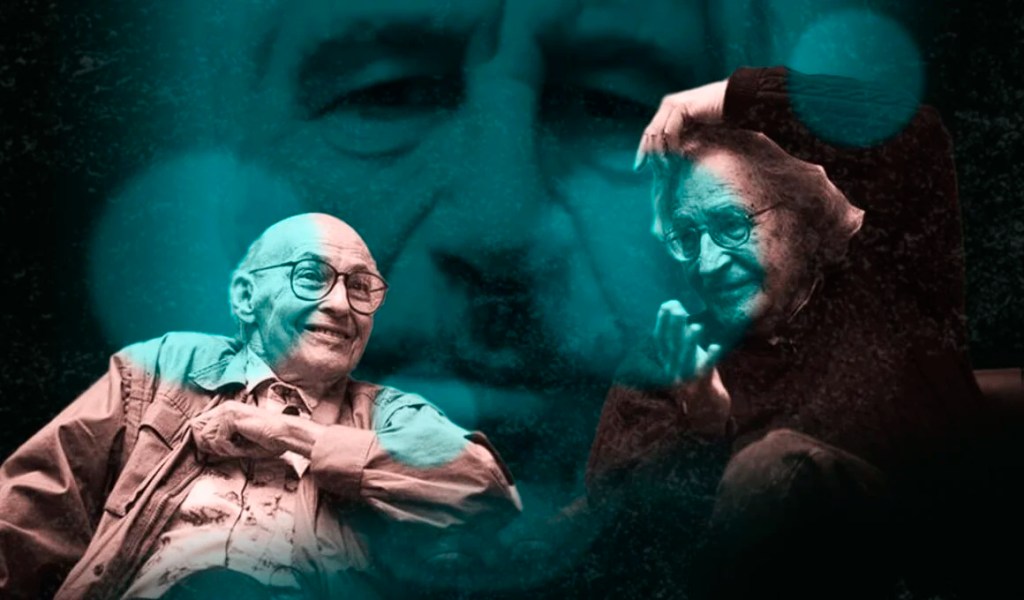
Well, an admitted “friend” of both Chomsky’s and Epstein’s was the AI pioneer Marvin Minsky. Like Chomsky, Minsky was a long-time professor and academic at MIT. It is very possible that Minsky connected the two men, especially considering the fact that Epstein was a major donor to MIT. Epstein described himself as being “very close” to Minsky, who died in 2016, roughly a year after Epstein began meeting with Chomsky. Epstein also financed some of Minsky’s projects and Minsky, like Ehud Barak, was accused of sexually abusing the minors Epstein trafficked.
Chomsky’s views on linguistics and cognition, for those who don’t know, is based very much on evolutionary biology. Chomsky was also a pioneer in cognitive science, described as “a field aimed at uncovering the mental representations and rules that underlie our perceptual and cognitive abilities.” Some have described Chomsky’s concept of language as based on “the complexity of internal representation, encoded in the genome, and their maturation in light of the right data into a sophisticated computational system, one that cannot be usefully broken down into a set of associations.” A person’s “language faculty”, per Chomsky, should be seen as “part of the organism’s genetic endowment, much like the visual system, the immune system and the circulatory system, and we ought to approach it just as we approach these other more down-to-earth biological systems.”
Despite their friendship, Minsky greatly diverged with Chomsky in this view, with Minsky describing Chomsky’s views on linguistics and cognition as largely superficial and irrelevant. Chomsky later criticized the widely used approach with AI that focuses on statistical learning techniques to mine and predict data, which Chomsky argued was “unlikely to yield general principles about the nature of intelligent beings or about cognition.”
However, Chomsky’s views linking evolutionary biology/genetics with linguistics/cognition were notably praised by the aforementioned Martin Nowak, who had attended one of the meetings Epstein had with Chomsky. Nowak, a professor of biology and mathematics and head of the Program for Evolutionary Dynamics at Harvard, later stated that he had “once broke out a blackboard during dinner with Epstein and, for two hours, gave a mathematical description of how language works,” further revealing that Epstein was interested in aspects of linguistics. It is unclear if this particular meeting was the same that Chomsky had attended alongside Nowak to discuss “neuroscience” and other topics.
However, given the importance of evolutionary biology and genetics to Chomsky’s theories, it is hardly surprising that Jeffrey Epstein would have gravitated more towards his views on AI than those of Minsky. Epstein was fascinated by genetics and, even per mainstream sources, was also deeply interested eugenics. Take for example the following from an article published in The Guardian in 2019:
Epstein was apparently fixated on “transhumanism”, the belief that the human species can be deliberately advanced through technological breakthroughs, such as genetic engineering and artificial intelligence.
At its most benign, transhumanism is a belief that humanity’s problems can be improved, upgraded even, through such technology as cybernetics and artificial intelligence – at its most malignant though, transhumanism lines up uncomfortably well with eugenics.
Thus, Epstein’s interest in AI, genetics, and more was tied into his documented obsession with “transhumanism,” which – as several Unlimited Hangout reports have noted – is essentially a rebranding of eugenics. Indeed, the term transhumanism itself was first coined by Julian Huxley, the former president of the British Eugenics Society and the first head of UNESCO who called to make “the unthinkable thinkable again” with regards to eugenics.
Aside from transhumanism, Epstein also had an avowed interest in “strengthening” the human gene pool, in part by impregnating as many women as possible with his “seed” in order to widely disperse his genes. These views may also explain Epstein’s interest in associating himself with people like James (Jim) Watson. As noted earlier in this article, Epstein stated in 2017 that he had invited both Watson and Chomsky to his home on separate occasions.
Watson has been a controversial figures for years, particularly after he openly stated that people of African descent are genetically inferior and less intelligent than their European counterparts. He also previously promoted the idea that women should abort babies that carried a “gay gene,” were such a gene ever discovered. He also felt that gene editing should be used to make all women “prettier” and to eradicate “stupidity”. Notably, Watson made all of these comments well before Epstein invited him to his home.
Watson was also praised, controversially, after these same comments by another Epstein-funded scientist, Eric Lander. Lander, who was recently Biden’s top science advisor, was forced to resign from that post last year after being accused of harassing those who worked under him in the Biden administration’s Office of Science and Technology. Prior to joining the Biden administration, Lander had collaborated with Watson on the Human Genome Project and later ran the Broad Institute, a non-profit born out of collaboration between MIT and Harvard.
Returning to Chomsky, though he may not have been aware of Epstein’s interests in eugenics and transhumanism, it has since become clear that Epstein’s main interest in Artificial Intelligence – his stated purpose for courting Chomsky – was intimately tied to these controversial disciplines. However, Chomsky did know of Epstein’s past, and likely also knew of Woody Allen’s similar past before meeting him as well. He turned a blind eye on those matters, telling the Journal that Epstein had “served his sentence” and, as a result, had been granted a “clean slate”. In saying this, Chomsky is apparently unaware of Epstein’s controversial “sweetheart deal” that resulted in an extremely lenient sentence and non-prosecution agreement. That “deal” was signed off on by then-US Attorney Alex Acosta because Acosta was told to “back off” Epstein because Epstein “belonged to intelligence.” Chomsky had previously told several people, including an Unlimited Hangout reader, that an Epstein-intelligence agency connection is a “conspiracy theory.”
Given Chomsky’s odd views on Epstein’s past and the fact that Epstein frequently discussed transhumanism and eugenics around other prominent scientists, it is possible, though unproven, that Chomsky may have known more about Epstein’s true interests in AI and genetics.
Would Chomsky have been willing to overlook these ethical conundrums? Given his political views on capitalism and foreign policy, many would likely say that he would not. However, finding ways to circumvent these ethical conundrums with respect to AI may have been one of Epstein’s main reasons for heavily funding MIT, particularly its Media Lab. Epstein, in addition to his own donations, also funneled millions of dollars from Bill Gates and Leon Black to the Media Lab.
According to former Media Lab employee Rodrigo Ochigame, writing in The Intercept, Joi Ito of MIT’s Media Lab – who took lots of donations from Epstein and attempted to hide Epstein’s name on official records – was focused on developing “ethics” for AI that were “aligned strategically with a Silicon Valley effort seeking to avoid legally enforceable restrictions of controversial technologies.” Ito later resigned his post at the Media Lab due to fallout from the Epstein scandal.
Ochigame writes:
A key group behind this effort, with the lab as a member, made policy recommendations in California that contradicted the conclusions of research I conducted with several lab colleagues, research that led us to oppose the use of computer algorithms in deciding whether to jail people pending trial. Ito himself would eventually complain, in private meetings with financial and tech executives, that the group’s recommendations amounted to “whitewashing” a thorny ethical issue. “They water down stuff we try to say to prevent the use of algorithms that don’t seem to work well” in detention decisions, he confided to one billionaire.
I also watched MIT help the U.S. military brush aside the moral complexities of drone warfare, hosting a superficial talk on AI and ethics by Henry Kissinger, the former secretary of state and notorious war criminal, and giving input on the U.S. Department of Defense’s “AI Ethics Principles” for warfare, which embraced “permissibly biased” algorithms and which avoided using the word “fairness” because the Pentagon believes “that fights should not be fair.”
Ochigame also cites Media Lab colleagues who say that Marvin Minsky, who worked with the Lab before his death, was known to say that “an ethicist is someone who has a problem with whatever you have in your mind.” Also troubling is the fact that Ito, and by extension the Media Lab, played a role in shaping White House policy with respect to AI. For instance, Obama called Ito an “expert” on AI and ethics during an interview with him in 2016. Ito, on his conversation with Obama, said the following: “[…] the role of the Media Lab is to be a connective tissue between computer science, and the social sciences, and the lawyers, and the philosophers […] What’s cool is that President Obama gets that.”
If you are Jeffrey Epstein, with a history of illegal and criminal activity, and interested in avoiding the regulation of controversial technologies you feel are necessary to advance your vision of transhumanism/eugenics, financing groups that greatly influence “ethics” policies that helps limit the regulation of those technologies would obviously benefit you.
Ochigame goes on to write:
Thus, Silicon Valley’s vigorous promotion of “ethical AI” has constituted a strategic lobbying effort, one that has enrolled academia to legitimize itself. Ito played a key role in this corporate-academic fraternizing, meeting regularly with tech executives. The MIT-Harvard fund’s initial director was the former “global public policy lead” for AI at Google. Through the fund, Ito and his associates sponsored many projects, including the creation of a prominent conference on “Fairness, Accountability, and Transparency” in computer science; other sponsors of the conference included Google, Facebook, and Microsoft.
Notably, Epstein was tied into these same circles. He was very, very close, not just with Bill Gates, but with several other top Microsoft executives and was also known to have a close relationship with Google’s Sergey Brin, who has recently been subpoenaed in the Epstein-JPMorgan case, as well as Facebook/Meta’s Mark Zuckerberg. Notably, many of these same companies are currently pioneering transhumanist technologies, particularly in healthcare, and are deeply tied to either the military or intelligence, if not both.
The MIT-AI-Military Connection
Chomsky is just one of several prominent academics and intellectuals who were courted by Epstein in an attempt to supercharge the development of technologies that could help bring his controversial obsessions to fruition. Notably, many of these characters, including Chomsky, have had their work – at one point or another – funded by the U.S. military, which has itself long been a major driver of AI research.
For example, Minsky and Danny Hillis, a close associate of Epstein’s in his own right, co-created a DARPA contractor and supercomputer firm called Thinking Machines, which was aimed at creating a “truly intelligent machine. One that can see and hear and speak. A machine that will be proud of us,” according to one company brochure. Minsky was Hillis’ mentor at MIT and the pair sought out Sheryl Handler, who worked for a genetic-engineering start-up at Harvard called the Genetics Institute, to help them create their supercomputer firm.
Thinking Machines, which made poor business decisions routinely from the beginning, was only able to function for as long as it did due to multi-million dollar contracts it had secured from the Pentagon’s DARPA. With the close of Cold War, DARPA sought to use its clout with Thinking Machines to push the company to develop a product that could deal with things like modeling the global climate, mapping the human genome and predicting earthquakes. Subsequent reporting from the Wall Street Journal showed that the agency had been “playing favorites” and Thinking Machine’s “gravy train” abruptly ended due to the bad publicity, subsequently leading to the collapse of the company.
Hillis, around this time, met Jeffrey Epstein. The introduction may have been brokered by former Microsoft’s Chief Technology Officer Nathan Myhrvold, a friend of Hillis’ who grew close to Epstein in the 1990s and even took Epstein on an official Microsoft trip to Russia. Myhrvold, who was also named as an abuser of the minors Epstein trafficked, was one of the other top Microsoft officials who was close to Epstein beginning in the 1990s. Another was Linda Stone, who later connected Jeffrey Epstein to Joi Ito of MIT’s Media Lab. As previously mentioned, Epstein would later direct the long-time head of Microsoft, Bill Gates, to donate millions to the Media Lab.
Chomsky’s own history at MIT brought him into contact with the military. For instance, during the early 1960s, Chomsky received funding from the Air Force, which aimed to program a computer with Chomsky’s insights about grammar in an attempt to endow it “with the ability to recognize instructions imparted to it in perfectly ordinary English, thereby eliminating a necessity for highly specialized languages that intervene between a man and a computer.” Chomsky later stated of the military funding of his early career that “I was in a military lab. If you take a look at my early publications, they all say something about Air Force, Navy, and so on, because I was in a military lab, the Research Lab for Electronics.”
Chomsky has since denied that military funding shaped his linguistics work in any significant way and has claimed that the military is used by the government “as a kind of a funnel by which taxpayer money was being used to create the hi-tech economy of the future.” However, reports have noted that this particular project was very much tied to military applications. In addition, the man who first recruited Chomsky to MIT in the mid-1950s, Jerome Wiesner, went on to be Chomsky’s boss at MIT for over 20 years as well as “America’s most powerful military scientist.”
To Chomsky’s credit, after this program ended, he became fully, and publicly, committed to anti-war activism. This activism led him, at one point, to consider resigning from MIT, which he declined to do – likely because he was rather quickly granted professorship. As Chris Knight writes, “this meant that instead of resigning, Chomsky’s choice was to launch himself as an outspoken anti-militarist activist even while remaining in one of the US’s most prestigious military labs.”
By staying at MIT, Chomsky chose to maintain his career, in relative proximity to the centers of power he would later become an icon for denouncing. However, it shows that Chomsky, from this time onward, began to make some choices that undermined his radicalism to an extent. Chomsky may have rationalized his decision to stay at MIT in the 1960s because it gave him a better platform from which to espouse his political and anti-war views. It is not unheard of for prominent public figures to make such compromises. However, in light of the recent Epstein revelations and what they appear to signal, it seems that Chomsky, particularly in his later years, may have become too comfortable and too willing to make these types of compromises – ones that a much younger Chomsky would have surely rejected.

 After the Crash