The Calling: How Cronyism Worsens Income Inequality (and Freed Markets Reduce It)

cronyism-out-of-control

By Steven Horwitz

Source: Future of Freedom Foundation

I recently gave an introductory Public Choice talk sponsored by Students for Liberty at the University of Ottawa. The next speaker was my friend Anne Rathbone Bradley, who was Skyping in from Washington. Anne gave a terrific talk about cronyism and rent-seeking that nicely complemented many of the points I’d made. But one of the side issues she raised really stuck with me, and I want to expand on it.

Anne connected cronyism (I hesitate to call it “crony capitalism”), rent-seeking, and income inequality in a way I hadn’t quite thought about before. The key to the connection is to realize some important truths about the political process.

The first truth is that cronyism is no accident. It is no accident that the U.S. economy has increasingly become one in which your connections to political power matter more for your ability to increase your wealth than does producing a product or service that consumers wish to buy. We are becoming what Ayn Rand deftly termed an “aristocracy of pull.”

The ability of some to get wealthier through political connections does trouble many on the political left, but they often argue that with better elected officials, or more ethical businesspeople, or limits on campaign contributions, we could dramatically reduce this sort of cronyism. What their argument misses is that as long as government gives out goodies, private-sector actors will find ways to get their hands on them. If you really want to take the money out of politics, you need to make it harder for politicians to hand out money.

For libertarians, the state is always little more than a dispenser of privileges to special interests. This is not an accident of who is elected or who is wealthy. Government privileges provide an easy path to profit for those who can capture them — and with none of the hard work of actually competing in the market. This is why many people, including those in the private sector, like the state.

The second important truth is that these political privileges are much more likely to be captured by those who already have financial and political power. Despite the fantasy believed by so many that government regulation and other interventions are all about constraining the rich and powerful in the name of the masses, in fact a great deal of government regulation is driven by the desires of those same rich and powerful to become more so. The more power we give to government, the more power we are giving to those with the money and connections to access political power. In other words, expanding the state gives more power and privilege to the powerful and privileged.

The last truth is that when private-sector actors seek to use political privileges to enhance their profits, they often do so by blocking smaller competitors’ access to the market, or by raising their costs of competing. When Walmart supports a higher minimum wage, it thereby favors raising the costs for their small mom-and-pop rivals. When taxicab companies defend their monopoly privileges, they intend to shut firms like Uber and Lyft out of the market altogether. When entrenched hairdressers demand that hair braiders be licensed, the established practitioners mean to raise their competitors’ costs or shut them out altogether.

When we put all three of these truths together, we get a story about the way in which those who already have wealth and power can and do make use of the state to block the upward mobility of their poorer, less-powerful potential competitors. Small-business owners, Uber and Lyft drivers, and African-American women who want to open hair-braiding businesses are trying to grab on to the bottom rungs of the income ladder and work their way up. These are the very people — start-up entrepreneurs and the working poor — that those critical of the market claim to care about.

In a world where government has all of these powers to intervene in markets, rent-seeking and cronyism are inevitable. Regulation will ensure that those who know the right people can tilt the regulatory playing field in their favor. The result will be a worsening of the income inequality that concerns so many. The rich will get richer through rent-seeking and cronyism, and they will do so at the expense of the poor and relatively powerless. If rent-seeking and cronyism worsen income inequality, and the source of rent-seeking and cronyism is the state’s ability to intervene, then a pretty good case can be made that freed markets will give us a world with less income inequality than the status quo.

Libertarians are right to point out that inequalities of income are not inherently bad. If the existing pattern of incomes were the result of a truly freed market (like in the famous, if simplified, Wilt Chamberlain example in Robert Nozick’s Anarchy, State, and Utopia), there would be no reason for worry. This is especially true because in a freed market, dynamic change would ensure that the same people do not occupy the same rungs on the ladder from year to year.

However, if inequalities are instead the result of a mixed economy in which those who already have wealth and power can enhance it at the expense of those with less — not to mention the consumers who lose out on the benefits of greater competition and lower prices, then libertarians are right to object and look for solutions. Of course, asking for more state action to combat state-driven inequalities is unlikely to work and very likely to make matters worse.

Thus, we can ground our arguments against government intervention in the market in our desire to reduce inequalities that are not the result of voluntary exchanges that benefit both parties.

Finally, this whole argument gives libertarians another reason to love the sharing economy of Uber, Lyft, AirBnB, and the rest. Not only are such companies providing important competition for established firms and thereby lowering prices and bringing better services and more options to consumers, they are also part of the fight against the unearned privileges of the rich and powerful and the fight against politically driven, and therefore unjustified, increases in income inequality.

Classical liberalism needs to reassert its long-standing commitment to progressive goals, even as it rejects the means preferred by most so-called progressives today. We have an opportunity to bring new allies to our cause by recognizing the interrelationships among rent-seeking, cronyism, the sharing economy, small businesspeople, and income inequality. Let’s not overlook it.

Standard & Poor’s: Runaway Inequality Dampens GDP Growth, Leads to Boom/Bust Cycles and Discourages Trade, Investment and Hiring

income-inequality-yahoo

Source: Washington’s Blog

Inequality Also Dampens Social Mobility, Increases Political Pressure and Produces a Less Competitive Workforce

Standard & Poor’s released a report on inequality today, concluding:

Higher levels of income inequality increase political pressures, discouraging trade, investment, and hiring. Keynes first showed that income inequality can lead affluent households (Americans included) to increase savings and decrease consumption (1), while those with less means increase consumer borrowing to sustain consumption…until those options run out. When these imbalances can no longer be sustained, we see a boom/bust cycle such as the one that culminated in the Great Recession (2).

Aside from the extreme economic swings, such income imbalances tend to dampen social mobility and produce a less-educated workforce that can’t compete in a changing global economy. This diminishes future income prospects and potential long-term growth, becoming entrenched as political repercussions extend the problems.

Our review of the data, as well as a wealth of research on this matter, leads us to conclude that the current level of income inequality in the U.S. is dampening GDP growth, at a time when the world’s biggest economy is struggling to recover from the Great Recession and the government is in need of funds to support an aging population.

S&P joins many others in concluding that runaway inequality hurts the economy, including:

  • Former U.S. Secretary of Labor and UC Berkeley professor Robert Reich
  • Global economy and development division director at Brookings and former economy minister for Turkey, Kemal Dervi
  • Societe Generale investment strategist and former economist for the Bank of England, Albert Edwards
  • Michael Niemira, chief economist at the International Council of Shopping Centers
  • Former executive director of the Joint Economic Committee of Congress, senior policy analyst in the White House Office of Policy Development, and deputy assistant secretary for economic policy at the Treasury Department, Bruce Bartlett
  • Deputy Division Chief of the Modeling Unit in the Research Department of the IMF, Michael Kumhof

Even the father of free market economics – Adam Smith – didn’t believe that inequality should be a taboo subject.

Numerous investors and entrepreneurs agree that runaway inequality hurts the economy, including:

Indeed, extreme inequality helped cause the Great Depression, the current financial crisis … and the fall of the Roman Empire . And inequality in America today is twice as bad as in ancient Rome, worse than it was in Tsarist Russia, Gilded Age America, modern Egypt, Tunisia or Yemen, many banana republics in Latin America, and worse than experienced by slaves in 1774 colonial America. (More stunning facts.)

Bad government policy – which favors the fatcats at the expense of the average American – is largely responsible for our runaway inequality.

And yet the powers-that-be in Washington and Wall Street are accelerating the redistribution of wealth from the lower, middle and more modest members of the upper classes to the super-elite.

8 Facts About American Inequality

income-inequality-graphic

By Pierce Nahigyan

Source: Nation of Change

…that dream of a land in which life should be better and richer and fuller for everyone, with opportunity for each according to ability or achievement. It is a difficult dream for the European upper classes to interpret adequately, and too many of us ourselves have grown weary and mistrustful of it. It is not a dream of motor cars and high wages merely, but a dream of social order in which each man and each woman shall be able to attain to the fullest stature of which they are innately capable, and be recognized by others for what they are, regardless of the fortuitous circumstances of birth or position.”

– James Truslow Adams, The Epic of America (1931)

The American Dream has been defined many ways by writers of both poetic and prosaic bent, but its essentials tend to involve life, liberty and the pursuit of happiness (or property, depending on your source).

The Declaration of Independence, upon which an entire nation was radically brought into existence, asserts that not only are all men created equal but that this is a “self-evident” truth. The significance of this fact lies not in its semantics, which epistemologists would challenge, but in its utilization as a primary foundational creed. By this “unanimous Declaration of the thirteen united States of America,” a contract was agreed to, that their union would be founded on this principle. Furthermore, life, liberty and the pursuit of happiness are rights that governments are created to uphold. Thus, America was endowed with its dream at the moment of its conception: the freedom to succeed.  

The United States has promoted a self-congratulating exceptionalism for decades, waving its Declaration and Constitution in the faces of other sovereign nations as if the latter had never beheld such concepts. Our capital F “Freedom” sets us apart from the rest of the world, as the political rhetoric has repeated ad nauseam, no matter the freedoms enjoyed by democracies on every continent. And yet our basic freedom, the freedom to succeed, America’s contractual promise, has been shrinking for thirty years.

The freedom to succeed transcends economic systems but it is most potently expressed by capitalist gains. The ability to go “from rags to riches” is ingrained in this nation’s ethos and there is nothing intrinsically immoral about that goal. However, the current state of American inequality reveals a very real and expanding gap between the rich and poor that betrays the foundational endowment of this Union. When the freedom to succeed is denied every citizen, their equality is equally denied. 

The wealth and income inequalities in America do not require socialist reforms to fix, and capitalism is not the problem. The problem is that we have let inequality advance in this country so gradually that its obviousness is masked by its familiarity. Below I outline eight facts about inequality in America that every American should know. 

1) 400 Americans have more wealth than half of all Americans combined. To put that into context, as of 2013 there are an estimated 316,128,839 people living in the United States, according to the U.S. Census Bureau. Just 400 Americans have more money than over 158 million of their fellow citizens. Their net worth is over $2 trillion, which is approximate to the Gross Domestic Product of Russia. This ratio has been verified by Politifact and former Labor Secretary Robert Reich. One explanation for the vast discrepancy in wealth is the definition of “worth,” which includes everything a person or household owns. This means savings and property but also mortgages, bills and debt. Poorer households can owe so much in debt that they possess a negative net worth.

2) America has the second-highest level of income inequality, after Chile. The Organization for Economic Cooperation and Development studies thirty-four developed countries and ranks them both before and after taxes and government transfers take effect (government transfers include Social Security, income tax credit and unemployment insurance). Before taxes and government transfers, America ranks tenth in income inequality. After taxes and transfers, it ranks second. Whereas its developed peers reduce inequality through government programs, the United States’ government exacerbates it. 

3) The current state of inequality can be traced back to 1979. After the Stock Market Crash of 1929, the gap between the rich and the poor began to narrow. For fifty years, wages still differed greatly between the upper- and working-classes, but a robust middle-class took shape, as well as the opportunity for working-class individuals to ascend. In his book, “The Great Divergence,” journalist Timothy Noah traces today’s inequality to the beginning of the 1980s and the widening gap between the middle- and upper-classes. This gap was influenced by the following factors: the failure of American schools to prepare students for new technology; poor immigration policies that favor unskilled workers and drive down the price of already low-income labor; federally-mandated minimum wage that has failed to keep pace with inflation; and the decline of labor unions.

4) Non-union wages are also affected by the decline of unions. The Economic Policy Institute claims that 20% of the growth in the wage gap between high-school educated and college educated men can be attributed to deunionization. Between 1978 and 2011, union representation for blue-collar and high-school educated workers declined by more than half. This has also diminished the “union wage effect,” whereby the existence of unions (more than 40% of blue-collar workers were union members in ’78) was enough to boost wages in non-union jobs – in high school graduates by as much as 8.2%. Not only did unions protect lower- and middle-class workers from unfair wages, they also established norms and practices that were then adopted by non-union employers. Two prime examples are employee pensions and healthcare. Today about 13% of workers belong to unions, which has reduced their bargaining power and influence. 

5) There is less opportunity for intergenerational mobility. In December 2011, President Obama spoke at Osawatomie High School in Kansas. He was very clear about the prospects of the poor in today’s United States:

“[O]ver the last few decades, the rungs on the ladder of opportunity have grown farther and farther apart, and the middle class has shrunk. You know, a few years after World War II, a child who was born into poverty had a slightly better than 50-50 chance of becoming middle class as an adult. By 1980, that chance had fallen to around 40 percent. And if the trend of rising inequality over the last few decades continues, it’s estimated that a child born today will only have a one-in-three chance of making it to the middle class – 33 percent.”

As refreshing as that honesty is, Obama promised no fix beyond $1 trillion in spending cuts and a need to work toward an “innovation economy.” 

In a speech one month later, Obama’s Chairman of Economic Advisers, Alan Krueger, elaborated on the dire state of America’s shrinking middle-class. The contraction, he stated, could partially be attributed to “skill-biased technical change”: work activities that have become automated over time, reducing the need for unskilled labor and favoring those with analytical training. He also highlighted the 50 year decline in tax rates for the top 0.1%, increased competition from overseas workers, and a lack of educational equality for children. Poor children are denied the private tutors, college prep and business network of family and friends available to their wealthier peers, which locks them into the class they are born into.

6) Tax cuts to the wealthiest have not improved the economy or created more jobs. Krueger also revealed that the tax cuts of the 2000s for top earners did not improve the economy any better than they did in the 1990s (meanwhile, income growth was stronger for lower- and middle-class families in the 1990s than in the last forty years). Tax rates for the top income earners in America peaked in 1945 at 66.4 percent. Following decades of gradual reductions, they have since been cut in half. During the same time, the payroll tax has increased since the 1950s and individual income tax has bounced between 40-50% through the present day. Conversely, corporate tax declined from above 30% in the 1950s to under 10% in 2011. All of these tax cuts are made ostensibly to improve the economy and create jobs. However, the National Bureau of Economic Research has concluded that it is young companies, “regardless of their size,” that are the real job creators in America. Tax cuts to the wealthiest do not create jobs

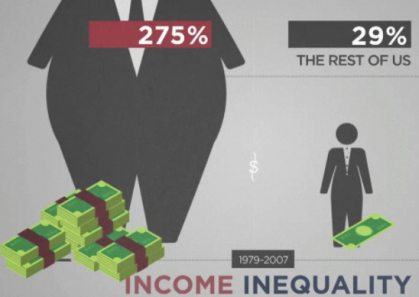
7) Incomes for the top 1% have increased (but the top 0.01% make even more). Between 1979 and 2007, the average incomes of the 1% increased 241%. Compare that to 19% growth for the middle fifth of America and 11% for the bottom fifth. Put another way, in 1980 the average American CEO earned forty-two times as much as his average worker. In 2001, he earned 531 times as much

Average income across the 1% is actually stratified into widely disparate echelons. Compare the $29,840 average income for the bottom 90% to the $161,139 of the top 10%. Compare the $1 million average income of the top 1% to the $2.8 million of the top 0.1%. Yet both still pale beside the $23 million average income of the top 0.01%. 

If those numbers seem a bit overwhelming, Politizane has created a video that illustrates this staggering inequality:

8) The majority of Congress does not feel your pain. Empowered by the Constitution to represent their constituents, United States Congress members are, for the first time in history, mostly millionaires. The 2012 financial disclosure information of the 534 current Congress men and women reveals that over half of them have a net worth of $1 million or more. After the past seven facts it is difficult to read this last one and believe that these 268 legislators have the best interests of the remaining 99% at heart. But if that is too presumptuous a leap, it is not too bold to say that wealthier donors, lobbyists and special interest groups enjoy greater access to these lawmakers than the average American. 

Life, and the Liberty to Go Hungry

Last week Congress failed to extend emergency benefits for unemployment, leaving 1.3 million people without federal aid. Congress is currently on a weeklong recess that will keep them from debating the issue until their return on January 27. The bill was too divisive for Republicans and Democrats to reach an agreement on, though unemployment is still above 7% nationally. 

Thankfully, the unemployed have their Congress working for them. And at $174,000 annual pay, those representatives are sure to return from vacation committed to fresh solutions. 

The pursuit of happiness is an ephemeral affair, but the freedom to succeed is not. It is something one possesses or lacks. It is the difference between enjoying a more prosperous life than one’s parents and believing there is no way out. A “self-evident” truth is one that is meaningful without proof, much akin to faith. If inequality continues to rise in America, the self-evident truths of its founding will be no more than words on an old piece of paper, its American Dream a tattered faith paid lip service by the deceitful and the blind.

Individual Wealth in Perspective

billionairehousing

By James Hall

Source: Negotium

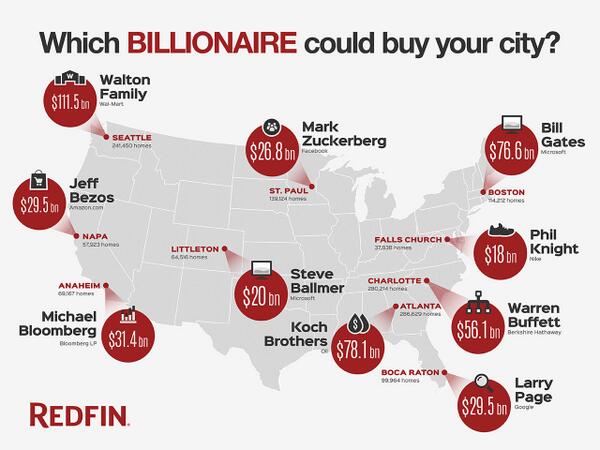
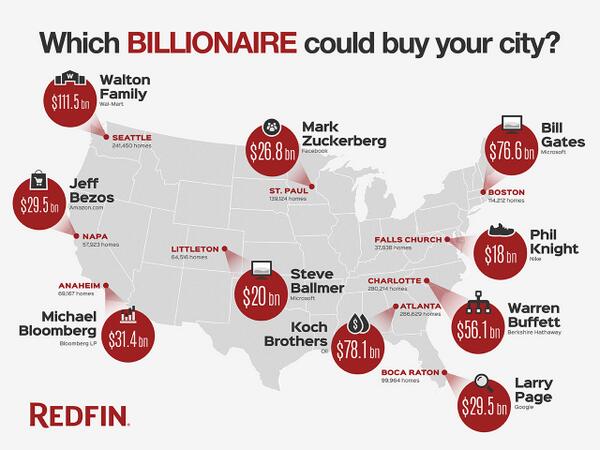
A quaint comparison of what money can buy in today’s market has Bill Gates being able to afford every home in Boston. His $76.6 billion reported by the Washington Post or the $78.4 billion by Forbes seems a pittance when put up against John D. Rockefeller’s peak wealth of $318.3 billion (based on 2007 US dollar). According to your resident commissars over at MSNBC, “The median net worth of American households hasn’t changed much over the past decades, it’s about $20,000.” So if Gates decided to purchase all the Beantown houses, whom would he pay for the bricks and mortar? Certainly, most Americans may think of “their home is their castle”, but few actually own a debt free deed to their grand estate. No wonder the banks and financial institutions, are so fond of placing liens on real property.

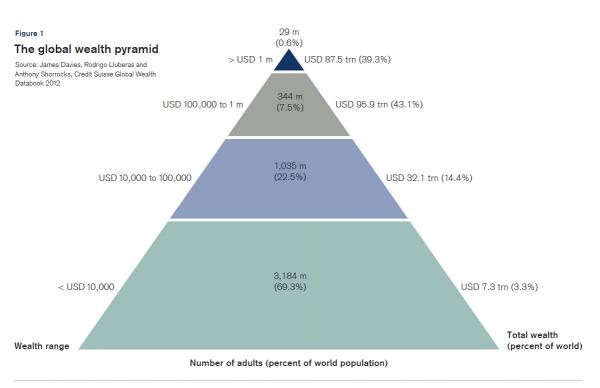
The proportional context of looking at individual wealth within the relative value of global wealth is examined in the essay; It’s A “0.6%” World: Who Owns What Of The $223 Trillion In Global Wealth, seems trite. Zerohedge concludes, “The bottom line: 29 million, or 0.6% of those with any actual assets under their name, own $87.4 trillion, or 39.3% of all global assets.”

CSwealth

Here are the stunning facts:

“In 2012, 3.2 billion individuals – more than two-thirds of the global adult population – have wealth below USD 10,000, and a further one billion (23% of the adult population) are placed in the USD 10,000–100,000 range.

The average wealth holding is modest in the base and middle segments of the pyramid, total wealth amounts to USD 39 trillion, underlining the potential for new consumer trends products and for the development of financial services targeted at this often neglected segment.

The remaining 373 million adults (8% of the world) have assets exceeding USD 100,000.

And then the top of the pyramid: 29 million US dollar millionaires, a group which contains less than 1% of the world’s adult population, collectively owns nearly 40% of global household wealth.

Some 84,500 individuals are worth more than USD 50 million, and 29,000 are worth over USD 100 million.”

After absorbing this macro economic analysis, it should ease the pain that the stewardship of world wealth is in such trustworthy hands. No need to burden the masses with the weight of building wealth, when that formula for getting to the top of the financial pyramid, has room for only the few. The expert obelisk creators never meant for wealth sharing and the tools to construct one’s own prosperity are not included in your capital accumulation education. The liability of mortgage and property tax obligations to retain your edifice requires regular payments to maintain the privilege of possession. Ownership is only a conditional wealth asset.

Investopedia says 3 Simple Steps To Building Wealth are:

“You need to make it. This means that before you can begin to save or invest, you need to have a long-term source of income that’s sufficient enough to have some left over after you’ve covered your necessities.

You need to save it. Once you have an income that’s enough to cover your basics, you need to develop a proactive savings plan.

You need to invest it. Once you’ve set aside a monthly savings goal, you need to invest it prudently.”

Ordinary consumers do not build great fortunes. The elementary prescription for “getting ahead” is severely limited in thinking for a world that frequently conducts business as a blood sport. However, many of the enterprises that carve out a market for their products or services have a distinct edge over the unconnected entrepreneur. Namely, government directed and controlled startups or collaborated ventures frequently become the commercial giants of the economy. Here lays the confusion when defining wealth as an accounting device of personal ownership of assets.

In addition, governments are often in the privatization and sale of state assets. The Economists reports that the “IMF estimate that non-financial government assets average 75% of GDP in advanced economies. In most countries, these are worth more than financial assets (stakes in listed firms, sovereign-wealth and securities holdings and the like).”

Liquid cash flow and high worth individuals, especially with inside track contacts, are able to cherry pick sweet heart deals. Such opportunities, usually transfers treasure, but infrequently are engines of new wealth creation. The only guarantee is that money, made or lost depending upon the accounting needs of the vulture predator, is never an option for the normal hard working taxpayer.

Unless people accept the reality that creating and growing wealth is a noble objective that involves the widespread commerce participation of a merchant class, the outrageous disparity of the top down wealth stream will widen even more, as the top tier inclusion narrows to fewer mega-billionaires.

Global business encourages transnational conglomerates with commercially identifiable names and logos. When entire economies prevail under a business plan that eliminates any rival competition, and achieves sole market dominance, the prospects to advance the individual wealth ledger of the average person diminishes.

An opportunistic society can only exist when independent business flourishes. Government bureaucrats and corporate technocrats oppose an unambiguous free market economy. As the map of the über-billionaires illustrates, their checkbook could swallow up entire cities. However, digesting, let alone growing communities into quality environments for future generations, takes an active involvement in the wealth building process that rewards contributing players.

Without a widespread populace practicing mutually beneficial business transactions, the capacity to achieve the skills necessary to compete successfully, will never develop. Instead of making money, saving money and investing money, learn the aptitude of business as a lifelong endeavor.

The poor will always be scraping the bottom, until they learn how to advance their abilities for the betterment of their own families. The alternative to greater concentration of wealth is to initiate a viable substitute to the financial stranglehold that furthers the appetites of egomaniacs like the character, Bretton James in the movie Money Never Sleeps. In the end, the true individual wealth that anyone can attain is the sincerity and moral substance of his or her own character. Money may not snooze from making more cash, but is only a means to elevate living a life worth lived.

In such a quest, the super rich may have a net worth equivalent to one’s property, but they can never afford the essence of your family or measure of your community.


The Global Money Matrix: The Forces behind America’s Economic Destruction

money-globe

By Dr. Gary Null

Source: GlobalResearch.ca

On the Brink of Economic Calamity

We are witnessing unprecedented low points in American economic history as 50 million Americans—17 million of them children—are living below the poverty line[i],[ii] while 47 million citizens rely on food stamps[iii].  All told, the 2008 economic collapse cost over $20 trillion globally[iv]. Millions of people lost their homes and jobs, while many of our nation’s children fell deeper into hunger. According to some figures, 53 million people entered the poverty ranks.[v] In the US and other developed nations, suicide rates skyrocketed due to financial stress and disruption of families. The Bureau of Labor Statistics has listed unemployment at 7.5% — a rate that is irreconcilable with reality. The more reliable figure, calculated by economist John Williams from Shadow Government Statistics, places unemployment at 22%. If we are to believe the analyses of Tyler Cowen at the Mercatus Center at George Mason University, we might be looking at an unemployment rate as high as 41%, since 33% of Americans are not working and no longer have the desire to find jobs.[vi]  This group is categorically removed from the government’s labor radar and is absent from the Bureau of Labor Statistics’ fudged data. 

 The Global Money Matrix

In the midst of this economic turmoil there is one group that still manages to flourish: the global elite. With more than $32 trillion stashed in offshore banks around the world, the wealth of the so-called “1%” is staggeringly obscene and grows by the day.[vii]  Their aggregate wealth, larger than the US GDP and national debt combined, is a testament to the tremendous influence and lobbying power held by a coterie of private interests that dominate nearly every sector of society.

Instead of reining in the inordinate control exercised by the elite, most of our elected officials have become little more than shills for these corporate overlords, creating policies that favor their campaign donors instead of the American people. Hundreds of millions of dollars were funneled into Barack Obama’s 2012 presidential campaign by donors whose business affiliations run the gamut from real estate and finance to media and law firms. According to Opensecrets.org, “Together, 769 elites are directing at least $186,500,000 for Obama’s re-election efforts — money that has gone into the coffers of his campaign as well as the Democratic National Committee.”[viii] This figure doesn’t even account for the massive contributions to Obama’s reelection by corporate-driven SuperPACs. Obama is just one example of how our politicians are beholden to the elite agenda. A quick glance at the campaign donation figures presented at Opensecrets.org reveals just how much special interests control Washington’s policymakers.

Given the corporatist influence that infects our halls of power, it is little wonder that our tax dollars continue to fund unconstitutional spying, perpetual war, and neoliberal policies that extend the powers of the world’s richest individuals and organizations. As Americans struggle financially, our social safety nets are increasingly losing priority to military and security expenditures that are historically unmatched anywhere in the world. Increasingly, the actions taken by the world’s most powerful corporations and governments seem to be at odds with public perception and wellbeing. Here are a few examples of how this combined influence has increased at the expense of the average American:

ALEC – This conservative group, funded by donors like the Koch brothers and Exxon Mobil and fueled by politicians including Ohio Governor John Kasich and Wisconsin Governor Scott Walker,[ix] writes model legislation calling to “privatize education, break unions, deregulate major industries, pass voter ID laws, and more.”[x] They do so with the stated aim to “form formal internal Task Forces to develop policy covering virtually every responsibility of state government.”[xi] ALEC’s website claims, “Each year, close to 1,000 bills, based at least in part on ALEC Model Legislation, are introduced in the states. Of these, an average of 20% become law.”[xii]

Federal Taxes and Expenditures – In 2014, President Obama plans to spend 57% of his discretionary budget on military, with 6% going to education, 3% to science, and 1% to food and agriculture.[xiii] And while the federal corporate tax rate is 35% in America, a variety of loopholes means that the average rate paid by corporations is 25%, with some companies paying as low as 10%.[xiv]

Citizens United – This US Supreme Court case set the legal precedent for unlimited campaign donations in US elections, qualifying corporate donations as a form a free speech. Since this case concluded, campaign expenditures have tripled.[xv]

TARP, or “the Bailout” – Following the economic crisis of 2008, US taxpayers handed $700 billion to major players in the automotive, financial, and insurance industries[xvi]. According to The New York Times, “Treasury…provided the money to banks with no effective policy or effort to compel the extension of credit. There were no strings attached: no requirement or even incentive to increase lending to home buyers, and…not even a request that banks report how they used TARP funds.”[xvii]  The Huffington Post reports, “Twenty-five top recipients of government bailout funds spent more than $71 million on lobbying in the year since they were rescued.”

In the Name of Security

The most concerning imbalance of power, however, may lie in the ‘security state’. In 2010, there were over 1900 private corporations with government contracts working for Homeland Security and NSA intelligence projects. Just one of these firms, Booz Allen Hamilton, where Edward Snowden was employed, has over 25,000 employees, nearly half of whom have security clearance of “top secret or higher”.[xviii]  Overall, there are an estimated half million individuals in private firms with access to intelligence secrets.[xix]  The federal intelligence agencies only employ 107,000 individuals; therefore, the bulk of intelligence and surveillance operations are conducted by private workforces.[xx] For fiscal year 2013, the country’s budget for intelligence, across 16 agencies, was approximately $52.6 billion, with 70% going to private contractors.[xxi]

Recent revelations by Edward Snowden unearthed the breadth and scope of this surveillance network. The National Security Agency has collected vast amounts of data to spy upon American citizens, elected legislators in Congress, leaders and populations of other nations, multilateral and international administrations, non profit organizations, and a variety of public and environmental advocacy groups. This defines the current trajectory of the US as a failed republic degenerating into a fascist regime.  For both corporate Republicans and Democrats, the rise of surreptitious surveillance on citizens, in direct violation of the Constitution, is perceived as a matter of national security to protect both the country’s domestic and foreign interests.

NSA Director Gen. Keith Alexander claimed publicly that intelligence surveillance of the American public “foiled” 54 terrorist attacks by extremists. Independent research confirmed that in fact only one, and a possible second attack, could be directly associated with the war on terrorism.  Speaking on the matter, Vermont Senator Patrick J. Leahy stated,

“There is no evidence that [bulk] phone records collection helped to thwart dozens or even several terrorist plots….These weren’t all plots and they weren’t all foiled.”.[xxii]

The Washington Times reported that “Keith B. Alexander admitted that the number of terrorist plots foiled by the NSA’s huge database of every phone call made in or to America was only one or perhaps two—far smaller than the 54 originally claimed by the administration.” General Alexander, under the questioning of Senator Leahy, also admitted that only 13 of the 54 cases were in any way connected to the U.S.  As the Washington Times clarifies,

“The [NSA phone records] database contains so-called metadata—the numbers dialing and dialed, time and duration of call—for every phone call made in or to the U.S.”[xxiii] 

This is but one example highlighting how the consolidation of corporate and political power comes at the cost of human rights and personal liberties for the average citizen.

 Obama has lied to the American people repeatedly about the extent of the security state and its infiltration into the lives of average citizens, including massive data collection of private phone calls, emails, and internet activity. The NSA revelations of Edward Snowden provide documented proof that intelligence surveillance is far more extensive than ever believed. The activities of the FBI, CIA, Pentagon, FISA courts, USDA and FDA, and the Justice Department contribute to the deterioration of citizens’ privacy and freedom. And a recent report by Essential Information entitled Spooky Business describes how some of America’s largest corporations have engaged in corporate espionage to spy on non-profit organizations. Ralph Nader writes, “In effect, big corporations have been able to hire portions of the national security apparatus, and train their tools of spycraft on the citizen groups of our country.”[xxiv] Thus, the powers of government and corporations are fostered and increased by one another, while those of the average American continue to dwindle

Groupthink and the 15%

It is unrealistic to frame the problem of control and socio-economic manipulation as a war between the 1 and the 99.  The 1 percent cannot achieve its goals without support from armies of technocrats and workforces willing to sacrifice moral values to secure careers in corporations and political parties, regardless of the inhumane ruthlessness behind their undemocratic agendas. The private industrial complexes of Too Big to Fail corporations require minions of technocrats and employees—as well as a large network of contracted small businesses, advisors, and consultants—to exert control over the population.  Therefore, we should realistically be speaking of a 15 versus 85 percent in the war on inequality, control, and power.

 When this additional 45 million people, or 15 percent of the population, are added to the formula for who controls the major stakes of power, wealth, influence and policymaking today, we can more easily understand how the psychology of “group think” creates a protective shield around the power brokers calling the shots.  When the psychologist Irving Janis first used the term “groupthink”, he referred to a collective weakening of individuals’ “mental efficiency, reality testing and moral judgment” through pressure to stick with the corporate plan.[xxv]  Among the characteristics common to groupthink, which enables the privileged elite to exert compliance to their mission without dissent, is a false belief in the inherent morality of their jobs. For example, the neoliberal free-market ideology posits that trickle down economics from the top will create more jobs and raise families’ personal income—a persistent myth that has no historical example to prove it as fact.  

The actual facts, according to the 2012 Global Wealth Data Book, show that since the implementation of neoliberal economics in the late 1970s and early 1980s, the financial health of America’s middle class has fallen to 27th globally, behind Qatar, Taiwan, Cyprus and Kuwait. Simultaneously, the US has the most millionaires and billionaires of any other nation.[xxvi]  Groupthink also generates an “illusion of invulnerability,” an insincere and narrow confidence that enables workers to take extreme risks and a distorted group rationalization to deny facts to the contrary of their optimism.  Other characteristics include stereotyping enemies, managerial pressure on nonconformists, and self-censorship of doubts within the organization.  An illusion of unanimity is sustained whereby the image is created and perpetuated that the majority agree with organization’s purpose and mission.[xxvii]

Without the possibility of groupthink and this additional 15 percent passively serving the most powerful 1 percent’s destructive acts, life in the US would be far more democratic, just, and free today. Unfortunately, our society currently necessitates profit for both legitimacy and survival. This unprecedented economic and political atmosphere is giving birth to a new face of fascism.

 The Dominant Culture

When considering the human element in our societal structure, the question arises as to how human beings can act with such blatant disregard for damage incurred. There are varying figures assessing the percent of psychopathology among high level financial and corporate executives. In the general population, approximately 1% can be clinically diagnosed with sociopathic and psychopathic disorders[xxviii]. However, for the wealthy and power elite, estimates are higher.

Canadian psychiatrist Dr. Robert Hare estimates that 4 percent of corporate executives are clinically sociopathic.[xxix] Sherree DeCovny, a former high-powered investment banker now with CFA Financial Magazine, believes it is as high as 10 percent.[xxx] Figures from psychological surveys in the UK place estimates even higher. Psychologist Clive Boddy has argued that the psychopathological behavior of financial executives was a major cause for the 2007 economic collapse. He also notes that individuals with the strongest psychopathic tendencies are those who tend to be promoted fastest.[xxxi]

Research supports this claim. In a survey of 500 senior executives in the US and UK, 26 percent observed firsthand wrongdoing in the workplace and 24 percent believed that it was necessary for professionals in the financial sector to engage in unethical and even illegal conduct in order to be successful. Sixteen percent said they would commit insider trading if they were certain they could get away with it, and 30 percent said that the pressures of compensation plans were an incentive to break the law.[xxxii]

Today, this banking elite owns the lives of millions of Americans by imprisoning them in debt. In the third quarter of 2013, consumer indebtedness reached $11.28 trillion.[xxxiii]  2014 and every year thereafter will see household debt increase. The majority of this debt, in the form of mortgages and outstanding home equity, student loans, auto loans, and credit cards, is money owed to the banking industry. It is by keeping the masses indebted, securing government allegiance and protection to extract money from citizens, that bankers are able to control the economy.

In a letter to Federal Reserve Chairman Ben Bernanke, Representative Alan Grayson and three of his Congressional colleagues raised their concern over large investment banks taking over the real economy.  According to their investment relations reports, both banks are engaged in the “production, storage, transportation, marketing and trading of numerous commodities.”[xxxiv] These include crude oil and oil products, natural gas, coal, electric power, agricultural and food products, and precious and rare metals. Additionally, JP Morgan markets electric power and “owns electricity generating facilities in the US and Europe.”[xxxv] Goldman Sachs has entered the uranium mining market.  According to Rep. Grayson, none of these activities have anything to do with the business of banking, and there is no indication that the Fed or any other agency is regulating these irregular business undertakings.[xxxvi]

In early 2013, the Swiss Federal Institute of Technology in Zurich conducted the most thorough analysis of the financial ties between over 43,000 transnational banks and corporations. This was the first empirical study to identify a network where global power and wealth is most heavily concentrated. Their startling results observed that a small faction of 147 super companies controls over 40 percent of the entire transnational network, with an additional 36 million companies below them. 

Predictably, almost all of the 147 super companies were financial institutions, with Barclays, Capital Group, the Vanguard Group, Deutsche Bank, JP Morgan, Goldman Sachs, Credit Suisse, and Bank of New York among the top of the list.[xxxvii]  With financial instruments of speculative trade insufficient to satisfy greed, such companies have every incentive to move into new territory, particularly resources and services that are essential to life. This includes fuel, water, food and minerals. As it stands, at least twenty-five major US companies have more wealth than entire countries.[xxxviii]

The prediction can be suggested that with current trends, the largest global banks will become the world’s most powerful “nations,” acting with complete autonomy outside of international laws that apply to sovereign states.  As corporate groupthink increases and infiltrates the larger civilian community, the transnationalist mind will persist as a breeding ground for psychopathology.

Conclusion

The consequences of today’s cowboy free market culture have sent the US middle class and economic mobility spiraling downward. Laid off workers have nowhere to use their skills to earn a livelihood for themselves and their families. Consequently, the worker is unable to meet expenditures and falls into a lower income bracket or poverty.  Mortgage defaults, credit card payments, and loans drag him further into debt. Without work and hence unable to pay taxes, the state, county and town suffer. In turn, local entities are forced to reduce their workforce and public services. The final result is the decline in the national quality of life, and the gradual deterioration of the US.  The inequality gap widens as the wealthy get richer and more powerful, while growing numbers of families become destitute.

A clear conflict exists between the values that we promote in the home and those values that are rewarded in the workplace. Unless we apply the same moral requirements to governments and corporations as we do to ourselves, friends, and families, the revolving door at the top of society will continue to consolidate power and wealth at any cost.

Notes

[i] Fessler, Pam. “How Many Americans Live In Poverty?” NPR. http://www.npr.org/blogs/money/2013/11/06/243498168/how-many-americans-live-in-poverty (accessed December 2, 2013).

[ii] National Center for Children in Poverty. “Child Poverty.” NCCP. http://www.nccp.org/topics/childpoverty.html (accessed December 1, 2013).

[iii] Plumer, Brad. “Why are 47 million Americans on food stamps? It’s the recession — mostly.” WashingtonPost.com. http://www.washingtonpost.com/blogs/wonkblog/wp/2013/09/23/why-are-47-million-americans-on-food-stamps-its-the-recession-mostly/ (accessed December 3, 2013).

[iv] Melendez, Eleazar. “Financial Crisis Cost Tops $22 Trillion, GAO Says.” The Huffington Post. http://www.huffingtonpost.com/2013/02/14/financial-crisis-cost-gao_n_2687553.html (accessed December 3, 2013).

 [v] Moench, Brian. “Death by Corporation, Part II: Companies as Cancer Cells.” Truthout. http://www.truth-out.org/news/item/17705-death-by-corporation-part-ii-companies-as-cancer-cells (accessed December 3, 2013).

 [vi]  “The real jobs numbers: 41% of America unemployed, 1 in 3 doesn’t want work at all – RT USA.” RT.com. http://rt.com/usa/jobs-us-employment-welfare-749/ (accessed December 3, 2013).

 [vii] Vellacott, Chris. “Super Rich Hold $32 Trillion in Offshore Havens.” Reuters.com. http://www.reuters.com/article/2012/07/22/us-offshore-wealth-idUSBRE86L03U20120722 (accessed December 13, 2003).

 [viii] “Barack Obama’s Bundlers.” Opensecrets RSS. http://www.opensecrets.org/pres12/bundlers.php

[ix] “What is ALEC?.” ALEC Exposed. http://www.alecexposed.org/wiki/What_is_ALEC%3F#Who_funds_ALEC.3F (accessed December 3, 2013).

[x] Nichols, John. “ALEC Exposed.” The Nation. http://www.thenation.com/article/161978/alec-exposed# (accessed December 3, 2013).

[xi] “History.” ALEC American Legislative Exchange Council. http://www.alec.org/about-alec/history/ (accessed December 3, 2013).

[xii] Ibid.

[xiii] “Where Does the Money Go? Federal Budget 101.” National Priorities Project. http://nationalpriorities.org/budget-basics/federal-budget-101/spending/ (accessed December 2, 2013).

[xiv] The Economist Newspaper. “The Trouble with Tax Reform.” The Economist. http://www.economist.com/blogs/democracyinamerica/2011/02/corporate-tax_reform (accessed December 3, 2013).

[xv] “Daily Kos.” : Buying Elections: Campaign Spending TRIPLES Since Citizens United. If You Can’t Win, Cheat + News!. http://www.dailykos.com/story/2013/03/11/1193246/-Buying-Elections-Campaign-Spending-TRIPLES-Since-Citizens-United-If-You-Can-t-Win-Cheat# (accessed December 3, 2013).

[xvi] Stein, Sam. “Top Bailout Recipients Spent $71 Million On Lobbying In Year Since Bailout.” The Huffington Post. http://www.huffingtonpost.com/2009/11/05/top-bailout-recipients-sp_n_346877.html (accessed December 3, 2013).

[xvii] Barofski, Neil. “Where the Bank Bailout Went Wrong.” NYTimes.com. http://www.nytimes.com/2011/03/30/opinion/30barofsky.html (accessed March 12, 2013).

[xviii] Murphy, Dan. “Booz Allen Hamilton, federal contractor.” Christian Science Monitor. http://www.csmonitor.com/World/Security-Watch/Backchannels/2013/0610/Booz-Allen-Hamilton-federal-contractor (accessed December 4, 2013).

[xix] Jonathan Fahey, Adam Goldman. “NSA Leak Highlights Key Role of Private Contractors,”  Huffington Post. June 10, 2013  http://www.huffingtonpost.com/2013/06/10/nsa-leak-contractors_n_3418876.html

[xx] Barton Gellman, Greg Miller.  “US Spy Network’s Successes, Failures and Objectives Detailed in ‘Black Budget’ Summary,”  Washington Post. August 29. 2013  http://articles.washingtonpost.com/2013-08-29/world/41709796_1_intelligence-community-intelligence-spending-national-intelligence-program

[xxi] Aubrey Bloomfield. “Booz Allen Hamilton: 70% of the US Intelligence Budget Goes to Private Contractors,”  Policymic.  http://www.policymic.com/articles/48845/booz-allen-hamilton-70-of-the-u-s-intelligence-budget-goes-to-private-contractors

[xxii] Waterman, Shaun. “NSA chief’s admission of misleading numbers adds to Obama administration blunders.” Washington Times. http://www.washingtontimes.com/news/2013/oct/2/nsa-chief-figures-foiled-terror-plots-misleading/ (accessed December 3, 2013).

 [xxiii] Ibid.

[xxiv] Nader, Ralph. “Corporate espionage undermines democracy.” The Great Debate RSS. http://blogs.reuters.com/great-debate/2013/11/26/corporate-espionage-undermines-democracy/ (accessed December 2, 2013).

[xxv] “Groupthink in Service of Government.” BATR. http://www.batr.org/wrack/080413.html (accessed December 3, 2013).

 [xxvi] “How Does America’s Middle Class Rank Globally?.” A Lightning War for Liberty. http://libertyblitzkrieg.com/2013/07/23/how-does-americas-middle-class-rank-globally-27/ (accessed December 3, 2013).

[xxvii] BATR.  Ibid.

[xxviii] Hare, Robert. “Focus on Psychopathy.” FBI. http://www.fbi.gov/stats-services/publications/law-enforcement-bulletin/july-2012/focus-on-psychopathy (accessed December 1, 2013).

 [xxix] Bercovici, Jeff. “Why (Some) Psychopaths Make Great CEOs.” Forbes. http://www.forbes.com/sites/jeffbercovici/2011/06/14/why-some-psychopaths-make-great-ceos/ (accessed December 2, 2013).

[xxx] Decovny, Sherree. “The Financial Psychopath Next Door.” CFA Magazine, Mar. – Apr. 2012. http://www.cfapubs.org/doi/pdf/10.2469/cfm.v23.n2.20 (accessed December 3, 2013).

 [xxxi] Boddy, Clive R.. “The Corporate Psychopaths Theory Of The Global Financial Crisis.” Journal of Business Ethics 102, no. 2 (2011): 255-259.

  [xxxii] LaCapra, Lauren Tara, and Leslie Adler. “Many Wall Street Executives Say Wrongdoing is Necessary: Survey.” Reuters. http://uk.reuters.com/article/2012/07/10/business-us-wallstreet-survey-idUKBRE86906G20120710 (accessed December 3, 2013).

[xxxiii] Salas Gage, Caroline. “Household Debt in US Climbed 1.1% in Third Quarter, Fed Says.” Bloomberg.com. http://www.bloomberg.com/news/2013-11-14/household-debt-in-u-s-climbed-1-1-in-third-quarter-fed-says.html (Accessed December 4, 2013.)

 [xxxiv]“Giant Banks Take Over Real Economy As Well As Financial System … Enabling Manipulation On a Vast Scale.” Washingtons Blog. http://www.washingtonsblog.com/2013/07/giant-banks-take-over-real-economy-as-well-as-financial-system-enabling-manipulation-on-a-vast-scale.html (accessed December 3, 2013).

  [xxxv] Hopkins, Cheyenne. “Fed Said to Review Commodities at Goldman, Morgan Stanley.” Bloomberg.com. http://www.bloomberg.com/news/2013-10-01/fed-said-to-review-commodities-at-goldman-morgan-stanley.html (accessed December 3, 2013). 

[xxxvi] “Giant Banks Take Over Real Economy As Well As Financial System … Enabling Manipulation On a Vast Scale.” Washingtons Blog. http://www.washingtonsblog.com/2013/07/giant-banks-take-over-real-economy-as-well-as-financial-system-enabling-manipulation-on-a-vast-scale.html (accessed December 3, 2013).

 [xxxvii] Upbin, Bruce. “The 147 Companies That Control Everything.” Forbes. http://www.forbes.com/sites/bruceupbin/2011/10/22/the-147-companies-that-control-everything/ (accessed December 3, 2013).

Mainstream Economics Warns Out-of-Control Inequality Harms the Economy…But Corrupt Government Policy Keeps Increasing Inequality

land grap

Who’s Who of Prominent Economists Agree: Inequality Harms Economic Growth

By WashingtonsBlog

A who’s who of prominent liberal and conservative economists in government and academia have now said that runaway inequality harms economic growth, including:

  • Former U.S. Secretary of Labor and UC Berkeley professor Robert Reich
  • Global economy and development division director at Brookings and former economy minister for Turkey, Kemal Dervi
  • Societe Generale investment strategist and former economist for the Bank of England, Albert Edwards
  • Michael Niemira, chief economist at the International Council of Shopping Centers
  • Former executive director of the Joint Economic Committee of Congress, senior policy analyst in the White House Office of Policy Development, and deputy assistant secretary for economic policy at the Treasury Department, Bruce Bartlett
  • Deputy Division Chief of the Modeling Unit in the Research Department of the IMF, Michael Kumhof

Even the father of free market economics – Adam Smith – didn’t believe that inequality should be a taboo subject.

Numerous investors and entrepreneurs agree that runaway inequality hurts the economy, including:

How Bad Is It?

So how bad is it, really?

Inequality in America today is twice as bad as in ancient Rome, worse than it was in Tsarist Russia, Gilded Age America, modern Egypt, Tunisia or Yemen, many banana republics in Latin America, and worse than experienced by slaves in 1774 colonial America. (More stunning facts.)

It’s Not an Accident … It’s Policy

Extreme inequality helped cause the Great Depression, the current financial crisis … and the fall of the Roman Empire . Bad government policy – which favors the fatcats at the expense of the average American – is largely responsible for our runaway inequality.

And yet the powers-that-be in Washington and Wall Street are accelerating the redistribution of wealth from the lower, middle and more modest members of the upper classes to the super-elite.

Defenders of the status quo pretend that this inequality is something outside of our control … like a force of nature. They argue that it’s due to technological innovation or something else outside of policy-makers’ control.

In reality, inequality is rising due to bad policy.

Nobel prize winning economist Joe Stiglitz said recently:

Inequality is not inevitable. It is not … like the weather, something that just happens to us. It is not the result of the laws of nature or the laws of economics. Rather, it is something that we create, by our policies, by what we do.

We created this inequality—chose it, really—with [bad] laws …

Gaming the System to Pillage and Loot

The world’s top economic leaders have said for years that inequality is spiraling out of control and needs to be reduced. Why is inequality soaring even though world economic leaders have talked for years about the urgent need to reduce it?

Because they’re saying one thing but doing something very different. And both mainstream Democrats and mainstream Republicans are using smoke and mirrors to hide what’s really going on.

And it’s not surprising … Nobel winner Stiglitz says that inequality is caused by the use of money to shape government policies to benefit those with money. As Wikipedia notes:

A better explainer of growing inequality, according to Stiglitz, is the use of political power generated by wealth by certain groups to shape government policies financially beneficial to them. This process, known to economists as rent-seeking, brings income not from creation of wealth but from “grabbing a larger share of the wealth that would otherwise have been produced without their effort”

Rent seeking is often thought to be the province of societies with weak institutions and weak rule of law, but Stiglitz believes there is no shortage of it in developed societies such as the United States. Examples of rent seeking leading to inequality include

  • the obtaining of public resources by “rent-collectors” at below market prices (such as granting public land to railroads, or selling mineral resources for a nominal price in the US),
  • selling services and products to the public at above market prices (medicare drug benefit in the US that prohibits government from negotiating prices of drugs with the drug companies, costing the US government an estimated $50 billion or more per year),
  • securing government tolerance of monopoly power (The richest person in the world in 2011, Carlos Slim, controlled Mexico’s newly privatized telecommunication industry).

(Background here, here and here.)

Stiglitz says:

One big part of the reason we have so much inequality is that the top 1 percent want it that way. The most obvious example involves tax policy …. Monopolies and near monopolies have always been a source of economic power—from John D. Rockefeller at the beginning of the last century to Bill Gates at the end. Lax enforcement of anti-trust laws, especially during Republican administrations, has been a godsend to the top 1 percent. Much of today’s inequality is due to manipulation of the financial system, enabled by changes in the rules that have been bought and paid for by the financial industry itself—one of its best investments ever. The government lent money to financial institutions at close to 0 percent interest and provided generous bailouts on favorable terms when all else failed. Regulators turned a blind eye to a lack of transparency and to conflicts of interest.

***

Wealth begets power, which begets more wealth …. Virtually all U.S. senators, and most of the representatives in the House, are members of the top 1 percent when they arrive, are kept in office by money from the top 1 percent, and know that if they serve the top 1 percent well they will be rewarded by the top 1 percent when they leave office. By and large, the key executive-branch policymakers on trade and economic policy also come from the top 1 percent. When pharmaceutical companies receive a trillion-dollar gift—through legislation prohibiting the government, the largest buyer of drugs, from bargaining over price—it should not come as cause for wonder. It should not make jaws drop that a tax bill cannot emerge from Congress unless big tax cuts are put in place for the wealthy. Given the power of the top 1 percent, this is the way you would expect the system to work.

Former Sectretary of Labor Robert Reich recently noted:

When so much wealth accumulates at the top, with money comes the capacity to control politics… It’s not that people are rich, it’s that they abuse their wealth … The wealthy contribute to political candidates and the access that their contributions buy entrenches inequality by securing subsidies, bailouts and policies that lead to even greater inequality.

Bloomberg reports:

The financial industry spends hundreds of millions of dollars every election cycle on campaign donations and lobbying, much of which is aimed at maintaining the subsidy [to the banks by the public]. The result is a bloated financial sector and recurring credit gluts.

Indeed, the big banks literally own the Federal Reserve. And they own Washington D.C. politicians, lock stock and barrel. See this, this, this and this.

Two leading IMF officials, the former Vice President of the Dallas Federal Reserve, and the the head of the Federal Reserve Bank of Kansas City, Moody’s chief economist and many others have all said that the United States is controlled by an “oligarchy” or “oligopoly”, and the big banks and giant financial institutions are key players in that oligarchy.

The chairman of the Department of Economics at George Mason University says that it is inaccurate to call politicians prostitutes. Specifically, he says that they are more correct to call them “pimps”, since they are pimping out the American people to the financial giants.

Economics professor Randall Wray writes:

Thieves … took over the whole economy and the political system lock, stock, and barrel.

No wonder the government has saved the big banks at taxpayer expense, chosen the banks over the little guy, and

No wonder crony capitalism has gotten even worse under Obama than under Bush.

No wonder big Wall Street players are continuing to loot taxpayer money and public resources.

No wonder the big banks continue to manipulate every market and commit crime after crime and … and profit handsomely from it, while law-abiding citizens slide further and further behind.

Yet Obama is prosecuting fewer financial crimes than Bush, or his father, or Ronald Reagan.

No wonder:

All of the monetary and economic policy of the last 3 years has helped the wealthiest and penalized everyone else. See this, this and this.

***

Economist Steve Keen says:

“This is the biggest transfer of wealth in history”, as the giant banks have handed their toxic debts from fraudulent activities to the countries and their people.

Stiglitz said in 2009 that Geithner’s toxic asset plan “amounts to robbery of the American people”.

And economist Dean Baker said in 2009 that the true purpose of the bank rescue plans is “a massive redistribution of wealth to the bank shareholders and their top executives”.

Without the government’s creation of the too big to fail banks (they’ve gotten much bigger under Obama), the Fed’s intervention in interest rates and the markets (most of the quantitative easing has occurred under Obama), and government-created moral hazard emboldening casino-style speculation (there’s now more moral hazard than ever before) … things wouldn’t have gotten nearly as bad.

As we wrote in March 2009:

The bailout money is just going to line the pockets of the wealthy, instead of helping to stabilize the economy or even the companies receiving the bailouts:

  • A lot of the bailout money is going to the failing companies’ shareholders
  • Indeed, a leading progressive economist says that the true purpose of the bank rescue plans is “a massive redistribution of wealth to the bank shareholders and their top executives”
  • The Treasury Department encouraged banks to use the bailout money to buy their competitors, and pushed through an amendment to the tax laws which rewards mergers in the banking industry (this has caused a lot of companies to bite off more than they can chew, destabilizing the acquiring companies)

As we pointed out in 2008:

The game of capitalism only continues as long as everyone has some money to play with. If the government and corporations take everyone’s money, the game ends.The fed and Treasury are not giving more chips to those who need them: the American consumer. Instead, they are giving chips to the 800-pound gorillas at the poker table, such as Wall Street investment banks. Indeed, a good chunk of the money used by surviving mammoth players to buy the failing behemoths actually comes from the Fed.

Quantitative Easing

It is well-documented that quantitative easing increases inequality (and see this and this.)

Quantitative easing doesn’t help Main Street or the average American. It only helps big banks, giant corporations, and big investors.

The Federal Reserve has been doing quantitative easing for 5 years … and inequality has shot up over the last 5 years. It’s not a coincidence.

Subsidies to Giant, Wealthy Corporations

Massive subsidies to big corporations is also part of the problem. Indeed, some financial analysts say that the taxpayer subsidy to the giant banks alone is $780 billion per year.

The average American family pays $6,000/year in subsidies to giant corporations.

This is a direct transfer of wealth from the little guy to the big guy … which increases inequality.

Goosing the Stock Market

Moreover, the Fed has more or less admitted that it is putting almost all of its efforts into boosting the stock market.

Robert Reich has noted:

Some cheerleaders say rising stock prices make consumers feel wealthier and therefore readier to spend. But to the extent most Americans have any assets at all their net worth is mostly in their homes, and those homes are still worth less than they were in 2007. The “wealth effect” is relevant mainly to the richest 10 percent of Americans, most of whose net worth is in stocks and bonds.

AP writes:

The recovery has been the weakest and most lopsided of any since the 1930s.After previous recessions, people in all income groups tended to benefit. This time, ordinary Americans are struggling with job insecurity, too much debt and pay raises that haven’t kept up with prices at the grocery store and gas station. The economy’s meager gains are going mostly to the wealthiest.

Workers’ wages and benefits make up 57.5 percent of the economy, an all-time low. Until the mid-2000s, that figure had been remarkably stable — about 64 percent through boom and bust alike.

David Rosenberg points out:

The “labor share of national income has fallen to its lower level in modern history … some recovery it has been – a recovery in which labor’s share of the spoils has declined to unprecedented levels.”

The above-quoted AP article further notes:

Stock market gains go disproportionately to the wealthiest 10 percent of Americans, who own more than 80 percent of outstanding stock, according to an analysis by Edward Wolff, an economist at Bard College.

Indeed, as we reported in 2010:

As of 2007, the bottom 50% of the U.S. population owned only one-half of one percent of all stocks, bonds and mutual funds in the U.S. On the other hand, the top 1% owned owned 50.9%.***

(Of course, the divergence between the wealthiest and the rest has only increased since 2007.)

Professor G. William Domhoff demonstrated that the richest 10% own 98.5% of all financial securities, and that:

The top 10% have 80% to 90% of stocks, bonds, trust funds, and business equity, and over 75% of non-home real estate. Since financial wealth is what counts as far as the control of income-producing assets, we can say that just 10% of the people own the United States of America.

Tyler Durden notes:

In today’s edition of Bloomberg Brief, the firm’s economist Richard Yamarone looks at one of the more unpleasant consequences of Federal monetary policy: the increasing schism in wealth distribution between the wealthiest percentile and everyone else. … “To the extent that Federal Reserve policy is driving equity prices higher, it is also likely widening the gap between the haves and the have-nots….The disparity between the net worth of those on the top rung of the income ladder and those on lower rungs has been growing. According to the latest data from the Federal Reserve’s Survey of Consumer Finances, the total wealth of the top 10 percent income bracket is larger in 2009 than it was in 1995. Those further down have on average barely made any gains. It is likely that data for 2010 and 2011 will reveal an even higher percentage going to the top earners, given recent increases in stocks.” Alas, this is nothing new, and merely confirms speculation that the Fed is arguably the most efficient wealth redistibution, or rather focusing, mechanism available to the status quo. This is best summarized in the chart below comparing net worth by income distribution for various percentiles among the population, based on the Fed’s own data. In short: the richest 20% have gotten richer in the past 14 years, entirely at the expense of everyone else.

***

Lastly, nowhere is the schism more evident, at least in market terms, than in the performance of retail stocks:

Saks chairman Steve Sadove recently remarked, “I’ve been saying for several years now the single biggest determinant of our business overall, is how’s the stock market doing.” Privately-owned Neiman- Marcus reported “In New York City, business at Bergdorf Goodman continues to be extremely strong.”

In contrast, retail giant Wal-Mart talks of its “busiest hours” coming at midnight when food stamps are activated and consumers proceed through the check-outs lines with baby formula, diapers, and other groceries. Wal-Mart has posted a decline in same-store sales for eight consecutive quarters.

As CNN Money pointed out in 2011, “Wal-Mart’s core shoppers are running out of money much faster than a year ago …” This trend has only gotten worse: The wealthy are doing great … but common folks can no longer afford to shop even at Wal-Mart, Sears, JC Penney or other low-price stores.

Durden also notes:

Another indication of the increasing polarity of US society is the disparity among consumer confidence cohorts by income as shown below, and summarized as follows: “The increase in equity prices has raised consumer spirits, particularly among higher-income consumers. The Conference Board’s Consumer Confidence index for all income levels bottomed in February/March of 2009. The recovery since then has been notable across the board, but nowhere as much as for those making $50,000 or more.”

Business Week notes:

Barry Ritholtz, [CIO of Ritholtz Wealth, and popular financial blogger], says millions of potential investors may conclude, as they did after the Great Depression, that the market is a rigged game for insiders. Such seismic shifts in popular sentiment can have lasting effects. The Dow Jones industrial average didn’t regain its September 1929 peak of 355.95 until 1954. “You’re going to lose a generation of investors,” says Ritholtz. “And that’s how you end up with a 25-year bear market. That’s the risk if people start to think there is no economic justice.”

Americans know that the system is rigged against them. See this. We know that the government is giving Wall Street crooks a pass. 70% of Americans know that the government’s economic policies have thrown money at the banks and hosed the people.

In such an environment, the average American has largely gotten out of stocks and other investments.

Over-Financialization

When a country’s finance sector becomes too large finance, inequality rises. As Wikipedia notes:

[Economics professor] Jamie Galbraith argues that countries with larger financial sectors have greater inequality, and the link is not an accident.

Government policy has been encouraging the growth of the financial sector for decades:

https://desultoryheroics.com/wp-content/uploads/2014/03/71000-financialandnonfinancialsectors-compensationlesleopold.jpg

(Economist Steve Keen has also shown that “a sustainable level of bank profits appears to be about 1% of GDP”, and that higher bank profits leads to a ponzi economy and a depression).

Unemployment and Underemployment

A major source of inequality is unemployment, underemployment and low wages.

Corporate Profits v. Jobs

Government policy has created these conditions. And the pretend populist Obama – who talks non-stop about the importance of job-creation – actually doesn’t mind such conditions at all.

The“jobless recovery” that the Bush and Obama governments have engineered is a redistribution of wealth from the little guy to the big boys.

The New York Times notes:

Economists at Northeastern University have found that the current economic recovery in the United States has been unusually skewed in favor of corporate profits and against increased wages for workers.

In their newly released study, the Northeastern economists found that since the recovery began in June 2009 following a deep 18-month recession, “corporate profits captured 88 percent of the growth in real national income while aggregate wages and salaries accounted for only slightly more than 1 percent” of that growth.

The study, “The ‘Jobless and Wageless Recovery’ From the Great Recession of 2007-2009,” said it was “unprecedented” for American workers to receive such a tiny share of national income growth during a recovery.

***

The share of income growth going to employee compensation was far lower than in the four other economic recoveries that have occurred over the last three decades, the study found.

Obama apologists say Obama has created jobs. But the number of people who have given up and dropped out of the labor force has skyrocketed under Obama (and see this).

And the jobs that have been created have been low-wage jobs.

Low Wage Jobs

For example, the New York Times noted in 2011:

The median pay for top executives at 200 big companies last year was $10.8 million. That works out to a 23 percent gain from 2009.

***

Most ordinary Americans aren’t getting raises anywhere close to those of these chief executives. Many aren’t getting raises at all — or even regular paychecks. Unemployment is still stuck at more than 9 percent.

***

“What is of more concern to shareholders is that it looks like C.E.O. pay is recovering faster than company fortunes,” says Paul Hodgson, chief communications officer for GovernanceMetrics International, a ratings and research firm.

According to a report released by GovernanceMetrics in June, the good times for chief executives just keep getting better. Many executives received stock options that were granted in 2008 and 2009, when the stock market was sinking.

Now that the market has recovered from its lows of the financial crisis, many executives are sitting on windfall profits, at least on paper. In addition, cash bonuses for the highest-paid C.E.O.’s are at three times prerecession levels, the report said.

***

The average American worker was taking home $752 a week in late 2010, up a mere 0.5 percent from a year earlier. After inflation, workers were actually making less.

AP pointed out that the average worker is not doing so well:

Unemployment has never been so high — 9.1 percent — this long after any recession since World War II. At the same point after the previous three recessions, unemployment averaged just 6.8 percent.

– The average worker’s hourly wages, after accounting for inflation, were 1.6 percent lower in May than a year earlier. Rising gasoline and food prices have devoured any pay raises for most Americans.

– The jobs that are being created pay less than the ones that vanished in the recession. Higher-paying jobs in the private sector, the ones that pay roughly $19 to $31 an hour, made up 40 percent of the jobs lost from January 2008 to February 2010 but only 27 percent of the jobs created since then.

Alan Greenspan noted:

Large banks, who are doing much better and large corporations, whom you point out and everyone is pointing out, are in excellent shape. The rest of the economy, small business, small banks, and a very significant amount of the labour force, which is in tragic unemployment, long-term unemployment – that is pulling the economy apart.

Money Being Sucked Out of the U.S. Economy … But Big Bucks Are Being Made Abroad

Part of the widening gap is due to the fact that most American companies’ profits are driven by foreign sales and foreign workers. As AP noted in 2010:

Corporate profits are up. Stock prices are up. So why isn’t anyone hiring?

Actually, many American companies are — just maybe not in your town. They’re hiring overseas, where sales are surging and the pipeline of orders is fat.

***

The trend helps explain why unemployment remains high in the United States, edging up to 9.8% last month, even though companies are performing well: All but 4% of the top 500 U.S. corporations reported profits this year, and the stock market is close to its highest point since the 2008 financial meltdown.

But the jobs are going elsewhere. The Economic Policy Institute, a Washington think tank, says American companies have created 1.4 million jobs overseas this year, compared with less than 1 million in the U.S. The additional 1.4 million jobs would have lowered the U.S. unemployment rate to 8.9%, says Robert Scott, the institute’s senior international economist.

“There’s a huge difference between what is good for American companies versus what is good for the American economy,” says Scott.

***

Many of the products being made overseas aren’t coming back to the United States. Demand has grown dramatically this year in emerging markets like India, China and Brazil.

Government policy has accelerated the growing inequality. It has encouraged American companies to move their facilities, resources and paychecks abroad. And some of the biggest companies in America have a negative tax rate … that is, not only do they pay no taxes, but they actually get tax refunds.

And a large percentage of the bailouts went to foreign banks (and see this). And so did a huge portion of the money from quantitative easing. More here and here.

Capital Gains and Dividends

According to a 2013 study published by a researcher at the U.S. Congressional Research Service:

The largest contributor to increasing income inequality…was changes in income from capital gains and dividends.

Business Insider explains:

Drastic income inequality growth in the United States is largely derived from changes in the way the U.S. government taxes income from capital gains and dividends, according to a new study by Thomas Hungerford of the non-partisan Congressional Research Service.

Essentially, what Democrats have been saying about income inequality — that it’s in a large part due to favorable taxation and deduction policies for high income Americans — is largely right

***

The study … conclusively found that the wealthy benefitted from low tax rates on investment income, which in turn caused their wealth to grow faster.

Essentially, taxing capital gains as ordinary income would make the playing field more fair, and reduce over time income inequality.

Joseph Stiglitz noted in 2011:

Lowering tax rates on capital gains, which is how the rich receive a large portion of their income, has given the wealthiest Americans close to a free ride.

Indeed, the Tax Policy center reports that the top 1% took home 71% of all capital gains in 2012.

Ronald Reagan’s budget director, assistant secretary of treasury, and domestic policy director all say that the Bush tax cuts were a huge mistake. See this and this.