Wealth of 400 richest Americans hits record $2.9 trillion

These six men own as much wealth as half the world’s population

By Alec Anderson

Source: WSWS.org

On Wednesday, the US finance magazine Forbes released its annual “Forbes 400” list of wealthiest Americans, revealing an immense increase in wealth among the top social stratum in the United States.

The total net worth of the 400 people included on the list hit a record $2.9 trillion this year, up from $2.7 trillion last year. The most heavily represented sector was finance, from which 88 people on the list, including bank executives, hedge fund managers and investors, drew their wealth.

The next highest proportion comes from technology giants such as Google and Facebook. The CEO of Twitter and payments firm Square, Jack Dorsey, registered the greatest percentage growth in wealth from the previous year, an increase of 186 percent to $6.3 billion. This was due in large part to a jump in Square’s stock price.

The threshold necessary for inclusion on the list rose to $2.2 billion in 2018, up $100 billion from last year’s threshold. Fully one-third of billionaires in the United States, a record 204 individuals, failed to make this year’s Forbes 400 list.

The average net worth of billionaires on the list rose to $7.2 billion, an increase of a half-billion over last year’s average of $6.7 billion.

As Forbes notes, the vast increase in wealth among the very richest Americans is largely thanks to a continuing surge in US stock indexes. They have reached new record highs in part due to unprecedented levels of stock buybacks and dividend increases, which are parasitic diversions of wealth away from productive investment in areas that produce decent-paying jobs and to the detriment of pursuits such as research and development. The billionaires on the Forbes 400 list have also benefited immensely from the Trump tax cuts for corporations and the wealthy signed into law in December 2017.

Topping the list is Amazon CEO and world’s richest person Jeff Bezos, whose $160 billion is $63 billion more than the second-wealthiest person on the list, Bill Gates, and a full $78.5 billion more than last year. Bezos has made his fortune through the super-exploitation of warehouse workers around the world, enabling Amazon to move its products faster and at cheaper prices than its retail competitors.

The staggering increase in Bezos’s wealth over the past year has been due to the more than 100 percent increase in Amazon’s stock price. The $2,950 Jeff Bezos has earned per second in 2018 is more than the $2,796 a fulfillment center worker in India makes in an entire year.

Ironically, the Forbes report was published the same day that the press was full of praise for Bezos’s supposed generosity and humanitarian concern for his workers, occasioned by the announcement that he was raising the minimum wage of his US-based employees to the poverty-level wage of $15 an hour.

If the $160 billion fortune Bezos holds were divided among Amazon’s global workforce of 500,000, each worker would receive $320,000.

Coming in second on the list with a net worth of $97 billion is Microsoft co-founder and former CEO Bill Gates, who had topped the Forbes list since 1994. The top 10 wealthiest people on the list alone have a total net worth of $730 billion, up from $610 billion in 2018.

However, just the top 45 individuals out of the 400 on the list accounted for fully half of the total wealth, or $1.45 trillion. That amounts to an average fortune of more than $32 billion each, which is more than the estimated $30 billion required to end world hunger, according to a United Nations estimate.

The Forbes report illustrates that the barrier to resolving societal ills, such as poverty, hunger and disease, is the siphoning off and hoarding of a growing proportion of society’s resources by the wealthiest segment of society.

The $2.9 trillion in the hands of these 400 richest people in the United States is roughly three-quarters of the total federal budget. It represents nearly three times the 2018 budget for the Department of Health and Human Services, which was slashed from over $1.126 trillion in 2017 to $1.112 trillion this year, and 176 times the $16.4 billion budget for the Department of Education in 2018.

Rather than addressing these issues, the Democratic Party’s midterm election campaign has instead been centered on a right-wing effort to channel opposition to Supreme Court nominee Brett Kavanaugh and Donald Trump behind a #MeToo-style hysteria over alleged sexual abuse. This is accompanied by the ongoing campaign to demonize Russia and Vladimir Putin and brand Trump as a stooge of the Kremlin.

The timing of the release of the Forbes list is significant, coming as it does on the 10-year anniversary of the passage of the Troubled Asset Relief Program (TARP)—the $700 billion bank bailout that set the stage for the trillions that were essentially stolen from the working class to rescue the financial oligarchy and make it richer than ever. The result of the decade-long plundering of society since the crash, carried out by both Republican and Democratic administrations, is the ever-increasing concentration of wealth at the very top reflected in the new Forbes 400 list.
The Richest Sociopath in the World

By John Rachel

Source: Dissident Voice

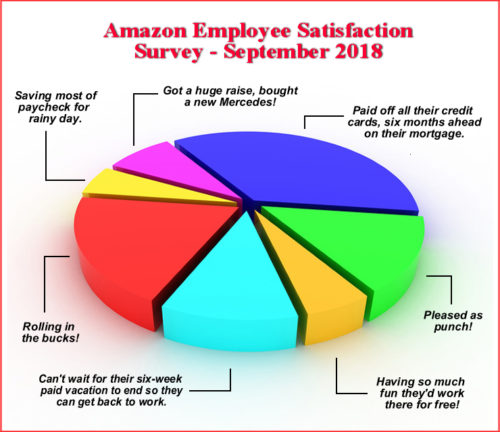
Obviously the above pie chart is a put-on. It is well-documented that working conditions for most employees of Amazon are  abysmaldehumanizing, bordering on abuse we normally associate with slavery.

Moreover, the median employee’s salary under Jeff Bezos’ imperial lordship is $28,446. No one working as a regular there has paid off their credit cards and is driving to work in a Mercedes. 

Jeff Bezos is referred to as The Richest Man in the World and his personal fortune, while growing by $191,000 each minute, is currently estimated at $168 billion.

So …

$28,446 vs. $168,000,000,000? While I can acknowledge the simple math, I find the contrast of such numbers on a gut level difficult to grasp.

To get a handle on such inequality, let’s try approaching it from different angles.

One way to put the disparity into perspective is to recognize it takes Bezos just under 9 seconds to earn what Amazon’s median worker does in an entire year.

Another is to recognize that for a worker to go through Jeff Bezos’ current personal fortune — and, of course, it continues mounting at accelerating levels as I write this — at his/her current median annual income of $28,446 per year, WOULD TAKE 5,905,927 YEARS! That’s close to 6 million years!

For Jeff Bezos himself to go through his current $168 billion, assuming his earnings stopped dead this very moment — which as you and I know they won’t — SPENDING $1,000,000 A DAY, would take NEARLY 460 years. Yes, even spending $1 million a day, in the year 2475 he’d still have plenty of cash, tens of million of dollars mad money. We can feel confident that he wouldn’t be foraging through the dumpster behind 7-11. 

Now, further consider that while the $28,446 median salary is above the national poverty line for a single individual if that person is the sole breadwinner for a family of four, it is marginally above it, which is why many Amazon employees must rely on government assistance to keep from starving.

As well as calculation, I did some speculation — a simple exercise in imagination.

Apparently Bezos’ wealth generating machine is raking it in so fast, he’s currently making $11.5 million per hour … every hour … 24 hours a day … seven days a week. $11,500,000 per hour! 

So here’s what I was picturing in my mind’s eye … 

If for 40 hours of the 168 hours in a week, Bezos were willing to scrape by on a mere $5,840,000 per hour, he could give every one of his 566,000 Amazon employees a $10 per hour raise. Of course, the remaining 128 hours in each week, Bezos could continue earning his normal $11.5 million per hour, not having to share any of it with the pathetic slobs who work for him.

Rhetorical question: Does Jeff Bezos have any concept of what that $10 per hour increase would mean to his employees? 

I’m not going to even suggest here I’m offering this for Bezos to entertain. There are so many advantages to him both as a putative member of the human race and the employer of over a half million workers — advantages that are so OBVIOUS — if they haven’t occurred to him up until now, then his brain functions in ways beyond my understanding. For one thing, he could point to his new fig leaf of “generosity” and ask people to stop calling him a selfish prick. Second, Amazon employees I’m sure would respond to his largesse with greater company loyalty and increased tolerance for his onerous working conditions. He’d still be the richest SOB on the block and could mock the pauperish Bill Gates and Warren Buffett as pitiable wannabees.

Consider …

The most poorly paid Amazon employee now makes $12 per hour. The $10 per hour raise I proposed would boost those $12 per hour workers right up there with Costco employees, who make an average of $21 per hour. And with the across-the-board $10 per hour increase, Bezos’ higher paid employees would be earning among the finest wages in the world provided by a major corporation. 

And by golly, there’s a plus side to the plus side …

Bezos’s bold and gracious gesture would result in a public relations coup of cosmic proportions! Amazon would no longer be demonized — well, not quite as much — by us bleeding-heart lefties as a capitalistic scourge and one-way ticket to Hell for the future of mankind, even if its environmental record is appalling and its business model generally the stuff of steroid-laced neo-feudalism.

Granted, Bezos would have to do some belt-tightening. He’d have to watch his pennies but could probably manage it, eh? Maybe he could skip a couple meals and do some of his own weeding at his estate. After all, after lavishing the $10 per hour raise on all of his employees, he’d only be pulling in $1,705,600,000 per week. I know I know! Like me you’re probably getting all teary-eyed for the poor guy.

Let me get to the extremely anti-climactic conclusion of this lament qua analysis.

Since nothing will change until the system itself changes, meaning the one in place now that creates, incentivizes, and lionizes the obscenely wealthy — reference current holder of the Office of President of the United States of America — I can only recommend this …

We have been labeling Jeff Bezos as ‘The Richest Man in the World’. Yet, quite honestly I don’t personally know any human, man or woman, who behaves like this gluttonous chunk of self-indulgent meat. It actually makes me nauseous to think we’re members of the same species.

Thus, from now on let’s use the correct terminology. Let’s call Jeff Bezos what he really is: the Richest Sociopath in the World.

We could probably order bumper stickers to help correct the record … from Amazon, of course.

What’s Wrong with the Economy: 9 Toxic Dynamics

By Charles Hugh Smith

Source: Of Two Minds

These nine dynamics are mutually reinforcing.

Beneath the surface signals of an eternally rising stock market and expanding GDP, we all sense something is deeply, systemically wrong with the U.S. economy. These nine structural dynamics generate secondary dynamics, all of which are toxic to social mobility, sustainable prosperity, accountability and democracy:

1. The financialization of the economy, which transformed services, credit, risk and labor into commodities that could be traded globally. Financialization generates enormously asymmetric returns: those with access to low-cost credit, global markets and expertise in finance collect the lion’s share of gains in income and wealth.

2. The technological transformation of the economy, which has placed a substantial scarcity premium on specific tech/managerial/communication skills and devalued ordinary labor and capital. As a result, the majority of gains in wealth and income flow to those with the scarce skills and forms of capital, leaving little for ordinary labor and capital.

3. The end of cheap fossil fuels. The fracking boom/bubble has obscured the long-term secular trend: the depletion of cheap-to-access and process oil. As many analysts have observed (Nate Hagens, Gail Tverberg, Richard Heinberg, Chris Martenson et al.), the global economy only grows if energy and credit are both cheap.

4. Globalization, which transformed the developing world into the environmental dumping ground of the wealthy nations and enabled the owners of capital to offshore waste and labor.

5. The destructive consequences of “growth at any cost” are piling up. “Growth” is the one constant of all existing political-economic systems, and none of the current Modes of Production (i.e. the structures that organize production, consumption, the economy and society) recognize that “growth” is not sustainable.

The first two dynamics drive three other dynamics that have hollowed out the productive economy:

6. The dominance of debt-funded speculation as the means of “getting ahead” as opposed to producing products and services of intrinsic value that serve the core needs of communities.

7. The economy’s gains in income and wealth are concentrated in the very top of the wealth-power pyramid: the top 5%–entrepreneurs, professionals and technocrats, etc., and within this class, most of the gains go to the top 1/10th of 1% –the existing owners of wealth, and financiers/speculators with access to cheap credit.

The net result is the bottom 95% have few opportunities to “get ahead” outside of gambling in the asset bubbles du jour: the stock and housing market. While the average middle class household may be able to borrow enough to speculate in the housing bubble, two factors limit the odds of success for ordinary investors/gamblers:

A. The gains in housing are concentrated in specific markets; outside these hot markets, gains are modest.

B. Asset bubbles eventually pop, leaving those still owning the assets with losses. The risks are thus intrinsic and high. The average investor/gambler lacks the experience needed to recognize the bubble has stopped expanding and exit the market before ll the other speculators rush for the narrowing exit.

8. The devaluation of ordinary labor and capital means the bottom 60% of the economy that lacks the requisite skills with a scarcity premium in the Emerging Economy have lost easy access to the ladder of social mobility.

9. The concentration of wealth and power in the hands of the self-serving few corrupts the economy and democracy. The U.S. economy is dominated by insider and elite rackets, skims, scams and cartels/quasi-monopolies, all of which corrupt the economy by creating perverse incentives for exploitation and gaming the system to benefit the few at the expense of the many.

This corruption in service of maximizing private/personal gains at the expense of the system itself also corrupts the mechanisms of governance, which are now little more than cloaking devices that protect insiders and elites from scrutiny and consequences.

The 20% above the bottom 60% may appear to have some access to social/economic mobility, but this is largely an artifact of the bubble economy since 2009. Once the bubble deflates, the illusion of social mobility for the “middle class” between the bottom 60% and the upper 20% vanishes.

The “upper middle class” between the bottom 80% and the top 5% is being squeezed by the over-production of elites, i.e. the over-abundance of those with college degrees and the relative scarcity of secure jobs within the top 5%. As a result, credential inflation is rampant, with Masters Degrees replacing Bachelors Degrees as the default for a white-collar job, and PhDs replacing Masters diplomas as the new default for positions that lack security and upward mobility.

In other words, the number of people who qualify for and desire a slot in the elite class (top 5%) far exceeds the number of slots available. As Peter Turchin has explained, this competition generates social disorder at the top of economic heap as the top 20% fight over the few positions open in the top 5%. The disgruntled, frustrated losers far outnumber the relatively few winners.

These nine dynamics are mutually reinforcing, meaning that each dynamic strengthens one or more of the others, reinforcing each other so the sum of the nine is far more powerful than a mere addition might suggest.

The New Aristocracy (the top 9.9%) (The Atlantic)


Why America is the World’s First Poor Rich Country

Or, How American Collapse is Made of a New Kind of Poverty

By Umair Haque

Source: Eudaimonia

Consider the following statistics. The average American can’t scrape together $500 for an emergency. A third of Americans can’t afford food, shelter, and healthcare. Healthcare for a family now costs $28k — about half of median income, which is $60k.

By themselves, of course, statistics say little. But together these facts speak volumes. The story they are beginning to tell is this.

America, it seems, is becoming something like the world’s first poor rich country. And that is the elephant in the room we aren’t quite grasping. After all, authoritarianism and extremism don’t arise in prosperous societies — but in troubled ones, which are growing impoverished, like America is today. What do I mean by all that?

Let’s begin with what I don’t mean. I don’t mean absolute poverty. Americans are not living on a few dollars a day, by and large, like people in, for example, Somalia or Bangladesh. America’s median income is still that of a rich country, around $50k, depending on how it’s counted. Nor do I really mean relative poverty — people living below median income. While that’s a growing problem in America, because the middle class is imploding, that is not really the true problem these numbers hint at, either.

America appears to be pioneering a new kind of poverty altogether. One for which we do not yet have a name. It is something like living at the knife’s edge, constantly being on the brink of ruin, one small step away from catastrophe and disaster, ever at the risk of falling through the cracks. It has two components — massive inflation for the basics of life, coupled with crushing, asymmetrical risk. I’ll come to what those mean shortly.

The average American has a relatively high income, that of a person in a nominally rich country. Only his income does not go very far. Most of it is eaten up by attempting to afford the basics of life. We’ve already seen how steep healthcare costs are. But then there is education. There is transport. There is interest and rent. There is media and communications. There is childcare and elderly care. All these things reduce the average American to constantly living right at the edge of ruin — one paycheck away from penury, one emergency away from losing it all.

But this isn’t true for America’s peers. In Europe, Canada, and even Australia, society invests in all these things — and the costs of basic necessities societies don’t provide are regulated. For example, I pay $50 dollars for broadband and TV in London — but $200 for the same thing in New York — yet in London, I get vastly more and better media for my money (even including, yes, American junk like Ancient Aliens). That’s regulation at work. And when basic goods like healthcare or elderly care or education are provided and managed at a social scale, that is when they are cheapest, and often of the best quality, too. Hence, healthcare costs far less in London, Paris, or Geneva — and life expectancy is longer, too.

So if you are earning $50k in America, it is a very different thing than earning $50k in France, Germany, or Sweden — in America, you must pay steeply for the basics of life, for basic necessities. Thus, incomes stretch much further in other countries, which enjoy a vastly higher quality of life, even though people there earn roughly the same amount, because they pay vastly less for basic necessities. Americans are rich, but only nominally — their money doesn’t buy nearly as much as their peers does, where it matters and counts most, for the basics of life.

What happens when societies don’t understand all the above? Well, a strange thing has happened to the American economy. While it’s true that things like TVs and Playstations have gotten cheaper, the costs of the basics of life have skyrocketed. All the things that really elevate people’s quality of life — healthcare, finance, education, transport, housing, and so on — have come to consume such a large share of the average household’s income that they have little left to save, invest, or spend on anything else. And what’s worse, while the basics of life have seen massive inflation, wages and incomes (not to mention savings and benefits and safety nets and opportunities) for most have stagnated. The result is an economy — and a society — that’s collapsing.

Yet all that is the straightforward effect of giving, for example, hedge funds control over drugs, or speculators control over housing, healthcare, and education — they will of course maximize profits, whereas investing in these things socially, or at least regulating them, minimizes real costs, and maximizes accessibility, affordability, and quality.

So the average American, who is left high and dry, must borrow, borrow, borrow, just to maintain a decent quality of life — because handing capitalism control of the basics of life has caused massive, skyrocketing inflation in necessities, while flatlining his income. Healthcare didn’t used to cost half of median income even a decade ago, after all — but now it does. So what happens when, in a decade or two, healthcare costs all of median income? How can an economy — let alone a society — function that way?

Well, what happens if the average American steps over the line? Misses a mortgage payment, gets ill and is unable to pay a few bills on time, can’t pay the costs of healthcare? Then they are punished severely and mercilessly. Their “credit rating” (note how banks and hedge funds don’t have them) is ruined. They can easily find themselves out on the street, without finance, without a second chance, without access to any kind of redress or support . And then they are rejected, shunned, and ostracized. They might not have an address anymore — so who will hire them? They are no longer a part of society — they have fallen through the cracks, and finding one’s way back is often next to impossible. Asymmetrical risk — corporations and lobbies and banks bear no risk at all, precisely because the average American bears them all now.

So Americans aren’t just absolutely or relatively poor, but poor in a new way entirely. First, the basics of life exploded in price, to the point that they are now unaffordable for many, maybe most, households. Second, Americans bear the risks of paying those unaffordable costs to an extreme degree, bearing the risks that institutions should, and so those risks are now ruinously high. A bank or hedge fund or corporation might go bankrupt, and liquidate its assets, and its owners stay rich — but if an American’s credit rating is ruined, loses his job, cannot pay his bills, or even if he declares bankruptcy, he falls through the cracks, hounded, embattled, institutionally black-marked. He finds himself outside society, with little way to get back in. Little wonder then that Americans work so much harder than anywhere else — they are always one step away from losing it all, from genuine ruin, but their peers in truly rich countries aren’t.

Marx probably would have called this immiseration. Neo-Marxist theorists call it precarity. And while there’s truth in both those ideas and perspectives, I think they miss three vital points.

We don’t see America as a poor country, but we should begin to. Americans live fairly abysmal lives — short, lonely, unhappy, full of work and stress and despair, compared to their peers. That is because they cannot afford better ones — predatory capitalism coupled with total economic mismanagement of social investments has made the basics of life ruinously unaffordable. In this way, it’s effectively a poor country — yes, there’s a tiny number of ultra-rich, but they are outliers now, off the map of the normal. Because it’s not just any kind of poverty, yesterday’s poverty, or even poverty as we are used to thinking about it.

America is pioneering a new kind of poverty. The kind of poverty that’s developed in America isn’t just bizarre and gruesome — it’s novel and unseen. It isn’t something that we understand well, economists, intellectuals, thinkers, because we have no good framework to think about it. It’s not absolute poverty like Somalia, and it’s not just relative poverty, like in gilded banana republics. It’s a uniquely American creation. It’s extreme capitalism meets Social Darwinism by way of rugged self-reliance crossed with puritanical cruelty.

The kind of poverty America’s pioneering today isn’t absolute, or even relative , but something more like perfectly tuned poverty, strategic poverty, basic poverty— nominally well-off people whose money doesn’t go far enough to make them actually live well, constantly living at the edge of ruin, and thus forced to choke down their bitter anger and serve the very systems which oppress and subjugate with more and more indignity and fear and servility by the year.

America’s still an innovator today. Unfortunately, what it’s innovating now is a new kind of poverty. Yet poverty is poverty. What happens in societies where poverty is growing? Authoritarianism rises, as people lose faith in democracy, which can’t seem to offer them working social contracts. Authoritarian soon enough becomes fascism — “this country, this land, its harvest — it is only for the true volk!”, the cry goes up, when there is not enough to go around. And the rest of the dark and grim story of the fall into the abyss you should know well enough by now. It ends in words we do not say.

Still, history, laughing, has told this tale to us many times. And it is telling it to tomorrow, again, in the tale of American collapse.

Big Pay Gaps Are Bad for Business

Would you do your best work for a CEO who pulls in 5,000 times your own salary?

By Sarah Anderson

Source: Other Words

Mattel is one of the largest toy-making companies on earth. Turns out it’s one of the biggest manufacturers of income inequality, too.

Last year, the Barbie doll manufacturer paid its CEO nearly 5,000 times as much as its median worker.

This stunning revelation is the result of a new regulation that requires U.S. publicly held corporations to report their CEO-worker pay ratios to the Securities and Exchange Commission.

Mattel’s gap is the widest reported so far. But most other big U.S. companies also have staggering divides. According to a new report by the staff of Minnesota Congressman Keith Ellison, the first 225 large corporations to release their numbers had pay ratios averaging 339 to 1.

“This immense inequality is a crisis for our economy and our democracy,” said Ellison, a longtime advocate of pay gap disclosure.

What’s good for these CEOs, however, is actually bad for business.

A CNBC analysis of the new pay ratio data, for example, suggests that companies with large pay disparities have lower profits per employee.

Why might that be? According to a recent study by a Harvard Business professor, companies tend to perform poorly if workers feel they’re not paid fairly. The study’s author said workers who feel that way are likely to lack motivation and even quit their jobs.

It’s not hard to understand how it could put a damper on your morale to be working hard and struggling to get by while your boss is being rewarded hundreds — or even thousands — of times more than you on payday.

Doug Smith, a former partner at the big McKinsey management consulting firm, argues that the economic costs of huge pay gaps go far beyond the problems of low employee morale and high turnover.

“Instead of building a real economy beneficial to all,” Smith says, “these unethical pay practices spread outsourcing, offshoring, tax avoidance, downsizing, and the substitution of good-paying permanent jobs with temporary, precarious employment.”

There’s a growing movement to use the new pay ratio data to encourage corporations to narrow their gaps. Portland, Oregon will soon become the first city to impose a tax penalty on companies with pay gaps above 100 to 1.

Charlie Hales, Portland’s mayor when the law was passed in late 2016, argued that it made good business sense to encourage narrower gaps.

In a former job at an employee-owned engineering firm, Hales had seen firsthand how a small pay ratio boosted the bottom line. “Everyone worked a little harder because your success was my success,” Hales said. “And that egalitarian culture led to a strong work ethic that drove the corporation to success.”

With the new pay ratio data now coming out, lawmakers in six states — California, Connecticut, Illinois, Massachusetts, Minnesota, and Rhode Island — are considering Portland-style pay ratio taxes.

Narrowing the divides within U.S. corporations may not automatically leave us all whistling away while we work. But we’ll all pay a price if we keep fiddling while extreme inequality burns down our economy.

A 2% Financial Wealth Tax Would Provide A $12,000 Annual Stipend To Every American Household

Careful analysis reveals a number of excellent arguments for the implementation of a Universal Basic Income.

By Paul Buchheit

Source: Nation of Change

It’s not hard to envision the benefits in work opportunities, stress reduction, child care, entrepreneurial activity, and artistic pursuits for American households with an extra $1,000 per month. It’s also very easy to justify a financial wealth tax, given that the dramatic stock market surge in recent years is largely due to an unprecedented degree of technological and financial productivity that derives from the work efforts and taxes of ALL Americans. A 2% annual tax on financial wealth is a small price to pay for the great fortunes bestowed on the most fortunate Americans.

The REASONS? Careful analysis reveals a number of excellent arguments for the implementation of a Universal Basic Income (UBI).

(1) Our Jobs are Disappearing

A 2013 Oxford study determined that nearly HALF of American jobs are at risk of being replaced by computers, AI, and robots. Society simply can’t keep up with technology. As for the skeptics who cite the Industrial Revolution and its job-enhancing aftermath (which actually took 60 years to develop), the McKinsey Global Institute says that society is being transformed at a pace “ten times faster and at 300 times the scale” of the radical changes of two hundred years ago.

(2) Half of America is Stressed Out or Sick

Half of Americans are in or near poverty, unable to meet emergency expenses, living from paycheck to paycheck, and getting physically and emotionally ill because of it. Numerous UBI experiments have led to increased well-being for their participants. A guaranteed income reduces the debilitating effects of inequality. As one recipient put it, “It takes me out of depression…I feel more sociable.”

(3) Children Need Our Help

This could be the best reason for monthly household stipends. Parents, especially mothers, are unable to work outside the home because of the all-important need to care for their children. Because we currently lack a UBI, more and more children are facing hunger and health problems and educational disadvantages.

(4) We Need More Entrepreneurs

A sudden influx of $12,000 per year for 126 million households will greatly stimulate the economy, potentially allowing millions of Americans to TAKE RISKS that could lead to new forms of innovation and productivity.

Perhaps most significantly, a guaranteed income could relieve some of the pressure on our newest generation of young adults, who are deep in debt, underemployed, increasingly unable to live on their own, and ill-positioned to take the entrepreneurial chances that are needed to spur innovative business growth. No other group of Americans could make more productive use of an immediate boost in income.

(5) We Need the Arts & Sciences

A recent Gallup poll found that nearly 70% of workers don’t feel ‘engaged’ (enthusiastic and committed) in their jobs. The work chosen by UBI recipients could unleash artistic talents and creative impulses that have been suppressed by personal financial concerns, leading, very possibly, to a repeat of the 1930s, when the Works Progress Administration hired thousands of artists and actors and musicians to help sustain the cultural needs of the nation.

Arguments against

The usual uninformed and condescending opposing argument is that UBI recipients will waste the money, spending it on alcohol and drugs and other ‘temptation’ goods. Not true. Studies from the World Bank and the Brooks World Poverty Institute found that money going to poor families is used primarily for essential needs, and that the recipients experience greater physical and mental well-being as a result of their increased incomes. Other arguments against the workability of the UBI are countered by the many successful experiments conducted in the present and recent past: FinlandCanada, Netherlands, Kenya, IndiaGreat Britain, Uganda, Namibia, and in the U.S. in Alaska and California.

How to pay for it

Largely because of the stock market, U.S. financial wealth has surged to $77 trillion, with the richest 10% owning over three-quarters of it. Just a 2 percent tax on total financial wealth would generate enough revenue to provide a $12,000 annual stipend to every American household (including those of the richest families).

It’s easy to justify a wealth tax. Over half of all basic research is paid for by our tax dollars. All the technology in our phones and computers started with government research and funding. Pharmaceutical companies wouldn’t exist without decades of support from the National Institutes of Health. Yet the tech and pharmaceutical companies claim patents on the products paid for and developed by the American people.

The collection of a wealth tax would not be simple, since only about half of U.S. financial wealth is held directly in equities and liquid assets (Table 5-2). But it’s doable. As Thomas Piketty notes, “A progressive tax on net wealth is better than a progressive tax on consumption because first, net wealth is better defined for very wealthy individuals..”

And certainly a financial industry that knows how to package worthless loans into A-rated mortgage-backed securities should be able to figure out how to tax the investment companies that manage the rest of our ever-increasing national wealth.


“If poor people knew how rich rich people are, there would be riots in the streets”

By Staff, Anticap.wordpress.com

Source: Popular Resistance

Chris Rock may be right. Still, Americans are well aware that economic inequality in their country is obscene, even though they often underestimate the growing gap between the poor and the rich.

But it’s Frank Rich, who conducted the interview with the American comedian, who made the more perceptive observation:

For all the current conversation about income inequality, class is still sort of the elephant in the room.

All the experts agree—from Thomas Piketty and the other members of the World Inequality Lab team to John C. Weicher of the conservative Hudson Institute—that inequality in the United States, especially the unequal distribution of wealth, has been worsening for decades now. Both before and after the crash of 2007-08. And there’s no sign that things are going to get better anytime soon, unless radical changes are made.

But, as it turns out, even the experts underestimate the degree of inequality in the United States. The usual numbers that are produced and disseminated indicate that, in 2014 (the last year for which data are available), the top 1 percent of Americans owned one third (35 percent) of total household wealth while the bottom 90 percent had less than half (45.3 percent) of the wealth.

According to my calculations, illustrated in the chart at the top of the post, the situation in the United States is much worse. In 2014, the top 1 percent (red line) owned almost two thirds of the financial or business wealth, while the bottom 90 percent (blue line) had only six percent. That represents an enormous change from the already-unequal situation in 1978, when the shares were much closer (28.6 percent for the top 1 percent and 23.2 percent for the bottom 90 percent).

Why the large difference between my numbers and theirs? It all depends on how wealth is defined. Both the World Inequality Lab and the Federal Reserve (in the Survey of Consumer Finances) include housing and retirement pensions in household wealth—and those two categories comprise most of the so-called wealth of most Americans. They just don’t own much in the way of financial or business wealth. They live in their houses and they retire based on contributions from their wages and salaries over the course of their work lives. They produce but don’t take home any of the surplus; therefore, they just don’t have the ability to amass any real wealth.

For the small group at the top, things are quite different. They do get a cut of the surplus, which they use, not only to purchase housing and put aside in their pensions, but to accumulate real wealth, for themselves and their families. If we take out housing and pensions and calculate just the shares of financial or business wealth—and, thus, equities, fixed-income claims, and business assets—the degree of inequality is much, much worse.

Yes, rich people in the United States are very rich—even more than either regular Americans or the experts believe.

But that’s not the real elephant in the room. The big issue that everyone is aware of, but nobody wants to talk about, is class. And that’s the reason there should be, if not riots, at least a sustained political movement to transform the existing economic and social structures in the United States.

Time To Make Life Hard For The Rich

By Hamilton Nolan

Source: Splinter

It is time for polite, respectable, rational people to start saying what has become painfully obvious: It is time to stop respecting the rich, and start stealing from them. In earnest.

Inequality is eating America alive. It has been growing for decades. To say that “the American dream is dead” is no longer a poetic exaggeration—it is an accurate description of 40 years of wage stagnation and declining economic mobility that has produced a generation that cannot expect to live better than their parents did. Not because of devastating war or plague, but because of a very specific set of rules governing a very specific economic system that encourages the accumulation of great wealth among a tiny portion of the population, to the detriment of the vast majority of people. Our political and business leaders have chosen to embrace a system that favors capital over labor. A system in which the more you already have, the more you make, and the less you have, the harder it is to build wealth. It is a system designed to increase inequality. It is functioning exactly as designed. And now, it is about to get worse.

How long are people supposed to tolerate being smacked in the face? By the rich? Who already have more than enough? It is not as though the fact that inequality is a crisis is a fact that snuck up on anyone. Economists have seen the trend for decades, and the general public has been well aware of it since at least the financial crisis. Obama called it “the defining challenge of our time.” Thomas Piketty became a rock star by writing a very dry book about it. It’s not an underground thing. It is well known and well understood by the people in control of the institutions with the power to change it. The response to this dire situation by the Republican Party, which a wholly owned subsidiary of the American capital-holding class, has been to pass a tax bill that will horribly exacerbate economic inequality in this country. It is a considered decision to make a bad situation worse. It is a deliberate choice—during a time when the rich already have too much—to take from the poor in order to give the rich (including members of Congress and the President) more. That is not a metaphor. That is the reality. That is what the Republican party is about to accomplish on behalf of the donor class, calling it “middle class tax relief” in the face of mathematical proof to the contrary. Even to my cynical ass, the sheer fuck you-ness of this action towards the majority of the country is breathtaking. This is not just a failure to solve a severe problem; it is the expenditure of vast amounts of political capital to make the severe problem worse so that a tiny handful of people will get wealthier than anyone needs to be.

Ideally, in a democracy, elected leaders reflecting the interests of the people would pass taxes and regulations to reverse the growing inequality here. For that to happen, we would need to end gerrymandering and reform campaign finance and probably abolish the Senate and the Electoral College, and that’s just for starters. It is not imminent, in other words. Our broken political system, which is designed to reward money with political power, is actually moving in the opposite direction of a solution. Who is suffering because of this? Most Americans. Certainly the bottom 50% are acutely suffering—money that would have been in their paychecks has been instead funneled upwards into the pockets of the rich. Every desperate family that has found themselves coming up short for rent or food or medicine, every American who has downgraded her dreams and aspirations because they became financially implausible, has been directly harmed by the political and economic class war perpetuated by the rich, even if they cannot see the perpetrators with their own eyes. I think that people have been more than patient in the face of this slow-moving crisis. In 2009, when the markets crashed and millions were laid off, nobody rioted and kidnapped the financiers and burned their homes. The outcome of that lack of direct action is the situation we find ourselves in today.

Violence against people is morally wrong and a bad way to solve problems. But capital is different. One thing that would help to create the political environment conducive to solving the inequality problem would be to make the cost of accumulating all that capital too high to be worth it. In other words, to create a downside to being too rich. I have personally stood in a room full of hedge fund titans and billionaire investors warning one another explicitly that inequality must be addressed lest the U.S. become a place like Latin America, where rich people are forced to live behind walls, surrounded by armed guards, because of the very real risks from the rage of the poor. Rich people in this country do not want to live like that. If they see that they must stop being so greedy in order to enjoy their own freedom, they will stop being so greedy. Those conditions have to be created by people who want justice.

Our situation is absurd. Not since the Gilded Age has it been more clear that a few people have too much. Furthermore, the people with too much are investing in political clout to give themselves more. It’s just wrong. If the government won’t help, we have to help ourselves. Sticking up a billionaire on the street for $100 is not going to do it. But one can imagine other ways that angry Americans might express their dissatisfaction with our current division of wealth: A large-scale online attack against the holdings of the very rich; yachts sunk in harbors; unoccupied vacation homes in the Hamptons mysteriously burned to the ground. Sotheby’s auctions swarmed by vandals, Art Basel attacked by spraypaint-wielding mobs, protests on the doorsteps of right-wing think tanks, venomous words directed at millionaires as they dine in fancy restaurants. People have a right to life and safety, but property does not. A life spent screwing the little people so that you can acquire lots of stuff loses its allure when you know that all that stuff will be smashed to pieces by angry little people. It is not hard to put together a list of those who should be targeted—Forbes publishes it every year. Likewise, public campaign finance records give us a pretty good idea of exactly who is funding the politicians who are perpetuating this economic war on behalf of the rich.

It is nice to imagine a grand, well-targeted computer hack that would neatly transfer billions of dollars out of the accounts of, say, the Walton family and into a charity account that would disburse the money to the poor in untraceable ways. That seems far-fetched. Realistically, what people can do now is to start thinking about ways to make it uncomfortable to be too rich. Socially uncomfortable and otherwise. When the accumulation of great wealth ceases to be a praiseworthy endeavor and instead becomes viewed as a sick, greedy pastime whose only reward is the hatred of your fellow citizens and the inability to live comfortably without fear of your excessive property being destroyed, rich people will rethink their goals. Until then, inequality will keep rising, and everything, for most people, will continue to slowly, slowly get worse.